
A workplace skin check has two parts: a short symptom questionnaire and a visual inspection of exposed skin — typically the hands, forearms, face, and lower legs where they can be contaminated. A trained responsible person compares each area against the worker's baseline record, then logs the result and refers any new or worsening signs to occupational health.
Not medical advice. Content covering recognition of skin signs, exposure, and health surveillance here is for HSE practitioner reference. It is not medical advice. Workers with specific symptoms or exposure concerns should consult an occupational physician or qualified medical professional.
Not legal advice. Regulatory content reflects general HSE professional understanding of UK, US, and EU requirements as of 2026. It is not legal advice. Specific compliance or enforcement questions should be directed to qualified legal counsel in the applicable jurisdiction. Regulatory content last reviewed: [Month YYYY].
A belief I see embedded in too many surveillance programmes is that a clean run of skin checks means the controls are working. It doesn't. The HSE is explicit that health surveillance never replaces the duty to control exposure — a check confirms a control failed quietly enough to leave the skin intact this time, not that the system is sound. Treating a clear inspection as proof of safety is how a slow-burning irritant problem reaches the point of a confirmed case before anyone reacts.
Occupational contact dermatitis remains the dominant work-related skin disease, accounting for an estimated 90–95% of occupational skin disease cases in the US (CDC/NIOSH, updated 2026). The point of skin checks for occupational dermatitis is early interception: spotting reversible damage before it becomes sensitisation that can end a career. This guide walks the full procedure as one connected chain — baseline, frequency, the physical inspection, the outcome decision, recording, and statutory reporting — because the official guidance is scattered across a dozen pages and rarely assembled into something you can actually run.
What Are Skin Checks for Occupational Dermatitis?
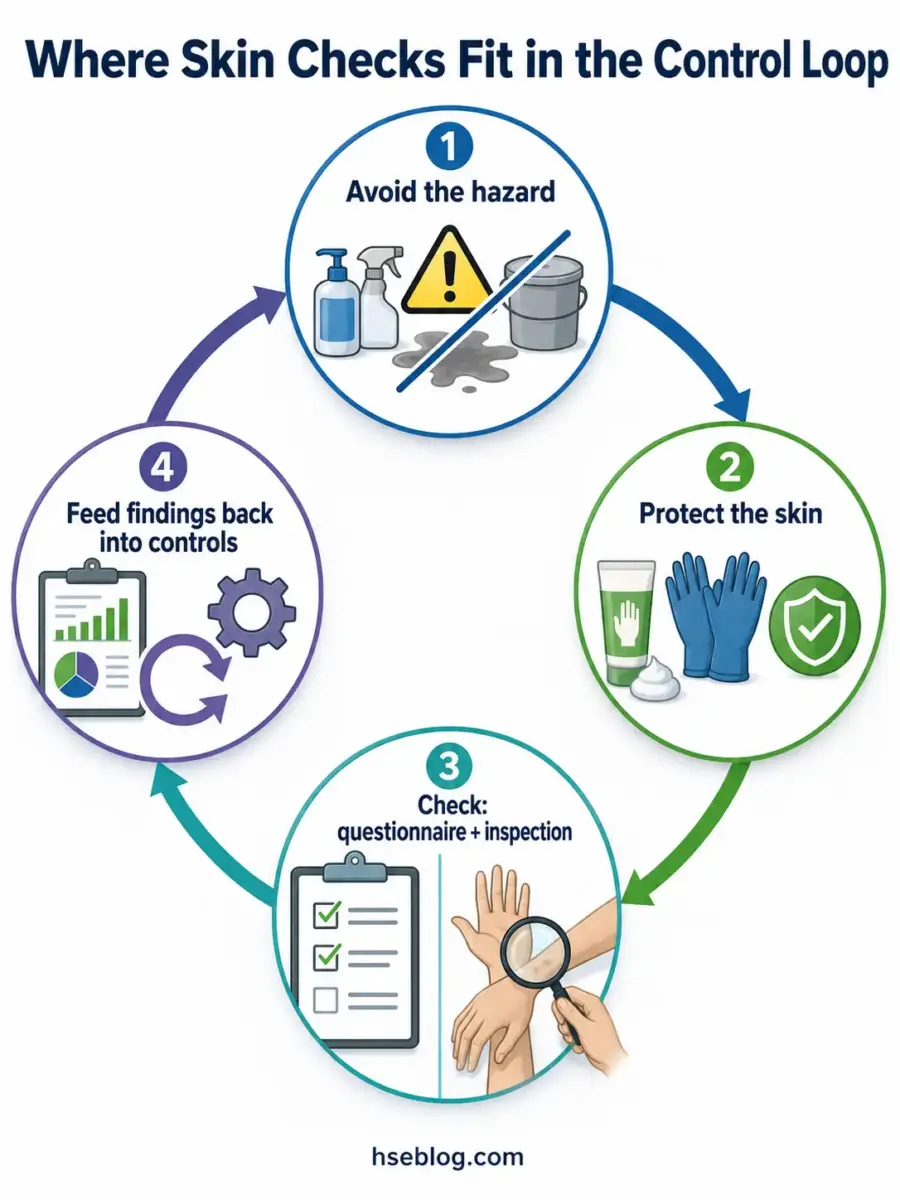
A skin check is a screening activity, not a diagnosis — it is the "Check" element of the HSE's Avoid-Protect-Check (APC) approach and a core part of skin health surveillance under COSHH.
Two instruments do the work, and they are designed to be used together:
- The symptom questionnaire — what the worker has noticed since the last check: itch, dryness, tightness, anything that flared at work and eased away from it.
- The visual skin inspection — a structured look at exposed skin against the worker's own baseline record.
The job of a check is narrow and important. It catches early, reversible signs so a worker can be removed from exposure before damage becomes permanent — it does not name the disease or identify a culprit allergen.
Two conditions sit behind almost everything you screen for:
- Irritant contact dermatitis — non-immune and dose-related. Repeated low-level insult (detergents, solvents, wet work) wears down the skin barrier over time.
- Allergic contact dermatitis — immune-mediated and effectively lifelong once a person is sensitised. After sensitisation, even tiny re-exposures can trigger a reaction.
Definition: A skin check screens for the early signs of work-related contact dermatitis. It is a monitoring tool, not a clinical assessment, and its findings should always loop back into how exposure is controlled.
The failure mode worth naming up front: organisations that run checks as a standalone box-tick, disconnected from the controls. A programme that detects cases but feeds nothing back into substitution, glove selection, or task redesign is surveillance theatre — it documents harm without preventing the next instance.
When Are Skin Checks Legally Required?
Under COSHH 2002, Regulation 11, health surveillance becomes a duty where exposure to a substance hazardous to health is linked to an identifiable disease and there are valid techniques to detect it — and for the skin, that means inspections, questionnaires, and record-keeping. Checks are risk-driven, not universal: you provide them where the assessment shows a real skin hazard, not as a blanket exercise.
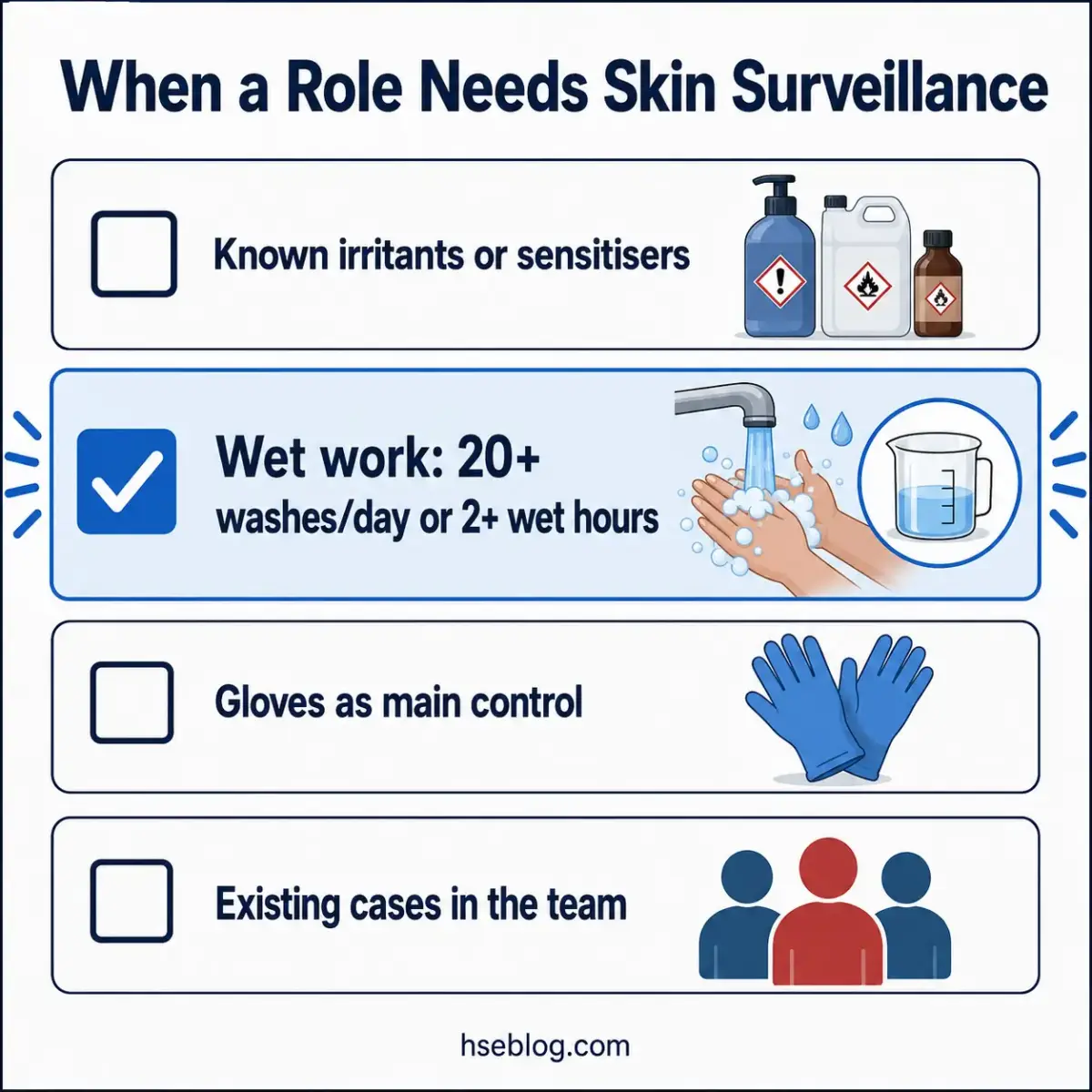
The practical triggers that should put a role into surveillance:
- Known sensitisers or irritants in the task — products carrying a skin-sensitiser or irritant warning (EU CLP H317 sensitiser, H315 irritant).
- Wet work — the HSE rule of thumb is roughly more than 20 hand washes per day, or wet hands for more than 2 hours per shift (HSE, current guidance).
- Existing cases in the workforce — one confirmed case usually means others are developing unnoticed.
- Reliance on gloves as the main control — glove occlusion is itself a risk, and glove failure is common.
The HSE splits surveillance into higher-level and lower-level tiers, and getting a role into the right tier is the practical compliance decision:
| Variable | Higher-level surveillance | Lower-level surveillance |
|---|---|---|
| Trigger | Clear skin hazard + significant or regular exposure | Occasional or well-controlled exposure |
| Visual inspection | Brief inspection, often monthly | May not be needed routinely |
| Questionnaire | Periodic (e.g. annually) | Annual, by trained responsible person |
| Who runs it | Trained responsible person, scheme set by OH | Trained responsible person |
The US sits differently. There is no prescriptive skin-check cadence under OSHA — the obligation runs through the general duty to provide a safe workplace, hazard communication under 29 CFR 1910.1200, and recordability of work-related skin disorders on the OSHA 300 log.
A recurring under-scoping error worth flagging: employers assess one hazard per role and miss cumulative exposure. Healthcare staff are the classic case — frequent handwashing, glove occlusion, and chemical disinfectants stacking on the same hands at once, where assessing any single factor understates the real risk. The HSE's own figure here is sobering: around 1,000 nurses each year develop work-related contact dermatitis (HSE, current guidance).
Who Can Carry Out Skin Checks?
Three roles get blurred together in most guidance, and the confusion causes real compliance gaps. The short answer: a trained responsible person runs the routine checks, a competent person sets up and oversees the scheme, and an occupational health professional handles anything clinical.
COSHH 2002, Regulation 12 is the legal hook — anyone carrying out health surveillance must have adequate knowledge, and where the task is delegated, the delegate must be competent. That is the basis on which a supervisor or safety rep can be trained as a responsible person.
| Role | Who it is | What they can do | What they must not do |
|---|---|---|---|
| Responsible person | Supervisor, first-aider, or safety rep, trained and coached by OH | Run questionnaires and visual inspections; record results; escalate findings | Diagnose; interpret borderline results unaided; run patch testing |
| Competent person / scheme owner | HSE or SHEQ professional | Design the scheme, set frequency, train the responsible person | Provide individual clinical interpretation |
| Occupational health professional | OH nurse or physician | Set the scheme, interpret individual and group results, manage referrals | — |
The selection of the responsible person is more than an administrative choice. A responsible person who is also the worker's line manager creates a reporting-suppression risk — workers who fear consequences for "slowing the line" will under-report symptoms, and the early-detection value of the whole programme collapses.
The judgment call here is between convenience and candour. Pairing the role with someone trusted and non-punitive — a respected safety rep rather than the manager who signs timesheets — materially changes early-reporting rates, which is the entire point of running checks at all.
How Often Should Skin Checks Be Carried Out?
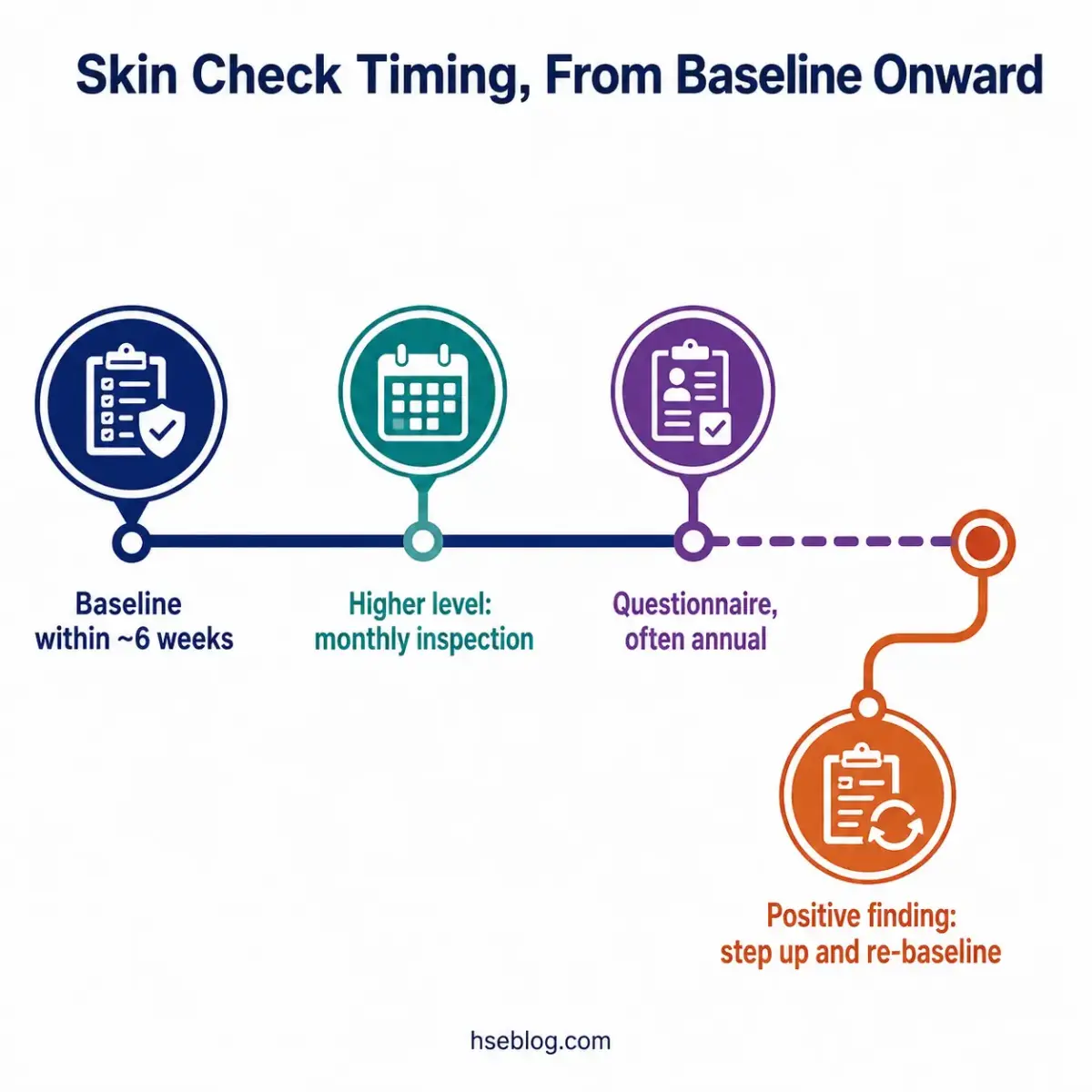
Start with the baseline: an assessment before exposure begins, or as soon as practicable after a worker starts — the HSE's example window is within about six weeks. Everything after that is read against this baseline, so a check done without one is reading skin against guesswork.
Frequency is calibrated to risk, not fixed in stone. The HSE guidance on health surveillance for occupational dermatitis (G403) sets out the questionnaire-plus-inspection method and the tiered cadence:
- Baseline — before exposure or within ~6 weeks of starting; records the individual's starting skin condition.
- Higher-level routine — brief visual inspection, often monthly, plus a questionnaire at a longer interval (e.g. annually).
- Lower-level routine — annual questionnaire by a trained responsible person; routine visual inspection may not be needed.
- Stepped-up — frequency increases after any positive finding or process change, with affected groups re-baselined.
The cadence is set in consultation with an OH professional, and it is meant to move. A positive finding is a signal to inspect that group more often, not to carry on at the original interval.
The anti-pattern I see most is "set-and-forget." Teams lock in a monthly cadence at launch and never revise it — even after a confirmed case or a change of product — when the correct response is to step frequency up and re-baseline the exposed group. A static schedule treats surveillance as a calendar event rather than a risk instrument.
How Do You Carry Out a Skin Check? Step-by-Step Procedure
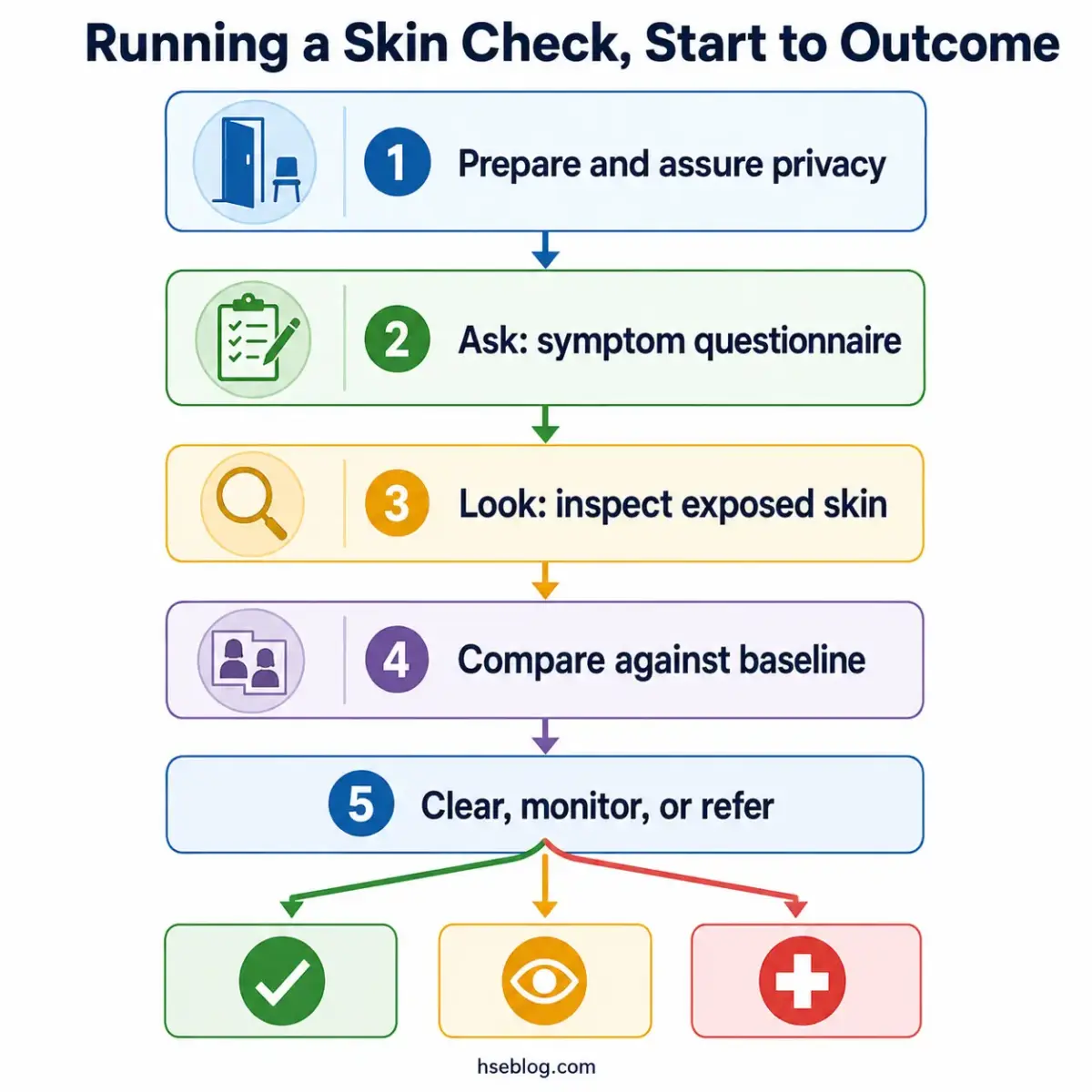
On the ground, a good check runs the same way every time: prepare, ask, look, decide, record. The discipline of the sequence is what makes findings comparable across months and across a team.
Competent-person caveat: This procedure is general HSE knowledge for screening. Setting up the scheme, training the responsible person, and interpreting clinical findings must be led by a competent person and an occupational health professional with relevant training and site-specific risk assessment. The steps below do not replace that.
The procedure:
- Prepare the setting. Private space, good lighting, the worker's baseline record to hand, and explicit confidentiality assured before anything starts.
- Run the questionnaire first. Ask about symptoms since the last check — itch, dryness, soreness, anything that flares at work. Verbal signals often arrive before visible ones.
- Carry out the visual inspection. Inspect the exposed skin in a consistent order: hands (including between the fingers and around the wrists), forearms, face, and the lower legs if they can be contaminated.
- Compare to baseline. Read each area against that individual's starting record, not a generic "normal" — small changes are only visible against a known starting point.
- Make the outcome decision and record it (decision tree below).
The outcome decision:
- No signs, no symptoms → continue exposure with existing controls; record as clear.
- Managed minor signs → monitor, advise on skin care and decontamination, and consider increasing check frequency.
- New, worsening, or persistent signs or symptoms → refer to occupational health; do not attempt to diagnose.
The highest-yield moment is the cross-check between questionnaire and inspection. Workers frequently under-report verbally but show signs on the skin, or report itch before anything is visible — relying on either signal alone systematically misses early cases, which is exactly what the two-instrument method exists to prevent.
What to Look For: Recognising Early Signs
Recognition is not diagnosis — the responsible person is trained to spot change, not to name the condition. The early signs build in a fairly predictable order:
- Early: dryness, itching, redness, scaling, fine cracking.
- Later: blistering, weeping, fissuring, pain.
- Distribution clue: irritant patterns tend to map onto the contact zone; allergic patterns may spread beyond where the substance actually touched.
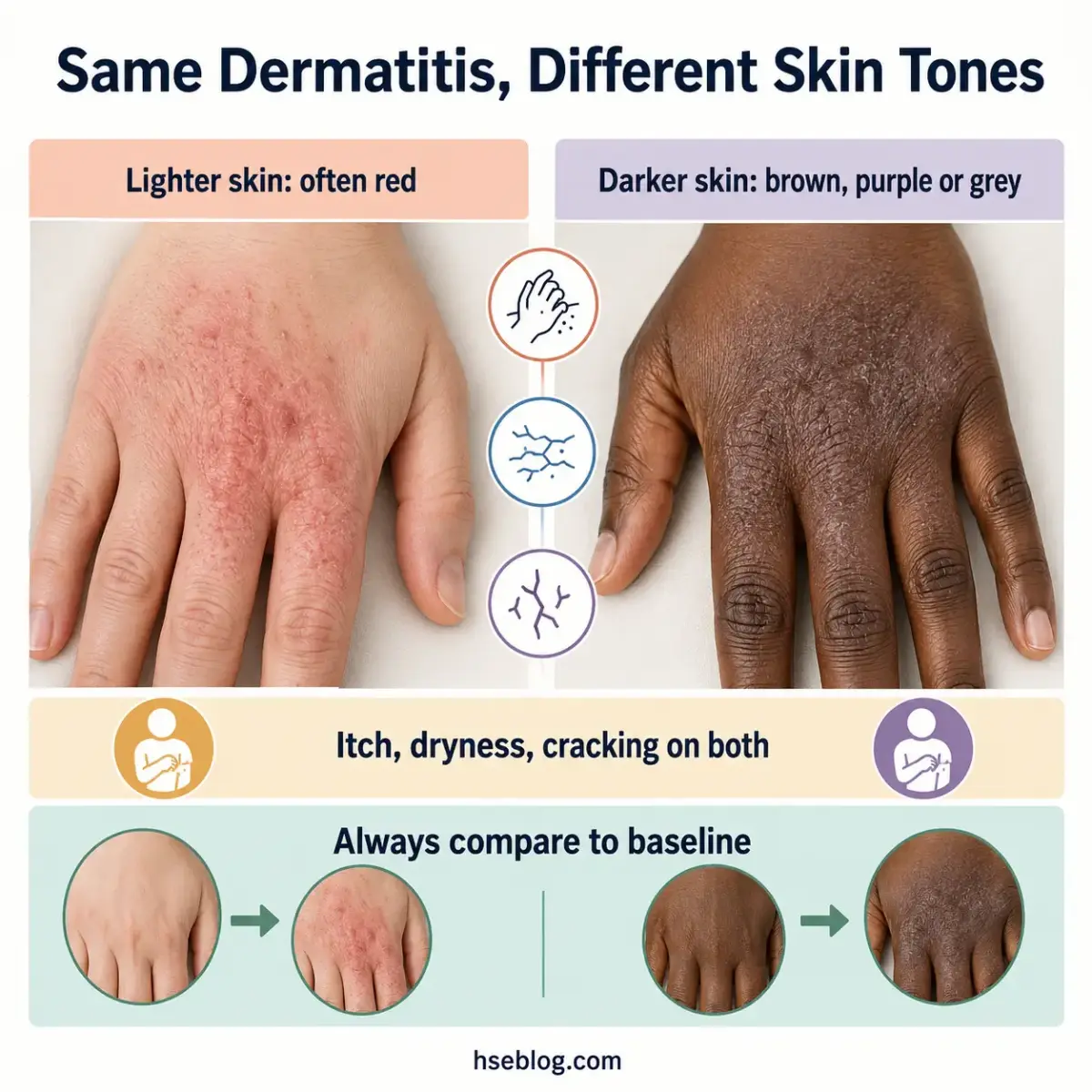
There is a detection blind spot that mainstream guidance has historically built in, and it matters. Standard training images over-rely on redness, which under-detects dermatitis on darker skin — on brown and Black skin, the same inflammation can appear dark brown, purple, or grey rather than red.
The defence against this is built into the method already: compare against the individual's baseline and lead with symptoms. A worker reporting persistent itch and tightness is reporting dermatitis regardless of what colour the skin reads as, and baseline comparison catches subtle change that a generic "look for redness" rule will miss. EU-OSHA's work-related skin disease image library (2023–2025 campaign cycle) is a useful training resource for showing presentation across skin tones.
Recording and Acting on Skin Check Findings
A single check is nearly meaningless in isolation — the record earns its value longitudinally, because it is the pattern across checks and across a team that reveals a failing control. One clear inspection tells you almost nothing; six months of creeping dryness across a shift tells you a great deal.
Two distinct records run in parallel, and confusing them is a common compliance failure:
| Record | What it contains | Who can see it |
|---|---|---|
| Health record | Worker identity, job, exposure summary, surveillance dates and outcomes | Employer may hold and inspect |
| Clinical notes | Detailed symptoms, examination findings, clinical opinion | Held in medical confidence by OH |
Managers receive only the outcome that affects work — a fitness or adjustment statement — never the clinical detail behind it. This separation is what lets workers report honestly without exposing private health information to their line.
Acting on findings is where surveillance either earns its keep or becomes theatre:
- Refer new or worsening signs, symptoms persisting despite controls, or any suspected allergic dermatitis to occupational health.
- Analyse at group level — a cluster in one team points at a control problem, not a coincidence of unlucky individuals.
- Feed it back into glove selection, substitution, or task redesign, so the check actually changes the exposure that caused it.
Reporting Confirmed Cases: RIDDOR and OSHA Recordkeeping
Get this wrong and you either over-report on suspicion or never escalate at all — both happen, and both are common. The clean line: a positive skin check is not a reportable event. The trigger is a clinical diagnosis, not a responsible person's concern.
Under UK RIDDOR 2013, Regulation 8, a clinician-diagnosed case of occupational dermatitis is reportable where the person's work involves significant or regular exposure to a known skin sensitiser or irritant. The diagnosis is the threshold — a suspicious inspection that prompts a referral does not, by itself, create a reporting duty.
| Aspect | UK (RIDDOR 2013, Reg 8) | US (29 CFR 1904) |
|---|---|---|
| Trigger | Doctor-diagnosed occupational dermatitis + qualifying exposure | Work-related skin disorder meeting recording criteria |
| What is filed | Report to the enforcing authority | Entry on the OSHA 300 log |
| On a positive check alone? | Not reportable | Not recordable |
| Who files | Responsible employer (the "responsible person" under RIDDOR) | Employer maintaining the 300 log |
The figures show why confirmed cases matter as a signal: around 876 new cases of work-related contact dermatitis were diagnosed by dermatologists in 2019 in Great Britain (HSE/THOR-EPIDERM, 2019), part of 4,698 cases reported to the EPIDERM scheme between 2010 and 2019 (University of Manchester/THOR). The HSE statistics page, updated June 2025, continues to reaffirm dermatitis as the dominant work-related skin disease and these surveillance schemes as the core data sources.
The timing confusion to guard against runs both ways. Some responsible persons report on a suspicious check (too early, before any diagnosis exists), while others never escalate because the referral never gets formally confirmed by a clinician (too late, so a genuine case is never reported at all).
Skin Check Requirements Across Jurisdictions (UK, US, EU)
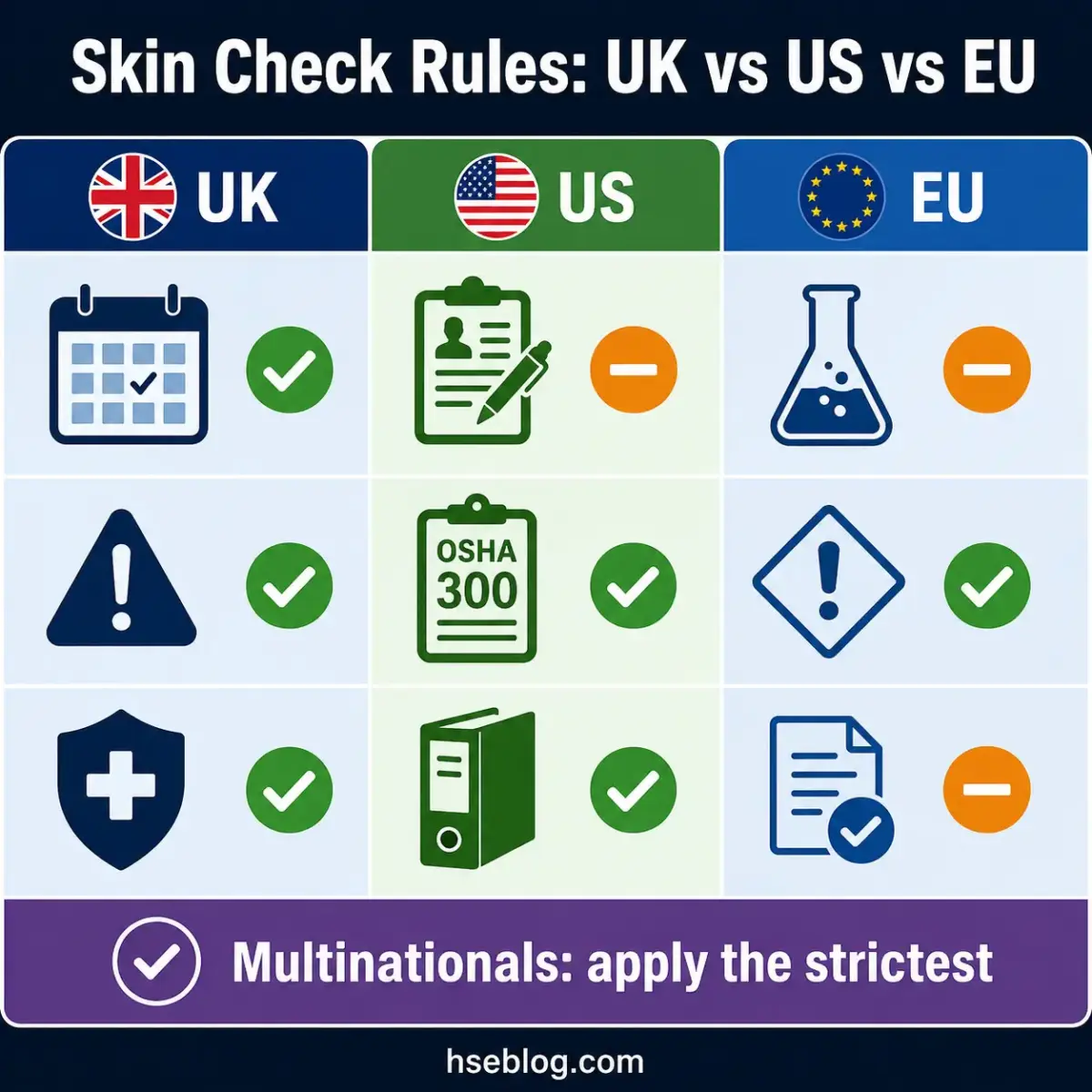
The obligation looks markedly different by region, and for multinational employers that divergence is the whole problem. The UK prescribes a structured visual-check model; the US prescribes no check cadence at all but records confirmed disorders; the EU drives the upstream risk assessment through classification.
| Element | UK (HSE) | US (OSHA/NIOSH) | EU (CLP) |
|---|---|---|---|
| Skin-check cadence | Prescribed: responsible person, tiered visual inspection + questionnaire | None prescribed | None prescribed |
| Hazard signalling | COSHH risk assessment | NIOSH skin notations (SK, SK-DIR, SK-SYS, SK-SEN); HazCom skin notations | H315 (irritant), H317 (sensitiser) |
| Confirmed-case duty | RIDDOR report on diagnosis | OSHA 300 log recordability | National implementation varies |
NIOSH's skin notation strategy (Current Intelligence Bulletin 61, 2009; profiles ongoing, index updated December 2024) is the closest US equivalent to a prescriptive trigger — it flags substances as direct, systemic, or sensitising dermal hazards so employers can select controls, even without a mandated check schedule. The NIOSH recommendations for preventing occupational skin disease are the practical US-side companion to the UK's HSE guidance.
The interpretation that matters for practice: a UK-style structured visual-inspection-plus-questionnaire programme is defensible best practice everywhere, even where local law does not mandate it. Recordkeeping and liability exposure are global even where the check cadence is not — so building to the stricter, more protective UK model across all sites is the operationally sound choice for any multinational.
Frequently Asked Questions
Can workers do their own skin checks between formal inspections?
Yes, and self-checking is actively encouraged under the APC approach — workers see their own hands every day. But self-checks supplement the formal programme, they don't replace it. A worker may normalise gradual change or under-report to avoid hassle, which is precisely why the responsible person's structured inspection and the questionnaire still run on schedule alongside any self-checking.
What is the difference between a skin check and patch testing?
They are different stages entirely. A skin check is workplace screening for early signs, run by a trained responsible person. Patch testing is a diagnostic procedure carried out only by a dermatologist to identify the specific allergen behind allergic contact dermatitis. A check might prompt the referral that eventually leads to patch testing, but it can never substitute for it.
How are skin checks adapted for workers with darker skin tones?
Redness-based criteria under-detect dermatitis on darker skin, where inflammation can appear brown, purple, or grey instead of red. The reliable adaptation is built into good practice: compare against the worker's own baseline rather than a generic appearance, and lead with reported symptoms such as itch, tightness, and dryness, which signal dermatitis regardless of skin tone.
Are agency, temporary, and contract workers covered by skin checks?
Generally yes — the duty follows the work activity and the exposure, not the employment contract. If a temporary worker does wet work or handles a sensitiser, the surveillance obligation applies. The real-world gap is coordination: short-tenure workers often miss baseline assessment, so whoever controls the worksite should confirm baseline timing rather than assume the agency handled it. This is jurisdiction-specific and not legal advice.
Do skin checks replace the need to control exposure?
No. The HSE is explicit on this point: health surveillance never reduces the legal duty to control exposure and provide decontamination. Checks detect failure after it has begun — they do not prevent it. A programme that leans on checking while neglecting substitution, glove selection, and task redesign has inverted the entire logic of the APC approach.
Is occupational dermatitis reportable to the authorities?
Only once it is clinically diagnosed. In the UK that means a RIDDOR report under Regulation 8 where the work involves significant or regular exposure to a known sensitiser or irritant; in the US it means an entry on the OSHA 300 log under 29 CFR 1904. A suspicious skin check alone is never a reportable event — diagnosis by a clinician is the trigger.
Conclusion
Run as a connected chain, the skin check programme comes down to a handful of decisions that hold under audit and, more importantly, catch disease while it is still reversible. Establish a baseline before exposure or within about six weeks. Choose the surveillance tier from the actual risk, not the job title. Run the questionnaire and the inspection together, every time, against the worker's own baseline.
Three judgment calls decide whether the programme works or just generates paper. Put the responsible person where workers will report honestly, not where they fear consequences. Step frequency up after any confirmed case rather than holding the launch cadence on autopilot. And read every finding as a question about the controls — because the value of skin checks for occupational dermatitis is not the inspection itself but what you change because of it.
The one failure that undoes everything is the easiest to commit: treating a clean check as proof the controls are sound. The skin is the last line, not the first — when it shows the first sign, the system upstream has already failed once, and the only acceptable response is to fix the exposure, not just to file the result.