What Are the Main Hazards in Glass Manufacturing?
Glass manufacturing exposes workers to three hazard families: thermal hazards (burns from molten glass and furnaces, plus heat stress and heat stroke), mechanical hazards (cuts and lacerations from sharp edges and breakage), and respiratory hazards (respirable crystalline silica dust, which causes incurable silicosis). Each demands its own engineering controls before personal protective equipment.
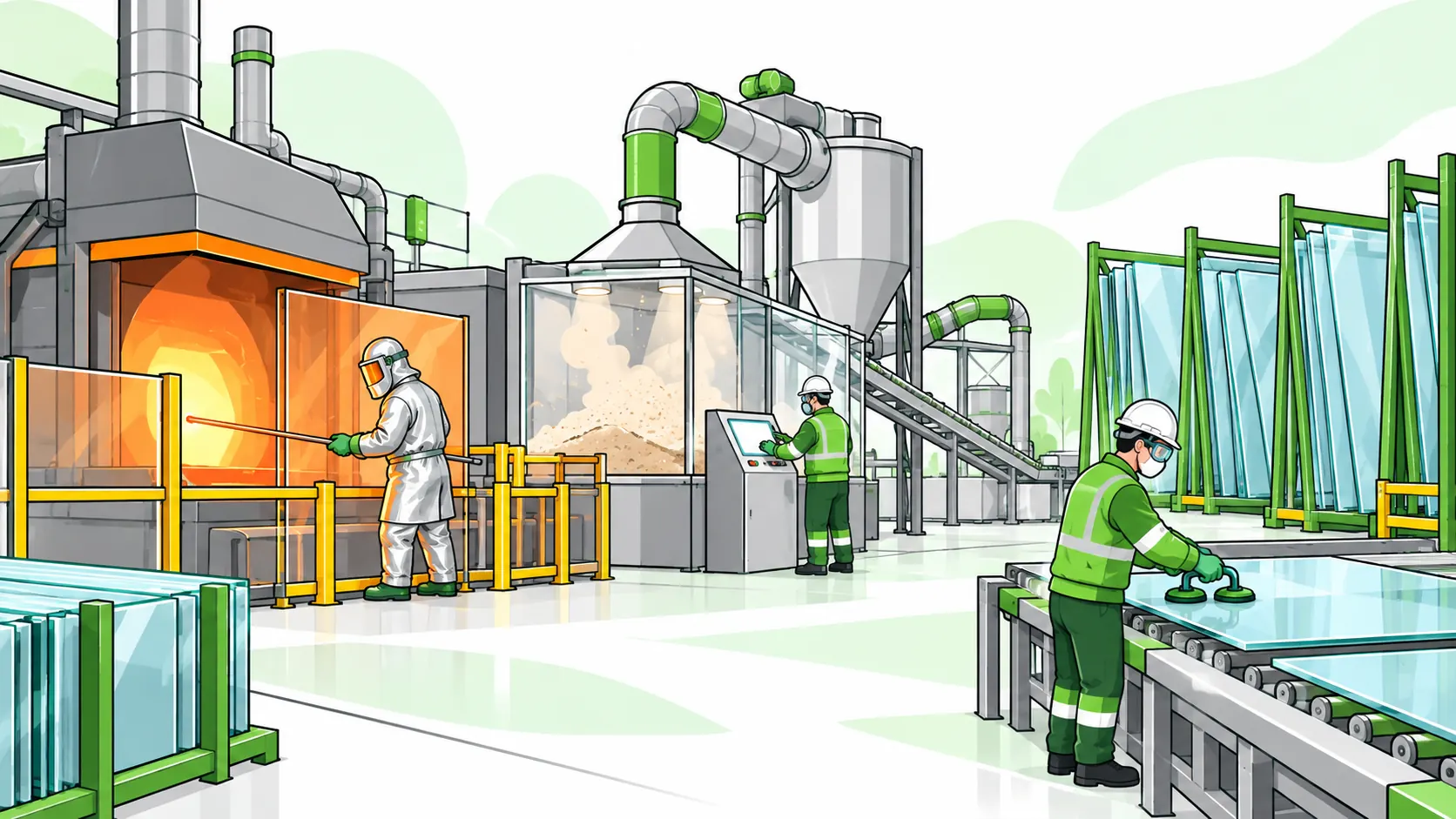
Few production environments stack three unrelated injury mechanisms onto a single line the way a glass plant does. A worker walking the forming floor can absorb radiant heat off the furnace, handle stock with edges sharp enough to sever tendons, and breathe silica-laden air — all in one shift, often within a few metres of each other.
That convergence is what makes glass manufacturing safety harder than the hazard list suggests. A control that fixes one problem can quietly worsen another, and a plant that manages each hazard in isolation tends to miss exactly where they collide.
Why Glass Manufacturing Is a High-Hazard Environment
The defining risk in glass production is not any single hazard — it is that three serious ones share the same floor space and shift. Manage them separately and the gaps between programs become where people get hurt.
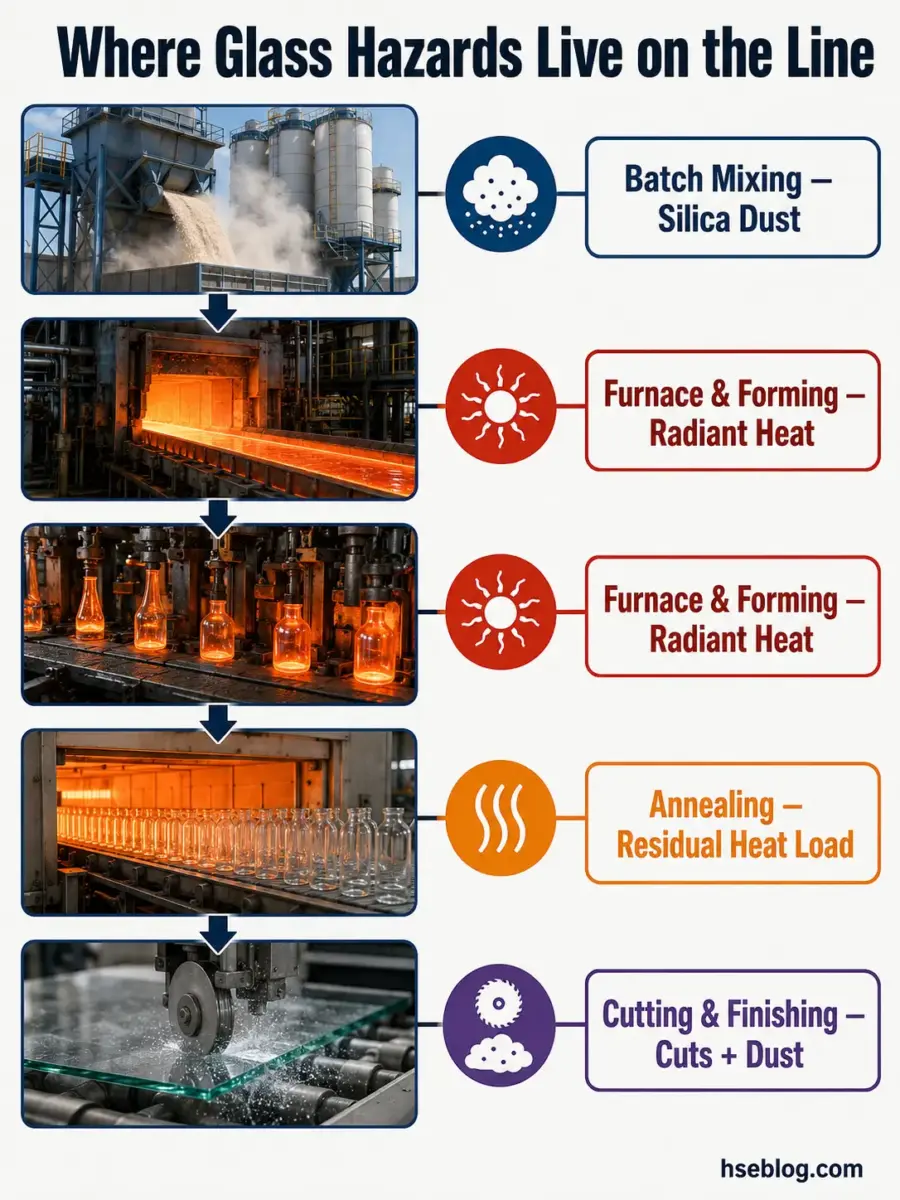
The process arc explains the pattern. Each stage carries its own dominant exposure, and the controls that suit one rarely suit the next.
| Process stage | Dominant hazard |
|---|---|
| Batch mixing & raw-material handling | Respirable crystalline silica dust |
| Furnace / melting | Radiant and contact heat, systemic heat stress |
| Forming (pressing, blowing, float) | Radiant heat, contact burns, heat stress |
| Annealing (lehr) | Residual heat, sustained heat load |
| Cutting / fabrication / finishing | Lacerations, flying shards, dust from dry processes |
Jurisdiction sets the rulebook from the start. In the US, glass production falls under OSHA general industry (29 CFR 1910), not the 1926 construction standards — which matters because the silica obligations, exposure assessment options, and program duties differ between the two.
A recurring failure mode is the silo. A plant builds a heat program, a glove policy, and a dust-mask habit as three disconnected efforts, then never assesses how one undermines another.
- Heat-resistant PPE versus heat strain: heavier protective clothing cuts burn risk but raises core-body-temperature risk in an already-hot building.
- Dry housekeeping versus dust control: sweeping or air-blowing cullet to keep walkways clear re-suspends the very silica the respiratory program is trying to suppress.
- Glove mandates versus handling injuries: issuing cut gloves does little when the real driver is manual handling of large, heavy sheets.
The point is integration. Glass manufacturing health and safety works only when controls are assessed together, not stacked in parallel.
Heat and Thermal Hazards: Furnaces, Molten Glass, and Heat Stress
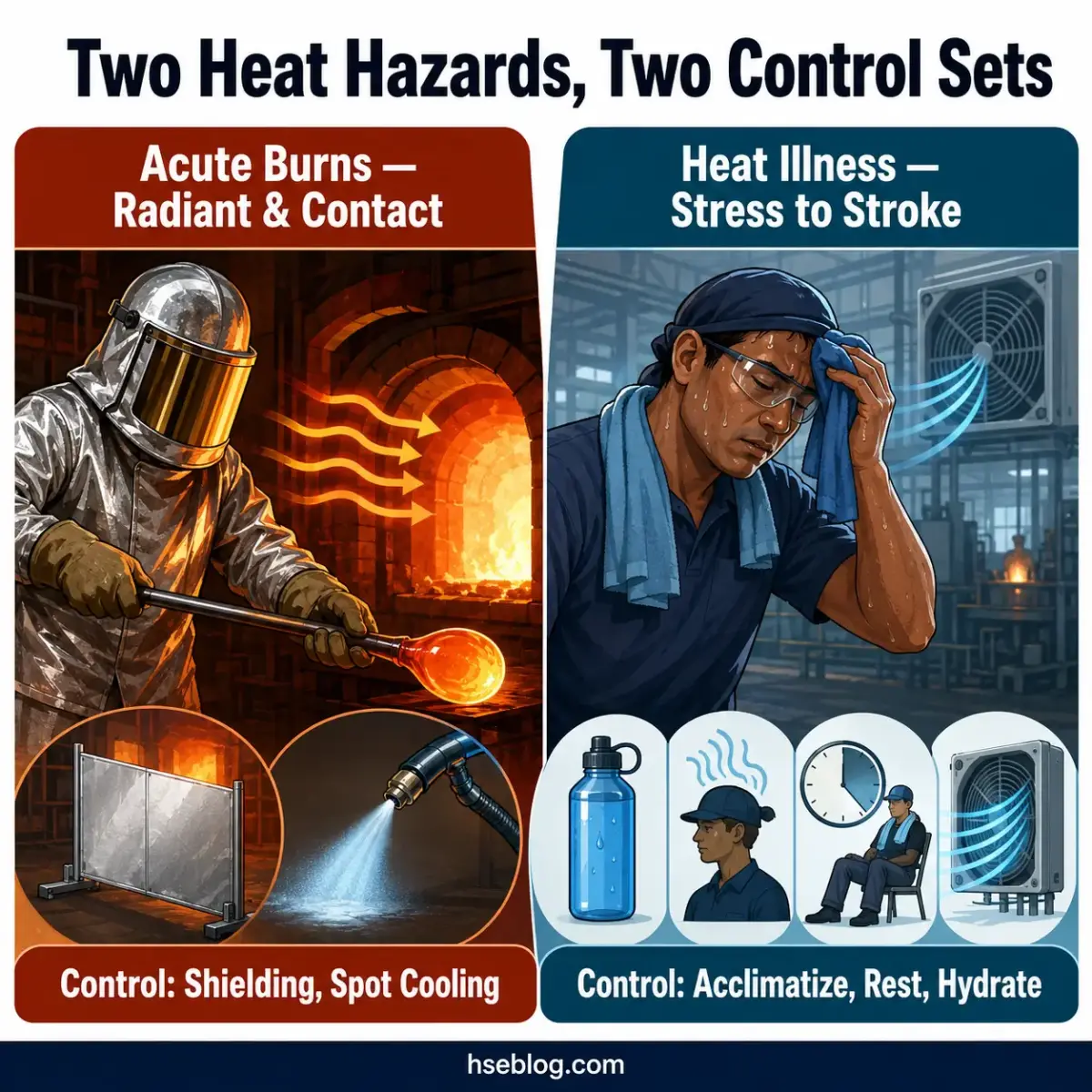
The thermal risk in a glass plant is two hazards wearing one label — acute burns from molten glass and furnaces, and systemic heat illness from sustained heat load — and they need different controls. Conflating them is how plants end up over-protected against burns and under-protected against heat stroke.
This article provides general HSE knowledge. Life-critical work such as furnace operation, hot-work near molten glass, and emergency response to heat illness must be planned and supervised by a competent person with relevant training, jurisdiction-specific authorization, and a site-specific risk assessment. The information here does not replace that.
The acute mechanism is contact and radiant heat. Molten glass and furnace zones run hot enough to keep glass liquid — far beyond any survivable contact threshold — and radiant heat injures skin and eyes without contact at all. Exact furnace operating temperatures vary by glass type, so a plant should reference its own engineering data rather than a generic figure.
The systemic mechanism is heat illness. A glass plant is a textbook indoor radiant-heat environment, precisely the setting OSHA's proposed heat rule was written to address. Heat exhaustion can progress to heat stroke, which is a medical emergency requiring immediate cooling and emergency services.
The scale of the heat problem is well documented across US industry. Between 2011 and 2022 there were 479 worker deaths from environmental heat exposure, alongside roughly 33,890 heat-related injuries and illnesses with days away from work (US Bureau of Labor Statistics, cited in OSHA's heat NPRM, 2024).
Controls belong in hierarchy order, not PPE-first:
- Engineering: radiant shielding and barriers, spot cooling, and ventilation that removes heat at the source.
- Administrative: acclimatization schedules, work/rest cycles, hydration access, and heat-index monitoring tied to defined trigger points.
- PPE — last, with a caveat: heat-resistant clothing protects against burns but adds insulation and metabolic load, so it raises heat-illness risk if used as the primary heat control.
That caveat is the most common misconception in hot-work settings. Teams treat heat-resistant PPE as the answer to heat itself and inadvertently push core-body temperature up — solving the burn while feeding the heat stroke.
Heat Stress Controls and the Acclimatization Gap
Acclimatization is the single most evidence-backed administrative control, and it is also the one most often skipped. New hires and workers returning after time away are the most heat-fatality-prone population, yet they are routinely put straight onto full duty.
A workable scheme mirrors the logic of the proposed federal triggers — a heat index of 80°F as the initial trigger and 90°F as the high-heat trigger (OSHA NPRM, 2024):
- Phase in exposure: start new and returning workers at a reduced share of full heat exposure and build up over roughly a week.
- Tie breaks to conditions: schedule mandatory rest, water, and cooling access against measured heat index, not the clock alone.
- Watch the high-heat trigger: above the 90°F-equivalent threshold, shorten work cycles and increase supervision for early heat-illness signs.
- Brief the emergency response: every shift should know that suspected heat stroke is a 911-level emergency, not a "sit down and recover" situation.
The judgment call most supervisors face is throughput versus acclimatization during a staffing crunch. In nearly every operational context the balance favours the slower ramp-up, because a single heat-stroke fatality costs far more than the lost output of a phased week.
Cut and Laceration Hazards: Sharp Edges, Breakage, and Handling
Cuts are the most frequent injury family in glass work and the most misdiagnosed at the control level — because the standard response, "wear cut gloves," targets the wrong mechanism. Laceration rates often stay flat under a glove mandate because the real driver is how sheets are handled, not whether hands are gloved.
The hazard has several distinct mechanisms:
- Scoring and snapping during cutting, where the controlled break can run unpredictably.
- Spontaneous breakage of stressed or flawed stock, sometimes without warning.
- Edge contact during handling of large sheets, the highest-volume cause.
- Foot and lower-limb injury from dropped or toppled sheets and stacks.
- Puncture from broken stock, an under-discussed risk when handling cullet and shattered pieces.
Controls follow the same hierarchy, engineering before PPE:
- Engineer the cut and the lift: automated and waterjet cutting plus mechanical handling remove hands from the sharpest interactions.
- Build in edge protection and stacking discipline: correct racking, edge guards, and load limits cut both handling and drop injuries.
- Maintain cullet housekeeping: contained, promptly cleared broken glass prevents the puncture and trip injuries that follow from letting it accumulate.
- Specify PPE to the actual exposure: match glove rating to edge sharpness and load, and protect eyes and face against flying shards.
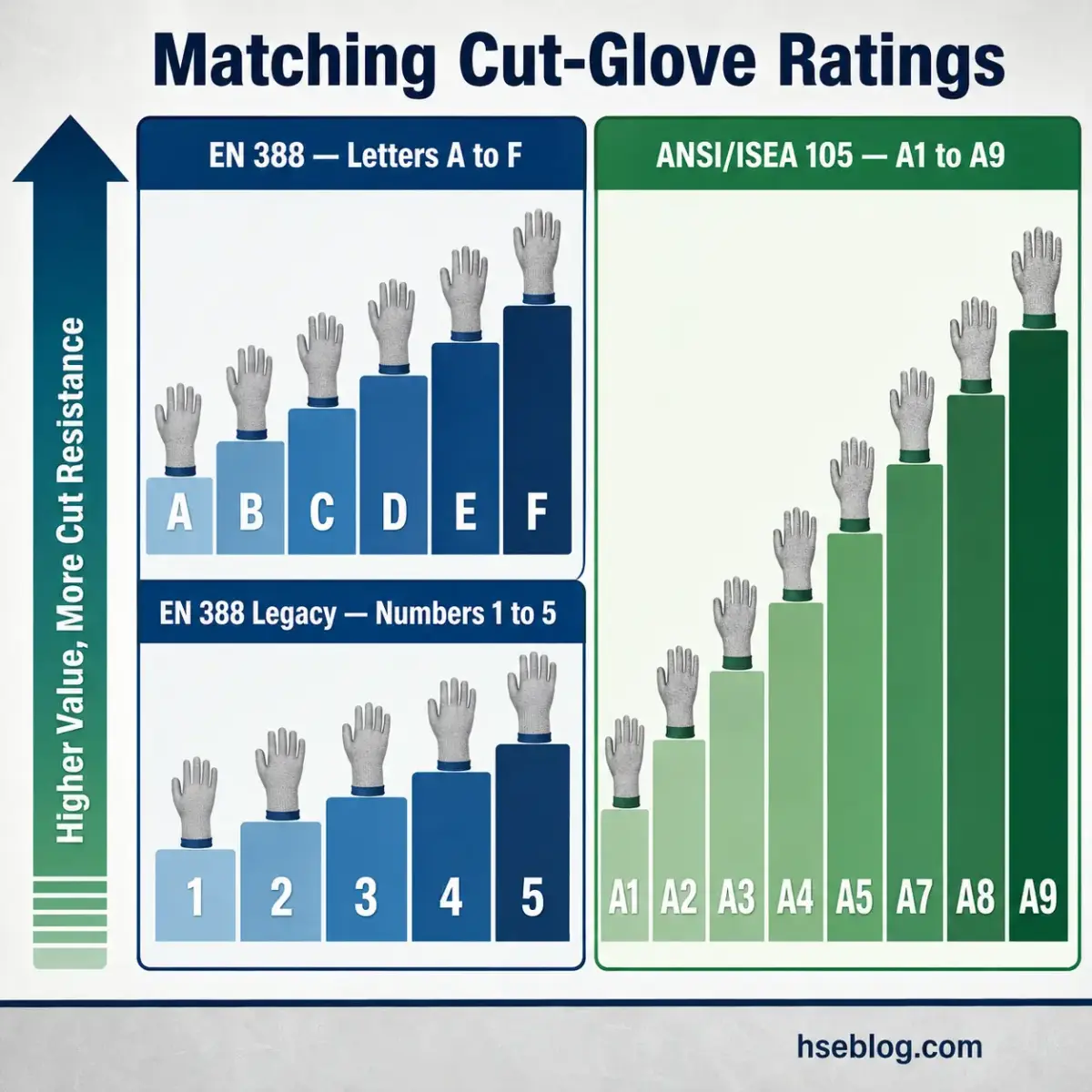
The phrase "cut-resistant" means nothing without a rating, and the two main standards do not use the same scale.
| Standard | Scale used | Range (low → high) | Jurisdiction |
|---|---|---|---|
| EN 388:2016 (ISO 13997 / TDM cut test) | Letters | A → F | EU / UK |
| EN 388 (legacy coupe test) | Numbers | 1 → 5 | EU / UK (legacy) |
| ANSI/ISEA 105 | Letter + number | A1 → A9 | US |
The practical reading is that a higher letter or number means more cut resistance, but the right level depends on the work. Heavy sheet handling with sharp edges warrants a high rating; light fabrication may not — and over-specifying gloves can reduce dexterity enough to create new errors.
This is where comparative interpretation matters. A plant choosing between "issue everyone A9 gloves" and "redesign the handling" should weigh that gloves protect the hand at the point of contact, while mechanical handling removes the contact altogether. The stronger operational answer is to engineer out the manual handling first, then glove the residual task — not the reverse.
Dust Hazards: Respirable Crystalline Silica and Silicosis Risk
Silica dust is the highest-stakes hazard in glass manufacturing, and the one competitors reduce to "wear a respirator" — which is the last control in the sequence, not the first. The defensible approach treats respirable crystalline silica (RCS) as a regulated carcinogen with enforceable limits, mandatory exposure assessment, and health surveillance.
Content covering health surveillance, exposure, and biological monitoring is for HSE practitioner reference. It is not medical advice. Workers with specific symptoms or exposure concerns should consult an occupational physician or qualified medical professional.
Where the dust comes from: silica sand is a primary batch raw material, so RCS is generated at batch handling and mixing, and again during dry cutting and finishing of silica-containing product. Wet processes and enclosed handling cut generation at the source; dry sweeping and compressed-air blowdown do the opposite.
Why it matters clinically: OSHA recognises respirable crystalline silica as causing silicosis — which is incurable and irreversible — as well as lung cancer, COPD, and kidney disease (OSHA, silica health effects). These endpoints are the reason silica carries program duties that ordinary nuisance dust does not. Around 2.3 million US workers are exposed to RCS across all sectors (OSHA/NIOSH, 2016 rulemaking basis).
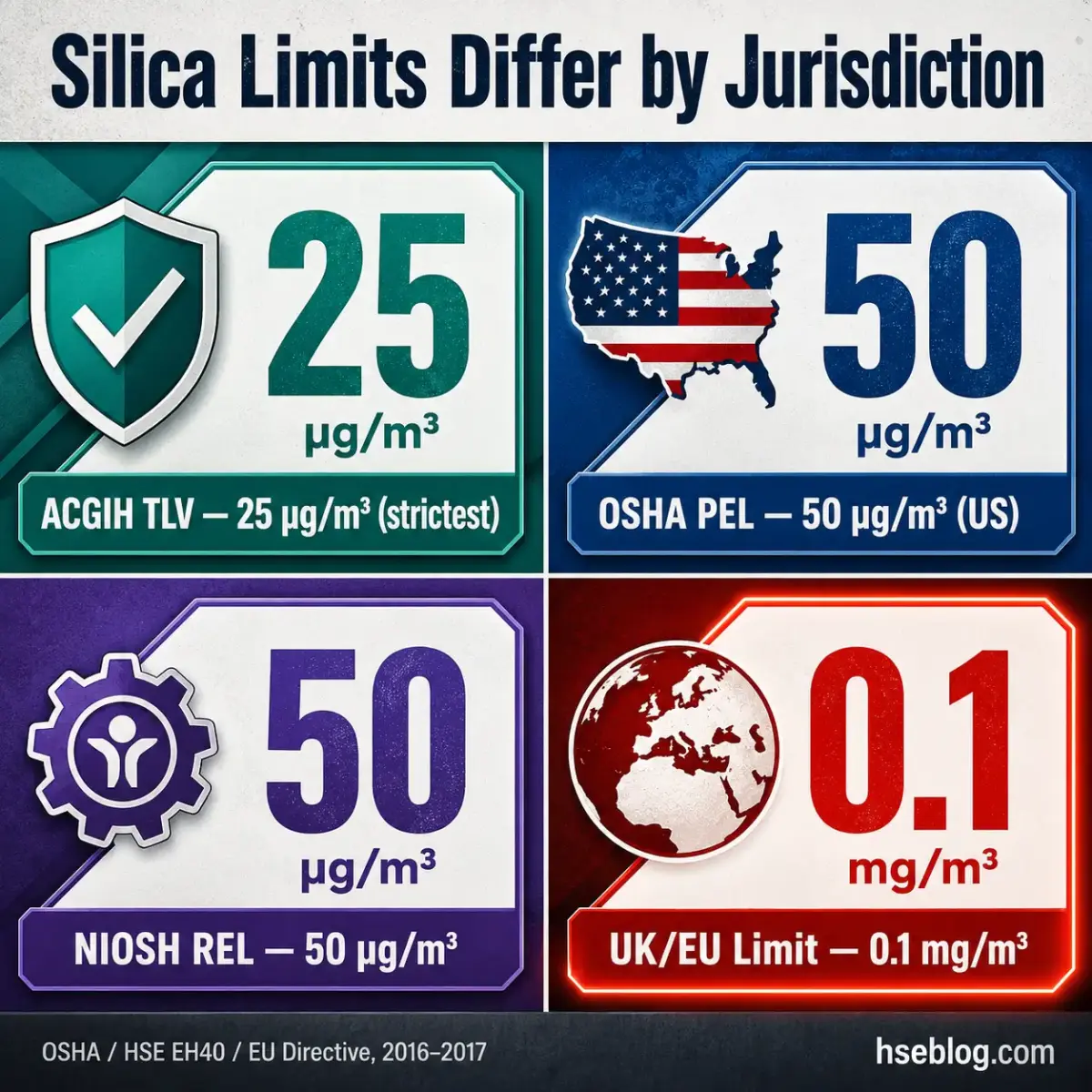
The exposure-limit landscape is where jurisdiction decides the number. Presenting them side by side exposes how wide the gap is.
| Body / Standard | Limit (8-hr TWA) | Jurisdiction | Legal status |
|---|---|---|---|
| ACGIH TLV | 25 µg/m³ (0.025 mg/m³) | US (guideline) | Health-based guideline — strictest |
| OSHA PEL | 50 µg/m³ (action level 25 µg/m³) | US | Enforceable |
| NIOSH REL | 50 µg/m³ | US | Recommended (RCS treated as potential carcinogen) |
| HSE EH40 WEL / EU BOEL | 0.1 mg/m³ (100 µg/m³) | UK / EU | Enforceable |
The values do not agree, so a multinational operator should set the strictest applicable limit as the internal standard while meeting each jurisdiction's legal duty. As an operational benchmark, the ACGIH TLV of 25 µg/m³ is the most protective reference. UK and EU duty-holders also face an obligation beyond the number: exposure must be reduced as low as reasonably practicable, not merely kept under the WEL.
Under OSHA's respirable crystalline silica standard for general industry (29 CFR 1910.1053), the mandatory program elements are specific:
- Exposure assessment — characterising actual airborne RCS for affected workers.
- Written exposure control plan — site-specific, naming the tasks, controls, and housekeeping methods.
- Regulated areas — where exposures exceed the PEL.
- Respiratory protection — selected by assigned protection factor, after engineering controls.
- Medical surveillance — offered to qualifying workers.
- Recordkeeping — of assessments, controls, and surveillance.
The most-cited general-industry silica violations are not usually over-PEL exposures — they are missing exposure assessments and inadequate or "global" written control plans that were never tailored to the site. The paperwork failure tends to precede the health failure, because a plant that never assessed its dust never knew it had a problem to control.
Respirator selection is the last line of defence, applied after substitution, local exhaust ventilation (LEV), wet methods, and enclosure. Treating it as the first line is the shared competitor failure — and the one OSHA's program duties are written to prevent. For the authoritative figures and duties, the primary reference is OSHA's respirable crystalline silica standard for general industry, with the clinical basis set out in OSHA's account of the health effects of respirable crystalline silica; the EU position is covered by the EU occupational exposure limit for respirable crystalline silica.
The Hierarchy of Controls Applied Across All Three Hazards
One lens ties the article together: the hierarchy of controls — eliminate, substitute, engineer, administrate, then PPE — applied identically to heat, cuts, and dust. The competitor habit of jumping straight to PPE fails the same way in all three.
| Hazard | Engineer first | Administrate next | PPE last |
|---|---|---|---|
| Heat | Shielding, ventilation, spot cooling | Acclimatization, work/rest, heat-index triggers | Heat-resistant clothing (adds heat load) |
| Cuts | Automated cutting, mechanical handling | Stacking discipline, cullet housekeeping | Cut-resistant gloves, eye/face protection |
| Dust | Substitution, LEV, wet methods, enclosure | Exposure assessment, regulated areas | Respirators by protection factor |
Read down the PPE column and the shared weakness is obvious. Every PPE control either adds a competing burden, depends on perfect compliance, or only protects after the hazard has already reached the worker.
Building a Glass Plant Safety and Compliance Program
In practice, the hazards become manageable only when they convert into a program — risk assessment, training, monitoring, and the documentation regulators actually inspect. The recurring failure here is not poor writing; it is that programs are written once and never revisited when the process, product mix, or staffing changes.
Risk assessment is the legal foundation, and it differs by jurisdiction.
- In the UK, a COSHH assessment underpins the duty to control RCS and other substances.
- In the US, the equivalent is the exposure assessment plus a written exposure control plan under 29 CFR 1910.1053.
- For heat, neither jurisdiction yet has a finalised dedicated standard, so the heat risk assessment currently rests on general duties and good practice.
Training and competency carry the life-critical work. Furnace and hot-work tasks should sit with a competent person, and recognised training pathways — NEBOSH, IOSH, OSHA outreach, or the regional equivalent — give that competency a verifiable basis rather than an assumed one.
Monitoring spans all three hazards.
- Silica: personal breathing-zone air sampling, triggered against the action level, with objective data used where it genuinely applies.
- Heat: heat-index monitoring tied to defined trigger points.
- Health: medical and health surveillance for qualifying workers, handled through occupational-health channels.
Recordkeeping is both a legal duty and the most common citation gap. Assessments, control plans, sampling results, and surveillance records are what an inspector asks for first — and the absence of a tailored, current record is frequently the citation itself.
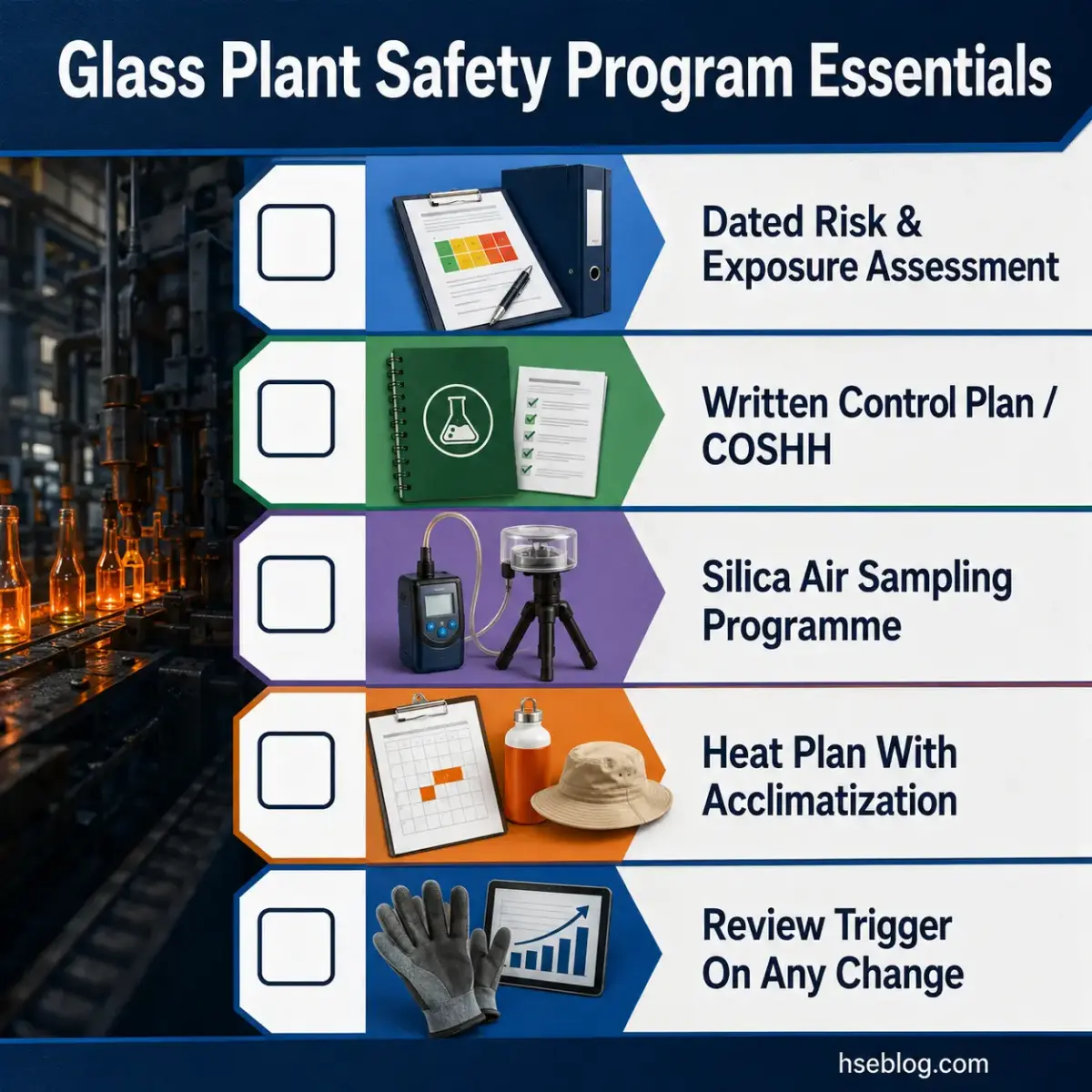
A practical compliance checklist for a glass operation:
- Site-specific risk/exposure assessment for heat, cuts, and dust — dated and reviewed on change.
- Written exposure control plan (US) or COSHH assessment (UK) naming actual tasks and controls.
- Air sampling programme for RCS with results retained.
- Heat plan with acclimatization, work/rest, hydration, and trigger logic.
- Glove specification mapped to EN 388 or ANSI ratings for each handling task.
- Competent-person assignment for furnace and hot-work activity.
- Health/medical surveillance arranged through occupational health.
- A scheduled review trigger tied to process, product, and staffing changes.
Frequently Asked Questions
What are the most common injuries in glass manufacturing?
The pattern splits by frequency and severity. Cuts and lacerations from edges, breakage, and handling are the most frequent but usually minor; minor burns are common near hot zones. The severe and chronic end is different — heat stroke is acute and life-threatening, and silicosis from respirable crystalline silica is chronic and incurable. Frequent does not mean most dangerous.
Is silica dust in glass manufacturing dangerous, and what is the exposure limit?
Yes. OSHA links respirable crystalline silica to silicosis (incurable), lung cancer, COPD, and kidney disease. The limit depends on jurisdiction: 50 µg/m³ in the US (OSHA, action level 25 µg/m³), 0.1 mg/m³ in the UK and EU, and a stricter 25 µg/m³ ACGIH guideline. Workers with exposure concerns should consult an occupational physician.
What PPE is required for glass manufacturing, and is it enough on its own?
PPE is the last control tier, never a substitute for engineering controls. The core kit is cut-resistant gloves rated to EN 388 (UK/EU) or ANSI/ISEA 105 (US), eye and face protection against shards, respirators selected by assigned protection factor for silica, and heat-resistant clothing — noting that heat-resistant clothing adds heat-illness risk if relied on as the main heat control.
How do you control heat stress in a hot indoor plant like a glass factory?
Lead with engineering and administration, not PPE. Use radiant shielding, ventilation, and spot cooling; then acclimatization for new and returning workers, work/rest cycles, hydration, and heat-index triggers (the proposed US thresholds sit at 80°F and 90°F). Treat suspected heat stroke as a medical emergency. Heat-resistant PPE protects against burns but can raise core-body-temperature risk.
Does OSHA have a heat standard for glass factories yet?
Not as a finalised federal rule. OSHA's proposed Heat Injury and Illness Prevention standard (NPRM 2024) remains unfinalised in 2026, with the post-hearing comment period closed October 30, 2025 and no finalisation date set. Enforcement continues through the General Duty Clause and an updated National Emphasis Program effective April 10, 2026, running for five years.
How do OSHA and UK/EU silica rules differ for manufacturers?
The duties and the numbers both differ. The US uses 29 CFR 1910.1053 — exposure assessment, written control plan, regulated areas, and medical surveillance — at a 50 µg/m³ PEL. The UK requires a COSHH assessment against an EH40 WEL of 0.1 mg/m³ plus reduction as low as reasonably practicable; the EU sets a binding 0.1 mg/m³ limit. Multinationals should adopt the strictest applicable standard.
A Final Word on Getting Glass Manufacturing Safety Right
The industry's recurring mistake is the one that runs through every section above: reaching for PPE first. Gloves, respirators, and heat-resistant clothing are visible, cheap to issue, and easy to audit — which is exactly why they get treated as the answer when they are only ever the last line.
The highest-impact change is to assess the three hazards together and engineer them out at the source before anyone reaches for protective equipment. Substitution and local exhaust ventilation beat respirators on silica; mechanical handling beats cut gloves; shielding and acclimatization beat heat-resistant clothing. The same logic, applied across heat, cuts, and dust, is what separates a glass manufacturing safety program that holds up from a hazard listicle that does not.
What that leaves the reader with is a single uncomfortable test. Look at your own plant and ask which of the three hazards is currently being managed mostly through PPE — because that is the one where the next serious injury is most likely waiting.