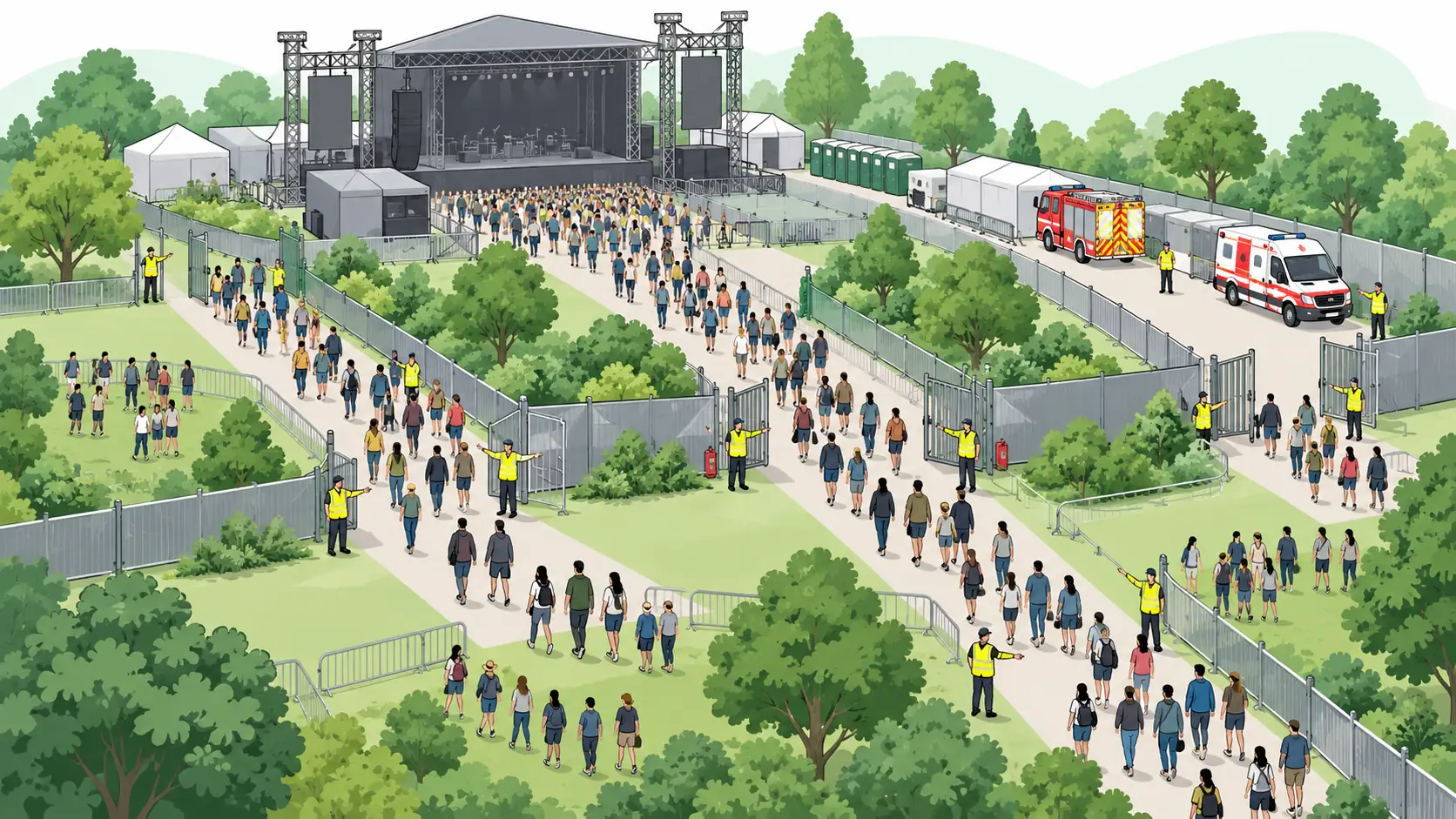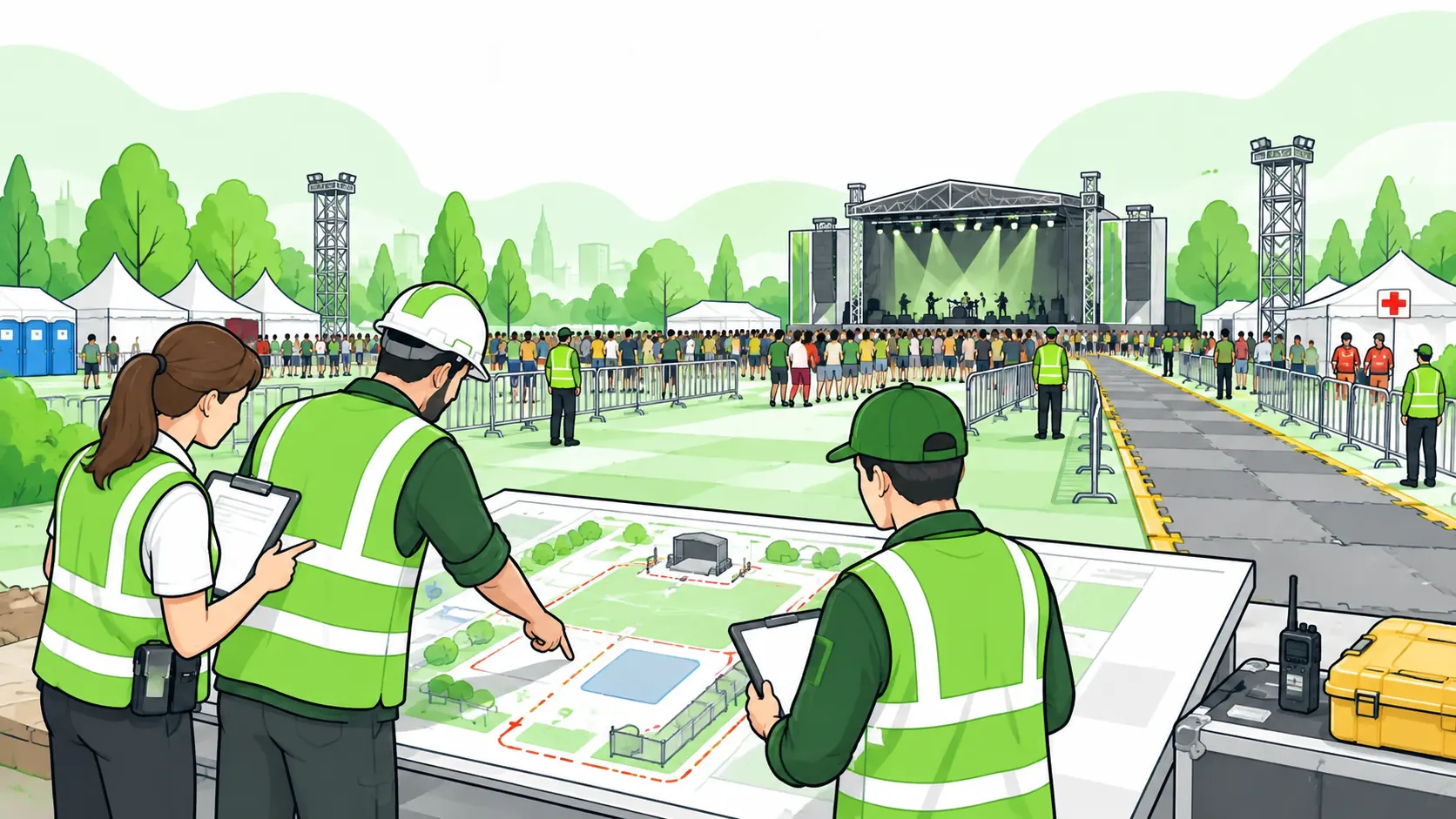
Event safety management is the process of identifying, assessing, and controlling risks to everyone affected by an event across its full lifecycle. It begins with a suitable-and-sufficient risk assessment — identifying hazards, deciding who could be harmed, applying the hierarchy of control, recording the findings, and reviewing them as conditions change.
On 29 October 2022, a dense, unmanaged Halloween crowd compressed in a narrow sloping alley in the Itaewon district of Seoul, killing 159 people and injuring 196 (peer-reviewed AcciMap analysis, Safety Science, 2024). There was no fire, no structural collapse, and no single villain — only too many bodies in too little space, and no one with the authority or the plan to slow the inflow upstream.
That mechanism — slow-building compression in a static crowd — is the failure mode event safety management exists to prevent, and it is the one competitors' "7 risks to plan for" listicles almost never address. This guide sets out the planning and risk-assessment framework for public events: how the duty is structured, how to build an assessment that survives contact with live conditions, how crowd science changes the way you read capacity, and how UK and US legal obligations actually differ. The aim is a defensible blueprint, anchored to named standards and labelled by jurisdiction.
What Is Event Safety Management? (And Why Planning Comes First)
Event safety management is the end-to-end discipline of protecting attendees, staff, contractors, and the wider public from harm across every phase of an event. It is distinct from the broader "risk management" most commercial guides describe — that wider exercise covers finance, reputation, and continuity, while safety management is about life and health.
That distinction matters because the two get blurred constantly, and the blurring is where life-safety controls quietly drop down the priority list. A ticketing dispute is a business risk; a crowd crush is a fatality risk. They do not belong in the same column.
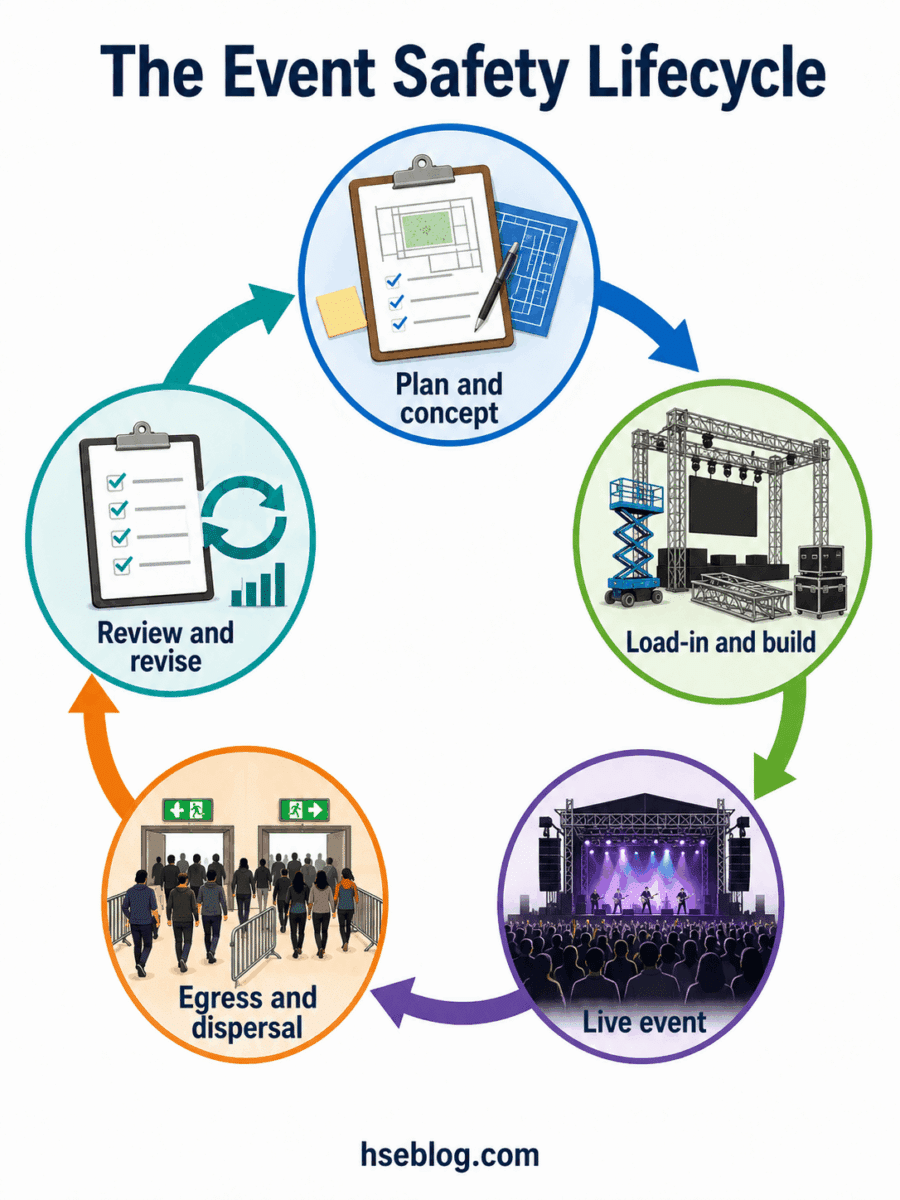
Definition: Event safety management is the systematic identification, assessment, and control of risks to health and safety across an event's full lifecycle — from concept and build, through the live event, to egress and load-out.
Three points anchor everything that follows:
- Risk is reassessed continuously, not once. The HSE's guidance on running an event safely treats safety as a lifecycle activity, because the hazards on a half-built site at load-in are not the hazards at peak capacity on show night.
- The duty sits with the organiser. Whoever organises and controls the event holds the primary legal responsibility, alongside the venue or occupier and any contractors.
- A competent person must be involved. Someone with the training, knowledge, and experience to recognise and control the specific hazards has to own the safety function — proportionate to the event's scale.
The most common failure I see in the published record and in audited plans is the "tick-box artefact" trap. The assessment is written once to satisfy a licensing condition, signed, filed, and never opened again as the build evolves — which is precisely when on-the-day conditions expose what the paper missed.
Who Is Responsible for Safety at an Event?
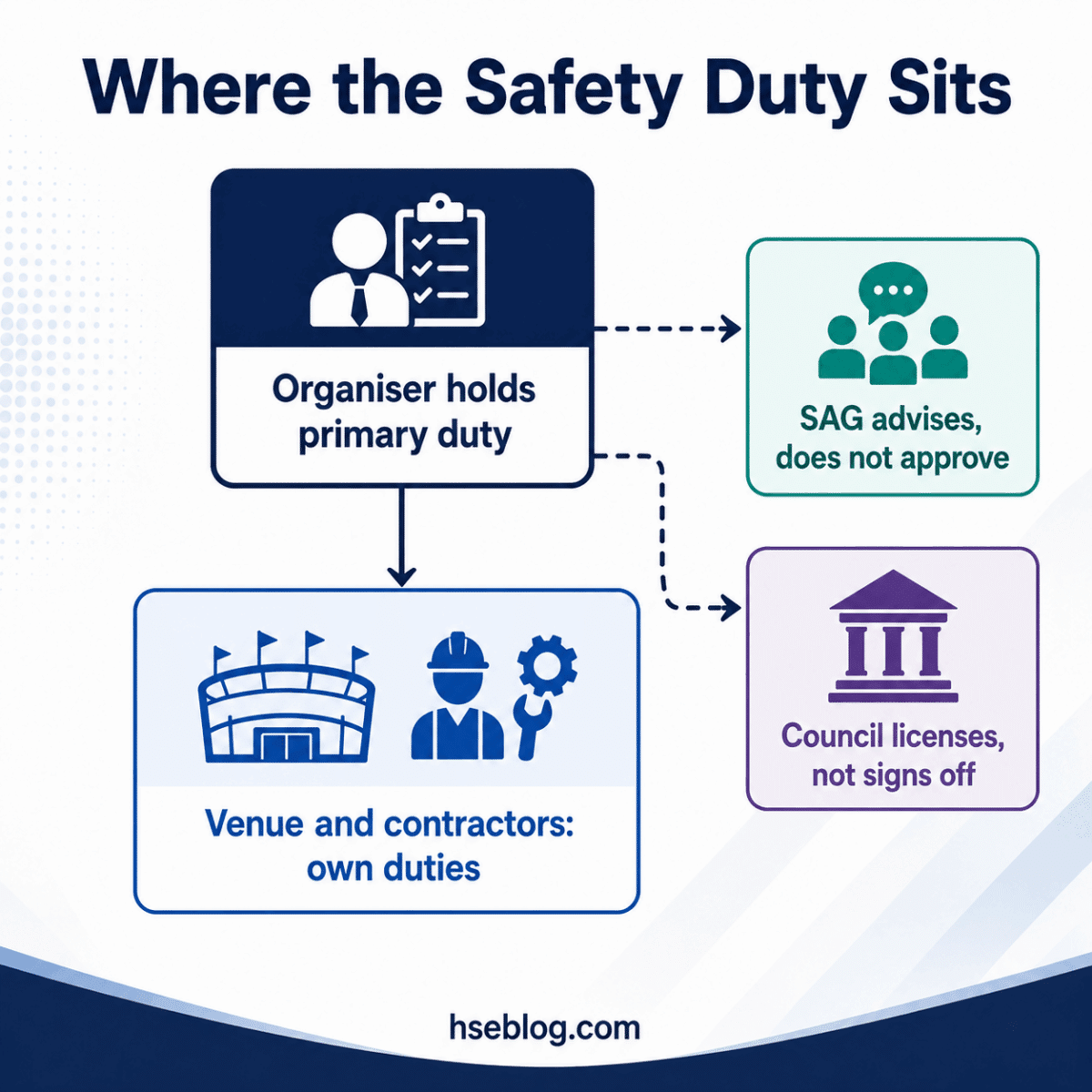
The organiser holds the primary, non-transferable duty for safety at an event. The persistent misconception — and it is a costly one — is that a Safety Advisory Group or the local authority "approves" the event and thereby absorbs the liability. They do not.
Responsibility is layered, not singular, and the layers coordinate rather than cancel each other out:
- Organiser: Primary duty-holder. Plans the event, appoints competent help, and carries the general duty of care to staff and the public.
- Venue / occupier: Duties relating to the premises themselves — structures, fixed installations, fire safety, and the safe condition of the site.
- Contractors and concessions: Responsible for the safety of their own activities and equipment, coordinated under the organiser's overall plan.
- Competent person: The individual or team with the knowledge to assess and control the specific hazards, scaled to the event.
The Safety Advisory Group deserves a clear word, because it is so widely misread. A SAG is a multi-agency advisory body — police, fire, ambulance, local authority, and others — that reviews and challenges an event safety plan. It is advisory. It does not license the event, it does not issue a safety permit, and it does not transfer your legal duty to itself.
| Party | Core duty | What it does NOT do |
|---|---|---|
| Organiser | Overall safety; appoints competent person; duty to staff and public | Cannot delegate the legal duty away |
| Venue / occupier | Premises, structures, fixed installations | Does not assume the organiser's operational duty |
| Contractor | Safety of own work and equipment (via RAMS) | Does not own the whole-event plan |
| Safety Advisory Group | Reviews and advises on the plan | Does not approve, license, or accept liability |
| Local authority | Licensing under the relevant regime | Licensing is not a safety sign-off |
Proportionality runs through all of this. A village fete and a 60,000-capacity festival sit on the same legal principle but demand very different depth — the duty does not change, the scale of the response does.
How to Conduct an Event Risk Assessment (Step by Step)
In the UK, the legal foundation for the event risk assessment is regulation 3 of the Management of Health and Safety at Work Regulations 1999, which requires a "suitable and sufficient" assessment of risks to employees and to others affected by the work — which at an event means the public. The phrase "suitable and sufficient" is the standard a generic downloaded template almost always fails.
Competent-person caveat: This article provides general HSE knowledge. Life-critical work such as crowd safety, structural sign-off, evacuation planning, and emergency medical provision must be planned and supervised by a competent person with relevant training, jurisdiction-specific authorisation, and a site-specific risk assessment. The information here does not replace that.
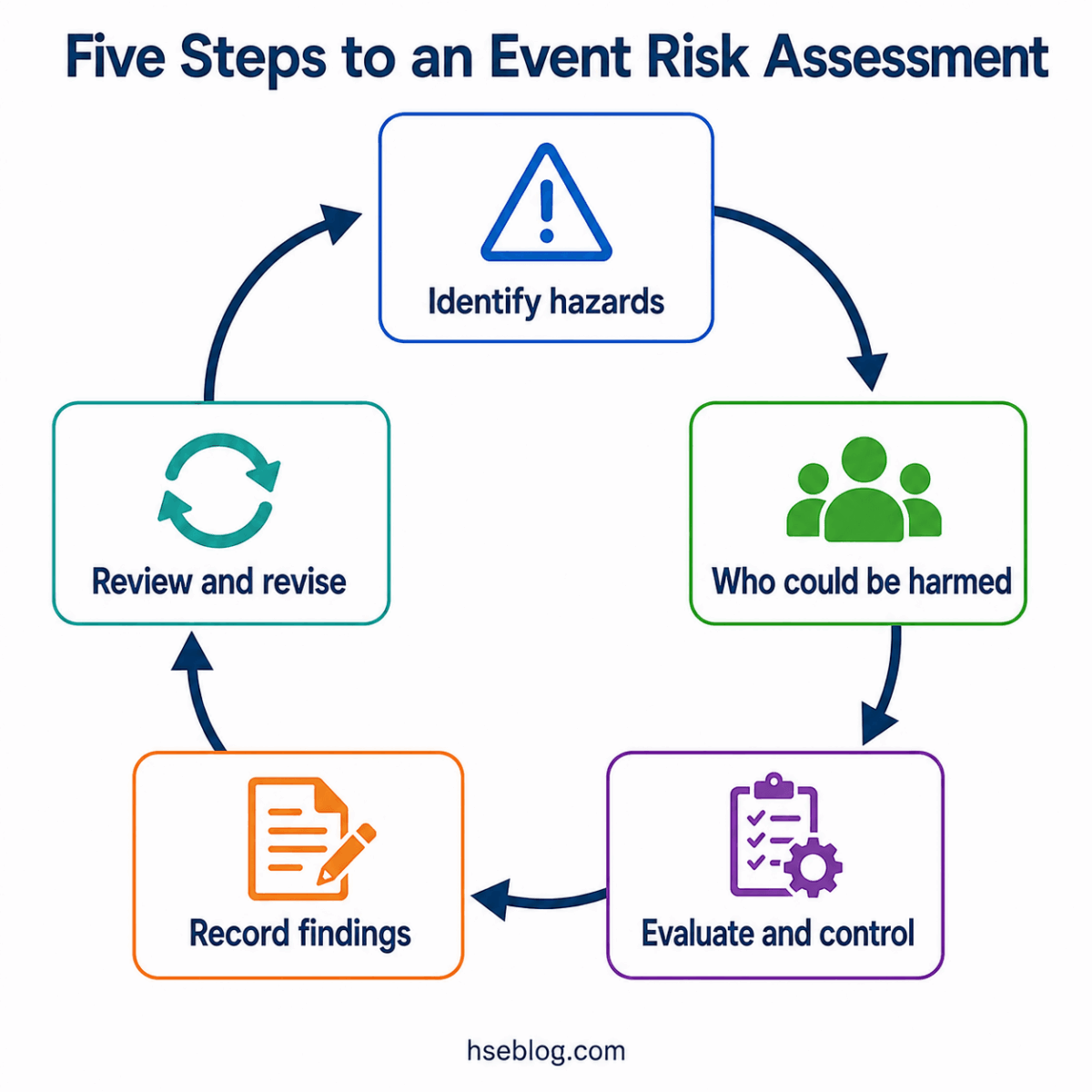
Run the assessment as an ordered method, mapped to the recognised five-step structure and made event-specific at every step:
- Identify the hazards. Work through activity hazards (rigging, pyrotechnics, performances), equipment hazards (temporary power, generators), environmental hazards (weather, ground conditions, lighting), and crowd-related hazards (density, flow, pinch points).
- Decide who could be harmed and how. Name the groups, not just "the public." Include children, elderly attendees, disabled visitors, pregnant attendees, lone workers, and contractors working at height or out of hours.
- Evaluate the risk and decide controls. Apply the hierarchy of control — eliminate the hazard, substitute it, engineer it out, use administrative controls, and only then rely on PPE. For crowd density, that means designing flow into the layout, not stationing a steward to wave at a problem already in motion.
- Record the significant findings. Document what matters and what you decided, in a form the people on site can actually use — not a 90-page binder no steward will read.
- Review and revise. Reassess on any material change, after any near-miss, and dynamically during the live event as conditions shift.
The HSE's guidance on running an event safely sets the same lifecycle expectation: the assessment is a working tool, not a one-time deliverable.
A worked illustration shows where judgment bites. Take a temporary stage barrier in front of a music stage: the hazard is crowd surge against the barrier; those harmed are front-row attendees and the barrier crew. The control is not simply "install a barrier" — it is barrier load rating, a working gap behind it, trained barrier staff, and an admission rate that prevents the front from being loaded faster than it can be relieved.
There is a pattern worth naming here. Teams routinely over-document the low-consequence, high-frequency hazards — trip hazards get three paragraphs — while under-treating the high-consequence, low-frequency ones like crowd surge, structural collapse, and weather escalation, precisely because those are harder to control and uncomfortable to confront.
Common Event Hazard Categories to Assess
A structured taxonomy keeps the hazard-identification step honest. Below are the categories that recur across event types, with the dominant concern for each.
| Hazard category | Typical concern |
|---|---|
| Crowd dynamics | Density, flow conflict, pinch points, surge |
| Fire | Marquees, cooking concessions, pyrotechnics, egress |
| Electrical / temporary power | Generators, cabling, water ingress, isolation |
| Temporary structures | Stages, marquees, grandstands, signage rigging |
| Weather and wind | Wind loading on structures, lightning, heat, ground saturation |
| Traffic / vehicle interface | Vehicle-pedestrian separation, load-in routes |
| Fireworks / pyrotechnics | Exclusion zones, fallout, competent operator |
| Food hygiene | Concession standards, gas, hot surfaces |
| Noise | Worker exposure, public hearing, neighbour impact |
| Medical | Provision scaled to crowd size and risk profile |
Building the Event Safety Plan
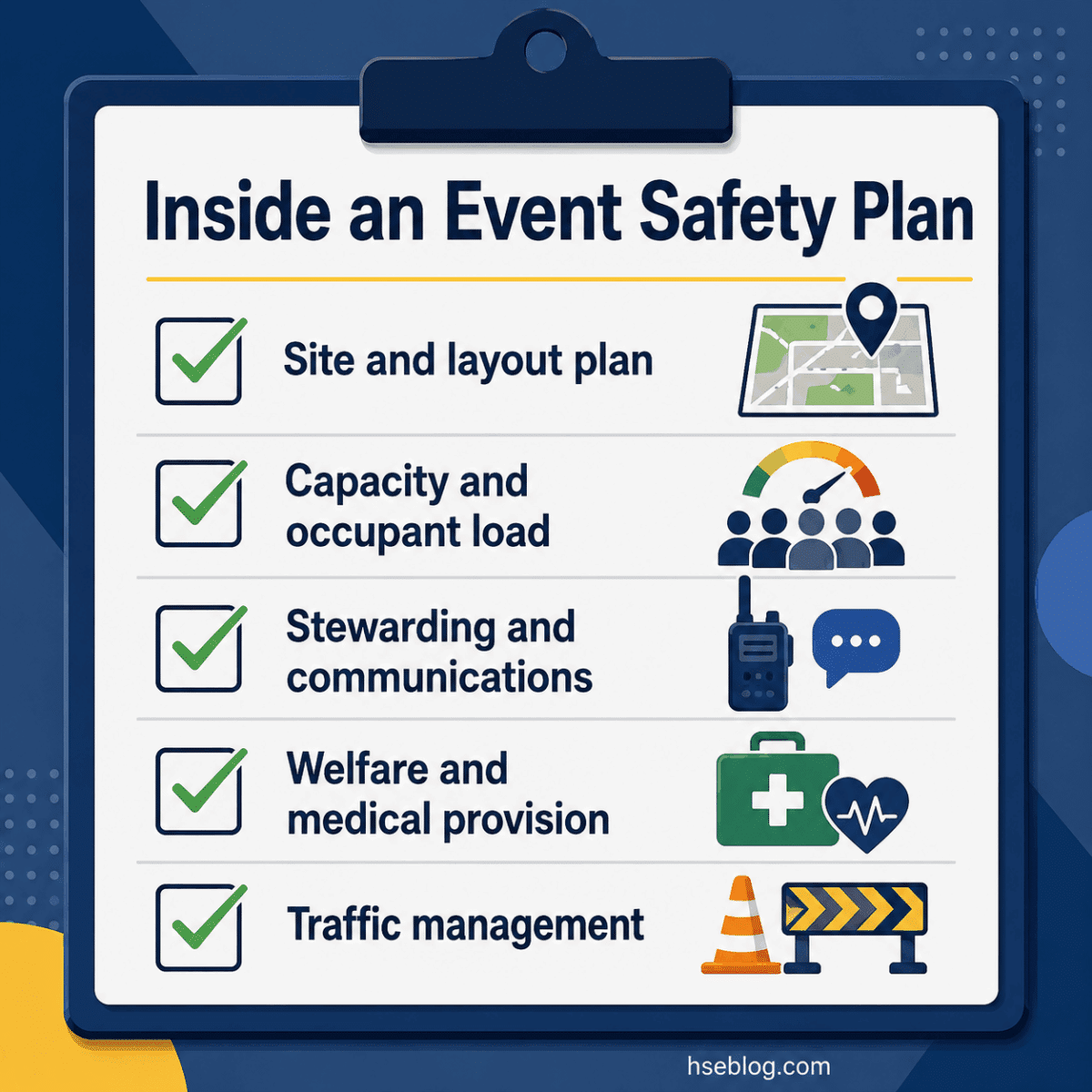
The event safety plan is not the risk assessment — it is the operational document that turns the assessment's analysis into roles, controls, and procedures people can execute. Competitors conflate the two constantly; the distinction is the difference between knowing a risk exists and knowing exactly who does what about it at 21:00 on show night.
What the plan must contain
Think of the plan as the bridge from "we identified the hazard" to "here is the named person, the resource, and the procedure."
- Site and layout plan: Entrances, exits, emergency routes, stage positions, barriers, welfare, and pinch points marked.
- Capacity and occupant-load calculation: A defensible number derived from area, exits, and density limits — not a guess based on past attendance.
- Stewarding and staffing: Numbers, positions, briefings, and command lines.
- Communications: Radio protocols, a common channel for incidents, and a clear chain to emergency services.
- Signage and wayfinding: Directional, emergency, and welfare signage that works under crowd conditions and poor light.
- Welfare and sanitation: Water, toilets, lost children, accessibility.
- Medical provision: Scaled to size and risk; the Purple Guide sets a tiered model for this in the UK.
- Traffic management: Vehicle-pedestrian separation, load-in and load-out routing.
Documentation that travels with the plan
A plan is only as strong as the evidence behind its controls. Hold these alongside it:
- Method statements and contractor RAMS for each significant activity.
- Structural certificates for stages, marquees, grandstands, and other temporary demountable structures.
- Competence evidence for specialist roles — pyrotechnics, rigging, electrical.
Two governance points decide whether the plan survives contact with reality. There must be version control so everyone works from the current document, and a single accountable owner who holds the plan together.
The recurring disconnect — and it shows up again and again in post-incident reviews — is between the plan written by an office team and the stewarding crew on the ground who have never read it. A control that lives only on paper is not a control.
Crowd Management and Crowd Safety
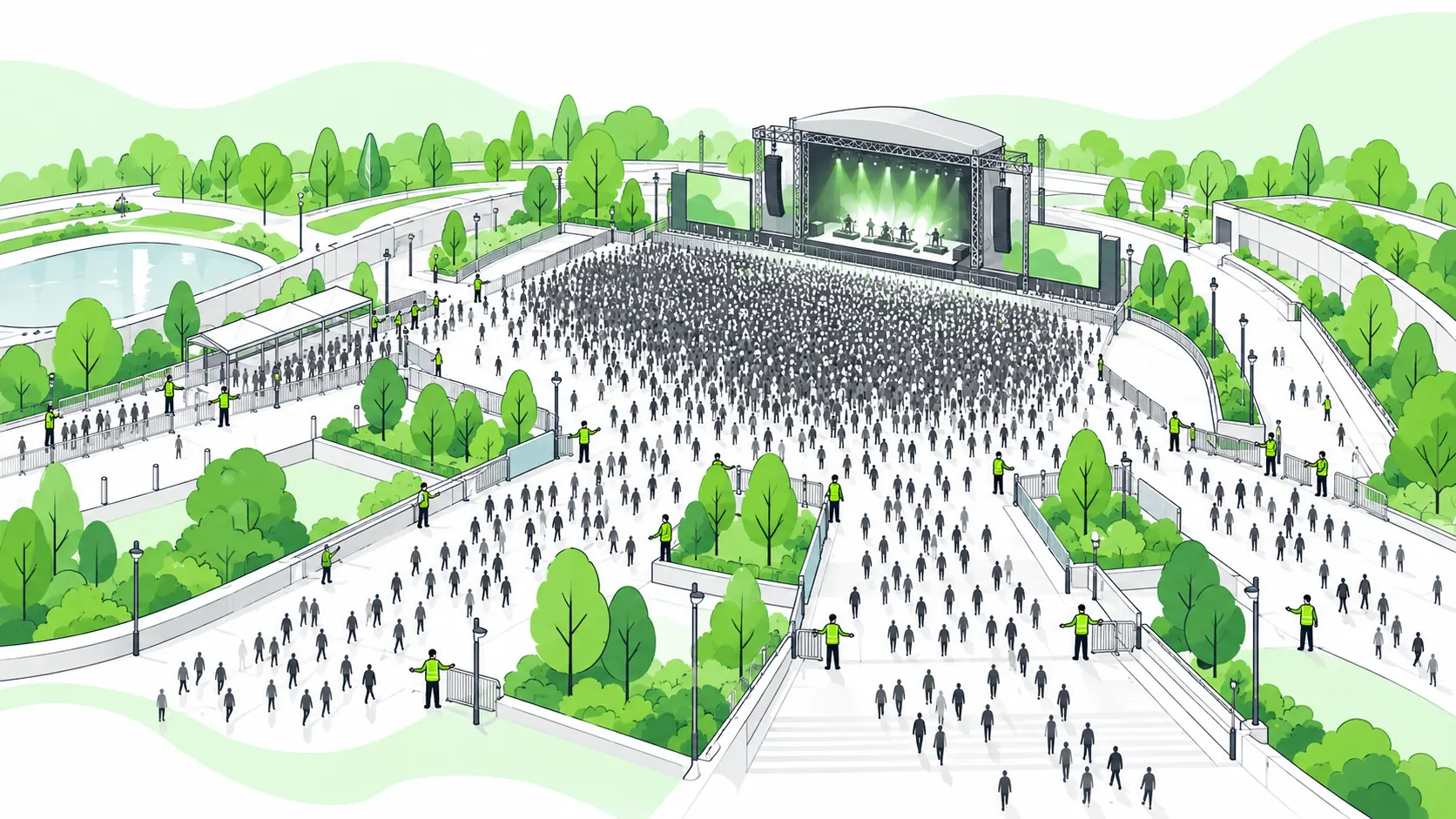
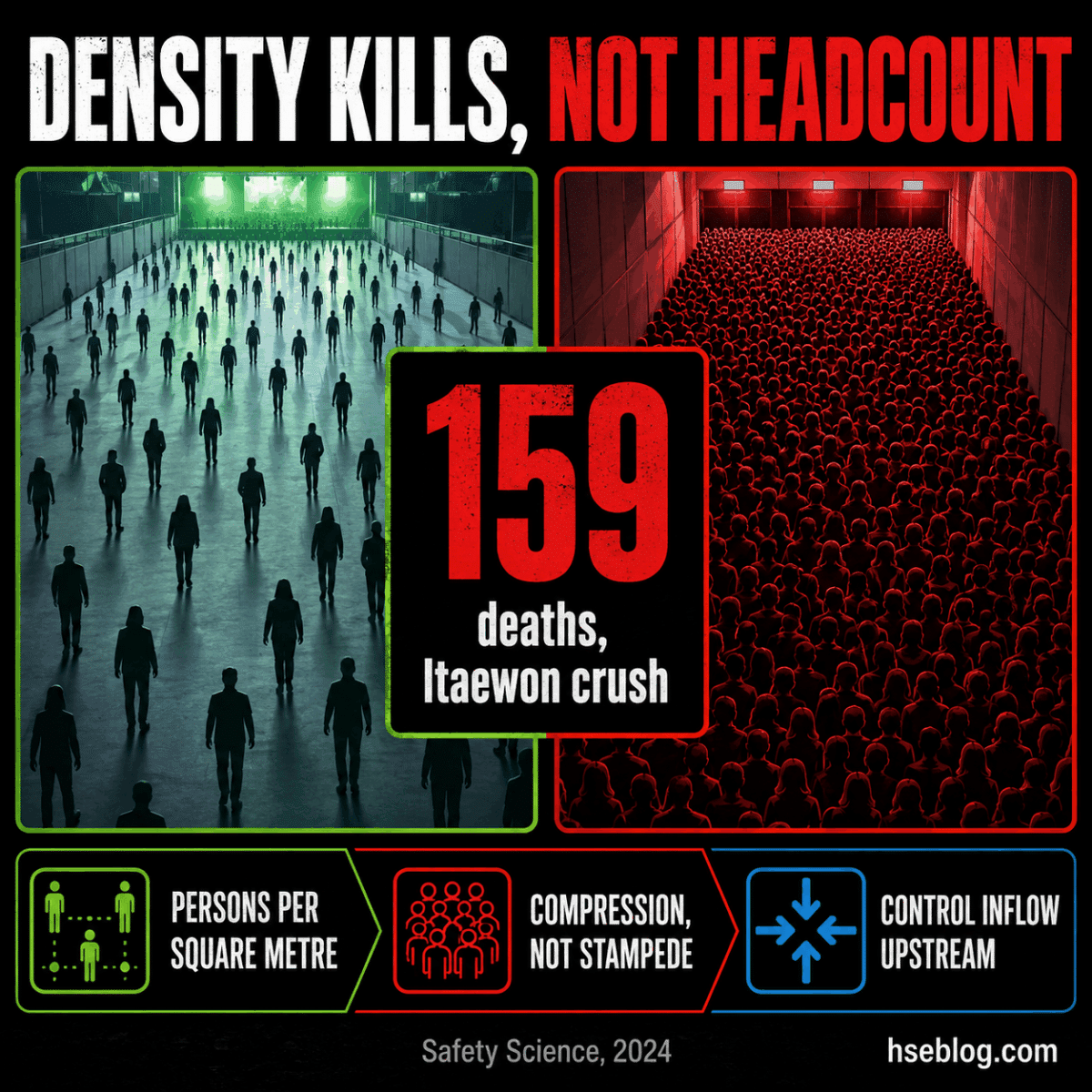
The controlling variable in crowd safety is density, not headcount — and getting that frame wrong is how competent-sounding plans fail. "We've got space for 5,000" tells you nothing about whether 5,000 people moving through a 3-metre gate at the same moment will be safe.
Crowd safety is a discipline grounded in crowd science, not common sense. The deadliest crowd incidents are not stampedes or panic-driven running; they are slow-building density crushes in static crowds, where people are compressed until they cannot expand their chests to breathe — compressive asphyxia. The Itaewon crush killed 159 people and injured 196 in exactly this way (peer-reviewed AcciMap analysis, Safety Science, 2024), and the Astroworld Festival in Houston killed 10 in a managed, ticketed event the following year (news reporting, 2021) — proof that crush risk is not confined to spontaneous gatherings.
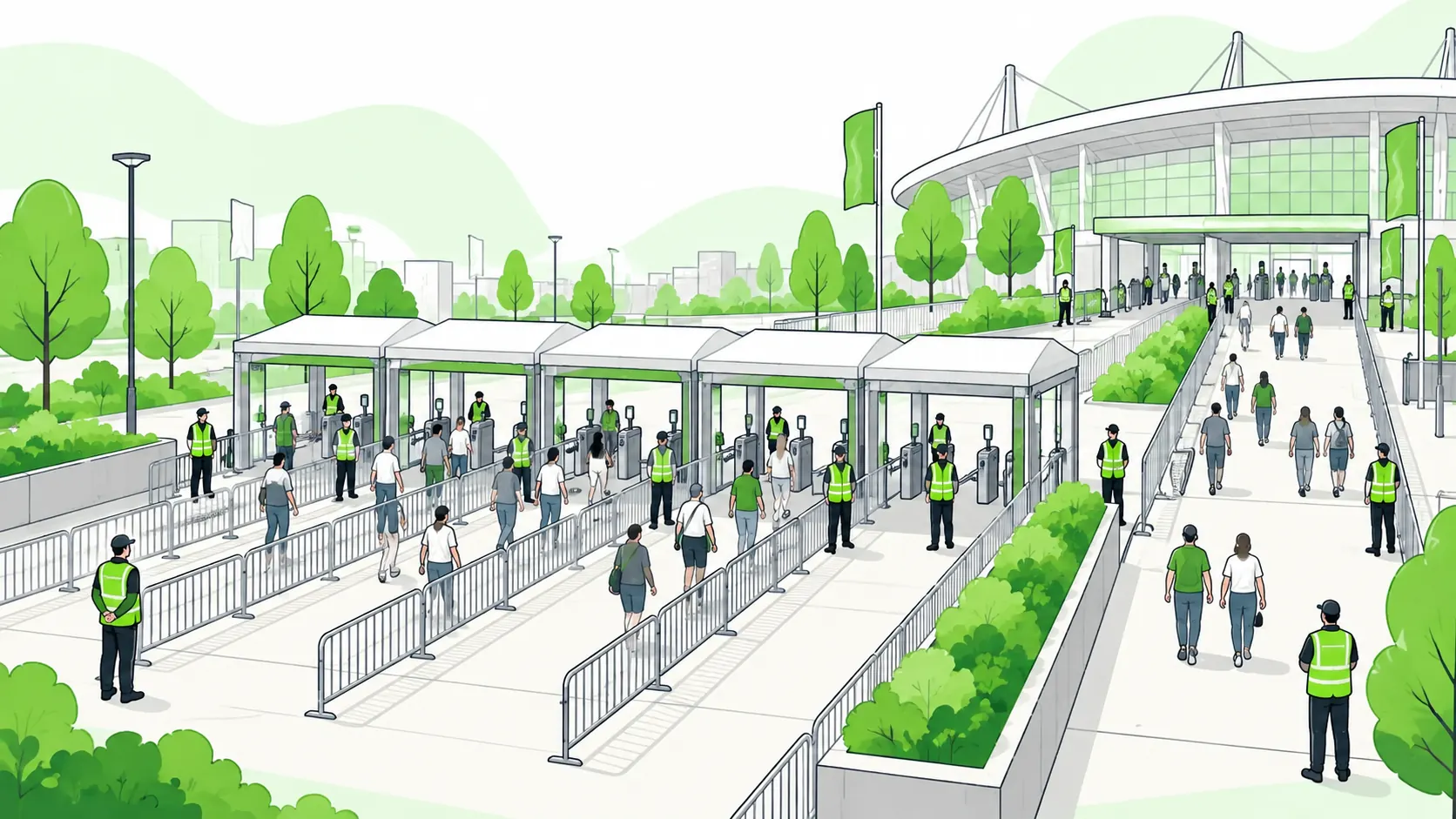
That mechanism reframes where the control point lives. If the danger is density building in a static crowd, the lever is upstream — admission rate, layout, and flow — not a reactive marshal once the crush has formed. The misconception that disasters are caused by panic leads planners to over-invest in crowd "control" at the point of failure and under-invest in the layout and ingress decisions that prevent it.
Jurisdictions express the staffing and density logic differently, and the figures are not interchangeable. The Purple Guide (the UK's recognised best-practice benchmark, which superseded the withdrawn HSG195) uses a risk-tiered model, while the US NFPA 101 Life Safety Code ties crowd-manager numbers to occupant load.
| Factor | UK — Purple Guide | US — NFPA 101 |
|---|---|---|
| Status | Recognised best-practice guidance (not statute) | Code, where adopted by the Authority Having Jurisdiction |
| Staffing logic | Risk-tiered; driven by hazard profile | Occupancy-based ratio |
| Crowd manager trigger | Proportionate to assessed risk | At least one crowd manager for assembly of 50+ persons |
| Additional staffing | Scales with risk assessment | Additional managers where occupant load exceeds 250 |
| Density units | Persons per square metre | Imperial; mobility constrained below ~4.95 sq ft per person |
A practical throughput figure to plan ingress around comes from US crowd-flow guidance: roughly one patron per second per portal. Whatever figure you use, label its jurisdiction and source, and where two standards conflict, plan to the more conservative density limit.
Emergency and Contingency Planning
The gap that recurs across post-event reviews is not the absence of an evacuation plan — most events have one. It is the absence of a defined answer to a simpler question: who has the authority to stop the show, and at what threshold? The decision paralysis in that missing answer is what costs the critical minutes.
Contingency planning covers what happens when the controls fail. Plan for the realistic scenarios:
- Fire in a marquee, concession, or rigging.
- Medical surge beyond on-site provision.
- Severe weather — high winds against temporary structures, lightning, heat.
- Structural failure of a stage, grandstand, or barrier.
- Security or terrorism incident.
- Loss of power or communications.
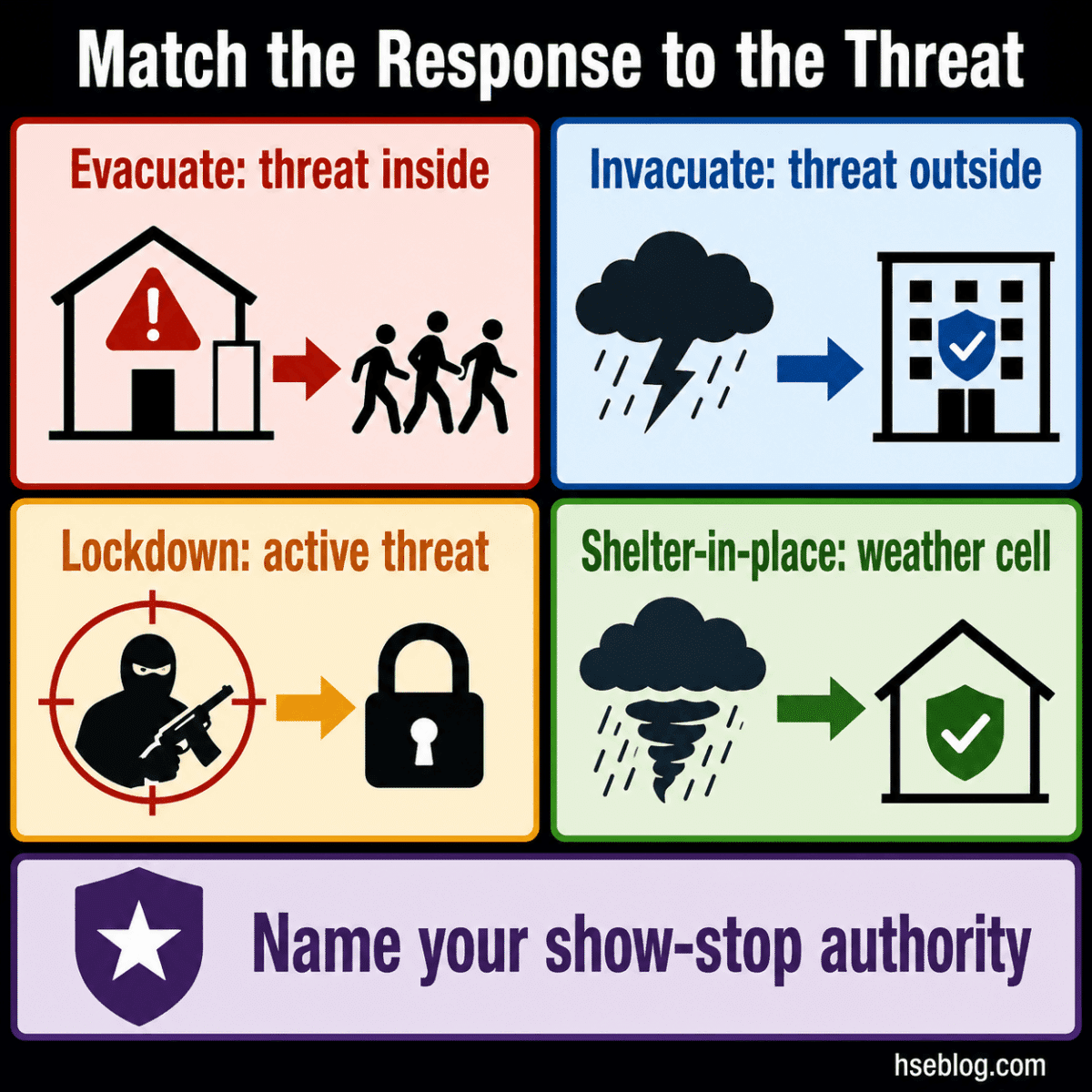
The response is not a single "evacuate" reflex — different threats need different movements, and confusing them gets people hurt.
| Response | When it applies |
|---|---|
| Evacuation | Threat inside the venue — fire, structural failure; move people out |
| Invacuation | External threat — move people into a safer building or zone |
| Lockdown | Active threat where movement increases exposure; secure in place |
| Shelter-in-place | Short-duration external hazard — severe weather cell passing |
Three structural elements turn scenarios into a usable plan. There must be a clear incident command structure with defined escalation triggers, integration with the emergency services agreed in advance, and explicit show-stop authority — a named role empowered to halt the event and the pre-set thresholds that compel it.
For the US framing, FEMA's Special Events Contingency Planning (IS-15.B) sets out how to build a planning team, run a hazard analysis, and apply the Incident Command System within NIMS to special events — a useful structure regardless of jurisdiction.
Event Safety Legal and Regulatory Requirements by Jurisdiction
Legal disclaimer: Regulatory content here reflects a general HSE professional's understanding of the relevant requirements as of 2026. It is not legal advice. Specific compliance questions, enforcement situations, or prosecution risk should be directed to qualified legal counsel in the applicable jurisdiction, and you should always confirm your local authority's requirements.
The legal obligations differ by jurisdiction, and the single most important synthesis point is one most sources miss: best-practice guidance and statutory duty are not the same thing, but departing from recognised guidance is treated as evidence that you failed the legal duty. "We weren't legally required to follow the Purple Guide" is a weak defence in front of a regulator or a court.
United Kingdom
The UK framework rests on a general duty backed by a specific assessment requirement.
- Health and Safety at Work etc. Act 1974, s.2–s.3 (UK): Imposes a general duty to ensure, so far as is reasonably practicable, the health and safety of employees and of others affected — which includes the public at an event.
- Management of Health and Safety at Work Regulations 1999, reg. 3 (UK): Requires the suitable-and-sufficient risk assessment that underpins the whole exercise.
- The Purple Guide (UK, best practice — not statute): The Events Industry Forum's recognised benchmark, used by organisers, local authorities, SAGs, and emergency services to assess event safety plans. It replaced the withdrawn HSG195.
United States
US obligations come through a general duty, a life-safety code, and a federal planning framework.
- OSHA General Duty Clause (US): Requires employers to provide a workplace free from recognised hazards likely to cause death or serious harm — the catch-all where no specific standard applies.
- NFPA 101 Life Safety Code (US, as adopted by the AHJ): Assembly-occupancy provisions require at least one crowd manager for 50+ persons, additional managers above an occupant load of 250, life-safety evaluation, and adequate means of egress. Always verify the locally adopted edition.
- FEMA IS-15.B (US): A framework for special-event planning teams, hazard analysis, and ICS integration within NIMS.
| Standard | Jurisdiction | What it requires |
|---|---|---|
| HSWA 1974, s.2–s.3 | UK | General duty to protect staff and public, so far as reasonably practicable |
| MHSWR 1999, reg. 3 | UK | Suitable-and-sufficient risk assessment |
| The Purple Guide | UK (best practice) | Recognised benchmark for crowd, medical, structures, welfare |
| OSHA General Duty Clause | US | Workplace free of recognised serious hazards |
| NFPA 101 (assembly) | US (per AHJ) | Crowd managers, egress, life-safety evaluation |
| FEMA IS-15.B | US | Special-event hazard analysis and ICS |
Regulatory currency note: This regulatory content was last reviewed in 2026. Re-confirm before relying on it — Martyn's Law in particular is moving toward active enforcement.
Martyn's Law: What Event Organisers Need to Know
The Terrorism (Protection of Premises) Act 2025 — known as Martyn's Law — is the most consequential recent change for UK event organisers, and it is not yet in force. It received Royal Assent on 3 April 2025, final statutory guidance was published in April 2026, and active enforcement is expected around Spring 2027, with the Security Industry Authority as regulator (ProtectUK).
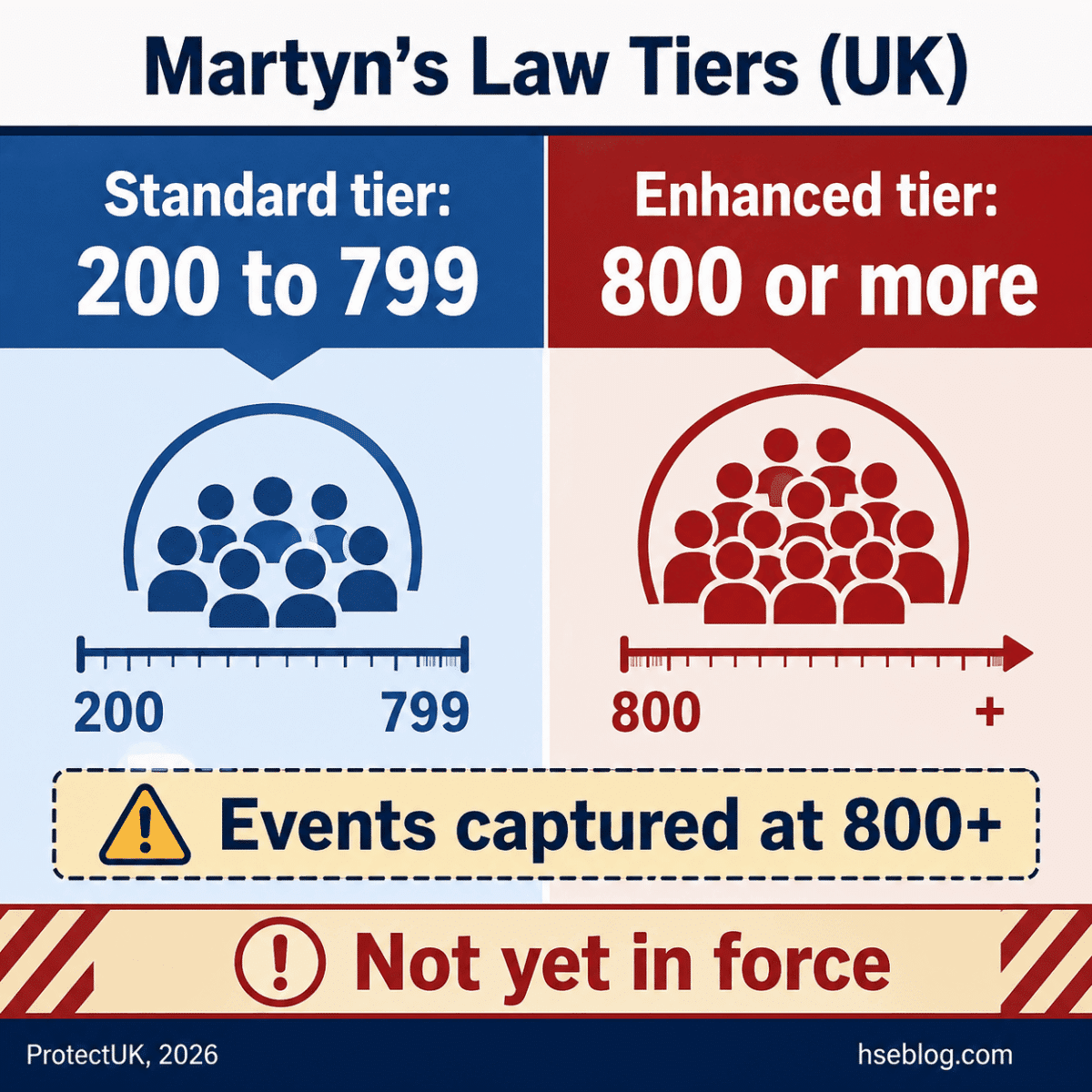
The Act introduces tiered public-protection duties based on the number of people present:
Tier thresholds (UK): The standard tier covers premises hosting 200–799 people; the enhanced tier covers premises and events hosting 800 or more. Qualifying public events sit in the enhanced tier at the 800+ threshold, with duties around evacuation, invacuation, lockdown, and communication.
The penalties give the duty teeth. For enhanced-tier non-compliance, the maximum monetary penalty can reach up to £18 million or 5% of qualifying worldwide revenue, whichever is greater (legal analysis of the Act, Ashfords LLP, 2025). The official scope, thresholds, and timeline are set out in the ProtectUK Martyn's Law overview.
A second freshness point worth tracking: a new edition of The Purple Guide was published by the Events Industry Forum in early 2026, continuing its rolling-update model as the live UK benchmark — so cite the current online edition, never the withdrawn HSG195.
Frequently Asked Questions
Do small events need a risk assessment?
Yes — proportionality, not exemption. A suitable-and-sufficient assessment scales down for a village fete but never disappears, because the legal duty under MHSWR 1999, reg. 3 (UK) applies regardless of size. The "it's only a small fete" assumption is exactly where avoidable harm slips through. The depth changes with the risk; the requirement to assess does not.
What's the difference between a risk assessment and an event safety plan?
The risk assessment is the analysis — it identifies hazards and decides controls. The event safety plan is the operational document that turns that analysis into named roles, procedures, and resources for the live event. One feeds the other. Many sources conflate them, but knowing a risk exists is not the same as having an executable plan to manage it on the day.
Does a Safety Advisory Group approve my event?
No. A SAG is a multi-agency advisory body that reviews and challenges your event safety plan, but it does not license the event, issue a safety permit, or accept your liability. The legal duty stays with the organiser throughout. Treating SAG engagement as a sign-off that transfers responsibility is a common and dangerous misreading of its role.
How many stewards or crowd managers do I need?
There is no universal number. Under NFPA 101 (US), assembly occupancies need at least one crowd manager for 50+ persons and more above an occupant load of 250 — an occupancy-based ratio. The UK's Purple Guide instead uses a risk-tiered model. Either way, tie staffing to density, flow, and layout, not headcount alone.
What capacity triggers Martyn's Law?
Under the Terrorism (Protection of Premises) Act 2025 (UK), the standard tier covers 200–799 people and the enhanced tier covers 800 or more, with public events captured at the 800+ threshold. The law is not yet in force — enforcement is expected around Spring 2027 — and it applies to the UK only. Confirm current status before relying on it.
What should I do if severe weather threatens an outdoor event?
Decide before, not during. Set pre-defined trigger thresholds — including wind limits for temporary structures — assign show-stop authority to a named role, and communicate the contingency to staff and emergency services in advance. The fatal pattern is reactive decision-making during escalation, when the time to act has already narrowed.
Conclusion
The single thing the events industry gets wrong, again and again, is treating the risk assessment as a document to be completed rather than a discipline to be practised. The assessment that satisfies a licensing condition and then sits in a folder is not protecting anyone; the one that gets reopened every time the build, the weather, or the crowd profile changes is. That shift — from artefact to working tool — is the highest-impact change most organisers can make.
The crowd-safety reframe is the second. Once you accept that density, not headcount, is the variable that kills, your controls move upstream into admission rate and layout, where they actually prevent harm, instead of downstream into reactive marshalling that arrives too late. Event safety management is ultimately about deciding the uncomfortable questions — who stops the show, at what threshold, on whose authority — while there is still room to decide them calmly.
With Martyn's Law moving toward enforcement and the Purple Guide refreshed, the bar for a defensible plan is rising, not holding steady. Build the plan the people on site will actually read, label every threshold by its jurisdiction, and treat recognised guidance as the standard you will be measured against — because that is exactly how it will be used.