TL;DR
- Inorganic arsenic in CCA carries an OSHA airborne limit of 10 µg/m³ (8-hour TWA), with medical surveillance triggered at half that level (OSHA, 29 CFR 1910.1018).
- Hexavalent chromium, also in CCA, sits at 5 µg/m³ (8-hour TWA) — among the tightest metal limits in the OSHA standard (OSHA, 29 CFR 1910.1026).
- Coal-tar creosote is a PAH mixture that IARC rates a probable human carcinogen (Group 2A), governed by a 0.2 mg/m³ limit for coal-tar-pitch volatiles (IARC, 2010; OSHA, Table Z-1).
- Pentachlorophenol production ended in the US in 2022; treated stock may be used only until February 2027 before the phase-out completes (US EPA, 2022).
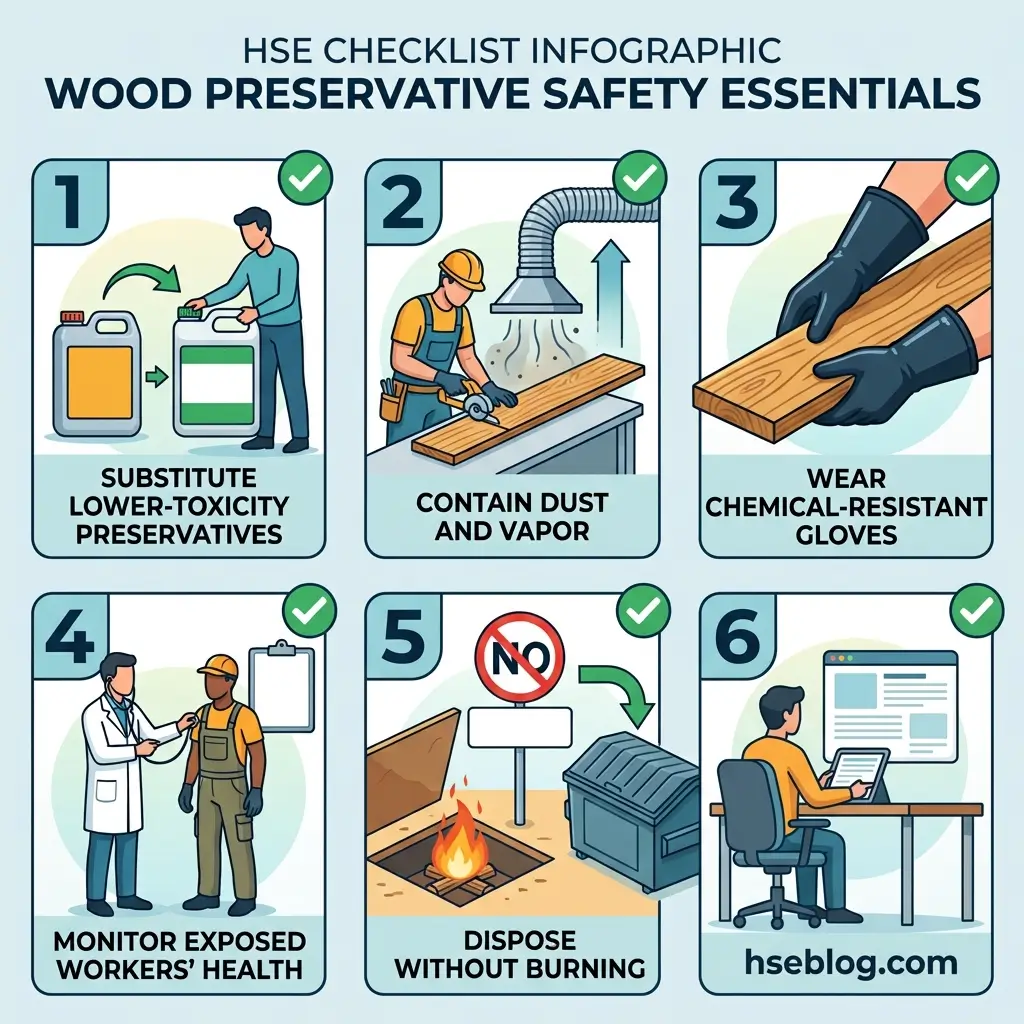
Wood preservative chemical safety centers on three heavy-duty pesticide systems — chromated copper arsenate, creosote, and pentachlorophenol — that carry known or probable carcinogens. Protecting people means controlling skin and inhalation exposure through substitution, enclosed treatment, dust control, respiratory protection, and health surveillance, then disposing of treated wood without burning or leaching it.
A belief persists on job sites and in lumber aisles: the arsenic problem in treated wood was solved in 2003. It wasn’t — the US EPA’s phase-out that year covered only residential chromated copper arsenate, while the same arsenic-and-chromium chemistry still treats utility poles, pilings, and marine timber (US EPA, Chromated Arsenicals).
Every heavy-duty wood preservative is a pesticide built to kill fungi and insects, which is exactly why it demands respect from the people who handle it. This guide covers wood preservative chemical safety end to end — what these chemicals contain, how they injure the body, the exposure limits that bound them, and the controls that hold exposure and environmental damage in check.
What’s Actually Inside Wood Preservative Chemicals
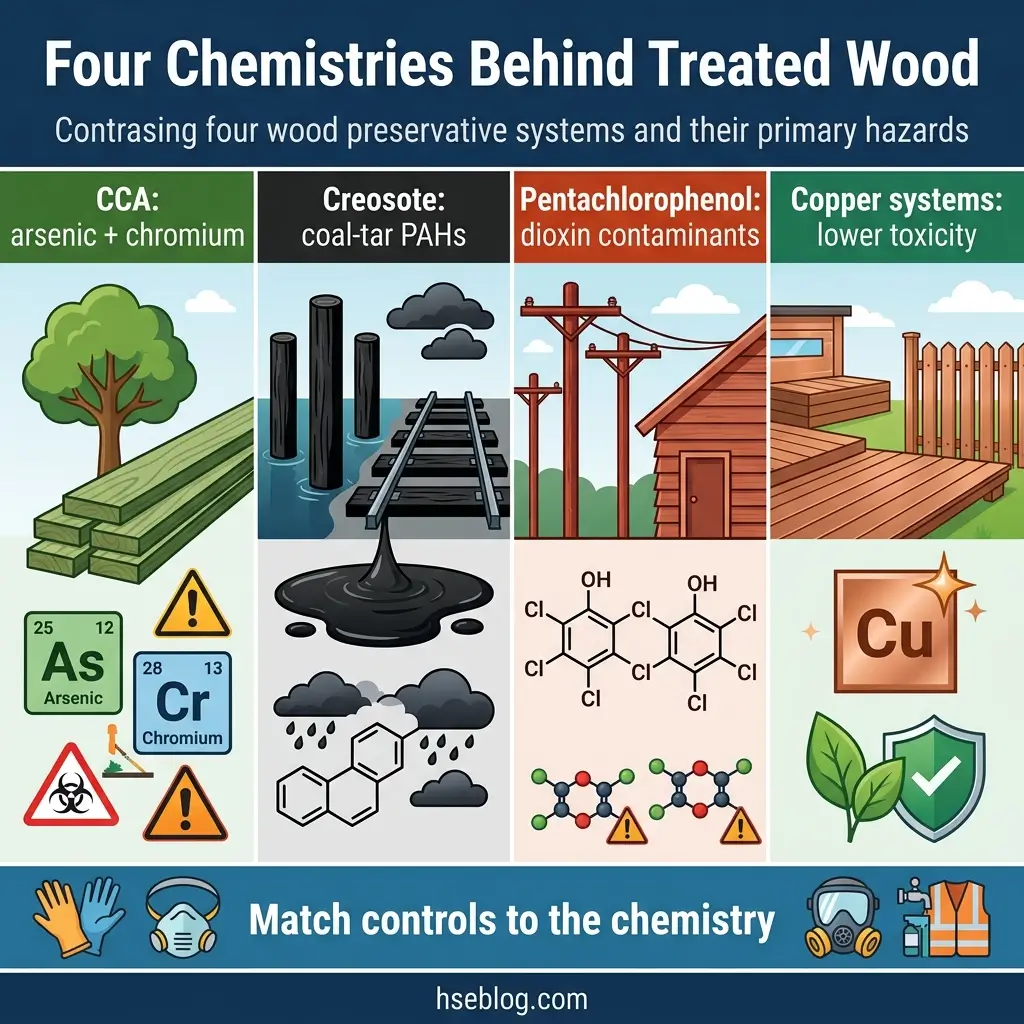
The hazard depends entirely on which chemistry you’re holding, and heavy-duty preservatives fall into just a handful of families. Read the family first; the controls follow from it.
| Preservative | Active chemistry | Primary hazard | Current status |
|---|---|---|---|
| Chromated copper arsenate (CCA) | Arsenic + hexavalent chromium + copper | Two carcinogens; metal leaching | Residential use ended 2003; still used for poles, pilings, marine |
| Creosote | Coal-tar PAHs incl. benzo(a)pyrene | Probable carcinogen; skin phototoxicity | Restricted-use pesticide (US); EU tightening |
| Pentachlorophenol (penta) | Chlorophenol + dioxin/furan contaminants | Anticipated carcinogen; dioxins | US phase-out completes 2027; Stockholm POP |
| Copper azole / ACQ | Copper + azole or quaternary co-biocide | Irritant; fastener corrosion | Dominant residential replacements |
| Borates | Boron compounds | Low mammalian toxicity; leaches when wet | Interior and protected use |
Two points separate the legacy chemistries from the newer ones. The arsenic, chromium, and coal-tar systems are restricted-use pesticides applied only inside licensed facilities, while copper-based products are the versions a homeowner now buys off the rack.
The older chemistries have not vanished from the supply chain. CCA remains under EPA registration review, and the agency’s most recent interim decision added mitigation measures specifically to protect treatment-plant workers (US EPA, 2025) — a signal that regulators still view the workforce, not the public, as the exposed population.
How These Chemicals Reach and Harm the Body
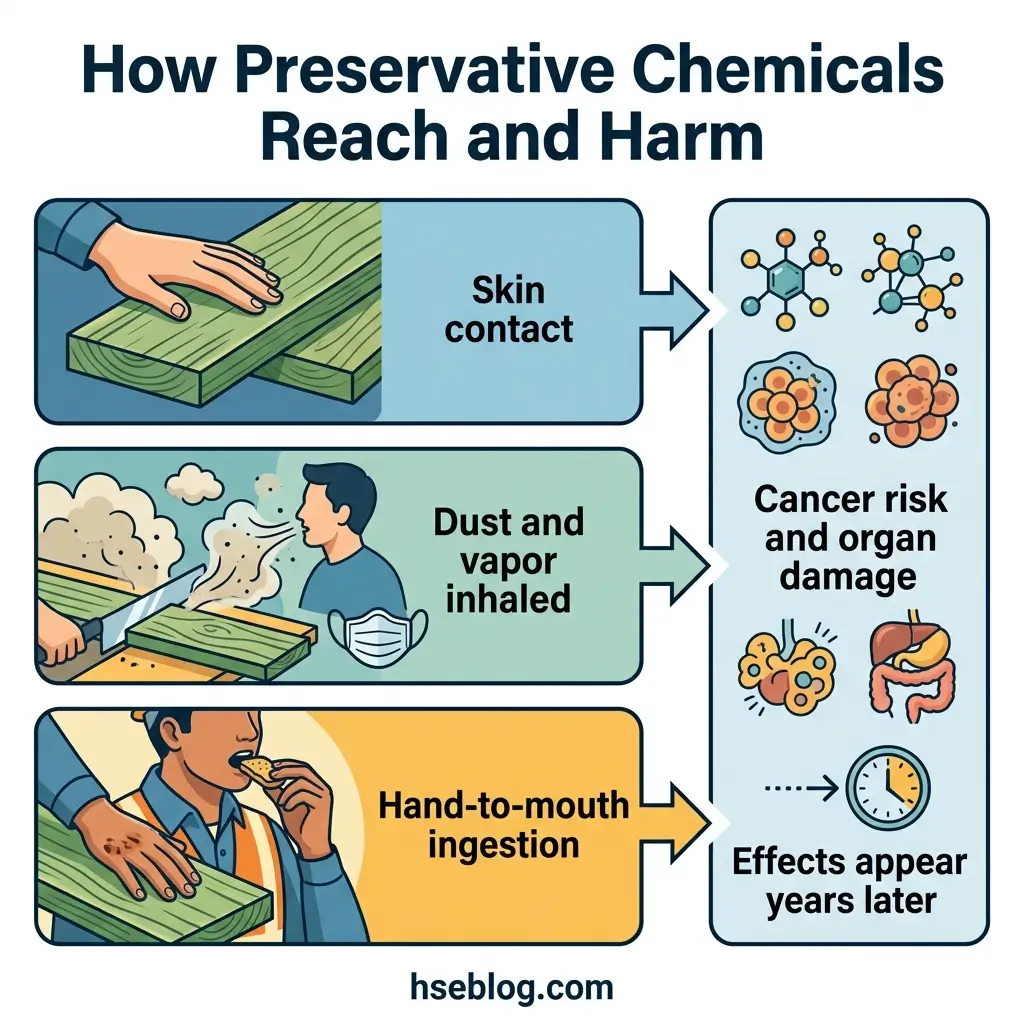
The damage almost always arrives through three doors — skin, lungs, and hand-to-mouth ingestion — and for these chemicals the endpoints include cancers that surface decades after the exposure.
Skin and eye contact
- Arsenic and chromium residues dislodge from CCA surfaces onto hands and settle into cuts and hair follicles.
- Creosote is phototoxic: skin contact followed by sunlight produces burning and blistering, which is why creosote safety data sheets warn workers to stay out of direct sun for two to three days after contact.
- Eye splashes of creosote cause conjunctivitis and, in severe cases, corneal scarring.
Inhalation of dust and vapor
- Sawdust from treated wood carries the preservative into the lungs — the main route of uptake in the wood-preserving trade.
- Coal-tar-pitch volatiles from heated creosote are linked to cancer of the lung, kidney, and skin (NIOSH).
- Hexavalent chromium attacks the respiratory tract and is a confirmed lung carcinogen.
Ingestion and the hand-to-mouth route
- Eating, drinking, or smoking with contaminated hands transfers arsenic directly.
- Pentachlorophenol is absorbed readily and carries dioxin and furan contaminants associated with chloracne and immune effects.
Inorganic arsenic is a Group 1 human carcinogen tied to lung, bladder, skin, kidney, and prostate cancer, and creosote is classed Group 2A — probably carcinogenic — with the profile refreshed in the ATSDR Toxicological Profile for Creosote updated in 2024. The pattern that matters for practitioners: these are latency diseases, so a clean shift feels identical to a harmful one, and the feedback only arrives years later.
A note on scope: the material here on exposure, health effects, and biological monitoring is for HSE practitioner reference. It is not medical advice. Anyone with symptoms or a specific exposure concern should see an occupational physician or qualified medical professional.
The Exposure Limits and Rules That Govern Wood Treatment
In the US, three OSHA substance-specific standards set the airborne numbers, and FIFRA decides who may apply these chemicals at all. Where limits differ between bodies, the more protective figure is the one to design around.
| Contaminant | OSHA PEL (8-hr TWA) | Notes | Standard |
|---|---|---|---|
| Inorganic arsenic | 10 µg/m³ | Action level 5 µg/m³ triggers monitoring | 29 CFR 1910.1018 |
| Hexavalent chromium | 5 µg/m³ | Regulated area required above the PEL | 29 CFR 1910.1026 |
| Coal-tar-pitch volatiles | 0.2 mg/m³ (benzene-soluble) | NIOSH recommends a lower 0.1 mg/m³ | 29 CFR 1910.1000, Table Z-1 |
Beyond the numbers, the licensing regime is the real gate. Under FIFRA, CCA, creosote, and penta are restricted-use pesticides that only a certified applicator may apply — treatment is not open work, and the OSHA hexavalent chromium standard layers exposure monitoring and regulated areas on top of that.
The jurisdictional picture diverges sharply, and that divergence is itself a compliance risk for anyone operating across borders:
- EU: Creosote is a CLP Category 1B carcinogen, and ECHA’s scientific committees have backed a proposal to restrict its market placement and ban secondary reuse of creosote-treated wood (ECHA, 2023).
- UK: HSE ran a public consultation across late 2024 reviewing which creosote uses remain permitted under the GB Biocidal Products Regulation.
- International: Pentachlorophenol is listed under the Stockholm Convention on Persistent Organic Pollutants, which is what aligned the US cancellation with the global position.
Regulatory content here reflects a general HSE reading of US requirements as of 2026, with EU and UK positions noted where they diverge. It is not legal advice. Specific compliance, enforcement, or liability questions should go to qualified legal counsel in the relevant jurisdiction.
Controlling Exposure During Handling and Treatment
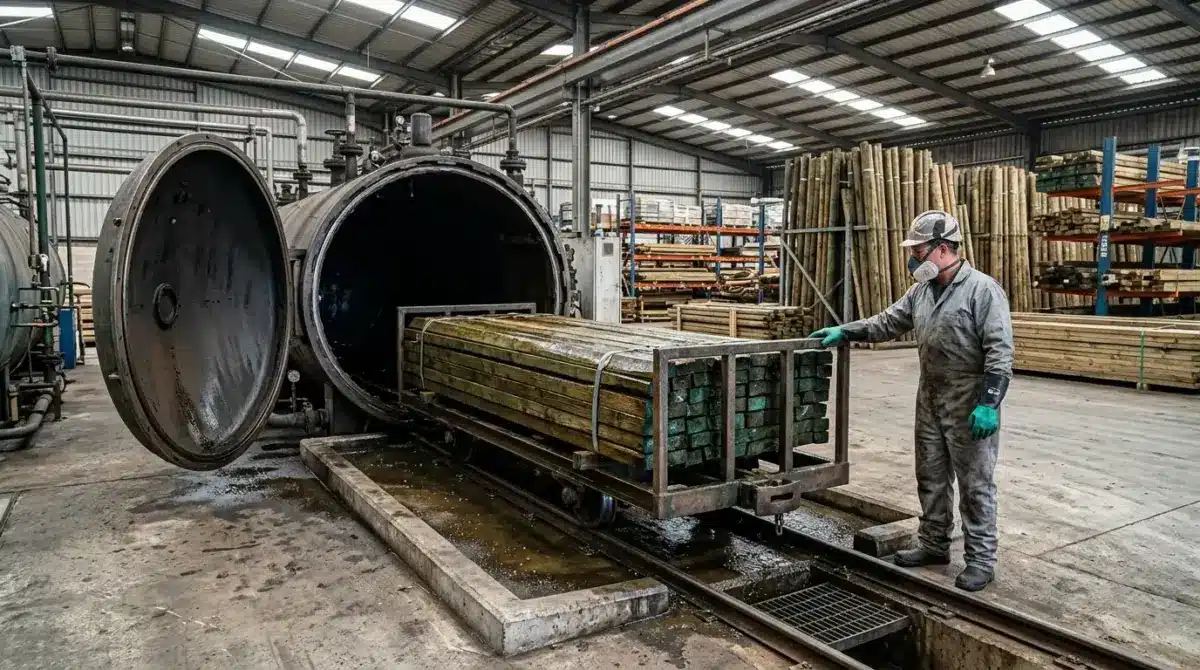
The control that does the most work on a treatment site is the one you never see in a photograph — enclosing the process so the chemical never reaches a breathing zone. Everything else is backup to that.
Start with substitution
- Move down the toxicity ladder where the end use allows: copper azole or ACQ instead of CCA, copper naphthenate or DCOIT for utility poles instead of penta.
- Substitution removes the arsenic and dioxin problem at source rather than managing it downstream.
Engineer the process to contain it
- Closed pressure cylinders and fixation areas keep freshly treated wood off open ground until the chemical is bound.
- Local exhaust ventilation captures vapor at cutting and mixing points.
- Sealed containment pads stop drip from reaching soil.
Fix the work practices that create dust
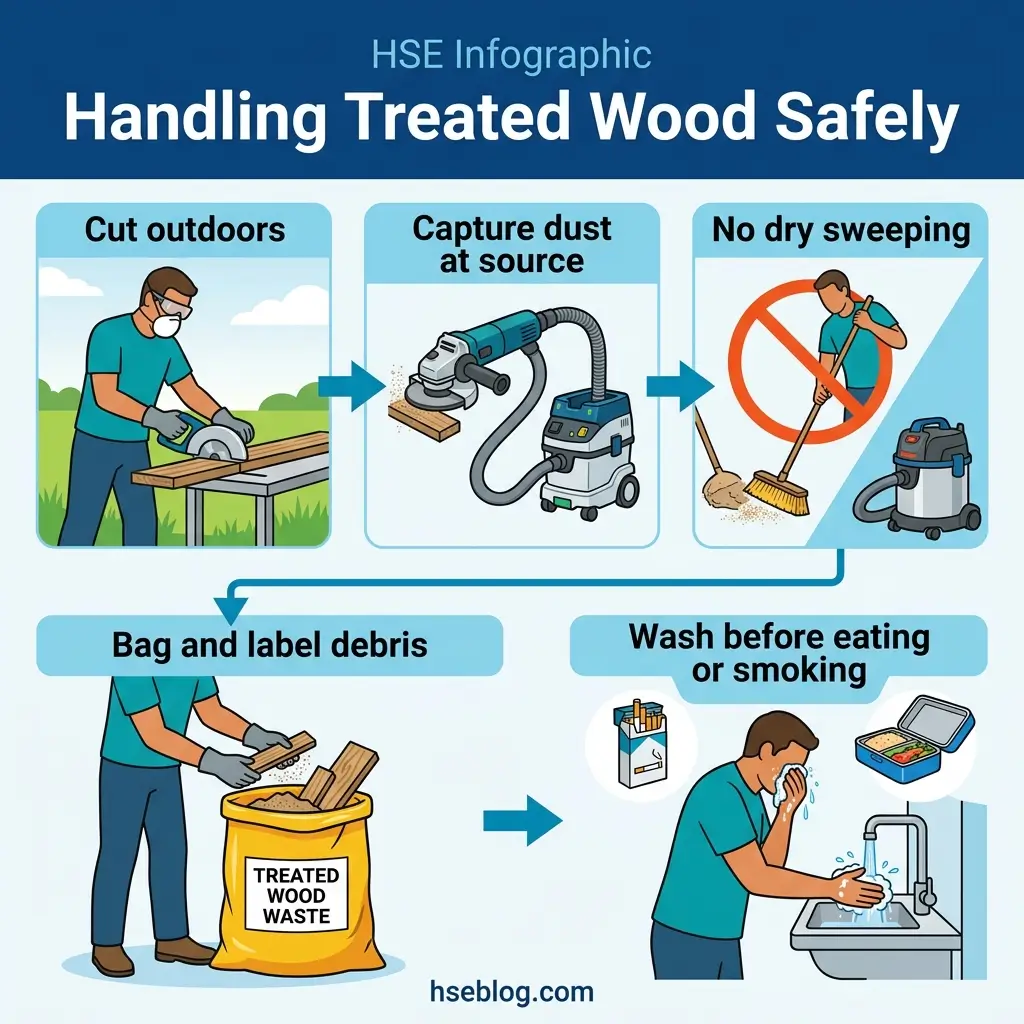
- Cut, sand, and machine treated wood outdoors or under extraction, never in an enclosed shop.
- Capture dust at the source with tool-mounted or HEPA collection.
- Never dry-sweep; the broom re-suspends everything you’re trying to remove.
- Damp-wipe surfaces and bag debris rather than piling it.
- Wash hands and face before eating, drinking, or smoking — no exceptions on a treatment site.
Match PPE to the chemical
- Chemical-resistant gloves (nitrile or neoprene), not cotton or leather, which absorb and hold preservative.
- Respiratory protection selected for the specific contaminant — a nuisance-dust mask is not adequate for arsenic or coal-tar work.
- Coveralls and eye protection, with creosote work adding sun cover for exposed skin.
Health surveillance
- Biological monitoring — urinary arsenic, for example — detects uptake that air sampling alone can miss.
- OSHA requires medical examinations for employees exposed to inorganic arsenic above the action level for 30 or more days a year.
Pressure treatment with CCA, creosote, or pentachlorophenol is not general maintenance work. Under US FIFRA it may be carried out only by, or under the direct supervision of, a certified pesticide applicator working to a site-specific risk assessment. The guidance here is general and does not replace that.
Disposal, Leaching, and Environmental Liability
The hazard doesn’t stop when the wood leaves the plant — it moves into soil, water, and smoke whenever the material is handled wrong at end of life. Disposal is where a manageable occupational risk becomes a community and liability problem.
The non-negotiables for treated-wood waste:
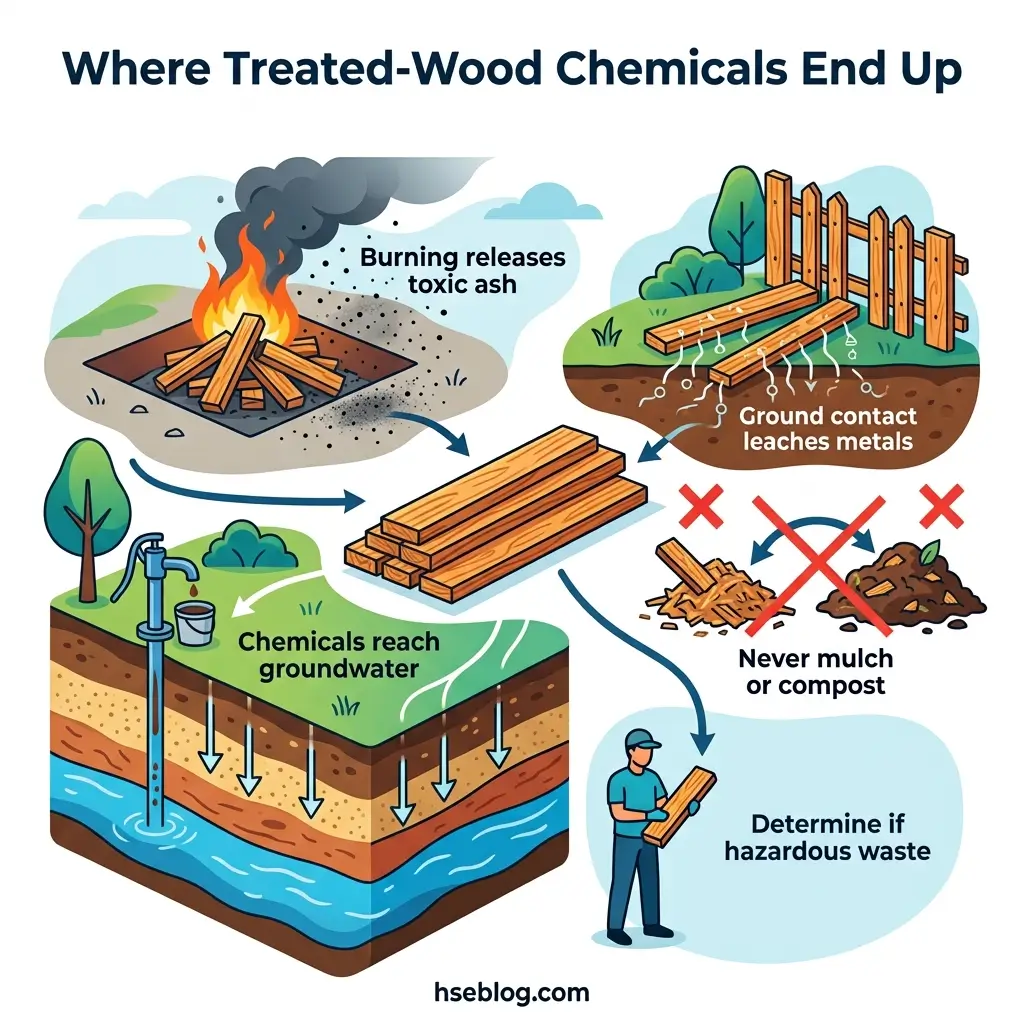
- Never burn it. EPA guidance is explicit: burning preservative-treated wood releases toxic chemicals in both smoke and ash, and arsenic-laden ash used on a garden has poisoned people.
- Never mulch or compost it. Sawdust and offcuts from CCA or creosote wood do not belong in soil amendments.
- Determine the waste class. Under RCRA, a non-household generator must assess whether its treated-wood waste is hazardous waste before disposal.
Leaching is the slower failure mode. Arsenic, chromium, and copper migrate from CCA in ground or water contact, and creosote’s PAHs can persist in groundwater for years — the reason many former wood-treating sites became long-term contaminated-land cases. EPA also records CCA as posing risks to aquatic invertebrates and plants, which is why ground-contact and over-water uses draw the closest environmental scrutiny.
Choosing Safer Wood Preservatives
When arsenic and coal-tar chemistries were pushed out of residential use, copper-based systems moved in — safer for people, but not consequence-free. The trade-offs shift from carcinogenicity to corrosion and leaching.
| Preservative | Basis | Best-fit use | Handling watch-out |
|---|---|---|---|
| ACQ | Copper + quaternary co-biocide | Decks, fences, ground contact | Corrodes fasteners; use hot-dip galvanized or stainless |
| Copper azole (CA) | Copper + azole co-biocide | Similar to ACQ, lighter loadings | Same corrosion; copper dust control |
| Copper naphthenate | Copper + naphthenic acids | Field cuts, poles | Solvent-borne types flammable; strong odor |
| Borates (DOT) | Boron compounds | Interior framing, sill plates | Leaches if it gets wet; keep dry |
Copper systems solve the acute toxicity problem but introduce two of their own. They accelerate corrosion of ordinary fasteners and connectors, and copper-tolerant fungi mean most formulations need a second co-biocide to stay effective.
The regulatory trajectory reinforces the direction of substitution. While the US keeps creosote as a restricted-use product, the EU is moving to close off its remaining uses (ECHA, 2023) — so a preservative that is compliant in one market may be near-prohibited in another.
Frequently Asked Questions
Can I burn scrap treated wood or use the ash in a garden?
No. EPA guidance is direct that preservative-treated wood should not be burned, because combustion releases toxic chemicals into both smoke and ash. Arsenic concentrates in the ash from CCA wood, and cases of poisoning have followed the use of that ash on vegetable gardens. Treated offcuts go to appropriate solid-waste disposal, never a fire pit.
Is CCA-treated wood actually banned?
No — this is a common misreading. The 2003 action was a voluntary phase-out of CCA for residential products only. Chromated copper arsenate is still used for utility poles, pilings, and marine structures, and EPA does not require removal of existing CCA decks or playsets (US EPA). “Restricted,” “phased out of one market,” and “banned” are three different things.
Do workers handling wood preservatives need medical monitoring?
For some chemistries, yes. OSHA requires medical examinations for employees exposed to inorganic arsenic above the action level of 5 µg/m³ for 30 or more days a year (29 CFR 1910.1018). Biological monitoring, such as urinary arsenic testing, is valuable because it captures total uptake across skin and lungs that air sampling alone can understate.
How do I tell what a piece of treated wood was treated with?
Use three cues. Color and residue help — CCA leaves a greenish tint, creosote is oily, dark, and pungent. The end-tag or stamp names the preservative and retention level on new material. End use is the strongest clue: utility poles and railway ties usually mean creosote or, on older stock, penta, while a modern deck board is almost certainly a copper system.
Are copper-based alternatives safe to handle without precautions?
They are far less toxic than the chemistries they replaced, but “safer” is not “harmless.” Copper and its co-biocides are irritants, the dust still warrants gloves and dust control, and these preservatives corrode standard fasteners — a structural risk if the wrong hardware is used. Basic dermal and respiratory precautions still apply.
Why is creosote still legal in the US but restricted in the EU?
Because two regulatory systems weighed the same evidence differently. In the US, creosote is a restricted-use pesticide under FIFRA, available only to certified applicators. In the EU it is a CLP Category 1B carcinogen, and ECHA’s committees have supported restricting its market placement and banning reuse of creosote-treated wood (ECHA, 2023). Same chemical, divergent legal status by jurisdiction.
The Direction Wood Preservation Is Heading
The trajectory is clear: away from arsenic, chromium, and coal-tar chemistries and toward copper systems and lower-toxicity actives. Pentachlorophenol’s US phase-out completes in 2027, the EU is closing in on creosote’s remaining uses, and CCA sits under active registration review (US EPA; ECHA).
That shift narrows the hazard but does not erase it. Millions of poles, ties, and legacy structures built with the older chemistries will stay in service — and in the waste stream — for decades, so wood preservative chemical safety for now means competence with both the chemistries being retired and the ones replacing them.
Treat every piece of preservative-treated wood as chemically active until you know otherwise. The label, the color, and the end use will usually tell you which hazard you’re managing before you ever pick up a saw.