
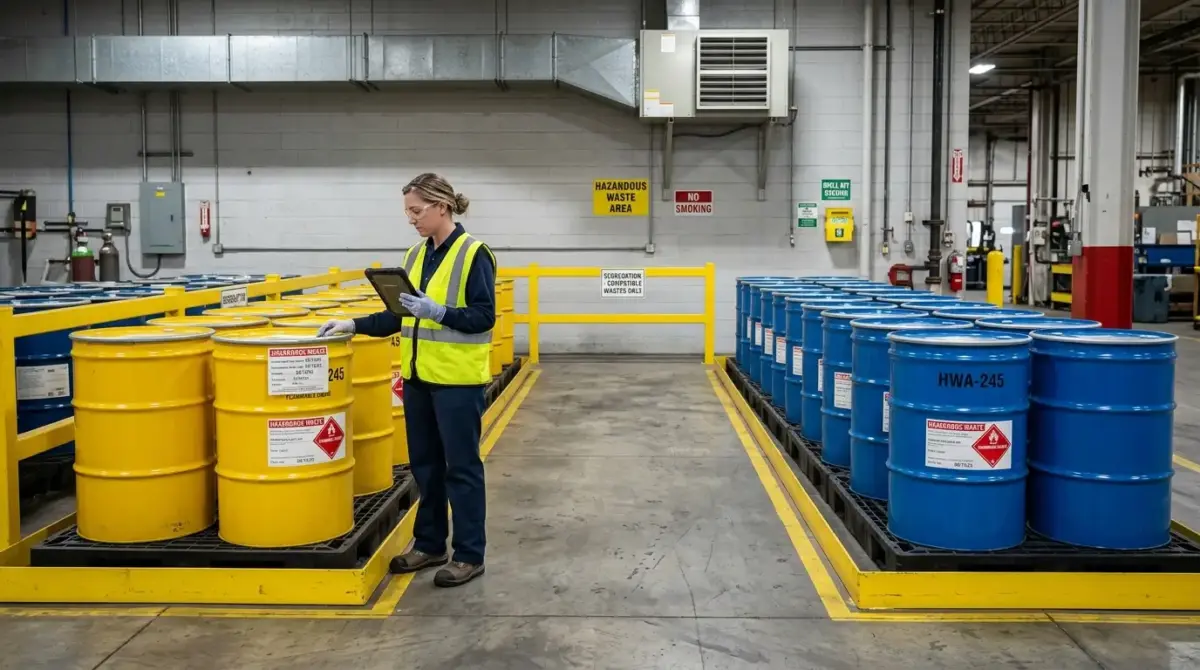
TL;DR
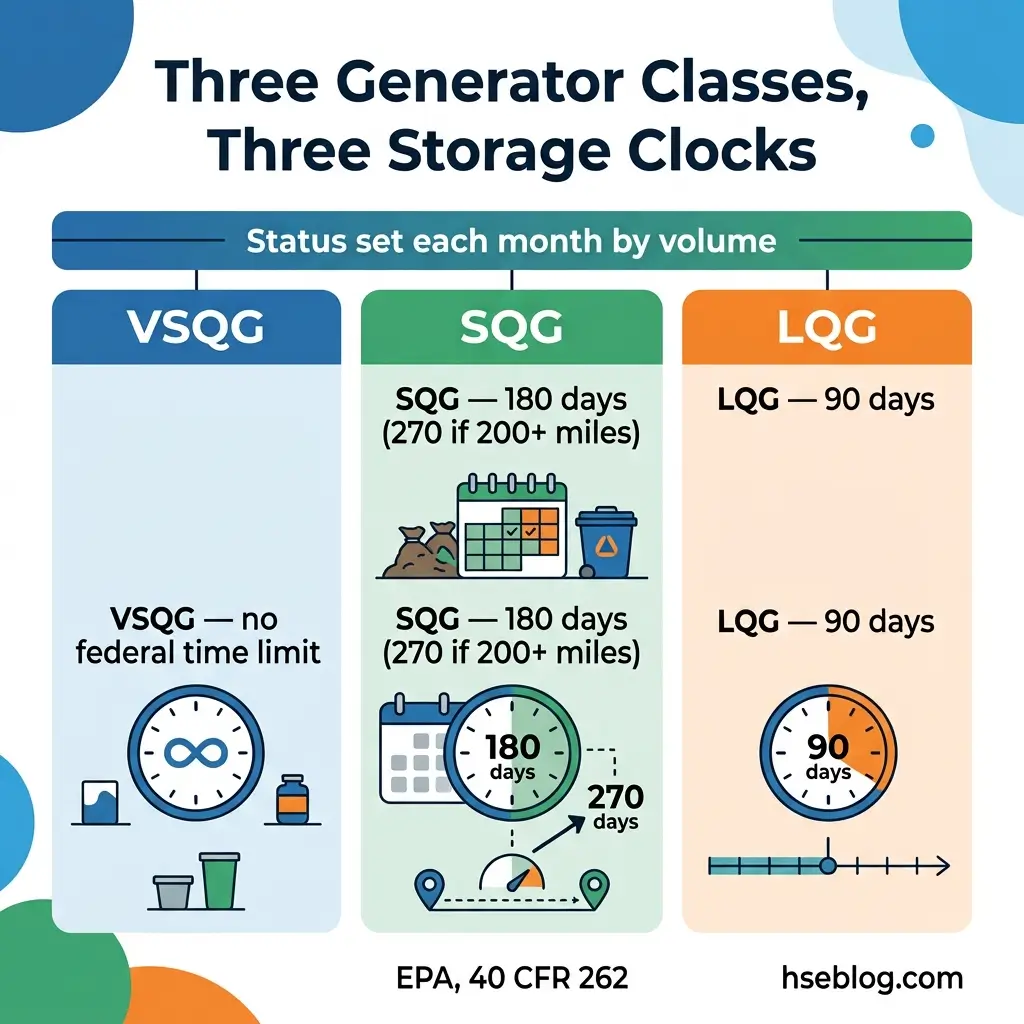
- If you’re a large quantity generator (LQG), the on-site clock is 90 days, with no quantity cap but a dated start required on every container (EPA, 40 CFR 262.17).
- If you’re a small quantity generator (SQG), you get 180 days — or 270 if your disposal facility is 200+ miles away — up to 6,000 kg on site (EPA, 40 CFR 262.16).
- If you’re a very small quantity generator (VSQG), there’s no federal time limit, but cross 1,000 kg on site and you become an SQG (EPA, 40 CFR 262.14).
- If waste sits past your limit without a permit, you’re operating as an unpermitted storage facility — among the more serious RCRA violations.
Hazardous waste storage under RCRA is time-limited on-site accumulation, not indefinite holding. Large quantity generators may accumulate for 90 days, small quantity generators for 180 (or 270 when shipping over 200 miles), and very small quantity generators face no federal clock but a 1,000-kilogram cap. Container and containment standards apply throughout.
A sealed drum of hazardous waste looks like a solved problem. It isn’t.
Steel corrodes from the inside as reactive contents attack the wall, and off-gassing builds pressure a closed lid was never meant to hold. Poly containers craze under sunlight and swell where solvents are incompatible with the plastic.
Every week a container waits, the odds of a leak, a reaction, or a failed inspection climb. That is the logic behind hazardous waste storage rules: time limits that push waste off site before it degrades, paired with containment that catches whatever escapes.
This guide covers how long you can legally hold hazardous waste, by generator category, and how satellite accumulation works. It also sets out the containment the regulations actually require — under US RCRA, with the key differences in UK and EU law.
Regulatory content here reflects general HSE professional understanding of the cited requirements as of 2026. It is not legal advice; specific compliance or enforcement questions belong with qualified counsel in the applicable jurisdiction. Life-safety-critical handling — segregating incompatible wastes, designing containment, responding to a leak — must be planned and supervised by a competent, trained person working from a site-specific risk assessment.
What “Storage” Actually Means Under the Rules
Under RCRA, most on-site holding of hazardous waste isn’t “storage” in the legal sense — it’s accumulation, a time-limited exemption from needing a storage permit. Cross the time or quantity threshold and that exemption falls away.
Accumulation versus storage
Accumulation is the short window a generator gets to collect waste before shipping it to a permitted treatment, storage, or disposal facility (TSDF). Storage, formally, is what a permitted TSDF does — and doing it without that permit is the violation the time limits exist to prevent.
Your generator category sets the rules
Everything downstream flows from one determination: how much hazardous waste your site generates in a calendar month. That status is not a fixed label — you re-evaluate it every month, and a busy month can move you up a tier (see EPA’s guidance on generator categories).
- VSQG — generates ≤100 kg of hazardous waste (or ≤1 kg of acutely hazardous waste) per month.
- SQG — generates more than 100 kg but less than 1,000 kg per month.
- LQG — generates 1,000 kg or more per month, or more than 1 kg of acutely hazardous waste.
Worth flagging early: what even counts as “hazardous” keeps moving. In February 2024, the EPA proposed listing nine PFAS compounds as RCRA hazardous constituents (Federal Register, 2024); the proposal’s status has shifted through 2025–2026, but the direction of travel is clear enough that facilities handling PFAS-bearing waste should watch the classification question closely.
How Long You Can Store Hazardous Waste, by Category
Three federal numbers set the on-site clock: 90 days, 180 days, and 270 days. Which one applies depends entirely on generator category, not on the type of drum or the size of the site.
| Category | Monthly generation | On-site time limit | Max on-site quantity |
|---|---|---|---|
| VSQG | ≤100 kg | No federal limit | 1,000 kg |
| SQG | >100 kg to <1,000 kg | 180 days (270 if TSDF 200+ miles away) | 6,000 kg |
| LQG | ≥1,000 kg | 90 days | No limit |
The clock is easy to misread. A common belief is that the 90-day window starts when a drum is full — it doesn’t; for central accumulation it begins when the first drop of waste enters that area, or when a container leaves a satellite area.
Two relief valves exist, but neither is automatic. An LQG or SQG facing genuinely uncontrollable, unforeseen circumstances can request a 30-day extension from the EPA Regional Administrator, and certain waste streams (such as electroplating sludges bound for metals recovery) carry their own longer windows under specific conditions.
Satellite Accumulation and the 55-Gallon Clock
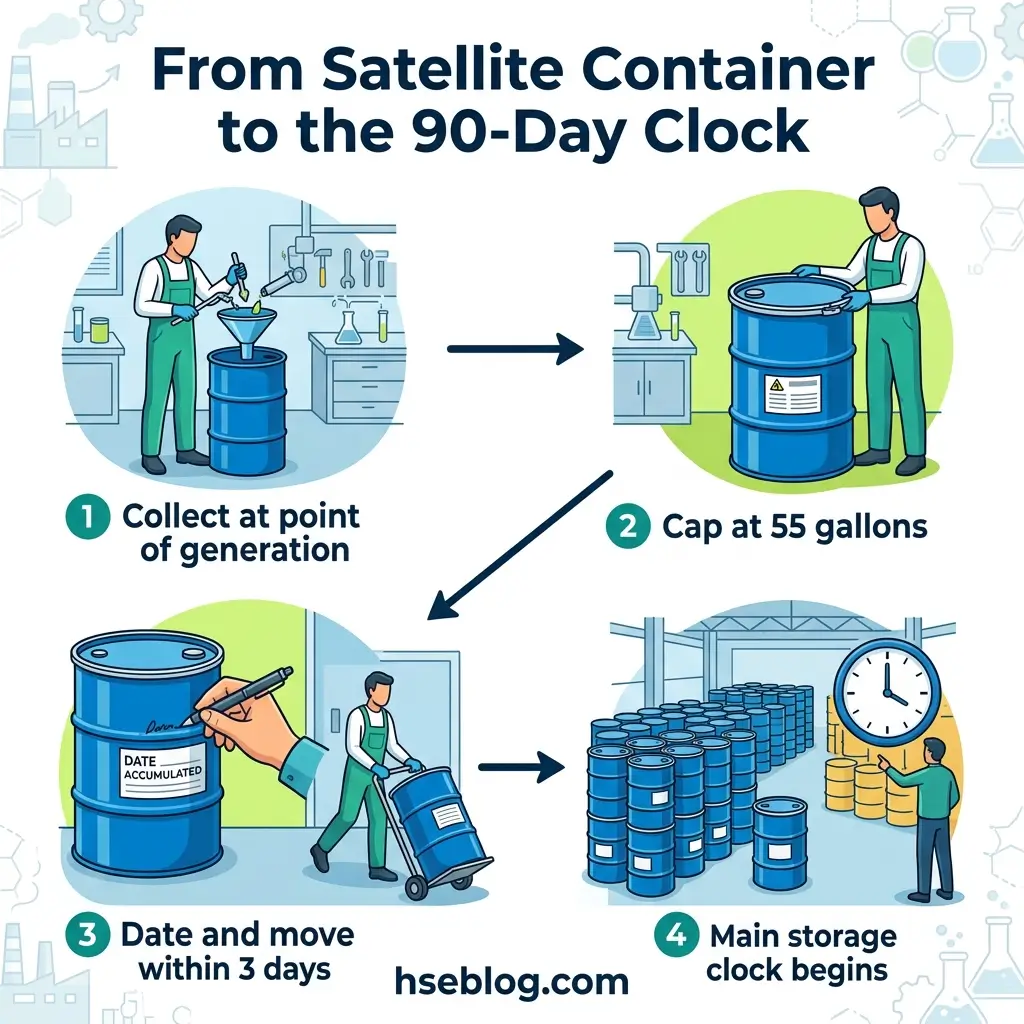
A satellite accumulation area (SAA) lets you collect hazardous waste right where it’s produced — up to 55 gallons — without starting the main storage clock. It’s the pressure-relief mechanism for a busy process line, and it has one hard trigger.
- Keep the container at or near the point of generation, under the control of the person operating that process.
- Keep it closed except when adding waste, and label it with its contents and hazard.
- Understand what isn’t running: the 90/180-day accumulation clock does not tick while waste sits in a compliant satellite area.
- Watch the ceiling: once you reach 55 gallons (or one quart of acutely hazardous waste), mark that container with the date and move it to central accumulation within three days.
- From that move, the main clock starts — 90 days for an LQG, 180 for an SQG.
Here’s the trap in “no time limit.” Satellite areas carry no federal day-count, but that is not permission to let containers age — degradation doesn’t pause for regulations, several state programs impose their own caps, and the practical rule is to collect and move, not to hoard.
Containment: Containers, Tanks, and Secondary Systems
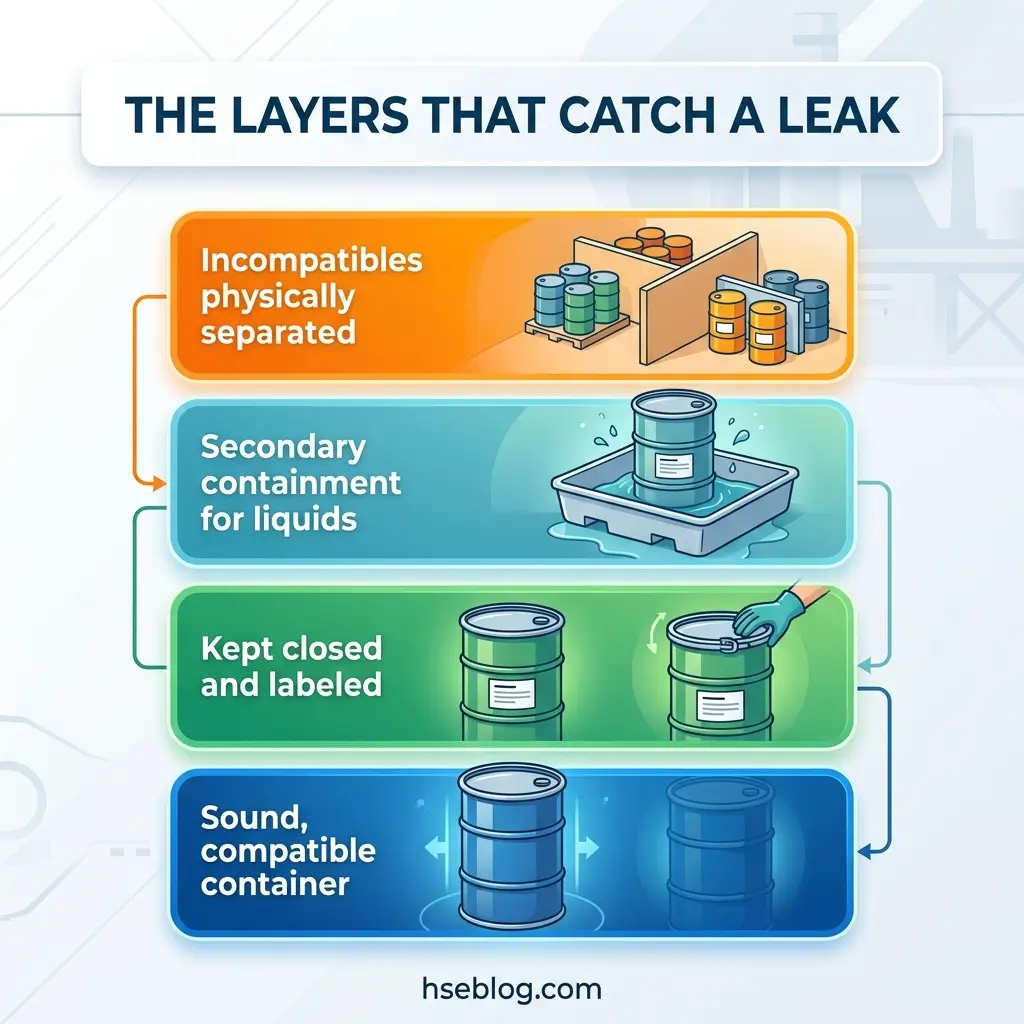
Containment answers a single question: when a container fails — and across a full storage cycle, some will — where does the waste go? The regulations build the answer in layers, and one of those layers is more nuanced than most checklists admit.
Container standards: condition, compatibility, closed
The federal container rules are short and strict, drawn from 40 CFR Part 265, Subpart I.
- Good condition — a container that begins to leak or corrode means the waste moves immediately to a sound container.
- Compatible material — the container can’t react with what’s inside it, which is why acids don’t sit in bare steel.
- Closed except in use — lids stay on unless you’re actively adding or removing waste.
- Labeled and dated — the words “Hazardous Waste,” the hazard, and the accumulation start date, kept legible.
- Inspected at least weekly in central accumulation areas, looking for leaks and deterioration.
Secondary containment: where it’s mandatory, where it isn’t
This is where practitioners get tripped up. Federal RCRA requires secondary containment for tank systems used by generators — Subpart J is explicit — but it does not impose a blanket secondary-containment mandate on container accumulation areas at the generator level (see 40 CFR 262.17).
That gap is filled from two directions. Many state programs require containment for containers holding liquids, and competent practice puts spill pallets or curbed, sealed floors under liquid drums regardless — because “not federally required” is a weak defense when a drum lets go over a floor drain.
Keeping incompatible wastes apart
Segregation is containment’s other half. A container of waste that’s incompatible with material nearby must be separated by a dike, berm, wall, or equivalent barrier, and waste can’t go into an unwashed container that last held something it reacts with.
The failure mode is chemistry, not paperwork: acids meeting bases, or oxidizers meeting flammables, can generate heat, gas, or fire fast — and a single shared containment tray can turn two compliant drums into one incident.
The Storage Failures Inspectors Cite Most
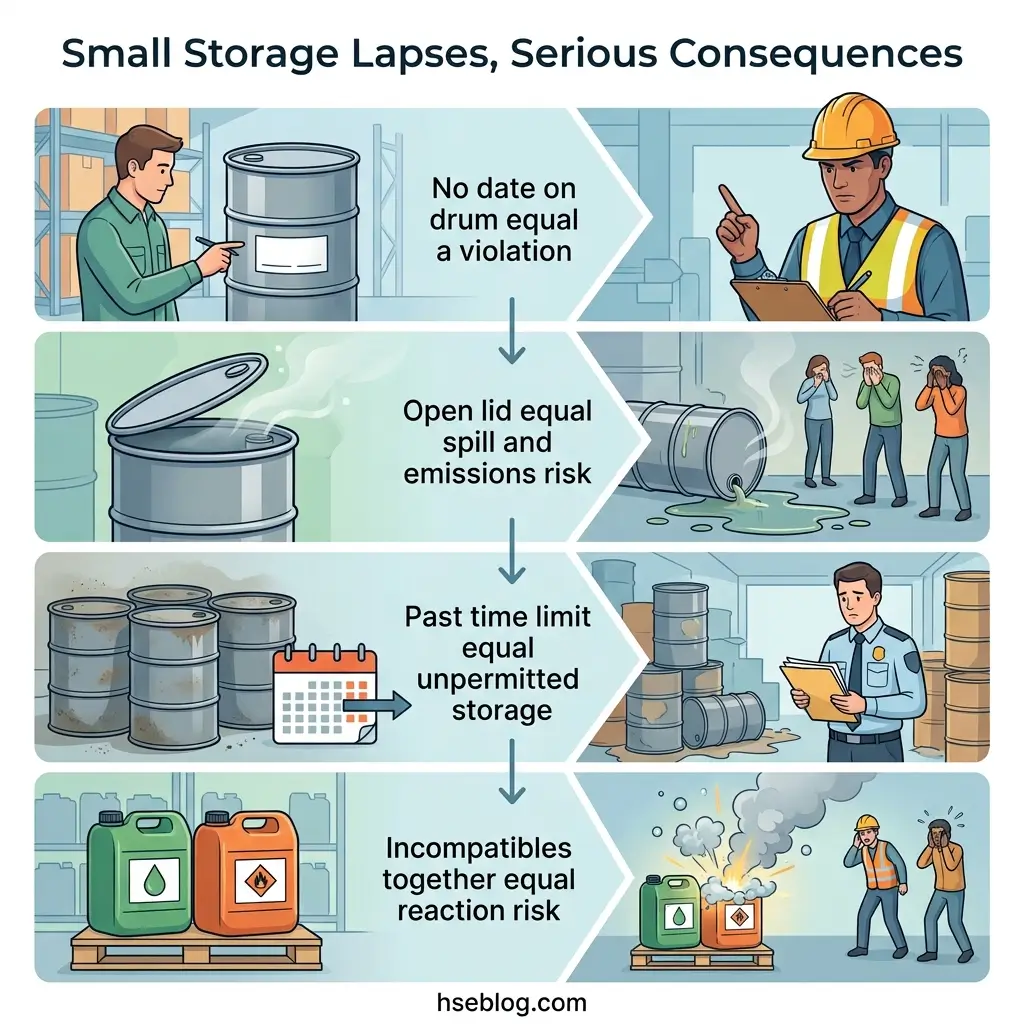
The findings that dominate RCRA container-management enforcement are rarely exotic. They cluster around dates, lids, and drums that overstayed — the ordinary failures of a storage area that nobody owned.
- Missing or illegible start dates — without a date, an inspector can’t confirm you’re inside the limit, so the container is treated as out of compliance.
- Containers left open — a lid off “just for the shift” is both an open-container citation and a real emissions and spill exposure.
- Over-limit drums — a drum past 90 or 180 days converts the site into unpermitted storage, a far heavier finding than a labeling slip.
- Incompatibles stored together — acids beside bases, oxidizers beside flammables, one thin barrier away from a reaction.
- Threshold creep — a single high-generation month quietly bumps an SQG into LQG territory, and the 90-day clock applies before anyone notices.
That last one is the judgment call worth planning for. If your monthly volumes run close to a category line, it is usually cheaper to ship early and stay in the lower tier than to absorb LQG’s shorter clock, biennial reporting, and fuller contingency-planning duties mid-cycle.
How UK and EU Storage Rules Differ
Outside the US, the storage clock is set differently. The UK caps how long a producer can hold hazardous waste on site, rather than counting days by generator size, and the EU works through a directive that Member States implement in their own permits.
| Jurisdiction | Governing framework | On-site / producer limit | Regulator |
|---|---|---|---|
| United States | RCRA, 40 CFR Part 262 | 90 / 180 / 270 days by category | EPA + authorized states |
| England & Wales | Hazardous Waste (E&W) Regs 2005; Environmental Permitting (E&W) Regs 2016 | Up to 12 months at producer premises | Environment Agency (SEPA / NRW / NIEA elsewhere) |
| EU | Waste Framework Directive 2008/98/EC | Set by Member-State permits | National competent authorities |
Two features of the UK regime carry weight in practice. The Environment Agency’s appropriate-measures guidance for permitted facilities, current as of 2026, expects documented maximum storage capacities, first-in-first-out rotation, and most wastes cleared within six months of receipt, with the EA notified if that slips (GOV.UK guidance).
The EU adds a hard line that the US handles more implicitly: Article 18 of the Waste Framework Directive bans mixing hazardous waste with other waste or diluting it, which shapes how containment and segregation are designed on the Continent. Where a business operates across these systems, the safe default is to run the shortest clock and the strictest segregation that any applicable jurisdiction demands.
Frequently Asked Questions
Bringing Storage Under Control
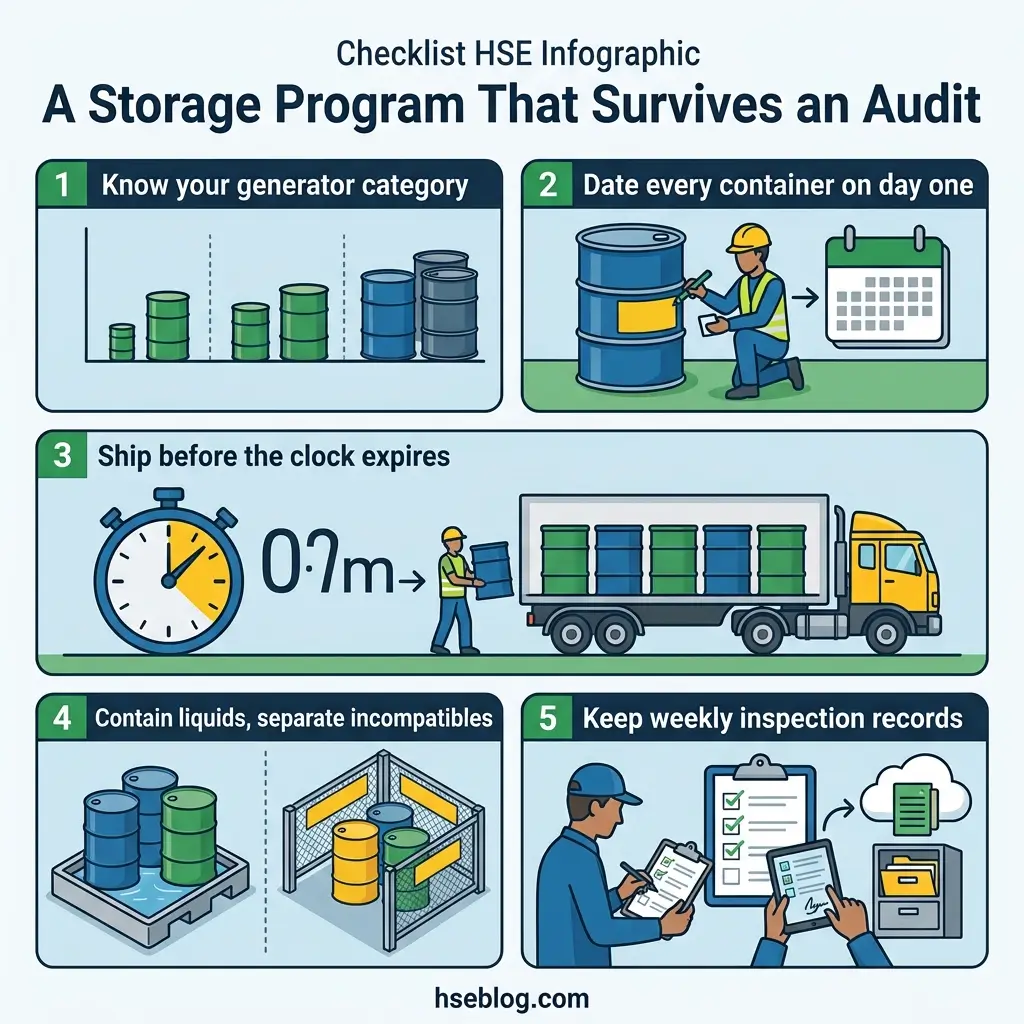
Sound hazardous waste storage is mostly two disciplines done relentlessly: date control and container control. Know your generator category each month, put a legible start date on every container the day it enters accumulation, and move waste off site before the clock runs out.
Treat containment as a system rather than a pallet. Sound, compatible, closed containers sit over secondary containment where liquids are involved — always under tanks, and under drums wherever state rules or good sense apply — with incompatible wastes physically separated. Then build the 90/180-day or 12-month window into the collection schedule, so no container quietly ages into a violation.
The boundary of what counts as hazardous keeps shifting, with PFAS the current case in point, so the most defensible program is the one that clears waste quickly and documents every step. A drum that leaves on schedule is a drum that never becomes evidence.