
TL;DR
- If your business produces, stores, moves or discards controlled waste, then you are a legal “waste holder” and the duty of care applies — there is no exemption for small firms.
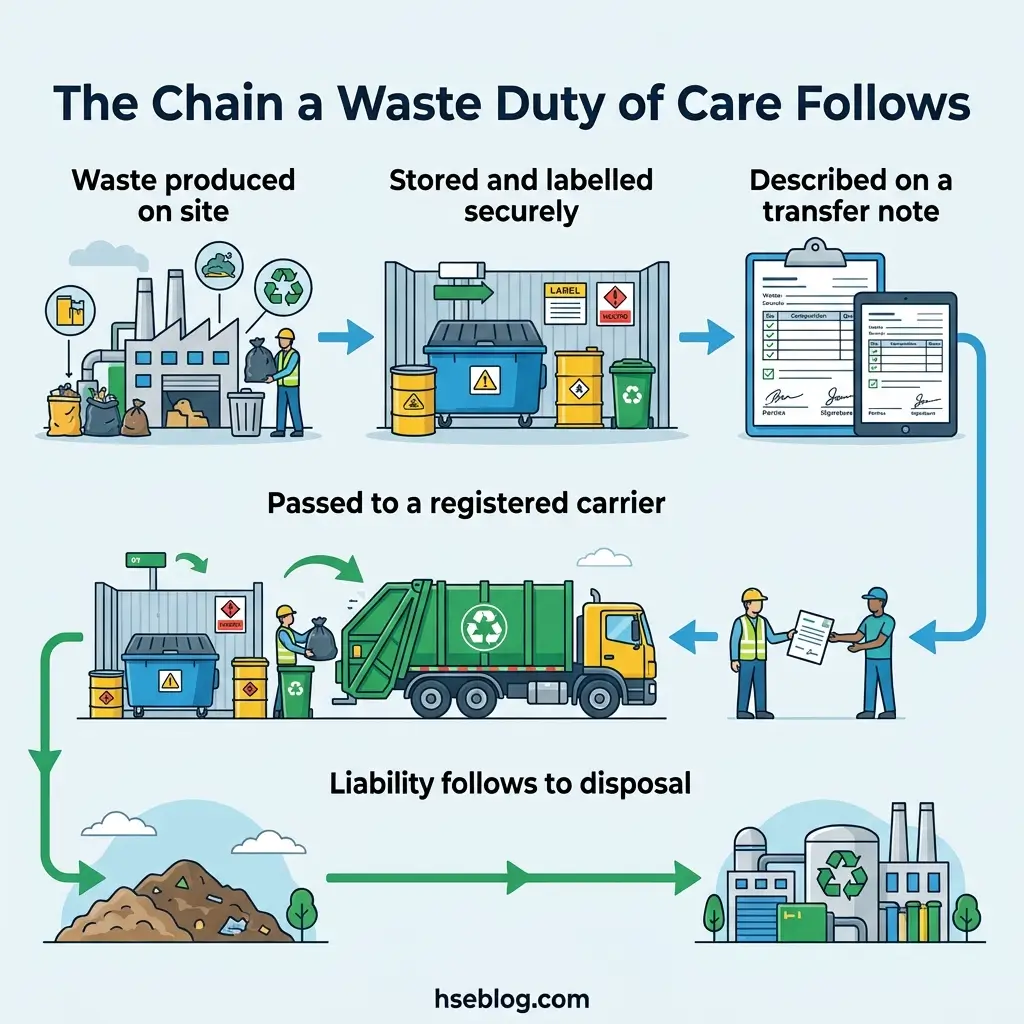
- If you hand waste to a carrier, then you must confirm they are registered before it leaves site, and your legal responsibility travels with the waste even after it goes.
- If you cannot produce your waste transfer notes for two years (three for hazardous waste), then you risk a fixed penalty notice or prosecution.
- If waste you produced is fly-tipped — even by your own contractor — then it can be traced back to you, and the fine falls on your business unless you can show you took reasonable steps.
The waste duty of care is a legal obligation under Section 34 of the Environmental Protection Act 1990. It makes an employer responsible for controlled waste from the moment it is produced until final recovery or disposal, requiring safe storage, accurate description, transfer only to authorised carriers, and records kept for at least two years.
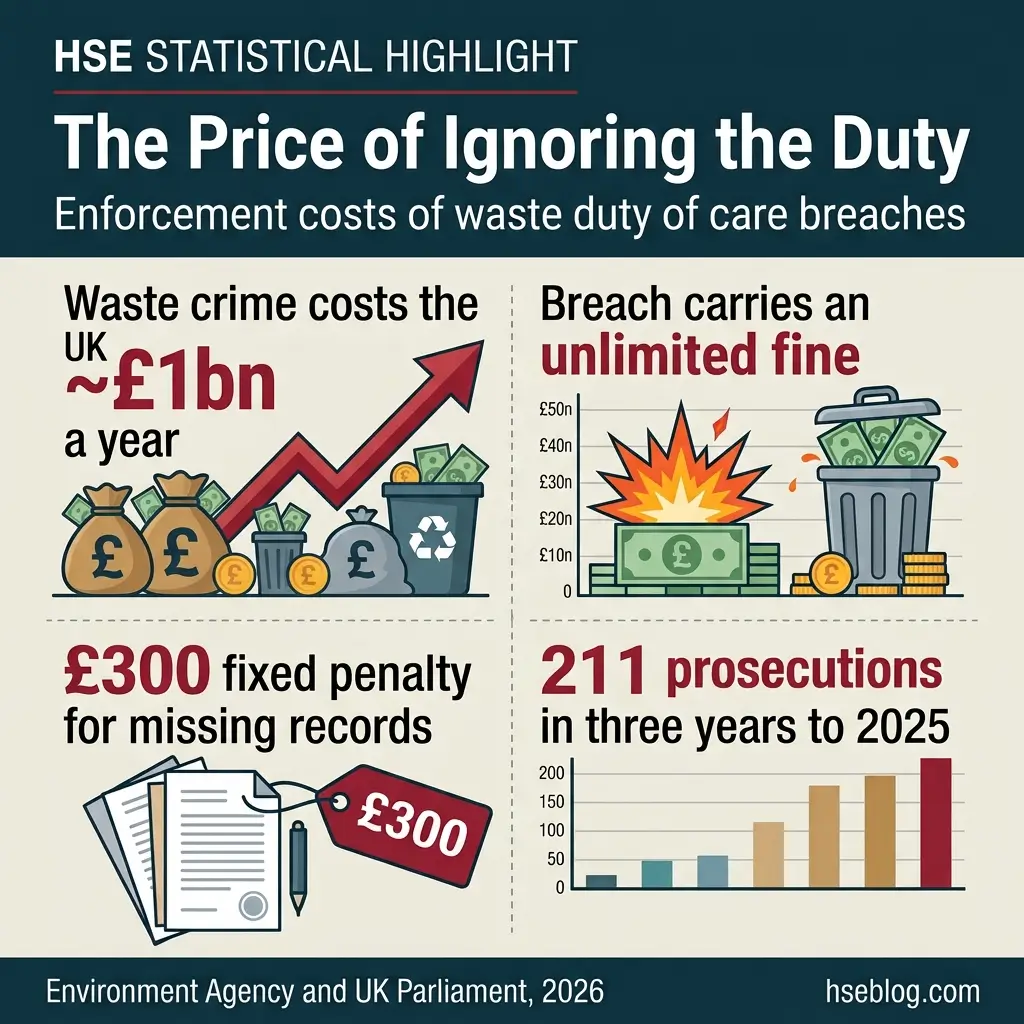
Mismanaged waste is not a housekeeping issue — it is a criminal liability that follows the organisation that produced it. Waste crime costs the UK economy an estimated £1 billion each year (Environment Agency, 2026), and much of it starts with legitimate businesses handing waste to the wrong carrier. Environment Agency
The waste duty of care makes that responsibility unavoidable, running from the moment waste is created until it is finally recovered or disposed of. This article sets out what the duty requires of an employer, the documents that prove compliance, how to vet a carrier, what non-compliance costs, and how digital tracking is about to change the picture.
Regulatory content here reflects general HSE professional understanding of England and Wales requirements as of 2026. It is not legal advice. Specific compliance questions, enforcement action, or prosecution risk should be directed to qualified legal counsel in the applicable jurisdiction.
What the Waste Duty of Care Requires of an Employer
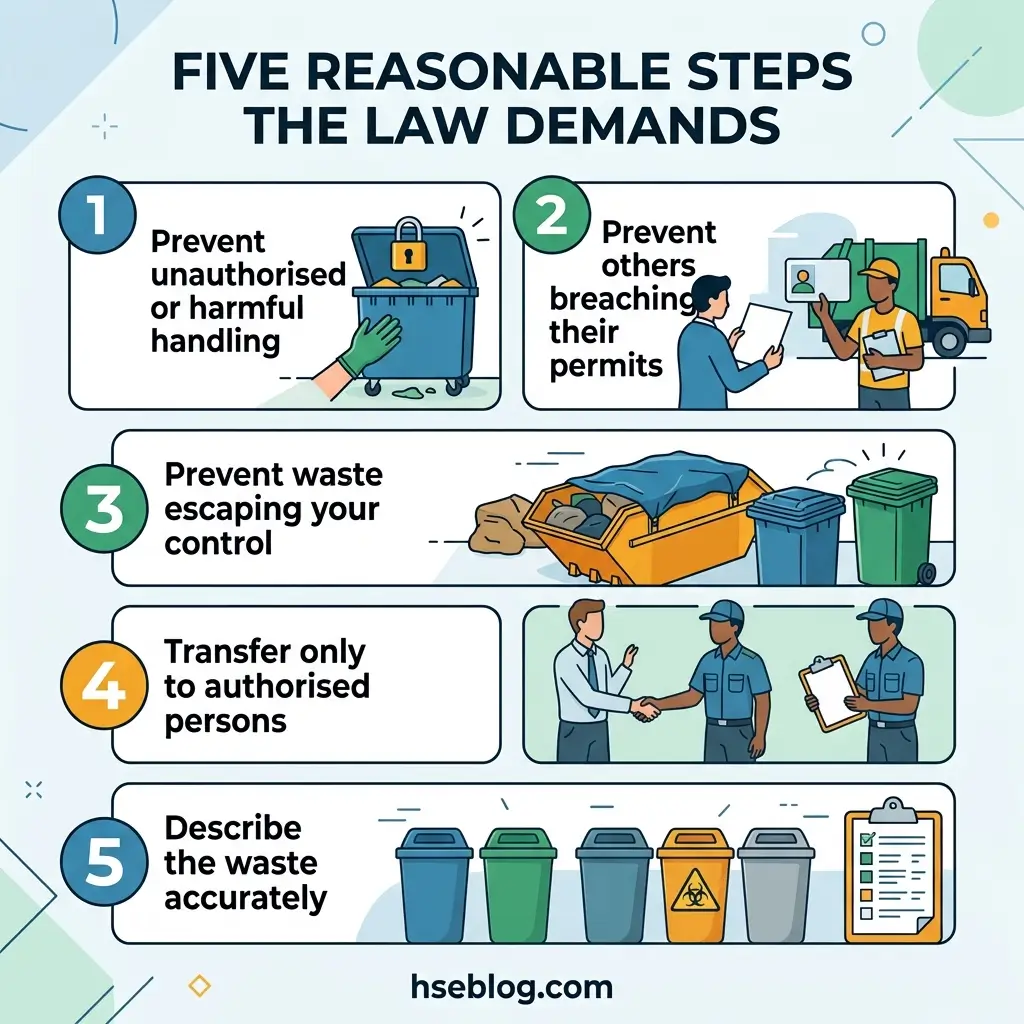
Under Section 34 of the Environmental Protection Act 1990, any employer that produces or handles controlled waste in England or Wales must take all reasonable steps to keep that waste safe throughout its life. The statutory waste duty of care code of practice sets out five duties every waste holder has to meet. GOV.UK
- Prevent unauthorised or harmful handling — do not let waste be deposited, treated or disposed of without the right permit or exemption.
- Prevent others breaching their permits — do not pass waste to a facility that cannot lawfully accept it.
- Prevent waste escaping your control — contain and secure it so nothing leaks, blows away, or is added to by others.
- Transfer only to authorised persons — hand waste solely to registered carriers, brokers, dealers, or permitted sites.
- Describe the waste accurately — give the next holder enough information to handle it lawfully and safely.
Who the duty holder actually is
The “employer” framing in this topic is precise, not loose. If a person creates waste as an employee, their employer — not the individual — is the waste producer in law, so the organisation carries the duty. Natural Resources Wales
That scope is wide. It covers private businesses such as shops, offices and factories, and public bodies such as schools, hospitals and prisons, as well as charities. A contractor working on your site is usually the producer of their own waste — but if they tip your waste into their skip, your duty applies to it. GOV.UK
The Records That Prove Your Duty of Care
Every transfer of controlled waste must be documented, and the document is your evidence that the duty was met. Non-hazardous waste moves on a waste transfer note; hazardous waste needs a consignment note for every movement, including moves between your own premises.
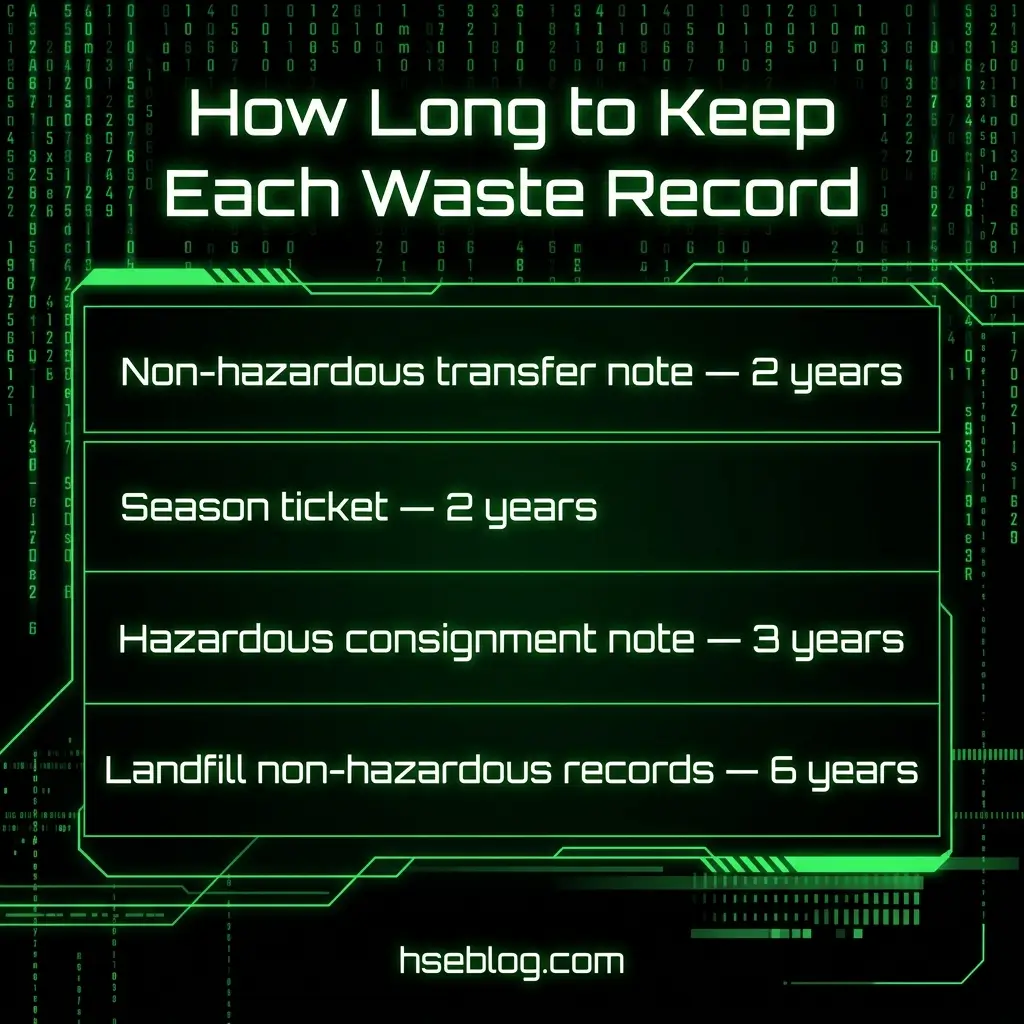
The retention periods are fixed, and an officer can ask to see records at any time.
| Document | Applies to | Minimum retention | Who must keep it |
|---|---|---|---|
| Waste transfer note | Non-hazardous controlled waste | 2 years | Producer and carrier |
| Season ticket | Repeat non-hazardous transfers, same carrier and waste, up to a year | 2 years | Producer and carrier |
| Hazardous waste consignment note | All hazardous waste movements | 3 years | Producer and carrier |
| Non-hazardous landfill records | Waste sent to landfill (landfill tax) | 6 years | Landfill operator |
These retention periods sit in the statutory code, which sets two years for non-hazardous transfers and season tickets and three years for hazardous consignment notes. Both the producer and the carrier keep their own copies. GOV.UK
What a transfer note has to say
A signature and a vague line about “general waste” will not survive scrutiny. A valid transfer note carries a written, signed description, the classification code, the quantity and type of container, the time and place of transfer, and the names, addresses and authorisation of both parties. GOV.UK
It must also confirm you applied the waste hierarchy, a declaration required under the Waste (England and Wales) Regulations 2011. The judgment call for most businesses is whether to raise individual notes or a season ticket — a season ticket saves paperwork for regular, identical collections, but you still log each transfer’s date and quantity.
Checking Your Waste Carrier Is Actually Registered
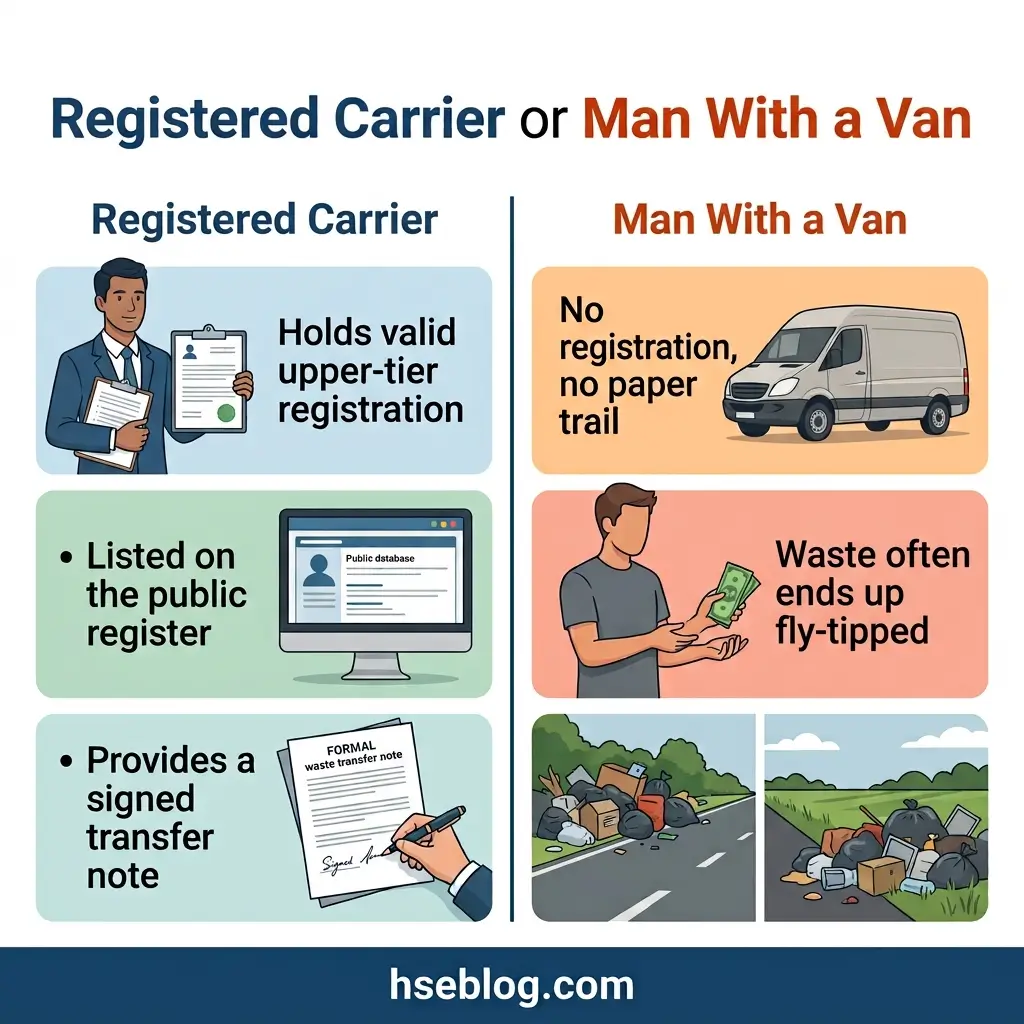
The single most common way a compliant-looking business ends up in the dock is trusting an unregistered “man with a van.” A cheap cash collection that disappears into a hedge lane becomes your problem, because the duty of care does not transfer with the waste — it stays with the producer until lawful disposal.
Before the first collection, work through four checks:
- Ask for their credentials — request the carrier, broker or dealer registration number, or the permit for the site receiving the waste.
- Verify it independently — check the number, business name or postcode against the Environment Agency’s public register rather than taking the paperwork at face value.
- Confirm the right tier — anyone carrying other people’s waste needs an upper-tier registration, with a number beginning CBDU; lower-tier registration is mainly for carrying your own waste. GOV.UK
- Record the check — save a screenshot or note the registration, because a recorded check is what proves you acted reasonably if the waste is later mismanaged.
The misconception worth killing outright is that “once it’s collected, it’s the carrier’s responsibility.” The person receiving your waste must also check that you met your duty, and if they suspect you misdescribed or badly stored it, they should refuse it and report you. Responsibility is shared along the chain, not passed down it. GOV.UK
Sorting, Storing and Describing Waste Before It Leaves Site
Preventing escape and describing waste correctly are active duties, not afterthoughts. Most enforcement problems trace back to weak storage or misclassification long before a carrier is even involved.
Store it so it cannot escape
- Use containers that are suitable, in good condition, and designed to stop leakage, contamination or spoiling.
- Label containers clearly and correctly so the contents are never in doubt.
- Limit access to authorised handlers, which also prevents unauthorised additions that would invalidate your waste description.
Classify it before you move it
- Assess whether the waste is hazardous or non-hazardous and assign the correct List of Wastes (European Waste Catalogue) code.
- Never assume a mixed skip is non-hazardous — items such as fluorescent tubes, batteries, WEEE, oils and solvents are hazardous and need a consignment note.
- Flag any special handling needs (flammable, dusty, liquid, or unsuitable for mixing) in the description.
Separate what the law now requires
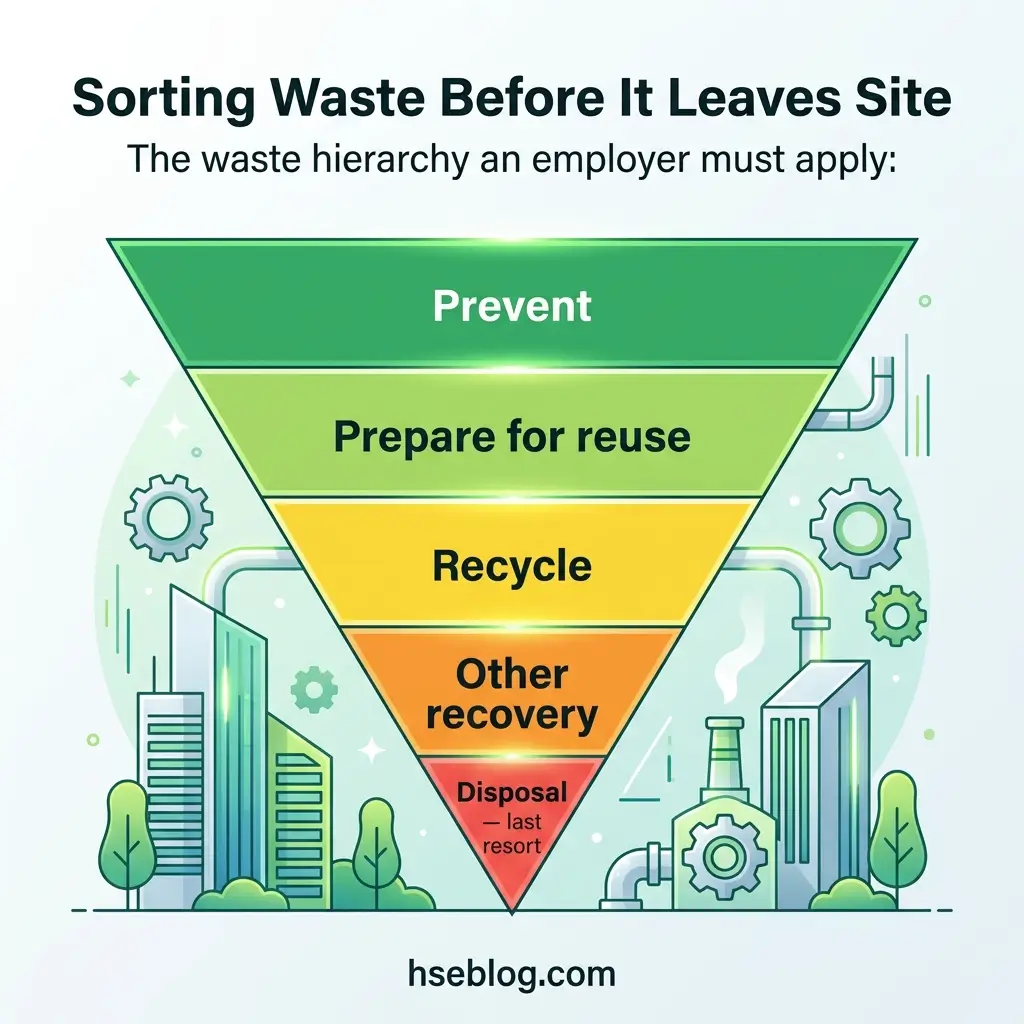
Storage duties tightened recently in England. Since 31 March 2025, all workplaces in England with 10 or more full-time-equivalent employees must separate the core recyclable streams — glass, metal, plastic, paper and card, and food waste — from general waste before collection under Simpler Recycling (gov.uk, 2025). Micro-firms with fewer than 10 employees have until 31 March 2027. This is a waste hierarchy obligation with its own enforcement, and it now sits alongside your existing duty of care. GOV.UKCountrystylerecycling
What Non-Compliance Costs
Breaching the waste duty of care is a criminal offence, and the financial exposure is deliberately open-ended. Failure to comply carries no upper limit on the court’s power to fine, and a fixed penalty notice may be issued in place of prosecution. GOV.UK
| Trigger | Consequence | Who acts |
|---|---|---|
| Failing to produce waste documentation on request | Fixed penalty notice (set at £300 for a Section 34 failure) | Local authority / regulator |
| Breaching any duty-of-care requirement | Unlimited fine on conviction, plus a criminal record | Courts, on prosecution by the regulator |
| Using an unregistered carrier | Fine or prosecution | Environment Agency / Natural Resources Wales |
| Fly-tipping traced to you or your carrier | Unlimited fine and, in serious cases, imprisonment | Regulator / local authority / courts |
The £300 fixed penalty for failing to produce documentation is set nationally, and paying it removes the prosecution for that offence — but the underlying breach still stands. Enforcement is not theoretical: the Environment Agency secured 211 prosecutions against waste criminals over the three years to March 2025 (UK Parliament, 2026), and fly-tipping is a separate, more serious offence than a documentation slip. Ealing CouncilUK Parliament
The reputational cost often outlasts the fine. A conviction for a waste offence is public, and it complicates tenders, insurance and permits for years.
How Digital Waste Tracking Changes Employer Duties from 2026
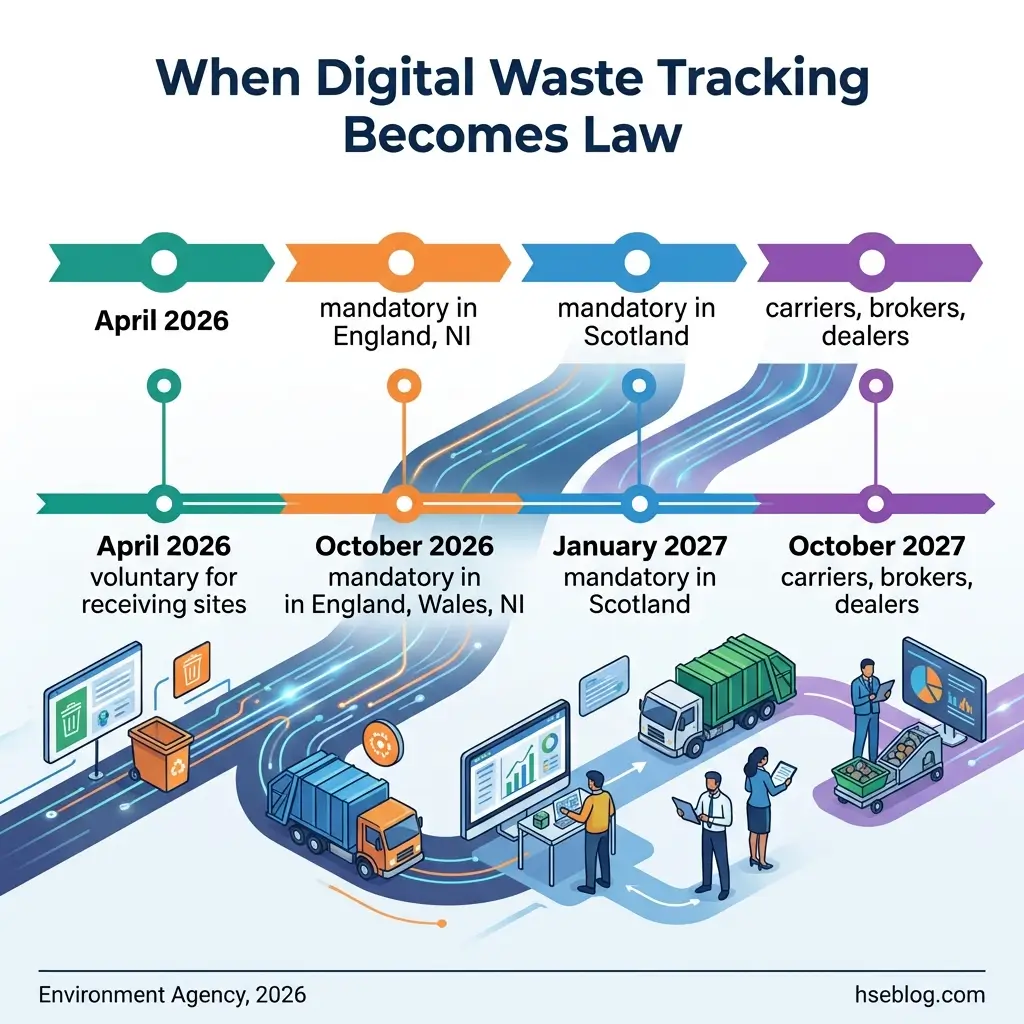
The biggest shift to the system in a generation is now in motion, and it moves waste records from paper toward a single national digital service. The phased rollout runs as follows:
- From 28 April 2026 (voluntary) — permitted operators receiving waste can start recording receipts on the new digital service. Environment Agency
- From October 2026 (mandatory) — receiving-site operators in England, Wales and Northern Ireland must use the service, with Scotland following in January 2027. Environment Agency
- From October 2027 — waste carriers, brokers and dealers come into scope. Environment Agency
The nuance that catches businesses out is what does not change yet. The Environment Agency has confirmed that operators must continue completing consignment notes, waste transfer notes and quarterly returns as normal alongside digital tracking during the transition. Digital tracking is being added to your existing duty of care, not swapped in for it. Environment Agency
For most employers, the immediate action is to establish whether any of your sites count as a permitted waste-receiving site, and to keep your transfer-note discipline intact. Once the service is mandatory, failing to use it correctly is a breach of waste regulations, enforceable through warnings, civil penalties, permit suspension or prosecution. Environment Agency
Frequently Asked Questions
Getting the Waste Duty of Care Right
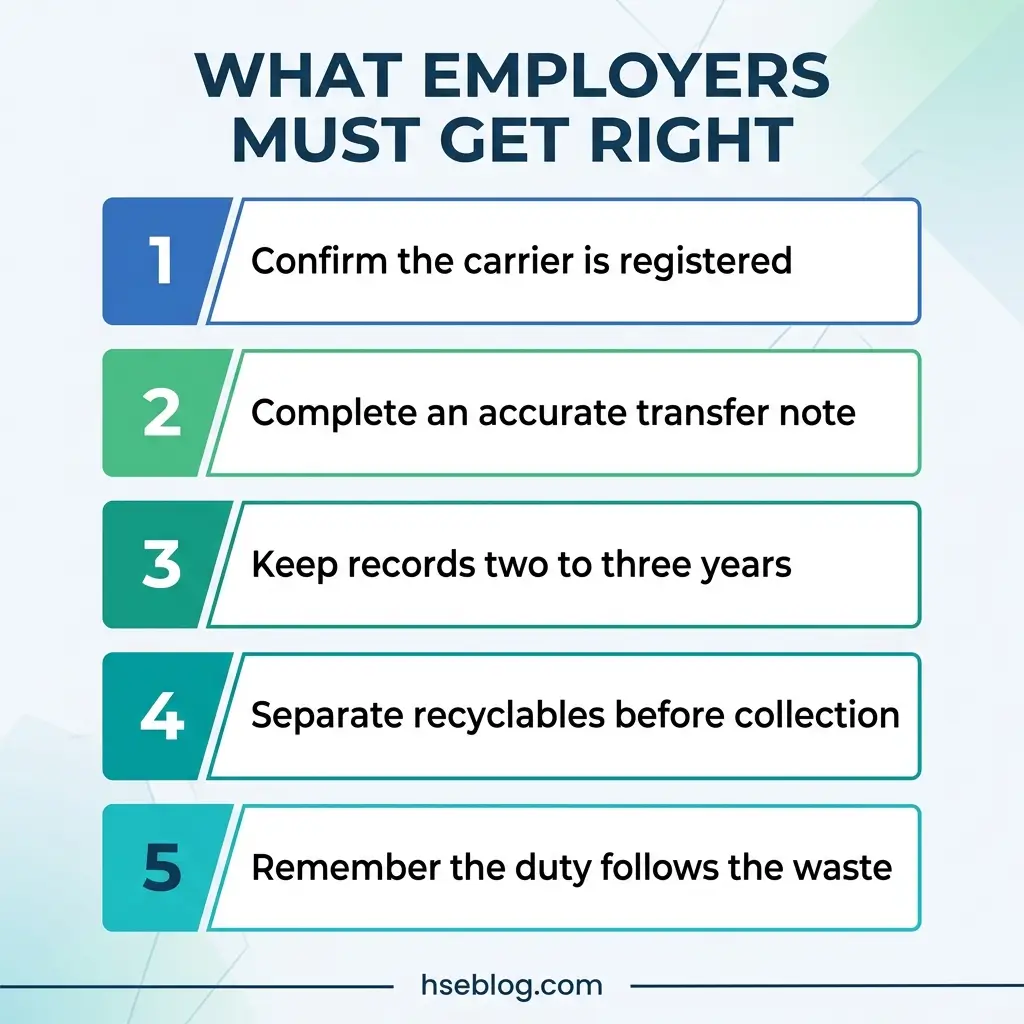
Treat the waste duty of care as a chain of custody your business owns from bin to final destination, not a task that ends when the truck pulls away. Three decisions carry most of the risk: check the carrier, complete and keep the paperwork, and separate waste correctly before it leaves site.
Verify every carrier, broker or dealer against the public register before the first collection, and record that you did. Keep waste transfer notes for two years and hazardous consignment notes for three, in a form you can produce the day an officer asks.
From October 2026, digital waste tracking will make those movements visible in near real time — but it will not lower the bar, and paper records still apply during the transition. The organisations that stay out of trouble are the ones that can prove, on any given day, exactly where their waste went.