
TL;DR
- If your waste is non-hazardous controlled waste, a waste transfer note must be completed and signed by both parties before the waste is moved.
- If your waste is hazardous, a consignment note is required instead of a transfer note — and in Scotland it is a special waste consignment note.
- If you are keeping the records, hold waste transfer notes for at least two years and consignment notes for at least three, and produce them on request.
- If you run a permitted waste site in England, Wales or Northern Ireland, you must record incoming loads on the Digital Waste Tracking service from October 2026.
Waste transfer notes and consignment notes are the legal documents that track controlled waste from producer to final destination in the UK. A waste transfer note covers non-hazardous waste; a hazardous waste consignment note — a special waste consignment note in Scotland — covers hazardous waste. Both must be completed before the waste moves, retained for two to three years, and shown to regulators on demand.
Section 34 of the Environmental Protection Act 1990 places a “duty of care” on everyone who produces, holds, carries or disposes of controlled waste in Great Britain. That duty does not end when the skip leaves the yard. It follows the producer, and the transfer note is the evidence that the producer met it.
Getting the paperwork wrong carries real consequences: criminal liability, unlimited fines, and — increasingly — automatic detection through digital records. The sections below set out the legal requirements for waste transfer notes and consignment notes: what each document is, what it must contain, how the rules differ across the four UK nations, how long to keep them, and what changes as Digital Waste Tracking becomes mandatory.
Waste transfer notes vs consignment notes: what’s the difference?
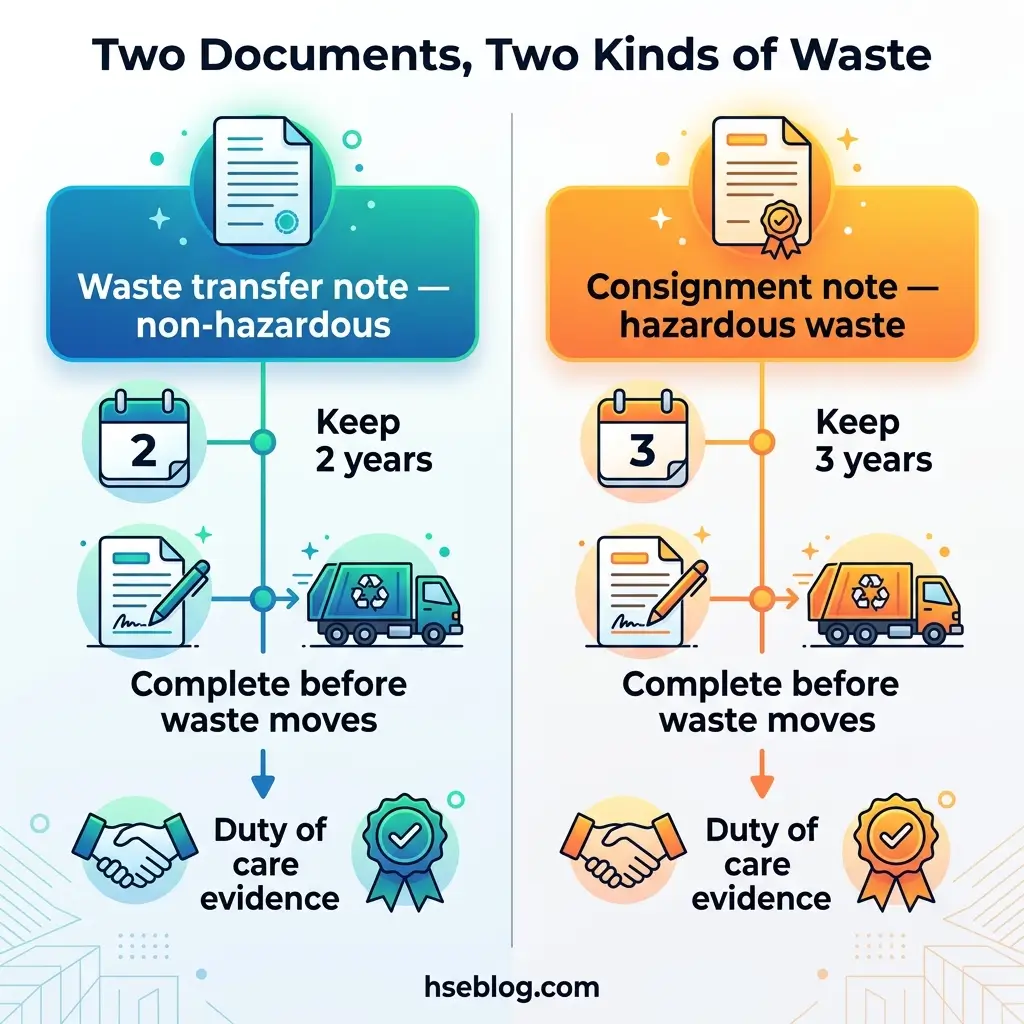
A waste transfer note and a consignment note do the same core job — proving a legal chain of custody — but they apply to different waste and carry different duties. The dividing line is whether the waste is classified as hazardous.
Waste transfer notes (non-hazardous controlled waste)
A waste transfer note (WTN) records the movement of non-hazardous controlled waste from one holder to the next. Every UK business produces controlled waste, so for most organisations this document is a routine legal obligation.
- Who completes it: the party handing over the waste (transferor) and the party receiving it (transferee) each fill in and sign their section.
- When: before the waste is transferred, not afterwards.
- What it covers: commercial, industrial and household waste that is not hazardous.
Consignment notes (hazardous waste)
Hazardous waste — batteries, solvents, oils, chemical residues, fluorescent tubes, clinical waste and much waste electrical equipment — cannot travel on a transfer note. It requires a consignment note, a more detailed document built for higher-risk material.
The format of a hazardous waste consignment note in England and Wales is set out in the Hazardous Waste (England and Wales) Regulations 2005, as amended. Scotland uses its own “special waste” version, covered below.
What a waste transfer note must legally contain
The Environmental Protection (Duty of Care) Regulations 1991 require every transfer note to carry enough information for the waste to be handled and disposed of safely. A missing field is not a technicality — it is the point where a regulator’s inspection turns into an offence.
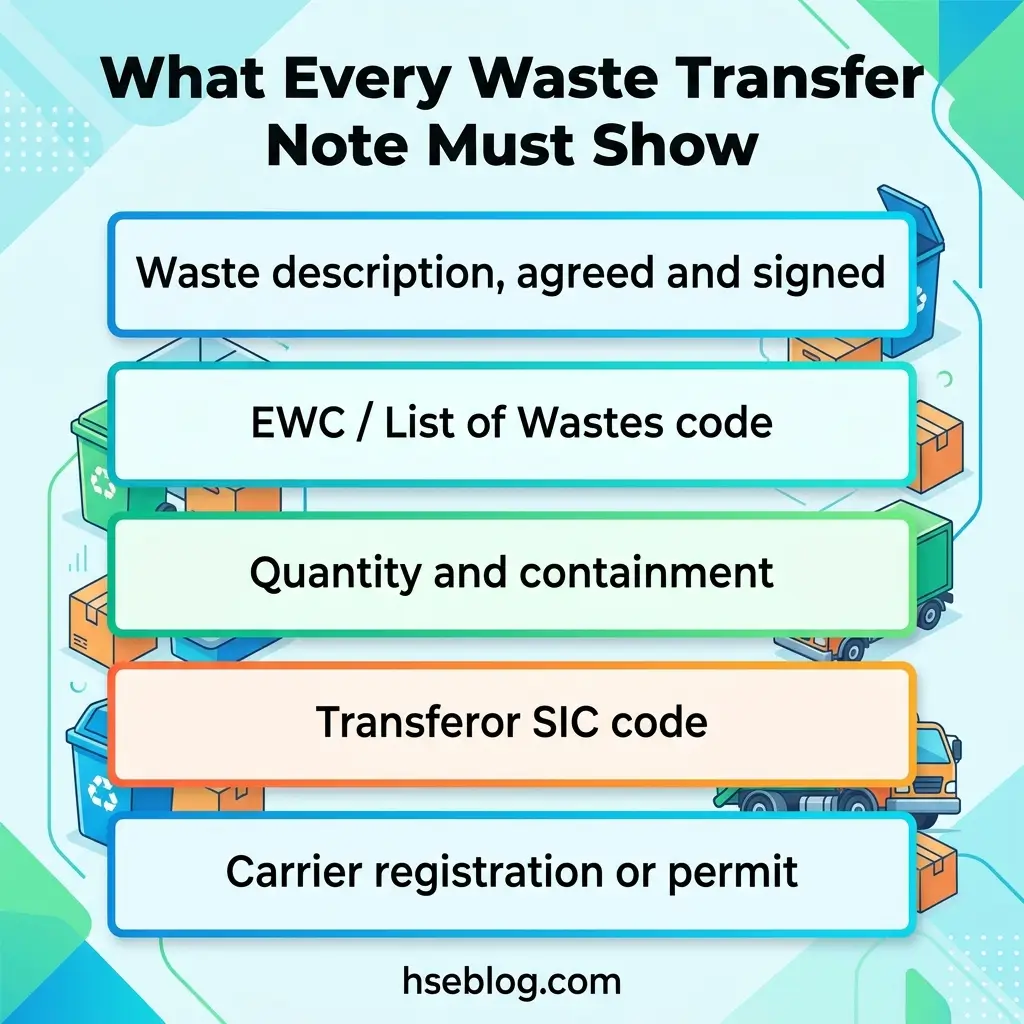
A valid waste transfer note must include:
- A written description of the waste, agreed and signed by both parties, precise enough for the next holder to manage it correctly.
- The EWC / List of Wastes (LoW) code — the six-digit reference that classifies the waste type.
- The quantity, usually by weight, and how the waste is contained.
- Names and addresses of the transferor and the transferee.
- The transferor’s Standard Industrial Classification (SIC) code, identifying the business activity that produced the waste.
- Whether the waste is transferred for recovery or disposal, plus the place and date of transfer.
- The other party’s authorisation — their waste carrier registration number, permit or exemption.
The practical failure I see most often is a vague description. “General waste” or “builder’s rubble” will not survive scrutiny, because the point of the description is to let the receiving site handle the material lawfully. The government’s Waste Duty of Care Code of Practice is explicit that the description and its EWC code are agreed jointly — not guessed by one side.
One useful flexibility: a single “season ticket” can cover a series of identical transfers over up to 12 months, provided the waste type, the carrier and the other details stay the same. The moment any of those changes, the season ticket no longer applies and a fresh note is needed.
Hazardous waste consignment notes: the stricter regime
Hazardous waste is regulated more tightly because the cost of getting it wrong is higher — to health, to the environment, and to the producer’s liability. The consignment note carries everything a transfer note does, plus several requirements that do not exist for ordinary waste.
Beyond the standard transfer-note fields, a hazardous waste consignment note adds:
- A unique consignment note code that identifies that specific movement and links every copy together.
- The hazardous property (HP) codes — HP1 to HP15 — describing exactly how the waste is dangerous, from HP1 explosive through HP7 carcinogenic to HP14 ecotoxic.
- The physical and chemical form of the waste and its component substances.
- A prohibition on mixing different hazardous waste categories, or hazardous with non-hazardous waste, without authorisation.
Only a very narrow set of movements is exempt — for example, household hazardous waste collected by a local authority, or waste that never leaves a single premises.
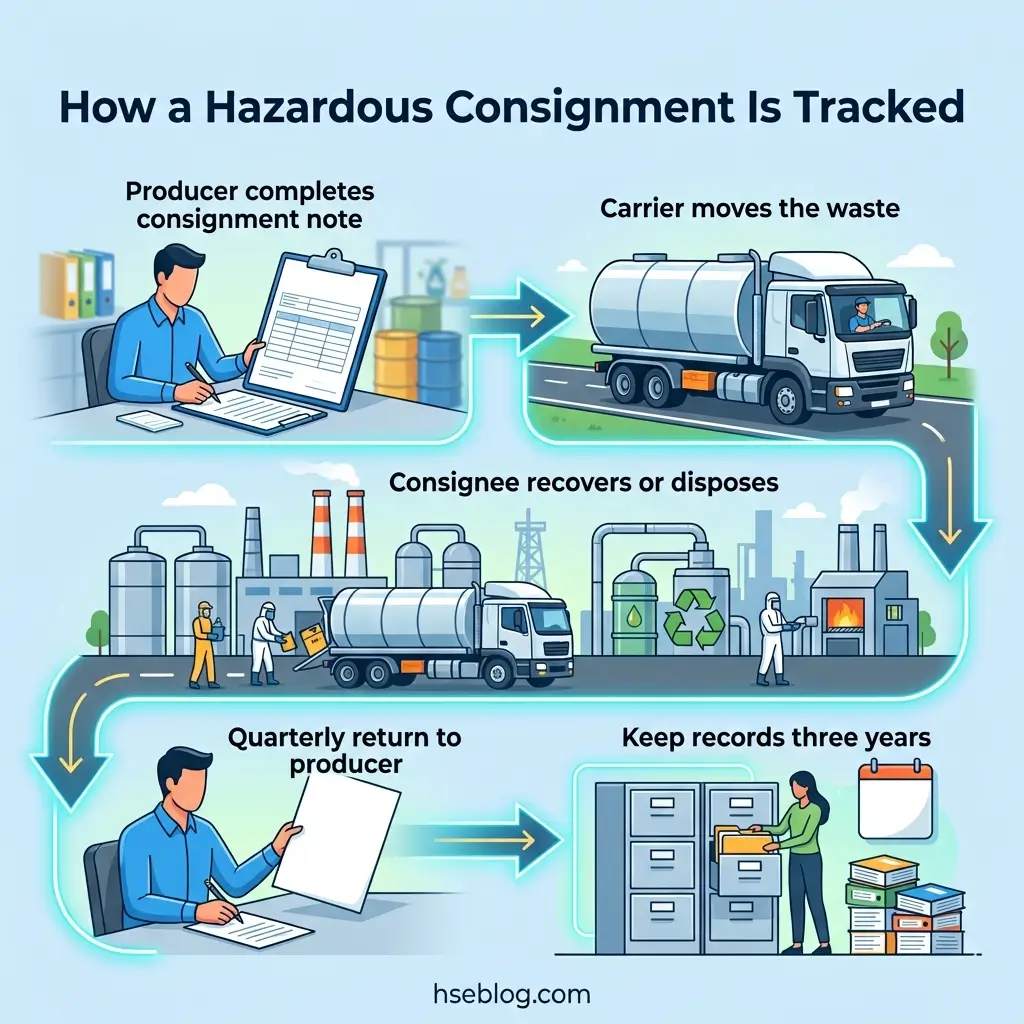
Consignee returns close the loop
The consignment note does not end when the waste is collected. In England and Wales, the consignee — the site that recovers or disposes of the waste — must send a quarterly return to the producer confirming what happened to it, within one month of the end of the quarter in which it was accepted.
A structural change worth noting: England removed the requirement to register premises as a hazardous waste producer in April 2016. Producers no longer pay an annual registration fee, but the consignment note and consignee-return duties remain fully in force. GOV.UK’s hazardous waste consignment note guidance sets out how these movements are documented, including waste crossing between the UK nations.
How the rules differ across the UK’s four nations
“Consignment note” is not one document — it hides four different systems, and assuming England’s rules apply everywhere is a common and costly error. The regulator, the legislation, the paperwork and even whether you must warn the regulator before moving the waste all vary by nation.
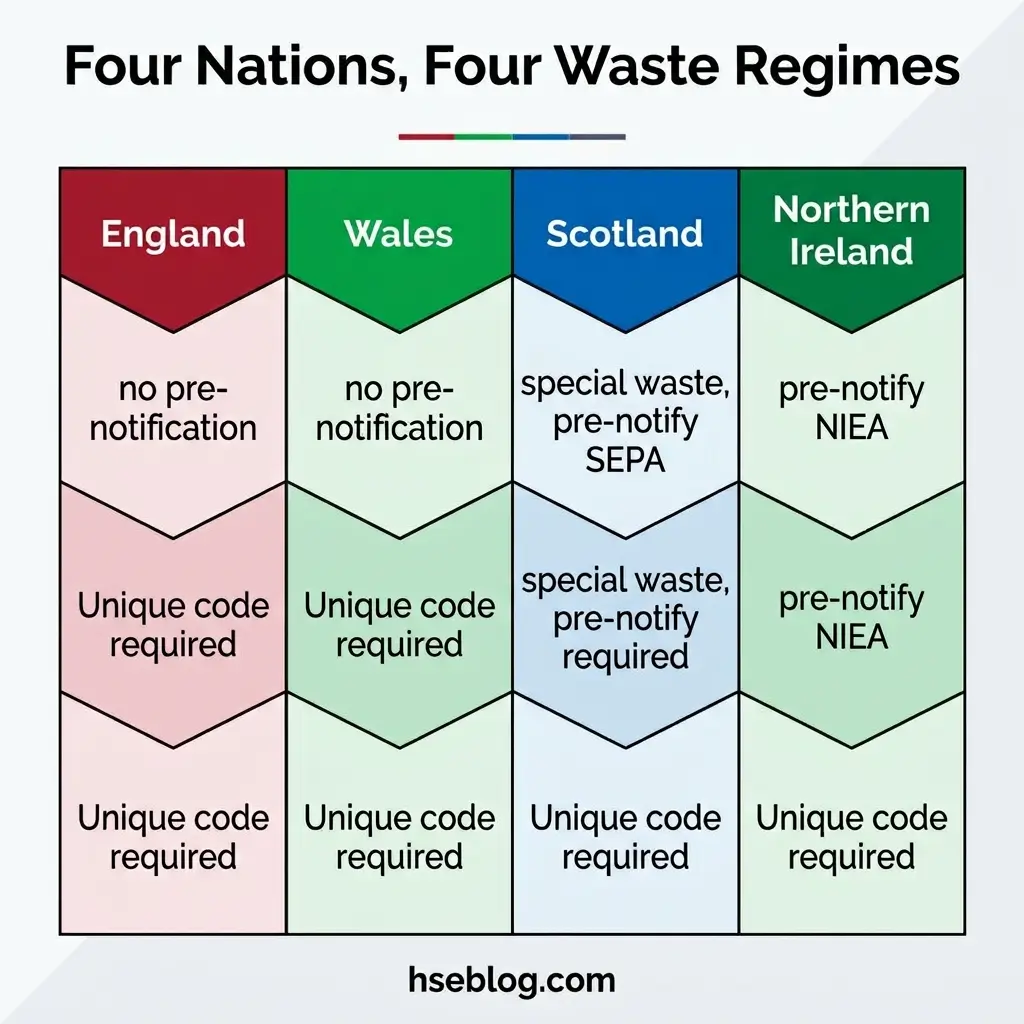
The sharpest practical difference is pre-notification. England and Wales require no advance notice to move hazardous waste, whereas Scotland and Northern Ireland require the regulator to be told before the movement happens.
| Nation | Governing regime | Hazardous document | Pre-notify regulator before moving? | Regulator |
|---|---|---|---|---|
| England | Hazardous Waste (England and Wales) Regulations 2005 | Consignment note | No | Environment Agency |
| Wales | Hazardous Waste (England and Wales) Regulations 2005 | Consignment note | No | Natural Resources Wales |
| Scotland | Special Waste Regulations 1996 | Special waste consignment note | Yes — at least 72 hours (max one month) before movement | SEPA |
| Northern Ireland | Hazardous Waste Regulations (NI) 2005 | Consignment note | Yes — at least 72 hours (max one month) before movement | NIEA |
In Scotland, hazardous waste is called “special waste,” and every consignment must carry a unique code issued by or purchased from SEPA, regardless of where in the UK it is going. SEPA’s special waste guidance confirms that producers there do not register as special waste producers, but the consignment and pre-notification duties still bind them. Northern Ireland operates a comparable purchased-code system through the NIEA.
Retention, penalties, and the duty of care that doesn’t transfer
Breaching the duty of care is a criminal offence, and the penalties reach further than most producers expect. Enforcement is carried out by the environmental regulators, local authorities and, on the road, the police — all of whom can stop vehicles and inspect records.
Retention obligations are strict and specific:
- Non-hazardous waste transfer notes: keep for at least two years from the date of transfer.
- Hazardous / special waste consignment notes: keep for at least three years, held by producer, carrier and consignee alike.
- Consignee returns: retain the quarterly confirmations that verify proper disposal, alongside the notes they relate to.
On the penalty side, local authorities can issue a fixed penalty notice — commonly up to £300 for failing to produce documents, though amounts are set locally — while serious or repeated breaches go to court, where magistrates can impose an unlimited fine on conviction. Refusing to produce a note when lawfully asked is itself an offence.
The point everyone gets wrong
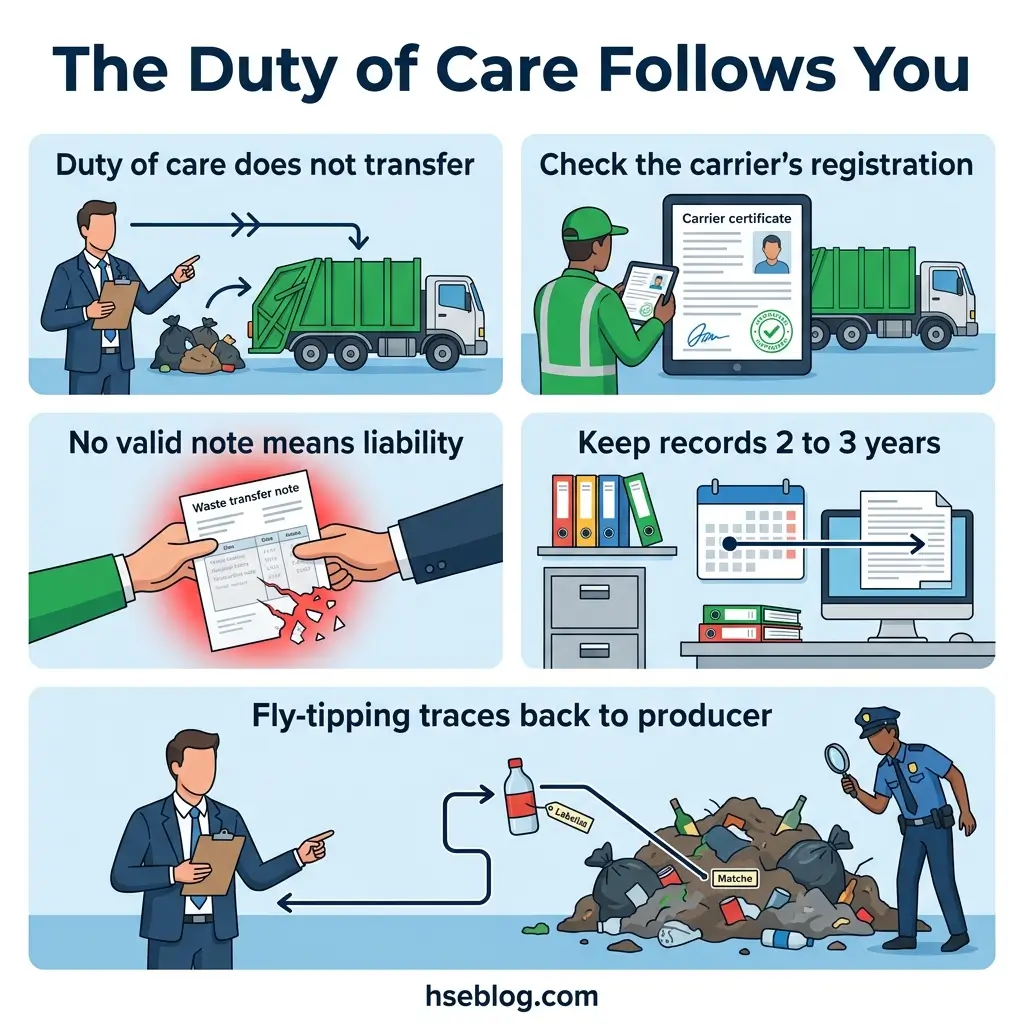
The most dangerous misconception is that handing waste to a carrier hands over the responsibility with it. It does not.
Under Section 34, the producer’s duty of care persists even after the waste is gone. If that waste is later fly-tipped or dumped, the producer who cannot show a valid transfer note — and cannot show they checked the carrier’s registration — can be prosecuted for the outcome. The note is not a receipt that discharges liability; it is the producer’s defence.
Digital waste tracking: what changes from October 2026
From October 2026, the paper-based system that has run since the 1990s begins to give way to a single national record. Digital Waste Tracking is introduced under Section 58 of the Environment Act 2021, and the Environment Agency estimates it is targeting waste crime that costs the UK economy around £1 billion a year.
The rollout is phased, and the dates matter:
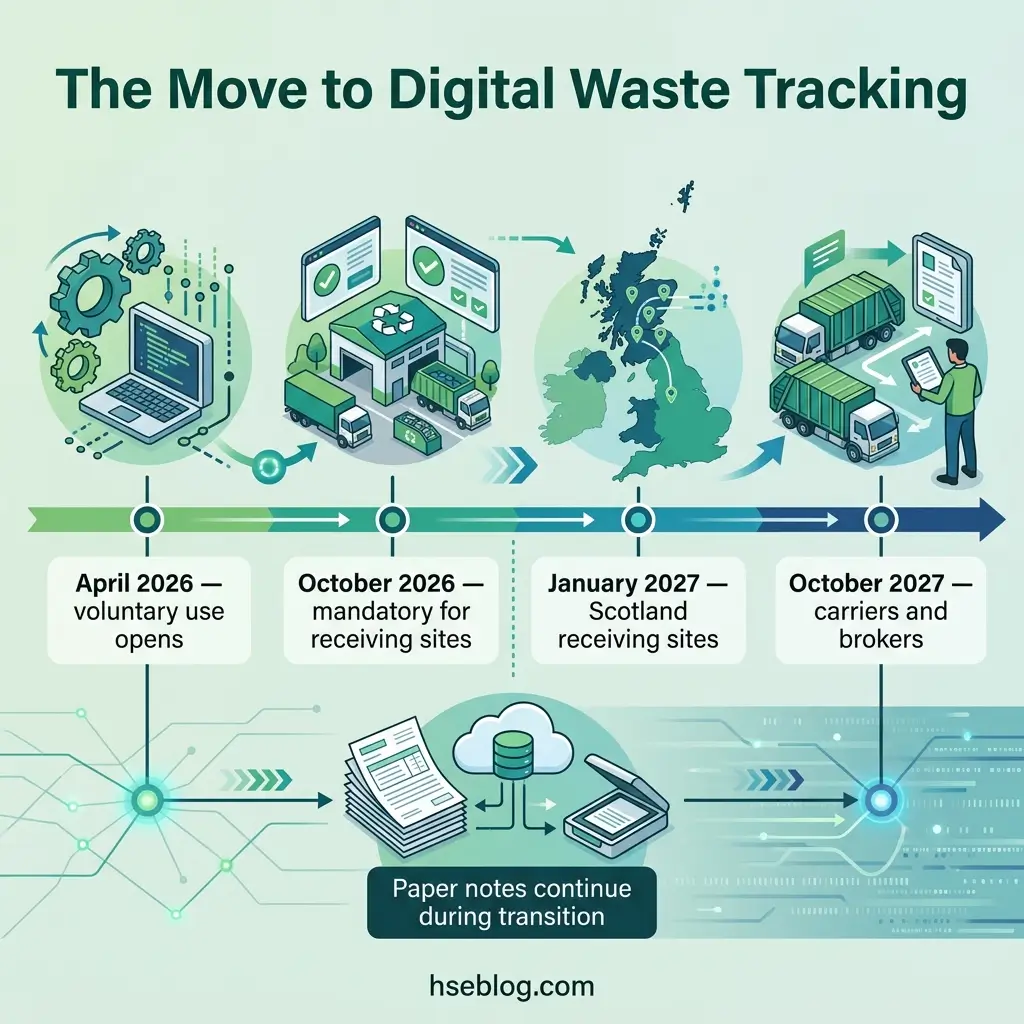
- 28 April 2026 — the service opened for voluntary use by permitted waste receiving sites (public beta).
- October 2026 — recording incoming loads on the service becomes mandatory for permitted receiving sites in England, Wales and Northern Ireland, under the Digital Waste Tracking (England) Regulations 2026 and parallel legislation.
- January 2027 — the mandate reaches receiving sites in Scotland.
- October 2027 — waste carriers, brokers and dealers must comply.
Here is the nuance many summaries get wrong: the paper system is not switched off in October 2026. The Environment Agency has been explicit that, initially, operators must continue completing waste transfer notes, consignment notes, consignee returns and quarterly returns alongside the new digital record, as its Digital Waste Tracking guidance makes clear. The two systems run in parallel through the transition, not in sequence.
The practical implication for producers is straightforward. Confirm that the site receiving your waste is set up to record digitally, keep your own documentation clean, and treat the change as a data-quality exercise rather than a distant deadline — because near real-time records make missing or inconsistent entries far easier for regulators to spot.
Frequently Asked Questions
The direction of travel is digital, but the duty is unchanged
Waste transfer notes and consignment notes are shifting from paper to a national digital record, and the phased mandate running from October 2026 to October 2027 is the biggest change to UK waste documentation in a generation. Receiving sites move first, carriers follow, and Scotland runs to its own January 2027 timetable — but for now the existing notes and returns continue alongside the new service.
What does not change is the principle underneath the paperwork. The duty of care stays with the producer, the document is the evidence that duty was met, and an accurate description with a verified carrier remains the difference between compliance and prosecution. Whether the record lives on a signed note or a digital entry, the organisation that can prove where its waste went is the one that stays protected.
If you do one thing before the mandate bites, make it this: check that every site receiving your waste can record it digitally, and that your own transfer notes and consignment notes would survive an inspector reading them line by line.