
TL;DR
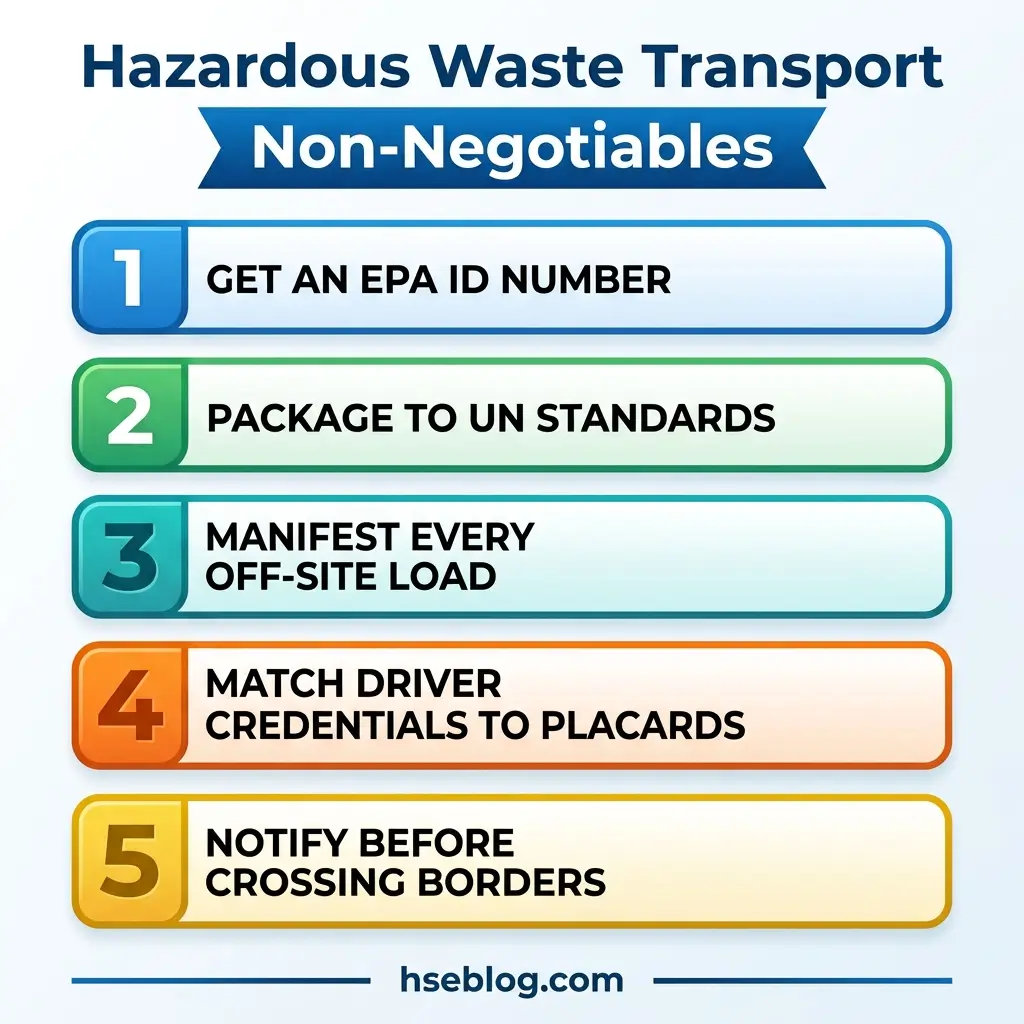
- Off-site moves are dual-regulated: hazardous waste transportation answers to the EPA (40 CFR 263) and US DOT (49 CFR) at the same time.
- If you package it, the waste must go in UN performance-oriented packaging authorized for its specific hazard class and packing group.
- If the load needs placards, the driver needs a HazMat endorsement and TSA clearance — but not every load crosses that threshold.
- If the waste leaves the country, Basel Convention notification and written consent must be secured before it moves.
Hazardous waste transportation in the United States is regulated jointly by the EPA under the Resource Conservation and Recovery Act (40 CFR Part 263) and the US DOT under the Hazardous Materials Regulations (49 CFR Parts 171–180). The waste must be classified, packed in authorized UN packaging, labeled, and tracked on a manifest from the point of generation to final disposal.
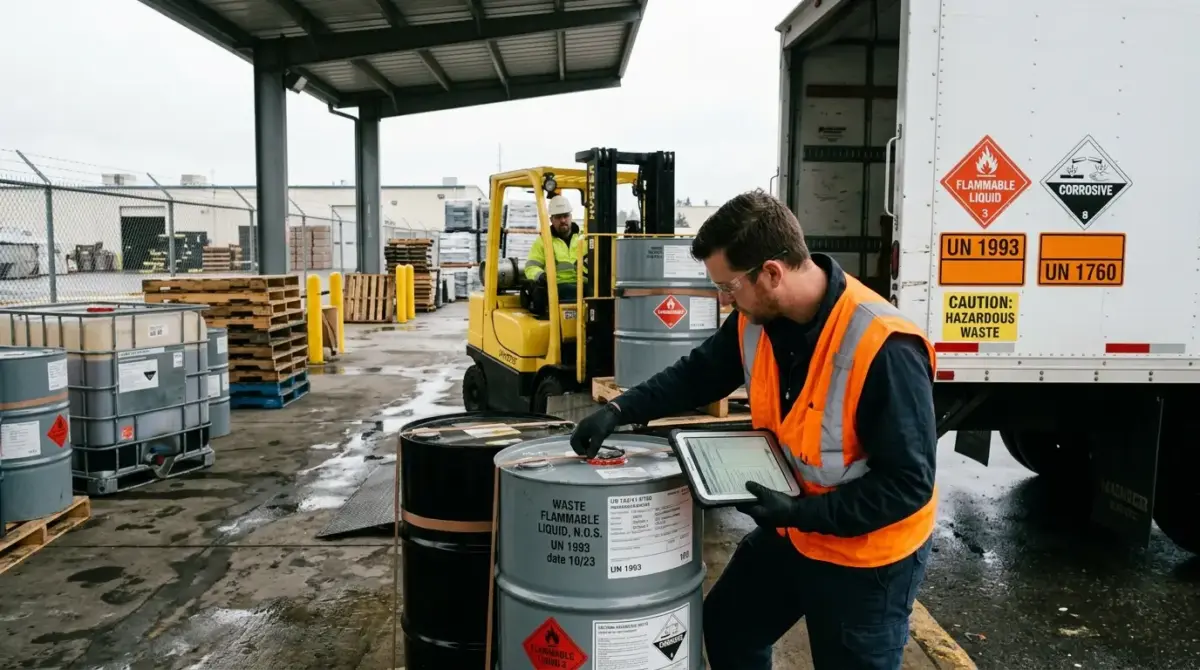
A single drum of spent solvent leaving a factory answers to two federal agencies at once. The EPA treats it as a regulated waste under RCRA, while the Department of Transportation treats it as a hazardous material in commerce. Satisfy one framework and ignore the other, and the shipment is still illegal.
That overlap is what makes hazardous waste transportation harder than it looks, because a leaking package on a highway is not just a compliance gap — it is a public exposure, a cleanup bill, and an enforcement file. This guide covers who regulates the movement, how to classify and package the waste, what the manifest system now demands, when a driver needs special credentials, and what changes the moment the load crosses a border.
Regulatory content here reflects a general HSE professional understanding of United States requirements as of 2026. It is not legal advice. Specific compliance questions, enforcement situations, or prosecution risk should be directed to qualified legal counsel in the applicable jurisdiction.
Who Regulates Hazardous Waste Transportation?
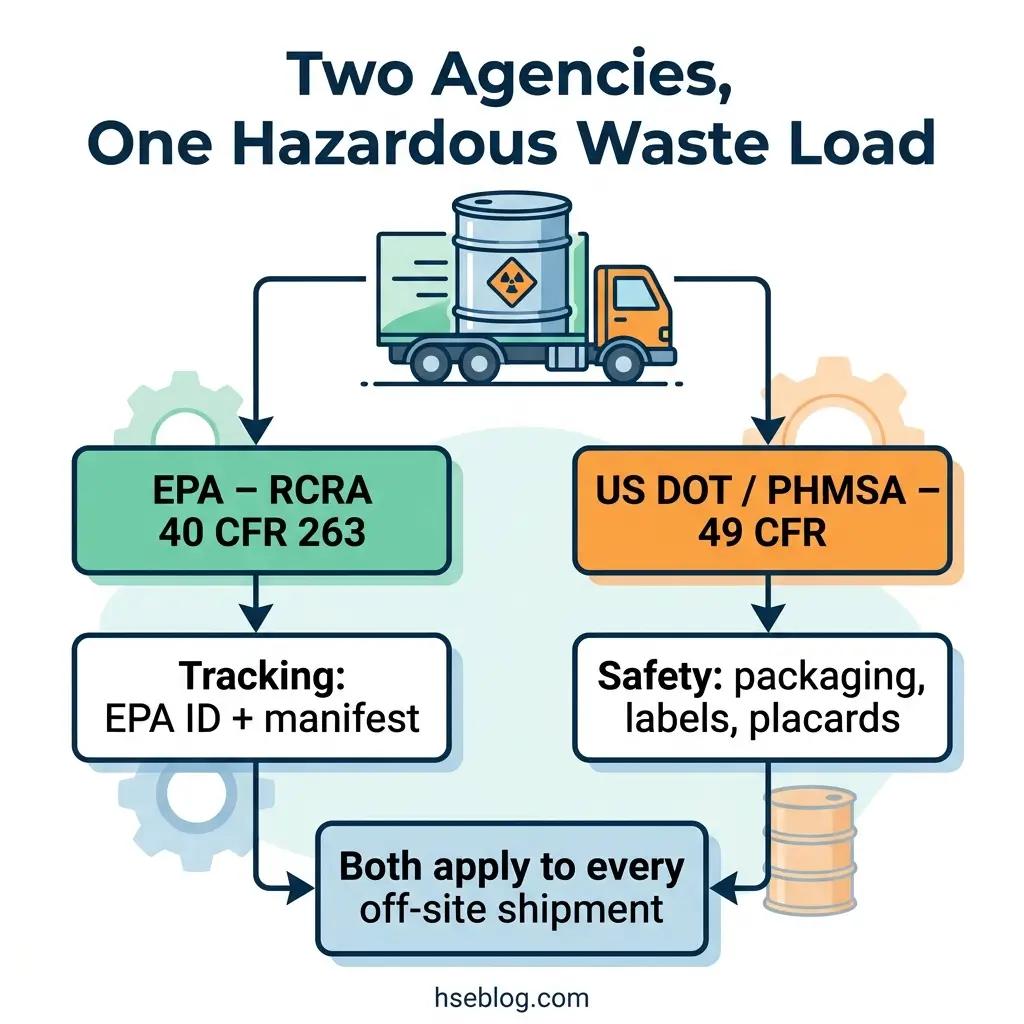
Two federal agencies share the job. The EPA governs the waste side under RCRA, and the US DOT — through the Pipeline and Hazardous Materials Safety Administration (PHMSA) — governs the physical transport under the Hazardous Materials Regulations.
The EPA defines a hazardous waste transporter as anyone moving waste off-site between properties on public roads. On-site movement within a facility’s own boundary — even across a public road separating contiguous parcels — falls outside these transporter rules, as EPA’s hazardous waste transportation guidance sets out.
The line matters because it decides whether the full regime applies at all. Any company that hauls regulated waste off-site must first obtain an EPA identification number, which is issued to the company as a whole rather than to each truck.
| Function | EPA (RCRA, 40 CFR 263) | US DOT / PHMSA (49 CFR) |
|---|---|---|
| Core concern | Tracking waste cradle-to-grave | Safe movement in commerce |
| Key requirement | EPA ID number + manifest | Classification, packaging, marking, placarding |
| Who it covers | Off-site hazardous waste transporters | Anyone offering or transporting hazmat |
| Records | Manifest kept three years | Shipping papers, incident reports |
To avoid two conflicting rulebooks, the EPA formally adopted large parts of the DOT rules for labeling, marking, placarding, and container use. In practice, that means a transporter reads RCRA for the tracking obligations and 49 CFR for how the waste physically travels.
Classifying and Packaging Hazardous Waste for Transport
Packaging is not about finding a strong container. It is about matching the waste to packaging that the regulations specifically authorize for its hazard class and packing group.
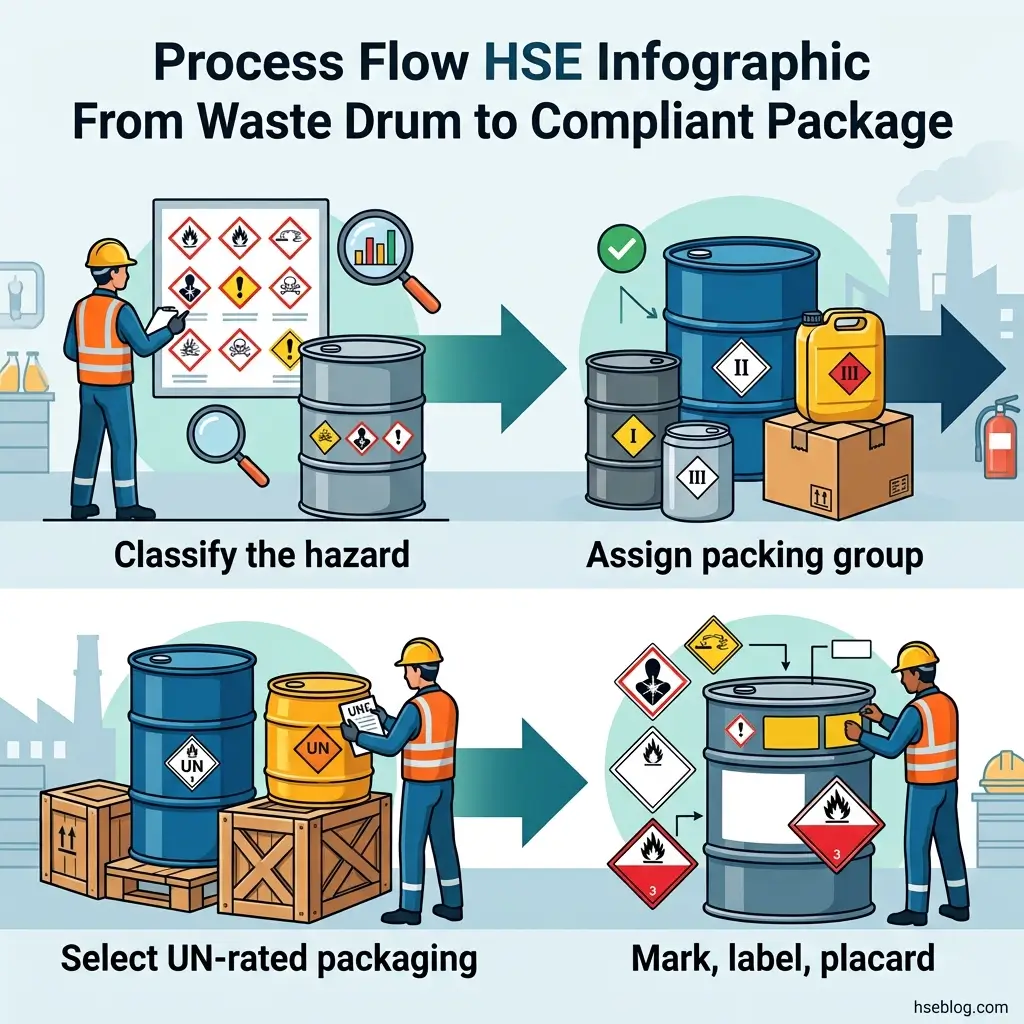
The process runs in a fixed order:
- Classify the hazard. Determine the DOT hazard class and proper shipping name from the Hazardous Materials Table at 49 CFR 172.101.
- Assign the packing group. Column 5 of that table indicates the degree of danger and drives how robust the packaging must be.
- Select authorized packaging. Column 8 references the exact packaging sections in 49 CFR Part 173 that are permitted for that material.
- Mark, label, and placard. Apply the UN number, hazard-class diamonds, and — where required — vehicle placards.
What packing groups actually mean
The packing group is the shipper’s call, and it sets the performance bar the container has to clear.
- Packing Group I — high danger: the most robust packaging and the strictest performance tests.
- Packing Group II — medium danger: standard performance-oriented packaging.
- Packing Group III — minor danger: the least stringent option within that hazard class.
Why “UN-rated” is the phrase that matters
Most non-bulk hazardous waste travels in UN performance-oriented packaging governed by 49 CFR Part 178. The DOT adopts the UN Model Regulations as its baseline, so a compliant drum, jerrican, or intermediate bulk container carries the circled-u UN mark certifying it passed drop, leakproofness, stacking, and pressure testing, as the FMCSA’s guide on complying with the hazardous materials regulations explains.
A recurring failure across the enforcement record is not weak packaging but the wrong packaging — a container never authorized for that material, or one closed against the manufacturer’s instructions. A thicker drum does not fix a classification error; it just moves an unauthorized package down the road.
The Hazardous Waste Manifest and the Move to e-Manifest
Every off-site shipment of RCRA hazardous waste must travel with a Uniform Hazardous Waste Manifest — the document that follows it from the generator to the receiving facility. It records the waste type and quantity, handling instructions, and signatures from each party in the chain.
The core transporter duties are consistent:
- Sign and date on receipt, and return a copy to the generator before leaving the property.
- Keep the manifest with the load for highway and air shipments; water and rail may substitute an equivalent shipping document.
- Deliver the entire quantity to the next designated transporter or facility, and obtain the recipient’s signature.
- Retain the manifest for three years from the date the waste was accepted.
This system is now firmly digital. The EPA launched the electronic manifest (e-Manifest) system on June 30, 2018, and its e-Manifest “Third Rule,” published July 26, 2024, pulled export and exception reporting into the platform on staggered dates in 2025 (EPA, 2024). As of December 1, 2025, manifests for exported hazardous waste must be filed electronically by the exporter — roughly 22,000 export manifests a year (EPA, 2024), as detailed in the Third Rule summary.
The direction is clear. In 2025 the EPA proposed retiring paper manifests entirely, estimating about $28.5 million in annual savings if electronic tracking becomes the only option (EPA, 2025). For anyone still running paper, the practical judgment call is no longer whether to move to e-Manifest but how fast, since the export requirement already forces electronic filing for cross-border loads.

Driver, Vehicle, and Routing Requirements
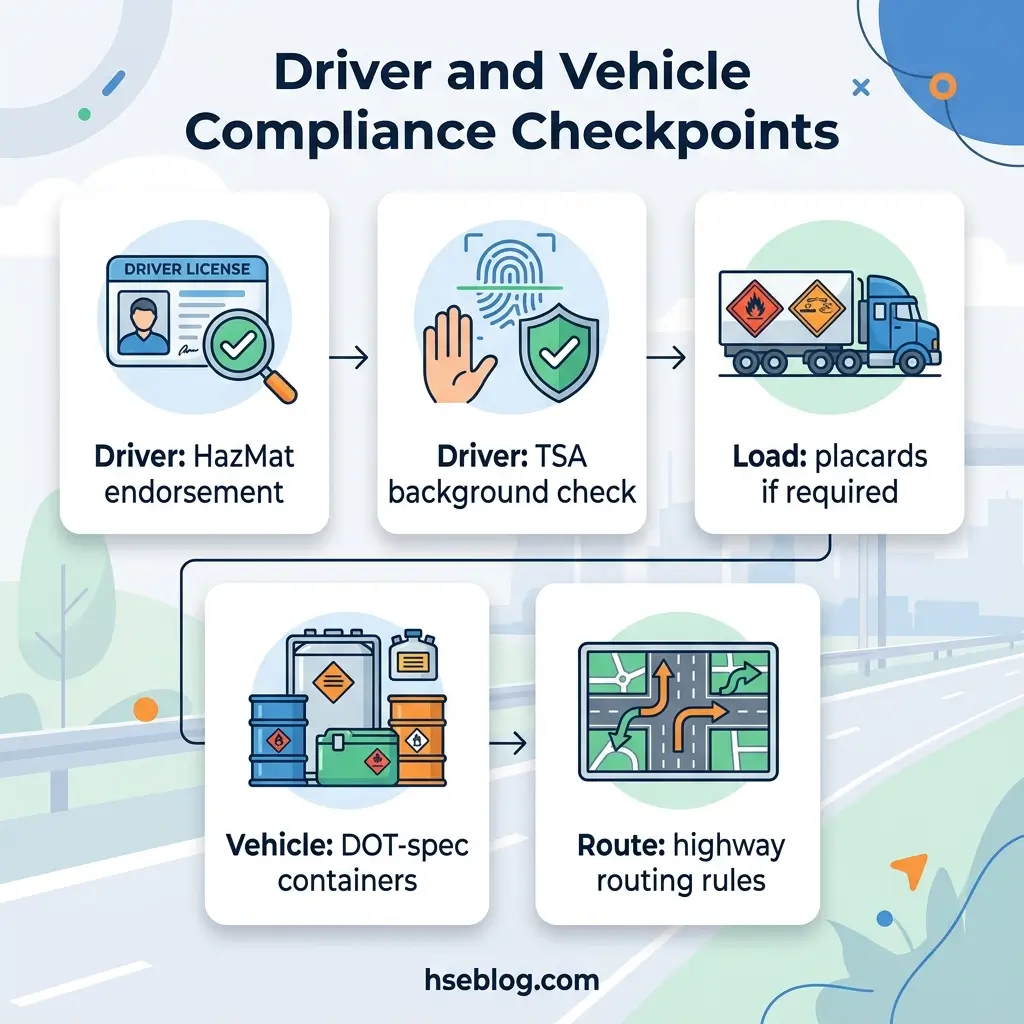
Being a registered transporter is not the same as being cleared to drive the load. The driver credential hinges on one trigger: whether the shipment must display placards.
The driver credential
A HazMat endorsement — shown as an “H” or “X” on a commercial driver’s license — is required to operate a vehicle carrying a load that must be placarded under 49 CFR Part 172, subpart F. To earn it, a driver passes a knowledge test and clears a TSA security threat assessment under 49 CFR 1572, which includes fingerprinting, a citizenship or lawful-residency check, and a criminal-history review.
This is where a common misconception costs people. Not every hazardous-waste load requires a placard, so a driver can legally carry certain smaller-quantity shipments without a HazMat endorsement — even though the transporter’s EPA and manifest obligations still apply in full.
The vehicle and the route
Once a load is placarded, additional rules attach to the vehicle and its path:
- Routing: placarded highway carriers must comply with the operational requirements in 49 CFR Part 397, including routing and attendance rules.
- Transfer facilities: a transporter may hold waste up to 10 days at a transfer facility without a storage permit, provided it stays manifested and in DOT specification containers (40 CFR 263.12).
- The 10-day line: hold it longer, and that location becomes a storage facility requiring a full RCRA permit — a threshold that turns a logistics decision into a permitting problem.
Crossing Borders: International Rules for Hazardous Waste
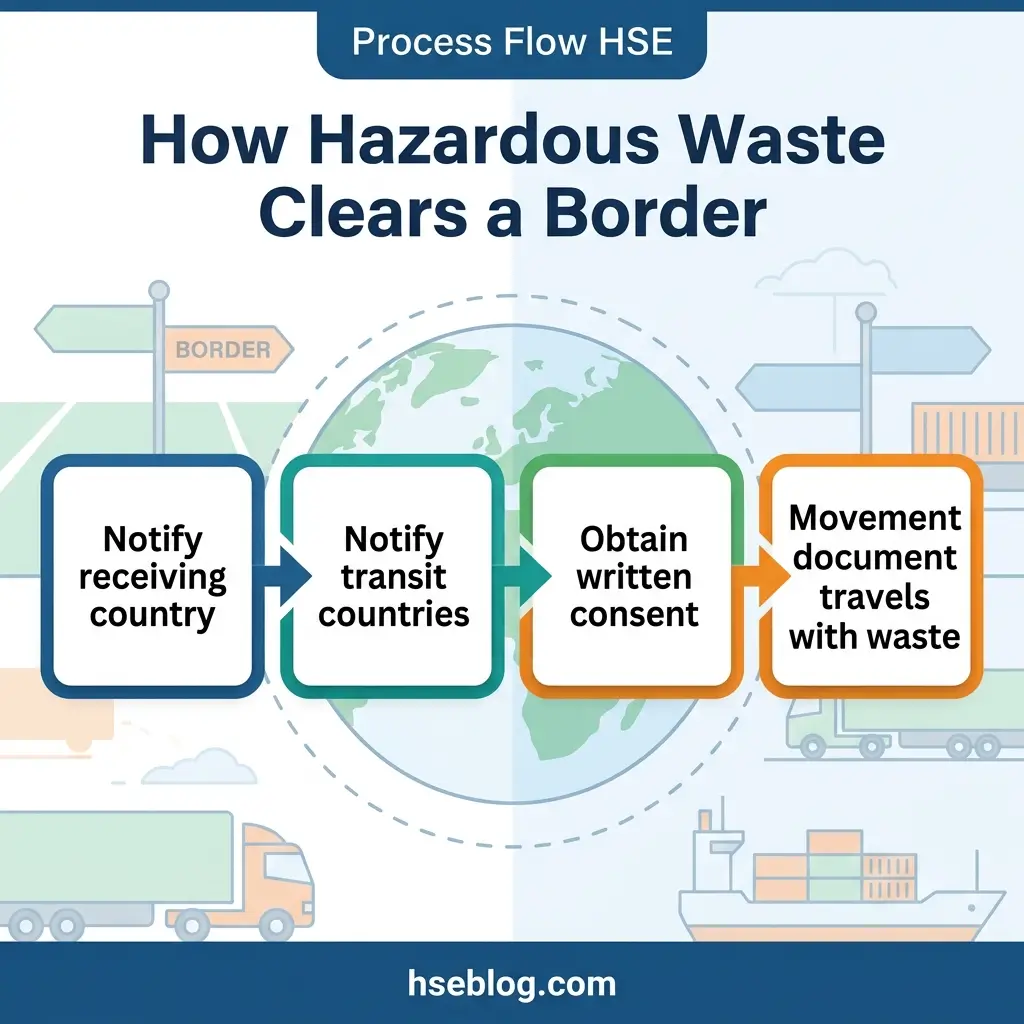
Once hazardous waste crosses a national boundary, a second rulebook applies. The Basel Convention requires the exporting country to notify — and obtain written consent from — the receiving and any transit countries before the waste moves, a procedure known as prior informed consent.
Two further Basel obligations shape the physical shipment. A movement document must accompany the waste from origin to final disposal, and the packaging, labeling, and transport must conform to recognized international rules — in practice, the same UN Model Regulations that underpin the US packaging system. As of 2024, 190 countries and the European Commission were parties to the Convention (EPA, 2024), and its control procedures are set out in Basel’s overview of controlling transboundary movements.
There is a wrinkle specific to US exporters that many overlook: the United States signed the Basel Convention but has not become a Party to it (EPA). US cross-border shipments instead run through the OECD Council Decision and bilateral agreements with countries such as Canada and Mexico, layered on top of the EPA’s own export rules.
| Framework | Jurisdiction | Core transport control |
|---|---|---|
| RCRA + HMR | United States (federal) | Manifest, UN packaging, placarding |
| Basel Convention | International (190+ parties) | Prior notification and written consent, movement document |
| Waste Shipment Regulation + ADR | European Union | Notification/consent plus road dangerous-goods rules |
The takeaway for anyone shipping internationally is that a fully compliant domestic package is only the starting point. The consent paperwork, not the drum, is usually what holds up a border crossing.
Spills, Liability, and Enforcement in Hazardous Waste Transportation
When a hazardous waste shipment leaks, the clock starts immediately — and responsibility does not sit with the driver alone. The regulations require prompt action to protect health and the environment, and they hold both the party that offered the load and the carrier accountable.
The immediate steps after a discharge are defined:
- Contain the release — take appropriate action such as diking the area to limit spread.
- Notify the National Response Center by phone when a serious accident or spill occurs, as required under DOT and Superfund rules.
- File the DOT written report where the incident meets the reporting criteria in 49 CFR 171.16.
- Clean up so the discharge no longer presents a hazard to health or the environment.
This is where trained emergency response matters. The steps above summarize the regulatory duties, but an actual release must be handled under the carrier’s emergency response plan by personnel trained for that material — the guidance here does not replace that plan or that training.
Liability is shared by design. Compliance with the hazardous materials regulations rests on both the shipper and the carrier, and when a party signs the manifest as an offeror, it certifies that the waste was properly classified, packaged, marked, and labeled and is fit for transport. The pattern that generates enforcement is rarely a single dramatic failure — it is a manifest discrepancy, a missing signature, or an unauthorized container that surfaces during a roadside inspection or at the receiving gate.
Frequently Asked Questions
Conclusion
The direction of travel in hazardous waste transportation is unmistakably digital. The EPA’s e-Manifest Third Rule already pulled export and exception reporting into the electronic system in 2025, and the agency has proposed retiring paper manifests entirely — a shift that would make electronic tracking the only route for RCRA shipments.
For the teams that own this work, the practical move is to stop treating packaging, manifesting, and driver credentials as separate silos, because a single shipment fails if any one of them is wrong. Build the checks into one workflow, keep the classification current, and watch the export rules closely as international tracking tightens.
The organizations that stay ahead will be the ones that treat every drum leaving the gate as a document trail and a physical hazard at the same time — because in this field, it is always both.