
TL;DR
- Assess every operating mode, not just normal use: Alignment, setup, and servicing routinely expose people to the open beam — your assessment must cover them all.
- The class label is the starting point, not the assessment: Classification describes the product; the assessment describes your task, your site, and your people.
- Cover beam and non-beam hazards together: Eye and skin injury sit alongside electrical, fire, fume, and collateral-radiation risks.
- Define the hazard zone with numbers: Use the nominal hazard zone and NOHD to decide where eyewear and barriers become mandatory.
- A competent person owns the document: For Class 3B and Class 4 lasers, a Laser Safety Officer should lead and sign off the laser risk assessment.
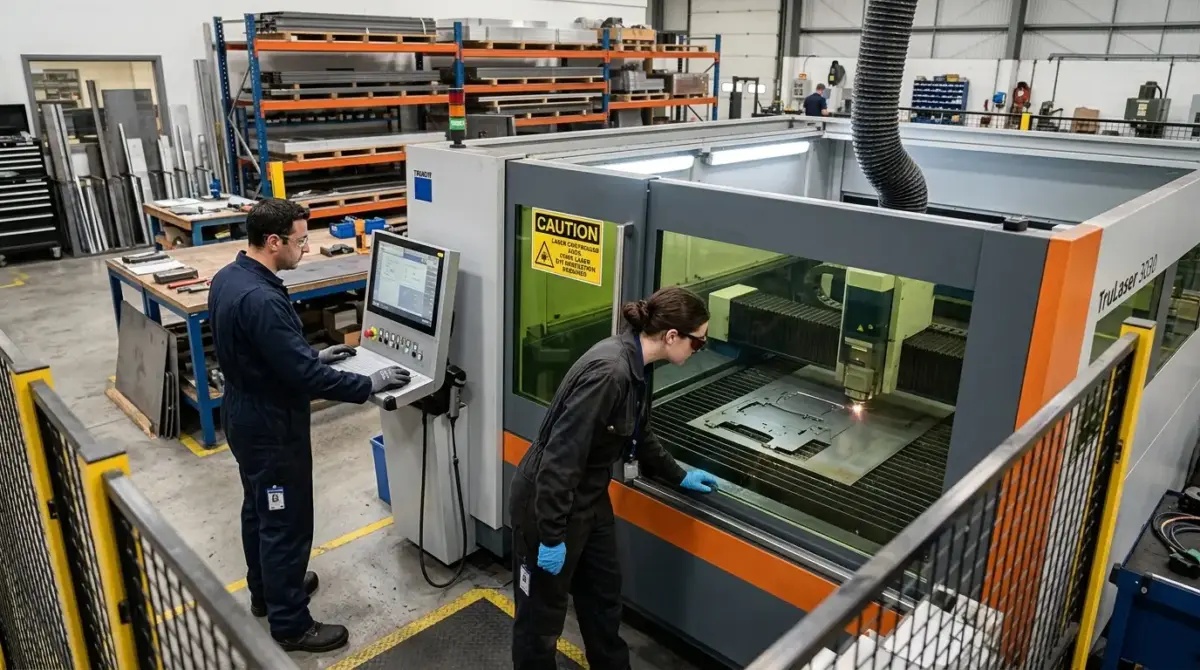
A laser risk assessment systematically identifies every hazard a laser creates across all operating modes — beam and non-beam — works out who could be exposed, then sets controls that keep exposure below the maximum permissible level. Conducting one means confirming the classification, mapping the beam path, quantifying the controlled area, and documenting controls under a competent person.
This article provides general HSE knowledge. Life-critical laser work — particularly the operation, alignment, and servicing of Class 3B and Class 4 systems — must be planned and supervised by a competent person with relevant training, jurisdiction-specific authorization, and a site-specific risk assessment. The information here does not replace that.
A laser’s class is the most quoted figure in any laser safety conversation, and one of the most misread. Classification answers a narrow question — what emission is accessible under defined test conditions, with assumed apertures, distances, and optical-aid scenarios — and IEC 60825-1 was never designed to describe the risk of the specific job in front of you, with its reflections, beam-path optics, and bypassed interlocks.
That gap is exactly where people get hurt. A Class 3B or Class 4 beam can cause permanent retinal injury faster than the eye’s blink reflex can close, and a flawed assessment is the mechanism that lets that exposure reach an operator, a colleague, or a maintenance technician. This guide walks through how to conduct a laser risk assessment that holds up — the standards it must satisfy, the step-by-step method, the beam and non-beam hazards it has to capture, and the calculations that turn a vague “eye hazard” into a defined controlled area.
What a laser risk assessment actually evaluates
The assessment evaluates the task, not the device. A laser sitting in its box has a class; a laser being aligned by a technician with the housing open has a risk profile, and those are different things.
That distinction drives everything that follows. Classification tells you the emission category under standardised assumptions — it does not tell you what the irradiance is at a specific point in your facility, what reflections the optics throw off, or whether your controls actually hold during service and bypass modes.
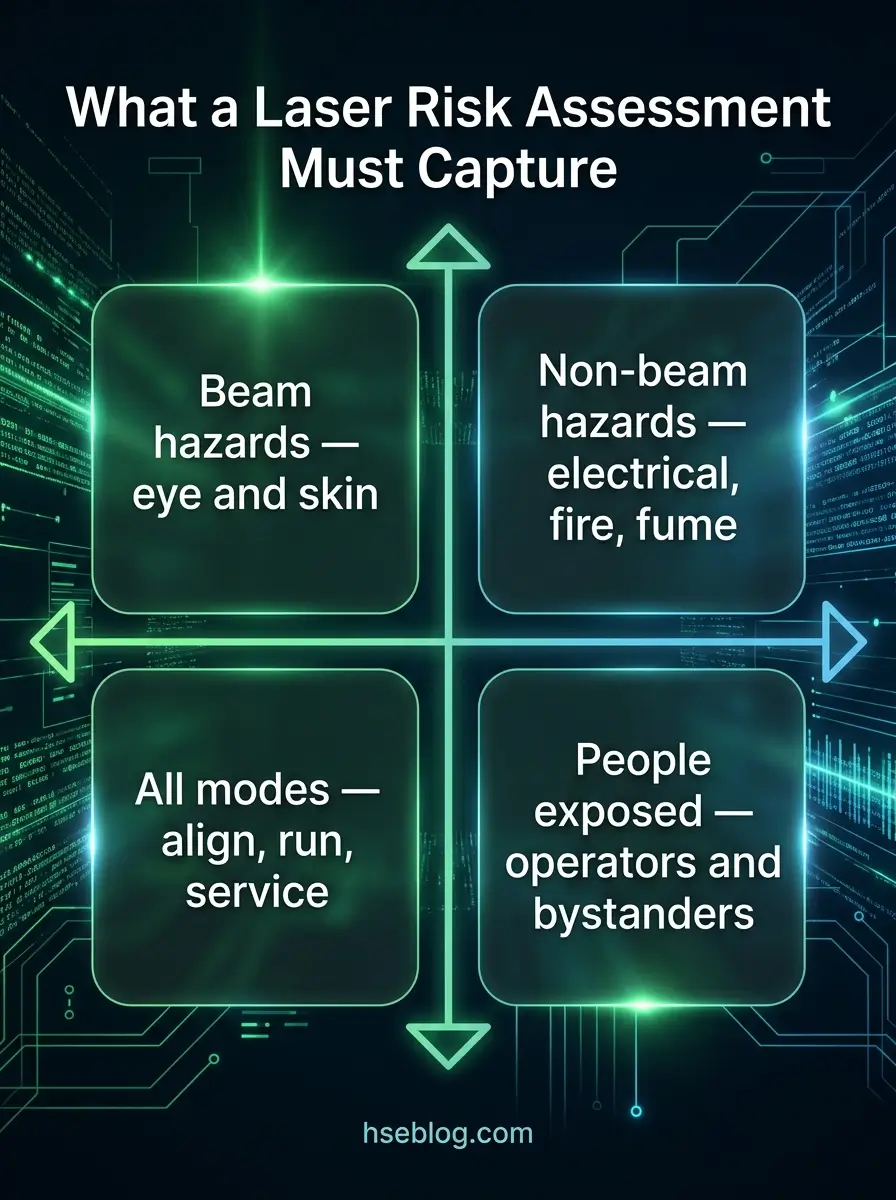
A complete laser risk assessment works across three layers:
- The beam itself. Wavelength, power or pulse energy, beam divergence, and how accessible the beam becomes in each operating mode — normal running, alignment, setup, and maintenance.
- The people and the environment. Who could be exposed and by what route: direct intrabeam viewing, specular reflection from a mirror-like surface, or diffuse scatter. Aided viewing through magnifiers or optics changes the answer again.
- The non-beam hazards. The electrical, fire, fume, gas, and collateral-radiation risks the beam generates as a side effect, which injure people well outside the line of the beam.
The practical reading on most sites is that the assessment is where classification gets translated into action. An auditor treats a generic “eye hazard” entry — no wavelength, no exposed-person analysis, no hazard distance — as inadequate, because it tells an operator nothing they can act on and proves nothing about the adequacy of the controls.
Which laws and standards your laser risk assessment must satisfy
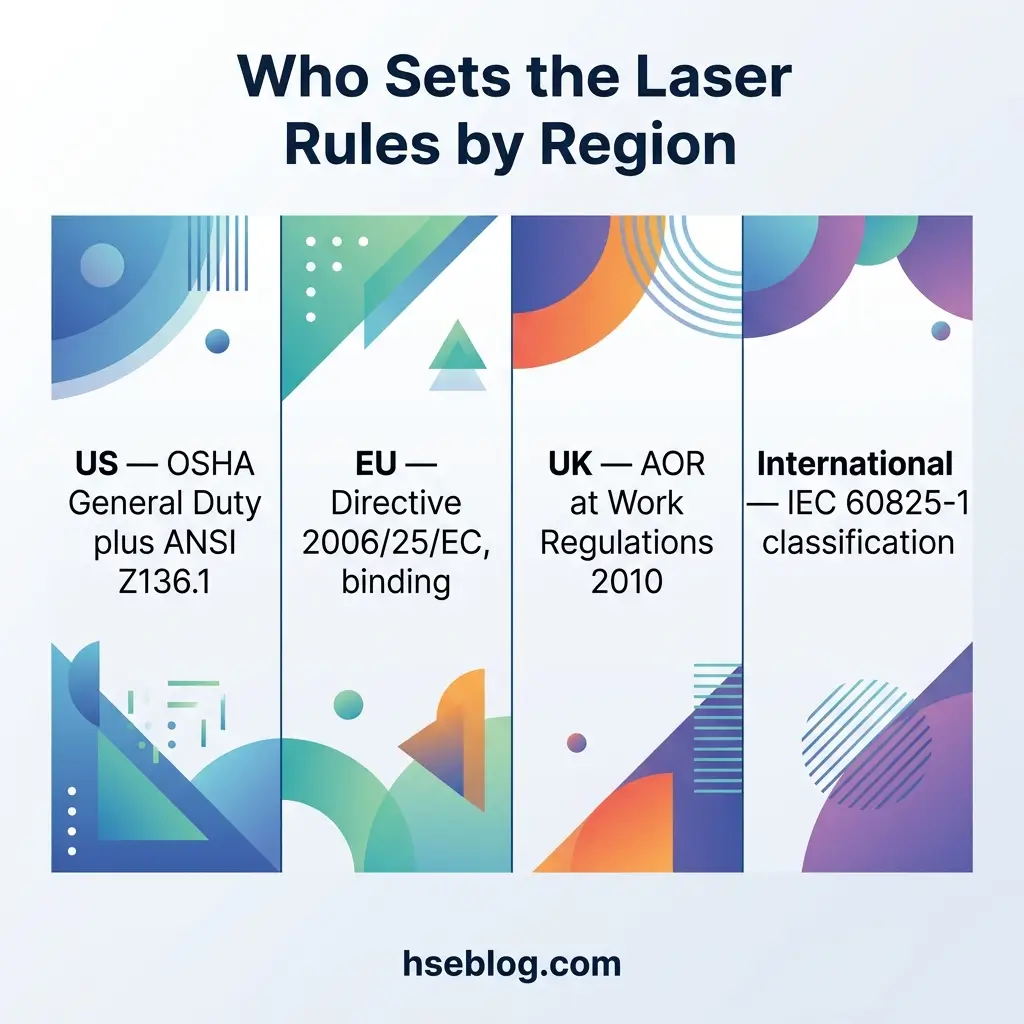
No single global law governs lasers; the obligation comes from a layered set of instruments, and which ones bind you depends entirely on where you operate. In the United States, OSHA has no laser-specific standard at all — it enforces the General Duty Clause (Section 5(a)(1)) and points employers to the ANSI Z136 series as the recognised basis for evaluating laser hazards, as set out on the OSHA laser-hazards standards page.
The instruments fall into a clear pattern:
| Jurisdiction | Governing instrument | Legal status | Core obligation |
|---|---|---|---|
| International | IEC 60825-1 (Ed. 3.0, 2014) | Product / classification standard | Classifies lasers (Class 1–4, plus 1C) and sets labelling |
| United States | OSHA General Duty Clause; ANSI Z136.1-2022 | OSHA-referenced; ANSI voluntary consensus | Hazard-free workplace; ANSI program with an LSO for Class 3B/4 |
| European Union | Directive 2006/25/EC | Binding via member-state law | Assess, measure, or calculate exposure against laser ELVs |
| United Kingdom | Control of Artificial Optical Radiation at Work Regs 2010 | Binding | Risk-assess and control artificial optical radiation exposure |
| Canada | CSA Z386 / provincial OHS; ANSI referenced | Binding / referenced | LSO and laser safety committee; documented risk assessments |
The European route is worth reading carefully because it makes the assessment a legal duty in its own right. Directive 2006/25/EC — the nineteenth individual directive under the framework Directive 89/391/EEC — requires employers to assess and, where necessary, measure or calculate the optical radiation their workers are exposed to and compare it against the laser exposure limit values in its annexes (EU-OSHA). The detail sits in EU-OSHA’s summary of Directive 2006/25/EC, and the UK transposed the same requirements through its 2010 regulations.
One freshness point matters here. The 2022 revision of ANSI Z136.1 rewrote its non-beam-hazards section, added 19 new definitions, and raised the maximum permissible exposures in parts of the near-infrared band (ANSI Z136.1-2022) — so any assessment leaning on an older edition may now be misaligned with current allowed exposure levels.
Regulatory content here reflects general HSE professional understanding of laser safety requirements across the named jurisdictions, as of 2026. It is not legal advice. Specific compliance questions, enforcement situations, or prosecution risk should be directed to qualified legal counsel in the applicable jurisdiction.
How to conduct a laser risk assessment, step by step
A defensible assessment moves through a fixed sequence, and skipping a stage is usually where the document later fails an audit. The order below works for an industrial Class 4 cutter or a research Class 3B system equally well.
- Confirm the classification and the real specification. Record wavelength, output power or pulse energy, pulse structure, and beam divergence. Verify against both the device label and the manufacturer’s data — and remember that an embedded Class 1 product can contain a Class 4 beam that becomes accessible during service.
- Map every operating mode and the beam path. Normal operation, alignment, setup, maintenance, servicing, and foreseeable faults. The published incident record is dominated by alignment and service, when housings are open, so the assessment that covers only routine running has already missed the highest-risk task.
- Identify who could be exposed, and how. Operators, nearby staff, visitors, and maintenance personnel. Separate direct intrabeam viewing from specular reflection and diffuse scatter, and flag any aided viewing through optics, which can defeat the assumptions behind a 1M or 2M class.
- Catalogue the non-beam hazards. Electrical, fire, laser-generated air contaminants, compressed gases or cryogens, collateral radiation, and mechanical risks. Be specific about the materials being processed, because the fume changes with the workpiece.
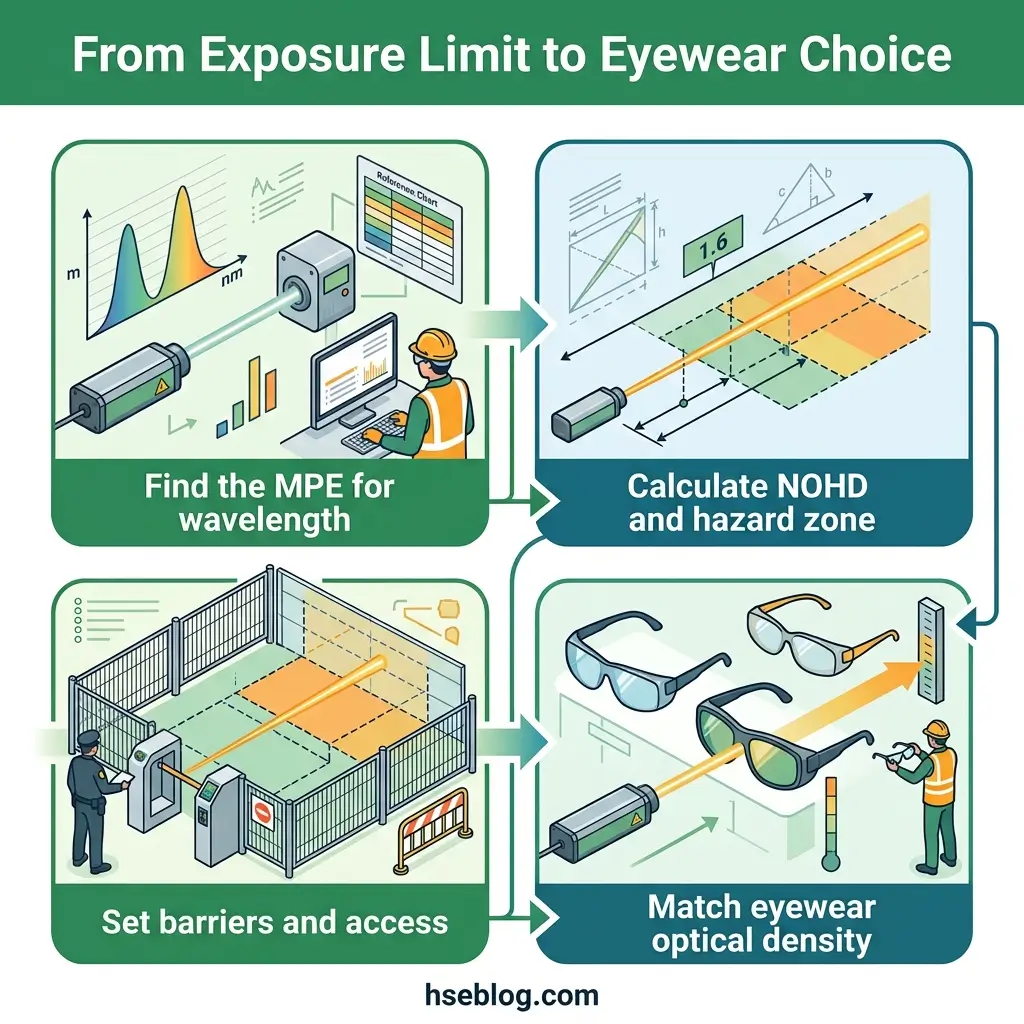
- Quantify the hazard zone. Determine the maximum permissible exposure for the wavelength and exposure duration, then calculate the nominal ocular hazard distance and the nominal hazard zone. These numbers define where the controlled area begins.
- Test the existing controls for failure points. Can an interlock be bypassed? Does the ventilation actually handle the fume load? Is the eyewear’s optical density correct for this wavelength? Generic confidence in controls is not evidence; the failure modes are.
- Assign controls by the hierarchy and record each one. Engineering first — enclosure, interlocks, beam stops — then administrative controls such as standard operating procedures, controlled-area access, and training, and finally PPE including eyewear and respiratory protection.
- Document, authorise, and set a review trigger. A competent person signs the assessment; for Class 3B and Class 4 lasers that should be a Laser Safety Officer. Build in a review on any change of laser, process, or layout, and after any incident.
Assessing beam and non-beam hazards together
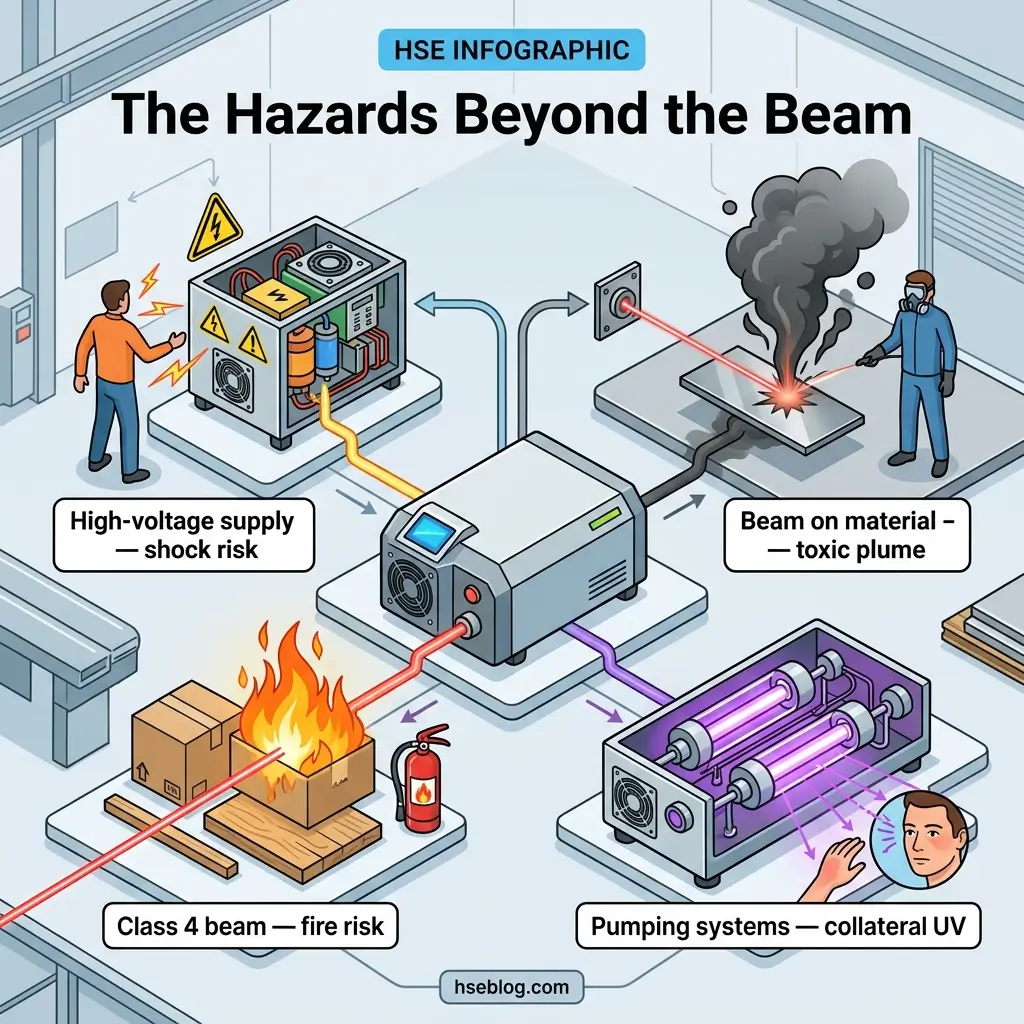
Across the published incident record, the hazard that hurts someone is often not the one the assessment focused on. Beam injuries get the attention because they are dramatic and instant, but a large share of laser harm comes from the systems around the beam — electrical supplies, fume, fire — and an assessment that treats those as an afterthought leaves a real gap.
It helps to hold both families side by side:
| Hazard family | Examples | What it threatens | Typical control |
|---|---|---|---|
| Beam — direct / specular | Intrabeam viewing; mirror-like reflections | Retina, cornea, skin | Enclosure, beam stops, eyewear |
| Beam — diffuse | Scatter from matte surfaces (Class 4) | Eyes at close range | Barriers, controlled area |
| Non-beam — electrical | High-voltage supplies; charged capacitors | Electrocution | Isolation, capacitor discharge, guarding |
| Non-beam — fire | Beam on combustibles; assist gases | Burns, facility fire | Fire-rated barriers, housekeeping |
| Non-beam — LGAC / plume | Vaporised tissue, plastics, metals | Respiratory and carcinogenic exposure | Local exhaust ventilation, plume evacuation, RPE |
| Non-beam — collateral radiation | UV/blue light; soft X-rays above 15 kV | Eyes, skin, ionising exposure | Shielding, enclosure |
The fume hazard is frequently under-assessed. When target irradiance reaches roughly 10⁷ W/cm², materials such as plastics, metals, and tissue can release carcinogenic, toxic, and noxious airborne contaminants (Berkeley Lab EHS) — and in surgical and aesthetic settings that plume can carry blood by-products and pathogens. Local exhaust ventilation, process isolation, and respiratory protection are the controls, in that priority order.
Electrical risk deserves equal weight. University laser-safety programs consistently identify electrical shock as the most lethal non-beam hazard, because pulsed systems store energy in capacitors and continuous-wave systems run on high-voltage supplies (Missouri S&T EHS) — which is why isolation and capacitor discharge belong in any assessment that touches servicing.
Setting the controlled area: nominal hazard zone, NOHD, and eyewear
The maximum permissible exposure is the single most useful number in the whole assessment. It is the highest irradiance or radiant exposure that may reach the eye or skin without causing biological damage, and it varies with wavelength and exposure duration through tables published in ANSI Z136.1 (University of Chicago, Office of Research Safety). Think of it as the speed limit the rest of the calculation has to respect.
Three quantities turn that limit into a physical boundary:
- Nominal ocular hazard distance (NOHD). The distance along the beam axis at which irradiance drops to the MPE. It depends on beam power, diameter, and divergence — and for a tightly collimated beam it is often far greater than the room itself.
- Nominal hazard zone (NHZ). The space within which exposure to a direct, reflected, or scattered beam exceeds the MPE. Inside it, you are at risk of an over-exposure; this is the area your barriers and access controls have to enclose.
- Optical density (OD). The logarithmic measure of how much an eyewear filter attenuates the beam, where higher OD means greater protection (NoIR). The eyewear has to reduce the beam at least to the MPE for that wavelength.
The judgment call in eyewear selection is the tension between optical density and visibility. Push the OD too high and the operator can no longer see the beam or the work, which tempts people to lift the glasses during alignment — the exact moment they are most exposed. The defensible choice balances enough attenuation to clear the MPE against enough visible transmission for the task to be done safely, rather than treating “more OD” as automatically better.
There is a live regulatory wrinkle worth building into any current assessment. The laser exposure limit values in EU Directive 2006/25/EC rest on ICNIRP science from more than two decades ago; ICNIRP published revised criteria in 2013, and in September 2023 a group of European occupational-safety institutes (PEROSH, 2023) formally called for the directive’s limits to be updated. A draft of EN 60825-1 already reflects the newer limit concept — which means some lasers presently rated Class 3B could fall into Class 1 under the revised scheme, even though the still-binding directive’s exposure limits might be exceeded in use (KAN). Where standards and statute diverge, the safe practice is to treat the stricter requirement as primary.
Why laser risk assessments fail — and how to make yours hold up
The most common reason an assessment fails review is rarely a missed exotic hazard. It is a small number of predictable structural weaknesses that recur across the published record, and each one is avoidable.
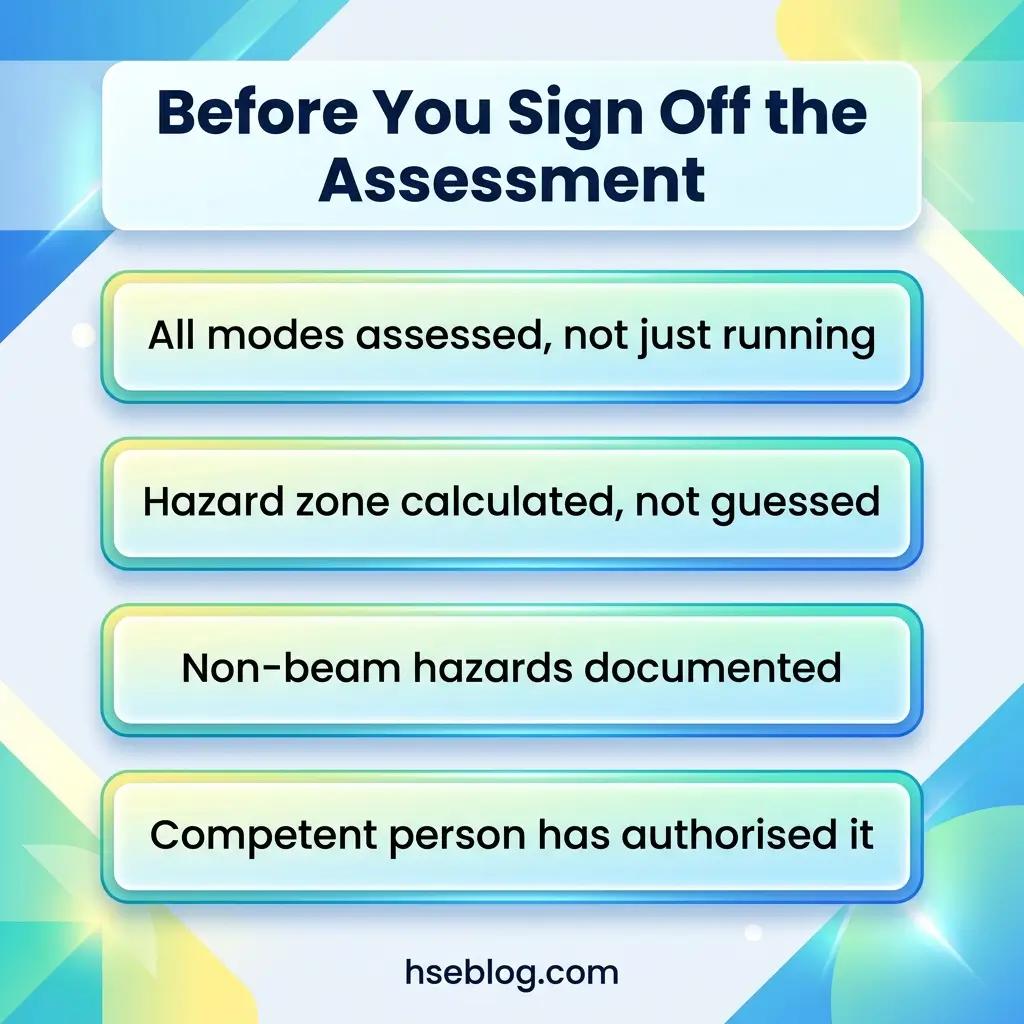
- Assessing only normal operation. Most documented exposure events occur during alignment or service, with guards removed — yet many assessments describe only routine running and treat the open-housing tasks as out of scope.
- Treating classification as the whole assessment. The class label omits site-specific reflections, beam-path optics, and bypass modes, so leaning on it alone leaves the real exposures unexamined.
- Generic hazard entries. “Eye hazard” with no wavelength, no NOHD, and no analysis of who is exposed proves nothing and guides no one. Specificity is what makes the document defensible.
- Under-assessing non-beam hazards. Electrical and fume risks are routinely thin in laser assessments, despite being the hazards most likely to injure someone standing outside the beam.
- Static documents. An assessment that is never re-triggered by change drifts out of date the instant the layout, the process, or the workpiece changes.
- No competent ownership. Where Class 3B or Class 4 lasers are in use, a Laser Safety Officer must hold the authority for evaluation and control of laser hazards — a point reinforced in CCOHS guidance on laser safety. Without that ownership, the assessment lacks both authority and technical depth.
The fix for every one of these is the same instinct: write for the worst task on the worst day, name the hazard precisely, and tie the document to a person and a review cycle.
Frequently Asked Questions
Conclusion
A sound laser risk assessment comes down to a few disciplined decisions. Assess every mode rather than just normal running, because alignment and service are where the published exposures cluster. Quantify the hazard zone with the MPE, NOHD, and nominal hazard zone instead of relying on the class label, and assess the electrical, fire, and fume hazards with the same rigour you give the beam.
The harder discipline is ownership. For Class 3B and Class 4 work, the document needs a competent person — a Laser Safety Officer — to author it, authorise it, and keep it alive through a review trigger, because an unsigned, unmaintained assessment offers no protection when the layout changes or an interlock gets bypassed.
If you take one thing from this, make your next laser risk assessment specific enough that a new operator could read it and know exactly where the beam is dangerous, who is at risk, and which control protects them — and current enough that it still matches the system on the floor today.