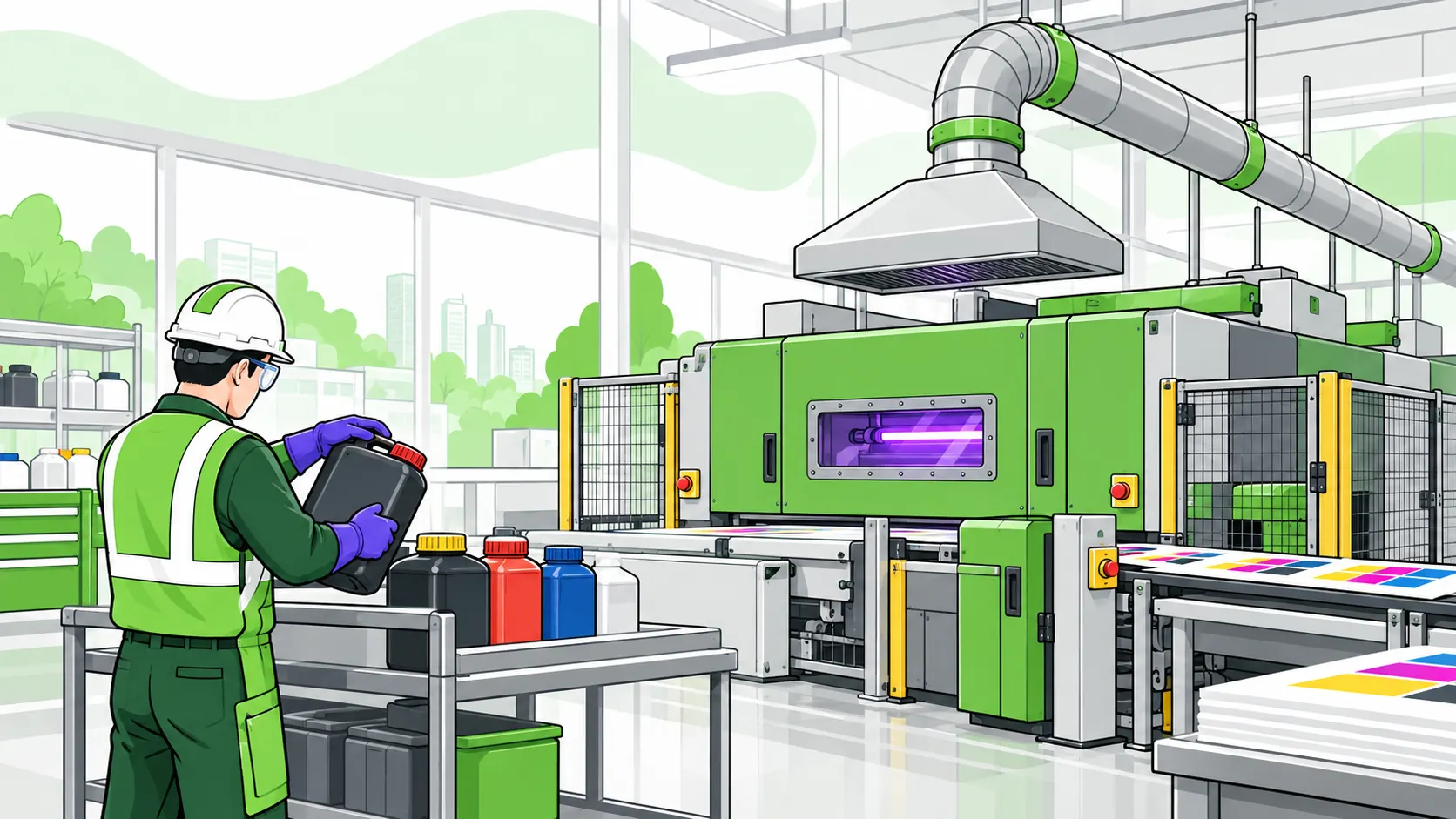
UV curing in printing carries two hazard families: non-ionising UV radiation from the curing lamps, which causes photokeratitis and skin damage, and chemical exposure to uncured inks containing acrylate monomers and photoinitiators that can permanently sensitise skin. Mercury lamps add ozone and heat. Control depends on lamp shielding, local exhaust ventilation, and PPE.
A page currently ranking for this topic tells readers that UV printers "do not emit harmful radiation." That single sentence is wrong in a way that puts operators at risk, and it captures why so much of the published advice on UV curing hazards in printing is unreliable. UV curing lamps emit intense non-ionising ultraviolet that causes photokeratitis and skin damage, and the uncured ink they polymerise is a recognised cause of occupational dermatitis (HSE work-related dermatitis guidance).
The stakes are real because the harm is delayed and invisible. Eyes burn hours after exposure, skin sensitisation builds silently until it becomes permanent, and ozone symptoms get mistaken for stuffy-room grumbling. This article separates the two hazard families the title names — radiation and chemistry — adds the exposure limits most competitors omit, and structures the controls by what actually works rather than a flat list of glasses and gloves.
What Makes UV Curing in Printing Hazardous? Two Risk Families, Not One
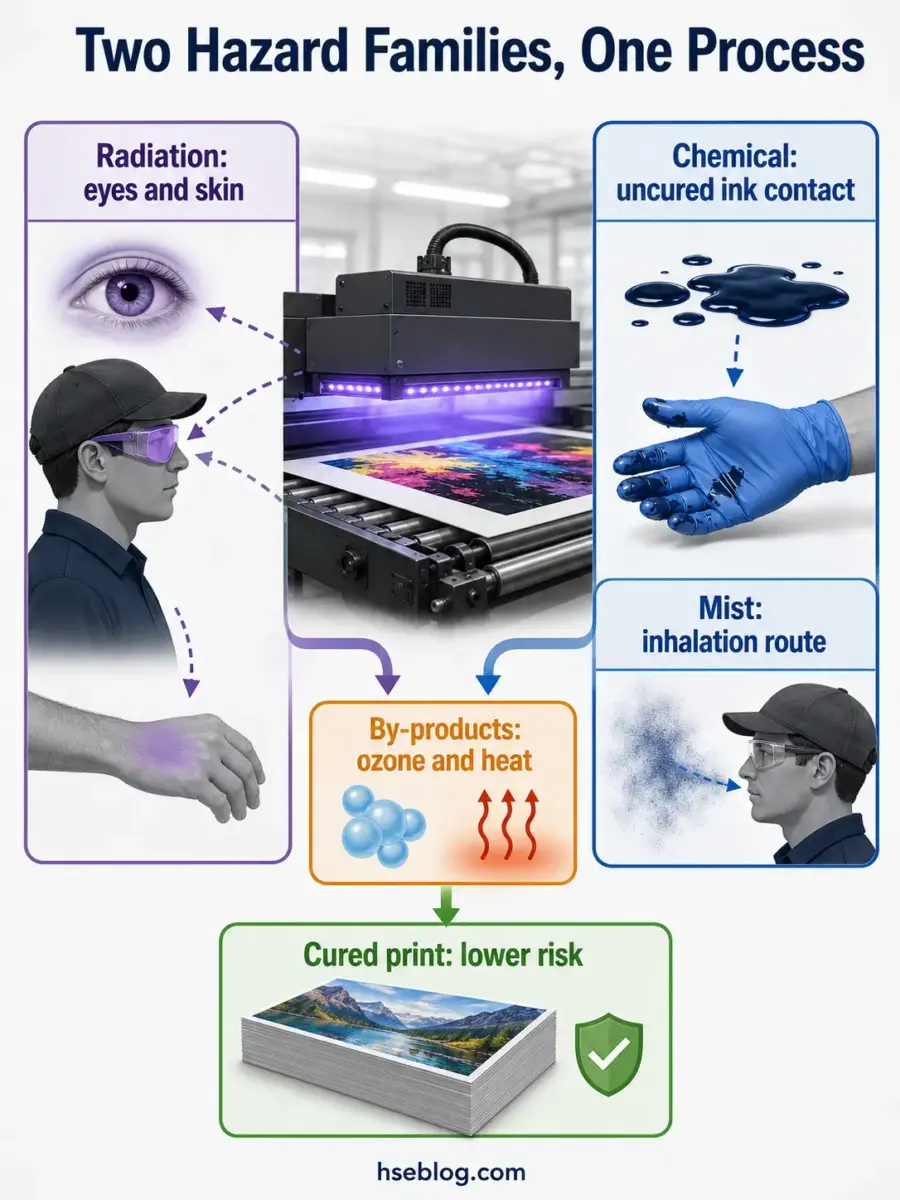
The hazard in UV printing lives in the lamp and the liquid, not the finished print. UV curing polymerises liquid inks and coatings in a fraction of a second: photoinitiators absorb the ultraviolet, then trigger acrylate monomers and oligomers to cross-link into a solid film. Two separate things in that process can hurt people.
- Non-ionising UV radiation — the curing lamp itself, harming eyes and skin through direct and scattered exposure.
- Chemical exposure — the uncured liquid ink, where reactive acrylates and photoinitiators contact skin or are inhaled as mist.
- By-products — ozone generated by short-wavelength lamps, and radiant heat from mercury arc tubes.
A point worth fixing early: the risk concentrates on uncured material and on exposed or leaking lamps. A fully cured print carries far lower risk — though, as the chemistry section shows, not zero where cure is incomplete.
The exposure geometry also shifts by process. Lithographic, screen, wide-format, and label or narrow-web printing each place workers at different distances from the lamp and handle the wet stock differently, which is why the HSE publishes separate COSHH Essentials sheets for each (UK).
A consistent pattern across shops that move from solvent to UV: they treat UV as "cleaner" because the inks are near solvent-free, and quietly under-control the dermal and optical risks that solvent-era habits never had to address. The hazard profile changed. The control culture often did not.
UV Radiation Hazards: How Curing Lamps Affect Eyes and Skin
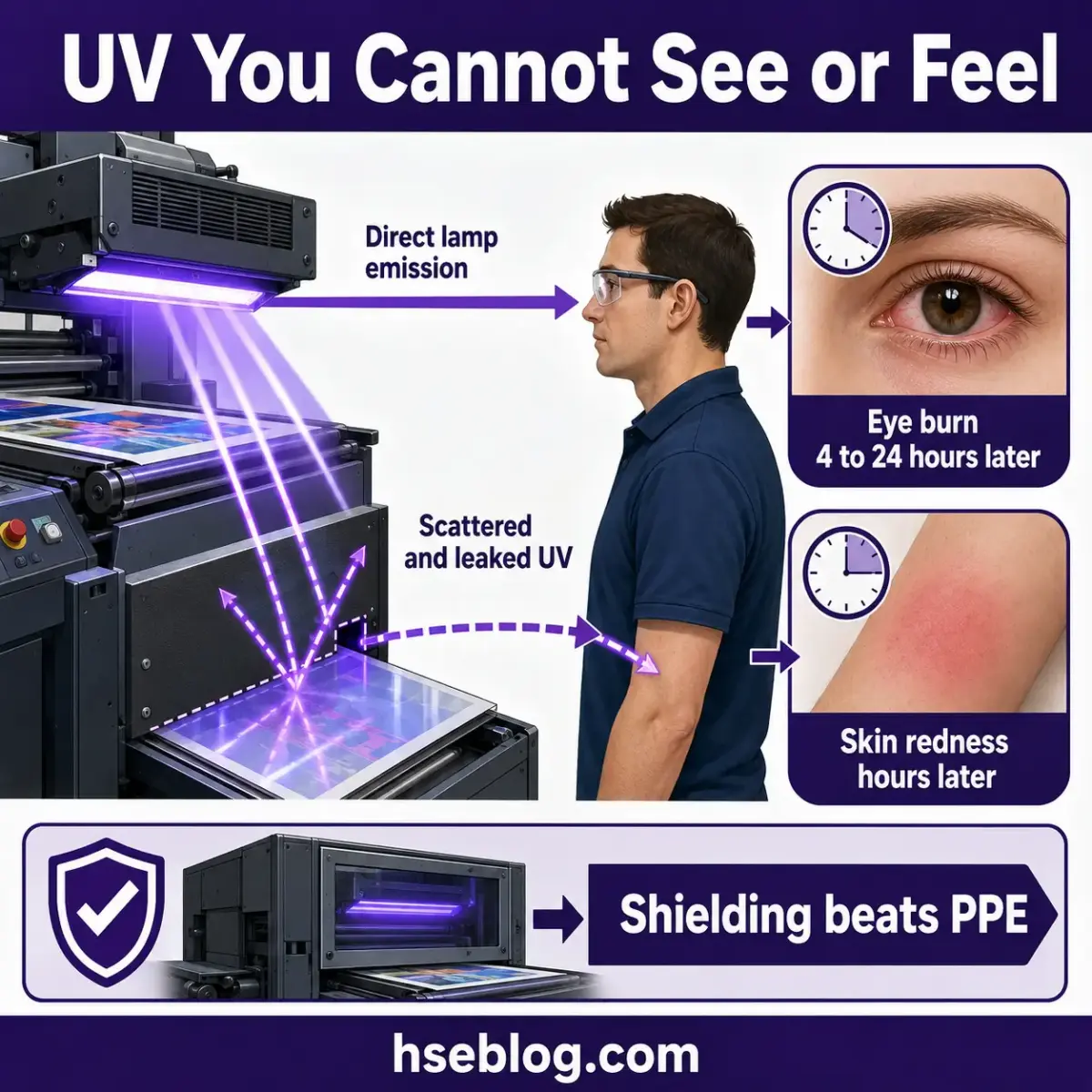
UV from curing lamps damages eyes and skin before the worker feels anything — that delayed, painless onset is exactly what makes it dangerous. The radiation is non-ionising, so it does not make anything radioactive, but it carries enough energy to burn the cornea and the skin like an intense sunburn.
| Effect | Onset | Type | What happens |
|---|---|---|---|
| Photokeratitis ("arc eye") | Delayed 4–24 hours | Acute, eye | Painful corneal inflammation, gritty sensation, light sensitivity |
| Erythema (sunburn) | Hours | Acute, skin | Redness and tenderness on exposed skin |
| Photoageing | Years | Chronic, skin | Premature skin damage from repeated exposure |
| Skin cancer | Long-term | Chronic, skin | Elevated risk with cumulative UV dose |
Lamp type changes the spectrum. Mercury vapour lamps emit a broadband mix rich in shorter-wavelength UV-C and UV-B; UV LED systems emit a narrow UV-A band. Both require control — UV-A still burns skin and eyes — but the mercury spectrum is more aggressive and, critically, generates ozone.
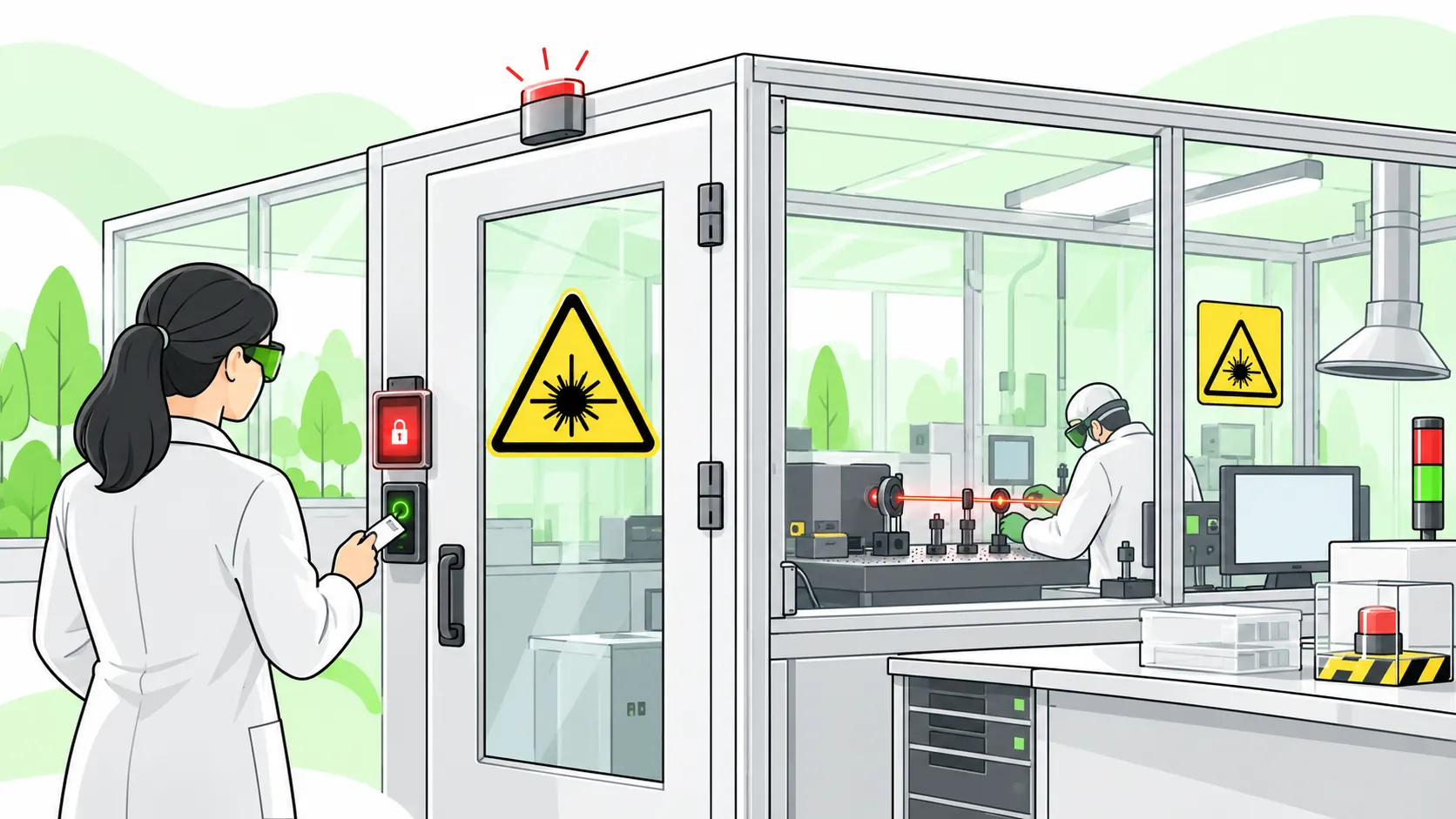
The exposure route people underestimate is indirect UV. Scattered light from gaps in shielding, a failed interlock, or a reflective substrate reaches the eyes without anyone looking straight at the lamp. Treating only "direct viewing" as the hazard misses most of the real dose.
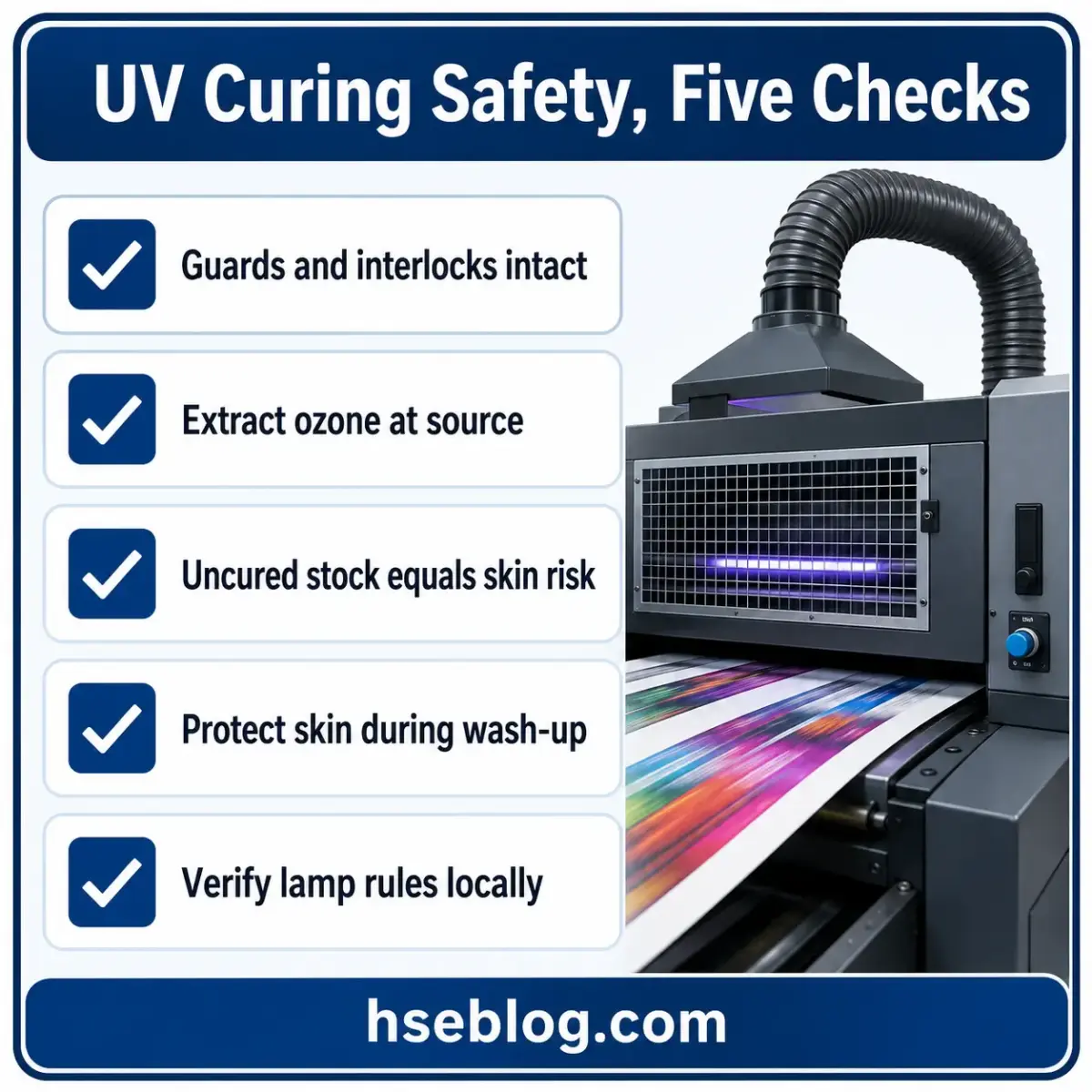
Reviewing how UV incidents tend to arise, the controlling factor is guard and interlock integrity, not eyewear. The recurring failure mode is interlock defeat — operators prop or bypass a UV unit's guard during setup, web-break clearing, or maintenance, which is precisely the moment uncontrolled direct exposure happens. PPE matters, but it is the last line, not the fix.
UV Radiation Exposure Limits and What They Mean
There is one widely accepted UV exposure number — and a jurisdictional catch worth understanding before you rely on it.
- Actinic UV limit: 30 J/m² effective radiant exposure over 8 hours (ICNIRP/ACGIH, via EU Directive 2006/25/EC, 2006). This is the working-population ceiling for the eye- and skin-damaging portion of the UV spectrum.
- US enforcement gap: there is no OSHA-specific UV permissible exposure limit (US). The ACGIH TLV and ANSI/IESNA RP-27 are advisory, not regulatory. In a US shop, applying the ACGIH/ICNIRP value as the protective reference is the sound practice.
- EU enforcement: the Artificial Optical Radiation Directive 2006/25/EC makes the 30 J/m² limit a legal duty to protect workers' eyes and skin (EU), referencing EN 62471 for non-laser sources.
For the lamps themselves, IEC 62471:2006 and the dedicated IEC 62471-6:2022 govern photobiological risk-group classification, assessment distances, and labelling for UV lamp products — and 62471-6 explicitly references ink photopolymerisation in printing (Global/EU via EN 62471, 2022). When buying or assessing a curing unit, the risk group on its IEC 62471 label is the starting point for the exposure assessment.
Chemical Hazards of UV-Curable Inks, Varnishes, and Coatings
Medical note: Content here covering skin sensitisation, exposure, and health surveillance is for HSE practitioner reference. It is not medical advice. Workers with skin symptoms, breathing difficulty, or exposure concerns should consult an occupational physician or qualified medical professional.
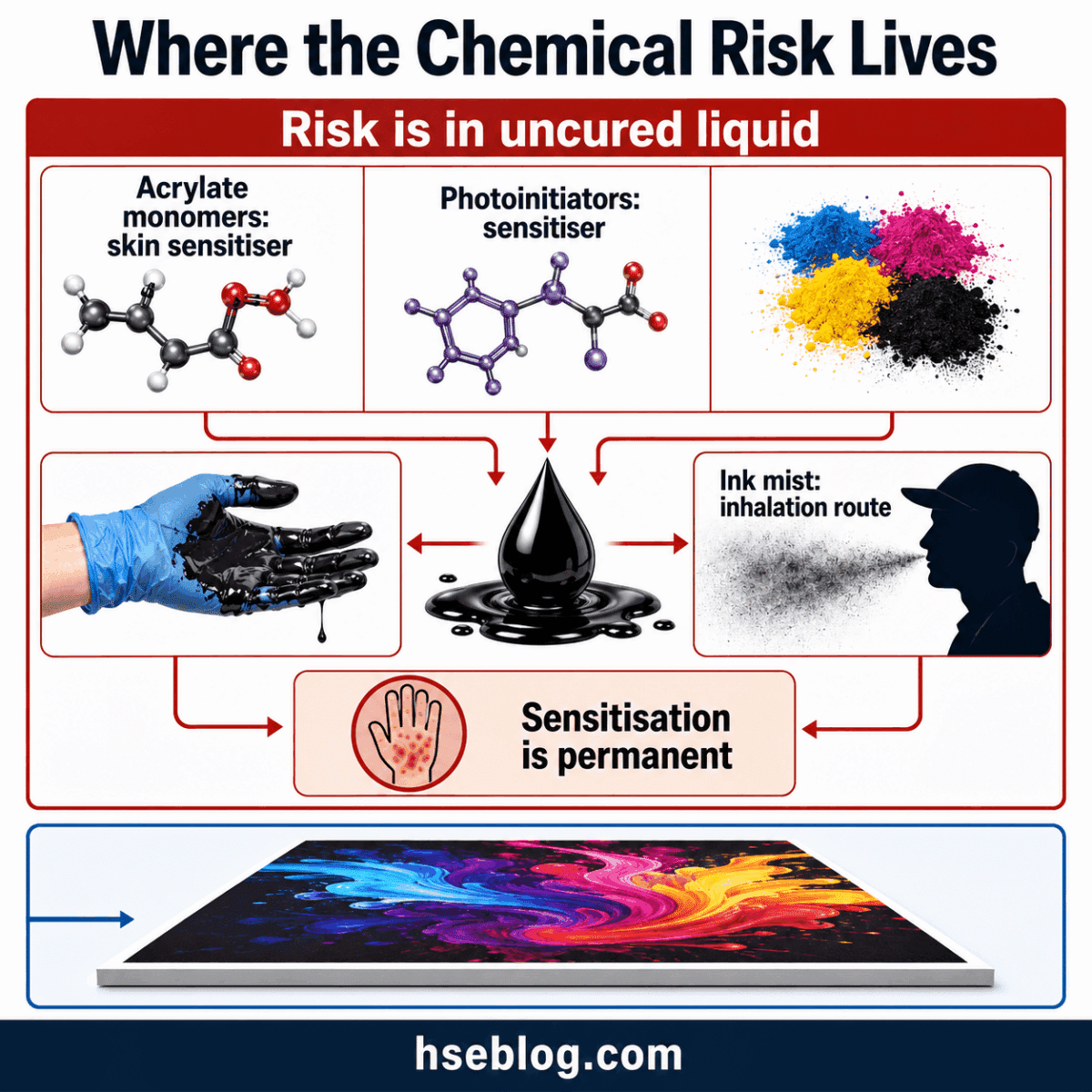
The defining chemical hazard of UV printing is permanent skin sensitisation from the uncured liquid — and it is the part competitors describe vaguely as "fumes." The danger sits in the wet ink: reactive acrylate monomers and oligomers, plus the photoinitiators that drive the cure, before the UV has locked them into a solid film.
Skin sensitisation deserves to lead because it is largely irreversible. Once a worker develops allergic contact dermatitis to an acrylate, even trace contact can trigger a reaction for the rest of their working life — and HSE lists UV-cured printing inks among recognised causes of occupational dermatitis (HSE work-related dermatitis guidance, UK). That permanence is what separates this from a passing irritation.
| Substance class | Typical GHS classification | Effect |
|---|---|---|
| Acrylate monomers | Skin Sens. 1/1B (H317), Skin Irrit. 2 (H315) | Allergic contact dermatitis, irritation |
| Some photoinitiators | Skin Sens. 1, Eye Irrit. 2 (H319) | Sensitisation, eye irritation |
| Selected reactive diluents | STOT RE, Repr. 2 (H361) per SDS | Target-organ / reproductive flags |
| Carbon black pigment | Carc. 2 (inhalation) | Inhalation concern, context-dependent |
| Titanium dioxide pigment | IARC Group 2B | Inhalation concern, context-dependent |
Classifications vary by product, so the supplier SDS is the authority for any given ink — the table shows the pattern, not a universal label. The pigment flags in particular are context-dependent inhalation concerns for the powder and mist, not a claim about a finished cured print.
Inhalation is the second route. High-speed printing throws up ink mist, fly, and aerosols that can irritate the airway and, with sensitisers present, contribute to respiratory sensitisation. There is also a migration concern: incompletely cured prints can release acrylates and photoinitiators such as ITX or DETX, which matters specifically for food and pharmaceutical packaging.
This is where a stubborn misconception causes real harm — "fully cured means safe, so handling is fine." On most lines cure is verified by mechanical tack or rub testing, not by FTIR analysis, so under-cured product reaches handling stations routinely. The practical judgment: treat dermal contact with any freshly run UV stock as a sensitisation route until cure is confirmed adequate.
Wash-Up Solvents and Cleaning Chemicals: The Overlooked Exposure
UV inks may be near solvent-free, but the press wash-up still uses solvents — and that is a separate skin hazard shops forget when they "go UV." Roller and cylinder cleaning puts bare or poorly gloved skin in repeated contact with cleaning chemicals, which is a documented high-risk task for dermatitis.
- The hazard is real even without "fumes." Wash-up solvents cause dermatitis and, depending on the solvent, central nervous system effects — yet many printers do not perceive cleaning chemicals as a skin hazard at all.
- Glove selection is the control that gets it wrong. HSE research points to nitrile around 0.4 mm as a sensible default for litho wash-up, with aggressive chemicals needing thicker or alternative materials checked against the SDS.
- Skin is the primary contact route here, not the lungs — so the protection that matters most is correct gloves that overlap the cuff, not a respirator.
Ozone and Heat: The By-Products of UV Curing
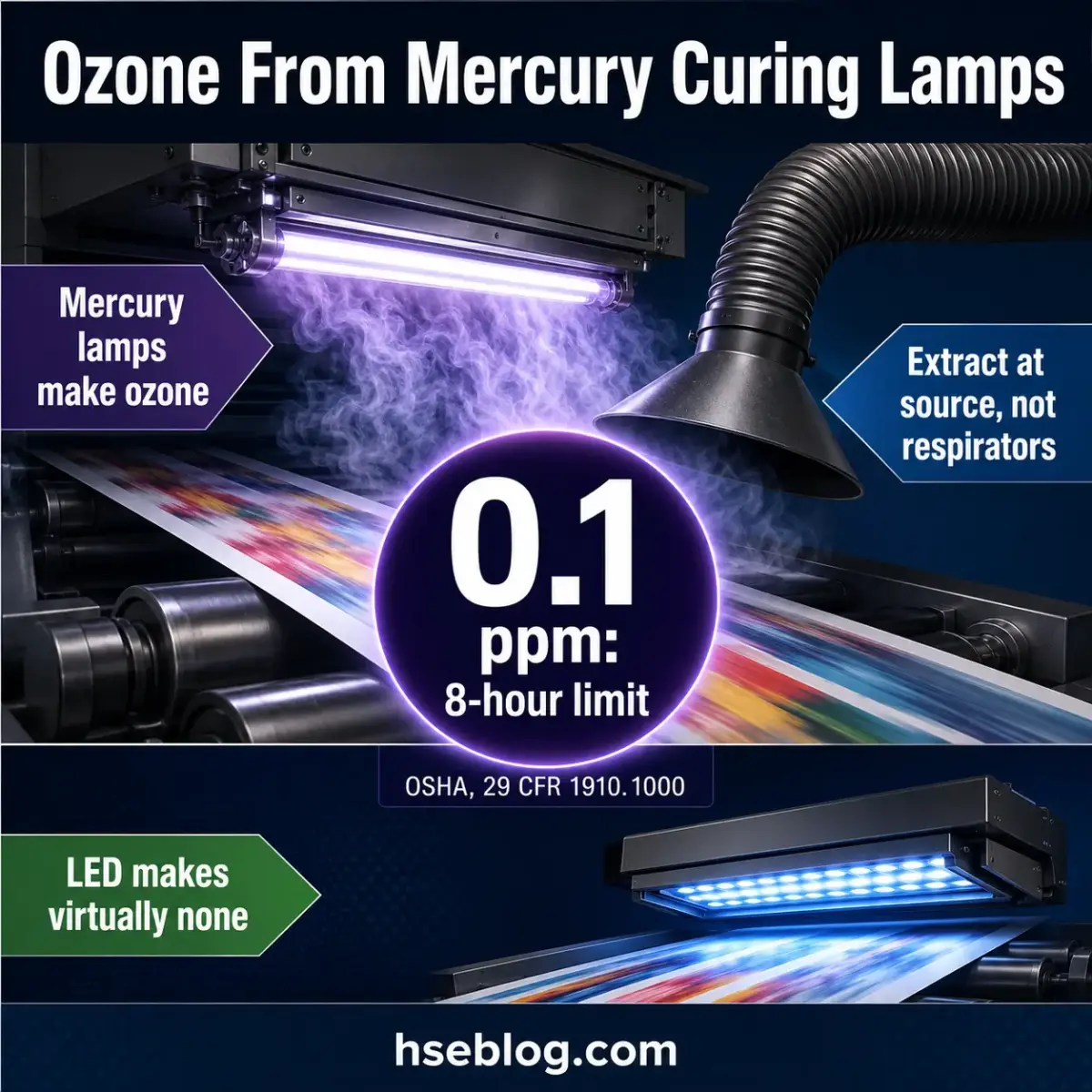
Mercury and some doped curing lamps generate ozone; UV LED systems essentially do not — that single difference drives much of the ventilation design. Ozone forms when short-wavelength UV splits oxygen molecules in the air around the lamp, and it is an irritant gas that should be controlled at source.
Low-level ozone irritates the eyes, nose, and throat. At higher concentrations it brings headache, nausea, chest pain, and reduced pulmonary function — which is why the limits below matter operationally, not just on paper.
Heat is the second by-product, and it is easy to underestimate. A mercury arc tube's quartz envelope runs around 1500°F (roughly 815°C), creating burn risk on contact, a fire risk for the substrate if the web stalls, and residual heat that builds up in stacked freshly cured stock.
The control logic is firm here: ozone is managed by extraction and ducting at source, not by handing out respirators. Respiratory protection is a fallback for the individual; local exhaust removes the gas before anyone breathes it.
A pattern worth naming: ozone complaints usually present as a vague "headache and stuffiness by mid-shift" rather than an acute event, so they get dismissed as ventilation grumbling. When those symptoms cluster around older mercury units with degraded extraction, that is the prompt to actually measure the air, not to assume.
Ozone Exposure Limits by Jurisdiction
The enforceable number to plan around is 0.1 ppm — but the short-term picture has a regulatory wrinkle worth knowing.
| Reference | Limit | Status |
|---|---|---|
| OSHA PEL (US) | 0.1 ppm, 8-hour TWA | Enforceable federal limit (29 CFR 1910.1000, Table Z-1) |
| ACGIH TLV | 0.1 ppm TWA (work-rate dependent); 0.2 ppm STEL | Advisory; widely adopted in practice |
| NIOSH IDLH | 5 ppm | Immediately dangerous to life or health |
| OSHA STEL | 0.3 ppm (proposed) | Remanded; not federally enforceable |
The enforceable US ozone limit is 0.1 ppm as an 8-hour TWA (US OSHA, 29 CFR 1910.1000 Table Z-1). The upper severity bound is the NIOSH IDLH of 5 ppm (US NIOSH, current), which a well-ventilated shop should never approach.
The wrinkle is the short-term limit. OSHA's proposed 0.3 ppm STEL was remanded and is not federally enforceable, although ACGIH applies a 0.2 ppm STEL and some state plans, such as Cal/OSHA, enforce a short-term value. Where a short-term peak is a concern, planning to the stricter 0.2 ppm STEL is the defensible reference.
Controlling UV Curing Hazards: The Hierarchy of Controls in Practice
Competent-person caveat: This article provides general HSE knowledge. Life-critical and exposure-critical work — including UV exposure assessment, COSHH assessment, and lamp risk classification — must be planned and supervised by a competent person with relevant training, jurisdiction-specific authorisation, and a site-specific risk assessment. The information here does not replace that.
Legal note: The regulatory content here reflects general HSE professional understanding of UK and US requirements as of the review date above. It is not legal advice. Specific compliance, enforcement, or prosecution questions should go to qualified legal counsel in the applicable jurisdiction.
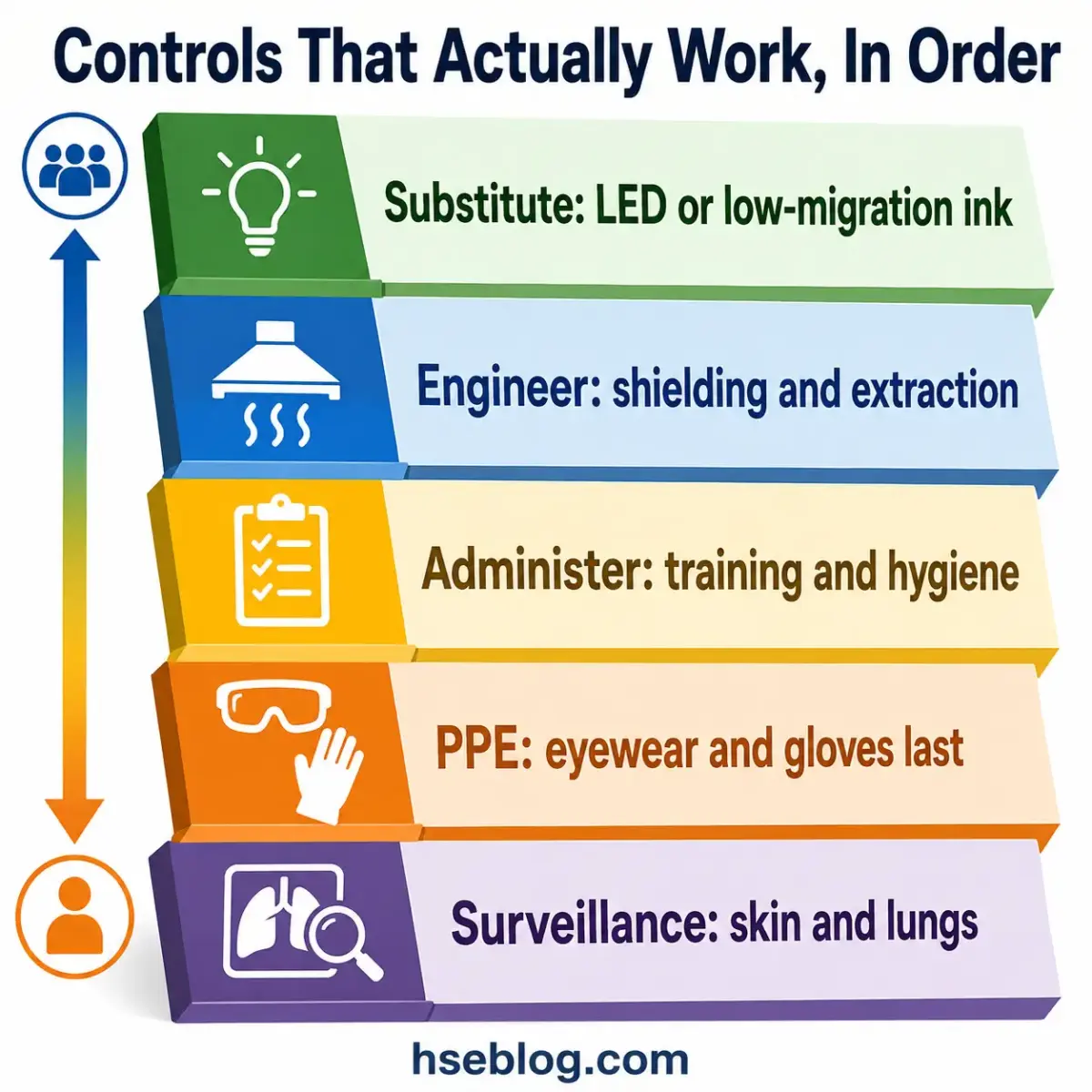
Effective control of UV curing safety runs top-down through the hierarchy — substitution and engineering first, PPE last — because only the upper tiers protect everyone continuously. Competitors jump straight to glasses and gloves; that inverts the logic.
- Eliminate or substitute. Switch to UV LED where the process allows — no ozone, a narrower UV-A band, and much lower heat — or move to low-migration, low-odour ink chemistries to cut the sensitisation load.
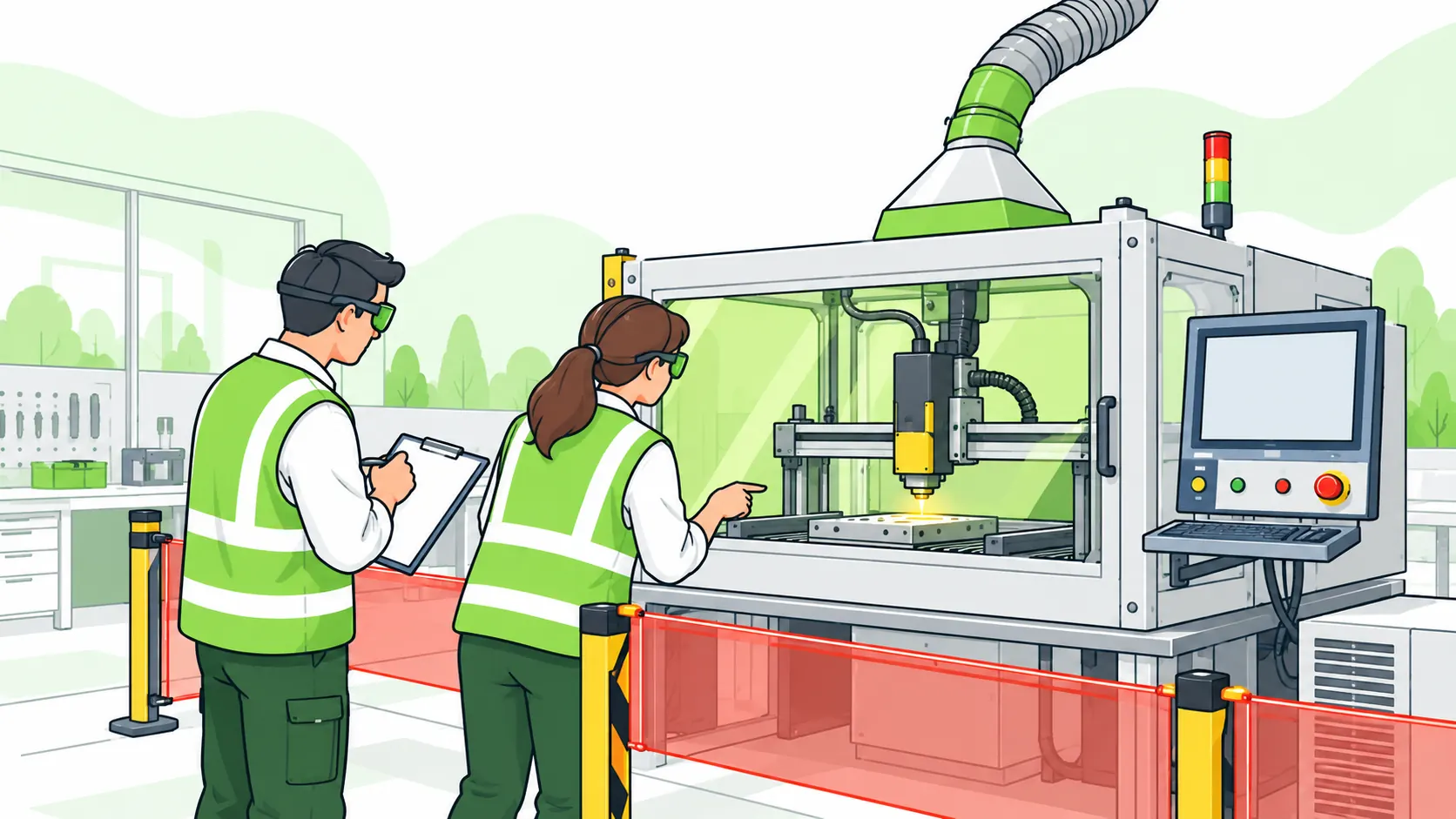
- Engineering controls. Fixed lamp shielding with working interlocks; local exhaust ventilation (LEV) sized for both ozone and ink mist; enclosed curing tunnels. This tier is where the COSHH Essentials sheets put the emphasis (UK).
- Administrative controls. A COSHH or exposure assessment, operator training, hygiene rules that forbid eating and bare-skin contact at the press, a defined cure-verification step, and considered placement of already-sensitised workers.
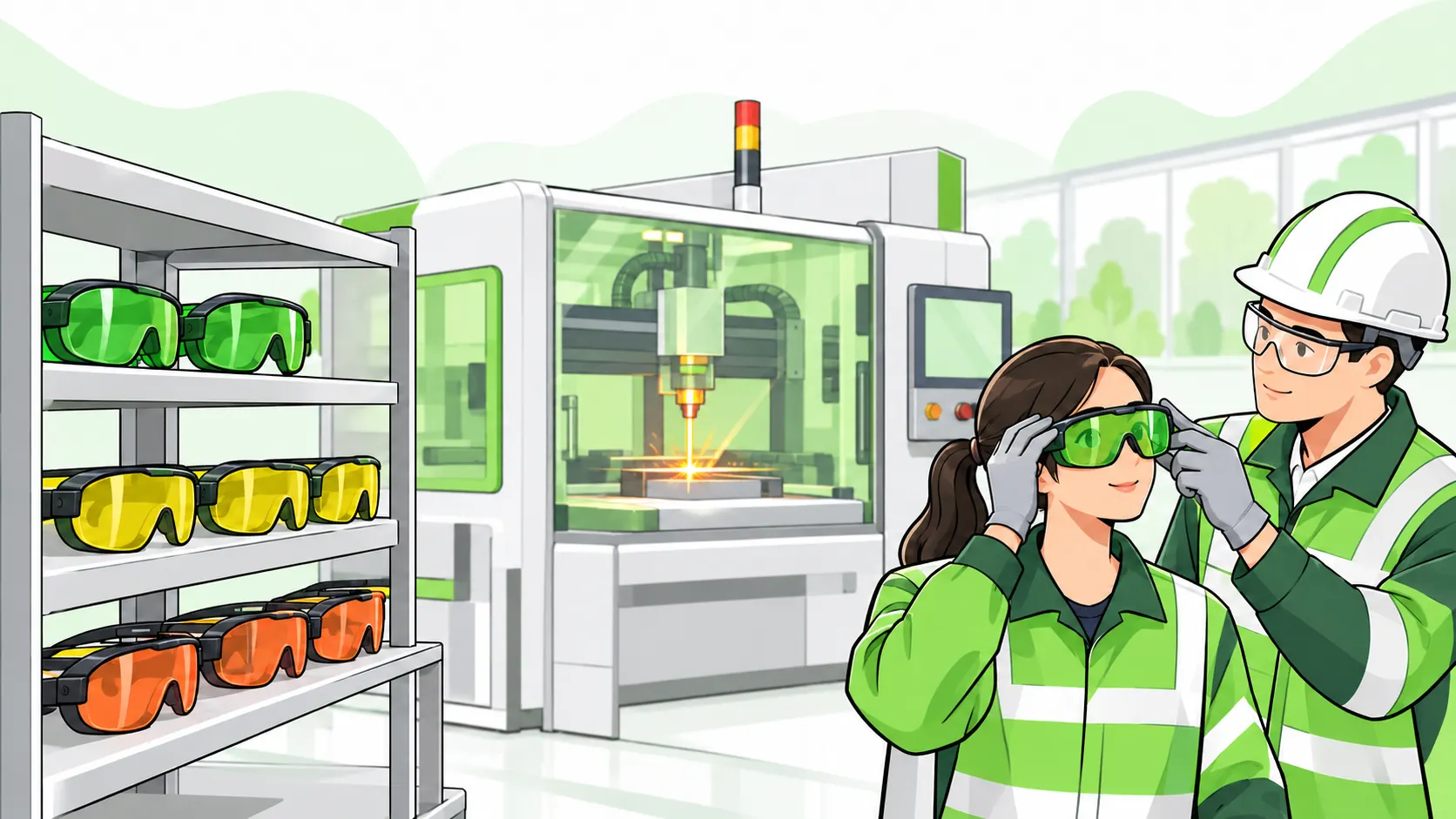
- PPE — the last line. ANSI Z87.1 eyewear with the correct UV filter marking, UV-absorbing face shields, nitrile or chemical-resistant gloves overlapping the cuff, and full skin coverage. Note that Tyvek-type coveralls do not reliably block UV.
- Health surveillance. Skin and dermatitis surveillance (HSE G403, UK) and respiratory monitoring where sensitisers are present, run as an employer duty under COSHH.
In COSHH practice, the written program duty under the Control of Substances Hazardous to Health Regulations 2002 (UK) is to prevent exposure where reasonably practicable and adequately control it where not — assess, control, monitor, and provide health surveillance, in that order.
The frequent error is buying eyewear and gloves while leaving a failing interlock or an undersized extraction system in place. PPE protects one person at the point of failure; shielding and LEV protect everyone, all the time. When budget is tight, the engineering tier comes first.
Mercury vs UV LED Curing: A Safety and Compliance Comparison
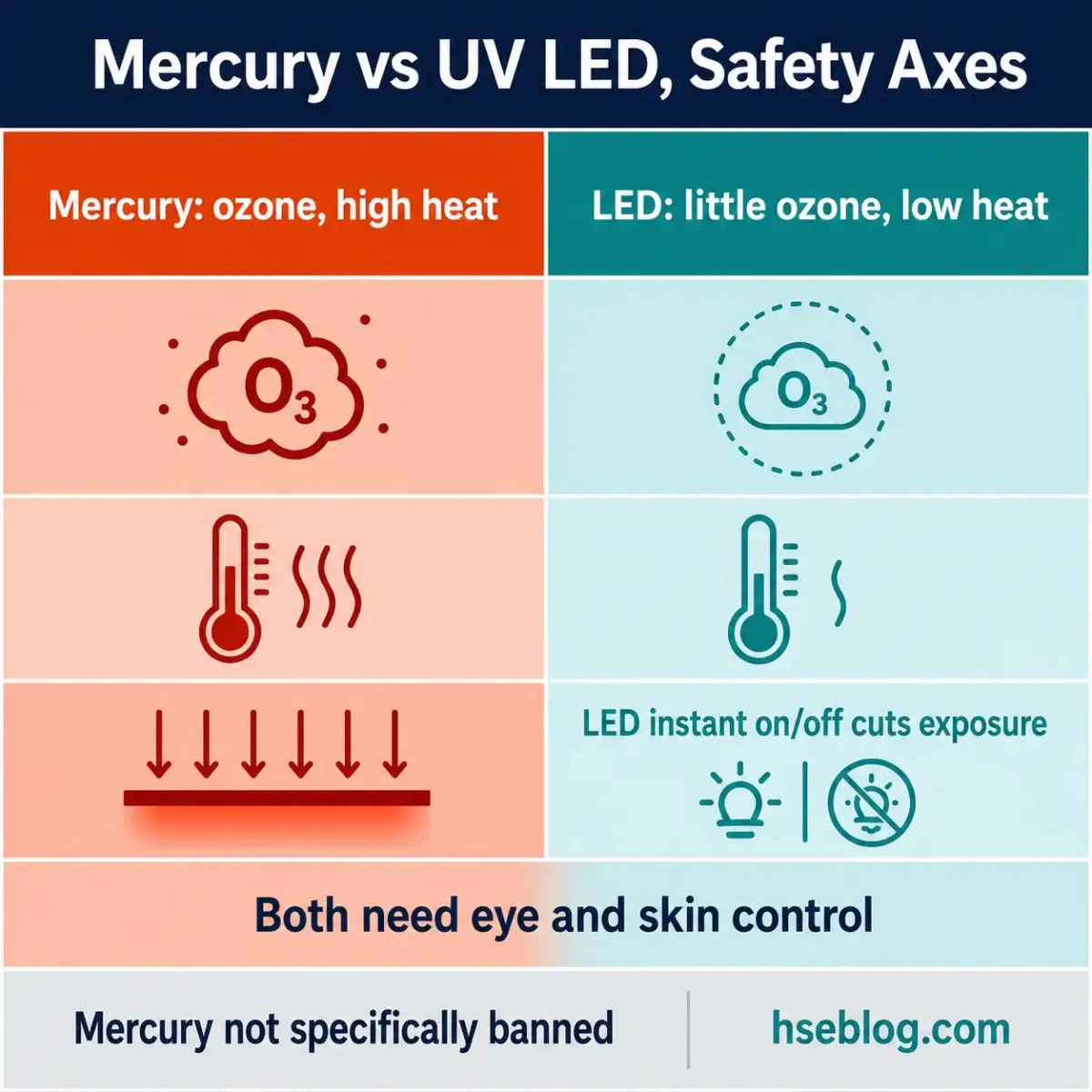
If you are choosing between lamps, UV LED is safer on most axes — but the "mercury is banned" story you may have heard is overstated. Both technologies cure ink with UV; the difference is the spectrum, the by-products, and the regulatory pressure around mercury.
| Safety axis | Mercury vapour lamp | UV LED |
|---|---|---|
| Ozone generation | Yes (short-wave UV) | Essentially none |
| UV spectrum | Broadband UV-C/UV-B/UV-A | Narrow UV-A |
| Heat output | Very high (~1500°F arc tube) | Much lower |
| Accidental exposure | Warm-up time, runs continuously | Instant on/off cuts setup exposure |
| Lamp life | Shorter | Longer |
| Regulatory pressure | Rising (mercury content) | Low |
LED's instant on/off is an under-rated safety feature: it removes the warm-up window during which a mercury unit sits emitting while operators work nearby during setup. Mercury still has legitimate uses — broadband cure suits certain substrates and applications — and its heat and ozone are managed, not magically absent.
The regulatory reality deserves precision. The Minamata Convention, EU RoHS, and various US state rules apply pressure on mercury use, but no current regulation specifically bans mercury UV curing lamps. The EU RoHS exemption that permits these lamps is reported to lapse on 24 February 2027 (GEW / UV+EB Technology, 2025) — and industry sources stress that the broader "ban" claims circulating are overstated.
Before relying on any of that, verify the current status for your operating jurisdiction; reported expiry dates get extended or amended. For shops wanting to remove photoinitiators from the chemistry entirely, electron beam (EB) curing exists as a photoinitiator-free alternative for specific applications.
Frequently Asked Questions
Do UV printers emit harmful radiation?
Yes — though not in the radioactive sense some assume. UV curing lamps emit non-ionising ultraviolet that can cause photokeratitis and skin burns from direct or leaked exposure. The radiation does not make anything radioactive, and a finished cured print is low-risk. The real hazard is the lamp itself, which is why shielding and interlocks matter more than reassuring marketing claims.
Is it safe to touch something printed with UV ink?
A fully cured print is low-risk; an under-cured one is not. Incompletely cured ink can release acrylate monomers and photoinitiators that sensitise skin, and cure is usually checked by tack-testing on the line rather than lab analysis. Treat freshly run stock with caution, and apply extra care for food, pharmaceutical, or skin-contact products where migration matters.
Can you become allergic to UV-curable inks?
Yes, and it is typically permanent. Acrylate monomers and some photoinitiators are skin sensitisers, and once a worker develops allergic contact dermatitis, even trace contact can trigger a reaction indefinitely. HSE recognises UV-cured printing inks as a dermatitis cause (UK). A sensitised worker often needs reassignment away from direct ink contact, because PPE alone may not be enough.
What gloves protect against UV ink and wash-up solvents?
Nitrile is the sensible default — HSE research points to roughly 0.4 mm for litho wash-up (UK). Compatibility must still be checked against each chemical's SDS, since aggressive solvents need thicker or alternative materials. Gloves should overlap the sleeve so ink cannot run inside the cuff. Latex and fabric gloves offer poor chemical protection here and should not be relied on.
Does UV LED curing eliminate ozone and the radiation risk entirely?
It eliminates ozone and sharply cuts heat, but not the radiation risk. LED systems still emit UV-A, which burns eyes and skin, so eye and skin controls remain necessary. The claim that "LED means no PPE" is wrong. LED is genuinely safer on several axes — ozone, heat, and accidental setup exposure — but it does not remove the need for shielding and protective eyewear.
Are mercury UV curing lamps banned?
Not specifically, anywhere, as of the review date. The Minamata Convention and EU RoHS apply pressure on mercury, and the EU RoHS exemption for these lamps is reported to lapse on 24 February 2027 (GEW / UV+EB Technology, 2025), but no current rule bans mercury UV curing lamps outright. The "ban" narrative is overstated — verify the live status for your own jurisdiction before acting.
The Habit That Has to Change
The industry's central mistake with UV curing is importing solvent-era instincts into a hazard profile that no longer matches them. Because UV inks smell less and contain little solvent, shops assume they are inherently cleaner — and quietly drop their guard on the two things that actually injure people here: leaked UV from defeated interlocks, and dermal contact with uncured acrylates that sensitise for life.
If one change carries the most weight, it is treating engineering integrity as the controlling factor — guards, interlocks, and source extraction kept genuinely functional — rather than buying eyewear and gloves and calling it control. PPE protects one person at the moment a barrier fails; shielding and ventilation stop the failure reaching anyone. The exposure numbers in this article — 0.1 ppm ozone and 30 J/m² actinic UV — are only meaningful if those upper-tier controls are in place to keep real exposures below them.
That is the heart of managing UV curing hazards in printing: respect the lamp and the liquid, verify cure before stock is handled, and check your jurisdiction's mercury position rather than trusting the headlines. Get those right, and the rest of the controls have something solid to sit on.