Yes. Paper, or cellulose, dust is combustible when finely divided and airborne, and OSHA treats particles under about 420 microns as combustible dust. In most print facilities it mainly raises fire load and feeds dryer ignition; a true dust explosion needs an enclosed, dense cloud, usually inside dust collectors, cyclones, or ductwork.
Two beliefs circulate in pressrooms, and both miss the target. One crew waves it off — "it's just paper" — while the other watches grain-silo explosion footage and assumes the whole building is primed to blow. Cellulose dust is genuinely combustible (OSHA), yet paper and print sit well down the list of recorded dust incidents, where food and wood dominate (Dust Safety Science, 2024).
The accurate picture is location-specific within a single building, and getting it wrong costs either way — wasted budget on phantom risk, or a missed hazard in the one asset that can actually deflagrate. This guide maps paper dust fire risk process by process, separates fire load from explosion, sets out the controls that hold up, and runs the US, UK, and EU duties side by side so you know exactly what the law asks of your site.
Is Paper Dust a Combustible Dust Hazard? Separating Fire Load From Explosion Risk
Yes — paper dust is a combustible dust, but that single fact is where most articles stop and where the real judgment begins. Cellulose dust meets the regulatory definition when it is fine and airborne, and OSHA deems a material combustible dust when its particles pass a U.S. No. 40 sieve, roughly 420 microns (OSHA, Hazard Communication Guidance for Combustible Dusts).
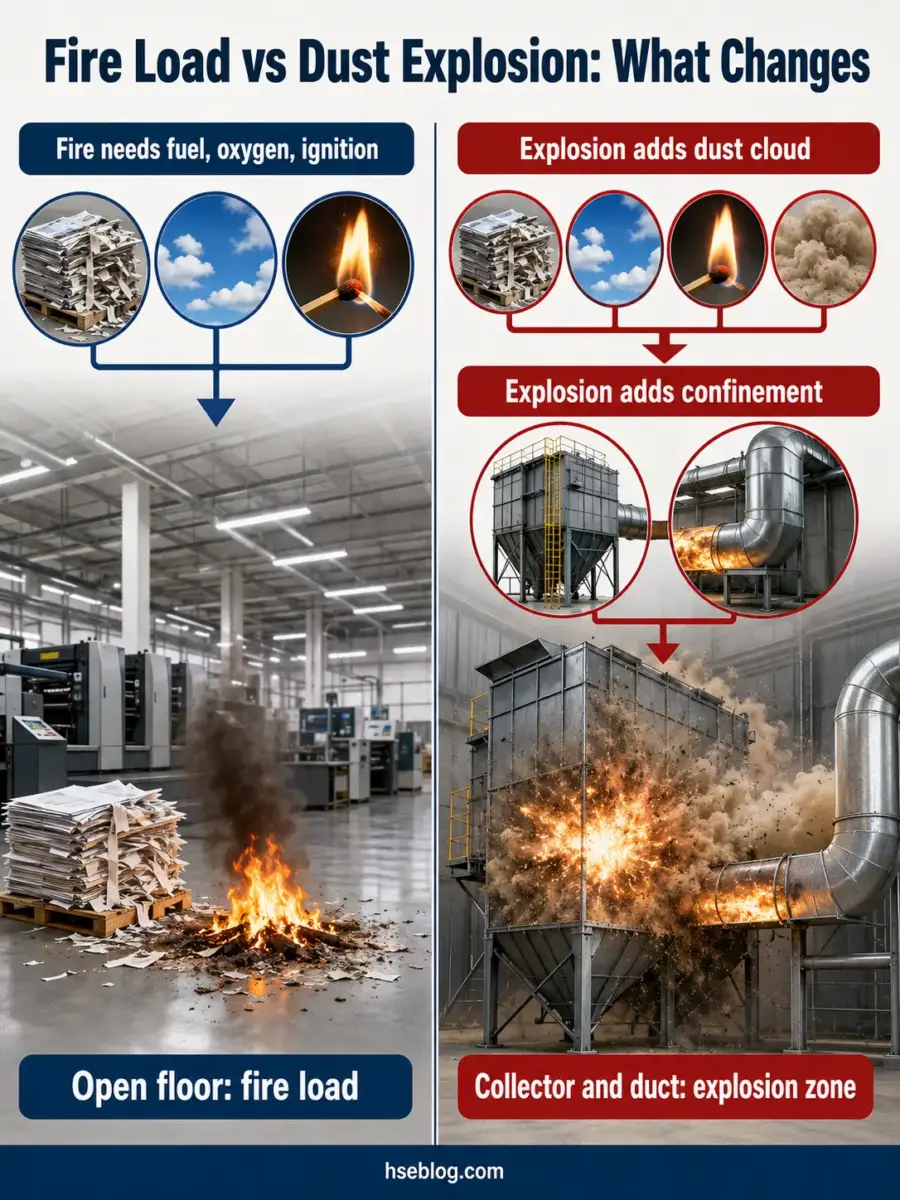
What changes the risk is not the dust's identity but its setting. A settled layer on a floor is a fire-load problem; the same material, lofted into a dense cloud inside a sealed vessel, is a deflagration problem.
The distinction comes down to two extra ingredients. An ordinary fire needs fuel, oxygen, and ignition — the familiar fire triangle. A dust explosion needs all three plus two more: the dust must be dispersed as a cloud, and that cloud must be confined.
| Condition | Open pressroom floor | Inside a dust collector or duct |
|---|---|---|
| Fuel (fine cellulose) | Present | Present |
| Oxygen | Present | Present |
| Ignition source | Possible (dryers, static) | Possible (friction, static, embers) |
| Dust dispersed as a cloud | Rarely sustained | Routine during operation |
| Confinement | Absent | Present |
| Dominant outcome | Fire / rapid flame spread | Deflagration (explosion) |
That table is the spine of this whole topic. On an open floor you are managing fire spread; inside a collector you are managing an explosion. The most common failure pattern I see across the published record is a team that treats the building as uniformly risky, when the hazard concentrates sharply in a handful of enclosed assets.
Why "It's Only Paper" Is the Wrong Mental Model
Bulk paper resists ignition because its mass dwarfs its exposed surface. A ream is hard to light; a cloud of the same paper ground to fines is a different material entirely.
The variable is surface-area-to-mass ratio. Divide a sheet into millions of particles and you multiply the surface exposed to oxygen and heat, so the fines ignite fast and burn in a flash front. Judging dust behaviour from how a stack of paper burns is the single most reliable way to underestimate the hazard.
Where Paper Dust and Ignition Sources Meet in a Print Facility
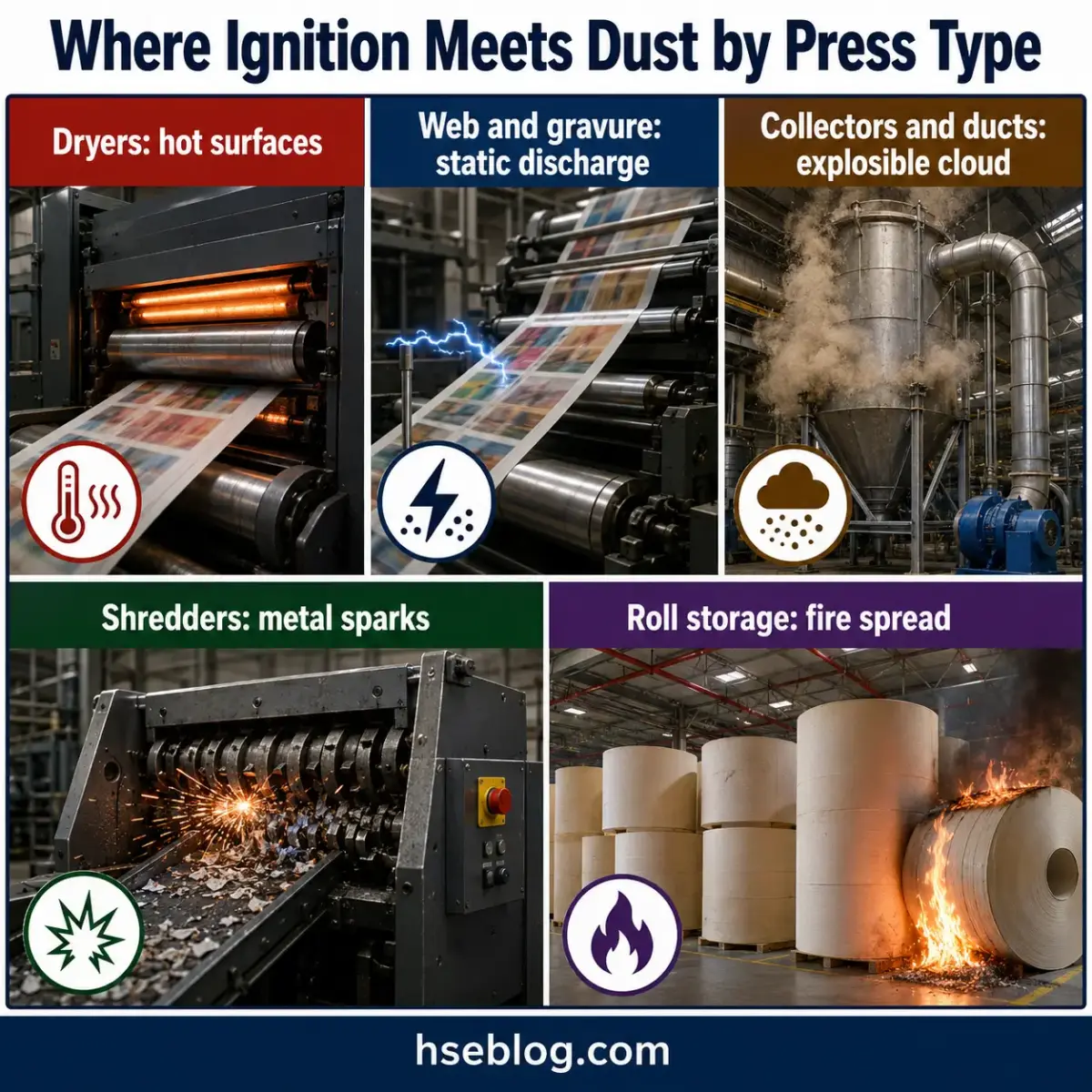
The recurring lesson from dust-incident records is that risk lives at equipment, not across floor plans — and in a print facility the dominant ignition source shifts sharply by press type. This is where generic paper-mill advice stops being useful and where a print operator has to look at their own line.
Dryers and curing units are the standout. Infrared, UV, and hot-air dryers run hot surfaces directly above a moving web, and fugitive dust settling on those surfaces — or a web that overheats or stalls — is repeatedly the highest-incident equipment category in dust data.
| Print method / asset | Dominant ignition source | Primary control |
|---|---|---|
| Web offset, heatset dryers | Hot dryer surfaces, web overheating | Temperature trips, dryer interlocks, surface housekeeping |
| Flexo / gravure (high-speed web) | Static discharge on fast substrate | Static eliminators, bonding/grounding, humidity band |
| Digital / toner | Hot fusers, toner as combustible fines | Extraction, electrical rating, housekeeping |
| Shredders, guillotines | Metal contaminants (staples, clips) sparking | Magnetic separation, blade maintenance |
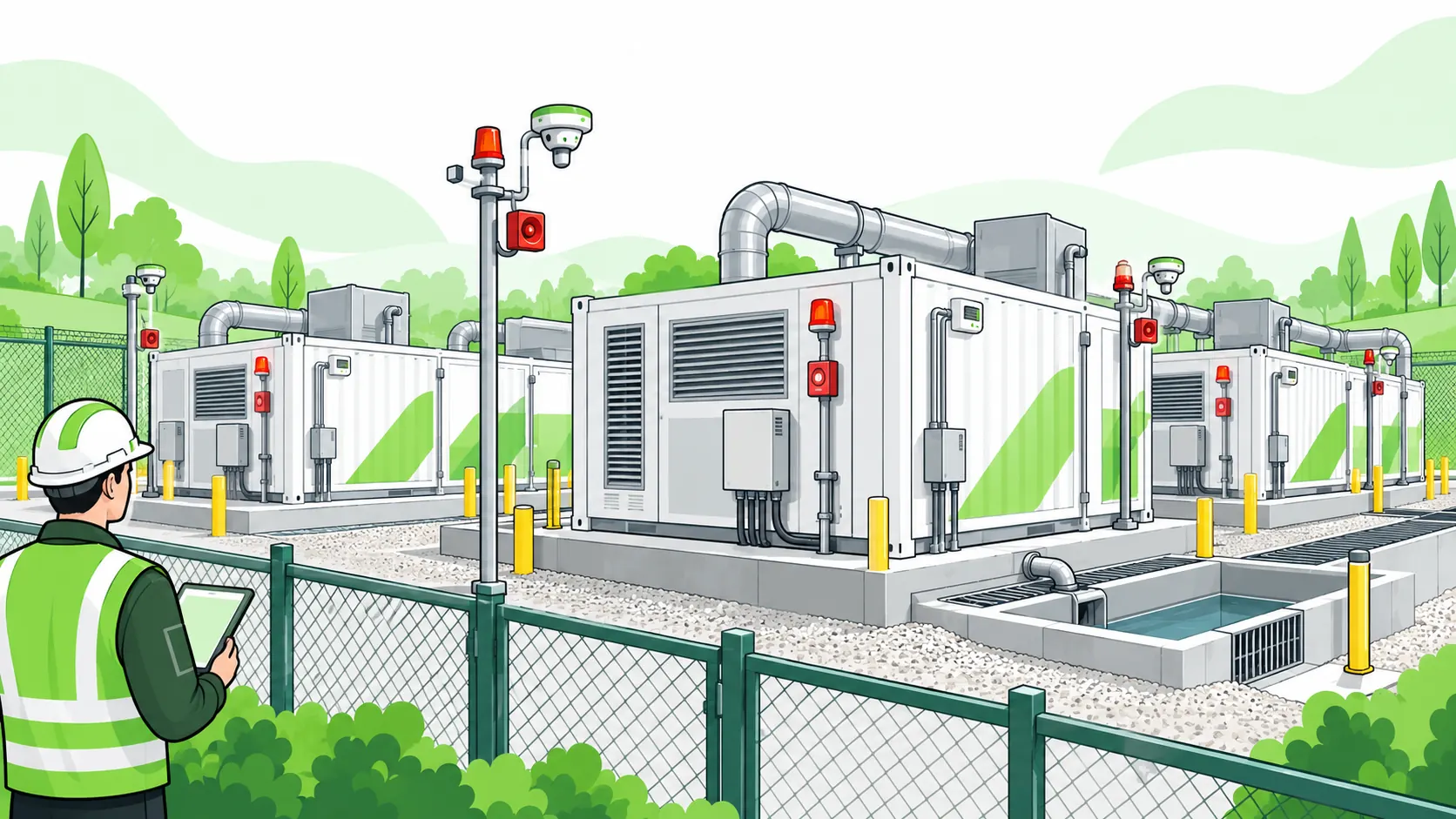
| Dust collectors, cyclones, ducts | Friction, static, drawn-in embers | Explosion venting/isolation/suppression, inspection |
| Bulk roll storage | External fire spread, not ignition | Storage separation, racking design, sprinklers |
The collector deserves its own warning. It is precisely where open-floor dust becomes an explosible cloud, yet on most sites it is the least-inspected asset — out of sight, out of mind, until it fails. Treat the collector as the highest-consequence box on site, not as plumbing.
Static is the other quiet driver. High-speed web, flexo, and gravure lines generate charge on fast-moving substrate, and a discharge near a dust cloud or solvent vapour is a credible ignition event.
The Solvent-and-Ink Interaction Most Dust Articles Miss
In a lot of print shops the dominant fire scenario is not paper dust at all. It is low-flashpoint solvent or ink vapour, ignited by static or a hot surface, with paper dust acting as a co-fuel once a fire starts.
Naming this honestly matters, because the search query pulls people toward "paper dust" when the bigger ignition risk on a solvent-based line is the vapour. The practical reading: assess flammable-liquid handling and dust together, not in separate silos, because they share ignition sources and they amplify each other.
How Serious Is the Risk? What the Incident Data Actually Shows
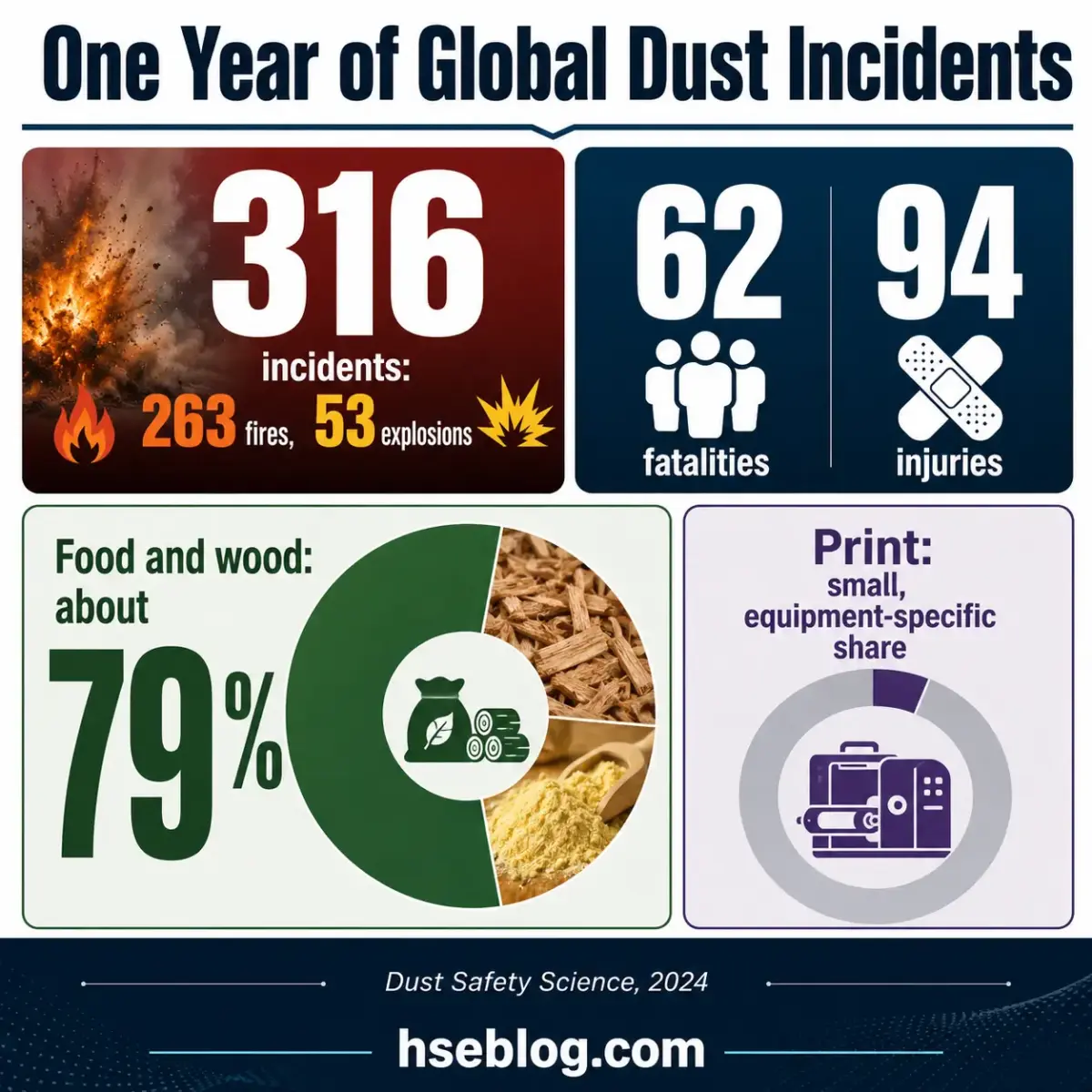
The honest headline: 316 combustible dust incidents — 263 fires and 53 explosions — caused 94 injuries and 62 fatalities worldwide in a single year (Dust Safety Science, 2024). That is a serious global toll, but it spans every dust-handling industry, not print.
When you break it down by sector, the calibrated picture holds. Food and wood products accounted for roughly 79% of recorded dust fires and explosions (Dust Safety Science, 2024), which leaves paper and print as a comparatively small share.
The history behind the enforcement is worth knowing:
- A systemic problem, documented early. The US Chemical Safety Board recorded 281 combustible dust incidents, 119 worker deaths, and 718 injuries between 1980 and 2005 (US Chemical Safety Board, cited by OSHA) — the tally that first framed dust as a recognized systemic hazard.
- The catastrophe that forced action. Fourteen workers died in the Imperial Sugar refinery dust explosion in 2008 (US Chemical Safety Board / OSHA), the event that drove OSHA to reissue its Combustible Dust enforcement program.
- No print-specific rate exists. Incident datasets do not separate commercial printing from pulp, paper, and wood, so any "print-shop explosion rate" you see quoted is invented.
Interpreting that data, rather than just reciting it, gives a print operator a precise instruction: dryers, collectors, and silos drive incidents. If your safety budget is finite — and it always is — those are the assets to harden first, not the open floor.
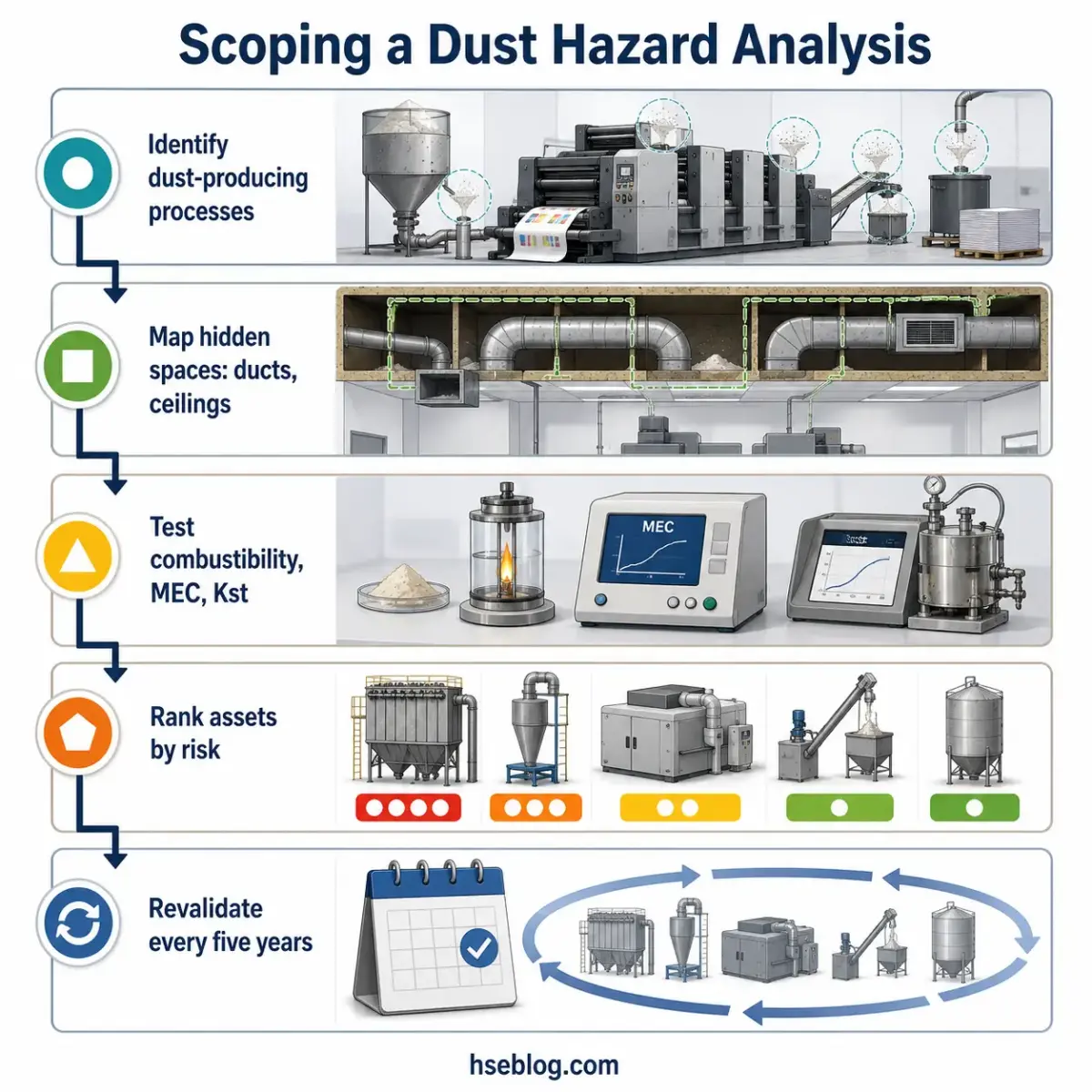
Conducting a Dust Hazard Analysis (DHA) for a Print Operation
Under NFPA 660, the Standard for Combustible Dusts and Particulate Solids (2024 edition, effective 6 December 2024), a facility that generates or handles combustible dust is expected to complete a Dust Hazard Analysis and revalidate it at least every five years — the framework that consolidated six older dust standards into one. For a print operator, the DHA is the document that turns "we have some dust" into "here is exactly where, how bad, and what we'll do."
This article provides general HSE knowledge. Life-critical work such as dust hazard analysis, explosion-protection design, and hazardous-area classification must be planned and supervised by a competent person with relevant training, jurisdiction-specific authorization, and a site-specific risk assessment. The information here does not replace that. Recognized pathways into that competence include NEBOSH, IOSH, and OSHA outreach training, or their regional equivalents.
A DHA for a print site, scoped sensibly, runs like this:
- Inventory every dust-producing material and process. Substrates, trimming, slitting, sheeting, shredding, and any toner or spray-powder use — not just the obvious cutters.
- Map the hidden spaces. The dust you cannot see drives secondary events: above false ceilings, on beams and cable trays, inside ducts, cyclones, and collector housings.
- Test the dust, don't assume it. Lab work establishes whether the dust is explosible, its minimum explosible concentration (MEC), and its Kst severity value.
- Rank assets by consequence. Prioritize collectors, dryers, and ductwork over open floor, because that is where confinement makes deflagration possible.
- Treat it as living, not filed. Re-run the relevant parts when a new press, substrate, or coating changes the dust profile.
Those lab metrics matter to a printer for a concrete reason. The Kst value classifies how violently a given dust deflagrates, and you cannot borrow a number from a textbook — your dust, with your fillers and coatings, has to be tested.
The UK reaches the same destination by a different route. Rather than a DHA, the duty under DSEAR is hazardous-area classification (HAC), which assigns dust zones based on how often an explosive atmosphere is present.
| Element | US approach (NFPA 660) | UK approach (DSEAR) |
|---|---|---|
| Core duty | Dust Hazard Analysis | Hazardous-area classification + risk assessment |
| Output | Risk ranking, control plan | Zoned areas (20 / 21 / 22) |
| Zoning logic | Risk-based assessment | Frequency of explosive atmosphere |
| Revalidation | At least every 5 years | When conditions change |
The failure mode to avoid is treating either as a one-time compliance artifact. A DHA or HAC done once and shelved is out of date the day you commission a new line.
Engineering and Housekeeping Controls That Actually Work
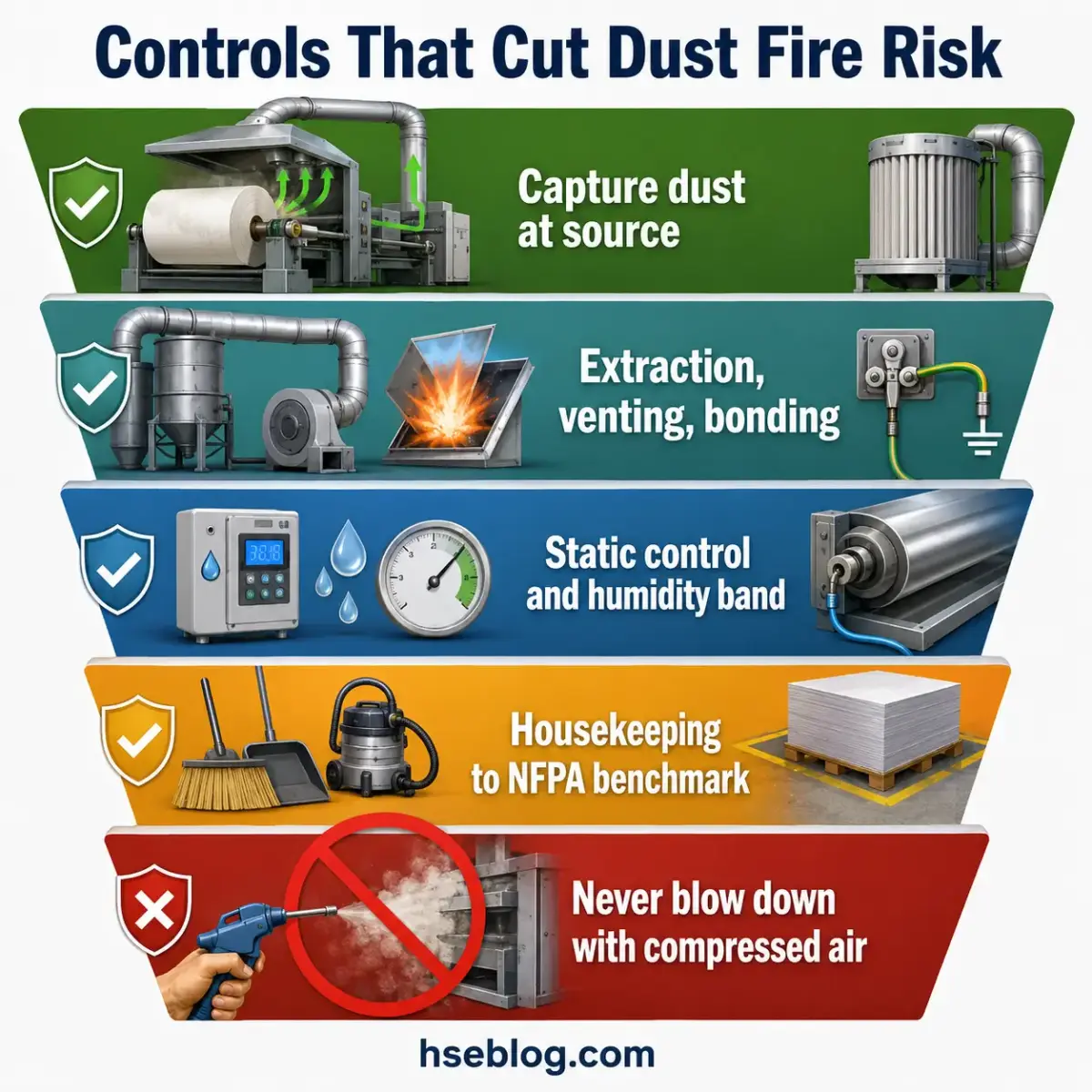
In day-to-day operation the controls that hold up are the ones ordered by the hierarchy of controls and aimed at the specific way paper dust ignites — not a flat list of tips. Work down from removing the dust at source to protecting people when nothing else has caught it.
Eliminate or substitute at source
- Capture before it escapes. Local extraction at slitters, sheeters, and trim points removes fines before they settle or loft.
- Reduce dust-generating steps where the job allows — cleaner cuts and well-maintained blades produce less fine debris.
Engineering controls
- Protect the collector. Where a DHA shows deflagration potential, fit explosion venting, isolation, or suppression so an event cannot propagate back into the building.
- Bond and ground everything that moves substrate. Presses and paper-handling equipment must be bonded and grounded to bleed off static charge.
- Interlock the dryers. Temperature trips and web-stall interlocks stop a dryer becoming an ignition source when the line falters.
Static and humidity
- Hold humidity in a control band. Maintaining humidity within a recognized range suppresses static charge generation on fast web lines.
- Add static eliminators on web and gravure lines as a direct charge-control measure, not a nice-to-have.
Administrative controls
- Permit hot work. A hot-work permit system keeps grinding, welding, and cutting away from dust and vapour.
- Maintain the boring things. Drying bearings and neglected electricals are common ignition sources; planned maintenance is fire prevention.
- Train to the hazard. Workers who understand why blow-down is dangerous behave differently from workers told only to "keep it tidy."
Housekeeping deserves a hard number, not a slogan. OSHA's housekeeping standard, 29 CFR 1910.22, sets no numeric depth, so enforcement leans on the NFPA-recognized benchmark — roughly a 1/32-inch (about 0.8 mm) layer over 5% or more of floor area, the figure that superseded the old "1/8-inch" rule of thumb still circulating in trade content. If you are still quoting 1/8 inch, you are working to a retired number.
The most common audit finding ties directly to that benchmark. Housekeeping programs clean floors and ignore elevated surfaces — beams, cable trays, light fittings — and that hidden layer is exactly what feeds a secondary explosion when a primary event shakes it loose.
Why Compressed Air Is the Most Common Self-Inflicted Hazard
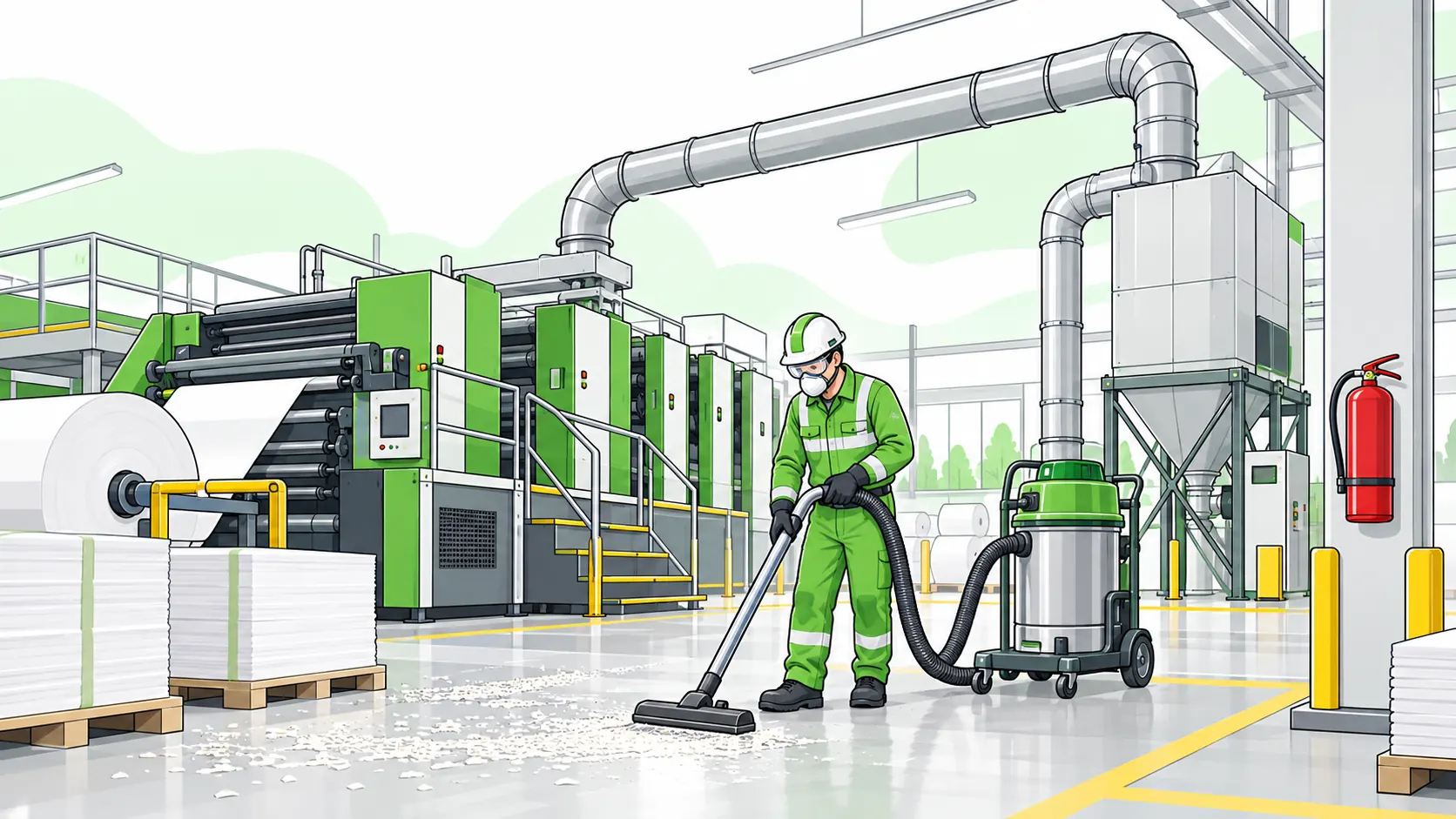
Blowing dust off equipment with an air line is the routine that quietly defeats every other control. A settled layer is a low-risk fire load; an air jet converts it, in seconds, into a suspended cloud — the one condition a deflagration needs.
The fix is unglamorous and effective: vacuum with appropriately rated equipment, or sweep, and ban compressed-air blow-down for dust removal outright. It is the cheapest high-value change on this list.
Regulatory and Legal Duties: US, UK, and EU Compared
Two regulatory philosophies govern the same hazard, and a print operator working across borders cannot run one compliance template against both. The US enforces combustible dust through general obligations and recognized standards; the UK and EU impose a direct, written statutory duty with explicit zoning.
Regulatory content here reflects a general HSE professional understanding of US, UK, and EU requirements as of 2025. It is not legal advice. Specific compliance questions, enforcement situations, or prosecution risk should be directed to qualified legal counsel in the applicable jurisdiction. The regulatory content in this article was last reviewed in 2025.
| Jurisdiction | Governing instrument | Legal character | Key duty |
|---|---|---|---|
| United States | General Duty Clause §5(a)(1); 29 CFR 1910.22, 1910.307; Combustible Dust NEP (CPL 03-00-008); NFPA 660 | Enforcement program — no dedicated dust standard | Provide a workplace free of recognized hazards; housekeeping; properly rated electrical equipment |
| United Kingdom | DSEAR 2002 (amended 2015) | Direct, enforceable statutory duty | Assess and reduce fire/explosion risk; classify dust zones 20/21/22; control ignition |
| European Union | ATEX 1999/92/EC (use); 2014/34/EU (supply) | Direct duty plus equipment requirement | Protect workers in explosive atmospheres; use ATEX-rated equipment in zoned areas |
The US route is easy to misread, and operators do. There is no dedicated combustible-dust standard, so OSHA cites hazards under the General Duty Clause, backed by the Combustible Dust National Emphasis Program, reissued in 2023, and it leans on NFPA 660 as the recognized benchmark a "recognized hazard" is measured against.
So the practical obligation is far closer to the UK's than the words suggest. "No specific standard" does not mean low exposure — a General Duty Clause citation built on NFPA can land just as hard as a DSEAR breach.
The UK is blunt by comparison. DSEAR creates a direct legal duty to assess and reduce fire and explosion risk from dangerous substances, classify hazardous areas, and control ignition sources, with HSE's DSEAR guidance setting the dust-zone framework. The EU layers ATEX on top: once an area is zoned, the equipment placed in it must meet the matching ATEX category — a supply-side duty US rules do not mirror directly.

Frequently Asked Questions
Is paper dust explosive or just flammable?
Both, depending on conditions. As a settled layer it behaves as flammable fire load that can spread flame. As a suspended cloud at sufficient concentration inside a confined space — a collector, cyclone, or duct — it becomes explosible and can deflagrate. The same material is a fire problem on the floor and an explosion problem inside an enclosure.
At what dust accumulation depth becomes dangerous in a print facility?
The NFPA-recognized benchmark is roughly a 1/32-inch (about 0.8 mm) layer over 5% or more of floor area, which replaced the older 1/8-inch rule of thumb still seen in trade content. Depth alone is not the whole test, though — particle size, the area covered, and the dust's explosion class all factor into whether a given layer is dangerous.
Do small or digital-only print shops need a dust hazard analysis?
A DHA is tied to whether combustible dust is present and handled, not to facility size. The belief that DHAs are only for mills is a misconception. Digital sites are not exempt: toner is itself a combustible fine, and certain spray powders add to the load, so a small digital operation can carry a real obligation.
Does humidifying the pressroom reduce fire risk?
Partly, and only against one mechanism. Holding humidity in a recognized band suppresses static charge generation on fast-moving web lines, which is a genuine, recognized control. It does nothing to remove the dust itself or to control hot surfaces and other ignition sources, so it supplements dust removal — it never replaces it.
Are printer toner and ink powders combustible dust too?
Yes. Toner and certain ink and spray powders are combustible fines, which widens the hazard well beyond paper fibres. This matters most at digital and powder-handling sites, where the dust profile a DHA must assess includes these materials. Assuming "paper only" understates the fuel actually present.
Who counts as a competent person to assess dust fire risk?
In both US and UK practice, a competent person has the training, knowledge, and experience to assess the specific hazard and interpret test results — and, in the UK, the authority DSEAR expects for that role. Interpreting Kst values, MEC, or zoning DIY is exactly what gets sites caught out. Recognized training routes include NEBOSH, IOSH, and OSHA outreach.
Conclusion
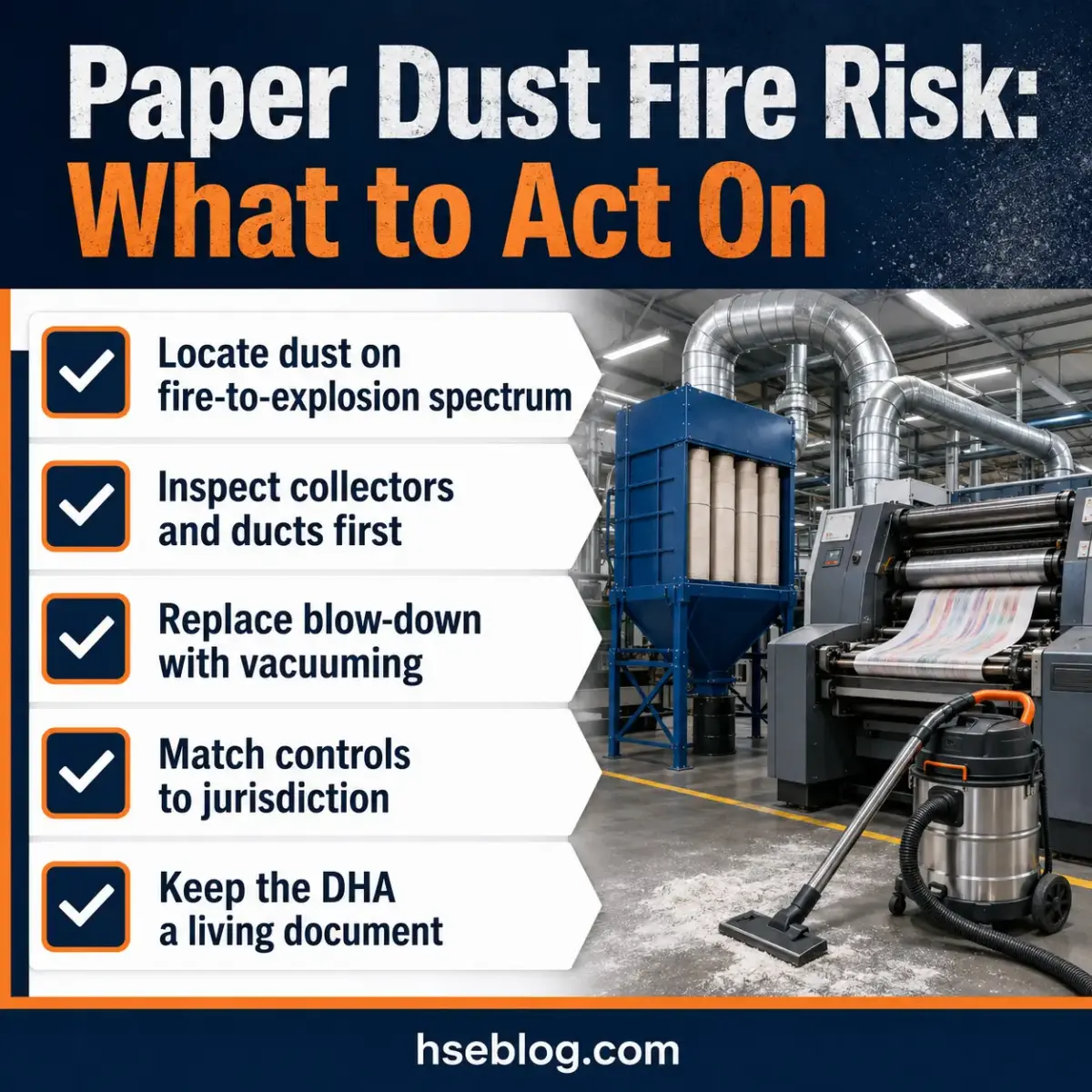
The industry's mistake with paper dust fire risk is treating a building as uniformly risky when the danger is anything but evenly spread. Dismiss the dust and you ignore real fire load and live deflagration zones; over-alarm and you spend on the open floor while the collector — the one asset that can actually explode — goes uninspected.
The highest-impact change is also the simplest: place your own dust on the spectrum, location by location, and act accordingly. Harden the collectors, dryers, and ducts first; hold housekeeping to the current NFPA-recognized benchmark rather than the retired 1/8-inch figure; and stop converting safe settled layers into explosible clouds with an air line. None of that needs a big budget — it needs the right target.
Match all of it to your jurisdiction, because the law's character changes at the border even when the hazard does not. Whether you answer to OSHA's General Duty Clause and NFPA 660, to DSEAR, or to ATEX, the obligation to find and control combustible dust is real — and the operator who knows precisely where their paper dust fire risk lives is the one who can prove they have managed it.