Radiant heat exposure is the transfer of thermal energy through infrared radiation from hot surfaces — furnaces, molten metal, kilns, or the sun — to a worker's body without direct contact or air movement. It drives occupational heat stress in foundries, glassworks, bakeries, and outdoor work, and is measured using globe temperature within the WBGT index.
Environmental heat exposure killed 999 US workers between 1992 and 2021, an average of 33 deaths a year (US Bureau of Labor Statistics, via OSHA, 2023). That national figure tracks "environmental heat" as a single bucket. It never isolates the radiant share — the heat carried by infrared coming off hot surfaces rather than hot air.
That blind spot matters, because the instrument most workplaces rely on to judge heat danger cannot see radiant sources at all. A glassworks can pass a casual thermometer check while a worker at the furnace absorbs a punishing infrared load. What follows maps where radiant heat exposure concentrates, why standard assessments under-flag it, and which controls actually interrupt the radiant pathway.
What Is Radiant Heat Exposure?
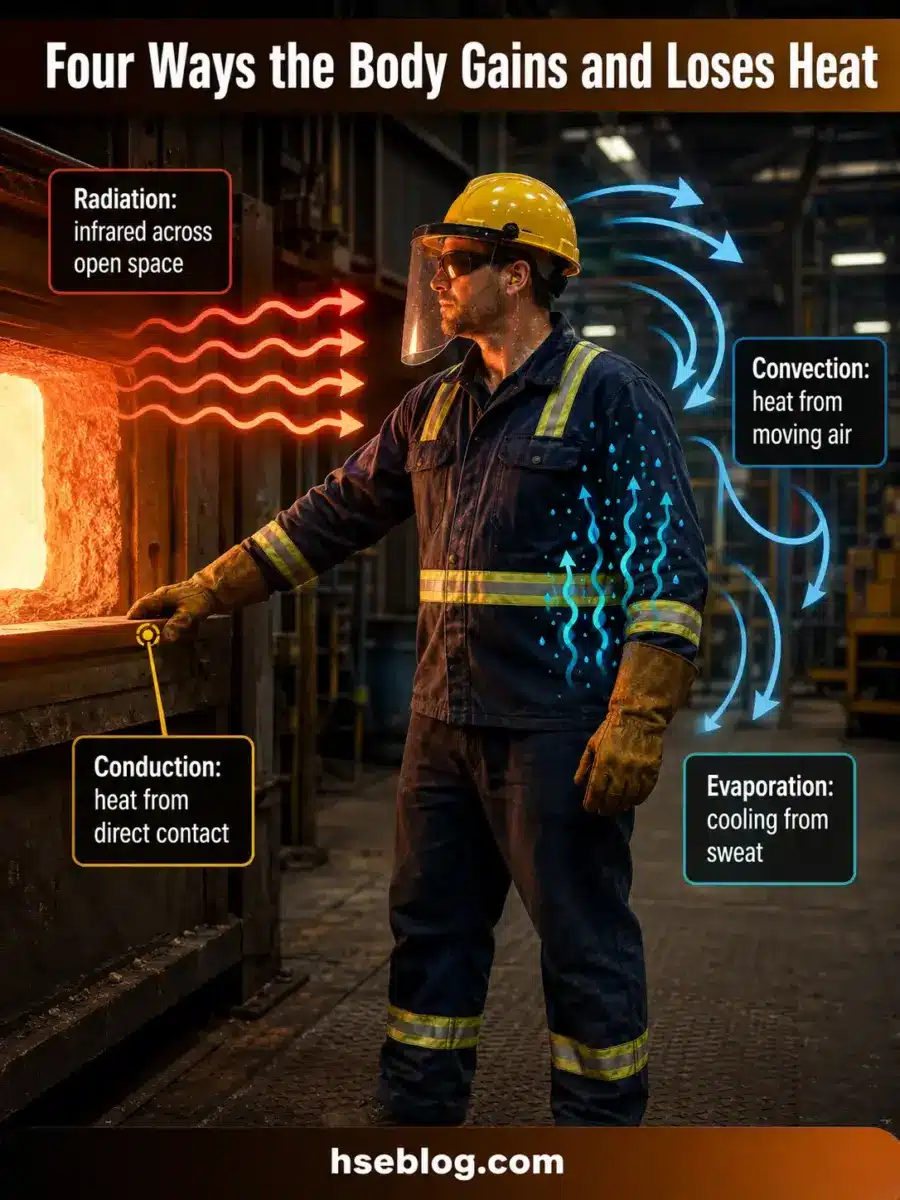
Radiant heat exposure is heat that reaches the body as infrared energy across open space — from a hot surface straight to the worker, with no contact and no help from moving air. It is one of four routes by which the body exchanges heat with its surroundings, and the only one that ignores air temperature.
The governing concept is mean radiant temperature. When the surfaces around a worker are hotter than skin, the body gains heat by radiation regardless of how warm or cool the air feels.
That gain travels in a straight line of sight. Block the line, and the energy stops; step out of it, and the load falls away with distance.
Radiant heat is also distinct from a contact burn. Touching a hot pipe is conduction; standing near a furnace door is radiation. The US Bureau of Labor Statistics records these as separate event categories, which changes both how incidents are coded and which control you reach for.
| Mechanism | How it moves heat | Workplace example |
|---|---|---|
| Radiation | Infrared across open space, line-of-sight, no contact | Furnace door, molten metal, the sun |
| Convection | Heat carried by moving air or fluid | Hot air circulating in a boiler room |
| Conduction | Direct contact between body and a hot object | Gripping an un-lagged steam pipe |
| Evaporation | Heat shed as sweat evaporates from skin | Cooling lost when PPE blocks sweat |
The recurring assessment failure here is simple: teams equate "hot environment" with "high air temperature." A worker can be cooked by the surface in front of them while the air reads comfortable.
Why Radiant Heat Is the Most Under-Assessed Heat Hazard
The figure most employers trust to judge heat danger — the weather heat index — leaves radiant heat out completely. It is measured in shade and combines only air temperature and humidity, so any space warmed by hot surfaces is systematically under-flagged.
The heat index also ignores two other things that decide whether a worker overheats:
- Wind and air movement. Still air around a furnace traps heat against the body; the index assumes none of this.
- Workload. A worker doing heavy manual labour generates far more internal heat than one standing still, yet the index treats them identically.
The defensible alternative is the Wet Bulb Globe Temperature (WBGT). OSHA's own guidance on how WBGT measures radiant heat with a black globe thermometer is the reference point here. WBGT integrates dry-bulb temperature, natural wet-bulb temperature, and the black globe reading, weighting the globe at 0.3 indoors and 0.2 outdoors plus dry bulb.
A consistent pattern across heat-strain investigations: an indoor facility passes a casual thermometer or heat-index check, yet workers show symptoms. The gap is almost always an unmeasured radiant source — something only a globe-temperature reading would have surfaced.
How Globe Temperature Captures Radiant Load
The black globe is a matte-black copper sphere with a thermometer at its centre. The matte surface absorbs incoming infrared, so the sphere heats up in proportion to the radiant energy reaching it.
The practical signal is the gap between globe and air temperature. A globe reading sitting well above the dry-bulb reading tells you radiant load is doing real work on the body — and the wider that gap, the harder the unseen source is pushing.
| Factor | Heat Index | WBGT |
|---|---|---|
| Air temperature | Yes | Yes |
| Humidity | Yes | Yes |
| Radiant heat | No | Yes (black globe) |
| Wind / air movement | No | Yes (natural wet bulb) |
| Workload | No | Applied through workload-based limits |
Which Industries Are Most at Risk From Radiant Heat?
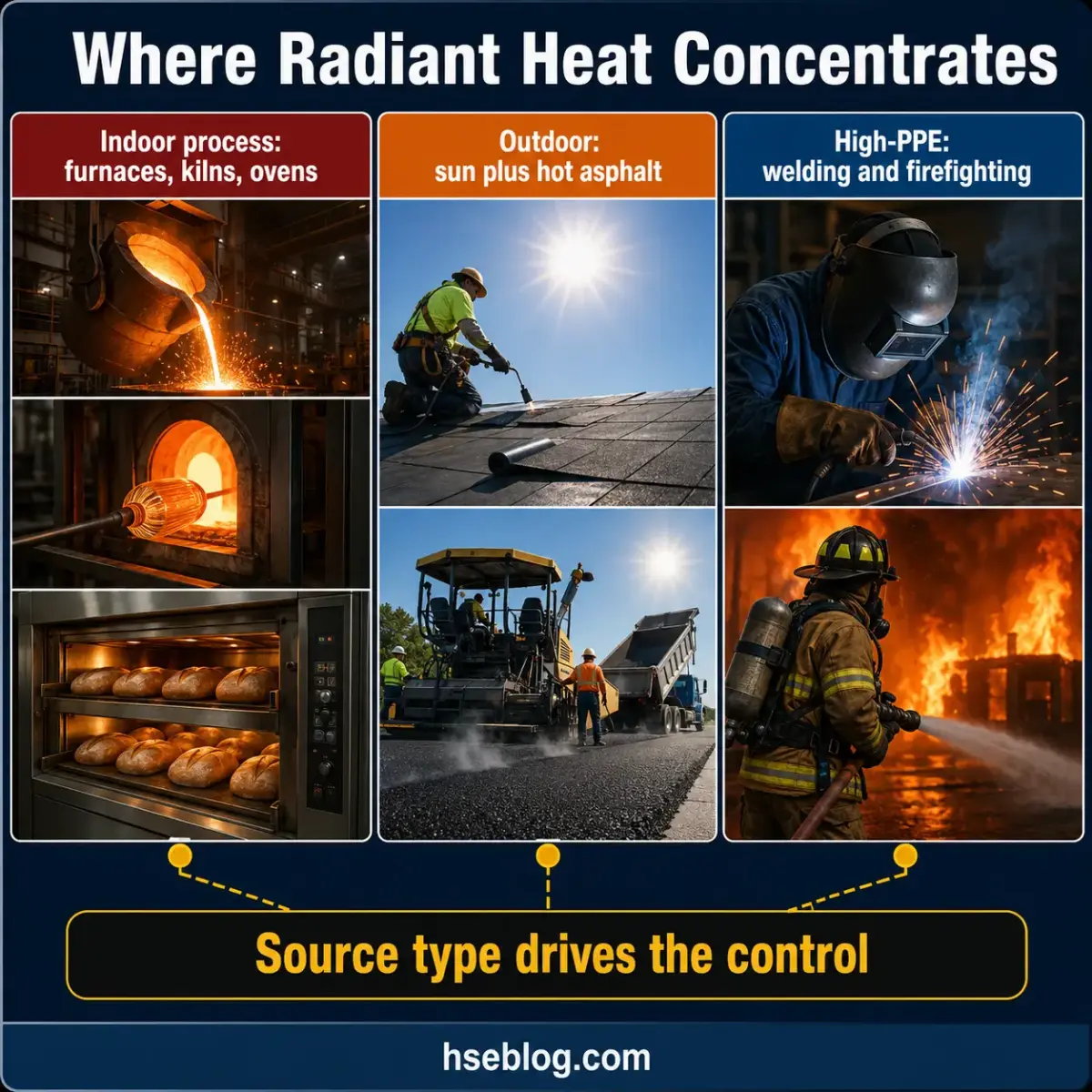
Radiant risk concentrates wherever a hot surface sits in a worker's line of sight — and that splits into two very different problems: indoor process heat and outdoor solar load. The control strategy differs by source, which is why grouping by source beats an undifferentiated list.
| Setting | Industries | Dominant radiant source | Control implication |
|---|---|---|---|
| Indoor process heat | Foundries and smelting, glass manufacturing, ceramics and brick-firing, bakeries and commercial kitchens, rubber and plastics, boiler rooms, power generation, laundries, steam tunnels | Furnaces, molten metal, kilns, ovens | Shield and isolate the source |
| Outdoor solar load | Construction, roofing, paving, agriculture | Direct sun plus radiant load off asphalt and concrete | Shade, scheduling, hydration |
| High-PPE radiant roles | Welding and hot work, firefighting and rescue | Intense local infrared combined with insulating or vapour-impermeable gear | Aluminized or cooling PPE, strict work-rest |
The outdoor concentration is well evidenced. Roughly one in three workplace heat-exposure deaths between 2011 and 2020 occurred among construction and extraction workers, and construction is consistently the single sector with the most heat-related fatalities (US Bureau of Labor Statistics, 2023).
A frequent program weakness sits on the indoor side. Employers assume "indoors equals safe," then overlook warehouses and food-processing plants where machinery, poor ventilation, and roof radiant gain create genuine exposure. Misclassifying an indoor site as low-risk is one of the most common ways a heat program leaves people unprotected.
One data limit deserves a straight answer. National statistics do not break out radiant transfer as its own category — BLS tracks "exposure to environmental heat" and, separately, "contact with hot objects or substances," but nothing isolates radiant load. Environmental-heat data is the closest available proxy, and it should be read as such rather than as a radiant-specific count.
Health Effects of Radiant Heat Exposure
This section covers heat-illness mechanisms and is written for HSE practitioner reference. It is not medical advice. Workers with specific symptoms or exposure concerns should consult an occupational physician or qualified medical professional, and occupational-health content of this kind benefits from medical review before publication.
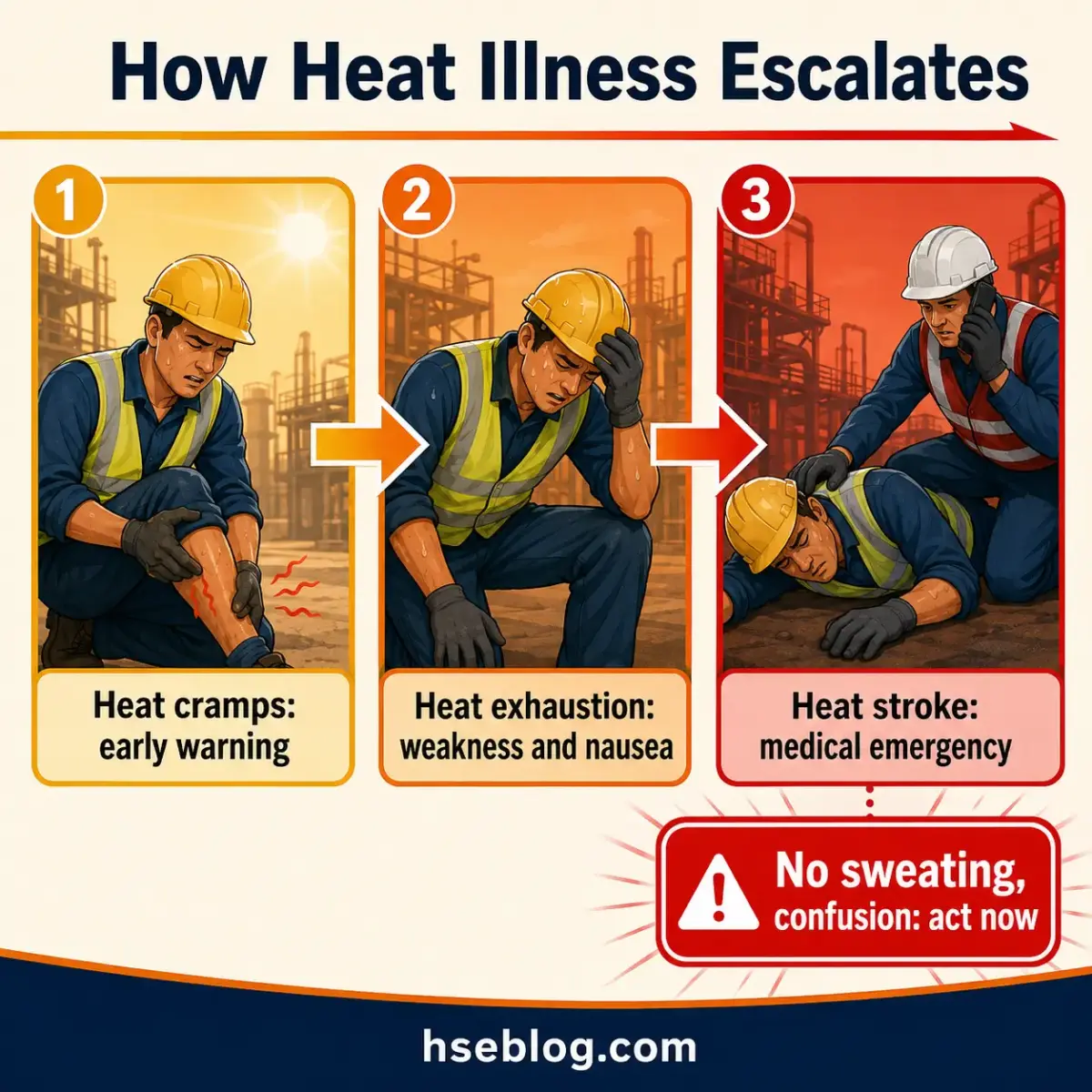
Reviewing the published heat-fatality record, the dangerous cases rarely arrive without warning. Heat illness escalates along a recognisable spectrum, and radiant environments add two injuries that general heat advice tends to skip.
The escalation runs in this order:
- Heat cramps — painful muscle spasms, often the first signal that fluid and electrolyte balance is failing.
- Heat exhaustion — heavy sweating, weakness, nausea, and rising core temperature; the body is losing the fight to cool itself.
- Heat stroke — a medical emergency in which core temperature reaches roughly 104°F (40°C) and thermoregulation collapses. This stage can kill or cause permanent harm within minutes.
Two effects are specific to radiant settings:
- Infrared eye injury. Sustained infrared exposure is the basis of the long-recognised "glassblower's" or "furnaceman's" cataract — a reason eye protection near intense sources should be rated for infrared, not just visible glare.
- Localized radiant burns. Skin close to molten metal or a furnace opening can burn from radiant load alone, without ever touching the source.
What converts radiant load into illness is rarely the heat in isolation. High metabolic workload, lack of acclimatization, and heat-trapping PPE that blocks sweat evaporation each push a tolerable exposure into a dangerous one.
The lethal failure mode is recognisable in hindsight. Heat stroke is often preceded by confusion, stumbling, and a worker who stops sweating — signs coworkers are trained to read as fatigue. Treating a medical emergency as someone "just needing a break" is how warning becomes fatality.
How to Control Radiant Heat Exposure
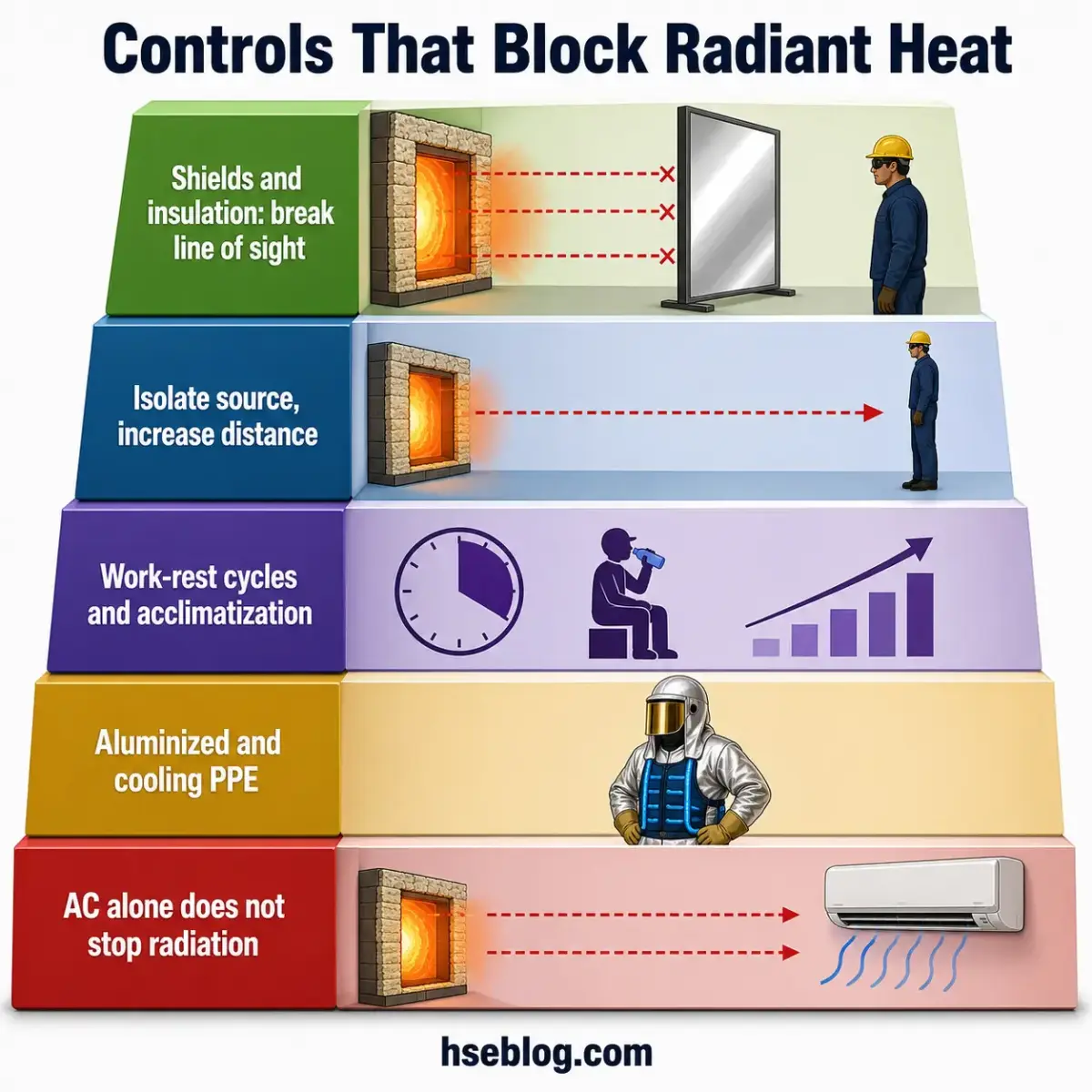
Controlling radiant heat means breaking the line-of-sight path between the hot surface and the worker — the one thing ventilation and air conditioning cannot do. Tie every control to the transfer pathway it interrupts, and the right priorities become obvious.
Life-critical work near furnaces, molten metal, or intense radiant sources must be planned and supervised by a competent person with relevant training, jurisdiction-specific authorization, and a site-specific risk assessment. The guidance below is general HSE knowledge and does not replace that.
Engineering controls — break the radiant path
These sit at the top of the hierarchy because they attack radiation directly. OSHA's guidance on reflective shields and insulation of hot surfaces is the practical reference here.
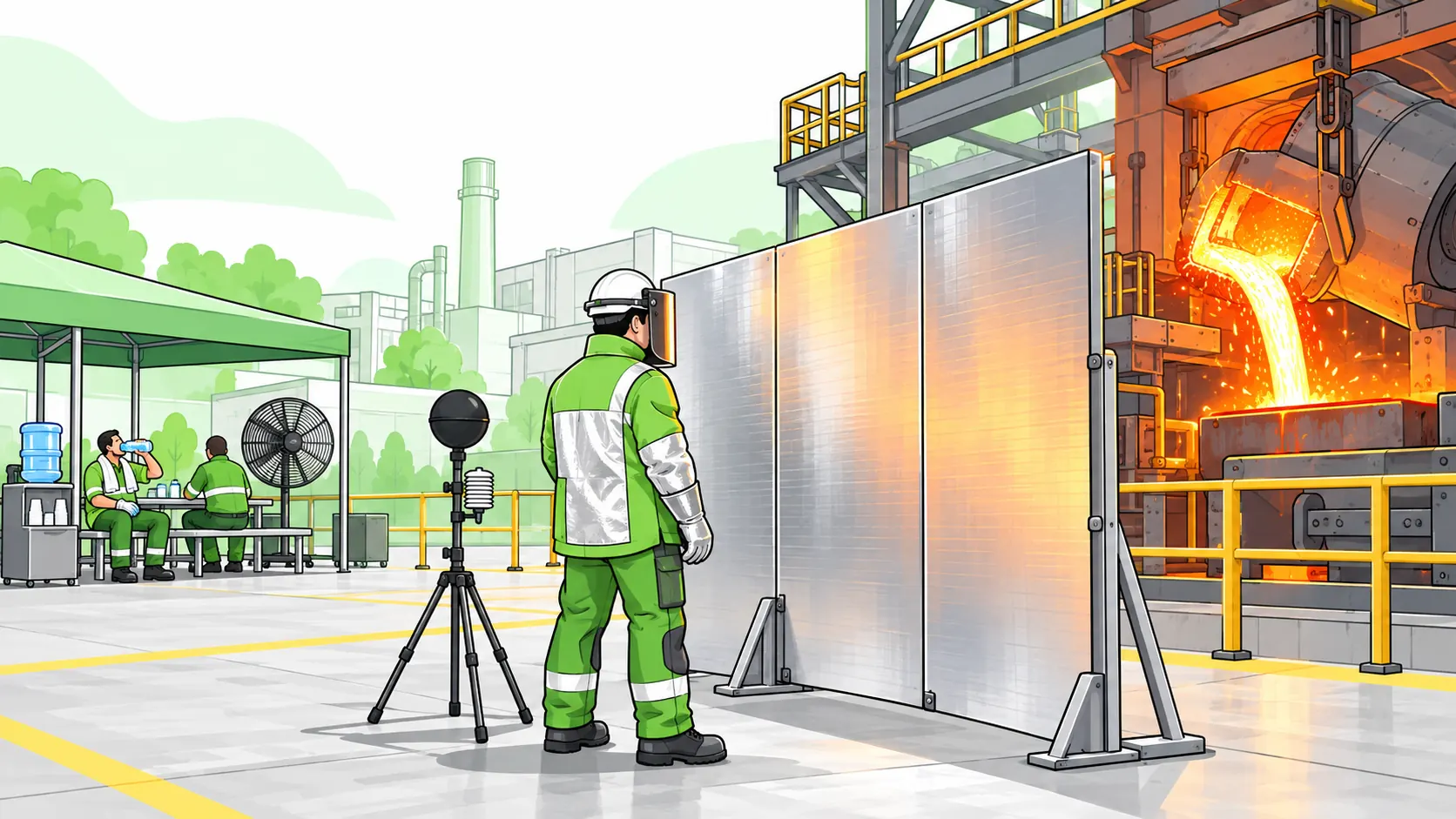
- Reflective and heat-absorbing shields — placed between source and worker, they reflect infrared rather than absorb it, interrupting the line of sight.
- Insulation of hot surfaces — lagging furnace walls and hot lines lowers the surface temperature that radiates outward.
- Source isolation — separating or enclosing the radiant source removes the line of sight entirely.
- Distance — radiant intensity falls sharply with distance, so even moving a workstation back cuts the load.
The comparative point matters: air conditioning and general ventilation address convective and evaporative pathways, not radiation. They make the air cooler while the infrared keeps arriving. A worker can sit in cooled air and still gain heat from a glowing surface in front of them.
Administrative controls and PPE — manage what you cannot remove
When the radiant source cannot be fully engineered out, these reduce dose and protect the body.
- Work-rest cycles tied to WBGT and workload, not to how the air feels.
- Acclimatization schedules built up over roughly one to two weeks for new or returning workers.
- Hydration and cooled rest areas that allow the body to recover between exposures.
- Reflective or aluminized clothing and cooling PPE for welding, firefighting, and similar high-radiant roles.
The judgment call most teams get wrong is treating a reflective shield as a set-and-forget install. Shields get repositioned, degraded, or bypassed for access, and a barrier that no longer sits in the line of sight it was specified to block has quietly stopped working. Verify placement on a schedule, not once.
Radiant Heat Regulations and Compliance by Jurisdiction
Regulatory content here reflects general HSE professional understanding of US and UK requirements as of June 2026. It is not legal advice. Specific compliance questions, enforcement situations, or prosecution risk should be directed to qualified legal counsel in the applicable jurisdiction.
No single number defines a legal limit for radiant heat in the United States or the United Kingdom. Both regulate through duties to manage risk rather than a fixed temperature, with the numeric methods supplied by ISO, ACGIH, and NIOSH.
United States
Enforcement runs through the General Duty Clause. Sites are cited under OSH Act Section 5(a)(1) (US, 1970), which requires employers to provide a workplace free from recognized hazards likely to cause death or serious harm — the mechanism OSHA uses for heat absent a specific standard.
Programmed pressure now comes from the revised Heat National Emphasis Program (CPL 03-00-024), effective April 10, 2026, which targets 55 high-risk industries and authorizes random inspections on National Weather Service heat-advisory days, removing the prior numeric inspection goal. The proposed federal Heat Injury and Illness Prevention rule remains unfinished: the NPRM published in August 2024, the informal hearing ran June–July 2025, and post-hearing comments closed October 30, 2025, with no finalization date set.
The misconception worth correcting is that "no heat standard" means "no enforcement." General Duty Clause citations for heat have been issued for years, and NEP inspections are programmed independently of any final rule.
United Kingdom
When the question is a maximum temperature, UK law sets none. The Workplace (Health, Safety and Welfare) Regulations 1992, Regulation 7 (UK) impose a duty to keep workplace temperature "reasonable" and to manage heat-stress risk through assessment rather than a fixed ceiling. HSE's thermal-comfort guidance treats radiant temperature as one of six factors that decide whether a workplace is too hot.
International thresholds
Where numbers are used, they come from voluntary and recommended standards. The ISO 7243:2017 WBGT screening method (International) establishes whether heat stress is present across an up-to-8-hour workday, with the black globe component capturing the radiant contribution.
For action limits, OSHA's PEL sits nowhere — there is none for heat — so practitioners turn to the ACGIH TLV and the NIOSH RELs and RALs. The stricter reference should govern: NIOSH's Recommended Alert Limit for unacclimatized workers (Pub. No. 2016-106) is the more protective figure, and it is the conservative one to plan around. ACGIH TLV values are copyrighted, so treat them by methodology and direct teams to ACGIH rather than reproducing the tables.
| Standard | Jurisdiction | Basis | Note |
|---|---|---|---|
| General Duty Clause 5(a)(1) | US | Recognized-hazard duty | No numeric heat limit |
| Heat NEP CPL 03-00-024 | US | Programmed inspections | Effective April 10, 2026; 55 industries |
| Workplace Regs 1992, Reg. 7 | UK | "Reasonable" temperature duty | No maximum temperature in law |
| ISO 7243:2017 | International | WBGT screening | Globe captures radiant load |
| NIOSH REL/RAL | US (recommended) | WBGT action limits | Unacclimatized RAL is the stricter reference |
Frequently Asked Questions
Does air conditioning protect workers from radiant heat?
No. Air conditioning lowers air temperature and supports convective and evaporative cooling, but it does nothing to block line-of-sight infrared from hot surfaces. A worker can stand in cooled air and still gain heat from a furnace in front of them. Reflective shields, surface insulation, and source isolation are what actually interrupt radiant load.
Why does the weather heat index underestimate radiant heat at work?
The heat index is measured in shade and combines only air temperature and humidity. It ignores radiant sources, wind, and workload entirely. That makes it unreliable for any indoor space heated by furnaces or ovens. Where radiant sources exist, WBGT with a globe-temperature reading is the defensible assessment metric.
Is there a legal temperature limit for radiant heat exposure?
There is no federal OSHA permissible exposure limit for heat, and UK law sets no maximum temperature either. Numeric thresholds come from voluntary or recommended methods — ISO 7243 screening, ACGIH TLV, and NIOSH REL/RAL. This is general information, not legal advice, and the applicable jurisdiction should always be confirmed.
Can radiant heat cause eye damage or burns indoors?
Yes. Sustained infrared exposure is linked to occupational cataract — the long-recognised "glassblower's" or "furnaceman's" cataract — and skin near molten metal or furnace openings can suffer localized radiant burns without contact. Eye protection in these settings should be rated for infrared, not just for visible glare.
How is radiant heat different from burns caused by touching hot objects?
Radiation transfers energy across open space with no contact; conduction requires direct touch. The US Bureau of Labor Statistics records them as separate event categories, which affects how incidents are coded and which control applies. Shielding and distance counter radiation; guarding and insulation counter contact burns.
Do reflective shields and aluminized PPE actually reduce radiant heat?
Yes — reflective barriers are among the most effective engineering controls against radiant load because they reflect infrared rather than absorb it. Their performance depends entirely on placement: a shield must sit in the line of sight it was specified to block, and aluminized clothing must stay clean and intact to keep reflecting.
Conclusion
The industry's core mistake with radiant heat is treating it as part of a vague "it's hot in here" and then measuring with a tool that cannot see it. The heat index built for weather forecasts has quietly become the default for indoor workplaces it was never designed to assess, and that is how a foundry or bakery passes a check while its workers carry a load the reading never captured.
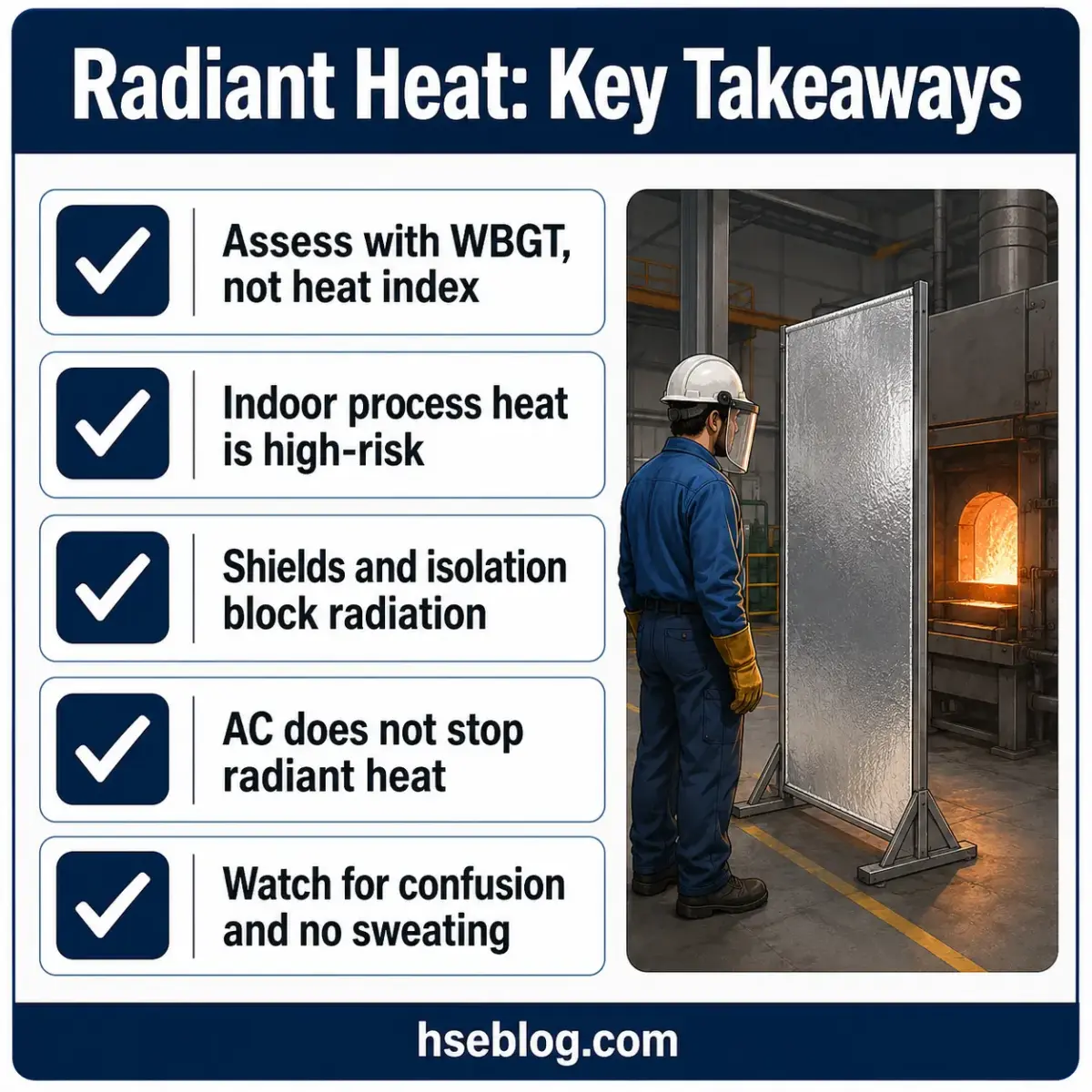
The single highest-impact change is also the simplest: assess radiant environments with WBGT and globe temperature, not the heat index, and then control to the mechanism the reading reveals. Reflective shields, surface insulation, and source isolation interrupt the line-of-sight path that ventilation leaves wide open — and they only keep working if someone verifies the barrier still sits where it belongs.
Radiant heat exposure rewards practitioners who respect the physics. Find the hot surface, measure the gap it opens between globe and air, break the line of sight, and the hazard that general heat advice keeps overlooking becomes one of the more controllable ones on site.