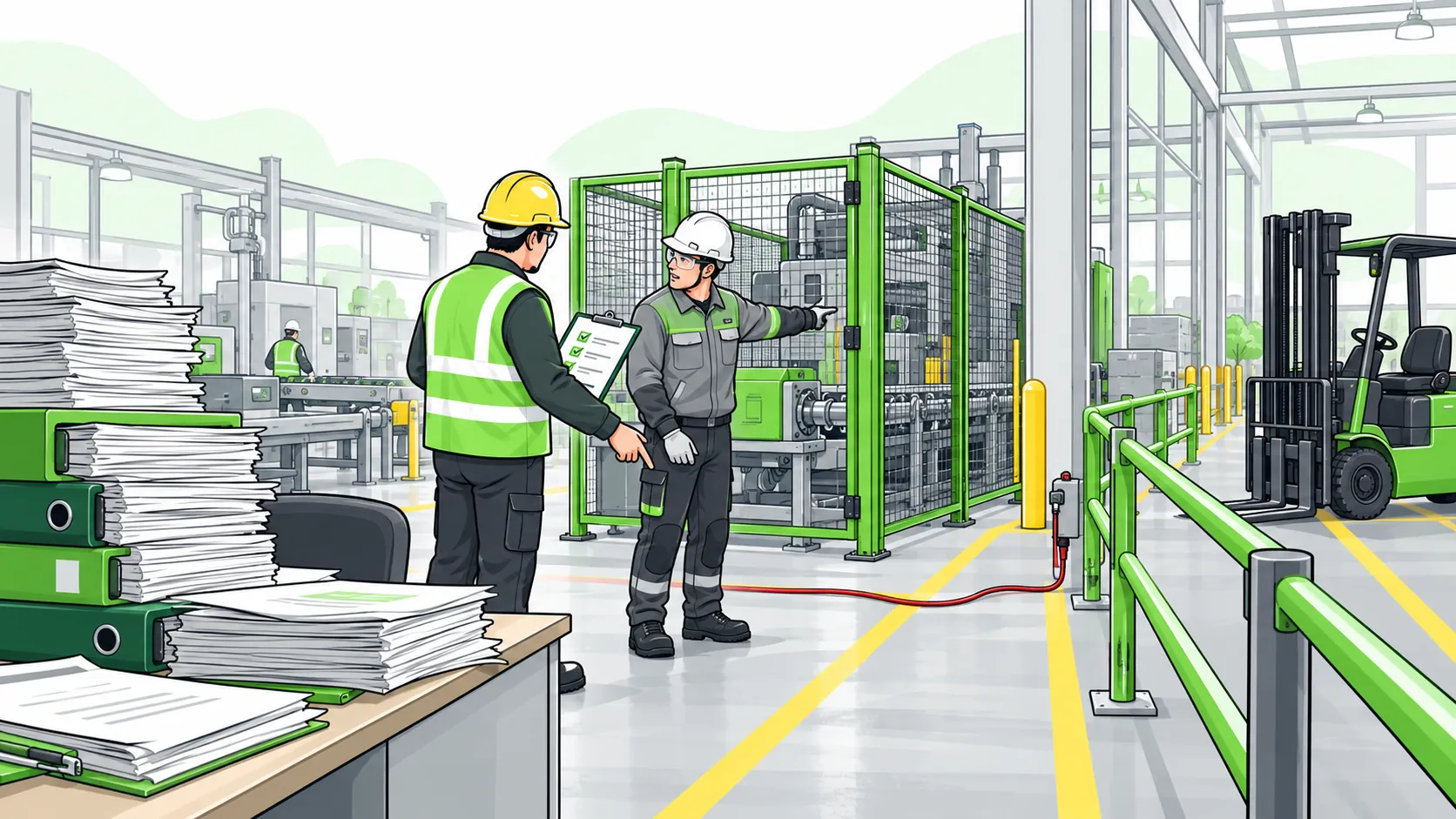
Inspection and maintenance are distinct safety activities. Inspection examines equipment to detect defects, wear, or hazards and produces a record of its condition. Maintenance is the physical work — servicing, repair, replacement, lubrication, adjustment — that returns equipment to a safe state. Put plainly: inspection identifies what is wrong; maintenance fixes it. Most safety law treats them as separate, separately enforceable duties.
"We checked it" is one of the most reassuring phrases on a worksite — and one of the most misleading. A completed inspection tells you the condition of a machine, but it does not change that condition by a single bolt.
The gap between knowing and fixing is exactly where people get hurt. Lockout/tagout — the standard governing servicing and maintenance — ranked #4 on OSHA's most-cited list for FY2025 with 2,177 citations (OSHA, 2025), and compliance with it prevents an estimated 120 fatalities and 50,000 injuries each year (OSHA Lockout/Tagout Fact Sheet). This guide sets out the difference between maintenance and inspection across US and UK law, then shows how the two lock together into a single safety loop.
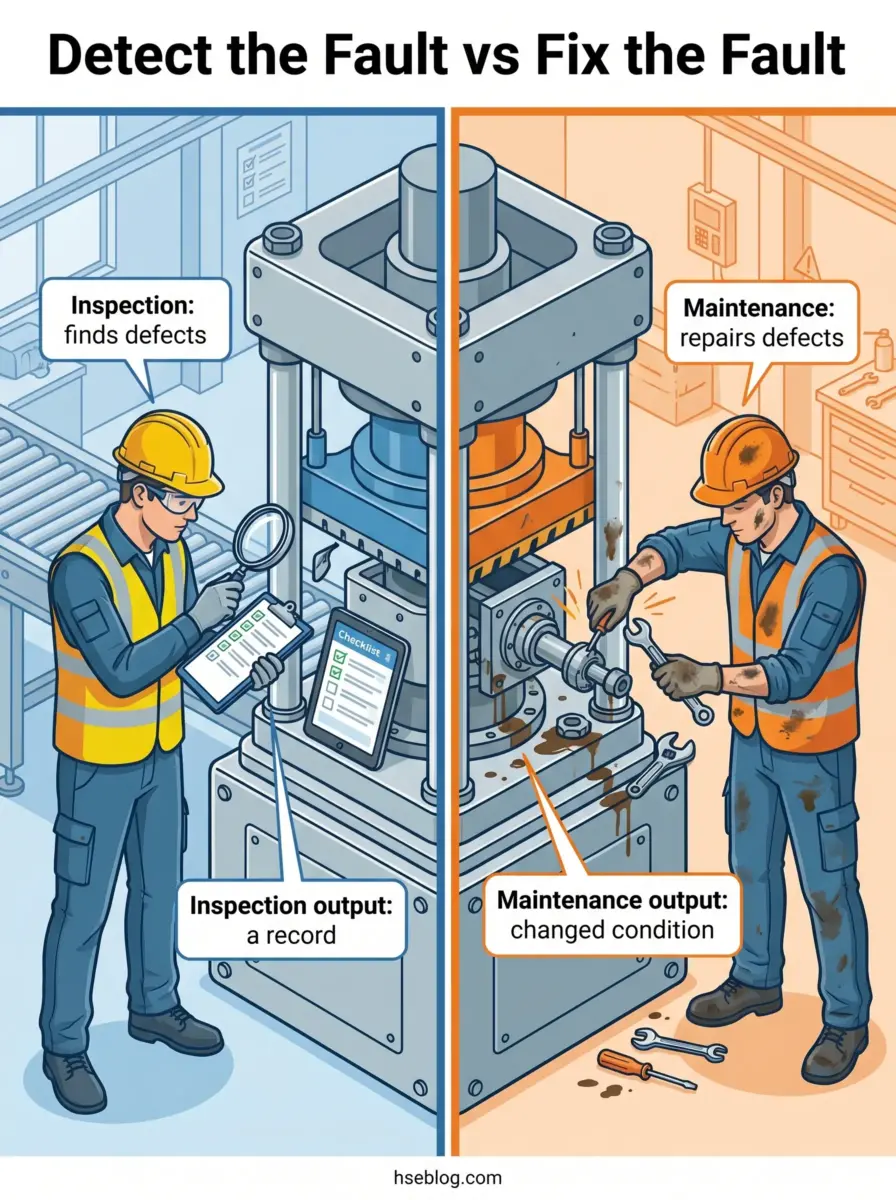
Maintenance vs Inspection: What's the Core Difference?
The cleanest line between the two is direction of effect: inspection gathers information, maintenance changes a physical state. An inspection that finds a cracked sling has accomplished nothing for safety until maintenance removes or replaces that sling.
That single distinction drives almost everything else — who performs the task, how often, what record proves it, and which regulation governs it.
The table below holds the whole comparison in one view.
| Dimension | Inspection | Maintenance |
|---|---|---|
| Purpose | Detect defects, wear, hazards | Keep or restore safe working order |
| Question it answers | "What's wrong?" | "Here's the fix." |
| Output | A record of condition | A changed physical condition |
| Typical performer | Competent person / examiner | Competent technician |
| Regulatory anchor | PUWER reg 6; LOLER reg 9 (UK); 29 CFR 1910.147(c)(6) (US) | PUWER reg 5 (UK); servicing duty under 1910.147 (US) |
The confusion driver is predictable. A team hears "we checked it" and assumes the defect is handled — but inspection vs maintenance is precisely the difference between spotting a fault and closing it out.
This article provides general HSE knowledge. Life-critical work — energy isolation under lockout/tagout, lifting-equipment thorough examination, pressure-system work — must be planned and supervised by a competent person with relevant training, jurisdiction-specific authorization, and a site-specific risk assessment. The information here does not replace that.
What Counts as Maintenance? Types and Purpose
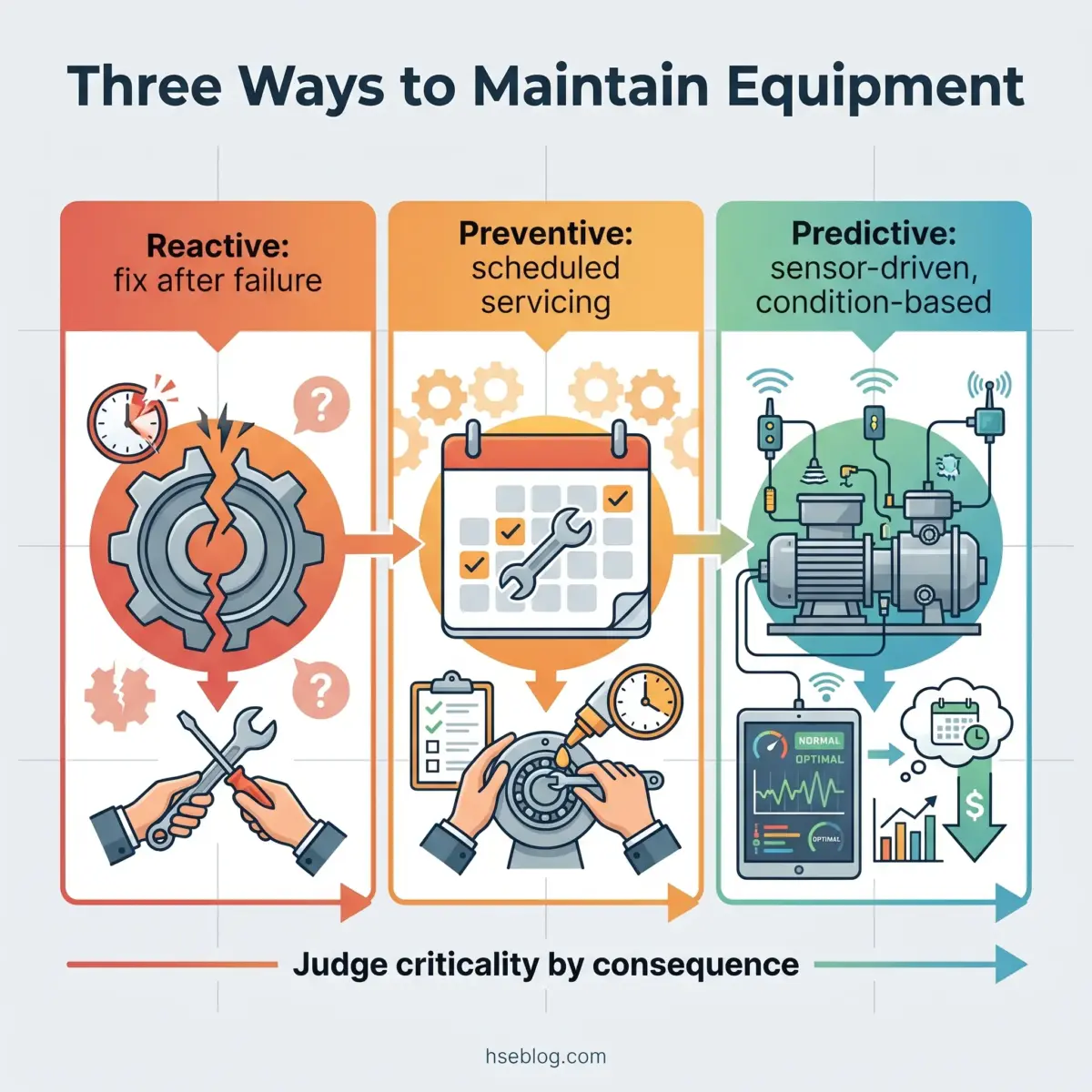
Under PUWER 1998 regulation 5 (UK), maintenance is defined as a state to be achieved — equipment kept "in an efficient state, in efficient working order and in good repair" — not a single method. That framing matters: maintenance is a strategy spectrum, not one task.
The three recognised approaches sit on a sliding scale of cost, planning, and risk tolerance.
- Reactive / corrective (run-to-failure) — repair only after breakdown. Defensible only for low-criticality, low-consequence items where failure causes no safety exposure.
- Preventive / planned (planned preventive maintenance) — time- or usage-based servicing, lubrication, and part replacement done on a schedule, before failure. This is the workhorse of most equipment maintenance and inspection programmes.
- Predictive and condition-based — sensor and data-driven, acting on the actual measured condition of the asset rather than a calendar. The closest maintenance gets to "fixing only what needs fixing."
Maintenance can contain checking activity — a technician inevitably looks at what they service. But checking is not maintenance's defining purpose; changing the equipment's condition is.
The judgment call most teams get wrong is criticality. A cheap interlock or machine guard carries a low replacement cost but a high failure consequence, so running it to failure is a poor preventive maintenance vs inspection trade-off. Criticality should be judged on consequence, never on price.
What Counts as Inspection? Types and Purpose
The word "inspection" is used loosely on most sites, which is half the problem. In safety terms, inspection means condition verification — and it comes in distinct tiers that differ sharply in frequency, formality, and who is allowed to do them.
As formality rises, frequency falls. A daily glance and a six-monthly statutory examination are both "inspection," but they are not interchangeable.
Pre-use / pre-shift check
The operator's quick look before running the equipment. Frequent, informal, and valuable — but it is not the formal inspection duty and was never meant to satisfy it.
Periodic inspection
A scheduled, more detailed examination by a competent person, sized to how the equipment deteriorates or depends on its installation conditions. This is the level PUWER regulation 6 (UK) targets.
Thorough examination / statutory inspection
The formal, recorded, often independent examination required for higher-risk equipment such as lifting gear and pressure systems. Under LOLER 1998 regulation 9 (UK), lifting equipment requires thorough examination at least every 6 months for accessories and equipment used to lift people, and at least every 12 months for other lifting equipment.
Whatever the tier, inspection produces a record and recommendations — it fixes nothing itself. That is the recurring failure pattern worth flagging now: pre-use checks get treated as discharging the formal inspection duty. They don't, and the space between them is exactly where slowly developing defects go unrecorded.
How Maintenance and Inspection Work Together in a Safety System
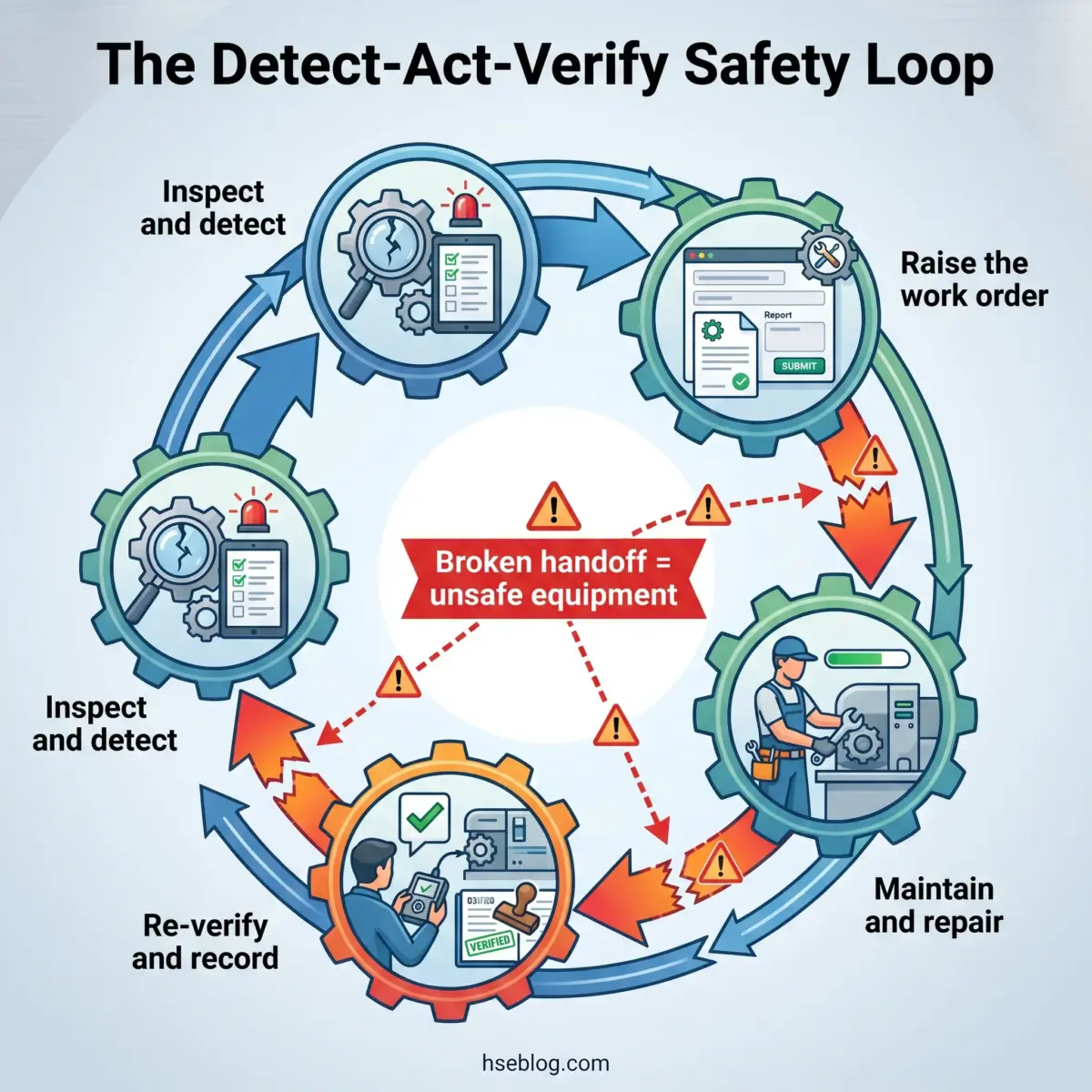
The most common organisational failure isn't a skipped inspection — it's a broken handoff between finding a defect and fixing it. Findings sit in a folder, or get mentioned at shift change, instead of becoming a tracked, closed-out action.
Reframing "maintenance vs inspection" as a single loop fixes the mental model. The activities aren't rivals; they are stages of one detect-act-verify cycle.
- Inspect — a competent person examines the equipment and records its condition.
- Detect — a defect, wear point, or deviation is identified.
- Raise — the finding becomes a defect report or work order, not a verbal remark.
- Maintain — the physical repair, replacement, or adjustment is carried out.
- Re-verify — the fix is confirmed effective before the equipment returns to service.
- Record — the closed-out action is documented and traceable end to end.
The chain breaks in three predictable places: verbal findings that never get logged, inspection reports that never generate a work order, and maintenance that's completed but never re-verified.
Traceability is what makes the loop audit-defensible. A clean line from defect report → work order → sign-off is the evidence that information actually became action.
Is Inspection Part of Maintenance, or Separate?
The honest answer is: it depends on whether you mean the activity or the legal duty. Informally, inspection sits inside any good maintenance programme; legally, most regulations create the two as distinct, separately enforceable obligations.
That nuance is where searches for "is inspection part of maintenance" usually go wrong.
- Colloquially, inspection is often bundled under a single "maintenance programme," and that's a reasonable everyday shorthand.
- Legally (UK), PUWER separates maintenance (regulation 5) from inspection (regulation 6) as different duties — PUWER inspection vs maintenance is not a stylistic distinction, it's two obligations. LOLER thorough examination is separate again.
- In practice, performing maintenance does not discharge an inspection duty, and inspecting does not discharge a maintenance duty. Each must be evidenced in its own right.
The dangerous shortcut here is offering a maintenance log to an inspector as proof of inspection. They are different evidence of different duties; one cannot stand in for the other. That is also the direct answer to "does maintenance replace a statutory inspection" — it does not.
Maintenance and Inspection Under the Law: Key Regulations by Jurisdiction
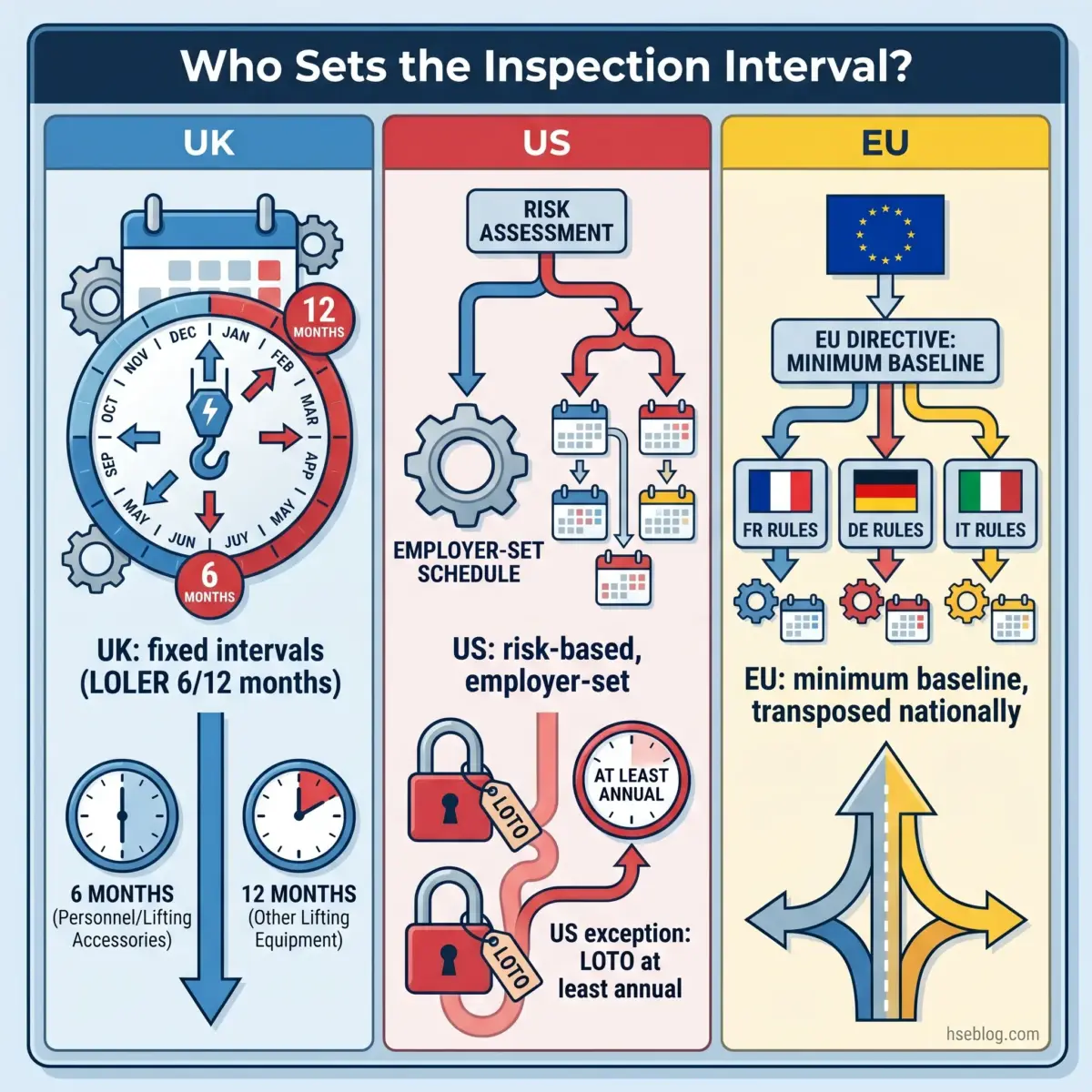
The jurisdictions diverge on philosophy, not on threshold values. The UK prescribes fixed intervals for defined equipment; the US sets a risk-based duty and lets the employer choose the interval — with a few hard exceptions.
Regulatory content here reflects general HSE professional understanding of UK, US, and EU requirements as of 2026. It is not legal advice. Specific compliance questions, enforcement situations, or prosecution risk should be directed to qualified legal counsel in the applicable jurisdiction. This regulatory content was last reviewed in [Month YYYY — to be filled at publish].
United Kingdom: PUWER and LOLER
The UK draws the cleanest statutory line between the two activities.
- Maintenance — PUWER 1998 reg 5 sets the state to achieve (efficient working order, good repair), not the method. See HSE's PUWER Approved Code of Practice (L22) for the distinction.
- Inspection — PUWER 1998 reg 6 requires inspection at suitable intervals by a competent person where safety depends on installation conditions or deterioration, with records kept.
- Thorough examination — LOLER 1998 reg 9 mandates fixed intervals for lifting equipment: at least 6 months (accessories and equipment lifting people) and at least 12 months (other lifting equipment), per HSE's LOLER guidance.
United States: OSHA's Performance-Based Approach
OSHA rarely prescribes a universal inspection interval. The duty holder must build a defensible, hazard-matched programme instead.
- The performance principle — under 29 CFR 1910.212 (machine guarding), OSHA imposes the duty to guard but sets no guard-inspection interval; the employer's risk assessment sets it.
- The fixed exception — under OSHA's Lockout/Tagout periodic inspection requirement, 29 CFR 1910.147(c)(6), each energy-control procedure must be inspected at least annually and the inspection certified (machine, date, employees, inspector).
- The trigger — servicing and maintenance is what brings LOTO into play in the first place, which is why the standard governs the maintenance/inspection boundary so directly.
European Union: The Use of Work Equipment Directive
EU Directive 2009/104/EC sets the minimum requirement that work equipment whose safety depends on installation conditions be inspected after installation, at intervals, and after exceptional events, by competent persons.
- Member states transpose this nationally, which is why UK PUWER reads the way it does and why EU-state requirements broadly align with it.
For an organisation operating across both regimes, the planning baseline should default to the stricter, more prescriptive interval. Planning to LOLER's fixed schedule rarely breaches a performance-based US duty; the reverse is not safe.
Who Can Carry Out Maintenance vs Inspection? The Competence Question
Competence requirements diverge by activity — and independence matters for inspection in a way it often doesn't for maintenance. This is high-value ground that competitor content rarely covers well.
The short version: routine maintenance needs task competence; formal inspection frequently needs demonstrable independence as well.
| Factor | Maintenance | Inspection (formal / statutory) |
|---|---|---|
| Competence basis | Task-competent, often manufacturer-guided | Demonstrable theoretical and practical knowledge |
| Independence | Not usually required | Frequently required; often third-party for thorough examination |
| Key rule | Competent for the specific task | LOTO periodic inspection by an authorized employee other than the one using the procedure (1910.147(c)(6)) |
The pattern worth naming is conflict of interest. When the person who maintains an asset also signs off its formal inspection, the inspector has a stake in repair cost and downtime — exactly the bias the duty is meant to exclude.
That's why defensible programmes separate the roles. NIOSH's best-practice guidance on LOTO periodic inspections reinforces the same point: the inspection is a distinct activity, performed separately. So "can the same person do maintenance and inspection" gets a split answer — usually fine for routine work, frequently not for statutory examination.
Common Failures: Where Organizations Confuse the Two
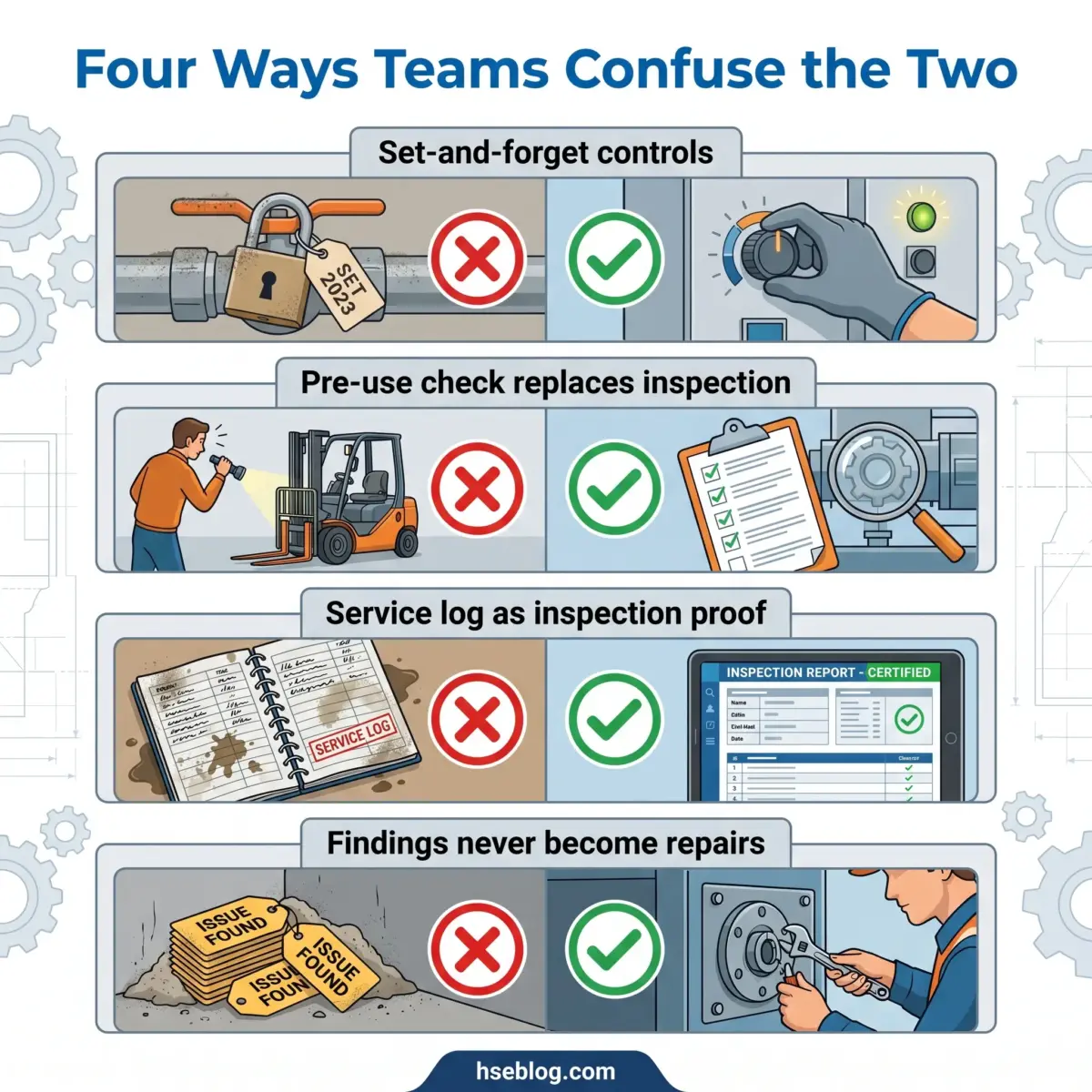
Across the published record, the same handful of mistakes recur — and they all share one root: confusing information (inspection output) with action (maintenance output), so one is silently assumed to deliver the other.
Each failure below pairs with the corrective principle that closes it.
- Set-and-forget. A control gets one maintenance event and is then treated as permanently fixed. Correction: re-inspect on a schedule; a fix is a snapshot, not a guarantee.
- Pre-use checks substituted for formal inspection. Frequent operator checks are offered as the inspection duty. Correction: keep both, and log the formal inspection separately under PUWER reg 6 or the relevant standard.
- Maintenance logs offered as inspection evidence. An auditor asks for inspection records and receives a service history. Correction: maintain distinct records — condition findings versus upkeep — because they prove different duties.
- No closed loop. Inspection findings never become tracked maintenance actions. Correction: every recorded defect generates a work order with a rectification deadline and a sign-off.
Frequently Asked Questions
How often should equipment be inspected versus maintained?
Maintenance frequency is driven by risk and usage, so it varies by asset. Some inspections, by contrast, are statutory and fixed — LOLER requires lifting-equipment thorough examination at 6 or 12 months (UK), and OSHA requires LOTO procedure inspection at least annually (US). Intervals are equipment- and jurisdiction-specific, so always work from the governing standard.
Can the same person do both the maintenance and the inspection?
Often yes for routine maintenance and informal checks. But formal and statutory inspections frequently require independence or a defined competent person. OSHA's lockout/tagout rule is explicit: the periodic inspection must be carried out by an authorized employee other than the one who uses the procedure (29 CFR 1910.147(c)(6)), removing any conflict of interest.
Does servicing or maintenance replace a statutory inspection?
No. They are separate legal duties, and a maintenance record does not discharge an inspection or thorough-examination obligation. UK PUWER even places them in different regulations — maintenance under reg 5, inspection under reg 6 — so completing one leaves the other outstanding. Each must be evidenced independently.
Is a daily pre-use check the same as a PUWER or OSHA inspection?
No. A pre-use check is an operator-level glance before running the equipment, not the formal inspection duty. It's genuinely useful for catching obvious faults, but it doesn't satisfy PUWER reg 6 or an OSHA hazard-matched inspection programme. The two run in parallel — the gap between them is where developing defects hide.
Do predictive maintenance sensors count as inspection?
Continuous condition monitoring performs an inspection-like function, and predictive maintenance increasingly blurs the practical line between inspecting and maintaining (2026 industry maintenance-strategy reporting, tied to ISO 55001 asset management). But it does not automatically satisfy a statutory inspection requirement. The legal duty for thorough examination or certified periodic inspection remains separate.
What records do I need to keep for maintenance versus inspection?
Keep them distinct, because they prove different things. Inspection records are usually the audit-critical evidence: date, condition, defects found, and the competent person. Maintenance logs evidence upkeep — what was serviced, repaired, or replaced. Recordkeeping expectations differ by regime, but offering one type as proof of the other will not hold up.
Conclusion
The industry's persistent error isn't laziness — it's a category mistake. Teams treat inspection and maintenance as the same job under two names, so a completed check feels like a completed repair. It isn't. Inspection generates information; maintenance changes the equipment. Confusing the two is how a known defect rides along in service, fully documented and entirely unfixed.
If there is one highest-impact change, it's this: make every inspection finding generate a tracked, closed-out maintenance action, and keep the two records separate. That single discipline closes the detect-act-verify loop, satisfies the distinct duties that PUWER, LOLER, and OSHA's lockout/tagout standard enforce, and turns "we checked it" into "we found it and fixed it."
Get the boundary between maintenance vs inspection right on paper, and the field follows. The asset that hurts someone is rarely the one nobody looked at — it's the one somebody looked at, noted, and never came back to.