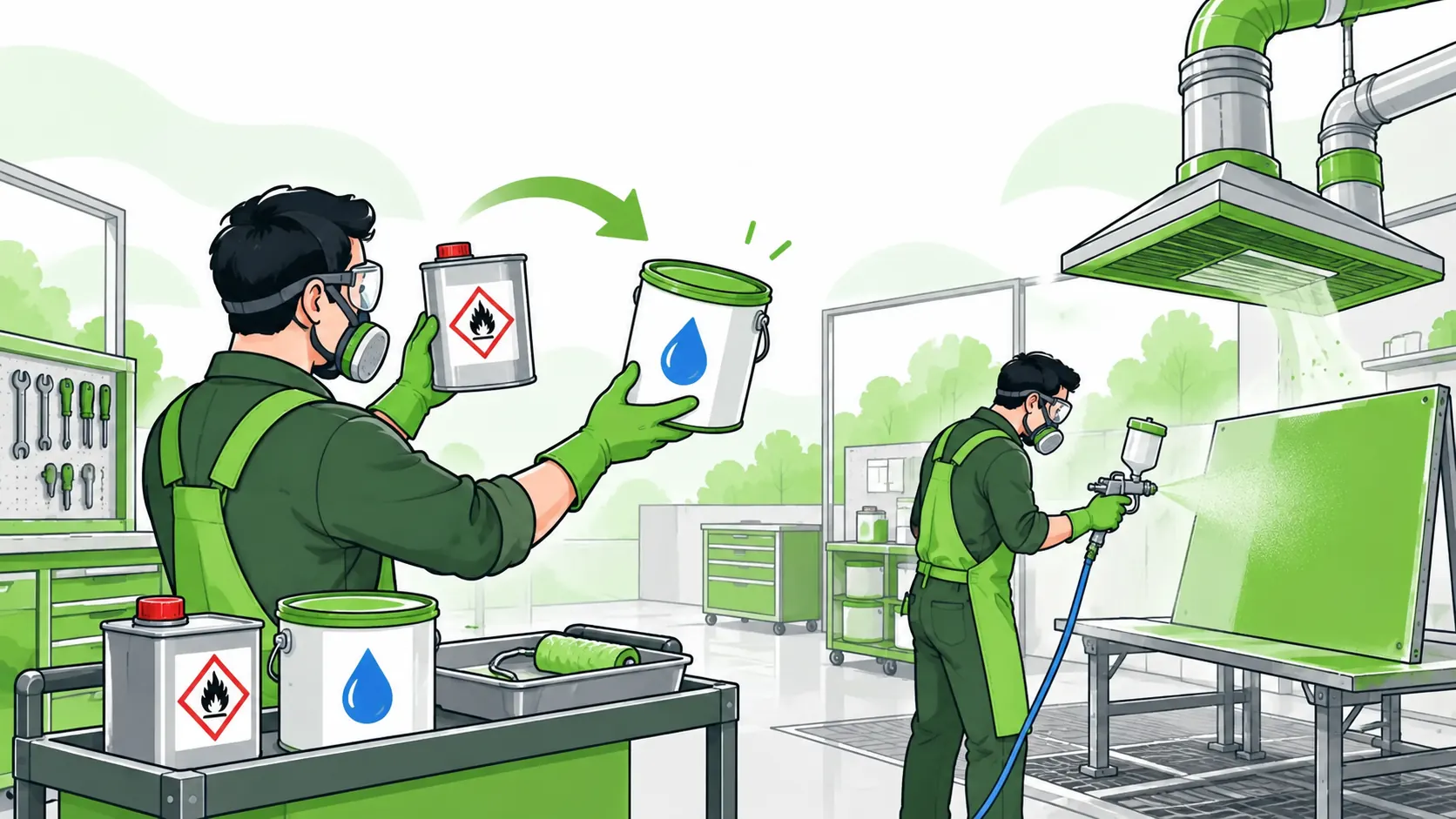
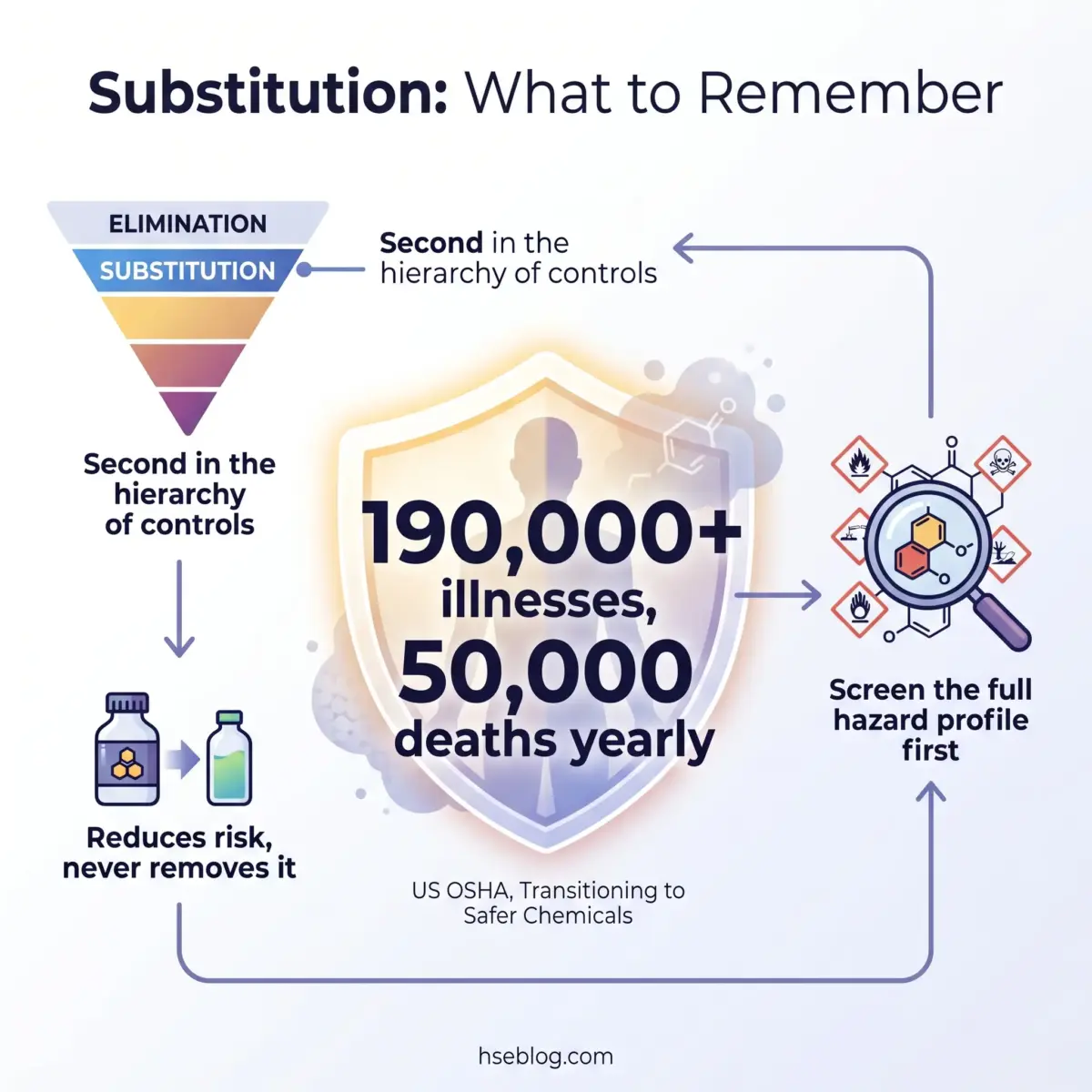
Substitution is the second level in the hierarchy of control. It means replacing a hazardous material, process, or piece of equipment with a less hazardous alternative — for example, swapping solvent-based paint for water-based paint. It reduces risk but does not remove the hazard entirely, which is why it ranks below elimination.
A belief follows new safety officers into nearly every exam room and toolbox talk: that substitution makes a hazard safe. It doesn't. Substitution makes a hazard less dangerous, and the gap between "safe" and "less dangerous" is exactly where real-world risk keeps hiding.
Get the idea right and substitution becomes one of the most powerful moves available below elimination. Get it wrong and teams either swap one problem for another, or quietly stop controlling a hazard they assume has gone. This guide explains substitution in the hierarchy of control in plain terms — where it ranks, why it sits second, how it differs from elimination, and how to avoid the swaps that backfire.
What Is Substitution in the Hierarchy of Control?
Substitution is the second-most-effective control in the hierarchy, defined as replacing a hazardous material, process, or piece of equipment with a less hazardous alternative (CCOHS, NIOSH). The hazard category survives the swap — its severity is what drops.
That distinction matters more than beginners expect. Substitution does not finish the job; it lowers the height of the problem so the remaining controls have less to manage. A residual hazard always stays behind, and it still needs monitoring.
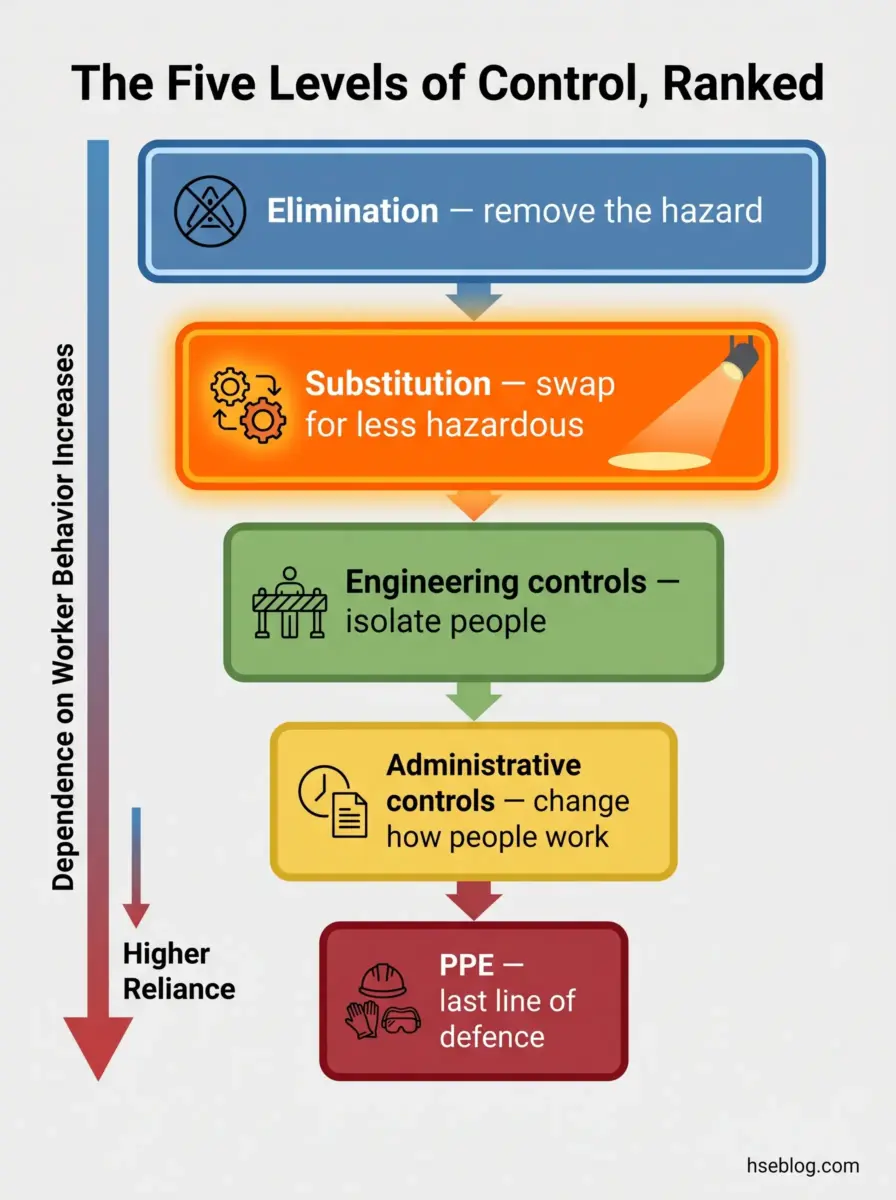
Here is the full five-tier map a beginner should picture, in order of preference:
- Elimination — the hazard is removed completely; no exposure is possible.
- Substitution — the hazard is replaced with a lower-severity version of itself.
- Engineering controls — people are physically isolated from the hazard.
- Administrative controls — work is reorganised through procedures, training, and signage.
- PPE — the worker's last barrier when higher controls can't reach the residual risk.
The common framing error is treating substitution as "making something safe." In practice it makes something less dangerous — and the leftover hazard still has to be controlled, measured, and reviewed.
Where Does Substitution Sit in the Hierarchy — and Why Second?
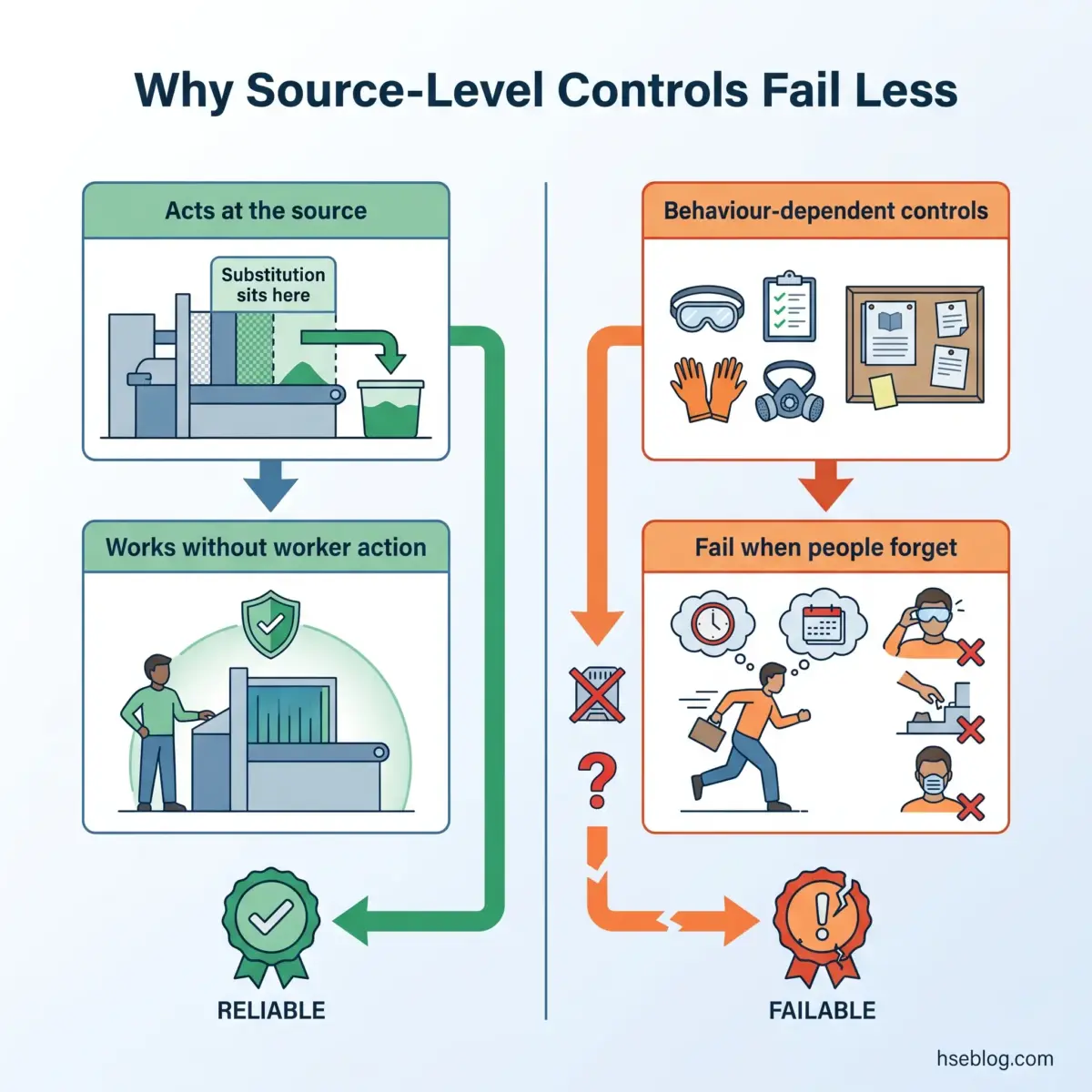
Rank any control by a single question: does it still work when a worker forgets to do something? Substitution mostly does, which is why it sits near the top — second only to elimination.
Why it beats engineering controls and everything below
Higher controls act at or near the source of the hazard and don't lean on human behaviour. Lower controls depend on training, compliance, and the right kit being used correctly every time.
Substitution outranks engineering controls because it shrinks the hazard itself rather than building a barrier around people who must still work near it. Decades of incident data support the same principle: source-level controls fail less often than behaviour-dependent ones. The NIOSH hierarchy of controls guidance sets out this top-to-bottom logic in detail.
Why it can't beat elimination
A lesser hazard is still a hazard. Because substitution leaves something behind, it can never reach the certainty of elimination — where the risk simply no longer exists.
The timing trap
Here is the judgment call most organisations get wrong. Substitution and elimination are cheapest and simplest at the design and procurement stage, and expensive once a process is running. The most common failure is trying to retrofit a substitute years too late, by which point only PPE feels affordable — which is the weakest tier of all.
Substitution vs Elimination: The Distinction People Get Wrong
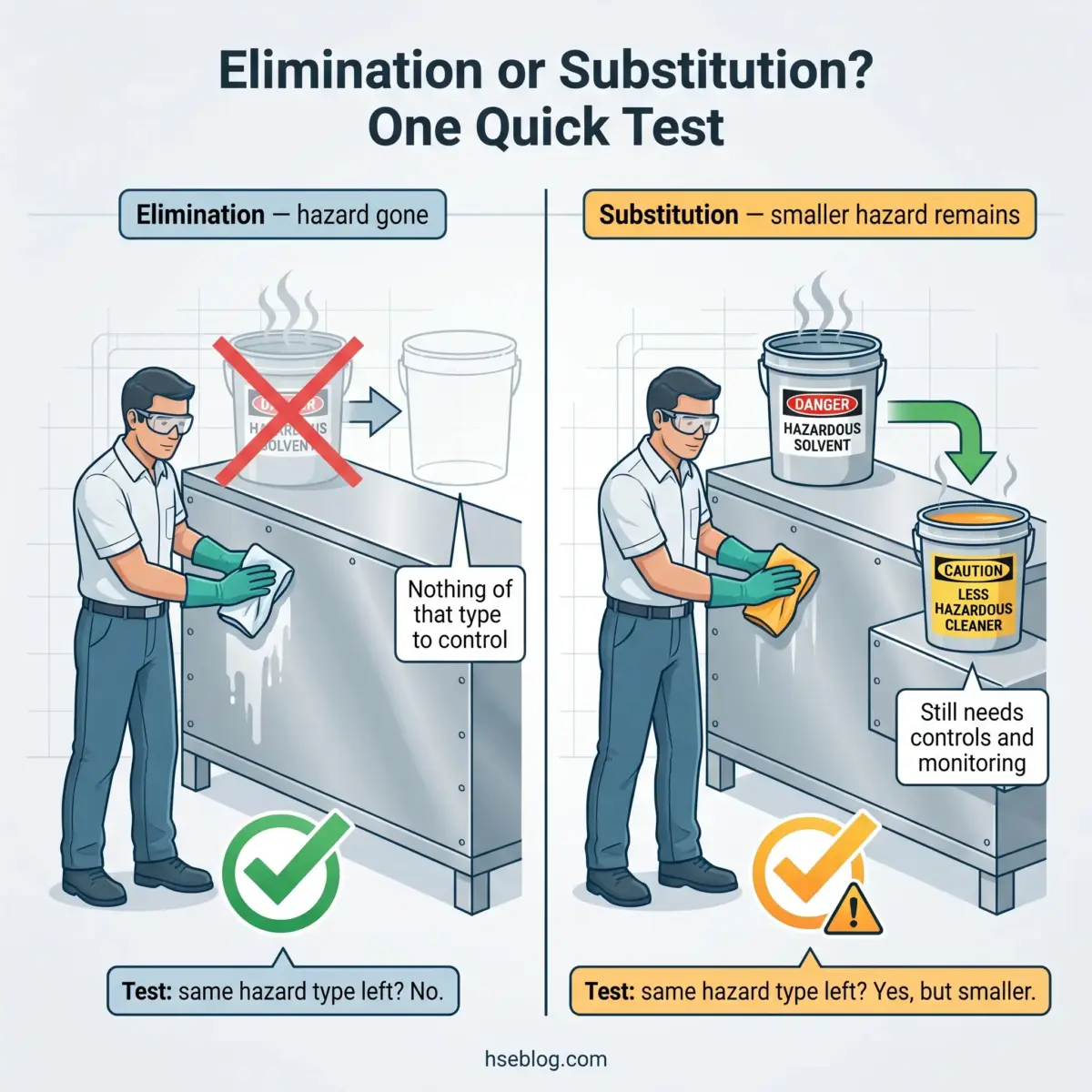
Elimination removes the hazard; substitution shrinks it. That one difference decides which tier a control belongs to — and it's the single point learners and exam candidates confuse most.
The confusion is understandable, because the same starting scenario can resolve either way. Take a workshop cleaning a part with a toxic solvent. Switch to a mechanical, water-based cleaning method and the solvent hazard is gone — that's elimination. Swap the toxic solvent for a milder one that still needs ventilation, gloves, and exposure monitoring — that's substitution.
| Question | Elimination | Substitution |
|---|---|---|
| Definition | Hazard removed entirely | Hazard replaced with a lesser one |
| Is the hazard gone? | Yes | No |
| Residual hazard to control? | None of that type | Yes — a smaller version |
| Example | Stop using the solvent; clean mechanically | Switch to a less toxic solvent |
| Hierarchy rank | First (most effective) | Second |
Apply one test on site: "Is there still a hazard of the same type to control afterward?" If yes, it's substitution. If no, it's elimination.
A recurring pattern is worth naming here. Teams routinely record a control as "elimination" on the risk assessment when it's really substitution — which inflates how protected they believe they are and skips the monitoring the residual hazard still demands. That paperwork gap matters for demonstrating the "reasonably practicable" duty, because the lower the control you've genuinely achieved, the more you must show you considered the higher ones first.
Examples of Substitution in the Workplace
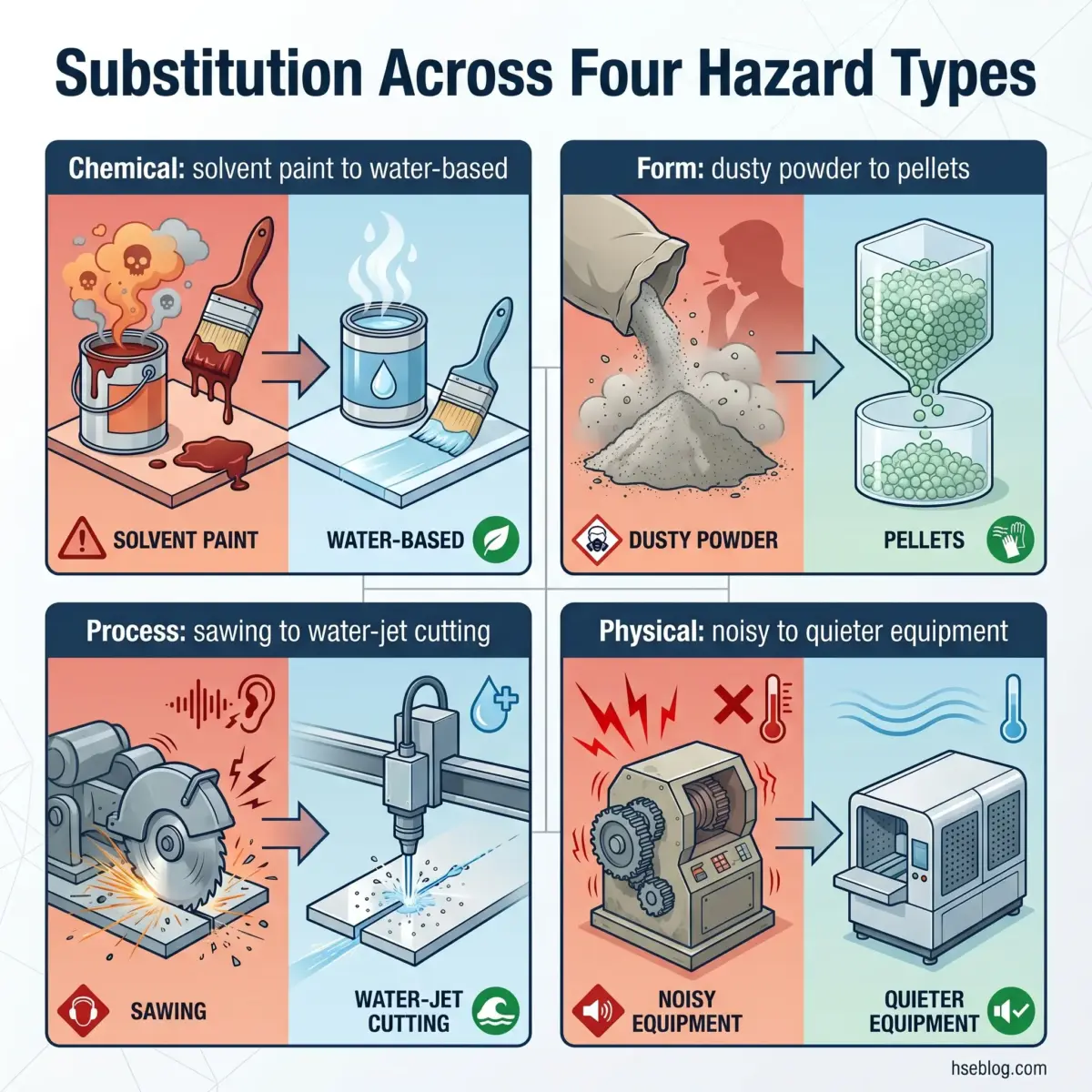
On real sites, the most familiar substitution is chemical — but the principle reaches across every hazard category, not just chemicals. The examples below are drawn from regulator sources so the concept generalises.
- Chemical: solvent-based paint replaced with water-based paint; solvent-based inks replaced with low-VOC or plant-based inks (NIOSH, CCOHS).
- Form-change: a dusty powder replaced with pellets, crystals, or a paste to cut inhalation risk (CCOHS).
- Process: water-jet cutting in place of mechanical sawing to reduce dust; dipping or brushing instead of spraying to cut airborne exposure.
- Equipment and physical agents: quieter equipment to reduce noise exposure; smaller containers to reduce manual-handling injury.
The CCOHS hierarchy of controls guidance is a solid Tier 1 reference for form-change and chemical examples, and it carries the caveat that matters most: "less toxic" is not validated until exposure to the substitute is confirmed below the relevant occupational exposure limit.
Where this article names chemical examples, "less hazardous" must be confirmed against current toxicological data and the product's safety data sheet. This is HSE practitioner reference, not medical or occupational-health advice — workers with specific exposure concerns should consult an occupational physician.
That exposure limit is not a single global number. OSHA PELs, NIOSH RELs, ACGIH TLVs, and EU OELs differ for the same substance, and the stricter value is the safer reference. A frequent trap is adopting a substitute on a vendor's "non-toxic" claim without an alternatives assessment — only to find the new product carries a different hazard (flammability, skin sensitisation, environmental harm) that nobody screened for.
Regrettable Substitution: When the "Safer" Choice Backfires
A safer-on-paper swap can quietly introduce a worse hazard — that's a regrettable substitution. It turns what should be a step up into a lateral move, or even a step backward.
Why it happens
The mechanism is almost always the same: assessing only the hazard you're trying to escape, and never screening the substitute's full profile. The classic pattern is a substance phased out for one recognised hazard whose replacement later proves harmful in a different way — a problem usually surfaced years later in health surveillance data, not at the point of purchase.
That delay is the whole reason an upfront alternatives assessment is cheaper than the eventual reversal. The stakes are not abstract: OSHA has cited more than 190,000 illnesses and 50,000 deaths each year in the US linked to chemical exposures as the rationale for managing chemical risk at the source (US OSHA, Transitioning to Safer Chemicals toolkit). Because OSHA's federal web resources carried a notice that updates were suspended as of October 2025, this figure should be re-verified against the live page before publication.
The safeguard: informed substitution
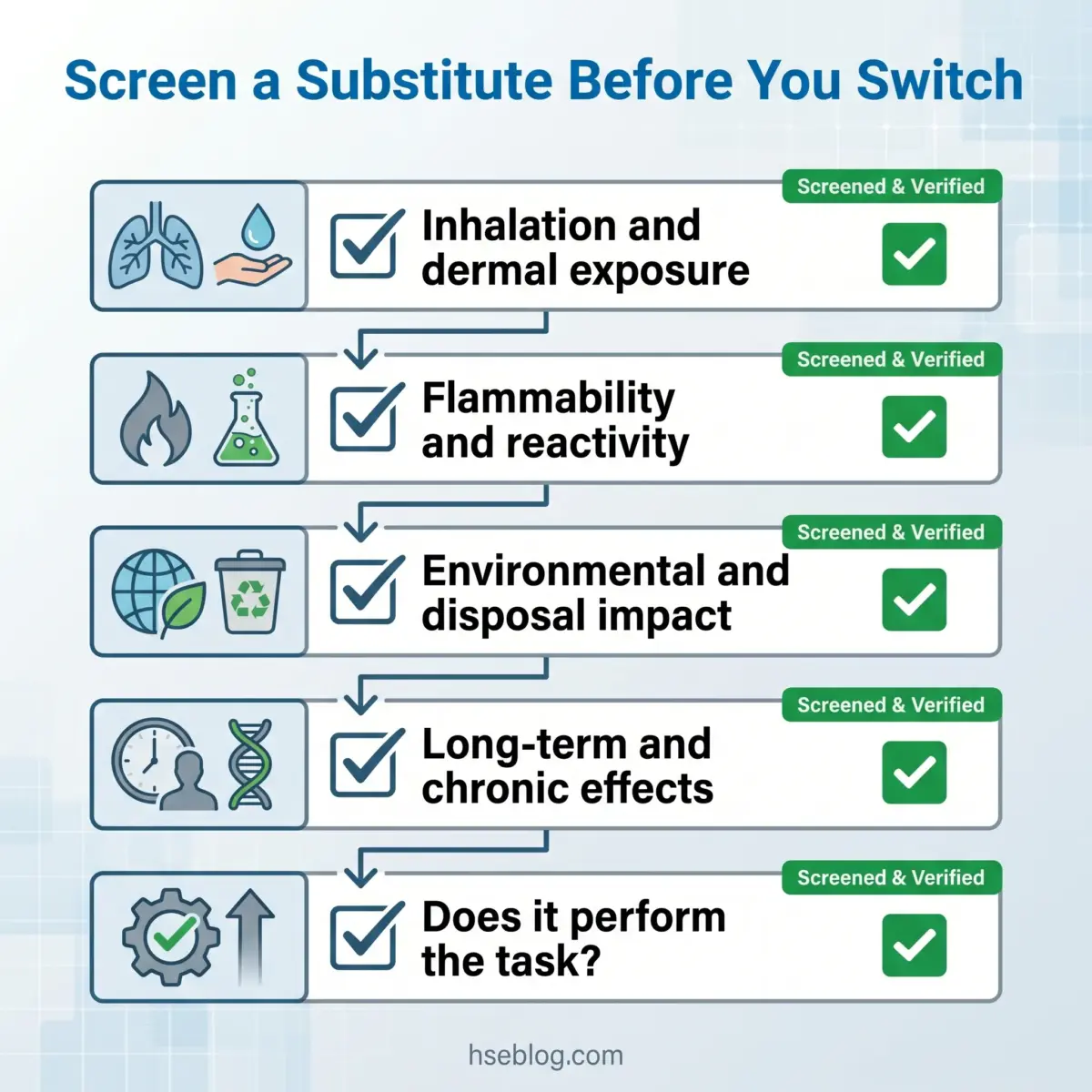
OSHA's informed substitution guidance is the framework that prevents the regret. It asks you to examine hazard, performance, and cost across all candidate options before switching — not after. The point is to compare the substitute's whole risk profile, not just the one hazard you're replacing:
- Inhalation and dermal hazards of the substitute
- Flammability and reactivity
- Environmental impact and disposal burden
- Long-term and chronic effects, including any carcinogenic or sensitising potential
- Performance fit — a substitute that fails the task gets bypassed by workers
How to Apply Substitution Correctly: A Simple Process
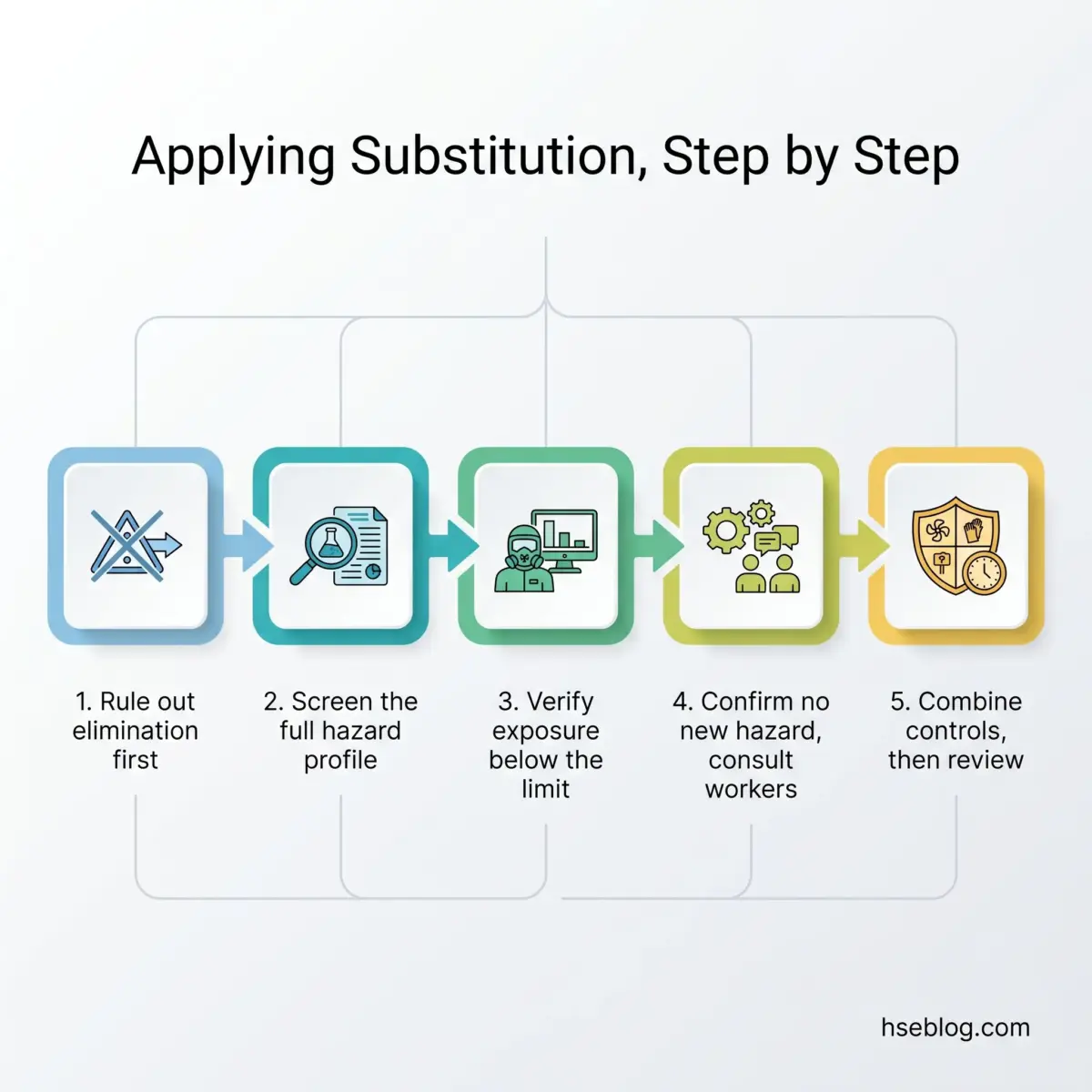
The mistake is reaching for a substitute before checking whether the hazard could be removed outright. Done well, substitution follows a short, repeatable sequence:
- Confirm elimination isn't reasonably practicable first. Substitution is the fallback when the hazard genuinely can't be removed — not the default.
- Screen candidates for their full hazard profile. Assess each alternative against every risk dimension, not just the hazard you're escaping.
- Verify exposure against the relevant occupational exposure limit. The substitute isn't validated until measured exposure sits below the applicable PEL, REL, TLV, or OEL — and the stricter limit governs.
- Confirm no new hazard, document the decision, and involve workers. ISO 45001:2018 expects worker consultation in this kind of risk decision, and the people doing the task often spot a performance or handling problem first.
- Combine substitution with lower-tier controls. It is rarely the whole answer; the residual hazard usually still needs engineering controls, procedures, or PPE.
- Schedule a periodic review. A chemical considered safe today can be reclassified later, so the substitute decision needs revisiting — not permanent sign-off.
Regulatory pressure is moving in this direction. Analysts tracking COSHH and REACH trends note momentum toward mandatory substitution of the most hazardous substances, shifting it from good practice toward an anticipated compliance default for certain chemicals (CPD Online, 2025), with the underlying push coming from EU REACH and EU-OSHA. Treating substitution as a living decision, rather than a one-time procurement choice, is how you stay ahead of that curve.
Frequently Asked Questions
Is substitution better than engineering controls?
Within the hierarchy ranking, yes — substitution sits above engineering controls because it reduces the hazard at its source rather than isolating people from it. In practice, though, the two are often combined, and feasibility can shape the real-world choice. A substitute paired with good ventilation is a common and entirely valid outcome.
What is a regrettable substitution?
It is a swap that introduces a new or unforeseen hazard, making the change a lateral or backward move rather than an improvement. It usually arises from assessing only the hazard being escaped and not the substitute's full profile. OSHA's informed-substitution approach — weighing hazard, performance, and cost across all options first — is the recognised way to prevent it.
When is the best time to apply substitution?
At the design, development, or procurement stage, when changes are cheapest and simplest to make. Retrofitting a substitute into a running process is far harder and more costly, which is why organisations that leave it late often fall back on weaker, behaviour-dependent controls instead.
Is substitution legally required under any standard?
It depends on jurisdiction, and this is general information rather than legal advice. ISO 45001:2018 (Clause 8.1.2) builds substitution into the mandated control order, while EU REACH and EU-OSHA push the substitution of the most hazardous substances over time. The exact legal force varies by regime, so check the standards that apply to your site.
Does substitution apply only to chemicals?
No — that is a common misconception. Substitution also covers processes, equipment, and physical agents: quieter machinery for noise, smaller loads for manual handling, water-jet cutting for dust-heavy sawing. Any hazard that can be exchanged for a lower-severity version of the same hazard is a candidate.
Conclusion
The industry's recurring error with substitution in the hierarchy of control is treating the swap as the finish line. A substitute arrives, the paperwork sometimes calls it "elimination," and the residual hazard stops getting the monitoring it still demands. That single habit undoes most of the protection the move was supposed to deliver.
If there is one change worth making, it is this: run an alternatives assessment before you switch, not after. Screening a candidate's full hazard profile — inhalation, dermal, flammability, environmental, and long-term effects — is what separates a genuine improvement from a regrettable substitution caught years later in health surveillance data. The cost of that upfront work is trivial against the cost of reversing a bad swap.
Substitution earns its place second in the hierarchy because it acts at the source and doesn't wait on anyone remembering a procedure. Respect what it can't do — remove the hazard entirely — and it becomes one of the most reliable tools you have. Treat it as "safe," and you've stopped controlling a hazard that never actually left.