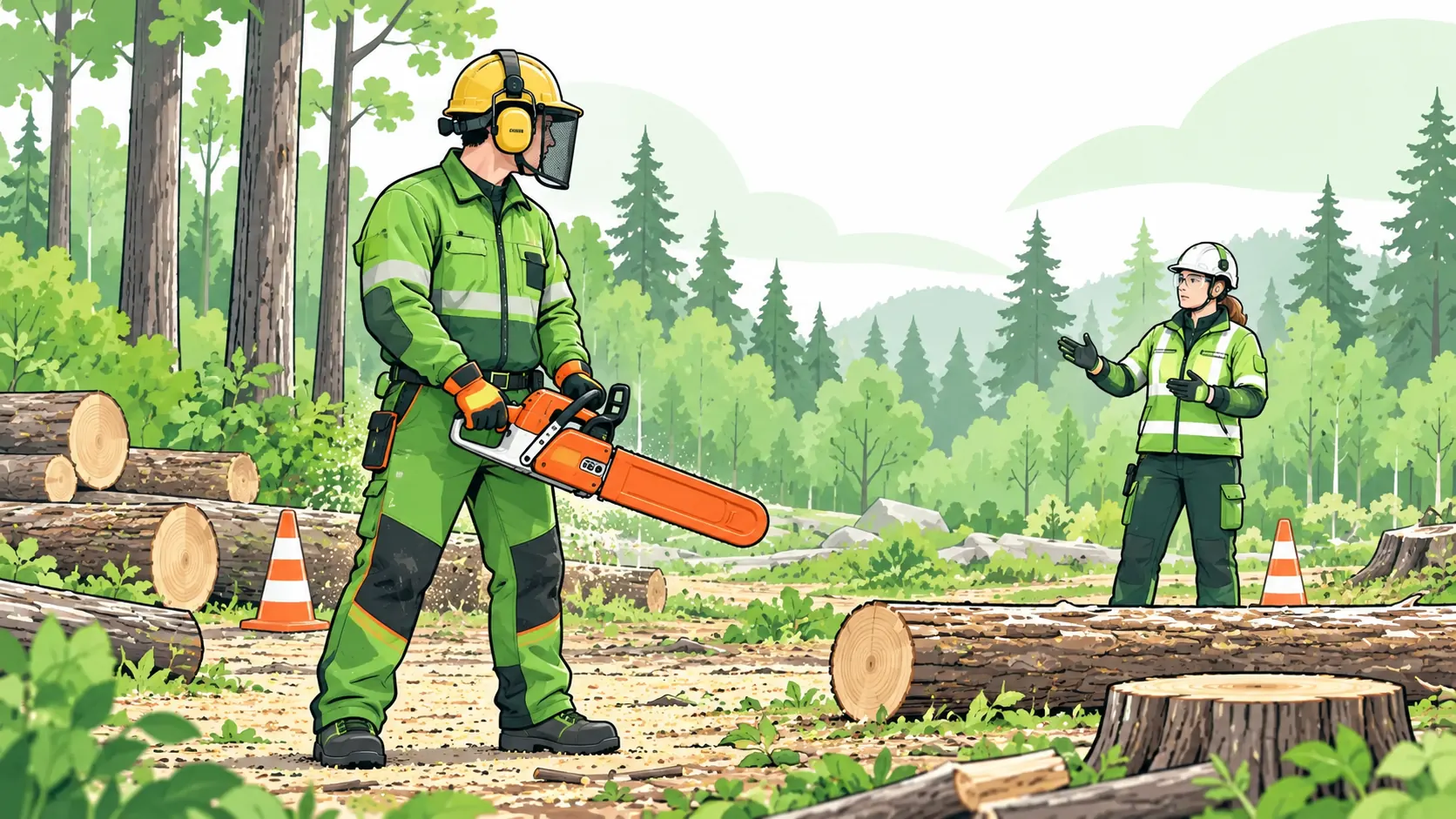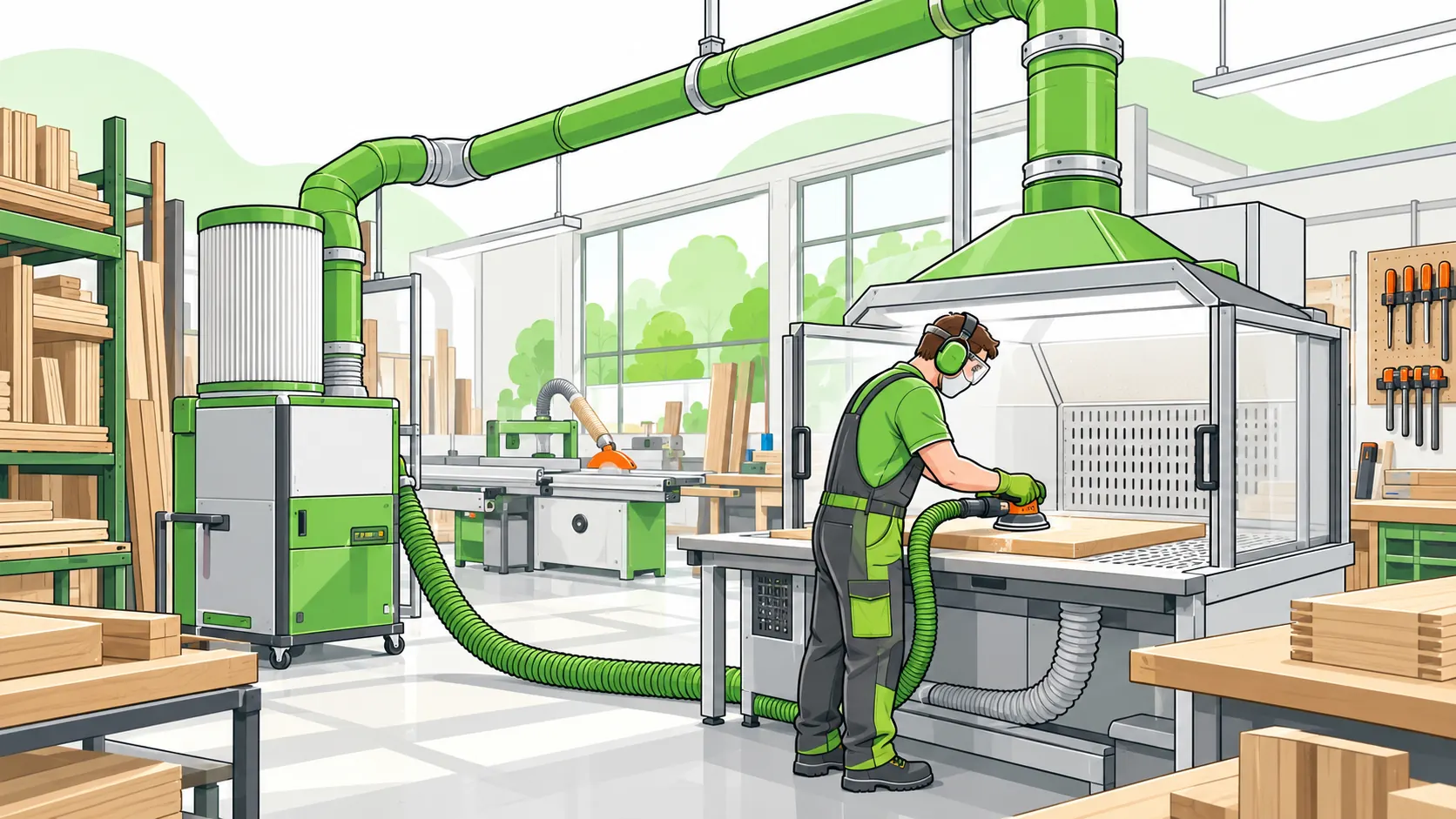
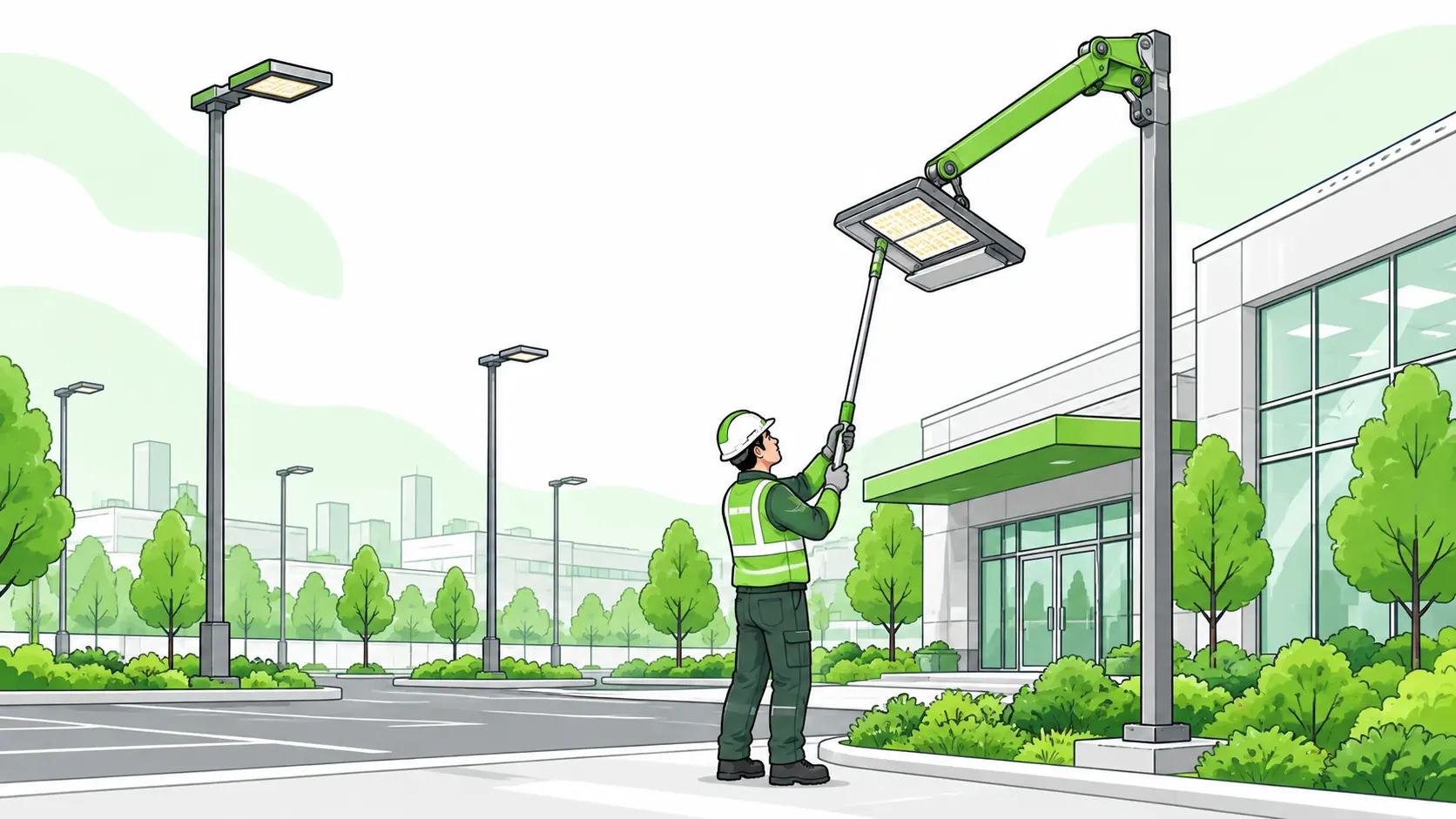
Elimination is the highest and most effective level of the hierarchy of controls. It means completely removing a hazard at its source so it no longer exists — for example, stopping the use of a toxic chemical or redesigning a task to be done at ground level. Because the hazard is gone, no worker can be exposed to it.
The single most common error I see in trainees and early-career safety officers is calling risk reduction "elimination." A machine gets a fixed guard, the assessment records "hazard eliminated," and everyone moves on — but the crushing point is still there, untouched, waiting for the day the guard is removed for maintenance and not refitted.
That confusion matters because elimination carries legal weight, not just best-practice status. ISO 45001, OSHA, and UK COSHH all put removing the hazard first, and an assessment that skips straight to PPE can fail an audit even when the PPE is adequate. This guide covers what elimination in the hierarchy of control actually is, why it ranks top, how it differs from substitution, where it's feasible, and how to apply it without the mislabelling that gets flagged in reviews.
What Is Elimination in the Hierarchy of Controls?
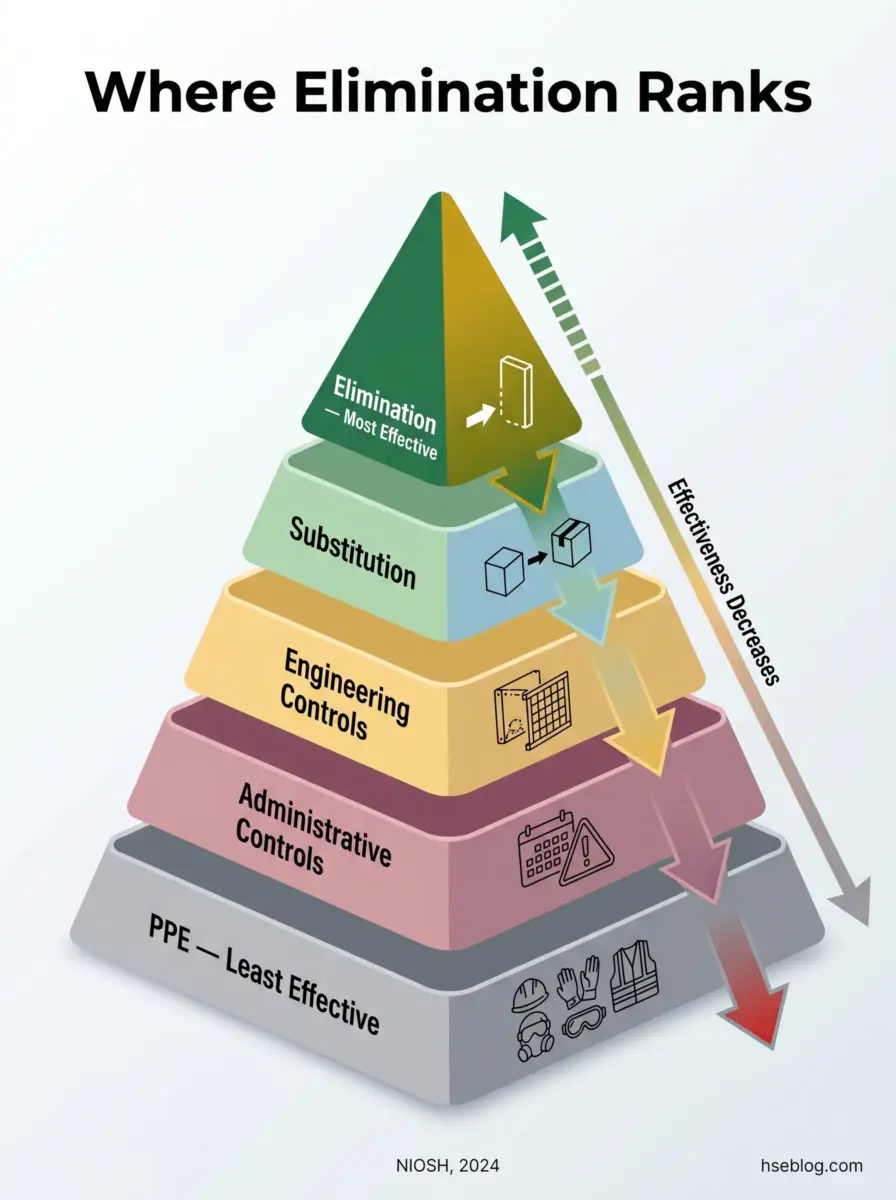
Elimination is the complete physical removal of a hazard so there is nothing left to cause harm. It sits at the top of the five-level hierarchy — elimination, substitution, engineering controls, administrative controls, then PPE — because it removes the hazard rather than managing exposure to it.
That distinction is the spine of the whole topic. Lower controls accept that the hazard exists and work to keep people away from it; elimination ends the question entirely.
The defining traits are consistent across every major framework:
- No hazard, no risk. Protection is intrinsic to the process, not dependent on a control performing correctly day after day.
- Permanent, not conditional. There is no guard to remove, no filter to maintain, no procedure to follow — the source of harm simply isn't there.
- Universal terminology. NIOSH, OSHA, ISO 45001, the UK's HSE, and Canada's CCOHS all use "elimination" for the same top-tier concept.
Here's the line to hold onto: if the hazard still exists but is now harder to reach, you have controlled it, not eliminated it. A guarded blade is still a blade.
Why Elimination Sits at the Top of the Hierarchy
Elimination outranks every other control because it doesn't depend on a human doing anything. The lower you go in the hierarchy, the more the control relies on behaviour, supervision, and maintenance to keep working — and behaviour is where controls fail.
NIOSH groups elimination, substitution, and engineering controls together as the more effective tier precisely because they reduce exposure without significant human interaction — a framing NIOSH reaffirmed when it refreshed its hierarchy guidance (NIOSH/CDC, 2024). PPE sits at the bottom for the opposite reasons: it protects one worker, only when worn correctly, and fails silently when it isn't.
Four reasons elimination beats the lower tiers:
- It runs 24/7 with zero compliance effort. Once the hazard is gone, there is nothing to enforce, audit, or remember.
- It removes the human failure point. No control to bypass, no PPE to forget, no procedure to shortcut under production pressure.
- It strips out downstream cost. No replacement filters, no respirator fit-testing, no health surveillance for an exposure that no longer happens.
- It shifts the burden from the worker to the design. Safety becomes a property of the system, not a daily demand on the person.
The pattern I'd flag here: organisations drift to the bottom of the hierarchy because PPE is cheap and immediate, then keep absorbing the same near-misses year after year — near-misses a single, one-time elimination would have closed permanently.
Elimination vs Substitution: What's the Difference?
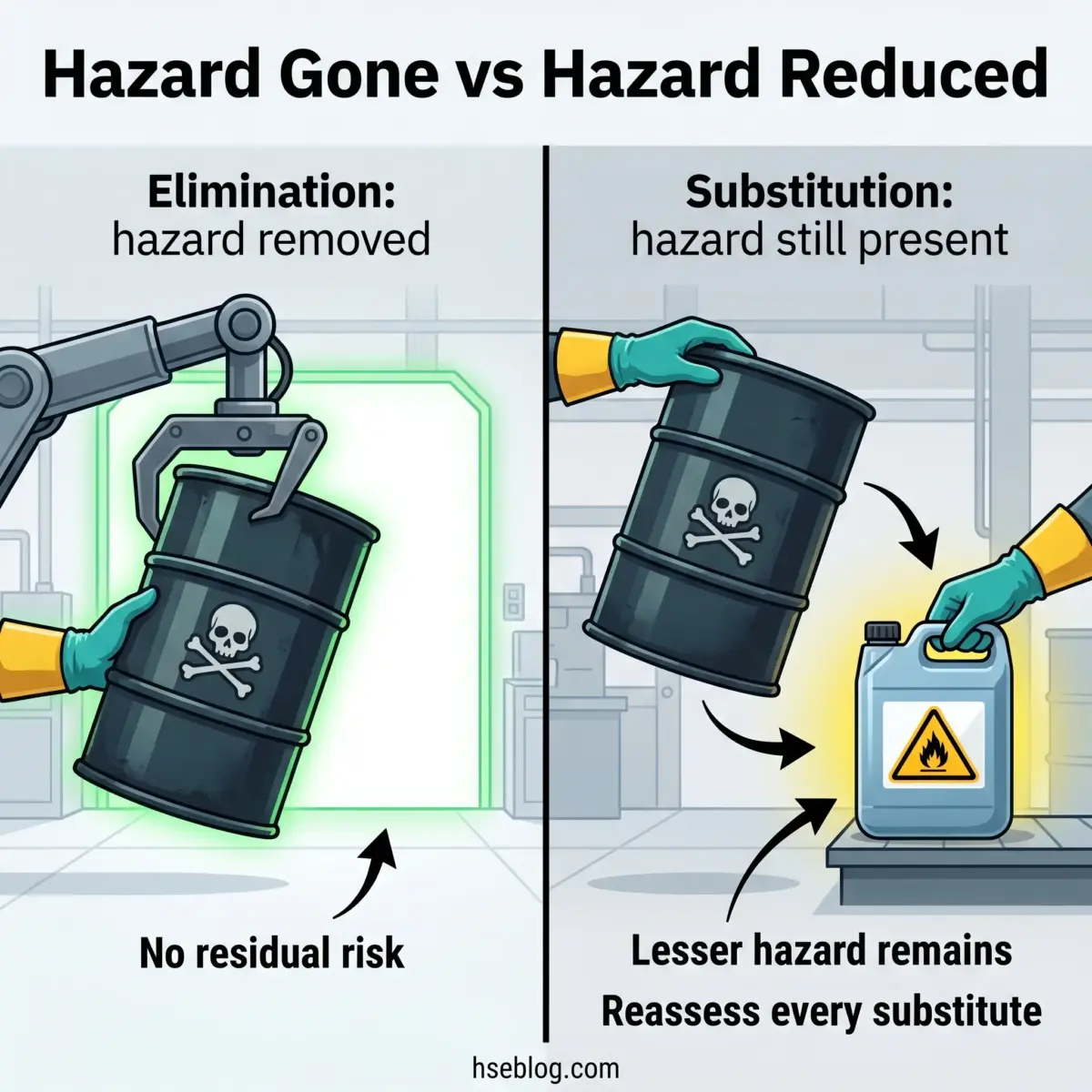
Elimination removes the hazard completely; substitution keeps a hazard but swaps it for a less dangerous one. This is the most-confused boundary in the hierarchy, and getting it wrong inflates how safe an assessment looks on paper.
The clearest test is a single question: after the change, is the original hazard still present in any form?
| Elimination | Substitution | |
|---|---|---|
| What happens to the hazard | Removed entirely — gone | Reduced but still present |
| Is the hazard still there? | No | Yes (a lesser one) |
| Workplace example | Ceasing use of a solvent altogether | Switching to a less toxic solvent |
| Typical failure mode | Hazard quietly reintroduced later | "Regrettable substitution" — the swap brings its own hazard |
Calling a substitution "elimination" on a risk assessment is a frequent audit finding. It overstates residual-risk reduction and misleads the next reviewer, who reads "eliminated" and assumes no further controls are needed for that hazard.
A substitute is never automatically safe, either. The replacement carries its own hazard profile — flammability, a different toxic mechanism, a new disposal route — and must be reassessed from scratch rather than waved through as the "safe option."
Real-World Examples of Hazard Elimination
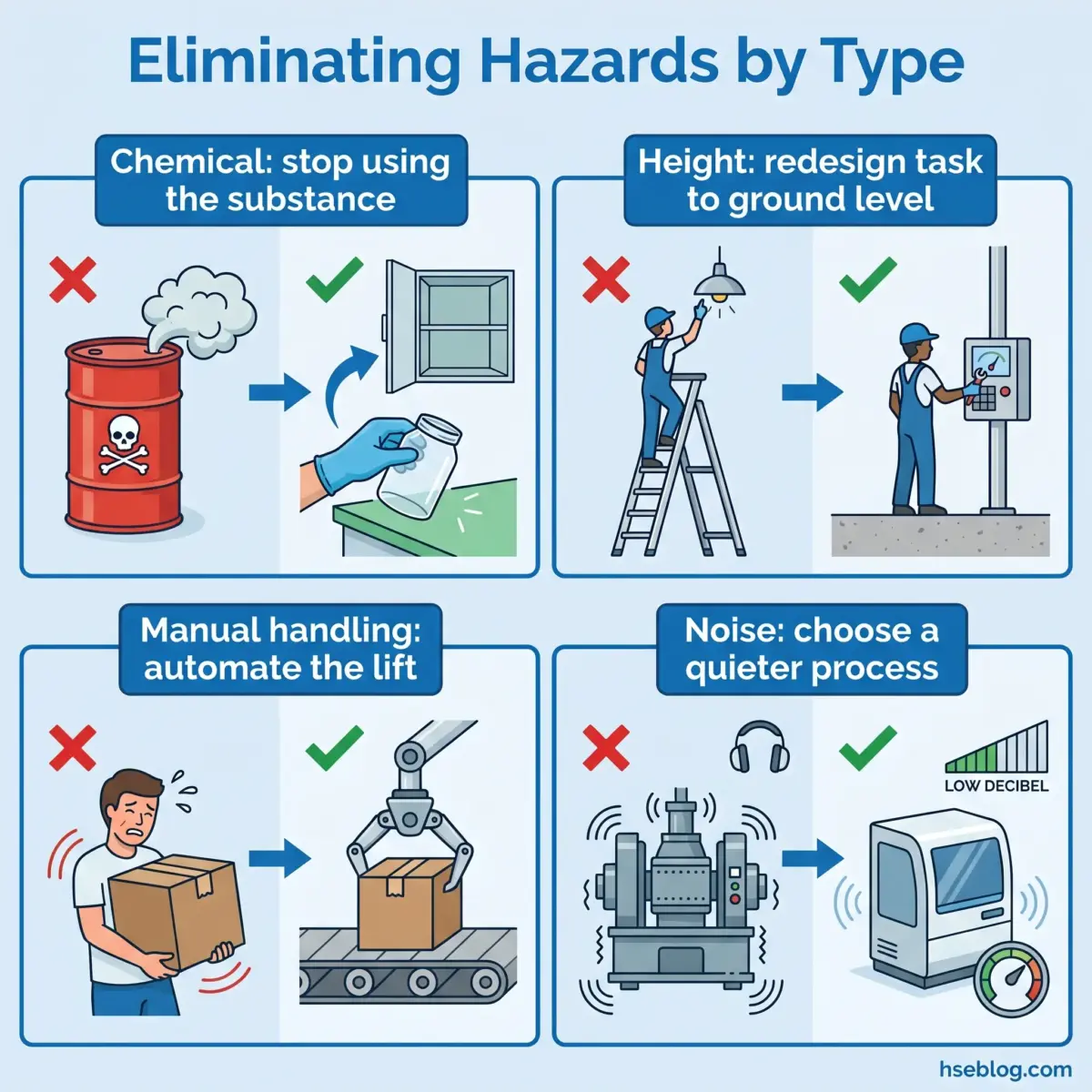
Hazard elimination becomes tangible once you see it applied across different hazard types. In each case below, the test holds: the source of harm is removed, not isolated or reduced.
Process and materials
- Discontinuing a toxic chemical entirely rather than ventilating around it.
- Reformulating a product so a hazardous solvent is no longer part of the recipe.
Work at height
- Redesigning a task to be done at ground level — assembling at grade and lifting the finished unit into place removes the fall hazard instead of arresting it.
Manual handling and ergonomics
- Automating a heavy manual lift with a robotic or mechanical system, so the lifting hazard no longer exists for any worker.
Noise
- Replacing a noisy process or selecting inherently quieter equipment, so the noise source itself is gone — not muffled and not managed with hearing protection.
Asbestos
- Full removal of asbestos-containing material rather than encapsulation. Encapsulation seals the fibres in place but the hazard remains; only removal eliminates it.
The recurring failure across all of these is reintroduction. A hazard is eliminated, then a process tweak or a procurement decision quietly brings it back because no management-of-change check flagged that an elimination was being undone.
When Elimination Is Easiest — and Why Timing Matters
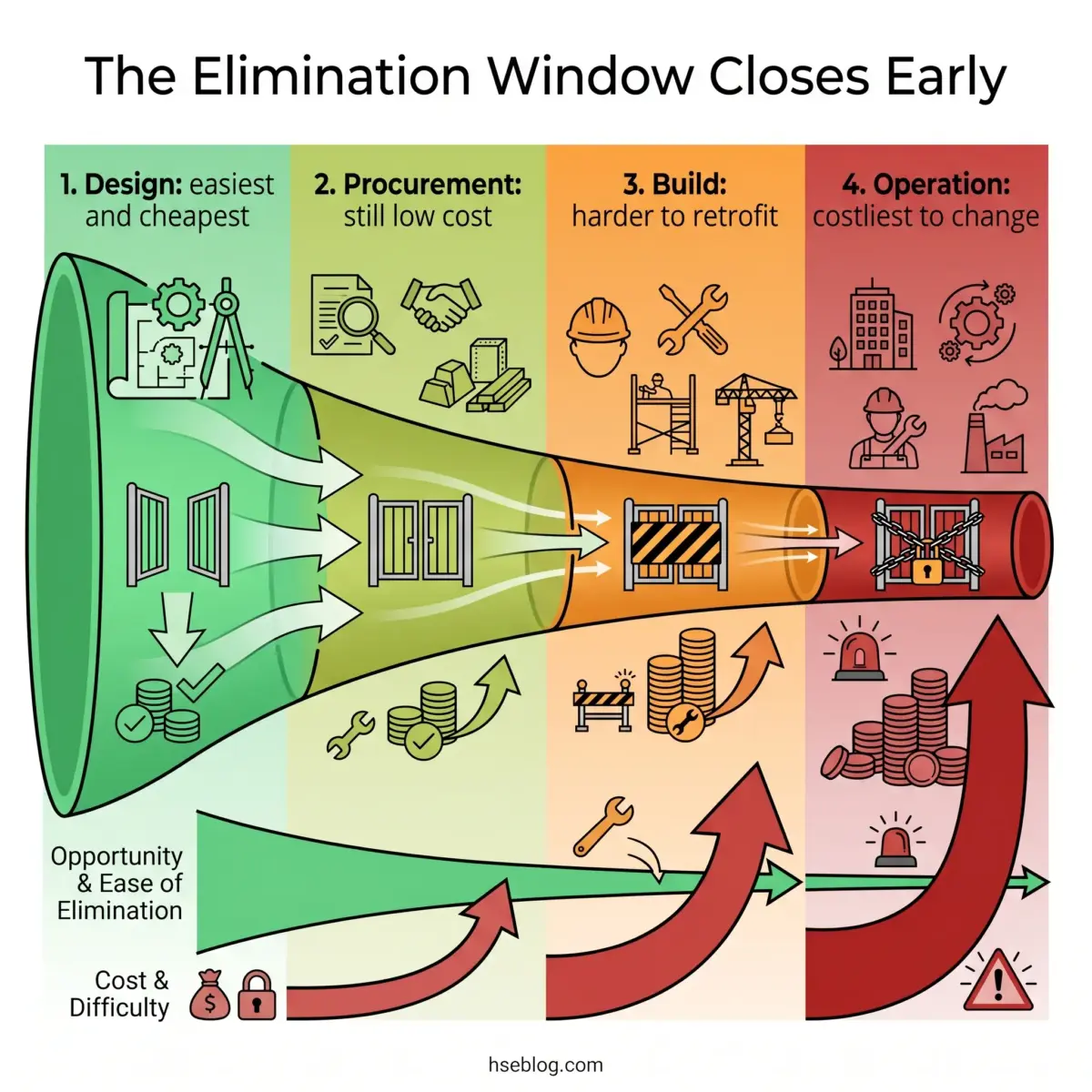
Elimination is cheapest and simplest at the design, procurement, or planning stage — and progressively harder and costlier to retrofit once a process is built and running. NIOSH makes the same point: elimination is easiest to implement when designing or developing a system, before anything is locked in.
This is the principle behind Prevention through Design (PtD), formalised in ANSI/ASSP Z590.3-2021 — designing hazards out before a system exists rather than controlling them after. Once a design reaches the build stage, the cheapest elimination window has usually already closed.
The windows where elimination is genuinely won or lost:
- Design and concept stage. The hazard can be engineered out of existence on paper at near-zero cost.
- Procurement. Specifying inherently safer equipment or materials is an elimination decision disguised as a purchasing one.
- New-equipment selection. Choosing a quieter, lower-energy, or non-hazardous alternative removes the source before it arrives on site.
- Management of change (MoC). Every process modification is a chance to eliminate — and the checkpoint that should catch a hazard being reintroduced.
The pattern worth naming: safety is brought into design reviews too late, after the layout is fixed and the equipment is ordered. By then the practitioner is left negotiating engineering controls and PPE for a hazard that could have been designed out for free months earlier.
The Limits of Elimination: When It Isn't Feasible
Elimination is the goal, not always the outcome. Some hazards are intrinsic to the work — you cannot eliminate the energy in an electrical system you need to operate, or the height of a transmission tower that must be climbed for inspection.
Feasibility governs the decision, and it has to be assessed honestly. The 2025 AIHA white paper reframing the model as a "hierarchy of risk treatment" leans on exactly this point — that practitioners should reason through what removing a hazard actually does to the task, not just default to the top tier as a slogan (AIHA, 2025).
What a feasibility check should weigh:
- Technical possibility. Can the hazard be removed at all without losing the function the work depends on?
- Operational impact. Does removal stop the process doing its essential job, or merely change how it's done?
- New hazards introduced. Does the "elimination" create a different hazard that is as bad or worse?
- Reasonably practicable. Where removal isn't reasonably practicable, you move down the hierarchy — but you document why, not just what you chose instead.
The trap I'd warn against is "set-and-forget." Teams treat an eliminated hazard as permanently solved, drop it from the review cycle, and miss the procurement or process change that quietly reintroduces it years later.
How Elimination Fits Regulatory Duties (US, UK, International)
Elimination isn't only best practice — it's embedded in standards and law, and the obligation is jurisdiction-specific. Most competing explainers default to "OSHA says" and stop there; the actual legal hooks are more precise and stricter in some jurisdictions than others.
Regulatory content here reflects general HSE professional understanding of the cited jurisdictions' requirements as of the last-reviewed date above. It is not legal advice. Specific compliance questions, enforcement situations, or prosecution risk should be directed to qualified legal counsel in the applicable jurisdiction.
| Jurisdiction | Instrument & clause | What it requires |
|---|---|---|
| International | ISO 45001:2018, Clause 8.1.2 | A process to eliminate hazards and reduce risks using the hierarchy, applied top-down starting with elimination |
| US | OSHA Recommended Practices (Hazard Prevention and Control) | Select the most feasible, effective, permanent controls; eliminate serious hazards and apply Prevention through Design |
| UK | COSHH 2002, Regulation 7 | Prevent exposure to hazardous substances — i.e. eliminate — and only apply lower controls where prevention isn't reasonably practicable |
| UK | MHSWR 1999, Schedule 1, Principle 1 | "Avoiding risks" — statutory general principle of prevention, with legal force, placing elimination first |
The strictest framing should govern your practice. Where the UK's HSE good-control-practice guidance under COSHH and the legally binding MHSWR principles demand that prevention be considered first, that bar is higher than a general "select feasible controls" instruction — so default to it. The international anchor is ISO 45001:2018 clause 8.1.2, and the US duty is set out in OSHA's hazard prevention guidance.
In practice, when an inspector or auditor challenges a risk assessment, they're usually challenging whether elimination and substitution were genuinely considered before the team jumped to PPE. A PPE-first assessment can fail the legal test even when the PPE itself is perfectly adequate, because the duty was to try to remove the hazard first.
Does the Hierarchy Always Have Five Levels?
Not always — but elimination is always first. The level count is presentation, not substance:
- Canada (CSA Z1002) inserts an "awareness systems" layer between engineering and administrative controls.
- Some UK presentations add a "reduce" layer alongside the standard tiers.
Whatever the count, elimination remains the top, most-effective action in every recognised version of the model.
How to Apply Elimination in a Risk Assessment
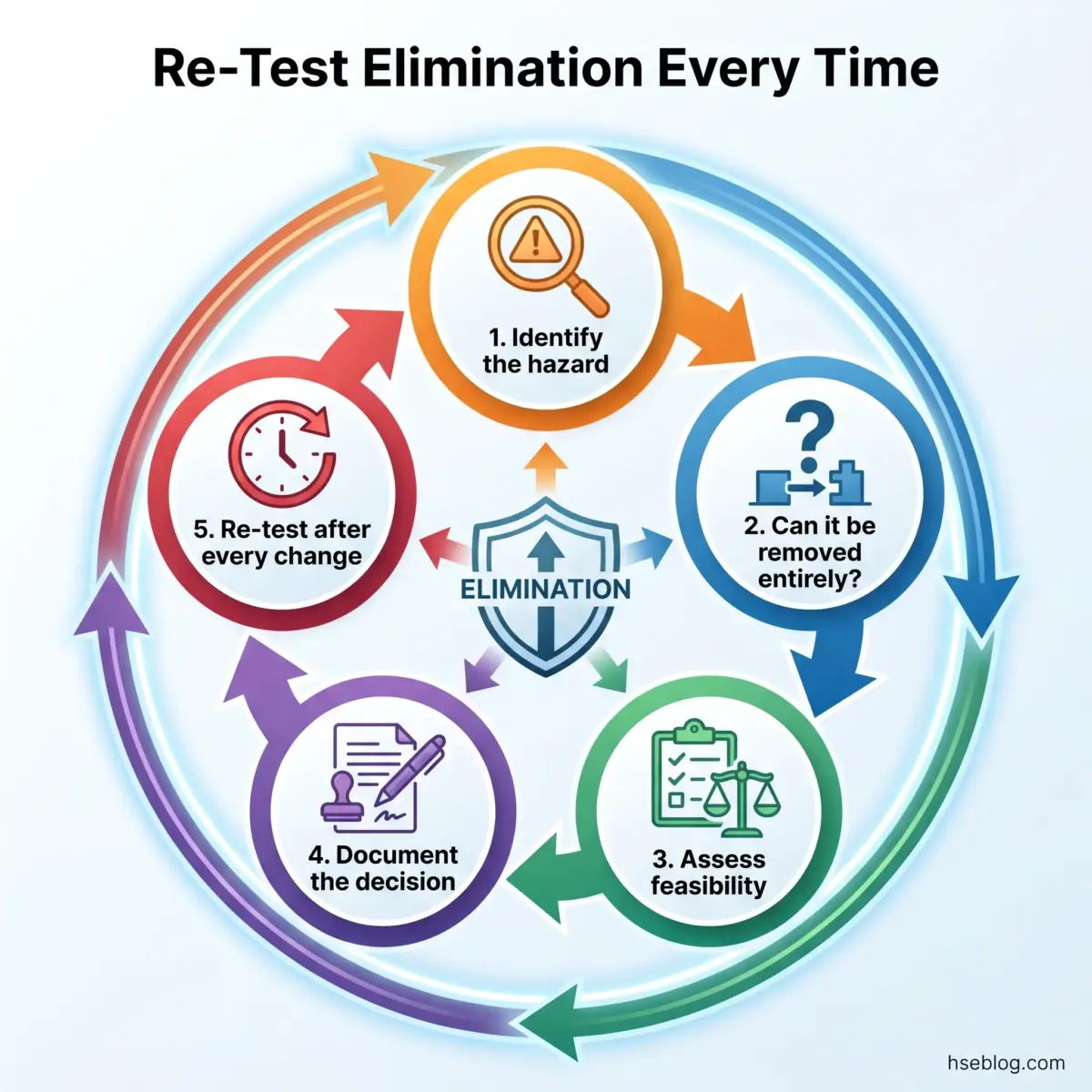
In a risk assessment or job hazard analysis, elimination is the first control you test — before you reach for anything lower. The discipline is to ask the elimination question explicitly and to record your reasoning when the answer is no.
The workflow:
- Identify the hazard precisely. Name the actual source of harm, not the activity around it.
- Ask the elimination question first. "Can this hazard be removed entirely?" — before considering substitution, guarding, or PPE.
- Assess feasibility honestly. Test technical possibility, operational impact, and whether removal introduces a new hazard.
- Record why elimination was rejected. If it isn't reasonably practicable, document that reasoning — not just the control you settled on instead.
- Re-test at every review and change. Revisit elimination after any process modification, equipment swap, or procurement decision through your MoC process.
The documentation gap is where most assessments fall short. Teams record the control they chose but not why elimination was rejected — and that rejection rationale is exactly what an auditor, or a post-incident investigation, goes looking for first.
Frequently Asked Questions
Is elimination always the best control measure?
In principle, yes — it's the most effective because it removes the hazard for everyone, permanently. In practice it isn't always feasible. Some hazards are intrinsic to the work and can't be removed without losing an essential function, and a poorly chosen removal can introduce a new hazard. The goal is to attempt elimination first, then move down the hierarchy when it isn't reasonably practicable.
What's the difference between elimination and engineering controls?
Elimination removes the hazard so it no longer exists; engineering controls isolate workers from a hazard that's still present. Guarding, ventilation, and enclosures are engineering controls — the danger remains, but a barrier reduces contact with it. This is a different boundary from elimination versus substitution and a frequent point of confusion among trainees.
Why is PPE the least effective if elimination is the most effective?
PPE protects only one worker, only when worn and fitted correctly, and it fails silently when it isn't. It depends entirely on human behaviour and ongoing supervision. Elimination removes the hazard for everyone at once and needs no daily compliance to keep working — which is why NIOSH places source-level controls above PPE.
Can you combine elimination with other controls?
Yes. Controls are layered, not mutually exclusive. You might partially eliminate a hazard and apply lower-tier controls to whatever residual risk remains. For instance, eliminating one hazardous step in a process while using engineering controls and PPE for the steps that can't yet be removed is common and entirely appropriate.
Is hazard elimination legally required?
It depends on the jurisdiction. Under UK COSHH Regulation 7 and the MHSWR 1999 general principles of prevention, duty-holders must prevent or eliminate exposure first where reasonably practicable. OSHA's recommended practices and ISO 45001:2018 clause 8.1.2 also prioritise elimination. Verify the exact duty against your own jurisdiction.
Does removing PPE count as eliminating a hazard?
No. Removing PPE removes a control, not the hazard. The source of harm is untouched and now less protected. This is a common beginner misconception — elimination acts on the hazard itself, never on the safeguards layered around it.
Conclusion
The thing the industry gets wrong about elimination isn't the definition — it's the labelling. Guards get recorded as elimination, substitutions get filed as elimination, and assessments end up overstating how much risk has actually been removed. The hazard is still there in every one of those cases, just dressed differently on paper.
If there's a single highest-impact change, it's this: ask the elimination question first, out loud, on every assessment — and write down the answer when it's no. The cost of elimination is decided at the design and procurement stage, long before the work starts, so the practitioners who win on this are the ones in the room early enough to design the hazard out rather than negotiate controls around it later.
Treat elimination in the hierarchy of control as a live question, not a closed box. Re-test it after every process change and procurement decision, because the hazard you eliminated last year is exactly the one a quiet change can bring back while no one's watching.