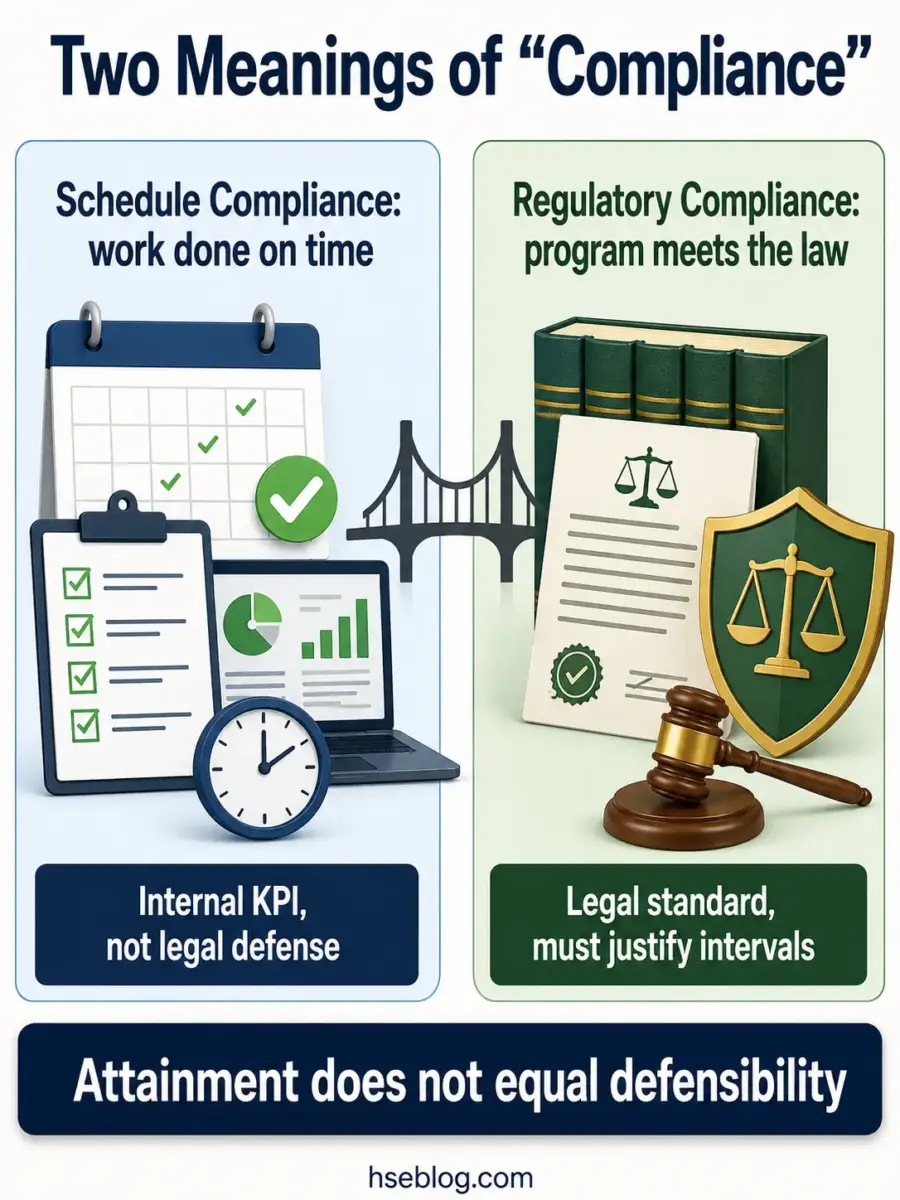
An equipment maintenance schedule sets when, how often, and by whom maintenance tasks are performed. Compliance has two meanings: schedule compliance (whether planned work finished on time) and regulatory compliance (whether the program meets the law). High schedule attainment does not prove legal compliance — a defensible schedule must satisfy the applicable standard and justify its intervals.
Most maintenance-scheduling guidance treats the law as a single passing line. Yet under OSHA's General Duty Clause, an employer can be cited for the consequences of unmaintained equipment even where no specific inspection interval is written anywhere in the standard. The absence of a prescribed interval is not the absence of a duty — and that gap is exactly where well-run programs still fail an audit.
This article covers both halves the title names: how to build an equipment maintenance schedule, and the regulatory compliance requirements that schedule is judged against. The stakes are concrete — up to $16,550 per serious violation and up to $165,514 per willful or repeated violation (US OSHA, 2025) — and the legal logic differs sharply between the US and UK regimes. Get the planning right but misread the compliance architecture, and a tidy CMMS dashboard becomes a liability rather than a defense.
Not legal advice. Regulatory content here reflects general HSE professional understanding of US (OSHA) and UK (HSE) requirements as of 2025. It is not legal advice. Specific compliance questions, enforcement situations, or prosecution risk should be directed to qualified legal counsel in the applicable jurisdiction. Regulatory content was last reviewed in [Month YYYY — to be filled at publish].
What Is an Equipment Maintenance Schedule — and Why "Compliance" Means Two Things
An equipment maintenance schedule is the operational layer that assigns who does which maintenance task when — sitting underneath the broader equipment maintenance plan, which defines what gets maintained and how. The plan is strategy; the schedule is the calendar that executes it.
The word "compliance" then splits into two meanings that most content quietly merges:
- Schedule compliance (attainment). Did planned work get completed in the planned window? It is an internal KPI for backlog control and reliability — useful, but it is not a legal defense.
- Regulatory compliance. Does the program satisfy the legal standard for the jurisdiction and the equipment? This is the test a regulator or auditor actually applies.
Definition callout: Schedule attainment tells you whether you finished the tasks you scheduled. Regulatory compliance tells you whether you scheduled the right tasks in the first place. They answer different questions.
A consistent failure mode in audit findings illustrates the gap. A site reports strong schedule attainment — often quoted in the 90%+ range — and treats that as proof of a healthy program.
The auditor then asks a different question: were the legally required tasks even in the schedule, and can you justify their intervals? When the metric measured completion of the wrong task set rather than coverage of the required one, high attainment becomes evidence of confident non-compliance, not safety.
Types of Maintenance Schedules: Time-Based, Usage-Based, and Condition-Based
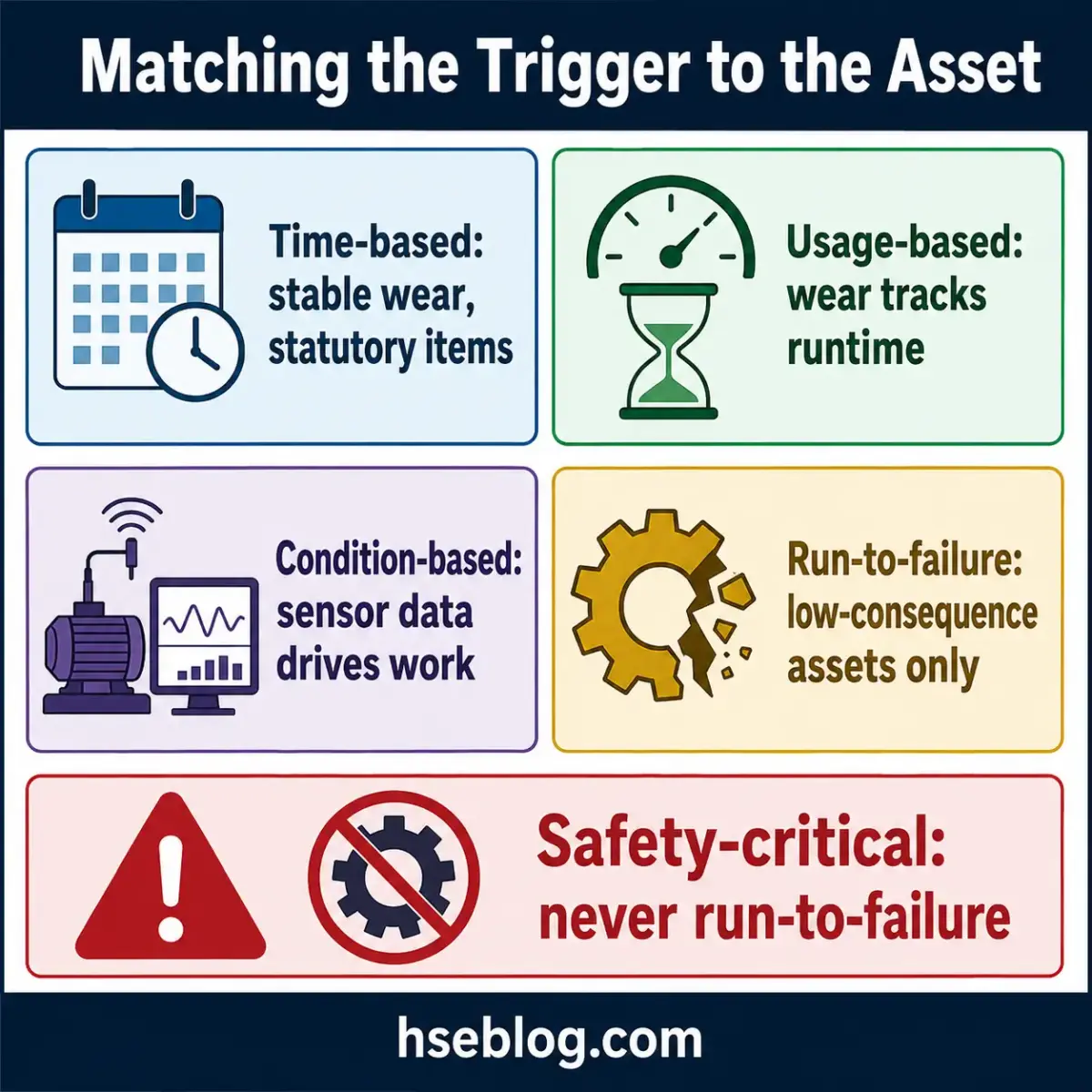
Three triggers drive almost every scheduled maintenance program, and the right one for a given asset is set by its risk profile — not by which method sounds most advanced. The time-based vs usage-based vs condition-based maintenance choice is a compliance decision as much as a reliability one.
Each trigger carries its own defensibility and its own characteristic failure mode:
| Scheduling trigger | Best-fit asset | Compliance strength | Typical failure mode |
|---|---|---|---|
| Time-based (calendar interval) | Statutory items, stable-wear assets | Strong — easy to evidence and audit | Over- or under-maintains when duty cycle varies |
| Usage-based (runtime hours/cycles) | Assets wearing with use (compressors, vehicles) | Strong — if meters are reliable and recorded | Fails silently when meter data is missing or wrong |
| Condition-based / predictive | High-value rotating equipment with sensor data | Strong — once data maturity exists | Adopted for prestige assets while safety items languish |
| Reactive / run-to-failure | Low-consequence, non-safety-critical items only | Defensible only for trivial-consequence assets | Misapplied to equipment with a safety function |
Run-to-failure is legitimate — but only where failure carries no safety exposure and no statutory duty. The moment an asset has a guarding, isolation, or lifting function, run-to-failure stops being a strategy and becomes a finding waiting to happen.
A pattern worth flagging from reviewing maintenance programs: teams invest in condition-based monitoring for the visible "prestige" machinery, then leave safety-critical guarding and energy-isolation checks on a neglected calendar trigger nobody owns. That inverts the risk priority — the most consequential tasks end up on the weakest schedule.
How to Build a Maintenance Schedule: A Criticality-First Method
A defensible equipment maintenance schedule is built criticality-first, not inventory-first. Starting with a list of assets produces a schedule that treats a guard interlock and a breakroom microwave with the same weight; starting with risk produces one an auditor can follow.
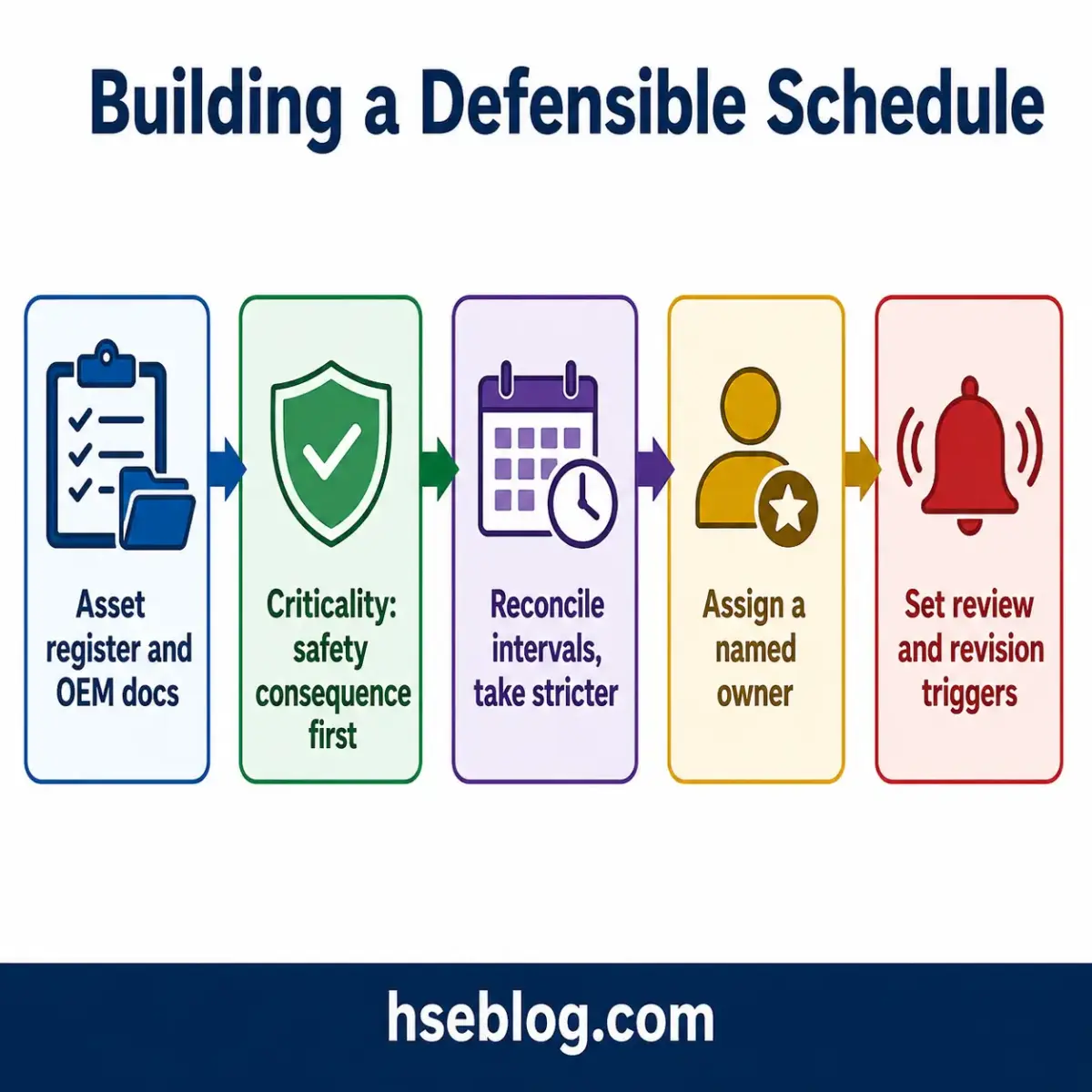
Build the schedule in this order:
- Assemble the asset register and equipment documentation. Capture OEM manuals and recommended intervals — but record them as a starting floor, not the final answer.
- Run a criticality / risk assessment. Weight safety consequence first, then statutory exposure, then production impact. A microwave's failure is an inconvenience; a guard's failure can be a fatality.
- Set intervals by reconciling three sources. OEM guidance, the regulatory minimum, and condition data — defaulting to the stricter requirement for that hazard.
- Assign a named, accountable schedule owner. "The maintenance department" is not accountability. A person is.
- Define a review cadence and revision triggers. Schedule a planned review, and list the events (a failure, a modification, a near miss, a standard revision) that force an off-cycle update.
This sequence is the "planning and scheduling" discipline competitors handle well — the criticality-first ordering is what makes it legally defensible rather than merely organized.
The recurring weakness here is mechanical: OEM intervals are copied verbatim into the CMMS and never reconciled against the real operating environment. Duty cycle, contamination, ambient temperature, and load all move the true wear curve — and closing that gap between manual and reality is precisely what NFPA 70B's 2023 edition now expects organizations to document.
Setting Maintenance Intervals: OEM Guidance vs Regulatory Minimums vs Risk
When three interval sources disagree, the legally required minimum is a floor the schedule cannot drop below — full stop. From there the judgment call is between three inputs that rarely align:
| Interval source | Role in the decision | Governing principle |
|---|---|---|
| OEM recommendation | Baseline reference | A floor reflecting average use — not your duty cycle |
| Regulatory minimum | Hard limit | The schedule may go shorter, never longer |
| Condition/risk data | Adjustment factor | Tightens the interval where wear runs ahead of plan |
Two reconciliation rules resolve most conflicts. NFPA 70B interval tables provide guidance but do not supersede manufacturer instructions; and for lifting equipment, LOLER's fixed statutory intervals override any longer interval an internal program would prefer. Where sources clash, the stricter requirement for that specific hazard governs.
The Compliance Half: What the Law Actually Requires (US vs UK)
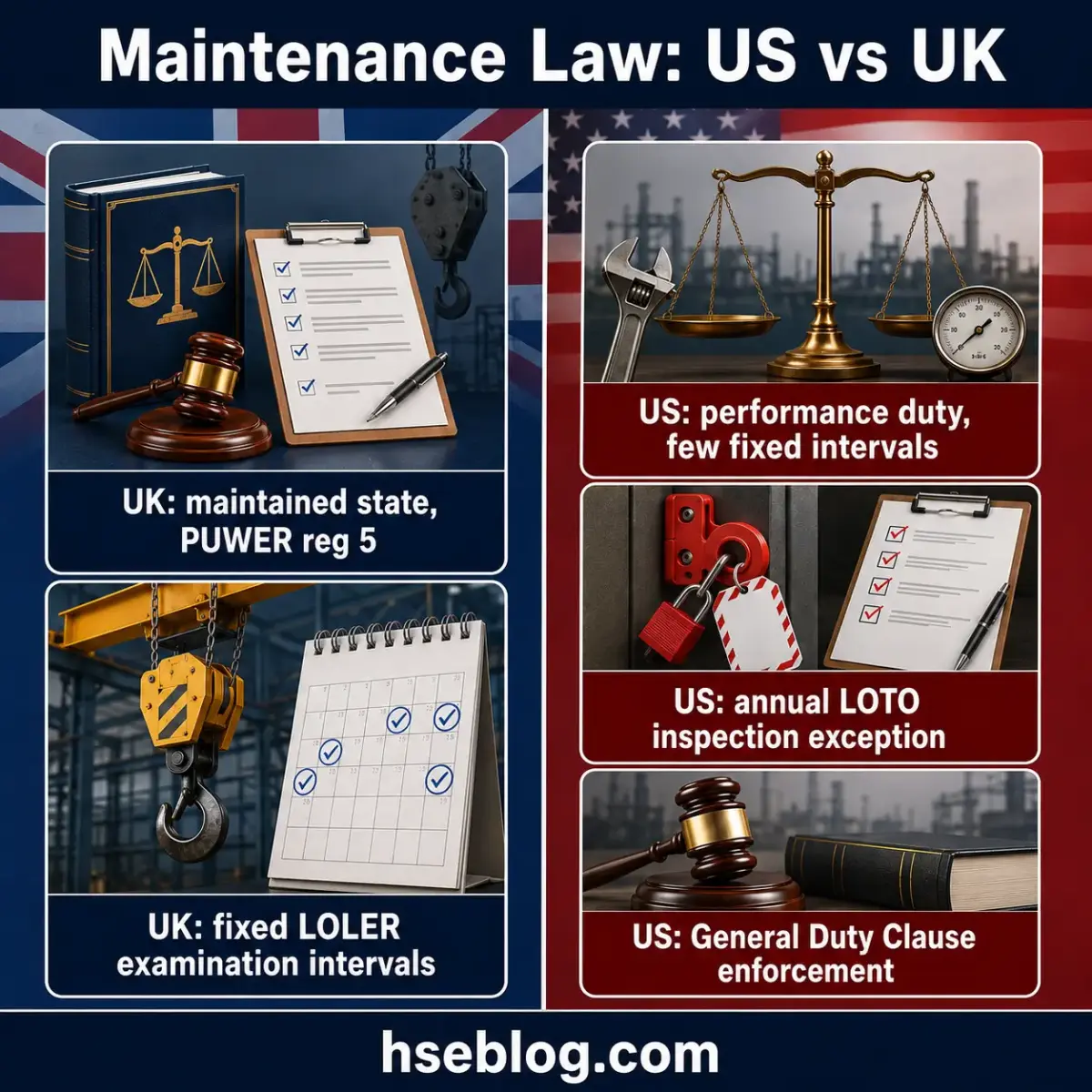
The same maintenance task carries fundamentally different legal logic depending on jurisdiction — and conflating the two regimes is where multi-site programs come undone. UK law prescribes a maintained state plus fixed inspection intervals; US law imposes a performance duty with few fixed intervals, enforced through the General Duty Clause and incorporated standards.
In the UK, the duties are explicit. Under PUWER 1998, Regulation 5 requires work equipment to be maintained in an efficient state, in efficient working order, and in good repair; Regulation 6 requires inspection at suitable intervals by a competent person, with records kept. For lifting equipment, LOLER 1998 Regulation 9 adds thorough examination at fixed statutory intervals — at least every 6 months for equipment used to lift people, at least every 12 months for other lifting equipment.
In the US, the architecture is performance-based. OSHA rarely sets a universal inspection interval — the duty-holder builds a hazard-matched program — with one notable fixed exception: 29 CFR 1910.147(c)(6) requires the energy-control procedure to be inspected at least annually and certified.
| United Kingdom (HSE) | United States (OSHA) | |
|---|---|---|
| What the law requires | Maintained state under PUWER reg 5; inspection at suitable intervals under reg 6; LOLER thorough examination for lifting gear | Performance duty to control recognized hazards; few prescribed intervals |
| Inspection interval logic | Fixed statutory intervals (LOLER) plus risk-based "suitable intervals" (PUWER) | Risk-based and employer-set; fixed annual LOTO inspection is the exception |
| Primary enforcement hook | PUWER/LOLER duties enforced directly | General Duty Clause 5(a)(1); 1910.303(b)(1) for electrical; incorporated standards |
The misreading I see most often in US-based teams is "OSHA doesn't require a PM program, so we're fine." OSHA does not prescribe the interval — but it cites the consequences of unmaintained equipment under Section 5(a)(1) of the OSH Act and under standards like 1910.303(b)(1), which requires electrical equipment to be kept in safe condition. No prescribed interval is not the same as no duty.
Maintenance vs Inspection vs Thorough Examination — Not Interchangeable
These three activities are legally distinct, and mislabeling them in your records is itself an audit finding. Naming matters because a regulator reads your records as evidence of what you actually did.
- Maintenance — the work that keeps equipment in a safe, working state (servicing, repair, replacement).
- Inspection — a check at suitable intervals to detect deterioration before it becomes dangerous; under PUWER, by a competent person, recorded.
- Thorough examination — the specific, more rigorous statutory examination LOLER requires for lifting equipment, often by an independent competent person.
A record that logs a quick visual check as a "thorough examination," or files a repair as an "inspection," misrepresents the program even when the underlying work was sound. Auditors notice the mismatch immediately.
Maintenance During Servicing: Where the Schedule Becomes Life-Critical
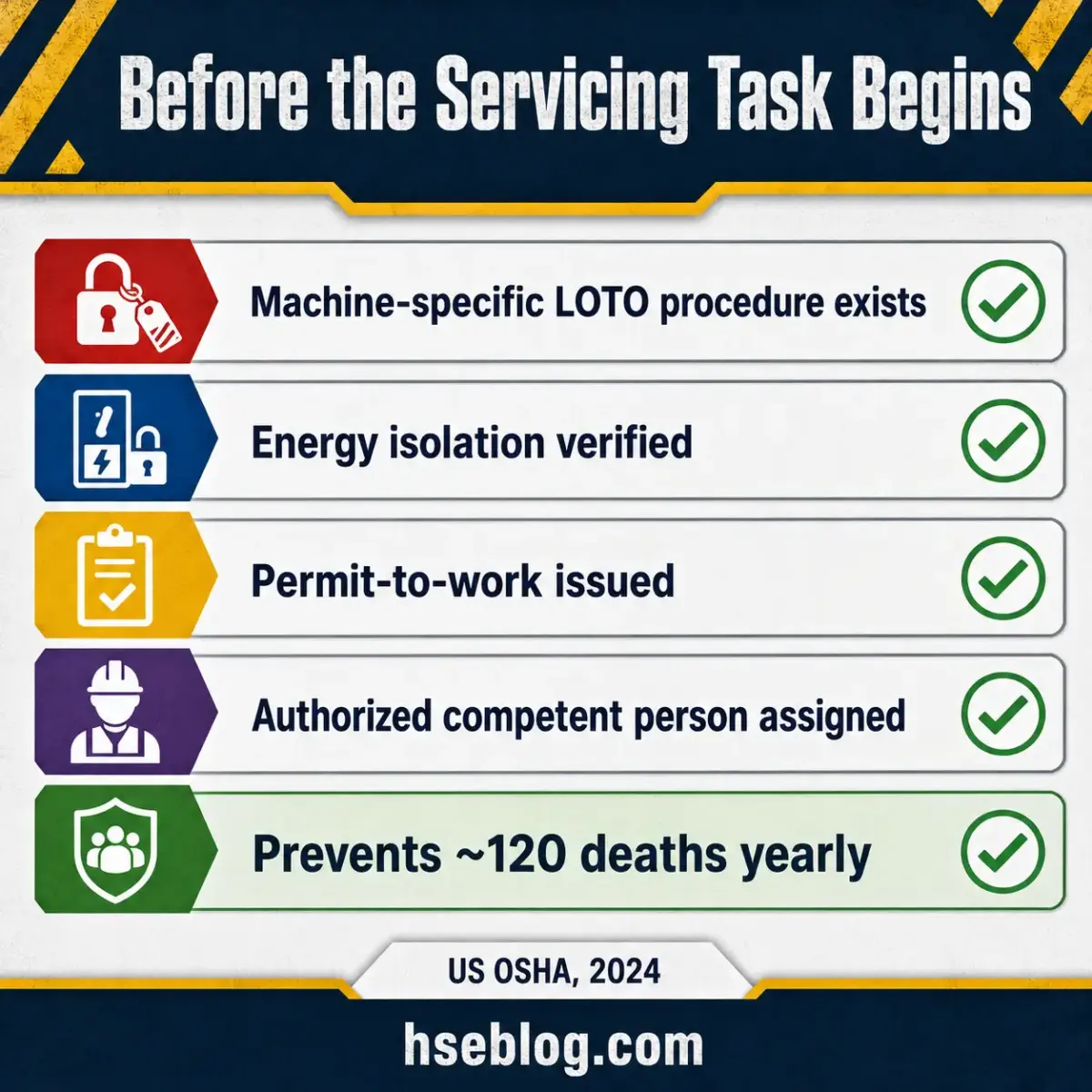
The act of maintaining equipment is itself one of the highest-risk moments in the operation — unexpected energization, stored energy release, and exposed moving parts converge precisely when guards are off and the maintainer is closest. A schedule that books the PM task but not the isolation procedure has scheduled the danger and forgotten the protection.
Competent-person caveat. This article provides general HSE knowledge. Life-critical work such as energy isolation, lockout/tagout, and servicing of energized equipment must be planned and supervised by a competent person with relevant training, jurisdiction-specific authorization, and a site-specific risk assessment. The information here is awareness-level and does not replace that.
The enforcement record shows why this matters. Lockout/tagout under 29 CFR 1910.147 drew 2,443 citations and ranked #5 on OSHA's most-cited list — roughly a 24% jump over the prior year (US OSHA, 2025), and machine guarding under 1910.212 added 1,541 citations at #10 (US OSHA, 2025). Compliant energy control is estimated to prevent around 120 fatalities and 50,000 injuries each year (US OSHA, 2024).
Three dependencies make servicing safe, and each belongs in the schedule rather than alongside it:
- Lockout/tagout (LOTO). 29 CFR 1910.147 protects the maintainer during servicing and requires the annual certified periodic inspection of each energy-control procedure.
- Machine guarding interaction. Maintenance access often means removing guards; the procedure must define how the machine is rendered safe before that happens.
- Permit-to-work and isolation. These are schedule dependencies, not afterthoughts — the PM task should not open until isolation is confirmed.
The single most-cited LOTO gap follows a predictable shape: a generic, site-wide lockout policy exists, but machine-specific energy-control procedures do not. The schedule books the maintenance, the policy looks complete on paper, and the one document that protects the person at the machine — the procedure for that machine — is missing.
For teams formalizing this, recognized training pathways (OSHA outreach in the US; NEBOSH and IOSH internationally) define what "competent" means for authorized and affected persons. Scheduling the task is not the same as authorizing the person.
Audit-Readiness: Making the Schedule Defensible, Not Just Complete
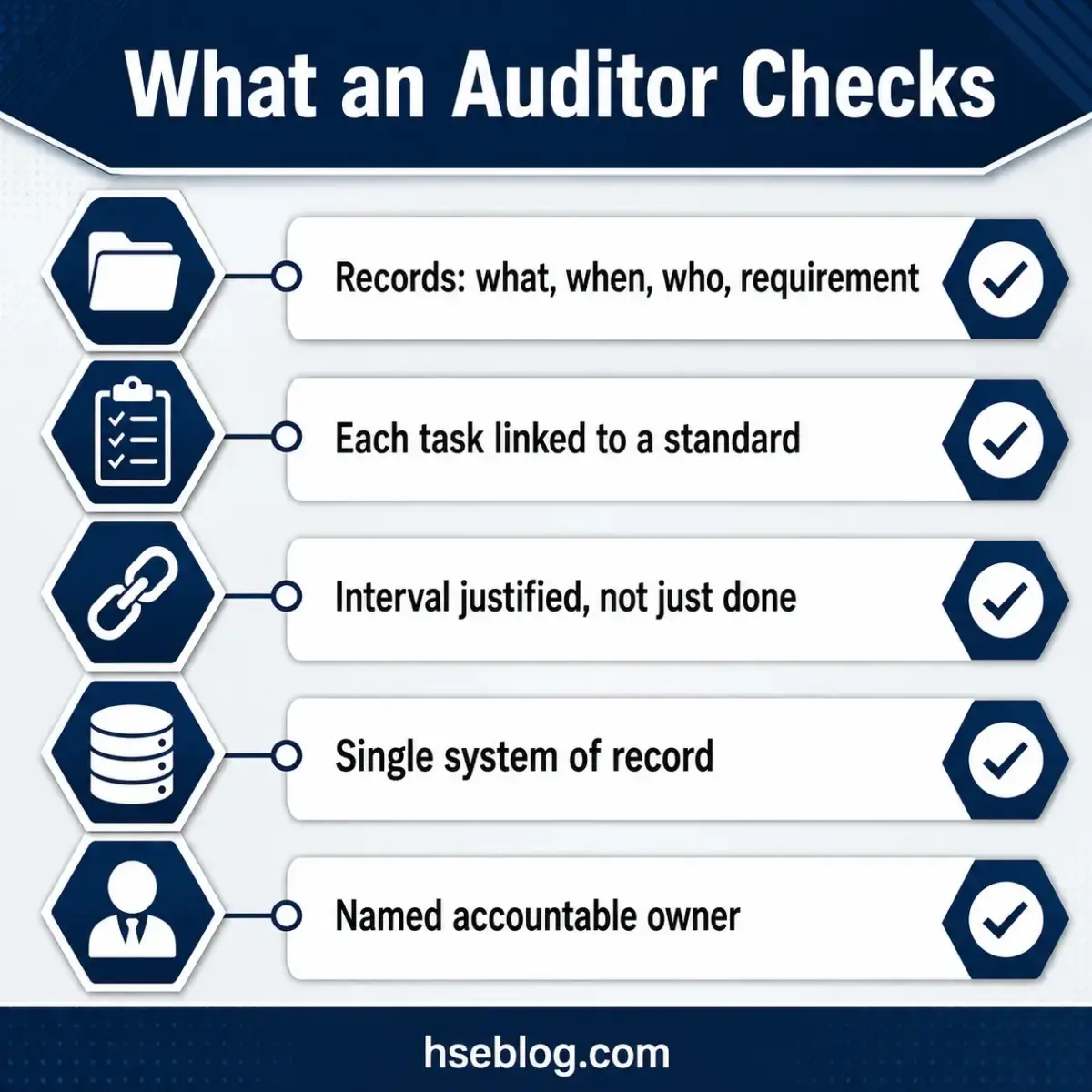
Auditors probe the justification for an interval far more than the completion rate — a program that cannot explain why a task sits at 12 months rather than 6 is exposed even at 100% attainment. Defensibility, not attainment, is what survives an inspection.
What an inspector or auditor actually checks breaks down into a clear set of evidence:
- Records with the four W's. What was done, when, by whom, and against which requirement — every task, traceable.
- Compliance notes linking task to requirement. Each task tied to the standard, OEM instruction, or risk assessment that justifies it.
- Interval justification, not just completion. Documented reasoning for why the interval is what it is, drawn from condition data, criticality, and the regulatory floor.
- A single system of record. One CMMS or controlled register — not maintenance evidence scattered across spreadsheets, emails, and a technician's notebook.
- Named accountability. A schedule owner who can stand behind the program when questioned.
The contrast that defines audit-readiness is simple. A complete schedule proves you finished tasks; a defensible schedule proves you scheduled the right tasks, for sound reasons, and can show your working. Only the second one holds up when a regulator is asking the questions.
Standards Beyond the Minimum: NFPA 70B, ISO 55001, and Industry Benchmarks
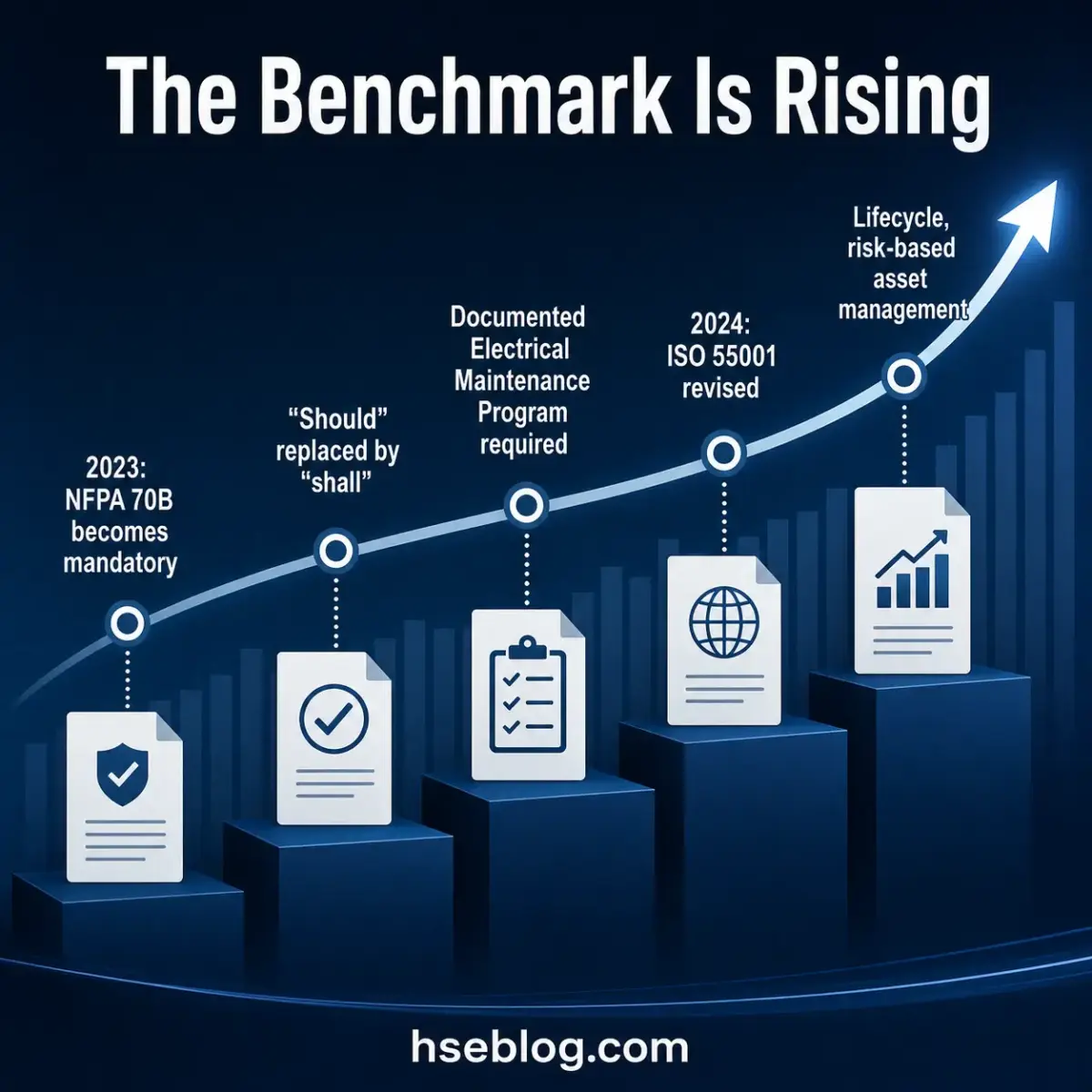
Two standards now set the benchmark regulators increasingly measure programs against — and exceeding the legal floor is what reduces enforcement and liability exposure. A program built only to the statutory minimum is compliant; a program built to these standards is defensible and resilient.
NFPA 70B (2023): from "should" to "shall"
The quiet change with the biggest practical reach is NFPA 70B's 2023 conversion from a Recommended Practice to a Standard — "should" became "shall." Equipment owners are now expected to implement and document a formal Electrical Maintenance Program, with a primary equipment list, a records policy, and intervals tied to condition, criticality, and operating environment.
NFPA 70B is not itself a law, but OSHA references it as the industry benchmark, and Authorities Having Jurisdiction adopt it. The shift converted a best practice many facilities skipped into a documented obligation an auditor can now hold them to — a change still missing from most maintenance-scheduling content.
ISO 55001:2024: the asset-management benchmark
ISO 55001:2024 revised the asset-management-system standard to the Harmonized Structure and made lifecycle management explicit within operational planning and control. It specifies requirements for establishing, maintaining, and improving an asset management system with risk-based decision-making across the full asset lifecycle.
For multi-site organizations, ISO 55001 is the framework that makes the parallel-jurisdiction picture coherent — one risk-based management system under which both PUWER duties and OSHA performance obligations can sit. The EU's Use of Work Equipment Directive 2009/104/EC sets the equivalent baseline for member states, mirroring the UK's maintained-state logic.
Where the standards exceed the law
The benchmark standards demand documentation and justification the bare legal floor does not. That is the point: an Electrical Maintenance Program documented to NFPA 70B, inside an ISO 55001 management system, answers the auditor's "why this interval?" before it is asked.
Frequently Asked Questions
Does OSHA require a preventive maintenance program?
No single OSHA standard mandates a formal preventive maintenance program for general industry. But OSHA cites unmaintained equipment that creates a recognized hazard under the General Duty Clause, Section 5(a)(1), and under specific standards like 1910.303(b)(1) for electrical equipment. The absence of a prescribed interval does not remove the underlying legal duty to control the hazard.
How often must equipment be inspected by law in the UK?
It depends on the equipment. PUWER 1998 reg 6 sets inspection at "suitable intervals" determined by risk, not a fixed number. LOLER 1998 reg 9, however, sets fixed statutory intervals for lifting equipment — at least every 6 months for equipment used to lift people and at least every 12 months for other lifting equipment, or per a written examination scheme.
What is the difference between schedule compliance and regulatory compliance?
Schedule compliance (attainment) is an internal KPI measuring whether planned work was completed on time. Regulatory compliance is a legal standard measuring whether the program satisfies the law for that jurisdiction and equipment. High attainment does not prove legal defensibility — you can complete the wrong tasks on time and still fail an audit on coverage and interval justification.
Is NFPA 70B mandatory now?
The 2023 edition became a Standard, replacing recommended "should" language with mandatory "shall" language, including a requirement for a documented Electrical Maintenance Program. NFPA 70B is not itself a law, but it becomes enforceable through OSHA references and adoption by the Authority Having Jurisdiction. In practice, auditors increasingly treat it as the benchmark for electrical maintenance programs.
Who counts as a "competent person" for maintenance inspections?
A competent person is defined by demonstrable training, knowledge, and experience specific to the equipment being inspected — not by job title. The role is defined by capability, and its exact requirements vary by jurisdiction and by the standard in play. Under PUWER and LOLER, for example, the competent person must be able to detect defects and judge their significance independently.
What records prove maintenance compliance in an audit?
An auditor expects records showing the task performed, the date, the person who did it, and the requirement it satisfied — plus the justification for the chosen interval. Keep this in a single system of record rather than scattered spreadsheets or email. Completion alone is not enough; the program must show why each interval was set as it was.
Conclusion
Pull up your own equipment maintenance schedule and ask the question an auditor will: not "what's our attainment percentage?" but "can we explain why every safety-critical interval is set where it is?" If the honest answer is that the OEM number was copied into the CMMS and never reconciled against duty cycle, contamination, or the regulatory floor, the program is exposed regardless of how green the dashboard looks.
The harder test is jurisdictional honesty. A US team leaning on "OSHA doesn't require a PM program" and a UK team treating PUWER's "suitable intervals" as a formality are making the same mistake from opposite directions — mistaking the shape of the duty for its absence. Run the two regimes in parallel, default to the stricter source, and book the isolation procedure in the same breath as the maintenance task.
The uncomfortable question to sit with this week: if a regulator walked your floor tomorrow, would your equipment maintenance schedule read as a defense — or as a confession that you measured the wrong thing well? Closing that gap is the whole job.