Whole body vibration is mechanical vibration transmitted through a seat or the feet into the body, mainly affecting drivers of off-road mobile plant. Long-term exposure is most strongly associated with low back pain and spinal degeneration, while short-term effects include fatigue, headache, and loss of balance. UK and EU law sets a daily exposure action value of 0.5 m/s² A(8).
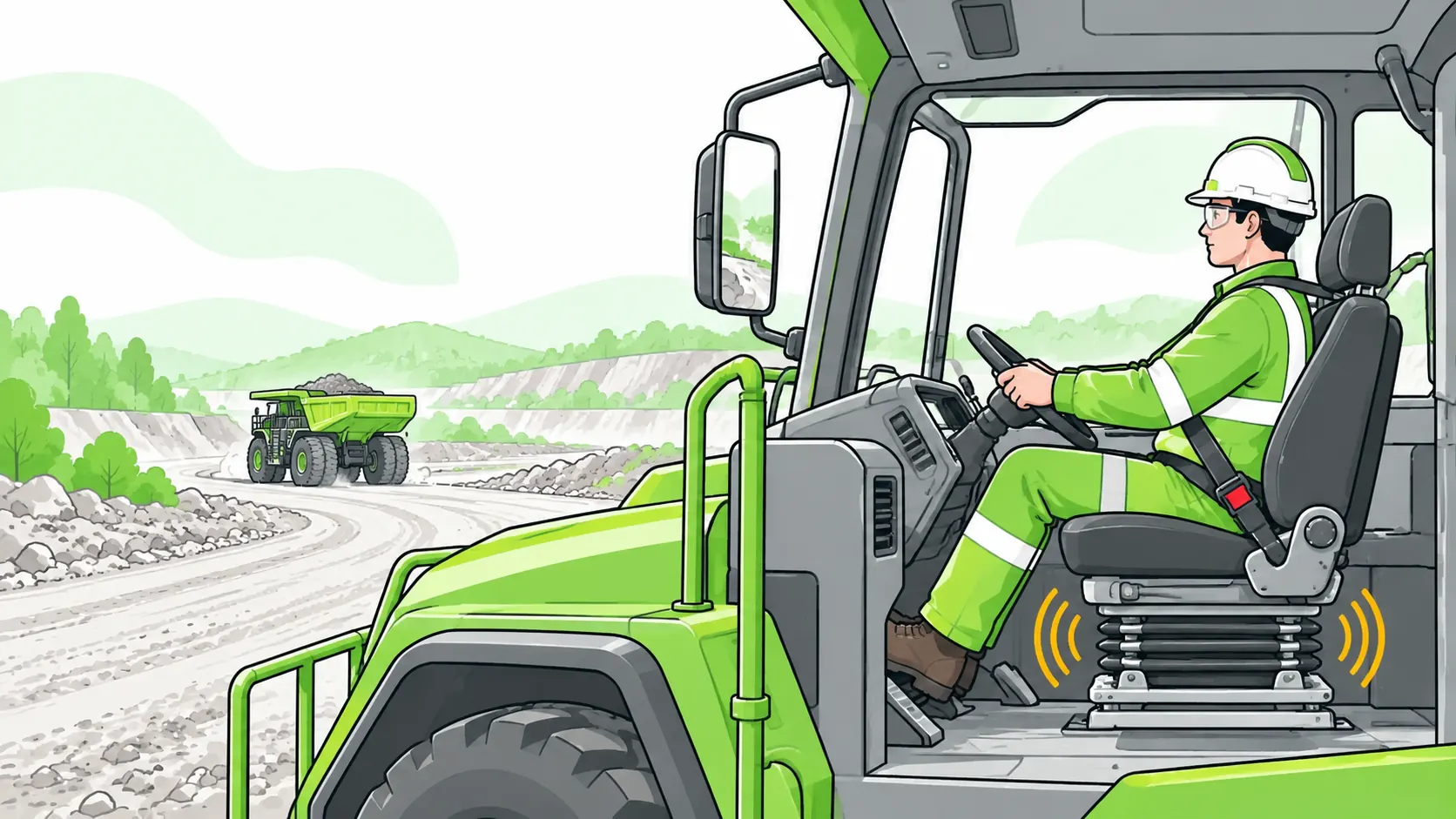
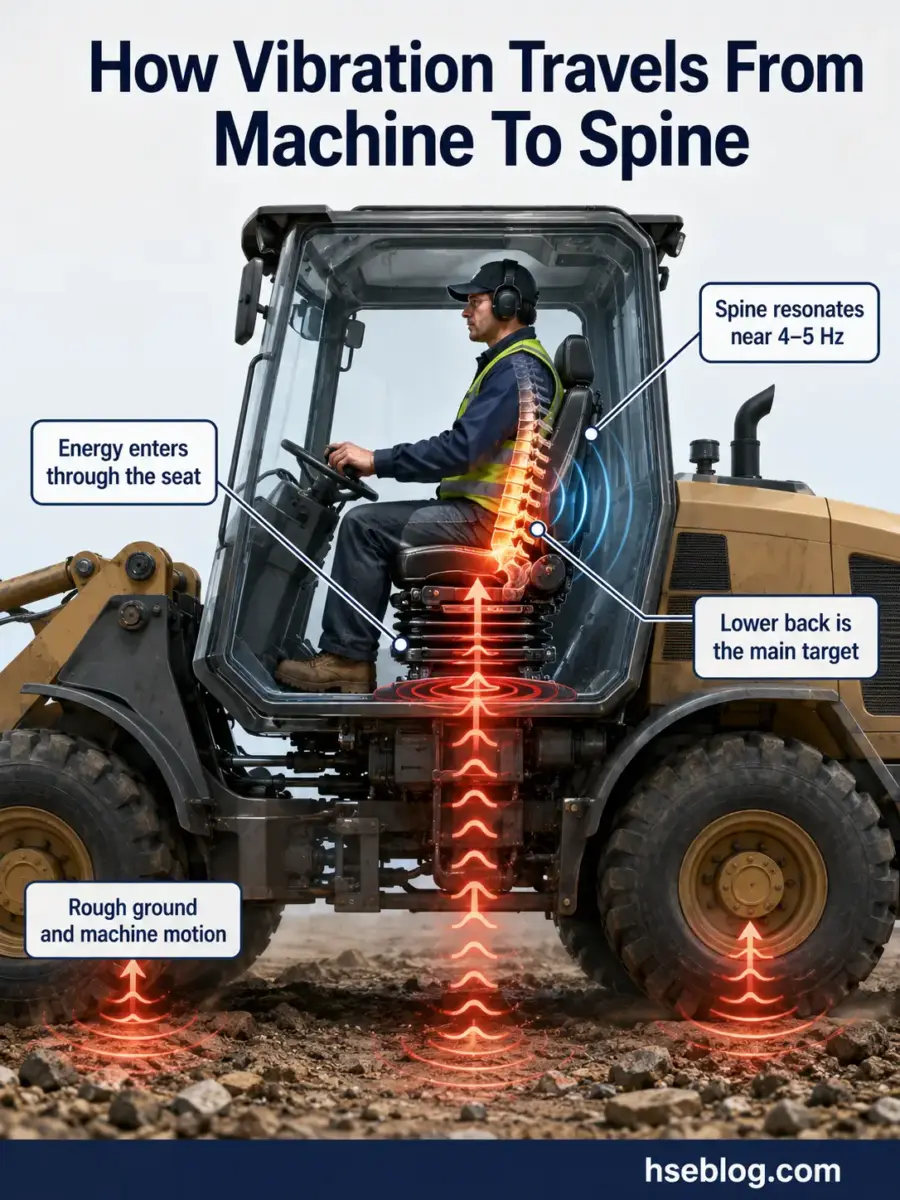
Sit in the seat of a tractor crossing a rutted field, or a dumper running a deteriorating haul road, and the machine does something subtle but damaging: it pumps vertical energy up through the seat pan and into the spine. The lumbar region resonates near 4–5 Hz, so the very frequencies that off-road plant generates are the ones the lower back amplifies rather than absorbs.
That mechanism is why whole body vibration earns serious treatment in any fleet or plant safety programme. This article walks the full chain — what causes whole body vibration, what it does to the body, how it is measured, the exposure limits that apply in each major jurisdiction, and the controls that actually work — with honest lines drawn between what the hazard causes and what it is merely associated with.
What Is Whole Body Vibration? (And How It Differs From Hand-Arm Vibration)
Whole body vibration (WBV) is mechanical vibration transmitted through a supporting surface — the seat for a seated driver, the feet for someone standing on a vibrating platform — into the whole torso and spine. It is a distinct hazard from hand-arm vibration (HAV), which enters through the hands from a gripped power tool, and the two should never be treated as the same problem with the same controls.
The health-relevant frequency band for WBV runs roughly 0.5–80 Hz. Within that, the spine has a natural resonance near 4–5 Hz, and much off-road plant vibration falls right in that range — which is why seated driving over rough ground is uniquely hard on the lower back.
A recurring organisational failure makes this worse in practice. Many teams run a thorough HAV programme — they track tool trigger-time, they log vibration magnitudes for grinders and breakers — and then treat WBV as an afterthought, because there is no obvious "tool" to point at. The hazard is the vehicle and the ground itself, which feels less controllable, so it quietly drops down the priority list.
| Factor | Whole Body Vibration (WBV) | Hand-Arm Vibration (HAV) |
|---|---|---|
| Entry point | Seat/buttocks (seated) or feet (standing) | Hands and fingers via a gripped tool |
| Typical sources | Off-road mobile plant, tractors, dumpers | Power tools — grinders, breakers, drills |
| Primary health target | Lumbar spine / lower back | Fingers and hands (HAVS / vibration white finger) |
| Governing measurement | ISO 2631 series | ISO 5349 series |
| UK daily values | EAV 0.5, ELV 1.15 m/s² A(8) | EAV 2.5, ELV 5.0 m/s² A(8) |
Both sit under the same UK regulations, but they carry different exposure values and demand different controls — a point worth settling before any risk assessment is written.
What Causes Whole Body Vibration? Sources and High-Risk Jobs
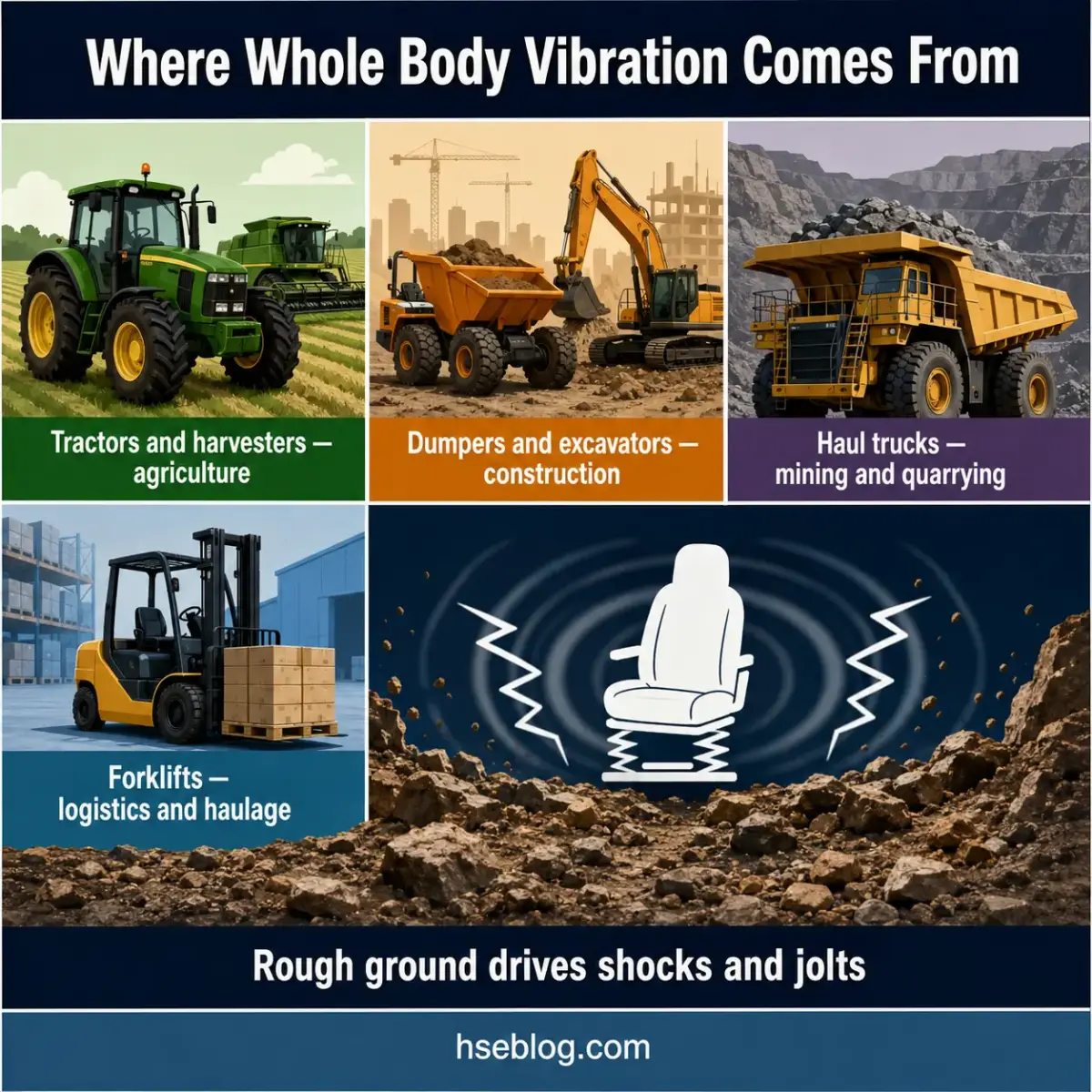
In real operations, the worst whole body vibration causes are rarely the engine — they are the interaction of vehicle and uneven terrain. Steady-state engine and transmission vibration contributes, but the shocks and jolts from driving over rough, broken ground drive the most serious spinal risk, and that distinction matters because shock-dominated exposure is assessed under a different standard (ISO 2631-5:2018).
Primary mechanical sources cluster around off-road mobile plant moving over poor surfaces:
- Off-road mobile plant over rough ground — tractors, forklifts, dumpers, and earth-moving machinery taking repeated jolts.
- Quarrying and earth-moving machinery — excavators and loaders working uneven, debris-strewn surfaces.
- Agricultural and harvesting machines — combine harvesters and tractors over field ruts and headlands.
- Engine and transmission vibration — a steady background contributor, usually secondary to terrain shocks.
The high-risk sectors follow the machines:
- Construction — dumpers, rollers, and excavators on unfinished ground.
- Agriculture, forestry, and horticulture — tractors and harvesters over fields and tracks.
- Mining and quarrying — haul trucks and loaders on degraded site roads.
- Logistics and haulage — forklifts and yard shunters, plus long road exposure.
What pushes a borderline machine into a genuine exposure problem is usually operational reality, not the design rating. The worst readings I see attributed in the published record and in fleet practice come from a deteriorating site haul road driven too fast, or a suspension seat left unmaintained and effectively bottomed-out — at which point the seat transmits more shock than no suspension at all.
Other aggravating factors stack on top: a seat not adjusted to the operator's weight, worn machine suspension, hard tyres, poor driving posture, and excessive speed. These are all controllable, which is precisely why the cause analysis matters before you reach for solutions.
What Are the Health Effects of Whole Body Vibration?
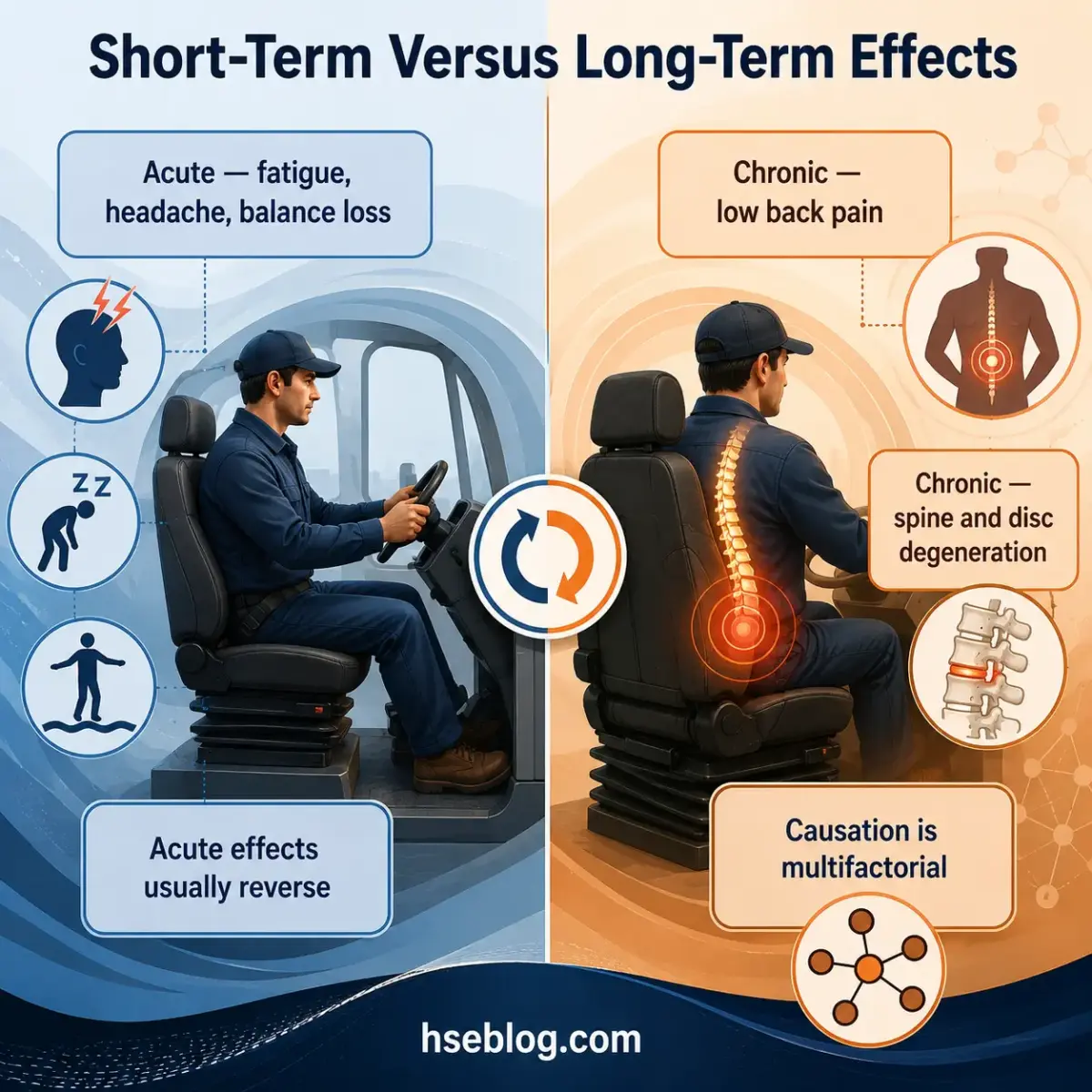
The health effects of whole body vibration split into transient short-term reactions and a chronic burden centred on the lower back — but the honest position is that the chronic harm is multifactorial, and WBV is one contributor among several. That nuance is not a hedge; it is exactly how HSE itself treats the evidence, and getting it wrong overclaims a YMYL topic.
Medical disclaimer: Content covering health effects, exposure, and health surveillance here is for HSE practitioner reference. It is not medical advice. Workers with specific symptoms or exposure concerns should consult an occupational physician or qualified medical professional.
The acute and chronic pictures are best kept separate:
| Tier | Reported effects | Nature |
|---|---|---|
| Acute / short-term | Fatigue, headache, loss of balance, transient discomfort (similar to post-travel motion effects) | Usually reversible |
| Chronic / long-term | Low back pain, lumbar/intervertebral disc and spine degeneration; reported associations with neck/shoulder pain and, in some studies, gastrointestinal, circulatory, and reproductive effects | Can be persistent or irreversible; causation multifactorial |
Two points temper that table. First, individual susceptibility varies considerably — age, prior back injury, body weight, and habitual posture all shift the risk. Second, the non-spinal associations (circulatory, gastrointestinal, reproductive) are largely associative and contested, not established causation. CCOHS's overview of vibration health effects sets out the same acute-versus-chronic split for readers who want a government-sourced cross-check.
A 2024 systematic review of the acute after-effects of occupational WBV sharpened this picture further: it found that postural stability tends to deteriorate or stay unchanged after exposure, while effects on cognition, vision, and motor control remain inconsistent (Applied Ergonomics, 2024). That is a useful corrective to the loose "WBV harms everything" framing — the evidence is strongest where the mechanism is most direct.
Whole Body Vibration and Low Back Pain: What the Evidence Actually Says
Low back pain is the most-studied and most-searched WBV outcome, and the weight of evidence supports a consistent association between long-term WBV exposure and both low back pain and lumbar spine degeneration. What the evidence does not support is treating WBV as the sole cause.
The confounding is real and unavoidable:
- Prolonged sitting loads the lumbar discs independently of vibration.
- Manual handling in and around the same jobs contributes its own spinal load.
- Posture and seat design shape how much of any given exposure reaches the spine.
Because back pain is so common in the general population and has so many causes, attributing one operator's back pain specifically to WBV is rarely clean. That diagnostic-attribution problem is exactly why HSE emphasises controlling exposure rather than waiting for a confirmed, WBV-specific diagnosis — by the time the harm is provable, it is usually too late to prevent.
How Whole Body Vibration Is Measured: A(8), m/s², and the Exposure Values
In practice, whole body vibration exposure is expressed as A(8) — frequency-weighted acceleration in metres per second squared (m/s²), averaged over an eight-hour reference day. The measurement is taken tri-axially at the seat interface, and for most seated drivers the vertical axis dominates the result.
The measurement logic breaks down into a few essentials:
- A(8) is a daily dose, not an instantaneous reading. It averages the day's exposure to a common eight-hour reference period so different jobs can be compared.
- Three axes are measured at the seat pad — x (front-to-back), y (side-to-side), and z (vertical). For seated operators, z is usually the largest contributor.
- VDV handles shocks better than A(8). Where the exposure is dominated by jolts and bumps, the Vibration Dose Value gives a more honest picture, because A(8) can under-weight short, severe transients.
- It needs a competent assessment. Real measurement requires the right accelerometer, correct mounting, and someone who can interpret the result against the regulations.
The pitfall here is relying on the machine manufacturer's declared vibration emission figure as if it were an exposure value. Declared figures come from standardised test tracks under controlled conditions; they routinely under-represent what an operator actually receives on a degraded, real-world site. Rather than reproduce a full A(8) calculation, the practical route is to estimate using HSE's published WBV calculator and then confirm high-risk cases with measured data.
Whole Body Vibration Exposure Limits by Jurisdiction
The whole body vibration exposure limit you must meet depends entirely on where the work happens — the UK and EU set enforceable numbers, the US sets none, and ISO offers guidance zones rather than legal limits. Anyone running a multinational fleet needs all four regimes side by side, because a standard built for one will fail an audit in another.
Legal disclaimer: Regulatory content here reflects general HSE professional understanding of UK, EU, US, and international requirements as of 2025. It is not legal advice. Specific compliance questions, enforcement situations, or prosecution risk should be directed to qualified legal counsel in the applicable jurisdiction.
| Jurisdiction | Instrument | EAV (action) | ELV (limit) | Legal status |
|---|---|---|---|---|
| UK | Control of Vibration at Work Regulations 2005 | 0.5 m/s² A(8) | 1.15 m/s² A(8) | Enforceable |
| EU | Directive 2002/44/EC | 0.5 m/s² A(8) | 1.15 m/s² A(8) | Enforceable via member-state law |
| US | OSHA General Duty Clause 5(a)(1); ACGIH TLV | None (TLV is ISO-based) | None | No enforceable number; recognised-hazard duty + voluntary TLV |
| International | ISO 2631-1:1997 (HGCZ); ISO 2631-5:2018 (shock dose) | Caution-zone band ~0.43–0.87 m/s² | — | Guidance, not a legal limit |
Read the table by legal weight, not just by number. In the UK and EU the ELV of 1.15 m/s² A(8) is a hard ceiling that must not be exceeded, and the EAV of 0.5 m/s² A(8) is the trigger point for mandatory action — HSE sets out both values directly in its WBV regulations guidance. The UK figures simply implement Directive 2002/44/EC, so a compliant UK position is also a compliant EU one.
The US sits differently. There is no specific WBV standard and no permissible exposure limit; employers carry a duty under the General Duty Clause 5(a)(1) to provide a workplace free of recognised hazards, and the ACGIH Threshold Limit Value — derived from ISO 2631-1 — serves as voluntary reference, as OSHA's own Technical Manual on health hazards confirms. ISO 2631-1's Health Guidance Caution Zone is a band, not a limit, and ISO 2631-5:2018 specifically addresses lumbar-spine risk from repeated shocks via a daily compression dose.
The judgment call for a cross-border operator is which number to manage to. A programme built only around the US "no number" reality will fail a UK or EU audit; a UK standard exported unchanged to a US site over-documents against values that are not legally binding there. The defensible position is to manage to the strictest applicable value regardless of site — in practice, treat the UK/EU EAV of 0.5 m/s² A(8) as the trigger everywhere.

How to Control Whole Body Vibration: The Hierarchy of Control
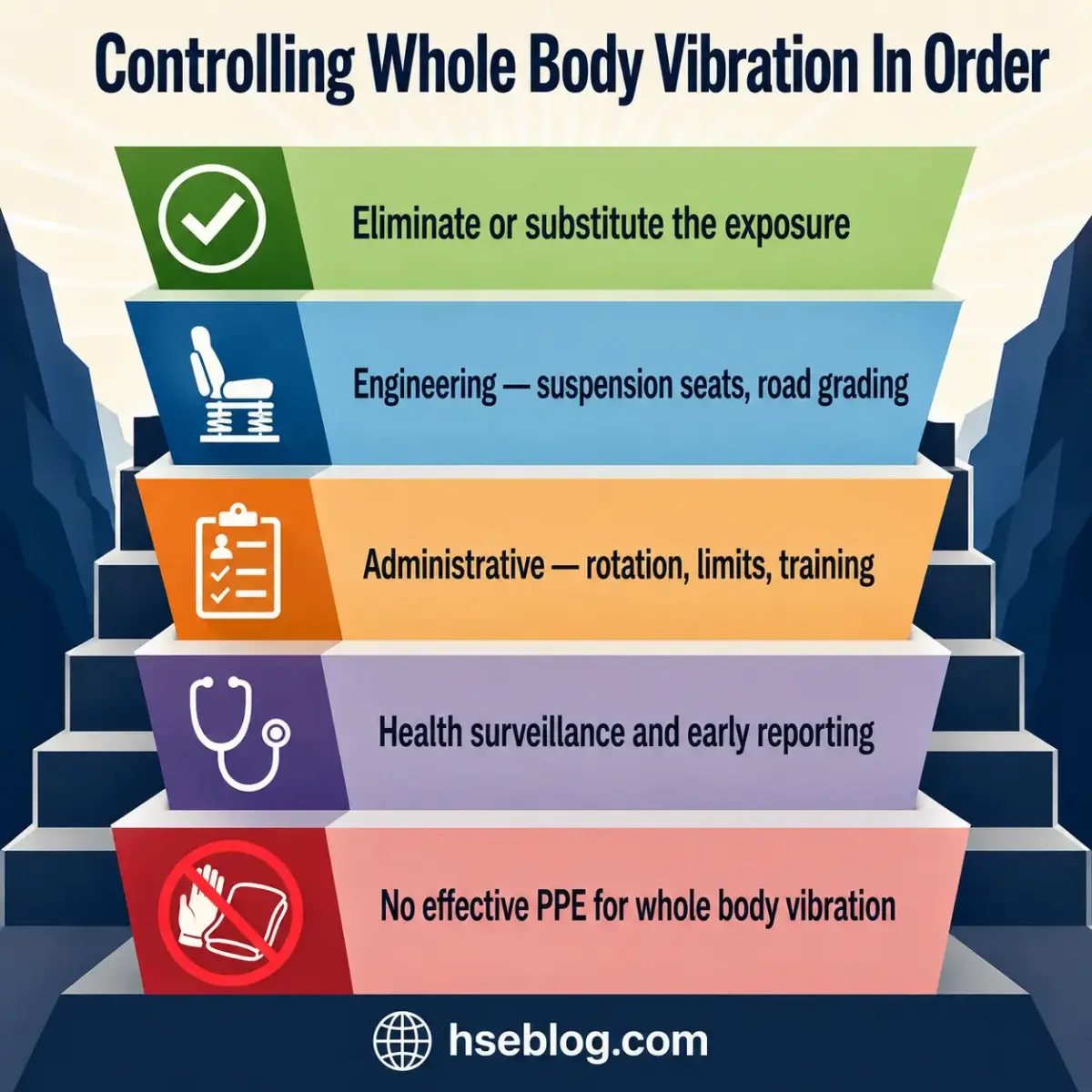
There is no effective PPE for whole body vibration — control is overwhelmingly engineering and administrative, ordered by the hierarchy of control. Any risk assessment that lands on "issue gloves" or "fit a gel cushion" has misunderstood the hazard, and an inspector will read it that way too. HSE's practical WBV guidance frames the same control logic for employers.
Work the hierarchy in order, top tier first:
- Eliminate or substitute. Remove the need to traverse rough ground at all where the task allows it; substitute a lower-vibration machine; or redesign the task so the operator spends less time exposed.
- Engineering controls. This is where most real reduction happens — well-specified suspension seats correctly adjusted to operator weight, maintained machine suspension and tyres, graded and repaired site roadways, and managed driving speed.
- Administrative controls. Job rotation, exposure-time limits, operator training, a working reporting culture, and scheduled maintenance that is actually carried out.
- Health surveillance. Where exposure approaches or exceeds the action value, surveillance and early symptom reporting catch harm before it becomes permanent.
Under the engineering tier, a short maintenance checklist prevents the most common backsliding:
- Match the seat to the operator's weight — re-check the weight setting, not just at handover.
- Inspect the suspension seat for wear and bottoming-out — a worn seat can amplify shock.
- Keep tyres and machine suspension within spec — degraded suspension transmits more, not less.
- Grade and pothole-repair haul roads — surface condition often beats machine rating for total exposure.
- Enforce sensible speeds on rough ground — speed converts surface defects into spinal shocks.
The set-and-forget failure mode is the one to watch. Teams fit suspension seats, log the line as "controlled," and never re-check adjustment, weight setting, or wear — and an unmaintained suspension seat that has bottomed out can amplify shocks rather than attenuate them, quietly converting the control into a hazard.
One misconception deserves a flat correction: anti-vibration seat cushions and "vibration gloves" do not meaningfully control WBV. Gloves are irrelevant to a hazard that enters through the seat, and aftermarket cushions are largely ineffective and can worsen transmission. The engineering control that works is a properly specified, properly maintained suspension seat.
Competent-person caveat: This article provides general HSE knowledge. Life-critical and exposure-critical work — including WBV risk assessment and the specification of vibration controls for mobile plant — must be planned and supervised by a competent person with relevant training, jurisdiction-specific authorization, and a site-specific risk assessment. Recognised pathways include NEBOSH, IOSH, OSHA outreach, and equivalent regional qualifications; the information here does not replace them.
Employer and Operator Duties Under the Vibration Regulations
Under the Control of Vibration at Work Regulations 2005 (UK), the duty chain runs in a fixed sequence, and stating the jurisdiction matters because the obligations are not identical elsewhere.
- Carry out a suitable and sufficient risk assessment (Reg 5). Identify who is exposed, estimate magnitude and duration, and flag vulnerable individuals.
- Act once the EAV is reached (Reg 6). Eliminate or reduce exposure so far as is reasonably practicable through engineering and administrative controls.
- Never exceed the ELV. The 1.15 m/s² A(8) limit is a ceiling; a narrow weekly-averaging exception exists only under specific conditions and should not be assumed.
- Provide information, instruction, and training, and consult workers. Operators need to understand the hazard and the controls they depend on.
- Arrange health surveillance where indicated (Reg 7). This supports early detection, not a substitute for prevention.
In the US the same outcomes are pursued through the General Duty Clause rather than a numbered standard, which is why the recommended posture for any precaution-led programme is to manage to the strictest applicable value.
Frequently Asked Questions
Is whole body vibration covered by OSHA?
Not by a specific standard. The US has no WBV permissible exposure limit; OSHA addresses it under the General Duty Clause 5(a)(1), which requires a workplace free of recognised hazards, and the ACGIH Threshold Limit Value serves as voluntary guidance. That contrasts sharply with the UK and EU, where the Control of Vibration at Work Regulations 2005 set enforceable action and limit values.
What is the difference between whole body vibration and hand-arm vibration?
Whole body vibration enters through the seat or feet and mainly harms the lumbar spine; hand-arm vibration enters through the hands from gripped tools and causes hand-arm vibration syndrome and vibration white finger. Their sources differ — mobile plant versus power tools — and although both sit under the same UK regulations, they carry separate exposure values and are measured under different ISO standards.
Can you claim compensation for a whole body vibration injury?
It depends on jurisdiction, and it is legally difficult. Because the main outcome — low back pain — is multifactorial, a civil claim turns on showing that workplace exposure caused or materially contributed to the condition, which is hard to prove cleanly. This is general information, not legal advice; anyone considering a claim should consult a qualified solicitor or attorney in their jurisdiction.
What is a safe level of whole body vibration?
There is no universally "safe" number. Below the UK/EU Exposure Action Value of 0.5 m/s² A(8) the risk is lower but not zero, and ISO 2631-1 frames a Health Guidance Caution Zone rather than a hard threshold. Individual susceptibility — age, body weight, prior back injury, and posture — shifts the risk for any given exposure.
Do anti-vibration seat cushions or gloves reduce whole body vibration?
No, not meaningfully. Gloves are irrelevant because WBV does not enter through the hands, and aftermarket cushions are largely ineffective and can even worsen shock transmission. The control that works is a properly specified, correctly weight-adjusted, and well-maintained suspension seat — an engineering control, not a comfort accessory.
Which jobs have the highest whole body vibration exposure?
Operators of off-road mobile plant — in construction, agriculture, forestry, mining and quarrying, and haulage. Tractors, dumpers, excavators, forklifts, and combine harvesters all generate significant exposure. Crucially, site and road condition plus seat maintenance often matter more to the real result than the machine's rated emission figure, so two operators on identical machines can receive very different doses.
Conclusion
The industry's most common mistake with whole body vibration is treating it as a comfort issue rather than a controllable spinal-load hazard — fitting a suspension seat once, logging it as "done," and never re-checking the adjustment, the wear, or the haul road that does most of the damage. The single highest-impact change is to manage the maintained system, not the one-off purchase: weight-set seats, graded roads, sensible speeds, and exposure that is actually estimated rather than assumed.
The second lesson is honesty about cause. WBV is firmly associated with low back pain and spinal degeneration, but it acts inside a multifactorial picture, and overclaiming that link is both inaccurate and, for a YMYL audience, a trust failure. Controlling exposure before harm is diagnosed is the responsible response precisely because the harm is so hard to attribute after the fact.
For any operation crossing borders, the defensible whole body vibration programme manages to the strictest applicable value — in practice the UK/EU action value of 0.5 m/s² A(8) — so that a single fleet standard holds up whether the audit is in London, Lyon, or a US site with no number to point at.