
TL;DR
- Banksman equals traffic marshal. One role, two names, used interchangeably in the UK for directing vehicle and mobile plant movement on site.
- Signals are codified, not improvised. Nine standard hand signals are set out in the UK’s Health and Safety (Safety Signs and Signals) Regulations 1996, Schedule 1, Part IX.
- Deploy after the hierarchy of control, not before. Segregation and engineering controls come first; a banksman is a residual control, not a default.
- Competence is site-specific. A three-year certificate does not override the employer’s duty to assess competence against the actual vehicles, layout, and hazards on that site.
- Lose sight, stop work. If either the driver or the banksman loses visual contact, operations halt immediately. There are no good exceptions to this rule.
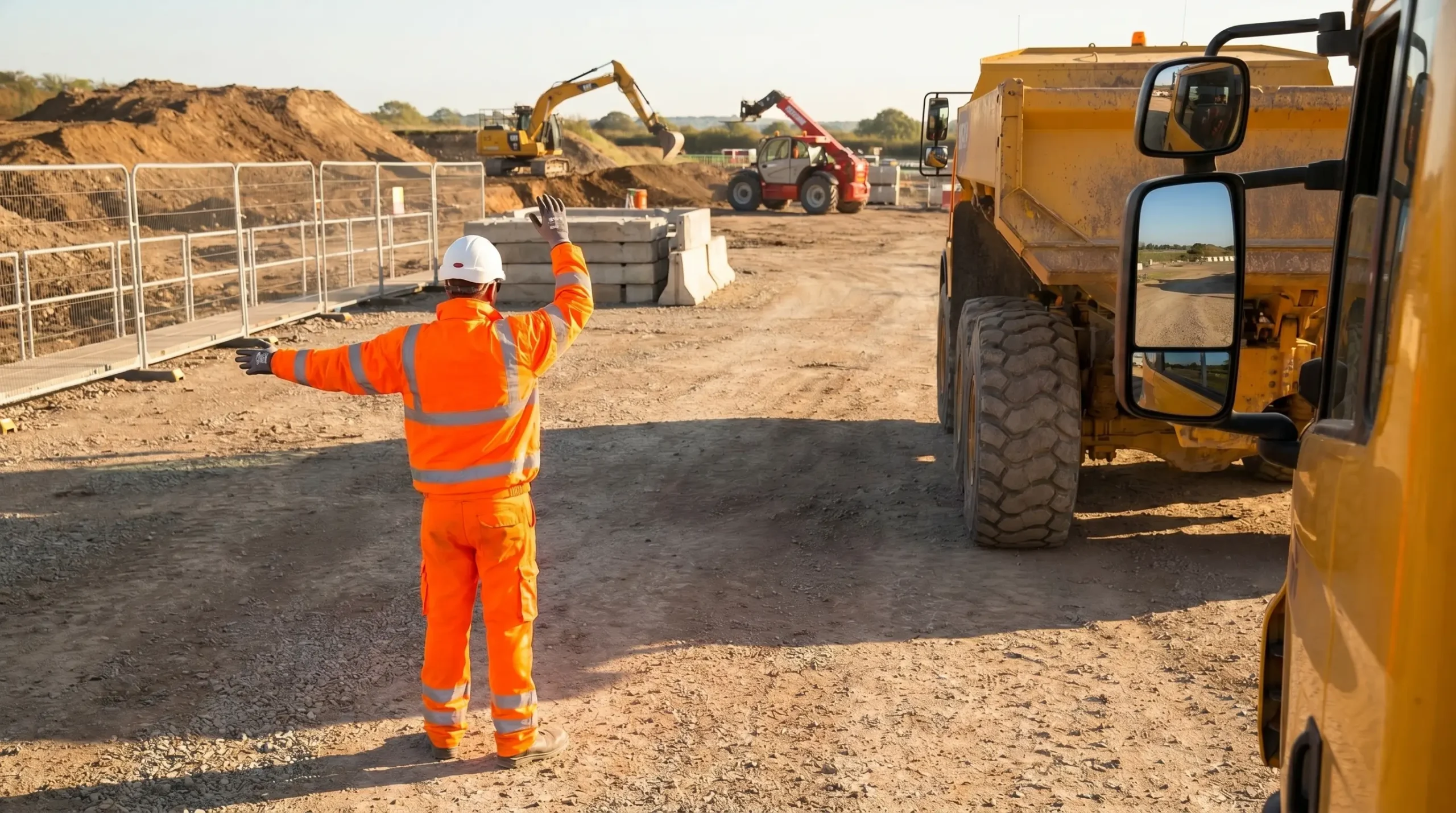
A banksman — also called a traffic marshal — is a trained operative who directs vehicle and mobile plant manoeuvres on a worksite using standardised hand signals. Under the UK’s Health and Safety (Safety Signs and Signals) Regulations 1996, nine core signals cover start, stop, movement direction, distance, and emergency stop. The role is a last-resort control, never a default.
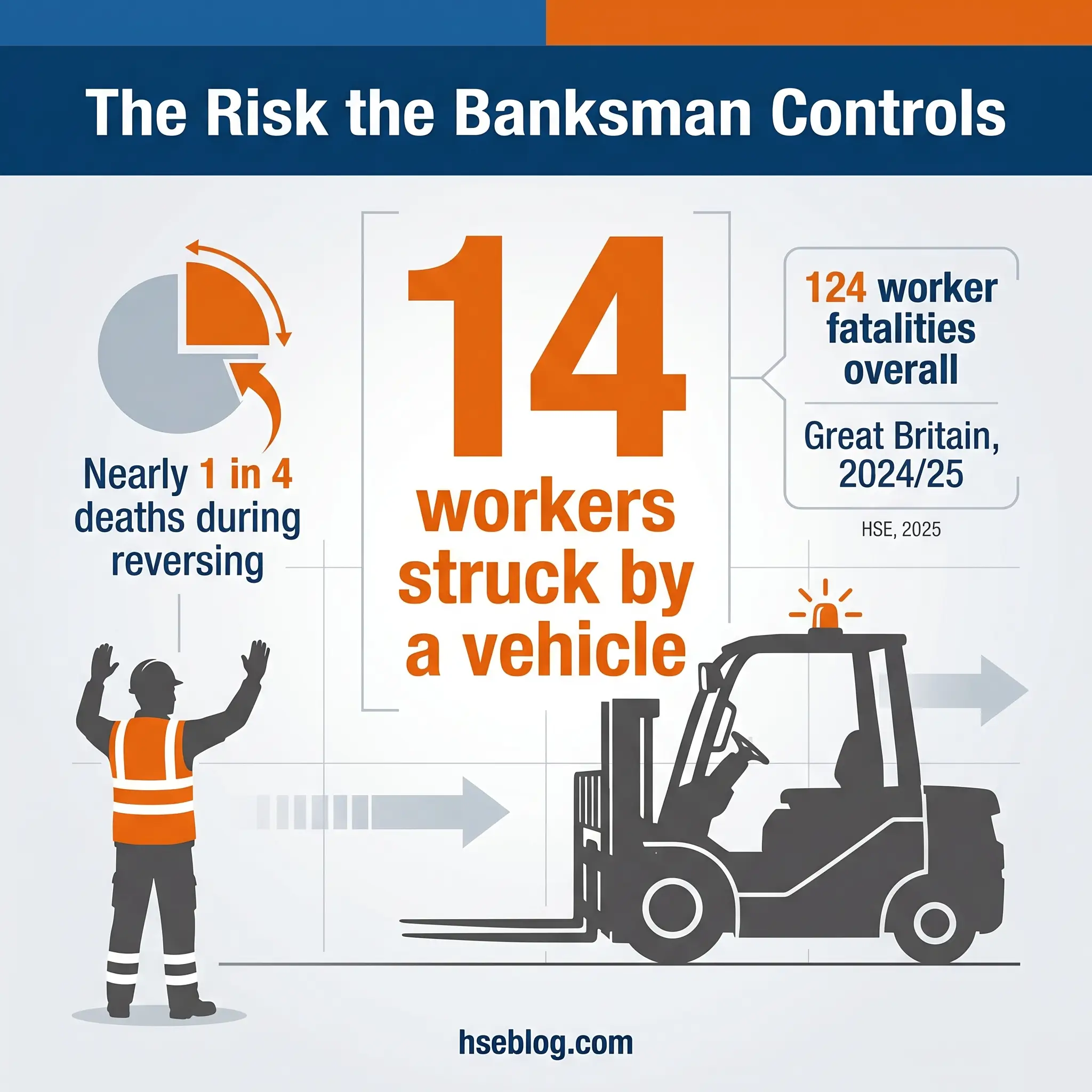
Fourteen workers were killed after being struck by a moving vehicle at work in Great Britain during 2024/25, against 124 total worker fatalities (HSE, Work-related fatal injuries in Great Britain, 2025). Long-running HSE guidance puts almost one in four workplace vehicle deaths in the reversing phase of a manoeuvre (HSE workplace transport guidance). The banksman role exists because of that pattern.
That role sits directly between a multi-tonne machine and the people around it, and the quality of the signalling decides whether the manoeuvre finishes cleanly or ends in a fatality. This article defines the banksman in regulatory terms, separates it from the slinger signaller and US spotter/flagger roles, explains each standard banksman hand signal, and covers the training, deployment, and failure patterns that seasoned auditors look at first.
Competent-person note: This article provides general HSE knowledge. Directing vehicle and mobile plant manoeuvres is life-critical work and must be planned and supervised by a competent person with relevant training, jurisdiction-specific authorisation, and site-specific risk assessment. The information here does not replace that.
What Is a Banksman (Traffic Marshal)?
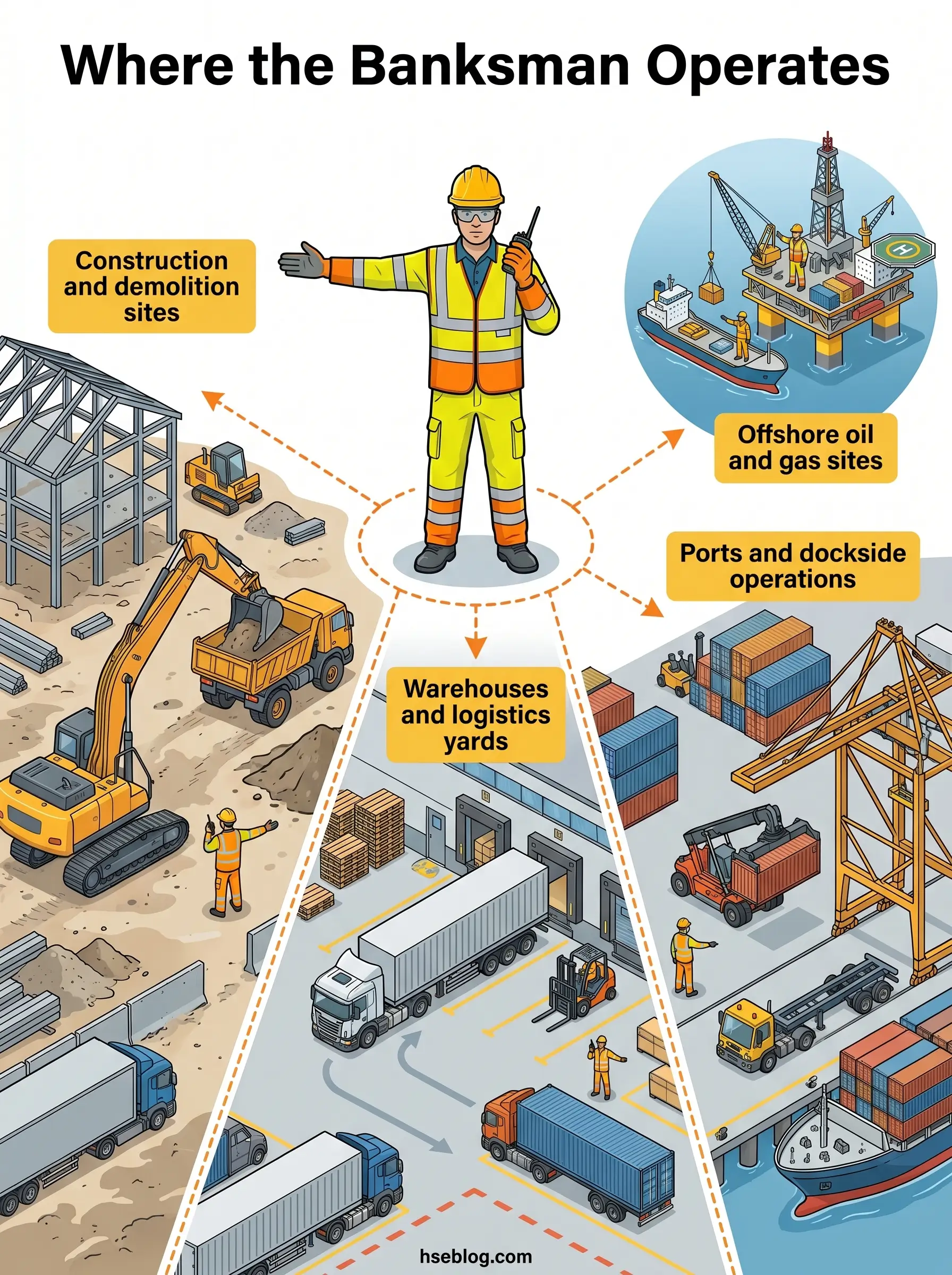
A banksman is a trained operative whose sole function during an active manoeuvre is to direct the driver or operator of a vehicle or mobile plant using an agreed, standardised set of signals. On UK construction, logistics, port, and manufacturing sites, the term “traffic marshal” is used for exactly the same role — the names are interchangeable, and readers should treat them as such throughout this article. The role also appears in warehousing, offshore oil and gas, and quarrying, wherever mobile equipment and people share the same operating footprint.
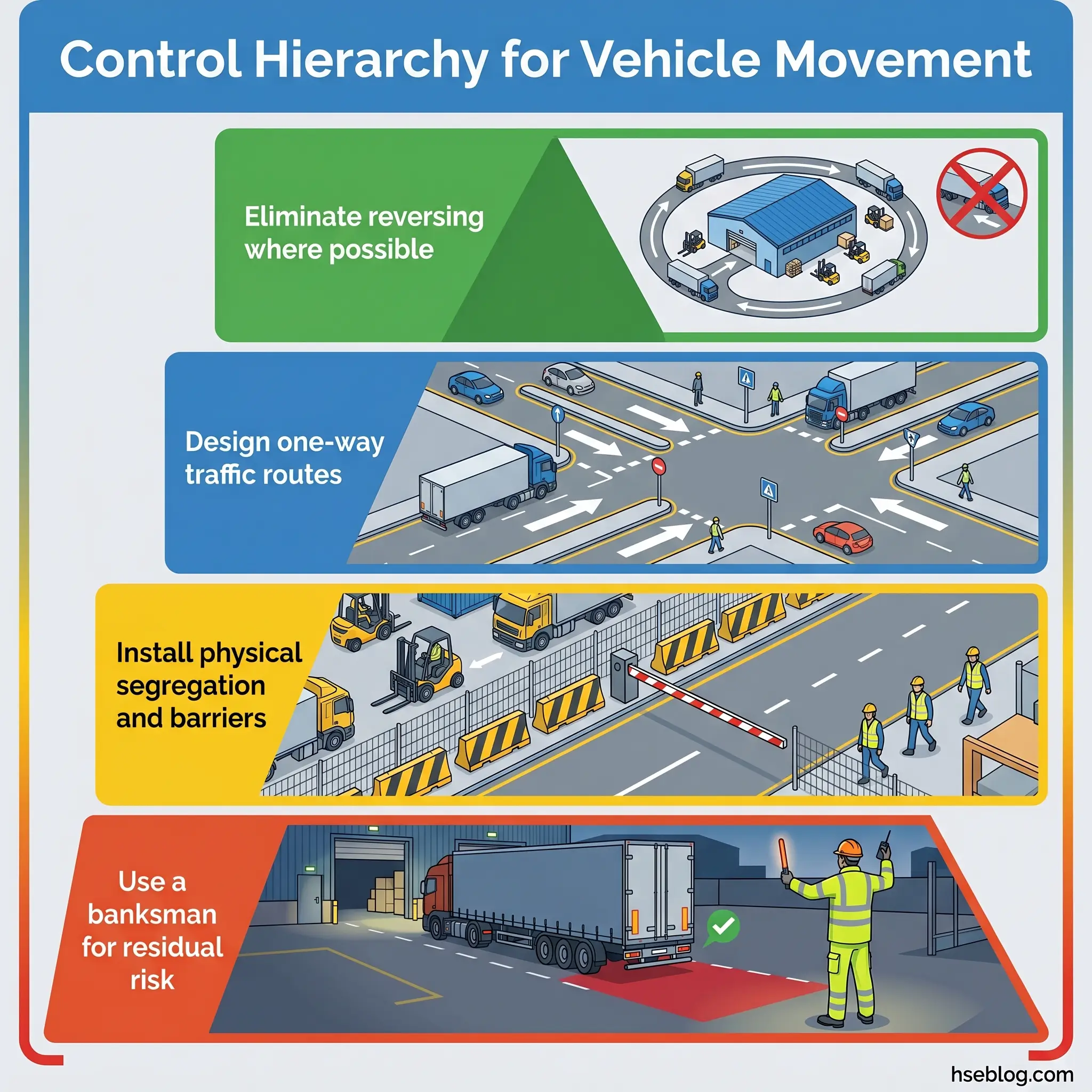
The HSE’s position, set out in its construction FAQ on banksmen, is that signallers should only be used where other measures are not practicable. In other words, the banksman is a residual control that activates after segregation, one-way routing, and engineering controls have been exhausted. A site that relies on banksmen as its first line of defence against vehicle-pedestrian conflict has inverted the hierarchy the regulator expects to see.
Banksman vs Slinger Signaller vs Traffic Marshal: Key Differences
The three terms get used interchangeably in conversation, and that is where people get hurt. The banksman and traffic marshal are the same role — directing ground-level vehicle and mobile plant movement. A slinger signaller is a different role under a different regulatory regime: directing lifting operations such as cranes or excavators used as lifting appliances, governed by the Lifting Operations and Lifting Equipment Regulations 1998 (LOLER) and the code of practice BS 7121.
One person may hold both qualifications, but the two sets of competencies and signal sets must not be blended during a single operation. The table below separates the three terms most commonly confused on site.
| Role | Operational scope | Governing regulation (jurisdiction) | Signal set |
|---|---|---|---|
| Banksman / Traffic Marshal | Ground-level vehicle and mobile plant manoeuvres on a worksite | SI 1996/341, Schedule 1 Part IX; HSWA 1974 (UK) | Vehicle/plant hand signals |
| Slinger Signaller | Lifting operations by cranes and lifting appliances | LOLER 1998; BS 7121 (UK) | Lifting-specific hand signals |
| Spotter / Flagger (US equivalent) | On-site vehicle guidance (spotter); public-highway work zones (flagger) | 29 CFR 1926.201; MUTCD Part 6 (US) | Standard Method signals; MUTCD flagger signals |
Core Duties and Responsibilities of a Banksman
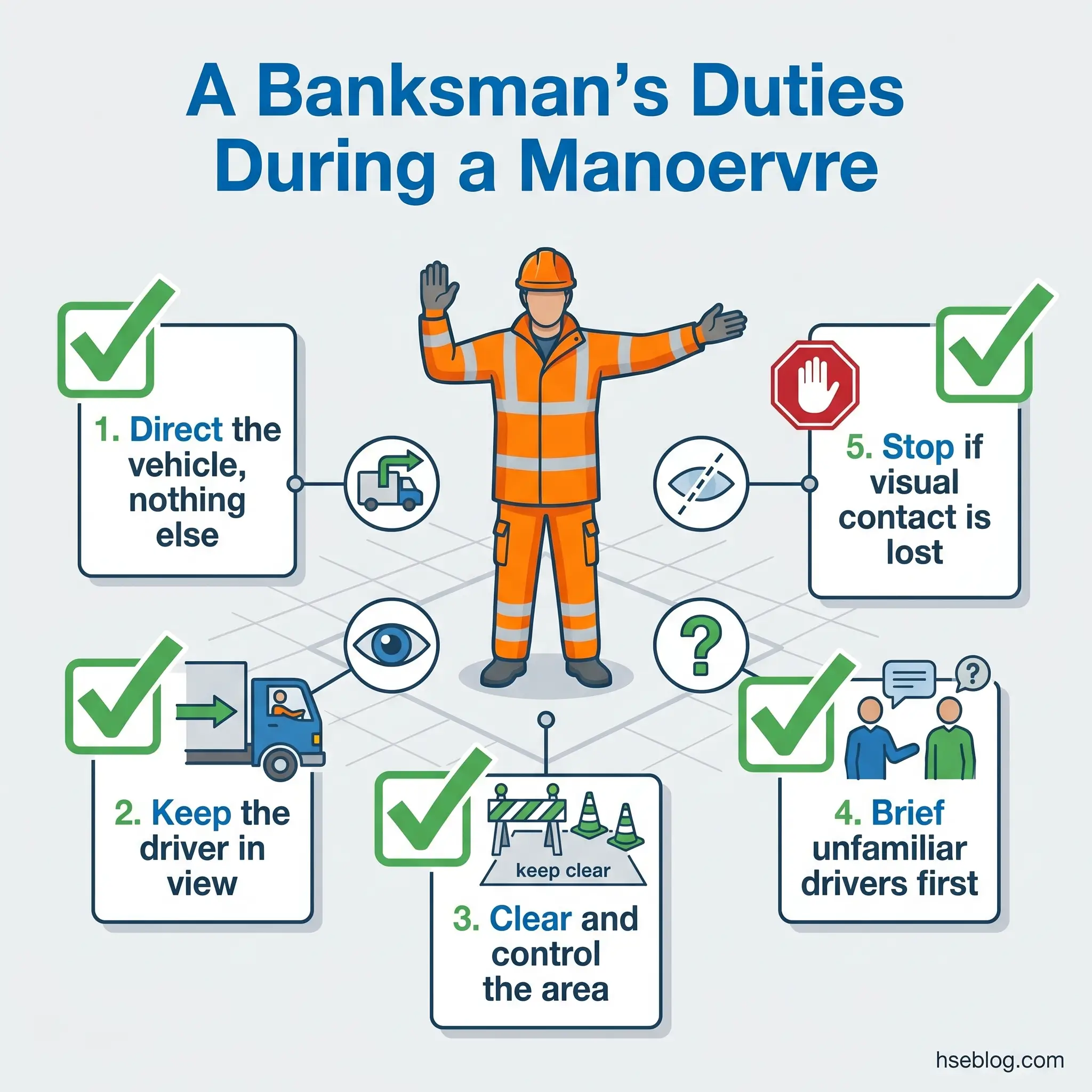
In real operations, the banksman’s job is not just to wave a vehicle in. The pre-operation checks, the area clearance, and the dynamic reading of the worksite around the moving vehicle carry as much weight as the signalling itself. Reviewing published HSE workplace transport guidance and L64, a consistent description of the role emerges: the banksman is the operator’s eyes for everything the cab cannot see, and the site’s buffer between the machine and everyone not in it.
The duty set runs along these lines.
- Guiding manoeuvres, especially reversing. Reversing and confined-space movement are the highest-risk phases, and the banksman is positioned to control them.
- Maintaining constant visual contact with the driver. Line of sight is the entire communication channel; if it breaks, the manoeuvre stops.
- Clearing the area before and during the manoeuvre. Pedestrians, loose materials, and unauthorised vehicles must be moved or excluded from the path.
- Briefing unfamiliar drivers. Delivery drivers arriving on a site for the first time need a pre-manoeuvre briefing on signals, route, and stop protocols.
- Agreeing signals with the driver or operator in advance. Standard signals are the default, but every operation starts with a confirmed agreement.
- Logging near misses and reporting hazards. A banksman’s observation position is ideal for spotting route hazards and equipment defects.
- Maintaining exclusive focus during the manoeuvre. No radio chatter on other matters, no loading assistance, no answering phones.
Audit Point: The clearest failure pattern in published workplace transport investigation material is the banksman being pulled into secondary tasks during an active manoeuvre — holding loads, assisting with rigging, or guiding a second vehicle. The exclusivity principle is not a guideline; it is what keeps the role functional. When auditors find a banksman also acting as a storeman or a rigger during active operations, they find a control that is already compromised before anything has gone wrong.
When Is a Banksman Required on Site?
The question most sites get wrong is not “what signals does a banksman use” but “should there be a banksman here at all.” The HSE’s workplace transport guidance on reversing makes the control order explicit: eliminate reversing first, then design one-way traffic routes, then install physical segregation and barriers, and only then deploy a banksman as a residual control for what the earlier layers cannot remove. A banksman is a procedural control that depends on a human maintaining focus and communication in noisy, dynamic conditions — the weakest layer in the hierarchy, not the strongest.
Practical triggers for banksman deployment include: reversing into a loading bay where one-way design is not achievable, tight-space manoeuvres inside an established work area, deliveries into an active construction footprint, and plant operations near a pedestrian zone that cannot be fully excluded. Each of these should arise only after the risk assessment has shown that better controls are not reasonably practicable.
The authority of the banksman also has a limit that catches people out. A banksman has no legal authority over traffic on a public highway unless authorised under the Community Safety Accreditation Scheme (CSAS) in England and Wales — and even that is an organisational accreditation, not a general authority, and it does not operate in Scotland. Anyone stepping off site onto a public road to manage traffic is exceeding their role.
The judgement call here is between treating banksmen as “always on” and treating them as a control of last resort. Auditors notice the difference quickly. A site that runs a banksman on every reversing move without having first considered whether a designed one-way system would remove the reverse altogether is displaying compliance theatre. The reviewer’s observation across workplace transport enforcement reporting is consistent: sites with the most banksman deployment per manoeuvre often have the weakest underlying traffic management design.
What Are the Standard Banksman Hand Signals?
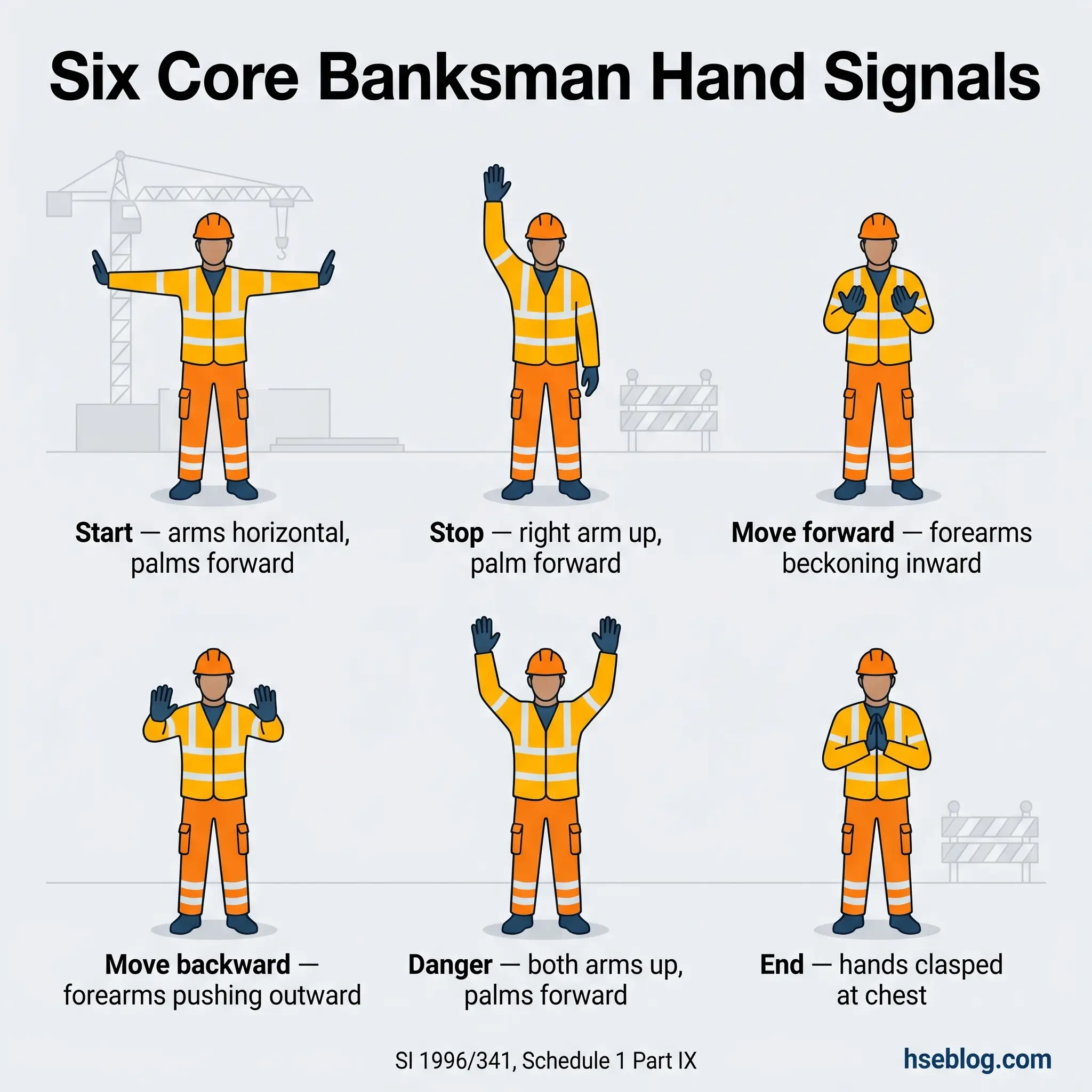
Nine core signals make up the working banksman signal set, defined in the UK’s Health and Safety (Safety Signs and Signals) Regulations 1996, Schedule 1, Part IX, and explained in detail in HSE’s L64 approved guidance. The regulations also include a parallel set for lifting operations (slinger signallers), which sits outside the vehicle banksman scope and should not be mixed with it. Across the signal set, one principle runs through everything: the speed of the gesture conveys the urgency. Faster arm movements mean faster action required; slower movements mean the driver should ease off.
- Start. Both arms extended horizontally from the shoulders, palms facing forward. Signals to the driver that the manoeuvre may begin.
- Stop. Right arm raised vertically, palm facing forward. The driver halts the vehicle immediately and waits for further direction.
- End of operation. Both hands clasped together at chest height. The manoeuvre is complete; the driver may shut down or move on.
- Move forward. Both arms bent at the elbows, palms facing upward, forearms making slow, beckoning movements toward the body. The driver moves forward at a speed matching the signal rate.
- Move backward. Both arms bent at the elbows, palms facing downward, forearms making slow movements away from the body. The driver reverses at the signal rate.
- Turn left (from the signaller’s perspective). Left arm extended roughly horizontally, palm facing downward, making small movements to the left.
- Turn right (from the signaller’s perspective). Right arm extended roughly horizontally, palm facing downward, making small movements to the right.
- Vertical and horizontal distance. Hands are held apart to show the remaining distance between the vehicle and an obstacle, closing together as the gap narrows.
- Danger / emergency stop. Both arms raised upward, palms facing forward. The driver stops immediately and does not resume until the cause is confirmed clear.
The regulations do allow alternative signals provided they are equally clear and comprehensible and are agreed before the operation begins. In practice, where a site deviates from the standard set, the audit question is whether the variation is documented, briefed, and consistent — or whether it has drifted in silently as shorthand, which is where confusion and incidents start.
A consistent pattern in published investigation material is the “move backward” signal being given from directly behind the reversing vehicle. The banksman is in the path of the machine they are directing. Safer positioning is at roughly a 45-degree offset from the rear of the vehicle, visible in the driver’s wing mirror, never in the reversing lane itself. If that position does not exist, the manoeuvre should not be attempted without redesigning the route or the approach.
Jurisdiction Note: The UK signal set in SI 1996/341 derives from EU Directive 92/58/EEC, so the core nine signals are broadly the same across European sites. The US does not use this set for general vehicle work; under OSHA 29 CFR 1926.1419 and the Standard Method hand signals in Appendix A of Subpart CC, the codified signals are for crane signal persons, and include boom-specific gestures that have no direct equivalent in the UK vehicle set. When working across jurisdictions, do not assume the signals transfer — confirm the applicable regulation and the locally-understood set before the first manoeuvre.
Verbal and Radio Communication Signals
Where hand signals are not workable — very large vehicles with long blind zones, mobile plant with extended booms, or low-visibility conditions from weather, dust, or darkness — the banksman communicates verbally, usually over a dedicated two-way radio channel. The communication principle does not change. Signals must still be pre-agreed, unambiguous, and tested before the manoeuvre begins.
Standard verbal commands typically mirror the hand signals: “forward,” “back,” “stop,” “left,” “right,” distance calls such as “two metres,” “one metre,” “half,” “six inches,” and a clear “that’s it” or “hold it there” at the stopping point. The “stop” command takes priority over every other word and must be respected immediately. Radios must be hands-free, on a dedicated channel with no unrelated traffic, and with a loss-of-signal protocol: if the channel drops, the driver stops. The HSE’s guidance position on lost communication is unambiguous — no signal, no movement.
How to Identify a Banksman on Site
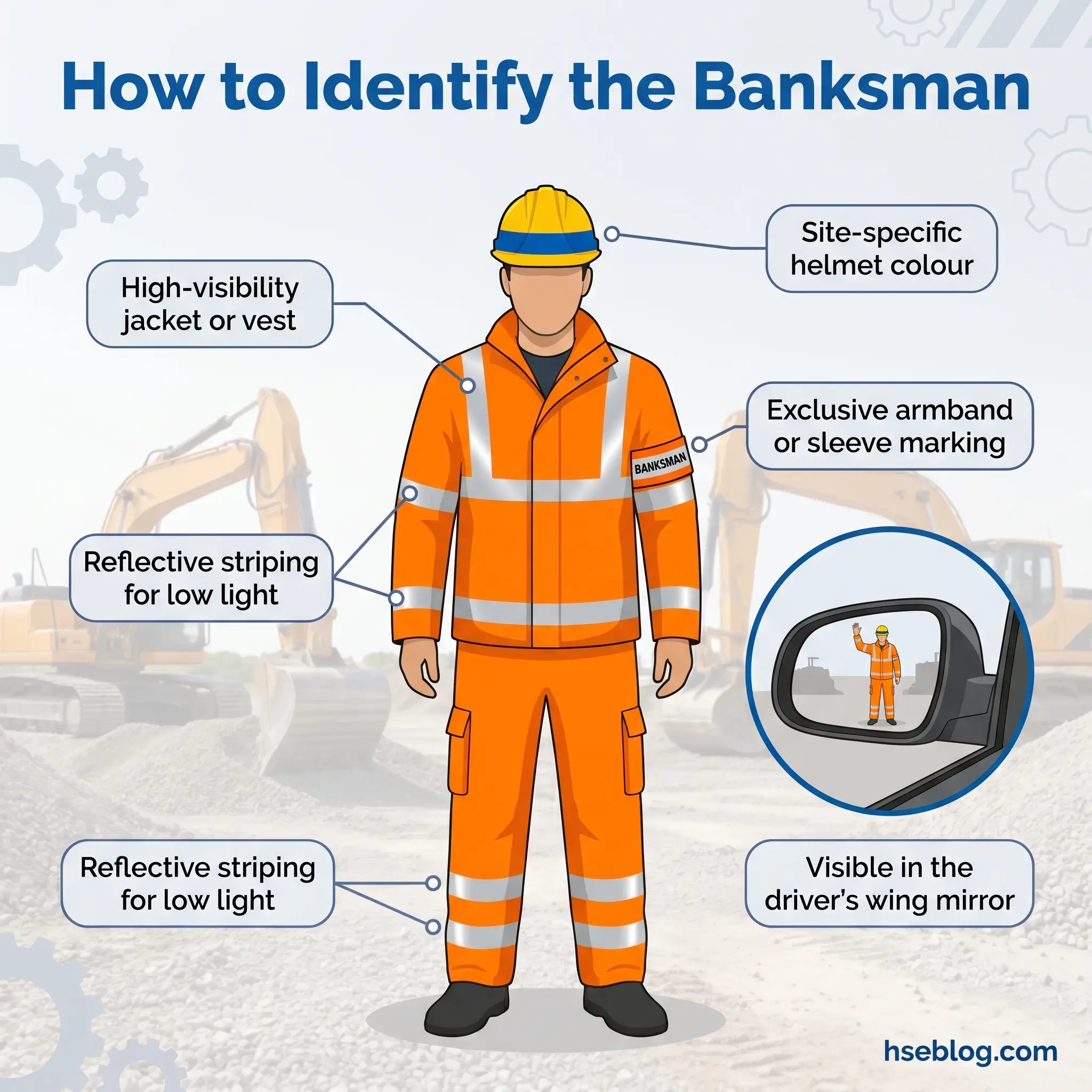
The problem that drives the identification rule is simple: in a busy worksite, a driver scanning the area from the cab has only seconds to find their banksman, and generic high-visibility clothing does not distinguish the signaller from anyone else in the same yard. The identification protocol exists so that the driver can lock onto the banksman immediately and maintain visual contact throughout the manoeuvre.
The working rules are consistent across UK practice. The banksman wears high-visibility clothing — a jacket, vest, armband, or sleeve — in a colour or marking exclusively used by banksmen on that site. On many UK construction sites, the Build UK Safety Helmet Colours standard is adopted: white helmets for site managers and vehicle marshals, orange for slinger signallers, blue for general operatives. The Build UK code is voluntary rather than statutory, and its value depends entirely on whether the site applies it consistently. Low-light and night operations require enhanced retroreflective material so the banksman remains detectable at distance under artificial or reduced lighting.
The easy failure here is adopting a colour code loosely. If the banksman wears a yellow hi-vis that every other worker on site also wears, the system is cosmetic. The distinguishing marking has to be genuinely exclusive on that site for the driver to use it as a visual anchor. And the rule the driver operates on is the same rule that governs the whole role: lose sight of the banksman, stop the vehicle.
Banksman Training and Competence Requirements
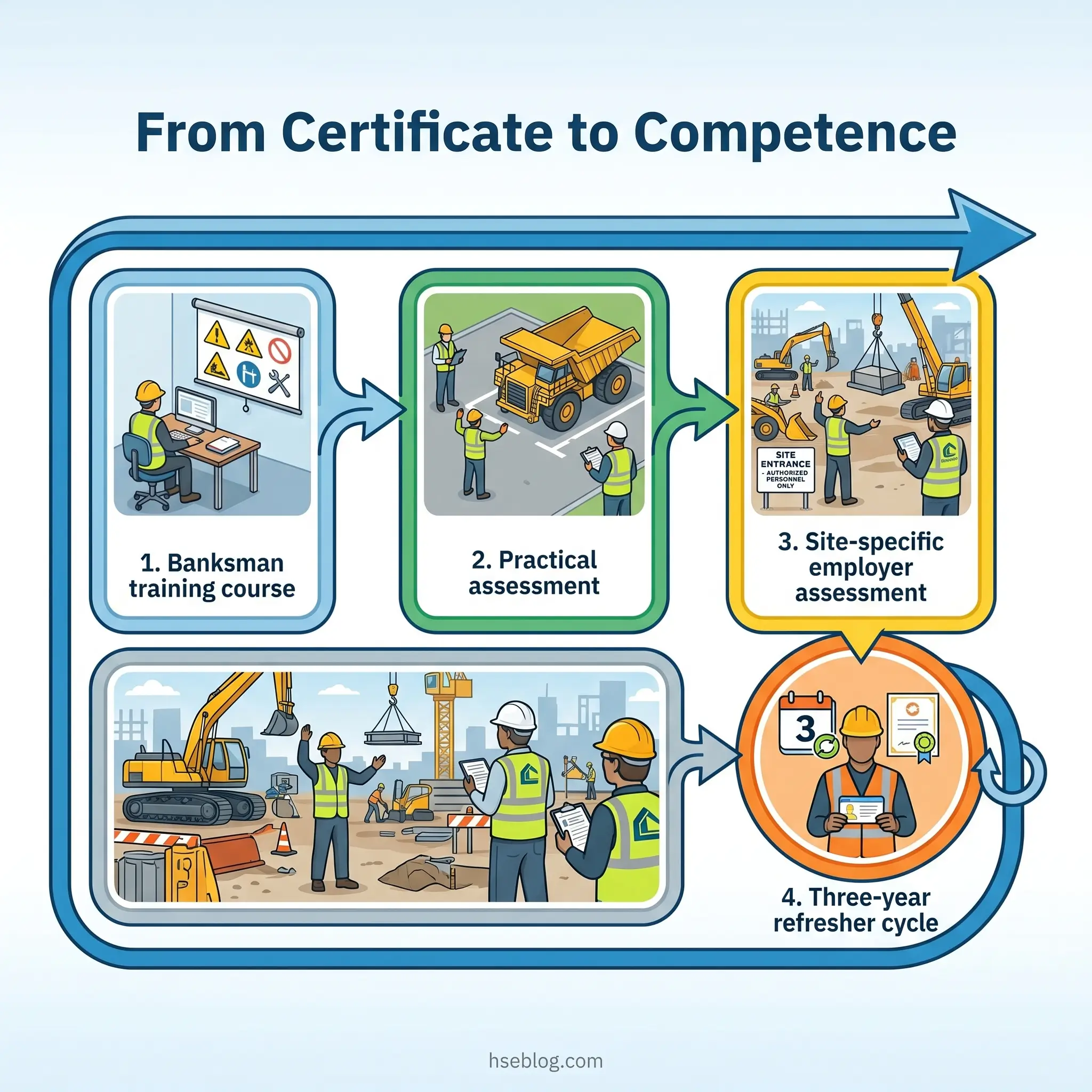
A three-year certificate is where most people stop thinking about banksman competence, and that is the wrong place to stop. Competence under UK health and safety law is a combination of theoretical knowledge, practical skill, and employer-assessed suitability for the actual work environment — not a laminated card. Online awareness training alone does not produce a competent banksman, and no course provider can substitute for the employer’s duty under the Management of Health and Safety at Work Regulations 1999 to assess that person against their specific site.
In the UK, the standard pathway is a Traffic Marshal or Banksman training course — typically half a day, delivered by a recognised provider — covering the signal set, positioning, communication protocols, and the legal framework. A practical assessment follows, and certificates generally carry a three-year validity before refresher training is required. The CSCS Green Card is often needed for construction site access but is not specifically tied to the banksman qualification; it sits alongside it, covering general construction health and safety competence. The minimum age for course enrolment is typically 16 in the UK, but active banksman duties on construction sites are generally restricted to those 18 or over.
The US framework operates under a different regulatory logic. Under OSHA 29 CFR 1926.1428, signal persons for crane operations must be qualified either by a third-party evaluator or by the employer, and must demonstrate knowledge of the Standard Method hand signals and the signal types relevant to the equipment in use. For on-site vehicle guidance outside crane operations, the term used is “spotter”; for public-highway work zones, flagger training under MUTCD Part 6 applies.
The recurring failure pattern, visible in enforcement and investigation material across jurisdictions, is treating the certificate as the endpoint. A banksman qualified on a low-traffic warehouse yard is not automatically competent on a complex construction site with excavators, cranes, and public-road interfaces — different traffic patterns, different vehicle types, different blind zones. The employer’s site-specific assessment is where that gap closes, and it is the step most commonly missed.
Legal Framework: Regulations Governing Banksman Operations
Compared across jurisdictions, the regulatory pattern becomes clearer: one set of rules defines the signals, another set imposes the duty to assess risk and deploy the signaller in the first place, and a third set governs the workplace design that either needs a banksman or does not. Understanding the chain matters because enforcement can come through any of the three doors.
In the United Kingdom, the primary framework operates through several linked instruments. The Health and Safety at Work etc. Act 1974, section 2, imposes the general duty on employers to ensure, so far as is reasonably practicable, the health and safety of their employees, including those engaged in or exposed to vehicle manoeuvres. The Management of Health and Safety at Work Regulations 1999, regulation 3, requires a suitable and sufficient risk assessment — which is where the decision to use a banksman, and the specification of the controls around them, is anchored. The Workplace (Health, Safety and Welfare) Regulations 1992, regulation 17, requires that traffic routes are organised so pedestrians and vehicles can circulate safely. And the Health and Safety (Safety Signs and Signals) Regulations 1996, Schedule 1, Part IX, together with HSE guidance L64 (third edition, 2015), prescribe the standardised hand signals themselves.
The EU framework sits behind all of this. Directive 92/58/EEC sets the minimum requirements for safety signs and signals at work, including the hand-signal set, and remains the parent standard across EU member states. Following the UK’s withdrawal from the EU, the 1996 Regulations continue to apply in Great Britain as retained law, with Northern Ireland operating under its own parallel instrument.
In the United States, the relevant provisions are split across standards. OSHA 29 CFR 1926.201 addresses flaggers and signalling for construction work zones, and OSHA 29 CFR 1926.1419 through 1428 cover crane signal person requirements under Subpart CC, with the Standard Method hand signals in Appendix A. For public-highway flagging operations, the Manual on Uniform Traffic Control Devices (MUTCD), Part 6, provides the procedural reference. The UK vehicle banksman signals and the US crane signal person signals are not competing standards — they serve different operational contexts, and readers working internationally need to apply the set that matches the operation, not a default.
Legal disclaimer: Regulatory content here reflects general HSE professional understanding of UK, EU, and US requirements as of 2026. It is not legal advice. Specific compliance questions, enforcement situations, or prosecution risk should be directed to qualified legal counsel in the applicable jurisdiction.
Common Banksman Hazards and How to Avoid Them
The fatal risk attached to the role is captured in a single category of the HSE’s injury statistics: struck by a moving vehicle. Fourteen workers died from being struck by a moving vehicle at work in Great Britain in 2024/25 (HSE, Work-related fatal injuries in Great Britain, 2025), and HSE workplace transport guidance continues to flag reversing as the single most dangerous phase — close to one in four workplace vehicle deaths occur during reversing. The banksman is positioned to prevent that outcome, which also means the banksman is positioned inside the danger zone that creates it.
The failure modes repeat across the published investigation record.
- Positioning errors. Standing in a blind spot, directly behind a reversing vehicle, or inside the swing radius of mobile plant. The 45-degree offset and wing-mirror visibility rule is the fix.
- Signal improvisation. Non-standard gestures, shortcuts between experienced crews, or signals given too quickly for the driver to read. The fix is to agree the full signal set before the manoeuvre and keep it consistent even with familiar operators.
- Exclusive-duties violations. Helping with loading, answering radios on other matters, supervising two vehicles simultaneously. The fix is the rule the regulations already state — the signalman’s duties consist exclusively of directing the manoeuvre.
- Complacency on routine work. The fifty-first reverse of the day carries the same risk as the first, but the concentration drops. The fix is a work pattern that rotates signallers on repetitive operations and does not run them for extended continuous periods.
- Adverse conditions. Low light, rain, noise, and dust erode both visibility and communication. The fix is to acknowledge the condition change in the pre-manoeuvre briefing and escalate controls — enhanced lighting, radio use, or suspension of the operation.
- Multi-vehicle conflict. Attempting to guide more than one vehicle at the same time. The rule is absolute: one banksman, one manoeuvre.
- Skipped briefing with unfamiliar drivers. Delivery drivers arriving on site carry no assumption about the site’s signals or layout. The fix is a mandatory pre-manoeuvre briefing before the vehicle moves.
Watch For: The most dangerous moment is rarely the complex lift or the tight turn the banksman has trained for. It is the routine reverse that the crew has completed many times that shift, where the “lose sight, stop work” rule is silently bypassed because nothing has gone wrong before. Reviewing near-miss reporting across workplace transport operations, complacency peaks exactly where familiarity is highest — and that is the operational moment worth engineering against, not assuming away.
Frequently Asked Questions
Conclusion
The banksman role is not a weakness most UK sites acknowledge, but it is where the workplace transport hierarchy is weakest by design. The published record keeps showing the same pattern: sites that treat the banksman as a residual control after segregation and engineering measures have been applied perform well, and sites that treat the banksman as a blanket answer to every reversing movement do not. Fourteen struck-by-vehicle fatalities in 2024/25 (HSE, 2025), with reversing implicated in close to one in four workplace vehicle deaths, is not a number a better-quality signal set is going to fix alone.
The single highest-impact change for most sites is not more banksman training, though the training matters. It is moving the decision about when to deploy a banksman further up the hierarchy — redesigning routes, separating pedestrians from vehicle corridors, and eliminating reverses before they happen. Where a banksman is genuinely needed after that work has been done, the hand signal set, the exclusivity rule, the visibility protocol, and the “lose sight, stop work” discipline are what make the control actually control the risk rather than just appear to. Banksman hand signals are the last, narrowest line of defence — they work only because everything behind them has been done properly first.