
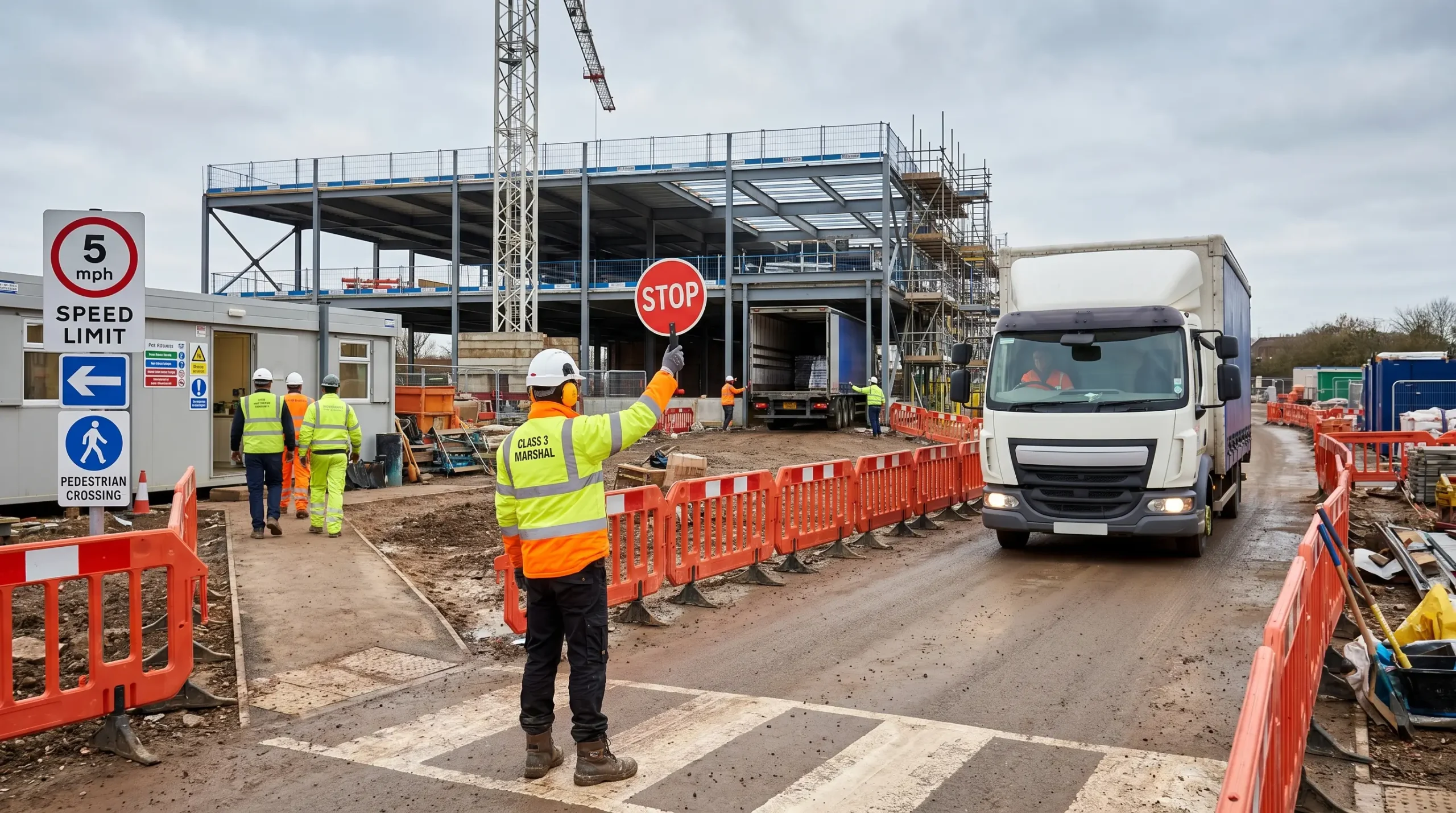
TL;DR: Traffic Management Planning by the Numbers
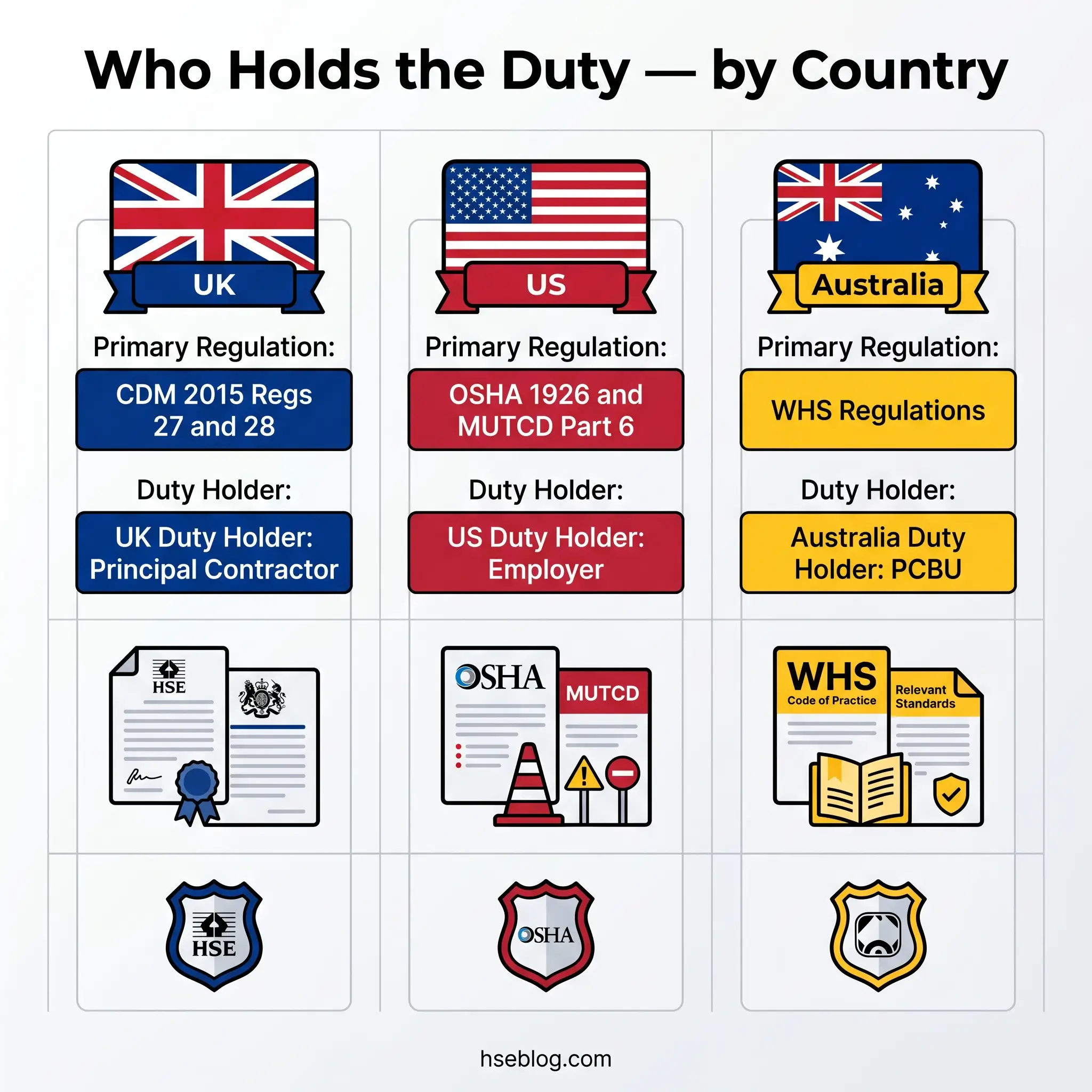
- 898 fatalities in US work zones in 2023, with an estimated 40,170 injuries (National Safety Council analysis of NHTSA FARS and CRSS data, 2024).
- 25 UK worker deaths in 2023/24 from being struck by moving vehicles — 18% of all work-related fatalities across every industry that year (HSE, 2024).
- MUTCD 11th Edition became effective January 2024; the state adoption deadline is January 2026, with Revision 1 issued December 2025 (FHWA, 2024–2026).
- UK construction fatality rate sits at roughly 4.8 times the all-industry average, with 35 worker deaths recorded in the sector in 2024/25 (HSE, 2025).
A traffic management plan for construction sites is a documented plan that identifies every vehicle and pedestrian hazard on and around the site and specifies the controls applied to each. It must include scaled site layout drawings, segregated routes, signage, delivery scheduling, named roles, emergency access, and review triggers — and must be updated as the site evolves through construction phases.
In 2023, 898 people were killed and an estimated 40,170 injured in US work zone crashes (National Safety Council analysis of NHTSA FARS and CRSS data, 2024). Across the Atlantic, being struck by a moving vehicle accounted for 25 worker deaths in Great Britain during 2023/24 — 18% of all work-related fatalities across every industry (HSE, 2024). A significant share of this toll lands on construction sites, where the written traffic management plan is meant to stand between a heavy vehicle and a person on foot.
A traffic management plan for construction sites is only as effective as the site reality it describes. Plans prepared at tender stage and never updated, segregation arrangements that collapse at the entrance gate, reversing controls that rely on a banksman who is not always present — these are the patterns driving the fatality numbers, not the absence of legal standards. This article works through what a construction site traffic management plan must contain across the UK, US, and Australian frameworks, how to develop one that operates in the field rather than the filing cabinet, and how to adapt it as the project moves through its phases.
What Is a Traffic Management Plan for Construction Sites?
A traffic management plan for construction sites is a documented framework that identifies traffic-related hazards on and around a site and sets out the controls used to manage vehicle and pedestrian movement safely. It covers every moving thing — delivery vehicles, mobile plant, passenger vehicles, workers on foot, site visitors, and where relevant, the public.
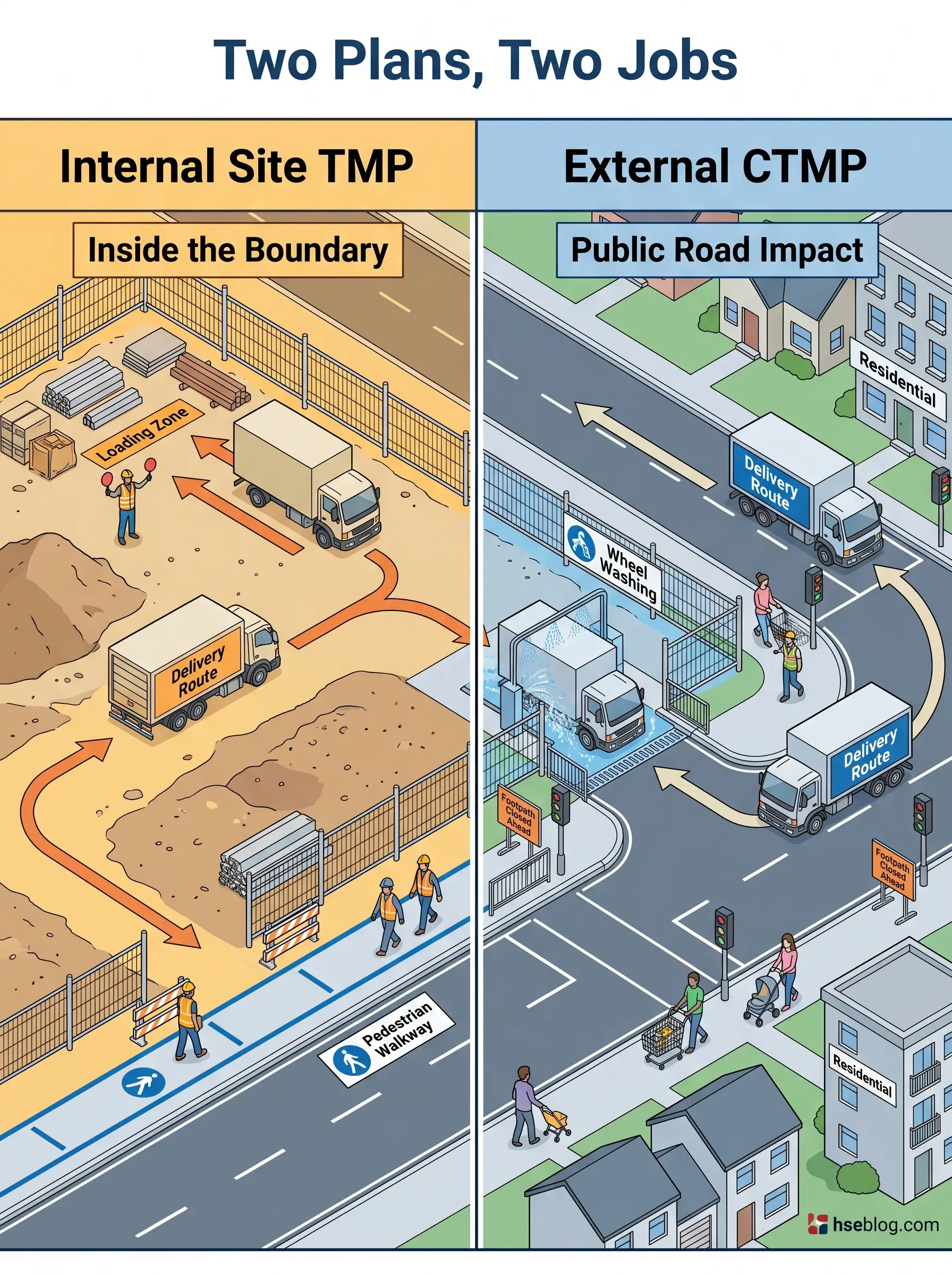
Two related but distinct documents share overlapping terminology, and confusing them is one of the most common errors on planning applications.
An internal site TMP governs vehicles and pedestrians within the construction boundary. This is the document a principal contractor uses to organise site routes, loading zones, and pedestrian walkways. A Construction Traffic Management Plan (CTMP) addresses the external impact of construction on public roads — delivery vehicle routing, wheel-washing to prevent road contamination, effects on local residents, and coordination with the local highway authority. Many projects require both, and they serve different regulatory audiences.
The plan is not a one-off deliverable. A consistent failure pattern across sites is the production of a TMP at project start that is then never updated as the site progresses through foundation, structural, and fit-out phases. The plan the site staff are meant to work to stops reflecting the site they actually see. Reviewing published construction enforcement decisions, the TMP-on-paper-but-not-on-site gap recurs repeatedly.
This article provides general HSE knowledge. Traffic management on construction sites is life-critical work. The plan must be developed or reviewed by a competent person with relevant training, jurisdiction-specific authorisation, and site-specific risk assessment. Recognised training pathways include NEBOSH, IOSH, OSHA outreach, and equivalent regional programmes. The information here does not replace that planning or training.
Why Construction Site Traffic Management Plans Save Lives
Struck-by-vehicle incidents are consistently among the top causes of construction fatalities in every jurisdiction that publishes credible data. Being struck by a moving vehicle caused 25 worker deaths in Great Britain during 2023/24 — 18% of all work-related fatalities across every industry that year (HSE, 2024). In the United States, an average of 54 worker-pedestrians are killed per year after being struck by vehicles in work zones (Bureau of Labor Statistics, Census of Fatal Occupational Injuries, reported by NSC, 2025). In 2023 alone, 176 pedestrians were struck and killed inside a US work zone, counting both workers and members of the public (NHTSA FARS data via the Work Zone Safety Information Clearinghouse, 2024).
UK construction fares particularly badly in aggregate. The sector recorded 35 worker fatalities in 2024/25, accounting for 28% of all worker deaths despite employing approximately 6% of the workforce — a fatality rate of roughly 1.92 per 100,000 workers, about 4.8 times the all-industry average (HSE, 2025).
Reviewing the pattern across investigation reports, reversing vehicle incidents dominate the fatality record. Most are preventable with basic one-way systems and banksman protocols — controls that appear in almost every written TMP. The controls exist on paper; they fail because nothing on site physically enforces them when the delivery driver is under time pressure and the banksman has been reassigned to another task. That is the gap between a compliant document and a compliant site.
Regulatory Requirements by Jurisdiction
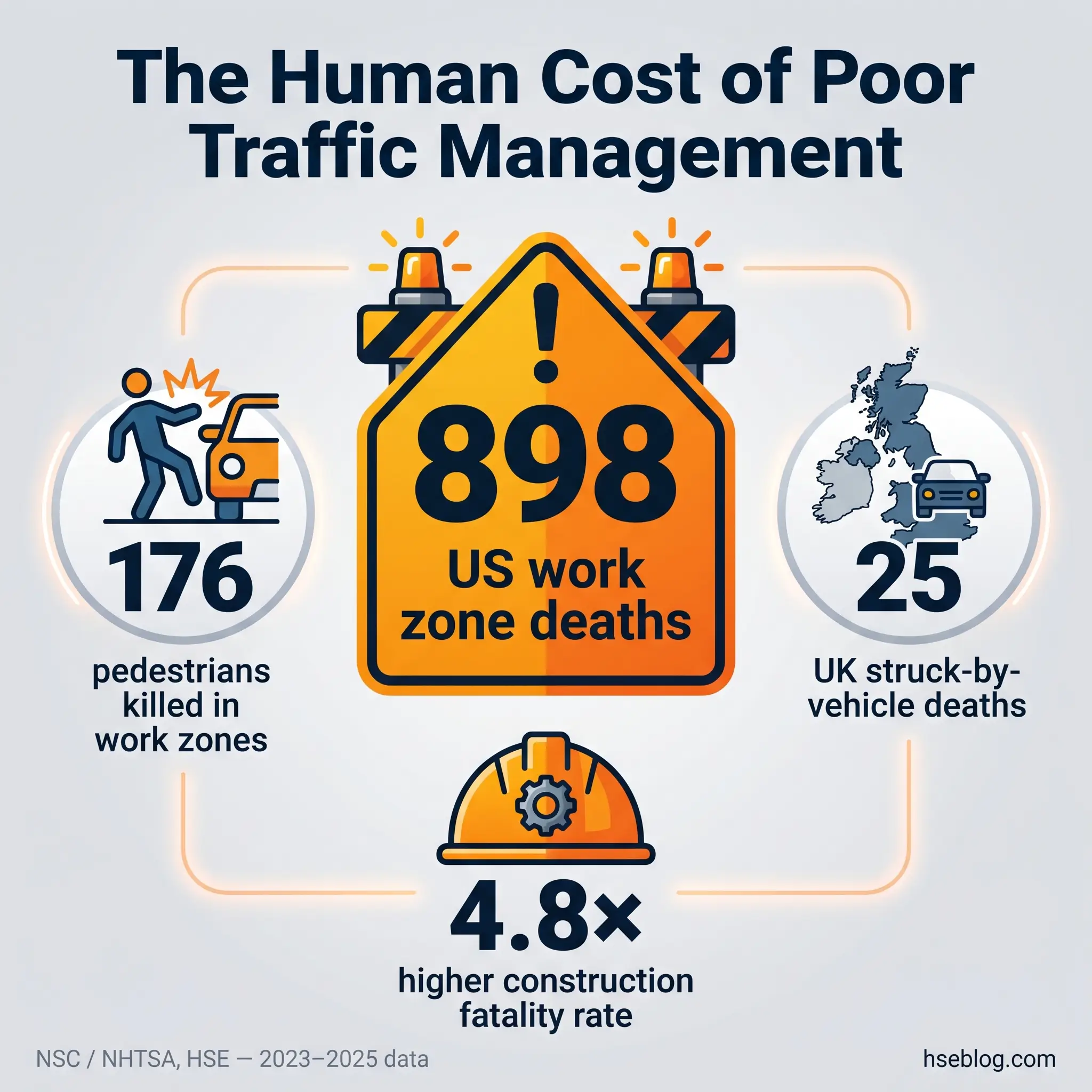
Duty-holder structures, enforcement mechanisms, and documentation requirements differ materially across jurisdictions. Multinational contractors that apply UK CDM assumptions to US projects — or the reverse — consistently struggle at audit. The sections below cover the three most frequently encountered frameworks.
UK: CDM 2015 and HSE Guidance
Under the Construction (Design and Management) Regulations 2015, the principal contractor holds the organising duty for traffic management on site. Regulation 27 of CDM 2015 requires construction sites to be organised so that pedestrians and vehicles can move without risks to health or safety, so far as is reasonably practicable (UK). Regulation 28 addresses vehicles specifically — requiring safe driving, appropriate loading, and measures against unintended movement (UK).
The practical reading of these clauses on most UK sites is that the principal contractor must produce traffic management arrangements within the construction phase plan, and those arrangements must be site-specific rather than template-based. The Workplace (Health, Safety and Welfare) Regulations 1992, Regulation 17 reinforces the underlying duty for every workplace, not only construction (UK). HSE guidance HSG144 (The Safe Use of Vehicles on Construction Sites) provides the detailed implementation reference most auditors expect to see cited, with the HSE’s construction transport topic page acting as the hub for current guidance and alerts.
US: OSHA Standards and the MUTCD
The US framework splits across two standards that govern different situations. OSHA 1926 Subpart G (Signs, Signals, and Barricades) defers to Part 6 of the Manual on Uniform Traffic Control Devices (MUTCD) for temporary traffic control on roadways, including signs, channelising devices, barriers, flagging, and pedestrian accommodation (US). OSHA 1926 Subpart O (Motor Vehicles, Mechanized Equipment, and Marine Operations) covers vehicles operating on the interior of construction sites (US). OSHA’s highway work zones hub links to the current federal standards, MUTCD reference, and NIOSH guidance.
The MUTCD 11th Edition became effective in January 2024 — the first full federal revision since 2009 — with Revision 1 issued in December 2025 and the state adoption deadline set for January 2026 (FHWA, 2024–2026). The updated Part 6 strengthens protections for vulnerable road users in work zones and expands pedestrian accommodation requirements. US sites still operating to the 2009 edition should confirm their state’s adoption timeline and update signage and control plans accordingly.
Jurisdiction Note: In the US, “traffic control” on a public highway or road work zone is governed primarily by the MUTCD via OSHA 1926 Subpart G. Interior site vehicle operations — plant, forklifts, delivery movements within the site boundary — fall under Subpart O. Treating the two as interchangeable leaves audit gaps and can leave roadway work zones under-specified.
Australia: WHS Regulations and Safe Work Australia Guidance
In the Australian Work Health and Safety (WHS) framework, the Person Conducting a Business or Undertaking (PCBU) must eliminate or minimise traffic risks so far as is reasonably practicable. Traffic management arrangements must form part of the WHS management plan for construction work. Safe Work Australia’s Traffic Management Guide for Construction Work (April 2021) sets out the practical expectations and is the reference most regulators work from (Australia). Workers must be given suitable information, instruction, training, and supervision on the traffic management plan.
The hierarchy of controls applies explicitly: eliminate the hazard where possible (remove the interaction between vehicles and pedestrians), then substitute, engineer, administratively control, and finally rely on PPE. Plans that skip straight to high-visibility clothing and a banksman without documenting why higher-order controls were not reasonably practicable typically fail WHS audit scrutiny.
Key Components of a Construction Site Traffic Management Plan
The most common gap between an audit-compliant plan and an effective one is not a drafting error — it is a missing component. Auditors across UK, US, and Australian frameworks look for the same defined set of elements. The difference between a plan that holds up and a plan that doesn’t is usually the detail behind each element, not the list of headings.
- Site layout and traffic routes. Scaled drawings showing all vehicle routes, one-way systems, turning circles, speed limits, and any areas excluded to vehicles. Routes must be sized for the largest vehicle that will use them, including abnormal loads and mobile cranes.
- Vehicle and pedestrian segregation. Documented separation of routes with physical barriers wherever reasonably practicable, with designated crossing points where routes must intersect.
- Signage, barriers, and physical controls. Specific sign types, placement locations, and barrier specifications. US sites cross-reference MUTCD Part 6; UK sites work from HSG144.
- Delivery scheduling and loading zones. Booked delivery windows, designated loading and unloading areas, waiting arrangements that prevent queuing onto public roads.
- Parking arrangements. Separate provision for workers, visitors, and operational vehicles — typically located away from active work areas.
- Roles and responsibilities. Named roles for site manager, traffic marshals, banksmen, and delivery liaison. Competency requirements defined for each.
- Emergency vehicle access. A maintained route from the gate to any point on the site, kept clear of storage and obstruction at all times.
- Visitor and subcontractor induction. Required briefing content, record-keeping, and refresher triggers.
- Communication protocols. Toolbox talks, briefings for visiting drivers, and site radio or mobile protocols during coordinated lifts or abnormal deliveries.
- Review and update schedule. Specific review dates and — critically — event-based triggers.
The most commonly missing component is the review trigger. Most plans specify monthly or phase-based reviews; far fewer specify event-based triggers such as crane erection, scaffold placement, excavation that changes vehicle routes, or changes in subcontractor density. Those are the events that typically invalidate an existing plan, and they need to be written into the review schedule rather than left to judgement in the moment.
How to Develop a Traffic Management Plan: Step-by-Step Process
Plans developed reactively, after site work has started, struggle to retro-fit segregation into an already-congested site. The development process below starts in the pre-construction phase, when decisions are still cheap to reverse. The sequence assumes the work is led by a competent person — an HSE professional, a qualified site manager, or an external specialist.
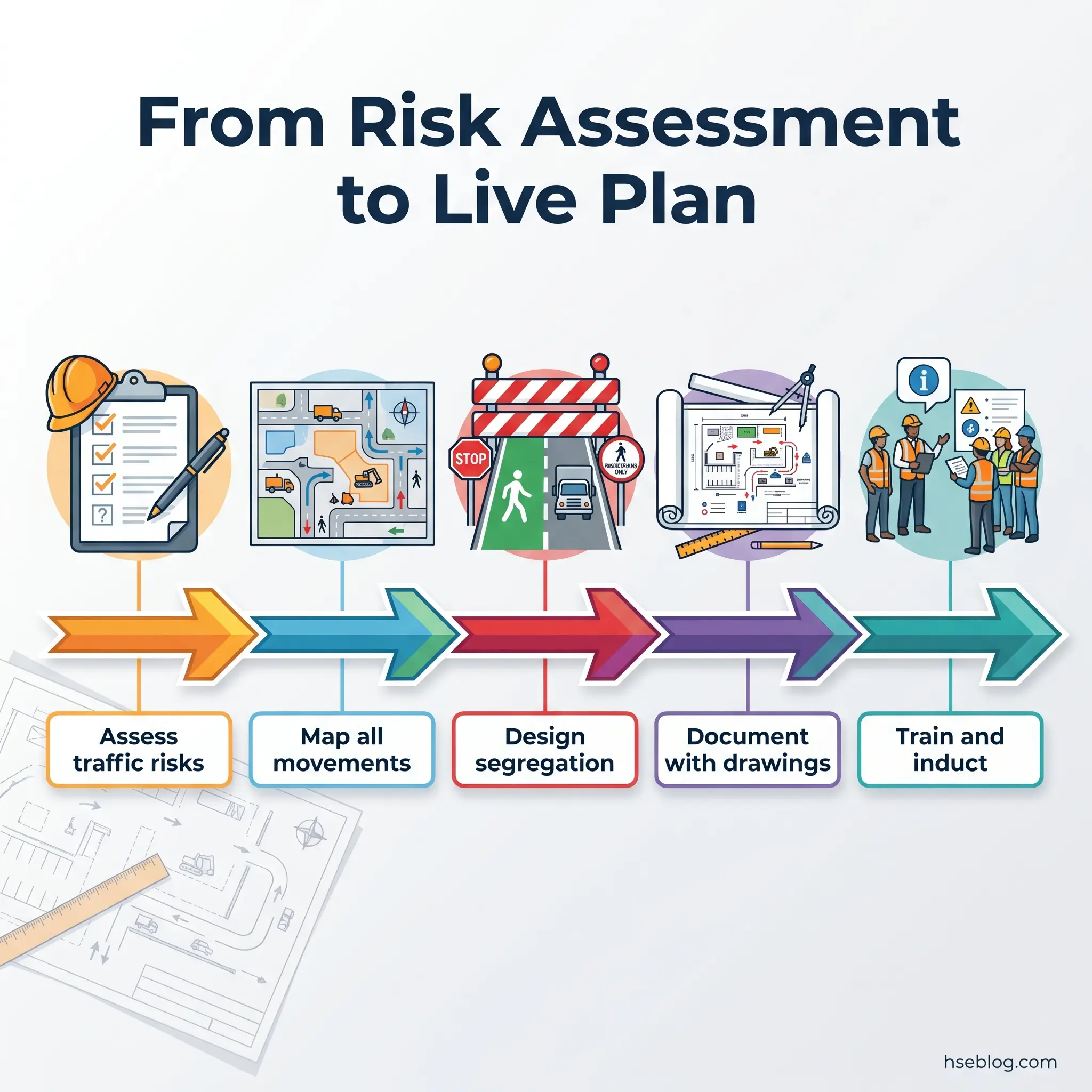
- Conduct a site-specific risk assessment for traffic hazards. Identify every anticipated vehicle type, pedestrian interaction, and external interface (public road access, neighbouring properties). Risk-rank each interaction.
- Map all anticipated movements. Delivery vehicles, mobile plant, workers on foot, visitors, members of the public where relevant. Map temporal patterns too — shift changes, delivery windows, break periods.
- Design segregation. Separate vehicle and pedestrian routes wherever reasonably practicable. Where full separation is not possible, specify crossing points, speed restrictions, and banksman controls.
- Select and specify traffic control devices. Signs, barriers, markings, and lighting — with reference to MUTCD Part 6 (US), HSG144 (UK), or the applicable jurisdictional standard.
- Define roles, responsibilities, and competency requirements. Name people or positions — not job titles alone. Specify training and authorisation requirements for each role.
- Document the plan with scaled site layout drawings. A plan without drawings is not a plan; it is a statement of intent. Drawings should be at a scale that shows individual route widths, crossing points, and sign locations.
- Communicate, train, and induct all site personnel. Induction, toolbox talks, visitor briefings. Record attendance.
- Implement monitoring, review, and update procedures. Set the review cadence and event triggers. Assign responsibility for updates.
The most effective plans are developed during the pre-construction planning phase and integrated with the logistics plan and construction programme. Plans developed after work has started face a structural problem: the site is already congested, and retro-fitting segregation means demolishing temporary arrangements that have become entrenched and costly to undo.
Vehicle and Pedestrian Segregation: The Critical Control
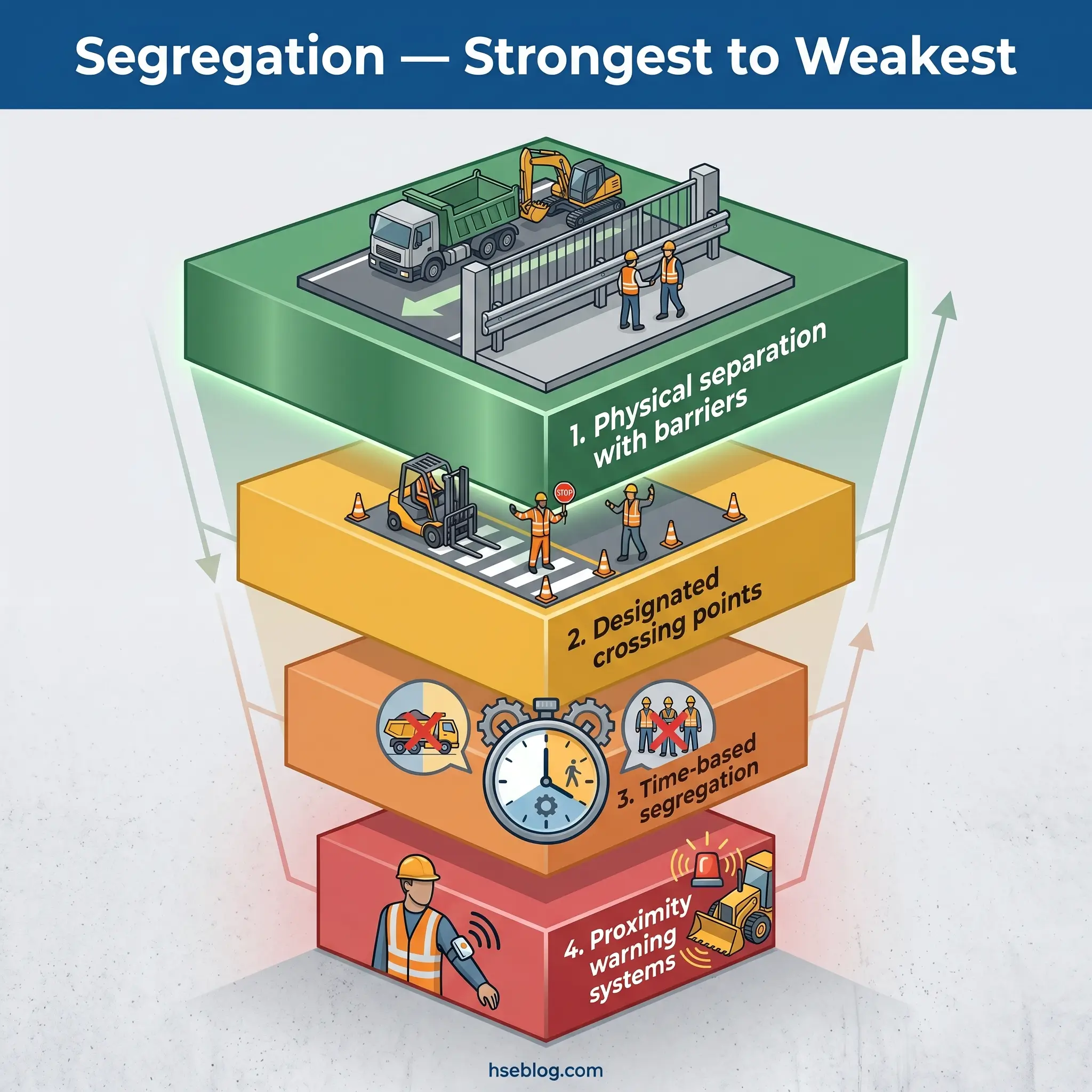
Segregation is the single most effective control for preventing struck-by fatalities. It sits at the top of the hierarchy of controls because it eliminates the interaction itself rather than managing it. When regulators cite duty holders after a fatality, the citation frequently turns on segregation — specifically, on the absence of it where it was reasonably practicable.
Complete physical segregation — separate vehicle and pedestrian routes divided by barriers — is the preferred approach. Pedestrian routes should follow natural desire lines; routes that force a worker to detour around a barrier will not be used consistently, and inconsistent use defeats the control.
Where full segregation is not achievable, the next layer combines designated crossing points, banksmen at high-risk points, and time-based segregation — for example, restricting vehicle movements during shift changes. Proximity warning systems, reversing cameras, and audible alarms add an engineered layer but do not substitute for physical separation.
Watch For: The most frequent point of segregation failure is not in the interior of the site — it is at the interface with the public highway. The entrance and exit point is where delivery vehicles, workers on foot, and public pedestrians converge in a narrow zone, often through a single-lane gate. Plans that focus segregation inside the hoarding and treat the gate as an afterthought create the most dangerous single location on the project.
HSE UK enforcement decisions make the cost of segregation failure concrete. Six-figure fines following struck-by fatalities tied to segregation failures are routine rather than exceptional in the published prosecution record. The cost of physical segregation — barriers, additional signage, a dedicated pedestrian gate — is a fraction of the cost of a fatality investigation, prosecution, and reputational damage.
Managing Reversing Vehicles on Construction Sites
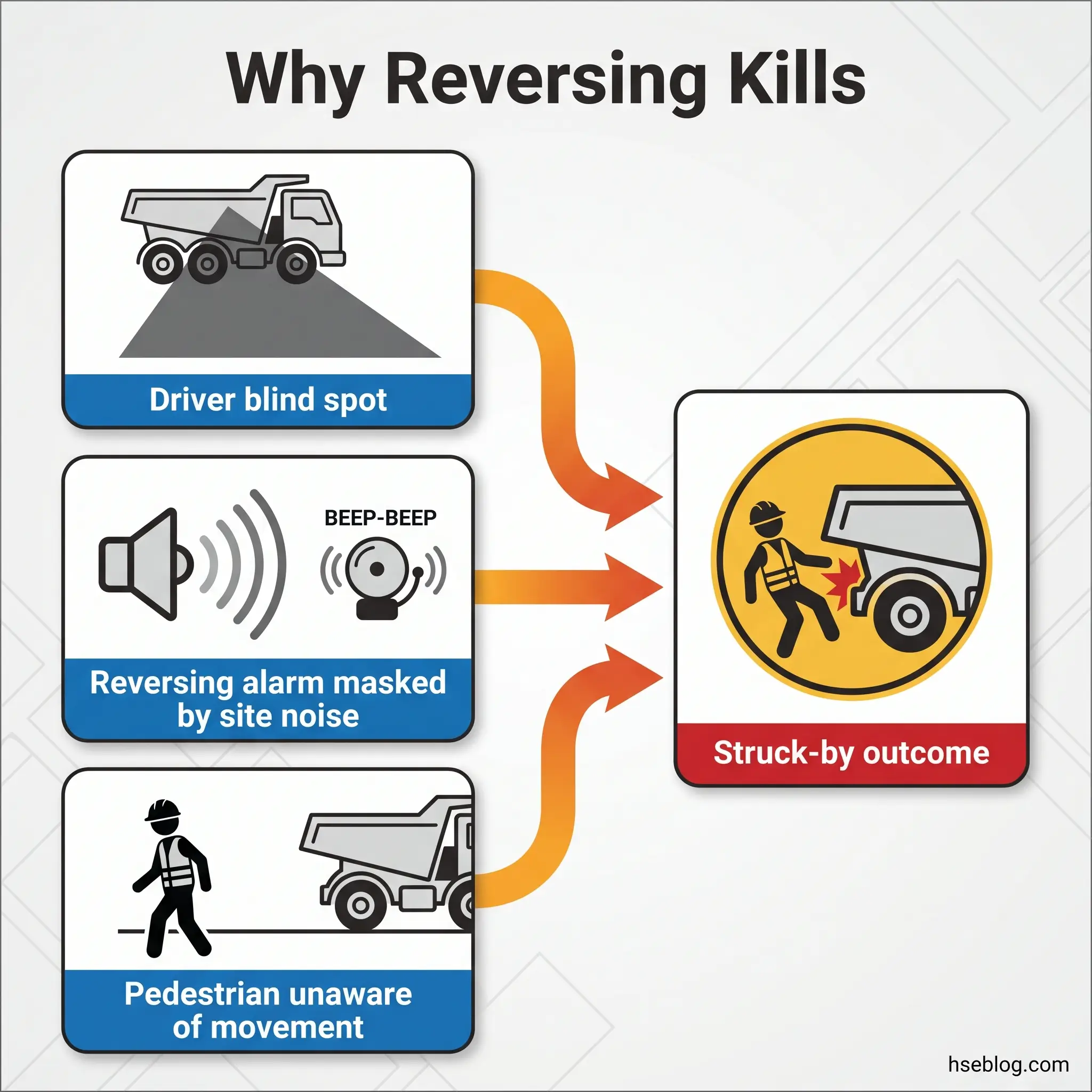
Reversing vehicles are disproportionately represented in construction fatality records. The hazard mechanism compounds three factors: the driver’s blind spot behind the vehicle, noise masking (reversing alarms lost against site noise), and pedestrians who assume vehicles will not reverse into them. Any one of these alone is often survivable; the combination is what kills.
The hierarchy for managing reversing runs in three tiers. First, eliminate the need to reverse — design one-way traffic routes, provide drive-through loading areas, and size turning circles for the largest expected vehicle. Second, reduce reversing where elimination is not practicable — minimise the number of reversing movements and the distances involved. Third, manage the residual risk — trained banksmen with defined communication signals, reversing cameras, radar-based proximity systems, and audible alarms.
A common planning error catches out otherwise-competent teams: one-way systems designed for standard articulated delivery vehicles but not checked against abnormal loads, concrete pumps, or mobile cranes. Those vehicles cannot navigate turning circles sized for standard HGVs and end up reversing — often into the busiest part of the site, because the plan didn’t anticipate their movement pattern. Route design must account for the full vehicle range that will access the site.
Banksman training is another point where plans and reality diverge. In the UK, CPCS and CSCS card schemes provide recognised training routes. In the US, there is no single federal training standard for banksmen — responsibility sits with the employer under OSHA, with flagger certification governed separately under MUTCD Part 6 where public roads are involved. Competent, in both contexts, means trained, authorised, and actually deployed. A banksman on the org chart who is pulled off to drive a forklift whenever deliveries arrive is not a control.
Adapting the Traffic Management Plan Through Construction Phases
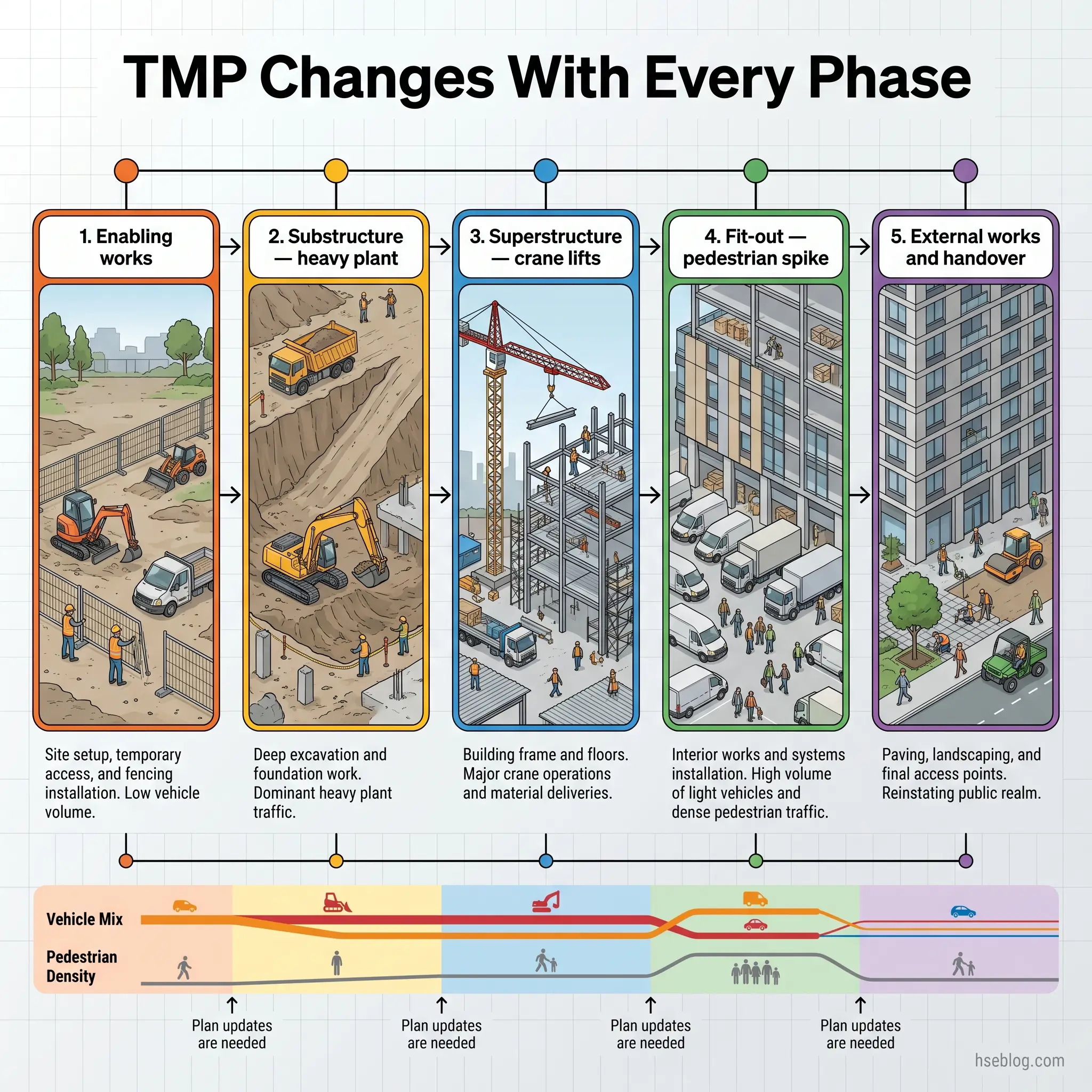
Traffic management arrangements that work during substructure will not work during fit-out. Each construction phase changes the site layout, the vehicle mix, and the pedestrian density. Plans that treat the TMP as a single static document — prepared once at construction phase plan stage and never revised — are working to a plan that no longer describes the site.
Enabling works phase. Site clearance, temporary access road establishment, perimeter fencing. This is when initial traffic routes are set and the foundation for later phases is laid. Mistakes made here — undersized turning circles, entrance points in the wrong location — are expensive to correct later.
Foundation and substructure phase. Heavy plant dominates — excavators, dump trucks, concrete trucks, piling rigs. Deep excavations constrain available route width. Pedestrian density is typically lower because fewer trades are mobilised, but vehicle mass is at its highest.
Superstructure phase. Tower cranes and material hoists take over as primary material movement, reducing some ground-level HGV activity but introducing lift zones that must be kept clear. The workforce grows as steel, concrete, and MEP trades mobilise. Pedestrian routes need to work around crane lift radii.
Fit-out and finishing phase. Pedestrian numbers spike as multiple subcontractors mobilise simultaneously. Delivery vehicles are smaller but more frequent, often on tight time windows. This is the phase that catches most sites off-guard — the physical layout has been optimised for structural work with wide vehicle routes and minimal walkways, and the TMP needs to invert its emphasis from vehicle flow to pedestrian flow.
External works and handover. Reinstating public pavements and roads, decommissioning temporary arrangements, reopening routes to the public. The CTMP — the external construction traffic management plan — is most active here as the site transitions back to normal use.
The transition that catches teams most often is superstructure to fit-out. Pedestrian volumes rise sharply; the site is still laid out for vehicles; the plan hasn’t been updated. Event-based review triggers (covered earlier in Key Components) are the mechanism for catching this — and the reason they belong in every plan.
Technology and Innovation in Construction Traffic Management
Technology layered onto physical controls strengthens traffic management; technology offered as a substitute for physical controls weakens it. That distinction runs through every technology decision.
Vehicle proximity warning systems — typically using RFID, ultra-wideband (UWB), or magnetic field detection — alert drivers when a pedestrian wearing a tag approaches the vehicle, and vice versa. They are most effective in situations where segregation is genuinely impractical, such as around excavators in deep excavations. CCTV and real-time monitoring support traffic flow observation and post-incident review. GPS tracking and telematics capture vehicle movement data that feeds into route optimisation and near-miss investigation.
BIM-based pre-construction traffic planning is increasingly common on larger projects. Modelling vehicle swept paths against the planned site layout identifies clashes before barriers are installed. IoT-enabled wearables add another detection layer for workers around mobile plant. Drone surveillance supports large or complex sites where visual oversight of the whole site is otherwise impractical.
The risk with every one of these tools is the same: sites adopt proximity warning systems and then relax the physical barriers because the technology “catches” approaches. Technology should be an additional layer, not a replacement for segregation. Reviewing published incident investigations involving proximity systems, the failure mode is almost always the system being partially deployed, not working as specified at the moment of the incident, or workers not wearing their tags.
What Does a Good Traffic Management Plan Look Like?
The difference between a plan that protects workers and a plan that protects a compliance file is rarely visible on paper. It shows up in the site itself.
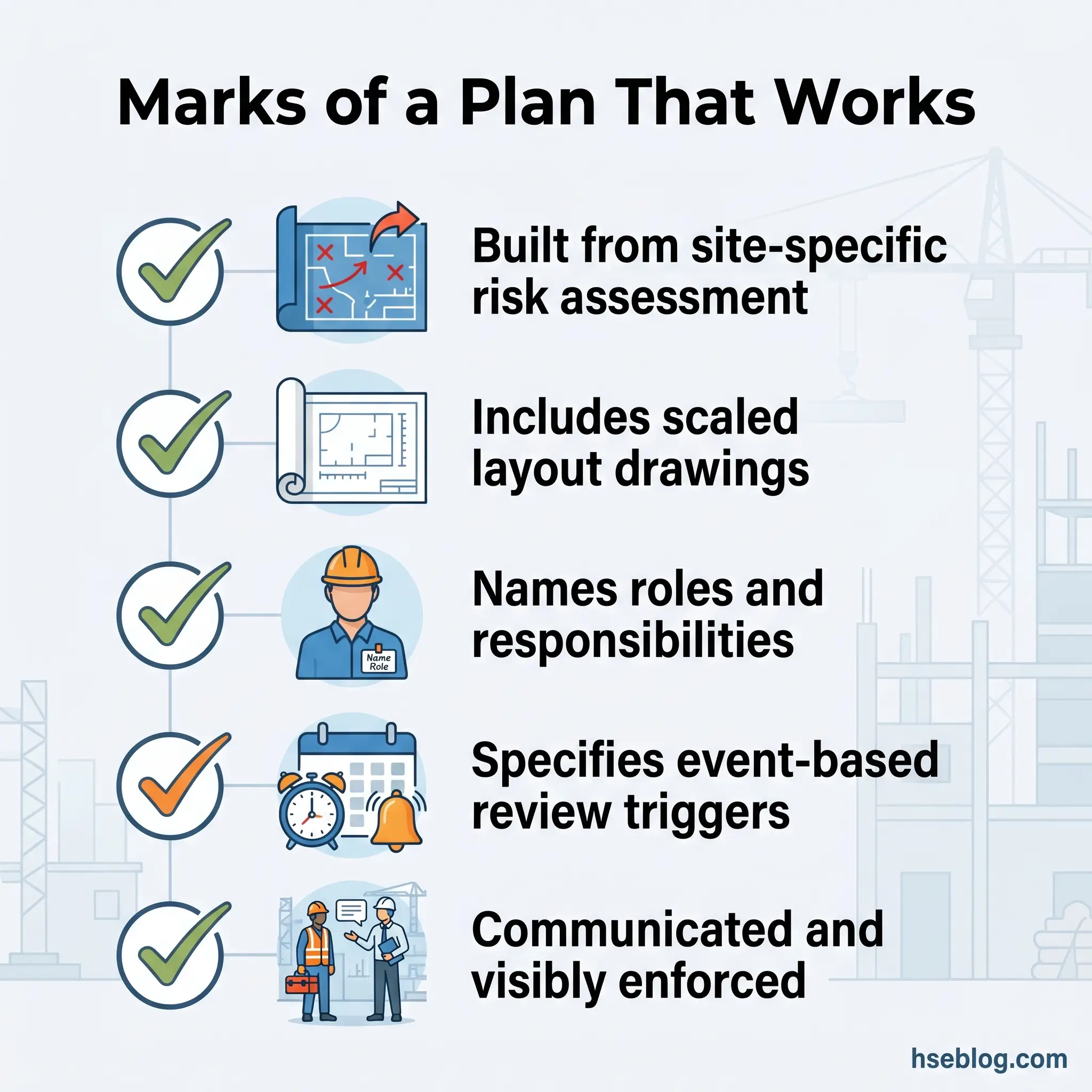
The characteristics that separate an effective plan from a compliance-only document are consistent across jurisdictions. The plan is built from a site-specific risk assessment rather than a template with the project name changed. It includes scaled site layout drawings showing routes, segregation, signage, and emergency access. It assigns named roles and responsibilities, not generic job titles. It specifies review triggers — both dates and events. It has been communicated to all site personnel through induction and ongoing briefings. And it is visibly enforced, with documented consequences for non-compliance.
Field Test: Could a visitor arriving on site for the first time navigate from the main gate to the site office without encountering an uncontrolled vehicle movement? If the honest answer is no, the plan has a gap — usually at the gate itself, usually in the pedestrian route, and usually because the plan was written for deliveries rather than for people arriving on foot.
For teams looking for a practical starting template, the HSA’s construction site traffic management plan tool provides a fillable structure that maps closely to what UK and Australian auditors also expect. The template is not a substitute for a competent person’s site-specific judgement — but it is a useful structural benchmark for teams building a plan for the first time.
Frequently Asked Questions
Conclusion
Traffic management on a construction site is not a paperwork exercise. The written plan earns its keep when it matches the site, is visibly enforced, and is updated when the site changes. Three decisions separate plans that protect people from plans that protect a compliance file. Build segregation in from the earliest phase and defend it through every layout change. Specify event-based review triggers alongside calendar-based ones — crane erection, scaffold placement, and phase transitions invalidate more plans than the calendar does. Treat technology as a supplement to physical controls, never a replacement.
The human cost sits behind each of the statistics at the top of this article. In 2023, 898 people died in US work zones; in Great Britain, being struck by a moving vehicle remains among the largest causes of work-related deaths. Every one of those fatalities maps to a traffic management arrangement that existed on paper but failed in the field. A traffic management plan for construction sites is the barrier between a vehicle and a person on foot — and it only works when the site looks like the drawing.