
TL;DR
- What is a safety culture maturity model? A staged framework that locates where an organisation’s safety culture sits today and maps a route toward shared ownership of safety.
- What are the stages? Most models use five — pathological, reactive, calculative, proactive, generative — describing the shift from indifference to safety being embedded in everyday work.
- Which model should you use? No single one is “best.” Hudson’s five-rung ladder gives the most diagnostic detail; DuPont’s four-stage Bradley Curve is simpler to communicate.
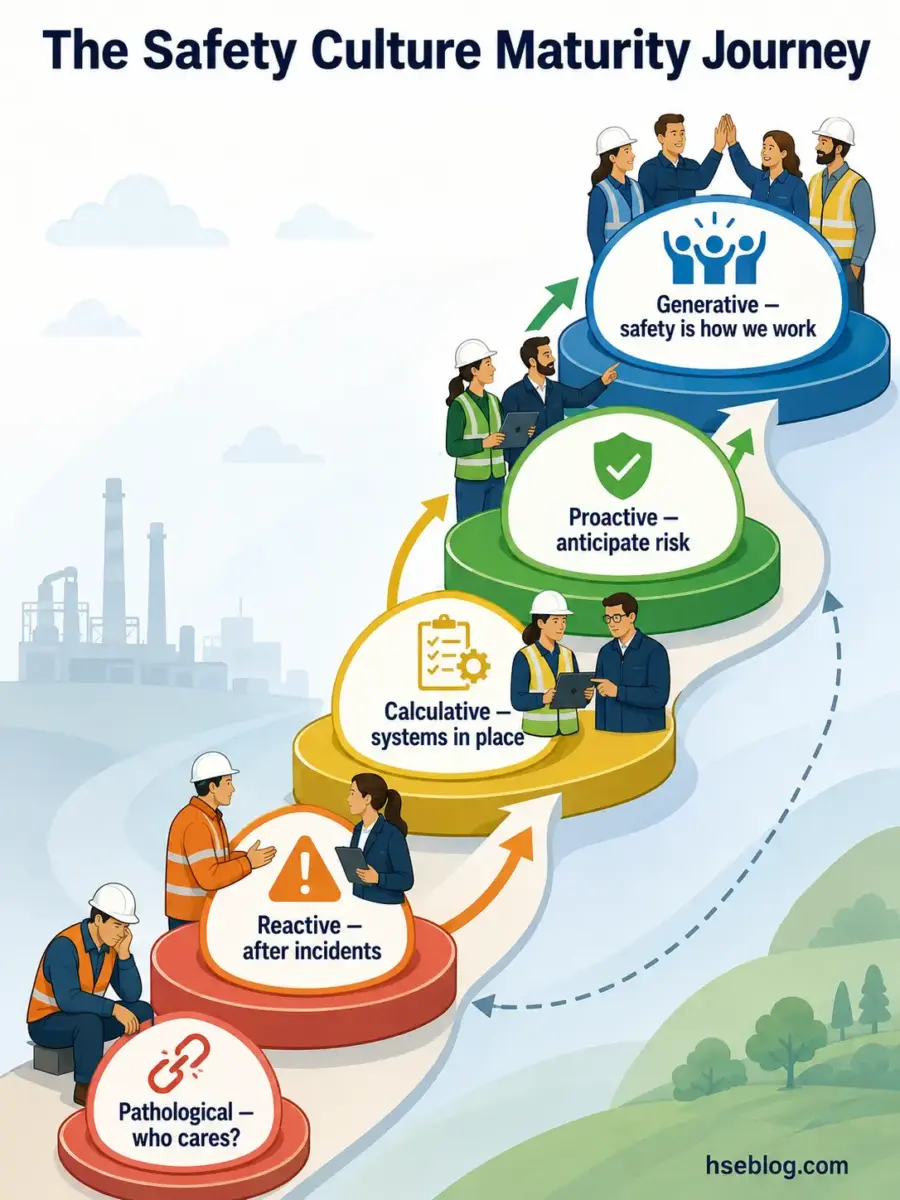
A safety culture maturity model describes how an organisation’s safety culture evolves through sequential stages — most commonly five: pathological, reactive, calculative, proactive, and generative. Each stage reflects a deeper level of leadership commitment, worker ownership, and open reporting, progressing from indifference toward safety being fully embedded in everyday work.
On 6 July 1988, the Piper Alpha platform in the North Sea was destroyed by a series of explosions and fire, killing 167 people (Cullen Inquiry / HSE historical record, 1990). The subsequent inquiry did not point to a single faulty valve so much as to a way of working — permits handled loosely, warnings normalised, communication that failed when it mattered most.
That disaster is widely credited with pushing researchers, including Patrick Hudson and Dianne Parker, toward a structured way of describing how organisations think about risk. A safety culture maturity model is the result: a diagnostic tool that names the level a culture has reached and shows what the next level demands. This article walks the five stages, maps the competing models onto one another, explains how to run a safety maturity assessment, and — the part most guides skip — sets out where the research says these models fall short.
What Is a Safety Culture Maturity Model?
A safety culture maturity model is a staged framework describing how an organisation’s collective attitudes, behaviours, and systems around safety evolve over time. Its job is diagnostic and developmental: tell you where you are, then show you the rung above.
The concept did not appear in a vacuum. “Safety culture” was first formally named by the International Atomic Energy Agency after the 1986 Chernobyl disaster, and the IAEA’s work on safety culture still anchors the field. The UK’s ACSNI definition (1993) and James Reason’s research on organisational accidents gave it shape; the maturity ladders followed.
A point worth fixing early, because it is the most common misconception I see among teams adopting one of these frameworks:
- It is not a scorecard to win. The value is not the number you land on — it is the structured conversation the assessment forces between leadership and the workforce about why the culture sits where it does.
- It is not a compliance certificate. A maturity model is a diagnostic and developmental tool, not assurance of legal compliance or incident prevention.
- A self-assessed “level” is not a regulatory status. No inspector recognises “we’re at proactive” as a defence. Maturity describes culture, not legal duty.
That last distinction matters more than it sounds. Organisations that treat the model as a thing to score rather than a mirror to look into tend to stall — a pattern the HSE’s guidance on organisational safety culture implicitly warns against by stressing the underlying factors over the label.
What Are the Five Stages of Safety Culture Maturity?
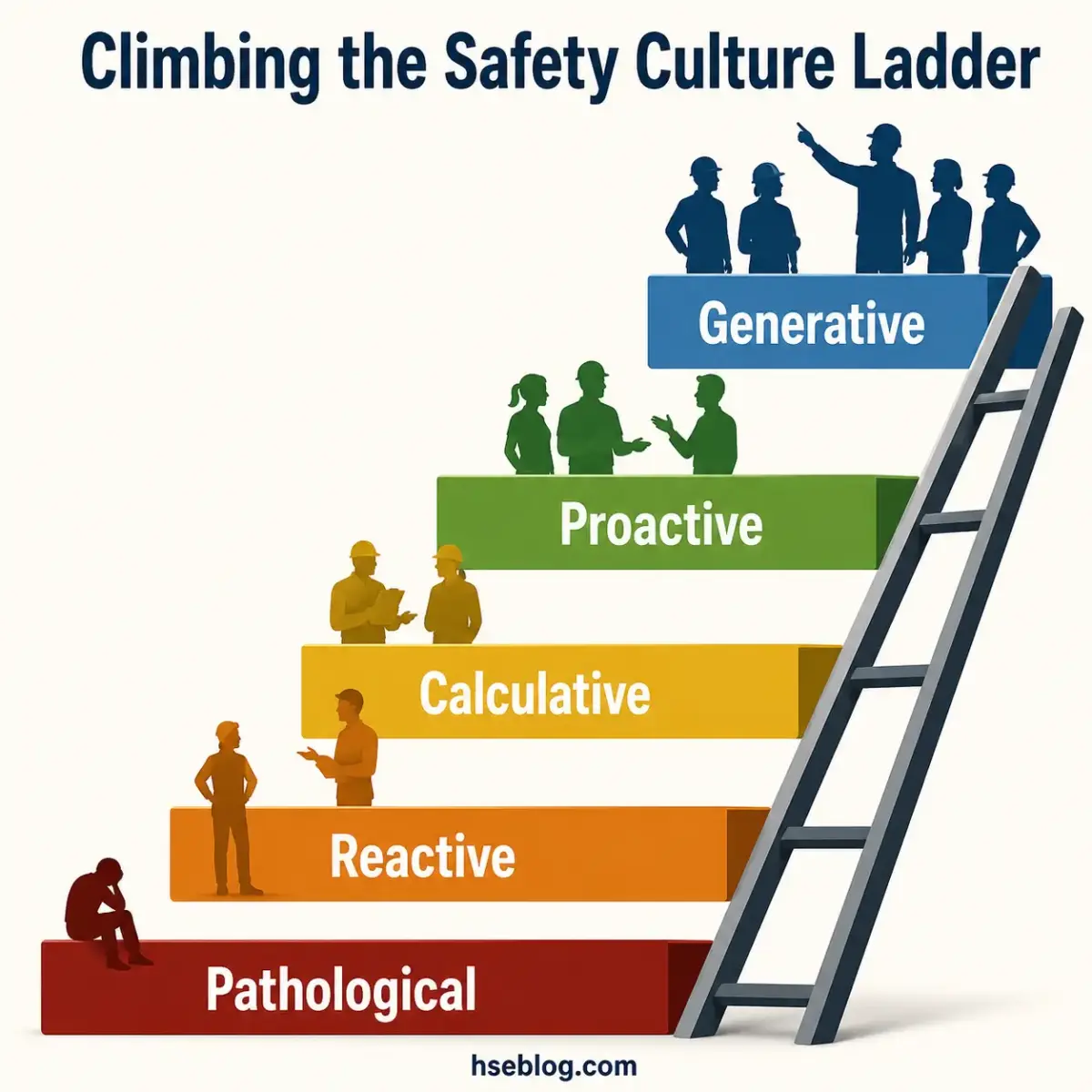
The five stages of safety culture maturity, in order, are pathological → reactive → calculative → proactive → generative — Hudson and Parker’s safety culture ladder, built on Ron Westrum’s earlier three-type typology. Hudson renamed Westrum’s middle “bureaucratic” type to “calculative,” giving the widely taught five-rung version.
Each rung is best read through four behaviours: how leadership thinks, how workers act, how information flows, and how incidents are treated.
- Pathological — “Why waste time on safety?” Leadership sees safety as a cost and a brake. Workers cut corners because that is what gets rewarded. Bad news is buried; incidents are blamed on the individual nearest the event.
- Reactive — “We act when something goes wrong.” Safety gets attention only after an incident. Effort spikes after accidents and decays in the quiet periods. Reporting exists but is largely lagging — counting injuries after the fact.
- Calculative — “We have systems for everything.” Procedures, audits, and metrics are extensive and well documented. The danger here is mistaking the paperwork for the culture, which I’ll return to below.
- Proactive — “We try to anticipate problems.” Leading indicators are tracked. The workforce is involved in spotting hazards before they bite, and management invests ahead of incidents rather than after.
- Generative — “Safety is how we do business here.” Safety is integrated into every decision without anyone needing to be told. The hallmark is chronic unease — a persistent wariness that something is being missed, especially when things look calm. This is what a generative safety culture and high reliability organisation thinking share: bad news is actively welcomed because it is information.
Two failure modes recur across the published record and are worth naming, because most explainers present the climb as smooth:
- The calculative plateau. Many organisations stall here, mistaking a large volume of safety paperwork for a strong culture. Audits multiply, the metrics look healthy, and the culture stops moving — having systems is not the same as having ownership.
- Regression under success. Hudson’s own observation: once outcomes improve, management “takes its eye off the ball,” investment drifts, and the organisation slides back toward reactive behaviour. Maturity is not a ratchet.
Why Stages Are a Ladder, Not a Leap
Maturity is sequential for a reason: each stage builds the trust and systems the next one depends on. A workforce that does not yet report near-misses cannot suddenly run a generative, learning-led culture — the reporting habit, and the trust that no one gets punished for it, has to come first.
So organisations generally cannot skip rungs. You can accelerate the climb, but you cannot bypass the foundations. And as the regression-under-success pattern shows, the movement runs both ways — a culture that reaches proactive can slide back if leadership attention lapses.
The Other Major Models: Bradley Curve, Keil Centre, and SCL
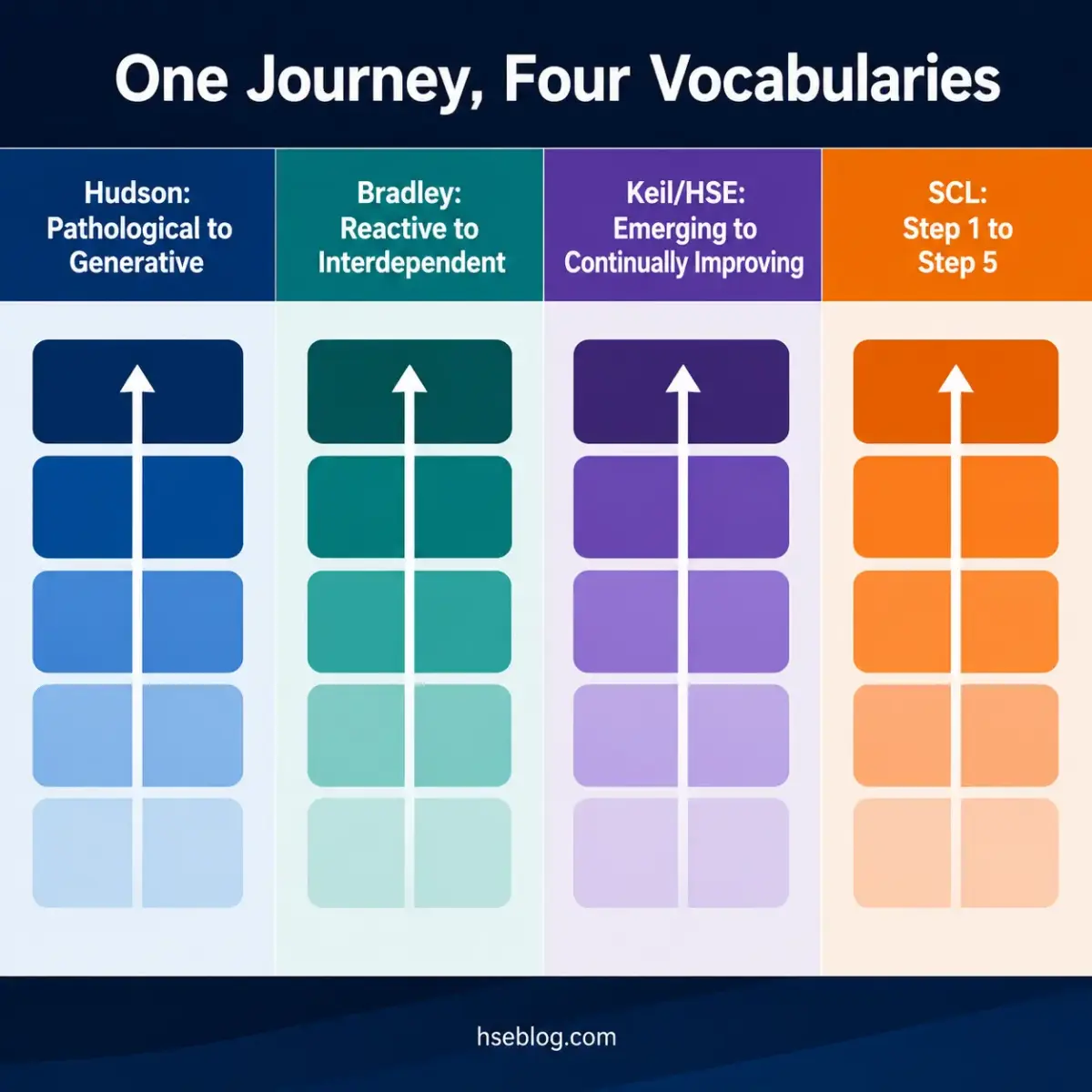
The competing safety culture models describe the same journey in different vocabularies — the destination is effectively identical across all of them. Once you see that, the urge to model-shop falls away.
Here is how the main frameworks line up, lowest maturity at the top:
| Maturity direction | Hudson Ladder (5) | DuPont Bradley Curve (4) | Keil Centre / HSE model (5) | NEN Safety Culture Ladder (5) |
|---|---|---|---|---|
| Lowest | Pathological | Reactive | Emerging | Step 1 |
| ↓ | Reactive | Dependent | Managing | Step 2 |
| ↓ | Calculative | Dependent → Independent | Involving | Step 3 |
| ↓ | Proactive | Independent | Cooperating | Step 4 |
| Highest | Generative | Interdependent | Continually Improving | Step 5 |
A few notes on the mapping:
- DuPont Bradley Curve. Four stages — reactive, dependent, independent, interdependent — popularised by DuPont, emphasising the shift from supervised compliance to collective behavioural ownership. It carries an “injury rates fall as maturity rises” narrative; treat that as a claim of the model rather than an independently measured correlation. (The individual attribution of the curve’s origin is reported inconsistently across secondary sources, so it is safest to credit DuPont as the populariser.)
- Keil Centre / UK HSE model. Five levels — emerging, managing, involving, cooperating, continually improving — developed in Edinburgh in the late 1990s and adopted by the UK Rail Safety and Standards Board. Its terminology is more neutral and optimistic than Hudson’s blunter “pathological.”
- The shared ancestor. All trace back to Westrum’s three-type typology (pathological, bureaucratic, generative). The Vision Zero / ISSA variant (starting → progressing → performing → advanced → excellent) is simply another contemporary five-stage rewording.
The practical trap is the proliferation itself. Teams burn time arguing whether four stages or five is “correct,” or which label fits, when the findings point to the same actions regardless. The terminology is not the work.
How to Assess Where Your Organisation Sits
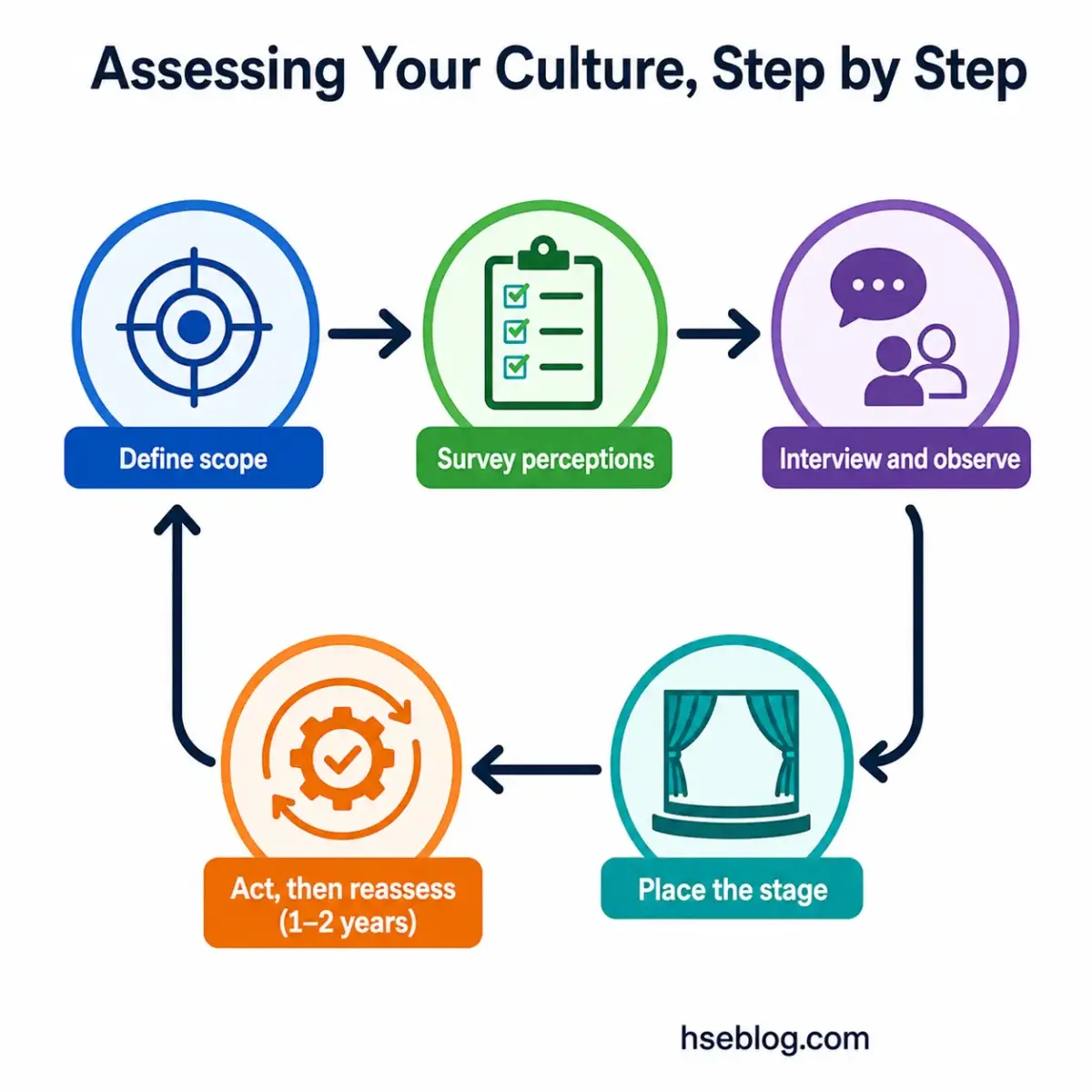
A credible safety maturity assessment triangulates several methods rather than relying on a single survey — and it is worthless without a closed-loop action plan attached to the findings. The reading itself is the easy part; acting on the gap is the point.
A workable sequence looks like this:
- Define scope and unit of analysis. Decide whether you are assessing the whole organisation, a site, a shift, or a function. Aggregate scores often hide wide internal variation.
- Gather perception data. Run a safety climate survey to capture the measurable “snapshot” of attitudes.
- Add depth. Use structured interviews and workshops to understand the why behind the survey numbers.
- Observe behaviour. Watch how work is actually done — what people do when no procedure is being read out.
- Triangulate, then place. Combine the four streams to locate the stage, noting disagreement between them rather than averaging it away.
- Build the action plan and reassess. Target the specific gaps, then reassess on a one-to-two-year cycle.
The methods, kept short:
- Perception / climate surveys — fast, scalable, but surface-level; they capture climate, not deep culture.
- Structured interviews — slower, richer, better at exposing the reasoning behind behaviour.
- Workshops — useful for surfacing shared norms and testing whether leaders and workers see the same picture.
- Behavioural observation — the reality check against what surveys claim.
One failure mode is so common it deserves a flag: assessing only frontline staff while exempting senior management from scrutiny. HSE’s human-factors guidance is explicit that senior managers must have their own perceptions and behaviours examined — not just the shop floor — because leadership behaviour is what sets the ceiling on maturity.
On indicators, the pattern is consistent across the literature: reactive and dependent cultures over-rely on lagging metrics such as TRIR or LTIFR, while proactive and generative cultures put weight on leading indicators. Counting injuries tells you about your past; leading indicators are how you read the present.
Do These Models Actually Predict Safety?
Here is the honest answer most ranking pages avoid: maturity-ladder assessments are valuable as a shared language and a diagnostic prompt, but weak as a precise measurement instrument. There is limited empirical evidence that a ladder score predicts accident-proneness, and at least one peer-reviewed study found ladder-based assessments can relate inversely to safety outcomes.
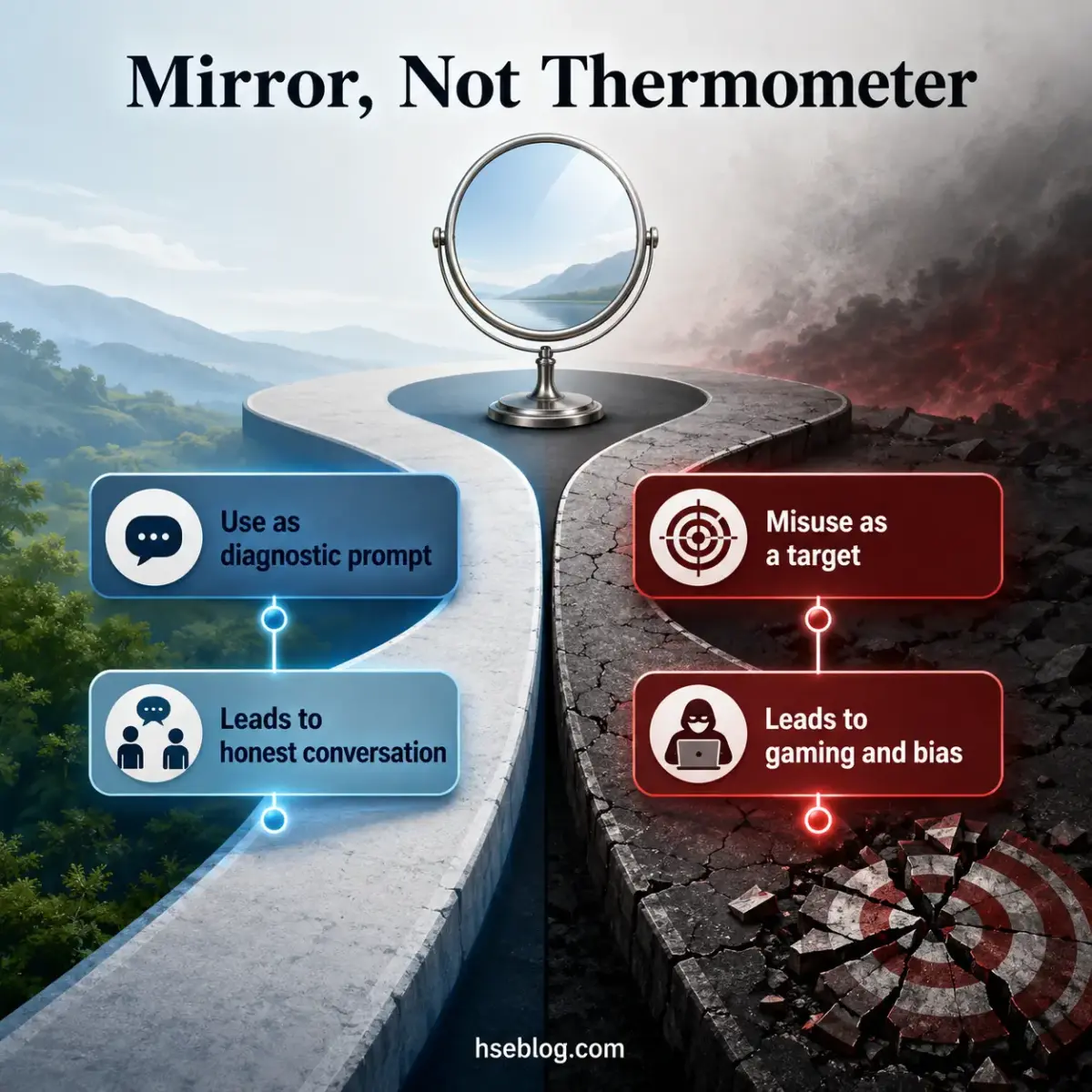
That finding should not be read as “the models are useless.” It should be read as a warning about how they are used. The interpretive judgment I’d offer: a maturity model is best treated as a mirror to start conversations, not a thermometer to produce a precise reading.
Use it for:
- A shared vocabulary. Giving leadership and the workforce common language to discuss something otherwise hard to name.
- A structured diagnostic prompt. Forcing the “why are we here?” conversation across levels of the organisation.
- Direction-setting. Showing what the next stage would actually require in behaviour, not just paperwork.
Don’t rely on it for:
- A precise measurement. The “level” is not a calibrated reading of risk.
- A target to hit. Treating the stage as a number to chase invites gaming and self-assessment bias.
- A substitute for judgement. Cultural reductionism — flattening a complex organisation to one label — hides exactly the internal variation that matters.
The strongest practitioners I’ve read and worked alongside hold both truths at once: the model is a genuinely useful frame, and the score is not the science.
How Maturity Models Relate to ISO 45001 and Certification
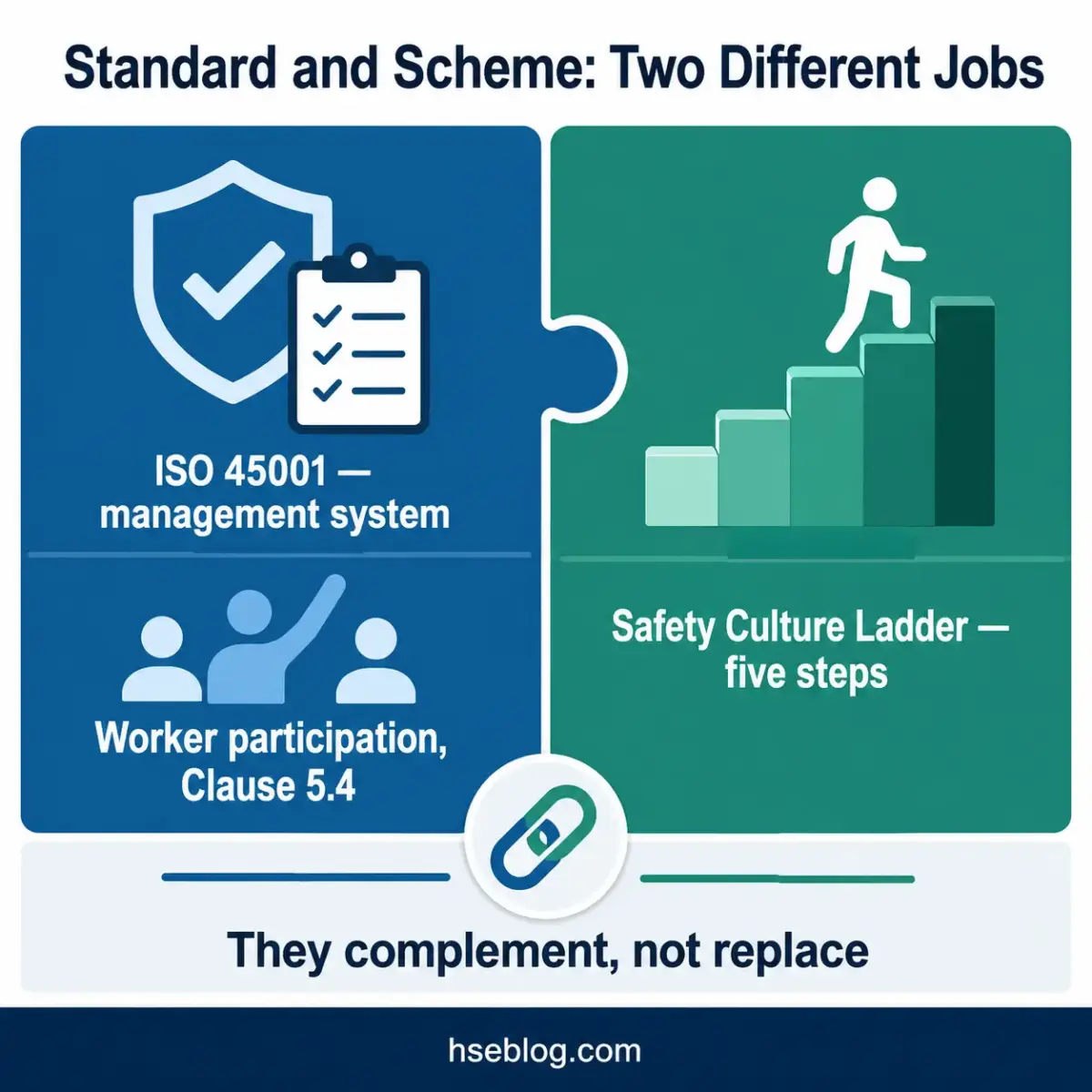
ISO 45001:2018 does not mandate a maturity model, but it underpins safety culture through Clause 5 on leadership and worker participation — particularly Clause 5.4, which requires organisations to establish processes for consulting and involving non-managerial workers in incident investigation, hazard identification, risk control, and auditing, and to remove the barriers that block that participation (ISO 45001:2018, Clause 5.4 — Jurisdiction: Global). In practice, that clause is the management-system anchor a generative culture grows from; you cannot have shared ownership if workers have no genuine route to participate.
Increasingly, practitioners meet maturity language not through theory but through procurement — a client or tender asks for it. Three reference points are worth keeping straight:
| Framework | Jurisdiction | Role in the culture/standards landscape |
|---|---|---|
| ISO 45001:2018 (Clause 5 / 5.4) | Global | Management-system standard; underpins culture via leadership and worker participation, without prescribing a maturity ladder. |
| NEN Safety Culture Ladder (SCL) | Netherlands / EU, used internationally | A certifiable five-step (Trede 1–5) culture-maturity scheme that complements — not replaces — ISO 45001. |
| HSE UK human-factors guidance (HSG48) | United Kingdom | Treats culture as a key influence on performance; guides inspectors, but sets no certifiable maturity level. The US has no equivalent federal maturity mandate — culture is encouraged through voluntary programmes. |
There is a freshness point to note here. The Safety Culture Ladder moved to version SCL 2.0: new certifications and recertifications have had to use 2.0 from 1 January 2025, all valid certificates must be on 2.0 by 1 January 2028, the underlying themes were reduced from six to five, and Step 1 was formally described for the first time (Safety Culture Ladder / NEN, 2024–2025). From 1 June 2025, NEN also released renewed, more accessible SCL products aimed at extending the scheme to smaller organisations (Safety Culture Ladder / NEN, 2025).
The risk in all of this is procurement-driven adoption. When organisations pursue SCL certification chiefly because a tender requires it, the behaviour can collapse into certificate-chasing — which is itself a calculative-stage symptom, not evidence of a mature culture.
Frequently Asked Questions
Conclusion
The most useful thing I can leave you with is what the industry consistently gets wrong about the safety culture maturity model: it treats the label as the achievement. Teams celebrate reaching “proactive,” chase an SCL certificate, or pile up audits at the calculative plateau — and mistake any of these for the culture itself.
The single highest-impact change is to use the model as a mirror, not a medal. Run the assessment honestly, include senior leadership in the scrutiny, report the variation between your sites and shifts instead of hiding it in an average, and tie every finding to an action. The peer-reviewed doubts about predictive validity are not a reason to abandon the frameworks — they are a reason to stop pretending the score is the point.
Whichever model you adopt — Hudson, Bradley, Keil, or the Safety Culture Ladder — they describe the same climb toward a culture where safety is simply how the work gets done. The question worth asking after the next assessment is not “what level are we?” but “what did the conversation change?”