

TL;DR
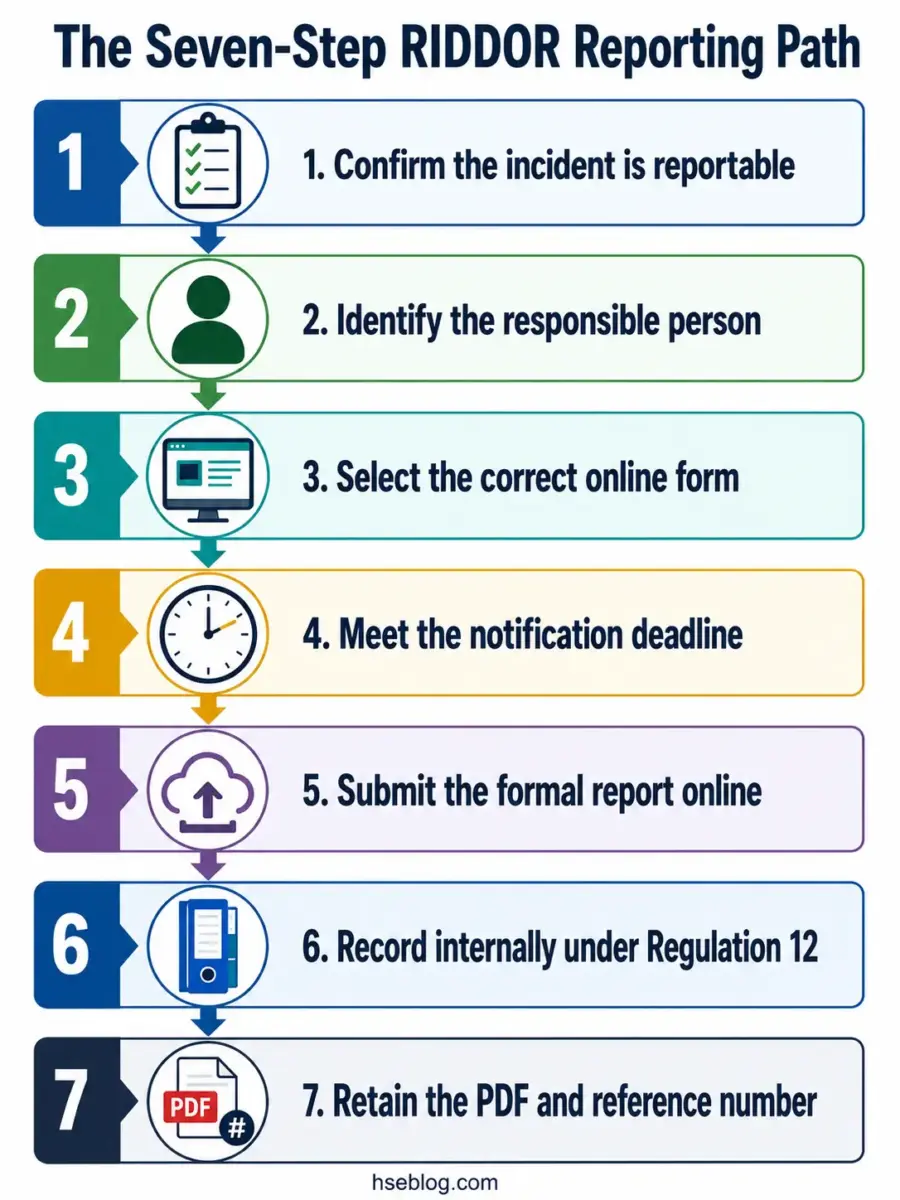
- Confirm reportability first: Only six specific trigger categories require a RIDDOR submission. Non-worker hospitalisation, specified injuries, and over-7-day absences are the most commonly missed.
- Identify the right person to file: The “responsible person” is rarely the injured worker or the line manager — it is the employer or the duty holder in control of the premises.
- Pick the correct online form: Five HSE online forms exist. Filing the wrong one causes rejection and eats your deadline.
- Respect the two-deadline structure: Notify without delay, file the formal report within 10 days (15 days for over-7-day injuries), and record the incident internally under Regulation 12.
- Download the PDF at submission: HSE stopped emailing copies after the 2019 form refresh. No PDF means no proof of compliance.
Section 37 of the Health and Safety at Work etc. Act 1974 sits quietly behind every RIDDOR submission. Anyone learning how to make a RIDDOR report for the first time needs to understand this clause before they touch the form: it doesn’t just fine the company when a reportable injury goes unreported, it opens a direct line to the director, manager, or company secretary whose consent, connivance, or neglect made the failure possible. On the distribution hub where I manage HSE — a large multi-dock operation running twenty-four-hour inbound and outbound flows — that’s the clause I walk every nominated duty holder through before I hand over the login for the HSE online portal. The form looks routine. The liability behind it is not.
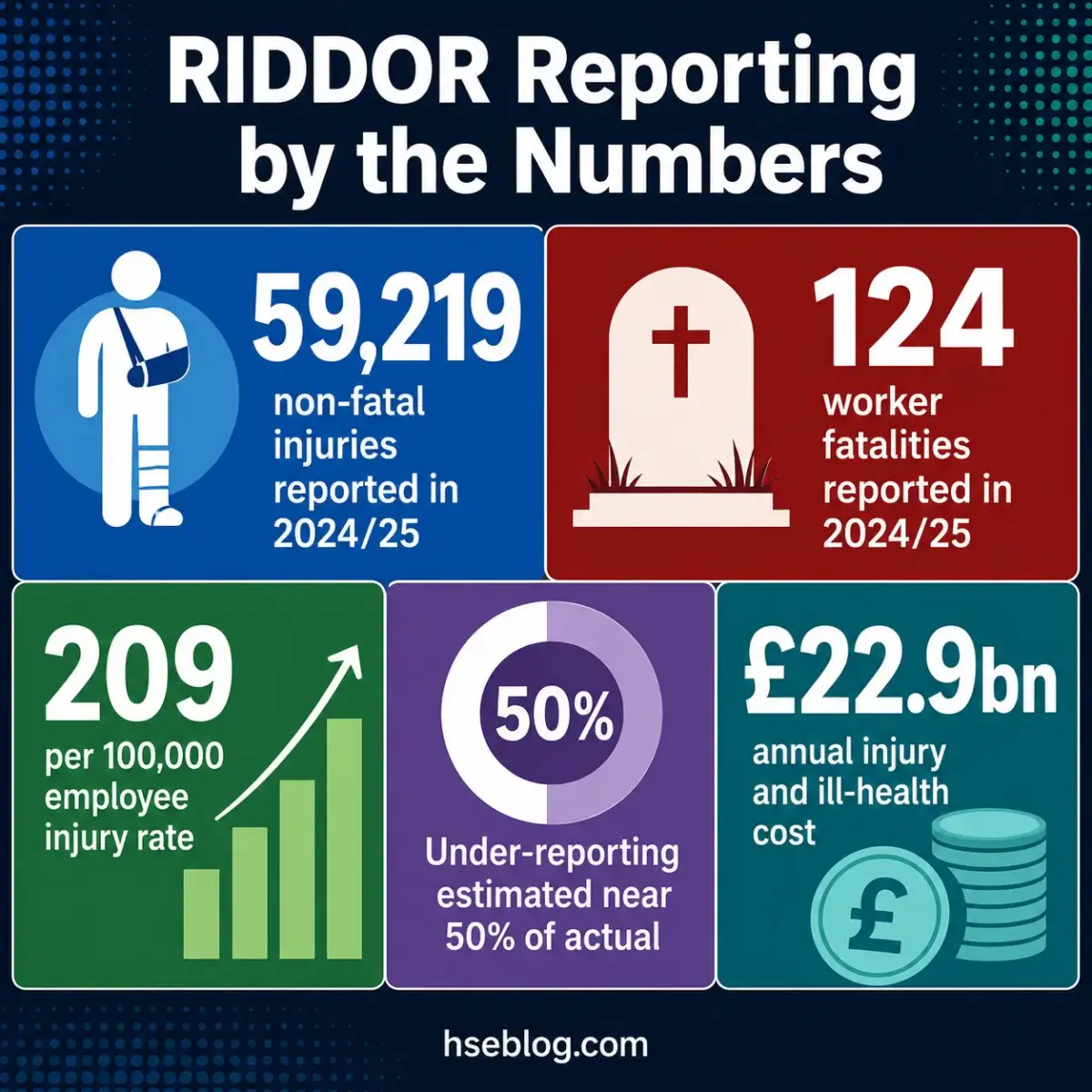
Under-reporting remains the uncomfortable backdrop. HSE’s 2024/25 figures (published at hse.gov.uk/statistics/overview.htm) put employer-reported non-fatal injuries at 59,219, down from 61,663 the previous year — yet the regulator openly estimates that employer reporting runs at roughly half the true level. That gap is why this guide walks the RIDDOR reporting procedure the way it actually needs to be done: responsible-person check, correct-form selection, deadline discipline, portal walkthrough, internal record, and the amendment process almost nobody explains until they need it.
Before You Start: Confirm the Incident Is RIDDOR Reportable
Most wasted RIDDOR submissions come from reporting something that was never reportable in the first place. A bruised knee from a slip on a dry floor, a worker off for three days with a sprained wrist, a near-miss that didn’t involve lifting equipment — none of these meet the test. Run the 30-second check against the trigger categories before you open the form.
RIDDOR 2013 (the full statutory instrument sits at legislation.gov.uk/uksi/2013/1471) captures six core triggers: a worker’s death, a specified injury to a worker, an over-7-day injury, a non-worker taken directly to hospital for treatment arising from the work, a reportable occupational disease under Schedule 3, and a dangerous occurrence from Schedule 2. A seventh route covers flammable gas incidents and dangerous gas fittings where it applies.
Two tests cut through the ambiguity. First, the identifiable external event test — if there is no triggering incident, a gradual-onset condition generally does not qualify for the accident route (the disease route is separate). Second, the arising out of or in connection with work test — the fact that something happened on-site doesn’t automatically make it reportable. A personal medical event with no work-related trigger sits outside RIDDOR entirely.
| Trigger | Reportable? | Relevant Regulation |
|---|---|---|
| Worker fatality | Yes, without delay | Reg 6, Schedule 1 |
| Specified injury to worker | Yes, without delay | Reg 4, Schedule 1 |
| Over-7-day injury | Yes, within 15 days | Reg 6 |
| Over-3-day injury | Record only, not report | Reg 12 |
| Non-worker taken to hospital | Yes, without delay | Reg 5 |
| Road traffic accident on public highway | No (limited exceptions) | Reg 10 |
| Dangerous occurrence (Schedule 2) | Yes, without delay | Reg 7 |
For deeper coverage of each trigger category, HSE’s reportable incidents hub at hse.gov.uk/riddor/reportable-incidents.htm is the authoritative reference.
Step 1: Identify the Responsible Person
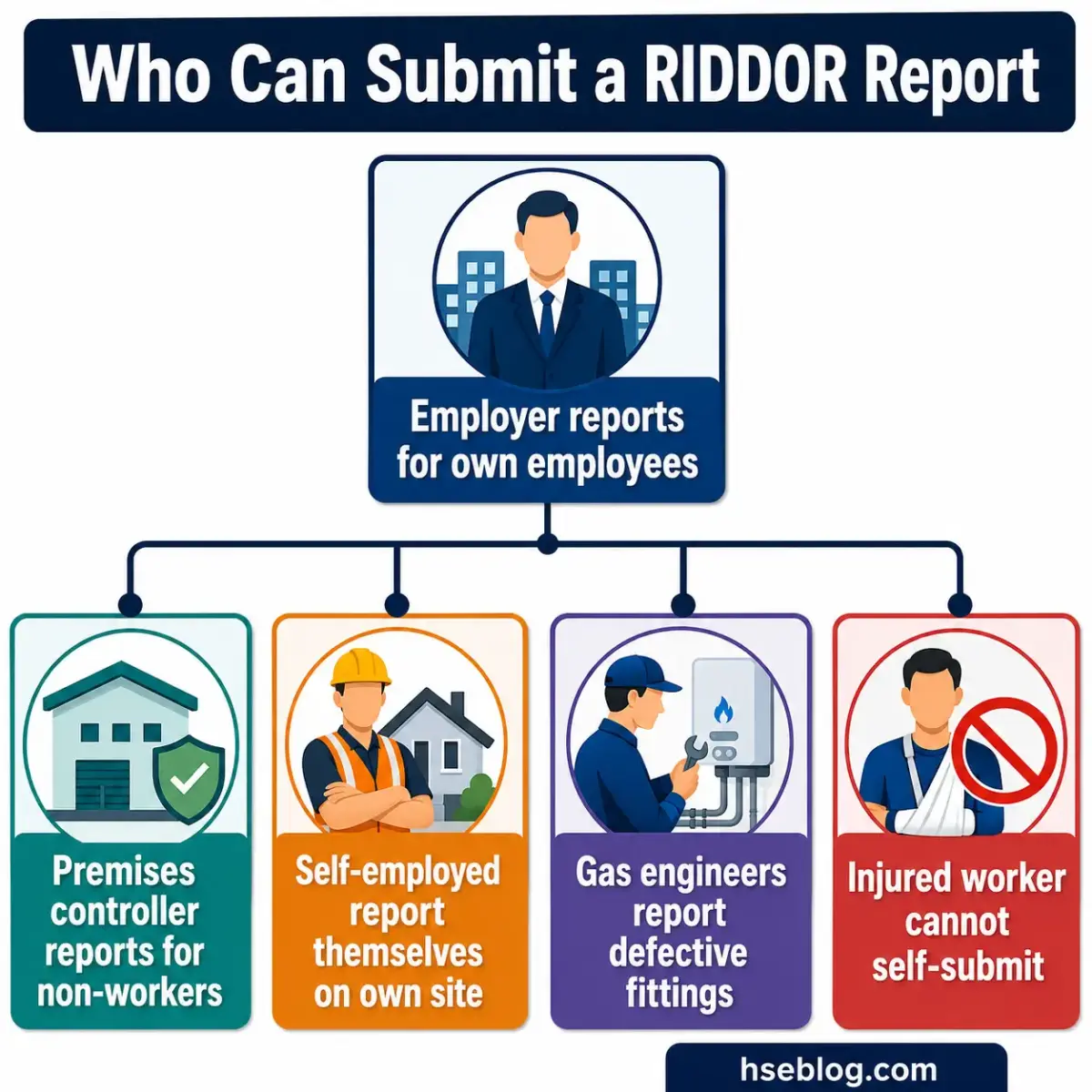
First-time reporters stall here more than anywhere else. The form asks who is submitting on behalf of the organisation, and the answer is not always the person holding the keyboard. Regulation 3 sets the rule: the employer reports for employees, the person in control of the premises reports for non-workers and self-employed operatives working on that site, and the self-employed report themselves when working on their own or domestic premises.
Mixed-site incidents are where this breaks. An agency driver tipping a trailer at our dock who tears a bicep on a stiff ratchet strap — the duty falls on the site controller where the incident happened, not the agency. A contractor’s electrician hospitalised after a live test in our switchroom — same principle. A visiting HGV driver hurt in our yard — the site is responsible. I have had duty managers assume “not my employee, not my report” more than once, and it has cost investigation time on every occasion.
| Scenario | Injured party | Responsible person | Regulation |
|---|---|---|---|
| Employee injured on employer’s site | Own employee | Employer | Reg 3(1) |
| Agency worker on host premises | Agency worker | Person in control of premises | Reg 3(1)(b) |
| Self-employed on client site | Self-employed | Client (premises controller) | Reg 3(1)(b) |
| Self-employed on own premises | Self-employed | Self-employed themselves | Reg 3(2) |
| Gas installation defect post-handover | Customer or worker | Gas engineer / supplier | Regs 6 & 7 |
The people who cannot report, regardless of how willing they are: the injured person themselves (unless self-employed), witnesses, union representatives, family members, or any colleague acting without written delegation from the responsible person. A report filed by the wrong party does not satisfy the duty.
Step 2: Choose the Correct Online Form
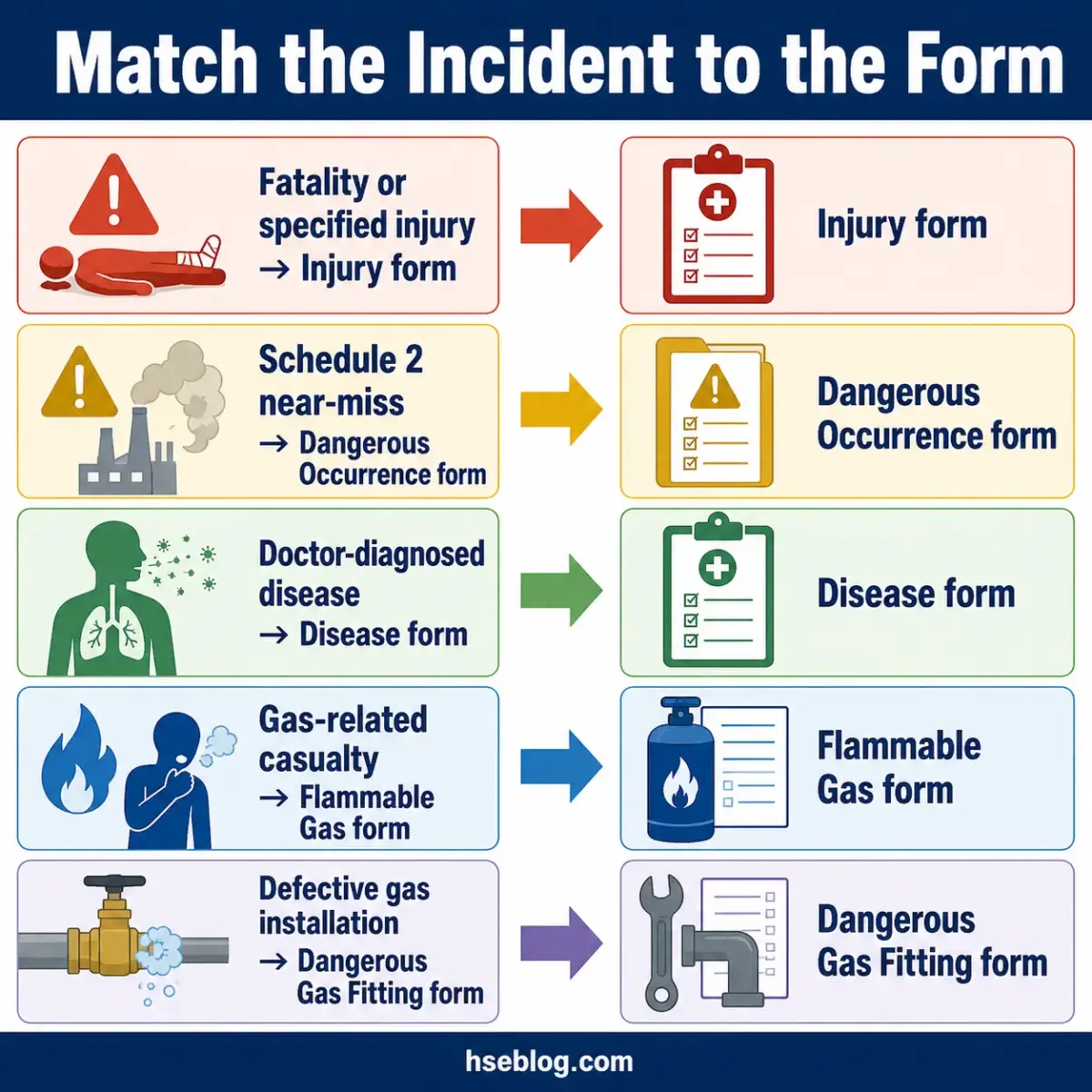
Five main online forms sit at notifications.hse.gov.uk, and filing under the wrong one triggers rejection — which does not stop your deadline clock. I have seen a disease notification wrongly filed as an injury report, rejected a week later, and by then the ten-day window was gone.
Watch For: The HSE portal does not warn you that you have chosen the wrong form. It accepts the submission, assigns a reference, and only later triggers a follow-up asking you to resubmit. The original reference does not transfer.
The five routes map cleanly to incident types. Report of an Injury covers worker fatalities, specified injuries, over-7-day injuries, and injuries to non-workers taken to hospital. Report of a Dangerous Occurrence covers the Schedule 2 list — lifting equipment failure over 7 metres, scaffold collapse over 5 metres, explosions, electrical short-circuits causing fire, and biological agent releases among them. Report of a Case of Disease is used only when a registered medical practitioner has issued a written diagnosis of a Schedule 3 occupational disease. Report of a Flammable Gas Incident covers gas-related deaths, loss of consciousness, or hospitalisation. Report of a Dangerous Gas Fitting is the route for Gas Safe engineers reporting defective installations.
Two specialist routes sit outside the main portal: ROGI for offshore installations, and separate notification to the Office for Nuclear Regulation for nuclear-licensed sites. If you are unsure which applies, the authoritative index lives at hse.gov.uk/riddor/reporting/how-to-make-riddor-report.htm.
Step 3: Know Your Deadline Before You Start Typing
The 10-day rule is well known. The 15-day rule is where the prosecutions happen. RIDDOR 2013 Schedule 1 sets a two-part duty for almost every reportable event: notify the enforcing authority by the quickest practicable means without delay, and submit the formal written report within 10 days of the incident. For over-7-day injuries, Regulation 6 gives you 15 days — but the clock starts on the day of the accident, not the day the 7-day threshold is crossed.
Worked example. A forklift operator twists her ankle on Monday 5 January. She is signed off work from the accident date. By Wednesday 14 January she has been absent for more than seven consecutive days (excluding the day of the accident but including non-working days), so the over-7-day trigger is met. The formal report is due by Tuesday 20 January — fifteen calendar days from 5 January, not from 14 January. Reporters who count from day 8 consistently miss the window by a week.
| Incident type | Initial notification | Formal report deadline | Reporting channel |
|---|---|---|---|
| Worker fatality | Without delay (phone) | 10 days | Phone + online form |
| Specified injury to worker | Without delay | 10 days | Online form (or phone) |
| Over-7-day injury | Not required | 15 days from accident | Online form |
| Non-worker taken to hospital | Without delay | 10 days | Online form |
| Dangerous occurrence | Without delay | 10 days | Online form |
| Reportable occupational disease | Without delay from diagnosis | 10 days | Online form |
Out-of-hours reality check: HSE is not an emergency service. For less-serious incidents after 5:00pm or at weekends, the online form is the correct route and is available twenty-four hours a day. The duty officer line exists for multi-casualty events, major site disruption, or evacuations of public areas — not for a delayed over-7-day submission.
Step 4: Gather the Information You Will Need
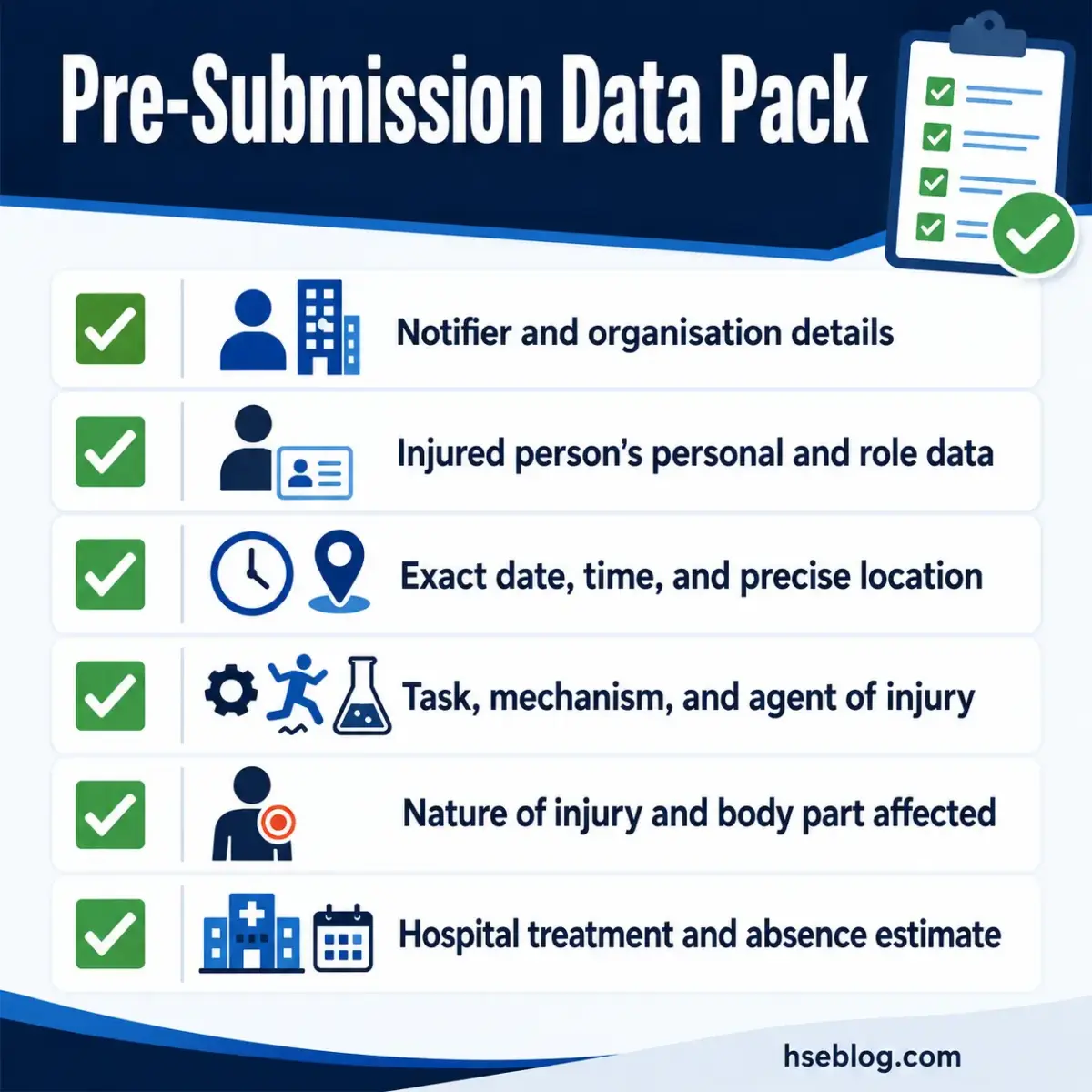
The HSE online portal times out, and its save function does not reliably preserve partially completed fields. Opening the form cold and hoping to remember details halfway through is how reports go in with wrong dates and guessed job titles. The pre-submission worksheet below mirrors the actual field order on the Report of an Injury form — compile it in a separate document first, then paste in.
About the notifier: full name, job title, organisation name, registered address, direct contact number, and email. About the organisation: main business activity, the address where the incident happened if different from the registered office, and approximate number of employees. About the injured person: full name, home address, age, sex, job title, and employment status from HSE’s list (employee, self-employed, trainee, member of the public, or other).
About the incident itself: exact date, exact time, precise location on-site (not just “the warehouse” but “loading dock 3, south-east corner”), what the person was doing at the moment of injury, what went wrong, and what caused the injury. The form then asks for the “kind of accident” from HSE’s standard drop-down (slipped/tripped/fell, struck by moving object, contact with moving machinery, and so on) and the “agent or factor” involved. Both feed HSE’s national statistical categorisation and are difficult to amend after submission. About the injury: nature of injury, body part affected, whether the injured person was taken to hospital, and an expected absence estimate.
Any photographs, site sketches, or witness names sit in your own investigation file; the HSE form does not host uploads, but the information feeds the narrative accurately.
Step 5: Submit the Report Through the HSE Online Portal
Regulation 5 requires the written report to be sent on the approved form. That form lives only at hse.gov.uk/riddor — downloaded F2508 PDF templates circulating on third-party sites are not accepted for routine reporting, and emailing one to the Incident Contact Centre does not discharge the duty.
Work through the portal in order. The interface opens with notifier details, then organisation details, then incident details, then injured person, then injury details, then kind of accident, then a free-text narrative. Two screens trip up first-time reporters most often: the kind of accident drop-down and the agent or factor drop-down. Both feed HSE’s statistical dataset, both drive enforcing-authority allocation, and both are hard to change post-submission. Take time to pick the closest match rather than defaulting to “other.”
Audit Point: The narrative field is factual only. “Operator loaded pallet onto reach-truck forks; forks tilted forward; pallet slid and struck operator’s left shin” is the correct form. Speculation on cause, blame, or intent (“the operator was rushing because the supervisor was shouting”) does not belong in the RIDDOR submission — it belongs in your internal investigation record.
Once you submit, one screen matters more than any other: the PDF download page. HSE removed automatic email confirmations from the reporting system during the 2019 form refresh, and has not reinstated them. The submission confirmation page offers a downloadable PDF containing your full narrative, the RIDDOR reference number, and the submission timestamp. If you navigate away without downloading, you cannot retrieve it from the portal — you can only request a retrospective copy from the Incident Contact Centre, which takes days. Save the PDF to the organisation’s incident file, and log the reference number in your internal register.
Step 6: Report by Phone (Fatalities and Specified Injuries Only)
The Incident Contact Centre on 0345 300 9923 operates Monday to Friday, 8:30am to 5:00pm, and is reserved for a narrow set of circumstances — fatal accidents to workers, specified injuries to workers, and certain multi-casualty events requiring immediate notification. For everything else, including over-7-day injuries and dangerous occurrences, the online form is the correct and only route.
A phone call does not replace the written submission. Under Schedule 1, the initial “without delay” notification by phone must still be followed by the formal written report within 10 days. The call handler opens a case record and logs the basics; the formal submission attaches the full incident detail to that record.
Before you dial, have ready: the injured worker’s name and job title, the time and location of the incident, the nature of the injury or confirmed fatality, a brief factual description of what happened, and your own name and role as the responsible person. Out-of-hours fatalities, multi-casualty incidents, and any event involving evacuation of public areas go through the duty officer contact route published at hse.gov.uk/contact — not the main Incident Contact Centre line.
Step 7: Record the Incident Internally (This Is a Separate Legal Duty)
On our site, the filing cabinet beside the HSE office holds three years of Regulation 12 records — the online RIDDOR submission does not replace it, and it never has. Regulation 12 imposes a standalone duty to keep a record of every reportable injury, disease, and dangerous occurrence, distinct from the HSE submission, held at the workplace, and available for inspection.
The record must contain, at minimum, the information set out in Schedule 1 Part 2: date and time of the incident, the injured person’s personal details, the nature and location of the event, and the RIDDOR reference number issued at submission. The minimum statutory retention period is three years from the date the record was made. HSE legal advisers routinely recommend retaining for at least six years to align with the Limitation Act 1980 window for civil personal injury claims — claimants can bring actions well beyond the statutory three-year records horizon.
Acceptable formats include the BI 510 accident book (widely used in SMEs), a digital incident management platform, or any structured record meeting the minimum content requirement. One nuance that catches operators: over-3-day injuries are recordable under Regulation 12 but not reportable to HSE. The absence alone, without crossing the seven-day threshold, triggers the internal record but not the online form.
What Happens After You Submit a RIDDOR Report
The notification enters HSE’s RIDDOR database and is routed to either HSE or the local authority depending on premises type — offices, warehouses, and most retail sites typically land with the local authority environmental health team, while industrial and higher-risk sites sit with HSE directly. Most reports are not individually investigated. Triage is driven by severity, pattern, and sector risk profile.
The responsible person may hear nothing at all. Alternatively, an inspector or environmental health officer may make contact to request further detail, ask for sight of the internal investigation, or arrange a site visit. Typical triggers for follow-up include any worker fatality, any specified injury involving amputation or permanent sight loss, repeat reports from the same site within a short window, and dangerous occurrences with off-site potential.
Possible enforcement outcomes run across a spectrum: no action, advisory letter, verbal warning, improvement notice, prohibition notice, Fee for Intervention charging, and ultimately prosecution. The RIDDOR submission itself also becomes disclosable evidence in any subsequent civil personal injury claim — the PDF you downloaded at Step 5 is the same document the claimant’s solicitor will see on disclosure. Keep the internal investigation rigorous and separate, because RIDDOR is a notification, not an investigation.
Amending or Correcting a RIDDOR Report
HSE operates a formal amendment process, but not many reporters discover it until they need it. To request an amendment, email the HSE Incident Contact Centre quoting the original reference number, specifying exactly what needs to change, and explaining why. Typical reasons include a corrected date of injury, a revised medical diagnosis that changes the injury classification, or an updated absence duration that moves the report from over-7-day into the specified injury bracket.
One element cannot be amended: the original submission date. A late amendment does not reset the statutory deadline, and if the amendment reveals that the original report should have been made sooner, the responsible person remains exposed on the original breach.
One scenario requires a new report rather than an amendment. If a worker initially reported as an over-7-day or specified injury subsequently dies within one year of the accident from the original injury, the fatality must be re-notified under the injury route. The earlier submission does not discharge that duty. This is a surprisingly common gap — an injury report closed out months earlier, the worker’s condition deteriorating, and the re-reporting trigger overlooked by HR and OH teams who never learned it existed.
Common Mistakes That Lead to RIDDOR Prosecutions
Enforcement patterns across recent HSE prosecution case law show a predictable set of failures. None of them are complicated. All of them cost.
- Treating the accident book as the RIDDOR report. The Regulation 12 record and the Schedule 1 submission are two duties, not one. Filing one does not discharge the other.
- Miscounting the 15-day over-7-day window. Starting the clock on day 8 instead of the date of accident consistently produces late submissions.
- Filing under the wrong form. A disease reported as an injury, or a near-miss reported as a dangerous occurrence when it doesn’t meet Schedule 2, triggers rejection and eats the window.
- Delegating the duty without training. A nominated reporter who has never seen the portal before is not a control — it is a liability.
- Missing occupational diseases altogether. No “incident” means no reporting prompt, so Schedule 3 diagnoses get filed as HR absence matters and never reach the HSE form.
- Failing to re-report a fatality within 12 months. The worker’s deterioration is tracked by HR or Occupational Health, but the RIDDOR chain is never reopened.
- Personal liability under Section 37 HSWA. A director who consents to, connives in, or neglects a RIDDOR failure is personally prosecutable — the corporate veil does not protect.
HSE attributes £22.9 billion in annual cost to workplace injury and work-related ill health across Great Britain. That figure stays abstract until one of these seven failures becomes yours on a charge sheet.
Frequently Asked Questions
Conclusion
Four decisions compress the entire process of how to make a RIDDOR report into operational clarity. Confirm the incident is reportable against the six trigger categories before you open the portal. Identify the responsible person under Regulation 3, and make sure they — not the injured worker, not a witness, not a well-meaning colleague — are the one filing. Select the correct online form, respect the without-delay notification alongside the 10-day (or 15-day) formal report deadline, and download the PDF confirmation the moment you submit. Record the same incident internally under Regulation 12, and retain that record for at least six years to cover the civil claims window.
The form itself is ten minutes of work once those decisions are disciplined. The harder part — and the one HSE’s 50% under-reporting estimate quietly confirms — is building an organisation where the duty holder is trained, reference numbers are logged, amendments are tracked, and Section 37 exposure on the directing mind is taken as seriously as the company exposure. The portal is the easy bit. The system behind it is the job.