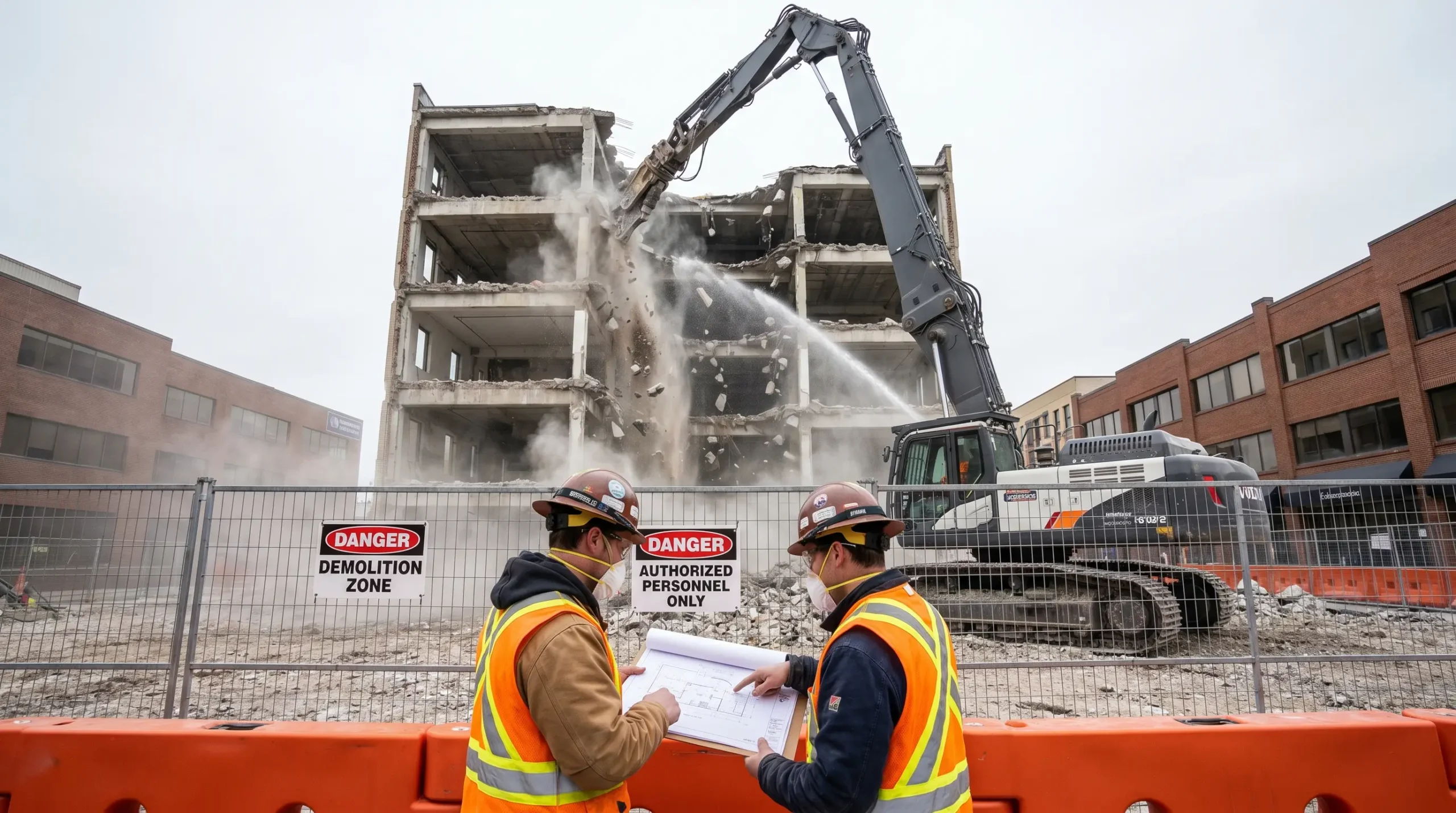
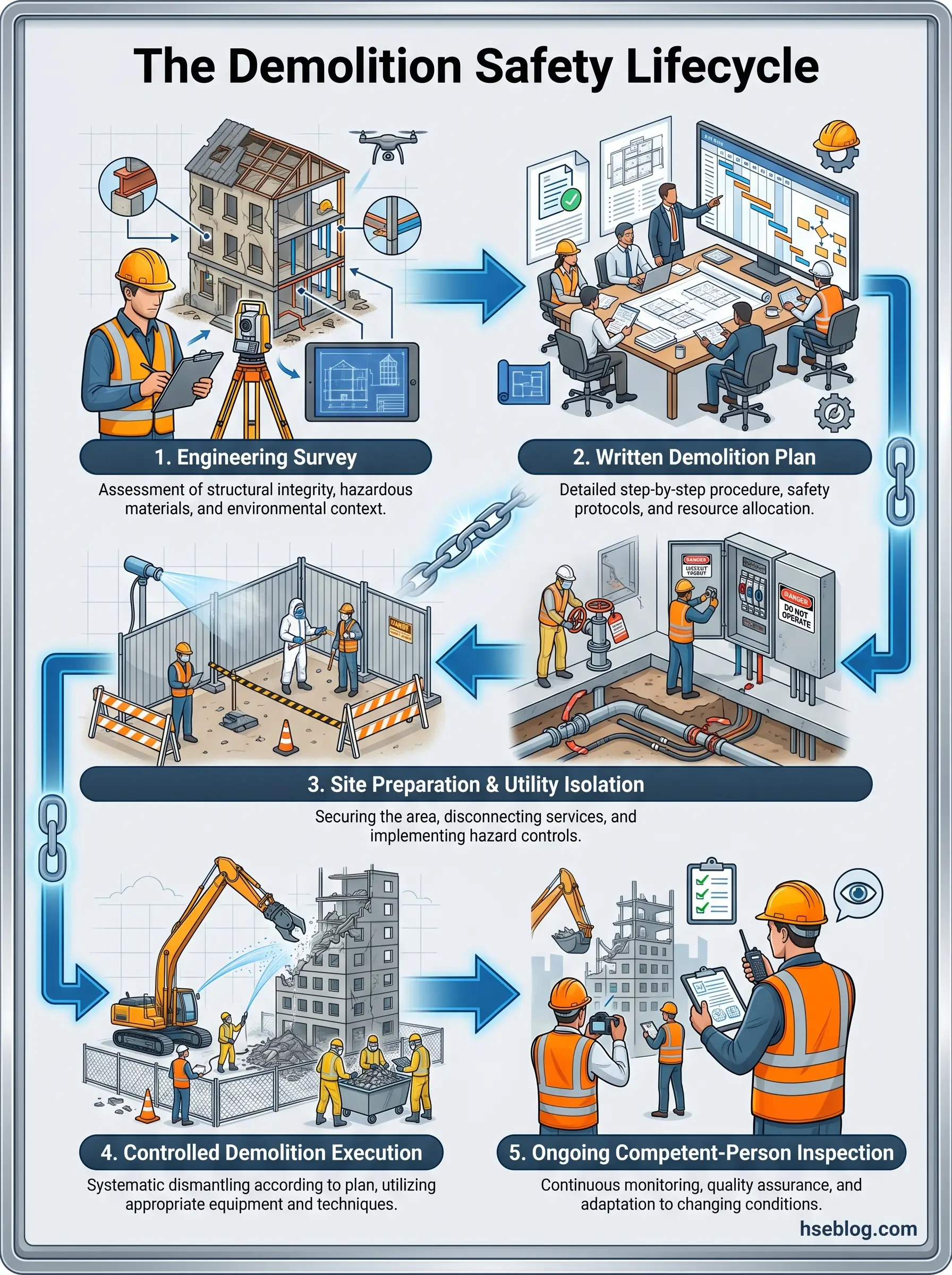
Demolition safety encompasses the planning, hazard controls, and procedures required to protect workers and the public during the intentional dismantling of structures. Before any demolition work begins, OSHA requires an engineering survey by a competent person to assess structural integrity and identify hazards. A written demolition plan, utility isolation, hazardous material abatement, and ongoing competent-person inspections throughout the project are fundamental requirements under both US and UK regulatory frameworks.
In 2024, 1,032 construction and extraction workers died on the job in the United States (US Bureau of Labor Statistics, 2026). Demolition — a subset of that occupational group — concentrates several of construction's deadliest hazard categories into a single operation: structural collapse, falls from height, struck-by debris, and toxic material exposure occurring simultaneously on the same site.
What makes demolition uniquely dangerous is that it reverses the controlled sequence of construction. Every load path, connection, and structural member was designed to hold a building up — not to behave predictably while being taken apart. This article covers the full lifecycle of demolition safety: from the pre-demolition engineering survey that OSHA treats as the single most critical compliance requirement, through method selection criteria that tie technique to site-specific risk, to the on-site procedures and training obligations that keep workers alive during execution. The primary keyword here — demolition safety — is not an abstraction. It is a system of interlocking controls where each element depends on the one before it.
What Is Demolition Safety and Why Does It Require Elevated Planning?
Demolition safety is the system of engineering controls, administrative procedures, and regulatory requirements that protect workers, the public, and adjacent structures during the intentional dismantling or destruction of buildings and infrastructure. OSHA frames demolition as "construction in reverse" — a description that captures why it carries compounding unknowns absent from new-build work.
A new structure is built from known materials, to documented specifications, under controlled conditions. A structure being demolished may have been modified over decades without records, may contain hazardous materials that predate modern regulation, and may behave unpredictably as load paths are disrupted during removal.
The regulatory framework reflects this elevated risk:
- OSHA Subpart T (US) — 29 CFR 1926.850 through 1926.860 governs demolition operations, with preparatory operations under 1926.850 carrying the heaviest compliance burden.
- CDM 2015 Regulation 20 (UK) — the only construction activity singled out for an explicit written-plan requirement before work begins.
- BS 6187:2011 (UK) — a code of practice covering demolition management, exclusion zones, and competency requirements.
- ANSI/ASSP A10.6-2006, R2016 (US) — voluntary consensus standard providing engineering survey scope and qualified-person definitions.
The citation data tells the story of where projects fail. Preparatory operations under 1926.850(a) account for up to three-quarters of all OSHA demolition citations, with the engineering survey requirement alone representing more than half of those (OSHA, current). The planning phase — not the wrecking ball — is where most demolition projects break down.
The Pre-Demolition Engineering Survey: Requirements and Common Failures
The engineering survey is the single most important document in any demolition project, and the single most frequently violated requirement in OSHA's demolition standards. Under 29 CFR 1926.850(a)(1) (US), a competent person must conduct an engineering survey of the structure before demolition operations begin, and written evidence of that survey must be maintained.
The survey's purpose is to force a structured confrontation with unknowns. Older buildings may have undergone unreported structural modifications. Load-bearing walls may have been altered. Chemical storage from decades-old industrial processes may predate any current record-keeping.
What Should an Engineering Survey Cover?
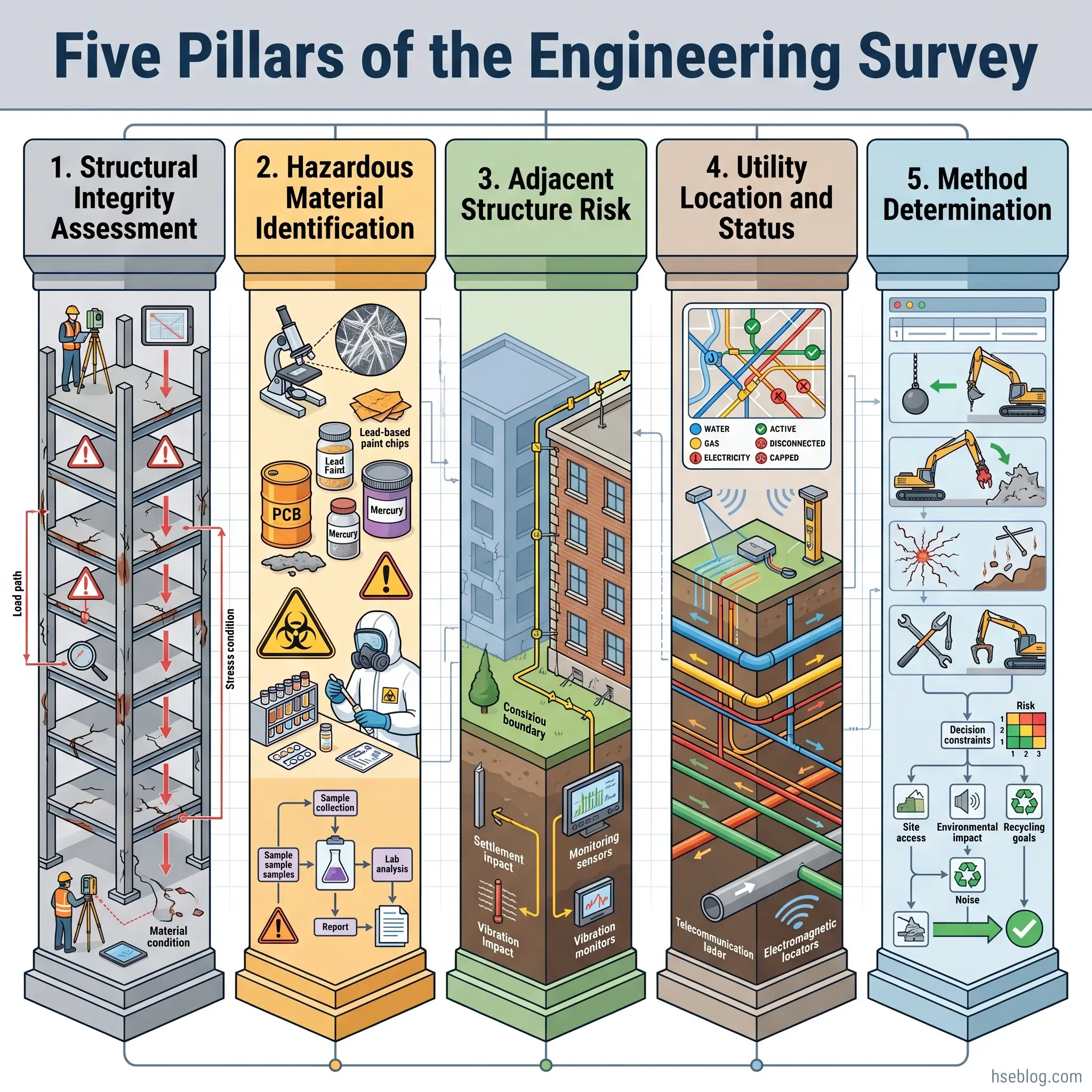
Drawing from OSHA's Technical Manual on demolition operations and ANSI A10.6 recommendations, the survey must assess:
- Structural integrity — framing condition, floor load capacity, wall stability, and the potential for unplanned collapse during progressive removal.
- Hazardous materials — asbestos, lead-based paint, PCBs, chemical residues in pipes or tanks, and radioactive materials in industrial settings.
- Adjacent structures — shared walls, proximity risks, vibration sensitivity, and any structures that could be destabilized by demolition activity.
- Utility identification — location and status of all services entering the structure.
- Method determination — the survey's findings should drive the selection of demolition method, not the reverse.
A common misconception treats the competent person designation as requiring a licensed Professional Engineer. It does not — under OSHA, a competent person is someone with knowledge to identify hazards and authority to correct them. ANSI A10.6 uses the term "qualified person" with a different but overlapping definition. A PE can serve in this role but is not required.
The UK framework under CDM 2015 requires the client to provide pre-construction information and a refurbishment/demolition asbestos survey (per HSG264 and the Control of Asbestos Regulations 2012) before demolition begins. This survey is separate from and additional to the structural assessment.
| Requirement | US (OSHA Subpart T) | UK (CDM 2015 / BS 6187) |
|---|---|---|
| Pre-demolition survey | Engineering survey by competent person — 1926.850(a) | Structural assessment + pre-construction information package |
| Written plan | Written evidence of survey required; plan implied by survey scope | Written demolition plan explicitly required — Regulation 20(2) |
| Asbestos survey | Required as part of hazardous material identification | Mandatory refurbishment/demolition asbestos survey — CAR 2012 |
| Who conducts it | Competent person (knowledge + authority) | Competent person; BS 6187 Annex A provides competency guidance |
| Notification threshold | No specific demolition notification to OSHA | F10 notification: 30+ days with 20+ workers, or 500+ person-days |
The survey must be treated as a living document. As demolition proceeds and new hazards emerge — structural conditions that differ from expectations, previously hidden materials, unexpected voids — the survey findings should be updated and the demolition plan adjusted accordingly.
Demolition Methods: Selection Criteria and Safety Implications
Method selection should be an output of the engineering survey — never an input to it. The most common method-selection failure across the published record is choosing a technique based on commercial pressure and then retrofitting the survey to justify that choice. When that sequence is reversed, risk controls are designed around the method rather than around the structure's actual condition.
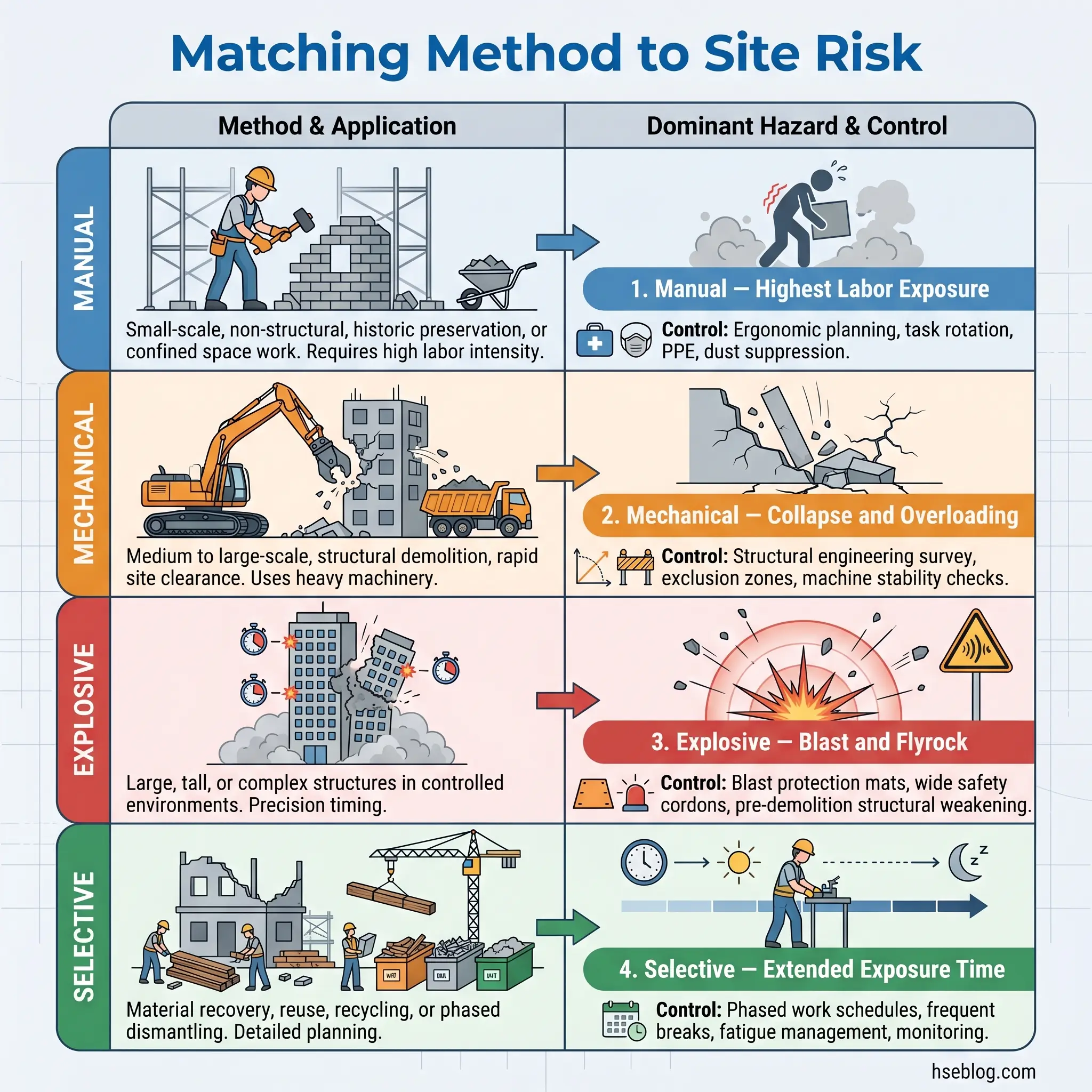
The principal demolition methods are manual, mechanical, and explosive. Each carries a distinct hazard profile, regulatory burden, and set of selection criteria.
| Method | Typical Application | Primary Hazards | Key Regulatory Requirement |
|---|---|---|---|
| Manual (hand) | Selective/partial demolition, confined areas, proximity to sensitive structures | Highest labor exposure, falls, struck-by | Close supervision, task-specific PPE, structural monitoring |
| Mechanical (excavator, high-reach) | Most full-structure demolitions; top-down progressive reduction | Structural collapse, equipment overloading, debris projection | Floor load verification — 1926.856(a) (US); competent-person inspection |
| Wrecking ball (balling) | Large open-area demolitions with adequate exclusion space | Wide debris field, crane failure, uncontrolled collapse | Ball ≤50% crane rated load or ≤25% line breaking strength — 1926.859 (US) |
| Explosive/implosive | Tall or structurally complex buildings where mechanical methods are impractical | Blast overpressure, flyrock, premature detonation, vibration damage | OSHA Subpart U; specialist blasting contractor required |
| Selective (deconstruction) | Material recovery and recycling emphasis | Extended worker exposure time, manual handling | Emerging waste-management requirements; ANSI A10.6 guidance |
Mechanical Demolition Equipment and Safety Controls
Mechanical demolition accounts for the vast majority of demolition operations. The equipment ranges from standard excavators fitted with hydraulic crushers or shears to purpose-built high-reach demolition machines with boom lengths exceeding 30 meters.
Before any mechanical equipment operates on an elevated floor, 29 CFR 1926.856(a) (US) requires verification that the floor can support the equipment's weight plus any accumulated debris. Curbs or stop-logs must be provided at floor openings per 1926.856(b) to prevent equipment from rolling into open shafts.
Top-down demolition — progressively reducing building height floor by floor — is identified by UK HSE guidance as often the safest method where available space is limited. It allows the smallest exclusion zones because debris falls inward and downward rather than outward.
When Is Explosive Demolition Appropriate?
Explosive demolition is the method most visible to the public but least commonly used in practice. Implosion is reserved for structures where building height, structural complexity, or site constraints make mechanical methods impractical or create greater risk than a controlled collapse sequence.
Compliance with OSHA Subpart U (Blasting and Use of Explosives) is mandatory. The work requires specialist blasting contractors with demonstrated competency in charge placement, delay sequencing, and blast-effect prediction. No general demolition contractor should attempt explosive demolition without this specialist expertise.
Key Demolition Hazards and Control Measures
Structural collapse is the primary catastrophic hazard in demolition — the one that kills multiple workers in a single event. Every other hazard on a demolition site exists in general construction; collapse risk at this scale and unpredictability does not.
The hierarchy of controls applies to each hazard category, but demolition's distinguishing feature is that engineering controls and administrative controls carry nearly the entire safety burden. PPE is the last line — and it cannot protect against a structural collapse.
Structural Collapse
The engineering survey and sequenced removal plan are the primary defenses. Top-down demolition, working from exterior to interior, and maintaining temporary bracing where load redistribution creates instability all reduce collapse probability.
Under 29 CFR 1926.854 (US), no wall section exceeding one story may stand without lateral bracing unless originally designed as a free-standing element. Structural or load-supporting members on any floor must not be cut or removed until all stories above have been demolished.
Falls from Height
Wall openings must be protected to a height of 42 inches under 1926.850(f) (US). Employee entrances to demolition areas require sidewalk sheds or canopies per 1926.850(i). Standard fall protection provisions under Subpart M apply in addition to these Subpart T–specific requirements.
Hazardous Material Exposure
The hazard that most consistently surprises demolition teams is the hidden one: chemical residues in decades-old piping, undocumented asbestos in adhesives and putties behind wall coverings, lead paint under layers of newer coatings. Approximately 5,000 asbestos-related deaths occur annually in the UK (HSE UK, current) — a figure driven largely by historical exposure during demolition and refurbishment work.
Identification and abatement must be completed before structural demolition begins:
- Asbestos — mandatory survey in both US and UK jurisdictions before any demolition.
- Lead-based paint — testing and lead-safe work practices where paint will be disturbed.
- Silica — respirable crystalline silica from concrete cutting and crushing; OSHA PEL of 50 µg/m³ (US).
- Chemical residues — pipes, tanks, and process equipment in industrial buildings may contain residues that predate current records.
Utility Strikes
All services — electric, gas, water, sewer, steam, and telecom — must be shut off, capped, or controlled outside the building line per 1926.850(c) (US). In the United States, 811 call-before-you-dig notification is required. Failure to confirm de-energization before entry has caused electrocutions and gas explosions on demolition sites that could have been prevented by a single verification step.
Developing the Demolition Safety Plan
The demolition safety plan prescribes the controls and procedures that the engineering survey's findings demand. The distinction matters: the survey assesses conditions; the plan prescribes actions. One is an input to the other — they are not interchangeable documents, and producing one does not satisfy the requirement for both.
In the UK, CDM 2015 Regulation 20(2) requires the demolition arrangements to be recorded in writing before work begins. Demolition is the only construction activity given this explicit written-plan mandate — a regulatory choice that reflects the severity of consequences when demolition proceeds without documented controls.
A demolition plan that earns its name addresses these elements:
- Scope and sequence — which structural elements are removed in what order, and how stability is maintained at each phase of progressive dismantlement.
- Hazard controls — specific controls linked to each finding from the engineering survey, not generic safety statements.
- Roles and responsibilities — who supervises each phase, who holds stop-work authority, who conducts ongoing inspections.
- Emergency procedures — structural collapse response, fire, hazardous material release, medical emergencies, and evacuation routes specific to the site's layout and access constraints.
- Environmental protection — dust suppression, noise barriers, vibration monitoring for adjacent structures, and debris/waste management.
- Interface management — coordination with other site activities, public protection measures, exclusion zones, and traffic management.
The Job Safety Analysis as Complement
The demolition plan says what to remove and in what order. A Job Safety Analysis (JSA) identifies the hazards associated with each specific task within that sequence — fall exposure during wall removal, silica exposure during concrete cutting, manual handling risks during selective deconstruction.
The judgment call practitioners face is how frequently to update both documents. A plan that was accurate on day one may be dangerously wrong by week three as conditions change, loads shift, and previously hidden hazards are exposed. Plans that include defined decision points for re-assessment — triggered by specific milestones or unexpected findings — consistently outperform static documents.
What Are the OSHA Requirements for Demolition? (Subpart T Overview)
OSHA 29 CFR 1926 Subpart T governs demolition operations through sections 1926.850 to 1926.860. These are additive to the rest of Part 1926 — every general construction standard also applies to demolition sites. Subpart T adds demolition-specific requirements on top of that baseline.
A practitioner-level reading of each section reveals what compliance actually looks like on site:
- 1926.850 — Preparatory operations — the engineering survey, utility isolation, hazardous material elimination, glass removal where fragmentation is a hazard, floor and wall opening protection (42-inch minimum), employee entrance protection via sidewalk sheds, and the top-down removal sequence. This section generates more citations than all other Subpart T provisions combined.
- 1926.851 — Stairs, passageways, ladders — safe access and adequate illumination must be maintained throughout demolition. Access routes deteriorate as the structure is dismantled; this section requires proactive management of egress.
- 1926.852–853 — Chutes and floor openings — requirements for dropping materials safely through chutes and removing materials through floor openings without endangering workers below.
- 1926.854 — Walls, masonry, chimneys — masonry must not exceed the floor's safe carrying capacity. No wall section over one story may stand without lateral bracing. Structural members must not be cut until all stories above are demolished.
- 1926.855 — Manual floor removal — planking requirements, structural member removal sequence, and load limits during hand demolition of floor systems.
- 1926.856 — Mechanical removal — floor strength verification before equipment operates on elevated floors, curbs/stop-logs at openings, crane compliance with Subparts N and CC.
- 1926.858 — Steel construction removal — column-by-column, tier-by-tier removal sequence to prevent progressive collapse of steel-framed structures.
- 1926.859 — Mechanical demolition (balling) — wrecking ball weight limits (50% of crane rated load or 25% of line breaking strength, whichever is lesser), exclusion zone requirements, and continuing inspections by a competent person throughout operations.
- 1926.860 — Selective demolition by explosives — references OSHA Subpart U for all blasting requirements.
These standards are among the oldest in OSHA's construction library and have not been substantially revised since original adoption. The practical implication: emerging methods such as robotic demolition and advanced high-reach techniques are governed by the General Duty Clause and voluntary consensus standards like ANSI A10.6 rather than specific Subpart T provisions.
A recent development worth noting: ANSI/ASSP A10.50-2024 was published as the first national voluntary consensus standard for heat stress management in construction and demolition operations (ASSP, 2024). It establishes acclimatization protocols and a hierarchy-of-controls framework for heat exposure — filling a gap that Subpart T never addressed.

Site Preparation and Utility Isolation Procedures
The most dangerous moment in many demolition projects is the transition from survey to physical work — when workers first enter a structure to begin preparatory operations and the engineering survey's findings are tested against reality for the first time. Competent supervision during initial access is non-negotiable.
Site preparation follows a sequence where order matters. Rearranging these steps introduces the hazards each step is designed to prevent.
- Utility notification and isolation — contact all utility providers. In the US, file 811 call-before-you-dig notification. Confirm de-energization through direct verification, not assumptions based on provider assurance alone.
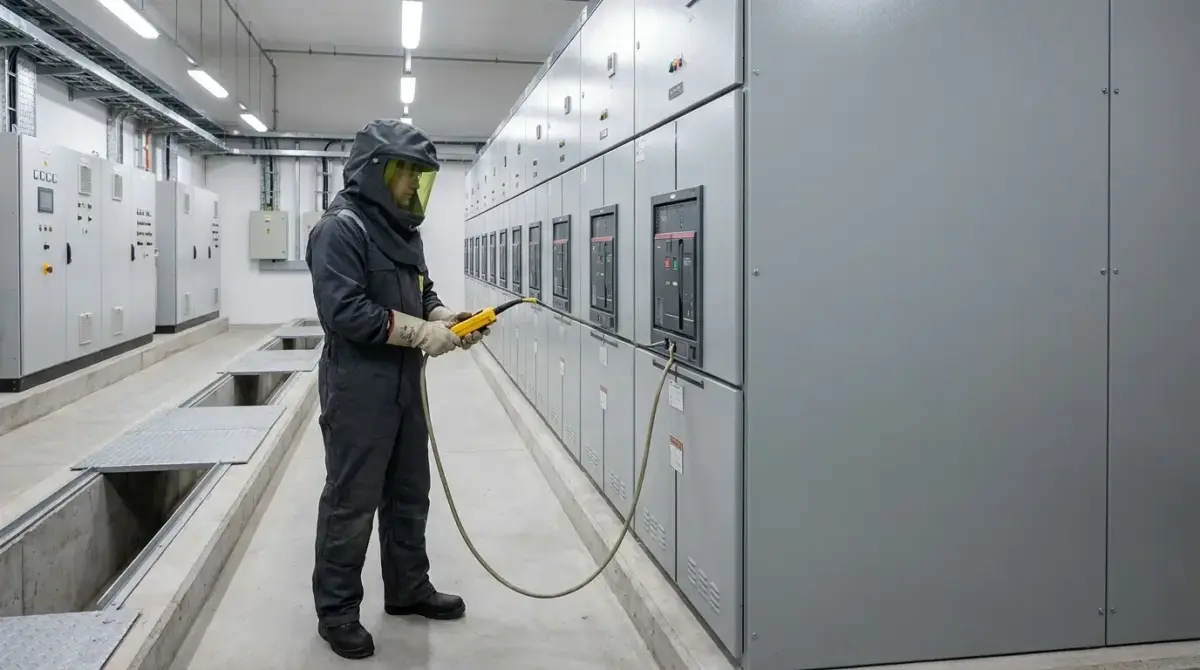
- Lockout/tagout — where temporary power, water, or other services must remain active during demolition, relocate and protect them per 1926.850(d) (US) and apply lockout/tagout procedures to all energy sources within the demolition zone.
- Hazardous material abatement — complete asbestos removal, lead paint stabilization or removal, PCB decontamination, and chemical residue neutralization before any structural demolition begins. Sequencing matters: structural vibration from premature demolition can release fibers and particles from materials that haven't yet been abated.
- Glass removal — where fragmentation hazard exists, glass is removed early in the preparatory phase to prevent uncontrolled shattering during mechanical operations.
- Shoring and bracing — structures damaged by fire, flood, explosion, or prior partial collapse require stabilization under 1926.850(b) (US) before workers enter.
- Perimeter security — fencing, signage, public protection measures, and in the UK, Section 81 notices under the Building Act 1984 where applicable. Exclusion zones are established based on demolition method, building height, and debris trajectory analysis. BS 6187:2011 (UK) provides specific guidance on exclusion zone determination.
- Access route establishment — safe entry and egress routes identified, illuminated, and maintained throughout the project per 1926.851 (US).
PPE Requirements for Demolition Operations
Respiratory protection is the PPE gap most consistently underestimated on demolition sites. Workers routinely underprotect during tasks that generate respirable silica or disturb unknown materials — and the engineering survey, not a generic PPE matrix, should drive respirator selection.
PPE on a demolition site extends well beyond standard construction requirements because the hazard profile is compounded: impact, dust, noise, chemical, and fall hazards occur simultaneously.
The hierarchy of controls applies here as everywhere: PPE is the last line of defense after engineering controls (dust suppression, ventilation, enclosure) and administrative controls (exposure time limits, work rotation, exclusion zones) have been applied. Within that context, demolition-specific PPE includes:
- Head protection — hard hats rated for impact and penetration; chin straps where overhead debris risk is elevated.
- Respiratory protection — task-specific and fit-tested. Asbestos abatement requires minimum half-face P100 respirators; silica exposure from concrete cutting demands APF-10 or higher depending on concentration; unknown materials default to a higher protection factor until identified.
- Eye and face protection — safety glasses as baseline, goggles for dust-generating tasks, face shields for cutting and grinding operations.
- Hearing protection — demolition noise routinely exceeds the 85 dBA action level that triggers OSHA's hearing conservation requirements.
- Fall protection — full-body harnesses, shock-absorbing lanyards, and anchor points rated for the worker's weight plus arrest forces for any work at height.
- Hand and foot protection — steel-toed boots with metatarsal guards for crush hazards; cut-resistant gloves appropriate to the material being handled.
- High-visibility clothing — mandatory where mobile equipment operates on site.
Every item requires visual inspection before each use. Respiratory protection requires fit testing and a written program. These are not optional refinements — they are regulatory requirements under OSHA's respiratory protection standard (29 CFR 1910.134, US) and PPE standards (29 CFR 1926 Subpart E, US).
Training and Competency Requirements for Demolition Workers
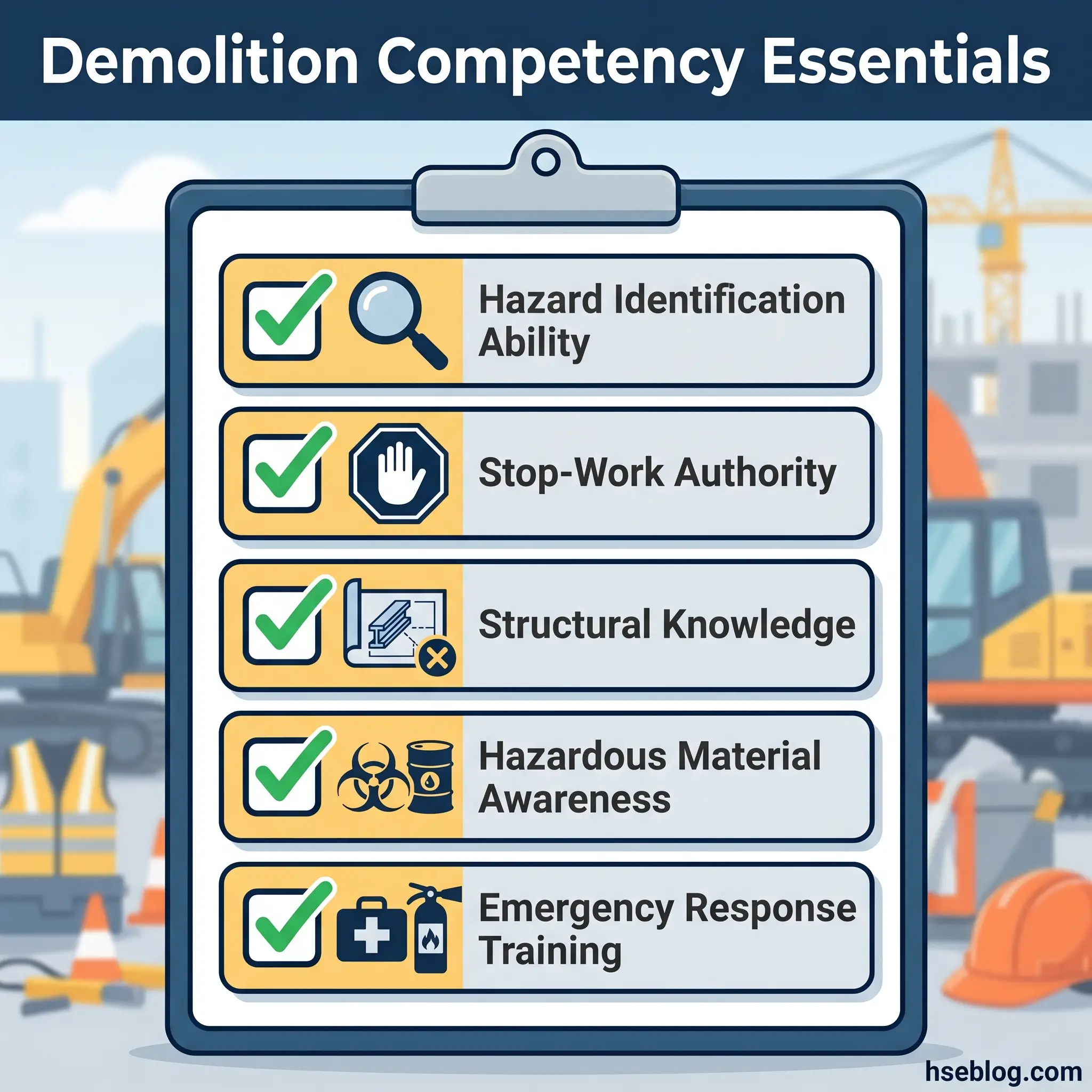
The "competent person" label is the most over-applied and under-verified designation in construction safety. On demolition projects specifically, the competent person must possess genuine structural knowledge — not just general construction experience. That distinction matters most when conditions deviate from the survey's findings during active demolition and someone must make real-time decisions about whether to continue, brace, or stop.
US Framework
OSHA requires hazard communication and site-specific training but does not mandate a specific demolition certification. The competent person must be capable of identifying existing and predictable hazards and must have authorization to take prompt corrective measures. ANSI A10.6 provides more detailed competency guidance, using the "qualified person" designation for individuals who conduct engineering surveys.
UK Framework
The UK offers a more structured competency pathway:
- CSCS cards — the Construction Skills Certification Scheme verifies that workers have achieved recognized qualifications for their role.
- NVQ/SVQ qualifications — National Vocational Qualifications provide assessed competency evidence at defined levels.
- CCDO — the Certificate of Competence of Demolition Operatives provides role-specific verification for demolition workers and supervisors.
- BS 6187:2011 Annex A — provides direct guidance on training and competence expectations for demolition activities.
Ongoing Competency Reinforcement
Toolbox talks and daily briefings serve as ongoing competency reinforcement, not as substitutes for formal training. Specialist training is required for hazardous material handling — asbestos awareness at minimum, and licensed abatement work where materials will be disturbed. Emergency response training for demolition-specific scenarios, particularly structural collapse rescue, requires its own dedicated program.
For practitioners seeking recognized qualifications, NEBOSH and IOSH certifications provide a foundation in occupational health and safety management, while OSHA's Outreach Training Program offers 10-hour and 30-hour construction courses that include demolition hazard awareness.
Frequently Asked Questions
What is the most frequently cited OSHA standard in demolition?
Section 1926.850(a) on preparatory operations generates the most citations, with the engineering survey requirement under 1926.850(a)(1) accounting for more than half of all Subpart T violations (OSHA, current). The pattern indicates that projects routinely begin demolition without a completed written survey — or with a survey that lacks the structural depth OSHA expects. Completing a genuine engineering survey before mobilization is the single most effective compliance step.
Does a competent person for demolition need to be a licensed engineer?
No. OSHA defines "competent person" by knowledge and authority — the ability to identify existing and predictable hazards, plus the authorization to take corrective action. A Professional Engineer can serve in this role, but the license is not the requirement. ANSI A10.6 uses "qualified person" with a similar but distinct definition. What matters operationally is that the designated individual has genuine structural knowledge relevant to the specific structure being demolished.
What is the difference between a demolition plan and an engineering survey?
The engineering survey assesses existing conditions: structural integrity, hazardous materials, utilities, adjacent structure risks. The demolition plan prescribes actions: removal sequence, hazard controls, emergency procedures, roles, and responsibilities. The survey is an input to the plan. Producing one does not satisfy the requirement for the other. In the UK, CDM 2015 Regulation 20(2) explicitly requires the demolition plan to be recorded in writing before work begins.
What hazardous materials must be removed before demolition begins?
Asbestos requires a mandatory survey before demolition in both US and UK jurisdictions — this is non-negotiable. Lead-based paint, PCBs, chemical residues in pipes and tanks, and radioactive materials in industrial settings must also be identified, tested, and abated before structural demolition commences. The abatement sequence must be completed before any activity that could disturb these materials through vibration, impact, or dust generation.
How do UK demolition safety requirements differ from US OSHA standards?
The UK framework under CDM 2015 uses a duty-holder structure (client, principal designer, principal contractor) distinct from OSHA's employer-obligation model. CDM Regulation 20 explicitly requires a written demolition plan — a mandate with no direct OSHA Subpart T equivalent. The UK also requires a refurbishment/demolition asbestos survey under CAR 2012, F10 notification for projects exceeding defined thresholds (30 days with 20+ workers or 500+ person-days), and competency evidence through the CSCS card scheme. BS 6187:2011 provides detailed good-practice guidance that OSHA's aging Subpart T standards do not match in scope.
Can demolition work begin before the engineering survey is completed?
No. Under 29 CFR 1926.850(a) (US), demolition operations must not begin until the engineering survey has been completed and written evidence maintained. There are no exceptions. In the UK, CDM 2015 similarly requires the written demolition plan — informed by the structural assessment — to be in place before work starts. Beginning work without these documents is both a regulatory violation and, more importantly, a decision to expose workers to unidentified hazards.
Conclusion
The consistent lesson from demolition incident reports and citation data is that failures concentrate in the planning phase, not the execution phase. When structures collapse unexpectedly, when workers are exposed to unidentified asbestos, when utility strikes cause electrocutions — the root cause almost invariably traces back to an engineering survey that was incomplete, a demolition plan that was treated as static paperwork, or a competent-person designation that carried the title without the structural knowledge it demands.
What the industry gets wrong most often is treating demolition safety as a set of isolated checkboxes rather than a sequential system where each control depends on the integrity of the one before it. The engineering survey must be genuine — a structural investigation, not a compliance form. Method selection must follow from survey findings, not from the commercial proposal. The demolition plan must include decision points for re-assessment as conditions change. And the competent person must have real authority to stop work when reality diverges from the plan.
The demolition safety framework under OSHA Subpart T and CDM 2015 provides the regulatory architecture. Voluntary consensus standards like ANSI A10.6 and BS 6187 provide the applied guidance. But architecture and guidance only protect workers when practitioners apply them with the diligence and structural understanding that demolition's compounding unknowns demand. That responsibility sits with every project team, every survey, every plan review — and it begins before the first piece of material is removed.