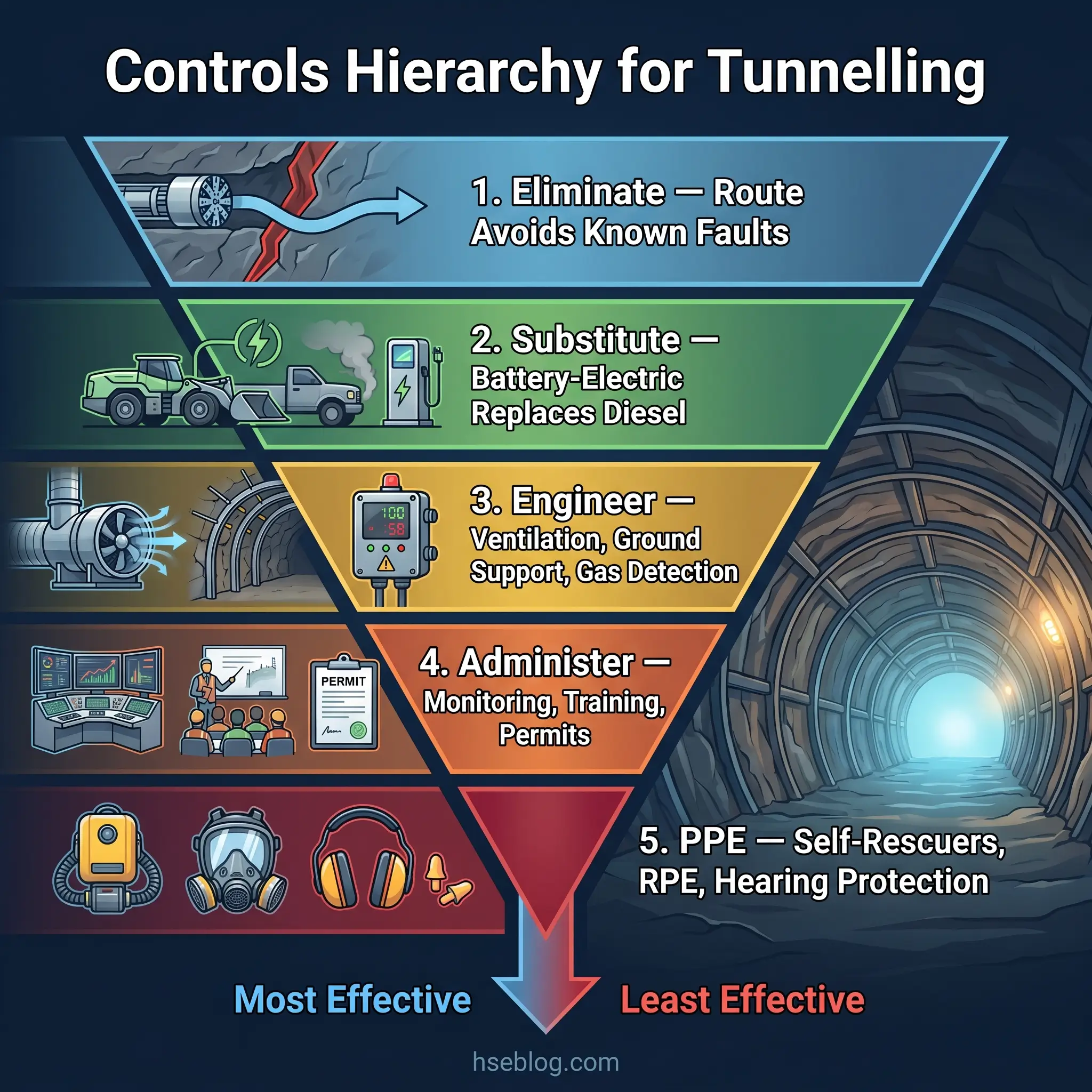
Tunnelling safety hazards include ground collapse, toxic or explosive atmospheres, fire, water ingress, noise, silica dust exposure, and struck-by incidents from underground plant. Control measures follow the hierarchy of controls — from elimination through design-phase decisions, to engineering controls like mechanical ventilation and ground support systems, administrative controls including atmospheric monitoring and emergency planning, and PPE as a last resort.
In 2024, 1,034 construction workers died on the job in the US, a fatality rate of 9.2 per 100,000 full-time equivalent workers (US Bureau of Labor Statistics, 2026). Tunnelling concentrates the worst of those risks — collapse, irrespirable atmospheres, flooding, fire — into a confined underground environment where escape routes are measured in hundreds of metres and minutes matter more than on any surface site.
The consequences of getting tunnelling safety wrong are not abstract. On July 9, 2025, a partial collapse of the Los Angeles Effluent Outfall Tunnel trapped and then forced the rescue of 31 workers, halting a major infrastructure project indefinitely. Five months earlier, a sudden water and soil inflow collapsed a section of the Srisailam Left Bank Canal tunnel in India, trapping eight workers. These incidents share a root cause that runs through the published tunnelling incident record: geological conditions that overwhelmed engineering assumptions. This article maps each major tunnelling hazard to its specific control hierarchy, cites the applicable regulatory clause with jurisdiction, and identifies the failure modes that separate competent tunnelling safety management from the kind that ends in investigation reports.
What Makes Tunnelling One of the Highest-Risk Construction Activities?
Tunnelling shares every hazard found on a surface construction site — and then concentrates them underground, where egress is limited, atmospheres can turn lethal within minutes, and the ground itself is an active, unpredictable participant.
Generic construction safety frameworks are insufficient here. That is why tunnelling has its own dedicated regulatory standards — OSHA's underground construction standard (29 CFR 1926.800) in the US, BS 6164:2019 in the UK, and jurisdiction-specific regulations in Australia and the EU. These exist because the hazard profile demands controls that surface construction never encounters.
Three characteristics distinguish tunnelling risk:
- Confinement with limited escape — workers operate in a single-exit tube where smoke, gas, or water can cut off the only route out.
- Geotechnical uncertainty — ground conditions between investigation boreholes remain probabilistic, not confirmed, until the face is actually excavated.
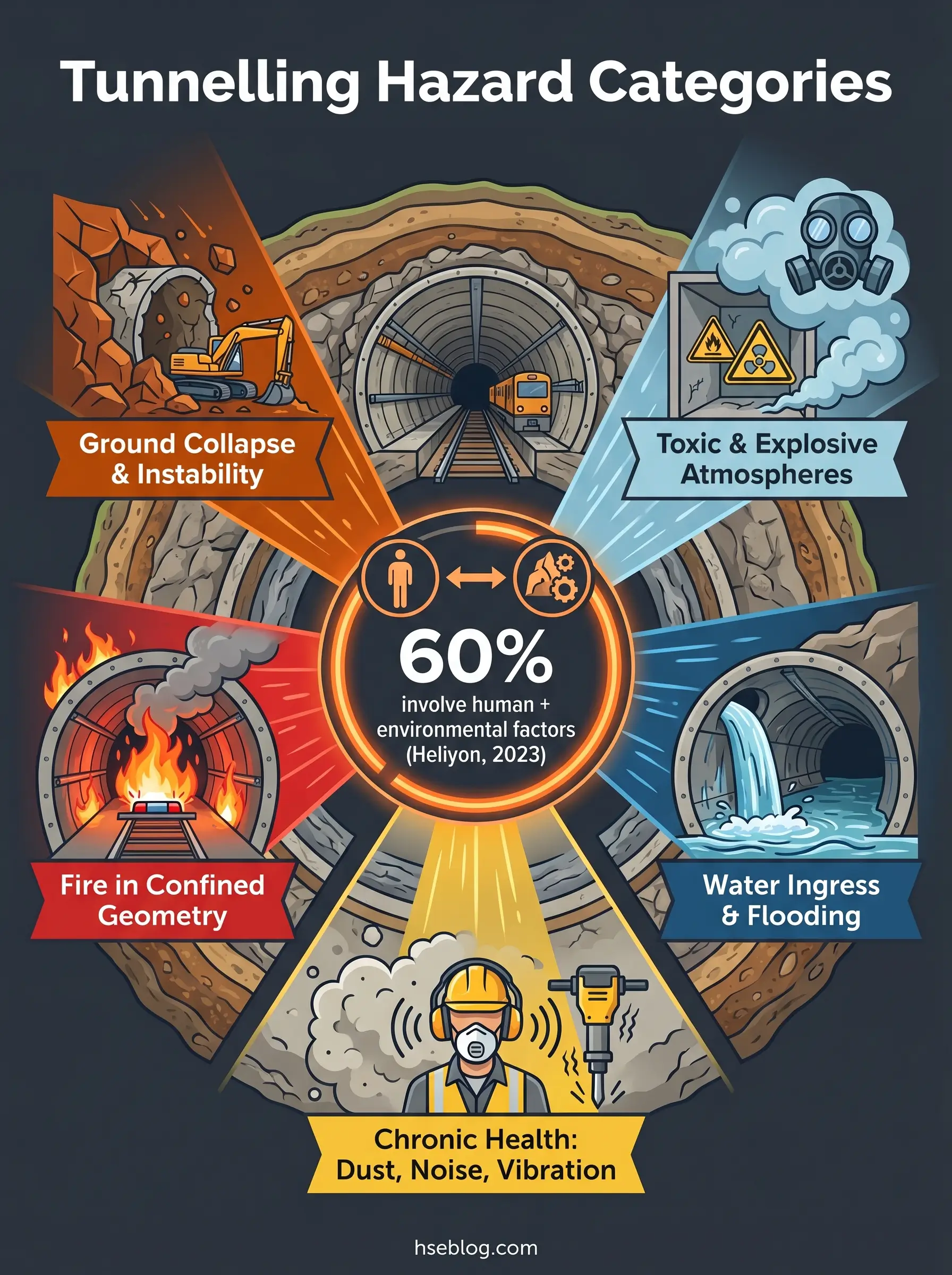
- Compounding human factors — research based on 536 respondents found that 30% of tunnel construction accidents stem from purely human error, with 60% involving a combination of human and environmental factors (Heliyon / Elsevier, 2023).
A pattern I consistently observe in the published incident record is that teams underestimate chronic hazards — noise, dust, vibration — because these are familiar and slow-acting, while over-focusing on dramatic acute hazards like collapse. BS 6164:2019 specifically addressed this bias by elevating occupational health guidance to co-equal status with safety. That rebalancing reflects a hard-won lesson: a tunnelling worker is significantly more likely to suffer long-term ill health than to die from an acute accident.
Primary Hazards in Tunnel Construction
Each hazard category below names the mechanism of harm, explains why tunnelling amplifies it, and references the regulatory standard that governs it. This is the core reference section — not a flat list, but a structured map of how tunnel workers get hurt.
Ground Collapse and Instability
Ground failure is the hazard most people associate with tunnelling, and the published fatality record confirms it as one of the leading acute killers.
The mechanisms differ by tunnelling method:
- Soft-ground tunnelling (TBM with slurry or earth-pressure balance) — face instability occurs when the TBM's chamber pressure fails to counterbalance ground and groundwater pressure. Loss of face support can trigger rapid inflow of saturated ground.
- Hard-rock tunnelling (drill-and-blast, NATM) — crown collapses, wedge failures along discontinuities, and rockbursts in high-stress environments. These can occur with minimal warning.
- Construction sequencing errors — removing temporary support too early, advancing the face beyond the designed unsupported span, or failing to install primary lining within specification.
The 2025 Los Angeles Effluent Outfall Tunnel collapse was attributed to "squeezing ground" deforming a previously built section — a failure mode where long-term ground pressure exceeded the installed support's capacity. The 2025 Srisailam tunnel collapse in India demonstrated how sudden water and soil inflow can overwhelm face stability with catastrophic speed.
A failure mode I see repeatedly across published investigation reports: geotechnical survey data is treated as definitive rather than probabilistic. Ground conditions between boreholes remain uncertain. The design should account for conditions worse than those encountered in investigation — not equal to them.
Atmospheric Hazards: Toxic Gases, Oxygen Deficiency, and Explosive Atmospheres
Atmospheric conditions in a tunnel under construction can shift from safe to lethal within a single shift, particularly near the face.
The gases of concern and their sources:
| Gas | Primary Source in Tunnelling | Health Effect | Key Regulatory Limit |
|---|---|---|---|
| Methane (CH₄) | Geological strata, organic deposits | Explosive at 5–15% in air | 10% LEL triggers gassy classification (OSHA 1926.800(h), US) |
| Carbon monoxide (CO) | Diesel exhaust, blasting fumes | Asphyxiation, cardiac stress | 35 ppm TWA (OSHA PEL, US) |
| Hydrogen sulphide (H₂S) | Geological sources, decomposing organic matter | Toxic at low concentrations, immediately dangerous at high | 10 ppm ceiling (OSHA PEL, US) |
| Nitrogen dioxide (NO₂) | Blasting fumes | Severe respiratory damage | 5 ppm ceiling (OSHA PEL, US) |
| Diesel particulate matter | Diesel engines | Carcinogenic with chronic exposure | No OSHA PEL; BS 6164:2019 (UK) added specific DPM monitoring guidance |
OSHA 1926.800 (US) requires quantitative testing for CO, NO₂, H₂S, methane, and other flammable gases. Under the gassy operations classification system in 1926.800(h), operations become classified as "gassy" when flammable gas is detected at 10% or more of the lower explosive limit on three consecutive test days. Declassification requires three consecutive days below that threshold.
Blasting operations produce a toxic cocktail of CO and NOx that requires mandatory re-entry delays and forced ventilation before personnel return. This is not discretionary — it is a regulatory requirement that, when bypassed under schedule pressure, has resulted in multiple documented fatalities.
The practical reality that published incident reviews confirm: static, pre-shift atmospheric testing alone is inadequate. Real-time continuous monitoring at the face and at key points along the tunnel is the expected standard under both OSHA 1926.800 and BS 6164:2019 (UK). Atmospheric conditions respond to ventilation changes, equipment operations, blasting, and geological conditions encountered at the face — all of which vary throughout a shift.

Fire and Explosion Risks
Fire in a tunnel under construction is uniquely dangerous for a reason that surface fires rarely present: the confined geometry channels heat and smoke directly along the escape route.
Sources of ignition underground include electrical faults, vehicle fires, hydraulic fluid leaks on TBMs, and — an emerging hazard — lithium-ion battery fires in the new generation of electric underground vehicles. BS 6164:2019 (UK) specifically addressed this: lithium-ion battery thermal runaway produces highly toxic fumes (hydrogen fluoride, among others) and is extremely difficult to extinguish with conventional suppression.
Key fire-prevention requirements by jurisdiction:
- OSHA 1926.800 (US) — internal combustion engines other than diesel are prohibited underground. Fire-resistant hydraulic fluids are required for underground equipment.
- EU Directive 2004/54/EC — water supply at 250 m intervals, fire detection systems, and fire-resistant tunnel linings for operational tunnels, but these design requirements shape construction-phase specifications.
- BS 6164:2019 (UK) — requires fire risk assessment specific to underground conditions, including the new lithium-ion battery hazard profile.
The judgment call facing many project teams now: the transition from diesel to battery-electric plant reduces DPM exposure but introduces a fire-risk profile that many site teams have not yet incorporated into their emergency response plans. Substituting one hazard for another without updating the risk assessment is not a control improvement — it is a control transfer with blind spots.
Water Ingress and Flooding
Water in tunnelling is rarely just a nuisance pumping problem. It is frequently a precursor to collapse.
Water saturation weakens ground, reduces effective stress in granular soils, and can destabilise installed support systems. The 2025 Srisailam tunnel collapse was triggered by sudden water and soil inflow — the water did not kill directly, but it destroyed the ground's ability to support itself.
Engineering controls for water hazards include:
- Hydrogeological investigation during the planning phase — the primary control, though unexpected water-bearing features remain a persistent source of tunnel incidents globally.
- TBM chamber-pressure regulation — designed to prevent water inrush at the face in pressurised-face machines.
- Probe drilling ahead of the face — detecting water-bearing zones before the main excavation reaches them.
- Grouting — pre-excavation treatment of water-bearing ground to reduce permeability.
- Dewatering systems — managing groundwater levels around the tunnel alignment.
Treating water ingress as merely a pumping inconvenience rather than a geotechnical warning sign is a documented failure mode in multiple published tunnel incident investigations. When water appears unexpectedly, the correct response is to stop, reassess ground conditions, and verify that support systems remain adequate — not to increase pump capacity and continue advancing.
Occupational Health Hazards: Noise, Vibration, Dust, and Manual Handling
This is the category that competitors consistently under-cover and that tunnelling's own culture historically neglects. The reason is structural: health effects manifest over years, but the tunnelling workforce is transient, moving from project to project. The harm becomes invisible because it follows the worker, not the project.
Practitioner note: BS 6164:2019 made its most significant changes in occupational health, not safety. The code shifted dust control from 8-hour time-weighted average monitoring to real-time 15-minute short-term exposure limit (STEL) monitoring — a fundamental change in how dust exposure is measured and managed underground. This reflects recognition that peak exposures during specific operations (shotcreting, muck removal, drilling) cause more harm than averaged-out shift exposures suggest.
The key chronic hazards:
- Respirable crystalline silica (RCS) — classified as a human carcinogen. Generated during rock drilling, shotcreting, and muck handling. BS 6164:2019 (UK) now requires real-time monitoring at 15-minute intervals rather than relying solely on shift-average sampling.
- Noise — TBMs, drilling, shotcreting, and underground haulage vehicles routinely exceed 85 dB(A). Hearing loss is cumulative and irreversible.
- Hand-arm vibration (HAV) and whole-body vibration — from drilling equipment and underground vehicles. Long-term exposure causes vascular and neurological damage.
- Diesel particulate matter (DPM) — a carcinogen with chronic exposure. BS 6164:2019 (UK) added specific DPM monitoring guidance and encouraged transition to battery-powered underground vehicles.
- Manual handling — segment handling, support installation, and material transport in confined, often awkward working positions.
Shift work and fatigue compound every one of these exposures. Fitness-for-work assessments should be conducted for all underground workers — not as a box-ticking exercise, but as genuine occupational health surveillance.
Electrical Hazards
Underground electrical systems operate in wet, confined, dust-laden environments that amplify every failure mode surface installations present.
Modern large-diameter TBMs demand high-voltage power supply — some exceeding 20 kV. BS 6164:2019 (UK) extensively revised its electrical safety guidance (Clause 25) to reflect these power demands. Key concerns include:
- Earth faults in wet conditions — residual current devices and earth-fault monitoring are critical.
- Cable damage from mobile plant movement — flexible cord protection in tunnel shafts requires specific routing and guarding.
- Oil-filled transformers underground — OSHA interpretation of 1926.800(s)(3) (US) requires specific precautions for oil-filled equipment in confined underground spaces.
Struck-By and Entanglement Hazards from Plant and Haulage
OSHA 1926.800 (US) requires access and egress designed to protect workers from being struck by excavators, haulage machines, trains, and other mobile equipment. The standard also requires that powered mobile haulage equipment not be left unattended without the master switch off, controls in neutral, and brakes set.
In long tunnels, the haulage corridor and the pedestrian route often share the same space. The discipline of maintaining separation degrades over time unless it is enforced through physical barriers — not just painted lines or procedural rules.
Additional controls include:
- Speed limits for underground vehicles, enforced through physical governors where practicable.
- Guarding on conveyors — entanglement with unguarded conveyor systems is a documented cause of severe injury and fatality underground.
- Lockout/tagout (LOTO) procedures — essential for TBM maintenance, conveyor maintenance, and any work on energised underground systems.
Hierarchy of Control Measures for Tunnelling Operations
The hierarchy of controls is not optional or aspirational in tunnelling. Regulators and courts expect documented evidence that higher-order controls were considered and, if not implemented, that the reasons are recorded. Over-reliance on PPE for dust and noise is one of the most common audit findings in tunnelling operations globally.
The table below maps each hazard category to its primary control tier — the combination no current industry overview provides:
| Hazard Category | Elimination / Substitution | Engineering Controls | Administrative Controls | PPE (Last Resort) |
|---|---|---|---|---|
| Ground collapse | Route selection avoiding known faults; design-phase geotechnical investigation | Ground support systems (rock bolts, shotcrete, steel ribs, precast segments); TBM face-pressure management | Competent-person inspections; convergence monitoring; dynamic risk assessment | Hard hat (limited protection against major collapse) |
| Atmospheric hazards | Substitute diesel plant with battery-electric (eliminates DPM at source) | Mechanical ventilation (mandatory: OSHA 1926.800(k), US); gas detection and alarm systems; extraction ventilation for dust (BS 6164:2019, UK) | Gassy-operations classification; re-entry delays after blasting; continuous monitoring protocols | Self-rescuers (emergency escape); RPE for dust |
| Fire / explosion | Eliminate ignition sources; use fire-resistant hydraulic fluids | Fire detection systems; suppression infrastructure; fire-resistant linings | Hot-work permits; emergency response plans; battery-management protocols | Self-rescuers |
| Water ingress | Route selection avoiding water-bearing strata | TBM chamber-pressure regulation; probe drilling; grouting; dewatering systems | Hydrogeological risk assessment; stop-and-reassess protocols | Waterproof PPE (secondary) |
| Noise / vibration / dust | Substitute with quieter equipment; use non-alkaline shotcrete accelerators (reduces chemical burns) | Extraction ventilation; water suppression for dust; vibration-dampened equipment | Exposure monitoring (15-min STEL for dust per BS 6164:2019, UK); rotation of workers; health surveillance | Hearing protection; RPE; anti-vibration gloves |
| Electrical | Design out live-work requirements | RCDs; earth-fault monitoring; cable protection systems | LOTO procedures; competent electrical workers only | Insulated tools; electrical PPE |
| Struck-by / entanglement | Design separation of pedestrian and vehicle routes | Physical barriers; conveyor guarding; speed limiters | LOTO; traffic management plans; speed limits | High-visibility clothing |
The persistent failure mode across the industry: teams default to PPE as the primary control for dust and noise because engineering solutions (extraction ventilation, quieter plant) are expensive and logistically complex underground. This is precisely the shortcut that regulators target in enforcement — and that BS 6164:2019 was revised to address.
Ventilation Design and Atmospheric Monitoring in Tunnels
Ventilation is the single most critical engineering control in tunnelling. Without adequate ventilation, every other control — atmospheric monitoring, dust suppression, fire response — operates in a compromised environment.
OSHA 1926.800(k) (US) establishes the baseline requirements:
- Minimum fresh air supply — 200 cubic feet per minute (cfm) per worker underground.
- Diesel engine air requirement — each brake horsepower of diesel engine requires at least 100 cfm, in addition to personnel air requirements.
- Reversibility — mechanical ventilation systems must be reversible, allowing airflow direction to be changed in an emergency (e.g., to push smoke away from an evacuation route).
- Post-shutdown re-entry — if ventilation is shut down and personnel evacuate, a competent person must verify air quality before anyone re-enters.
BS 6164:2019 (UK) adds that extraction ventilation — pulling contaminated air away from the face rather than diluting it with supply air — is the preferred technique for dust containment. This approach captures dust at or near its source before it disperses through the tunnel.
Specification note (OSHA 1926.800, US): The minimum ventilation rate of 200 cfm per worker applies regardless of tunnel size. For tunnels using diesel equipment, the diesel-air requirement (100 cfm per brake horsepower) typically exceeds the personnel requirement and becomes the governing calculation. Ventilation design must also account for tunnel length, cross-sectional area, number of workers, type and quantity of equipment, and the blasting schedule.
A critical failure mode: ventilation calculations at the design stage are based on assumptions about the equipment fleet and work methods. When the actual fleet on site differs — larger engines, more vehicles than planned, additional operations running simultaneously — the ventilation system may be inadequate. Regular reassessment against actual site conditions is not a nice-to-have; it is the difference between a ventilation system that works on paper and one that actually protects workers.
Emergency Preparedness and Rescue in Tunnel Construction
OSHA 1926.800(g)(5) (US) requires a rescue team to be available during all phases of underground construction in a tunnel. This is a standing requirement, not one triggered by a specific event.
Effective emergency preparedness in tunnelling rests on several interdependent systems:
- Check-in/check-out — OSHA 1926.800(c) (US) requires an accurate count of personnel underground at all times. Without a reliable headcount, rescue coordination cannot function. Automated personnel tracking and real-time location systems are emerging as best practice for large projects.
- Emergency self-rescuers — closed-circuit breathing apparatus carried by every worker, providing breathable air for escape from an irrespirable atmosphere. Workers must be trained in donning and using self-rescuers under stress — not just shown the device during induction.
- Communication systems — standard radio does not function reliably underground. Wired systems, leaky-feeder radio, or dedicated underground communication networks are required.
- Shelter places — at suitable intervals in long tunnels, providing a protected waiting area with breathable air for workers who cannot reach the portal.
- Evacuation routes — clearly marked, physically maintained, and practised through regular drills.
The 2025 Los Angeles tunnel collapse demonstrated the value of trained self-rescue. Thirty-one workers reached safety because co-workers knew the procedures and the escape route. Emergency plans that exist only as documents in the site office, without regular drills under realistic conditions, fail when they are needed.
What Are the Key Regulatory Standards for Tunnel Construction Safety?
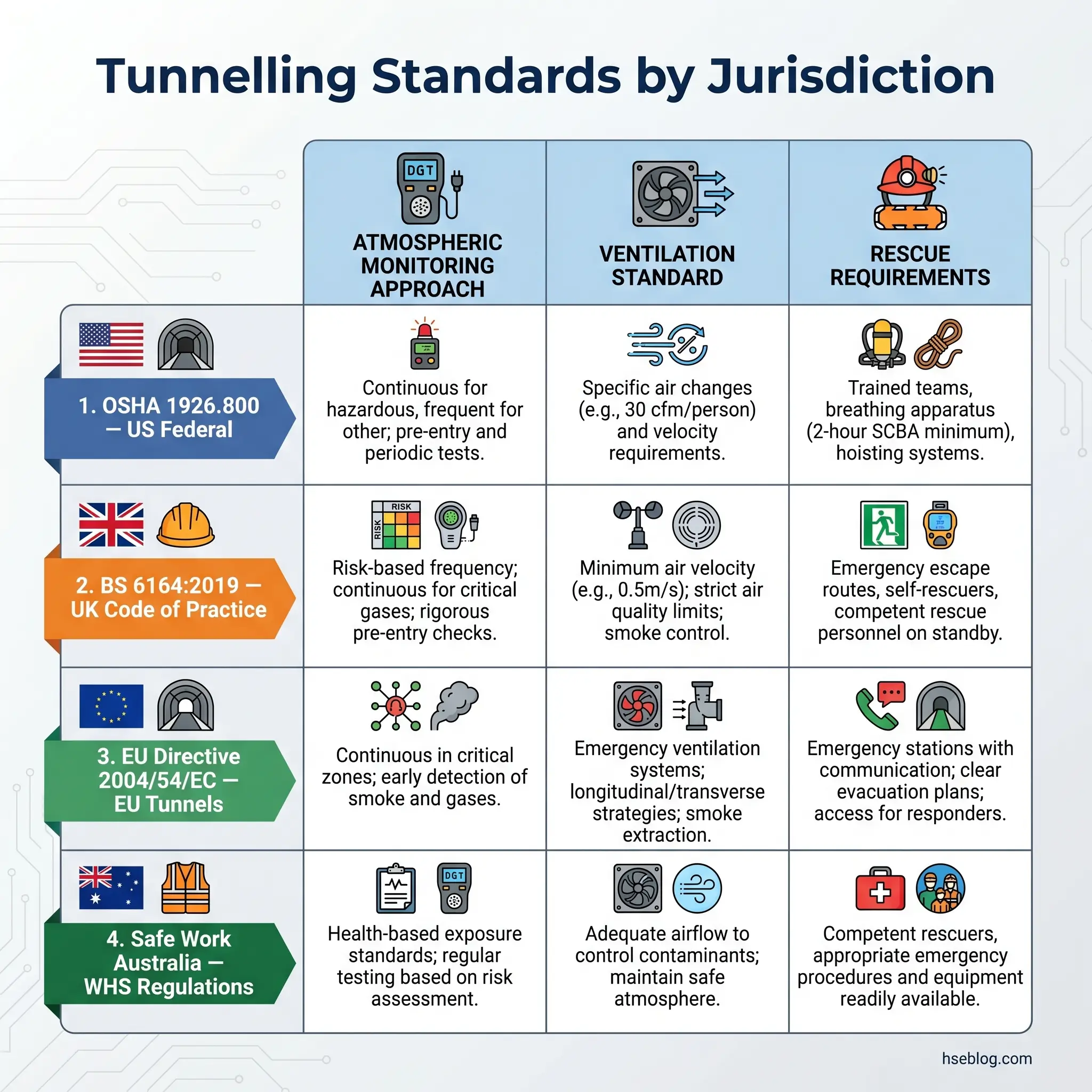
No single global standard governs tunnelling safety. Projects must comply with the jurisdiction where work takes place — and projects with international stakeholders often need to reconcile requirements that differ on specific thresholds.
| Standard | Jurisdiction | Scope | Atmospheric Monitoring | Ventilation | Rescue |
|---|---|---|---|---|---|
| OSHA 29 CFR 1926.800 | US | All underground construction: tunnels, shafts, chambers, passageways | Quantitative testing for CO, NO₂, H₂S, CH₄; gassy classification at 10% LEL | Min. 200 cfm/person; 100 cfm/bhp diesel; reversible | Rescue team required at all phases |
| BS 6164:2019 | UK | Shaft sinking, tunnel construction, cut-and-cover, immersed tube | Risk-assessment-based; real-time dust monitoring at 15-min STEL; DPM guidance | Extraction ventilation preferred for dust | Rescue provisions per risk assessment |
| EU Directive 2004/54/EC | EU | Road tunnels >500 m on trans-European network | Operational-phase focus | Mechanical ventilation; emergency ventilation | Emergency exits; shelter areas |
| Safe Work Australia WHS | Australia | Tunnelling as high-risk construction work | Per confined-space and WHS duties | Per risk assessment | Per WHS emergency planning |
| ITA/IAEI Code of Practice (3rd ed.) | International | Risk management framework for insurance and contracts | Uses BS 6164:2019 as default standard | Per BS 6164:2019 | Per risk assessment |
| BS EN 16191:2014 | EU/UK | TBM safety — guarding, emergency stops, safe access | Machine-specific | Machine-specific | Machine-specific |
A conflicting-standards issue practitioners must navigate: OSHA 1926.800 (US) uses a specific numerical threshold (10% LEL on three consecutive days) to trigger gassy operations classification. BS 6164:2019 (UK) uses a broader risk-assessment approach to atmospheric management. For projects with international stakeholders, the stricter threshold should be adopted unless jurisdictional law specifically dictates otherwise.
Willful violations of OSHA 29 CFR 1926.800 carry penalties up to $165,514 per violation (OSHA, 2026 adjusted). These are not theoretical — underground construction is a high-priority enforcement area.
Risk Assessment and Safety Management Planning for Tunnelling Projects
A risk assessment for tunnelling that is completed at the pre-construction phase and then filed is operationally useless. This is the single most common risk-management failure mode in the published tunnelling incident record.
Pre-Construction Foundation
The risk assessment begins with geotechnical and hydrogeological investigation — boreholes, geological mapping, groundwater monitoring, and historical records of the site and surrounding area.
BS 6164:2019 (UK) strengthened the role of the design checker: the checker must now certify not only the safety of the design but also its constructability. This change reflects incidents where designs were structurally adequate on paper but could not be safely built with available methods.
Dynamic Risk Management During Construction
Three principles separate effective tunnelling risk management from the static, document-filing approach:
- Continuous reassessment as the face advances — geological conditions revealed during excavation frequently differ from predictions. The risk register must be updated in response to actual ground conditions, not treated as a fixed document.
- Method statements tied to conditions — safe systems of work for each tunnelling method (TBM, NATM, drill-and-blast) must specify trigger conditions for switching to contingency methods when conditions deteriorate beyond design parameters.
- Multi-contractor coordination — where multiple contractors operate in the same tunnel, interface risks (communication, emergency response coordination, conflicting activities) require explicit management.
The judgment call that defines competent tunnelling risk management: when conditions encountered at the face differ from the design assumptions, does the project team stop and reassess, or does it push forward and hope the design margins are sufficient? The published incident record consistently shows which choice leads to investigation reports.
Emerging Technologies Improving Tunnel Construction Safety
Technology adoption in tunnelling tends to be project-specific rather than industry-wide. A system proven on a metro project in one country may not appear in the specification for the next project elsewhere. The gap between available technology and specified technology remains significant.
That said, several developments are actively changing safety practice on projects where they are deployed:
- Real-time atmospheric and dust monitoring — instruments now enable the 15-minute STEL approach that BS 6164:2019 (UK) recommends, replacing the older reliance on shift-average sampling that masked peak exposures.
- Digital twin technology — integrating IoT sensor data (strain gauges, accelerometers, convergence monitors) with BIM models to provide real-time structural monitoring of the tunnel during construction.
- AI-driven TBM parameter optimisation — systems like ATAS, applied on the Łódź metro project in Poland, adjust face pressure and advance rate based on real-time geological feedback rather than preset parameters.
- Wireless sensor networks for safety risk sensing — H-WSN systems have been credited with avoiding over 300 major accidents across 1,200 projects in 20 countries since 2021, according to the technology developers.
- Battery-electric underground plant — eliminating DPM at source, though introducing the lithium-ion fire risk that BS 6164:2019 flagged as an emerging concern.
- Personnel tracking and real-time location systems — providing the accurate, instant headcount that emergency rescue coordination demands, replacing manual check-in/check-out boards.
The misconception worth correcting: technology does not reduce the need for competent supervision. It provides better data faster — but the judgment to stop work, change methods, or evacuate remains a human decision that no sensor network can make.
Frequently Asked Questions
What is the most common cause of death in tunnel construction?
Ground collapse and struck-by incidents from plant and haulage are historically the most frequent acute causes of tunnelling fatalities. However, acute fatality data tells only part of the story. Chronic occupational health harm — respiratory disease from silica dust and diesel particulate exposure, noise-induced hearing loss, and vibration-related conditions — affects far more tunnelling workers over their careers. The distinction matters because it shapes where prevention investment should be directed.
Is tunnelling classified as confined space work?
Tunnelling shares key confined-space characteristics: limited access and egress, potential atmospheric hazards, and restricted natural ventilation. In several jurisdictions — notably under Australia's WHS Regulations — tunnelling work explicitly triggers confined-space duties. However, dedicated tunnelling standards such as OSHA 1926.800 (US) and BS 6164:2019 (UK) go beyond general confined-space requirements, addressing hazards specific to underground excavation that generic confined-space codes do not cover.
What atmospheric testing is required before entering a tunnel under construction?
Under OSHA 1926.800 (US), quantitative testing is required for carbon monoxide, nitrogen dioxide, hydrogen sulphide, methane, and other flammable gases. Testing must occur as often as necessary to ensure safe conditions — not just as a pre-shift formality. After blasting, mandatory re-entry delays apply until forced ventilation has cleared toxic fumes and a competent person has verified air quality. BS 6164:2019 (UK) adds real-time continuous monitoring requirements.
What is a gassy operation in tunnel construction?
Under OSHA 1926.800(h) (US), a gassy operation is classified when flammable gas is detected at 10% or more of the lower explosive limit on three consecutive test days. This classification triggers additional requirements: only approved equipment may be used, open flames are prohibited, ventilation must be enhanced, and warning signs must be posted at all entrances. Declassification requires three consecutive days with readings below 10% LEL.
Who is responsible for tunnelling safety on a construction site?
Responsibility is jurisdiction-dependent. Under OSHA (US), the employer bears primary duty. Under UK CDM 2015, duties are distributed among the client, principal designer, principal contractor, and individual contractors. Under Australian WHS law, the PCBU (person conducting a business or undertaking) holds the primary duty of care. Across all jurisdictions, the competent person concept is central — life-critical decisions must be made by individuals with demonstrated training and experience.
What ventilation rate is required in tunnel construction?
OSHA 1926.800 (US) requires a minimum of 200 cubic feet per minute of fresh air per worker underground. Additionally, each brake horsepower of diesel engine requires at least 100 cfm — this diesel requirement typically exceeds the personnel requirement and becomes the governing calculation. Mechanical ventilation must be reversible. BS 6164:2019 (UK) adds that extraction ventilation is the preferred method for dust containment, with real-time monitoring at 15-minute intervals.
Conclusion
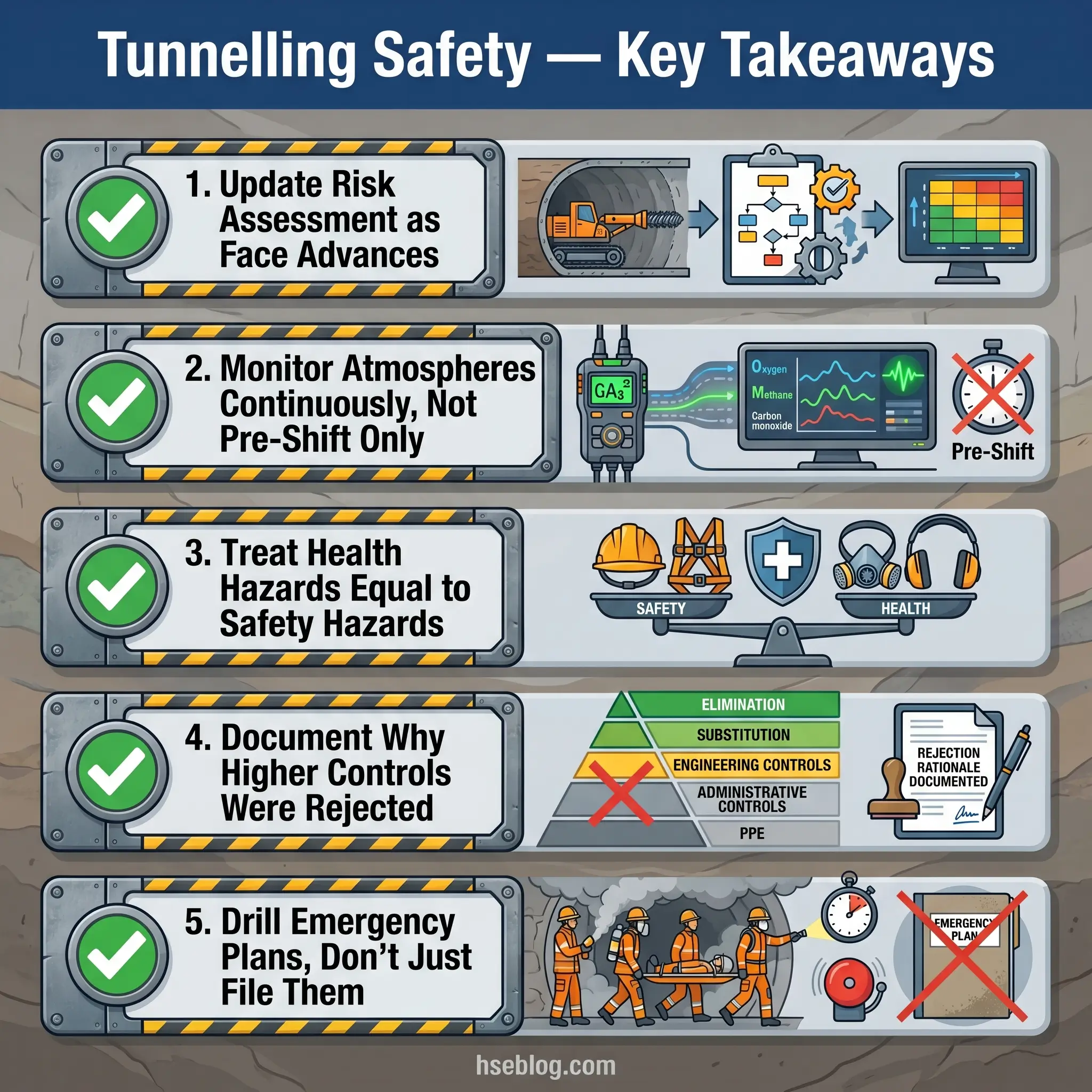
The tunnelling industry's persistent blind spot is not a lack of standards or technology. It is the gap between what the risk assessment says at the planning phase and what actually happens as the face advances into ground that does not match predictions.
Two patterns run through every major tunnel incident investigation of recent years. First, chronic occupational health hazards — silica dust, noise, DPM, vibration — are systematically under-controlled relative to acute safety hazards, partly because the transient workforce carries the damage away from the project that caused it. BS 6164:2019 attempted to correct this imbalance, but code revisions only work when site teams implement them. Second, risk assessments that are completed once and filed are the common denominator in tunnel failures where ground conditions exceeded design assumptions.
The highest-impact change any tunnelling project can make is cultural, not technical: treat the risk assessment as a living document that is updated every time the face reveals something the boreholes did not predict, and give the competent person on site the authority — and the operational backing — to stop work when conditions demand it. The 31 workers who walked out of the Los Angeles tunnel in July 2025 did so because someone had already made the decisions and trained the responses that mattered before the ground moved.