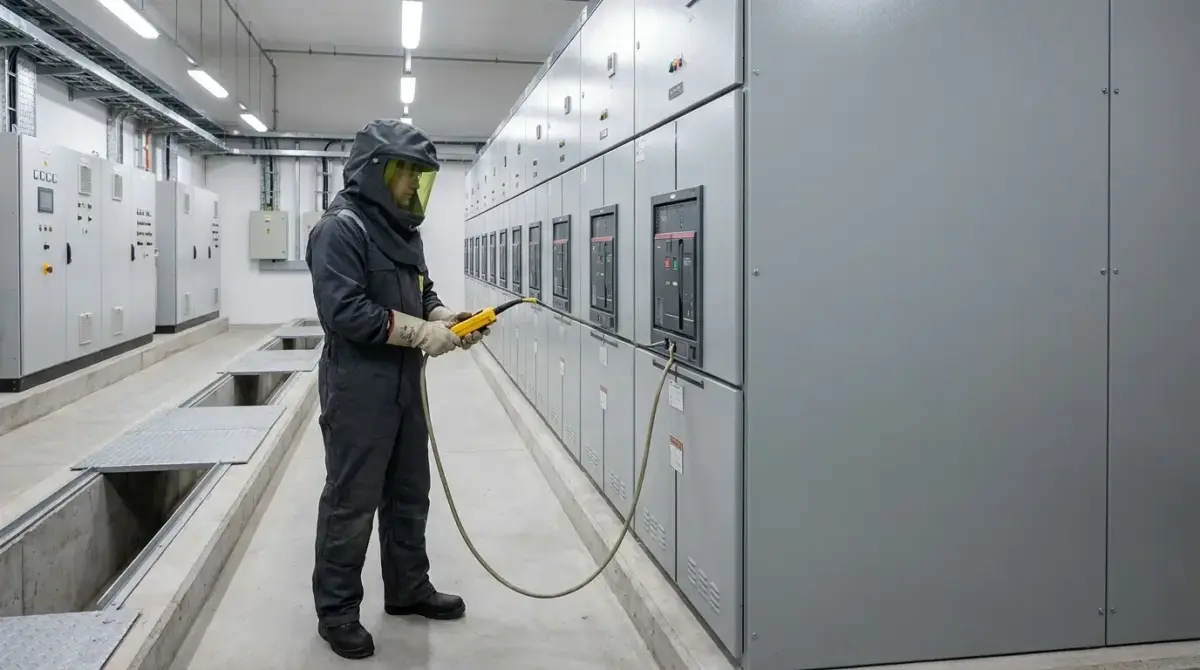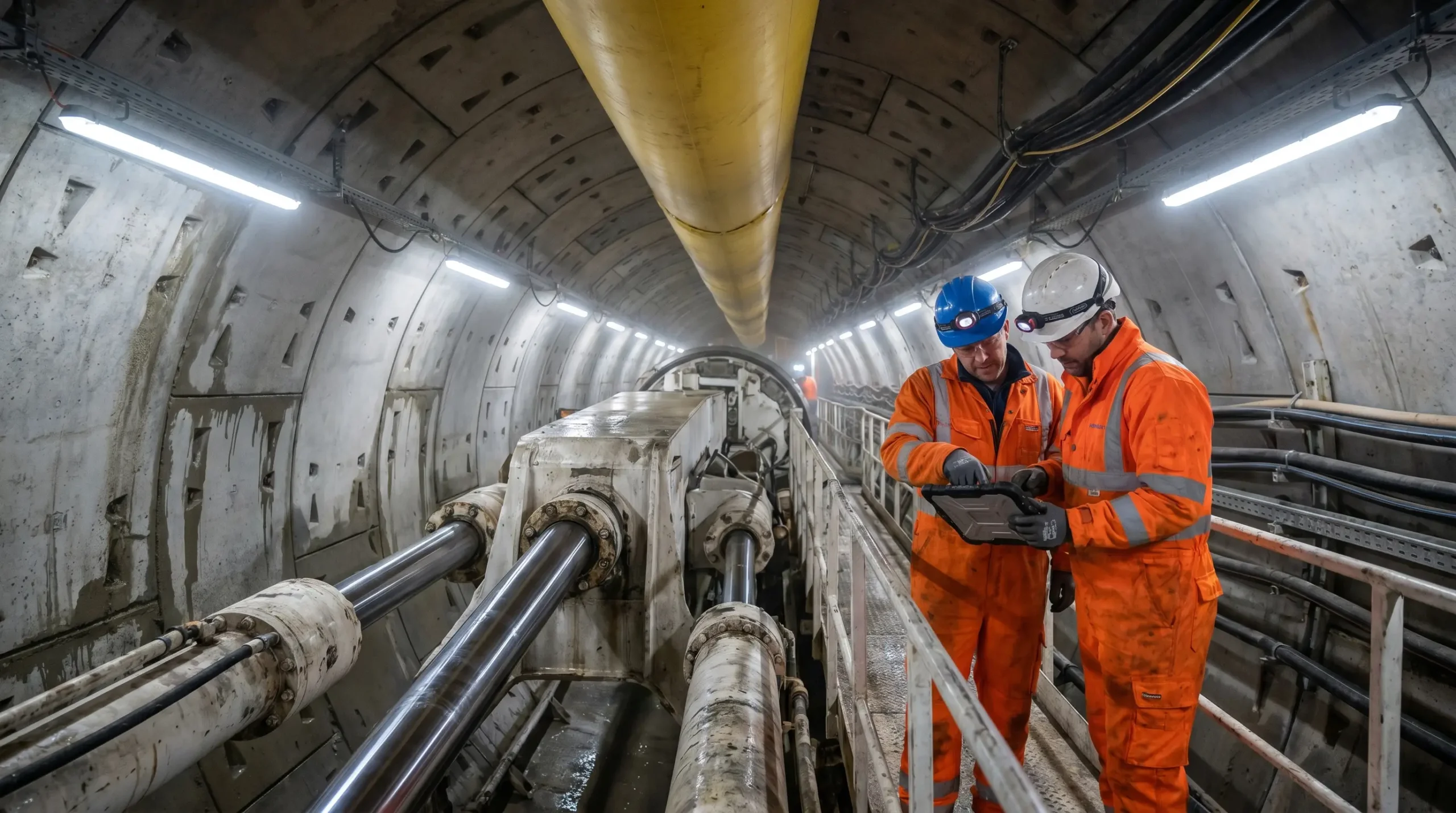
Tunnel boring machine operations present risks across six categories: geological hazards (ground collapse, water inrush), mechanical hazards (cutterhead failures, muck transport injuries), atmospheric hazards (gas exposure, silica dust), hyperbaric intervention risks (decompression sickness during cutterhead maintenance), emergency evacuation challenges in long tunnels, and chronic occupational health effects including noise-induced hearing loss and respiratory disease. Managing TBM safety requires understanding each category's distinct hazard mechanism and applying controls that are specific to the underground tunnelling environment.
In 2024, 1,032 construction and extraction workers died on the job in the United States (US Bureau of Labor Statistics, 2026). Tunnel-specific fatalities are buried within that total — BLS does not disaggregate them — but the tunnelling industry knows its own losses. Every major TBM incident investigation reveals the same uncomfortable pattern: the machine was performing as designed, and then something interrupted the process, and the safety framework built around normal operations failed to protect workers during the interruption.
That pattern is the central problem this article addresses. TBMs are inherently safer than drill-and-blast methods — they shield crews from the excavation face and eliminate flyrock and blast fumes. But they introduce a distinct risk profile that generic tunnelling safety guidance does not adequately cover. The six risk categories explored here — geological, mechanical, atmospheric, hyperbaric, emergency preparedness, and occupational health — each demand specific controls grounded in the regulatory frameworks of the jurisdictions where TBM projects operate. What follows is a practitioner-facing synthesis of those risks, structured around the distinction between normal-operation hazards and the far more dangerous process-disturbance periods.
What Makes TBM Operations a Distinct Safety Challenge
The core distinction in TBM safety is between normal boring — a continuous, controlled cycle of excavation, spoil removal, and lining installation — and process disturbances, where that cycle breaks down and workers must leave their protected work zones.
During normal operations, the TBM functions as a moving factory. The excavation face is sealed behind the cutterhead, spoil moves through enclosed conveyors or slurry lines, and precast segments are erected within the shield. Barrier distance between workers and the primary hazard source (the face) remains intact.
Process disturbances collapse that barrier distance. Cutter wear requires inspection or replacement. Mechanical failures demand hands-on repair. Geological surprises force manual intervention at the face.
Research from the Victory Boogie Woogie tunnel project in The Hague measured this directly:
- ~11% of construction time was attributable to process disturbances (Tunnelling and Underground Space Technology, 2022), yet these periods accounted for a disproportionate share of injury potential.
- Disturbance-response work is routinely under-planned. Project teams prepare detailed risk assessments for the boring phase but underestimate both the duration and hazard exposure of intervention work.
- The risk profile inverts during disturbances. Controls designed for continuous boring — atmospheric monitoring cycles, ventilation flow rates, guarding configurations — may not match the hazard profile of a cutterhead intervention or an emergency geological response.
The practical implication is that TBM safety management must maintain two parallel risk frameworks: one for normal operations and one for every category of disturbance that can interrupt them.
Geological and Ground-Condition Risks
Ground conditions are the primary risk driver on any TBM project because geological hazards cascade directly into mechanical, atmospheric, and scheduling risks.
The hazard is not simply "bad ground." It is encountering ground conditions in a location where the TBM is configured for a different geology. Pre-construction geotechnical investigations sample discrete points along an alignment; the ground between those points is interpolated. When the interpolation is wrong, the consequences range from reduced advance rates to catastrophic face collapse.
The principal geological hazards break down as follows:
- Ground collapse and face instability — soft soils and fractured rock zones where the tunnel face cannot self-support. Loss of face pressure in an earth pressure balance (EPB) or slurry TBM triggers a cascading failure: soil liquefaction at the face, over-excavation, void propagation upward, and surface sinkholes.
- Water inrush — sudden groundwater ingress exceeding the TBM's dewatering capacity. High water tables and fault zones intersecting permeable strata are the classic triggers.
- Mixed-face conditions — the cutterhead encounters rock and soil simultaneously, creating asymmetric forces that accelerate tool wear and increase vibration.
- Gas pockets — methane or hydrogen sulphide in previously uncharacterised strata, with immediate atmospheric and explosion risk.
- Ground settlement — over-excavation or face pressure loss causing subsidence above the tunnel alignment, damaging surface structures.
Face Stability and Earth Pressure Balance Failures
EPB and slurry TBMs maintain face stability by balancing the earth and water pressure at the excavation face with a corresponding pressure inside the cutterhead chamber.
When that balance fails, the sequence is predictable and fast. The face loses confinement, material flows uncontrolled into the chamber, a void develops behind the face, and the void migrates toward the surface. Real-time face pressure monitoring and automated pressure regulation are the primary engineering controls, supplemented by surface settlement monitoring and compensation grouting.
The judgment call for practitioners is recognising the early indicators — pressure fluctuations, unexpected muck volumes, torque spikes — before the cascade becomes irreversible. Reviewing published sinkhole incidents consistently shows that warning data existed in the TBM's operating parameters before the surface event; it was either not monitored in real time or not interpreted quickly enough.
Mechanical and Equipment Risks on the TBM
The most frequent mechanical injuries on TBM projects do not come from dramatic component failures — they come from the routine movement of materials and lining segments through confined underground space.
Published incident patterns consistently show that struck-by and caught-between injuries from segment erectors, conveyor systems, and muck cars account for a significant share of TBM-related injuries. These are high-frequency, moderate-severity events that accumulate across a project's duration.
The broader mechanical risk landscape includes several categories:
Cutterhead and Main Drive Failures
Cutter tool wear is inevitable. As tools degrade, boring efficiency drops, vibration increases, and the frequency of worker interventions rises. Each intervention is a process disturbance with its own risk profile.
Main bearing and drive failures are lower probability but extreme consequence — in deep tunnels, replacing a main bearing can take months and requires engineering solutions that were never part of the original safety plan.
Conveyor and Muck Transport Hazards
Horizontal transport of excavated material through long tunnel sections creates persistent exposure to:
- Struck-by risks from muck cars, locomotives, and conveyor components
- Caught-in hazards at conveyor transfer points, drive stations, and tail pulleys
- Crush risks during segment transport and positioning
These hazards are continuous throughout the shift, unlike cutterhead interventions which are episodic. That continuity of exposure is precisely why muck transport deserves more safety attention than it typically receives.
Electrical and Fire Hazards
TBMs operate high-voltage electrical systems in wet underground conditions — a combination that demands rigorous isolation and maintenance protocols.
| Hazard | Mechanism | Primary Control |
|---|---|---|
| Electrical contact | Cable damage from equipment movement, water ingress to switchgear | Isolation procedures, IP-rated enclosures, RCD protection |
| Hydraulic fire | Pressurised fluid leak contacting hot surfaces | Fire-resistant hydraulic fluids, automatic suppression systems |
| Transformer failure | Oil-filled transformers in confined space | Dry-type transformers where practicable, bunding, gas detection |
Fire risk is amplified by limited evacuation routes. BS 6164:2019 expanded its guidance on vehicle fire suppression and prohibits open flames underground — a requirement that sounds obvious but reflects real enforcement history.
Atmospheric and Ventilation Hazards
Ventilation is the control that every other atmospheric safeguard depends on, and it is the control most likely to degrade silently as the tunnel lengthens.
OSHA 29 CFR 1926.800 requires a competent person to perform all air monitoring in underground construction and mandates a minimum air velocity of 30 feet per minute where drilling or blasting occurs. BS 6164:2019 took a different approach to dust specifically, shifting to real-time 15-minute short-term exposure limit monitoring rather than relying solely on 8-hour time-weighted averages — a more protective approach for peak exposures.
The key atmospheric hazards in TBM tunnelling include:
- Oxygen depletion — consumed by diesel engines, displaced by inert gases from the ground, or reduced by biological activity in organic soils.
- Methane and hydrogen sulphide — naturally occurring in certain geological formations. OSHA's gassy vs. potentially gassy classification determines the entire electrical and ventilation compliance regime for the project.
- Carbon monoxide and diesel particulate — from underground mobile equipment. MSHA-approved engines are required for underground diesel equipment under OSHA jurisdiction.
- Respirable crystalline silica — now classified as a Group 1 human carcinogen by IARC. BS 6164:2019 moved to extraction ventilation as the preferred control method, recognising that dilution ventilation alone is insufficient for silica.
A common failure pattern across long-tunnel projects is ventilation capacity drift. A system designed to deliver adequate air quality at 500 metres becomes marginal at 2 kilometres as duct friction losses increase and the air volume reaching the face drops. Ventilation plans must be dynamically redesigned as the tunnel advances — calculating required fan capacity and duct diameter for the full tunnel length at project start, with staged upgrades planned before they become necessary, not after air quality monitoring shows the system is failing.

Hyperbaric Intervention Risks During Cutterhead Maintenance
Hyperbaric cutterhead intervention is the highest-consequence risk unique to pressurised-face TBMs, and the one where the gap between what is technically possible and what is operationally practiced is widest.
When cutter tools wear beyond tolerance or the cutterhead sustains damage, someone — or increasingly, something — must enter the pressurised excavation chamber to inspect and repair. On EPB and slurry machines operating under pressure, this means workers entering a compressed-air environment through an airlock system, performing physically demanding work in extreme heat and confined space, and then decompressing according to strict schedules.
The specific hazards during hyperbaric interventions are severe and interconnected:
- Decompression sickness — inadequate or rushed decompression allows nitrogen bubbles to form in blood and tissues. Severity ranges from joint pain to paralysis and death.
- Barotrauma — pressure-related injury to ears, sinuses, and lungs during compression or decompression.
- Heat stress — elevated temperatures in the excavation chamber, combined with heavy PPE and physical exertion under pressure, create a heat illness risk that is difficult to control.
- Confined space hazards — the excavation chamber is the most confined, least accessible workspace on the entire project.
The UK's Work in Compressed Air Regulations 1996 provides the legal framework for compressed-air work, supplemented by the BTS Compressed Air Working Group's revised guide published in 2024. That revision now includes guidance on integrating high-pressure compressed air work into the UK regulatory framework, including surface living habitats for saturation working (Tunnels and Tunnelling, 2024).
Two intervention approaches exist, and the choice between them is itself a critical safety decision:
| Factor | Bounce Diving (<3.5 bar) | Saturation Technique (>3.5 bar) |
|---|---|---|
| Decompression | Daily, after each entry | Once, at end of intervention campaign |
| Cumulative decompression risk | Higher (repeated cycles) | Lower (single decompression) |
| Worker endurance | Limited by daily pressure exposure | Extended working periods possible |
| Infrastructure required | Standard airlock | Surface living habitat, medical support |
The emerging alternative is robotic cutterhead inspection. Articulated robots capable of accessing excavation chambers to change worn cutter discs are now in deployment, substantially reducing the need for human hyperbaric exposure (SAALG Geomechanics, 2025). Several manufacturers introduced AI-driven predictive maintenance systems in 2024–2025 that reduce unplanned process disturbances — catching cutter wear before it forces an emergency intervention.
The judgment call that defines project safety culture here is whether to intervene hyperbaric or seek an alternative — ground treatment from the surface, TBM design modifications allowing atmospheric access, or waiting for robotic capability. Too often, that decision is driven by schedule pressure rather than a proportionate assessment of whether the intervention risk is acceptable. When reviewing investigation reports from hyperbaric incidents, a recurring finding is that the intervention was deemed "necessary" on programme grounds when safer alternatives existed but would have caused delay.
Emergency Preparedness and Evacuation Challenges
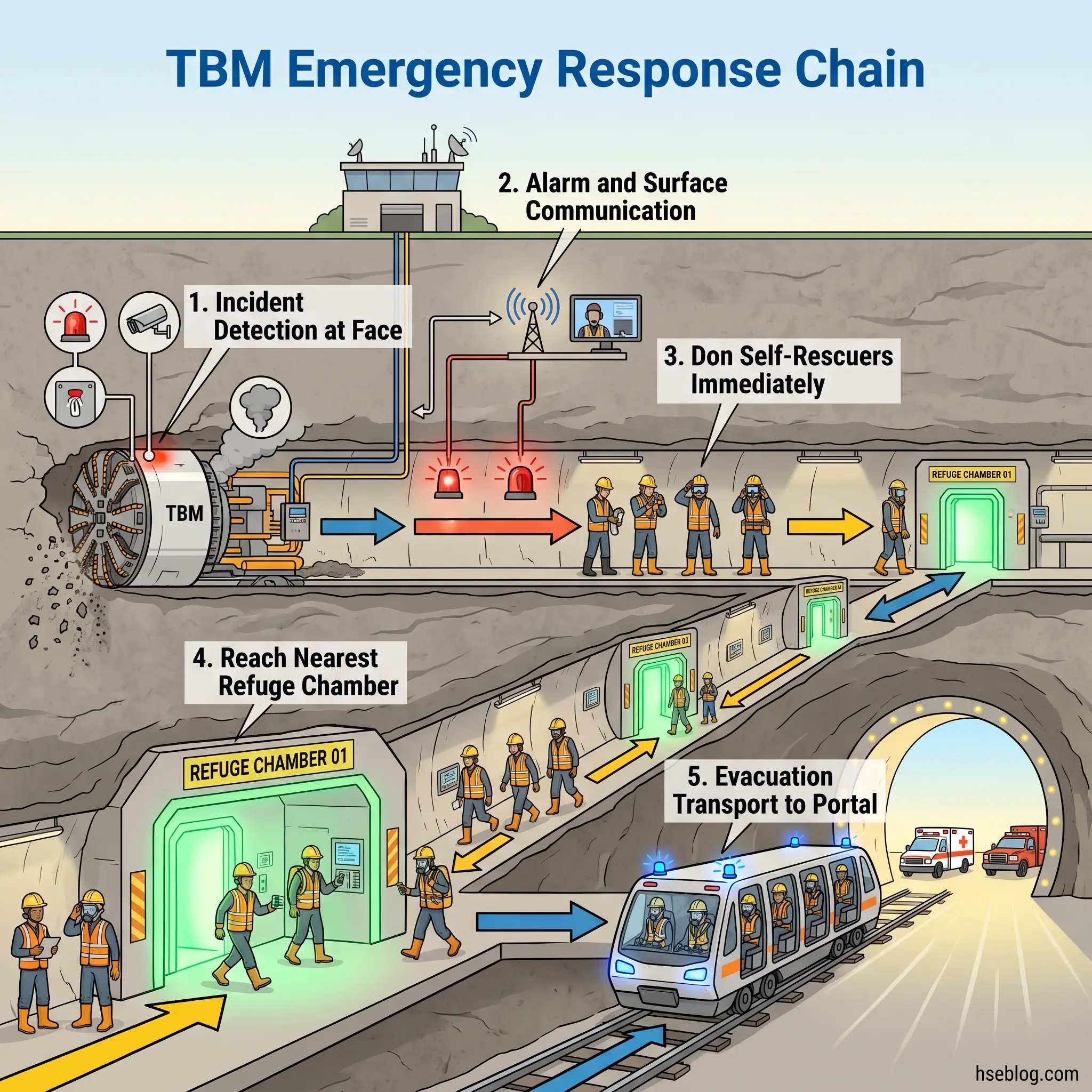
Emergency response in TBM tunnelling is defined by a constraint that no amount of planning fully eliminates: there is typically one way in and one way out, and the distance to safety increases every day.
OSHA 29 CFR 1926.800 requires NIOSH-approved self-rescuers for all underground workers and mandates that rescue teams be available for prompt response. EN 16191:2014 Annex D requires refuge chambers integrated into tunnelling machinery, providing a survivable environment when evacuation is not immediately possible.
Effective emergency preparedness for TBM projects must address:
- Evacuation distance — tunnels exceeding 2 km require specialised transport systems (rail-based evacuation vehicles, not walking pace) and staged refuge points along the alignment.
- Fire suppression — hydraulic fluid fires in the confined tunnel environment produce toxic smoke that travels faster than people can walk. Automatic suppression systems on the TBM and support equipment are essential, not optional.
- Communication — maintaining reliable voice and data contact across the full tunnel length, including through curves and past electrical interference from the TBM itself.
- Self-rescuer training — providing the device is insufficient. Workers must be trained to don it under stress, in darkness, while moving.
A misconception that persists on many projects is that emergency drills adequately test the plan. They rarely do. Most drills simulate orderly withdrawal from a location near the portal. The critical test — whether the plan works when the incident occurs at the tunnel face, 3 km from the shaft, during a shift change with maximum personnel underground — is almost never rehearsed because it would shut down production for a full shift. That gap between tested and untested scenarios is where real emergency plans fail.
What Are the Key Health Risks for TBM Tunnel Workers?
Projects with excellent acute-injury records sometimes mask poor occupational health outcomes because chronic health effects are invisible for years — dust exposure today becomes a cancer diagnosis a decade later.
Content covering occupational health surveillance and exposure risks is for HSE practitioner reference. It is not medical advice. Workers with specific symptoms or exposure concerns should consult an occupational physician or qualified medical professional.
The chronic health risks for TBM tunnel workers span multiple exposure pathways:
- Noise-induced hearing loss — prolonged proximity to the cutterhead, hydraulic systems, and ventilation fans produces sustained noise levels that frequently exceed 85 dB(A). Hearing protection is mandatory, but compliance degrades over long shifts in hot, confined conditions.
- Respirable crystalline silica exposure — the most serious long-latency risk. Silica is classified as a Group 1 human carcinogen, and TBM boring through silica-bearing rock generates respirable dust continuously. The disease does not appear in acute injury statistics, which is precisely why it is under-prioritised.
- Whole-body vibration — workers on or near the TBM are exposed to vibration transmitted through the machine structure, contributing to musculoskeletal disorders over time.
- Fatigue — TBM operations typically run 24/7. Shift patterns of 10–12 hours underground, combined with commute times to remote portal locations, compress rest periods below what fatigue science supports for safety-critical work.
- Mental health — isolation from natural light, confined working environment, repetitive work cycles, and the psychological burden of working under compressed air for those involved in hyperbaric interventions.
Health surveillance requirements vary by jurisdiction but share a common structure: pre-employment medical examination, periodic monitoring during employment, and post-employment follow-up for workers with significant exposure histories. Compressed-air workers face the most rigorous medical fitness requirements, governed in the UK by the Work in Compressed Air Regulations 1996.
Risk Controls and the Hierarchy of Controls Applied to TBM Operations
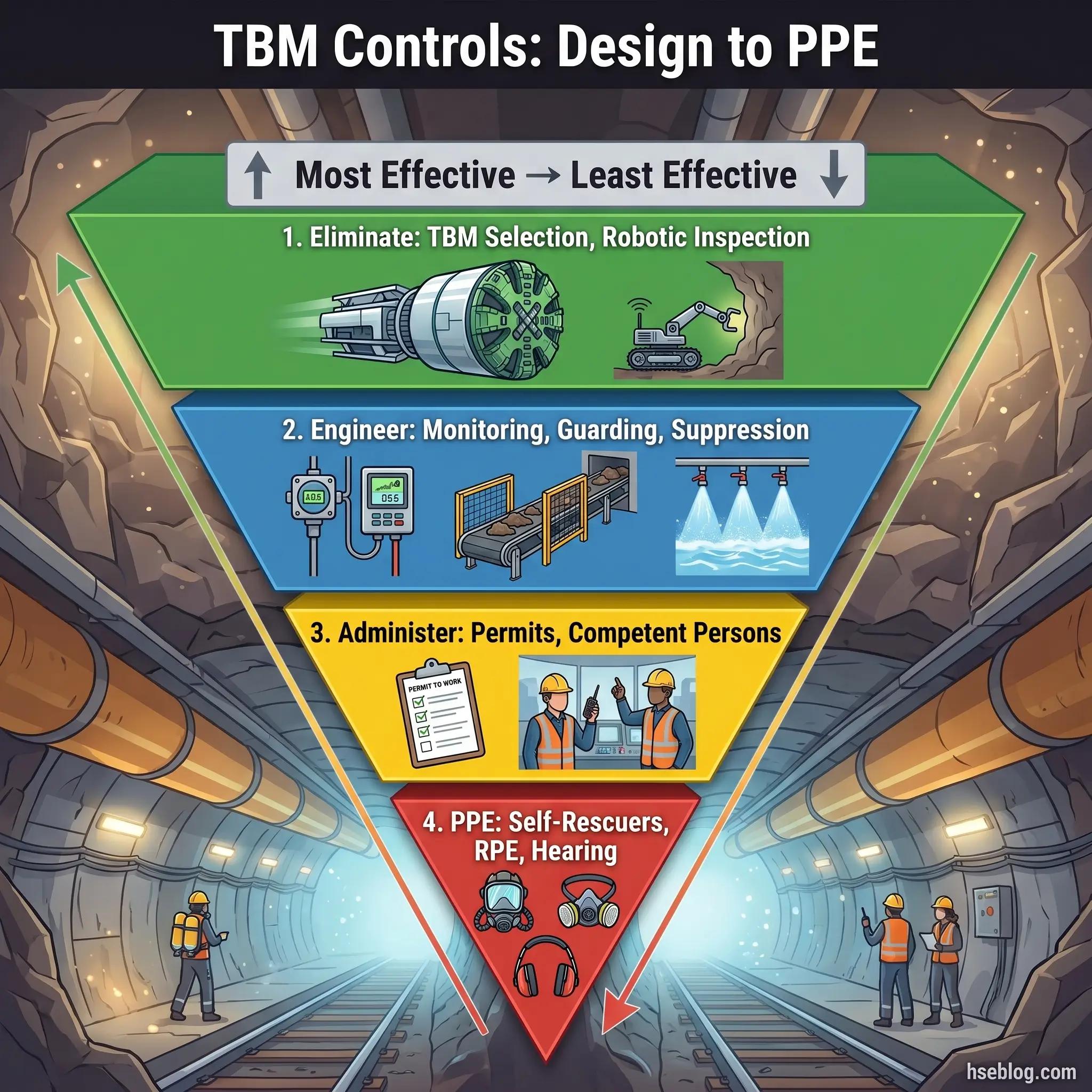
The hierarchy of controls is well understood in theory but frequently inverted in practice on TBM projects — teams default to PPE and procedures because engineering controls require design-phase decisions that have already been locked in by the time the safety team is fully mobilised.
That inversion is the central lesson of TBM risk management. The most consequential safety decisions happen during procurement and design, not during boring.
Elimination and Substitution
The highest-value safety interventions occur before the TBM is ordered:
- Selecting the TBM type appropriate to the geology — eliminating the mismatch between machine capability and ground conditions that drives process disturbances.
- Designing out hyperbaric interventions — specifying TBM configurations that allow atmospheric-pressure access to the cutterhead where geology permits.
- Robotic cutterhead inspection — replacing human entry to the excavation chamber with articulated robots capable of tool change and inspection (SAALG Geomechanics, 2025).
Engineering Controls
- Real-time atmospheric monitoring — continuous gas detection and dust monitoring at the face and along the tunnel, with automated alarm thresholds.
- Face pressure management systems — automated EPB or slurry pressure regulation with operator override controls.
- Conveyor guarding and emergency stops — physical guards at all transfer and pinch points, with accessible e-stops along the full conveyor length.
- Fire suppression — automatic systems on the TBM, backup locomotives, and transformer stations.
- Ventilation systems — designed for full tunnel length with staged capacity upgrades, not initial-drive conditions only.
Administrative Controls
Permit-to-work systems for cutterhead interventions, competent person designation under OSHA 29 CFR 1926.800, fatigue management through shift planning, and comprehensive induction training covering TBM-specific hazards rather than generic construction safety content.
PPE
NIOSH-approved self-rescuers, respiratory protective equipment rated for silica exposure, hearing protection, high-visibility clothing, and hard hats. PPE is the last line — as OSHA's Underground Construction guidance booklet makes clear, it protects the individual worker when all upstream controls have either been implemented or have failed.
Regulatory Framework for TBM Tunnelling Safety
The regulatory landscape for TBM safety is fragmented — no single standard covers all TBM-specific risks comprehensively, and the gaps between standards are where risk can be overlooked.
Practitioners must cross-reference multiple documents, and understanding which requirements apply in which jurisdiction is itself a compliance task. The ITA-AITES guidelines on occupational health and safety in tunnel construction exist specifically to fill gaps where national frameworks are incomplete.
The following table maps the key regulatory requirements across the primary jurisdictions:
| Requirement Area | US — OSHA 29 CFR 1926.800 | UK — BS 6164:2019 | EU — EN 16191:2014 |
|---|---|---|---|
| Dust monitoring | 8-hour TWA; PEL 50 µg/m³ (silica rule) | Real-time 15-min STEL; extraction ventilation preferred | Within machinery confines only |
| Ventilation | Min 30 ft/min air velocity | Performance-based; real-time monitoring | Atmospheric monitoring within machine |
| Atmospheric classification | Gassy / potentially gassy categories | Risk-assessment-based | Not specifically addressed |
| Compressed air work | General duty clause | Work in Compressed Air Regs 1996 + BTS guide (2024) | Explicitly excluded from EN 16191 scope |
| Self-rescuers | NIOSH-approved, mandatory | Recommended in guidance | Refuge chambers required (Annex D) |
| Competent person | Explicitly required for air monitoring | Required under CDM Regulations 2015 | Implied through Machinery Directive |
| Penalties (willful violation) | Up to $165,514 per violation (OSHA, 2026) | Unlimited fines + imprisonment | Member state enforcement |
Three critical gaps deserve attention:
- EN 16191 explicitly excludes hyperbaric conditions and explosive atmospheres. Projects involving pressurised-face TBMs in the EU must source compressed-air safety requirements from national legislation, not the tunnelling machinery standard.
- OSHA 29 CFR 1926.800 was last substantially revised in 1989. While amendments have updated penalty levels, the technical provisions predate modern TBM technology. State-plan OSHA states may impose requirements beyond the federal standard.
- BS 6164:2019 is guidance, not law — but UK courts give it significant weight as the standard of reasonable care. Its next revision cycle is underway, expected to address ongoing revisions of EN 16191 and EN 12110 (Tunnels and Tunnelling, 2024).
Regulatory content here reflects general HSE professional understanding of US, UK, and EU requirements as of 2025. It is not legal advice. Specific compliance questions, enforcement situations, or prosecution risk should be directed to qualified legal counsel in the applicable jurisdiction.
Frequently Asked Questions
What is the most dangerous part of TBM tunnel construction?
Hyperbaric cutterhead interventions and process disturbance periods carry the highest risk — not normal boring operations. Research from Dutch TBM projects found that approximately 11% of construction time is attributable to process disturbances (Tunnelling and Underground Space Technology, 2022), yet these periods generate disproportionate injury potential because workers leave protected zones and barrier distance from the excavation face collapses.
How are TBM workers protected from gas exposure underground?
Protection relies on continuous atmospheric monitoring by a competent person as required under OSHA 29 CFR 1926.800, mechanical ventilation maintaining minimum air velocity, gassy-operations classification triggering approved electrical equipment, and personal self-rescuers. BS 6164:2019 adds real-time 15-minute short-term exposure monitoring for dust, providing better peak-exposure protection than 8-hour time-weighted averages alone.
What is a hyperbaric intervention on a tunnel boring machine?
When cutter tools wear or the cutterhead is damaged on a pressurised-face TBM, workers enter the excavation chamber through an airlock under compressed air to inspect and repair. Interventions below 3.5 bar use bounce diving with daily decompression; above 3.5 bar, saturation techniques with surface living habitats eliminate repeated decompression risk. Robotic alternatives are now emerging that can perform tool changes without human entry.
What OSHA standard applies to TBM tunnel construction?
OSHA 29 CFR 1926.800, Subpart S — Underground Construction, is the primary federal standard. It covers access and egress, ventilation, atmospheric monitoring, self-rescuers, gassy operations classification, rescue teams, fire prevention, and haulage safety. State-plan OSHA states may impose additional requirements beyond the federal baseline.
What is the difference between gassy and potentially gassy tunnel operations?
Under OSHA, a tunnel is classified as gassy when air monitoring or geological evidence indicates methane or other flammable gases are present or likely. Gassy classification requires all electrical equipment to be OSHA-approved for the atmosphere. Potentially gassy requires only approved ventilation equipment. The classification determines the entire electrical and ventilation compliance regime — getting it wrong exposes the project to both explosion risk and enforcement penalties up to $165,514 per willful violation (OSHA, 2026).
How has AI improved tunnel boring machine safety?
AI contributions are emerging but not yet universally deployed. Predictive maintenance systems identify cutter wear patterns before they trigger unplanned interventions, reducing process disturbance frequency. AI-driven parameter optimisation adjusts boring parameters to reduce ground risk. Robotic cutterhead inspection eliminates human hyperbaric exposure for routine tool changes. Digital twins enable real-time risk simulation. These capabilities are advancing rapidly — several manufacturers introduced AI-driven systems in 2024–2025 (SAALG Geomechanics, 2025) — but they supplement rather than replace competent human oversight.
Conclusion
The industry's understanding of TBM risk has a persistent blind spot. Projects invest heavily in geological investigation, machine specification, and boring-phase safety — and those investments work. Normal TBM operations are, by historical standards, remarkably safe.
Where the framework breaks is at the boundary between normal operations and process disturbances. The 11% of construction time consumed by disturbances is where controls thin out, where workers enter hazard zones they were not originally assessed for, and where schedule pressure overrides the question of whether an intervention is proportionate to its risk. Hyperbaric cutterhead entry remains the starkest example: a procedure with life-threatening consequences that is sometimes authorised because the alternative is a programme delay, not because the risk has been genuinely weighed.
The highest-impact change available to any TBM project team is temporal — moving safety-critical decisions earlier. TBM type selection, cutterhead access design, ventilation capacity planning for full tunnel length, and the decision framework for hyperbaric versus alternative intervention methods all belong in the procurement and design phase. By the time the TBM is in the ground, the most consequential safety choices have already been made. The question is whether they were made by safety professionals with the authority to influence them, or whether they were inherited as engineering constraints that the safety team must now work around.