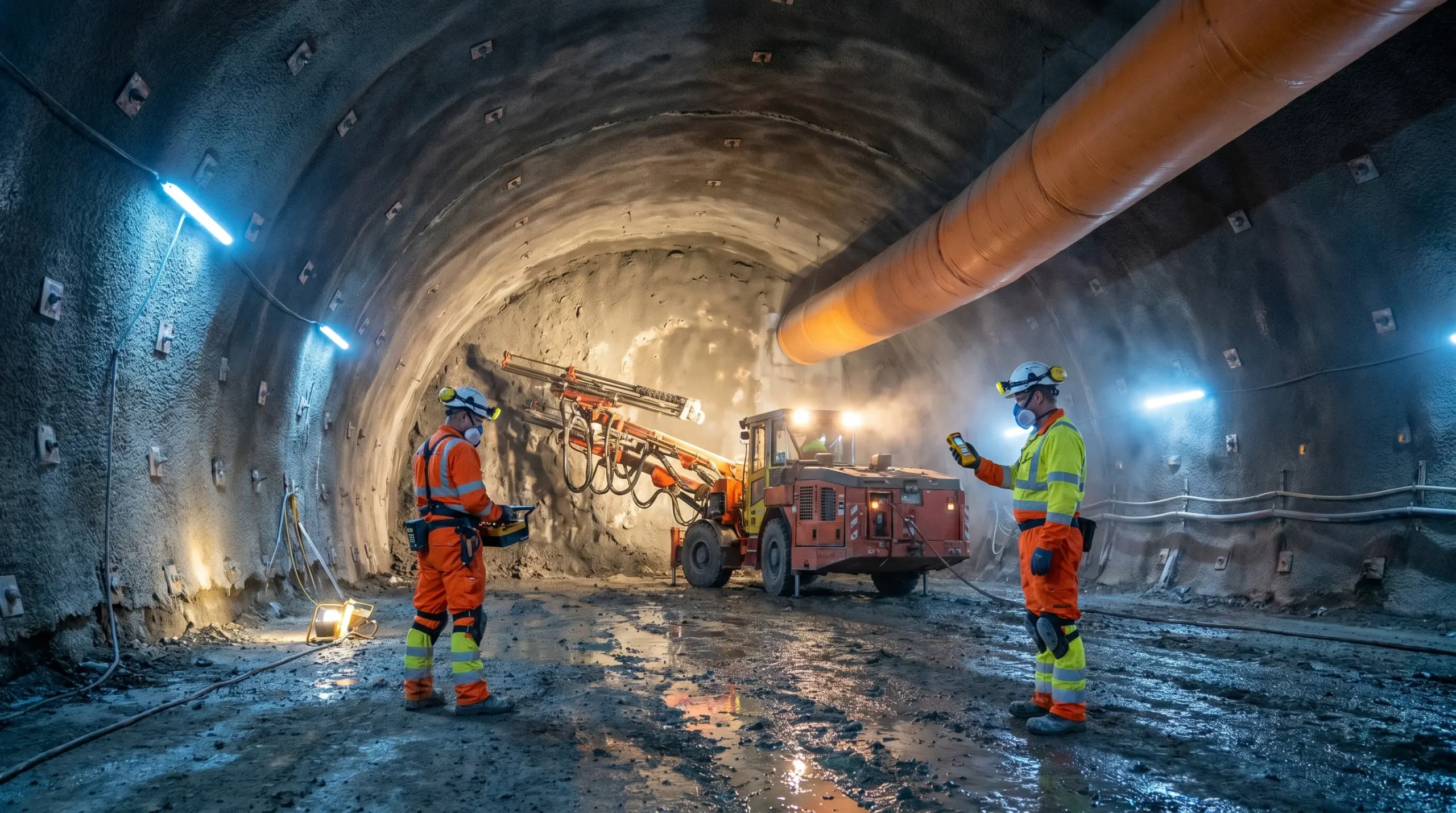
The short version: Underground works require mechanical ventilation supplying at least 200 cubic feet per minute of fresh air per worker, with a minimum face velocity of 30 feet per minute during blasting or rock drilling under 29 CFR 1926.800(k). Airflow must be reversible. UK projects apply BS 6164:2019, which favors concentration-based limits and continuous monitoring by a competent person.
29 CFR 1926.800(k)(2) reads as a single tidy line: at least 200 cubic feet per minute of fresh air per worker underground. The number behaves well on a design submission. On a 2-kilometre drive served by a flexible bag line losing roughly 1.5% of its flow per 100 metres under ideal conditions — and substantially more in practice through kinks, tape failures at duct joints, and tears around hangers — the 200 cfm measured at the portal arrives at the face as something materially less. The standard is satisfied at the meter. The worker still breathes contaminated air.
Ventilation in underground works is the single engineering control on which every other underground safety system depends. When it fails — bad design, duct leakage, fan trip, untested reversibility — multiple atmospheric hazards activate at once: methane accumulates, blast fumes linger, oxygen depletes, diesel particulate climbs. This article covers what the major standards actually require under OSHA, MSHA, BS 6164, and EU directives, the engineering methods used to deliver compliant atmospheres, and the recurring failure patterns that separate paperwork compliance from a genuinely breathable face.
Competent-person notice. This article provides general HSE knowledge on ventilation in underground works. Detailed design — fan selection, duct sizing, calculation of post-blast clearance times, gassy classification decisions — must be planned and supervised by a competent ventilation engineer with jurisdiction-specific authorisation and site-specific risk assessment. The information here does not replace that work.
Why Ventilation Is the Foundational Control in Underground Works
Underground works concentrate hazards that surface workplaces dilute by default. Limited natural air exchange, single or restricted egress, and rock strata that release gases on their own schedule mean that an underground atmosphere is whatever the ventilation system makes it — there is no ambient backstop.
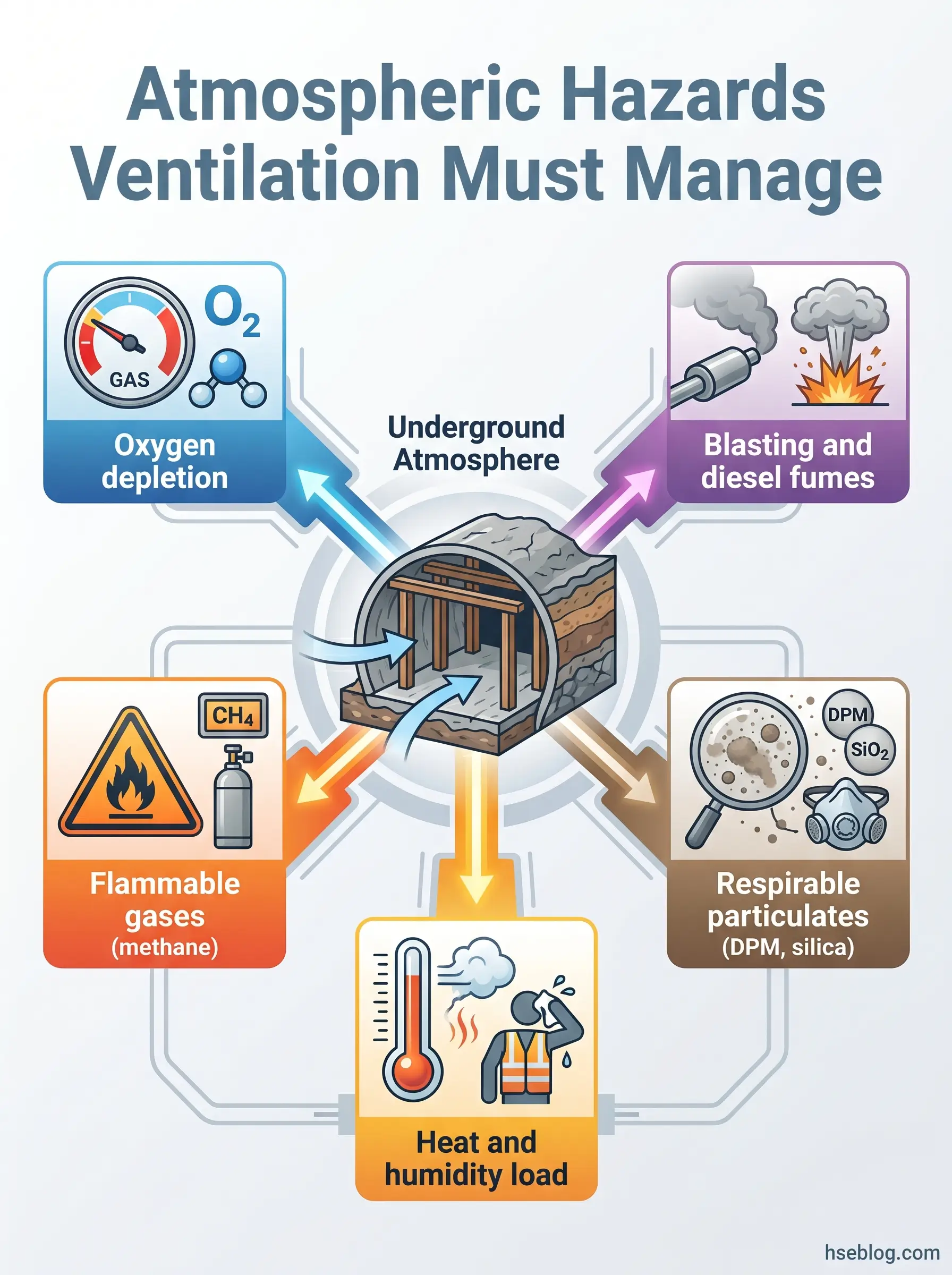
The hazard inventory that ventilation manages is wide:
- Oxygen depletion — strata absorption, displacement by other gases, or biological and chemical consumption.
- Flammable gases — methane (CH₄) from coal measures and certain sedimentary strata; hydrogen (H₂) from electrolysis or battery banks.
- Toxic combustion products — carbon monoxide (CO) and nitrogen oxides (NOₓ) from blasting and diesel equipment.
- Naturally occurring toxins — hydrogen sulfide (H₂S) from organic-rich strata; radon in some geologies.
- Respirable particulates — diesel particulate matter (DPM), respirable crystalline silica (RCS), and general respirable dust.
- Heat and humidity load — from rock, equipment, hydration of fresh concrete, and human metabolism.
These compound in ways surface ventilation engineers rarely encounter. Heavier-than-air gases pool at the invert; lighter-than-air gases accumulate at the crown; cross-section changes around niches and step-downs create dead zones the bulk-air calculation misses entirely. A consistent pattern across published confined-space and tunnelling investigations is that atmospheric testing is performed at the entry point but not at the working level, where heavier-than-air contaminants actually accumulate — the meter reads safe; the worker is not in the same atmosphere as the meter.
The wider stakes are not abstract: 1,032 fatal injuries were recorded in US construction and extraction occupations in 2024, at a construction sector fatality rate of 9.2 per 100,000 full-time equivalents (US Bureau of Labor Statistics, 2026 release of 2024 CFOI data). Not all are ventilation-related, but underground construction is a sector where ventilation failure feeds disproportionately into the worst outcomes.
This article addresses construction-phase ventilation — tunnels and shafts under construction, where the controlled atmosphere is built incrementally as the drive advances. Operational ventilation in finished road, rail, and metro tunnels — designed around traffic-induced contaminant loads and emergency smoke control — follows different design logic and sits outside the scope here.
Regulatory Requirements by Jurisdiction
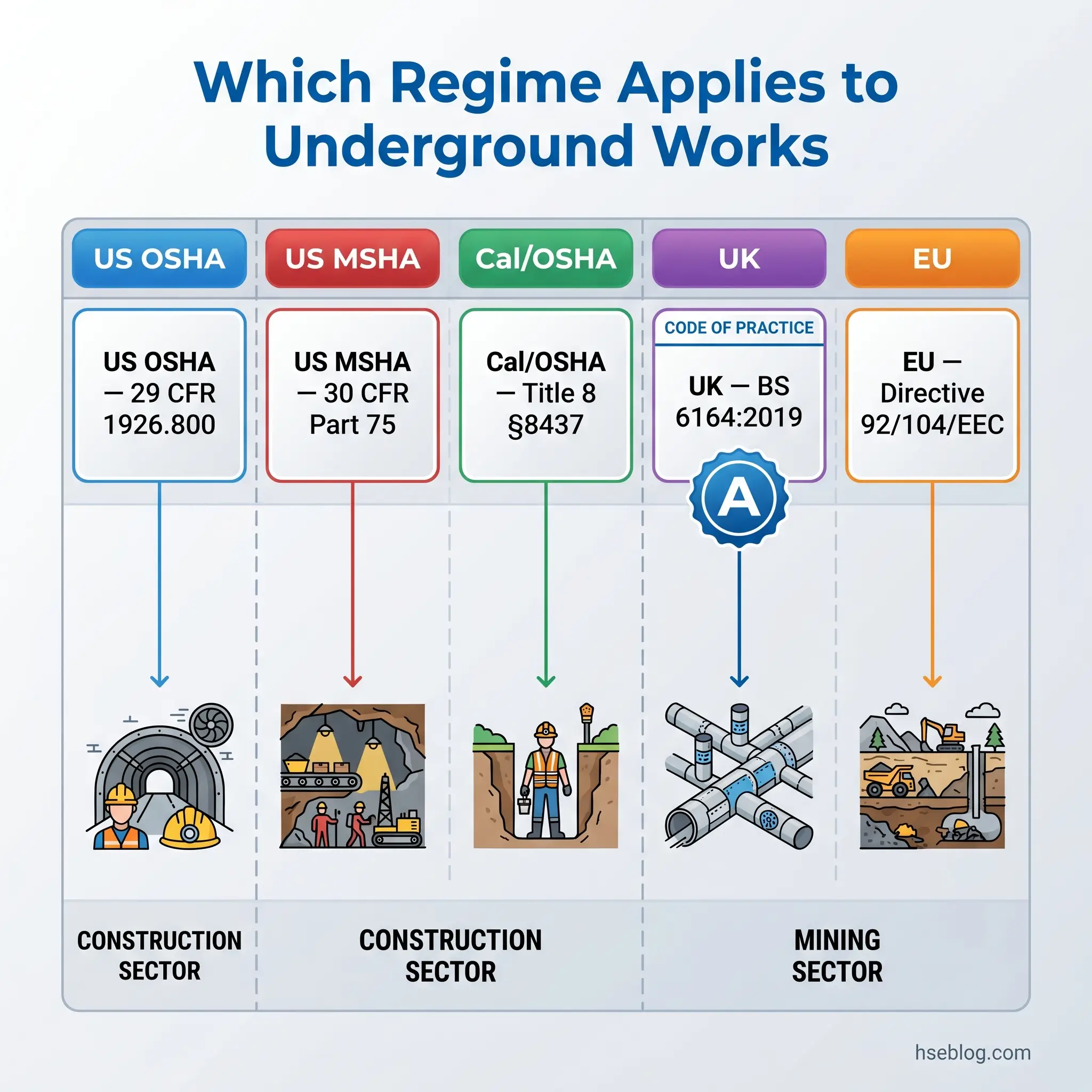
Operators working across borders meet at least four substantially different ventilation regimes, and one frequent error is treating the framework that happens to be most familiar as the universal default. Construction-sector underground works and mining-sector underground works are governed separately in most jurisdictions, with materially different thresholds.
| Jurisdiction | Regime | Scope | Key Document | Status |
|---|---|---|---|---|
| US (federal) | OSHA | Construction tunnels, shafts, chambers | 29 CFR 1926.800 Subpart S | Law |
| US (federal) | MSHA | Coal, metal, non-metal mines | 30 CFR Part 75 (coal); Part 57 (M/NM) | Law |
| US (California) | Cal/OSHA | Construction tunnelling | Title 8 §8437 | Law (stricter than federal in places) |
| UK | HSE / BSI | Construction tunnelling | BS 6164:2019 | Code of practice (benchmark) |
| EU | National transposition | Extractive industries (surface + underground) | Directive 92/104/EEC + Directive (EU) 2017/164 | Law via Member State law |
The practical reading: when a project sits within a single jurisdiction, the applicable regime is usually unambiguous. The harder calls arise on internationally-contracted projects, where competing standards push in different directions. The defensible default is the stricter threshold on each parameter — particularly because BS 6164:2019, although technically a code of practice rather than statutory law, is treated by UK courts and the tunnelling-insurance market as the benchmark of competent practice. Departing from it requires articulated justification, not silence.
A misconception worth correcting on this point: BS 6164 is sometimes dismissed as "guidance, not law, so optional." That misreads its standing. Under UK case law on health and safety, departure from a published code of practice is evidence of inadequate practice that the operator must rebut. Insurers writing tunnel cover treat BS 6164 alignment as an underwriting baseline. Multinational contractors usually adopt it as a global default for that reason.
A live freshness signal here: MSHA issued a Notice of Proposed Rulemaking in July 2025 on Ventilation Plan Approval Criteria (30 CFR 75.370), proposing changes to how district managers can require ventilation plan revisions while retaining the underlying safety provisions. The mining-sector regulatory landscape is actively moving — anyone planning under MSHA jurisdiction should check the current status against the rule docket before relying on a static reading.
Legal note. Regulatory content here reflects general HSE professional understanding of the cited jurisdictions' requirements as of late 2025. It is not legal advice. Specific compliance questions, enforcement situations, or prosecution risk should be directed to qualified legal counsel in the applicable jurisdiction.
Air Quality and Exposure Thresholds Underground
OSHA's carbon monoxide PEL sits at 50 ppm. NIOSH's recommended limit is 35 ppm; ACGIH's TLV is 25 ppm. On the same contaminant, in the same workplace, a defensible site policy can be twice as strict as the local statutory minimum — and on diesel particulate matter, OSHA has no PEL at all. The numbers that define a compliant underground atmosphere differ across standards more than most non-specialists assume.
| Contaminant | OSHA PEL (US) | NIOSH REL | ACGIH TLV | EU IOELV (2017/164) | BS 6164:2019 |
|---|---|---|---|---|---|
| Oxygen | ≥ 19.5% | — | — | — | Concentration-based control |
| Methane | 5% LEL action / 10% hot-work stop / 20% evacuation (1926.800(j)) | — | — | — | Concentration-based control |
| Carbon monoxide | 50 ppm 8-hr TWA | 35 ppm TWA; 200 ppm ceiling | 25 ppm TWA | CO listed | Cited concentration limits |
| Nitrogen dioxide | 5 ppm ceiling | — | — | 0.5 ppm 8-hr TWA; 1 ppm STEL | Short-term limits with real-time monitoring |
| Hydrogen sulfide | 20 ppm ceiling; 50 ppm peak | — | 1 ppm TWA; 5 ppm STEL | — | Concentration-based |
| Diesel particulate matter | No DPM-specific PEL | 100 µg/m³ EC (recommended) | — | — | 100 µg/m³ EC, 15-min TWA (pending HSE update) |
| Respirable silica | 50 µg/m³ 8-hr TWA (1926.1153) | — | — | — | Aligned with HSE WEL |
The transatlantic gap on NO₂ is striking: OSHA's 5 ppm ceiling sits an order of magnitude above the EU's 0.5 ppm 8-hour value under Directive (EU) 2017/164. For carbon monoxide, OSHA's 50 ppm PEL is twice the ACGIH TLV. Sites writing internal exposure standards default to NIOSH or ACGIH on the toxic-gas line — and to BS 6164/NIOSH alignment on DPM — because the more permissive OSHA values do not reflect current toxicological consensus.
A recurring pattern in field exposure data is average-period gaming. Sites measure CO and NO₂ on long time-weighted averages, which can mask acute spikes immediately after blasting that drive the actual exposure dose. BS 6164:2019's shift toward short-term limits with real-time monitoring as the preferred control is a direct response to that lesson. US construction-sector enforcement still leans heavily on 8-hour data, so internal policy is where short-term monitoring discipline has to be built in.
Diesel exhaust was reclassified as carcinogenic to humans — IARC Group 1 — in 2012 (IARC/WHO, 2012). That reclassification is the regulatory pressure underneath every tightening DPM regime globally, and the underlying reason BS 6164:2019 carries an EC-based limit while OSHA still has none. Underground works are among the highest-exposure environments for this carcinogen.
Medical note. Content covering exposure limits, diesel particulate matter, silica, and health surveillance is for HSE practitioner reference. It is not medical advice. Workers with respiratory symptoms or specific exposure concerns should consult an occupational physician or qualified medical professional.

Primary (Main) Ventilation Systems
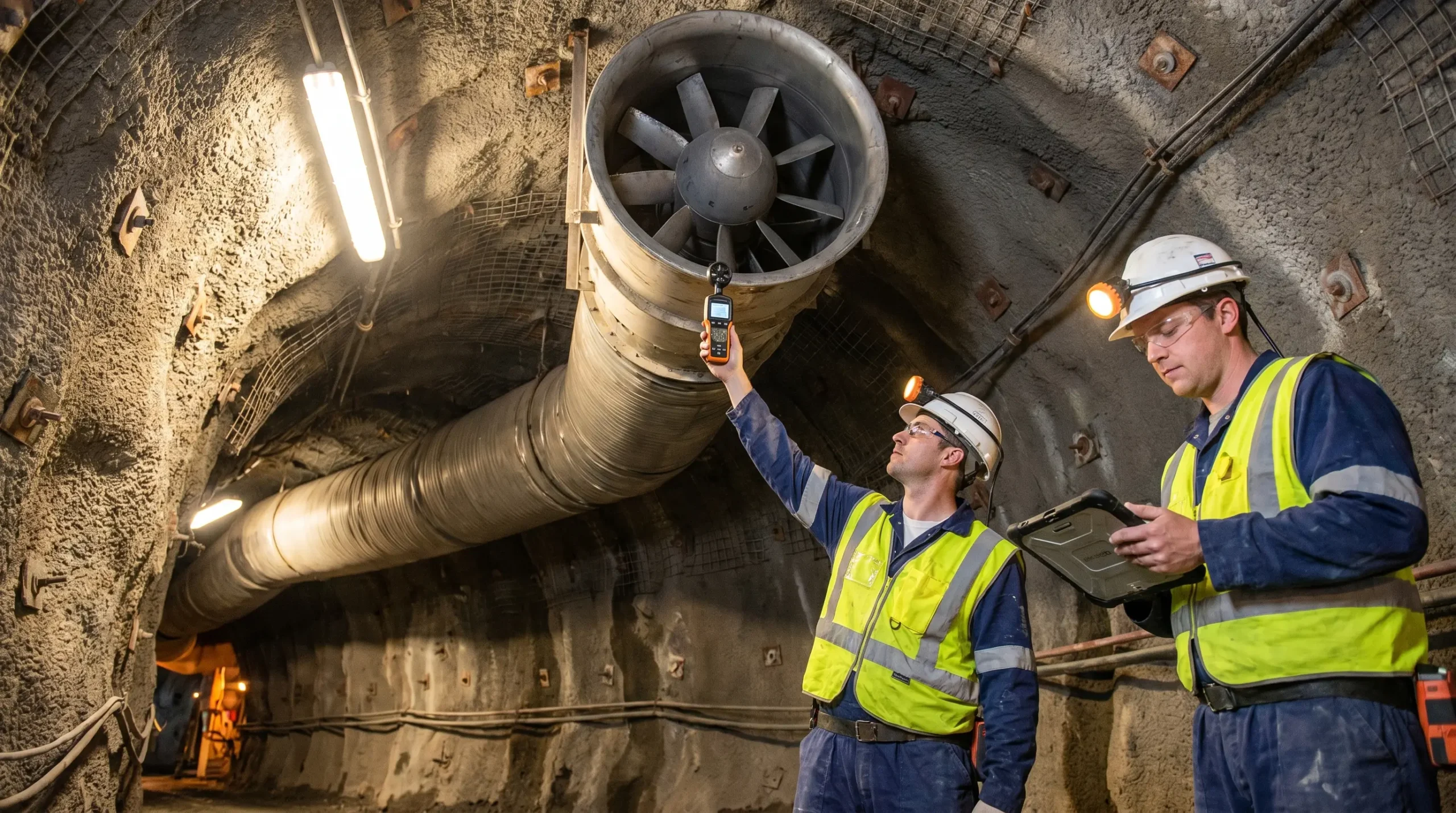
29 CFR 1926.800(k)(13) places main fans in underground construction on the surface, offset from the tunnel mouth, with explosion doors or a weak-wall section providing equivalent cross-sectional area in potentially gassy or gassy operations. The clause's logic is fire and explosion isolation — a main fan inside the bore is exposed to the very hazard it must continue running through. Most readers conflate primary ventilation with the auxiliary system that actually reaches the face. They are separate engineering problems with separate failure modes.
Three primary configurations are common in construction tunnelling:
- Flow-through (push-pull) circuits — surface intake fan at one portal, exhaust through a second portal or vent shaft. The simplest arrangement, available only where geometry permits a complete circuit.
- Single-portal systems — surface main fan pushing or pulling air into a tunnel with one open end, relying on the duct as the return path.
- Mine-type arrangements — surface main fan offset from the tunnel mouth, with offset distance and explosion-relief provisions sized to the assessed gas hazard.
The practical interpretation auditors typically test against: a face-mounted main fan — occasionally proposed by contractors as a cheaper alternative on shorter drives — has been declined repeatedly by OSHA in interpretation correspondence dating back to the late 1990s and early 2000s. The reversibility requirement under 1926.800(k)(4) is materially harder to satisfy with a downstream fan; the fire-isolation logic fails outright. This argument has been adjudicated and lost. Relitigating it on each project wastes engineering effort.

Auxiliary Ventilation Methods
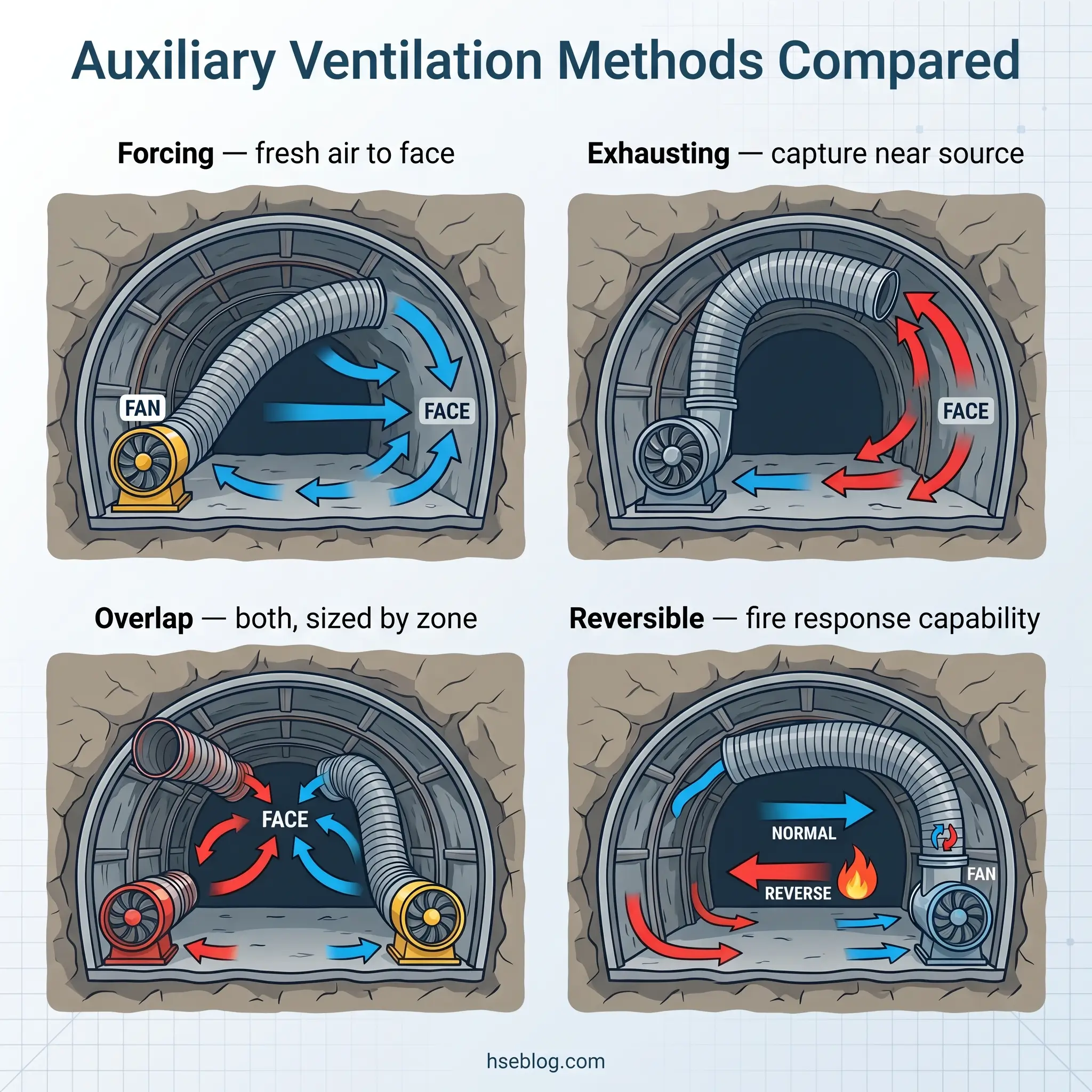
On any given heading, the choice between forcing, exhausting, overlap, and reversible configurations is driven by what is being drilled, blasted, or extracted at the face — not by what the contractor used on the last project. Four configurations dominate construction practice. Selection considers drive length, hazard profile (particularly methane and dust), re-entry priorities, and the geometry of the heading.
Forcing (blowing) ventilation
Fresh air is pushed through a duct from the portal to a point near the face. Contaminated air returns along the open tunnel toward the portal. The advantage is fast, clean air delivery at the heading — useful where face cooling and rapid drilling-cycle resumption matter. The trade-off is that workers stationed between the duct outlet and the portal breathe return air carrying the dust and blast fumes generated at the face.
Post-blast re-entry under a forcing-only system is slow in absolute terms because the contaminant cloud has to traverse the entire tunnel length to clear. CFD-modelled comparisons indicate forcing reaches permissible exposure thresholds at the workers' position roughly five times faster than exhaust-only configurations in the scenarios modelled (Adhikari, Tukkaraja & Jayaraman Sridharan, 2019) — but that is dilution at a worker location near the face, not full-tunnel clearance.
Exhausting (extracting) ventilation
A duct draws contaminated air from a point near the face out to the portal; fresh air enters through the open tunnel cross-section. BS 6164:2019 favours this configuration for dust control because contaminants are captured near the source rather than dispersed along the bore. Workers along the tunnel breathe fresh intake air.
The trade-offs: lower air velocity at the face means slower convective cooling and slower post-blast clearance unless the system is sized generously. Ducts operating under negative pressure can collapse if specification is wrong — they need rigid or semi-rigid construction at the suction end, not the soft bag line used in forcing systems.
Overlap (combined) systems
A forcing duct delivers fresh air to the face; an exhaust duct extracts contaminated air from a point set back along the heading. The overlap zone — the distance between the forcing outlet and the exhaust intake — is the dominant design variable. Too short, and the exhaust short-circuits the fresh-air supply, recirculating contaminants. Too long, and dilution efficiency drops between the two duct terminations.
CFD work over the last decade has converged on overlap as the configuration of choice for long drives, methane-bearing strata, and projects where blast-cycle re-entry sits on the critical path. The added cost is two ducts and two fan sets. The benefit is near-source capture combined with positive face delivery.
Reversible systems
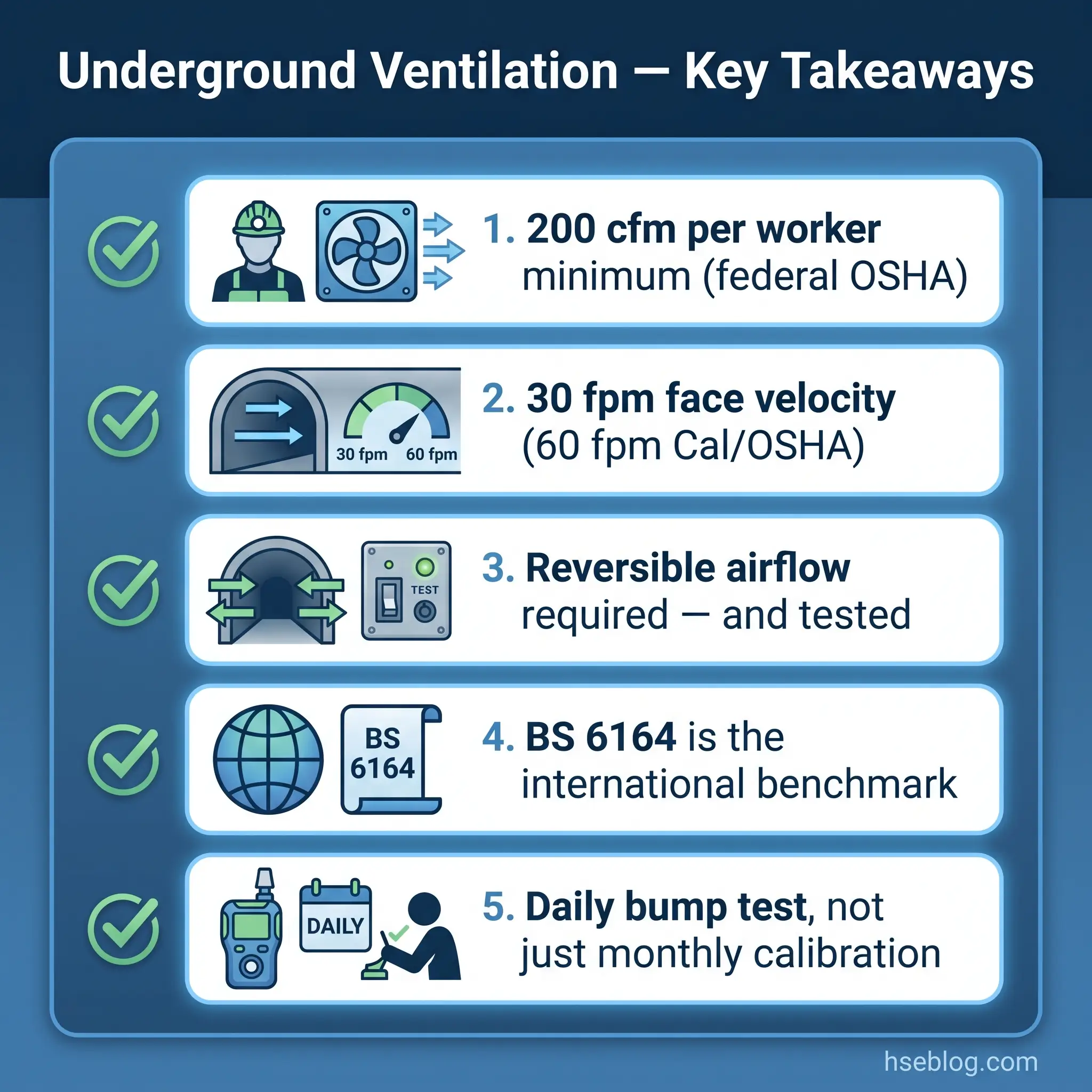
Reversibility is mandatory in US underground construction under 29 CFR 1926.800(k)(4): the direction of airflow must be reversible. The clause's purpose is fire response — depending on where workers are located relative to a fire, the correct survival path may require either pushing smoke away from them or pulling it away from them.
The implementation point usually missed: reversibility on a control panel is not the same as recoverable performance under reversed flow. Fan performance curves change under reversed direction. Some flexible bag lines collapse rather than carry reversed airflow — OSHA addressed this directly in interpretation correspondence. Ventilation curtains and doors configured for one direction may fail open or closed when pressure inverts. Reversibility should be exercised under controlled conditions before commissioning sign-off, and tested periodically thereafter. A reversibility test that has never been run on the installed system is a reversibility claim, not a reversibility capability.
| Method | Best for | Re-entry profile | Common failure mode |
|---|---|---|---|
| Forcing | Short drives, fast face cooling | Slow full-tunnel clearance; fast face dilution | Workers in tunnel breathe return air |
| Exhausting | Dust-heavy headings, BS 6164 alignment | Slow unless oversized | Duct collapse under negative pressure |
| Overlap | Long drives, gassy strata, critical-path re-entry | Optimised by overlap-zone length | Recirculation if overlap too short |
| Reversible (all main systems) | Fire emergency response | Depends on layout | Reversibility never tested under load |
Designing the Ventilation System: Air Quantity and Pressure
200 cfm per worker, 30 fpm face velocity — the federal floor numbers under 29 CFR 1926.800(k)(2)–(3). Cal/OSHA Title 8 §8437 doubles the velocity to 60 fpm. MSHA 30 CFR 75.325(a) operates in a different range entirely: 3,000 cfm at a coal-mine working face, 9,000 cfm at the last open crosscut, 30,000 cfm at a longwall face. The construction-sector minima are not interchangeable with the mining minima. Applying construction values to a mining operation is non-compliant.
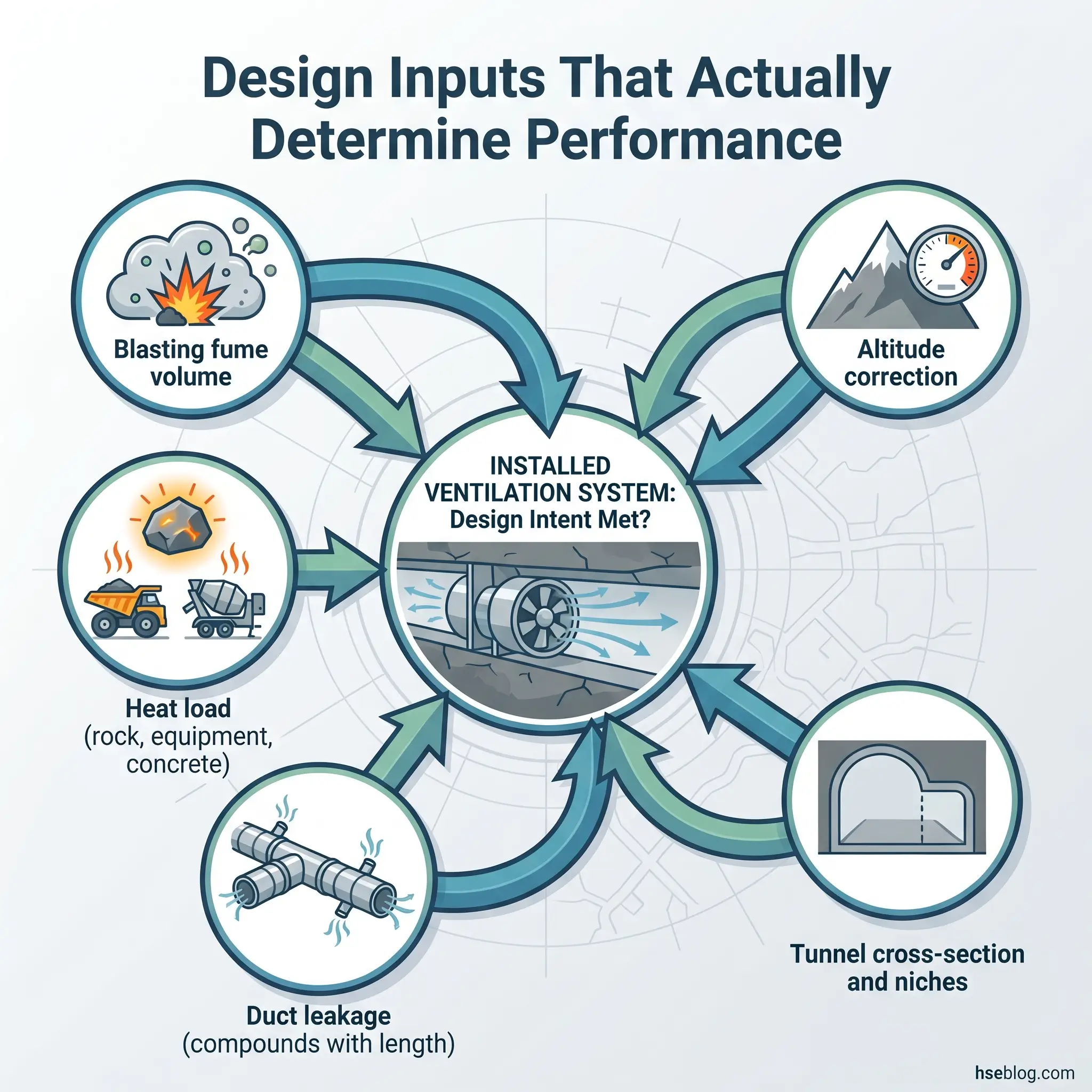
These regulatory floors are necessary but not sufficient. Design inputs that actually determine whether the installed system performs include:
- Blasting fume volume — mass of explosive multiplied by per-kilogram fume yield from supplier data sheets gives the contaminant volume to be cleared between cycles.
- Heat load — rock heat (geothermal gradient × exposed surface), diesel equipment heat rejection, cement hydration heat, and metabolic heat — all reduce permissible occupied-time at the face if not removed.
- Duct leakage — new flexible duct under controlled installation runs at roughly 1.5% loss per 100 metres; field-installed duct, particularly after repair tape, hanger damage, and reuse, runs substantially worse. Leakage compounds with length.
- Tunnel cross-section — air quantity divided by cross-section gives linear velocity, but cross-sections change at niches, alcoves, and equipment storage points, creating local velocity drops the bulk calculation misses.
- Altitude correction — air density falls with altitude; mass-flow design parameters require correction at elevation.
Re-entry time after blasting is concentration-driven, not clock-driven. CO is typically the rate-limiting contaminant because its toxicological threshold sits below NOₓ on dilution-time-to-acceptable terms in most blast-fume mixtures. There is no fixed regulatory wait — the test is measurement against the applicable exposure limit at the worker's position.
Ventilation is not a marginal cost. Peer-reviewed analysis indicates ventilation can account for 30–50% of total tunnel engineering investment during construction, with ventilation cost scaling approximately with the cube of tunnel length (PMC, 2025). The cubic scaling is why ventilation engineering for long drives is fundamentally different from short-drive engineering — the assumptions that work at 500 metres break down at 5 kilometres.
A useful pattern to watch: per-worker cfm and face velocity are the parameters non-specialists check on the inspection record. Duct leakage, fan curve degradation over operating hours, and recirculation paths are where systems quietly drift below their design point. None of these show up on the standard inspection sheet, and none are caught by spot-checking the portal flow meter.
Atmospheric Monitoring and the Competent Person
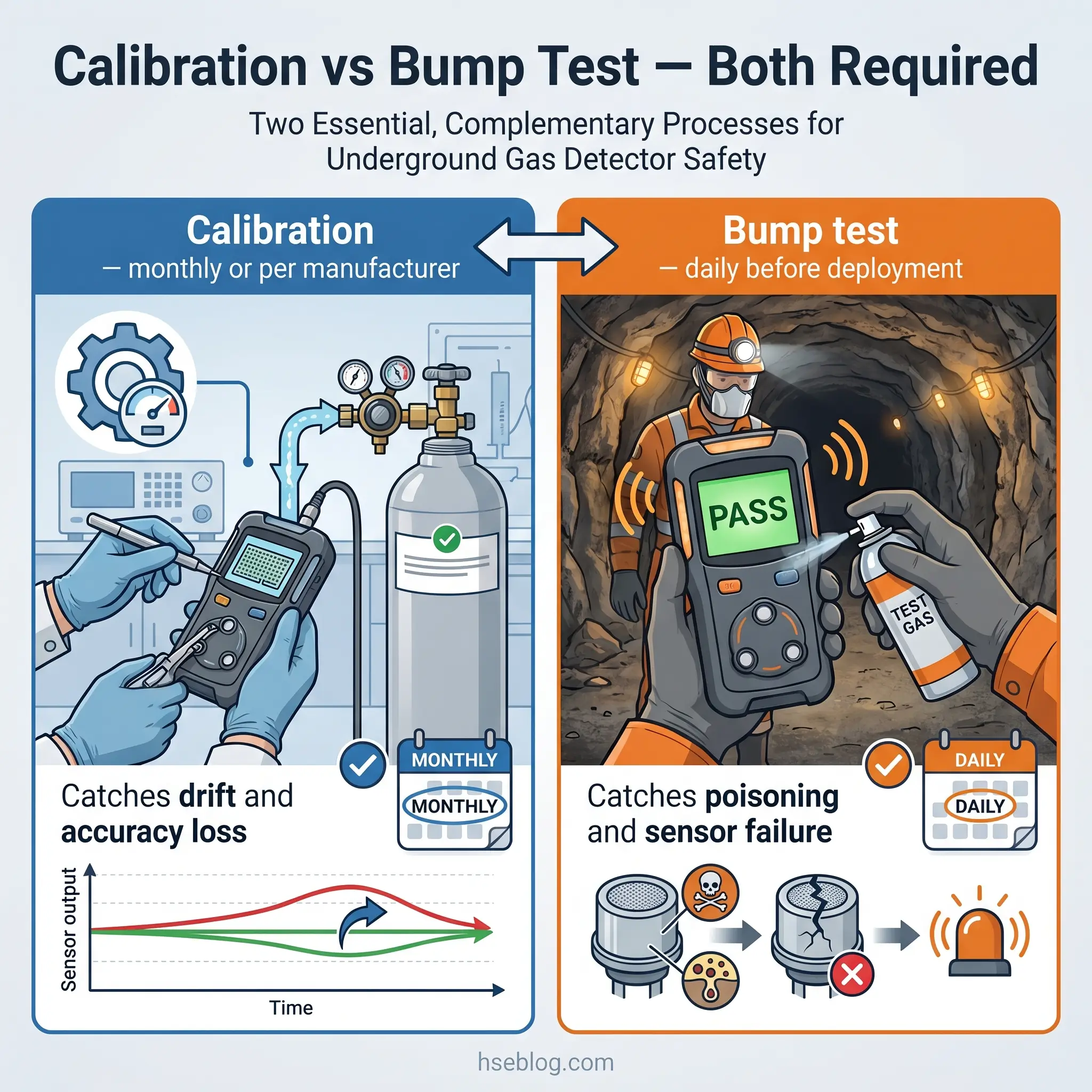
A consistent audit finding across underground projects is detectors that are technically calibrated but whose bump-test records are inconsistent. The calibration certificate stays current while day-to-day functional verification lapses. Ventilation isn't installed once and trusted thereafter — continuous verification is what closes the gap between design intent and actual atmosphere at the worker's location.
The monitoring regime under 29 CFR 1926.800(j) requires a competent person to conduct quantitative testing for carbon monoxide, nitrogen dioxide, hydrogen sulfide, and other toxic substances as often as necessary based on operations. Methane testing operates under a specific trigger structure: 5% of LEL prompts increased ventilation, 10% of LEL near hot work requires suspension, 20% of LEL forces evacuation. Continuous monitoring is the practical standard for methane and CO in most operations; spot monitoring is acceptable for less dynamic contaminants where conditions justify.
Instrument types in routine use:
- Multi-gas portables worn by workers, typically configured for O₂, CO, H₂S, and methane (LEL).
- Fixed-point atmospheric monitoring systems for trending at portals, working face areas, and known accumulation points.
- Flame-ionisation or infrared methane detectors depending on application and required range.
- Real-time DPM monitors using light-scattering technology with correction factors to differentiate diesel-derived elemental carbon from mineral dust, referenced in BS 6164:2019 as preferred technology.
MSHA requires monthly calibration of methane detectors under 30 CFR 75.342. The construction-sector regulation is less prescriptive on interval, leaving "as often as necessary" to competent-person judgment — which in practice means following the manufacturer's calibration schedule plus daily bump tests with known gas before deployment. A detector that was correctly calibrated a month ago but has not been bump-tested since can still be poisoned, zero-drifted, or sensor-failed without the operator knowing. Daily bump testing catches the failures that monthly calibration misses. Calibration is necessary; bump testing is what proves the instrument is actually reading.
The competent person designation under 1926.800(j) is not a paperwork formality. It carries authority to halt work, escalate ventilation, and determine that contaminant levels exceed limits — which means it requires demonstrated capability, not just attendance at training. Sites that staff this role as a clipboard responsibility find that out the hard way when an event tests the appointment. Recognised training pathways (NEBOSH, IOSH, OSHA outreach, and regional equivalents) are the floor, not the ceiling.
Special Situations: Gassy Operations, Blasting, and Fire
Three scenarios demand ventilation responses beyond steady-state operation. Each has explicit regulatory triggers that must be matched to operational reality.
Potentially gassy and gassy operations
29 CFR 1926.800(h) defines the classification structure. An operation is potentially gassy where air monitoring records 10% of methane LEL for more than 24 hours, or where geology indicates likelihood (coal-measure strata, oil-shale, certain limestones, gas-show records from adjacent excavations). It becomes gassy where 10% of LEL is sustained for three consecutive days, where prior ignition has occurred at the site or in connected workings, or where the work area is continuously connected by airflow to a gassy area.
Each classification escalates requirements substantially. Equipment must be approved for the gas classification (permissible electrical equipment, diesel emission controls). Ventilation safeguards expand to include explosion doors or weak-wall provisions on the main fan under 1926.800(k)(13), surface-located reversal controls, and increased monitoring frequency. The classification is not optional once a trigger condition is met — it is the operator's obligation to apply it correctly, which means having a defensible monitoring record to support the classification call either way.
Post-blast ventilation and re-entry
Blasting releases CO, NOₓ, and dust simultaneously into the heading. Re-entry is governed by reducing all three below the applicable exposure limit at the worker's position — there is no fixed clock. CFD modelling consistently identifies CO as the rate-limiting contaminant in conventional explosive mixtures.
Ventilation mode materially affects re-entry time. Published modelling indicates forcing systems reach exposure thresholds at the workers' position approximately five times faster than exhaust-only systems (Adhikari et al., 2019), while overlap systems sit between the two but capture contaminants closer to source. The selection trade-off is not merely speed — it is also where the contaminants travel during clearance. Forcing pushes them along the tunnel toward the portal; exhausting captures them near source; overlap does both, constrained by overlap-zone geometry.
Fire emergencies
Underground fires are the worst-case ventilation challenge. Reversibility, smoke management, lithium-battery fire characteristics on battery-electric vehicles, and refuge-chamber tenability all interact with ventilation strategy in ways that cannot be improvised during an event.
The HS2 Chiltern Tunnels multi-service-vehicle fire — a documented event currently influencing the BS 6164 revision discussion (BSI Standards Development, 2024–2025) — is the kind of case that drives standard development because it tested assumptions about smoke behaviour, ventilation response, and worker evacuation simultaneously. The judgment-call problem in fire response is that reversing the airflow to push smoke away from one group of workers may push it toward another. Pre-planned fire-response protocols — informed by worker location systems, refuge-chamber positions, and modelled smoke spread under both directions of ventilation — are the only way these decisions get made fast enough during a real event. Reversibility on a control panel without that decision framework behind it is incomplete.

Emerging Trends: Ventilation on Demand and Real-Time Monitoring
Two developments are reshaping how underground ventilation is operated, although adoption is uneven and most construction projects still run conventional systems.
Ventilation on Demand (VoD) adjusts airflow dynamically based on real-time sensor inputs — worker location via RFID or other positioning, vehicle activity, gas concentrations. Reported energy savings span 20–50% versus traditional constant-flow operation, with the lower end drawing on Natural Resources Canada data and the higher end coming from vendor case studies (cited via Straits Research, 2024–2025). The honest reading of the range is that VoD doesn't replace the design baseline — the installed system still needs to deliver full ventilation when called for — and the savings come from not running full ventilation when conditions don't require it. Treating VoD as a way to reduce installed capacity misreads what it does.
Real-time monitoring is the parallel trend, particularly for DPM and dust. Light-scattering DPM monitors with elemental-carbon correction factors, referenced in BS 6164:2019, allow short-term exposure management rather than reconstruction of exposure from after-the-fact 8-hour samples. This is the technological enabler behind the 15-minute TWA approach BS 6164 has shifted toward. Battery-electric vehicles, displacing diesel equipment in mining and starting to penetrate civil tunnelling, remove the DPM source from the ventilation calculation entirely — a structural change in the design problem when they become the fleet norm.
CFD modelling is now routine practice for post-blast clearance prediction and overlap-zone optimisation. Published comparisons indicate CFD results sit roughly 17% lower than traditional resistance-loss calculations for equivalent scenarios — the older calculations were conservative, but conservatism in ventilation has a cost worth checking on longer drives.
Frequently Asked Questions
What is the minimum fresh air required per worker in underground construction?
Federal OSHA requires at least 200 cubic feet per minute of fresh air per worker underground under 29 CFR 1926.800(k)(2). California applies the same per-worker minimum but doubles the face linear velocity to 60 fpm under Title 8 §8437. The US mining sector runs under MSHA 30 CFR 75.325 with per-face quantities rather than per-worker — these are not interchangeable. UK BS 6164:2019 uses contaminant concentration as the test rather than a fixed per-worker cfm.
What is the difference between forcing and exhausting ventilation in tunnels?
Forcing ventilation pushes fresh air to the face through a duct, with contaminated return air travelling along the open tunnel back to the portal. Exhausting ventilation pulls contaminated air from the face through a duct, with fresh air entering through the open tunnel cross-section. Forcing delivers cleaner air to the face faster but moves contaminants along the tunnel. Exhausting captures contaminants near source — the configuration BS 6164:2019 prefers for dust control.
Why must underground ventilation systems be reversible?
29 CFR 1926.800(k)(4) requires reversible airflow direction so smoke and heat can be directed away from workers during a fire, depending on where they are located relative to it. The clause assumes reversibility is a usable capability, not a switch on a panel. Some flexible bag-line ducts collapse under reversed flow — OSHA addressed this specifically — and fan performance under reversed direction differs from forward operation. Reversibility should be tested under controlled conditions, not assumed.
When does an underground operation become classified as gassy?
Under 29 CFR 1926.800(h), an operation is potentially gassy when air monitoring shows methane at 10% of LEL for more than 24 hours, or where geology indicates likelihood. It becomes gassy when 10% of LEL is sustained for three consecutive days, where prior ignition has occurred, or where the work area is continuously connected by airflow to a gassy area. Each classification triggers stricter equipment approval, ventilation safeguards, and monitoring frequency.
Does BS 6164 apply outside the United Kingdom?
Not as statutory law, but as influence. BS 6164:2019 is the BSI code of practice for tunnelling in the UK construction industry. UK courts and the tunnelling insurance market treat it as the benchmark of competent practice — departure is evidence of inadequate practice the operator must rebut. The International Tunnelling Insurance Group code adopts BS 6164 as its default reference, which is why multinational contractors typically apply it as a baseline standard regardless of where the project sits.
How does underground construction ventilation differ from mine ventilation requirements?
In the US, underground construction (tunnels, shafts) is governed by OSHA 29 CFR 1926.800 — 200 cfm per worker, 30 fpm face velocity, reversible airflow. Mining is governed by MSHA 30 CFR Part 75 (coal) or Part 57 (metal/non-metal) — 3,000 cfm at the coal working face, 9,000 cfm at the last open crosscut, and ventilation-plan approval requirements that have no construction-sector equivalent. The principles overlap; the legal regimes do not.
Putting It Into Practice
Three decisions determine whether ventilation in underground works performs as designed rather than as drawn. First, the auxiliary configuration — forcing, exhausting, or overlap — has to match the dominant hazard, drive length, and re-entry priorities on this specific heading. Defaulting to forcing because it is the most familiar configuration is the most common selection error on longer drives and in dust-heavy or methane-bearing strata, where exhausting or overlap usually wins on the merits.
Second, the regulatory floor is not the design target. 200 cfm per worker and 30 fpm face velocity are the lowest legal numbers in federal US construction; they are not the numbers a competent design produces. Real design accounts for duct leakage at field-realistic rates, fan curve degradation over operating hours, blasting fume volumes specific to the explosive used, and heat load specific to the equipment and geology. Defensible site policy on toxic-gas exposure tracks the stricter NIOSH and ACGIH reference values rather than the older OSHA PELs, and defensible DPM policy tracks the BS 6164:2019 / NIOSH alignment at 100 µg/m³ elemental carbon.
Third, the competent-person framework around the installed system is what catches the slow drift between design intent and actual atmosphere — duct leakage growing, fan performance fading, detectors calibrated but never bump-tested, reversibility never exercised under load. Ventilation in underground works fails quietly until it fails catastrophically. The monitoring discipline, the bump-test routine, the periodic reversibility test, and the competent-person walk-down at the face are what keep that distance from closing.