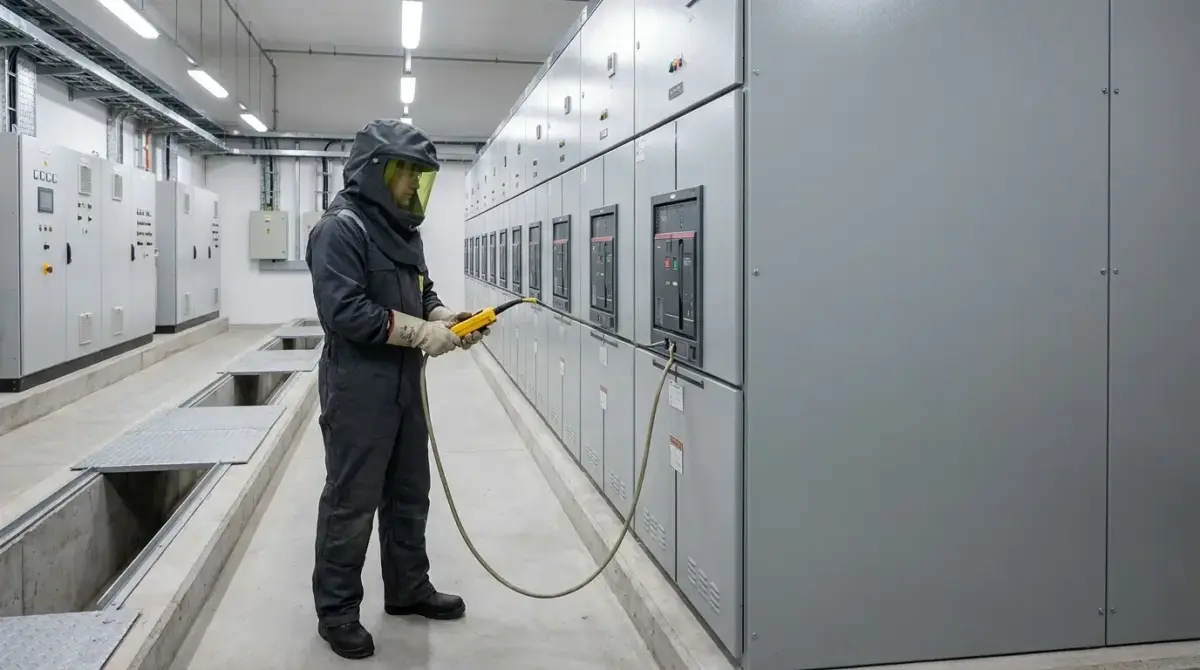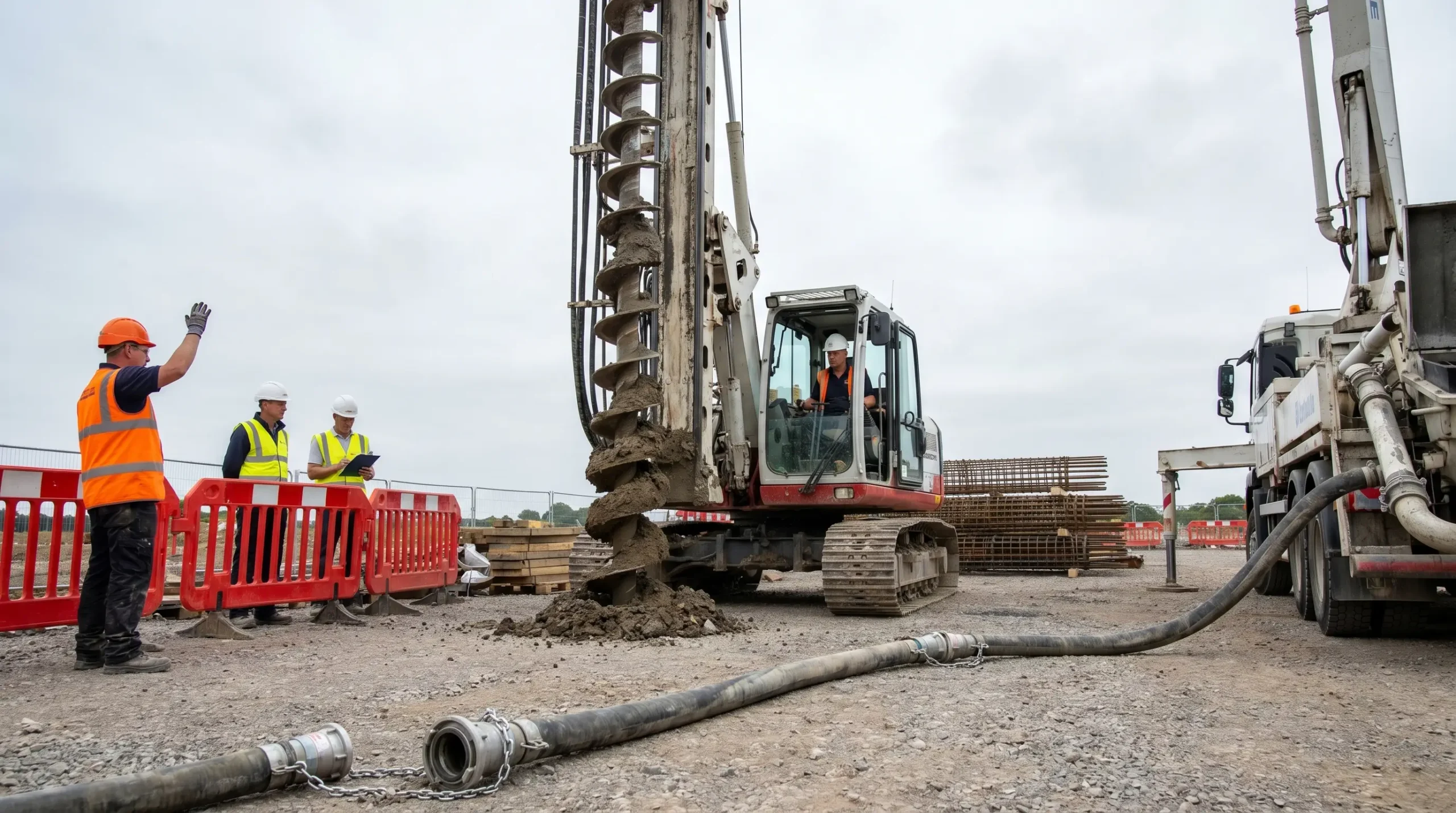
Piling operations present elevated safety risks including struck-by injuries from falling hammers or swinging piles, entanglement in rotating auger parts, rig instability and collapse, underground service strikes, noise and vibration exposure exceeding occupational limits, falls from height on rig leads, and exposure to hazardous substances in contaminated ground. Effective piling safety requires controls at every level of the hierarchy — from method selection at design stage through engineering guards, permit-to-work systems, dynamic exclusion zones, and task-specific PPE.
This article provides general HSE knowledge. Life-critical work such as piling rig operation, pile driving, lifting operations, and work in proximity to underground services must be planned and supervised by a competent person with relevant training, jurisdiction-specific authorisation, and site-specific risk assessment. The information here does not replace that.
In June 2024, piling contractor Van Elle Limited was fined £233,000 at Dumfries Sheriff Court after a piling rig mast collapsed and killed a driver on site. The prosecution under PUWER 1998 Regulation 5 revealed that corroded securing lugs — a failure detectable through routine thorough examination — had been missed (Construction News, 2024). That single enforcement action captures what makes piling safety distinct from general construction safety: the equipment is heavier, the energy involved is greater, the failure consequences are less forgiving, and the margin between a controlled operation and a fatal one is thinner than most site teams appreciate.
Piling work sits at the intersection of heavy plant operation, lifting operations, ground engineering, and underground hazard management. The US construction industry recorded 1,034 worker fatalities in 2024, with a fatal injury rate of 9.2 per 100,000 full-time equivalent workers (US Bureau of Labor Statistics, 2026). Piling fatalities are classified within struck-by, caught-in/between, and falls categories rather than tracked as a separate activity — which means they are absorbed into broader statistics and their specific patterns remain under-examined. This article maps the hazard mechanisms specific to piling operations, pairs each with the controls that actually work under site conditions, and identifies where those controls most commonly fail.
What Is Piling and Why Is It a High-Risk Construction Activity?
Piling is a foundation engineering method that transfers structural loads through weak or compressible surface soils to competent bearing strata below. The reason it demands a dedicated safety approach — rather than treatment as standard earthworks — is the combination of high-energy equipment, dynamic ground interaction, vertical fall zones, and confined heavy-plant working areas that together create a hazard radius far larger than most general construction activities.
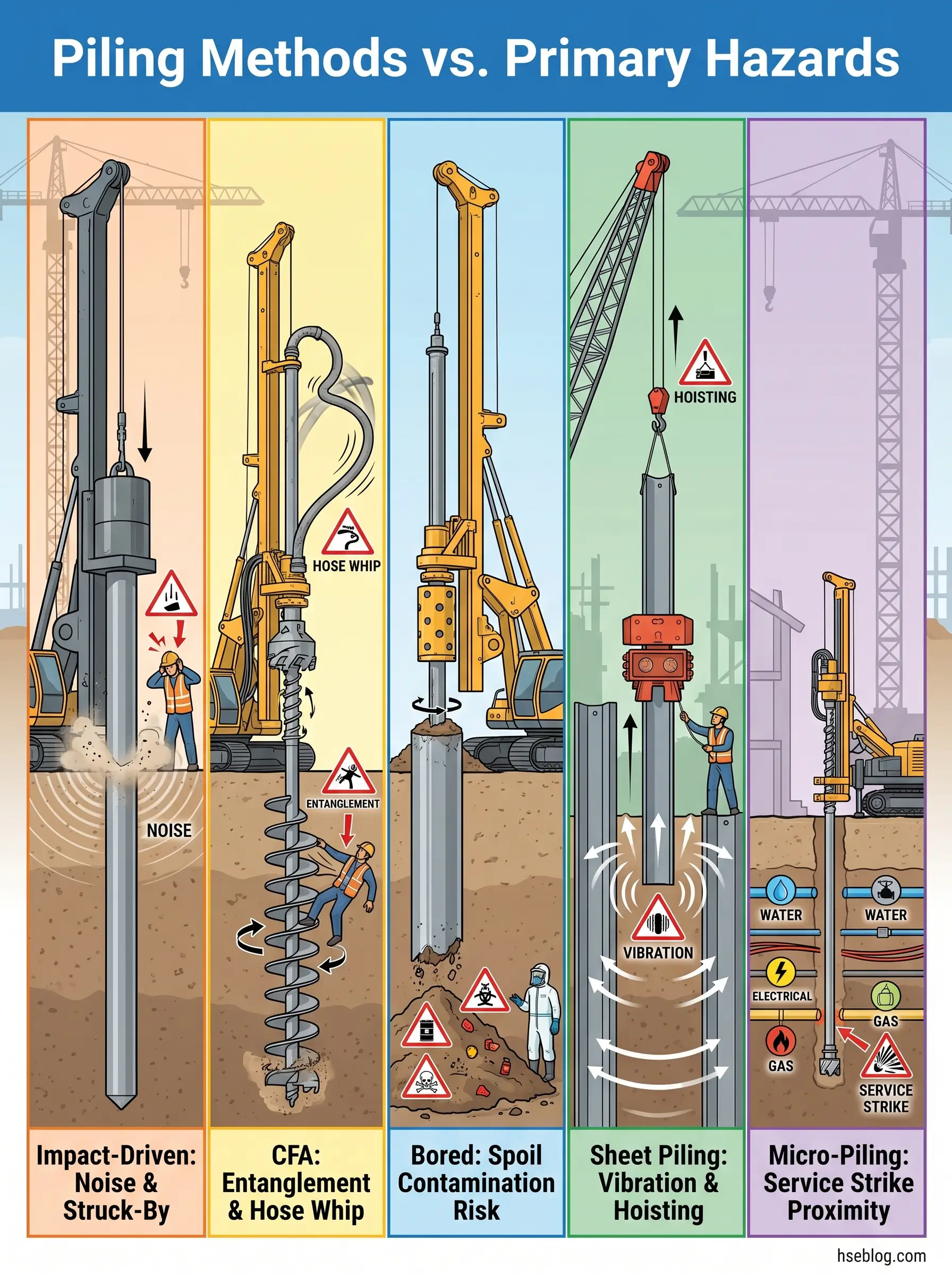
Different piling methods introduce fundamentally different hazard profiles. Understanding which hazards dominate depends on the method selected.
| Piling Method | Primary Energy Source | Dominant Hazard Profile |
|---|---|---|
| Impact-driven piles | Drop hammer or hydraulic hammer | Extreme noise (>100 dB), ground vibration, struck-by from hammer/pile, flying debris |
| CFA (continuous flight auger) | Rotary auger + pressurised concrete | Entanglement in rotating parts, pressurised hose whip, concrete splash, over-flighting |
| Bored piling | Rotary drilling rig | Entanglement, excavation stability, spoil handling, hazardous ground contamination |
| Sheet piling | Vibratory hammer or press | Noise/vibration, struck-by during hoisting, hand-arm vibration during cutting |
| Micro-piling | Rotary drill or driven small-diameter | Confined space access, grout pressure, underground service proximity |
Each method carries its own regulatory requirements. In the US, OSHA 29 CFR 1926.603 governs pile driving equipment specifically. In the UK, PUWER 1998 covers equipment safety and guarding, while LOLER 1998 applies to any lifting operation involved in pile handling. The EU harmonised standard BS EN 16228:2014+A1:2021 addresses drilling and foundation equipment safety across seven parts — with Part 4 specific to foundation equipment.
Three roles form the safety management chain on a piling site:
- Competent person — responsible for inspections, risk assessment approval, and ensuring controls are implemented. This is a regulatory term with specific meaning under both OSHA and UK law.
- Piling supervisor — manages the operational sequence and holds authority to stop work. In the UK, the FPS Piling Supervisor Safety Training Scheme defines the expected competency.
- Appointed person for lifting operations — required whenever cranes or other lifting equipment handle piles, slings, or rig components.
Teams new to piling projects frequently underestimate the hazard radius around the rig, treating it as equivalent to a standard excavator working area. The vertical fall zone of the mast, the noise envelope extending well beyond the immediate work area, and the ground vibration propagation distance all create an impact footprint that general construction experience does not prepare supervisors for.
What Are the Main Hazards in Piling Operations?
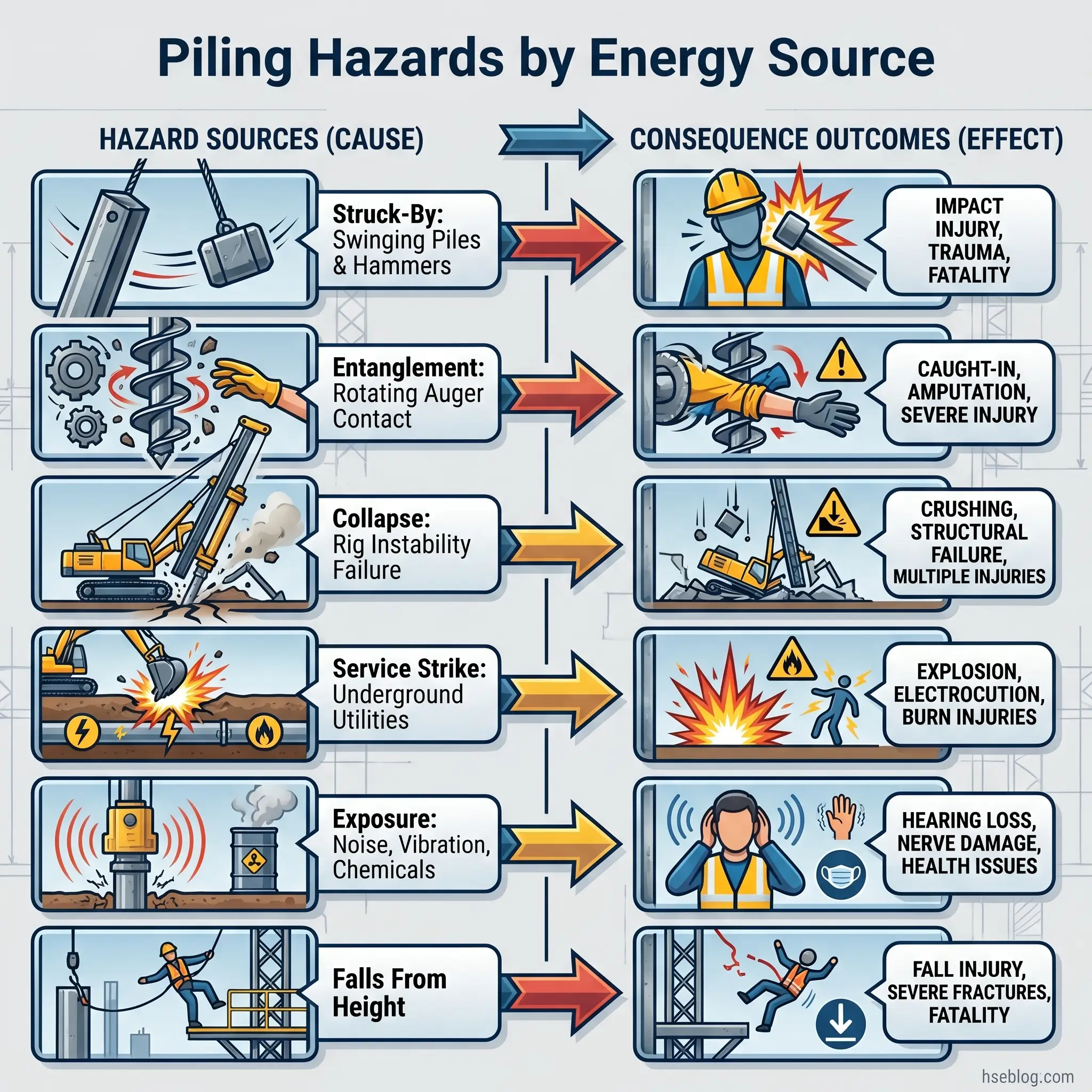
The hazards in piling operations fall into distinct categories defined by their energy source and exposure pathway. Organising them this way — rather than as a random checklist — makes the risk assessment logic transferable across piling methods and site conditions.
Struck-By and Falling Object Hazards
Struck-by incidents account for a disproportionate share of piling fatalities relative to the workforce size. The mechanisms are specific to piling and differ from general construction struck-by hazards.
- Hammer detachment or drop — hydraulic or drop hammers can release unexpectedly if stop blocks or blocking devices fail. OSHA 1926.603 requires stop blocks to prevent the hammer from being raised beyond safe limits.
- Pile kickback and swing — during hoisting, an unsecured pile can swing laterally with enough force to cause fatal injury. The most persistent near-miss pattern in piling is workers guiding piles by hand rather than using tag lines.
- Hose whip from pressurised lines — in 2024, a worker in Queensland was killed when struck by a flexible hose on a CFA piling rig during compressed-air line clearing. WorkSafe Queensland issued a safety alert in 2025 highlighting this specific hazard. OSHA 1926.603(a)(10) requires safety chains or equivalent on all hose connections — a requirement confirmed by a 2005 interpretation letter to cover hydraulic systems as well as steam and air lines.
- Debris ejection — steel tube blow-out during impact driving can send fragments beyond the immediate work zone.
Entanglement in Rotating Parts
CFA and rotary bored piling rigs present an entanglement hazard with no equivalent in impact-driven piling. The auger rotates at the surface during boring, and workers who enter the rotation zone — whether to clear spoil, attach concrete lines, or inspect progress — risk being caught and drawn into the mechanism.
The UK HSE's Operational Guidance OG-00055 specifically addresses this hazard and challenges the use of trip-wires as a sole injury mitigation measure. Trip-wires may reduce injury severity after entanglement begins, but they do not prevent the initial contact. PUWER 1998 Regulations 11 and 12 require guarding of dangerous parts, and BS EN 16228 sets design-level guarding requirements for foundation equipment.
The practical interpretation of these requirements is that physical guarding — auger guards, mechanical spoil cleaners that remove the need for manual clearing, and interlocked access gates — must be the primary control. Trip-wires, where fitted, supplement but do not replace physical barriers.
Rig Instability and Collapse
A piling rig operates with a high centre of gravity, a heavy suspended mass at the top of the mast, and dynamic loading during driving or boring. The conditions that cause instability include:
- Inadequate working platform — soft or uncompacted ground that cannot sustain the rig's bearing pressure, leading to differential settlement and mast lean.
- Over-flighting in CFA piling — continuing to auger beyond the planned depth causes the auger to act as an Archimedes screw, drawing the rig downward and potentially destabilising the mast.
- Maintenance failure — the Van Elle prosecution (June 2024) demonstrated this precisely. Corroded mast retaining pins failed, causing the mast to collapse onto the operator's cab (Construction News, 2024). A thorough examination under LOLER 1998 should have identified the corrosion before failure.
- Incorrect rig setup — failure to deploy outriggers fully, or positioning the rig on sloped ground without adequate levelling.
Underground Service Strikes During Piling
Between 400,000 and 800,000 underground utility strikes are reported annually in the US across all excavation and ground-penetrating operations (Common Ground Alliance, 2024). Piling introduces a distinct strike risk compared to general excavation because piles penetrate well below typical service-burial depths — but the rig must also navigate shallow services during site setup and positioning.
The highest-consequence strikes involve electrical cables and gas mains. The critical point: a desktop utility search (call-before-you-dig / 811 in the US, utility records search in the UK) identifies known services, but many services are unmapped or inaccurately recorded. On-site scanning with CAT (cable avoidance tool) and Genny (signal generator) is the second layer. Neither alone is sufficient.
The Federation of Piling Specialists publishes a permit-to-dig template specifically adapted for piling operations, which requires both the desktop search and the on-site scan to be completed and signed off before any ground penetration.
Noise, Vibration, and Occupational Health Hazards
Piling generates noise and vibration exposures that frequently exceed occupational limits. The exposure type varies by method.
Impact piling produces impulse noise that can exceed 100–130 dB at the operator position. CFA piling generates lower but sustained noise, typically still above the 85 dBA action level. The regulatory thresholds differ by jurisdiction:
| Jurisdiction | Noise Exposure Standard | Action/Limit Level |
|---|---|---|
| US (OSHA) | PEL: 90 dBA TWA (8-hour) | Mandatory minimum |
| US (NIOSH) | REL: 85 dBA TWA | Recommended |
| UK | Noise at Work Regulations 2005 | Lower action: 80 dB(A); Upper action: 85 dB(A) |
The stricter UK/NIOSH thresholds should serve as the recommended baseline for hearing conservation programmes. The OSHA PEL of 90 dBA represents the US mandatory minimum, not a safe target.
Vibration exposure divides into whole-body vibration for rig operators and hand-arm vibration during pile-breaking and cutting. OSHA has no specific numerical vibration limit. The UK Control of Vibration at Work Regulations 2005 set an exposure action value of 2.5 m/s² and a limit value of 5 m/s² for hand-arm vibration — these provide a practical reference framework regardless of jurisdiction.
Chemical hazards include contaminated spoil from brownfield sites, cement dermatitis from wet concrete handling on CFA rigs, silica dust from pile cutting, and creosote exposure from treated timber piles.
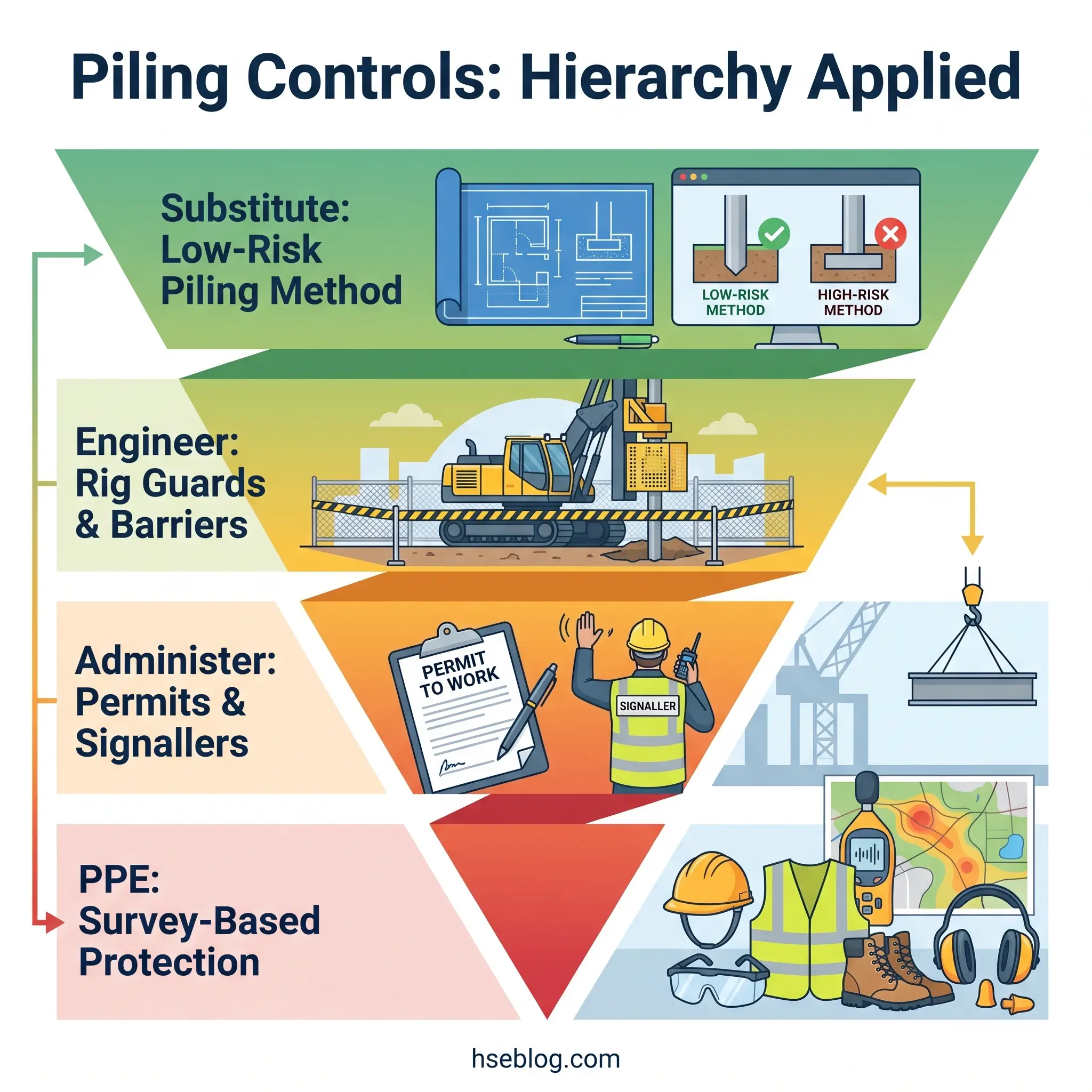
Control Measures for Piling Operations: The Hierarchy Applied
Every hazard identified above has a control — but the critical question is whether that control survives contact with real site conditions. The hierarchy of controls applies to piling the same way it applies to any hazard, yet its application here is more nuanced than most HSE professionals expect because the highest-level controls (elimination and substitution) operate at the design stage, months before the first rig arrives on site.
Elimination and Substitution at the Design Stage
The most impactful piling safety decisions are made by designers, not site supervisors. Under CDM 2015 (UK), designers have a legal duty to eliminate foreseeable risks or reduce them through design choices — and piling method selection is one of those choices.
Selecting CFA piling instead of impact-driven piling eliminates the extreme impulse noise and ground vibration associated with drop hammers. But this is substitution, not elimination — CFA introduces auger entanglement and pressurised concrete-line hazards that do not exist in impact driving.
The judgment call is whether the substituted hazard profile is genuinely lower-risk for the specific site context. Factors that drive this decision include:
- Proximity to occupied structures — vibration-sensitive environments favour CFA or pressed piling.
- Ground contamination — bored piling in contaminated ground generates hazardous spoil that impact-driven piles avoid.
- Underground service density — micro-piling in congested utility corridors increases service-strike exposure per metre of penetration.
Designers who treat method selection as purely a geotechnical decision, without consulting the project HSE team on the hazard trade-offs, miss the most powerful control opportunity in the entire piling operation.
Engineering Controls on the Piling Rig and Work Area
Engineering controls physically separate workers from energy sources. On piling rigs, the priority engineering controls are:
- Auger guards and mechanical spoil cleaners on CFA rigs — eliminating the need for manual clearing near rotating parts, as required by PUWER 1998 Regulations 11–12 and BS EN 16228.
- Safety chains on all hose connections — OSHA 1926.603(a)(10) requires these on every hose, including hydraulic lines. The Queensland fatality in 2024 involved a hose connection without adequate retention.
- Stop blocks and blocking devices — prevent the hammer from being raised beyond safe travel limits or from falling uncontrolled.
- Overhead operator protection — cab protection rated for the loads involved in that specific piling operation, not generic ROPS/FOPS from earthmoving equipment.
- Physical exclusion zone barriers — not cones and tape, but rigid barriers that prevent pedestrian entry during active pile driving or hoisting.
The most common engineering control failure is treating exclusion zones as static when they must be dynamic. The zone should expand when a pile is being hoisted into position — the swing radius plus the fall zone of the pile and rigging — and contract once the pile is seated in the leads and driving begins. Many sites draw one perimeter at the start of the shift and leave it unchanged regardless of the task phase.
Administrative Controls and Safe Systems of Work
Where engineering controls cannot fully eliminate exposure, administrative controls manage the remaining risk through systems of work.
- Daily pre-use inspections — the rig operator inspects the mast, hydraulic cylinders, wire ropes, hose connections, and ground conditions before the first pile of every shift. OSHA 1926.1412(d)(1) specifies wire rope inspection requirements for crane-mounted rigs.
- Permit-to-work systems — underground service strike prevention requires a permit-to-dig signed off against both the desktop utility search and the on-site scan results. Hot work permits apply when pile cutting involves oxy-fuel or plasma methods.
- Designated signaller — OSHA 1926.603(c)(1) requires that when the operator cannot see the point of operation, a designated signaller with exclusive signal authority must be positioned to direct the operation. This is not optional and not delegable to whoever happens to be standing nearby.
- Banksman supervision of exclusion zones — a trained banksman manages pedestrian and vehicle movements around the rig. The banksman role requires specific training; it is not a general labourer duty.
- Method statements — the piling method statement must be site-specific, referencing the actual ground investigation report, the actual utility survey, and the actual rig being used. Generic method statements copied between projects are a persistent industry failing.
PPE — hearing protection, head protection, high-visibility clothing, steel-toed footwear, eye protection for pile cutting — is the final layer. Hearing protection selection must be based on actual noise survey data for the specific rig and method, not a default to maximum NRR earmuffs that may cause over-protection and inability to hear warnings.
Piling Risk Assessment: A Structured Approach
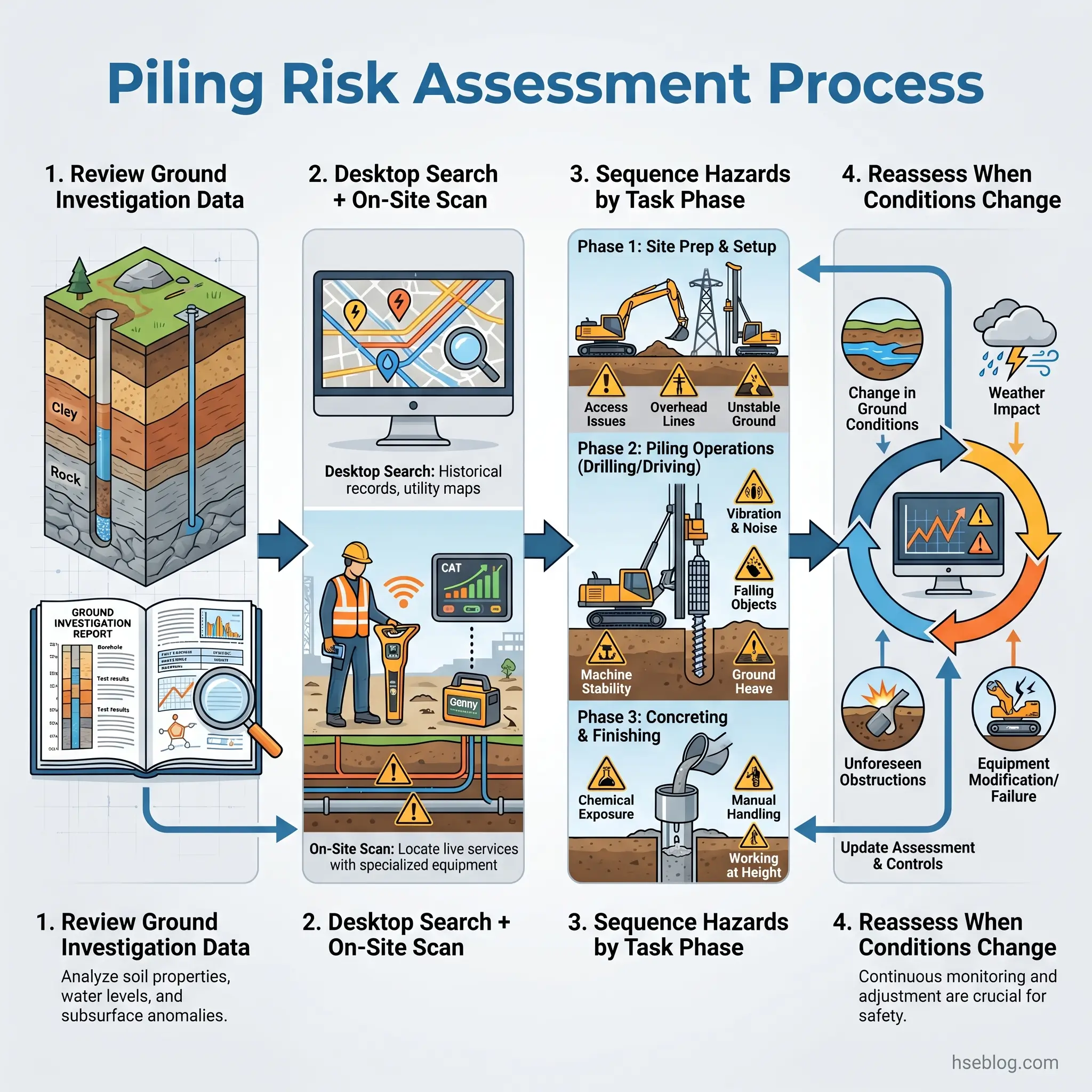
A piling risk assessment that actually prevents incidents must be site-specific, method-specific, and dynamic. The persistent industry problem is generic assessments copied between projects, where the most critical variable — ground conditions — changes at every site but the risk assessment does not. The litmus test: does the RA reference the actual ground investigation report for this project?
The process follows a logical sequence, with each step feeding the next.
Step 1: Pre-Construction Ground Investigation Review
Before any risk assessment can be meaningful, the geotechnical data must be reviewed. The ground investigation report identifies the soil profile, groundwater level, contamination status, and bearing characteristics. Each of these directly affects the hazard profile:
- Granular soils in high water tables increase the risk of pile-hole collapse in bored piling.
- Contaminated ground introduces chemical exposure hazards during spoil handling.
- Variable bearing strata may cause unexpected driving resistance, increasing hammer energy and noise exposure.
Step 2: Desktop Utility Search and On-Site Scanning
The utility search operates in two layers. The desktop search (811 in the US, utility records in the UK) identifies known buried services. The on-site CAT and Genny scan detects electromagnetic signals from live cables and locates metallic pipes.
Neither layer catches everything. Some services are unmapped. Some are installed without records. Some have been diverted from their recorded positions. The risk assessment must account for residual uncertainty — the question "what if there is an unrecorded service at the pile position?" must have an answer in the method statement.
Step 3: Task-Step Sequencing
Each phase of the piling operation introduces distinct hazards. The risk assessment should address them sequentially:
- Site setup and rig delivery — transport access, lifting the rig from low-loader, positioning on the working platform.
- Rig positioning — levelling, outrigger deployment, proximity to exclusion zone boundaries and site edges.
- Pile installation — the active driving/boring phase with struck-by, entanglement, noise, and vibration exposure at their peak.
- Concreting (CFA/bored) — pressurised concrete delivery, hose management, wet concrete splash exposure.
- Pile testing — load testing introduces additional lifting and rigging hazards.
- Demobilisation — disassembly and transport, often rushed at project end, with corresponding increases in handling risk.
Step 4: Dynamic Risk Reassessment
Ground conditions change during piling — especially on sites with variable geology or tidal influence. Weather deterioration affects rig stability and ground bearing capacity. Unexpected obstructions force deviations from the planned pile sequence. The risk assessment must include trigger conditions for stopping work and re-evaluating, not just the initial pre-construction assessment.
Piling Equipment Inspection and Maintenance Requirements
The Van Elle prosecution settled any debate about whether maintenance regimes on piling rigs are "nice to have" or legally mandatory. A corroded retaining pin — a component that would have been flagged during a competent thorough examination — failed and killed a worker (HSE prosecution, June 2024). The regulatory position across jurisdictions is unambiguous: piling equipment must be inspected at defined intervals by competent persons, and the results must be documented.
Inspection requirements operate on three tiers.
Tier 1: Daily Pre-Use Checks
The rig operator conducts a visual and functional inspection before the first pile of every shift. This is not a bureaucratic exercise — it is the first line of defence against overnight deterioration, hydraulic leaks, and loose connections.
Items that must be checked include:
- Mast/boom condition — visual inspection for cracks, corrosion, loose pins, and deformation.
- Hydraulic cylinders and hoses — leaks, abrasion, connection tightness, safety chain presence on every hose.
- Wire ropes — broken wires, kinking, corrosion, proper spooling. OSHA 1926.1412(d)(1) specifies wire rope inspection criteria for crane-mounted piling rigs.
- Hose connections — safety chains intact per OSHA 1926.603(a)(10).
- Ground conditions — check for overnight settlement, water accumulation, or changes to the working platform.
Tier 2: Periodic Competent-Person Inspections
At defined intervals — typically weekly or monthly depending on the inspection scheme — a competent person conducts a more detailed inspection covering structural integrity, control system function, and wear patterns.
Under PUWER 1998 Regulation 6 (UK), equipment must be inspected at suitable intervals and the results recorded. The frequency depends on the equipment type, the operating environment, and the manufacturer's recommendations.
Tier 3: Statutory Thorough Examination
In the UK, LOLER 1998 requires a thorough examination of lifting equipment by a competent person — typically an independent third-party examiner — at intervals not exceeding 12 months for lifting equipment (6 months for lifting accessories such as slings and shackles). The examiner issues a written report, and the equipment must not be used if defects are identified until remediated.
During hard driving conditions — where the hammer impacts repeatedly at high energy — inspection frequency should increase. OSHA 1926.603 recognises that pile driving equipment is subject to unusual stresses, and the competent person must adjust the inspection regime accordingly.
The point where maintenance discipline most commonly degrades is on multi-rig sites where equipment moves between projects. Each handover is a risk point. The incoming operator may not have visibility of the rig's full maintenance history, and documentation does not always travel with the machine. A robust system ensures the examination records are physically attached to or accessible with the rig, not filed in an office at the previous site.
| Inspection Tier | Who | Frequency | Key Focus |
|---|---|---|---|
| Pre-use daily | Rig operator | Every shift, before first pile | Hydraulics, ropes, hoses, ground, mast pins |
| Periodic | Competent person | Weekly to monthly | Structural integrity, wear, control systems |
| Thorough examination | Independent examiner | 6–12 months (LOLER, UK) | Full structural, mechanical, and safety assessment |
Regulatory Framework for Piling Safety
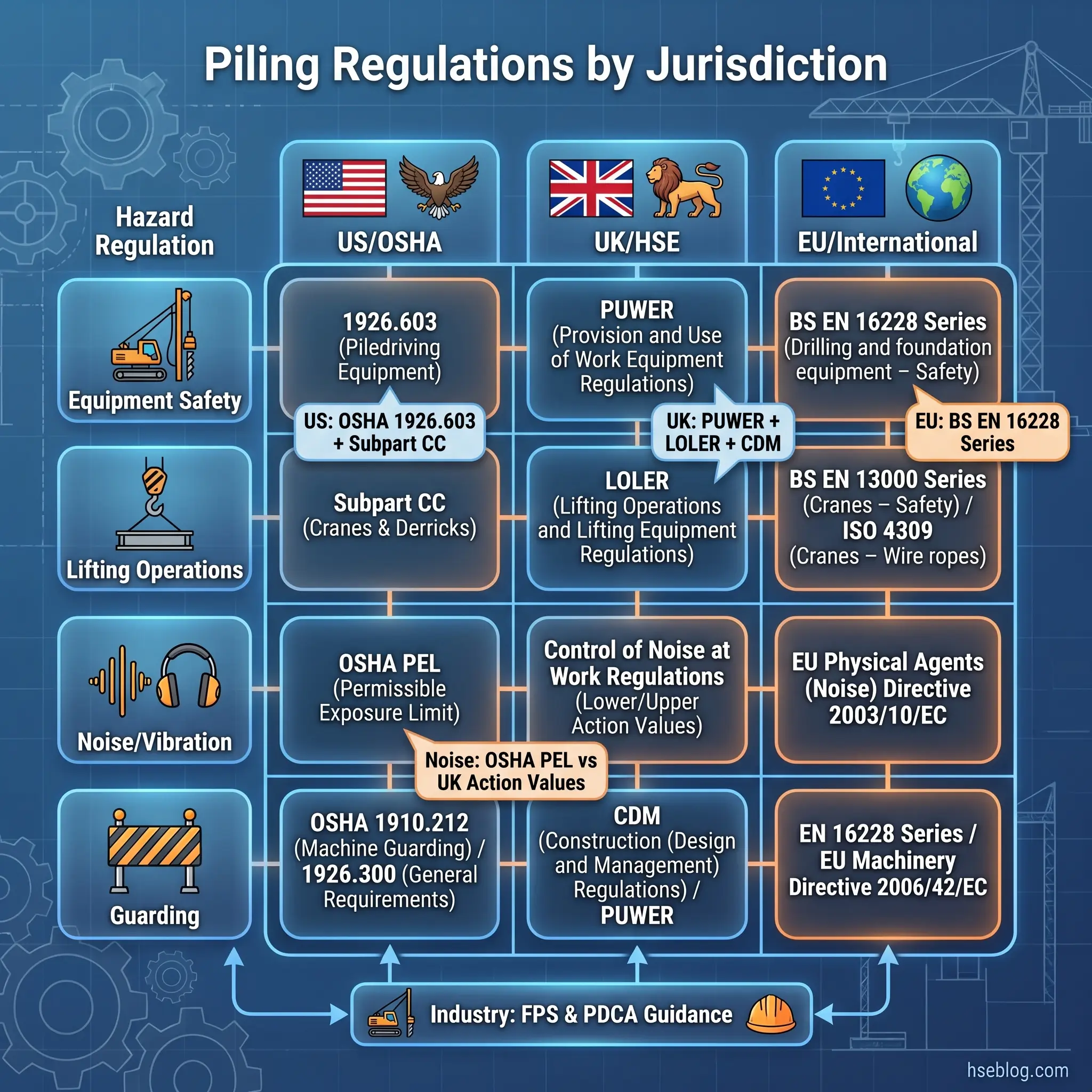
A common compliance gap is the assumption that a single standard covers all piling hazards. It does not. The regulatory framework for piling is layered — crane operations, fall protection, noise, vibration, excavation safety, and lifting operations each fall under separate regulations that apply concurrently with the piling-specific requirements.
United States: OSHA Framework
Sites cited under OSHA for piling violations typically show failures across multiple standards, not just one. The key regulations:
OSHA 29 CFR 1926.603 governs pile driving equipment directly — covering overhead protection, stop blocks, blocking devices, safety chains on hose connections, stability, and signalling. But when cranes are used for pile driving, Subpart CC (Cranes and Derricks in Construction, §1926.1404(p)) applies concurrently. Fall protection from rig leads falls under Subpart M. If piles are driven in excavations, Subpart P governs the pit walls.
The practical reading: compliance officers do not limit their inspection to 1926.603. A piling site inspection will test against every standard that applies to the activities present.
United Kingdom: HSE Framework
The UK framework layers multiple regulations and approved codes of practice:
- PUWER 1998 — Regulations 5 (maintenance), 6 (inspection), 11–12 (guarding of dangerous parts including rotating augers).
- LOLER 1998 — thorough examination of all lifting equipment and accessories used on the piling site.
- CDM 2015 — places duties on designers to consider piling method selection as a safety decision, and on principal contractors to manage site-wide coordination.
- Noise at Work Regulations 2005 and Control of Vibration at Work Regulations 2005 — specific numerical action and limit values.
International and Harmonised Standards
BS EN 16228:2014+A1:2021 is the harmonised European standard for drilling and foundation equipment safety. It runs to seven parts, with Part 1 covering common requirements and Part 4 addressing foundation equipment specifically. This standard sets design-level safety requirements for rig manufacturers and is referenced by UK HSE inspectors when assessing whether equipment meets the "state of the art" in guarding and safety systems.
The Federation of Piling Specialists publishes industry-specific guidance covering CFA over-flighting prevention, concrete line management, supervisor competency, and the piling-adapted permit-to-dig template. In the US, the Pile Driving Contractors Association (PDCA) publishes safety best management practices that supplement the OSHA standards.
Regulatory content here reflects general HSE professional understanding of US, UK, and EU requirements as of 2025. It is not legal advice. Specific compliance questions, enforcement situations, or prosecution risk should be directed to qualified legal counsel in the applicable jurisdiction.
Training and Competency Requirements for Piling Personnel
A qualification card confirms that someone passed an assessment at a point in time. It does not confirm competency for the specific rig model, the specific piling method, or the specific ground conditions on a given project. This distinction — between certification and competency — is where piling safety management most frequently falls short.
Operator competency requires layers. The base layer is a recognised third-party certification — in the UK, CPCS (Construction Plant Competence Scheme) or NPORS (National Plant Operators Registration Scheme) cards demonstrate assessed competence on the relevant plant category. OSHA restricts those under 21 from operating hoisting machines, establishing a minimum age requirement for pile driving equipment operation.
Above the certification, operators need manufacturer-specific training on the exact rig model deployed. An operator with extensive experience on driven-pile rigs but no CFA experience represents a risk that paper-based competency checking misses — the hazard profile, the control requirements, and the operational techniques are fundamentally different.
The signaller or banksman role carries specific regulatory requirements. Under OSHA 1926.603(c)(1), when the operator's view of the point of operation is obstructed, a designated signaller must be assigned with exclusive signal authority. This means one person, clearly identified, whose signals the operator follows. Shared or informal signalling arrangements breach this requirement and introduce conflicting-instruction hazards.
For piling supervisors, the UK model offers a structured path. The FPS Piling Supervisor Safety Training Scheme defines the expected competency, covering rig-specific hazard awareness, method statement interpretation, dynamic risk assessment, and emergency response.
Competent person appointments — for inspections, risk assessment sign-off, and lift planning — require both the relevant technical knowledge and practical experience. The regulatory definition under UK law emphasises "sufficient training and experience or knowledge" — all three elements, not just one.
The judgment call for any piling site manager is straightforward: would you allow this person to supervise this operation if you were standing next to them? If the answer depends on hoping their card means they know what they are doing, the competency verification has not been completed.
Frequently Asked Questions
What PPE is required for piling operations?
Piling PPE includes hard hats meeting ANSI Z89.1 (US) or EN 397, hearing protection selected based on the actual noise survey for the specific rig and method — not a default to maximum NRR — high-visibility clothing, steel-toed boots, and eye protection for pile cutting or welding tasks. Gloves appropriate to the task protect against cement dermatitis on CFA sites and laceration hazards during steel handling. PPE is the last line of defence, applied after engineering and administrative controls have reduced exposure as far as practicable.
What is the safe distance from a piling rig during operation?
There is no universal fixed safe distance. The exclusion zone must be determined by the site-specific risk assessment and should account for the fall zone of the rig mast and hammer, the pile swing radius during hoisting, the noise contour above the applicable action level, and the debris ejection range during driving. The PDCA defines the "fall zone" as the area where the mast or load could land if it fell. OSHA 1926.1401 provides crane-related definitions that apply when cranes are used in pile driving. The zone must be dynamic — expanding during hoisting and adjusting as the operation phase changes.
Can piling cause damage to adjacent buildings?
Ground vibration from piling — particularly impact-driven methods — can cause structural damage to adjacent buildings and infrastructure. The duty holder should conduct pre-condition surveys of neighbouring structures before piling begins. Vibration monitoring with trigger and action levels set per BS 7385-2 (UK) or DIN 4150-3 (Germany/international) provides real-time data to stop operations before damaging thresholds are reached. CFA or pressed piling methods generate significantly lower vibration and may be specified where adjacent structures are sensitive.
What is a piling method statement and what should it contain?
A piling method statement is a site-specific document that describes how the piling operation will be executed safely. It must include the rig type and model, piling sequence and layout, exclusion zone dimensions and management, lifting plan for pile handling, emergency procedures including underground service strike response, environmental controls for noise, vibration, and spoil management, and the names and competency evidence of key personnel. It differs from a generic safe work procedure because it references the actual ground investigation report, utility survey, and site conditions for that project.
How often should piling equipment be inspected?
Piling equipment requires three tiers of inspection: daily pre-use checks by the operator before each shift, periodic competent-person inspections at weekly to monthly intervals depending on the scheme, and statutory thorough examinations under LOLER 1998 (UK) at intervals not exceeding 12 months for lifting equipment — 6 months for accessories. During hard driving conditions, OSHA 1926.603 recognises that equipment is subject to unusual stresses, and inspection frequency should increase. The Van Elle prosecution (2024) demonstrated that failure in this regime has fatal consequences.
What is the difference between impact piling and CFA piling from a safety perspective?
Impact piling produces higher noise — often exceeding 100 dB at the operator position — and significant ground vibration, but carries lower entanglement risk because there are no rotating parts at the surface during driving. CFA piling generates lower noise but introduces two hazards impact piling does not: entanglement in the rotating auger and pressurised concrete-line failure including hose whip. Method selection should be treated as a safety decision informed by the site-specific risk assessment, not solely a geotechnical choice.
Conclusion
The pattern that runs through published piling incidents and enforcement actions is consistent: the controls existed on paper but failed in practice. Van Elle had a maintenance regime — but corroded pins went undetected. The Queensland CFA site had hose connections — but the retention system did not prevent the fatal whip. Sites across the industry draw exclusion zones — but leave them static while the operation phase changes around them.
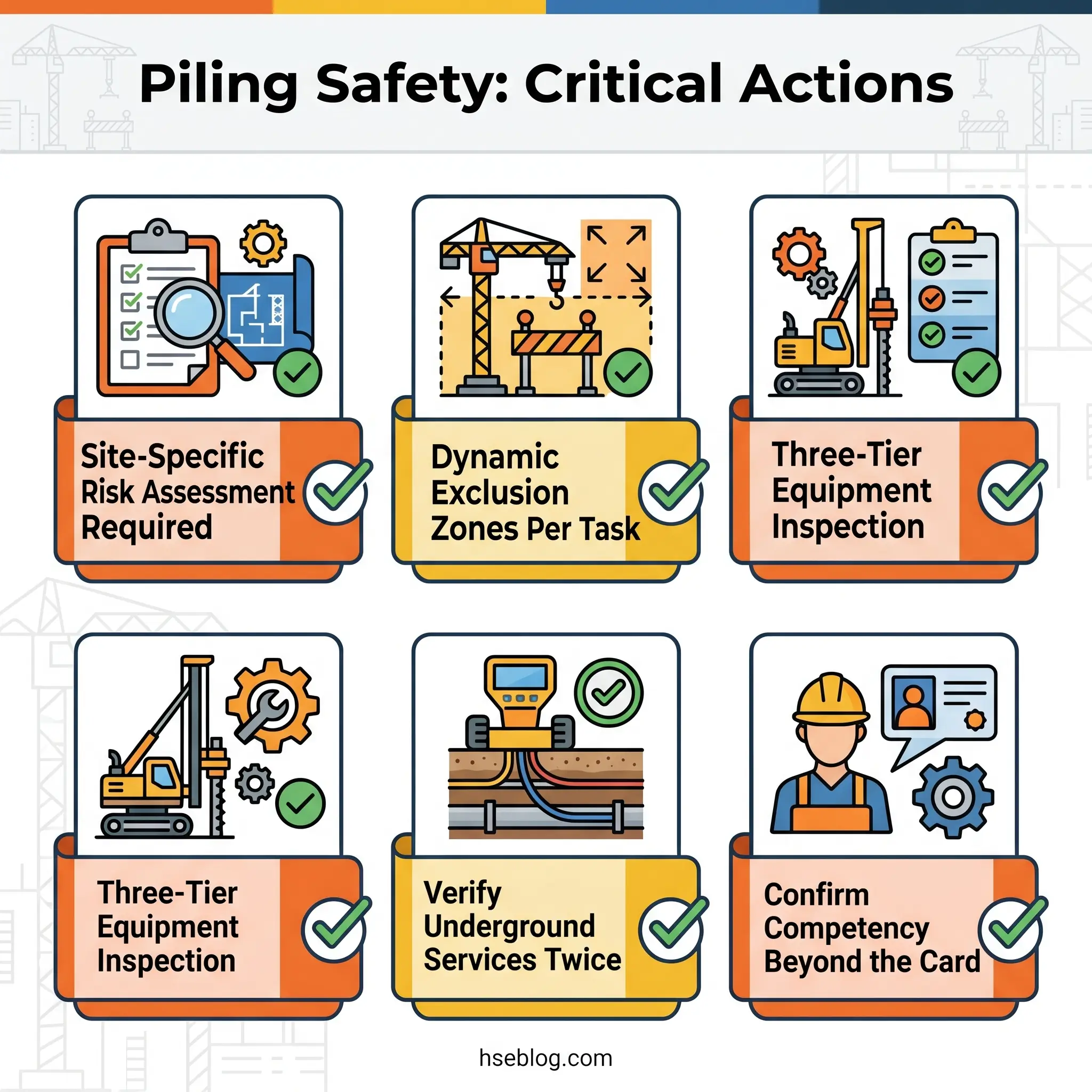
The single highest-impact change any piling operation can make is closing the gap between what the method statement says and what actually happens at the rig. That means dynamic exclusion zones that respond to task phase, equipment inspections conducted by people who know what failure looks like on that specific rig model, utility verification that combines desktop records with on-site scanning and still plans for the service that neither method found, and competency checks that go beyond the card to confirm actual experience with the method, the rig, and the ground.
Piling safety does not fail because the hazards are unknown. Every hazard in this article is well-documented, well-regulated, and well-understood by competent practitioners. It fails when the distance between the written system and the operational reality becomes wide enough for someone to be killed in the gap.