

TL;DR
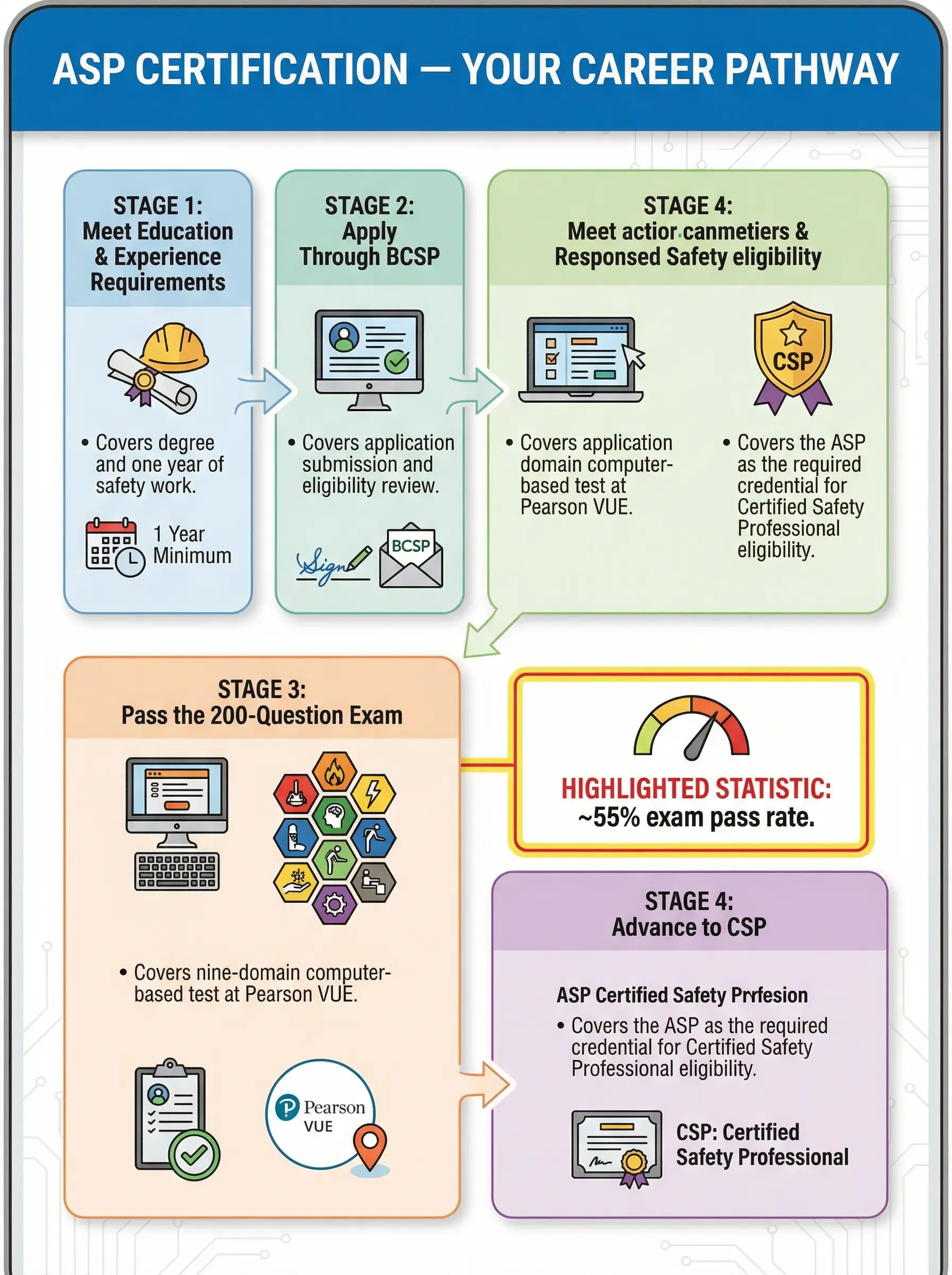
- ASP stands for Associate Safety Professional — a globally recognized credential issued by the Board of Certified Safety Professionals (BCSP) that validates your competency in occupational safety, health, and environmental practice.
- You need a bachelor’s degree in any field (or an associate in SH&E) plus one year of professional safety experience where at least 50% of your duties involve preventative safety work.
- The exam is 200 multiple-choice questions across nine domains covering everything from advanced math and industrial hygiene to fire protection, ergonomics, and law and ethics — with a five-hour time limit.
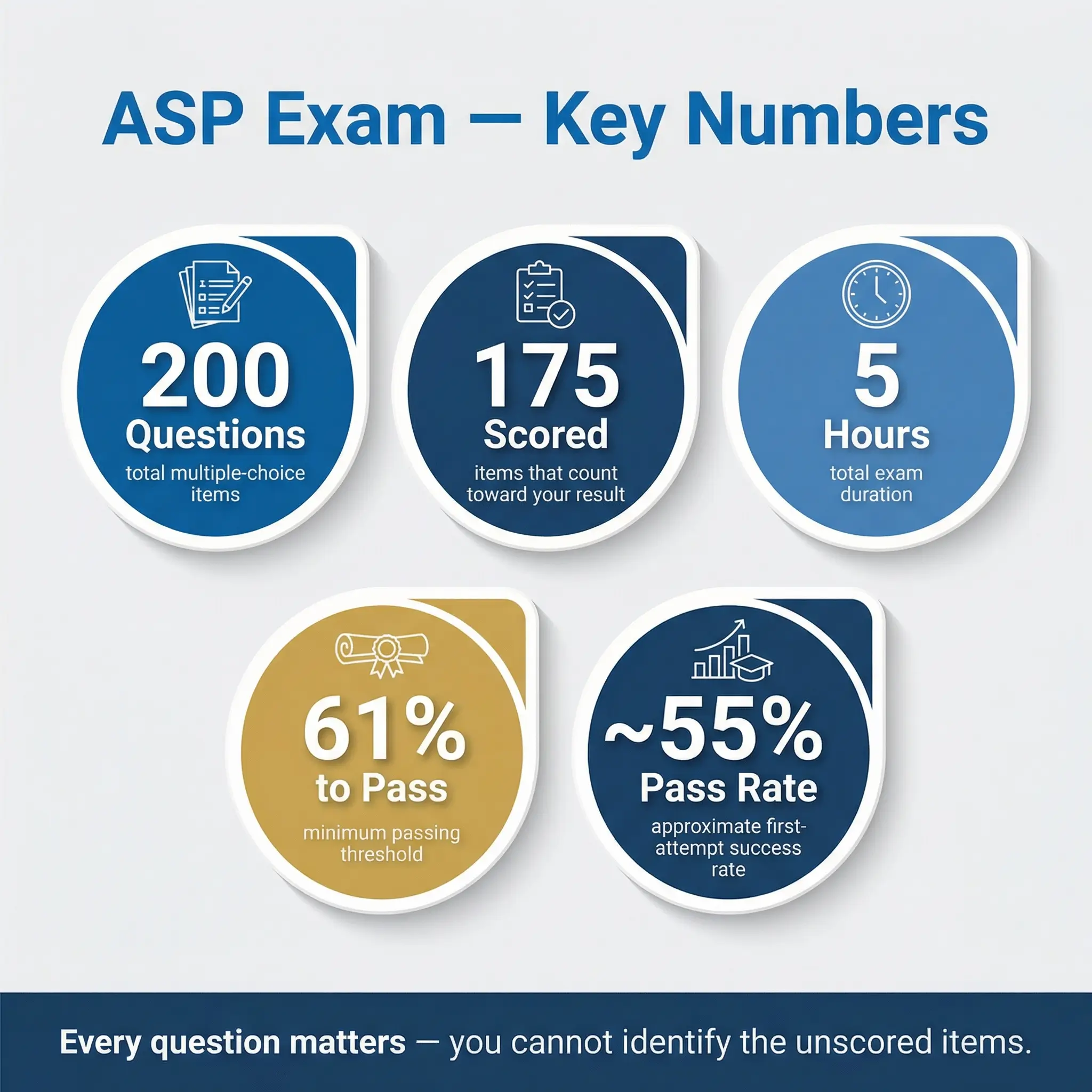
- The pass rate hovers around 50–55%, and you need roughly 61% correct answers — making structured preparation and blueprint-aligned study non-negotiable.
- ASP is the required stepping stone to the CSP (Certified Safety Professional) — the gold standard credential in the HSE profession and a career accelerator across every high-risk industry.
I was conducting a management system audit at a refinery complex along the Gulf coast when a young safety coordinator pulled me aside during a break. He had three years of field experience, a degree in environmental science, and a stack of training certificates — but every job posting he applied for listed “ASP or CSP preferred.” He wanted to know if the ASP certification was worth the time, the money, and the stress of another exam. I told him what I tell every early-career professional who asks: the ASP is not just another certificate to hang on a wall. It is the single most credible signal that you have moved from task-level safety compliance into professional-level safety practice.
The ASP certification matters because it separates practitioners who understand safety principles from those who merely follow checklists. Across construction, oil and gas, petrochemical, mining, manufacturing, and energy sectors, hiring managers and project directors increasingly filter candidates by BCSP credentials before they even read your résumé. More critically, the ASP is the mandatory gateway to the CSP — the certification that opens doors to senior HSE management, lead auditor roles, and corporate safety director positions. This article breaks down exactly what the ASP certification is, who qualifies, how the exam works, what the nine domains cover, how to prepare effectively, and what it means for your career trajectory in occupational health and safety.
What Is the ASP Certification?
The Associate Safety Professional (ASP) certification is a professional credential administered by the Board of Certified Safety Professionals (BCSP), the leading credentialing body for safety, health, and environmental practitioners in the United States — with global recognition across multinational EPC projects, oil and gas operations, and regulated industries worldwide. BCSP has been the leader in EHS credentialing since 1969.
The ASP validates that a practitioner possesses the foundational knowledge and applied skills to perform professional-level safety duties. This includes the following competencies, which I have seen tested not just on paper but in real operational settings across refineries, construction mega-projects, and mining operations:
- Worksite hazard assessment and risk identification — conducting walkthroughs, JHAs, and baseline risk assessments that go beyond clipboard exercises to identify conditions that actually injure workers
- Hazard control evaluation and implementation — selecting, recommending, and overseeing controls using the hierarchy of controls, from elimination and engineering controls down to administrative measures and PPE
- Incident investigation and loss record management — leading or supporting root cause analyses, maintaining OSHA 300 logs or equivalent recordkeeping systems, and trending leading and lagging indicators like TRIR, DART, and LTIFR
- Emergency response planning — developing, reviewing, and drilling site-specific ERPs that account for fire, chemical release, medical emergencies, and natural disasters
- Safety program coordination — bridging the gap between management system requirements and frontline execution, translating policies into toolbox talks, permits, and daily pre-task plans
BCSP describes the ASP holder as someone who “may be called upon to coordinate safety activities, conduct basic safety analyses, identify hazardous situations, and recommend or oversee implementation of risk reduction measures.” — [External Link: BCSP — Associate Safety Professional Overview → https://www.bcsp.org/associate-safety-professional-asp]
One distinction that trips up many practitioners: the ASP is not a training certificate. It is a professional certification governed by psychometric standards, continuous recertification requirements, and an enforceable code of ethics. I have seen candidates confuse it with OSHA 30-Hour or NEBOSH General Certificate — both valuable, but structurally different. The ASP requires a degree, verified professional experience, and a proctored exam. That is a fundamentally higher bar.
ASP vs. Other Safety Credentials — Where Does It Fit?
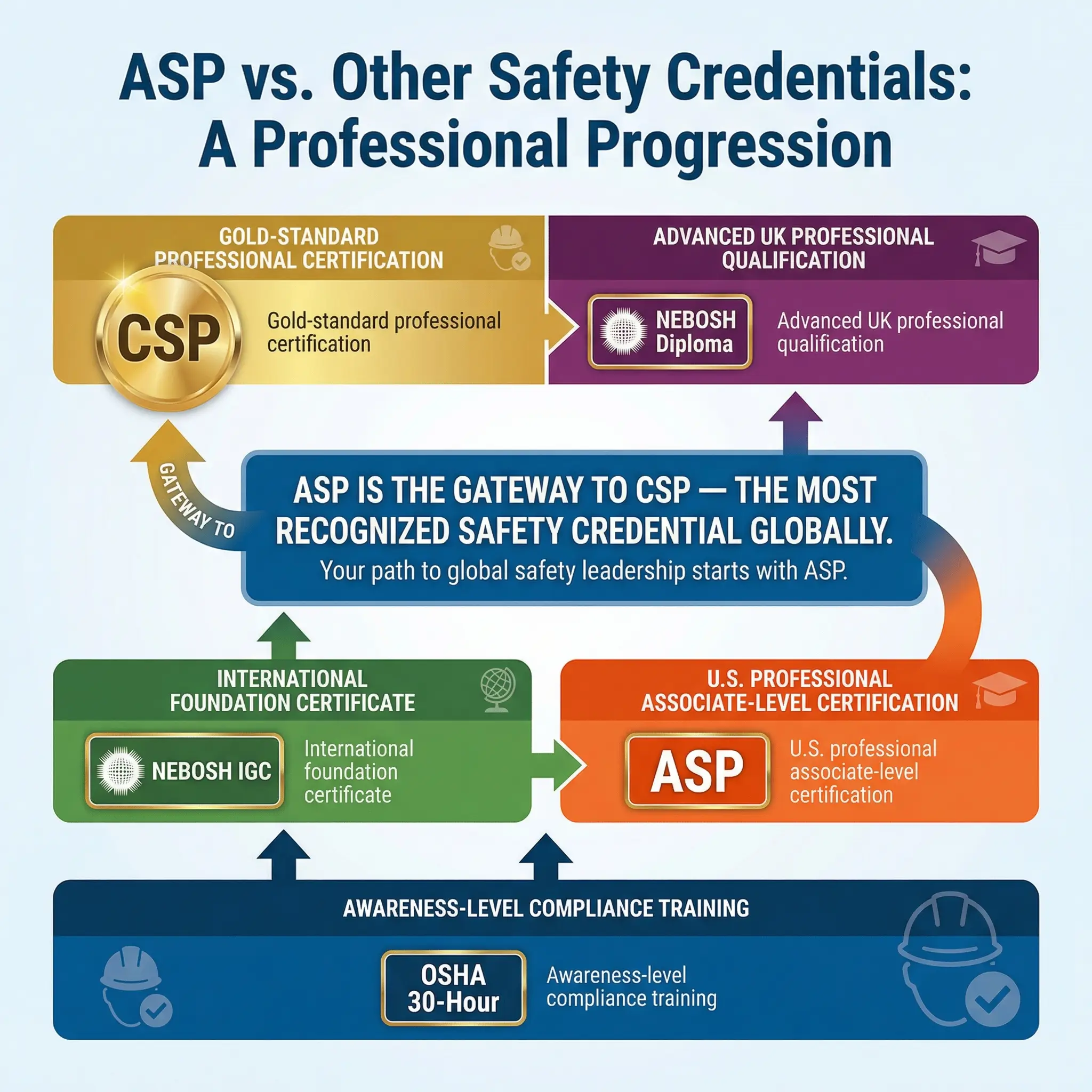
Understanding where the ASP sits in the broader credentialing landscape helps you make an informed decision. Here is how it compares to the credentials most commonly encountered across international HSE roles:
| Credential | Issuing Body | Level | Exam Format | Pathway To |
|---|---|---|---|---|
| OSHA 30-Hour | OSHA (US) | Awareness / Compliance | Instructor-led, no proctored exam | None (standalone) |
| NEBOSH IGC | NEBOSH (UK) | Foundation | Written + practical exam | NEBOSH Diploma |
| ASP | BCSP (US) | Professional (Associate) | 200-question proctored CBT | CSP (mandatory) |
| CSP | BCSP (US) | Professional (Certified) | 200-question proctored CBT | SMS, Board roles |
| ISO 45001 Lead Auditor | Various (IRCA-accredited) | Auditor specialist | Course + assessment | Audit practice |
| NEBOSH Diploma | NEBOSH (UK) | Advanced | Multi-unit written exams | GradIOSH → CMIOSH |
Pro Tip: If you are working on multinational EPC projects in the Gulf, Southeast Asia, or Africa, the ASP/CSP combination is often listed alongside NEBOSH in tender prequalification documents. I have reviewed contractor safety submissions where holding both BCSP and NEBOSH credentials gave companies a measurable scoring advantage during bid evaluations.
Who Is Eligible for the ASP Certification?
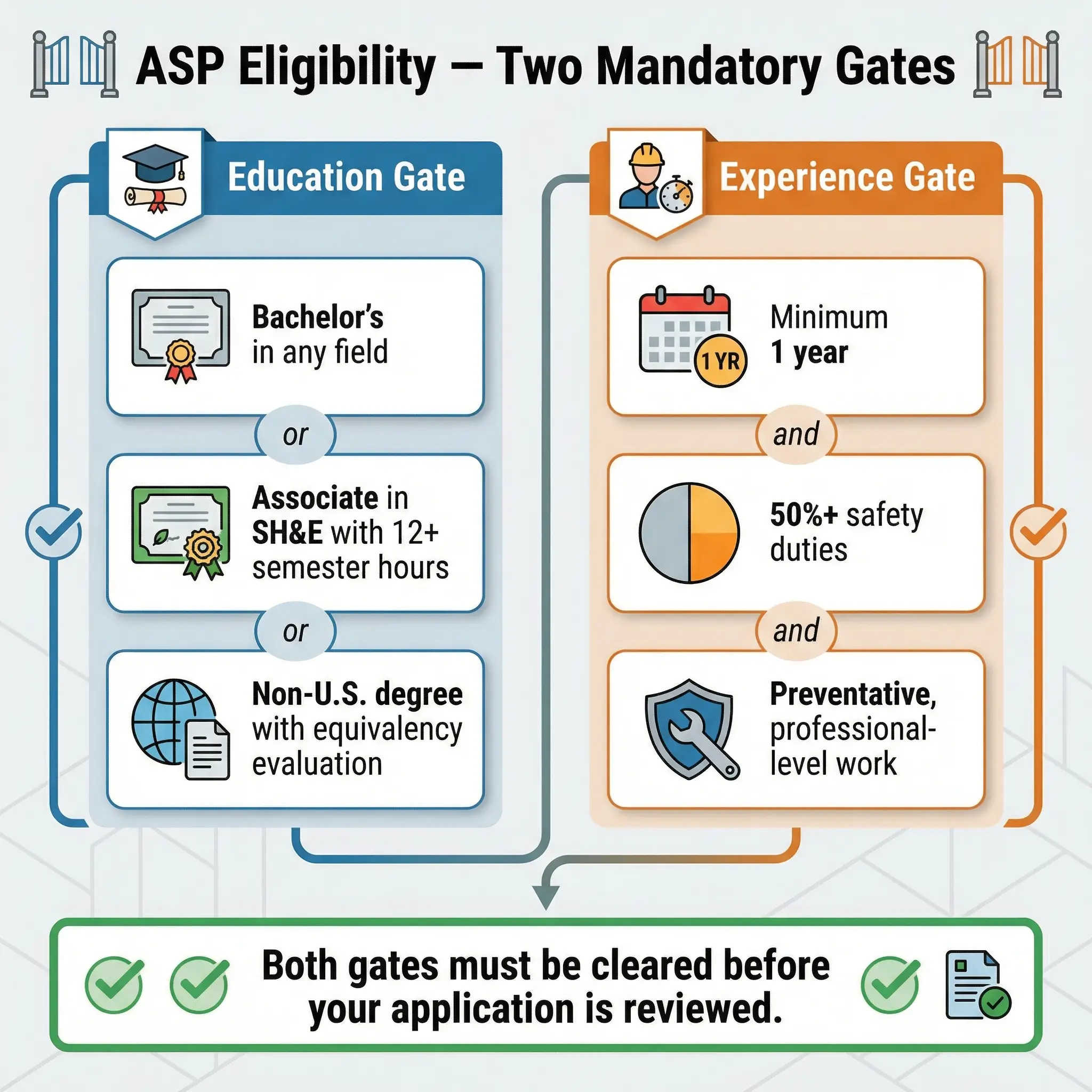
BCSP has defined clear eligibility gates for the ASP, and I have seen more candidates delayed by misunderstanding these requirements than by failing the exam itself. The two pillars are education and experience — both are mandatory, and both are verified.
Education Requirements
At minimum, candidates need a bachelor’s degree in any field, or an associate degree in safety, health, or the environment. The key details that catch people off guard are worth noting:
- Bachelor’s degree in any field — engineering, business, biology, liberal arts — it does not matter. BCSP does not restrict by discipline. I have worked with ASP holders whose undergraduate degrees ranged from chemistry to communications.
- Associate degree alternative — if using an associate degree, it must include at least four courses totaling 12 semester hours (or 18 quarter hours) in safety, health, or environmental domains aligned with the ASP exam blueprint.
- Non-U.S. degrees — if your degree is from outside the United States, it will need to be evaluated for U.S. equivalency. BCSP maintains a list of accepted credential evaluation services. During an audit in Southeast Asia, I met a safety officer who lost four months because he did not get his degree evaluated before applying. Start this early.
Experience Requirements
Education alone does not qualify you. You must have at least one year of safety experience where safety constitutes at least 50% of your duties, is preventative in nature, and reflects professional-level breadth and depth.
BCSP is specific about what counts as qualifying experience. The following types of duties typically meet the threshold based on the credential requirements and what I have seen accepted in practice:
- Hazard assessments and workplace inspections — not just tagging along, but planning, conducting, and reporting findings with recommendations
- Safety program development or management — writing procedures, developing safe work method statements, managing permit-to-work systems
- Incident investigation — leading or materially contributing to root cause analyses, not just filling out forms
- Employee safety training — designing and delivering content, conducting competency assessments
- Risk assessment and analysis — performing JHAs, HIRA, HAZOP participation, or failure mode analysis
- Regulatory compliance activities — ensuring compliance with OSHA standards, developing audit protocols, managing corrective actions
Pro Tip: BCSP randomly audits approximately 5% of applications. If selected, you may need to supply additional documentation, such as a letter from your employer verifying your job details or a completed BCSP Experience Validation Form. Keep a detailed job description and supervisor contact information ready before you submit. I learned this lesson the hard way watching a colleague’s application stall for weeks during a random audit because his employer’s HR department was slow to respond.
How to Apply for the ASP Certification
The application process is straightforward but detail-sensitive. I have walked several junior colleagues through it, and the candidates who read the instructions carefully saved themselves weeks of back-and-forth with BCSP.
Here is the step-by-step process in the order BCSP requires:
- Create a BCSP account — go to BCSP.ORG, select the “My Profile” portal, and register. This becomes your permanent credentialing dashboard for all BCSP certifications.
- Start the ASP application — from your dashboard, select “Applications” and choose the ASP. You will enter your education history, professional experience details, and contact information.
- Complete required disclosures — BCSP requires applicants to disclose if they have been convicted of offenses or have had a professional license or credential suspended, revoked, or placed under probation. This is reviewed on a case-by-case basis.
- Pay the application fee — the application fee is $160, but you can save by opting for the App+Exam Fee Combo, which costs $494. Paying the combo upfront is cheaper than purchasing the exam authorization separately after approval.
- Wait for eligibility determination — BCSP reviews your submitted application. Once approved, candidates have one year to take and pass the certification examination.
- Purchase and schedule your exam — you can schedule your exam through the single sign-on option to Pearson through your BCSP My Profile at one of their testing centers. Pearson VUE operates hundreds of testing centers worldwide.
What It Costs — Full Breakdown
Budget clarity matters, especially for self-funded candidates. Here is the total cost picture based on current BCSP fee structures:
| Fee Component | Cost |
|---|---|
| Application fee (standalone) | $160 |
| Exam fee (standalone) | $350 |
| App + Exam combo (discounted) | $494 |
| Annual maintenance fee (after certification) | $170 |
| Recertification (every 5 years) | Included with annual fee + 25 points |
| Exam retake (if needed) | $350 per attempt |
I always advise candidates to factor in study materials as well. Reference textbooks, the BCSP examCORE prep course, and third-party practice exams can add $200–$500 depending on your study approach. Some employers reimburse certification costs — ask before you pay out of pocket.
Inside the ASP Exam — Format, Structure, and What to Expect
The ASP exam is where preparation meets pressure. Having sat for BCSP examinations myself and coached others through the process, I can tell you this: the exam is fair, but it is not forgiving to candidates who study casually.
Exam Format at a Glance
The ASP examination is a computer-based test that consists of 200 multiple-choice questions, each with four possible answers of which only one is correct. But there is a critical nuance that many candidates miss:
- 200 total questions — only 175 are scored. The 24 unscored questions on the ASP exam are called “beta” questions (some sources round to 25). These are embedded throughout the exam to evaluate new questions for future test versions. You cannot identify which questions are scored and which are not — so treat every question as if it counts.
- Five-hour time limit. That gives you roughly 1.5 minutes per question. It sounds generous until you encounter calculation-heavy industrial hygiene or physics problems that require working through formulas on the on-screen calculator.
- Passing score of approximately 61%. You must answer at least 93 out of the 175 scored questions correctly. BCSP uses the modified-Angoff and Bookmark Standard Setting methods to determine the cut score — meaning your result is based on absolute competency, not how you compare to other test-takers.
- Exam administered at Pearson VUE centers worldwide. Results are available immediately after you submit.
Pro Tip: You may schedule the exam at any time available as long as it is at least six weeks from your last exam attempt. If you do not pass on the first try, use those six weeks strategically — do not just re-read the same material. Analyze your domain-level score report to identify exactly where you fell short.
The Nine ASP Exam Domains — What You Will Be Tested On
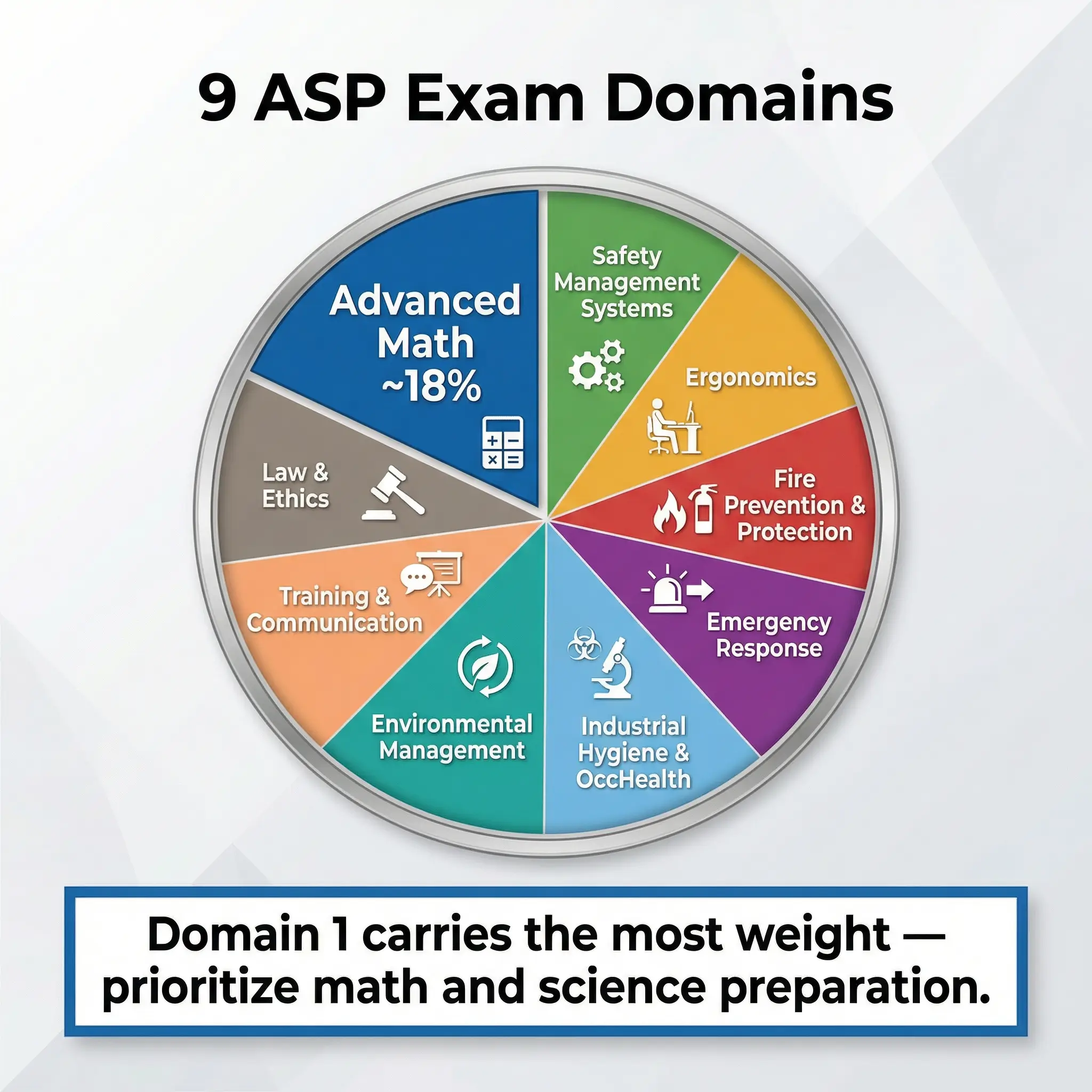
The ASP exam blueprint is divided into nine domains, each weighted differently. Understanding these domains is not just exam strategy — it maps directly to the knowledge areas you will use daily as a safety professional. The nine domains are: Advanced Sciences and Math, Safety Management Systems, Ergonomics, Fire Prevention and Protection, Emergency Response Management, Industrial Hygiene and Occupational Health, Environmental Management, Training Education and Communication, and Law and Ethics.
Here is what each domain covers in practical terms and how it connects to real field work:
Domain 1: Advanced Sciences and Mathematics (~18%)
This is the heaviest-weighted domain and the one that eliminates the most underprepared candidates. It covers calculations you will encounter in industrial hygiene, fire protection engineering, structural safety, and environmental monitoring.
The following topics are tested, and each one has direct field application:
- Chemical and industrial hygiene calculations — computing TWAs, STELs, mixture TLV assessments, dose-response relationships. On a chemical plant audit, I once identified a monitoring gap because the site team was averaging exposure readings incorrectly — exactly the kind of applied math this domain tests.
- Electrical calculations — power, impedance, arc flash energy, circuit analysis. Relevant to NFPA 70E compliance and electrical safe work practices.
- Physics calculations — force, energy, momentum, thermodynamics basics. These underpin everything from fall protection arrest force calculations to pressure vessel safety.
- Structural and mechanical calculations — rigging loads, storage capacity, crane load charts. One crane collapse investigation I participated in traced back to a load calculation error that a competent rigger should have caught.
- Ventilation and engineering control calculations — duct velocity, air changes, capture velocity for local exhaust ventilation. Critical for industrial hygiene and confined space ventilation planning.
Domain 2: Safety Management Systems
This domain tests your understanding of how safety programs are structured, implemented, measured, and improved. It aligns directly with ISO 45001 principles, the PDCA cycle, and organizational safety culture concepts.
Topics include safety program elements, management commitment structures, leading vs. lagging indicators (TRIR, DART, LTIFR, near-miss rates), behavior-based safety approaches, and safety culture assessment. During my career, I have seen organizations with excellent written management systems that still had catastrophic failure rates — because implementation and measurement were disconnected. This domain tests whether you understand that gap.
Domain 3: Ergonomics
Covers musculoskeletal disorder (MSD) risk factors, anthropometrics, workplace design principles, manual handling assessments, vibration exposure, repetitive motion hazards, and environmental stressors like lighting and thermal comfort. If you have ever assessed a workstation or reviewed a manual lifting task using NIOSH lifting equations, you are already practicing what this domain tests.
Domain 4: Fire Prevention and Protection
Tests your knowledge of fire chemistry (the fire tetrahedron), classification of fires, fire detection and suppression systems, explosive atmospheres (dust and vapor), fire prevention programs, and hot work permit requirements. Every refinery turnaround I have managed required daily hot work risk assessment — this domain tests the science behind those decisions.
Domain 5: Emergency Response Management
Covers ERP development, evacuation planning, drill design and evaluation, hazardous materials response, crisis communication, workplace violence preparedness, and business continuity. The domain tests both planning and execution knowledge.
Domain 6: Industrial Hygiene and Occupational Health
This is the second knowledge-intensive domain. It covers the anticipation, recognition, evaluation, and control of workplace health hazards — chemical, physical, biological, and radiological. Exposure monitoring techniques, sampling strategies, OELs (PELs, TLVs, WELs), respiratory protection programs, hearing conservation, and medical surveillance all fall here. If you have managed a COSHH assessment or an industrial hygiene monitoring program, this domain is your territory.
Domain 7: Environmental Management
Tests knowledge of environmental regulations, waste classification, hazardous waste storage and disposal, spill prevention and response (SPCC plans), air and water quality management, and environmental impact assessment. This domain bridges HSE practice with environmental compliance — a growing expectation for safety professionals on multinational projects.
Domain 8: Training, Education, and Communication
Covers adult learning theory, training needs analysis, competency assessment, presentation methods, safety communication strategies, and organizational culture change. Every toolbox talk, safety induction, and competency matrix you have developed draws on this domain’s content.
Domain 9: Law and Ethics
Tests your understanding of OSHA regulatory framework (29 CFR), workers’ rights, employer obligations, legal liability, professional ethics, the BCSP Code of Ethics, and worker privacy protections. I have served as an expert witness in safety litigation — and the legal principles tested in this domain are the exact ones that determine liability outcomes after serious incidents.
How to Prepare for the ASP Exam — A Field Professional’s Study Strategy
Passing the ASP on your first attempt is realistic — but only with a structured, blueprint-driven study plan. With an approximate pass rate of 55%, the exam is challenging, but with the right preparation, it’s absolutely within reach. Here is the approach I recommend based on coaching several colleagues through successful attempts.
Step 1: Download and Study the ASP Exam Blueprint
The ASP Exam Blueprint PDF from BCSP outlines the nine key safety, health, and environmental knowledge areas covered on the exam and shows how much weight each domain carries. This document is your study roadmap. Print it. Highlight the domains where you have the least field experience. That is where your study time needs to concentrate.
Step 2: Assess Your Baseline Knowledge
Before buying textbooks or courses, take a self-assessment. BCSP offers one, and several third-party providers sell practice exams. The goal is not to pass a practice test on day one — it is to map your knowledge gaps against the blueprint domains so your study plan is targeted, not generic.
Step 3: Choose Your Study Resources
The most effective study approach combines primary reference texts with structured prep courses and regular practice testing. The resources that consistently produce results include:
- “Safety and Health for Engineers” by Roger L. Brauer — the most widely referenced ASP/CSP study textbook, comprehensive across all nine domains
- “Safety Professional’s Reference and Study Guide” by W. David Yates — another standard reference with practice questions aligned to BCSP blueprints
- BCSP examCORE — BCSP’s own online, self-paced prep program with over 20 hours of video instruction, learning modules, challenge quizzes, and pre/post assessments
- Third-party practice question banks — multiple providers offer 500–1,000+ practice questions aligned to the ASP blueprint. Use these to simulate exam conditions.
Step 4: Build a Realistic Study Schedule
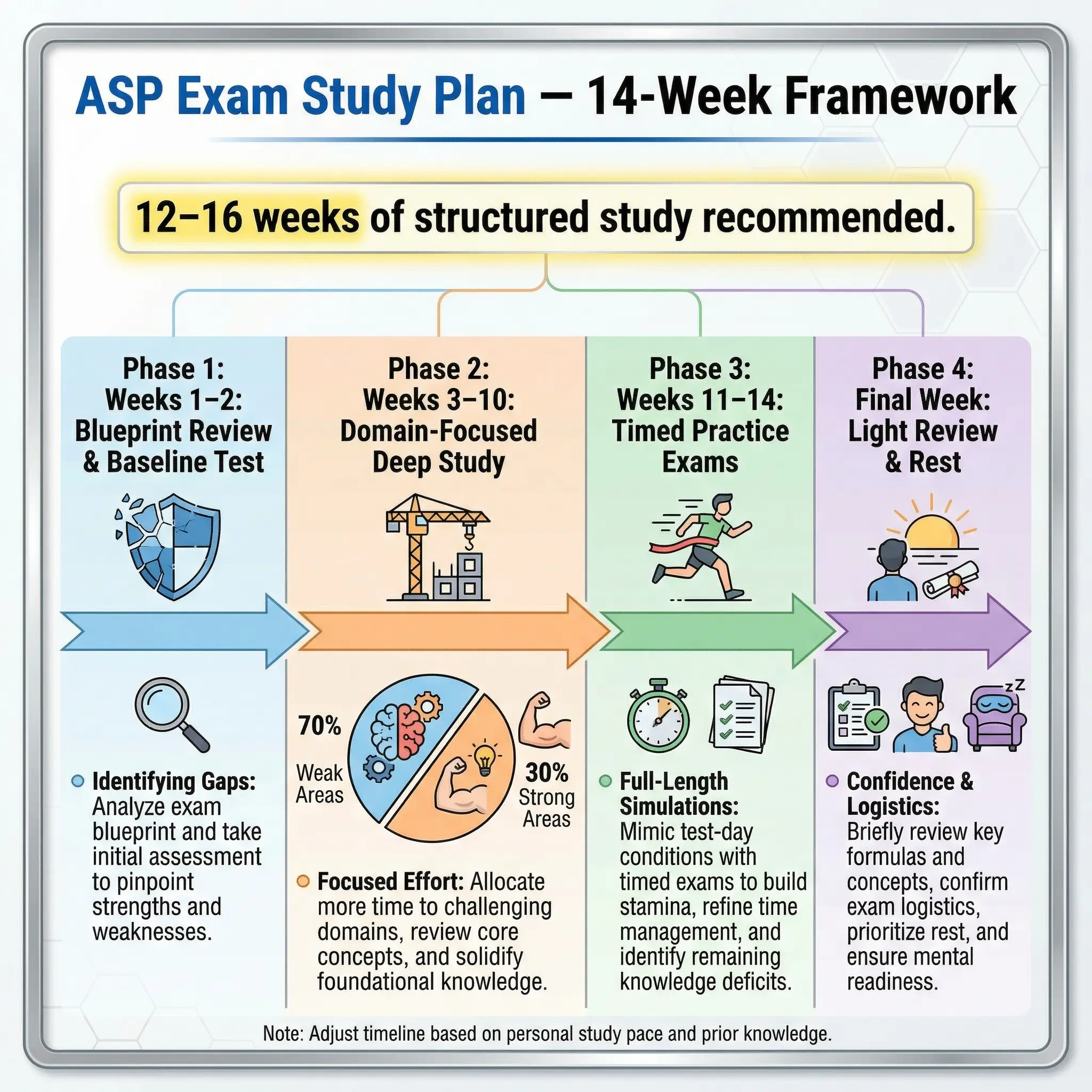
Most candidates who pass on their first attempt study for 12–16 weeks. The most effective pattern I have seen is:
- Weeks 1–2: Review the entire blueprint. Take a baseline self-assessment. Identify your three weakest domains.
- Weeks 3–10: Dedicate roughly 70% of study time to weak domains and 30% to maintaining strong ones. Study 1–2 hours daily or 8–10 hours weekly.
- Weeks 11–14: Shift to full-length practice exams under timed conditions. Review every wrong answer — not just what the right answer was, but why.
- Final week: Light review only. Do not cram. Focus on rest, confidence, and logistics.
Step 5: Master the Calculator and Exam Mechanics
The ASP exam provides an on-screen calculator — no physical calculators are permitted. Practice using this calculator type (TI-30XS equivalent interface) before exam day. Many marks are lost not because candidates do not know the formula, but because they fumble the calculator under time pressure.
Pro Tip: Arrive at the Pearson VUE center 30 minutes early. Personal items are not allowed in the testing room — leave your phone, wallet, and notes in your car or a provided locker. You will be given scratch materials for working through calculations. The exam is closed-book. No reference materials of any kind.
After You Pass — Maintaining Your ASP Certification
Earning the ASP is not a one-time achievement. BCSP requires ongoing professional development to maintain active certification, and this is a standard I fully support. The safety profession evolves — regulations change, new hazards emerge, and best practices are refined. A credential that does not require maintenance quickly becomes meaningless.
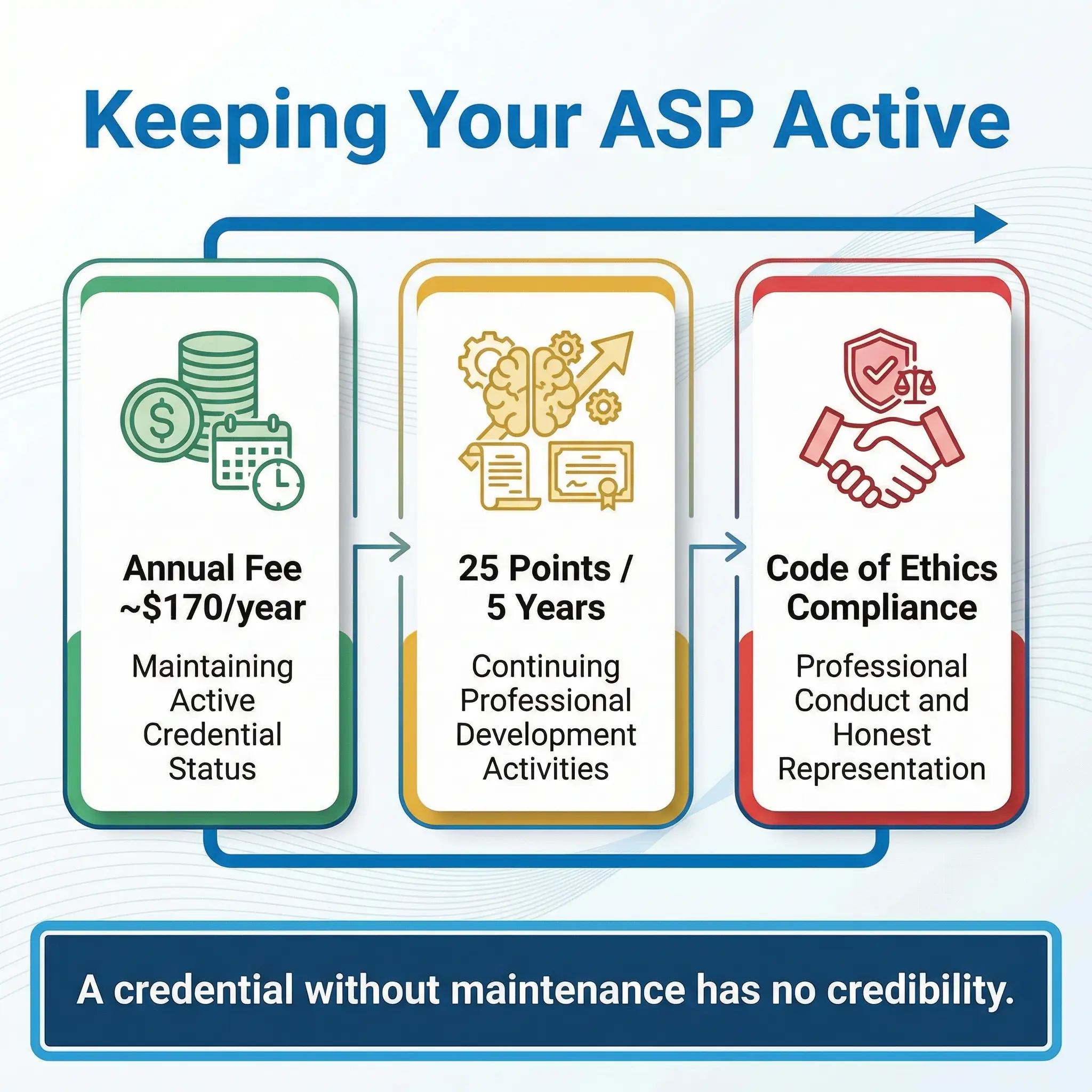
Here is what is required to keep your ASP current:
- Annual maintenance fee of approximately $170 — this must be paid each year to retain your right to use the ASP designation after your name
- 25 recertification points every five years — earned through professional development activities including attending conferences, publishing articles, completing continuing education courses, obtaining additional certifications, or contributing to safety committees and standards development
- Compliance with the BCSP Code of Ethics — retaining the ASP letters after expiration is a violation of the Code of Ethics, similar to other U.S. professional certifications. If you choose not to renew, you must remove the designation.
One important nuance: renewing the ASP is optional and up to the individual, and not renewing it will not affect the validity of a CSP certification if you have already advanced. Most professionals who earn the CSP let the ASP lapse, since the CSP encompasses and supersedes it.
The ASP as a Career Accelerator — Why It Matters in the Field
I will be direct: in a competitive HSE job market, credentials matter. Not because a certificate makes you competent — experience does that — but because credentials open the doors that let your experience be seen.
The ASP certification creates career advantages that I have observed repeatedly across industries and geographies:
- Job qualification threshold — many Safety Officer, Safety Coordinator, and Safety Analyst positions in oil and gas, construction, and manufacturing now list “ASP or CSP preferred” or “BCSP credential required” in their job descriptions. Without it, your application may not pass the initial HR screening, regardless of your field experience.
- Salary differentiation — certified safety professionals consistently command higher compensation than non-certified peers in equivalent roles. The credential signals to employers that you have been externally validated, not just internally trained.
- CSP eligibility — this is the strategic play. The ASP meets the credential requirement for the Certified Safety Professional (CSP). The CSP requires four years of professional safety experience plus a BCSP-approved credential — and the ASP is the most common pathway. Without it, you cannot sit for the CSP exam.
- International project credibility — on multinational EPC and EPCM projects governed by IFC Performance Standards or World Bank EHS Guidelines, BCSP credentials carry weight alongside NEBOSH and IOSH qualifications. I have reviewed prequalification submissions in the Middle East, West Africa, and Southeast Asia where ASP/CSP credentials influenced contractor ranking scores.
- Professional network access — BCSP credentialing connects you to the broader American Society of Safety Professionals (ASSP) ecosystem, regional chapters, technical committees, and professional development events that build career-long networks.
Common Mistakes Candidates Make — And How to Avoid Them
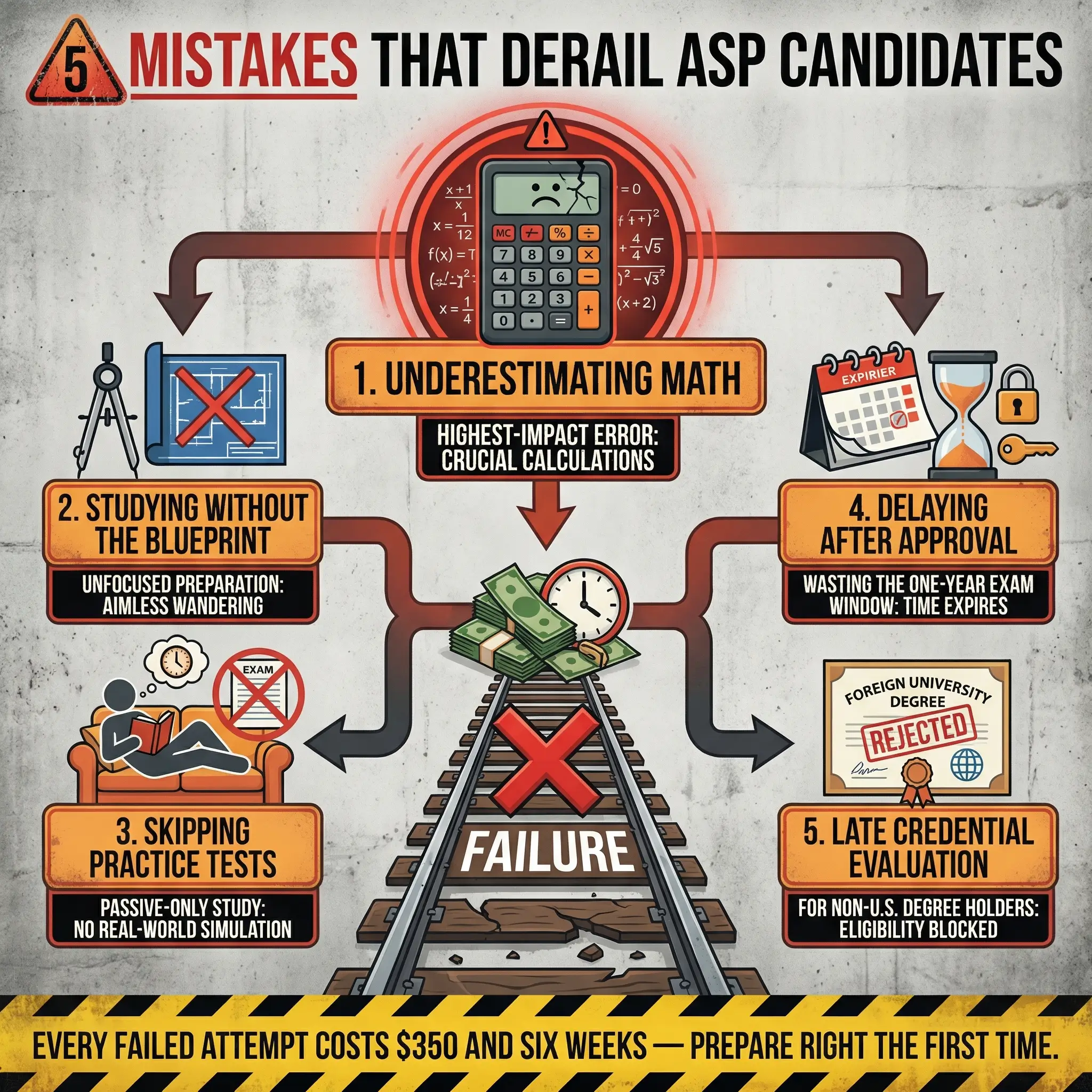
Over the years, I have seen the same errors derail ASP candidates repeatedly. Each one is avoidable with awareness and planning:
- Underestimating the math domain — Domain 1 carries the heaviest weight. Candidates with non-technical backgrounds often allocate too little study time to calculations. If you have not used algebra, chemistry equations, or physics formulas since university, budget extra weeks for this domain.
- Studying without the blueprint — buying a general safety textbook and reading cover to cover is inefficient. The blueprint tells you exactly what is tested and at what weight. Study to the blueprint, not around it.
- Ignoring practice tests — reading is passive. The exam is active — you must apply knowledge under time pressure. Practice exams reveal not just what you do not know, but how you perform under exam conditions.
- Waiting too long to apply — your one-year exam window starts when BCSP approves your application, not when you feel ready. Some candidates apply, delay studying, and then rush at the end. Apply when you are ready to commit to a study schedule.
- Not verifying non-U.S. credentials early — degree equivalency evaluation takes time. If your degree was earned outside the United States, start this process months before you intend to apply.
ASP to CSP — The Professional Progression Path
The ASP is not the destination. For any HSE professional serious about reaching senior roles — Safety Director, Corporate HSE Manager, Lead Auditor, EHS Vice President — the CSP is where you are heading. The ASP is the required first step on that path.
Here is how the progression works once you hold an active ASP:
- Accumulate four years of professional safety experience — the same 50%-or-more safety duties requirement applies, but the CSP demands four times the experience depth of the ASP
- Apply for the CSP through BCSP — your active ASP satisfies the “BCSP-approved credential” requirement for CSP eligibility
- Pass the CSP examination — another 200-question, nine-domain, five-hour exam at a higher professional level
- Maintain CSP certification — same 25-point recertification cycle every five years
The strategic insight here is that much of the ASP study material overlaps with CSP content. Candidates who study thoroughly for the ASP are simultaneously building their CSP knowledge base. I have known professionals who passed both exams within a year of each other by leveraging this overlap.
Conclusion
The ASP certification is the most decisive early-career move an HSE professional can make. It validates that you are not just performing safety tasks — you understand the science, the systems, the law, and the ethics behind them. In over a decade of field practice across refineries, construction mega-projects, mining operations, and chemical facilities, I have never met a certified professional who regretted the investment. I have met plenty of uncertified professionals who regretted the delay.
The path is clear: meet the education and experience requirements, apply through BCSP, study systematically against the nine-domain blueprint, and pass the exam. Then use the ASP as your launchpad to the CSP — the credential that will define your professional ceiling for the next twenty years.
Safety is not a field where credentials replace competence. But in a world where hiring decisions, bid evaluations, and project assignments are made by people who may never see your field work, the ASP tells them what they need to know: this professional has been tested, verified, and held accountable to a standard. That is worth every hour of study and every dollar of investment.