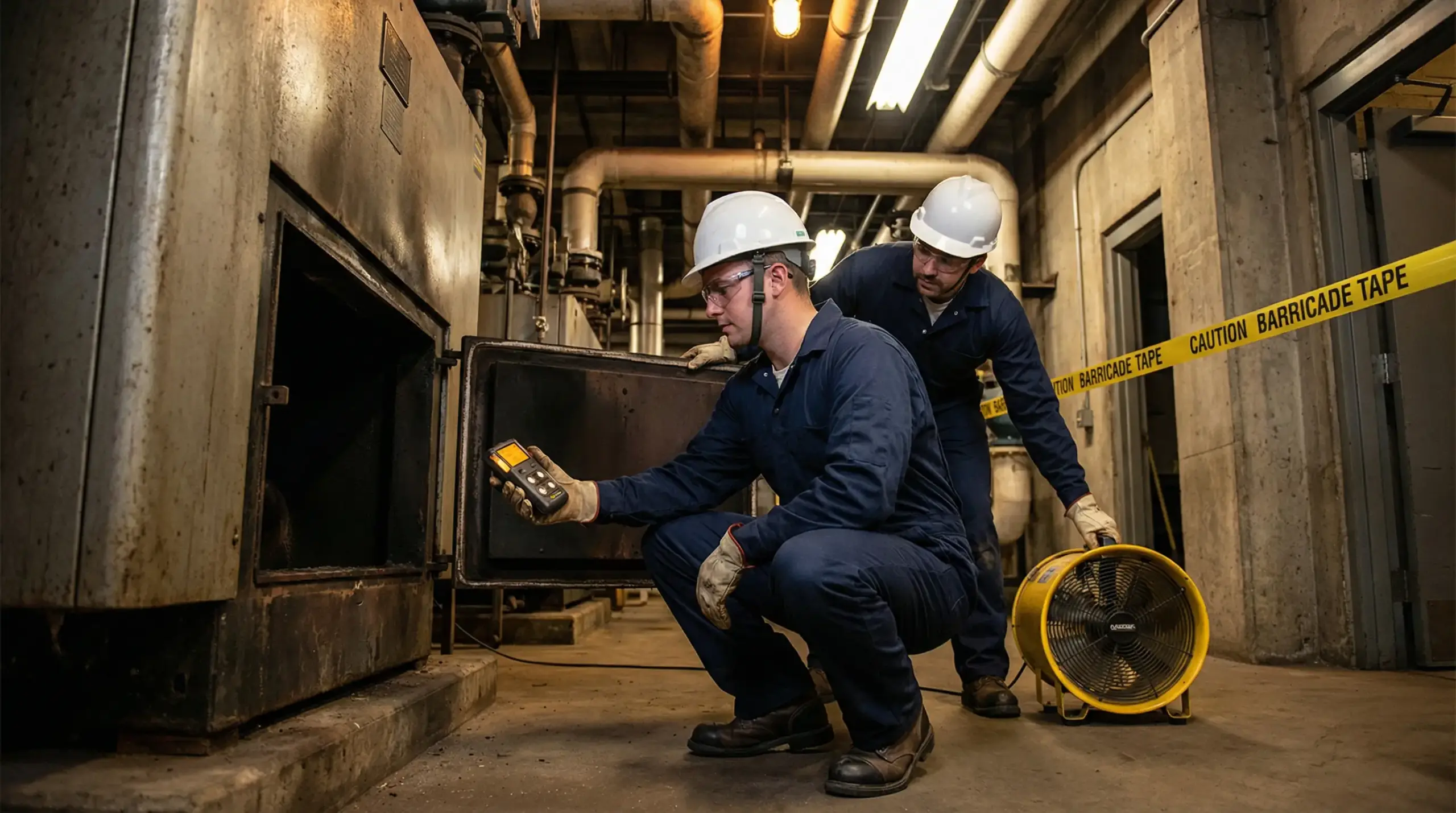
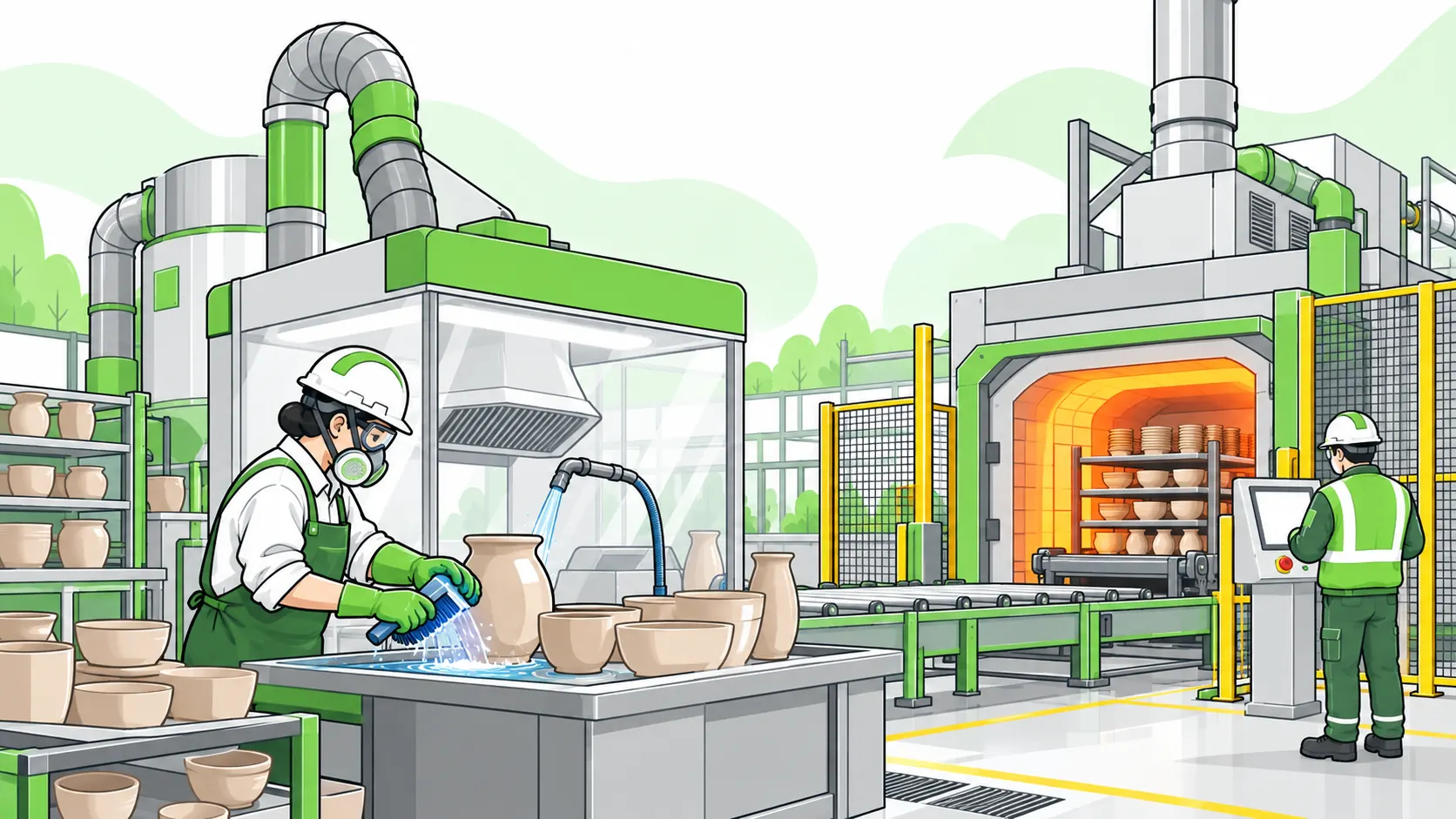
Ceramic industry safety rests on two distinct hazards: respirable crystalline silica, which causes irreversible silicosis and lung cancer over years, and kiln operation, which can produce carbon monoxide, toxic fumes, and severe burns within minutes. Silica is controlled through substitution, ventilation, and monitoring; kilns through room extraction, gas detection, and thermal protection.
A persistent belief inside ceramics, tile, and sanitaryware plants is that the work is "light manufacturing" — clay, water, heat, nothing exotic. That framing is contradicted by the regulatory record: crystalline silica inhaled at work is a confirmed Group 1 human carcinogen (IARC), and ceramic manufacturing sits alongside quarrying, foundry work, and stoneworking on every regulator's list of recognized silica-exposure industries.
The cost of misreading this is not theoretical. Silicosis is irreversible, kiln atmospheres can turn lethal without warning, and the two hazard families are usually owned by different people who rarely compare notes. This article treats ceramic industry safety as the occupational compliance problem it actually is — separating the exposure limits, the hierarchy of controls, the health-surveillance duties, and the kiln-specific risks that hobby-studio guidance routinely skips.
Why Ceramic Manufacturing Is a High-Risk Industry for Occupational Disease
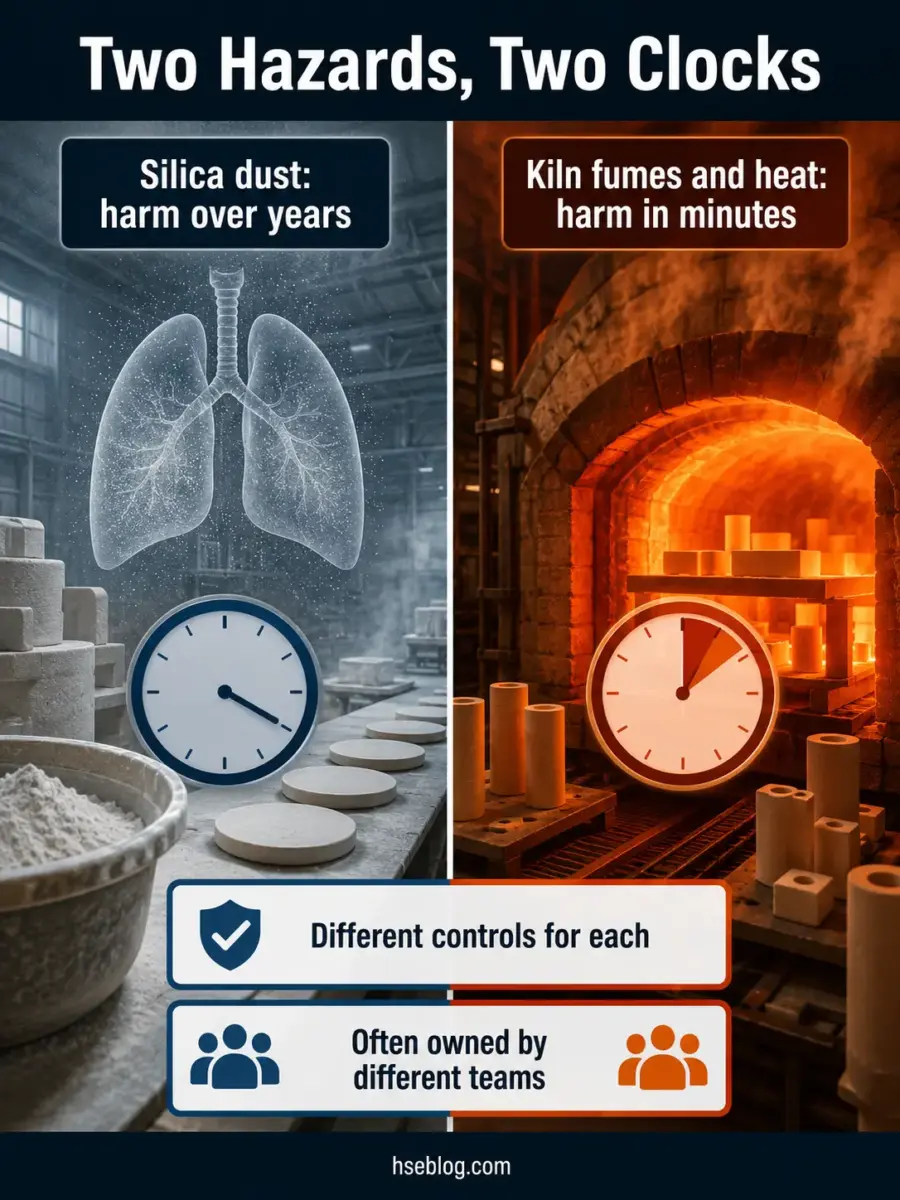
Ceramic manufacturing carries two genuinely serious occupational hazards that run on different clocks — and most safety programs are built to catch only one of them. Regulators do not treat ceramics as a minor case; it appears on the same recognized-exposure lists as quarrying, foundries, and stonework.
The hazard profile splits cleanly into two domains:
- Chronic silica disease. Respirable crystalline silica drives silicosis, COPD, and lung cancer over a span of years, which is why the harm is invisible day to day.
- Acute and chronic kiln hazards. Firing produces toxic gases, intense radiant heat, and burn risks that can injure within a single shift.
The phrase "it's just clay and a kiln" is exactly where the failure starts. It treats a dual YMYL-grade occupational health problem as routine light assembly, and the assumption quietly removes silica and kilns from the scope of any formal assessment.
The most common root cause I see in the published record is not a missing respirator — it is a missing exposure assessment. When management files ceramics under "low-hazard light manufacturing," nobody samples the air, nobody assesses the kiln room, and the under-assessment itself becomes the upstream defect that surfaces years later as uncontrolled exposure and disease no one was watching for.
What Is Respirable Crystalline Silica and Why It Matters in Ceramics
Respirable crystalline silica (RCS) is the ultra-fine fraction of silica dust — small enough to reach deep lung tissue and far too small to judge by eye. The crystalline forms, principally quartz and cristobalite, are the carcinogenic ones; amorphous silica is classified separately and far less hazardous.
That distinction is not academic. IARC classifies inhaled occupational crystalline silica as a Group 1 carcinogen, while amorphous silica sits in Group 3 — so the form of the dust, not just the quantity, determines the risk.
Ceramic bodies and glazes are rich sources of it. Clay bodies, flint, feldspar, grog, and many glaze and colour materials all carry crystalline silica, and porcelain and sintered materials can hold meaningful crystalline fractions. A practical consequence follows directly: if you can see a dust cloud in the air, you are almost certainly already above the exposure limit, because the respirable particles that matter most are invisible (OSHwiki).
Where teams get caught is the "silent" sources. The obvious dusty task — dry-mixing powders — usually gets some attention, while the steady contributors go unmanaged: reclaiming and recycling dry scrap, dry sweeping floors, and workwear carrying fine dust home to be inhaled by the worker and their family.
Where Silica Dust Is Generated Across the Ceramic Process
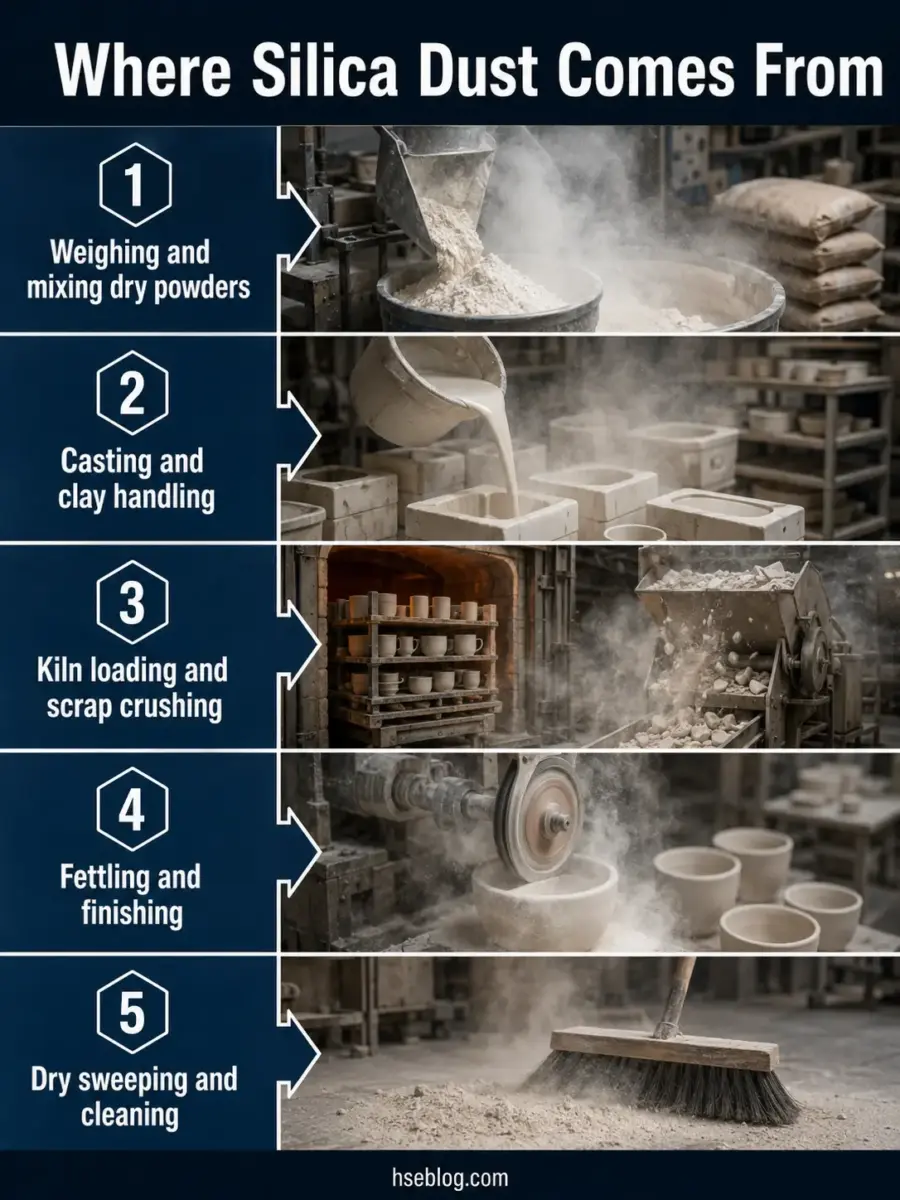
Silica exposure is not spread evenly across a plant — it concentrates at identifiable stages, which is what makes targeted control possible. The HSE COSHH Essentials ceramics task sheets are organized around exactly these points, and they are the most useful free reference a UK or international operator can pull.
Map your controls to where the dust is actually made:
- Glaze and colour preparation. Weighing, sieving, and mixing dry powders is the highest-energy dust step in many plants.
- Casting and clay handling. Slip preparation and clay forming, especially with dry additions.
- Kiln placing and unloading. Handling green, white, and fired ware, plus crushing scrap, generates high dust levels.
- Fettling, finishing, and polishing. Dry abrasion of fired or unfired ware releases respirable particles directly into the breathing zone.
- Housekeeping and maintenance. Dry sweeping and compressed-air cleaning re-suspend settled dust that was, briefly, under control.
How Silica Exposure Damages Health: Silicosis, Lung Cancer and COPD
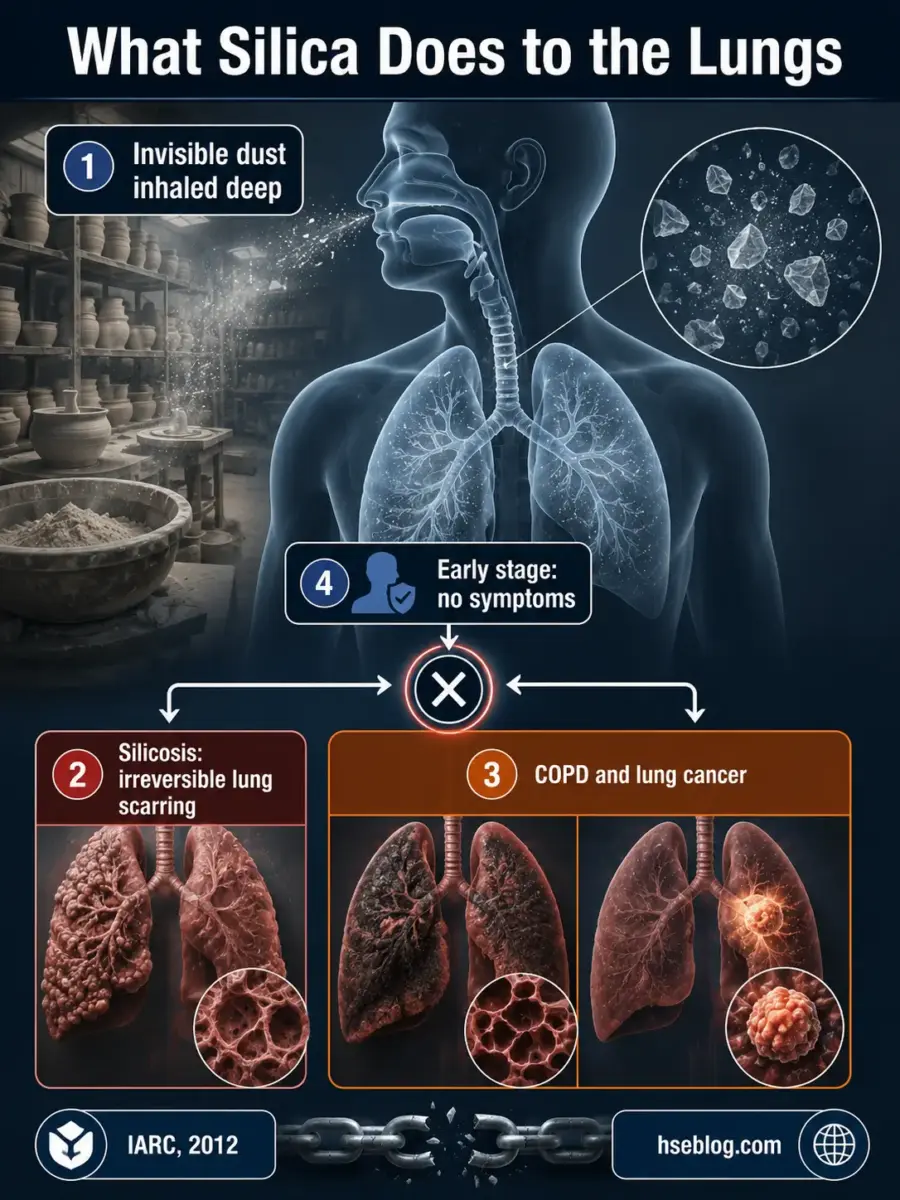
A consistent and dangerous pattern across the silica disease record is that the harm is well advanced before anyone feels it. Significant RCS exposure can cause silicosis — which is irreversible and may keep worsening even after exposure stops — alongside COPD and lung cancer (HSE).
This section is for HSE practitioner reference. It is not medical advice. Workers with respiratory symptoms or specific exposure concerns should consult an occupational physician or qualified medical professional, and any health surveillance must be designed and interpreted by competent occupational-health staff.
The disease behaves in ways that make it easy to under-manage. Silicosis develops slowly, is rarely seen in workers under 40, and carries an associated increased risk of tuberculosis, kidney disease, and arthritis (HSE). The HSE silicosis guidance sets this out plainly and is worth putting in front of supervisors who think a respiratory hazard would announce itself.
The engineered-stone crisis reset what "slow" can mean. In high-silica, high-energy processing, accelerated silicosis has appeared in months to a few years rather than decades — a warning that dose and intensity, not just time on the job, drive the timeline.
The dose-response data from the sector itself is more nuanced, and it has to be read carefully rather than as reassurance. A 15-year extended follow-up of German porcelain workers found silicosis risk strongly associated with average RCS exposure above roughly 0.10–0.15 mg/m³ and cumulative exposure above about 1.0–3.0 mg/m³-years, yet recorded 284 lung-cancer deaths with no exposure-related excess across 537,129 person-years (Birk et al., Frontiers in Public Health, 2025). That is risk literacy, not an all-clear: it tells you where silicosis risk climbs steeply, and it reflects one cohort's historical exposures — not a safe threshold to design down to.
The misconception that quietly kills programs is reading silence as safety. Early silicosis is typically asymptomatic, so an absence of complaints is routinely misread as proof that controls are adequate, when it often just means the disease has not yet declared itself.
Silica Exposure Limits: How OSHA, HSE and the EU Differ
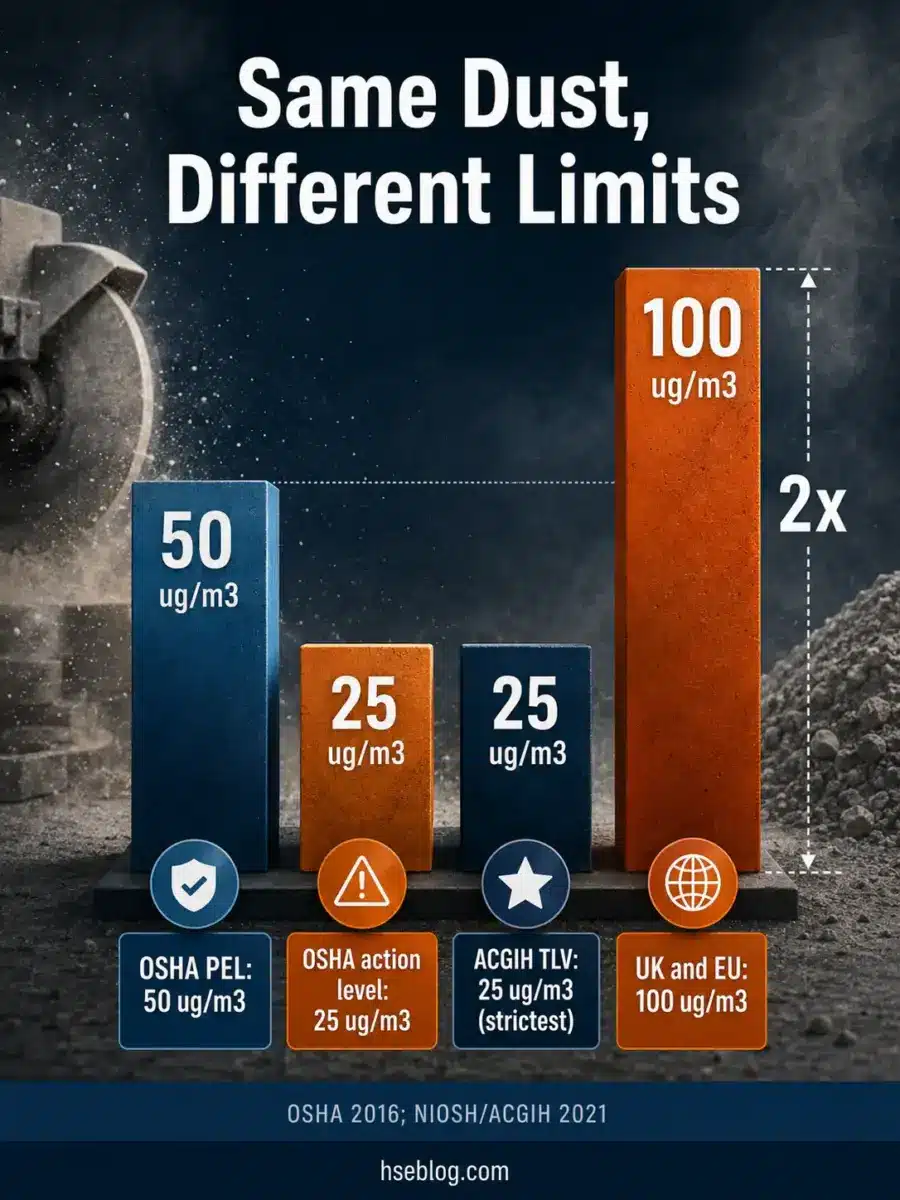
The single most important fact about silica limits is that there is no universal number — and a workplace must apply its own jurisdiction's value, not the most convenient one. The US, UK, and EU limits diverge by a factor of two to four for the exact same dust.
| Body / Jurisdiction | 8-hour limit (respirable) | Averaging basis | Action level |
|---|---|---|---|
| OSHA PEL (US) | 50 µg/m³ (0.05 mg/m³) | 8-hour TWA | 25 µg/m³ |
| NIOSH REL (US, advisory) | 50 µg/m³ (0.05 mg/m³) | up to 10-hour TWA | — |
| ACGIH TLV (advisory, strictest) | 25 µg/m³ (0.025 mg/m³) | 8-hour TWA | — |
| UK WEL / EU BOELV | 100 µg/m³ (0.10 mg/m³) | 8-hour TWA | — |
The numbers map to real duties. OSHA's general-industry standard caps RCS at 50 µg/m³ as an 8-hour TWA and requires employers to assess exposure and act at the 25 µg/m³ action level under 29 CFR 1910.1053 — the respirable crystalline silica standard for general industry. The UK WEL and the EU binding limit both sit at 0.1 mg/m³ over eight hours, double the US PEL, and the EU-OSHA overview of respirable crystalline silica confirms the directive basis; the EU figure is under review.
Comparing the values rather than picking one is the whole point. The ACGIH TLV-TWA of 0.025 mg/m³ is the strictest commonly cited benchmark and the most defensible reference for risk-based decisions, with NIOSH's REL at 0.05 mg/m³ (NTP/NIOSH/ACGIH, 2021). When standards conflict, the stricter value is the safer planning basis even where it is not the legal floor.
The trap I watch for is the cross-border one. A multinational ceramic group that standardizes on the familiar UK/EU 0.1 mg/m³ figure becomes non-compliant the instant a US site applies it, because the OSHA PEL is half that — and "we use the corporate limit" is not a defense to an OSHA citation. No limit, in any jurisdiction, is a guaranteed safe level; the cleaner the control, the better, regardless of the number.
Controlling Silica Dust: The Hierarchy of Controls in Practice
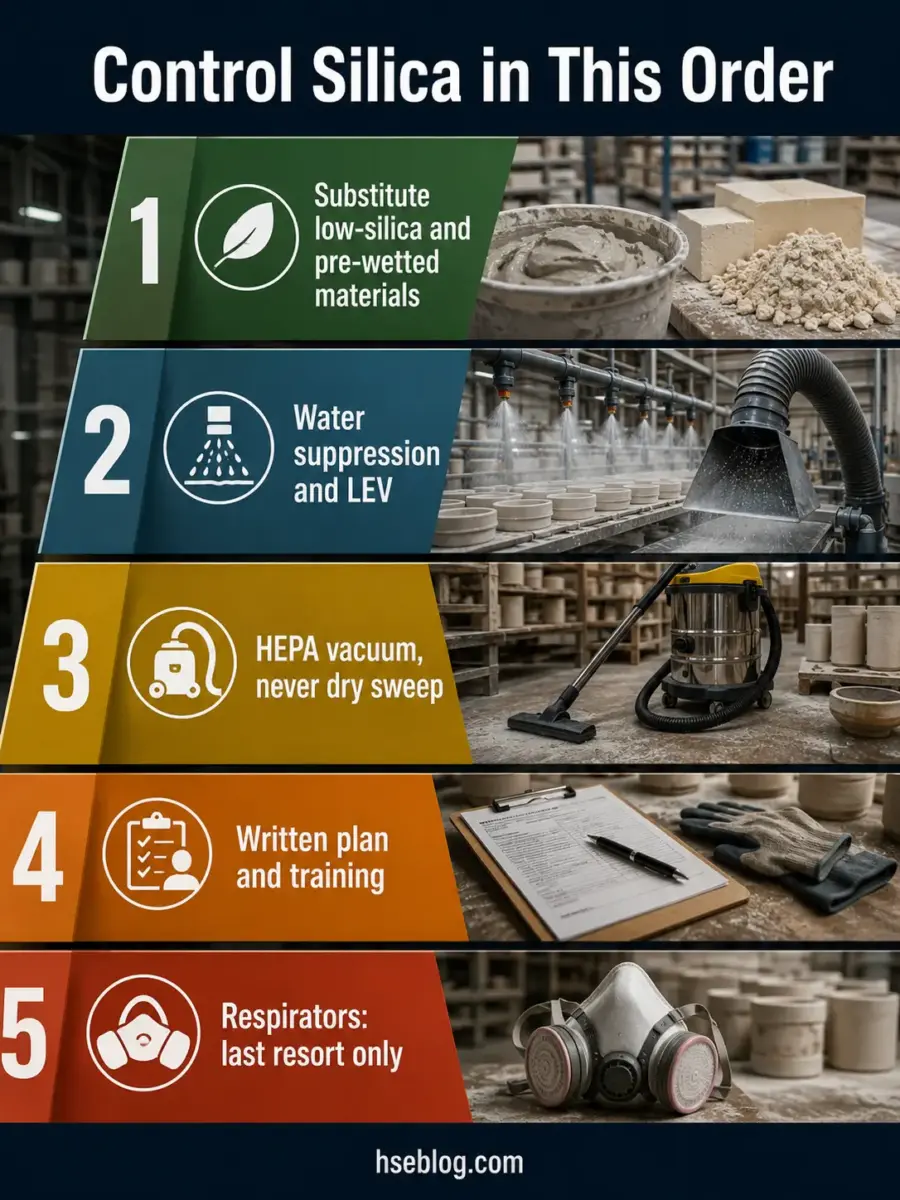
OSHA's silica standard does not just set a number — it expects exposure to be controlled at the source first, with respirators treated as a last resort rather than the plan. Applied to ceramics, the hierarchy looks like this in priority order:
- Eliminate or substitute the hazard. Specify lower-silica bodies and glazes where the product allows, and buy pre-wetted clay and ready-made slurry glazes to cut dry-powder handling at the highest-dust steps.
- Engineer the dust out. Water suppression, well-designed local exhaust ventilation (LEV), and disciplined housekeeping are the core engineering controls; the HSE COSHH Essentials task sheets specify these point by point.
- Replace dry sweeping with HEPA. Use HEPA-filtered vacuuming and wet methods instead of brooms or compressed air, which simply re-suspend the dust you settled.
- Add administrative controls. Run a COSHH or written exposure-control plan, define and sign regulated areas, train workers, and launder contaminated workwear on site rather than sending dust home.
- Use RPE as a supplement, not a substitute. Respiratory protective equipment fills gaps the higher tiers cannot close, and it only works with correct selection, fit-testing, and ongoing program management.
The HSE's COSHH Essentials guidance for the ceramics industry is the most practical task-by-task control reference available, and it reinforces that suppression and ventilation, not masks, carry the load.
The failure mode I see most often is the "set-and-forget" LEV. Extraction gets commissioned correctly, signed off, and then never re-tested — performance degrades silently as ducts clog and fans wear, until a system everyone trusts is moving a fraction of its rated air. The legal requirement for periodic thorough examination and testing of LEV exists precisely because this drift is so predictable; an extraction certificate with no recent test behind it is a paperwork control, not a real one.
Health Surveillance and Exposure Monitoring Duties
Controlling exposure is not where the employer's duty ends — measuring the air and watching worker health are separate, mandatory loops. In practice this means two parallel obligations: monitor the workplace against the limit, and monitor the people working in it.
The duties, in plain terms:
- Exposure assessment. Sample the air and compare results to your jurisdiction's limit; OSHA's standard requires assessment whenever exposure may exceed the action level.
- Health surveillance. HSE's refreshed guidance reinforces that health surveillance is a legal requirement under COSHH wherever silicosis could reasonably develop, not an optional add-on (HSE G404, 2025).
- Medical examinations (US). OSHA 1910.1053 makes medical examinations available to exposed employees, repeated at least every three years — or more often where a physician advises it.
- Record retention. Exposure and medical records must be kept for the long retention periods the standards specify, because silica disease emerges long after the exposure that caused it.
The misconception worth correcting here is the "clear X-ray means fine" reading. Surveillance exists to detect early change and trigger tighter control — a normal result is a snapshot, not a license to relax the engineering controls that produced it. Where surveillance findings start drifting, the correct response is to revisit exposure control, not to repeat the test and hope.
Kiln Hazards: Heat, Gases and Fumes
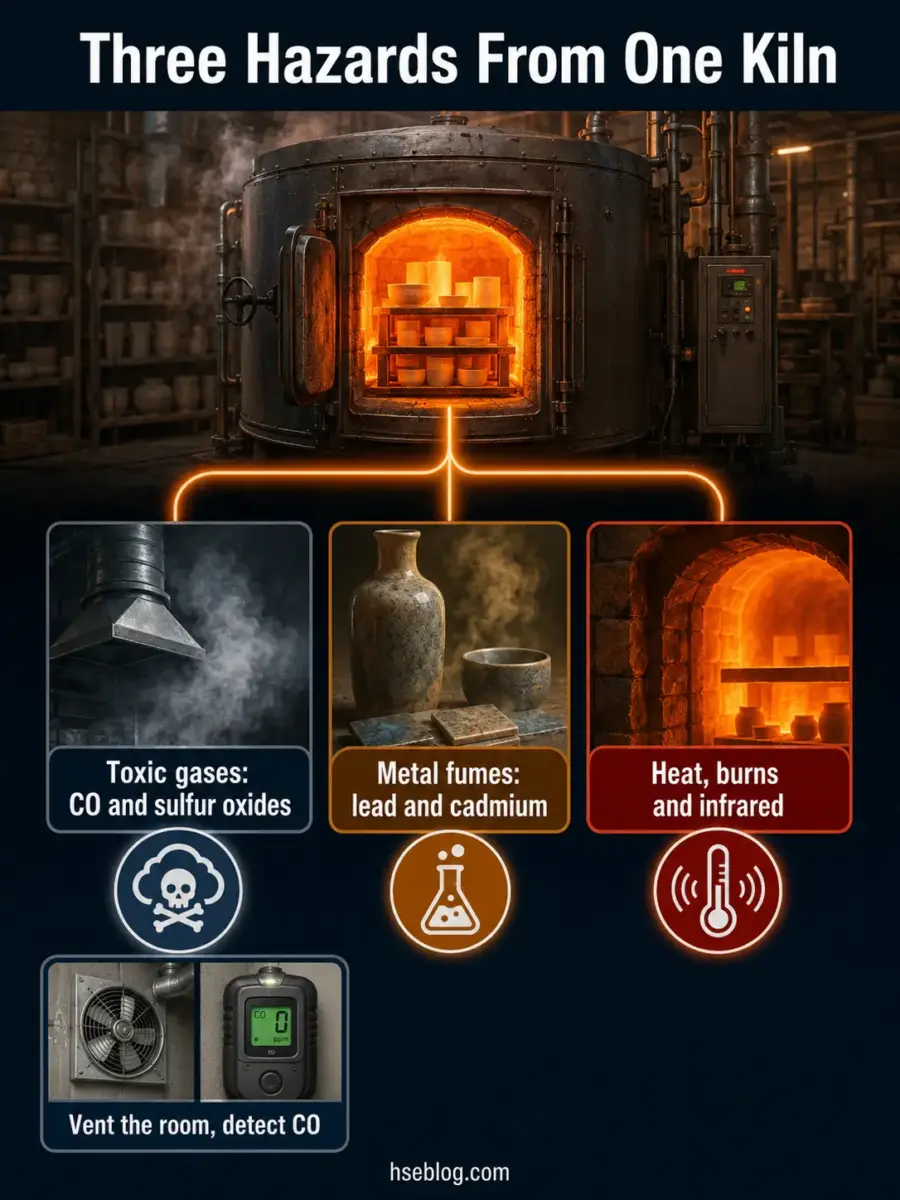
Pivoting from dust to the kiln means moving from a chronic hazard to ones that can injure in a single firing — and the studio literature is at its vaguest exactly here. Kiln risks split into three families, each with its own control.
| Hazard family | What it is | Primary control |
|---|---|---|
| Toxic atmosphere | CO and irritant sulfur oxides from burning off organics and sulfur; oxygen depletion can shift an unvented kiln into reduction | Kiln venting plus independent room extraction; fixed CO detection |
| Metal and acid-gas fumes | High-temperature firing can vaporize lead, cadmium, antimony, and selenium and release chlorine, fluorine, sulfur dioxide, nitrogen dioxide, and ozone | Fume extraction at the kiln; low-toxicity glaze selection |
| Thermal | Contact burns, radiant heat load, and infrared exposure to the eye | Thermal PPE, guarding, IR-blocking eye protection |
Two technical facts drive the controls. Firing burns off organics and sulfur to produce carbon monoxide and irritant sulfur oxides, and an unvented kiln can slide into a reducing atmosphere as it consumes the available oxygen (Ceramic Arts Network). Separately, high-temperature firing can vaporize toxic metals such as lead, cadmium, antimony, and selenium and release chlorine, fluorine, sulfur dioxide, nitrogen dioxide, and ozone — all highly toxic by inhalation (Princeton University).
Carbon monoxide deserves singling out because it gives no warning at all: it is colourless and odourless, so CO detection and genuine room ventilation are non-negotiable rather than nice-to-have.
The recurring layout error across kiln rooms is treating "the kiln is vented" as "the room is safe." A kiln vent that discharges fumes outside does nothing for the operator if the surrounding room has no independent make-up air and extraction — the fumes that escape seals, spy holes, and the loading door still accumulate where people stand.
Thermal Hazards: Burns, Radiant Heat and Heat Stress
Kiln thermal risk is more than touching a hot surface — it is contact burns, a radiant heat load on the operator, and whole-body heat stress in the kiln area. Employers must protect workers from recognized hot-surface burn hazards using thermal PPE, training, and inspection, and the ASTM C1055 contact-burn guide is the recognized consensus reference for what surface temperatures cause injury, on what timescale (OSHA General Duty Clause; ASTM C1055).
Two points operators routinely miss:
- Infrared eye damage. IR radiation from a hot kiln can harm the eye and contribute to cataracts, so IR-blocking lens protection is needed when viewing through spy holes — ordinary safety glasses do not address it (Washington State DOH).
- Heat stress is a combined load. Assess it by combining environmental heat with metabolic load from the work itself, not by air temperature alone. OSHA's proposed federal Heat Injury and Illness Prevention rule explicitly cites heat-generating equipment such as furnaces, putting kiln-room heat stress squarely in regulatory view (US OSHA, 2024–2025).
Kiln Maintenance and Electrical/Energy Safety
Servicing a kiln introduces a hazard the firing crew never sees: stored and live energy. The rule is simple — do not service a hot or energized kiln, and isolate the energy first.
The controls that matter:
- Lockout/tagout. Control of hazardous energy during servicing and maintenance applies to electric kiln work under 29 CFR 1910.147 (US) wherever the standard's conditions are met.
- Guarding and isolation. Guard moving equipment on automated kiln cars and conveyors, and verify isolation before anyone reaches into a serviced unit.
- Thermal cooldown. Confirm the kiln is at a safe temperature before maintenance, not just powered down.
Building a Compliant Ceramic Safety Program
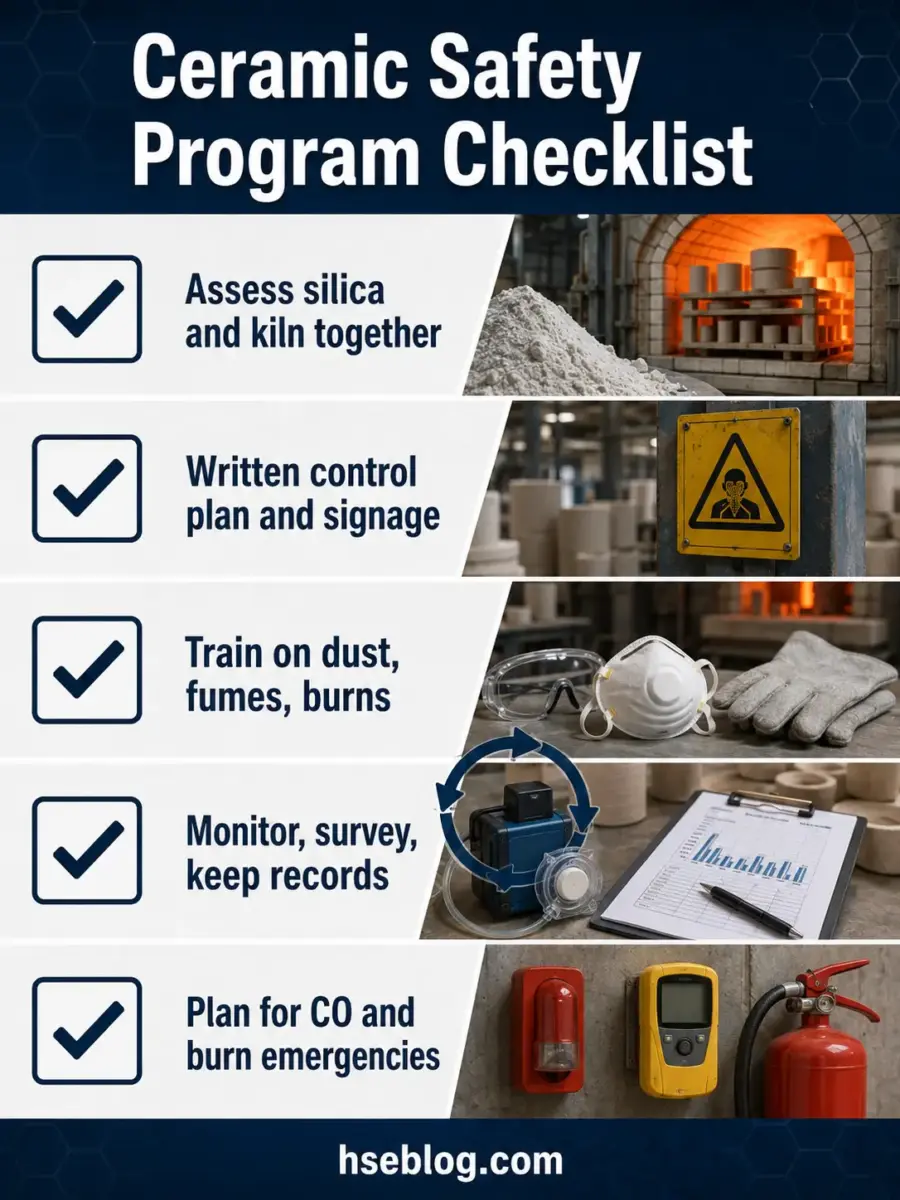
A working ceramic safety program ties the silica and kiln domains into one managed system rather than two parallel binders. Build it as a closed loop, in this order:
- Assess both hazard domains. Run a COSHH or risk assessment that covers respirable silica and kiln atmospheres together, including the kiln room itself, not only the kiln.
- Write the control plan. Document the exposure-control plan, define and sign regulated areas, and specify the engineering controls each task depends on.
- Train and communicate. Train workers on dust sources, RPE use and fit, CO risk, and burn hazards — and make the "invisible dust" point explicit.
- Monitor, survey, and record. Close the loop with air monitoring, health surveillance, and record retention, then feed findings back into the controls.
- Plan for emergencies. Prepare for a CO event, a kiln-room malfunction, and serious burns, with rescue and first-response roles assigned in advance.
The regulatory content here reflects a general HSE professional understanding of US and UK requirements as of 2025 and is not legal advice. Specific compliance questions, enforcement situations, or prosecution risk should go to qualified legal counsel in the applicable jurisdiction, and the limits cited should be checked against the current standard before you rely on them.
The seam where real incidents cluster is organizational, not technical. Silica is usually owned by the hygiene or EHS function and kilns by production engineering, and the unmanaged gap between them — who assesses the kiln room's dust, who tests the LEV that serves a fettling bench next to a kiln — is exactly where assessments fall through. Naming an owner for that seam is the single highest-value structural fix most ceramic operations have not made.
Frequently Asked Questions
Is silica dust from ceramics dangerous if I can't see it?
The dust you cannot see is the dangerous part. The respirable fraction is far too fine to judge by eye, so a visible cloud usually means you are already above the exposure limit (OSHwiki). Clear air is not proof of safety — only air monitoring against your jurisdiction's limit confirms whether exposure is controlled.
What is the OSHA permissible exposure limit for silica in general industry?
Under 29 CFR 1910.1053, the US OSHA limit for respirable crystalline silica is 50 µg/m³ as an 8-hour TWA, with action required at 25 µg/m³ (OSHA, 2016). Note that the UK and EU sit at 100 µg/m³ — double the US figure — and the advisory ACGIH value is stricter still at 25 µg/m³, so apply your own jurisdiction's number.
Do electric kilns produce dangerous fumes, or only gas kilns?
Yes, electric kilns produce dangerous fumes too. The hazard comes from what is being fired, not the heat source: organic burn-off generates carbon monoxide and sulfur oxides, and glaze materials can release metal fumes and acid gases regardless of fuel (Princeton University). An electric kiln still needs venting and a ventilated room.
How long does it take to develop silicosis from ceramic work?
It usually takes years to decades at lower exposures, and silicosis is rarely seen under age 40 (HSE). But the timeline is dose-dependent: accelerated forms have appeared within months to a few years at high, intense exposures, as the engineered-stone cases showed. Diagnosis and prognosis are medical questions for an occupational physician.
Is health surveillance legally required for ceramic workers exposed to silica?
It is not optional. In the UK, health surveillance is a legal requirement under COSHH wherever silicosis could reasonably develop, reinforced by HSE's refreshed guidance (HSE G404, 2025). In the US, OSHA 1910.1053 makes medical examinations available to exposed employees, repeated at least every three years.
Can wearing a dust mask alone keep ceramic workers safe?
No. Respiratory protection is the last tier of the hierarchy of controls, not the plan. Substitution and engineering controls — lower-silica materials, water suppression, and local exhaust ventilation — must come first, with RPE filling only the gaps they cannot close. A mask without controls above it is a sign the program is built backwards.
Conclusion
The hardest question in ceramic industry safety is not technical — it is "who owns the seam between the dust and the kiln?" If you cannot name a single person responsible for both the silica risk at the fettling bench and the atmosphere in the kiln room, that gap is your most likely path to an uncontrolled exposure or a CO event.
Two checks separate a real program from a paper one. First, can you state your jurisdiction's silica limit from memory and show recent air monitoring against it — not a corporate default borrowed from another country? Second, when was the LEV serving your dustiest task last thoroughly examined, and would you stake a worker's lungs on the answer?
The competent operators treat ceramics as the regulated occupational hazard it is, not as light manufacturing that happens to be dusty. The disease is irreversible, the kiln gives no warning, and both have been documented for decades — which means the knowledge to prevent harm already exists. What remains is the decision to act on it before a diagnosis or an alarm forces the issue.