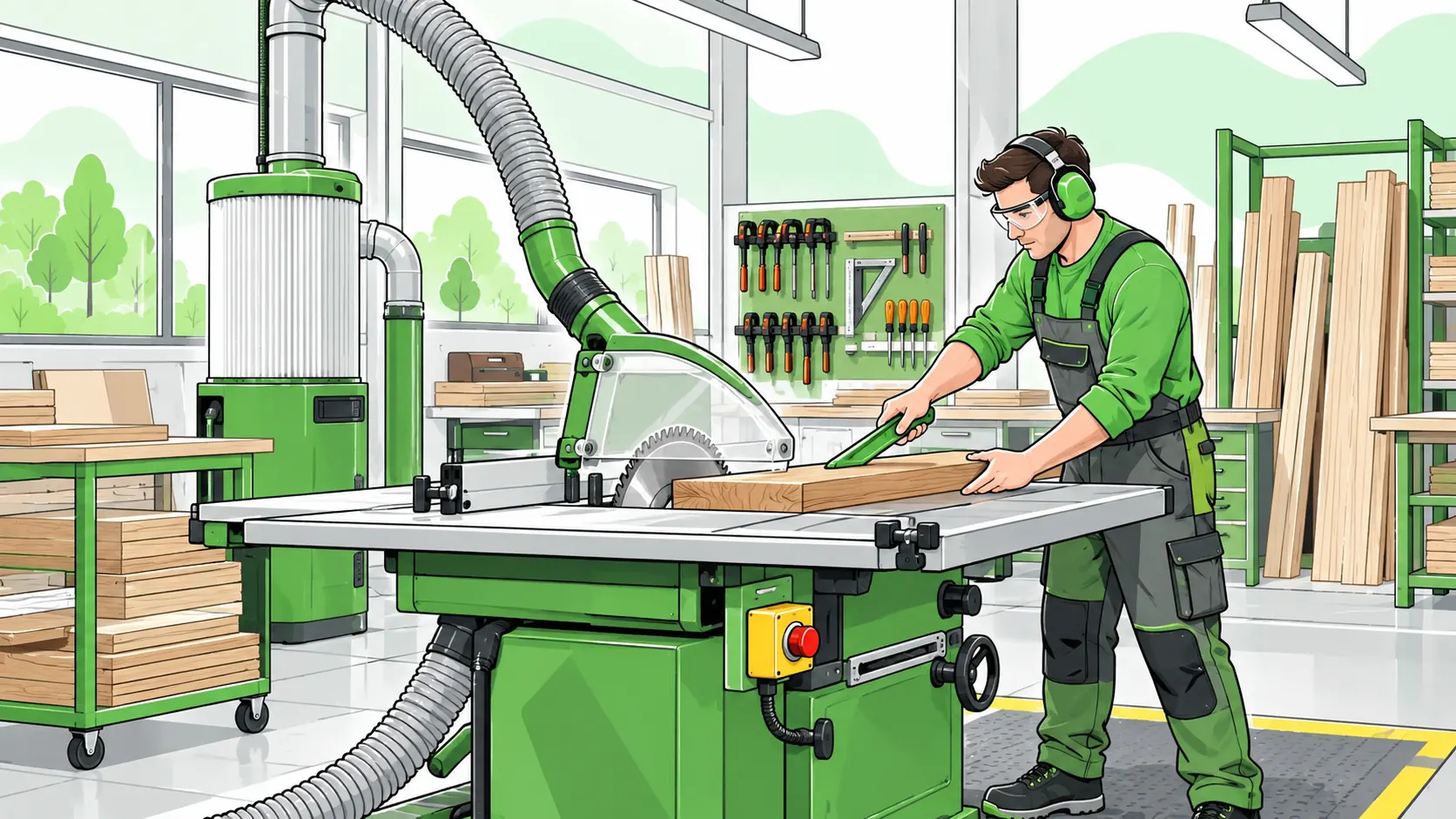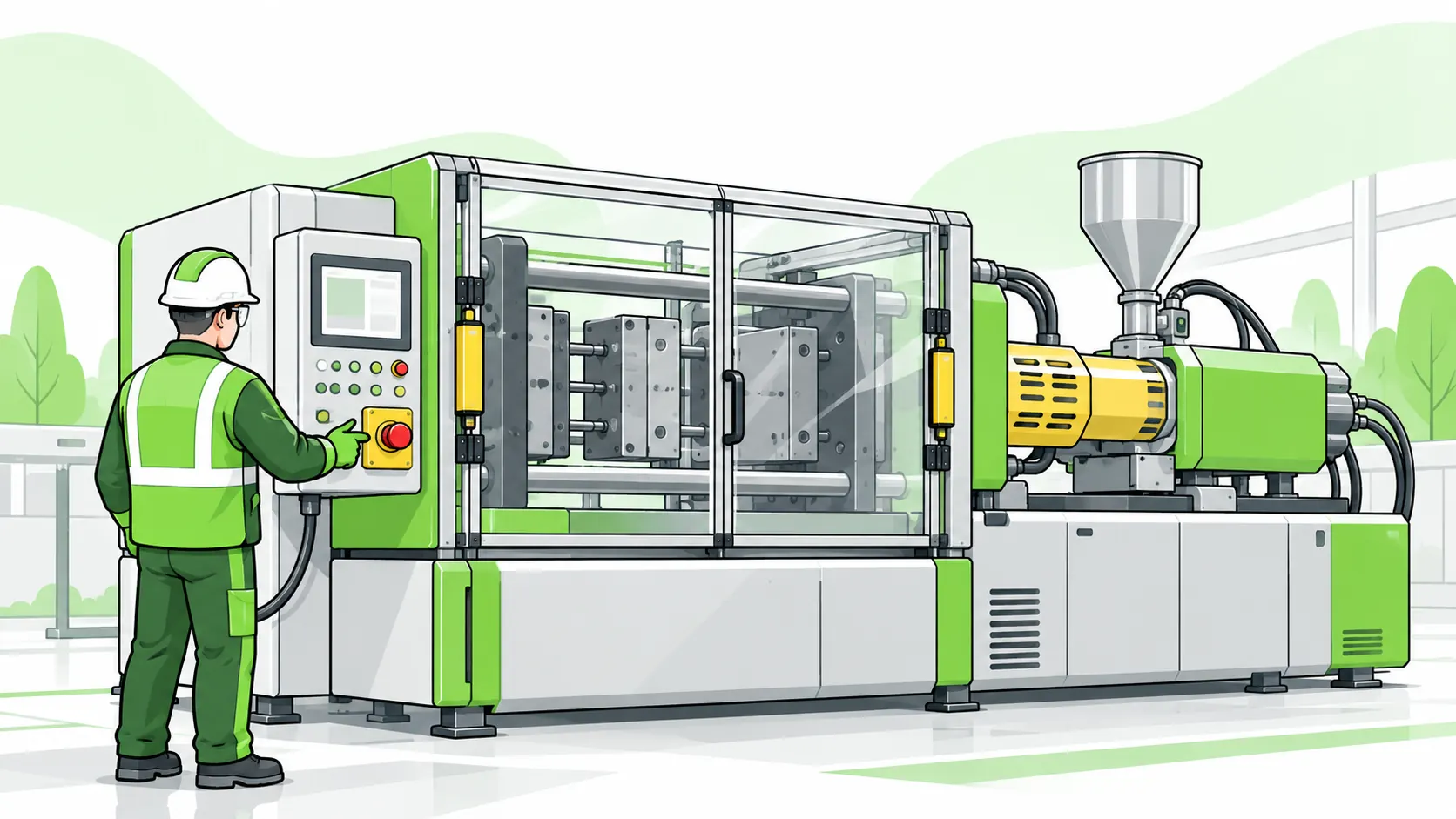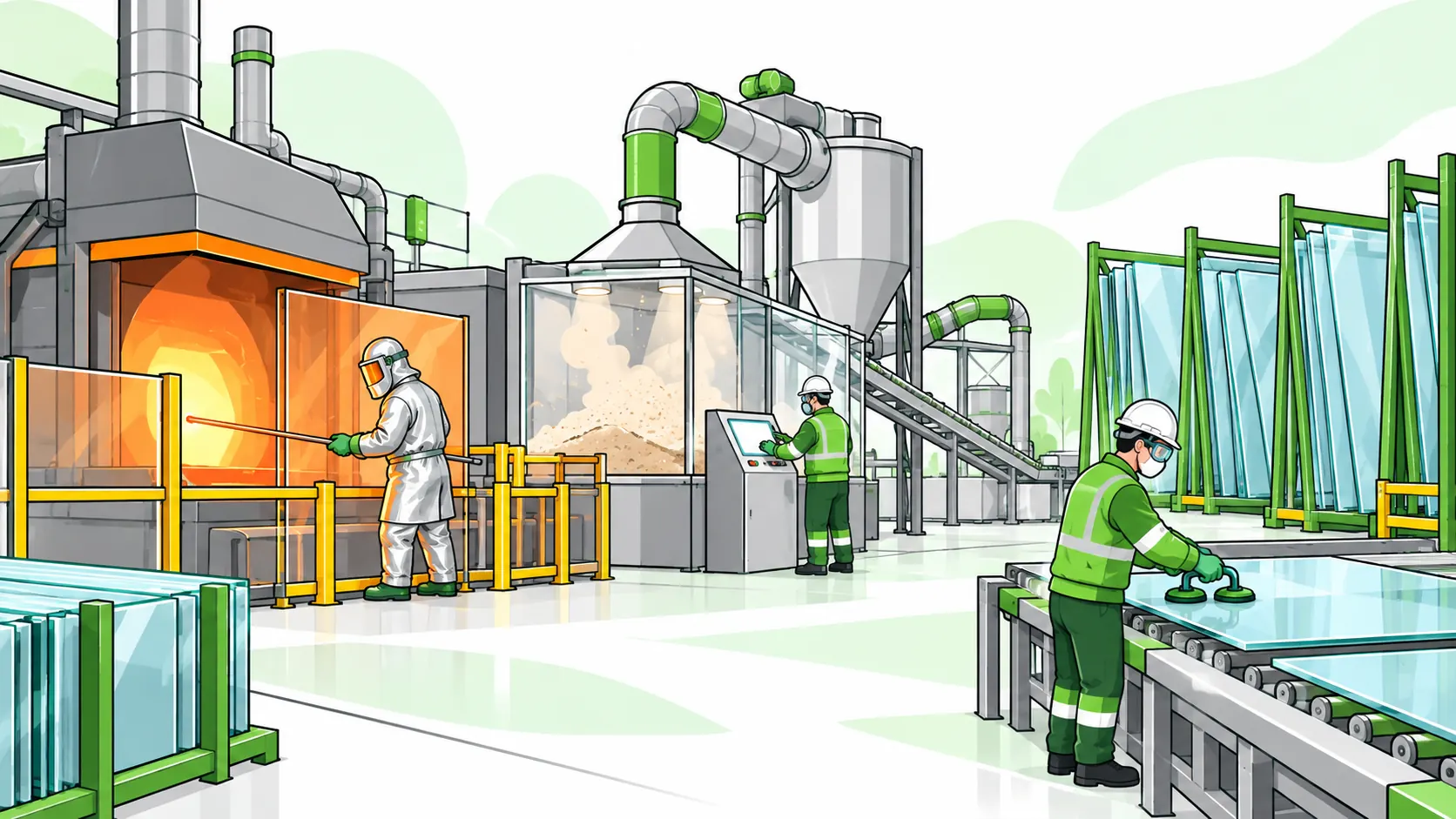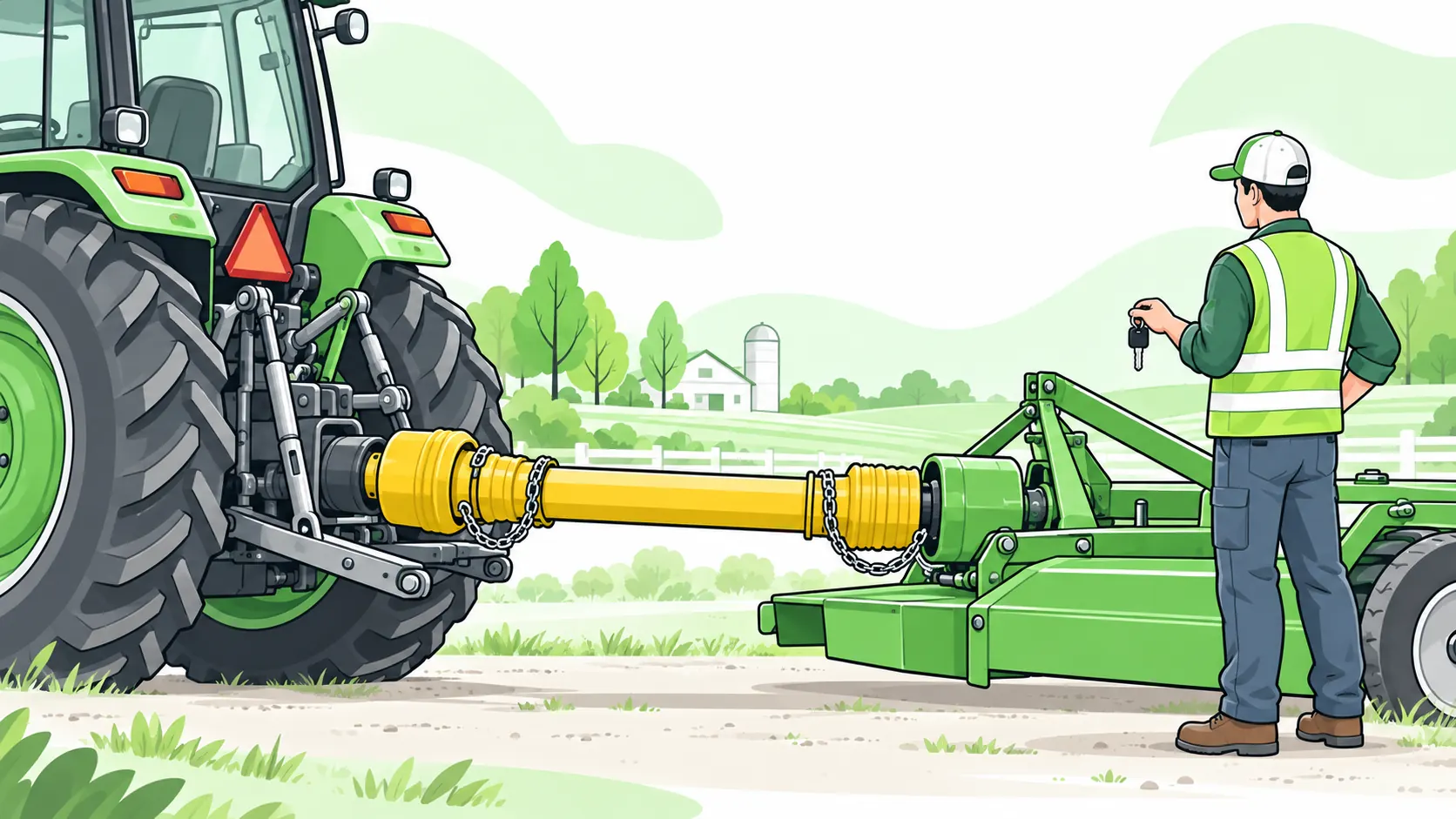
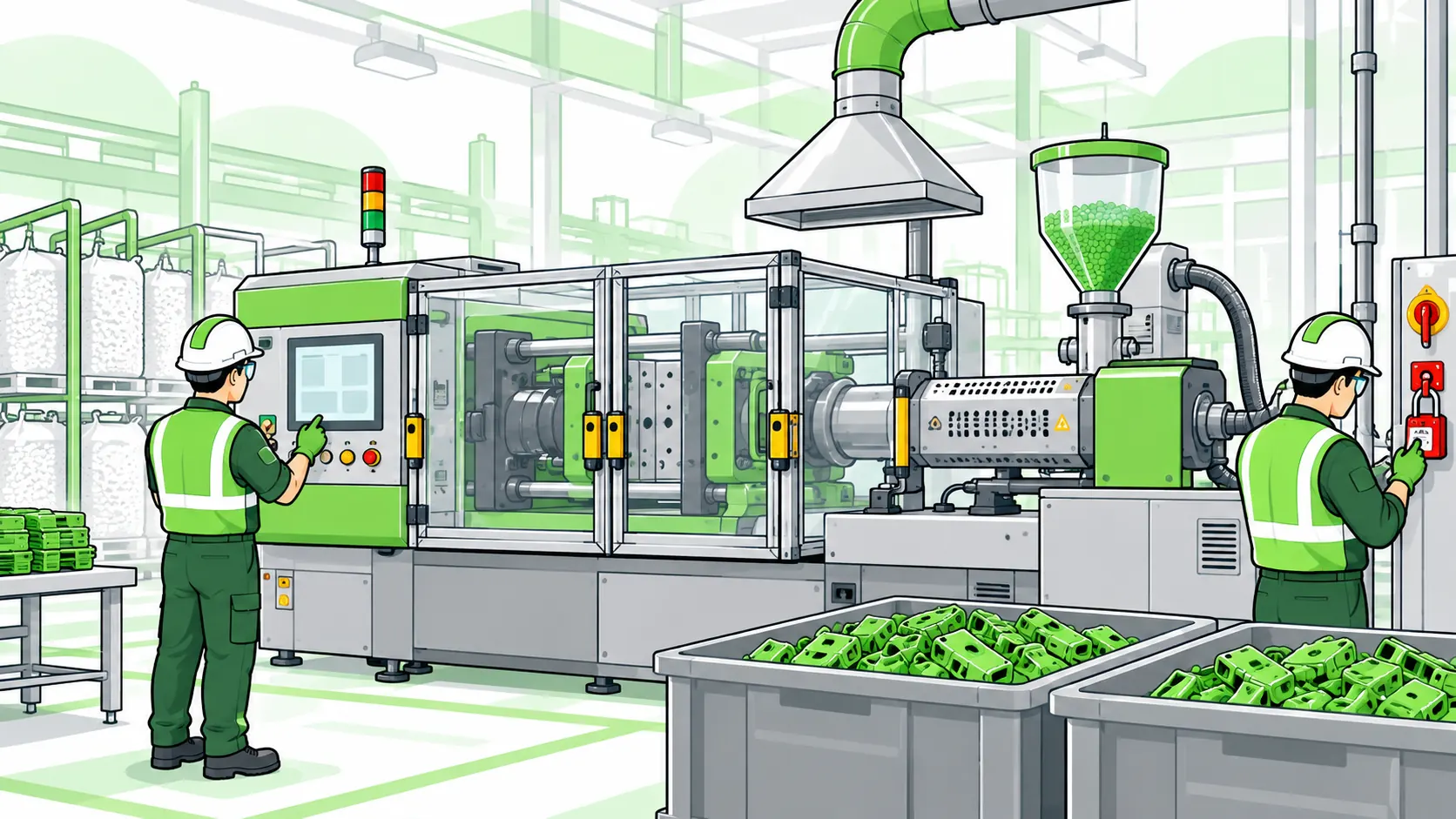
Plastics manufacturing exposes workers to seven main hazard families: mechanical and machine-guarding hazards (the leading cause of amputations), thermal burns from molten polymer, chemical and fume exposure, combustible-dust and fire hazards, noise, ergonomic strain, and electrical or stored-energy hazards. Each is controlled using the hierarchy of controls, prioritising engineering controls over PPE.
Twenty-nine workers died in US plastics and rubber products manufacturing in 2024, nearly double the sixteen recorded the year before (US Bureau of Labor Statistics, 2024). The subsector also runs a recordable injury rate above the private-industry baseline — 2.8 cases per 100 full-time workers against 2.3 for all private industry (US Bureau of Labor Statistics, 2024).
Those numbers sit on top of an active enforcement reality: OSHA renewed its National Emphasis Program on Amputations in Manufacturing (CPL 03-00-027) for a five-year term effective June 27, 2025, with a targeting list that now includes plastics manufacturing (US Department of Labor / OSHA, 2025). This article maps every recognised hazard family in plastics manufacturing safety to its specific control and its governing clause across OSHA, HSE, and ISO.
What are the main hazards in plastics manufacturing?
Plastics manufacturing carries seven hazard families, and they are not equally lethal. Mechanical and machine-guarding hazards cause the most amputations; chemical fume and ergonomic strain cause the most long-term ill health.
A point most commercial guides get wrong: there is no single plastics-specific OSHA standard. Hazards are regulated through general-industry standards rather than a dedicated rule, which is why a clause-by-clause map matters more here than in heavily-coded sectors. OSHA's own plastics industry hazards and solutions pages confirm this fragmented coverage.
The recognised hazard families across injection moulding, extrusion, blow moulding, thermoforming, and composites are:
- Mechanical / machine guarding — crushing and amputation at clamps, feed mechanisms, and granulators.
- Thermal / molten material — burns from heated barrels, hot moulds, and molten-polymer splash.
- Chemical / fume — thermal-degradation products, additives, isocyanates, and styrene.
- Combustible dust and fire — deflagration from regrind dust and the general polymer fire load.
- Noise — hearing loss from granulators, extruders, and compressed-air ejection.
- Ergonomic — musculoskeletal disorders from repetitive de-moulding and roll handling.
- Electrical / stored energy — shock plus stored hydraulic, pneumatic, and thermal energy.
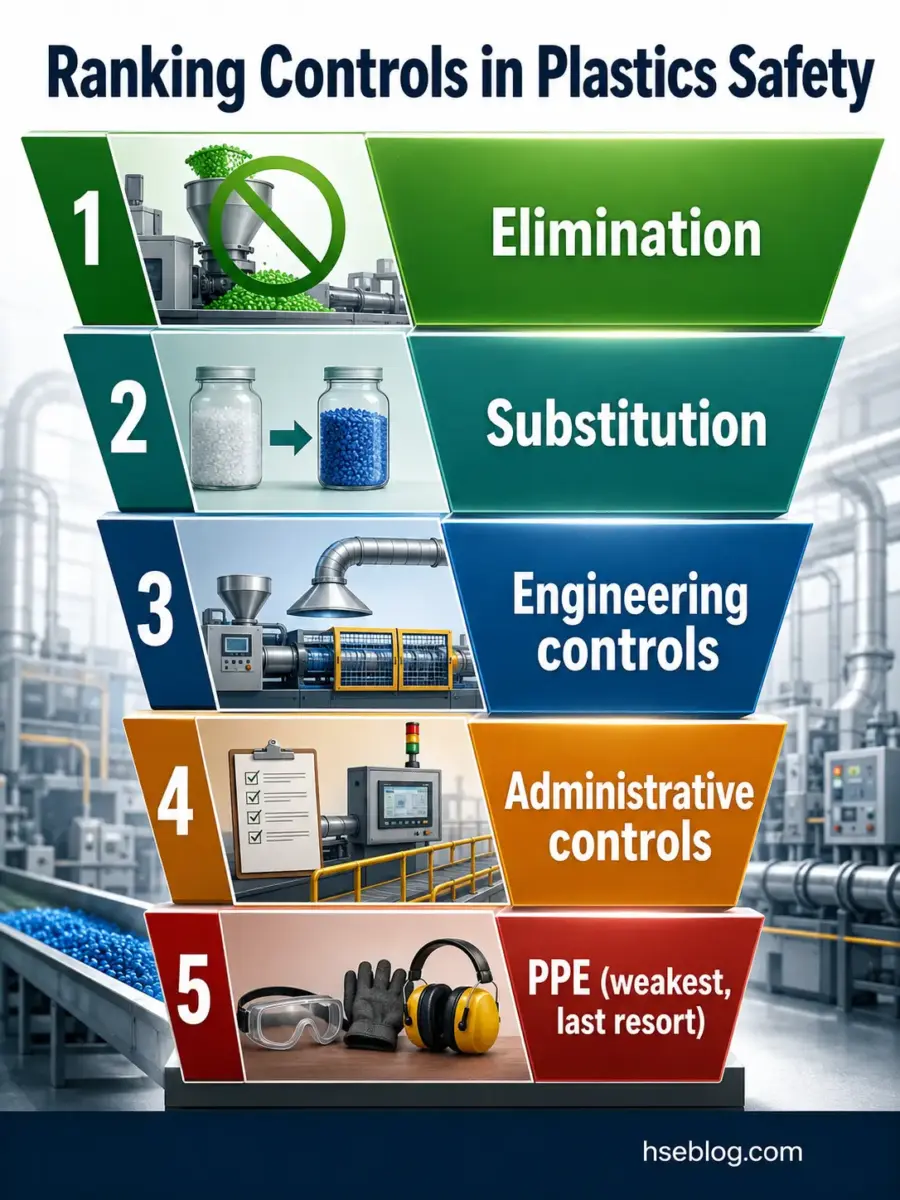
The recurring failure mode is jumping straight to PPE because it is cheap and visible, while guarding gaps and ventilation deficiencies — the higher-order controls — stay unaddressed. The table below is the working reference for the rest of this article.
| Hazard family | Primary control | OSHA reference (US) | HSE / ISO reference (UK / Int'l) |
|---|---|---|---|
| Mechanical / guarding | Fixed guards, interlocked gates, light curtains | 29 CFR 1910.212; 1910.147 | PUWER; ISO 20430:2020 |
| Thermal / molten | Insulation, shrouding, purge guards, heat-rated PPE | 1910 general duty | HSE plastics guidance |
| Chemical / fume | Local exhaust ventilation, then RPE | 1910.1200; 1910.134 | COSHH; HSE PPIS13/PPIS14 |
| Combustible dust / fire | Dust capture, explosion protection, housekeeping | 1910.22; HazCom | DSEAR; HSE guidance |
| Noise | Engineering reduction + hearing conservation | 1910.95 | Control of Noise at Work Regs 2005 |
| Ergonomic | Workstation redesign, lift assists, rotation | General duty | Manual Handling Operations Regs 1992 |
| Electrical / stored energy | Lockout/tagout, energy verification | 1910.147; 1910.333 | PUWER; ISO 20430 |
Competent-person note: This article provides general HSE knowledge. Life-critical work such as machine guarding, lockout/tagout, and respiratory-protection selection must be planned and supervised by a competent person with relevant training, jurisdiction-specific authorisation, and a site-specific risk assessment. The information here does not replace that.
Mechanical and machine-guarding hazards
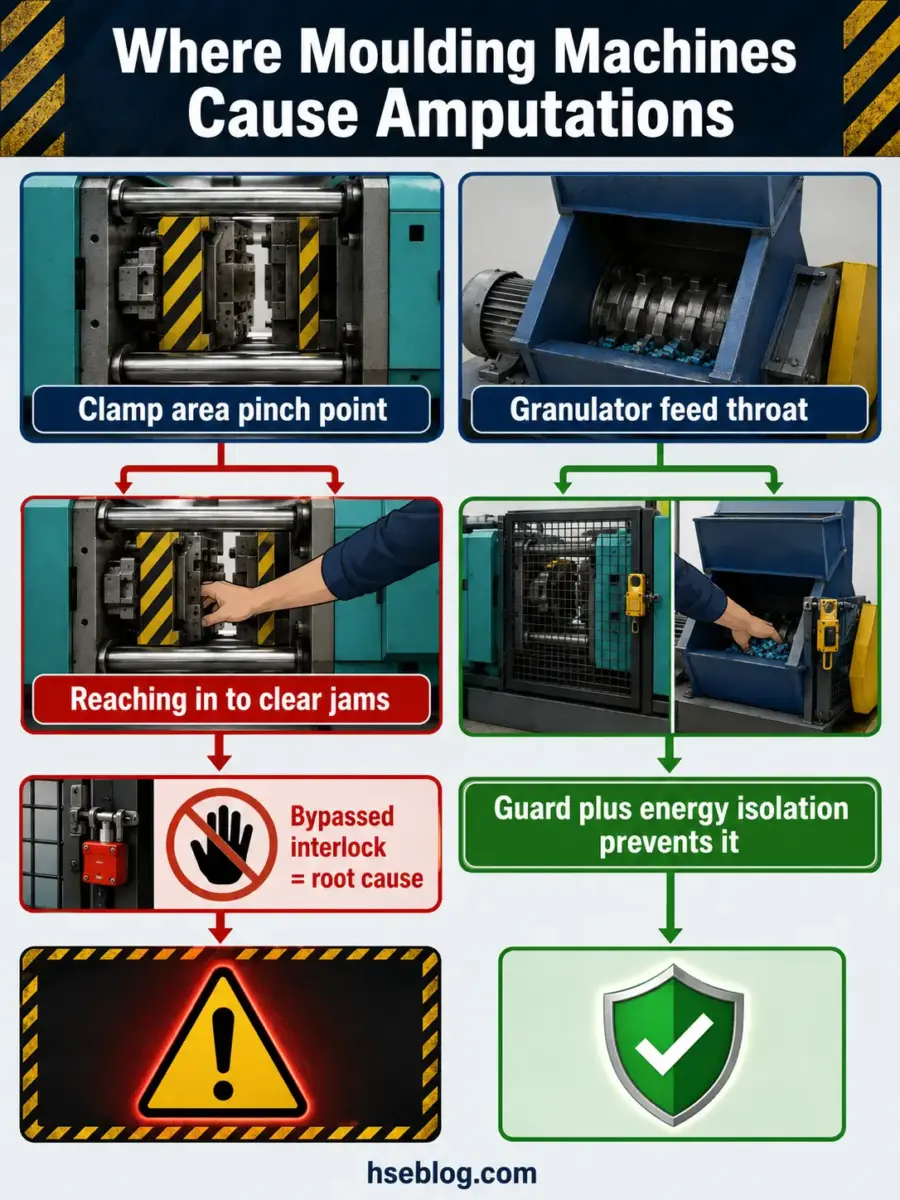
Most plastics amputations happen at the clamp and the feed mechanism, when a worker reaches in to clear a stuck part. This is the highest-severity, highest-enforcement hazard in the sector, which is why OSHA's renewed Amputations NEP (CPL 03-00-027) lists plastics manufacturing as a targeting priority (US Department of Labor / OSHA, 2025).
The machines that bite are predictable:
- Injection moulding clamps — clamp mechanisms exert extreme closing force; an unguarded mould area is an amputation point.
- Extruders and winders — rotating screws, rolls, and nip points draw in hands, gloves, and clothing.
- Granulators / regrind machines — open feed throats and cutting rotors are among the most dangerous items on the floor.
Machines must be guarded at the point of operation, at ingoing nip points, and against rotating parts — a requirement under 29 CFR 1910.212 (US) and, for in-use equipment in the UK, PUWER. The controls that satisfy it are layered:
- Fixed guards built to the manufacturer's specification and the ANSI/SPI B151 machine series (US consensus standards).
- Interlocked operator gates that stop the cycle when opened.
- Electro-sensitive protective equipment (ESPE) such as light curtains where physical access is needed.
OSHA's machine-guarding guidance for injection moulding machines sets out task-specific expectations for each of these.
Here is the pattern that shows up again and again in moulding-machine amputation investigations: operators "trick" or bypass interlocks to clear jams faster under production pressure, and maintenance teams treat an interlock as if it were an energy isolation. Guards designed for normal operation are not designed for servicing — which is the bridge to lockout/tagout covered later in this article.
Thermal and molten-material hazards
Molten polymer leaves the barrel hot enough to cause full-thickness burns on contact, and it does not behave like a hot solid — it sticks, splashes, and keeps burning. Thermal hazards split into contact burns, radiant heat, and splash/ejection.
The heat sources cluster by task:
- Barrel and nozzle — sustained high surface temperatures; contact burns during setup and maintenance.
- Hot moulds and platens — radiant and contact burns during tool changes.
- Molten purge — ejected hot melt splashes during purging and start-up.
- Hydraulic oil and steam — pressurised hot oil and moisture flashing to steam off wet pellets.
The controls follow the source:
- Insulation and barrel shrouding to remove the contact surface.
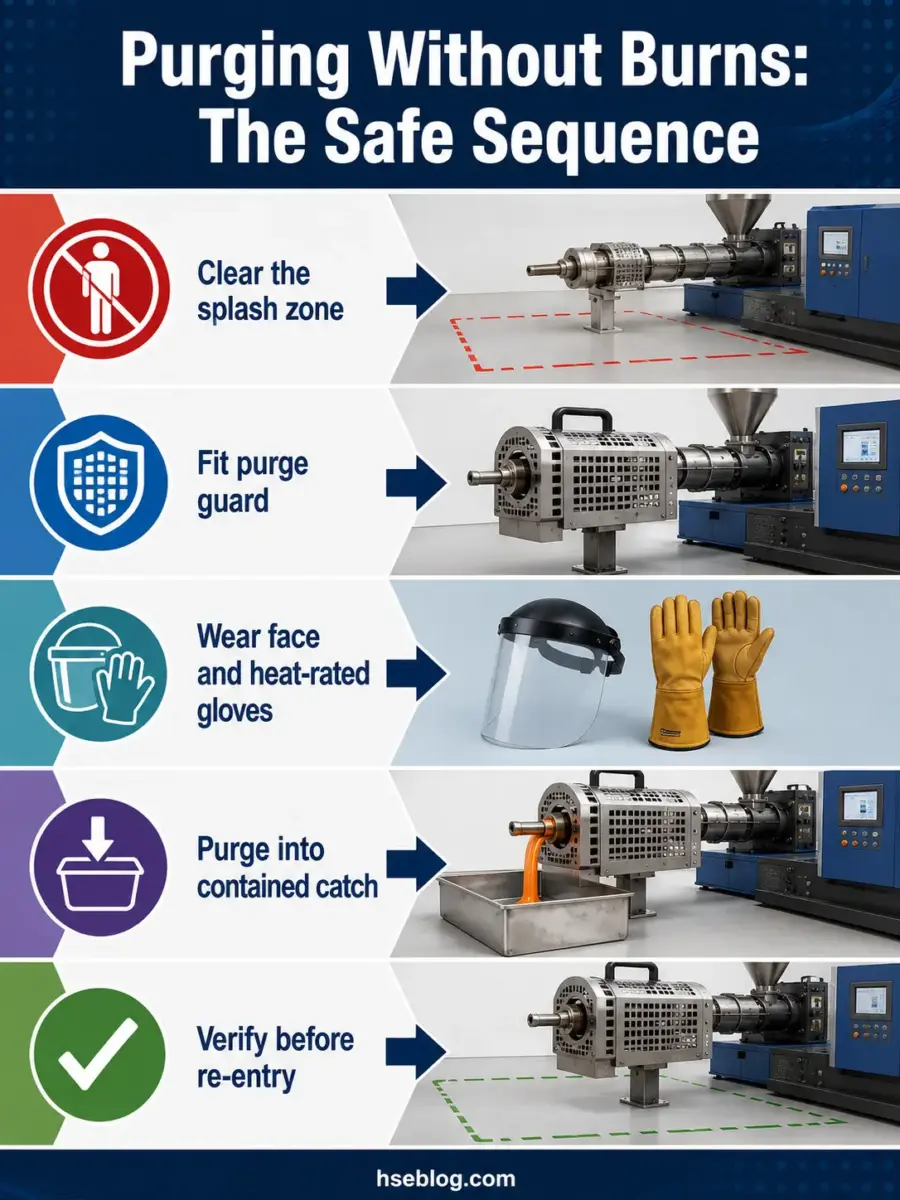
- Purge guards and a written purge procedure with the splash zone cleared of people.
- Heat-rated gloves and face protection as the backup once engineering controls are set.
The judgment call most sites get wrong is treating purging as a routine "quick" task. Molten-polymer splash during purging is one of the more common burn mechanisms, yet it is regularly done without face protection or a cleared exclusion zone. Purging deserves its own safe system of work, not a verbal "stand back."
Chemical, fume and respiratory hazards
Processing fume is governed in the US by hazard communication and respiratory-protection standards, and in the UK by COSHH — and in both, ventilation comes before respirators. Heating polymer above its processing temperature releases thermal-degradation products that vary by polymer and additive package, so no fixed universal "list of gases" applies.
Medical advice disclaimer: Content covering exposure, fume, and biological monitoring is for HSE practitioner reference. It is not medical advice, and the exposure limits referenced here must be verified against current published values before use. Workers with respiratory symptoms or exposure concerns should consult an occupational physician or qualified medical professional.
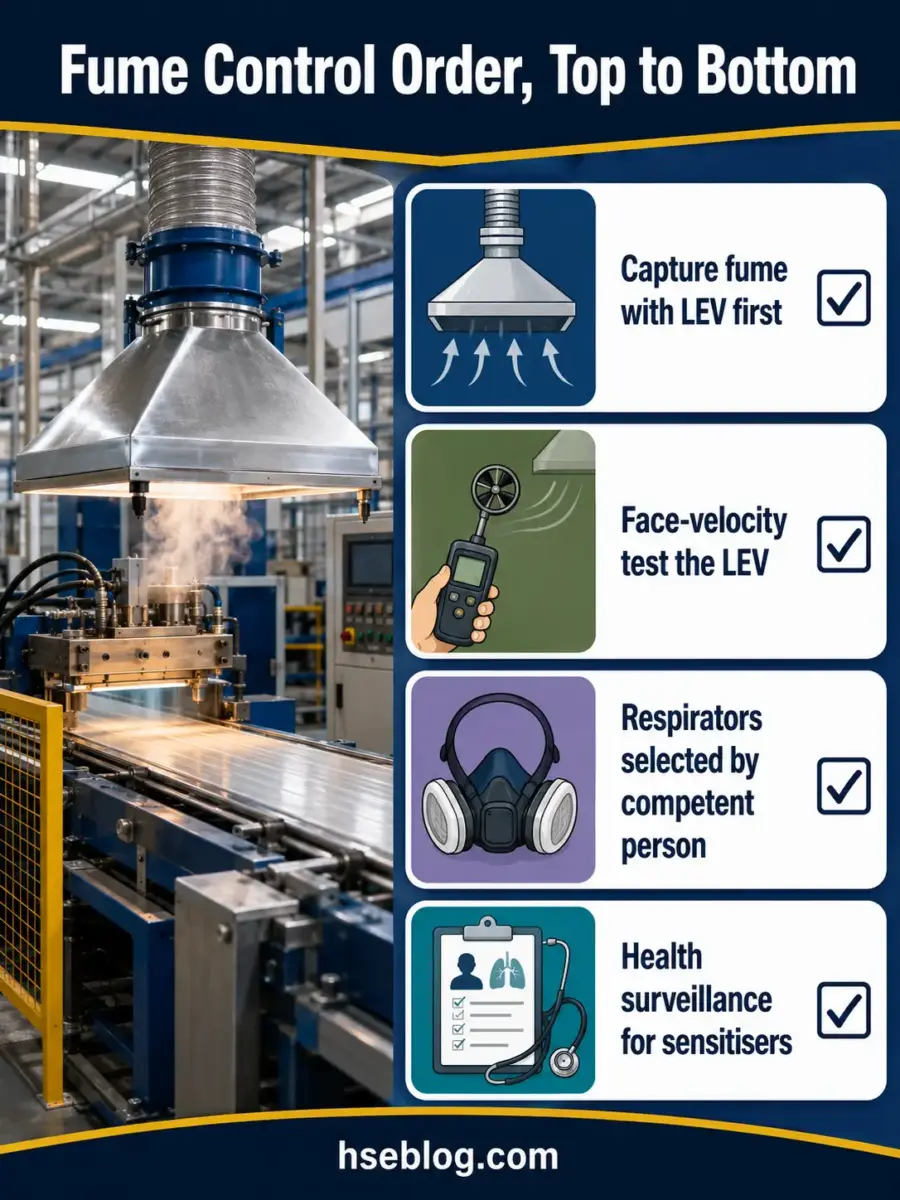
The control order is non-negotiable:
- Local exhaust ventilation (LEV) captures fume at the source — the primary engineering control under 29 CFR 1910.1200 (US) and COSHH (UK).
- Respiratory protection is the backup under 29 CFR 1910.134 (US), selected by a competent person, fit-tested, and run under a written programme.
- Health surveillance / biological monitoring is added where exposures warrant it, particularly for sensitisers.
A failure mode worth auditing for: LEV is installed, then never face-velocity tested or maintained. It is assumed effective for years while quietly under-performing, and the gap only surfaces during an exposure investigation. An LEV that is not on a tested maintenance schedule is a control on paper only.
Isocyanates in polyurethane processing
Isocyanates are respiratory sensitisers — once a worker is sensitised, there is effectively no safe exposure threshold for them, and a single significant exposure can trigger occupational asthma. NIOSH's Health Hazard Evaluation work on isocyanate exposure documents this sensitisation pattern in processing environments.
Control combines source capture (LEV), skin protection against the liquid component, and respiratory protection where airborne control is incomplete. Where polyurethane processing is ongoing, health surveillance for respiratory function is the defensible practice, not an optional extra.
Styrene in fibre-reinforced and composite moulding
Open and contact moulding of fibre-reinforced plastics releases styrene into the breathing zone, and the exposure rises sharply during hand lay-up and spray application. The UK reference point is HSE's PPIS14 styrene-control guidance, which sits within the broader HSE guidance for the plastics industry.
OSHA's permissible exposure limit, the NIOSH recommended limit, and the ACGIH threshold limit value for styrene diverge substantially, with ACGIH historically the strictest. The practical position is to control to the strictest applicable value rather than the most lenient — and to confirm the current numeric limits against OSHA's annotated PEL tables and the NIOSH Pocket Guide before relying on them.
Legionnaires' disease risk in injection-moulding cooling systems
Injection-moulding cooling water can aerosolise, and OSHA has flagged an increased Legionnaires' disease risk tied to those cooling systems — an exposure most plastics guides omit entirely. The mechanism is contaminated water becoming an inhalable aerosol around the machine and its cooling circuit.
The control is water-system management: monitoring, temperature control, biocide regimes, and routine cleaning of the cooling circuit. Treating the cooling system as a plumbing detail rather than a microbiological hazard is the gap here.
Combustible dust, fire and explosion hazards
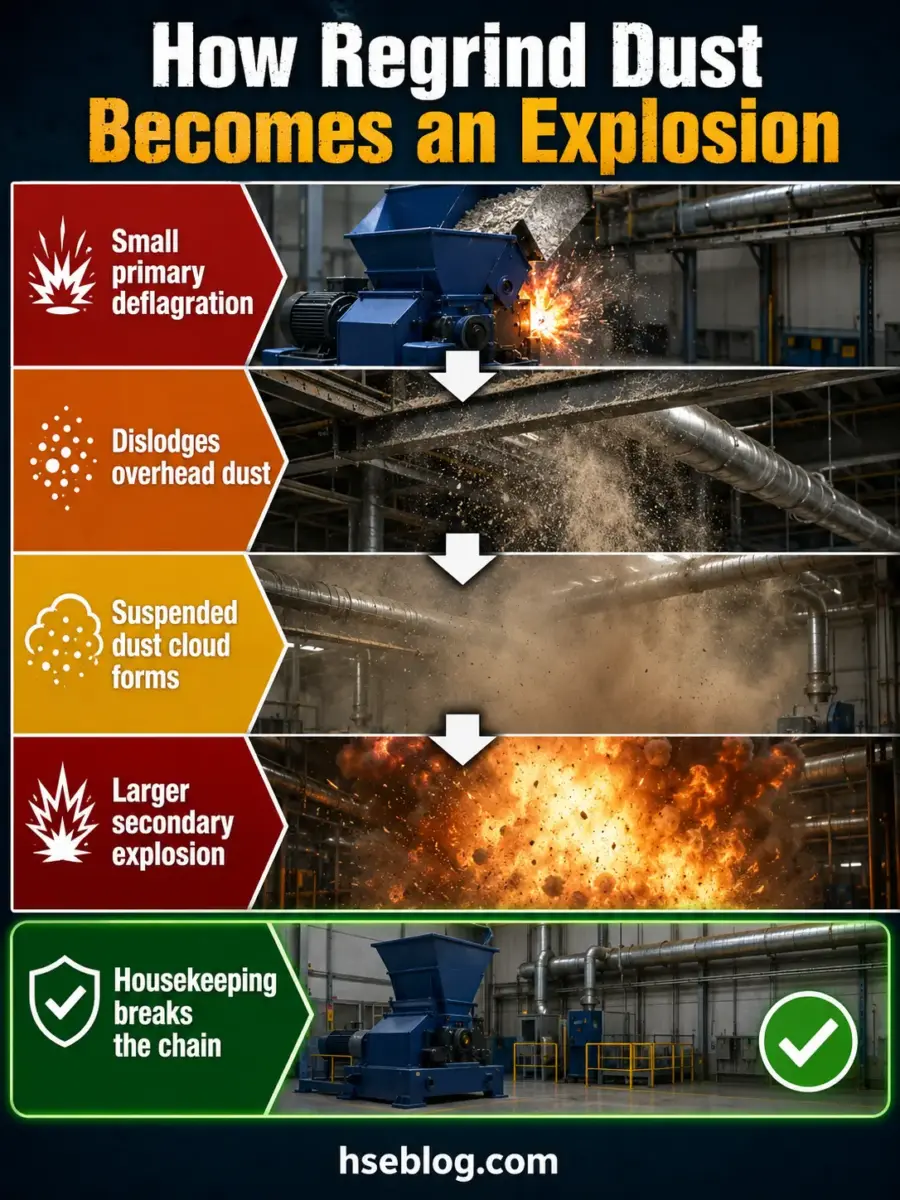
Plastic dust from grinding and regrind is combustible, and under the right conditions it does not just burn — it deflagrates. The distinction between a fire and a deflagration is the whole point of this section.
- A fire needs fuel, oxygen, and an ignition source, and it stays where the fuel is.
- A deflagration needs those three plus dust suspended as a cloud in a confined space, and it propagates as a pressure wave.
The high-risk operations are predictable:
- Granulation and regrind — cutting and grinding generate fine combustible dust.
- Powder handling — pneumatic conveying and bagging of powdered polymer or additives.
- Stored material and product — a general fire load that feeds an initial event.
The controls map to the mechanism:
- Dust capture and explosion protection on collection systems, not just nuisance extraction.
- Ignition-source control — hot-work permits, bonding/grounding, and electrical-area classification under DSEAR (UK).
- Housekeeping to stop fugitive dust accumulating on beams, ducts, and rafters.
The misconception that kills is treating regrind dust on overhead surfaces as a housekeeping nuisance rather than a secondary-explosion hazard. In the most severe dust events, a small primary deflagration shakes accumulated dust off overhead surfaces into a cloud, and that cloud is what produces the building-levelling secondary explosion. The dust you can see on the rafters is the hazard, not the floor.
Physical hazards: noise and spilled-pellet slips
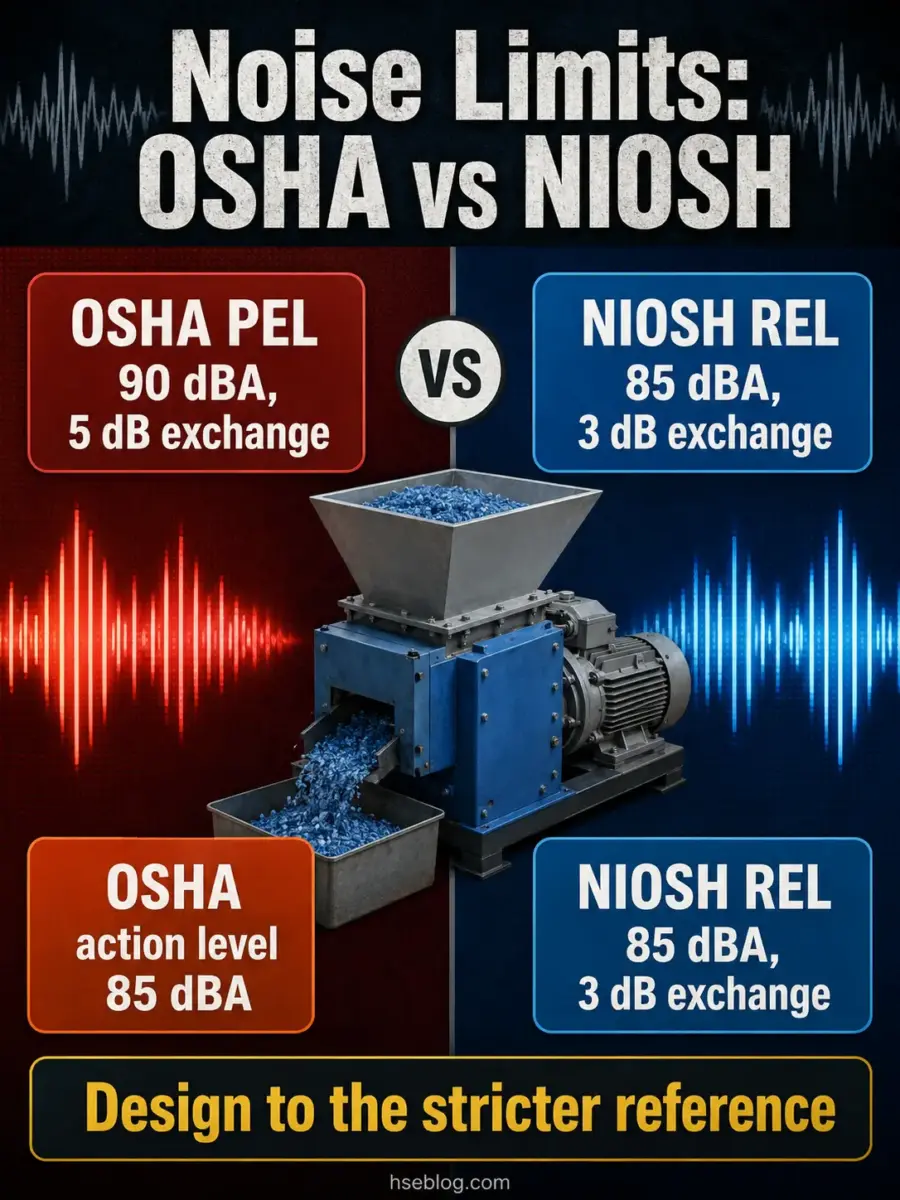
When an 8-hour noise exposure reaches the 85 dBA action level, 29 CFR 1910.95 (US) requires a hearing-conservation programme; the permissible exposure limit sits higher at 90 dBA. These are two distinct physical hazards that both OSHA and HSE single out for plastics, and neither produces a dramatic single event — which is exactly why they get under-managed.
Noise-induced hearing loss and hearing conservation
Granulators, extruders, and compressed-air ejection are the dominant noise sources on a moulding floor. The threshold question is where action begins, and the standards disagree.
| Reference | Exposure metric | Trigger | Exchange rate |
|---|---|---|---|
| OSHA PEL (US) | 8-hr TWA | 90 dBA | 5 dB |
| OSHA action level (US) | 8-hr TWA | 85 dBA | 5 dB |
| NIOSH REL | 8-hr TWA | 85 dBA | 3 dB |
NIOSH's 3 dB exchange rate is more protective than OSHA's 5 dB, so for the same measured noise NIOSH treats the dose as higher. The defensible engineering position is to design to the 85 dBA / 3 dB reference, then confirm with monitoring — because noise monitoring determines the requirement, not a fixed answer. The programme adds engineering noise reduction, hearing protection, and audiometric testing.
Slips and falls from resin pellets
Spilled resin pellets and beads roll underfoot like ball bearings, and slips from them are a leading plastics accident type. The named industry control is Operation Clean Sweep, a pellet-containment programme that targets loss at transfer, handling, and clean-up.
Pellet-slip risk is chronically underestimated because it produces no single catastrophic event, yet it is one of the most frequent injury sources on a moulding floor. The controls are containment at transfer points, immediate spill clean-up discipline, and capture trays under known loss points.
Ergonomic and manual-handling hazards
Musculoskeletal disorders are the dominant ill-health driver on a moulding floor, the mirror image of machine guarding being the dominant injury driver. The harm is cumulative and invisible quarter-to-quarter, which is why ergonomic risk is the most likely hazard to be deprioritised.
The exposures are specific to the processes:
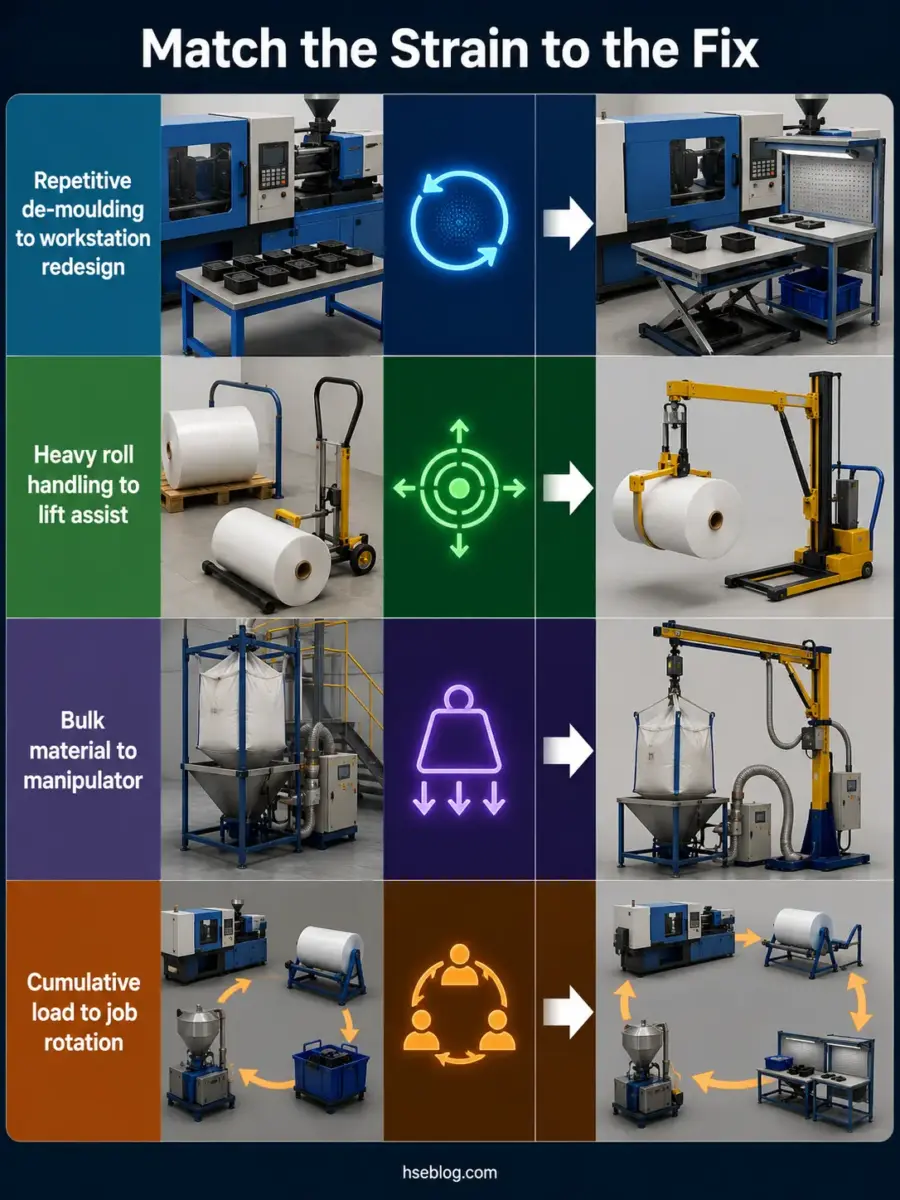
- Repetitive de-moulding — rapid, repeated reach-and-grasp cycles tending the mould.
- Roll and sheet handling — heavy, awkward lifts in thermoforming and film operations.
- Material and regrind handling — manual lifting of sacks, gaylords, and regrind bins.
The controls sit mostly in design, not behaviour:
- Workstation redesign to remove reach, bend, and twist from the de-moulding cycle.
- Lift assists and manipulators for rolls, tools, and bulk material.
- Job rotation to limit cumulative loading on any one worker.
- Task-based risk assessment using recognised tools, informed by NIOSH MSD evaluation methods and HSE manual-handling guidance.
The judgement here is resourcing: an amputation forces action, while a slow MSD epidemic does not. Treating ergonomic assessment as scheduled work — not an exception triggered by complaints — is what separates sites that control it from sites that absorb the lost-time cost year after year.
Controlling hazardous energy: electrical and lockout/tagout
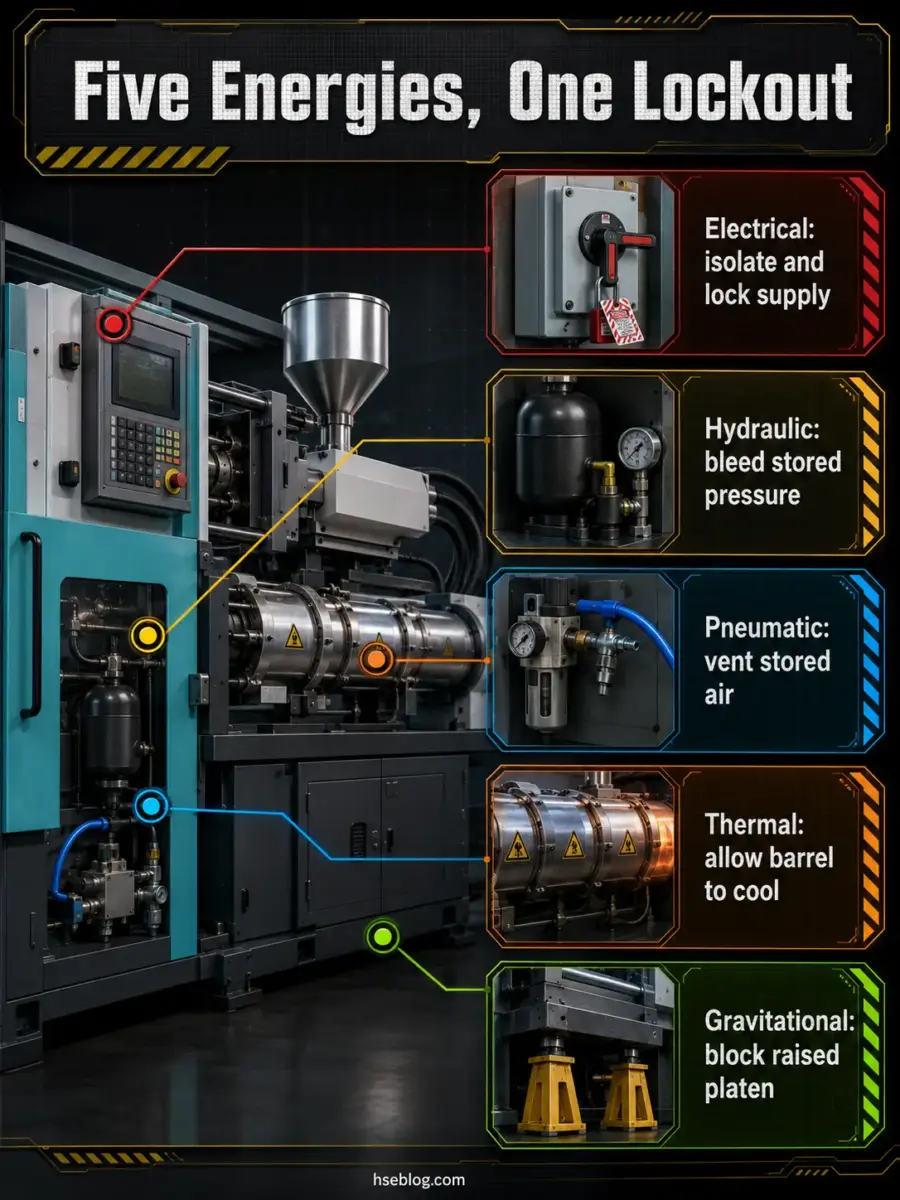
A moulding machine stores energy in at least five forms, and a lockout/tagout procedure that only kills the electrics is a procedure that gives false confidence. This section closes the loop opened by machine guarding: guards protect during normal operation, but servicing demands energy isolation.
The energy sources to isolate and verify are:
- Electrical — main supply and control circuits, covered by 29 CFR 1910.333 (US).
- Hydraulic — stored pressure in accumulators and clamp circuits that can move a platen after shutdown.
- Pneumatic — stored air in ejection and core-pull systems.
- Thermal — residual heat in barrels and moulds that burns long after power-off.
- Gravitational — a raised platen, tool, or hopper that can fall.
The field procedure most aligned with 29 CFR 1910.147 (US) and the consensus standard ANSI Z244.1 isolates and verifies every one of those before work begins. The servicing-versus-normal-operation boundary is the test for when LOTO becomes mandatory: routine production with guards in place is one regime, and any task requiring access past a guard or into the machine is the other.
The common gap is a documented LOTO procedure that omits stored hydraulic pressure and thermal energy. The electrical disconnect gets locked, the worker assumes the machine is dead, and a charged accumulator or a hot barrel proves otherwise. A LOTO procedure is only as good as its least-addressed energy type.
Building a compliant control program across jurisdictions
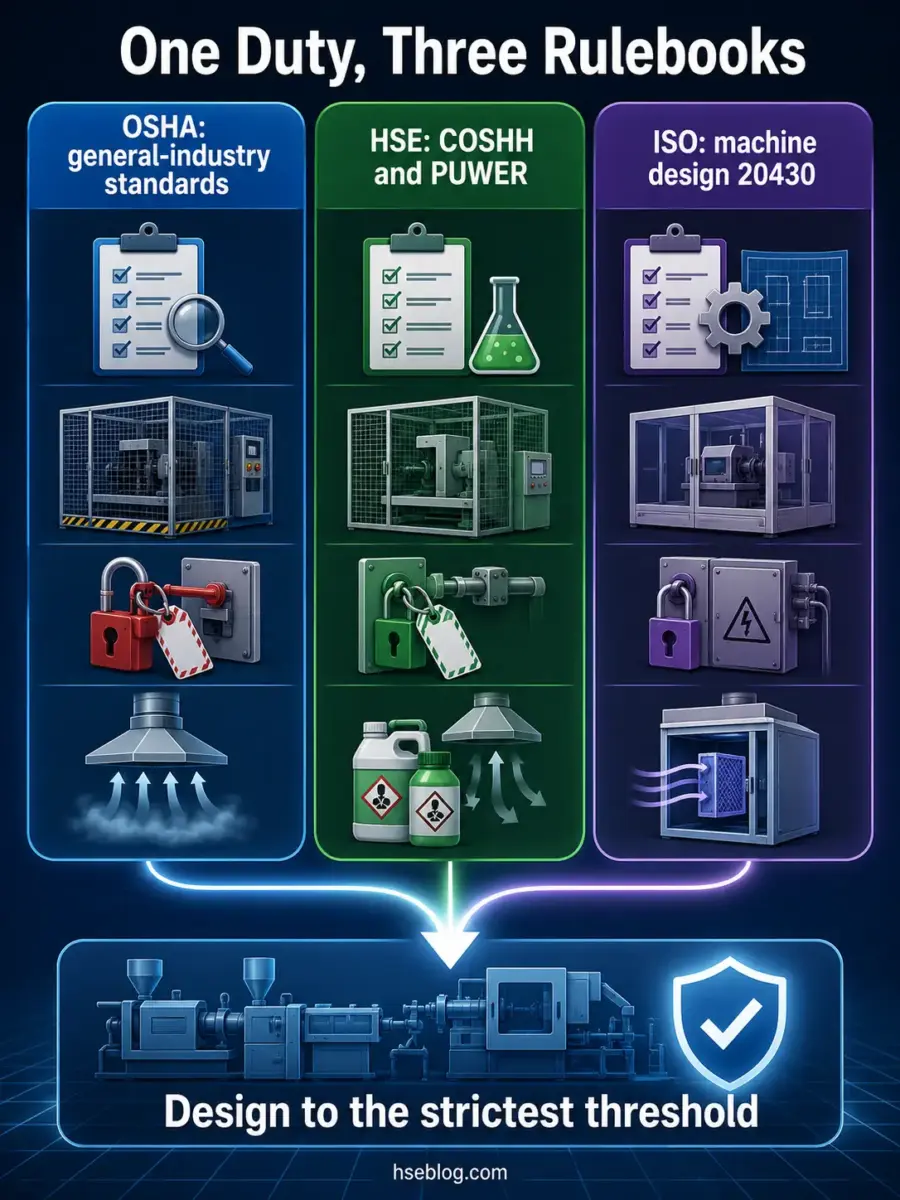
The written program must address risk assessment, competent-person oversight, training, and health surveillance — obligations that appear under OSHA general-industry standards (US), HSE's COSHH and management duties (UK), and the design requirements of ISO 20430 (international). The same underlying duty is delivered through different instruments, and a multinational operation has to satisfy all of them at once.
| Obligation | OSHA (US) | HSE (UK) | ISO (International) |
|---|---|---|---|
| Risk assessment | General duty + standard-specific duties | COSHH and management regs: suitable and sufficient assessment | ISO 12100 risk-assessment framework |
| Machine safety | 1910.212 + ANSI/SPI B151 | PUWER in-use duties | ISO 20430:2020 design/construction |
| Hazardous energy | 1910.147 / ANSI Z244.1 | PUWER + safe systems of work | Referenced via ISO 20430 |
| Chemical exposure | 1910.1200 / 1910.134 + PELs | COSHH + workplace exposure limits | — |
| Noise | 1910.95 (PEL 90 dBA) | Control of Noise at Work Regs 2005 | — |
| Competent person & training | Required by individual standards | Explicit competent-person duty | Informs procurement and design |
A few load-bearing points sit under that table:
- Risk assessment is the foundation, not the paperwork. It is both a legal duty (COSHH in the UK; the general duty plus specific standards in the US) and the document that decides which controls you actually need.
- ISO 20430:2020 governs machine design, not your existing duties. It was reviewed and confirmed current in 2025, replacing the older EN 201, and it is the live benchmark for procurement and retrofit assessment of injection moulding machines (ISO, 2025).
- Training pathways matter for the competent-person requirement. Recognised routes include NEBOSH and IOSH qualifications and OSHA outreach training, or the regional equivalent.
The trap for multi-site and multinational manufacturers is running to the least stringent applicable standard by default — the laxest noise threshold, the most lenient exposure limit. The defensible practice is the opposite: design to the strictest applicable threshold across jurisdictions, because that single policy survives an audit anywhere you operate.
Frequently Asked Questions
Is there a specific OSHA standard for the plastics industry?
No — there is no plastics-specific OSHA standard. Plastics hazards are regulated through general-industry standards: machine guarding (29 CFR 1910.212), lockout/tagout (1910.147), noise (1910.95), hazard communication (1910.1200), and respiratory protection (1910.134), all jurisdiction US. Sites must read across these rather than rely on one dedicated rule.
What is the most common cause of injury on an injection moulding machine?
Reaching into the clamp or mould area to clear a stuck part is the leading injury mechanism, frequently after an interlock has been bypassed for speed. That is the dominant traumatic-injury cause. The dominant ill-health cause is different — musculoskeletal disorders from repetitive de-moulding and material handling, which accumulate quietly rather than appearing as a single event.
What gases or fumes are released when plastic is heated?
It depends on the polymer and its additive package, so there is no fixed universal list. Heating above the processing temperature generates thermal-degradation products specific to that material, which is why the safety data sheet and the actual process temperature matter. Local exhaust ventilation captures fume at source; respiratory protection is the backup.
Do plastic dusts really cause explosions?
Yes. Combustible plastic dust from granulation, regrind, and powder handling can deflagrate when suspended as a cloud in a confined space with an ignition source. The severe events are usually secondary explosions, where a small primary blast lifts accumulated dust off overhead surfaces into a cloud. Housekeeping of settled dust is the control that breaks that chain.
Can injection moulding cause Legionnaires' disease?
Yes, through the cooling-water system. OSHA has flagged an increased Legionnaires' risk where injection-moulding cooling water becomes an inhalable aerosol around the machine. The control is water-system management — monitoring, temperature control, biocide regimes, and routine cleaning of the cooling circuit — rather than anything specific to the moulding process itself.
Does ISO 20430 apply to machines we already own?
ISO 20430:2020 (international) governs the design and construction of injection moulding machines, so it applies directly to new procurement, not retroactively to machines you already run. In use, your obligations come from OSHA standards (US) or PUWER (UK). It remains the benchmark for retrofit and procurement decisions, and it was confirmed current in 2025.
Conclusion
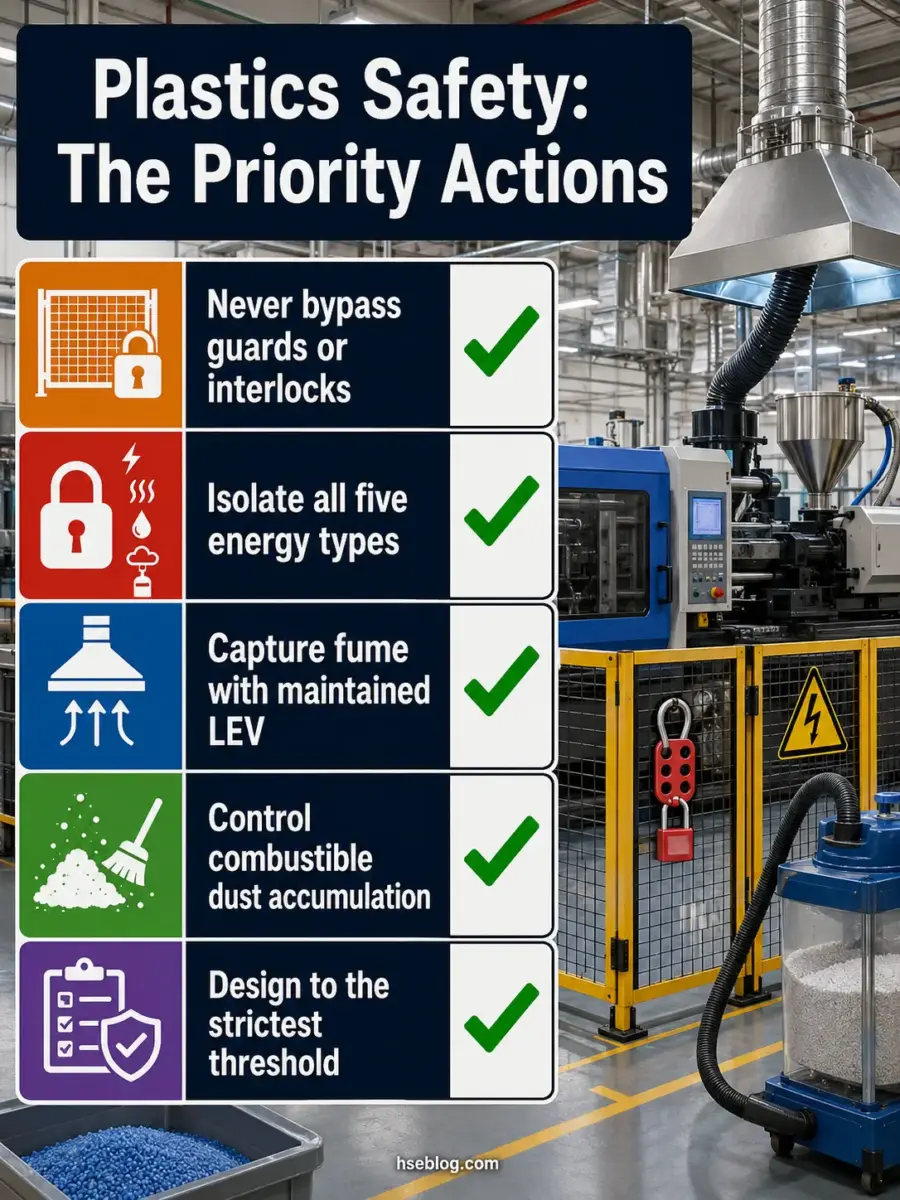
What the plastics sector gets wrong is the order of operations. PPE is cheap, visible, and reassuring, so it gets bought first — while the guarding gap, the untested LEV, and the LOTO procedure that ignores stored hydraulic pressure stay in place because fixing them costs more and shows less.
The single highest-impact change is to invert that instinct. Treat engineering controls as the default and PPE as the admission that something higher up failed, then hold that line across every hazard family — from the clamp area to the cooling-water circuit. The rising fatality count and OSHA's renewed Amputations NEP (US Department of Labor / OSHA, 2025) mean the cost of getting this wrong is now both human and enforced.
Plastics manufacturing safety is not a single procedure to master; it is a coordinated program that maps each hazard to its strictest applicable control and keeps every one of those controls verified rather than assumed. The site that does that is the one where the next reach into a jammed clamp ends with a stopped machine instead of an amputation.