
TL;DR
- CHST certification validates construction-specific safety competency through the Board of Certified Safety Professionals (BCSP)
- No college degree required — three years of hands-on construction safety experience qualifies you to apply
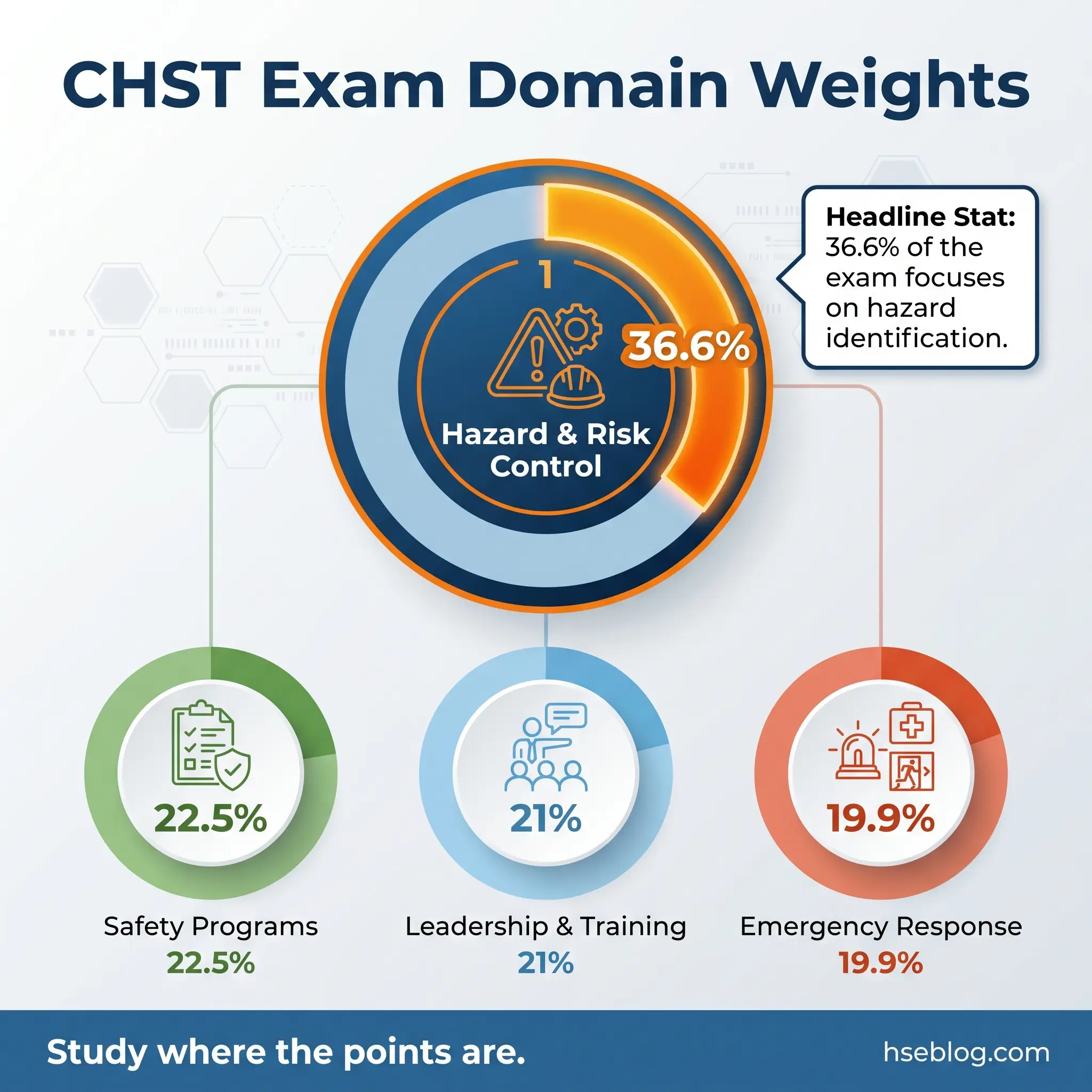
- The exam covers four weighted domains with hazard identification carrying the heaviest load at 36.6%
- Recertification demands 20 points every five years plus an annual maintenance fee to keep the credential active
- Employers increasingly list CHST as preferred or required for site safety coordinator and safety manager roles
I was reviewing contractor safety submittals on a high-rise project in the Gulf when a superintendent handed me a stack of resumes for an open site safety technician position. Twelve candidates. Nine listed generic “OSHA 30-Hour” cards as their only credential. Two had NEBOSH certificates — solid, but designed for a different regulatory landscape. One had a CHST after their name. That candidate understood confined space protocols specific to concrete formwork, could walk me through a competent person inspection under OSHA 1926 Subpart L, and explained fall protection anchorage calculations without referencing notes. The CHST holder got the job.
The Construction Health and Safety Technician (CHST) certification is one of the few credentials built exclusively for construction safety practitioners who work at the technician and field specialist level. Administered by the Board of Certified Safety Professionals (BCSP), it tests applied knowledge — not academic theory. This article covers every aspect of the CHST certification: who qualifies, what the exam tests, how to prepare effectively, what it costs, and why it matters for your career trajectory in construction safety.
What Is the CHST Certification and Who Administers It?
The CHST is a professional certification that recognizes competency in performing health and safety activities specifically aimed at preventing construction-related illnesses and injuries. It is not a general safety credential — it targets the construction environment exclusively.
The Board of Certified Safety Professionals (BCSP), headquartered in Indianapolis, administers the CHST alongside several other safety credentials including the Certified Safety Professional (CSP), Occupational Health and Safety Technician (OHST), and Safety Trained Supervisor (STS). Key facts about the CHST credential include:
- Accreditation: BCSP certifications are accredited under internationally recognized standards, giving the CHST credibility across borders and industries
- Target professional: Construction site safety specialists, safety technicians, and field-level safety coordinators who spend a significant portion of their duties on hazard prevention
- Scope of competency: The credential confirms you can identify construction hazards, develop site-specific safety plans, conduct incident investigations, deliver safety training, and apply OSHA construction standards in real-world scenarios
- Distinction from CSP: The Certified Safety Professional requires a bachelor’s degree and four years of professional-level experience. The CHST has no degree requirement and targets technician-level practitioners — making it the primary credential for experienced field safety personnel without a four-year degree
The CHST is designed for construction job safety, health, and environment specialists who may be responsible for one or more construction projects or job sites. — Board of Certified Safety Professionals
Pro Tip: If you are a field safety officer on construction projects and your long-term goal is the CSP, earning the CHST first accomplishes two things: it gives you an immediate, recognized credential while you build the experience and education the CSP requires, and the CHST itself qualifies as a BCSP-approved credential for the CSP application pathway.
CHST Eligibility Requirements: Who Qualifies?
One of the strongest features of the CHST is its accessibility. I have worked with excellent safety technicians who never attended university but could run circles around degree holders when it came to hazard recognition on an active construction site. The CHST rewards that kind of applied expertise.
The eligibility criteria are straightforward, but each element carries specific conditions that catch unprepared applicants:
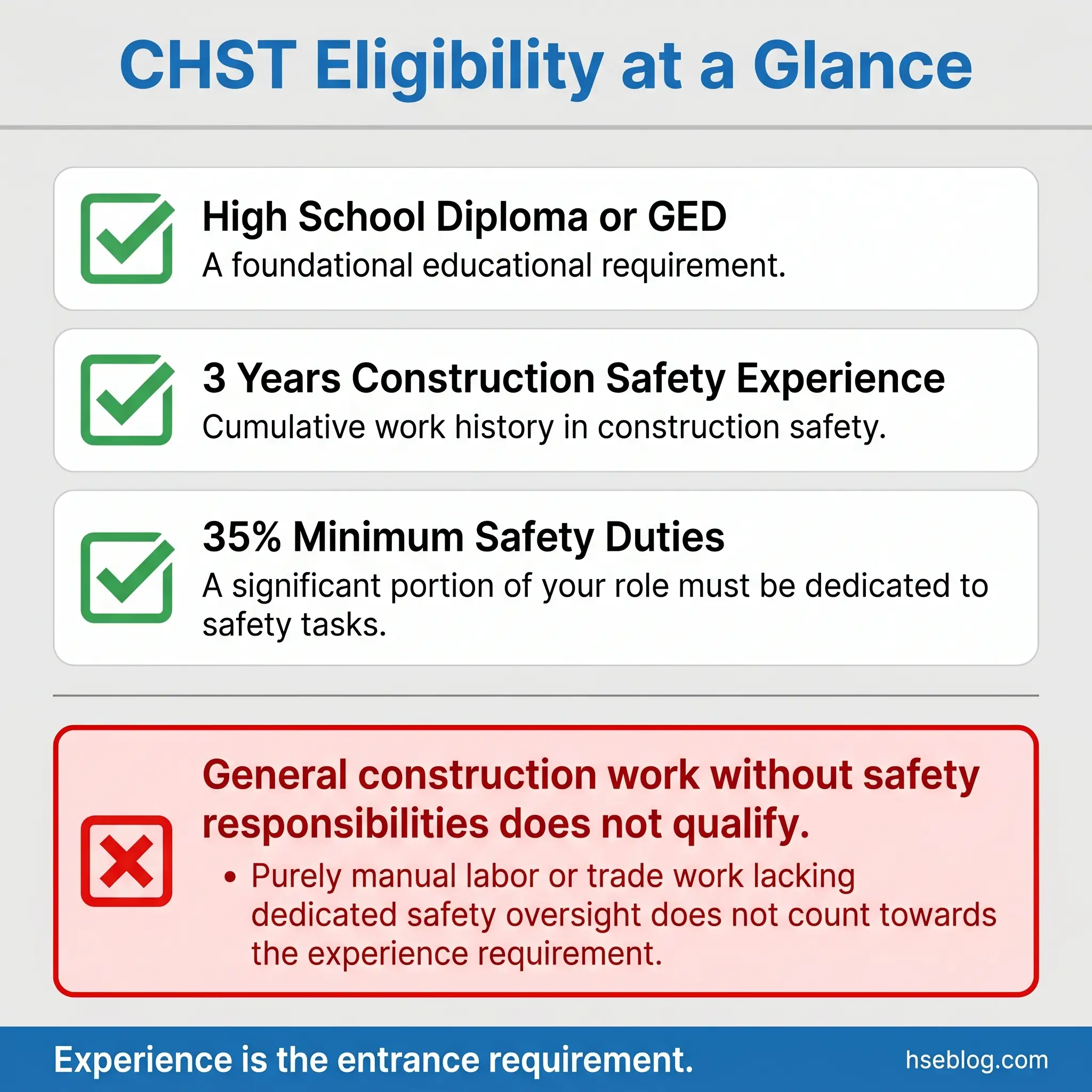
- Education: A high school diploma or GED is sufficient. No associate or bachelor’s degree is required — a deliberate design choice by BCSP to keep the credential accessible to experienced practitioners
- Experience: A minimum of three years working in construction safety, health, and environmental roles. Part-time roles qualify, but at least 35% of your job duties must involve technical safety functions
- Nature of duties: Simply working on a construction site is not enough. Your role must include active safety responsibilities — hazard assessments, safety plan development, incident investigation, training delivery, or regulatory compliance activities
- Background disclosure: Applicants must disclose any criminal convictions or actions against professional licenses. BCSP reviews these confidentially and reserves the right to deny applications based on the findings
The 35% threshold is where I see the most confusion. During an audit on a large infrastructure project in Northern Europe, a project coordinator asked me whether his role qualified. He spent about 20% of his time on safety-related tasks — reviewing permits, attending safety meetings, filing incident reports. The rest was scheduling and logistics. That 20% would not meet the CHST threshold. The certification requires that safety be a core function of your job, not an ancillary responsibility.
CHST Exam Structure: Four Domains That Define the Test
Understanding the exam blueprint is the single most important preparation step. I have sat through enough certification prep workshops to know that candidates who study without knowing the domain weights waste hours on low-yield content.
The CHST5 examination blueprint divides the exam into four domains, each with a distinct percentage weight that determines how many of the 200 questions target that area:
| Domain | Content Area | Weight |
|---|---|---|
| Domain 1 | Hazard and Risk Identification and Control | 36.6% |
| Domain 2 | Emergency Preparedness, Fire Prevention, and Response | 19.9% |
| Domain 3 | Safety Program Development, Implementation, and Sustainment | 22.5% |
| Domain 4 | Leadership, Communication, and Training | 21.0% |
Domain 1: Hazard and Risk Identification and Control (36.6%)
This is the heaviest domain — more than a third of the exam — and it reflects what construction safety technicians actually spend most of their time doing on site. This domain tests both knowledge and applied skill in the following areas:
- Hot work hazards and controls — cutting, welding, brazing operations near combustible materials
- Electrical hazards — lockout/tagout procedures, ground-fault protection, temporary wiring on active construction sites
- Fall protection systems — guardrails, personal fall arrest, safety nets, and the competent person’s role in selecting appropriate systems under OSHA 1926 Subpart M
- Excavation and trenching — soil classification, protective systems, competent person inspections per Subpart P
- Scaffolding — erection, inspection, and load capacity requirements
- GHS classification and labeling — understanding Safety Data Sheets and hazard communication on construction sites
- Industrial hygiene basics — noise exposure monitoring, silica dust controls, heat stress recognition
Pro Tip: Domain 1 is where most candidates either pass or fail the exam. Allocate at least 40% of your total study time here. Focus on scenario-based questions — the exam does not simply ask “what is fall protection?” It presents a construction scenario and asks you to identify the correct control measure for that specific situation.
Domain 2: Emergency Preparedness, Fire Prevention, and Response (19.9%)
This domain evaluates your ability to plan for, prevent, and respond to emergencies on construction sites. The questions test knowledge of emergency action plans, fire prevention protocols, and coordination with external response agencies.
- Emergency action plan elements — evacuation routes, assembly points, alarm systems, accountability procedures
- Fire prevention on active sites — hot work permits, fire watch duties, portable extinguisher placement, temporary heating safety
- Environmental emergency response — spill containment, hazardous material release procedures, stormwater pollution prevention
- Post-incident procedures — scene preservation, witness statements, root cause analysis techniques
Domain 3: Safety Program Development, Implementation, and Sustainment (22.5%)
This domain tests your ability to build and maintain safety programs — not just follow them. It covers the full cycle from site-specific safety plan development through inspection, enforcement, and continuous improvement.
- Site-specific safety plan development — aligning contract documents with safety requirements, conducting job safety analysis, identifying foreseeable hazards
- Regulatory compliance — applying OSHA construction standards (29 CFR 1926) to real worksite conditions
- Inspection and audit techniques — systematic worksite inspections, corrective action tracking, trend analysis
- Incident investigation — data gathering, causation techniques, post-incident reporting and follow-up
- Recordkeeping — OSHA 300 logs, exposure monitoring records, training documentation
Domain 4: Leadership, Communication, and Training (21%)
Construction safety technicians do not operate in isolation. This domain tests your ability to lead, communicate, train, and influence behavior on site — skills that separate effective safety professionals from clipboard carriers.
- Training delivery methods — selecting appropriate instructional formats for diverse workforces, developing site-specific training content
- Behavior-based safety techniques — recognizing at-risk behaviors, coaching rather than policing, motivating compliance
- Communication strategies — toolbox talks, safety meetings, incident briefings, communicating with non-English-speaking workers
- Leadership in safety — exercising stop-work authority, consulting with subject matter experts, managing confidentiality
CHST Exam Logistics: Format, Fees, and Testing Process
Knowing the administrative details before you apply prevents costly mistakes. I once mentored a safety officer on a marine construction project who submitted his CHST application, got approved, then waited eleven months before scheduling his exam — nearly missing his one-year eligibility window.
The CHST application and testing process follows a clear sequence:
- Create a BCSP account at bcsp.org and select the CHST application
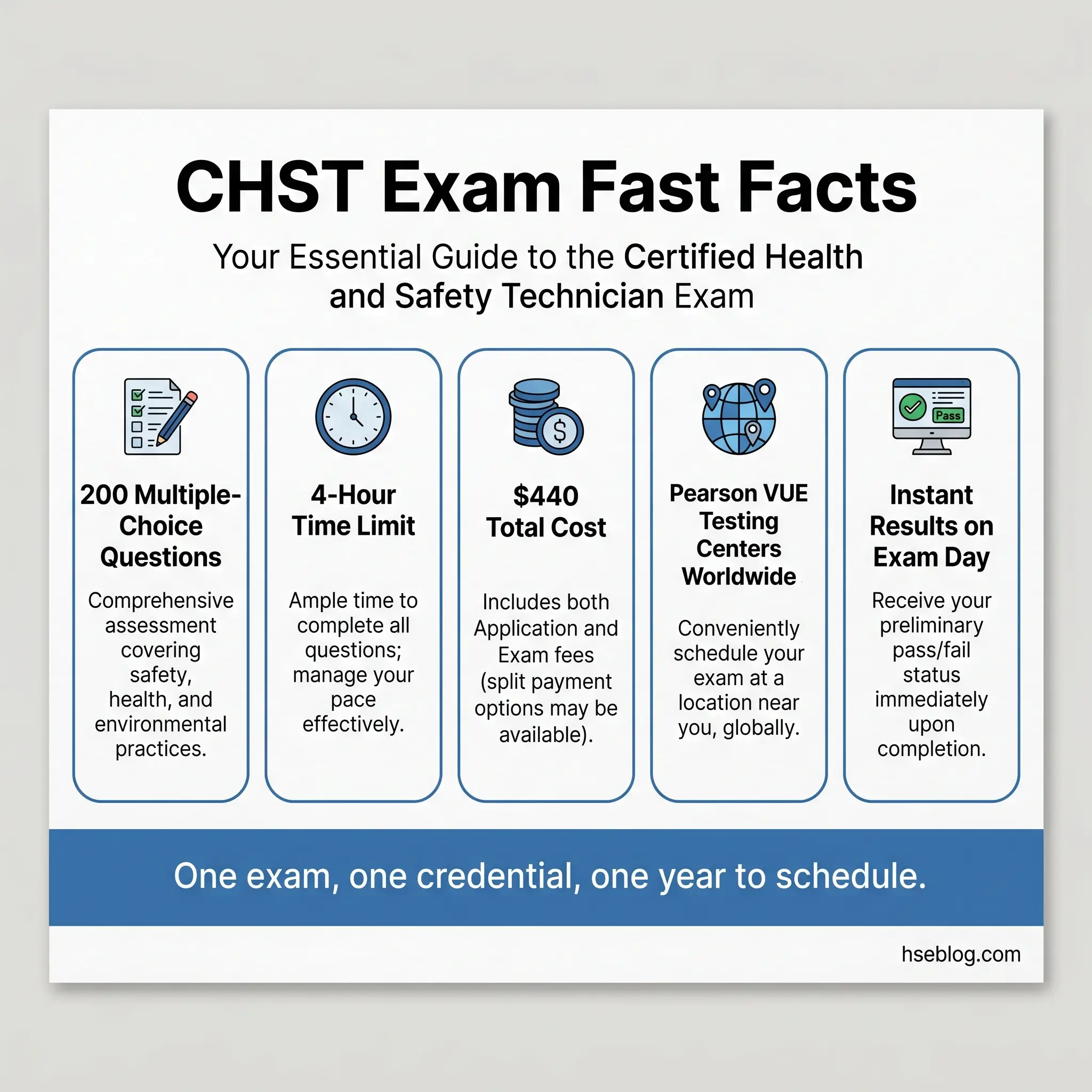
- Submit the application with documentation of your construction safety experience and the $140 non-refundable application fee
- Receive eligibility confirmation from BCSP after their review of your qualifications
- Schedule the exam through Pearson VUE within your one-year eligibility window and pay the $300 exam fee
- Sit for the exam at a Pearson VUE testing center — the test is computer-based with 200 multiple-choice questions and a four-hour time limit
- Receive results immediately upon completion at the testing center, including a domain-by-domain performance breakdown
The financial investment breaks down as follows:
| Cost Item | Amount |
|---|---|
| Application fee | $140 |
| Examination fee | $300 |
| Combined application + exam package | $426 |
| Annual maintenance fee | $145 |
| Eligibility extension (if needed) | $100 |
Each question offers four answer choices with one correct answer. Approximately 10–15% of questions are experimental items that do not count toward your score — but you cannot identify which ones they are, so treat every question as scored. There is no penalty for guessing, which means you should answer every question even if you are unsure.
Pro Tip: The exam provides formulas for calculation-based questions, so memorizing equations is unnecessary. However, you must know when and how to apply those formulas. Practice using the approved calculator models before exam day so the tool feels familiar under timed pressure.
How to Prepare for the CHST Exam: Field-Tested Strategies
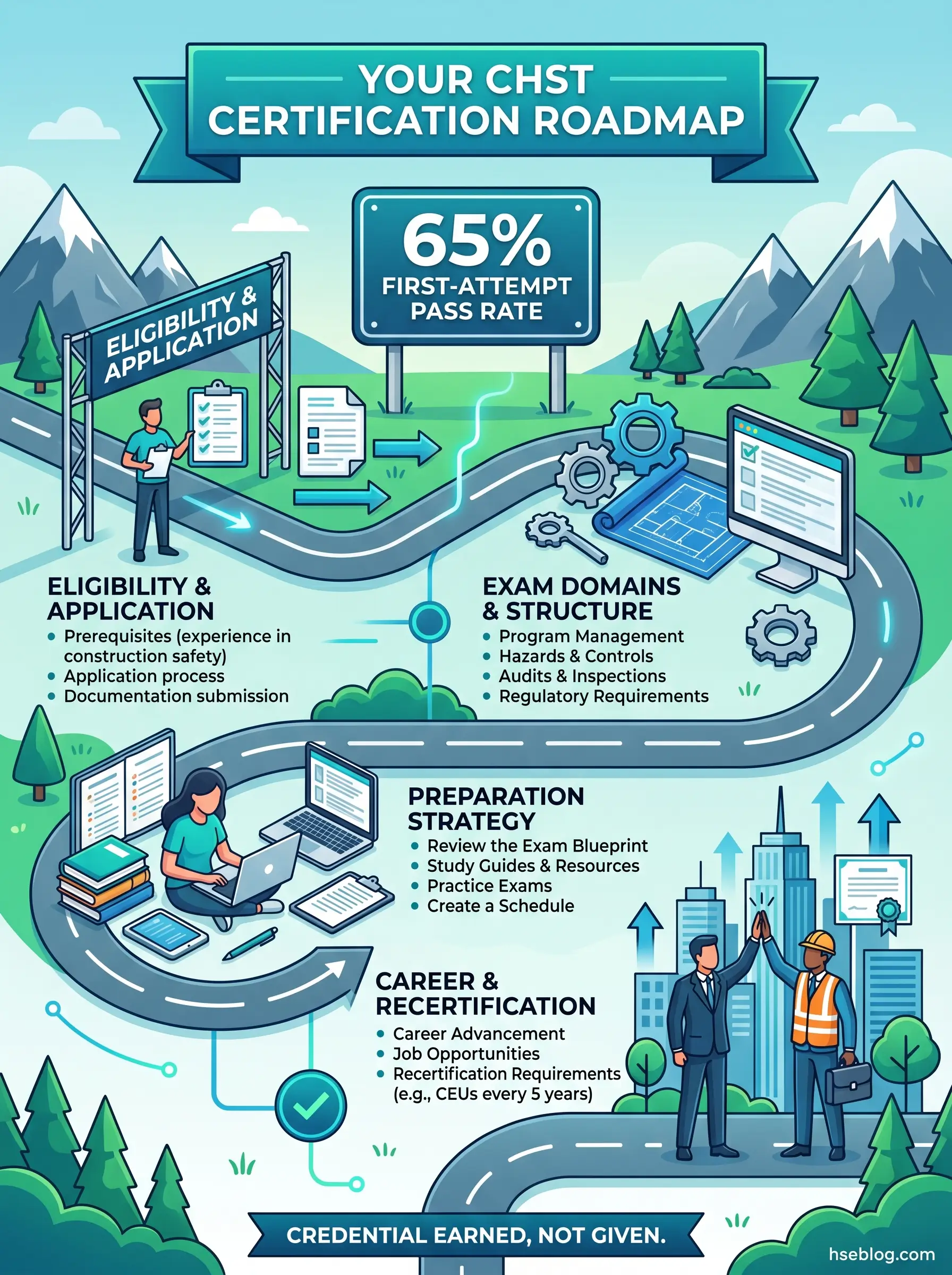
Passing the CHST on the first attempt requires a structured approach. The 65% first-attempt pass rate reported by BCSP in 2023 tells you that roughly one in three candidates does not pass — and field experience alone does not guarantee success. The exam tests applied knowledge in a specific format that requires deliberate practice.
A preparation strategy that mirrors how the exam actually works should follow these priorities:
- Download the CHST5 Examination Blueprint from BCSP’s website first. This is your syllabus. Every question on the exam traces back to a knowledge or skill statement in this document
- Allocate study time by domain weight. Domain 1 at 36.6% should consume roughly 40% of your preparation hours. Domain 4 at 21% should not receive equal time to Domain 1
- Use BCSP’s examCORE program as your primary study platform. It contains over 1,000 practice questions aligned to the current blueprint, with pre- and post-assessments that identify weak areas
- Cross-reference weak domains against OSHA standards. If you score poorly on fall protection questions, go directly to 29 CFR 1926 Subpart M and read the standard. Subparts M (Fall Protection), P (Excavations), Q (Concrete and Masonry), and R (Steel Erection) are consistently heavy-testing areas
- Practice under timed conditions. Four hours for 200 questions means roughly 72 seconds per question. Candidates who fail often cite time management — not content gaps — as their primary problem
I worked with a site safety coordinator in Southeast Asia who failed the CHST on her first attempt. Her feedback was instructive: she knew the material from years of field experience, but the scenario-based question format threw her. Construction safety knowledge and construction safety exam readiness are different skills. She spent six weeks on timed practice tests before her retake and passed comfortably.
If you do not pass, you must wait at least six weeks before scheduling a retake and will need to pay the examination fee again.
CHST vs. CSP: Understanding the Career Progression
One of the most common questions I hear from construction safety professionals is whether to pursue the CHST or the Certified Safety Professional credential. The answer depends on where you are in your career and what educational background you hold.
The two credentials serve different professional levels, and understanding their relationship helps you plan your certification pathway strategically:
| Criteria | CHST | CSP |
|---|---|---|
| Education Required | High school diploma / GED | Bachelor’s degree (any field) |
| Experience Required | 3 years in construction safety (35% minimum) | 4 years professional-level safety (50% minimum) + BCSP credential |
| Scope | Construction-specific | All industries |
| Professional Level | Technician / field specialist | Professional / management |
| Pathway Relationship | Qualifies as BCSP credential for CSP application | Gold standard SH&E certification |
The CHST is not a lesser version of the CSP. It is a different credential for a different career stage. Many excellent construction safety technicians spend their entire careers at the field level and never need or want the CSP. Others use the CHST as a stepping stone — earning field recognition immediately while pursuing the degree and experience the CSP demands.
Pro Tip: If you hold a CHST and later earn a bachelor’s degree, you can apply for the CSP using the CHST as your BCSP-approved credential requirement. This eliminates the need to first earn the Associate Safety Professional (ASP) designation — saving you one certification step.
Maintaining Your CHST Certification: Recertification Requirements
Earning the CHST is not a one-time achievement. BCSP requires active maintenance to ensure credential holders stay current with evolving standards, regulations, and best practices. I have seen safety professionals lose their credentials simply because they forgot to track recertification points — a preventable and professionally embarrassing situation.
The recertification cycle operates on two parallel requirements:
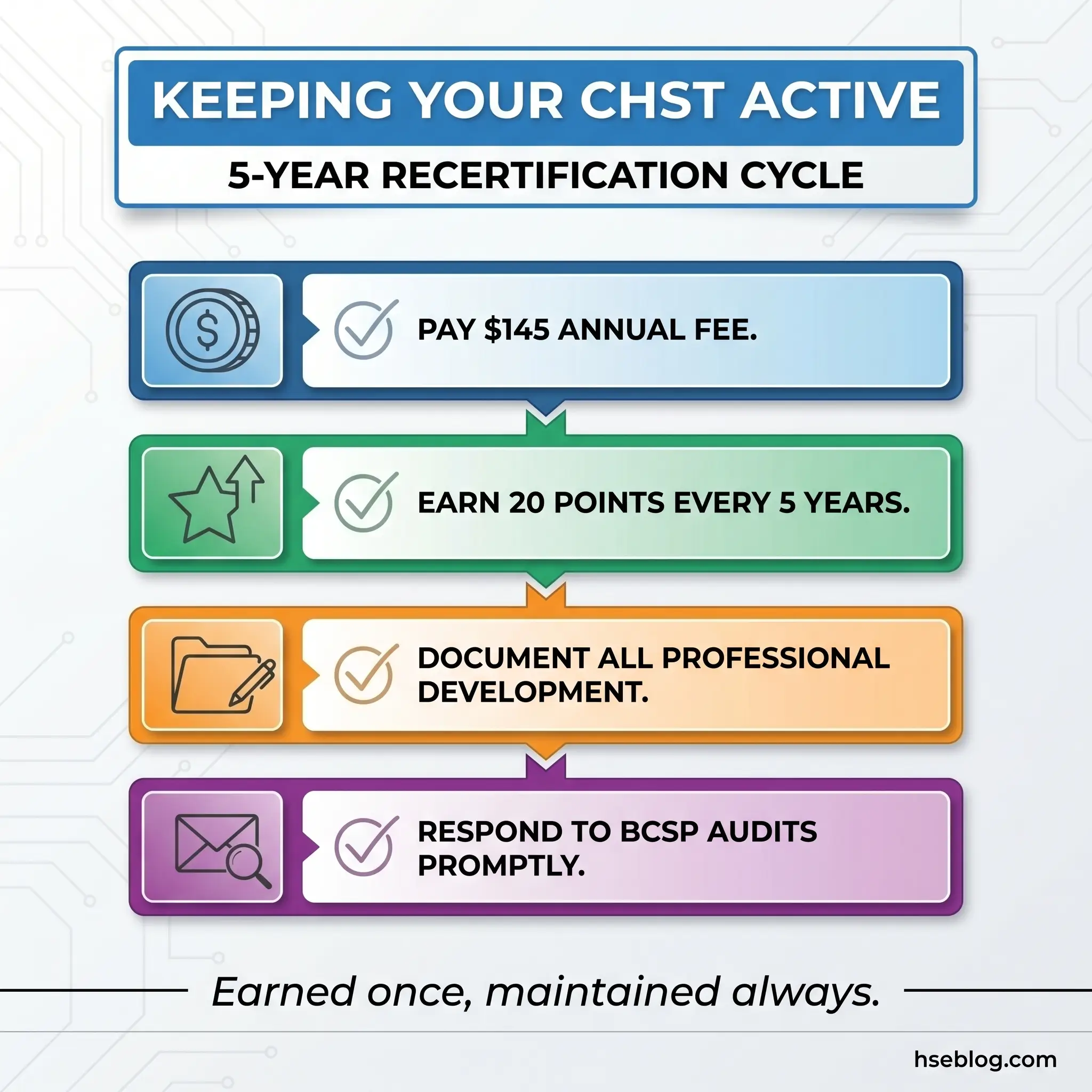
- Annual maintenance fee: Currently $145 per year. This must be paid to retain active credential status. Missing a payment can result in your credential being placed in inactive status
- Recertification points: You must accumulate 20 recertification points every five years. Points are earned through professional development activities including continuing education courses, conference attendance, publishing safety-related content, mentoring, and professional association involvement
- Alternative recertification: If you cannot accumulate sufficient points, you may retake the CHST examination to renew your certification
- Record retention: Maintain documentation of all recertification activities. BCSP may audit your records at any time during the five-year cycle
The recertification system rewards active professionals who continue to grow. Attending an ASSP professional development conference, completing an OSHA Training Institute course, or presenting a safety topic at an industry seminar all generate points. The system is designed so that anyone genuinely working in construction safety should accumulate the required points through normal professional activity.
Why the CHST Matters: Career Impact and Industry Recognition
Credentials matter most when they change hiring outcomes. On a large EPC project in the Gulf, the client’s HSE specification required all contractor safety personnel to hold either a CHST, CSP, or equivalent BCSP credential. Three subcontractors scrambled to replace uncredentialed safety staff before mobilization — a costly and disruptive consequence of ignoring certification requirements.
The career impact of the CHST credential extends across several measurable dimensions:
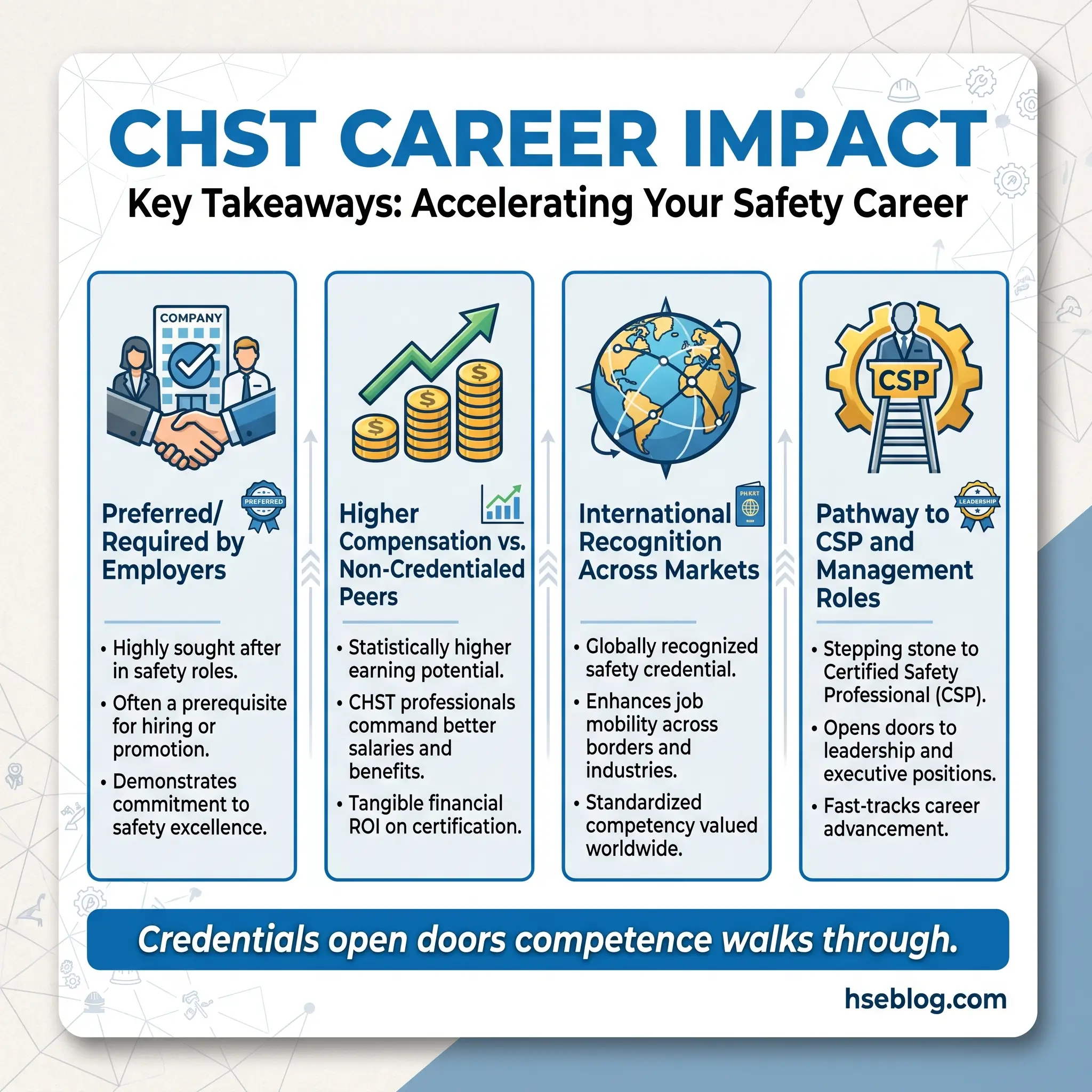
- Hiring preference: Construction firms, general contractors, and EPC companies increasingly list the CHST as a preferred or required qualification in safety technician and safety coordinator job postings
- Salary differentiation: CHST holders typically command higher compensation than non-credentialed peers in equivalent roles. BCSP’s own salary calculator and industry surveys consistently show a credential premium
- Professional mobility: The CHST is recognized internationally, allowing credentialed professionals to pursue opportunities across geographic markets without re-qualifying under local systems
- Contract compliance: Many owner-operators and government agencies now include BCSP credential requirements in contractor prequalification criteria. Holding a CHST can directly affect whether your employer wins or loses bids
- Advancement pathway: The credential positions you for progression into safety manager, project safety director, and HSE lead roles — particularly when combined with field experience and continuous professional development
The CHST does not replace field competence. No credential can substitute for the ability to walk a jobsite, recognize a hazard, and stop the work before someone gets hurt. What the CHST does is verify that your competence has been independently assessed against a recognized standard — and that verification carries weight in boardrooms, prequalification meetings, and courtrooms.
Conclusion
The Construction Health and Safety Technician certification fills a critical gap in construction safety credentialing. It recognizes the practitioners who are on the ground every day — walking scaffolds, reviewing excavation permits, running toolbox talks, and stopping unsafe work before it becomes an incident. Unlike credentials that require advanced degrees, the CHST meets experienced field professionals exactly where they are and asks a direct question: can you demonstrate competency in the work you already do?
Preparing for and passing the CHST exam demands discipline. The 65% first-attempt pass rate confirms that this is not a credential you collect by showing up. It requires deliberate study, honest self-assessment of your domain-specific weaknesses, and timed practice that replicates exam conditions. Candidates who approach it with the same rigor they bring to a critical lift plan or a confined space entry tend to pass.
Every construction site deserves safety personnel whose competence has been verified by something more rigorous than a wallet card from a weekend course. The CHST provides that verification. If you have spent three or more years protecting construction workers and you have not yet pursued this credential, the question is not whether you can afford to earn it — it is whether you can afford not to.