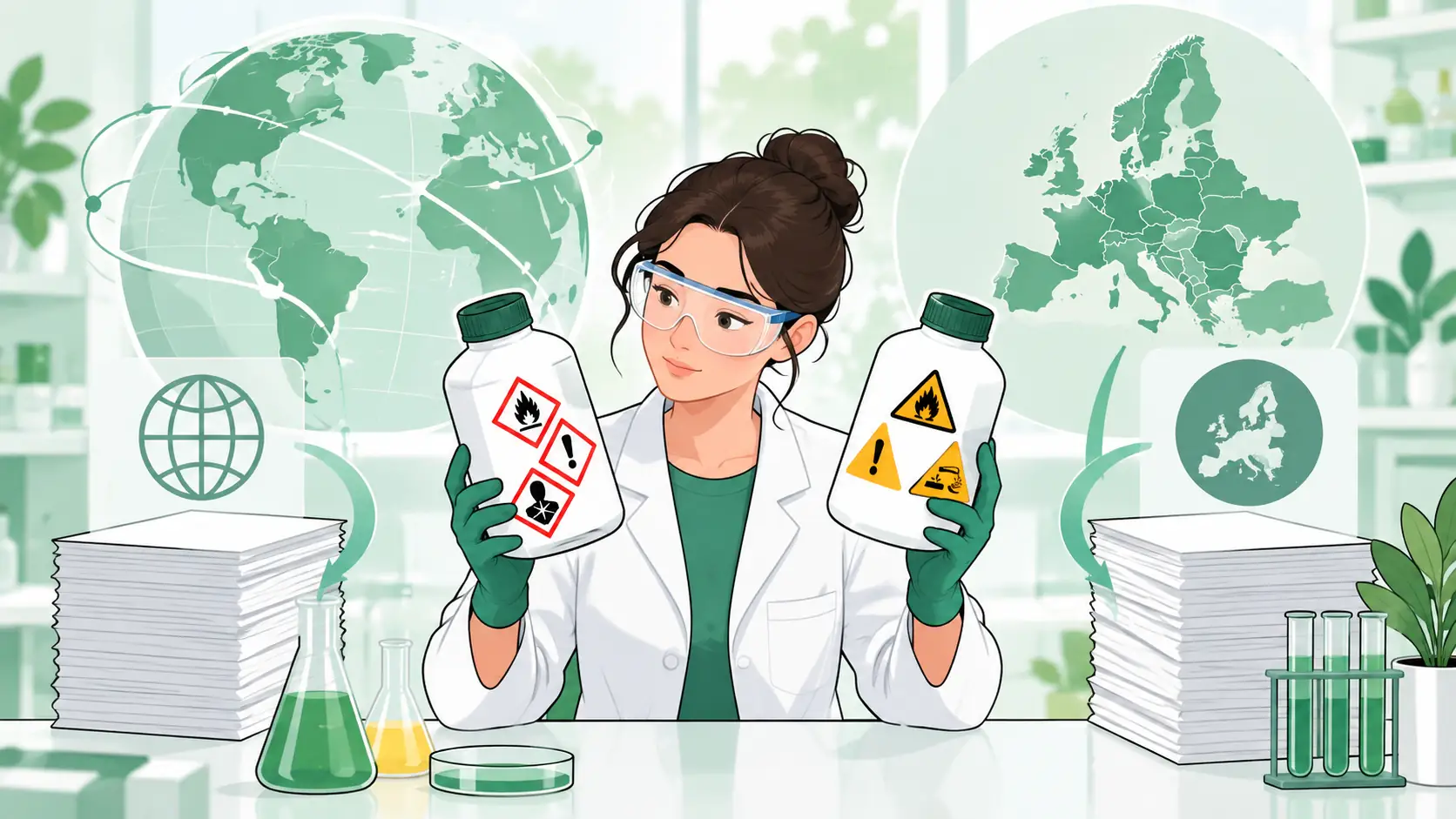
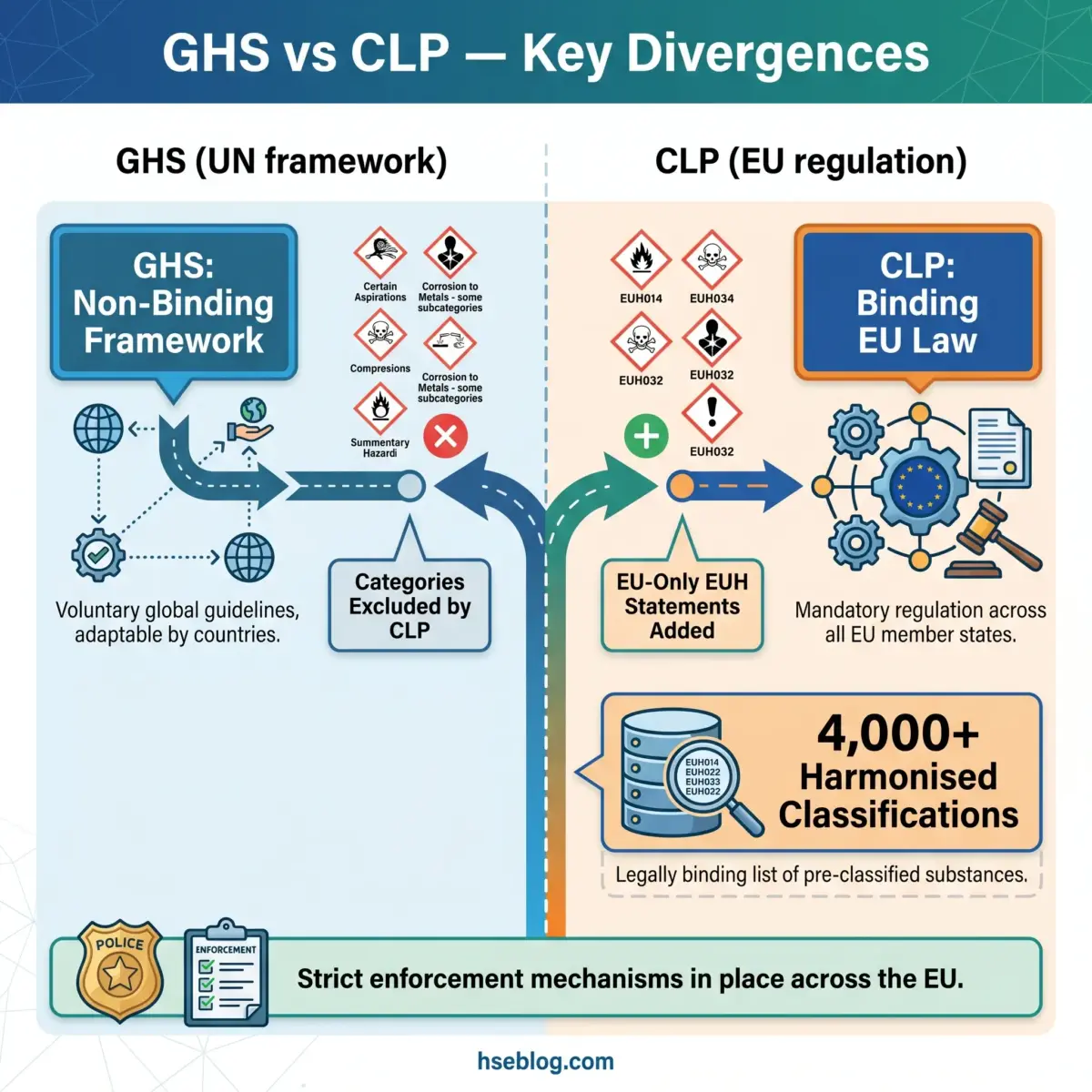
CLP (Classification, Labelling and Packaging) is the EU's legally binding implementation of the UN's Globally Harmonized System (GHS). While CLP adopts most GHS hazard classes, it excludes some lower-severity categories, adds EU-specific hazard statements (EUH codes) and unique hazard classes for endocrine disruptors and persistent substances, and maintains a mandatory harmonised classification list that GHS does not require. A GHS-compliant label from another jurisdiction does not automatically satisfy CLP requirements.
Regulation (EC) No 1272/2008 — the CLP Regulation — carries direct legal force across every EU and EEA Member State, with non-compliance triggering enforcement action, market withdrawal, and financial penalties. In the United States, the parallel OSHA Hazard Communication Standard (29 CFR 1910.1200) recorded 2,888 violations in fiscal year 2024 (US OSHA, 2025), making it the second most frequently cited standard across all industries. These are not abstract regulatory frameworks. They govern every safety data sheet, every chemical label, and every hazard communication programme in their respective jurisdictions — and they do not produce identical outcomes for the same substance.
That divergence is precisely what this article addresses. GHS provides the global menu; CLP is one jurisdiction's selection from that menu, with significant additions and omissions that make "GHS-compliant" an unreliable shorthand for "CLP-compliant." Understanding where these two systems align and where they diverge is not optional for any HSE professional, SDS author, or compliance manager handling chemicals across borders. The sections below walk through each point of divergence — from un-adopted hazard categories to the EU's new 2023 hazard classes — and explain why those differences create real compliance risk.
What Are GHS and CLP? Definitions and Core Purposes
GHS — the Globally Harmonized System of Classification and Labelling of Chemicals — is a framework developed under the United Nations. First adopted in 2002, it provides a standardised set of criteria for classifying chemical hazards and a uniform approach to hazard communication through labels and safety data sheets. The current edition, GHS Revision 11, was published by UNECE on 12 September 2025. Critically, GHS is a recommendation. It is not a treaty, not a binding convention, and has no enforcement mechanism of its own. For GHS to carry legal weight, a national or regional government must transpose it into domestic legislation.
CLP — the Classification, Labelling and Packaging Regulation — is how the European Union performed that transposition. Enacted as Regulation (EC) No 1272/2008 and in force since 20 January 2009, CLP replaced the earlier Dangerous Substances Directive (67/548/EEC) and Dangerous Preparations Directive (1999/45/EC). Unlike GHS, CLP is directly applicable law. Every substance and mixture placed on the EU market must be classified, labelled, and packaged in accordance with CLP, with notification obligations to the European Chemicals Agency (ECHA).
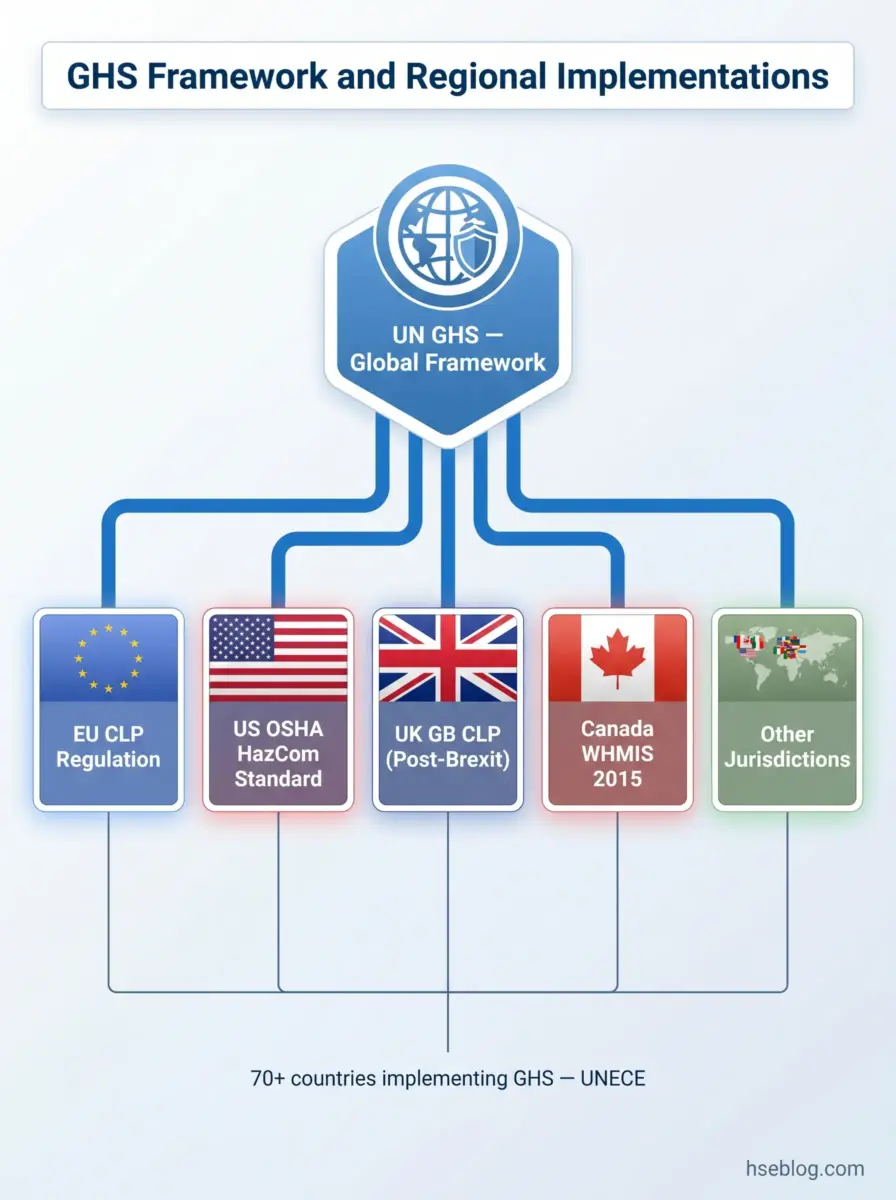
The relationship is parent-child, not synonymous. GHS is the global template; CLP is one regional implementation. Other major implementations include OSHA's HazCom Standard in the US, WHMIS 2015 in Canada, GB CLP in the UK post-Brexit, China's GB 30000 series, and Japan's JIS Z 7252. GHS has been implemented in over 70 countries worldwide (UNECE, current), but no two implementations are identical — and that is by design.
A persistent failure mode across the supply chain is worth flagging here. Suppliers frequently describe their SDS or label as "GHS compliant" and treat that phrase as universal. In practice, a GHS-compliant SDS produced under US HCS requirements will not satisfy CLP obligations because different building blocks were adopted, different hazard categories apply, and EU-specific elements are absent entirely. "GHS compliant" tells you the format family — it does not tell you the jurisdiction.
How Does GHS Work as a Framework? The Building Block Approach
The reason CLP and GHS are not identical is structural, and it traces back to how GHS was designed. The UN did not create GHS as a rigid, all-or-nothing standard. Instead, GHS operates on a building block approach — a deliberate design choice that allows each adopting jurisdiction to select which hazard classes, hazard categories within those classes, and communication elements it will implement.
This means a country may adopt all categories within a given hazard class or only the most severe ones. It may add hazard communication elements that GHS does not contain. It may adopt the framework based on one GHS revision while another country adopts a different revision entirely. The result is that the same chemical, assessed against the same body of toxicological data, can carry different classifications in different markets — not because the data changed, but because the regulatory criteria differ.
Consider a substance with an oral LD50 of 2,500 mg/kg. Under GHS, this falls into Acute Toxicity Category 5 (H303). The EU does not adopt Category 5 under CLP — it stops at Category 4. So in the EU, this substance would not be classified for acute oral toxicity under CLP at all, while in a jurisdiction that adopted all five GHS categories, it would carry H303 on its label. Same substance, same data, different classification outcome.
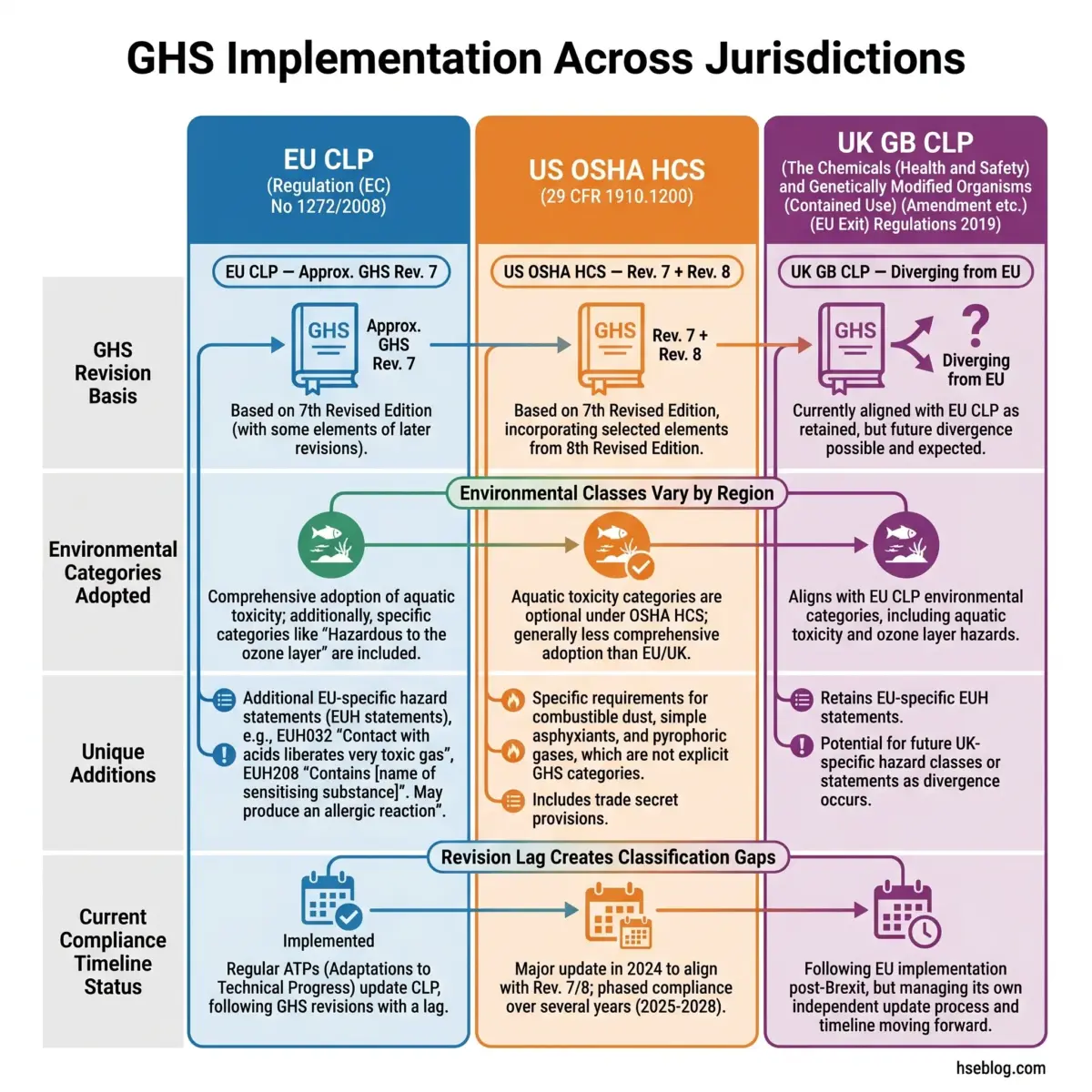
The practical implication for companies operating across borders is direct: you cannot classify a substance once and export that classification globally. Each destination market's building block selections and GHS revision basis must be checked independently. The EU adopted building blocks approximately aligned to GHS Rev. 7. OSHA's 2024 HazCom final rule aligned the US to GHS Rev. 7 with select Rev. 8 elements. GHS Rev. 11 was published in September 2025 — and neither the EU nor the US has adopted it yet. Different jurisdictions, different revisions, different outcomes.
What Are the Key Differences Between CLP and GHS?
This is where the comparison moves from conceptual to concrete. The divergences between CLP and GHS fall into several distinct categories: hazard categories the EU chose not to adopt, elements the EU added beyond GHS, the harmonised classification system unique to CLP, labelling and packaging rules more prescriptive than GHS requires, and the revision lag between UN updates and EU adoption. Each creates a specific compliance requirement that "GHS compliance" alone does not satisfy.
The following table summarises the primary points of divergence before the detailed discussion below.
| Dimension | GHS (UN Framework) | CLP (EU Implementation) |
|---|---|---|
| Legal status | Non-binding UN recommendation | Directly applicable EU law (Reg. EC 1272/2008) |
| Hazard categories | Full menu of all categories within each class | Excludes several lower-severity categories (Cat. 5 Acute Tox., Cat. 3 Skin Irrit., Cat. 2B Eye Irrit., others) |
| EU-specific statements | Not applicable | EUH statements (Annex II Part 1), plus new hazard classes (ED, PBT/vPvB, PMT/vPvM) |
| Mandatory classification list | No global equivalent | Annex VI — over 4,000 harmonised substance entries (ECHA, ongoing) |
| Precautionary statements on label | No numeric limit specified | Typically limited to six on the label |
| Packaging requirements | General guidance | Specific: child-resistant fastenings, tactile warnings |
| Revision basis | Rev. 11 (September 2025) | Approximately aligned to Rev. 7 |
| Enforcement | None — framework only | Member State enforcement, penalties, ECHA notification |
Hazard Categories Not Adopted Under EU CLP
When the EU transposed GHS into CLP, it deliberately excluded the lowest-severity tier within several hazard classes. The rationale was that these categories represent hazards of sufficiently low magnitude that mandatory classification and labelling obligations were not warranted in the EU market. The excluded categories, with their associated H-codes, are:
- Flammable Liquids Category 4 (H227) — flash point above 60°C and up to 93°C
- Acute Toxicity Category 5 (H303, H313, H333) — the lowest acute toxicity tier across oral, dermal, and inhalation routes
- Skin Corrosion/Irritation Category 3 (H316) — mild skin irritation
- Serious Eye Damage/Eye Irritation Category 2B (H320) — mild, reversible eye irritation
- Aspiration Hazard Category 2 (H305) — lower-confidence aspiration concern
- Aquatic Acute Toxicity Category 2 (H401) and Category 3 (H402) — moderate and mild acute aquatic toxicity
These H-codes should not appear on any SDS or label intended for the EU/EEA market. One point that consistently catches SDS authors: CLP's Category 2 for eye irritation corresponds to GHS Category 2A (the more severe sub-category), not to 2B. An SDS imported from a jurisdiction that uses GHS Category 2B must not carry that classification into a CLP context.
EU-Specific Hazard Classes and Statements Not in GHS
CLP does not just subtract from GHS — it adds substantially. The most established additions are the EUH statements (supplemental hazard information listed in Annex II, Part 1 of CLP). These statements originated from risk phrases under the EU's former Dangerous Substances and Dangerous Preparations Directives that had no GHS equivalent. Examples include EUH014 ("Reacts violently with water"), EUH029 ("Contact with water liberates toxic gas"), and EUH071 ("Corrosive to the respiratory tract"). They are mandatory on EU labels and SDS where applicable, and they exist nowhere in the GHS framework.
More significantly, the EU introduced entirely new CLP hazard classes via Delegated Regulation (EU) 2023/707 that have no parallel in any GHS revision or any other jurisdiction's implementation:
| New Hazard Class | EUH Codes | Compliance — New Substances/Mixtures | Compliance — Existing Substances/Mixtures |
|---|---|---|---|
| Endocrine Disruptors — human health | EUH380 / EUH381 | Substances: 1 May 2025; Mixtures: 1 May 2026 | Substances: 1 November 2026; Mixtures: 1 May 2028 |
| Endocrine Disruptors — environment | EUH430 / EUH431 | Same as above | Same as above |
| PBT (Persistent, Bioaccumulative, Toxic) | EUH440 | Same as above | Same as above |
| vPvB (very Persistent, very Bioaccumulative) | EUH441 | Same as above | Same as above |
| PMT (Persistent, Mobile, Toxic) | EUH450 | Same as above | Same as above |
| vPvM (very Persistent, very Mobile) | EUH451 | Same as above | Same as above |
These new hazard classes mark a significant expansion of CLP beyond GHS. As of 2025–2026, no other GHS-implementing jurisdiction — not the US, not the UK, not Canada — has adopted equivalent classifications. For companies placing substances or mixtures on the EU market, these classes require new assessment against criteria that GHS does not contain, new label elements, and new SDS content. The compliance deadlines are already active for new substances as of May 2025, making this an immediate operational requirement, not a future consideration.
Jurisdiction Note: The new 2023 hazard classes apply in EU/EEA Member States and, under the Windsor Framework, in Northern Ireland. They do not apply in Great Britain (England, Scotland, Wales) under GB CLP.
Harmonised Classification vs Self-Classification Under CLP
CLP operates a dual classification mechanism that GHS itself does not prescribe. Annex VI of the CLP Regulation contains a binding list of harmonised classifications for over 4,000 substances (ECHA, ongoing), updated annually through Adaptations to Technical Progress (ATPs). Where a harmonised classification entry exists for a substance, that classification is mandatory — it overrides any self-classification the supplier might reach independently for the endpoints covered by the entry.
However, harmonised entries rarely cover every hazard endpoint. A substance may have a harmonised classification for carcinogenicity and reproductive toxicity but no entry for skin sensitisation or aquatic toxicity. For those uncovered endpoints, the supplier must self-classify based on available data. This dual approach — mandatory harmonised classification plus self-classification for remaining endpoints — is unique to CLP's implementation structure.
The judgment call for SDS authors is straightforward but frequently missed: always check Annex VI before finalising a classification. The failure to consult the harmonised list — particularly for well-known industrial chemicals where the supplier assumes their in-house data is sufficient — is one of the more common audit findings in EU chemical safety compliance.
How Other Major Jurisdictions Implement GHS Differently
The CLP–GHS divergence is not unique to the EU. Every major GHS-adopting jurisdiction has made its own building block selections, and understanding these differences reinforces why "GHS compliant" is never a sufficient compliance statement for any single market.
United States — OSHA HCS 2024. OSHA published its final rule on 20 May 2024, aligning the US Hazard Communication Standard to GHS Rev. 7 with select Rev. 8 elements, effective 19 July 2024. This was a significant update — the previous US HCS was aligned to GHS Rev. 3, meaning substances classified under the old standard may receive different classifications under the updated criteria. OSHA extended compliance deadlines by four months in a January 2026 final rule: substances must comply by May 2026, employer hazard communication programmes by November 2026, mixtures by November 2027, and employer programmes for mixtures by May 2028. Notably, OSHA HCS includes provisions for combustible dust and simple asphyxiants that GHS does not contain as standalone classes, but it does not adopt environmental hazard categories at all — a major structural difference from CLP.
United Kingdom — GB CLP. At Brexit on 31 January 2020, the UK retained EU CLP as GB CLP. Initially identical, the two systems are now diverging. Great Britain maintains its own Mandatory Classification and Labelling (MCL) list, separate from EU Annex VI, with different ATP update schedules. The UK has not adopted the 2023 new EU hazard classes (ED, PBT/vPvB, PMT/vPvM) for the GB market. Northern Ireland, under the Windsor Framework, continues to follow EU CLP — creating a regulatory split within the UK itself.
The practical trap for companies with historical classifications is worth identifying. An organisation that classified a substance under US HCS when it was aligned to GHS Rev. 3 may find that the classification changes when it updates to Rev. 7 compliance. The criteria within the "same" GHS framework produce different outcomes at different revision levels. This is not a deficiency — it reflects evolving scientific understanding — but it means reclassification is not optional when a jurisdiction updates its GHS revision basis.
Watch For: OSHA's Hazard Communication standard recorded 2,546 violations in preliminary FY 2025 data (US OSHA, 2025), maintaining its position as the second most frequently cited standard. Chemical classification and labelling compliance remains a persistent enforcement focus even in jurisdictions with mature GHS implementation.
CLP Labelling and Packaging Requirements Beyond GHS
CLP's labelling provisions go well beyond what GHS specifies, and this is one of the areas where compliance failures most frequently occur for companies entering the EU market. GHS provides general guidance on label content and layout. CLP prescribes specific requirements that affect physical label production.
The most operationally significant CLP-specific labelling requirement is the limit on precautionary statements. CLP guidance restricts labels to typically no more than six precautionary statements, requiring the supplier to select the most relevant ones. GHS does not impose this numeric restriction. For substances with multiple hazard classifications — which is common for industrial chemicals — this forces a prioritisation exercise that the GHS framework leaves open.
CLP also specifies minimum label dimensions and minimum pictogram sizes tied to package capacity. Packages of 3 litres or less require labels of at least 52 × 74 mm, scaling upward for larger containers. These are binding requirements, not suggestions.
The CLP Amendment Regulation (EU) 2024/2865 — published 20 November 2024 and entering into force on 10 December 2024 — introduces additional labelling obligations that widen the gap further. New requirements include minimum font sizes, mandatory sans-serif fonts, black text on white backgrounds for hazard and precautionary statements, provisions for fold-out labels, QR codes linking to digital hazard information, and specific obligations for chemicals sold online.
Beyond labelling, CLP mandates child-resistant fastenings for packages containing substances classified in specific hazard categories (including acute toxicity Categories 1–3, STOT SE Category 1, and others). Tactile warnings — raised triangular shapes detectable by touch — are required for packages containing substances hazardous to consumers, including several acute toxicity, corrosivity, and flammability categories. GHS does not include equivalent packaging requirements.
Audit Point: The 2024 CLP amendment also requires that when a mixture's classification is triggered by an ED, PBT, vPvB, PMT, or vPvM substance, the identity of that contributing substance must appear on the label. This creates a new content requirement that will challenge label space, particularly for multi-component mixtures — a practical operational issue that formulators and label designers are already navigating.
GHS Revision Cycle and Its Impact on CLP Updates
GHS is not static. The UNECE Sub-Committee of Experts on the GHS updates the framework biennially, and each revision may introduce new hazard classes, refine classification criteria, adjust precautionary statement language, or incorporate new testing guidance. GHS Rev. 11, published in September 2025, introduced a climate-relevant hazard classification (contributing to global warming), non-animal testing guidance for skin sensitisation, and rationalised precautionary statements (UNECE, 2025).
CLP does not automatically absorb these updates. Adoption of new GHS elements into CLP requires formal EU legislative action — typically through Delegated Regulations or ATPs to the CLP Regulation. This process takes time, involves regulatory impact assessment, and may result in the EU adopting some elements of a revision while declining others. The result is a persistent lag: CLP is currently approximately aligned to GHS Rev. 7, while the published global framework has advanced to Rev. 11.
This lag is not merely academic. A toxicologist or regulatory affairs specialist reviewing GHS Rev. 11 criteria will find classification thresholds and category definitions that do not yet apply in the EU. Applying Rev. 11 criteria to a CLP classification would be incorrect — CLP remains governed by the criteria in its own regulation as amended, regardless of what the latest GHS revision says. The field procedure most aligned with sound compliance practice is to classify according to the target jurisdiction's adopted criteria, not according to the latest published GHS revision, unless that jurisdiction has formally adopted it.
Why the Difference Between CLP and GHS Matters in Practice
The divergences outlined above are not regulatory trivia. They create concrete compliance risks for any organisation that manufactures, imports, distributes, or uses chemicals across jurisdictional boundaries.
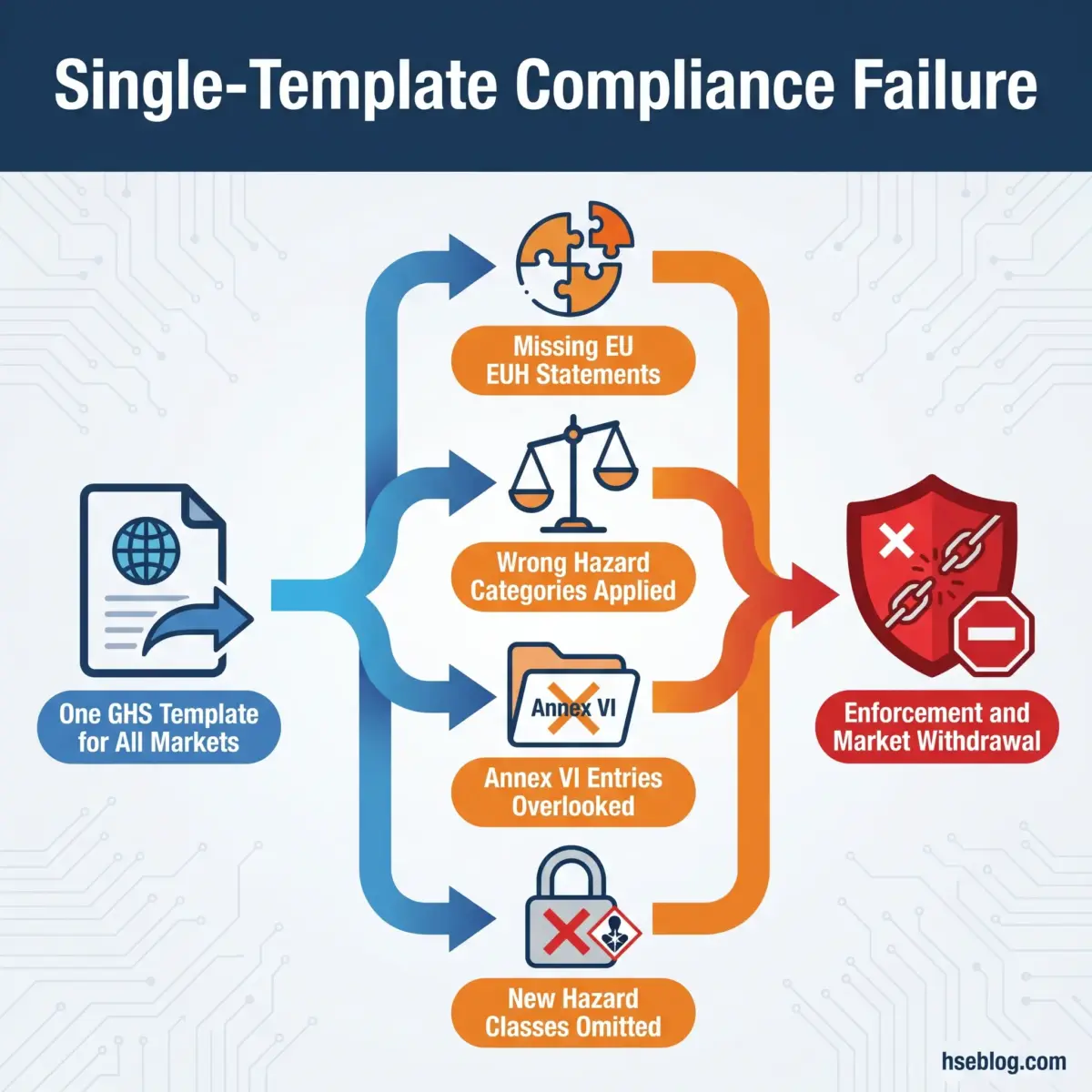
A substance classified under one GHS-implementing jurisdiction may not carry the same classification in the EU, and vice versa. The building block selections, un-adopted categories, EU-specific additions, harmonised classification entries, and revision-level differences all contribute to potential mismatches. A "GHS label" produced under US HCS requirements — which does not include environmental classifications, EUH statements, or harmonised Annex VI entries — is not CLP-compliant by default. A separate CLP assessment is always required.
The enforcement consequences are real. Sites cited for OSHA Hazard Communication violations face penalties up to $165,514 per willful or repeat violation under 2025 rates (US OSHA, 2025). In the EU, Member State authorities enforce CLP through market surveillance, and non-compliance can result in product withdrawal, reformulation orders, and administrative or criminal penalties depending on the jurisdiction.
The highest-risk failure mode — and one that appears repeatedly across multinational organisations — is the single-template approach. An organisation maintains one SDS and one label template, makes minor adjustments per market, and assumes compliance. This approach systematically misses the building block divergences, the EUH requirements, the new 2023 hazard classes, and the harmonised classification obligations that are invisible to generic, jurisdiction-unaware templates. The only reliable approach is jurisdiction-specific classification and labelling, built from the target market's adopted GHS revision, building block selections, and any jurisdiction-specific additions.
Frequently Asked Questions
Is CLP the same as GHS?
No. CLP is the EU's legally binding implementation of the GHS framework. It adopts most GHS hazard classes but excludes several lower-severity categories, adds EU-specific EUH statements and entirely new hazard classes (endocrine disruptors, PBT/vPvB, PMT/vPvM), and maintains a mandatory harmonised classification list of over 4,000 substances under Annex VI. GHS itself is a non-binding UN recommendation with no enforcement mechanism.
What GHS hazard categories does CLP not include?
CLP excludes the lowest-severity tiers within several hazard classes: Flammable Liquids Category 4 (H227), Acute Toxicity Category 5 (H303/H313/H333), Skin Irritation Category 3 (H316), Eye Irritation Category 2B (H320), Aspiration Hazard Category 2 (H305), and Aquatic Acute Toxicity Categories 2 and 3 (H401/H402). These H-codes must not appear on EU/EEA labels or SDS.
What are EUH statements and why do they only exist in CLP?
EUH statements are supplemental hazard information statements unique to the EU CLP Regulation. They originate from risk phrases under the EU's pre-GHS Directives (67/548/EEC and 1999/45/EC) that had no GHS equivalent, plus new hazard classes introduced in 2023. Examples include EUH014 (reacts violently with water), EUH071 (corrosive to respiratory tract), and EUH380/EUH440 (endocrine disruptor/PBT classifications). No other GHS jurisdiction uses them.
Does a GHS-compliant label from the US meet CLP requirements?
Not automatically. US OSHA HCS does not require environmental hazard classification, does not include EUH statements, does not reference EU harmonised classifications from Annex VI, and may apply hazard categories that CLP does not adopt. A separate, jurisdiction-specific CLP classification and labelling assessment is required before placing a product on the EU market.
How does UK CLP differ from EU CLP after Brexit?
GB CLP was initially identical to EU CLP but is diverging. Great Britain maintains a separate Mandatory Classification and Labelling list, follows a different ATP update schedule, and has not adopted the 2023 new EU hazard classes (ED, PBT/vPvB, PMT/vPvM). Northern Ireland continues to follow EU CLP under the Windsor Framework, creating a regulatory split within the UK.
Which GHS revision does CLP currently follow?
CLP is approximately aligned to GHS Rev. 7, though it does not mechanically mirror any single revision. New GHS elements are incorporated into CLP through formal EU legislative acts — Delegated Regulations and ATPs — which typically lag several years behind the current GHS edition. The latest published GHS revision is Rev. 11, published by UNECE in September 2025.
Conclusion
The difference between CLP and GHS is not a matter of terminology — it is a structural compliance issue with measurable consequences. GHS provides the global classification and labelling framework. CLP is one jurisdiction's binding legal implementation of that framework, with deliberate omissions, significant additions, and enforcement mechanisms that GHS itself does not carry. Every other major GHS jurisdiction — the US, UK, Canada, and beyond — has made its own distinct selections from the same framework, producing a global landscape where "GHS compliant" means something different in every market.
That landscape is growing more complex, not less. The EU's 2023 introduction of hazard classes for endocrine disruptors, PBT, vPvB, PMT, and vPvM — with compliance deadlines already active — has no equivalent anywhere else in the world. The 2024 CLP amendment adds new labelling prescriptions. GHS Rev. 11 introduces elements that neither the EU nor the US has adopted yet. The post-Brexit divergence between GB CLP and EU CLP continues to widen. For HSE professionals and regulatory affairs specialists managing chemical compliance across borders, the operational discipline is clear: classify and label per jurisdiction, verify building block selections and revision bases independently, and treat every "GHS compliant" claim as a starting point for verification — never as a destination.