
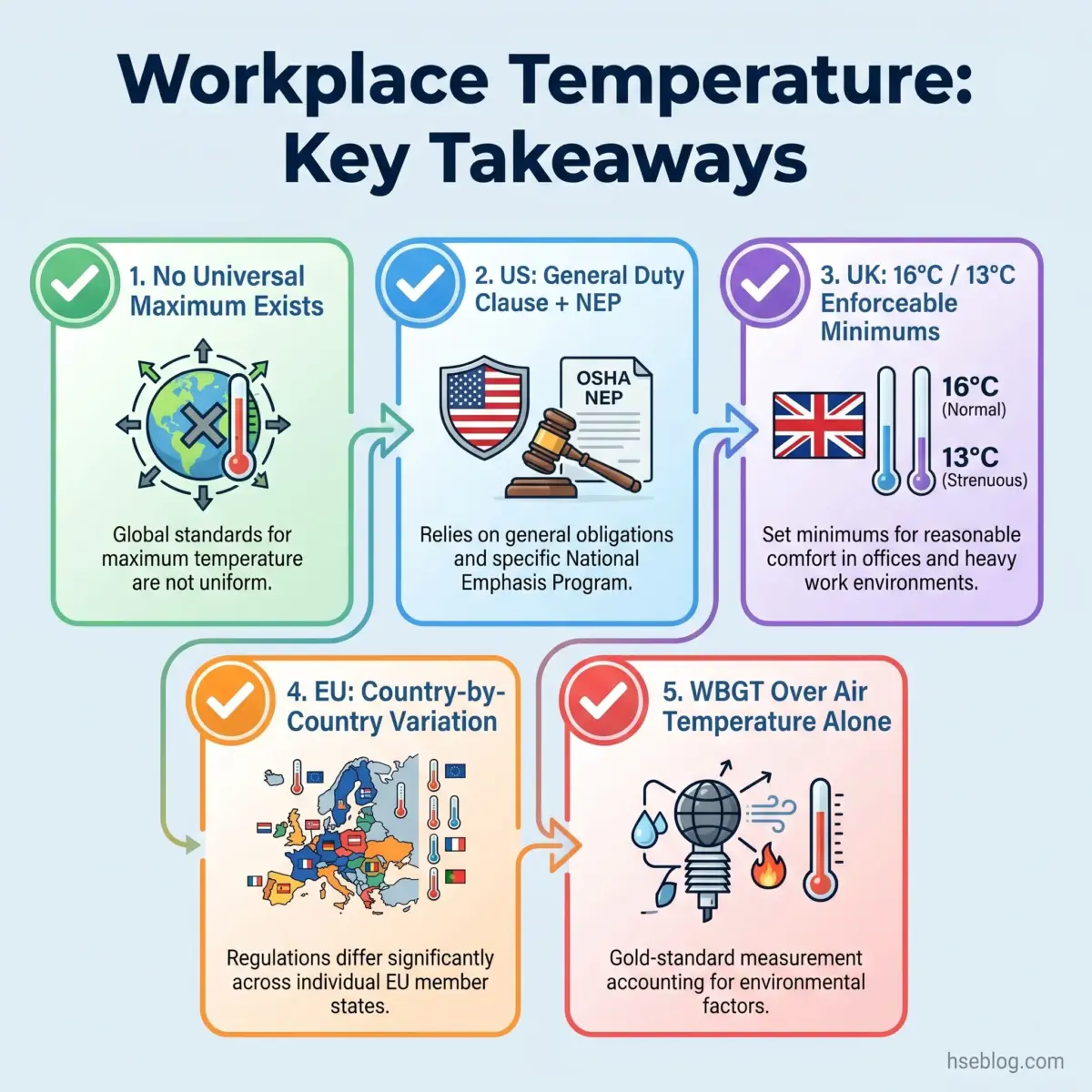
Workplace temperature regulations vary by jurisdiction, but most countries do not impose a single binding maximum. In the US, OSHA recommends 68–76°F for indoor settings and enforces heat hazards through the General Duty Clause and the updated 2026 National Emphasis Program. The UK sets enforceable minimums of 16°C and 13°C but no maximum. Spain mandates 17–27°C for office work. Compliance everywhere depends on thermal comfort risk assessment, not a single number.
Regulatory content in this article reflects general HSE professional understanding of the cited jurisdictions as of 2026. It is not legal advice. Specific compliance questions, enforcement situations, or prosecution risk should be directed to qualified legal counsel in the applicable jurisdiction.
On April 10, 2026, OSHA issued an updated National Emphasis Program targeting heat-related hazards across 55 high-risk industries — 22 of them newly added — with enforcement authority extending to opportunistic heat inspections during any site visit (OSHA's heat illness prevention rulemaking page). That directive, effective for five years through 2031, signals something that every employer operating in the US needs to internalize: the absence of a specific federal heat standard has never meant the absence of federal enforcement, and the enforcement apparatus is expanding.
The confusion around workplace temperature regulations runs deeper than most employers realize. Across every jurisdiction I review — US federal, state-level, UK, EU — the same question recurs: what temperature is too hot or too cold to work legally? The answer is rarely a single number, because thermal risk does not reduce to one. This article synthesizes the regulatory frameworks of the US, UK, and EU side by side, explains why no universal numeric limit exists, and provides the thermal comfort risk assessment methodology that actually drives compliance. Every regulatory citation includes its jurisdiction. Every statistic carries its source and year.
What Are Workplace Temperature Regulations?
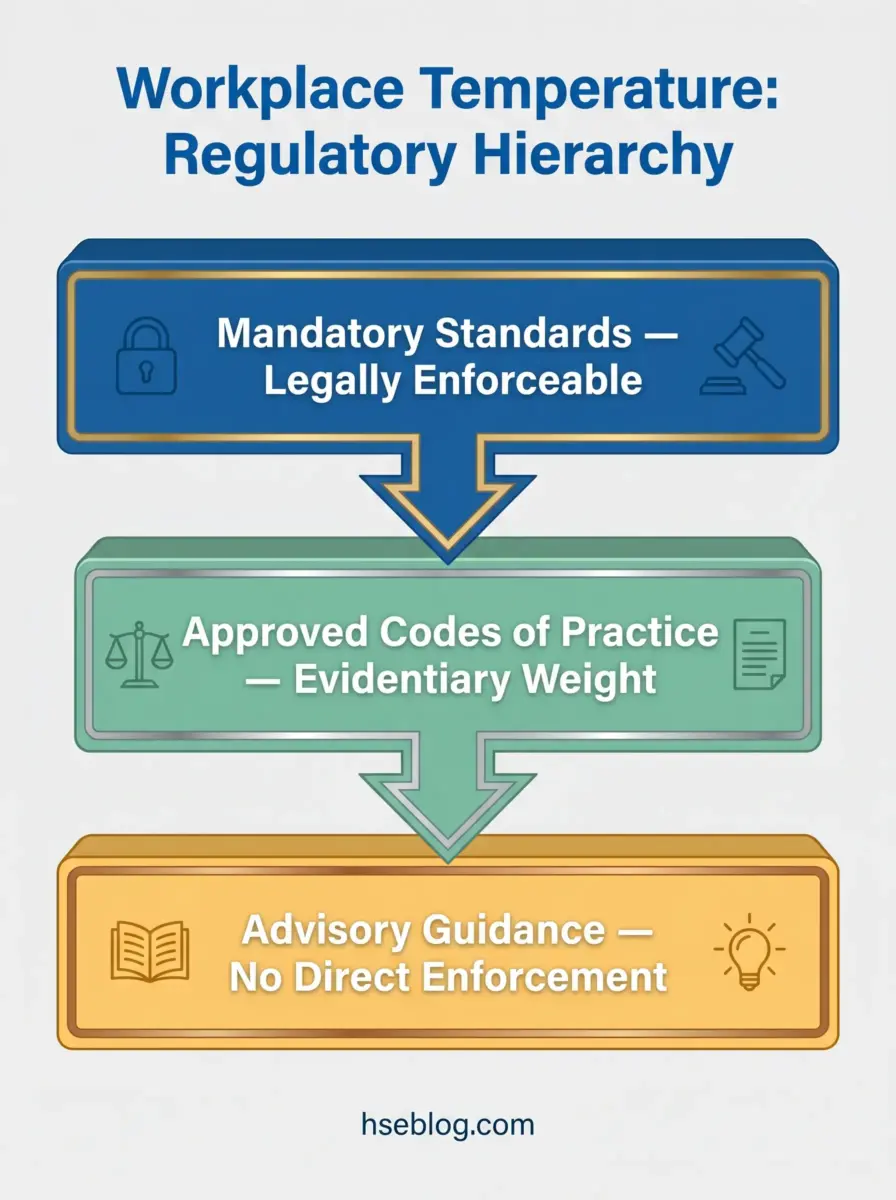
Workplace temperature regulations are the legal frameworks governing indoor and outdoor thermal conditions under which employees work. They encompass mandatory enforceable standards, approved codes of practice, and advisory guidance — three categories that employers routinely conflate, often to their detriment.
The core distinction matters: a mandatory standard carries legal force and specific penalties for violation. An approved code of practice (as in the UK) carries strong evidentiary weight — failing to meet it shifts the burden of proof to the employer. Advisory guidance (such as OSHA's recommended temperature range) carries no direct enforcement power but may inform enforcement actions under broader duties. Treating all three as equivalent leads to either over-compliance on advisory figures or — far more dangerously — under-compliance on binding obligations.
The reason most jurisdictions have not established a single mandatory minimum or maximum is not regulatory neglect. Thermal comfort depends on six interacting variables: air temperature, radiant temperature, humidity, air velocity, metabolic rate, and clothing insulation. A warehouse worker in heavy PPE performing manual handling at 24°C faces a materially different thermal load than an office worker at the same temperature in light clothing. A single number cannot capture that variance, which is why the regulatory trend across all major jurisdictions favors risk-assessment-based approaches over fixed thresholds.
Watch For: The most common employer misunderstanding is assuming that "there must be a number somewhere." In practice, the absence of a hard limit is deliberate — and it places a greater burden on employers, not a lesser one, because it requires them to assess and justify their own thermal conditions rather than simply checking a thermometer against a threshold.
Workplace Temperature Regulations in the United States
The US federal framework for workplace temperature is built on a paradox that trips up employers every summer: OSHA recommends an indoor temperature range of 68–76°F (20–24°C) and humidity of 20–60%, but these figures carry no enforcement power whatsoever. They are guidance — not regulation, not standard, not code. The enforceable mechanism is the General Duty Clause, Section 5(a)(1) of the OSH Act of 1970 (jurisdiction: US federal), which requires employers to provide a workplace "free from recognized hazards that are causing or are likely to cause death or serious physical harm."
That clause is broad by design, and OSHA has used it aggressively for heat-related enforcement. Approximately 7,000 heat-related inspections and 60 citations were conducted under the National Emphasis Program between April 2022 and December 2024 (OSHA / Jackson Lewis, 2025). The updated NEP issued April 10, 2026 (CPL 03-00-024, jurisdiction: US federal) expands enforcement further: it now targets 55 high-risk industries, adds 22 new industries to the priority list, and authorizes compliance officers to conduct opportunistic heat inspections during any site visit — not only on days with heat advisories (Littler Mendelson analysis).
The proposed federal Heat Injury and Illness Prevention Standard — the NPRM published August 30, 2024 (jurisdiction: US federal) — would establish an initial heat trigger at a heat index of 80°F and a high-heat trigger at 90°F, requiring written heat illness prevention plans, acclimatization protocols, rest breaks, and training. A public hearing concluded July 2, 2025. As of mid-2026, the rule remains stalled with no finalization date set. Employers preparing for summer 2026 should not wait for the proposed rule — the NEP is the active enforcement instrument now.
| Proposed Rule Element | Initial Trigger | High-Heat Trigger |
|---|---|---|
| Heat Index Threshold | 80°F (27°C) | 90°F (32°C) |
| Required Actions | Water, shade/cooling, acclimatization plan | Mandatory rest breaks, observation, enhanced monitoring |
| Status (2026) | Proposed — not finalized | Proposed — not finalized |
The practical reality: employers who interpret "no specific standard" as "no obligation" misread the enforcement landscape. The General Duty Clause combined with the expanded NEP creates a functional enforcement framework that has produced real citations, real penalties, and real inspections — the absence of a dedicated standard has not prevented OSHA from acting.
US State-Level Heat Standards
Where federal OSHA has stalled on a binding standard, several states have moved ahead with their own enforceable heat illness prevention rules. For multi-state employers, this patchwork creates genuine compliance complexity.
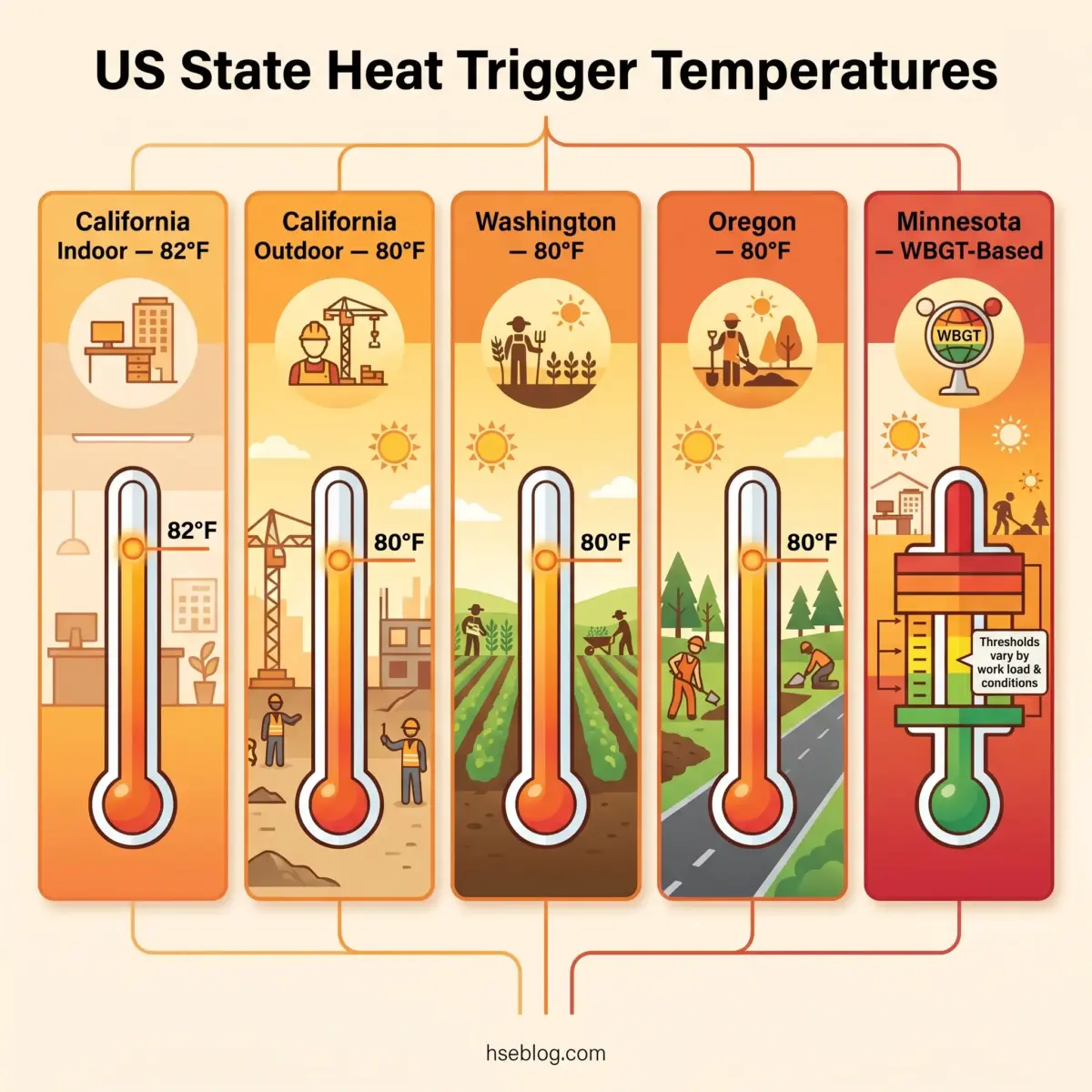
| State | Trigger Temperature | Key Requirements | Effective Date | Source |
|---|---|---|---|---|
| California (indoor) | 82°F | Water, cool-down areas, written plan; enhanced measures at 87°F | July 2024 | Title 8, §3396 |
| California (outdoor) | 80°F | Water, shade, high-heat procedures at 95°F | 2005 (revised) | Title 8, §3395 |
| Washington | 80°F | Year-round; mandatory paid breaks at higher temps | 2023 (revised) | WAC 296-62-095 |
| Oregon | 80°F | Indoor and outdoor; enhanced protections above 90°F | 2022 | OAR 437-002-0156 |
| Minnesota | WBGT-based | Min 60°F (heavy work), 65°F (light-moderate work) | In effect | MN OSHA standards |
Colorado, Maryland, and Nevada have active or proposed standards in various stages of rulemaking.
California's indoor heat standard (Section 3396, jurisdiction: California, effective July 23, 2024) is currently the most comprehensive in the US, requiring employers to measure temperature, provide cool-down areas, and implement a written Heat Illness Prevention Plan when indoor temperatures reach 82°F (Cal/OSHA heat illness prevention resources). The judgment call for multi-state employers: build a heat illness prevention program around the most stringent state standard — typically California — and apply it company-wide, rather than maintaining separate programs per state. The marginal cost of over-compliance in a less-regulated state is negligible compared to the compliance risk of managing a patchwork.
Workplace Temperature Regulations in the United Kingdom
The UK framework rests on Regulation 7 of the Workplace (Health, Safety and Welfare) Regulations 1992 (jurisdiction: UK), which states that temperature in all workplaces inside buildings shall be "reasonable" during working hours. That single word — "reasonable" — does more legal work than most employers appreciate.
The Approved Code of Practice accompanying the 1992 Regulations specifies enforceable minimums: 16°C for sedentary work and 13°C for work involving significant physical effort. These are not recommendations — failing to meet ACOP minimums shifts the burden of proof to the employer in any enforcement action or prosecution. An employer maintaining a warehouse at 11°C for workers performing moderate physical tasks cannot credibly claim compliance.
Audit Point: The ACOP minimum figures are legally enforceable in practice. If an HSE inspector finds a workplace below 16°C (sedentary) or 13°C (physical work) without documented justification and mitigation, the employer faces an improvement notice or, in repeated or serious cases, prosecution under the Health and Safety at Work etc. Act 1974, Section 2 (jurisdiction: UK).
The conspicuous gap in UK law is the absence of a statutory maximum workplace temperature. HSE's published position is that "every workplace is different," and no meaningful upper limit can be imposed without creating either unworkable obligations for process industries or false reassurance for everyone else. This absence is frequently misinterpreted as a licence to do nothing about heat — a dangerous misreading. The "reasonable temperature" requirement under Regulation 7, combined with the employer's duty under the Management of Health and Safety at Work Regulations 1999 (jurisdiction: UK) to assess all workplace risks, means employers must conduct a thermal comfort risk assessment and act on the findings (HSE guidance on workplace temperature law).
The Chartered Institution of Building Services Engineers (CIBSE) recommends a comfortable indoor working range of 16°C–24°C. While this is guidance rather than law, it provides a practical benchmark that many employers and workplace designers reference. The threshold for action is not a number on a thermometer — it is the proportion of workers reporting thermal discomfort, which is why HSE's assessment approach focuses on subjective reporting alongside objective measurement.
Workplace Temperature Standards in the European Union
The EU Framework Directive 89/391/EEC (jurisdiction: EU) requires all member-state employers to assess and prevent workplace risks, including thermal stress, but sets no specific temperature limits. Implementation falls to individual member states, producing a fragmented landscape that challenges multinational employers.
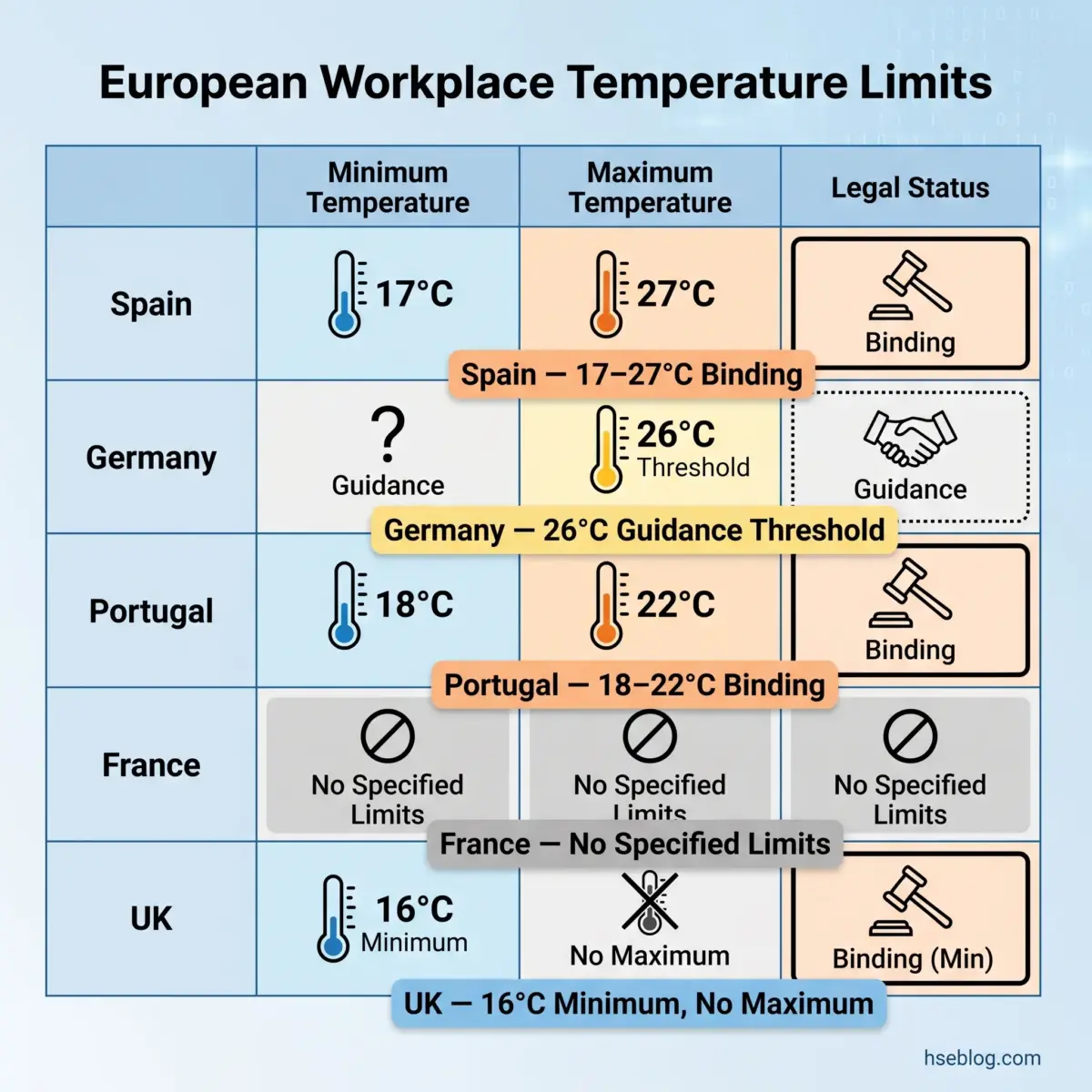
The variation across member states is striking, and a comparison table is the clearest way to present it:
| Country | Minimum | Maximum | Legal Status | Source Regulation |
|---|---|---|---|---|
| Spain | 17°C (office) / 14°C (light physical) | 27°C (office) / 25°C (light physical) | Binding | Royal Decree 486/1997 |
| Germany | Not specified | 26°C recommended; 30°C requires action; 35°C unsuitable | Guidance (ASR 3.5) | ASR A3.5 |
| Portugal | 18°C | 22°C (25°C permitted in some cases) | Binding | National legislation |
| France | Not specified | Not specified | N/A — general duty | Code du Travail |
| UK (post-Brexit, included for reference) | 16°C (sedentary) / 13°C (physical) | None | ACOP (binding in practice) | Workplace Regs 1992 |
Spain's Royal Decree 486/1997 (jurisdiction: Spain) stands out as one of the most specific frameworks in Europe, mandating 17–27°C for office work and 14–25°C for light physical work. These are binding limits — not guidance, not recommendations. Germany's ASR A3.5 takes a different approach: the 26°C threshold is advisory, but once indoor temperatures reach 30°C the employer must implement additional measures (ventilation, altered working hours, provision of drinks), and at 35°C the workspace is deemed unsuitable for continued work without protective measures equivalent to those used in outdoor hot environments. Despite its detail, ASR A3.5 is technically guidance, not binding regulation.
France specifies no maximum workplace temperature in the Code du Travail (jurisdiction: France), relying instead on the employer's general obligation to ensure worker safety. This generality contrasts sharply with Spain's specificity — and the gap creates real compliance questions for employers operating across both countries.
The European Trade Union Confederation (ETUC) has been calling for an EU-wide directive on maximum working temperatures, citing a 42% increase in heat-related workplace deaths in the EU since 2000 (ILO, 2024). European Parliament questions in 2024–2025 pressed the Commission on whether a binding directive would be proposed. No directive has been adopted yet, but the political momentum — driven by consecutive record-breaking summers — makes this a regulatory space to watch closely.
International Thermal Comfort Standards
The regulations discussed above operate against a backdrop of voluntary technical standards that provide the scientific methodology for assessing thermal environments. These standards are where the science meets the law — and where the gap between best practice and regulatory practice becomes most visible.
ISO 7730:2005 (jurisdiction: international) establishes the Predicted Mean Vote (PMV) and Predicted Percentage Dissatisfied (PPD) methodology for moderate thermal environments. PMV uses the six thermal comfort factors — air temperature, radiant temperature, humidity, air velocity, metabolic rate, and clothing insulation — to calculate a comfort index from −3 (cold) to +3 (hot). A PMV of zero represents thermal neutrality. PPD estimates the percentage of occupants likely to feel uncomfortably warm or cool at a given PMV. This methodology underpins most modern thermal comfort assessments in indoor environments.
ASHRAE Standard 55-2023 (jurisdiction: primarily US, widely referenced internationally) specifies thermal environmental conditions for human occupancy. Its compliance range requires a PMV between −0.5 and +0.5, which corresponds to fewer than 10% of occupants dissatisfied. ASHRAE 55 is the reference standard for HVAC design and indoor environmental quality assessments across North America and beyond.
For heat stress — as opposed to thermal comfort — the critical standard is ISO 7243 (jurisdiction: international), which defines the Wet Bulb Globe Temperature (WBGT) index. WBGT integrates dry-bulb temperature (air temperature), natural wet-bulb temperature (humidity and evaporative cooling), and globe temperature (radiant heat). This composite metric is far more accurate than air temperature or heat index alone because it accounts for all environmental factors that determine heat load on the human body.
The ACGIH Threshold Limit Values (TLV) for heat stress (jurisdiction: US, widely referenced) provide action limits and threshold limit values based on metabolic rate and WBGT, adjusted for acclimatization status. The NIOSH Criteria for a Recommended Standard on Occupational Exposure to Heat and Hot Environments (2016 revision, jurisdiction: US) provides the most detailed occupational exposure guidance available.
| Standard | What It Measures | Compliance Range | Primary Jurisdiction |
|---|---|---|---|
| ISO 7730 | Thermal comfort (PMV/PPD) | PMV −0.5 to +0.5 | International |
| ASHRAE 55 | Indoor thermal conditions | PMV −0.5 to +0.5 | US / International |
| ISO 7243 | Heat stress (WBGT) | Varies by metabolic rate | International |
| ACGIH TLV | Occupational heat exposure | WBGT limits by workload | US / International |
| NIOSH Criteria | Heat exposure guidance | REL by metabolic rate | US |
The critical insight for practitioners: air temperature alone is a poor measure of thermal risk. WBGT is the occupational health gold standard because it captures what a thermometer cannot — the combined effect of humidity, radiant heat sources, and air movement on the body's ability to cool itself. Yet most employers, and many regulations, default to simple air temperature or heat index. The proposed OSHA standard allows employers to use either heat index or WBGT, but WBGT is the more precise and scientifically validated metric. Where available, WBGT should govern your assessment.
Why Is There No Universal Maximum Workplace Temperature?
This is the question that drives a significant share of search traffic to workplace temperature content — and it deserves a direct answer rather than the evasion most sources offer.
Four factors explain why most jurisdictions have not set a single binding maximum.
Process-driven heat environments make a universal maximum impractical. Bakeries, foundries, smelters, glass works, laundries, and commercial kitchens generate extreme temperatures as an inherent feature of the work. Setting a universal indoor maximum of, say, 30°C would force closure of entire industries during warm months — or render the standard meaningless by exempting the very workplaces where heat risk is highest.
Thermal comfort is multifactorial. The same air temperature produces vastly different physiological outcomes depending on humidity, radiant heat, air movement, metabolic rate, and clothing. A worker in a well-ventilated office at 28°C with light clothing is in a fundamentally different thermal situation than a worker at 28°C in a poorly ventilated warehouse wearing chemical-resistant coveralls and a respirator. A single number treats these as equivalent, which they are not.
A hard maximum creates perverse incentives. If the legal maximum is 30°C, employers may treat 29°C as "safe" without recognizing that 29°C with 80% relative humidity in stagnant air is physiologically more dangerous than 33°C with low humidity and good airflow. A numeric threshold invites box-ticking rather than genuine risk assessment. This is not a theoretical concern — it is a pattern I observe consistently in how organizations respond to compliance thresholds across every domain of HSE.
The regulatory trend favors risk assessment over numeric limits. Requiring employers to assess, control, and monitor thermal conditions — accounting for all six comfort factors, the specific work being performed, and the vulnerability of individual workers — produces better outcomes than a number on a wall. The UK's approach, for all its frustrating vagueness, forces employers to engage with the actual thermal conditions their workers face rather than comparing a thermometer reading to a threshold.
None of this means employers have no obligations. Every jurisdiction discussed in this article imposes a duty to assess thermal risk and take reasonable action. The obligation is harder to define than a number — which is precisely why it is more protective.
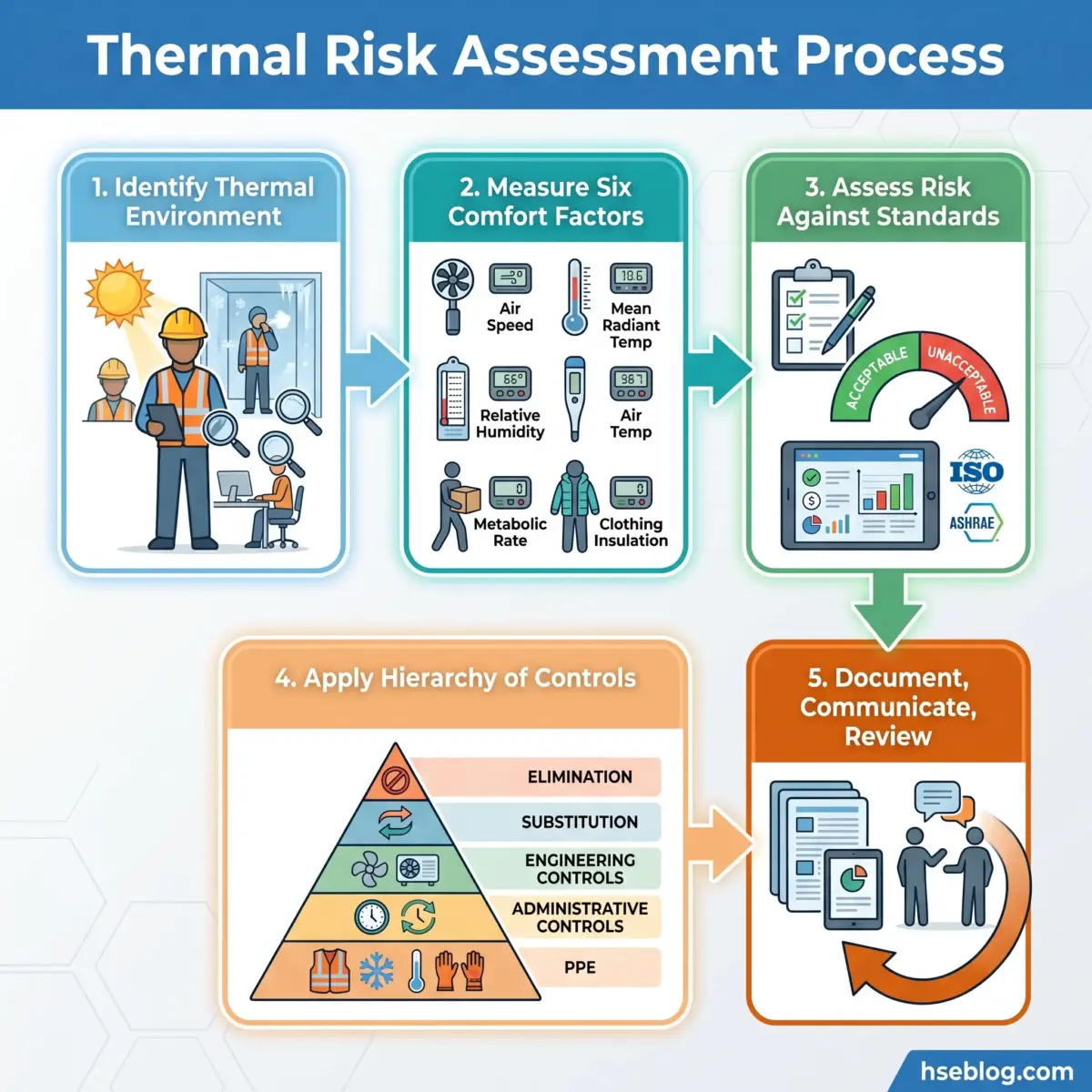
How to Conduct a Thermal Comfort Risk Assessment
Regulatory compliance across all jurisdictions ultimately converges on one practical requirement: conducting a thermal comfort risk assessment that is proportionate, documented, and reviewed. This section outlines how that assessment works in practice.
1. Identify the thermal environment.
Begin by characterizing the workplace. Is this a controlled indoor environment (office, call center), a semi-controlled environment (warehouse, retail floor), an uncontrolled indoor environment (production facility with process heat), or outdoor work? Each category has a different risk profile and requires different monitoring approaches. For process-heat environments, identify the specific heat sources — machinery, ovens, furnaces, steam, molten material — and their proximity to workers.
2. Measure the six thermal comfort factors.
ISO 7730 and HSE UK guidance both identify six factors that determine thermal comfort: air temperature, radiant temperature, humidity, air velocity, metabolic rate, and clothing insulation. Measurement instruments include dry-bulb thermometers (air temperature), globe thermometers (radiant temperature), psychrometers or hygrometers (humidity), and anemometers (air velocity). For heat stress assessment, a WBGT meter integrates the first four factors into a single index. Metabolic rate is estimated from the work activity using tables in ISO 8996, and clothing insulation is estimated from the garments worn using ISO 9920 values.
3. Assess the risk.
Compare measured values against the applicable standard — WBGT limits from ACGIH TLV for heat stress, PMV/PPD targets from ISO 7730 or ASHRAE 55 for thermal comfort. Factor in worker acclimatization status: OSHA and NIOSH data show that 50–70% of outdoor heat fatalities occur in the worker's first few days on the job or after returning from absence — acclimatization is not optional, it is a critical variable in heat risk.
4. Apply the hierarchy of controls.
The hierarchy of controls, applied specifically to thermal risk, operates as follows:
- Elimination — relocate the process or task away from the heat source, or schedule heat-intensive work for cooler periods
- Engineering controls — mechanical ventilation, local exhaust ventilation near heat sources, radiant heat barriers and reflective shielding, air conditioning, insulation of hot surfaces
- Administrative controls — work-rest schedules calibrated to WBGT and metabolic rate, acclimatization protocols (14-day graduated exposure for new workers, 7-day re-acclimatization after absence), mandatory hydration (NIOSH recommends 1 cup of water every 15–20 minutes during heat exposure), buddy systems and symptom monitoring
- PPE — cooling vests, evaporative cooling garments, reflective clothing. PPE is the last resort because it can also increase thermal burden if not correctly selected
5. Document, communicate, and review.
Record the assessment findings, control measures implemented, and review triggers. A thermal comfort risk assessment is not a one-time exercise — thermal conditions change hourly, seasonally, and with process variation. Establish monitoring triggers: when forecast temperatures exceed a defined threshold, when new processes or equipment are introduced, when workers report discomfort, when a heat-related incident or near-miss occurs. The assessment should be a living document with defined review intervals, not a binder completed once and shelved.
Field Test: Ask this question of any thermal risk assessment: "Does this document tell me what to do differently on a 35°C day versus a 22°C day?" If the answer is no, the assessment is a paper exercise, not a functional control.
Employer Duties and Worker Rights in Extreme Temperatures
Across jurisdictions, workplace temperature law creates obligations that flow in both directions — duties imposed on employers and rights available to workers. Understanding both is essential for compliance and for the protection of workers who may not realize they have legal avenues available.
Employer Obligations
In the US, the General Duty Clause (Section 5(a)(1), OSH Act 1970, jurisdiction: US) requires employers to provide a workplace free from recognized hazards. For heat, this translates into a practical obligation to provide adequate water, shade or cooling areas, rest breaks, acclimatization for new or returning workers, training on heat illness symptoms, and emergency response procedures. Under the updated NEP (April 2026, jurisdiction: US), OSHA compliance officers are specifically instructed to assess these elements during heat-related inspections.
In the UK, the obligation flows from the Health and Safety at Work etc. Act 1974, Section 2 (jurisdiction: UK) and the Management of Health and Safety at Work Regulations 1999 (jurisdiction: UK). Employers must assess all risks — including thermal risk — and implement proportionate controls. The Workplace Regulations 1992 add the specific requirement for "reasonable" temperature, supported by the ACOP minimums.
In the EU, the Framework Directive 89/391/EEC (jurisdiction: EU) establishes the overarching duty to assess and prevent all workplace risks. Member states implement this through national legislation, which is why the specific obligations vary — Spain's binding temperature ranges create different compliance requirements than France's general duty approach.
Enforcement consequences are material. In the US, OSHA maximum penalties stand at $16,285 per serious violation and $162,851 per willful violation (as adjusted). UK prosecutions under the Health and Safety at Work Act can result in unlimited fines and, in cases involving fatalities, imprisonment. These figures are not theoretical — they represent the financial and criminal exposure employers face for failing to manage thermal risk.
Worker Rights
Workers in the US can file a confidential complaint with OSHA if they believe they are exposed to a heat hazard, and Section 11(c) of the OSH Act protects them from retaliation for doing so. Workers can also refuse work they reasonably believe poses an imminent danger of death or serious injury, though this right is narrowly defined and requires specific conditions to be met.
In the UK, workers can raise concerns with their employer, their safety representative, or directly with HSE. There is no specific temperature at which a worker can unilaterally stop work — the legal mechanism is the reporting and investigation process. Under the Employment Rights Act 1996 (jurisdiction: UK), workers who raise health and safety concerns are protected from dismissal or detriment.
In the EU, Article 8(4) of the Framework Directive 89/391/EEC (jurisdiction: EU) gives workers the right to withdraw from situations presenting "serious, imminent and unavoidable danger." Implementation varies by member state — in Spain, workers can report temperature violations to the Labour Inspection; in France, the right of withdrawal (droit de retrait) allows workers to stop work in conditions of serious and imminent danger.
Special Populations
Thermal risk assessments must account for workers with increased vulnerability: pregnant workers, older workers, those with cardiovascular conditions, diabetes, or obesity, and workers taking medications that affect thermoregulation (such as diuretics, beta-blockers, or anticholinergics). These populations require specific consideration — not as an afterthought, but as an integral part of the assessment. A generic assessment that does not account for vulnerable workers is incomplete in every jurisdiction discussed here.
Jurisdiction Note: Worker protections against retaliation vary significantly across jurisdictions. US protections under Section 11(c) are federal. UK protections are statutory under employment law. EU protections depend on member-state transposition of the Framework Directive. Workers should verify the specific protections available in their jurisdiction before exercising reporting or refusal rights.
Frequently Asked Questions
Does OSHA have a specific temperature standard for workplaces?
No. OSHA recommends an indoor range of 68–76°F (20–24°C) but this is guidance, not an enforceable standard. The primary enforcement mechanisms are the General Duty Clause (Section 5(a)(1), OSH Act, jurisdiction: US) and the updated National Emphasis Program issued April 10, 2026, which targets 55 high-risk industries and authorizes heat inspections during any site visit. The proposed federal heat standard, published as an NPRM in August 2024, remains stalled with no finalization date.
Can you legally refuse to work if it's too hot?
The answer depends on your jurisdiction. In the US, workers can file a confidential OSHA complaint and are protected from retaliation under Section 11(c). The right to refuse work requires a reasonable belief that imminent danger exists and that there is insufficient time to use normal channels. In the UK, there is no specific temperature threshold for refusal — workers should raise concerns through their employer, safety representative, or HSE. In the EU, Article 8(4) of Framework Directive 89/391/EEC grants workers the right to withdraw from serious and imminent danger, though implementation varies by member state.
What is the minimum legal temperature for a workplace in the UK?
The Approved Code of Practice to the Workplace (Health, Safety and Welfare) Regulations 1992 (jurisdiction: UK) specifies 16°C for sedentary work and 13°C for work involving significant physical effort. These are legally enforceable — an employer below these figures without documented justification and active mitigation faces enforcement action. There is no statutory maximum workplace temperature in the UK.
What is the difference between heat index and WBGT?
Heat index combines air temperature and humidity to estimate perceived temperature — it is the metric used by the National Weather Service and the proposed OSHA standard. WBGT goes further, additionally accounting for radiant heat and air movement, making it the more accurate and scientifically validated occupational health metric. ISO 7243 and ACGIH TLV both use WBGT. The proposed OSHA standard allows employers to use either, but WBGT provides a more precise assessment of actual thermal stress on the body.
Do workplace temperature regulations apply to outdoor workers?
Yes, though regulatory mechanisms differ. In the US, California, Washington, and Oregon have explicit outdoor heat illness prevention standards with trigger temperatures as low as 80°F. The General Duty Clause applies to all workers, outdoor included. In the UK, the general duties under HSWA 1974 and the Management of Health and Safety at Work Regulations 1999 apply to outdoor workers — construction workers receive additional protection under CDM Regulations 2015 (jurisdiction: UK). EU member states apply the Framework Directive to all workplaces, including outdoor sites.
Are there workplace temperature regulations for working from home?
In the UK, employers retain a duty of care to home workers under HSWA 1974, including thermal conditions — though enforcement is practically limited. In the US, OSHA's jurisdiction over home offices is restricted, and the proposed heat standard does not cover telework. The practical approach is for employers to include thermal comfort guidance in remote working risk assessments and provide equipment (fans, portable heaters) where warranted. This remains an evolving area with limited regulatory specificity in all jurisdictions.
Conclusion
Workplace temperature regulation is moving faster in 2026 than at any point in the past two decades, and the direction is consistent across jurisdictions: toward broader enforcement, lower trigger thresholds, and greater employer accountability. The US regulatory picture — defined for years by the gap between OSHA's recommendations and the absence of an enforceable standard — is being reshaped by the expanded NEP, active state-level rulemaking, and a proposed federal standard that, even stalled, has already shifted employer behavior through its public comment record and hearing testimony. In the EU, the ETUC's push for a binding heat directive, backed by data showing a 42% increase in heat-related workplace deaths since 2000 (ILO, 2024), signals that the current patchwork of member-state approaches may not survive the decade.
For practitioners, the operational takeaway is this: build your thermal risk management program around the scientific best practice — WBGT-based assessment, six-factor thermal comfort analysis, acclimatization protocols, and living risk assessments with monitoring triggers — rather than chasing the minimum threshold of whichever jurisdiction you happen to be in. The employers who face enforcement problems are not the ones running sophisticated thermal assessments in moderately warm environments. They are the ones who treated "no specific standard" as permission to do nothing, measured air temperature with a wall thermometer, and called it compliance.
The regulatory trajectory is clear. The question for employers is whether they get ahead of it or respond to it after a citation, a prosecution, or — the outcome every HSE professional works to prevent — a worker who does not go home.