What an event emergency evacuation plan is, in one paragraph
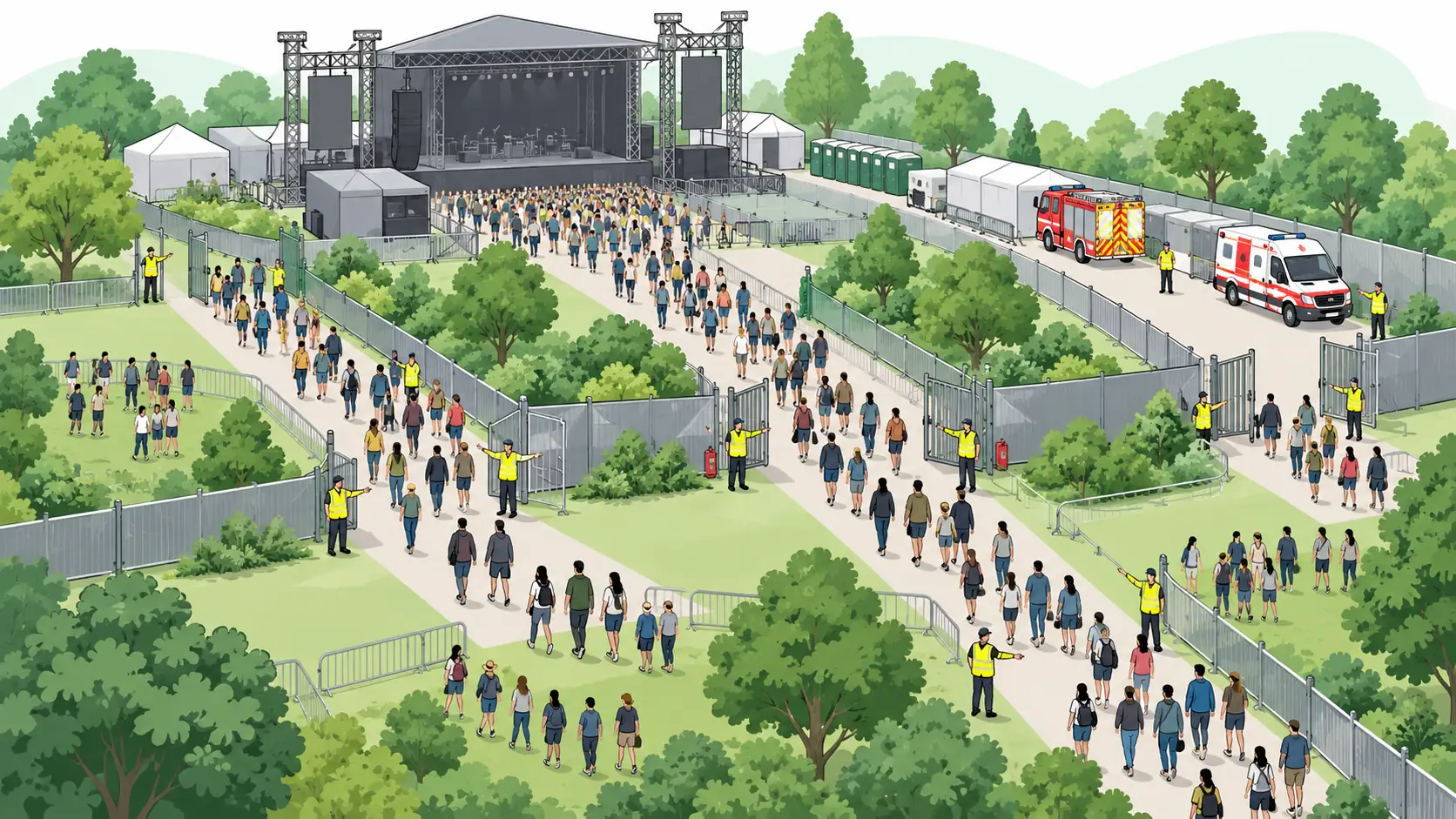
An event emergency evacuation planning process produces a documented, site-specific procedure for moving attendees safely out of — or to safety within — a venue during an emergency. Effective plans assess crowd dynamics, calculate exit capacity, name who can order an evacuation, and rehearse staff. They go well beyond a standard workplace plan because event crowds are large, unfamiliar with the site, and vulnerable to crush.
On 29 October 2022, a Halloween crowd funnelled into a narrow sloping alley in the Itaewon district of Seoul. There was no fire, no structural collapse, and no single panic trigger — yet 159 people died and 196 were injured from compression alone (news reporting, 2022).
That is the uncomfortable truth event organisers have to start from. Event emergency evacuation planning is a life-critical discipline because the failure mode at mass gatherings is rarely the hazard people imagine — it is the movement of bodies through space. This guide sets out how to build a defensible plan across both the US and UK frameworks, how to size egress to a real crowd, and how to choose the right response when "get everyone out" is the wrong call.
Competent-person caveat: This article provides general HSE knowledge. Life-critical work such as planning a mass-evacuation for an assembly-occupancy or festival crowd must be planned and supervised by a competent person with relevant training, jurisdiction-specific authorization, and a site-specific risk assessment. The information here does not replace that.
What an event evacuation plan actually is — and when you are legally required to have one
An event evacuation plan is triggered by occupancy and crowd thresholds, not just by employer duty — and that trigger differs sharply between the US and UK. This is the single most common point of confusion, because a great deal of ranking content blurs a workplace plan and an event plan into one document.
When you reclassify a building for an event, the duty does not transfer automatically. In the US, the requirement is driven by assembly-occupancy classification under NFPA 101 and the International Building Code. Importantly, OSHA 29 CFR 1910.38 — the emergency action plan rule — covers your workers, not your attendees. That scope limit is a gap competitors rarely flag.
In the UK, the duty arises under the Regulatory Reform (Fire Safety) Order 2005, which makes the responsible person assess fire risk and provide adequate means of escape, layered with the licensing regime. Above capacity thresholds, Martyn's Law now adds a separate terrorism-response duty.
| Question | United States | United Kingdom |
|---|---|---|
| What triggers the duty? | Assembly-occupancy classification (NFPA 101 / IBC) | Fire Safety Order 2005 + licensing; Martyn's Law above capacity tiers |
| Who must the plan protect? | Attendees (life-safety code) + workers (OSHA 1910.38) | Attendees + relevant persons |
| Who enforces? | Authority having jurisdiction (AHJ), local fire marshal | Fire authority, local authority, SIA (Martyn's Law) |
A recurring failure mode sits behind all of this: organisers reuse a building's fixed fire-evacuation plan for a temporary or repurposed event without re-running the occupant load. The plan looks complete on paper, but it was never sized for the actual crowd standing in the room.
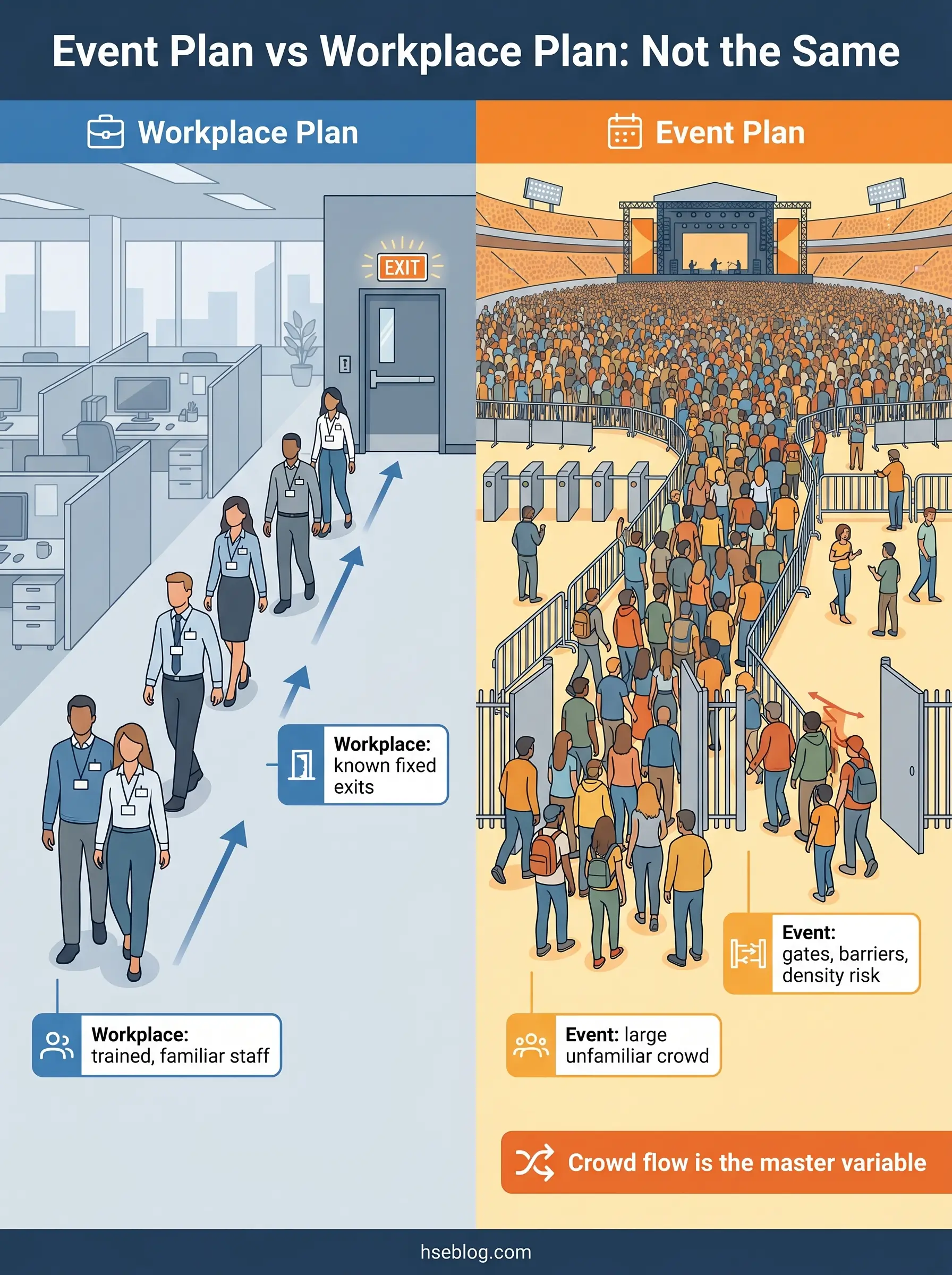
Event evacuation vs. workplace emergency action plan: why they are not interchangeable
A workplace emergency action plan assumes occupants who are trained, sober, and familiar with the building's exits. An event evacuation plan assumes the opposite — transient attendees who entered through one gate, may be impaired, and will instinctively leave the way they came in. The two overlap, but treating an event like a large fire drill is exactly where plans fail.
Why event evacuations fail: crowd dynamics and the difference between an evacuation and a crowd crush
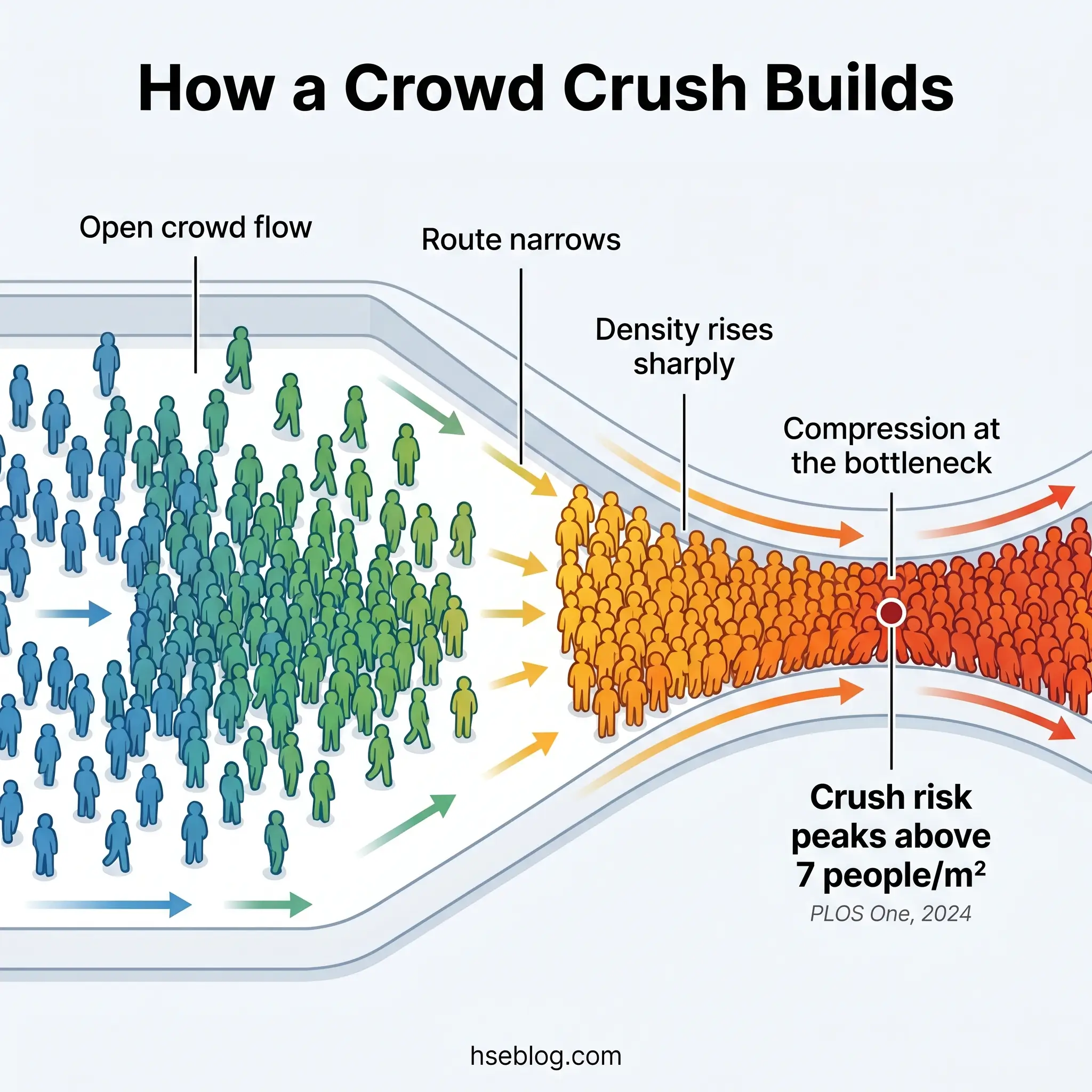
Crowd density is the master variable in event safety, and a fatal crush can occur with no fire, no panic, and no blocked exit — purely from flow into a constriction. During the Itaewon crush, average density reached roughly 7.57 people per square metre, peaking near 9.95, with crowd pressure exceeding 1,000 N/m (PLOS One, 2024). Those numbers describe a state in which an individual has no control over their own movement or breathing.
It helps to separate two distinct events that planners often merge:
- Evacuation is intentional, managed movement out of a space. It is something you design and control.
- Crowd crush (progressive collapse) is unintentional compression as a dense crowd flows into a narrowing space. It is something a badly designed evacuation can cause.
The geometry repeats across incidents: routes that narrow, flows that merge, and downward slopes that add gravity to the press. At Astroworld in 2021, 10 people died of compression asphyxia in a crowd of roughly 50,000 during a performance surge (TIME, 2021). The Hathras religious gathering in 2024 saw 121 deaths as attendees crushed at a constricted exit while leaving (news reporting, 2024). Different continents, same mechanism.
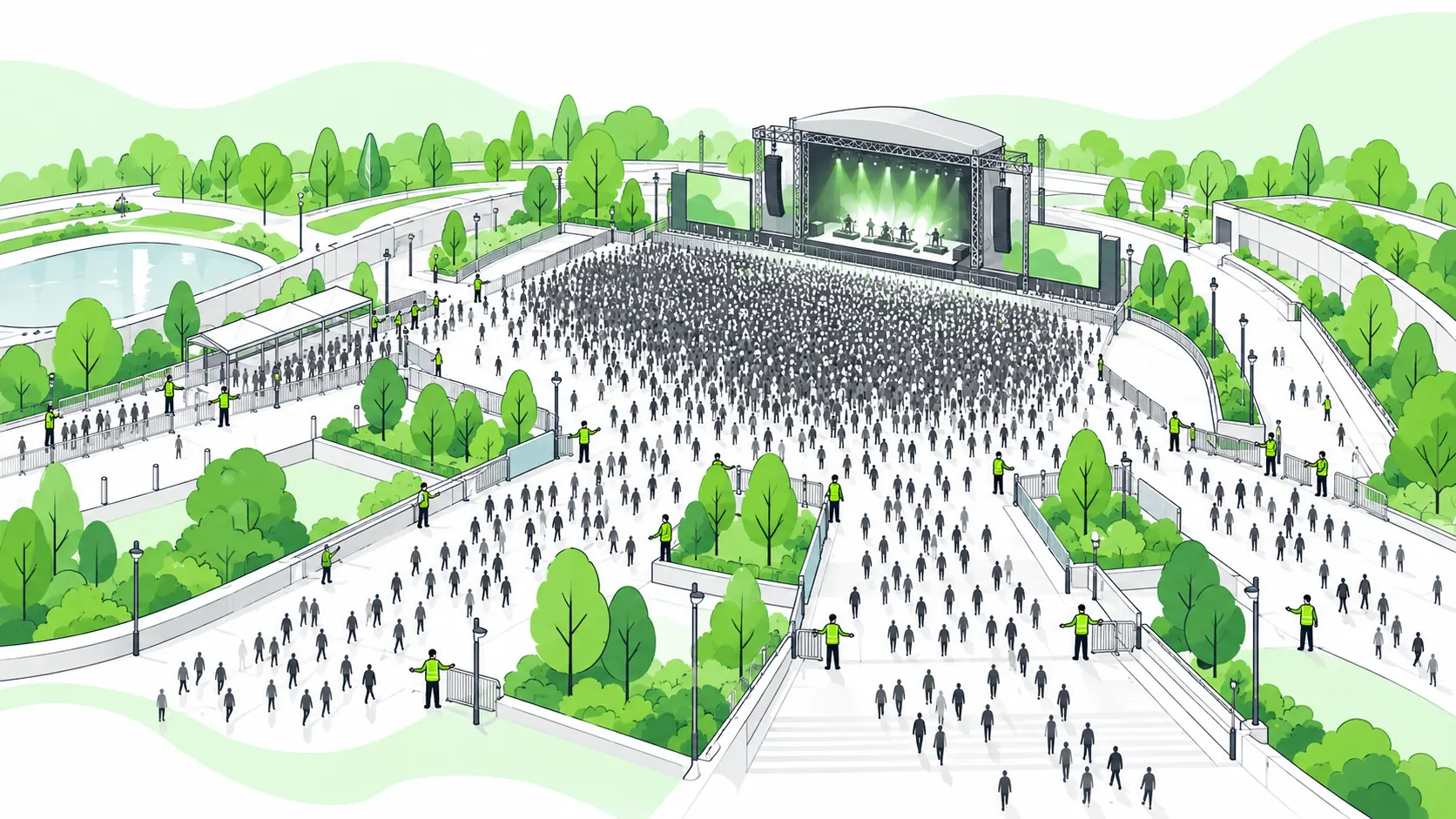
The insight that separates a real plan from a paper one is behavioural. Planners count total exit capacity on a site map, then assume the crowd will distribute evenly across it. They will not. People predominantly leave the way they entered, even when a nearer exit exists — so symmetric capacity on paper can still bottleneck at the single familiar gate.
How to build an event emergency evacuation plan: a step-by-step framework
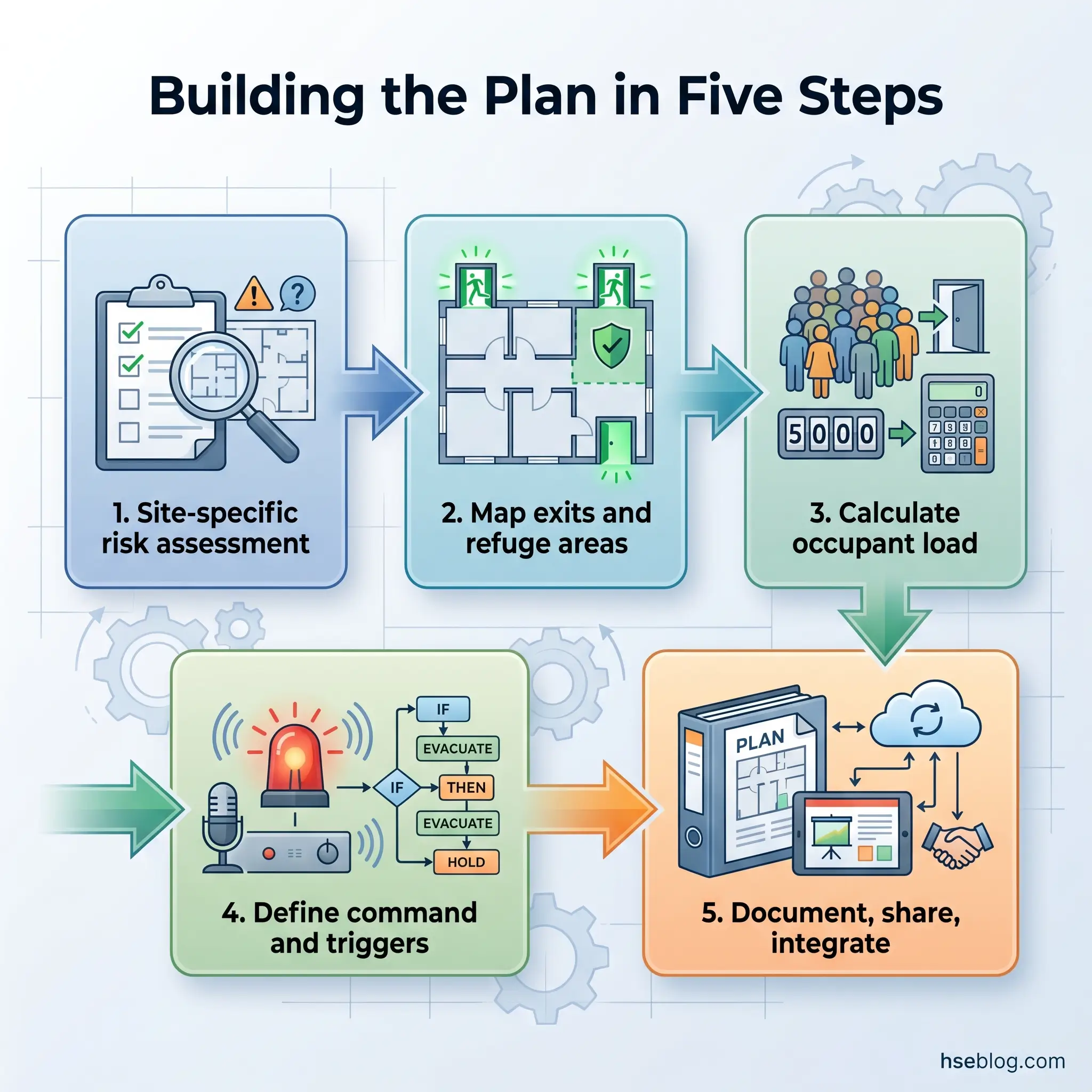
A defensible plan is built in the order a planner actually works — from risk assessment outward to a written, shared document. Treat these five steps as sequential; skipping the early ones is what produces plans that fail under load.
Step 1 — Run a site-specific risk assessment
Risk assessment is the legal foundation, and in the UK it is a statutory requirement under management-of-health-and-safety duties. Identify hazards specific to this event type, this audience profile, and this site. A daytime family fair and a night-time standing-room concert with alcohol carry entirely different crowd risks on the same patch of ground.
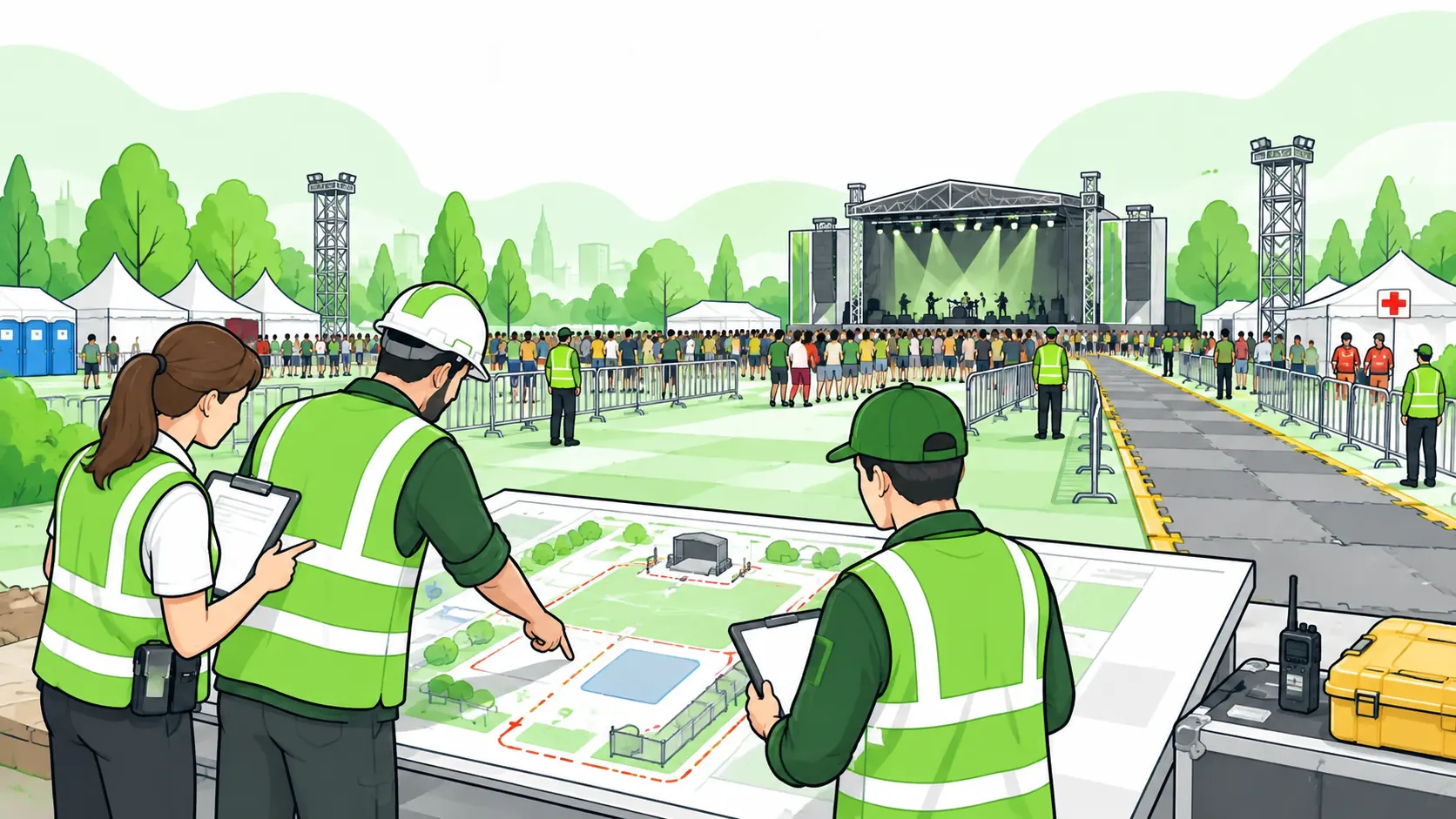
Step 2 — Map the site, exits, and refuge areas
Map every egress route, emergency exit, and on-site refuge or muster area. For open-site events such as fields and street festivals, your "exits" are gates, junctions, and natural boundaries, not doors. The map must show where the crowd will want to go, not only where it is allowed to go.
Step 3 — Calculate occupant load and exit capacity
Size the egress to the real crowd, not to the building's nominal rating. This drives the number, width, and arrangement of exits, and it is covered in full in the egress-capacity section below. The principle: occupant load comes first, and everything else is derived from it.
Step 4 — Define the command structure and decision triggers
Name who has the authority to order an evacuation, under what conditions, and how that decision is reached under pressure. UK practice now leans on structured incident command and the Joint Decision Model so the call is not improvised. A trigger left undefined becomes a delay, and delay is what kills at the front of a crowd.
Step 5 — Document, communicate, and integrate the plan
Write the plan down, share it with stewards and the emergency services, and embed it inside the event's overall safety and operations plan. A standalone PDF that no steward has read is not a plan. The HSE's event-safety guidance on incidents and emergencies is a sound UK reference point for this integration.
Evacuation, invacuation, lockdown, or shelter-in-place: choosing the right response
Evacuation is only one of four responses, and choosing the wrong one can be more dangerous than the threat itself. Moving tens of thousands of people outdoors during a lightning storm or an external attack can manufacture exactly the crush conditions you are trying to avoid. Martyn's Law has formalised this four-mode thinking for UK premises, and the Martyn's Law guidance on ProtectUK is the authoritative reference for it.
The decision is dynamic and must be owned by a named role with pre-set triggers — never invented on the night.
| Response | When to use it | Key risk |
|---|---|---|
| Evacuation (move out) | Fire, smoke, internal threat where leaving is safest | Crush at exits if flow and capacity are misjudged |
| Invacuation (move to a safer place within) | External threat, severe weather, hazard outside the venue | Holding people without enough protected internal space |
| Lockdown (prevent movement/entry) | Active attacker, hostile intruder | Trapping people near the threat if zones are wrong |
| Shelter-in-place (hold in a protected area) | Airborne hazard, short-duration external danger | Air quality and communication failure during the hold |
The classic failure here is a plan that defines only a full off-site evacuation. When a sudden storm hits, staff have no rehearsed alternative, so they push the whole crowd toward the exits in precisely the conditions that create a crush.
Calculating exit capacity, egress width, and crowd-flow routes
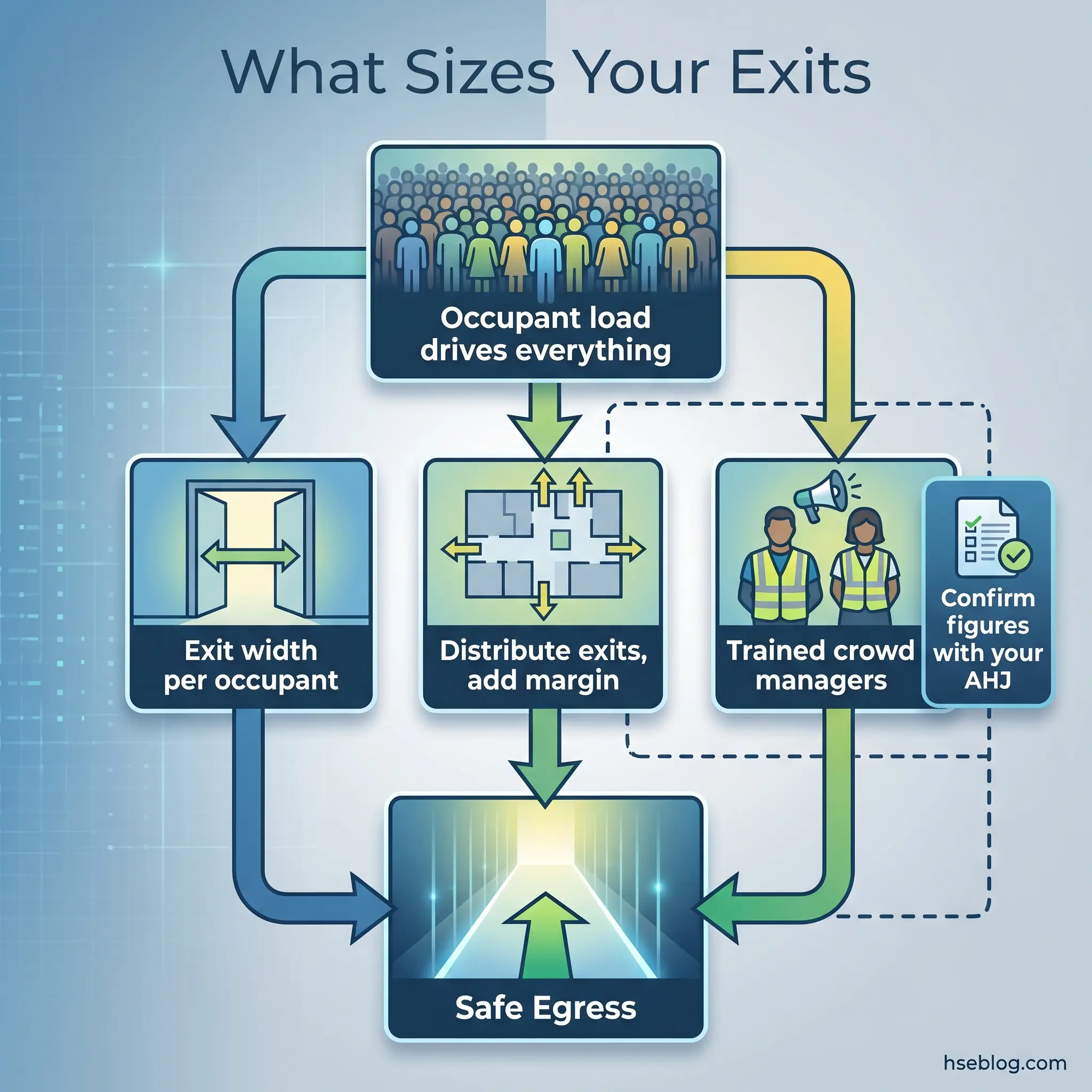
Occupant load is the basis for everything — the number, width, and distribution of your exits all derive from it. Where US codes set per-occupant capacity factors, UK practice draws on the Green Guide's egress calculations for sports grounds; OSHA's PEL-style logic does not govern here, but the principle of confirming against the stricter, locally adopted figure does. Treat exact numbers as edition- and jurisdiction-specific, and verify them against your adopted code with the AHJ or local authority.
A few concepts do the heavy lifting, and they translate across both frameworks:
- Occupant load drives exit count and width. More people means more and wider egress, calculated per occupant for level routes and stairs separately.
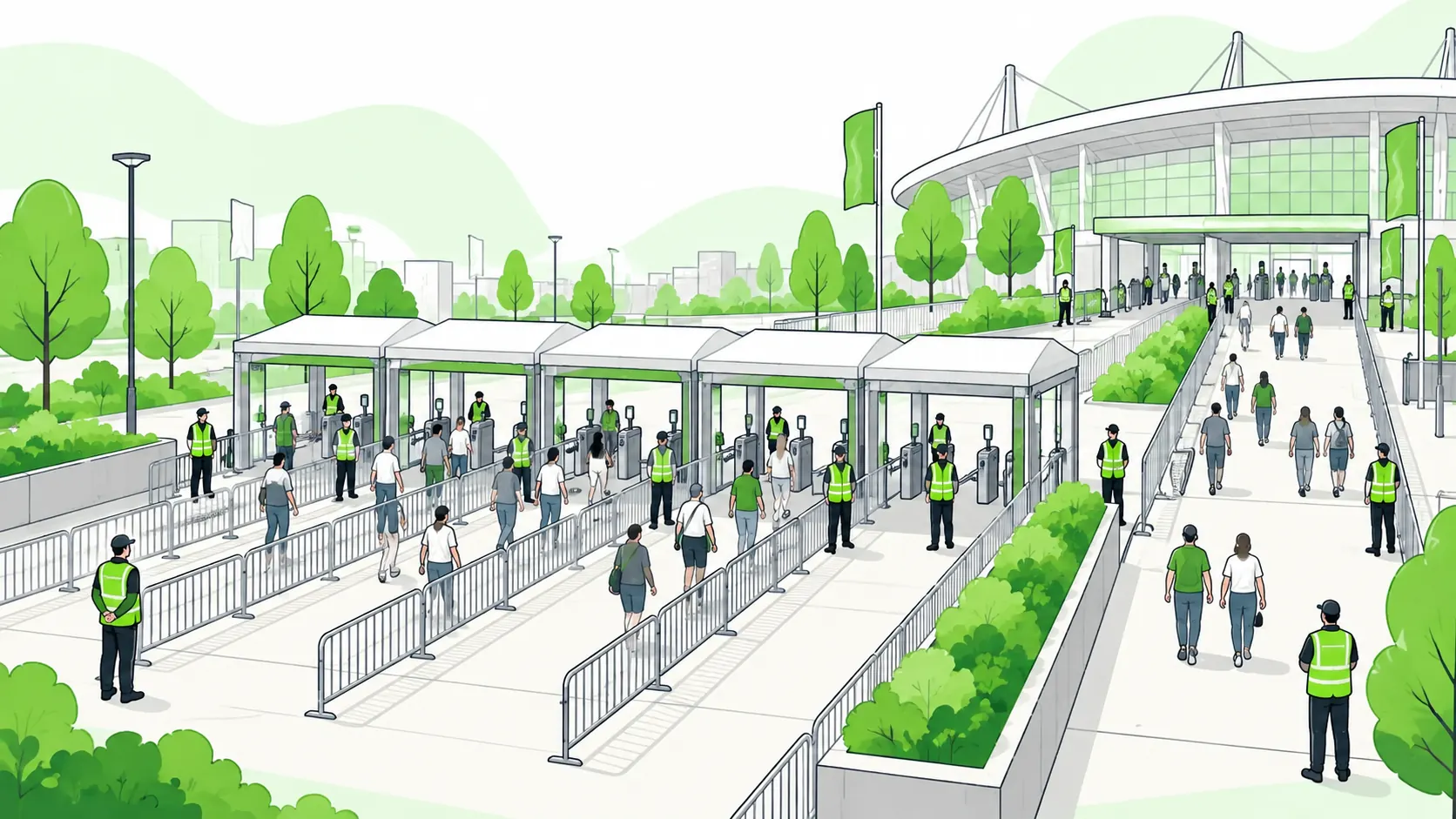
- Distribute exits, never concentrate them. Place them apart, away from likely hazard points, so no single point carries the whole crowd — and build margin above expected attendance.
- Crowd managers are a code requirement, not a courtesy. Under NFPA 101, assembly occupancies require trained crowd managers, commonly cited as roughly one per 250 occupants, with a documented life-safety evaluation for festival-seating and large assembly events. Confirm the current trigger against the adopted edition, since these are configuration-specific.
- Density has a planning target. General event practice often manages toward roughly 4 people per square metre, well below the crush densities recorded at Itaewon — but treat this as a monitored limit, not a fixed safe number, since sources differ. The free read-only NFPA 101 text is worth checking for the assembly-occupancy provisions.
The real-world catch is that calculated capacity is often met on paper and lost on the day. Chained gates, locked panic hardware, merchandise stacked against an exit, or décor obscuring exit signage can functionally erase an exit you counted on.
Inclusive evacuation: planning for disabled and reduced-mobility attendees
Inclusive evacuation is a core duty, not an accessibility add-on — and a plan that moves everyone benefits the whole crowd's flow. The most common gap is treating inclusive provision as a single accessible viewing platform, with no thought to how those attendees egress once the main crowd is already surging toward the same routes.
Build the provision into the plan from the start:
- Identify needs in advance. Use accessible registration or on-arrival flagging, and create Personal Emergency Evacuation Plan (PEEP)-style arrangements for attendees who need them.
- Provide the physical means. Designate refuge points and accessible routes, position evacuation chairs, and assign trained assistants for people who cannot use stairs or move quickly.
- Make communication reach everyone. Pair audible alarms with visual messaging and staff-relayed instruction so attendees with sensory impairments are not left behind.
Communication and crowd messaging during an evacuation
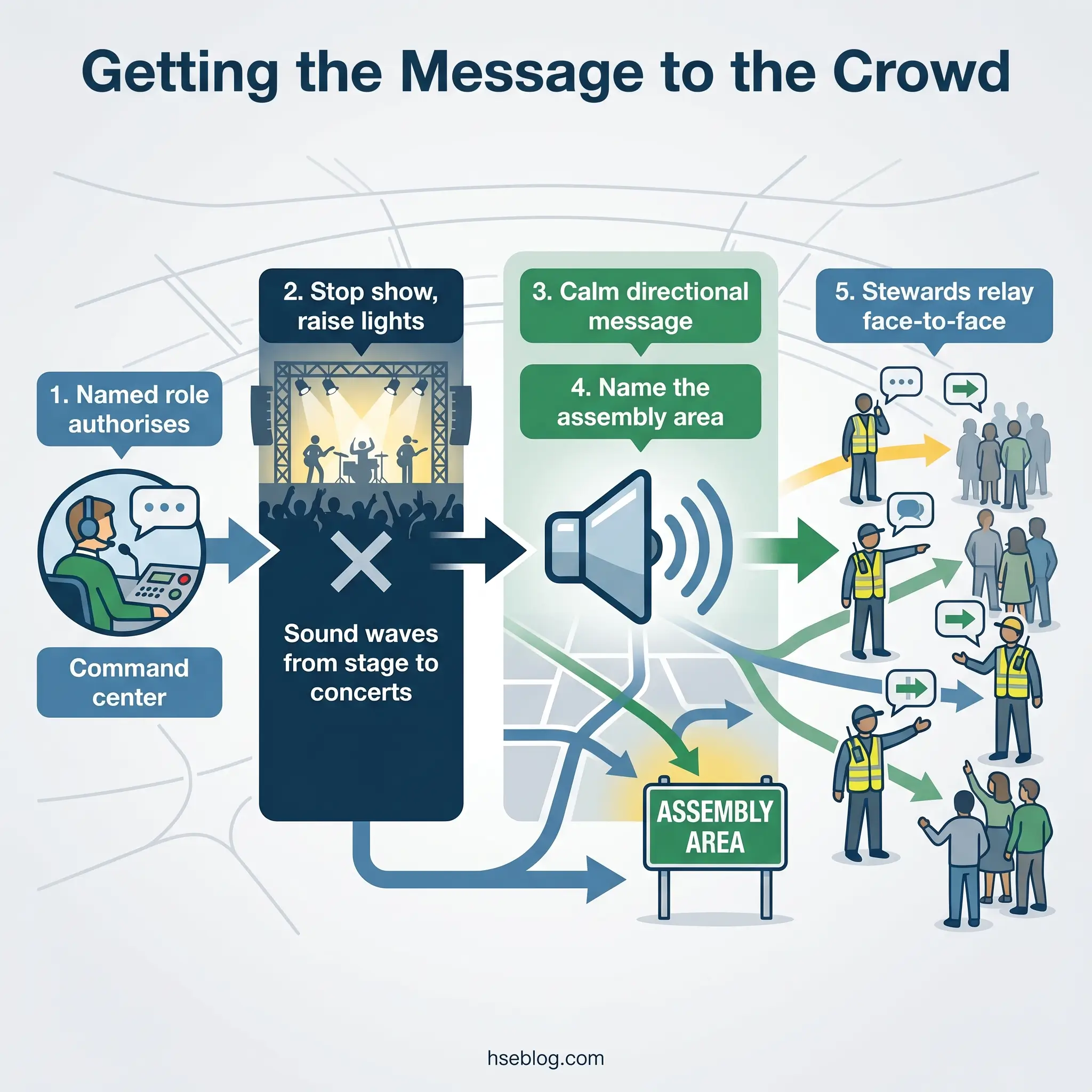
How instructions are delivered decides whether a crowd moves calmly or freezes. The evidence is consistent: mass "panic" is overstated, and calm, early, specific messaging does more than any crowd-control force. Sequence your messaging deliberately:
- Authorise and confirm. A named role triggers the response; stop the performance and raise the house lights, because the show stop is itself a control measure.
- Direct, do not alarm. Use pre-scripted, calm, directional wording — "proceed to the nearest exit, towards [named] assembly area" beats a vague siren that leaves people guessing.
- Relay and reinforce. Stewards repeat the message face-to-face along routes, actively redirecting people away from the familiar entry gate.
A note on wording: vague alarms make people gravitate to the route they know. Specific direction is what overrides that instinct and prevents compression at the front.
Staff roles, training, and evacuation drills
A plan is only as good as the people executing it, so roles and rehearsal carry as much weight as the document. Define the chain clearly and assign it before the gates open:
- Incident controller — holds the authority to order the response and owns the decision triggers.
- Crowd managers and stewards — manage flow, density, and routes in their zones.
- Exit and route wardens — keep specific egress points open and unobstructed.
- Accountability lead — runs the headcount and assembly-area roll.
- Emergency-services liaison — interfaces with fire, ambulance, and police.
Train and drill before the event, including a physical walkthrough of this specific site, with a refresher and briefing on the day. The point of a drill is to find the plan's flaws, not to rubber-stamp it.
The gap I see most often: stewards are trained thoroughly on ingress and ticketing but never rehearse reverse-flow egress under a failure scenario. Their first real evacuation then happens live, with a crowd, which is the worst possible time to learn it.
Coordinating with emergency services and local authorities
Event evacuation is multi-agency by nature, so the plan must be validated and rehearsed with responders before the event — not handed over on the day. The practical test is whether your evacuation routes and your emergency-vehicle access can both function at once.
United Kingdom
Engage the Safety Advisory Group (SAG) early and work to multi-agency joint principles such as JESIP and the Joint Decision Model. Plans for larger events may need local-authority and ambulance-service validation before sign-off.
United States
Coordinate with the AHJ, local fire and EMS, and — for large events — law enforcement. Align on assembly zones and on dedicated access for responders well ahead of the gates opening.
A pattern worth pre-empting in either jurisdiction: organisers route crowd egress and emergency-vehicle access along the same single road. The ambulance trying to get in then fights the crowd trying to get out, and both lose.
Reviewing, testing, and updating the plan
A plan is a living document, and the most dangerous version is last year's plan reused unchanged. Close the loop after every event and drill, and force a revision when conditions shift.
- Debrief honestly. Ask whether the chain of command was clear, whether communications reached the crowd, and whether routes stayed unobstructed.
- Watch the update triggers. Any change to site layout, capacity, regulation, or threat intelligence demands a fresh review.
- Control versions and re-brief. After any change, update the version and re-brief every steward, because an outdated mental model is as dangerous as an outdated document.
Legal disclaimer and regulatory currency note: The regulatory content here reflects a general HSE professional understanding of US and UK requirements as of 2026, including Martyn's Law (Terrorism (Protection of Premises) Act 2025), which received Royal Assent on 3 April 2025 with statutory guidance published 15 April 2026 and is not yet in force. It is not legal advice. Specific compliance questions or enforcement situations should be directed to qualified legal counsel in the applicable jurisdiction. For competence, point your team toward recognised training pathways such as NEBOSH, IOSH, OSHA outreach, or an equivalent regional qualification.
Frequently Asked Questions
What is the difference between an evacuation plan and an emergency action plan?
An emergency action plan, such as the one required under OSHA 29 CFR 1910.38 in the US, is employer- and worker-focused and assumes trained, familiar occupants. An event evacuation plan must account for transient attendees who are unfamiliar with the site and vulnerable to crowd dynamics. They overlap, but they are not interchangeable — using one in place of the other leaves attendees uncovered.
Do small events under 200 people need an evacuation plan?
Yes, in principle. A proportionate plan is good practice even below statutory capacity thresholds. Those thresholds — for example Martyn's Law standard tier at 200 in the UK, or NFPA crowd-manager triggers in the US — add specific duties; they are not the floor below which no plan is needed. Size the plan to the crowd and the site, not to a number.
How do you evacuate an outdoor festival with no walls or doors?
Treat gates, junctions, and natural boundaries as your exits, and plan for dispersal in multiple directions rather than toward a single point. Designate off-site assembly areas and pre-decide weather-driven shelter or invacuation options. Open sites remove the building's constraints but introduce terrain, vehicle routes, and crowd-direction problems that must be mapped in advance.
Should you stop the show or music during an emergency?
Yes — the show stop is a deliberate control measure, not a last resort. Stopping the performance and raising the house lights interrupts the crowd's focus and lets directional messaging land. Define in the plan exactly who holds the authority to call it, so there is no hesitation when seconds matter at the front of a crowd.
What crowd density is dangerous, and how is it measured?
Density is measured in people per square metre and is the key risk metric. Crush risk rises sharply at high densities — the Itaewon crush averaged roughly 7.57 people per square metre, peaking near 9.95 (PLOS One, 2024). Event practice often manages toward around 4 per square metre, but treat that as a monitored limit rather than a universal safe number, since sources differ.
How quickly should a venue be able to evacuate?
There is no universal time. Target egress times are derived from occupant load and exit capacity, and they depend on your adopted code, the venue layout, and the scenario. Calculate the figure for your specific site and confirm it against the locally adopted edition with your AHJ or local authority, rather than copying a generic target from another venue.
The plan that fails the crowd it was written for
The industry's most expensive mistake is treating event evacuation as a bigger fire drill. The incident record says otherwise: Itaewon, Astroworld, and Hathras were not fires — they were flow and density failures, and a plan built only around "get everyone out" can cause exactly that. The single highest-impact change most organisers can make is to stop counting exits on a map and start asking where the crowd will actually try to go.
Get that one shift right and the rest follows — you size egress to the real crowd, you pre-decide invacuation and shelter for the threats that make leaving dangerous, and you rehearse the reverse flow your stewards have never practised. Event emergency evacuation planning earns its place not as paperwork but as the discipline that decides whether a crowd of strangers gets home. The names behind those density figures are the reason it deserves that seriousness.