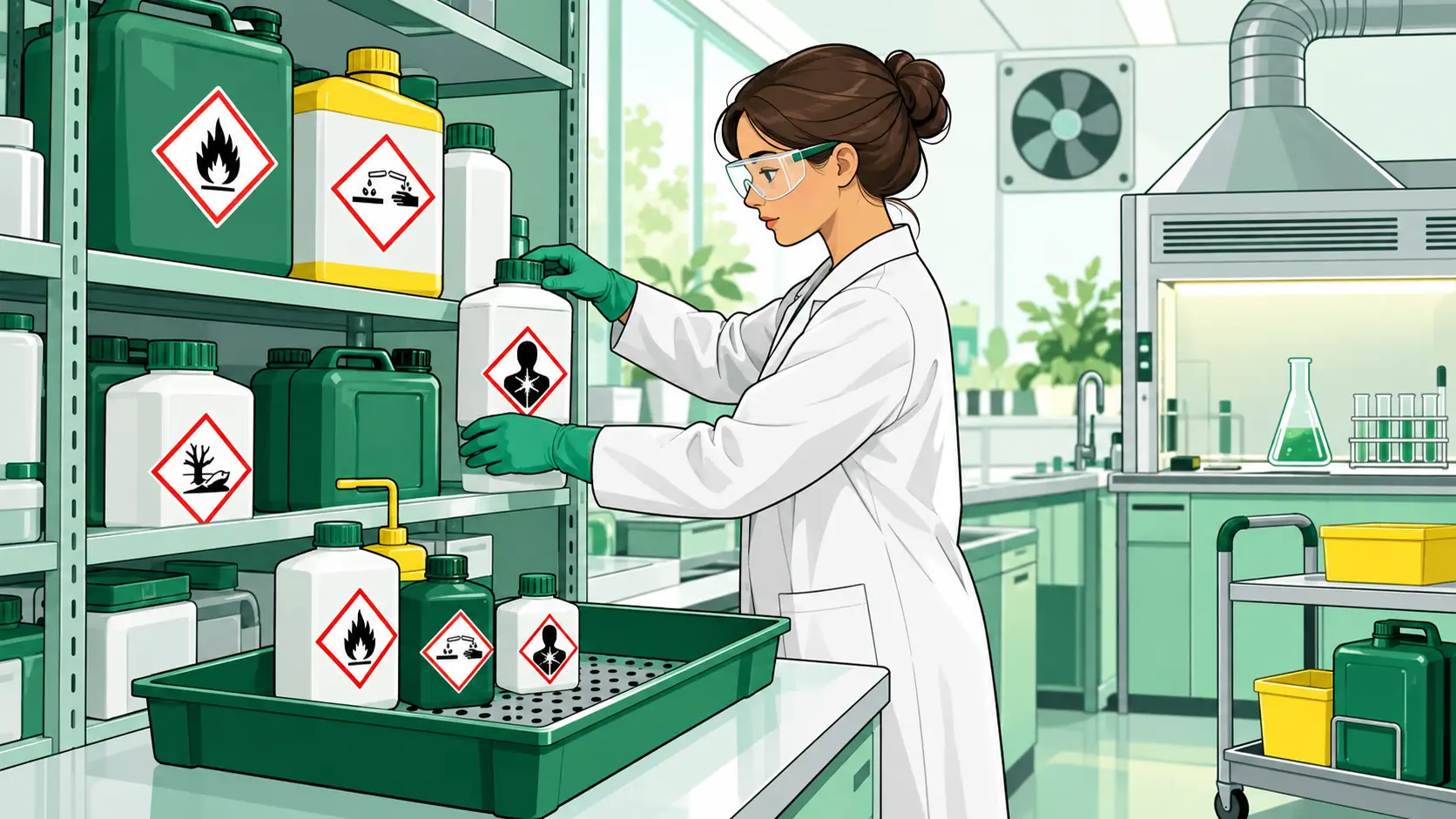
CLP hazard pictograms are nine standardised symbols used on chemical labels under the EU's Classification, Labelling and Packaging Regulation (EC No 1272/2008). Each pictogram features a black symbol on a white background within a red diamond border, representing a specific category of physical, health, or environmental hazard. Derived from the UN Globally Harmonised System (GHS), they appear alongside signal words, hazard statements, and precautionary statements to give workers and emergency responders immediate hazard recognition at the point of use.
What Are CLP Hazard Pictograms?
Hazard Communication ranked as the second most frequently cited OSHA standard in fiscal year 2024 (OSHA, 2024). That ranking does not reflect obscure paperwork failures — it reflects a persistent, global problem: chemicals reach workers without adequate hazard information, and when labelling fails, the first line of defence disappears before anyone touches a container.
CLP hazard pictograms exist to solve that problem at its most basic level. They are the visual shorthand that tells a worker — before reading a single word — what category of danger a chemical substance or mixture presents. Getting them right matters. Getting them wrong, or ignoring them, is where exposure incidents begin.
The Regulatory Origin
CLP stands for Classification, Labelling and Packaging. The CLP Regulation (EC No 1272/2008) is the EU's implementation of the United Nations Globally Harmonised System of Classification and Labelling of Chemicals (UN GHS). The distinction matters: GHS is the international model framework — a recommendation. CLP is the binding legal instrument that translates GHS into enforceable EU law.
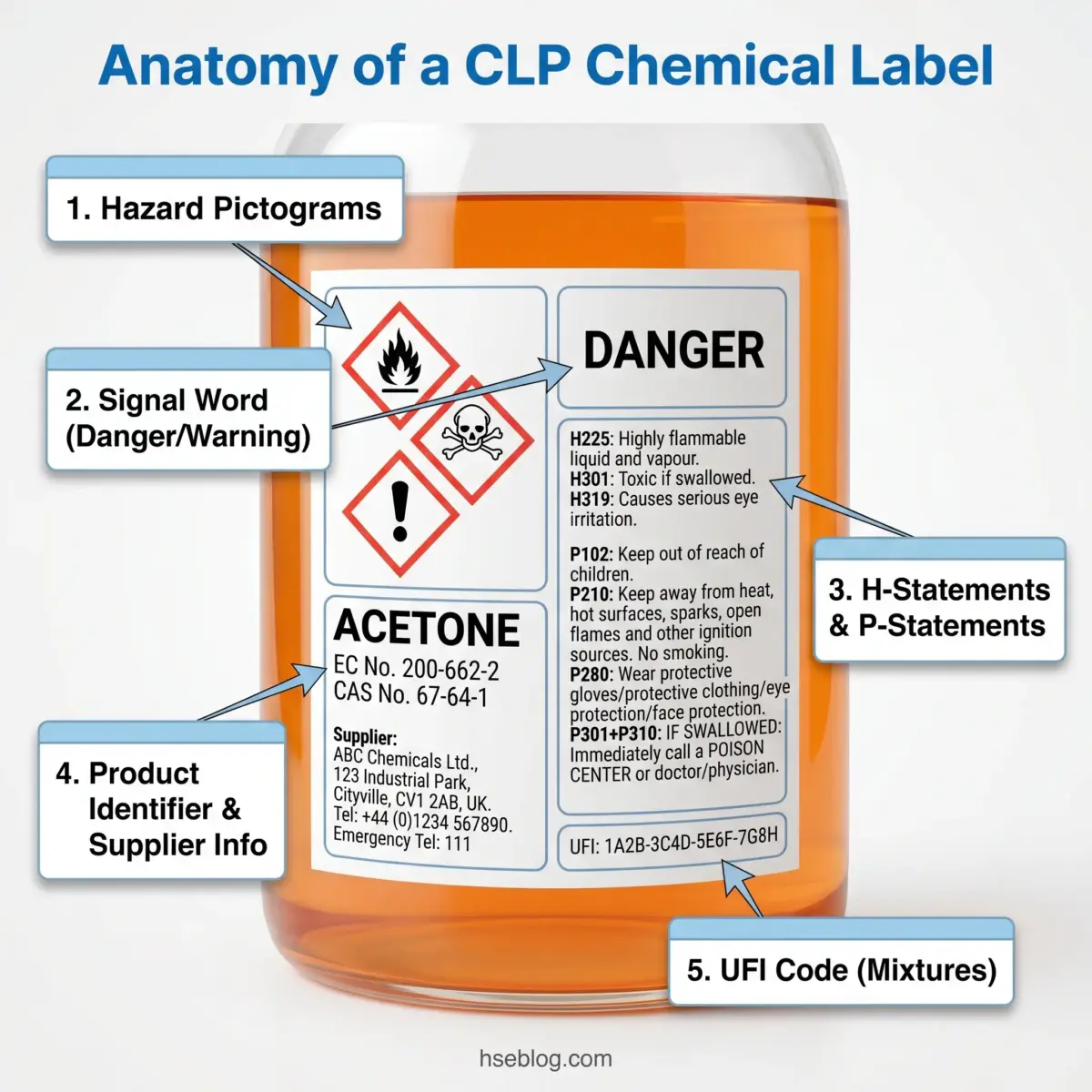
Under CLP, every substance or mixture classified as hazardous must carry a label displaying the relevant pictograms alongside signal words ("Danger" or "Warning"), H-statements (hazard statements), P-statements (precautionary statements), product identifiers, supplier information, and — since October 2020 — a Unique Formula Identifier (UFI) for mixtures requiring poison centre notification.
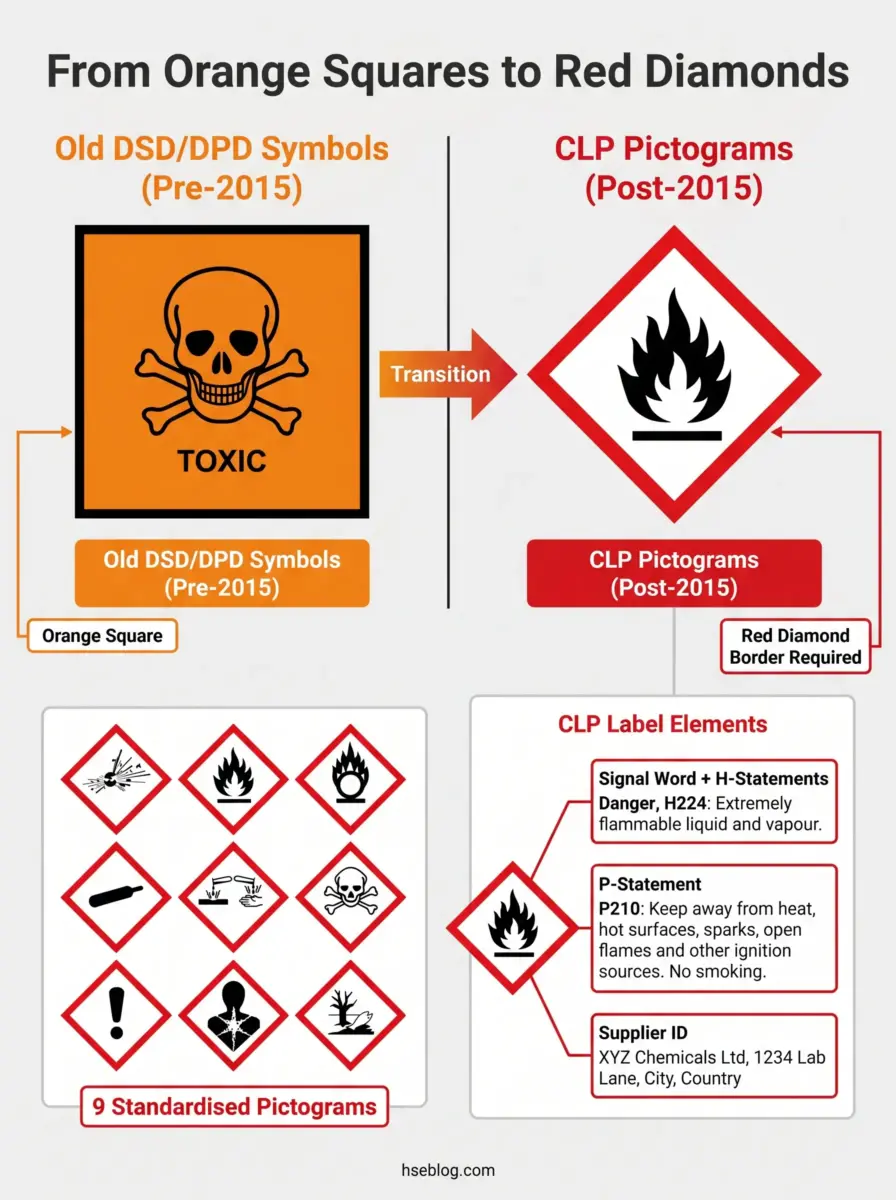
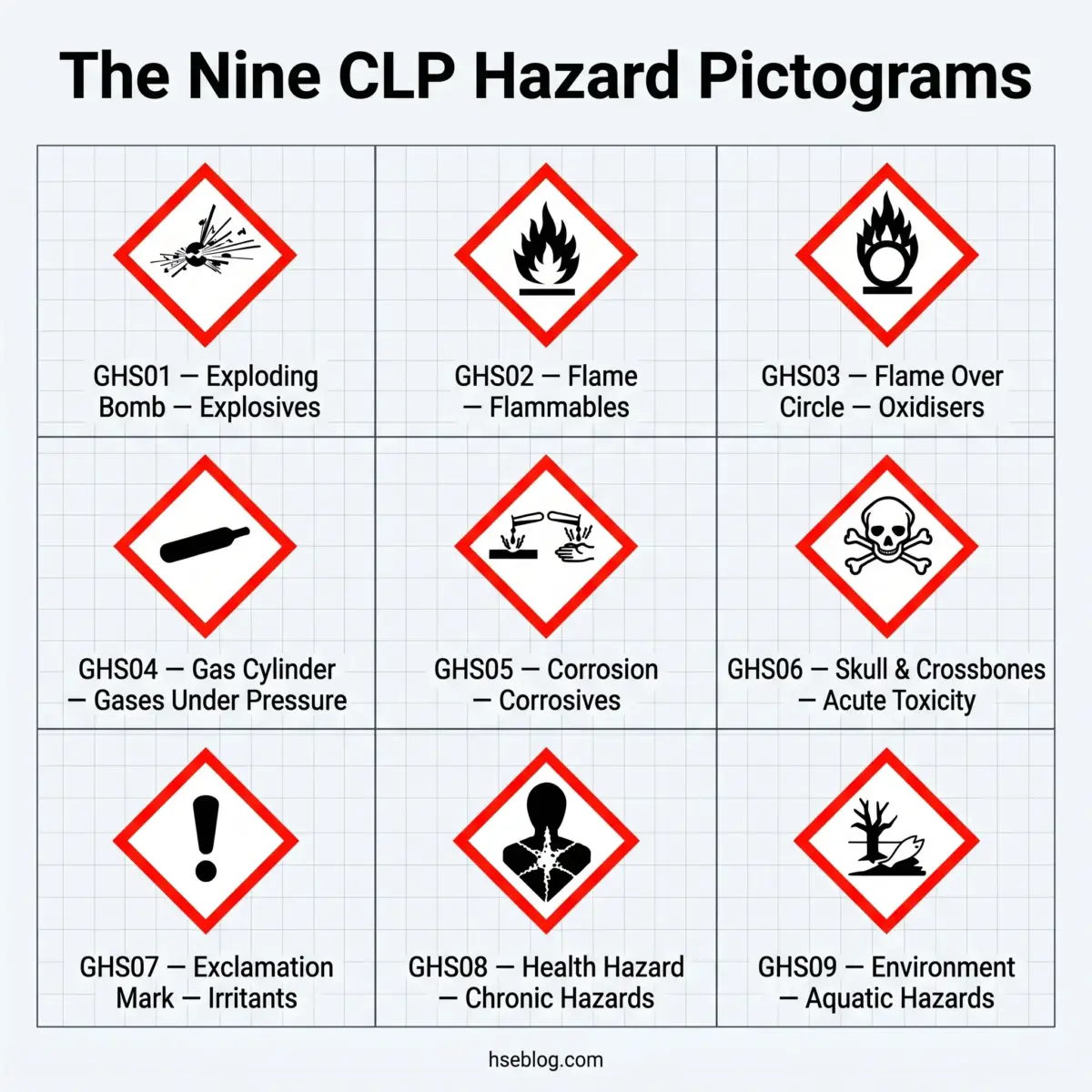
There are nine CLP hazard pictograms, each assigned an alphanumeric code from GHS01 through GHS09. These codes exist for classification reference only — they must not appear on the label itself. The visual format is standardised: a black symbol on a white background within a red diamond-shaped border (a "red-bordered diamond" in regulatory language).
A training gap that still surfaces regularly during COSHH assessment audits: many workers recognise the old orange-background square symbols from the predecessor Dangerous Substances Directive (DSD) and Dangerous Preparations Directive (DPD), but do not realise the red diamond CLP pictograms fully replaced them from 1 June 2015. When audit questioning reveals that a worker identifies an orange square symbol but hesitates on the equivalent red diamond, the site's chemical safety training needs updating.
The Nine CLP Hazard Pictograms and Their Meanings
Each of the nine pictograms represents a distinct hazard category — or in some cases, multiple related categories — and carries its own recognition logic. The sections below cover each pictogram's official symbol name, GHS code, the hazard classes it applies to, common workplace examples, and the signal word typically associated with it. For the authoritative EU reference on each pictogram, ECHA maintains a dedicated CLP pictograms reference page.
One pattern worth flagging before working through the list: workers frequently conflate the exclamation mark (GHS07) with the health hazard silhouette (GHS08). The practical consequence is serious in both directions — treating a lower-severity irritant as though it carries the same chronic risk as a carcinogen, or treating a carcinogen with insufficient respect because the health hazard symbol looks less immediately threatening than the skull-and-crossbones.
GHS01 — Exploding Bomb
The exploding bomb pictogram applies to explosives, self-reactive substances and mixtures (Types A and B), and organic peroxides (Types A and B). Substances carrying this pictogram can detonate or explode under specific conditions — heat, friction, shock, or confinement.
The signal word is Danger. Common workplace examples include certain commercial explosives, ammonium nitrate formulations under specific conditions, and unstable organic peroxides used in polymerisation processes.
GHS02 — Flame
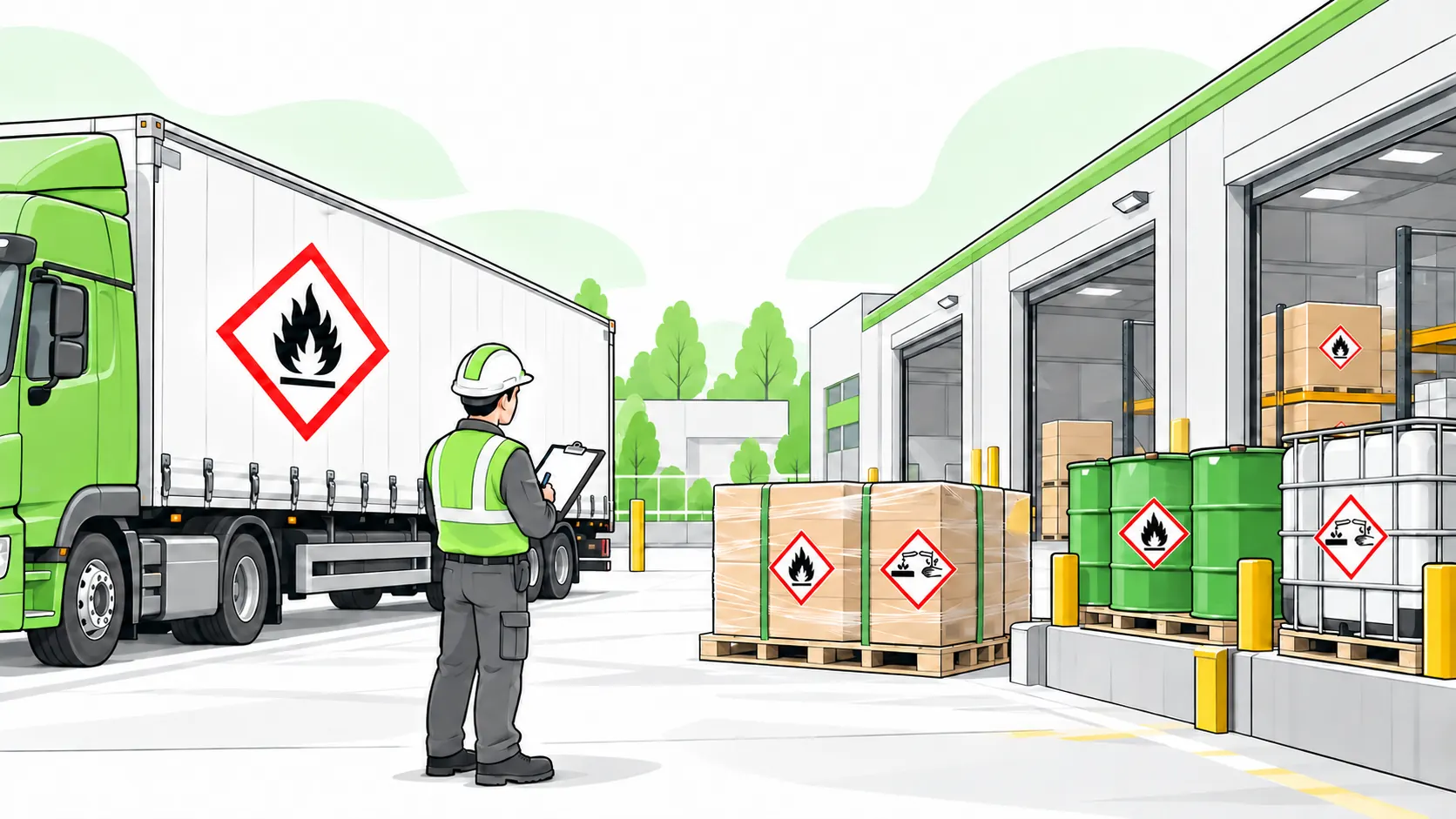
The flame pictogram covers flammable gases, aerosols, liquids, and solids, as well as pyrophoric liquids and solids, self-heating substances, and substances that emit flammable gas on contact with water. This is the most frequently encountered pictogram across general industry because flammable liquids (solvents, fuels, cleaning agents) are present in almost every workplace.
The signal word is Danger for the more severe categories (e.g., flammable liquids Category 1 and 2) and Warning for less severe categories (e.g., flammable liquids Category 4). Following OSHA's 2024 HazCom update to GHS Revision 7, desensitised explosives now also fall under this pictogram in the US.
GHS03 — Flame Over Circle
The flame-over-circle pictogram identifies oxidising gases, liquids, and solids. Oxidisers do not burn themselves — they intensify the combustion of other materials by supplying oxygen or other oxidising agents. The practical danger is that they make fires hotter, faster, and harder to extinguish.
The signal word is Danger (Categories 1 and 2) or Warning (Category 3). Common workplace examples include hydrogen peroxide at higher concentrations, sodium hypochlorite (bleach) at certain strengths, and potassium permanganate.
GHS04 — Gas Cylinder
This pictogram covers gases under pressure — compressed, liquefied, refrigerated liquefied, and dissolved gases. The hazard is the stored energy: a ruptured cylinder becomes a projectile, and refrigerated liquefied gases can cause severe cryogenic burns.
The signal word is Warning. Common workplace examples include compressed nitrogen, oxygen cylinders, acetylene (dissolved gas), and CO₂ cylinders. This is one of the few pictograms where the hazard is purely physical — no toxicity involved — yet the consequences of mishandling can be immediately fatal.
GHS05 — Corrosion
The corrosion pictogram applies to substances that are corrosive to metals, cause skin corrosion, or cause serious eye damage. The symbol depicts material being eaten away and a hand being damaged — both consequences represented in a single image.
The signal word is Danger for skin corrosion and serious eye damage. Common examples include concentrated sulphuric acid, sodium hydroxide (caustic soda), and hydrofluoric acid. Under CLP Article 26 precedence rules, this pictogram supersedes the exclamation mark (GHS07) when both skin corrosion and skin irritation classifications apply to the same substance.
GHS06 — Skull and Crossbones
The skull-and-crossbones pictogram represents the most severe acute toxicity — Categories 1, 2, and 3 via oral, dermal, or inhalation routes. Substances carrying this pictogram can kill or cause serious harm from a single exposure at relatively low doses.
The signal word is always Danger. Common workplace examples include methanol (at certain concentrations), hydrogen cyanide, and certain organophosphate pesticides. A critical precedence rule: when GHS06 applies, GHS07 (exclamation mark) must not appear on the same label — the skull-and-crossbones entirely supersedes it. This is one of the most operationally important rules in CLP labelling.
GHS07 — Exclamation Mark
The exclamation mark is the lower-severity health warning pictogram. It covers acute toxicity Category 4, skin and eye irritation, skin sensitisation, specific target organ toxicity — single exposure (STOT SE) Category 3, and substances hazardous to the ozone layer.
The signal word is Warning. The common misconception here is dismissal — because the exclamation mark looks less dramatic than the skull-and-crossbones or the health hazard silhouette, workers sometimes treat substances carrying it as essentially harmless. Skin sensitisers carrying GHS07 can cause occupational dermatitis that ends careers. The pictogram deserves the same stop-and-read-the-SDS response as any other.
GHS08 — Health Hazard (Silhouette)
The health hazard silhouette — showing a human torso with a starburst over the chest — covers the chronic, life-altering hazards: respiratory sensitisation, germ cell mutagenicity, carcinogenicity, reproductive toxicity, specific target organ toxicity (single and repeated exposure, Categories 1 and 2), and aspiration hazard.
The signal word is Danger for Categories 1A, 1B, and 2 of the most serious classes (carcinogenicity, mutagenicity, reproductive toxicity). These are the hazards that do not produce immediate dramatic symptoms but destroy health over months or years of exposure. The judgment call for practitioners reviewing COSHH assessments: when GHS08 appears on a label, the risk assessment must address long-term exposure controls, health surveillance requirements, and exposure monitoring — not merely acute spill response.
GHS09 — Environment
The environment pictogram — a dead tree and dead fish — identifies substances hazardous to the aquatic environment, both acute and chronic categories.
The signal word may be absent (no signal word is assigned for environmental hazards under CLP) or Warning depending on the category. A key jurisdictional difference: GHS09 is mandatory on labels in the EU and GB under CLP, but it is not required in the US under OSHA's Hazard Communication Standard. This creates a practical decision for multinational suppliers, addressed in the jurisdictional comparison section below.
How CLP Pictograms Fit on a Chemical Label
Pictograms do not exist in isolation on a label. They are one element within a structured hazard communication system, and understanding that structure matters because each element serves a different function.
CLP Article 17 sets out the mandatory label elements. The complete label for a classified substance or mixture must include the product identifier, supplier name and contact details, the nominal quantity (for consumer products), the relevant hazard pictograms, the signal word, hazard statements (H-statements), precautionary statements (P-statements), supplemental information where required, and — for mixtures notified to poison centres — the UFI code. Each element answers a different question: the pictogram tells you what kind of hazard exists; the H-statement tells you how the hazard manifests; the P-statement tells you what to do about it.
Sizing and Readability
CLP Annex I, Section 1.2.1 requires each pictogram to occupy at least one fifteenth of the label surface area, with an absolute minimum of 1 cm². The most common labelling non-conformance found during supply-chain audits involves containers under 500 ml: suppliers meet the absolute minimum of 1 cm² but fail the proportional one-fifteenth rule, rendering the pictogram technically non-compliant.
EU Regulation (EU) 2024/2865, which entered into force in December 2024, introduced additional readability requirements. These include minimum font sizes for label text, a requirement for sans-serif font in black text on a white background, and expanded provisions for fold-out labels on small containers. The regulation also permits digital labelling as a supplement to the physical label — not a replacement.
Audit Point: When reviewing chemical labels during a site audit, check both the absolute and proportional size requirements. A label with correctly sized pictograms but illegible text still fails compliance under the 2024 amendment.
Pictogram Precedence Rules Under CLP Article 26
When a substance is classified for multiple hazards, the label could theoretically carry six or seven pictograms — cluttering the label and diluting the visual impact of each symbol. CLP Article 26 prevents this through a set of precedence rules that remove redundant pictograms while preserving every critical hazard signal. The full text of Article 26 is concise, but its practical application trips up even experienced SDS authors.
The rules work as follows:
- GHS01 (exploding bomb) makes GHS02 (flame) and GHS03 (flame over circle) optional — unless the substance is classified for multiple physical hazards where both are independently required. The logic: if something can detonate, the fact that it is also flammable is a secondary concern.
- GHS06 (skull and crossbones) supersedes GHS07 (exclamation mark) entirely. When a substance is acutely toxic at Categories 1–3, the lower-severity Category 4 pictogram must not appear. This is absolute — no exceptions.
- GHS05 (corrosion) supersedes GHS07 (exclamation mark) for skin and eye effects. If a substance is classified as both corrosive to skin and irritating to eyes, only GHS05 appears for those endpoints. GHS07 may still appear if it is triggered by a different classification (e.g., skin sensitisation — unless Rule 4 applies).
- GHS08 (health hazard) for respiratory sensitisation supersedes GHS07 for skin sensitisation and for skin/eye irritation. The chronic hazard pictogram absorbs the lesser warning.
- Only one signal word appears. When multiple hazard classifications produce both "Danger" and "Warning," only "Danger" is printed. The label never displays both.
Watch For: The most frequent precedence error in practice is not applying the rules — it is over-applying them. Non-specialist SDS authors sometimes assume GHS08 supersedes GHS07 in all circumstances, which is incorrect. GHS08 only supersedes GHS07 when the specific classifications overlap as described in Rule 4. If GHS07 is triggered by acute toxicity Category 4 and GHS08 is triggered by carcinogenicity, both pictograms must appear.
A worked example clarifies the logic. Consider a substance classified as acutely toxic Category 2 (oral), a skin sensitiser Category 1, and hazardous to the aquatic environment (chronic Category 1). Without precedence rules, it would carry GHS06, GHS07 (for skin sensitisation), and GHS09. Applying Article 26: GHS06 supersedes GHS07 for acute toxicity, but GHS07 was triggered here by skin sensitisation, not by acute toxicity Category 4 — so does it survive? The answer depends on whether GHS08 is also present for respiratory sensitisation. If GHS08 is not present, GHS07 remains for skin sensitisation. The final label: GHS06 + GHS07 + GHS09 with "Danger" as the signal word.
CLP vs GHS vs OSHA HazCom: How Pictogram Systems Compare
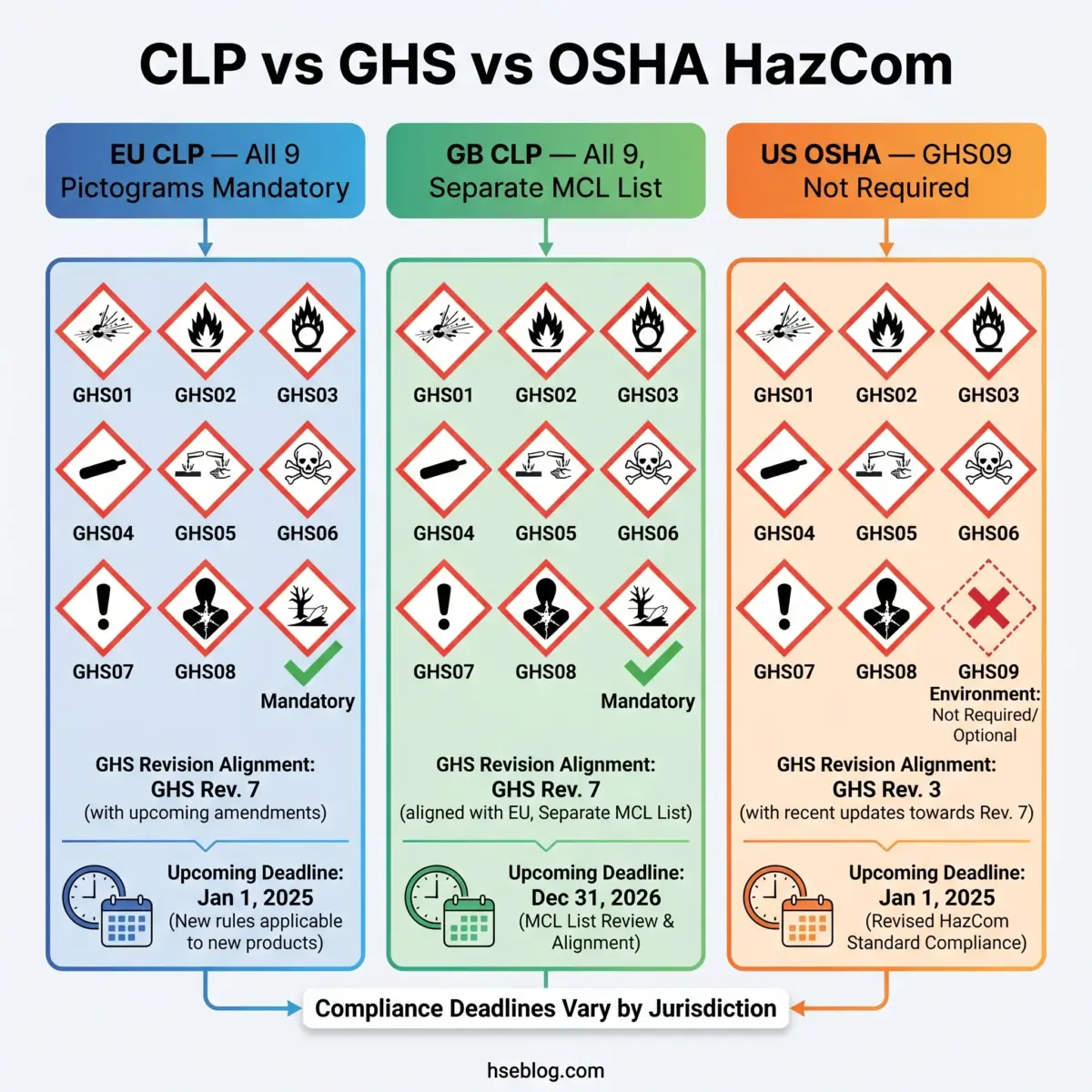
The nine pictogram symbols are visually identical across jurisdictions because they all derive from the same UN GHS source. The differences lie in which GHS revision each jurisdiction has adopted, which pictograms are mandatory, and the compliance timelines for recent updates. For companies operating across borders, these differences determine whether a single label can serve multiple markets.
| Feature | EU CLP | GB CLP | US OSHA HazCom |
|---|---|---|---|
| GHS Revision | Rev. 6/7 + additional EU hazard classes | EU CLP as retained at Brexit (Jan 2021) | Rev. 7 (+ parts of Rev. 8, from May 2024) |
| Mandatory Pictograms | All 9 (GHS01–GHS09) | All 9 (GHS01–GHS09) | GHS01–GHS08 mandatory; GHS09 not required |
| Environment Pictogram | Mandatory | Mandatory | Not required |
| New Hazard Classes | ED, PBT/vPvB, PMT/vPvM (from May 2025 for new substances) | Not adopted | Not adopted |
| Classification Source | EU harmonised classification (Annex VI) | GB MCL list (6th ed. Feb 2025, 7th ed. Sept 2025) | Employer/manufacturer classification per HazCom |
| Key Compliance Deadline | Varied: new substance labels May 2025; labelling provisions delayed to Jan 2028 | Ongoing — MCL updates published periodically | Substance SDS/labels by May 2026; mixture SDS/labels by Nov 2027 |
The HSE GB CLP hazard pictogram page provides GB-specific guidance, while OSHA's Hazard Communication Standard page covers the US framework.
Companies exporting to both the EU and the US often produce a single label that includes GHS09 even for the US market. This is legally permissible under OSHA HazCom — the standard does not prohibit additional pictograms — and avoids maintaining dual label versions. The trade-off is that US-based inspectors unfamiliar with GHS09 may query its inclusion, requiring the supplier to explain that it is a voluntary addition. For most supply chains, the cost of that occasional explanation is lower than the cost of managing separate label inventories.
Jurisdiction Note: Northern Ireland follows EU CLP under the Windsor Framework, while England, Scotland, and Wales follow GB CLP. UK-wide suppliers face dual requirements: products sold in Northern Ireland must comply with EU CLP (including any post-Brexit amendments), while products for Great Britain follow GB CLP. This affects not only pictogram assignments but also the classification source — EU harmonised classifications for Northern Ireland, GB MCL for Great Britain.
What Has Changed: 2024–2025 CLP and GHS Updates
The 2024–2025 period has produced more regulatory movement in chemical hazard communication than any comparable window in the past decade. Three jurisdictions have simultaneously updated their frameworks, creating a period of overlapping compliance timelines that supply chain and HSE teams need to track carefully.
EU: Regulation (EU) 2024/2865
The most significant development is the EU's adoption of Regulation (EU) 2024/2865, which entered into force on 10 December 2024. This amendment introduces new label design requirements — minimum font sizes for readability, expanded fold-out label provisions for small containers, and the first formal framework for digital labelling as a supplemental information channel. It also integrates advertising disclosure rules for hazardous products and elevates the new hazard classes (endocrine disruptors for human health and the environment, PBT/vPvB, PMT/vPvM) into the CLP framework.
These new hazard classes, originally introduced via Delegated Regulation (EU) 2023/707, follow a phased timeline: mandatory classification for new substances and mixtures placed on the market from 1 May 2025, with existing substances required to comply by 1 November 2026 and existing mixtures by 1 May 2028. Critically, the new hazard classes do not yet have dedicated pictograms — they trigger existing pictograms, primarily GHS07 and GHS08, depending on the specific category. Several labelling provisions from the 2024 amendment have been delayed to January 2028 via Regulation (EU) 2025/2439.
US: OSHA HazCom GHS Rev. 7
OSHA published its final rule updating the Hazard Communication Standard (29 CFR 1910.1200) on 20 May 2024, effective 19 July 2024. The update aligns US HazCom with GHS Revision 7 and incorporates elements of Revision 8, including desensitised explosives under the flame pictogram and a new "chemicals under pressure" category. Compliance deadlines extend through the next two years: substance SDS and label updates by May 2026 (extended by four months from the original January 2026 deadline), mixture SDS and labels by November 2027, and employer compliance six months after each.
GB: MCL List Updates
GB CLP, which retained EU CLP as it stood at Brexit in January 2021, continues to diverge from the EU framework through independent updates to the GB Mandatory Classification and Labelling (MCL) list. HSE published the 6th edition in February 2025 and the 7th edition in September 2025, with 78 substances receiving new or revised classifications. A further 60-substance proposal was notified to the WTO in January 2026.
The phased implementation timelines across all three jurisdictions mean that the same chemical substance may carry different label requirements depending on the destination market at any given point between now and 2028. Supply chain teams relying on a single "global" label need jurisdiction-specific label management rather than a blanket approach.
How to Read and Respond to CLP Pictograms in the Workplace
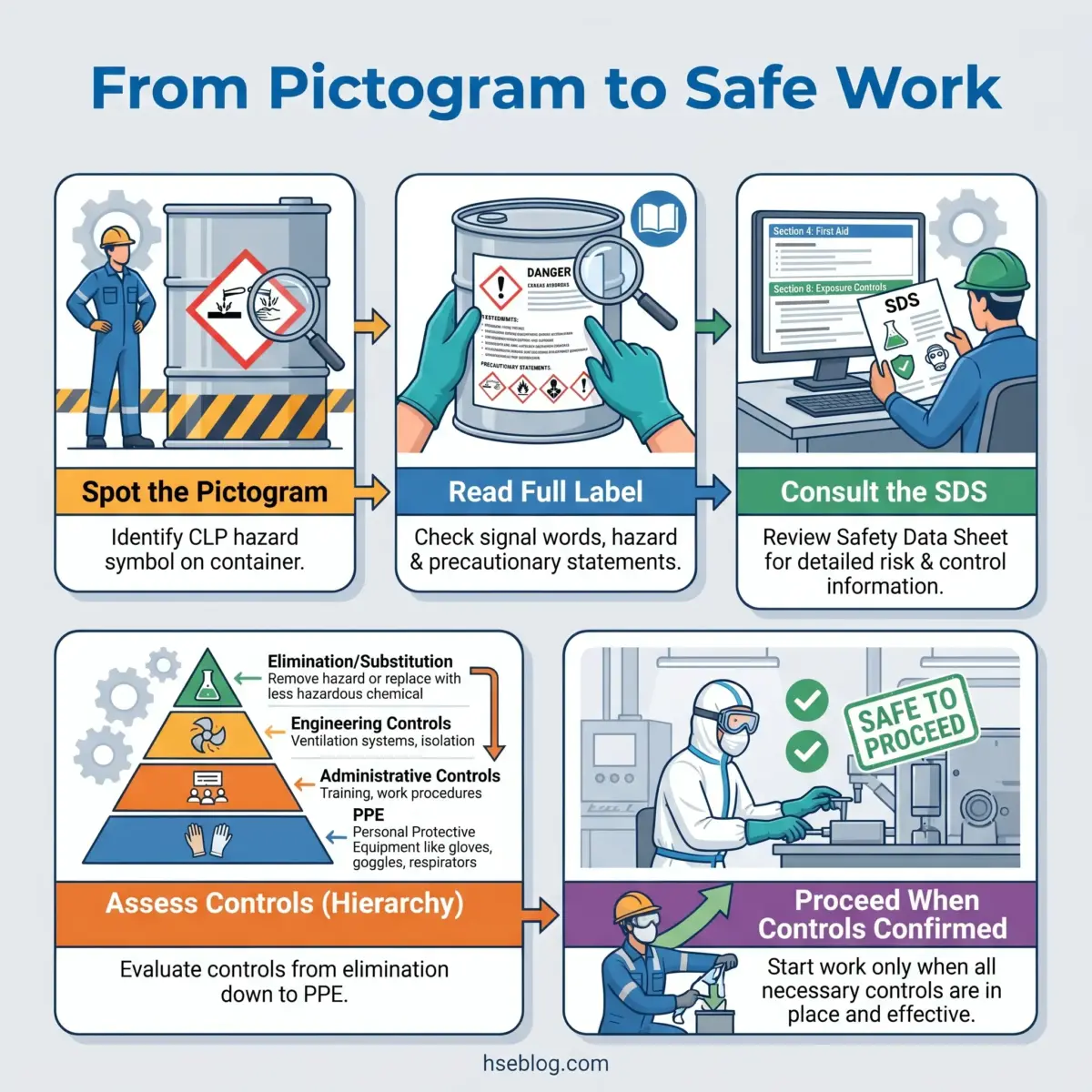
The most dangerous gap in workplace chemical safety is not misunderstanding what a pictogram means — it is failing to act on it. A published pattern across chemical exposure incident reports is remarkably consistent: the pictogram was present, the worker recognised it, the Safety Data Sheet was not consulted, and default PPE was assumed to be sufficient.
Pictograms are the first-glance hazard alert. Their function is to trigger a decision sequence, not to serve as the decision itself. When a worker encounters any CLP pictogram on a container — whether in stores, in a laboratory, on a production line, or in a maintenance workshop — the response should follow a consistent pattern.
Each pictogram group should prompt specific control-hierarchy thinking. A flame (GHS02) demands assessment of ignition sources, ventilation, and flammable storage limits. A health hazard silhouette (GHS08) demands exposure monitoring, health surveillance, and long-term control adequacy. A corrosion pictogram (GHS05) demands assessment of PPE material compatibility — not all gloves resist all corrosives, and a generic "chemical-resistant glove" claim is not a substitute for checking the SDS and the glove manufacturer's permeation data.
The absence of a pictogram on a workplace container is equally important. Decanted or transferred chemicals require secondary labelling under CLP, yet workplace audits consistently find unlabelled or inadequately labelled secondary containers. A clear bottle with no label, sitting next to a process line, is one of the most common near-miss scenarios in chemical workplaces — and one of the most preventable.
The Fix That Works: Effective pictogram training does not focus on memorisation alone. It focuses on recognition speed and response. Can a worker identify all nine pictograms reliably within seconds? And does the worker know — without thinking — that the next step is always to read the SDS? If the answer to either question is no, the training programme has not finished its job.
Private industry employers reported 2.5 million nonfatal workplace injuries and illnesses in 2024 (US Bureau of Labor Statistics, 2026). Chemical-related respiratory illnesses remain a significant contributor to that total, and the first barrier against those illnesses is a label that gets read and acted on.
Frequently Asked Questions
How many CLP hazard pictograms are there?
Nine pictograms exist under CLP, coded GHS01 through GHS09. They cover three broad hazard domains: physical hazards (exploding bomb, flame, flame over circle, gas cylinder), health hazards (corrosion, skull and crossbones, exclamation mark, health hazard silhouette), and environmental hazards (environment). Each pictogram uses a standardised format — black symbol, white background, red diamond border — and the GHS codes serve as classification references, not label elements.
Is the environmental pictogram (GHS09) mandatory in all countries?
GHS09 is mandatory on labels in the EU and Great Britain under CLP but is not required in the United States under OSHA's Hazard Communication Standard. For companies exporting to multiple markets, applying GHS09 universally is the simplest compliance strategy — OSHA does not prohibit additional pictograms — but US-based receiving sites may occasionally question its presence. Including it avoids the risk of non-compliance in any market that requires it.
What is the difference between the exclamation mark and the skull-and-crossbones pictogram?
GHS07 (exclamation mark) covers lower-severity acute toxicity at Category 4 and other less severe health effects such as irritation and skin sensitisation. GHS06 (skull and crossbones) covers the most severe acute toxicity at Categories 1 through 3, representing substances that can kill or cause serious harm from a single exposure. Under CLP Article 26, when GHS06 applies, GHS07 must not appear on the same label.
Do the new CLP hazard classes (endocrine disruptors, PBT) have their own pictograms?
No dedicated new pictograms have been assigned. The new hazard classes — endocrine disruptors for human health and the environment, PBT/vPvB, and PMT/vPvM — trigger existing pictograms, primarily GHS07 and GHS08, depending on the specific hazard category and severity. This means existing pictogram recognition training remains valid, but workers and assessors need to understand that these pictograms now cover a broader range of underlying hazards.
What is the minimum size for a CLP hazard pictogram on a label?
Each pictogram must occupy at least one fifteenth of the total label surface area, with an absolute minimum of 1 cm² regardless of container size. The 2024 CLP amendment (Regulation EU 2024/2865) introduced additional readability requirements including minimum font sizes for surrounding text and specified sans-serif font in black on white. Both the proportional and absolute size rules must be met simultaneously.
What replaced the old orange hazard symbols?
The old orange-background square symbols from the Dangerous Substances Directive (67/548/EEC) and Dangerous Preparations Directive (1999/45/EC) were fully replaced by the red-diamond CLP pictograms. The transition period ended on 1 June 2015 in the EU. Since that date, only CLP pictograms are legally permitted on labels for substances and mixtures placed on the EU market. The symbols themselves were redesigned to align with the UN GHS, though some — like the skull-and-crossbones and the flame — remain visually similar to their predecessors.
Conclusion
Chemical hazard communication is entering its most dynamic period in over a decade. The EU's 2024 CLP amendment, OSHA's alignment with GHS Revision 7, and GB's independent MCL updates are reshaping labelling requirements simultaneously, and the compliance timelines will not fully resolve until 2028. For HSE professionals managing chemical safety across jurisdictions, the nine CLP pictograms remain the stable visual foundation — but the regulatory architecture around them is shifting.
The practical priority has not changed: every pictogram on a label must trigger a decision, not a glance. The pictogram identifies the hazard category. The SDS provides the detail. The risk assessment determines the controls. When that sequence breaks — when pictograms are too small to read, when GHS07 is dismissed as unimportant, when precedence rules are misapplied and critical pictograms disappear from a label — the communication system fails at its most basic function.
Keeping pace means tracking the phased implementation dates, auditing labels against both the existing and incoming requirements, and ensuring that worker training covers not just pictogram recognition but the response that must follow recognition. The symbols themselves are simple. The discipline they demand is not.