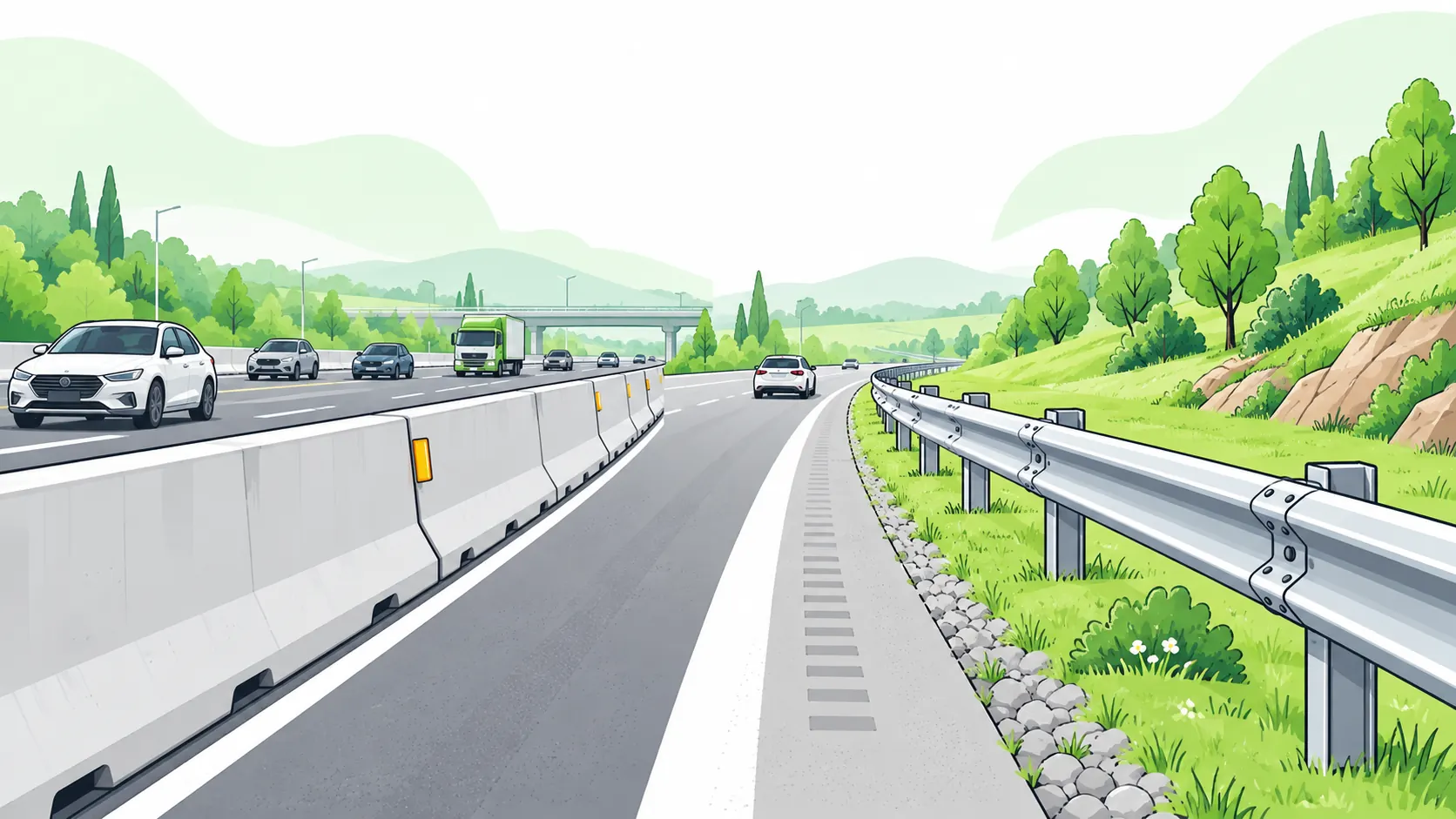
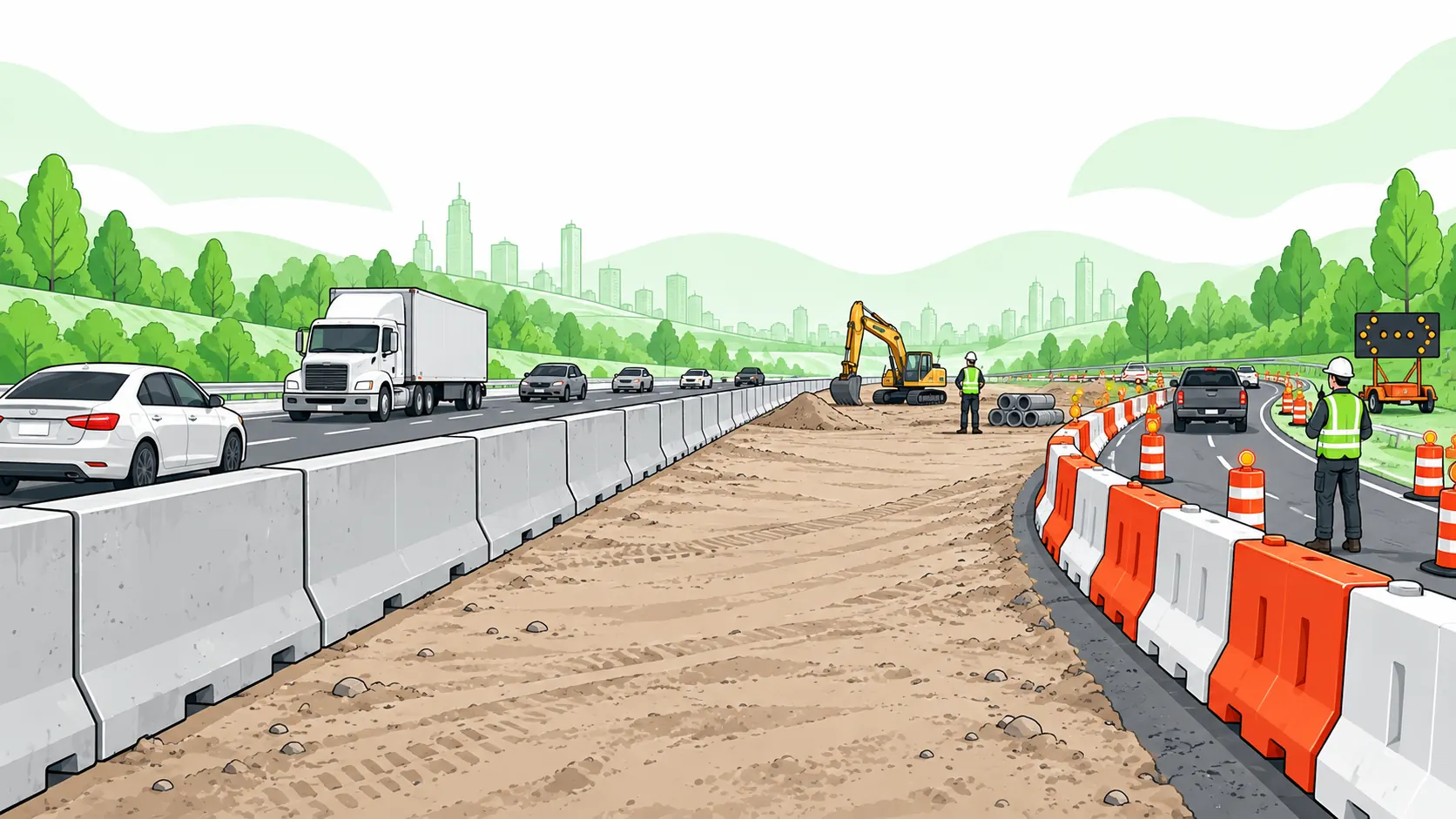
For safety, the deciding factor in concrete vs plastic jersey barriers is not the material — it is whether the device is a crash-tested positive barrier or a longitudinal channelizing device. A positive barrier redirects an errant vehicle; a channelizing device only guides traffic and ruptures on impact. Concrete and steel-reinforced units are usually rated barriers; most plastic "jersey barriers" are not.
A continuous line of plastic units can look exactly like a solid concrete wall and stop nothing. The FHWA is blunt about this: a longitudinal channelizing device is not a barrier, because on impact the plastic units rupture and the vehicle penetrates the line.
That gap between appearance and performance is where people get hurt. US work zones recorded 850 fatalities in 2024, down from 905 in 2023 (Federal Highway Administration via ATSSA, 2026) — still more than two deaths a day, and the reason barrier-class selection is a life-safety decision, not a procurement preference.
Concrete vs Plastic Jersey Barriers: Why the Real Question Isn't the Material
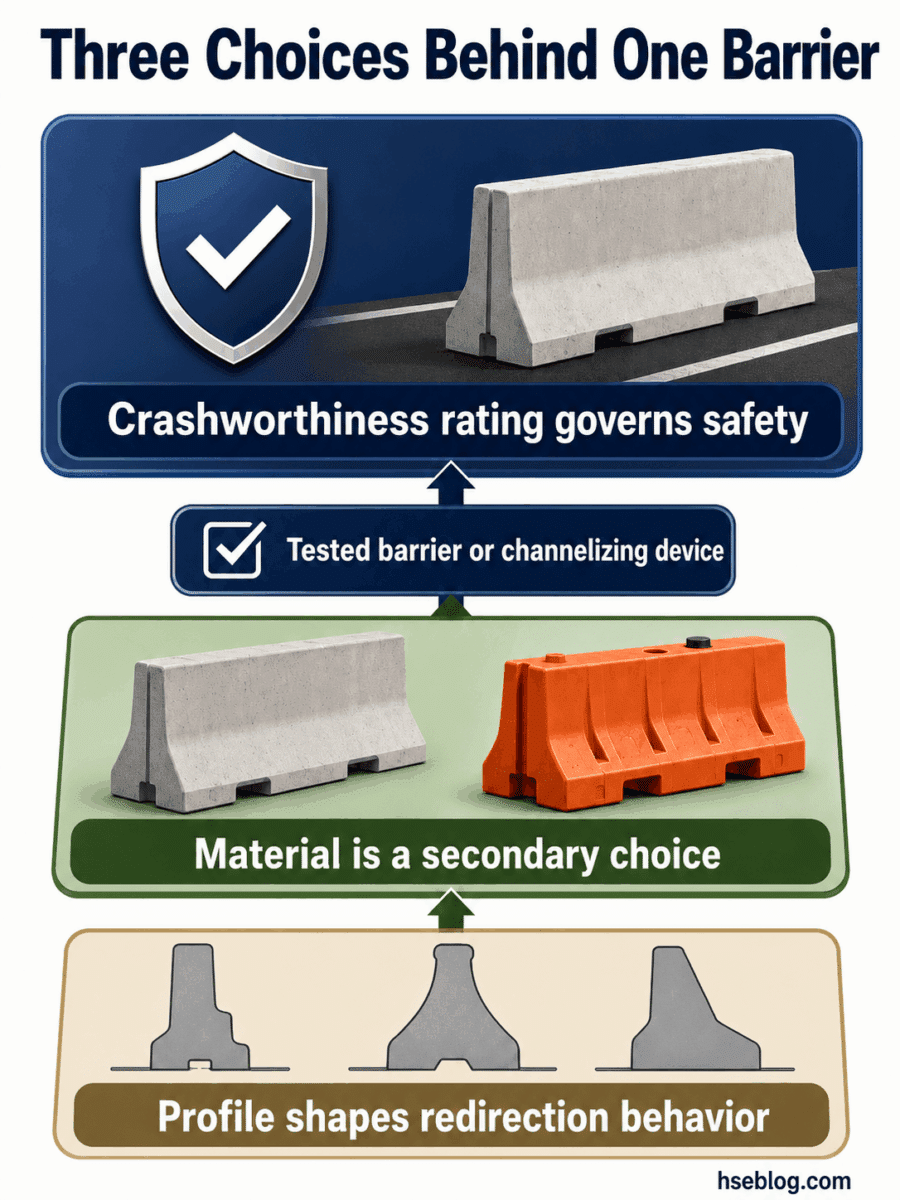
The honest answer to "which is better" is that the comparison is built on the wrong axis. Material is one of three independent choices, and it is the least important to whether the device saves a life.
A jersey barrier safety comparison actually involves three separate decisions:
- Profile geometry — New Jersey, F-shape, or single slope. This shapes how a vehicle climbs or is redirected.
- Material — cast concrete, precast/portable concrete, plastic shell, or steel-reinforced plastic. This affects weight, handling, and cost.
- Crashworthiness rating — whether the unit has passed a recognized crash test at the road's operating speed. This is the only one that decides whether intrusion is survivable.
A device is either a tested positive barrier or it is not. Material can hint at the answer, but it never settles it — a heavy plastic shell with no passing crash test is not a barrier, and a properly reinforced plastic unit can be.
The recurring procurement error is treating "looks like a jersey wall" as "performs like a jersey barrier." A neat, continuous line of water-filled units reads as a solid wall to the eye and offers little or no vehicle redirection in a real impact.
This article provides general HSE knowledge. Barrier selection for live roadways is life-critical work and must be planned and signed off by a competent traffic-control or highway engineer, with jurisdiction-specific authorization and a site-specific engineering study. The information here does not replace that study.
What a Jersey Barrier Actually Does: Redirect, Not Stop
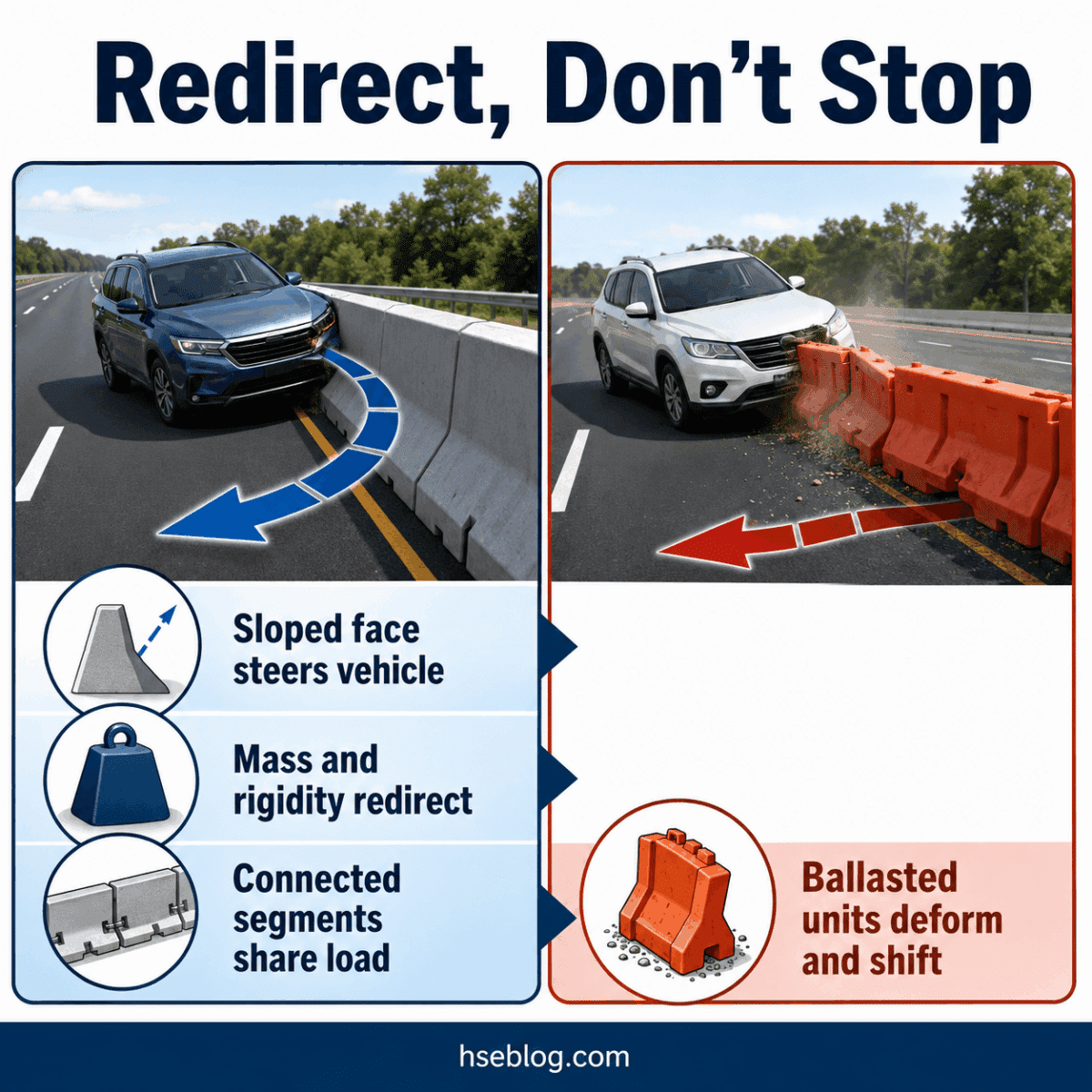
A jersey barrier's purpose is to redirect an errant vehicle back toward its travel path — not to halt it abruptly. The 32-inch safety-shape profile uses the lower sloped face to lift and steer the tire and body, converting a head-on collision into a glancing one.
That redirection is the functional baseline both materials are measured against, and it depends on three things working together: mass, rigidity, and tested connection behavior between units. Lose any one and the line stops behaving like a barrier.
Profile and material are independent variables, which is the point most comparisons miss:
| Profile | Key geometric trait | Practical effect |
|---|---|---|
| New Jersey profile | Steeper lower face, higher slope break | Long service record; can promote more climb in small cars |
| F-shape barrier | Lower slope break point | Reduces small-car rollover and vehicle climb |
| Single / constant slope | One continuous angled face | Performs consistently as the roadway is overlaid and raised |
Specifying "F-shape" tells you nothing about whether a unit is crashworthy — an F-shape can be cast in concrete or molded in plastic. Conflating profile with material is one of the most common specification mistakes I see in tender documents.
Concrete Barriers: Mass-Based Redirection
A temporary concrete barrier for a work zone earns its redirection through sheer mass and rigidity. Cast-in-place runs behave as a near-continuous wall; portable and precast segments — the familiar k-rail — depend on tested connections such as pin-and-loop or proprietary hook systems to transfer impact load down the line.
Even a "rigid" portable concrete barrier deflects under impact. The published working width for a given segment, connection, and run length is part of its rating — a short, poorly anchored run can move further than the data sheet implies.
Plastic Barriers: Ballast, Deformation, and the Fill Condition
A water-filled barrier vs concrete barrier comparison turns on how the plastic unit manages energy. Plastic units rely on water or sand ballast, shell deformation, and lateral displacement — they absorb and slow rather than firmly redirect.
The critical caveat: that behavior is valid only in the exact fill and connection condition that was crash-tested. A drained or half-filled unit is a different object from the one in the test report, even though it looks identical.
Positive Barrier vs Longitudinal Channelizing Device: The Distinction That Governs Safety
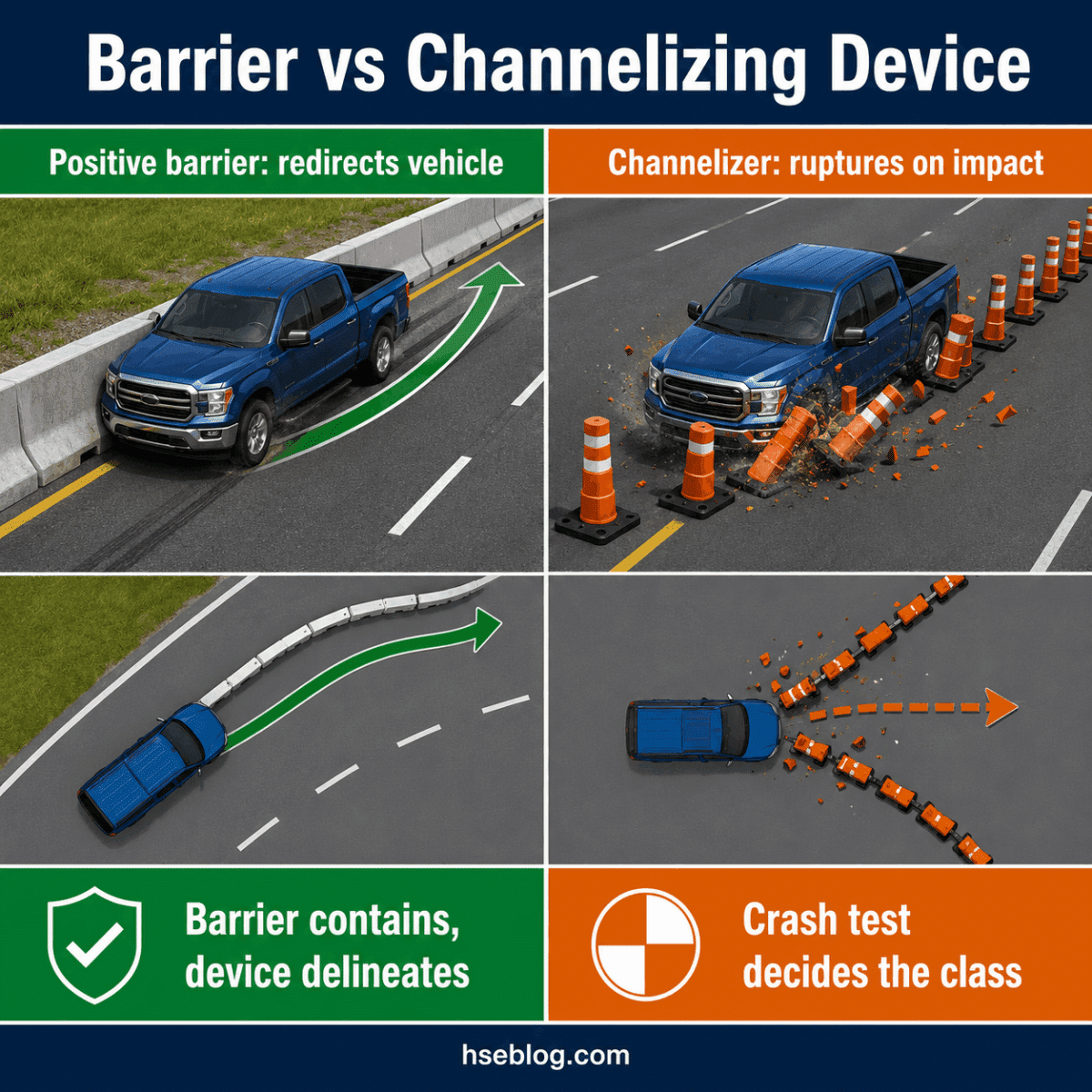
This is the distinction that actually decides whether someone walks away from an intrusion, and almost no vendor comparison states it cleanly. In FHWA terms, a positive protection barrier physically redirects an errant vehicle, while a longitudinal channelizing device only delineates and discourages intrusion.
The FHWA's own guidance on barriers versus longitudinal channelizing devices is explicit: an LCD is not a barrier because the plastic units rupture on impact and the vehicle penetrates the line. They are different hardware classes, judged by different test regimes — and an LCD cannot be substituted where a barrier is specified.
What that means on the ground:
- A channelizer guides. It tells drivers where the work zone edge is and adds psychological deterrence. It does not contain a vehicle that leaves the lane at speed.
- A barrier contains. It is engineered and tested to absorb and redirect the impact of a defined vehicle at a defined speed and angle.
- Material is not disqualifying — a missing crash test is. Steel-reinforced water or cable units have been tested and accepted as barriers at specific Test Levels. A plastic jersey barrier crashworthy claim is only valid with a passing crash test behind it.
| Attribute | Positive barrier (rigid / tested) | Longitudinal channelizing device |
|---|---|---|
| Primary function | Redirect an errant vehicle | Delineate and discourage intrusion |
| Impact behavior | Contains and redirects | Units rupture; vehicle penetrates |
| Typical material | Concrete, steel, steel-reinforced units | Plastic shell with water/sand ballast |
| Test basis | MASH Test Level / EN 1317 containment | Channelizer criteria — not a barrier crash test |
| Suitable for high speed | Yes, when rated to the operating speed | No |
The highest-consequence field failure mode follows directly from this: a drained, partly filled, or non-standard-connected plastic unit treated as if it still performs to its tested rating. Fill state and connection detail are not cosmetic — they are the rating.
How Crashworthiness Is Actually Rated: MASH Test Levels and EN 1317 Containment
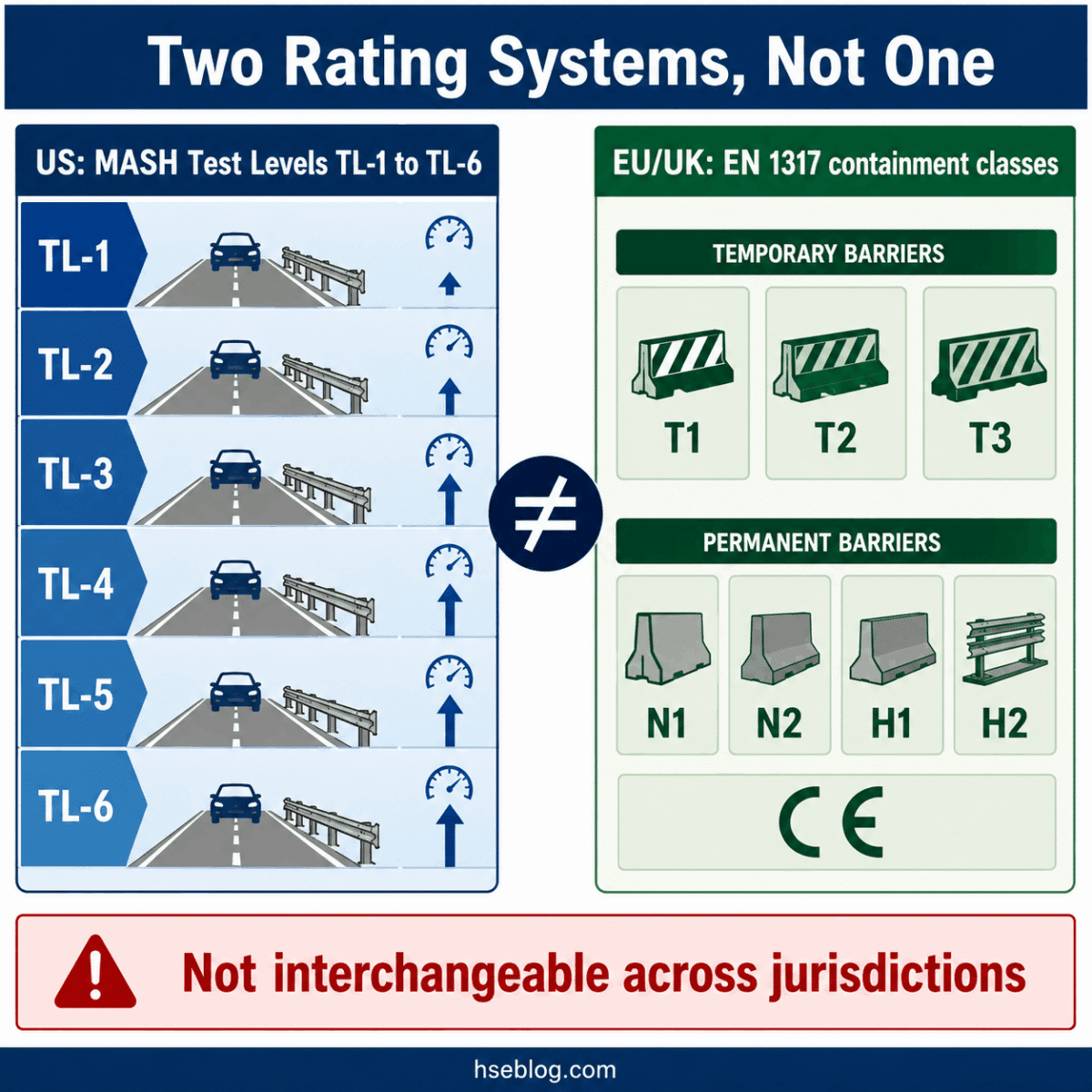
Two rating systems decide suitability, and neither asks "concrete or plastic" — they ask whether the device is rated for this road. In the US that system is AASHTO MASH; in Europe and the UK it is EN 1317.
Speed was a factor in 34% of fatal work zone crashes (US, 2022) (Federal Highway Administration, 2024), which is exactly why the rating is tied to operating speed rather than appearance.
Under AASHTO's Manual for Assessing Safety Hardware (MASH, 2016), crash performance is judged on three things: structural adequacy, occupant risk, and post-impact vehicle trajectory. The MASH Test Level rises with test speed, and temporary work-zone devices manufactured after 31 December 2019 must meet MASH 2016 — verified through an FHWA eligibility letter.
| MASH Test Level | Nominal passenger-car test speed | Typical application |
|---|---|---|
| TL-1 | ~50 km/h (31 mph) | Very low-speed, low-volume |
| TL-2 | ~70 km/h (44 mph) | Low-speed work zones, local roads |
| TL-3 | ~100 km/h (62 mph) | Most highways and high-speed work zones |
| TL-4 | Adds heavier single-unit truck | Mixed truck traffic |
| TL-5 / TL-6 | Adds tractor-trailer / tanker | High truck-volume, critical locations |
Europe and the UK classify differently. EN 1317 sorts road restraint systems by containment level, working width, and impact severity, as set out in the EN 1317-2 containment levels.
| EN 1317 class | Type | CE-marked? |
|---|---|---|
| T1, T2, T3 | Temporary containment (rising severity) | Not CE-marked |
| N1, N2 | Normal containment (permanent) | CE-marked |
| H1–H4 | Higher containment (permanent) | CE-marked |
| L1–L4 | Very high containment | CE-marked |
These systems are not interchangeable. They use different test vehicles, speeds, and impact angles, so a device eligible under MASH is not automatically compliant under EN 1317, and vice versa.
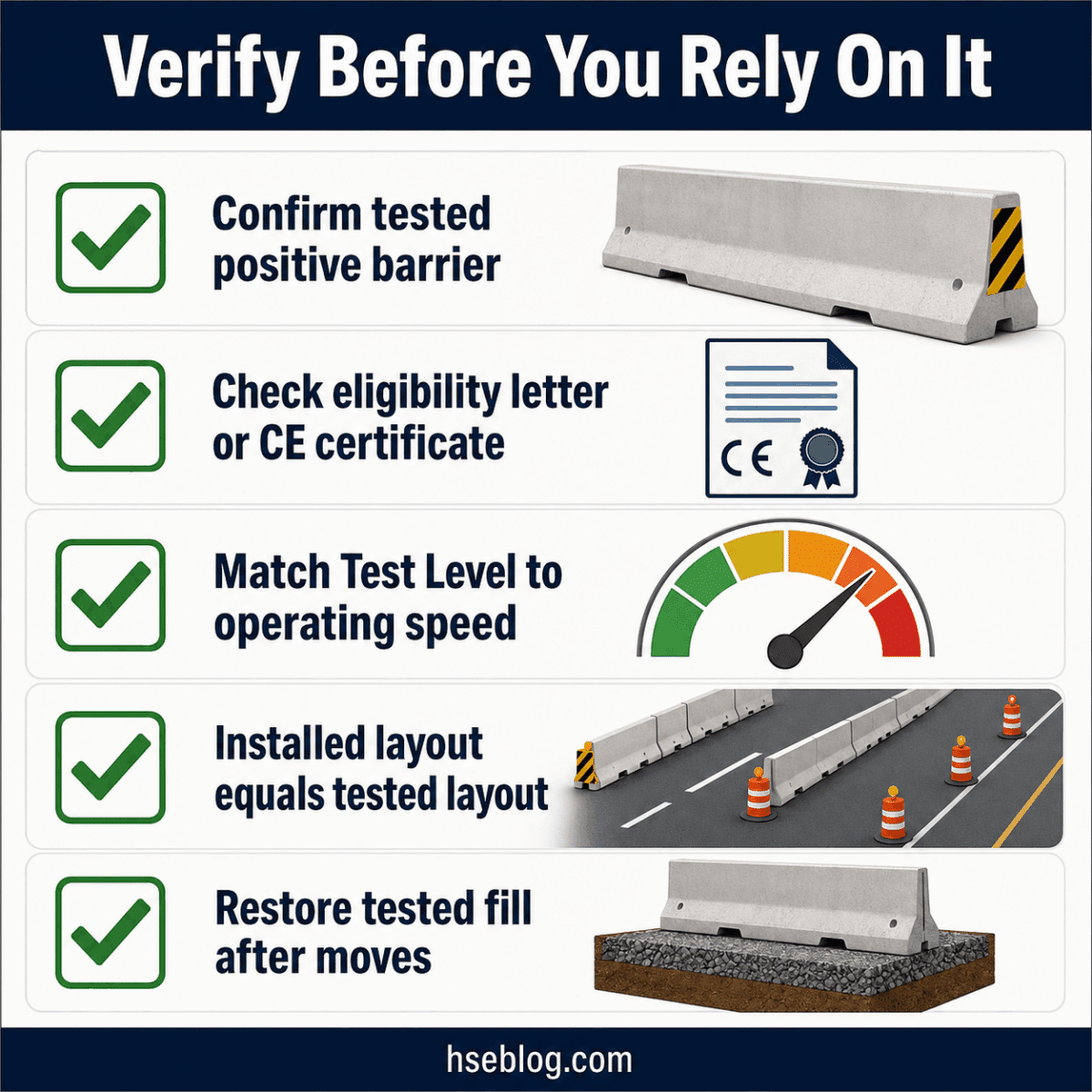
The practitioner check is therefore never "concrete or plastic." It is: show me the FHWA eligibility letter or CE certificate, the Test Level or containment class, and confirm that the installed configuration matches the tested one.
When Concrete Is the Right Choice — and When Plastic Is
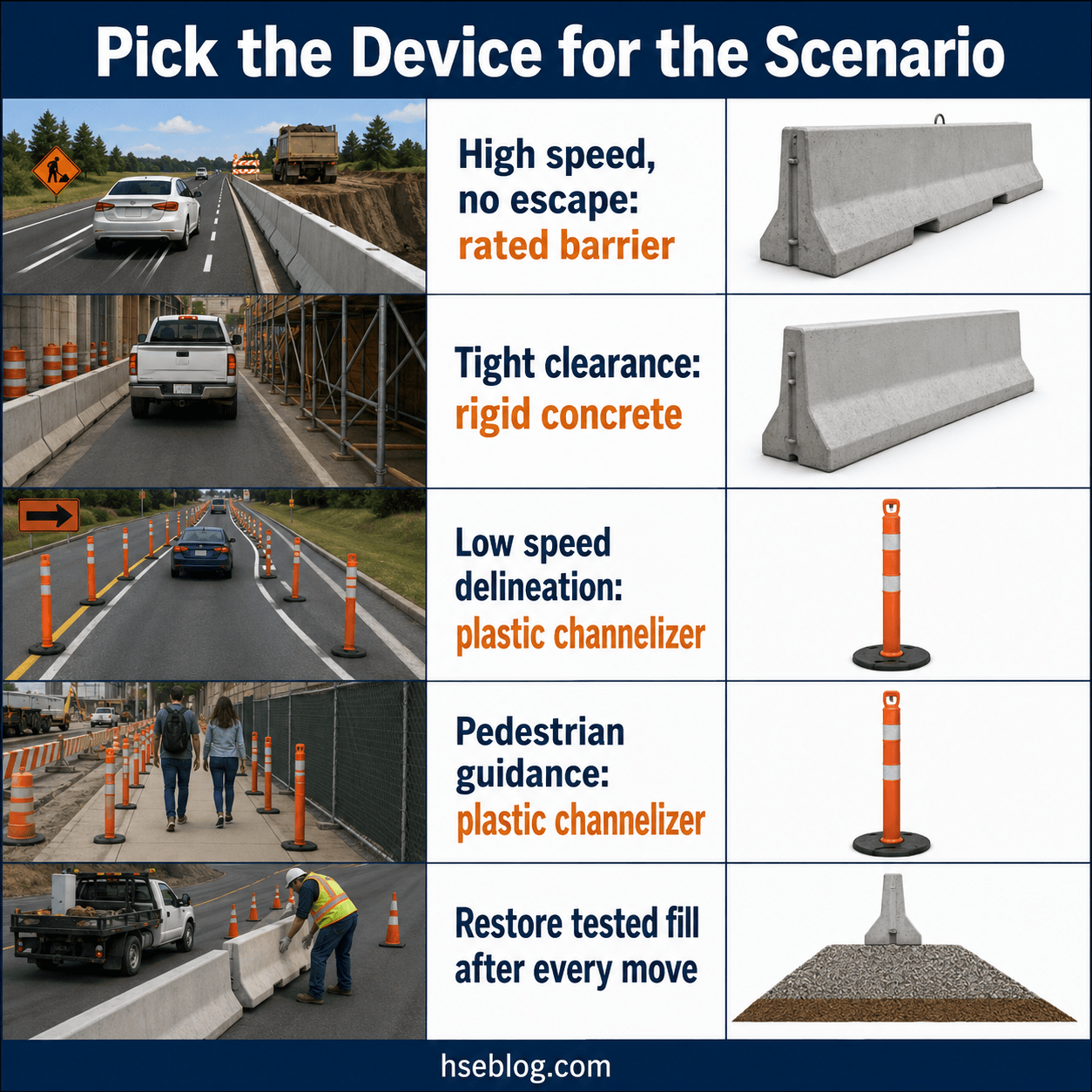
The problem with a blanket answer is that the right device changes with operating speed, duration, intrusion risk, and how much deflection space exists behind the line. Match the device class to the scenario, not to the budget.
A few principles drive the choice:
- Rated positive barrier — for high-speed roadways, no worker escape route, long duration, and limited lateral clearance. This is usually concrete or a steel-reinforced unit.
- Plastic channelizer — for low-speed or non-traffic-facing delineation, pedestrian and crowd guidance, frequent repositioning, and short durations.
- Deflection and footprint — rigid barriers need little working width; ballasted units deflect and need clear space behind them, or the redirection they do offer is defeated by whatever is in that space.
| Scenario | Recommended device class | Rationale |
|---|---|---|
| High-speed roadway, no worker escape route | Rated positive barrier (concrete / steel-reinforced) | Redirection at operating speed is mandatory |
| Long-duration closure, limited lateral clearance | Rigid concrete barrier | Minimal deflection / working width |
| Low-speed or non-traffic-facing delineation | Plastic channelizer | Guidance without a redirection demand |
| Pedestrian / crowd guidance | Plastic channelizer | Light, repositionable, no vehicle threat |
| Frequent reconfiguration, short duration, low speed | Plastic channelizer | Rapid deployment outweighs redirection need |
The judgment call most often gets botched after placement, not before. The "set-and-forget" failure pattern is real: crews place ballasted units correctly, then drain or shift them mid-project to get plant access — and never restore the tested condition, silently downgrading protection for the rest of the job.
The Regulatory and Compliance Layer (US, EU/UK)
Barrier class is not just good practice — in high-speed work zones it is a legal obligation. In the US, three instruments set the floor, and in Europe the EN 1317/CE pathway does the same job.
The field interpretation runs like this:
- Crashworthiness is required, not optional. The MUTCD 11th Edition, Part 6 (Chapter 6M, Section 6M.02), published December 2023 and effective January 2024, requires temporary traffic barriers and their end treatments to be crashworthy and strengthens positive-protection guidance where workers face increased risk from traffic.
- Positive protection is the default in high-speed zones. Under 23 CFR Part 630, Subpart K, agencies must use positive protection devices, at minimum, in high-speed work zones that leave workers no means of escape from intruding traffic — unless an engineering study determines otherwise.
- Eligibility must be evidenced. A device made after 31 December 2019 must meet MASH 2016, shown by an FHWA eligibility letter for the specific product and configuration.
- In the EU/UK, the route is EN 1317. Permanent N, H, and L containment systems must be CE-marked; temporary T1–T3 classes are not CE-marked but must still hold the containment class for the application.
There is a freshness point worth tracking: states were required to reach substantial conformance with the MUTCD 11th Edition by January 2026, so positive-protection expectations in high-speed zones are now the prevailing standard, not an aspiration (Federal Highway Administration, 2023, effective 2024).
The compliance trap is configuration. Using a MASH-eligible barrier in an untested layout — wrong connection, reduced ballast, a foreshortened run — can void the basis of its acceptance, so the paperwork passes while the installed protection does not.
For competence, route designers and supervisors toward recognized training pathways — work zone traffic control certification, and NEBOSH, IOSH, or OSHA outreach programs for the underlying risk-management discipline — and keep final selection with a competent engineer.
Regulatory content here reflects a general HSE professional's understanding of US and EU/UK requirements as of 2026. It is not legal advice. Specific compliance, enforcement, or liability questions should go to qualified legal counsel and your governing DOT or national highway authority.
Regulatory currency note: content last reviewed against the MUTCD 11th Edition (2023), AASHTO MASH 2016, 23 CFR 630 Subpart K, and EN 1317 as published. Verify against the current edition and your jurisdiction's DOT specification before specifying any device.
Frequently Asked Questions
Are plastic jersey barriers safe to use on highways?
It depends entirely on the unit's rating, not its material. Most plastic "jersey barriers" are longitudinal channelizing devices that rupture on impact, so they are not suitable as positive protection on high-speed runs. The exception is a steel-reinforced plastic unit that has passed a crash test at a Test Level matching the road's operating speed.
Do water-filled barriers actually stop a vehicle?
Unreinforced water-filled barriers do not reliably redirect a vehicle — they absorb energy through ballast and shell deformation and can be penetrated at speed. Their behavior is only as good as the exact fill and connection condition that was crash-tested. A drained or half-filled unit no longer matches its test report and should not be relied on for protection.
What MASH test level do I need for a work zone barrier?
Match the MASH Test Level to your operating speed: TL-2 for low-speed roads and commonly TL-3 for most highways, with higher levels where heavy trucks dominate. Under AASHTO MASH 2016, confirm the device with an FHWA eligibility letter for that exact product and layout. Final selection should be set by an engineering study, not a rule of thumb.
Is the F-shape barrier safer than the New Jersey profile?
The F-shape barrier has a lower slope break point, which reduces small-car climb and rollover compared with the classic New Jersey profile. Both profiles can meet crash criteria, so neither is "unsafe." Profile is a separate choice from material — an F-shape says nothing about whether the unit is crashworthy on its own.
Are MASH and EN 1317 ratings interchangeable?
No. MASH (US) and EN 1317 (EU/UK) use different test vehicles, speeds, and impact angles, so a device accepted under one is not automatically compliant under the other. On an international project, specify and verify the rating for the governing jurisdiction. Do not assume cross-acceptance between a MASH Test Level and an EN 1317 containment class.
Can plastic barriers replace concrete k-rail to save cost and time?
Only where the application does not require positive vehicle redirection — low-speed delineation, pedestrian guidance, or short, frequently moved layouts. They are never a like-for-like substitute for portable concrete barrier on high-speed runs, where the FHWA distinction between a barrier and a channelizing device controls. Substituting one for the other there removes protection that the law expects.
Conclusion
The industry keeps losing this argument because it asks the wrong question. "Concrete vs plastic jersey barriers" treats material as the safety variable, when the variable that decides survival is whether the device is a crash-tested positive barrier or a channelizing device that ruptures on impact.
The single highest-impact change is also the simplest: stop buying by appearance and start buying by rating. Demand the FHWA eligibility letter or CE certificate, confirm the Test Level or containment class against the operating speed, and verify that what gets installed — fill, connections, run length — is the configuration that was actually tested. That one habit closes the gap that the work zone fatality figures keep exposing.
Concrete or steel-reinforced units usually win for high-speed positive protection, and plastic channelizers earn their place in low-speed delineation and crowd guidance. Keep the call with a competent engineer, hold the rating to the governing jurisdiction, and treat any drained or shifted ballasted unit as a downgrade until its tested condition is restored.