
TL;DR
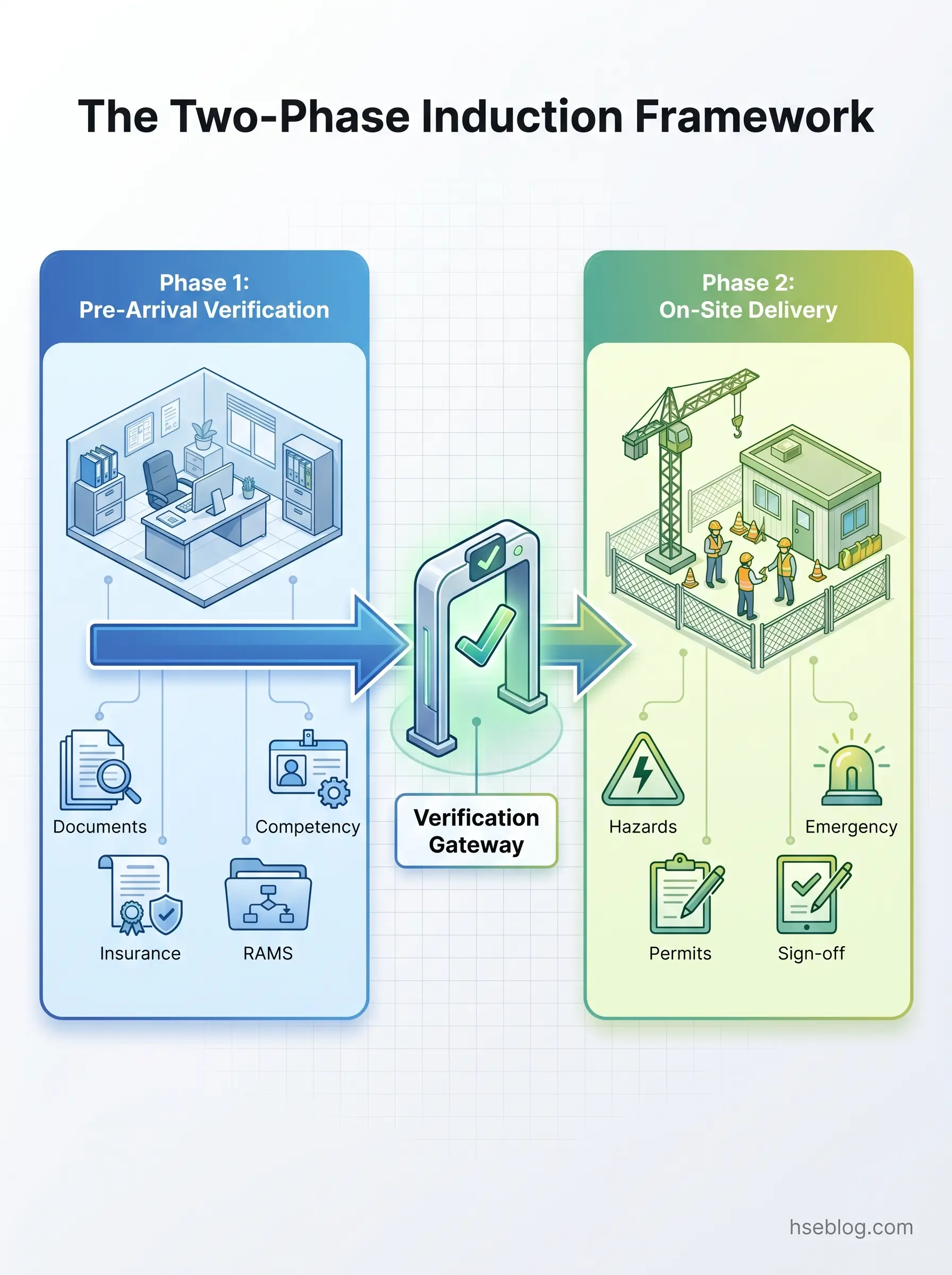
- Run induction as a two-phase system. Pre-arrival verification (competencies, insurance, RAMS/SWMS) is structurally separate from on-site delivery (site-specific hazards, emergency procedures, access).
- Tie induction status to physical access. If a non-inducted person can walk past the gate, the induction is documentation, not a control.
- Verify comprehension, not signatures. A signed acknowledgment is paperwork. A short assessment, Q&A, or practical demonstration is evidence.
- Match induction depth to risk profile. A demolition crew and a window cleaner cannot share one generic deck.
- Re-induct on change. New hazards, extended absence, serious incidents, or annual cycles all reset the requirement.
A contractor safety induction is a structured pre-work process that introduces contractors, subcontractors, and their workers to site-specific hazards, emergency procedures, permit systems, and reporting protocols. Required under OSHA’s multi-employer doctrine, CDM 2015 Regulation 15, and ISO 45001 Clause 8.1.4.2, it functions as both a legal compliance gateway and the first active layer of contractor hazard control.
This article provides general HSE knowledge on contractor induction programs. Site-specific induction content for high-risk activities — confined spaces, energized work, work at height, hot work, demolition — must be planned and supervised by a competent person with relevant training, jurisdiction-specific authorization, and a current site risk assessment. Recognized training pathways including NEBOSH, IOSH, OSHA outreach, and equivalent regional qualifications underpin the competence required to design and deliver induction programs effectively.
Regulation 15 of the UK’s Construction (Design and Management) Regulations 2015 places a direct, non-delegable duty on principal contractors: every worker must be given a suitable site-specific induction before carrying out construction work. Not a generic safety leaflet. Not a one-page sign-in sheet. A site-specific induction. The same principle echoes through OSHA’s multi-employer citation policy, ISO 45001 Clause 8.1.4.2, and the EU Framework Directive — a contractor entering a site without a structured induction is, in regulatory terms, a controlled hazard being treated as uncontrolled.
The principle has been quietly diluted in many workplaces. Contractor safety induction has, in too many organizations, become a tick-box exercise: a 15-minute slide deck, a signed acknowledgment, a hard hat handed over at reception. Records show induction was “delivered.” Subsequent investigations frequently show it was not understood. The cost of that gap shows up in the fatality data — 1,034 construction workers died on the job in the US in 2024 (US Bureau of Labor Statistics, 2025), with falls from height alone accounting for roughly 38% of those deaths. This article walks through what an effective contractor safety induction actually contains, how to structure it across pre-arrival and on-site phases, the regulatory requirements across major jurisdictions, and the failure patterns that recur in published enforcement actions.
What Is a Contractor Safety Induction and Why Does It Matter?
A contractor safety induction is the structured process by which an organization briefs external contractors, subcontractors, and their workers on site-specific hazards, safety rules, emergency procedures, and reporting requirements before any work commences. It is distinct from employee onboarding (which covers employment terms, internal systems, and culture) and from visitor orientation (which is typically a brief escorted walk to a meeting room). Its function is operational: ensure every person carrying out work on the site understands the risk environment they have entered and the controls protecting them.
The reason it matters is structural. A contractor arriving on site brings their own training, their own employer, and their own task focus. They do not arrive with knowledge of the site’s live hazards, current restricted areas, the permit system in operation, or the specific evacuation arrangements. The induction is the bridge between what the contractor was trained to do generally and what this specific site requires. Without it, the contractor is operating on assumption rather than information — and assumption is the failure mode that recurs across confined-space fatalities, struck-by incidents involving site traffic, and electrocutions during energized work.
A common framing error is treating induction as a one-time administrative event rather than the first layer of ongoing contractor safety management. The induction sets the tone for the engagement; if it is compressed, generic, or undelivered to subcontractor tiers, the rest of the safety system inherits those gaps.
Who Needs a Contractor Safety Induction?
The scope question is one of the most consistently misunderstood aspects of contractor induction programs. The short answer: every person carrying out work on the site, regardless of contract length, employer, or task duration. The longer answer requires unpacking who that includes.
Induction applies to:
- Contractors and their direct employees — the head contractor’s workforce in full
- Subcontractors at every tier — second-tier, third-tier, and below; the chain does not exempt the bottom
- Suppliers and delivery personnel entering operational areas, particularly where unloading involves cranes, forklifts, or restricted zones
- Visiting consultants, auditors, and inspectors who move beyond reception or escorted areas
- Short-duration contractors — emergency repair crews, specialist technicians on a half-day visit
The principle is that induction depth should be proportionate to risk exposure, not contract duration. A specialist electrician on site for two hours to repair a fault may be exposed to higher concentrated risk than a long-term cleaning contractor working in low-hazard areas.
A pattern that recurs in published enforcement actions: organizations exempt “quick-visit” contractors from induction because the work itself looks low-risk, only to find the contractor has accessed a restricted area, walked through a crane operating zone, or entered a space subject to a live confined-space permit. The contractor’s task may have been low-risk; the environment they entered was not. The induction’s job is to control the environmental exposure, not just the task.
Re-induction triggers — events that should reset the requirement — typically include:
- Significant changes to site conditions, layout, or active hazards
- Introduction of new high-risk activities adjacent to the contractor’s work area
- Extended absence from site (commonly six months or more)
- A serious incident or near-miss requiring revised controls
- Annual refresh as a baseline minimum
Regulatory Requirements for Contractor Inductions Across Jurisdictions
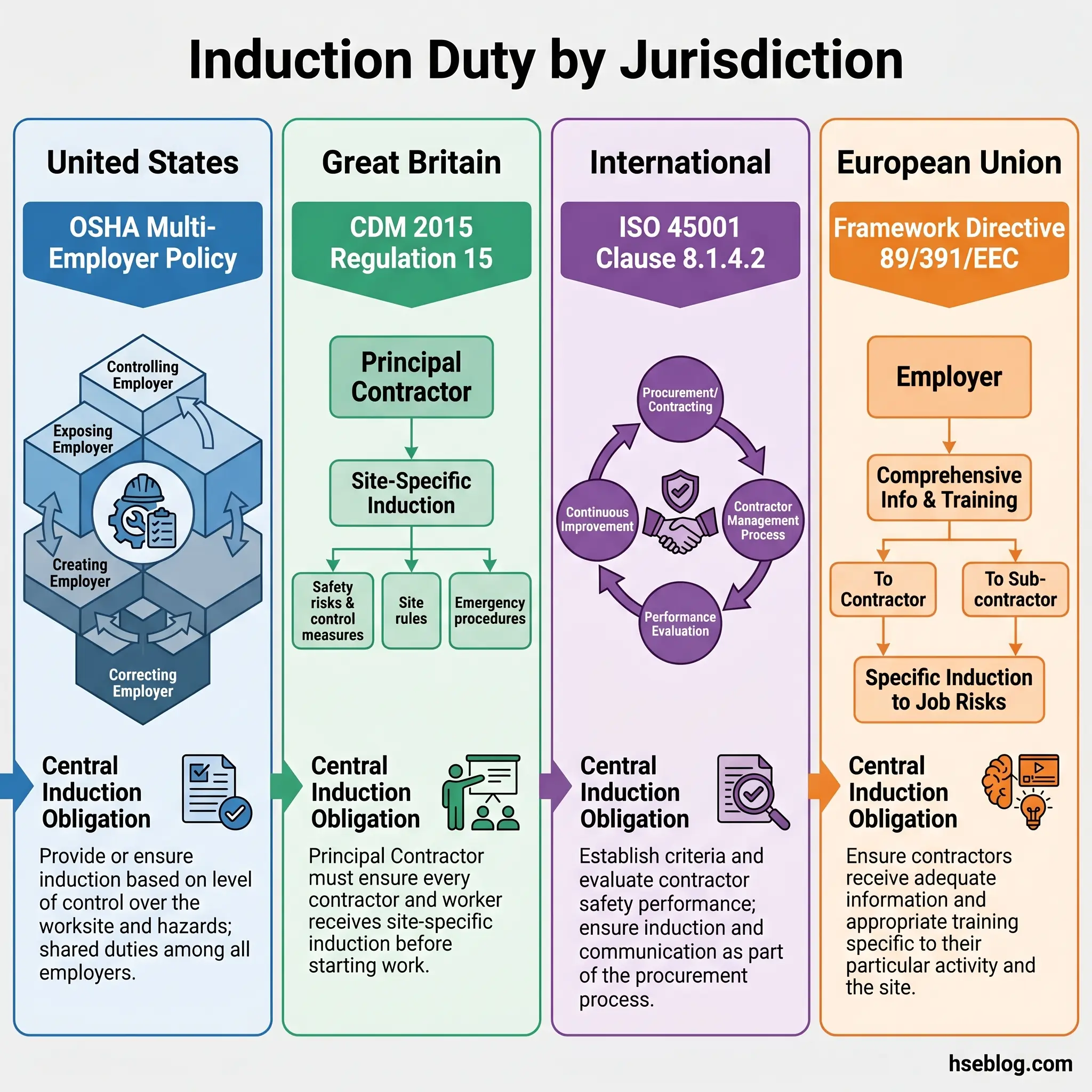
The regulatory landscape for contractor induction is not unified, but the major frameworks converge on a consistent principle: the controlling employer or principal contractor bears responsibility for ensuring contractors are inducted before commencing work. Where they diverge is in prescriptive specificity.
United States — OSHA framework. OSHA does not have a single “contractor induction” rule. Its approach is layered. The Multi-Employer Citation Policy holds the controlling employer responsible for hazards on the site, including those affecting contractor employees. The practical reading of 29 CFR 1926.16 on most construction projects is that the prime contractor bears overall responsibility for compliance with the standards, including subcontractor obligations. For Process Safety Management facilities, 29 CFR 1910.119(h)(3) is more specific: contract employers must ensure each contract employee is instructed in the known potential fire, explosion, and toxic release hazards related to their job and the facility, and trained in the applicable provisions of the emergency action plan. The OSHA general duty clause closes the gaps where specific standards do not reach. Current OSHA penalties run up to $16,550 per serious violation and $165,514 per willful or repeated violation as of January 2025 (OSHA, 2025).
Great Britain — CDM 2015. The UK system is more prescriptive. CDM 2015 Regulation 15 places the duty on principal contractors to ensure that suitable, site-specific inductions are provided to all workers before they carry out construction work. The requirement is for site-specific content, not generic awareness. Section 3 of the Health and Safety at Work Act 1974 extends the employer’s duty to non-employees — meaning the duty toward contractors exists independently of CDM in non-construction settings.
International — ISO 45001:2018. Clause 8.1.4.2 requires organizations to establish and maintain processes to ensure that the OH&S management system requirements are met by contractors and their workers. This is the most prescriptive standard about pre-qualification: it expects defined criteria for contractor selection, coordination of activities, and ongoing performance monitoring — not just a one-time induction.
European Union — Framework Directive 89/391/EEC. Article 6 places the obligation on employers to take measures necessary for the safety and health of workers, including those not directly employed, with adequate information and training as a stated component. National implementation across Member States adds country-specific specificity.
| Jurisdiction | Key Instrument | Core Induction Requirement |
|---|---|---|
| United States | OSHA Multi-Employer Policy; 29 CFR 1926.16; 29 CFR 1910.119(h)(3) | Controlling/prime contractor responsibility; PSM contract employees instructed in site hazards and emergency plan |
| Great Britain | CDM 2015 Reg 15; HSWA 1974 s.3 | Principal contractor must provide suitable site-specific induction before construction work begins |
| International | ISO 45001:2018 Clause 8.1.4.2 | Defined contractor selection criteria, coordination processes, OH&S compliance verification |
| European Union | Framework Directive 89/391/EEC, Article 6 | Employer duty to provide adequate information and training to all workers, including contractors |
Jurisdiction Note: The threshold question across these frameworks is not whether induction is required — it is whether the induction was effective. Multiple HSE UK prosecutions and OSHA citations have arisen not from absent inductions but from inductions delivered in a language the contractor did not adequately understand, or that omitted the specific hazard the contractor was subsequently injured by. The regulator’s test is substance, not paperwork.
What to Include in a Contractor Safety Induction Checklist
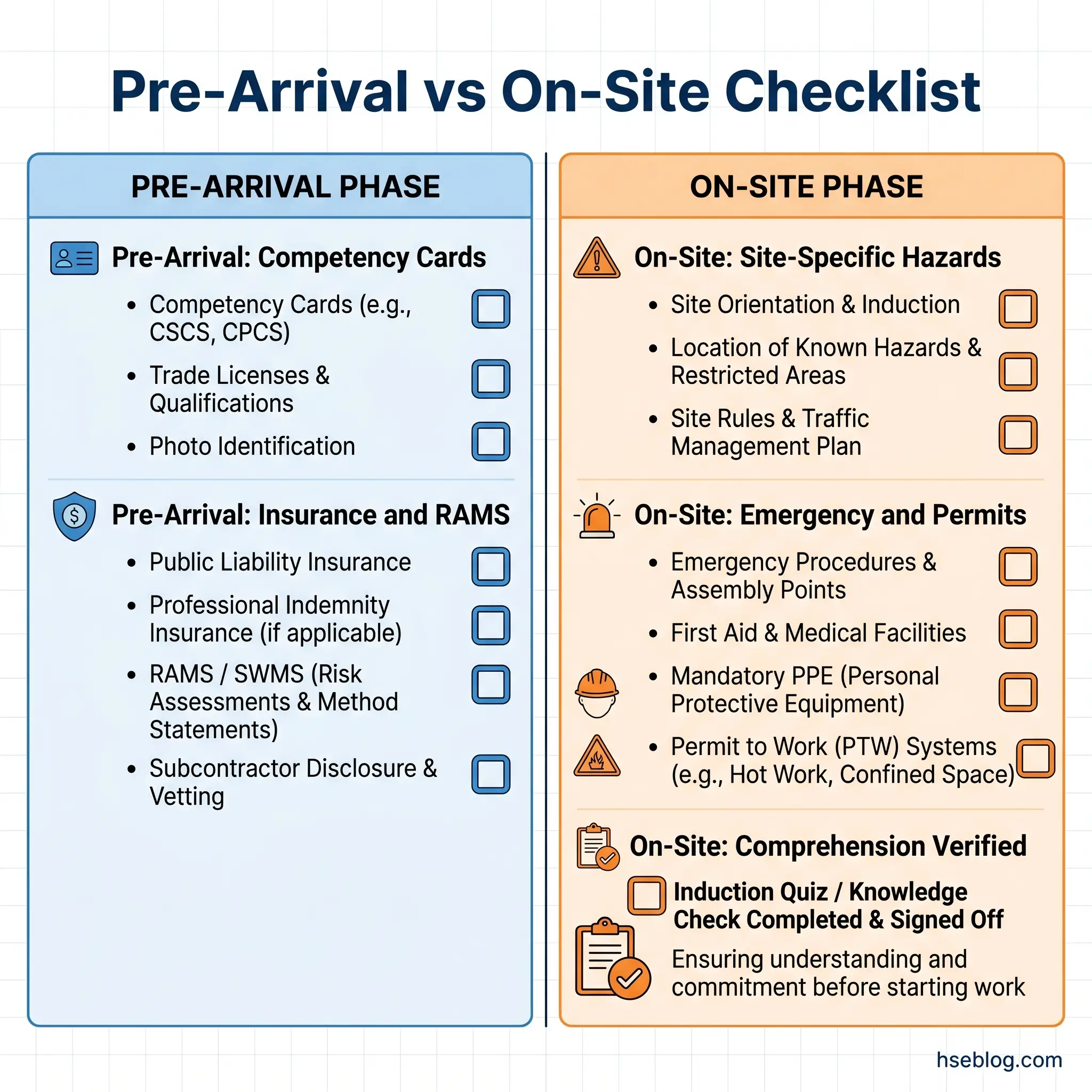
The most useful structural distinction in a contractor induction program is the separation between pre-arrival activities and on-site delivery. Most generic checklists merge them, which is why generic checklists fail in practice. The pre-arrival phase verifies that the contractor should be on site at all. The on-site phase prepares them for this specific site on this specific day.
Phase 1: Pre-Arrival Documentation and Verification
This phase happens before the contractor’s first vehicle reaches the gate. It is the gatekeeping layer and protects against the most common failure mode in contractor management: arrival without verified competence.
- Proof of competency — relevant licenses, trade certifications, OSHA 10/30-hour cards (US), CSCS or equivalent cards (UK), CITB qualifications, and role-specific training records. The verification must match the actual scope of work.
- Insurance verification — public liability and workers’ compensation cover, with policy expiry dates checked against the contract period.
- Risk assessments and method statements (RAMS) or Safe Work Method Statements (SWMS) — task-specific documents showing the contractor has thought through the work. Generic boilerplate RAMS are a red flag.
- Subcontractor chain disclosure — full visibility of which subcontractors will be on site, at which tier, doing which work. Hidden subcontracting is a recurring source of induction gaps.
- Medical fitness declarations — required where the role involves specific health surveillance triggers (working at height, confined spaces, respiratory exposure, fitness for duty).
- Previous safety performance records — incident rates, prosecution history, or pre-qualification questionnaire (PQQ) responses, where the contract value or risk warrants it.
Phase 2: On-Site Safety Induction Content
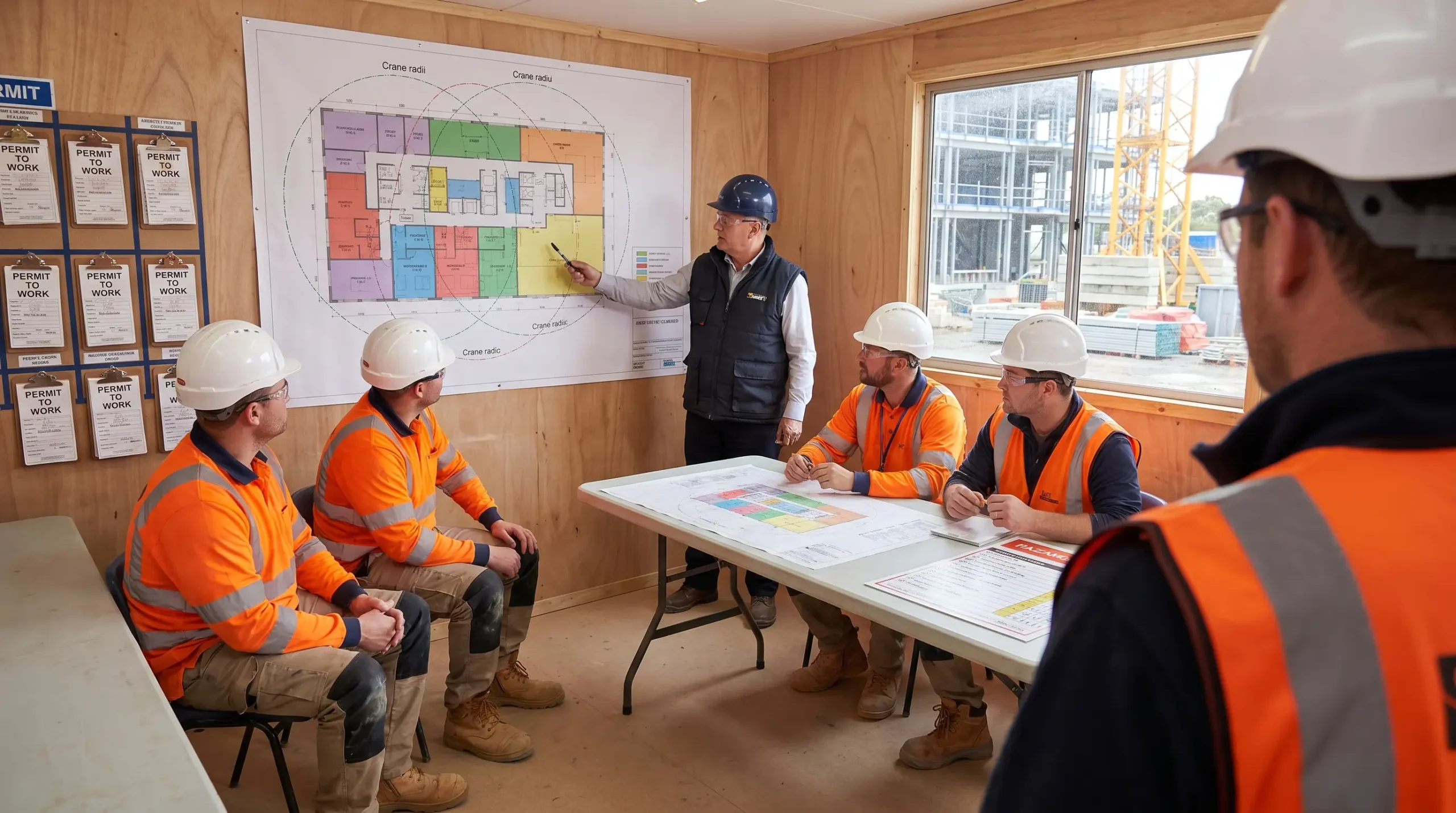
This phase is the briefing the contractor actually attends, in person or through a hybrid digital-plus-in-person model. Content scales with site complexity, but the core elements do not change.
- Site orientation — physical layout, work zones, restricted areas, welfare facilities, parking, walking routes
- Site-specific hazards and current risk profile — an excerpt from the live hazard register, not a generic hazard list. What is happening on the site this week
- Emergency procedures — evacuation routes, alarm types, muster points, emergency contact numbers, severe weather arrangements
- First aid provisions — locations of first aid stations, names of designated first aiders, AED locations
- Accident, incident, and near-miss reporting — who to report to, the timeline for reporting, the threshold for reportable events under RIDDOR (UK) or OSHA recordkeeping (US)
- PPE requirements by zone and task — what is mandatory site-wide and what is task- or area-specific
- Permit-to-work system overview — where applicable, an explanation of which activities require permits (hot work, confined space entry, energized electrical work, work at height) and how to request one
- Communication protocols — site contact, reporting lines, stop-work authority, radio channels or check-in systems
- Environmental controls — waste segregation, spill response, dust and noise controls, environmentally sensitive areas
- Housekeeping standards — what is expected and how it is enforced
- Sign-off and comprehension verification — not just a signature; a brief assessment, Q&A, or demonstration
Audit Point: When an auditor reviews an induction program, the first question is rarely “do you have an induction?” — it is “show me five contractor records, the specific hazards covered for each, and the evidence of comprehension.” Programs that cannot produce that on demand are vulnerable.
The most consequential gap in checklist design is the difference between presentation and comprehension. A signed acknowledgment form is evidence of attendance. It is not evidence that the contractor understood the permit-to-work system or knows where the muster point is. The strongest induction programs include a brief verbal or written assessment — typically five to ten questions on critical content — to verify absorption before site access is granted.
Best Practices for Effective Contractor Safety Inductions
Moving from a checklist that documents activity to a program that prevents harm requires applied judgment about delivery, not just content. The following practices recur across induction programs that perform well in audits and, more importantly, in incident-free contractor engagements.
- Customize induction depth by risk profile and trade. A demolition contractor’s induction should differ markedly from a cleaning contractor’s. Treat the induction as a modular system: a common core (emergency procedures, reporting, general site rules) plus role-specific or zone-specific modules delivered by someone with operational knowledge of those hazards. A single generic deck for every contractor regardless of trade is a compliance exercise, not a safety intervention.
- Deliver in the contractor’s working language. Where the workforce includes non-native speakers, the induction must be available in their working language with translated materials, qualified interpretation, or visual aids that do not depend on text comprehension. HSE UK enforcement records include cases where prosecution followed contractor injuries on sites where the induction was delivered only in English to a workforce that did not adequately speak it.
- Include a physical site tour for high-risk environments. A slide deck cannot show a contractor the actual location of the muster point, the geometry of access to a confined space, or the specific layout of crane operating zones. For sites above a certain risk threshold, the on-site walk-through is the induction — the slides are supporting material.
- Verify comprehension before access. Use brief written or verbal assessments on critical content. For high-risk tasks, supplement with practical demonstrations (correct fall arrest harness donning, correct gas monitor pre-use check, correct lockout sequence). Signed acknowledgment alone is not evidence of competence.
- Maintain a digital, auditable record. Date-stamped sign-off, digital storage, and an accessible audit trail are now expected by both regulators and clients. Records should link the contractor to the specific induction version delivered, the assessment results, and the access permission granted.
- Integrate induction with permit-to-work and JSA/HIRA systems. The induction tells the contractor about the permit system; the permit system controls the specific task on the day. The two systems must reference each other — induction without permit integration leaves the highest-risk activities under-controlled.
- Schedule refresher inductions on defined triggers. Annual minimum, plus re-induction on significant site change, new hazard introduction, extended absence, or post-incident. Treat the trigger list as policy, not discretion.
- Assign a named site contact for each contractor group. The contractor needs a person — not a desk or a generic email — to escalate to. The named contact is the operational thread running from induction through job completion.
The judgment call that recurs across these practices is between speed and depth. Site teams under schedule pressure want induction completed in 30 minutes so the contractor can start work. Effective induction takes longer for high-risk work — typically 60 to 120 minutes on-site, plus pre-arrival digital learning. The balance favors depth almost every time, because the cost of an inadequately inducted contractor causing an incident is orders of magnitude greater than the cost of an extra hour of induction time.
How Has Digital Technology Changed Contractor Inductions?
The shift from classroom-only induction to hybrid and fully digital delivery has reshaped contractor onboarding over the past decade. Online pre-induction modules, mobile-accessible platforms, and QR-code-based site check-ins have removed bottlenecks that used to slow the start of every project. The benefits are real: contractors can complete the general awareness component before arrival, freeing on-site time for site-specific content; assessments can be standardized and auto-scored; records can be retrieved instantly during audits or after incidents.
The limitations are equally real. A contractor who clicks through a 20-minute online module at 11 PM the night before arriving on site has technically completed induction, but the safety value is close to zero. Digital induction optimizes for throughput; site-specific safety requires comprehension and context that throughput-optimized systems do not always deliver.
Both OSHA and HSE UK accept digital training where comprehension is verifiable, but neither accepts digital delivery as a substitute for site-specific hazard orientation in high-risk environments. The regulator’s position is that the medium does not change the substance: the induction must still be effective, must still cover the actual hazards on the actual site, and must still be understood by the actual contractor.
The strongest hybrid systems use online pre-learning to cover general site rules, emergency principles, and policy content, then require a mandatory on-site briefing that contextualizes the digital content to the specific site, the specific day’s activities, and the specific contractor’s scope. The on-site component is shorter than a full classroom induction would be, but it is not skipped.
OSHA’s 2026 enforcement priorities — which include expanded targeted inspections in construction, stricter documentation requirements, and movement toward a federal heat illness prevention standard — reinforce the trend toward documented, verifiable contractor safety programs (OSHA / WorkCare, 2025). The expectation is that digital systems make the documentation easier, not that they replace the substantive induction.
Common Mistakes That Undermine Contractor Inductions
This is the section where most generic induction guides stop short. The checklist is straightforward; the failure modes are where the practitioner work is. Reviewing patterns across published HSE UK prosecutions, OSHA citations, and contractor incident investigations, the following mistakes recur.
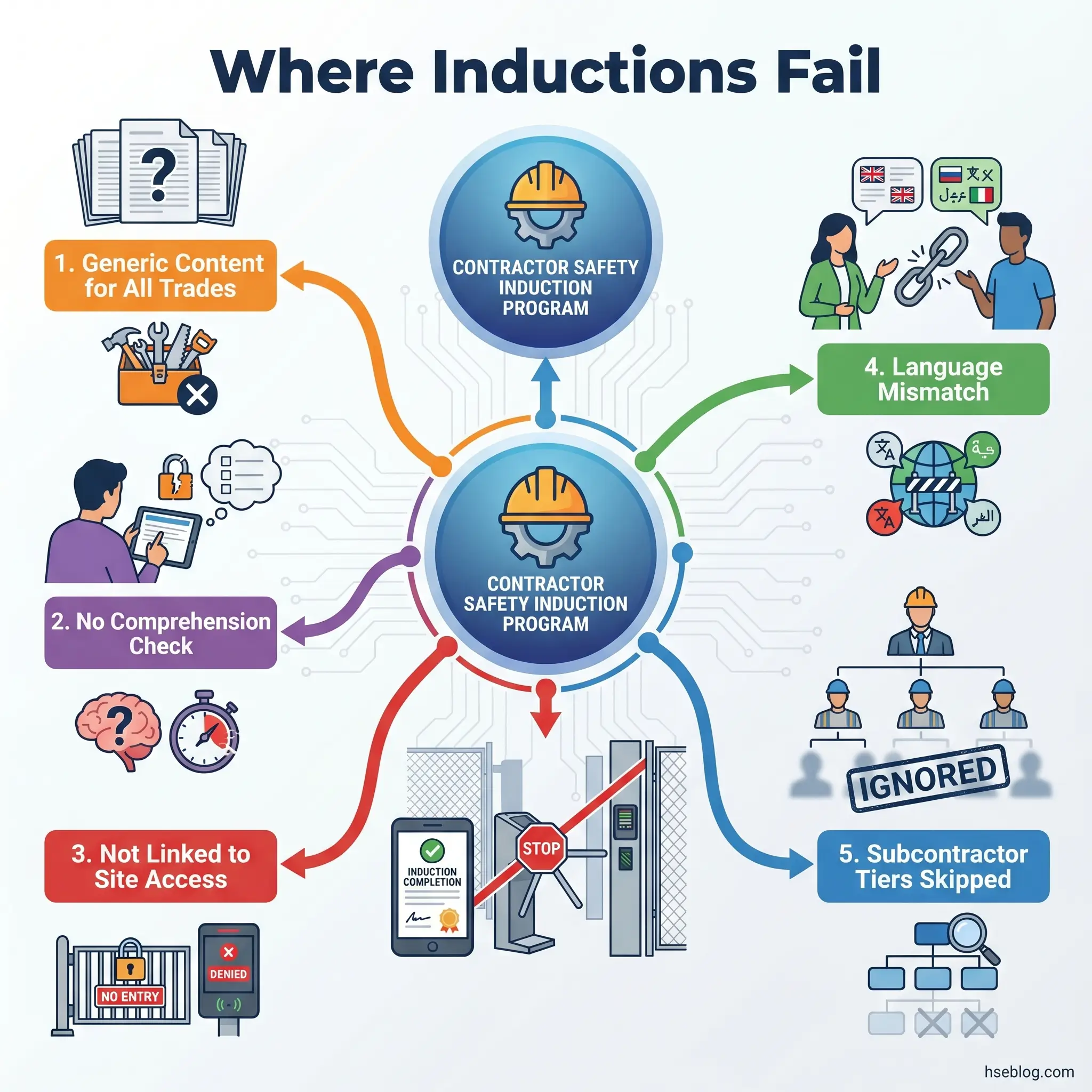
- One-size-fits-all generic induction. A demolition contractor and a copier-repair technician sit through the same 45-minute deck. The deck covers nothing specific to either. The records show induction “completed.”
- Treating induction as a one-time event. No refresher cycle. No re-induction on site change. A contractor inducted in January is still considered inducted in November, after three new high-risk activities have started on adjacent areas.
- Language mismatch. Induction delivered in a language the contractor does not adequately read or speak. Translated materials are absent. Comprehension is assumed because a signature was obtained.
- Stale content. The hazard register has changed; the induction deck has not. New equipment has been introduced; the deck still references the old layout. The induction is technically delivered but factually wrong.
- No comprehension verification. Signed forms are accepted as evidence of understanding. No assessment, no Q&A, no demonstration. The contractor “understood” because the form says so.
- No link between induction status and site access. The reception desk does not check whether the contractor in front of it has completed induction. The badge-issuing system does not verify induction status. A contractor who has not been inducted can physically reach the work area.
- Subcontractor tier omissions. The head contractor is inducted thoroughly. Their subcontractor’s workers — who are doing the actual high-risk work — were never directly inducted because the head contractor “took responsibility” without delivering the content.
Watch For: The single most common systemic failure is the disconnect between induction records and site access control. If a contractor can physically enter the site without their induction status being verified at a checkpoint, the induction is not functioning as a control — it is functioning as a record. The induction becomes a real safety control only when it is linked to access, physically or procedurally.
Frequently Asked Questions
Conclusion
Effective contractor safety induction is, at its core, three operational decisions made well. First, structure the program in two phases — pre-arrival verification (competence, insurance, RAMS) separate from on-site delivery (site-specific hazards, emergency procedures, permit systems). Second, link induction status to site access, so the gate enforces what the policy requires. Third, verify comprehension before granting access, through assessment, Q&A, or demonstration appropriate to the risk level.
The rest follows from those three. Tailoring by risk profile, delivering in the working language, refreshing on defined triggers, and integrating with the permit and JSA systems are the operational tactics that make the program robust. The single largest failure pattern across published enforcement actions and investigation reports is not the absence of induction — it is the presence of induction that did not reach the contractor doing the high-risk work, in a form they understood, on the day they needed it.
A contractor safety induction program that satisfies regulators is one that produces, on demand, the records linking each contractor on site to the specific content delivered, the verified comprehension, and the controlled access that followed. A program that prevents incidents is one where those records are accurate because the substance is real.