

TL;DR
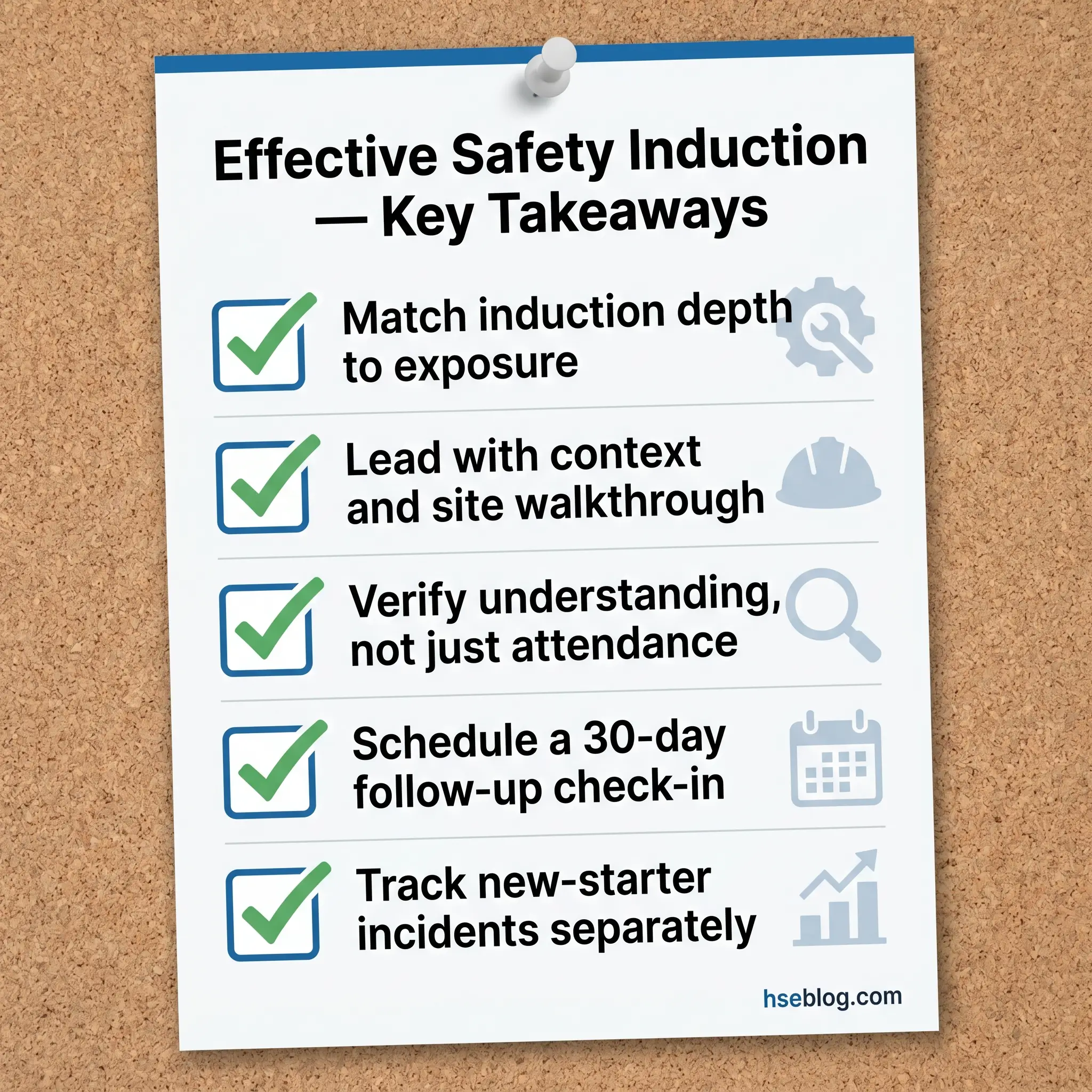
- Tailor depth to risk — A 30-minute office induction and a full-day site induction can both be right. The wrong one is the duration that doesn’t match the exposure.
- Sequence for retention — Lead with workplace context and a site tour, then layer procedures on top. Inductions opening with a policy deck lose the audience fast.
- Verify, don’t just deliver — A signature confirms attendance, not understanding. Use scenario-based questions and 30-day observation to test whether the content actually landed.
- Track new-starter incidents separately — If first-90-day injury rates are higher than the workforce baseline, the induction is failing regardless of completion statistics.
A safety induction is the structured first-contact training given to new employees, contractors, and visitors before they begin work. Effective delivery requires content tailored to the specific workplace’s hazards, sequencing that prioritises context and site familiarisation over policy documents, verification of understanding through scenario-based assessment, and measurable follow-up during the first 30 to 90 days.
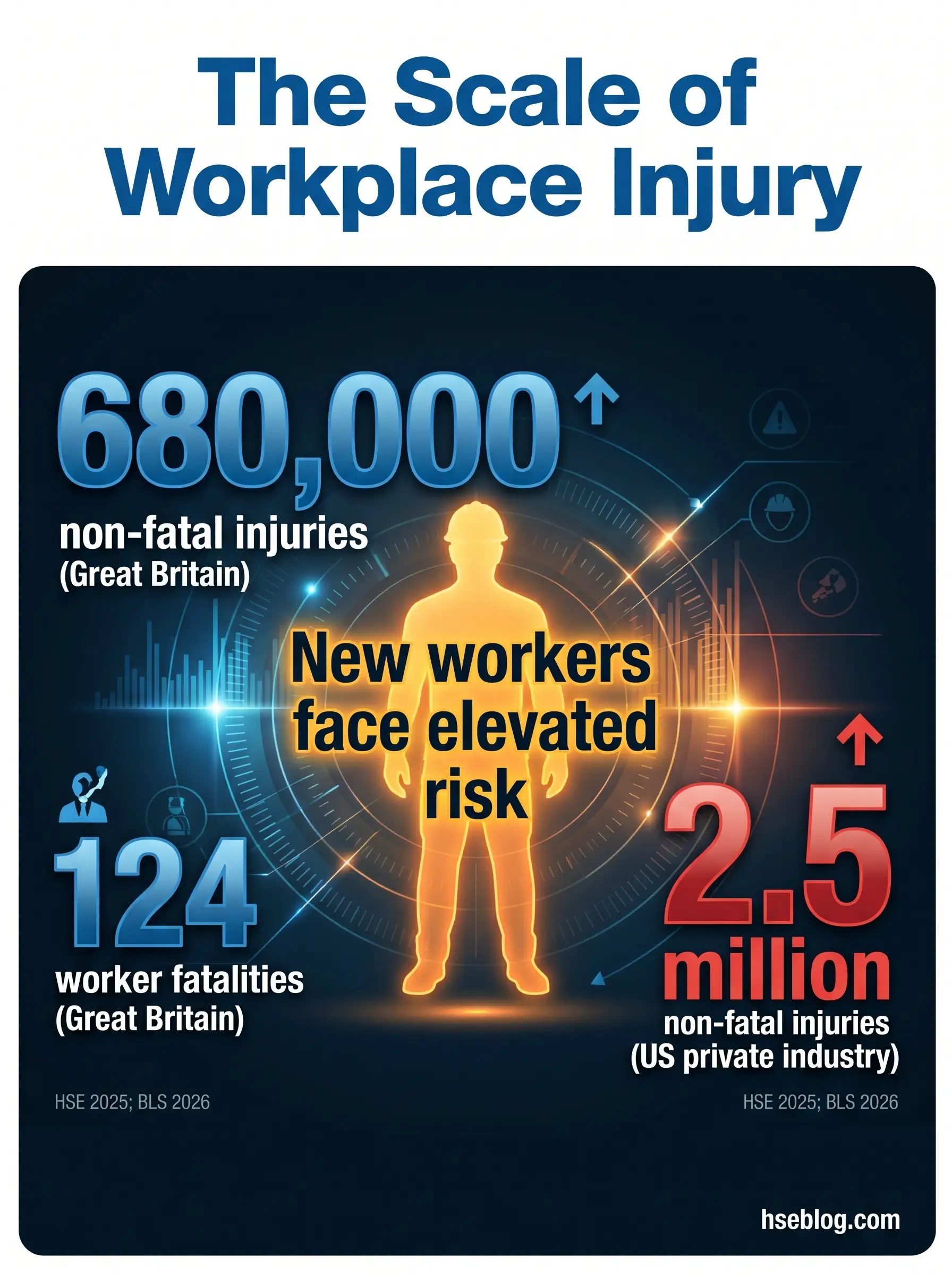
The strongest predictor of a preventable incident in the first weeks of employment is not the absence of an induction. It is the belief that a signed induction form is proof of competence. UK Health and Safety Executive figures for 2024/25 record 680,000 non-fatal workplace injuries and 124 fatal injuries, with 1.9 million workers reporting work-related ill health (HSE, 2025). New and young workers carry disproportionate risk inside those figures — a pattern that holds across regulators in the US, the UK, Canada, and Australia regardless of how the data is sliced. The full numbers are available through the HSE annual workplace injury statistics.
A safety induction is the only structured training many workers will receive before their first shift in a new environment. If it is delivered as a paperwork exercise, the worker carries no working knowledge of the hazards onto the floor — and the organisation carries no defensible evidence of competence into any subsequent investigation. This article walks through how to deliver an effective safety induction: the legal foundations, the audiences who need one, the content that earns its place, the delivery mechanics that make information stick, the failure modes worth naming, and the verification methods that distinguish a trained worker from a signed form.
What Is a Safety Induction and Why Does It Matter?
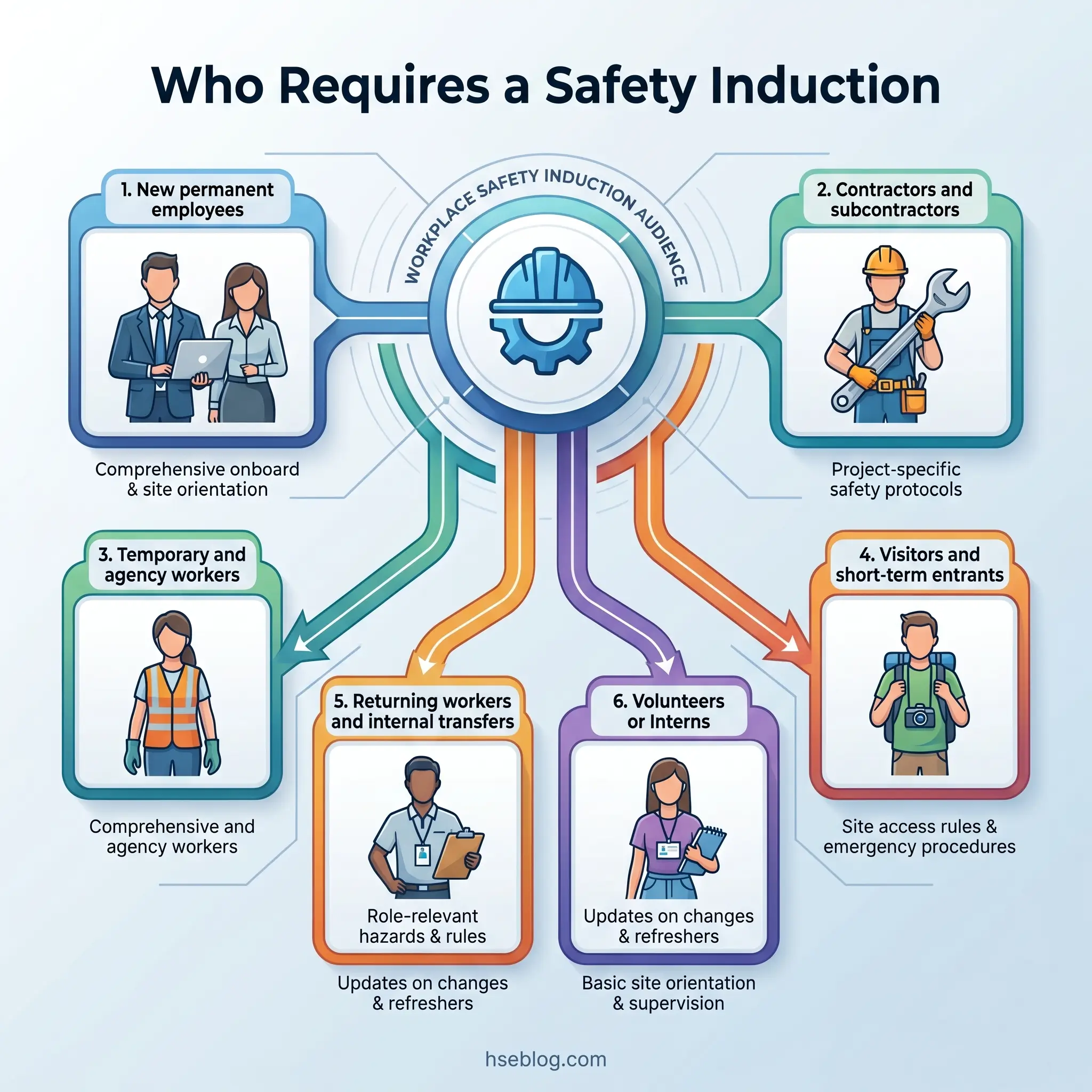
A safety induction is the structured first-contact training given to anyone entering a workplace before they begin productive work. It introduces the hazards present in the environment, the procedures for emergencies and incident reporting, the rules of access, and the specific responsibilities the new arrival carries from that point forward. The audience is not only new permanent employees — it includes contractors, agency workers, visitors, returning workers, and internal transfers stepping into unfamiliar exposures.
The function is distinct from ongoing safety training and from the toolbox talks that punctuate a working week. A toolbox talk is a five-minute briefing on a specific topic at the point of work. Refresher training is the periodic revisit of competence in established staff. The induction is the moment a worker moves from outside the workplace’s risk landscape to inside it — and the only structured opportunity to set the baseline of awareness before exposure begins.
The reason it matters operationally is straightforward. New workers do not yet recognise the site’s hazards. They do not yet know which doors are emergency exits, where the first-aid station is, or which permit governs the work they are about to start. They have not yet absorbed the unwritten rules — what a particular alarm pattern means, who the first aider is on the night shift, where the assembly point relocates to in high winds. Until those gaps are closed, the worker is operating on imported assumptions from the last workplace, and those assumptions can be wrong in dangerous ways.
US data tells a parallel story. The Bureau of Labor Statistics recorded 2.5 million non-fatal workplace injuries and illnesses in private industry in 2024 — the lowest since 2003 — alongside 5,283 fatal work injuries in 2023, a rate of 3.5 per 100,000 full-time equivalent workers (BLS, 2024 and 2026). The headline downward trend in non-fatal incidents is a real story. The persistence of fatalities is the other story, and within both, new and young workers continue to feature disproportionately. The figures are aggregated in OSHA’s commonly used workplace safety statistics.
The pattern I see most often when reviewing how organisations handle this stage is that the induction is treated as an administrative checkpoint rather than a learning event. The signature is collected, the form is filed, and the worker is on the tools by the end of the morning. The organisation has discharged a procedural step. Whether the worker has actually learned anything is a separate question, and it is the question that matters when something goes wrong.
Legal Requirements for Safety Induction Training
The duty to provide induction training is not discretionary in any major regulatory jurisdiction. The specific wording differs, but the underlying obligation is the same: the employer must provide information, instruction, training, and supervision before the worker is exposed to hazards.
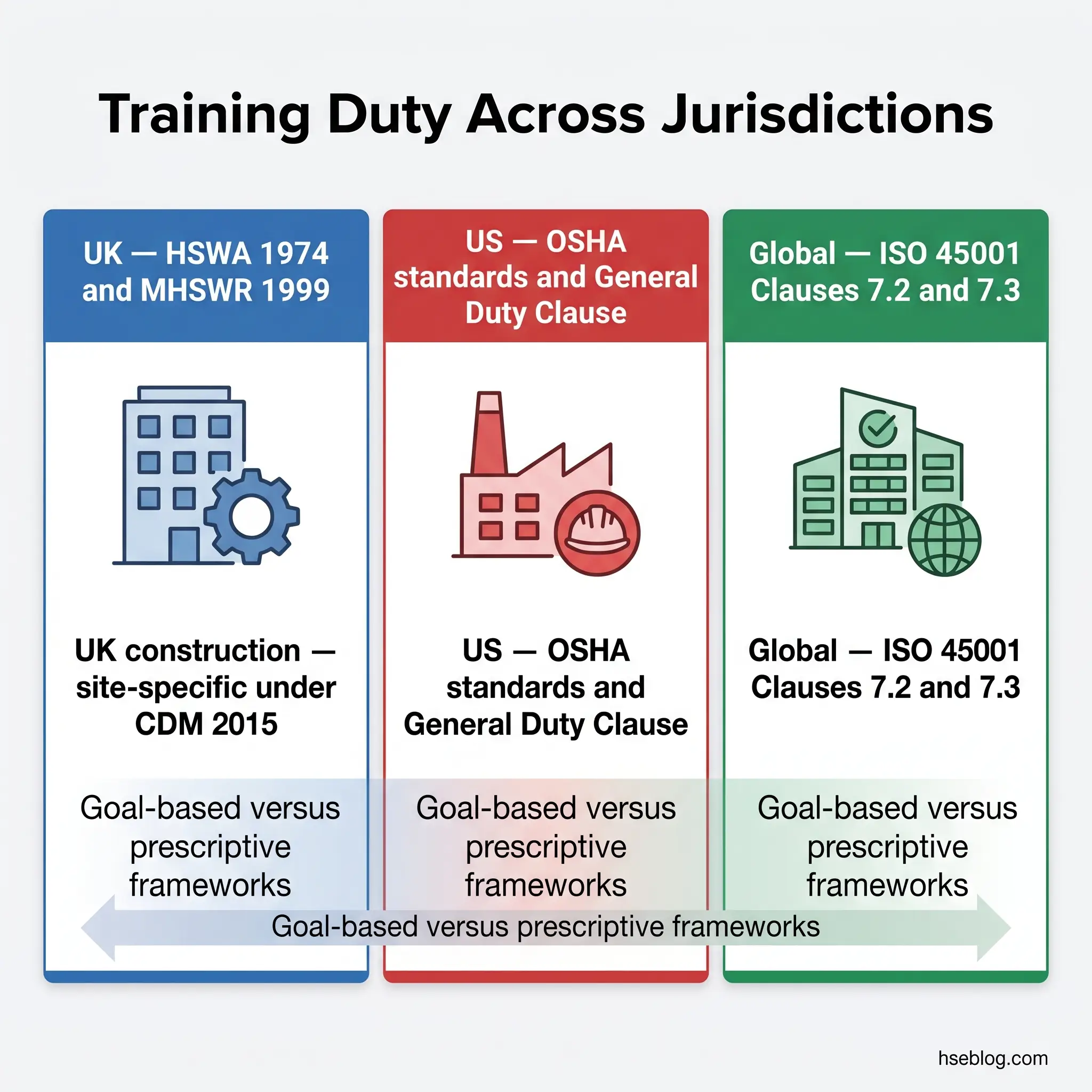
In the UK, the Health and Safety at Work Act 1974 sets the foundation. Section 2 places a general duty on the employer to provide such training as is necessary to ensure the health and safety at work of employees, while Section 7 requires employees to cooperate with their employer on health and safety matters. When a worker is recruited, transferred to new responsibilities, or introduced to new equipment, technology, or systems of work, the Management of Health and Safety at Work Regulations 1999 — Regulation 13 in particular — require training to be provided, and provided during working hours. On a UK construction site, the operative test is whether the site-specific induction matches the actual risks of that location, as required under the Construction (Design and Management) Regulations 2015.
In the US, the structure is different but the obligation is parallel. The General Duty Clause of Section 5(a)(1) of the OSH Act 1970 requires employers to furnish a workplace free from recognised hazards likely to cause death or serious physical harm. Training is the implied vehicle for meeting that duty in many situations, and is explicitly required by individual standards. Where hazardous chemicals are present in a workplace, OSHA’s Hazard Communication Standard at 29 CFR 1910.1200 requires training at the time of initial assignment and whenever a new chemical hazard is introduced. The Personal Protective Equipment standard at 29 CFR 1910.132 requires training before any worker uses PPE. Industry-specific standards layer further requirements on top.
Where OSHA’s standards specify which topics require training, ISO 45001:2018 takes a goal-based approach. Clauses 7.2 (Competence) and 7.3 (Awareness) require organisations to determine necessary worker competence, ensure that competence through education, training, or experience, verify effectiveness, and retain documented evidence. Workers must also be made aware of the OH&S policy, the hazards relevant to them, and the implications of non-conformance.
Field interpretation: regulators rarely ask “did you do an induction?” during an investigation. They ask “what did the worker actually understand after the induction, and how do you know?” That question is the one most weakly answered by the typical attendance sheet.
| Jurisdiction | Source | Practical requirement |
|---|---|---|
| UK | HSWA 1974 (s.2, s.7); MHSWR 1999 (reg.13); CDM 2015 | Training on recruitment and at trigger points; site-specific induction in construction |
| US | OSH Act 1970 (s.5(a)(1)); 29 CFR 1910.1200; 29 CFR 1910.132; industry standards | Training before initial assignment to hazardous chemicals or PPE; topic-specific obligations |
| Global | ISO 45001:2018 (cl. 7.2, 7.3) | Determine competence, deliver training, verify effectiveness, retain documented evidence |
Construction-Specific Induction Requirements
Construction generates a disproportionate share of fatal injuries across most jurisdictions, and the regulatory response is correspondingly tighter. Under CDM 2015 in the UK, the principal contractor must provide a site-specific induction to every worker on every site — generic company-wide induction is not sufficient. The induction must address the particular hazards of that site, the agreed control measures, and the site rules. The regulator’s own HSE guidance on site inductions walks through the practical detail. In the US, OSHA’s construction standards under 29 CFR 1926 impose training requirements for fall protection, scaffolding, excavation, and other discipline-specific hazards that overlap with general induction content. The practical implication is that a worker moving between construction sites — even within the same employer — should be re-inducted to each new site’s specific risk picture.
Who Needs a Safety Induction?
The most common gap I encounter when auditing induction systems is not the new permanent employee. It is the population the system did not see coming.
A complete induction audience covers six distinct groups, and the depth of induction varies for each.
New permanent employees receive the full induction, including organisational culture, long-term safety expectations, role-specific hazards, and the company’s broader OH&S management system. This is the population most systems are designed around.
Contractors and subcontractors need a site-specific induction covering the hazards of the location, the permit-to-work systems, the supervision arrangements, and the interface risks between their work and other operations on site. A contractor inducted in their own company’s general safety policy is not inducted to your site.
Temporary and agency workers are exposed to the same hazards as permanent staff but typically arrive with less familiarity with the specific equipment, procedures, and reporting culture. They need at least the same depth of induction as permanent staff for the work they will perform, and often more attention to task-specific hazards.
Visitors — clients, consultants, auditors, delivery drivers — need a proportionate induction covering emergency procedures, escorted versus unescorted protocols, and any restricted areas. A short briefing with a printed visitor card is adequate for low-risk visits; longer site time warrants more.
Returning workers — those returning after extended absence, role change, or transfer to a different site or department — are the population most often missed. The assumption that “they already know the ropes” is the recurring failure pattern. Hazards change, sites change, procedures change. A re-induction is the appropriate baseline.
Volunteers carry the same duty of care from the employer as paid staff. Treating them as exempt from induction creates a population with hazard exposure but no structured awareness — an avoidable risk.
Watch For: the internal transfer who has been with the organisation for years. They often skip induction entirely on the basis of long service. If the new site, role, or shift pattern carries different hazards than the old one — confined space access where there was none, night work where there was day work, chemical exposure where there was none — they need a full site- or role-specific induction. Long service is not competence in unfamiliar exposure.
What Topics Should a Safety Induction Cover?
The content of a safety induction should be tailored to the workplace’s actual risk profile. A textbook list of every conceivable hazard wastes time on irrelevant topics and dilutes attention from the ones that matter on this site, today, for this worker.
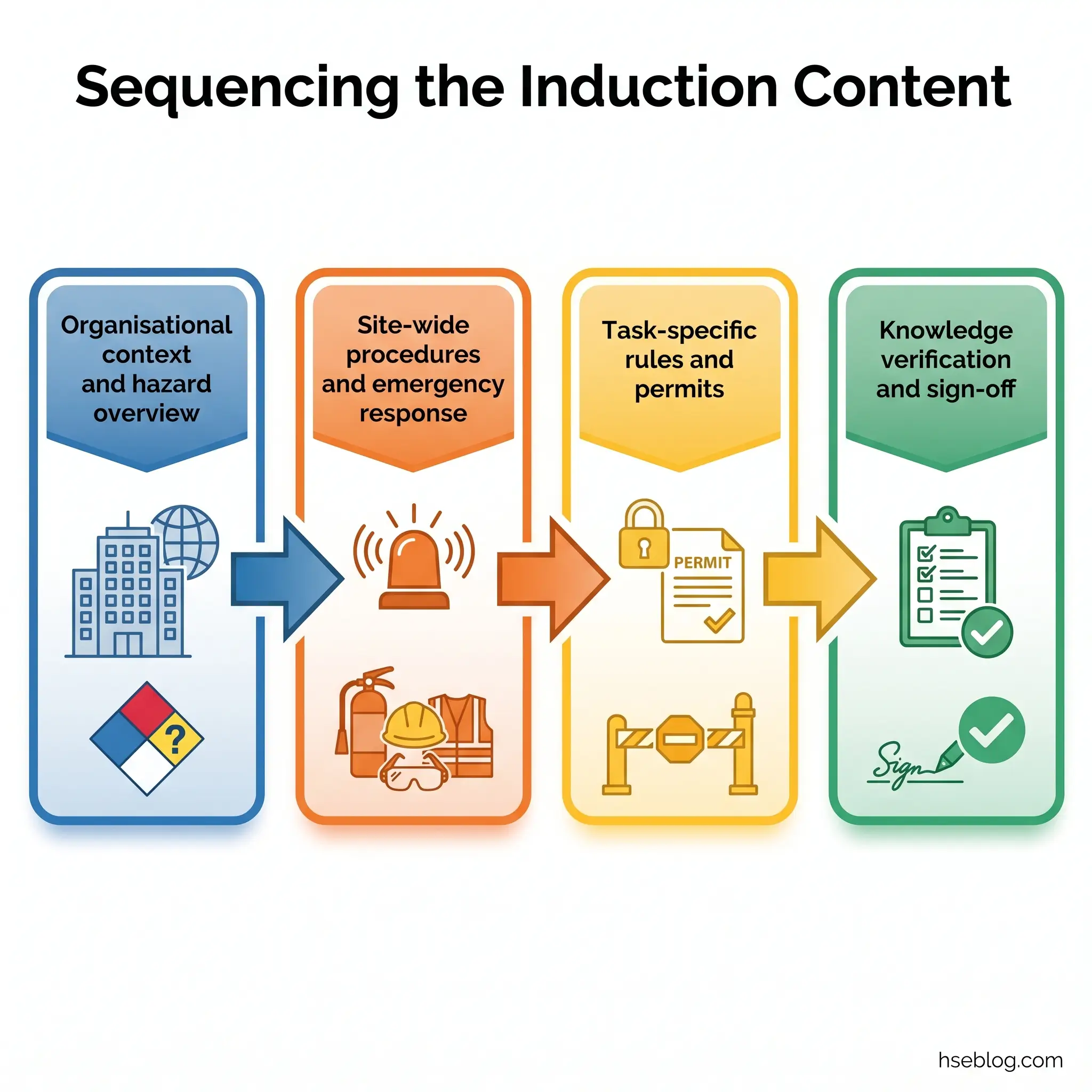
That said, certain content areas appear in almost every induction and benefit from a logical sequence — context first, then site-wide procedures, then task-specific elements, then verification.
Organisational safety policy and culture: what safety means in this organisation, the visible commitment of management, and the standard of behaviour expected. This frames everything that follows.
Hazard and risk overview: the specific hazards present in this workplace — physical, chemical, biological, ergonomic, psychosocial — described as they actually exist on site. Not a textbook taxonomy.
Emergency procedures: fire evacuation routes, alarm systems, assembly points, first-aid arrangements, spill response procedures, and how to raise an alarm. This is the content that must survive the next 24 hours regardless of how much else is forgotten.
Reporting obligations: how to report incidents, near-misses, hazards, and unsafe conditions; who to report to; the expectation that reporting is encouraged and non-punitive. The single most important sentence in this part of the induction is the assurance that reporting a near-miss will not be treated as causing a problem.
PPE requirements: what is mandatory for which areas, where to obtain it, how to wear and maintain it, and the limits of PPE as a control measure. PPE training is required under 29 CFR 1910.132 in the US and is universally treated as core induction content.
Site rules and access: restricted areas, traffic management, permit-to-work systems, smoking areas, mobile phone use, and any site-specific behavioural rules.
Worker rights and responsibilities: the right to refuse unsafe work, the duty to cooperate, whistleblower protections where they apply.
Key contacts: the safety officer, first aiders, fire wardens, and direct supervisor — and how to reach each of them.
The sequencing matters. Inductions that lead with the safety policy document tend to lose the audience within the first ten minutes. Inductions that open with a brief site walkthrough or a real workplace incident — anonymised but specific — give the procedural content something to attach to. The hazards, the procedures, and the policy each become more memorable when they are anchored to the physical environment the worker will actually occupy.
Tailoring Induction Content to Risk Level
Content depth and emphasis should differ sharply between low-risk and high-risk environments. A low-risk office induction might run thirty to sixty minutes, covering fire evacuation, display screen equipment ergonomics, manual handling for occasional lifting, and basic first-aid arrangements. A high-risk industrial induction — construction, oil and gas, mining, manufacturing with heavy machinery — can legitimately run a full day or more, covering lockout/tagout, confined space awareness, working at height, chemical hazards under HazCom or COSHH, permit-to-work systems, and energy isolation. The duration is a function of exposure, not a target for its own sake. A two-hour induction for a high-hazard role is too short. A two-hour induction for an office role is probably too long.
How to Structure and Deliver a Safety Induction: Step-by-Step
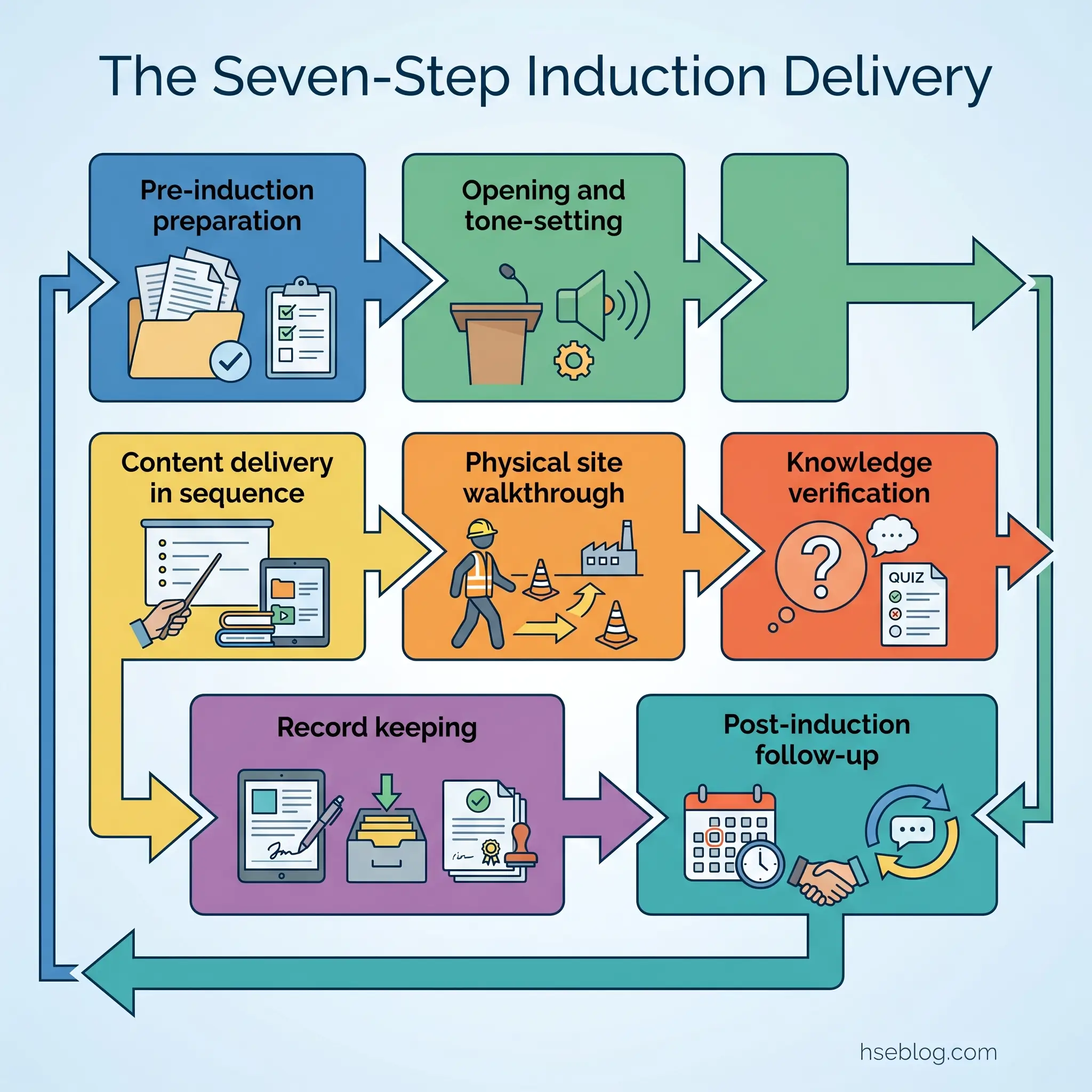
Effective delivery follows a recognisable pattern from preparation through to follow-up. Each step exists to address a specific failure mode in the induction process.
- Pre-induction preparation. Gather the site-specific materials, identify a competent trainer with current knowledge of the hazards being covered, prepare the training environment, and send pre-arrival information to the inductee — what to bring, what to wear, what to expect, when and where to arrive. The pre-arrival communication does double duty: it prevents the awkward first-hour scramble and signals that the organisation takes the process seriously.
- Opening the session. Set the tone in the first five minutes. Safety as a shared value, not a bureaucratic hurdle. The trainer’s role and credentials. The expectation that the session is interactive — questions are not interruptions, they are the point. The first impression of the induction is what determines whether the inductee engages or switches off for the next two hours.
- Delivery sequence. Context first: what this organisation does, what the main hazards are, why the induction matters here. Procedures next: emergency, reporting, PPE, site rules. Site walkthrough after the procedural content has given the walkthrough something to anchor to. Knowledge verification last — once everything has been seen and discussed.
- Site walkthrough. Physical tour of the workplace showing emergency exits, first-aid stations, assembly points, hazardous areas, welfare facilities, and any visual examples of the hazards covered earlier. This step is the irreplaceable component of induction. No video, no photograph, no virtual reality module fully substitutes for physically seeing where the fire exit is and walking the route to the assembly point.
- Knowledge verification. Move beyond a signature on a form. Use scenario-based questions: “If you smelled solvent vapours in this corridor, what would you do?” “Show me where you would go if the fire alarm sounded.” “Who is your first point of contact for reporting a near-miss?” Verbal Q&A, short written quizzes, or — for higher-risk roles — a practical demonstration. The standard is whether the worker can act on the information, not whether they can remember it for the next five minutes.
- Documentation. Record attendee details, date, topics covered, trainer name and credentials, knowledge-check results, and signatures. Retain the records for the duration of employment plus a defined period — and longer where specific regulations require it. UK asbestos training records, for example, must be retained for 40 years.
- Follow-up. Assign a safety mentor or buddy for the first week. Schedule a short check-in within the first 30 days to address questions that have surfaced once the worker is actually doing the job. The induction is the start of competence development, not the end of it.
Audit Point: the step most often skipped or rushed is knowledge verification. Organisations collect a signature confirming attendance but rarely test comprehension. In post-incident investigations, a signed attendance sheet with no competence evidence is a weak defence — and it leaves the organisation exposed regardless of how thorough the rest of the induction was.
Common Mistakes That Undermine Safety Inductions
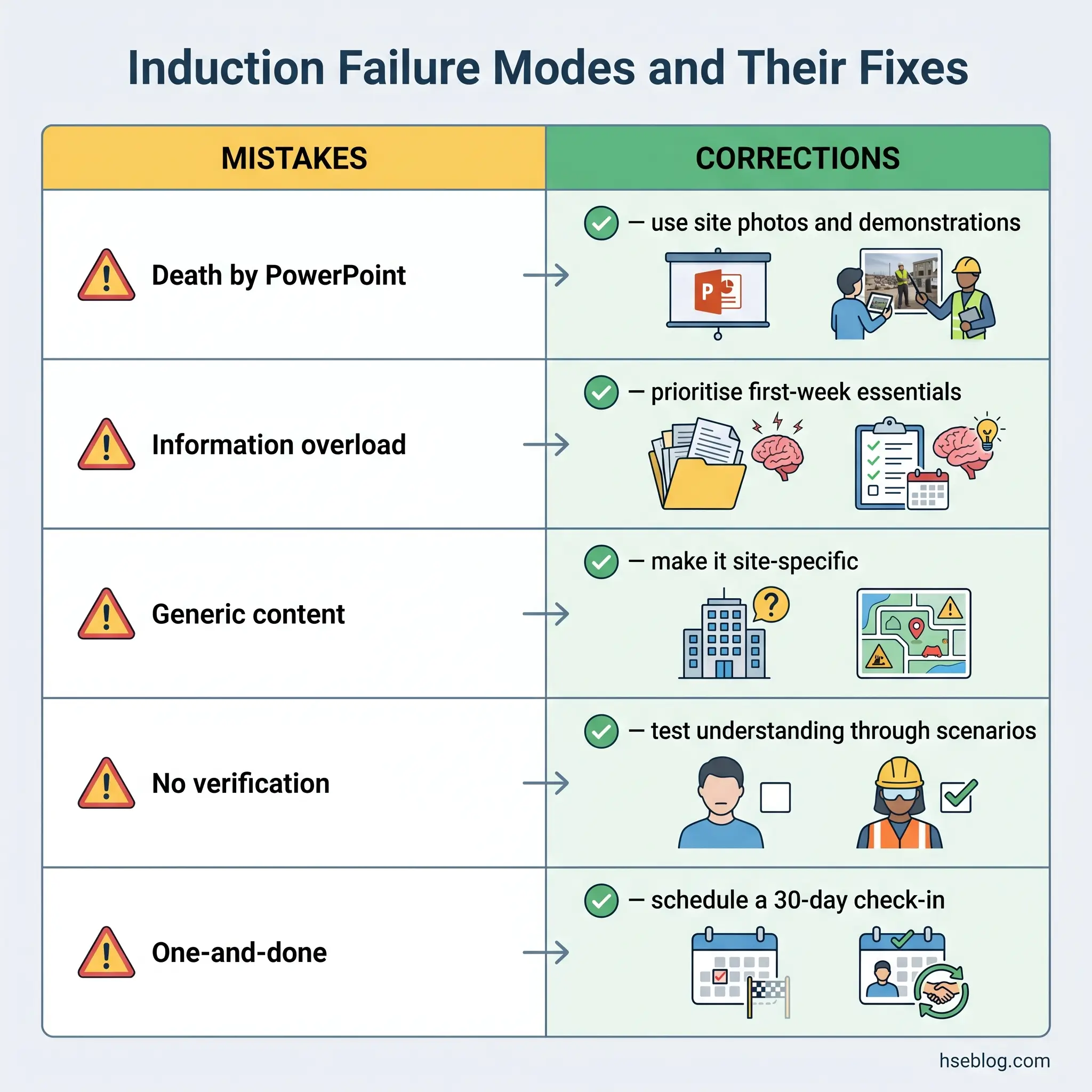
A consistent finding across published incident investigations is that “the worker had been inducted” but could not recall the specific hazard or procedure relevant to the incident. The induction was delivered. It was not received. The patterns below are the failure modes that produce this outcome.
Death by PowerPoint. Slide decks dense with text, read aloud verbatim, with no images of the actual hazards on the actual site. Retention from this format is near zero by the end of the second hour. The fix is to replace text-heavy slides with a structured discussion, supported by photographs of the real workplace and short demonstrations.
Information overload. Cramming every policy, every form, every procedure into a single session. The induction becomes an endurance test. The brain disengages around the ninety-minute mark and stops absorbing new information. The fix is to prioritise — what does this worker need to know to be safe in their first week? — and defer the rest to a second session, refresher training, or written reference materials.
Generic content. Using a one-size-fits-all induction module across every site, role, and task. This is the failure mode that CDM 2015 specifically targets in construction with the site-specific induction requirement. A worker arriving on a high-rise project does not need a generic module on workplace ergonomics. They need site-specific content on fall protection, the lift plan, and the welfare arrangements.
Rushing the process. Compressing the induction to get the worker on the tools faster, treating the time as lost productivity. The cost calculus is wrong. A serious incident in week one costs more in investigation time, lost time, and potential prosecution than the entire induction would have taken if delivered properly.
No competence verification. Treating a signature as evidence of understanding. The signature confirms presence in the room. It does not confirm that any of the content was absorbed.
Neglecting language, literacy, and cultural barriers. Delivering an induction in a language or format that a proportion of the workforce cannot meaningfully engage with. The person nods, signs, and leaves with no working knowledge of the hazards. This is a particular risk on multinational sites and in industries with high migrant workforce participation. Multilingual delivery, visual content, and bilingual mentors during the first week are practical correctives.
One-and-done mentality. Treating induction as a single event rather than the first phase of ongoing competence development. The induction ends, the worker is on the tools, and there is no further structured contact about safety until the next annual refresher. The 30-day check-in is the missing step that turns a one-off event into a sustained learning trajectory.
Pro Tip: if you are reviewing an existing induction programme and want a single test to apply, ask three randomly selected workers who completed it within the last sixty days to demonstrate where the nearest emergency exit, first-aid station, and assembly point are located. If any of the three cannot do all three confidently, the induction is not delivering on its core purpose, regardless of what the completion records say.
Choosing the Right Delivery Method: In-Person, Online, or Hybrid
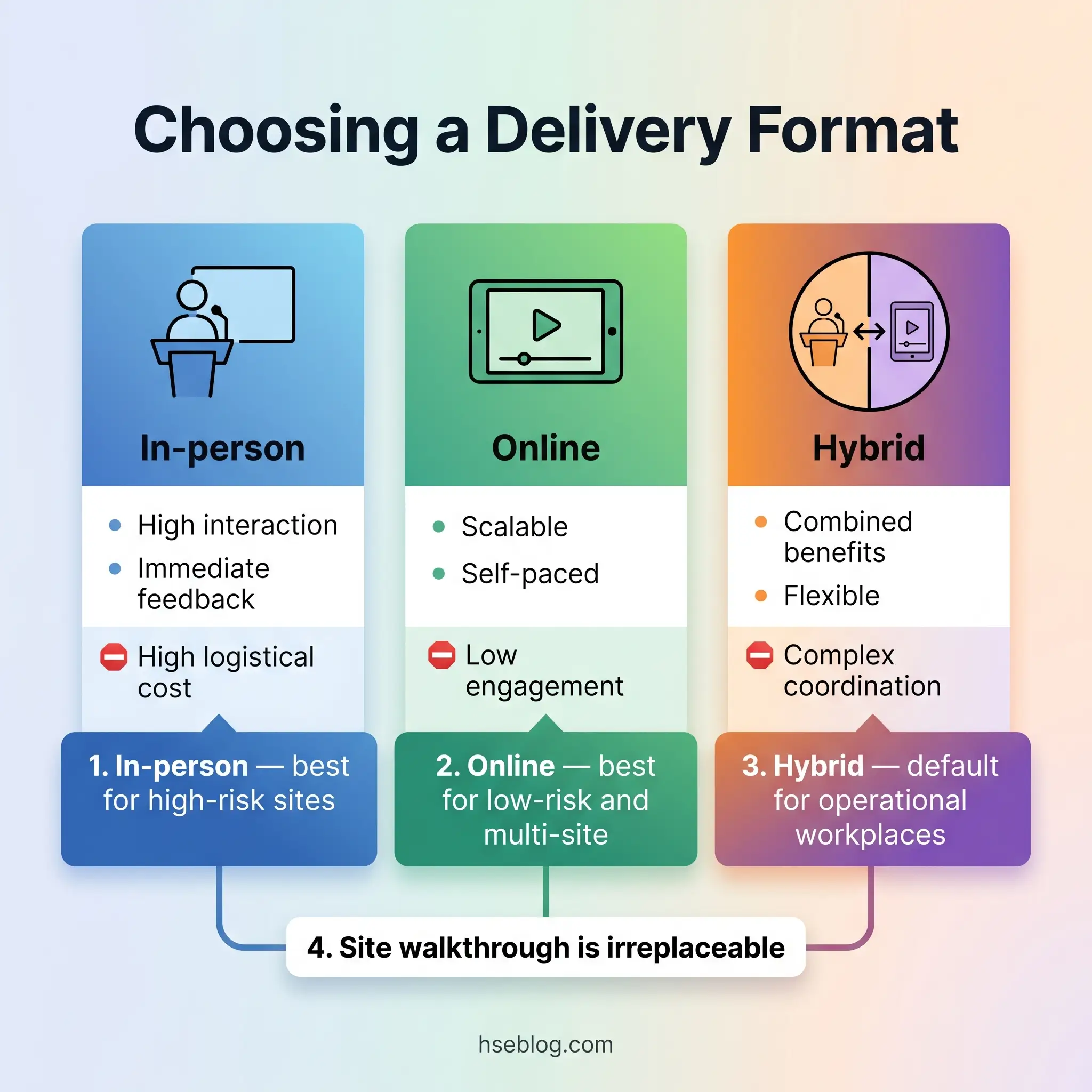
There is no single correct delivery method. The choice depends on the workplace’s risk profile, the audience, the geographic distribution of the workforce, and the resources available to deliver and maintain the content.
In-person classroom plus site tour is the highest-engagement format and remains the standard for high-risk environments. It allows physical demonstration of PPE, live questioning, and a real walkthrough of the site. Its limitations are scalability — a competent trainer can only deliver so many sessions per week — and consistency, since different trainers may emphasise different content.
Online or fully digital induction delivers consistent messaging at scale, supports multilingual versions, tracks completion automatically, and is easy to update. Its limitation is the gap it cannot close: it cannot familiarise the worker with the physical site they will work in. There is also a well-documented risk of passive click-through completion — the worker progresses through the modules with the screen open in the background — which the platform has no way to detect.
Hybrid or blended induction is the format most aligned with the available evidence on adult learning retention for operational environments. The pattern: a pre-arrival online module covering the policy, the hazard categories, the regulatory framework, and the emergency theory; followed by an in-person session focused on the site walkthrough, PPE demonstration, scenario-based knowledge verification, and the introduction to the safety mentor. The online portion covers content that does not require physical presence; the in-person portion covers what does.
Emerging technologies — virtual reality for hazard recognition simulation, microlearning for refresher content, AI-adaptive training paths — are increasingly available and have legitimate applications. They are supplementary tools. A VR simulation of a fall-from-height scenario can reinforce hazard awareness in a powerful way, but it does not replace the site walkthrough that shows the worker which scaffolding is theirs to climb tomorrow.
| Method | Best for | Limitations | When to use |
|---|---|---|---|
| In-person | High-risk environments; small groups | Lower scalability; trainer consistency | Construction, manufacturing, oil & gas |
| Online | Low-risk environments; multi-site rollout | No site familiarisation; passive completion risk | Office, retail, low-hazard service sectors |
| Hybrid | Most operational workplaces | Requires investment in both formats | Default for any site with physical hazards |
The practitioner judgment: online-only induction is adequate for low-risk office environments. For any workplace where the worker will encounter physical, chemical, or mechanical hazards, online content must be supplemented with an in-person site tour and hands-on PPE familiarisation. Treating online completion as a full induction in those environments is the kind of decision that becomes difficult to defend in a post-incident review.
How to Measure Whether Your Safety Induction Actually Works
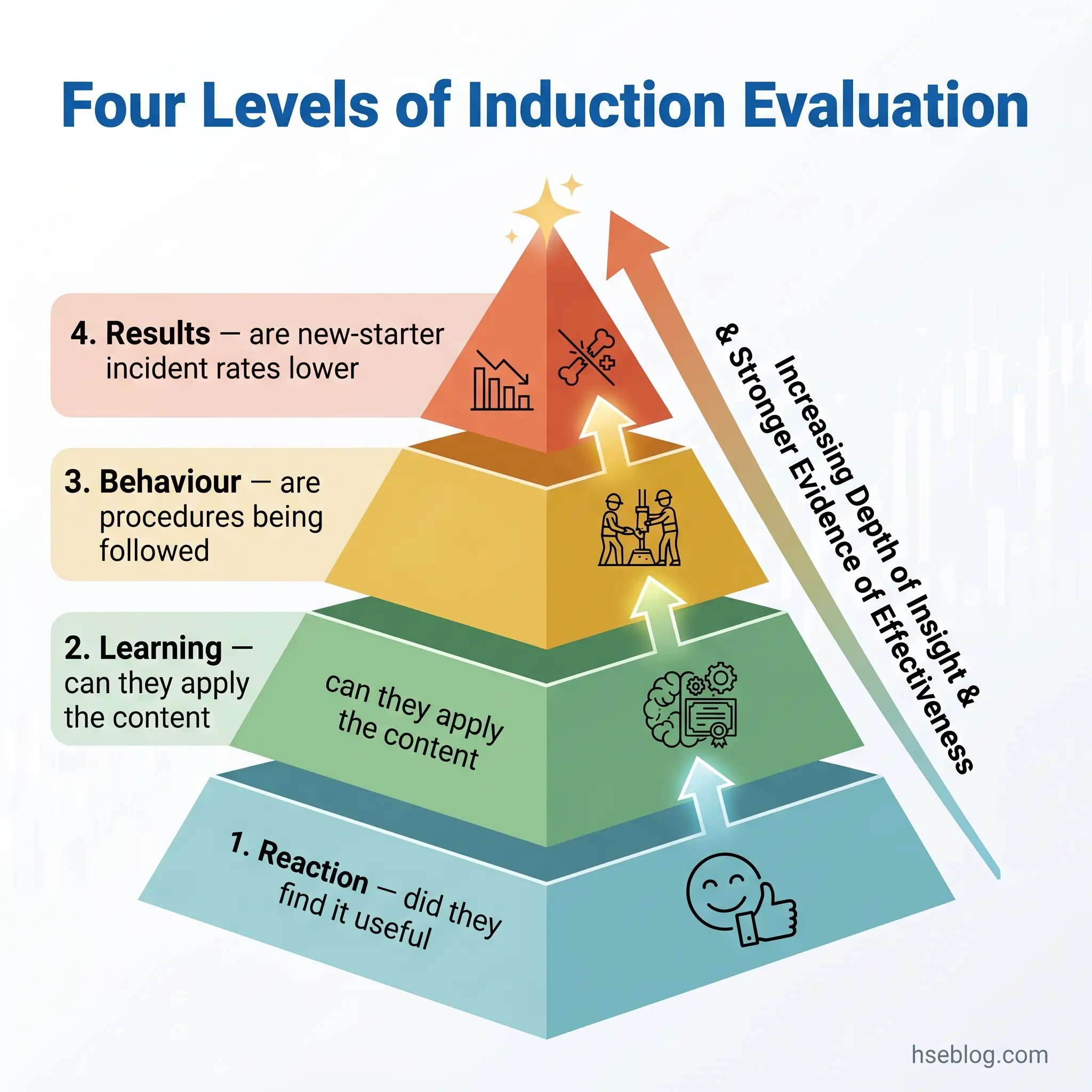
Most organisations measure their induction by completion rate. Did the worker attend? Did they sign the form? That is not a measure of induction effectiveness. It is a measure of process compliance. Effective measurement requires four levels of feedback, broadly aligned with the established Kirkpatrick framework for training evaluation.
Level 1 — Reaction. Post-induction feedback on the clarity, relevance, and engagement of the session. A short survey delivered immediately after completion. This is the easiest level to measure and the least informative. A worker who enjoyed the session may still have learned nothing useful; a worker who was bored may have absorbed the critical content. Reaction data is a starting point, not an outcome.
Level 2 — Learning. Knowledge verification through scenario-based questions, not multiple-choice recall. The standard is whether the worker can apply the content, not whether they can repeat it. This assessment happens at the end of the induction itself and produces the documentary evidence that supports both compliance and incident investigation defence.
Level 3 — Behaviour. Observation during the first 30 to 90 days. Are inductees following the procedures covered? Are they wearing the PPE correctly? Are they reporting near-misses at a rate that suggests they understood the reporting expectations? This is where the safety mentor or buddy plays a structural role — informal observation that feeds back into the induction review process.
Level 4 — Results. Track new-worker incident and near-miss rates as a leading indicator of induction quality. Most safety management systems already capture incident data with employment-tenure information; the segmentation just isn’t routinely run. Compare new-starter incident rates to the workforce baseline. If the new-starter rate is materially higher, the induction is failing regardless of what the completion records show.
The review cycle that ties the four levels together is straightforward. Schedule a formal review of induction content at least annually. Review immediately after any significant change — new hazards, regulatory updates, site layout changes — and after any incident that reveals a gap in induction content. Stale induction material is one of the most reliable findings in third-party audits.
The pattern I see when organisations begin tracking new-starter incidents separately is that the data has been there all along. It just was not being looked at. Once it is segmented and reviewed quarterly, the connection between induction quality and early-tenure incidents becomes visible — and the case for improving the induction becomes data-driven rather than abstract.
Safety Induction Checklist: Essential Items to Document
A defensible induction record covers eleven elements. These are the items an auditor, an incident investigator, or a regulator would expect to find on file.
- Inductee details — name, role, department, employment type (permanent, contractor, agency, visitor)
- Date, time, and location — when and where the induction was delivered
- Trainer identity and competence — name, role, and qualification of the person delivering the induction
- Topics covered — linked to a standard topic list and any site-specific additions
- Site tour completion — confirmation that the physical walkthrough was conducted, not just discussed
- Knowledge verification method and results — what assessment was used and what the inductee scored
- PPE issued — type and quantity of PPE provided, including size where relevant
- Inductee signature — confirming both attendance and stated understanding
- Trainer signature — confirming delivery and assessment
- Scheduled follow-up date — typically a 30-day check-in
- Record retention period and storage location — including any regulation-specific retention requirements
Digital induction records with timestamps and embedded knowledge-check results provide substantially stronger audit evidence than a paper sign-off sheet. For organisations operating across multiple sites, a centralised digital record system also makes it possible to verify an individual’s induction status before they begin work on any site. That capability matters in particular for contractors moving between projects within the same organisation, where the historical pattern has been that paper records get lost in the transition.
Frequently Asked Questions
The Test That Matters
If you have run inductions for any length of time, the question worth sitting with is not whether your programme is delivered. It almost certainly is. The harder question is whether it is received. Pull the last quarter’s induction records. Pick five at random. Then walk to where each of those workers is now and ask them to point to the nearest emergency exit, name the first aider on shift, and describe how they would report a near-miss they had this morning. The answers, or the silences, will tell you more about your induction’s effectiveness than any completion dashboard.
The work of building an effective safety induction is not the work of writing better slides. It is the work of sequencing content for retention, verifying understanding rather than recording attendance, and treating the first 30 to 90 days as the measurement window for whether the induction did its job. New-worker injury rates are the leading indicator. The signature on the form is the trailing one.
Organisations that treat safety induction as a learning event rather than an administrative checkpoint tend to discover something useful: the same effort that improves the induction also exposes weaknesses elsewhere in the safety management system. The questions a well-designed induction prompts — what hazards are we actually flagging? what evidence do we hold of competence? how do we know if it worked? — are the questions a mature safety culture asks at every level. Effective safety induction is the foundation on which the rest of that culture is built.