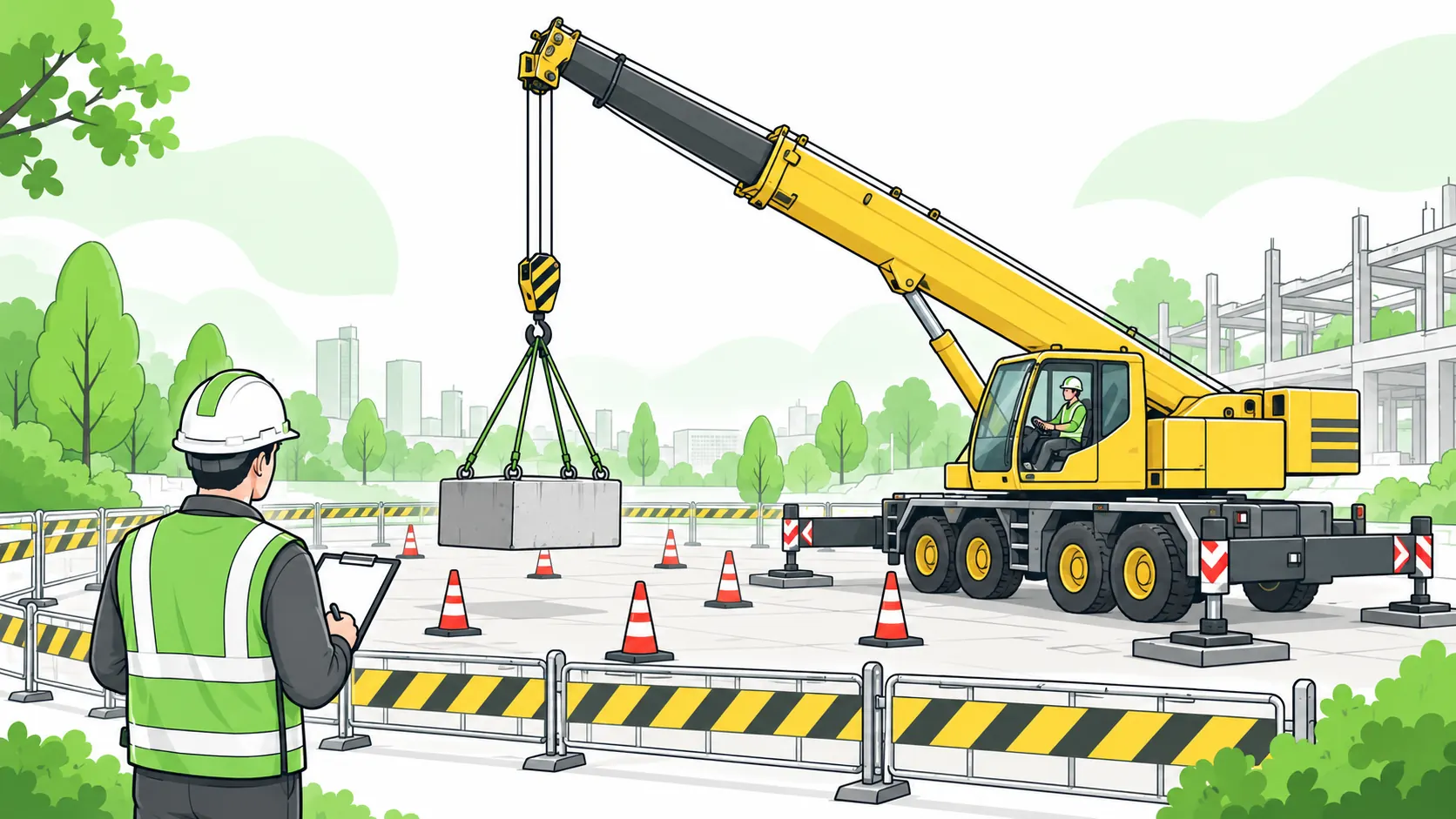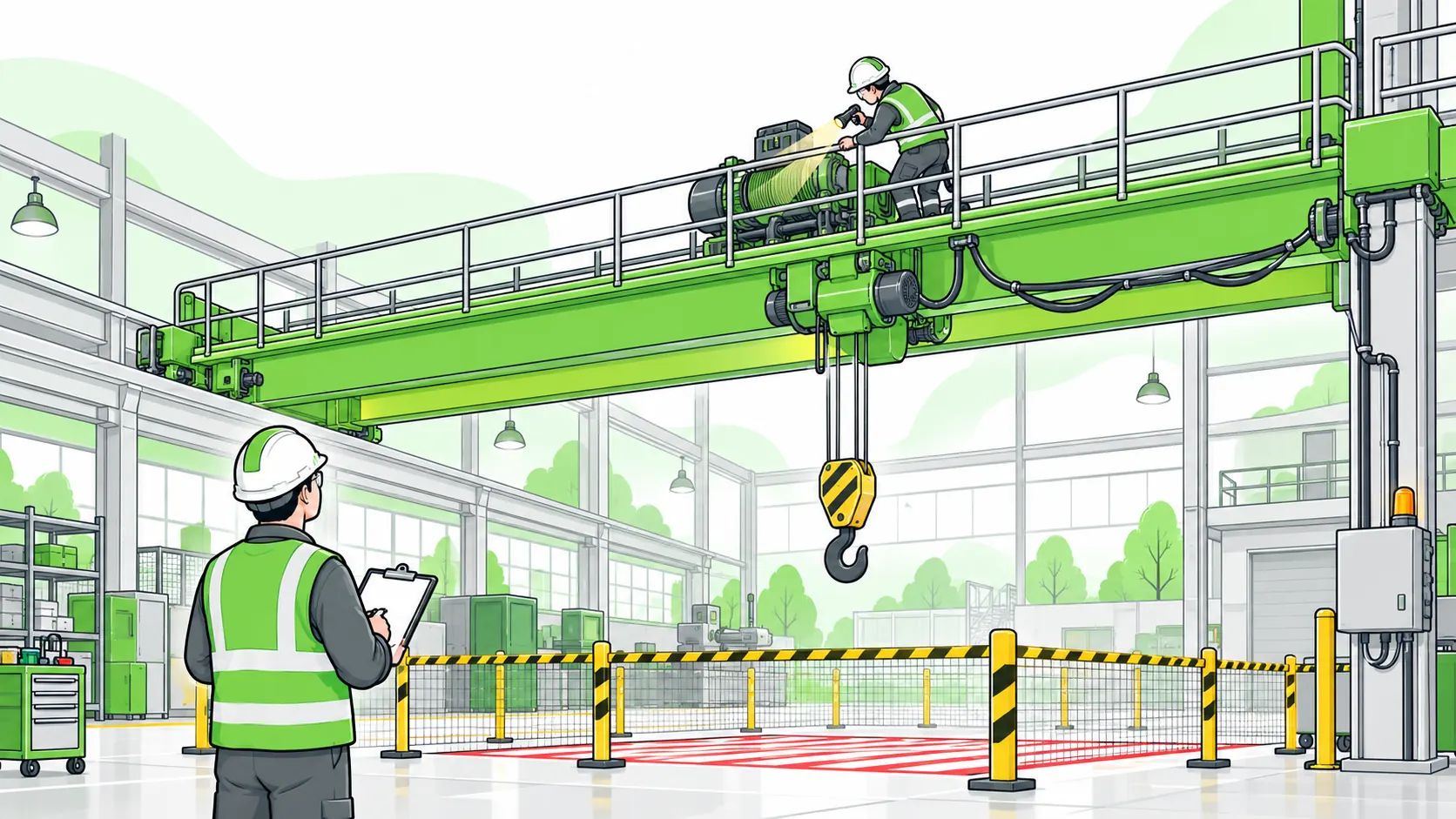
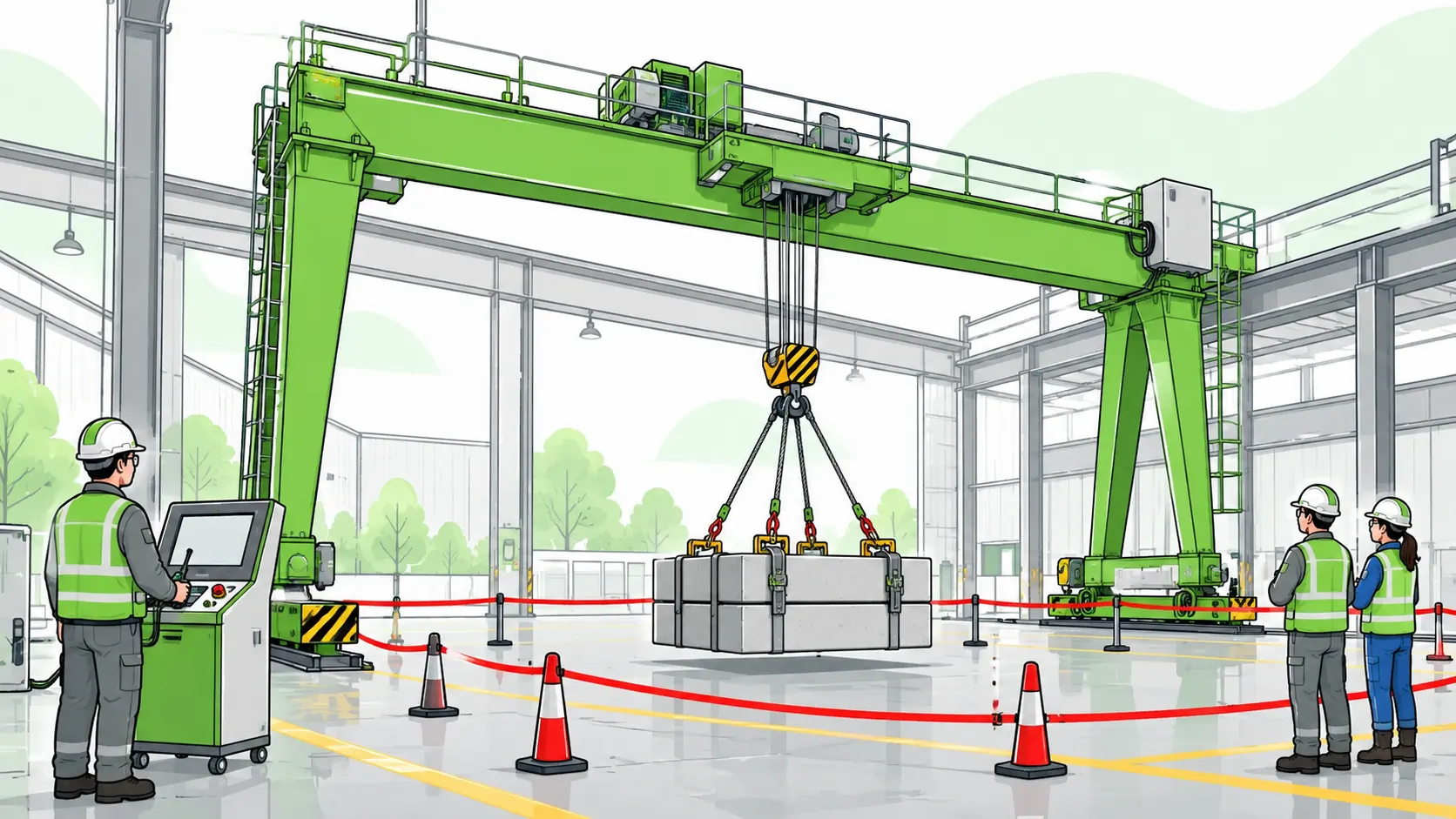
Crane load testing is a controlled procedure that applies a measured weight — typically 100% to 125% of a crane's rated capacity — to verify that its structure, brakes, and mechanical systems can safely handle working loads. It is required after new installation, major repairs, structural modifications, and re-rating, and is mandated by OSHA, ASME B30, and LOLER depending on jurisdiction.
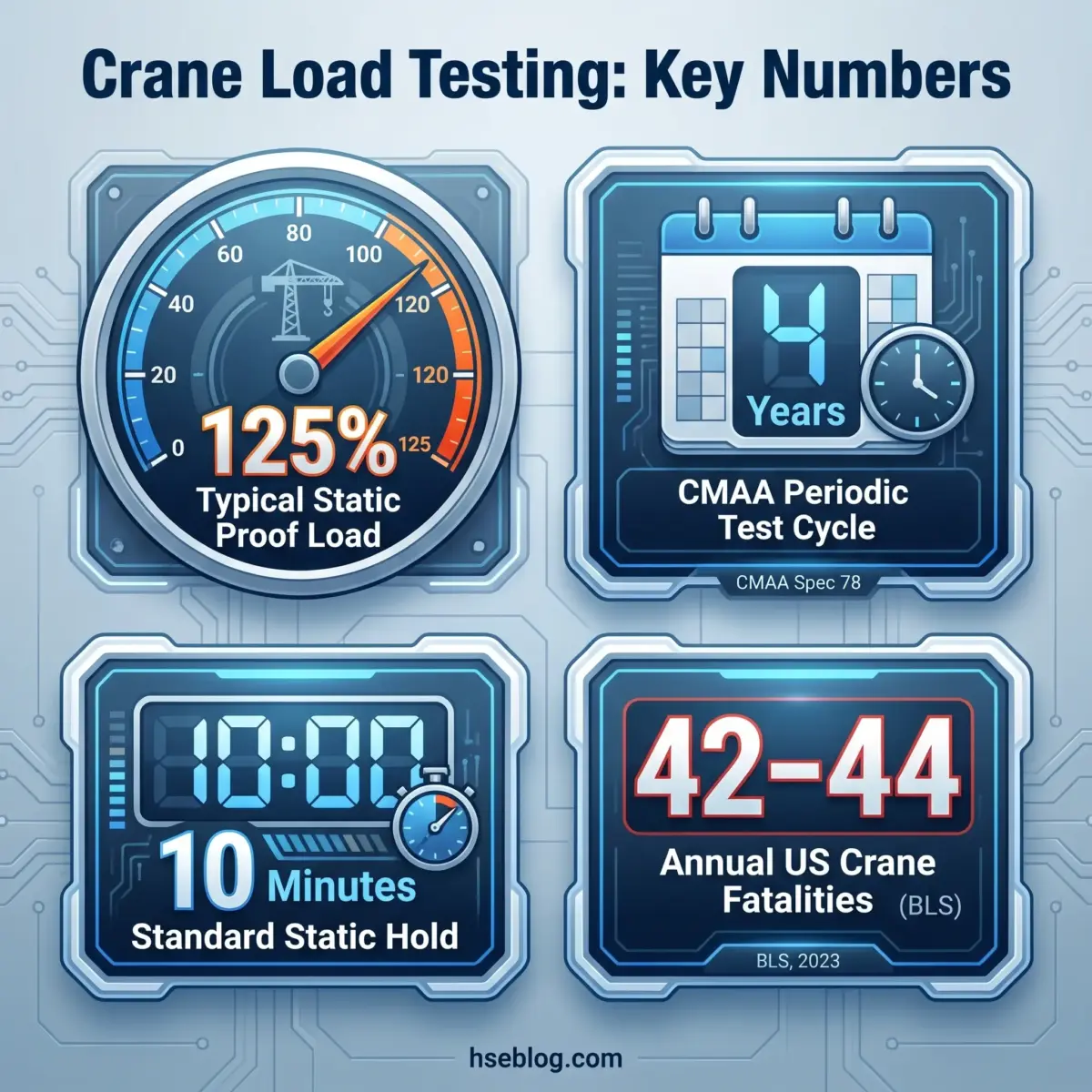
OSHA 29 CFR 1910.179(k)(2) states it plainly: all new and altered overhead and gantry cranes shall be load-tested prior to initial use. That single clause, written in 1971 and reinforced by OSHA's 2009 letter of interpretation, settled a decades-long debate about whether load testing was advisory or compulsory. The answer is compulsory — and the consequences of ignoring it are structural, legal, and potentially fatal. An average of 42–44 crane-related fatalities occurred annually in the US between 2011 and 2017 (US Bureau of Labor Statistics, 2023), and a recurring factor in post-incident investigations is equipment that passed visual inspection but had never been subjected to a verified proof load.
This article maps the full scope of crane load testing — when it is required, how static and dynamic tests differ, what proof load percentages apply under which standards, the step-by-step execution procedure, test weight options most competitors never address, documentation obligations, and competent person qualifications. The regulatory landscape here is genuinely complex: OSHA, ASME, CMAA, LOLER, and BS 7121 each define different triggers, intervals, and proof load criteria, and the practical reading of those standards is where most testing programs either succeed or fail.
What Is Crane Load Testing and Why Does It Matter?
A crane that passed its morning pre-operational check is not a crane that has been load-tested. That distinction — between routine inspection and formal proof load verification — is where the most dangerous compliance gap in lifting operations sits.
Crane load testing is a controlled procedure where a measured load, at or above the crane's rated capacity, is applied to verify three things that visual inspection cannot answer. First, whether the structural members deflect within acceptable limits and return to their original position when the load is removed — confirming no permanent deformation has occurred. Second, whether the braking system holds the proof load without drift over a sustained period. Third, whether the mechanical systems — hoist drive, trolley traverse, bridge travel, limit switches, speed controls — perform correctly under stress.
The gap between "looks fine" and "verified safe" is not theoretical. Published investigation reports repeatedly identify cranes that operated for years with undetected fatigue cracks in structural members, degraded braking surfaces, or miscalibrated overload protection — conditions that a visual walk-around will never catch but that a proof load test will expose before a catastrophic failure occurs under operational loads.
Watch For: Teams that treat a daily pre-operational checklist as equivalent to load testing. The checklist confirms that controls respond, wire rope is seated, and limit switches function at no-load or light load. It tells you nothing about structural capacity under proof loads.
When Is Crane Load Testing Required?
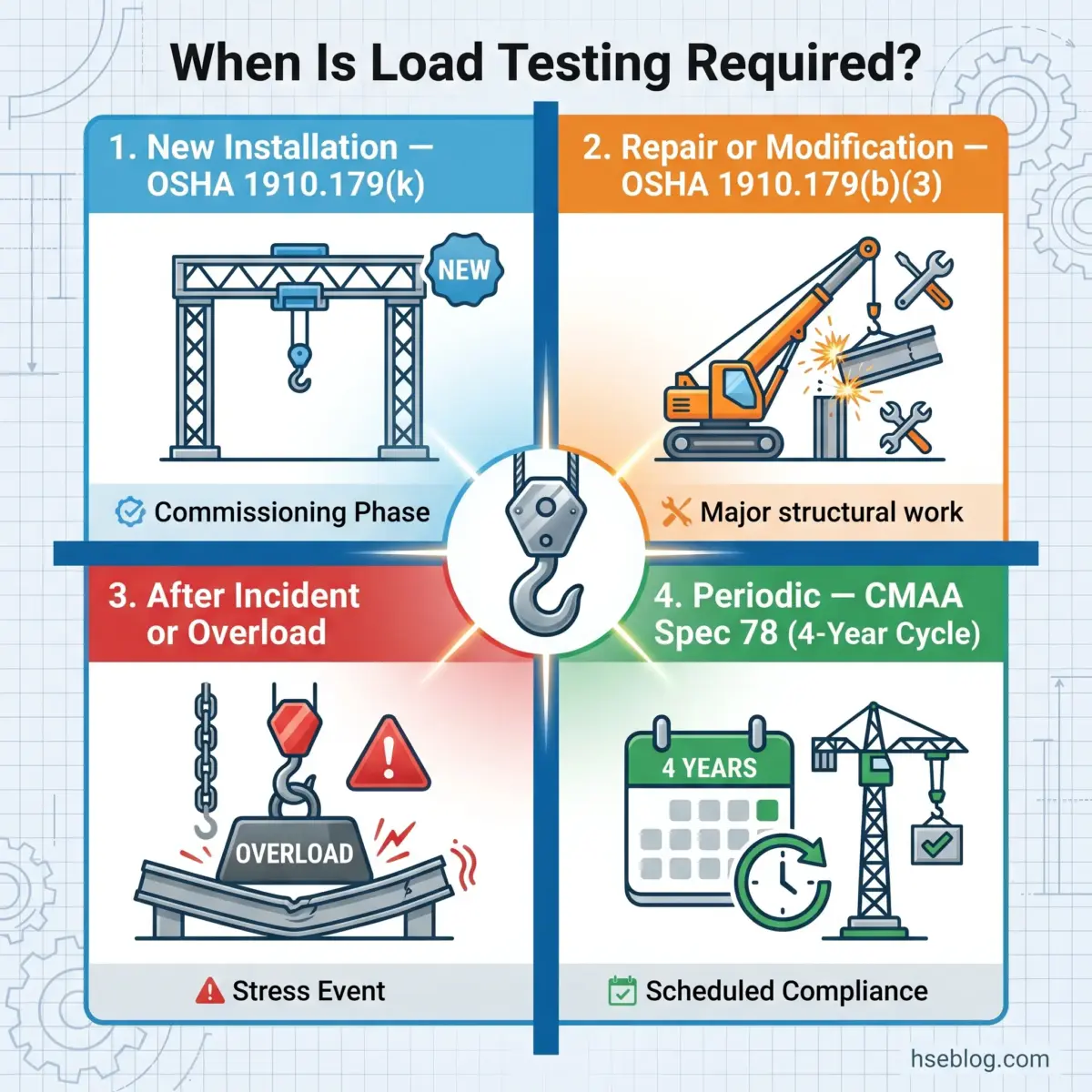
The triggers for mandatory load testing fall into four categories, and each carries different regulatory weight depending on jurisdiction. Reviewers, auditors, and enforcement officers check against these categories — not against a single blanket schedule.
Commissioning triggers apply to any crane entering service for the first time at a site. Under OSHA 1910.179(k)(2), every new overhead and gantry crane must complete a rated load test before initial use. In the UK, LOLER 1998 requires a thorough examination — which may include a proof load test at the competent person's discretion — before first use. For tower cranes, BS 7121 Part 2-5 requires testing after each erection at a new site, because the structural configuration changes with every assembly.
Repair and modification triggers cover any work that affects load-bearing members, hoist systems, or rated capacity. OSHA 1910.179(b)(3) requires that modified or re-rated cranes be checked by a qualified engineer or the manufacturer and tested per (k)(2), with the new rated load displayed. A frequently overlooked scenario: downrating. Many teams assume that reducing a crane's rated capacity exempts them from re-testing, but the load moment indicator, overload cutoffs, and limiting systems still require verification at the new rating. The re-rating documentation must be completed by a qualified engineer, and a load test confirms the systems function at the adjusted capacity.
Incident-driven triggers activate after any event that may have compromised structural integrity — a shock-load event, a dropped load, a collision with another crane or fixed structure, or operation beyond rated capacity. The judgment call here is whether the incident produced forces exceeding those the crane was designed for. When in doubt, the conservative position is to test.
Periodic triggers are where the regulatory landscape becomes genuinely confusing. OSHA does not impose a universal periodic load test interval for existing, unmodified overhead cranes. This surprises many safety managers. The Overhead Alliance guide to load test requirements consolidates CMAA Specification 78's recommendation: a load test at minimum once every four years at 100% of rated capacity, with written reports maintained for the life of the equipment. In the UK, LOLER's thorough examination schedule runs on 6- or 12-month cycles depending on equipment type, with the competent person determining at each examination whether a proof load test is warranted.
Periodic Load Test Intervals: US vs. UK Requirements
The difference in philosophy between the two major regulatory frameworks creates real operational confusion for multinational operations.
| Aspect | US Approach | UK Approach |
|---|---|---|
| Governing regulation | OSHA 1910.179 + CMAA Spec 78 | LOLER 1998, Regulation 9 |
| Mandatory periodic load test? | No universal OSHA mandate for unmodified cranes; CMAA recommends every 4 years | No fixed interval; competent person determines if proof loading is needed during thorough examination |
| Thorough examination interval | Not defined in OSHA (inspection requirements in 1910.179(j)) | 6 months for equipment lifting persons; 12 months for other lifting equipment; or per examination scheme |
| Who decides if proof load is needed? | Employer, following CMAA guidance and manufacturer recommendations | Competent person, during each thorough examination |
| Documentation retention | Life of equipment (CMAA); readily available to appointed personnel (OSHA) | Life of equipment (LOLER) |
Jurisdiction Note: OSHA's silence on periodic load testing for existing, unmodified cranes does not mean periodic testing is unnecessary — it means the regulatory floor is lower than industry best practice. CMAA Specification 78 fills that gap. Many insurance carriers and corporate policies mandate the four-year cycle regardless.
Types of Crane Load Tests: Static vs. Dynamic
Static and dynamic load tests serve distinct verification purposes, apply different load magnitudes, and test different failure modes. Conflating them — or performing only one when both are required — leaves a critical gap in the verification record.
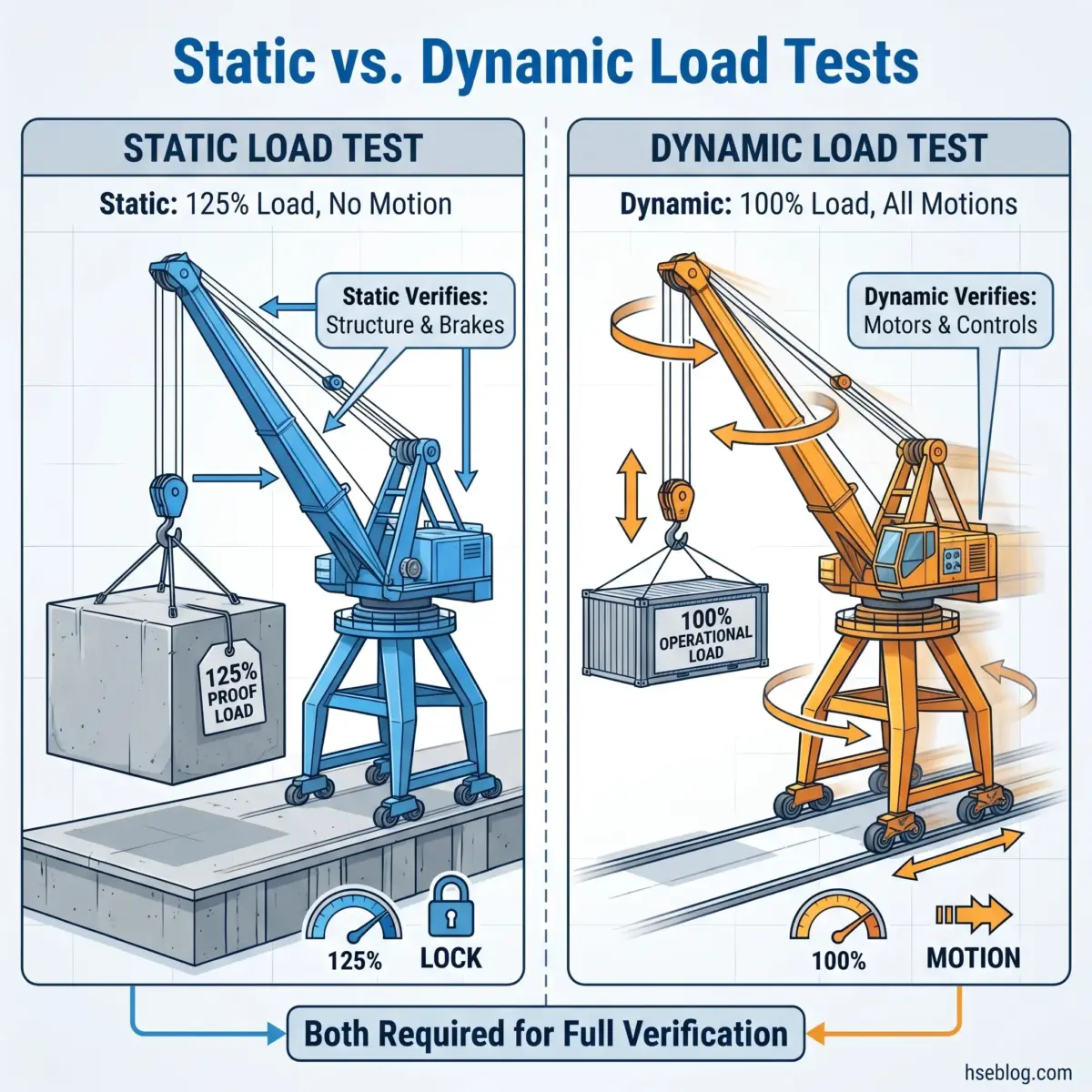
The static load test answers a structural question. The crane lifts a proof load — typically 125% of rated capacity — to a height of 12 to 18 inches and holds it motionless for a specified duration, usually 10 minutes for overhead cranes. During this hold, the test verifies two things: that the braking system holds the proof load without measurable drift, and that the structural members deflect within acceptable limits. After the load is lowered and removed, the structure is re-measured to confirm it has returned to its original geometry — any residual deformation indicates permanent structural damage.
The reason the static test uses a higher percentage than the dynamic test is straightforward: it establishes a structural safety margin. Operating loads should never reach 125% of rated capacity, so a structure that holds 125% without permanent deformation has demonstrated reserve capacity above its working range.
The dynamic load test answers an operational question. The crane operates through all designed motions — hoist up and down, trolley traverse, bridge travel — under load, typically at 100% of rated capacity. This verifies that drive motors deliver adequate torque, brakes arrest motion cleanly under inertia, speed controls regulate properly under load, and all limit switches trip at their set points. A crane can pass a static test and fail a dynamic test if, for example, the hoist brake holds under static conditions but cannot arrest a descending load at rated speed.
The most common procedural error in static testing is measuring deflection only during or after the proof load application, without taking a baseline measurement before loading. Without that pre-test measurement at mid-span, the post-test measurement is meaningless — you have no reference point to determine whether deformation occurred during the test itself.
Audit Point: Ask for both the pre-test and post-test deflection readings in the test record. If only one measurement exists, the test data is incomplete regardless of whether the crane "passed."
Proof Load Percentages and How They Vary by Standard
This is where the regulatory landscape creates genuine confusion — and where getting the number wrong has direct structural consequences. The proof load percentage is not universal. It varies by standard, crane type, and application context, and the hierarchy of which specification governs is itself a source of field-level errors.
The following table maps the key references:
| Standard / Regulation | Jurisdiction | Proof Load (Static) | Proof Load (Dynamic) | Applies To |
|---|---|---|---|---|
| OSHA 29 CFR 1910.179(k)(2) | US — General Industry | Up to 125% of rated load | Not separately specified | Overhead & gantry cranes |
| ASME B30.2 | US / International | 100–125% of rated load | 100% of rated load | Overhead & gantry cranes |
| OSHA 29 CFR 1919.71 | US — Maritime | 110% (boom cranes); 125% (trolley-equipped) | Combined with examination | Maritime/longshoring cranes |
| LOLER 1998 / BS 7121 | UK | Typically 125% | Typically 110% | All lifting equipment (competent person determines) |
| EN 14439 | EU / International | Per crane-type test regime | Per crane-type test regime | Tower cranes |
| CMAA Specification 78 | US — Industry | 100% (periodic test) | 100% (periodic test) | Overhead cranes (periodic re-certification) |
A persistent source of confusion in the field is the difference between OSHA's mandatory language and ASME's advisory language. OSHA 1910.179(k)(2) uses "shall" — load testing is mandatory for new and altered cranes. The underlying ANSI B30.2.0-1967 standard, which OSHA incorporated by reference, uses "should" for certain provisions. OSHA's 2009 letter of interpretation settled this: the OSHA requirement takes precedence, and the advisory "should" in the consensus standard does not override the regulatory "shall."
The hierarchy that governs proof load selection in practice: manufacturer specifications take precedence first. If the manufacturer specifies a proof load percentage, follow it — unless a regulatory requirement is stricter. Second, the applicable regulation (OSHA, LOLER). Third, voluntary consensus standards (ASME, CMAA). When manufacturer instructions conflict with regulatory requirements, the stricter of the two applies, and the rationale for the selected proof load must be documented.
Field Test: Before any load test, verify three documents: the manufacturer's original test requirements, the applicable OSHA or LOLER regulation for the crane type, and the ASME B30 section that applies. The proof load percentage comes from whichever of these is most stringent.
Step-by-Step Crane Load Testing Procedure
The procedure below applies to overhead and gantry crane load testing. Mobile crane and tower crane testing share the same principles but involve additional considerations for ground bearing capacity, outrigger setup, and radius-dependent load charts that fall outside this scope.
Every step here carries equal weight. The testing community's pattern of treating the actual load application as "the test" while shortchanging pre-test inspection and post-test documentation is exactly where testing programs produce false confidence.
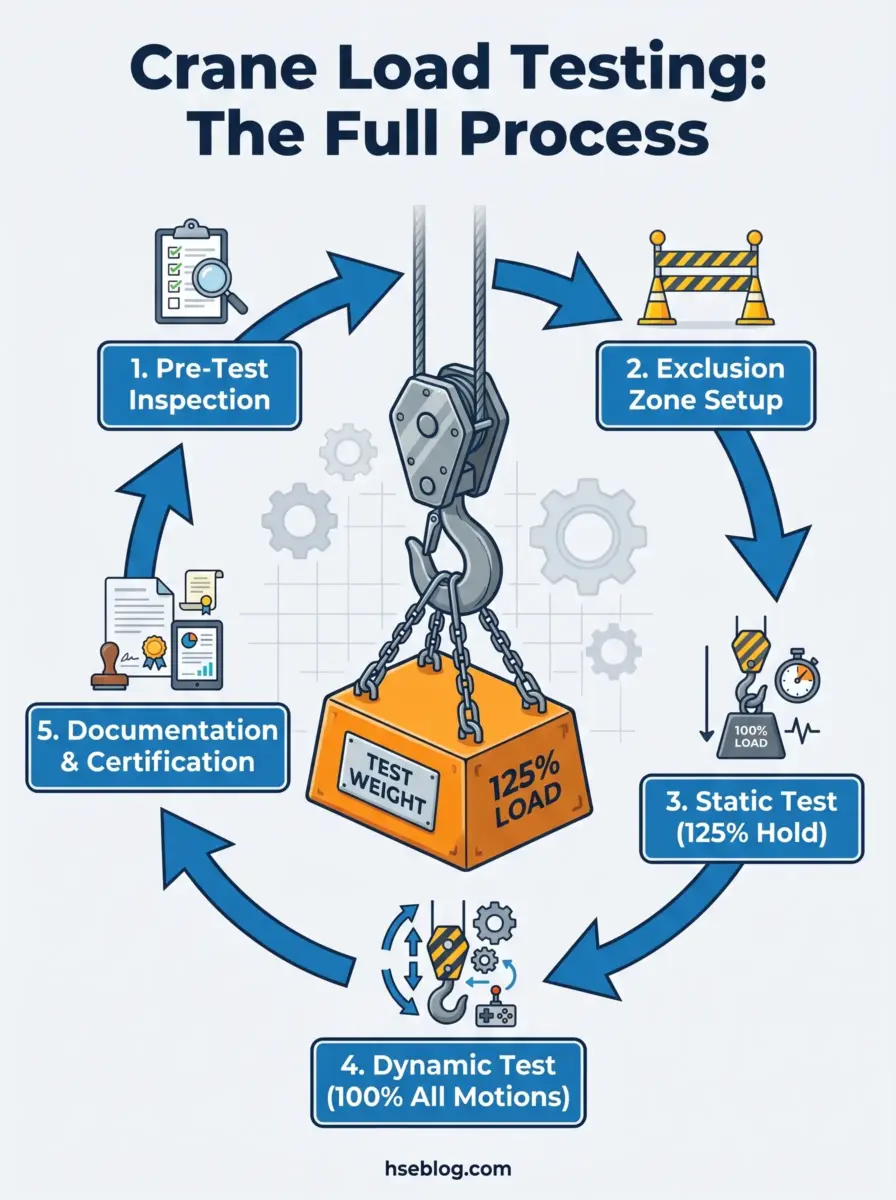
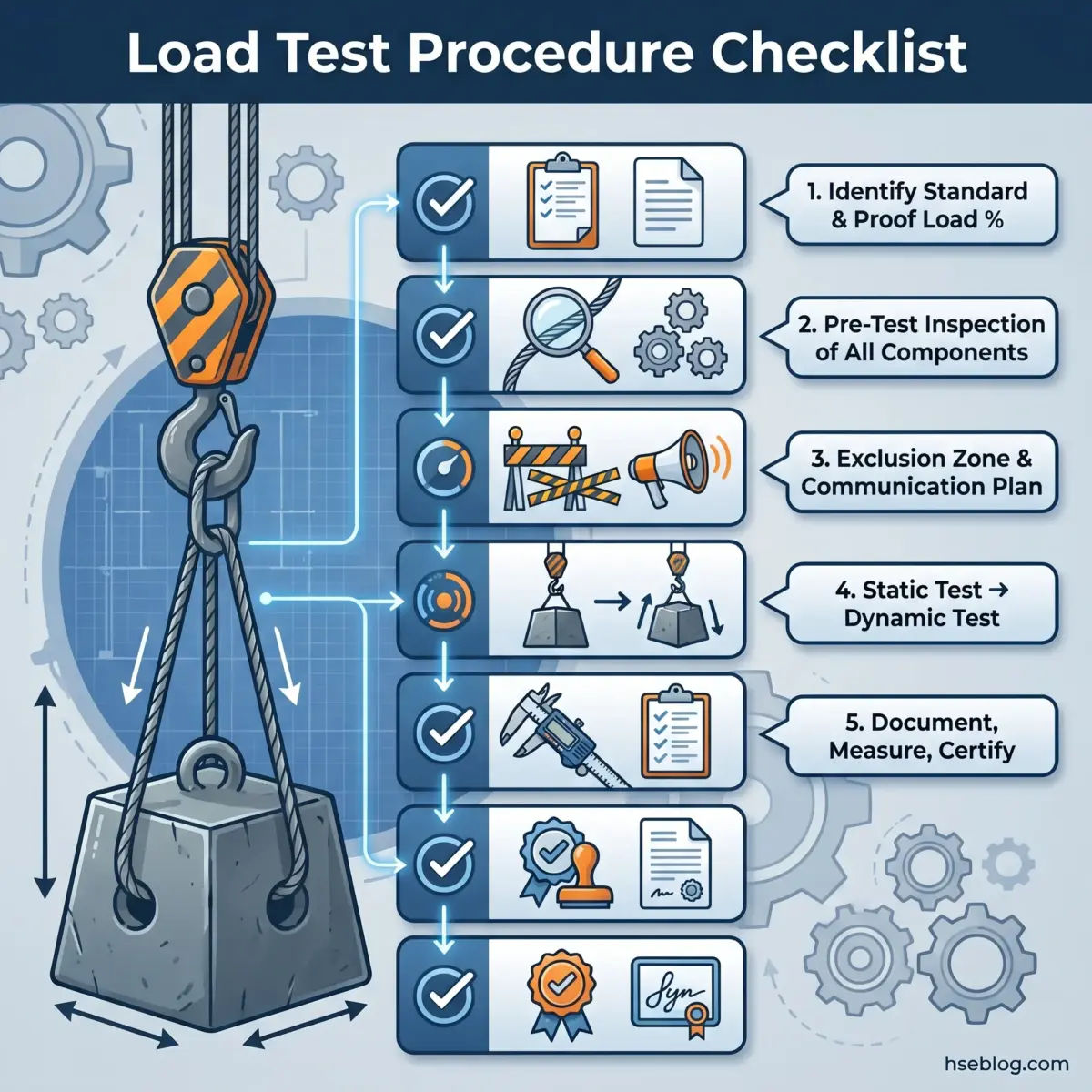
1. Determine the applicable standard and proof load percentage. Identify the crane type, the regulatory jurisdiction, and the manufacturer's test requirements. Calculate the exact test load weight based on the selected proof load percentage applied to the crane's current rated capacity — not its original nameplate capacity if it has been re-rated.
2. Complete a thorough pre-test inspection. Before any test load is applied, inspect all load-bearing and safety-critical components. This inspection is part of the test record, not a separate activity. The inspection covers:
- Wire rope condition — per ISO 4309:2017 discard criteria (confirmed current in 2024 review), checking for broken wires, diameter reduction, corrosion, and core deterioration
- Hook condition — throat opening, twist, wear, latch function
- Brake condition — disc/shoe wear, adjustment, holding capacity under no-load operational check
- Structural members — visible cracks, corrosion, deformation at connections, welds, and stress concentration points
- Runway alignment — rail condition, end stops, clearances
- Limit switches — upper hoist limit, lower limit, trolley travel limits, bridge travel limits — all must be functionally tested before load testing begins
- Load-indicating devices — RCI/RCL calibration verification
3. Prepare the test area. Establish an exclusion zone beneath and around the crane's operating envelope. Barricade the area physically — signage alone is insufficient. Assign a dedicated signal person. Establish a communication plan between the crane operator, the signal person, and the competent person directing the test. Confirm emergency procedures are in place, including the procedure for a controlled lowering if any system fails during the test.
Complacency around exclusion zones is where repeat periodic tests at familiar facilities most often fail. On the first-ever test of a new crane, teams enforce tight exclusion. On the fourth periodic test of the same crane, non-essential personnel are routinely allowed to remain in the bay "because we know this crane." The proof load doesn't know how many times the crane has been tested before.
4. Execute the static load test. Rig the test weight to the hook using certified rigging rated for the proof load. Take a baseline deflection measurement at mid-span of the bridge girder(s) before lifting. Lift the proof load (125% of rated capacity, or as determined in Step 1) to a height of 12 to 18 inches above the floor. Hold for the required duration — typically 10 minutes. During the hold, monitor brake performance for any drift and observe structural members for any visible distress. After the hold period, lower the load in a controlled manner. Take a post-test deflection measurement at the same mid-span point. Compare pre- and post-test readings. Any residual deflection beyond manufacturer-specified tolerances indicates permanent deformation and constitutes a test failure.
5. Execute the dynamic load test. With the load at 100% of rated capacity (or as determined in Step 1), operate the crane through every designed motion: hoist up, hoist down, trolley traverse in both directions, bridge travel in both directions. Verify that each motion starts, runs, and stops smoothly. Confirm all speed controls regulate properly under load. Test every limit switch under loaded conditions. Verify that brakes arrest motion cleanly without excessive overtravel.
6. Complete the post-test inspection. After both tests are complete and all loads removed, re-inspect structural members, connections, welds, wire rope, and braking components. Check for any conditions that were not present in the pre-test inspection — new cracks, deformation, unusual wear patterns, heat discoloration on braking surfaces.
7. Document and certify. Complete the full documentation package per Section 7 below. The competent person directing the test signs the certification.
Test Weight Options: Solid Weights, Water Bags, and Hydraulic Systems
The method of applying the test load is an operational decision that every competitor article ignores — yet it directly affects test accuracy, safety, logistics, and cost. Three primary methods exist, each with distinct trade-offs.
Certified solid weights are the most traditional method and offer the highest accuracy. Steel or cast-iron test weights are calibrated, certified, and stacked to reach the target proof load. The primary limitation is logistics: a 50-ton proof load test requires 50+ tons of certified weights transported to site, lifted into position, and — critically — supported by the floor. Floor loading capacity must be verified before test weights are staged. For large-capacity cranes, the logistics of solid weights can be prohibitive.
Water weight bags changed the economics and safety profile of load testing. Bags are positioned empty beneath the crane, connected to a water supply, and filled incrementally while suspended. The safety advantage is significant: if a bag or connection fails, water flows out progressively rather than dropping as a concentrated mass. The offshore industry and high-capacity testing operations use water bags extensively, and compliance with LEEA Technical Guidance Note 051 provides the quality framework. However, the gradual filling characteristic creates a procedural discipline requirement — the competent person must be rigorous about holding at the exact target load for the full required duration, since the incremental fill process can create a false sense of having "already tested" during the filling phase itself.
Hydraulic load simulation systems apply force against a fixed anchor point without suspending any physical mass. They are useful where physical test weights are impractical — for example, testing a crane mounted high in a facility where floor-level weight staging is impossible. The limitation is that hydraulic simulation tests the crane's structural and braking response to a vertical force but does not replicate the inertial behavior of a real suspended mass during dynamic testing. Calibration verification of the hydraulic system is critical and must be current.
Regardless of method, all test loads require verified measurement. Certified weights carry calibration certificates. Water bags require calibrated load cells between the crane hook and the bag rigging. Hydraulic systems require calibrated pressure gauges correlated to force output.
What Does Crane Load Testing Documentation Require?
Incomplete documentation is the single most common audit finding in crane load testing programs. A test that was performed correctly but documented poorly is, from an enforcement and legal standpoint, a test that may as well not have happened.
The documentation package resulting from every load test must include the following elements, each serving a distinct evidentiary purpose.
The pre-test inspection report records the condition of all load-bearing and safety-critical components before any test load was applied. It identifies any deficiencies found and documents the corrective actions taken before proceeding with the test. This report establishes the baseline equipment condition.
The test plan or method statement documents the proof load to be applied, the standard referenced, the test type (static, dynamic, or both), the test weight method selected, and the acceptance criteria. This document should be prepared and approved before the test day — not written retrospectively.
The test execution record captures the actual load applied (verified by load cell or calibration certificate), the duration of the static hold, deflection readings (pre-test baseline and post-test), all motions tested during the dynamic test, and a pass/fail determination for each function tested. This is the core evidentiary document.
The post-test inspection findings document the condition of the crane after load removal, specifically noting any changes from the pre-test inspection — deformation, cracks, unusual wear, brake condition.
The signed certification by the qualified or competent person who directed the test, including their credentials and, where required, their registration or certification number.
OSHA requires test reports "on file where readily available to appointed personnel." In enforcement practice, "readily available" means producible during an inspection — not after a multi-day search through filing cabinets. LOLER requires thorough examination certificates kept for the life of the equipment. CMAA Specification 78 requires written reports maintained for the life of the equipment.
OSHA's Injury Tracking Application received over 370,000 Form 300A submissions in its most recent data release (OSHA, 2025), reinforcing the enforcement emphasis on documentation accessibility. Facilities that cannot produce current test certifications during an inspection face citation regardless of whether the tests were actually performed.
The Fix That Works: Create a single-page cover sheet for every load test file that lists: crane ID, test date, test type, proof load applied, pass/fail, competent person name and credential number, and the file location of all supporting documents. Attach it to the front of the physical or digital file. This solves the "readily available" problem in under five minutes.
Who Is Qualified to Perform Crane Load Testing?
The qualification question is non-negotiable YMYL territory. The wrong person performing or certifying a load test invalidates the entire exercise — and in the event of a subsequent failure, creates both criminal and civil liability exposure.
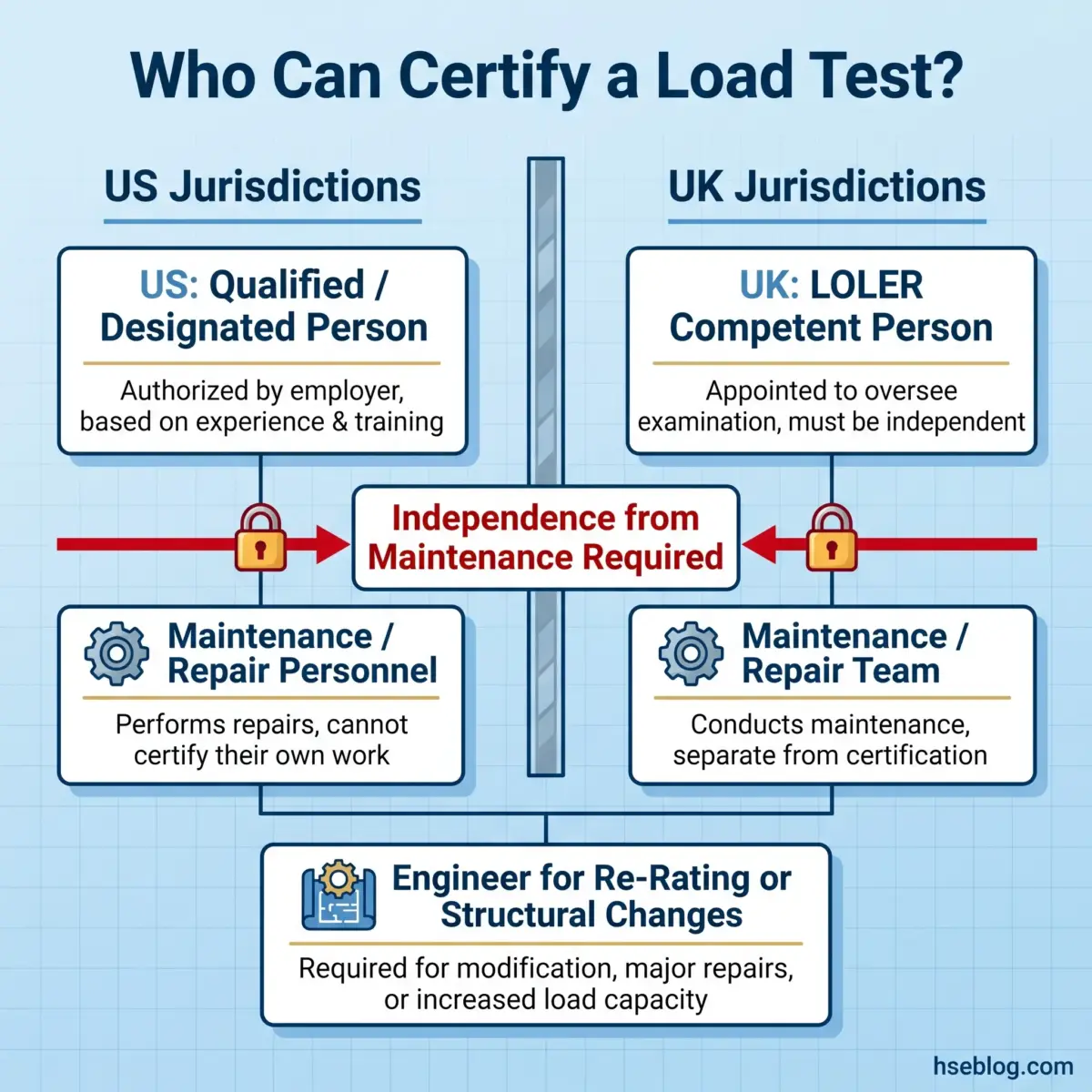
In the US, OSHA 1910.179 requires testing by or under the direction of an "appointed or authorized person." ASME B30 further defines "qualified person" (by training and experience) and "designated person" (selected by the employer as competent to perform specific duties). For re-rating, structural modifications, or situations where rated capacity was exceeded, professional engineer involvement is either required by the standard or strongly recommended by industry practice.
In the UK, LOLER 1998 requires thorough examination — which may include proof load testing — by a "competent person" as defined in the Approved Code of Practice. The definition requires appropriate practical and theoretical knowledge of the specific type of equipment being examined. Insurance company engineers and accredited third-party inspection bodies commonly fill this role.
The independence requirement is where organizations most consistently cut corners. A person examining equipment should not be assessing the adequacy of their own maintenance work. The entire purpose of third-party verification — confirming that a repair actually restored the equipment to safe operating condition — collapses when the person who performed the repair is the same person who signs off the subsequent load test. LOLER's ACoP is explicit on this point. ASME B30 and CMAA address it through the distinction between the person performing maintenance and the person directing or certifying the test.
The practical test of independence: if the load test reveals a deficiency, does the person certifying the test have the authority and incentive to fail the crane — even if that means their own maintenance work is called into question? If the answer is no, the independence requirement is not met.
Key Safety Standards and Regulations for Crane Load Testing
The regulatory landscape for crane load testing spans multiple jurisdictions, crane types, and standards bodies. This consolidated reference maps every standard a lifting equipment coordinator needs to track.
| Standard | Jurisdiction | Scope | Key Load Test Provision |
|---|---|---|---|
| OSHA 29 CFR 1910.179 | US — General Industry | Overhead & gantry cranes | (k)(2): rated load test mandatory for new/altered cranes; up to 125% |
| OSHA 29 CFR 1926 Subpart CC | US — Construction | All crane types in construction | 1926.1433: design, construction, testing requirements |
| OSHA 29 CFR 1919.71 | US — Maritime | Longshoring/maritime cranes | 110% (boom), 125% (trolley-equipped) |
| ASME B30.2 | US / International | Overhead & gantry cranes | 100–125% for new, reinstalled, altered, repaired, modified |
| ASME B30.5 | US / International | Mobile & locomotive cranes | Load testing provisions for mobile crane applications |
| ASME B30.11 | US / International | Monorails & underhung cranes | Load testing aligned with B30.2 principles |
| CMAA Specification 78 | US — Industry | Overhead cranes (periodic) | §4.7: 100% load test minimum every 4 years |
| LOLER 1998 (Reg 9) | UK | All lifting equipment | Thorough examination at prescribed intervals; competent person determines proof load need |
| PUWER 1998 | UK | All work equipment | General maintenance and inspection obligations complementing LOLER |
| BS 7121 (multiple parts) | UK | All crane types | Pre-use testing, RCI/RCL calibration, load test procedures, post-test examination |
| EN 14439 | EU / International | Tower cranes | Specific static and dynamic test regimes at first erection |
| ISO 4309:2017 | International | Wire rope care and inspection | Discard criteria for wire ropes; pre-test rope condition assessment (confirmed current 2024) |
Legal Disclaimer: Regulatory content here reflects general HSE professional understanding of US (OSHA) and UK (LOLER/PUWER) requirements as of 2025. It is not legal advice. Specific compliance questions, enforcement situations, or prosecution risk should be directed to qualified legal counsel in the applicable jurisdiction.
Frequently Asked Questions
Is crane load testing required by OSHA for existing cranes that haven't been modified?
OSHA 29 CFR 1910.179(k) mandates load testing for new and altered overhead and gantry cranes. For existing cranes that have not been modified, re-rated, or involved in a capacity-exceeding incident, OSHA does not impose a universal periodic load test requirement. However, CMAA Specification 78 recommends a minimum four-year periodic load test cycle, and many insurance carriers and corporate safety programs mandate this as a condition of coverage. The distinction matters: OSHA sets the regulatory floor, not the ceiling.
What is the difference between a proof load test and a rated load test?
The terms overlap in practice but carry different technical meanings depending on the standard applied. "Proof load test" generally refers to testing above rated capacity — typically at 125% — to verify structural safety margin. "Rated load test" refers to testing at the crane's marked rated capacity (100%) to verify operational performance. OSHA 1910.179 uses "rated load test" but permits loads up to 125%. The key distinction is whether the test is verifying structural reserve (proof load) or operational functionality (rated load).
Can water bags be used instead of solid weights for crane load testing?
Water-filled weight bags are widely accepted and offer meaningful advantages: they can be transported empty and filled on-site, and their failure mode is a progressive leak rather than a sudden mass drop. They must be used with calibrated load cells to verify the actual applied load, and the test must meet all hold-duration and load-accuracy requirements of the applicable standard. LEEA Technical Guidance Note 051 provides the quality framework for water bag testing.
How long do you hold the load during a static crane load test?
Typical hold duration for overhead cranes is 10 minutes, though the exact duration depends on manufacturer instructions and the applicable standard. The hold must be long enough to confirm the braking system holds without measurable drift and to take accurate structural deflection measurements. Some manufacturer specifications or standards for specific crane types may require longer holds. The competent person should verify the required duration against the manufacturer's original test procedure before execution.
What happens if a crane fails a load test?
The crane must be immediately removed from service — no exceptions and no "conditional" continued use. A qualified engineer must assess the nature and extent of the failure: whether it is excessive deflection indicating structural fatigue, brake drift indicating mechanical deterioration, permanent deformation indicating the structure has exceeded its elastic limit, or a control/limit switch failure. The engineer determines whether repair is feasible and specifies the scope of work. After repair, a complete re-test — not a partial re-test — is required before the crane returns to service. The failure and the full remediation path must be documented.
Does downrating a crane require a load test?
Reducing a crane's rated capacity does not exempt the crane from testing. The overload protection systems — load moment indicators, overload cutoffs, capacity warning devices — must be recalibrated and verified at the new rating. A load test confirms these limiting systems function correctly at the adjusted capacity. A qualified engineer must document the re-rating, and the new rated load must be conspicuously displayed on the crane per OSHA 1910.179(b)(3).
Conclusion
The single most damaging pattern across crane load testing programs is not a lack of testing — it is testing that checks the box without checking the equipment. A test that skips baseline deflection measurement produces numbers without meaning. A test certified by the person who performed the preceding repair produces confidence without verification. A test file buried in a cabinet produces compliance without evidence.
What the industry consistently gets wrong is treating load testing as an event rather than a system. The event is the proof load application. The system is the full chain: correct standard identification, proof load calculation, pre-test inspection, exclusion zone enforcement, baseline measurement, controlled execution, post-test comparison, independent certification, and accessible documentation. Break any link in that chain, and the test's value as a safety verification collapses — regardless of whether the crane held the load.
The highest-impact change for any facility managing crane load testing is enforcing the independence requirement. Separate the team that maintains the crane from the person who certifies the test. That structural separation is what transforms a load test from a procedural formality into a genuine safety verification — the kind that catches the failure mode before it catches a worker.