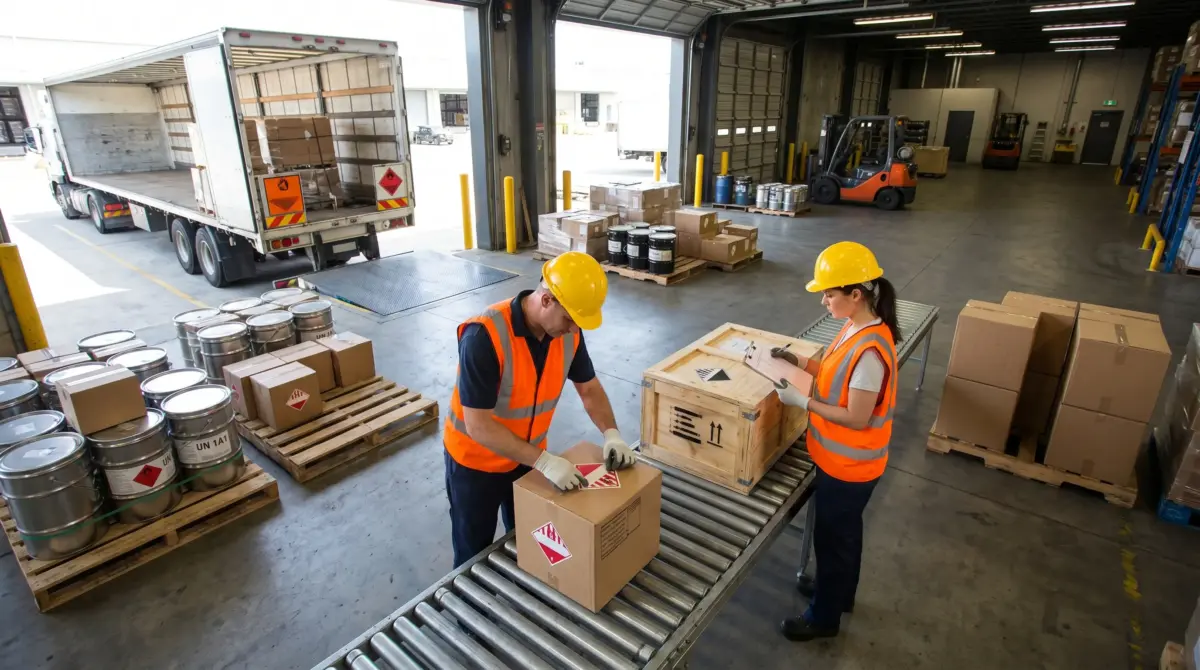
Hazardous materials transported in commerce in the United States are classified into nine hazard classes under 49 CFR, administered by the Pipeline and Hazardous Materials Safety Administration (PHMSA). Classification is the first and most consequential compliance step — it determines every downstream requirement for packaging, marking, labeling, placarding, shipping papers, and training. More than 3.3 billion tons of hazardous materials move across US transport networks annually, with over 1.2 million shipments per day (PHMSA, 2023).
What Is HAZMAT Transportation and Why Is It Regulated?
Under 49 U.S.C. §5103, a hazardous material is any substance or material that the Secretary of Transportation determines poses an unreasonable risk to health, safety, and property when transported in commerce. That statutory definition is broad by design. It captures not only industrial chemicals moving between plants but also the aerosol cans, lithium batteries, nail polish, and cleaning solvents that e-commerce sellers ship daily from their garages.
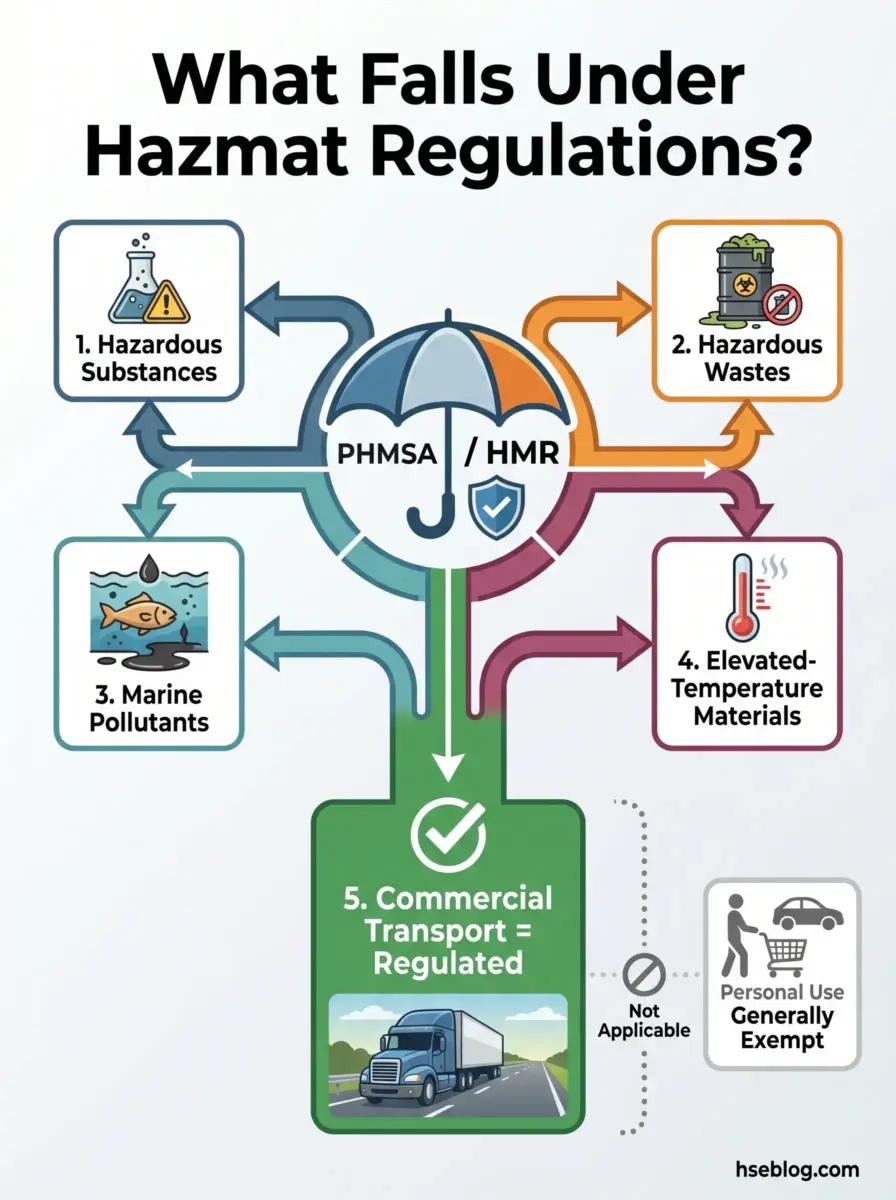
PHMSA — the Pipeline and Hazardous Materials Safety Administration — administers the Hazardous Materials Regulations (HMR), codified across 49 CFR Parts 100–185. The regulatory rationale is straightforward: materials that can explode, burn, poison, corrode, or irradiate require controls that protect drivers, dock workers, emergency responders, the public, and the environment. The scope extends to hazardous substances, hazardous wastes, marine pollutants, and elevated-temperature materials.
A critical distinction that catches many small businesses: "in commerce" is the trigger. Personal-use transport of hazardous materials in a private vehicle is generally exempt. The moment a material moves in furtherance of a commercial enterprise — including an Etsy shop shipping perfume or a landscaping company hauling herbicide — full HMR compliance applies. PHMSA enforcement data consistently shows that undeclared shipments, often from small shippers unaware their products are regulated, remain a leading source of transport incidents.
The Regulatory Framework: US Domestic and International Standards
Hazmat regulation is not a single rulebook — it is a layered system of international foundations and jurisdiction-specific implementations, each with its own update cycle, enforcement authority, and modal scope. Understanding this hierarchy is essential for anyone whose shipments cross borders or switch transport modes.
The foundation is the UN Recommendations on the Transport of Dangerous Goods (Model Regulations), maintained by the United Nations Economic Commission for Europe. These Model Regulations establish the classification system, hazard communication standards, and packaging performance criteria that virtually every national and modal framework builds upon. They are not directly enforceable — instead, they harmonize the frameworks that are.
Within the US, the HMR (49 CFR Parts 171–180) is administered by PHMSA, with modal enforcement distributed across agencies: FMCSA enforces on highways, FRA on rail, FAA in air transport, and the US Coast Guard on vessels. A single shipment moving by truck to a port, then by vessel, then by air in the destination country can fall under four distinct enforcement regimes — each applying different quantity limits and packaging specifications to the same material.
The international modal frameworks each derive from the UN Model Regulations but impose mode-specific requirements. IATA Dangerous Goods Regulations govern international air transport and are generally the most restrictive, particularly on quantity limits and packaging. The IMDG Code governs maritime transport — Amendment 42-24 becomes mandatory from January 1, 2026. For European road transport, ADR 2025 became mandatory from July 1, 2025. Canada's Transportation of Dangerous Goods Regulations (TDG) apply north of the border.
One point that warrants emphasis: PHMSA's HMR preempts conflicting state and local regulations. States may impose additional requirements that do not conflict with federal standards, but they cannot set lower thresholds or create contradictory classification schemes.
| Framework | Transport Mode | Governing Body | Current Edition | Jurisdiction |
|---|---|---|---|---|
| 49 CFR (HMR) | All domestic modes | PHMSA (DOT) | Continuously updated | United States |
| IATA DGR | Air (international) | IATA / ICAO | 66th Edition (2025) | International |
| IMDG Code | Sea | IMO | Amendment 42-24 (mandatory Jan 2026) | International |
| ADR | Road | UNECE | 2025 (mandatory Jul 2025) | Europe + signatories |
| TDG | All modes | Transport Canada | Current | Canada |
How US Regulations Align with International Standards
PHMSA periodically aligns the HMR with the UN Model Regulations, ICAO Technical Instructions, and IMDG Code through the HM-215 harmonization rulemaking series. This process ensures that US shippers using international frameworks can generally comply with both domestic and international requirements simultaneously — though gaps persist. The currently authorized international editions are the 2025–2026 ICAO Technical Instructions and IMDG Amendment 42-24.
Jurisdiction Note: When a material ships multimodally — for example, by truck to a port and then by air — the shipper must verify compliance against each applicable framework for each transport leg. A material that ships legally under 49 CFR ground provisions may exceed IATA DGR quantity limits for the air leg. This is one of the most common compliance traps in multimodal logistics.
How Are Hazardous Materials Classified? The Nine DOT Hazard Classes
Classification is where compliance begins — and where it most often fails. Every downstream requirement flows from the hazard class and division assigned to a material. A misclassified substance gets the wrong packaging specification, the wrong hazard label, the wrong proper shipping name on the shipping paper, and the wrong placard on the vehicle. That single classification error generates multiple independent violations, each separately citable.
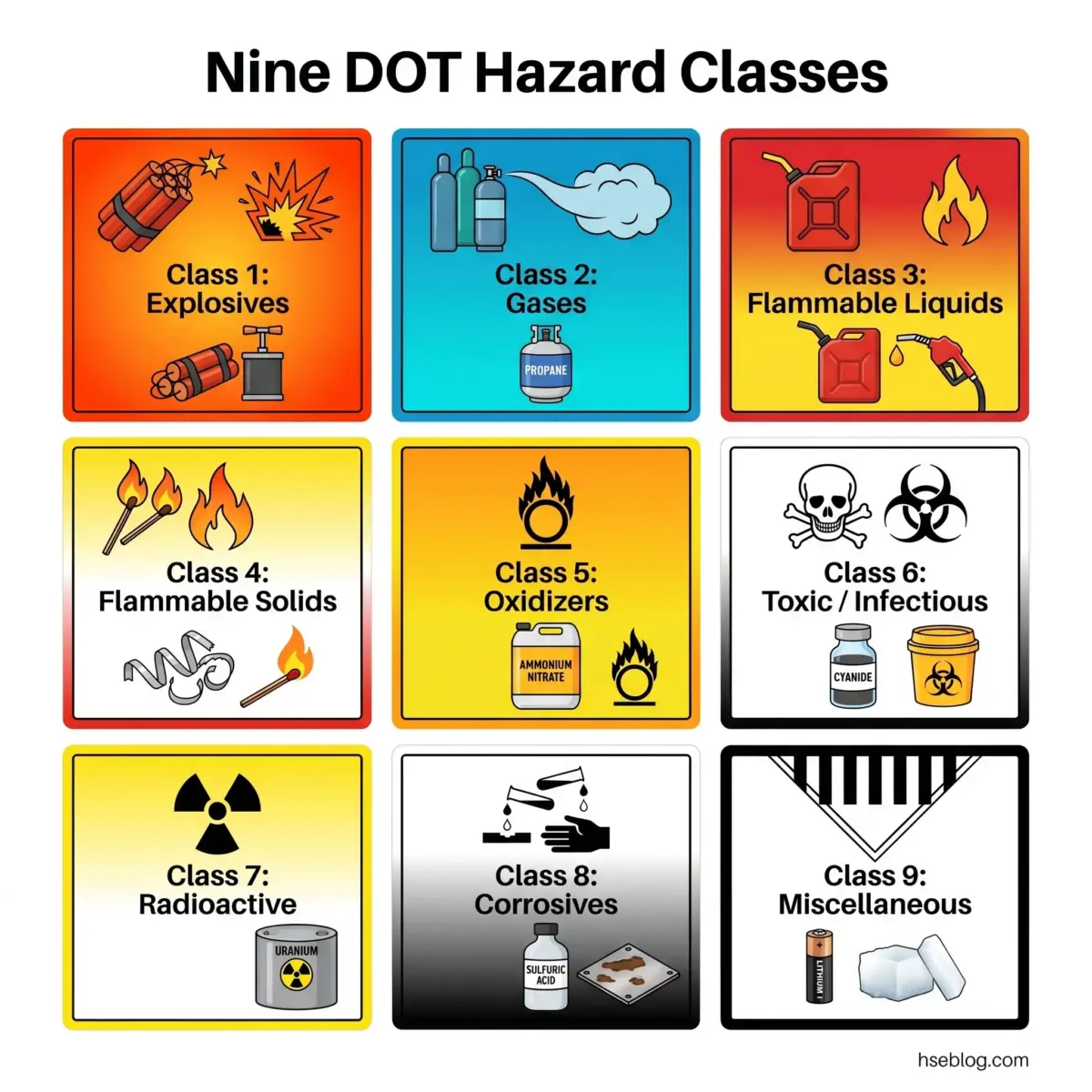
The nine classes established under 49 CFR, derived from the UN Model Regulations, organize materials by their primary hazard mechanism:
Class 1 — Explosives are divided into six divisions (1.1 through 1.6) based on blast and projection hazard severity. Division 1.1 presents a mass explosion hazard; Division 1.6 contains extremely insensitive articles. Common examples include fireworks, ammunition, blasting caps, and detonating cord.
Class 2 — Gases cover any material with a vapor pressure exceeding 300 kPa at 50°C or that is completely gaseous at 20°C at standard atmospheric pressure. Division 2.1 covers flammable gases (propane, acetylene), Division 2.2 covers non-flammable, non-toxic gases (nitrogen, oxygen, carbon dioxide), and Division 2.3 covers toxic gases (chlorine, anhydrous ammonia).
Class 3 — Flammable Liquids includes liquids with a flash point at or below 60°C (closed cup). Gasoline, acetone, many paints and adhesives, and ethanol fall here. Packing group assignment depends on flash point and boiling point.
Class 4 — Flammable Solids splits into three divisions: 4.1 flammable solids (safety matches, naphthalene), 4.2 spontaneously combustible materials (white phosphorus, certain metal powders), and 4.3 materials dangerous when wet (sodium, calcium carbide).
Class 5 — Oxidizers and Organic Peroxides covers Division 5.1 oxidizers (ammonium nitrate, calcium hypochlorite) that can intensify fire by supplying oxygen, and Division 5.2 organic peroxides (benzoyl peroxide, methyl ethyl ketone peroxide) that are thermally unstable.
Class 6 — Toxic and Infectious Substances includes Division 6.1 toxic materials (pesticides, cyanides) and Division 6.2 infectious substances (regulated medical waste, diagnostic specimens, biological cultures).
Class 7 — Radioactive Materials covers materials with specific activity exceeding 70 kBq/kg. Examples include uranium hexafluoride, medical isotopes for diagnostic imaging, and industrial radiography sources.
Class 8 — Corrosives are materials that cause visible destruction or irreversible damage to skin tissue or corrode steel/aluminum at specified rates. Sulfuric acid, sodium hydroxide, and wet-cell batteries are common Class 8 materials.
Class 9 — Miscellaneous Dangerous Goods captures materials that present a hazard during transport but do not meet the criteria for Classes 1–8. Lithium batteries (now designated 9A in some frameworks), dry ice, environmentally hazardous substances, and airbag modules fall here.
Beyond class and division, Packing Groups indicate hazard severity within a class: Packing Group I (great danger), Packing Group II (medium danger), and Packing Group III (minor danger). The assigned packing group directly determines packaging performance requirements — PG I materials demand the most robust packaging specifications. Not all classes use packing groups; Classes 1, 2, and 7, and Division 6.2 have their own severity frameworks.
Using the Hazardous Materials Table (49 CFR 172.101)
The Hazardous Materials Table is the primary classification reference. It lists every regulated material by proper shipping name, alongside columns for hazard class/division, UN identification number, packing group, required label codes, special provisions, and authorized packaging sections. Learning to read this table competently is a non-negotiable skill for anyone classifying materials.
A common starting point is the Safety Data Sheet (SDS), specifically Section 14 — Transportation Information. However, the SDS is prepared by the chemical manufacturer and may not reflect the shipper's specific configuration (quantity, packaging type, transport mode). The shipper bears ultimate classification responsibility under the HMR. Using the SDS as the sole classification authority, without verifying against the Hazardous Materials Table and the applicable classification criteria in 49 CFR Part 173, is a frequent error — and one that does not provide a compliance defense.
Watch For: Materials with multiple hazards are assigned a primary class and may carry subsidiary hazard designations. The precedence rules in 49 CFR 173.2a determine which hazard class takes priority. Missing a subsidiary hazard means missing a required subsidiary label — and giving emergency responders incomplete information.
What Are the Requirements for Hazmat Packaging, Marking, Labeling, and Placarding?
These four terms are related but distinct. Conflating them — which happens routinely — leads to compliance gaps because each has its own regulatory subpart, its own specifications, and its own enforcement patterns.
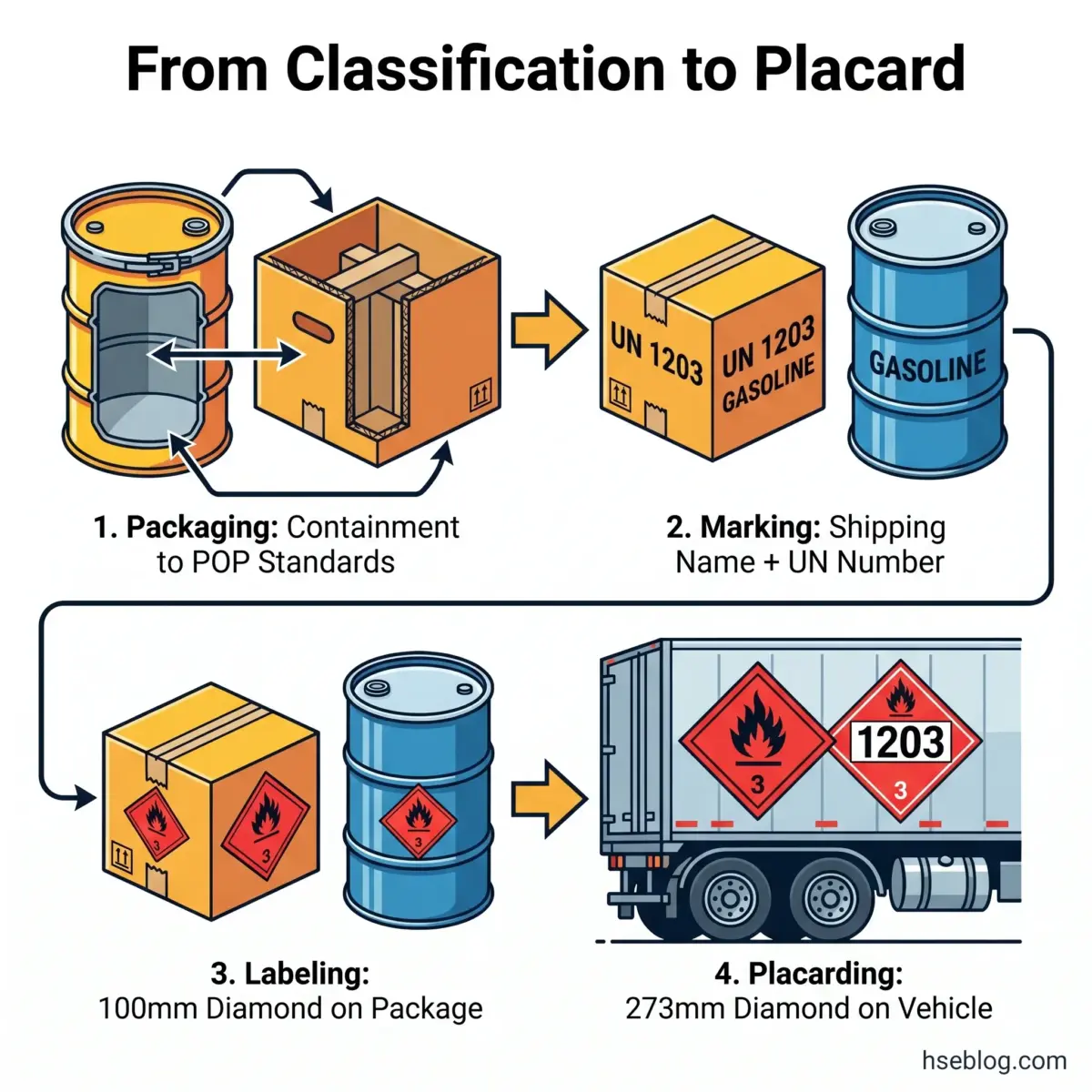
Packaging refers to the physical containment of the hazardous material. For most non-bulk shipments, UN Performance Oriented Packaging (POP) standards apply — packaging must be tested and certified to withstand drop, stacking, and pressure tests corresponding to the material's packing group. Bulk packaging applies to containers exceeding 119 gallons for liquids or 882 pounds for solids. The packaging authorization for each material is specified in the Hazardous Materials Table and detailed in 49 CFR Part 173.
Marking is the information applied directly to the outer surface of a package: the proper shipping name, UN or NA identification number, consignee and consignor names and addresses, and any applicable special markings (e.g., orientation arrows for liquids, limited quantity marks). Markings must be durable, in English, and not obscured by other labels or attachments.
Labeling requires diamond-shaped hazard labels (100mm × 100mm minimum) placed on non-bulk packages. Labels correspond to the material's primary and subsidiary hazard classes and must meet the color, symbol, and text specifications in 49 CFR 172, Subpart E.
Placarding uses larger diamond-shaped signs (273mm × 273mm minimum) displayed on transport vehicles and bulk containers. Placarding thresholds differ by material category. Table 1 materials — which include the most dangerous hazard classes such as Division 1.1 explosives, Division 2.3 toxic gases, and Division 6.1 PG I poisons — require placards for any quantity. Table 2 materials require placards when the aggregate gross weight of all Table 2 materials aboard reaches 454 kg (1,001 lbs). For mixed loads of Table 2 materials, the DANGEROUS placard may substitute for individual class placards.
From an enforcement perspective, the most commonly cited deficiencies across PHMSA hazmat incident statistics involve incorrect or missing proper shipping names, faded or illegible markings, and absent subsidiary hazard labels. These are not paperwork technicalities — they directly impair the ability of emergency responders using the Emergency Response Guidebook (ERG) to identify the hazard and select appropriate response actions.
Over a ten-year period from 2011 to 2020, PHMSA data recorded 164,789 non-bulk packaging incidents compared to 15,743 bulk packaging incidents (PHMSA, 2021). Non-bulk shipments — the everyday packages moving through parcel networks — account for the overwhelming majority of reported incidents.
Shipping Papers and Documentation Requirements
Every regulated hazmat shipment must be accompanied by a shipping paper containing specific information in a prescribed format. This is not a formality — shipping papers are the primary information source for emergency responders and enforcement officers encountering a shipment in transit.
Required shipping paper elements include the UN or NA identification number, the proper shipping name exactly as listed in the Hazardous Materials Table, the hazard class or division, the packing group (in Roman numerals), the total quantity by weight or volume, the type and number of packages, and the shipper's certification that the shipment has been properly classified, described, packaged, marked, and labeled in accordance with the HMR. The hazmat entries must be distinguished from non-hazardous items — either by an "X" in a designated column, by highlighting, or by listing them first.
A frequently overlooked requirement involves the emergency response telephone number. Every hazmat shipping paper must include a 24-hour telephone number that connects to someone who can provide real-time, substance-specific incident mitigation guidance. A general office line, a voicemail system, or a number that rings to someone without hazmat knowledge does not satisfy this requirement. Many shippers contract with emergency response information providers for this service.
The Emergency Response Guidebook (ERG), published by the DOT in cooperation with Transport Canada and Mexico's SCT, is used by first responders to identify materials by their UN/NA number or placard and determine initial isolation and protective action distances. Correct shipping papers feed directly into effective ERG use — incorrect proper shipping names or missing UN numbers degrade response quality.
Shipping paper copies must be retained by the shipper for two years from the date of acceptance by the initial carrier. When hazardous waste is involved, the EPA Uniform Hazardous Waste Manifest under RCRA overlays additional documentation and tracking requirements.
Who Needs HAZMAT Training and How Often?
The definition of "hazmat employee" at 49 CFR 171.8 is broader than most organizations expect. It encompasses anyone who directly affects hazmat transportation safety — not just drivers. The warehouse worker loading boxes onto a pallet, the receiving clerk accepting incoming hazmat shipments, the administrative assistant preparing shipping papers, and the supervisor overseeing any of these functions all meet the definition.
Five training components are required under 49 CFR 172, Subpart H. General awareness/familiarization training covers recognition of hazardous materials and basic regulatory familiarity. Function-specific training addresses the employee's actual job duties with hazardous materials. Safety training covers emergency response procedures, personal protection measures, and accident prevention. Security awareness training (with one recent exception, noted below) addresses the security risks of hazmat transport and methods to enhance security. Modal-specific training applies when applicable to a particular transport mode.
New employees may perform hazmat functions under the direct supervision of a trained and certified employee for up to 90 days from hire. After that window, they must have completed initial training and the employer must have a training record (certification) on file.
Recurrent training is required every three years — but the practical recommendation is to align it with regulatory update cycles, since the HMR evolves faster than three-year intervals.
Audit Point: Enforcement inspections consistently flag two training deficiencies: employers who did not know their warehouse or administrative staff qualified as hazmat employees, and training records that lack the required certification elements (employee name, completion date, training materials description, trainer name/address, and employer certification).
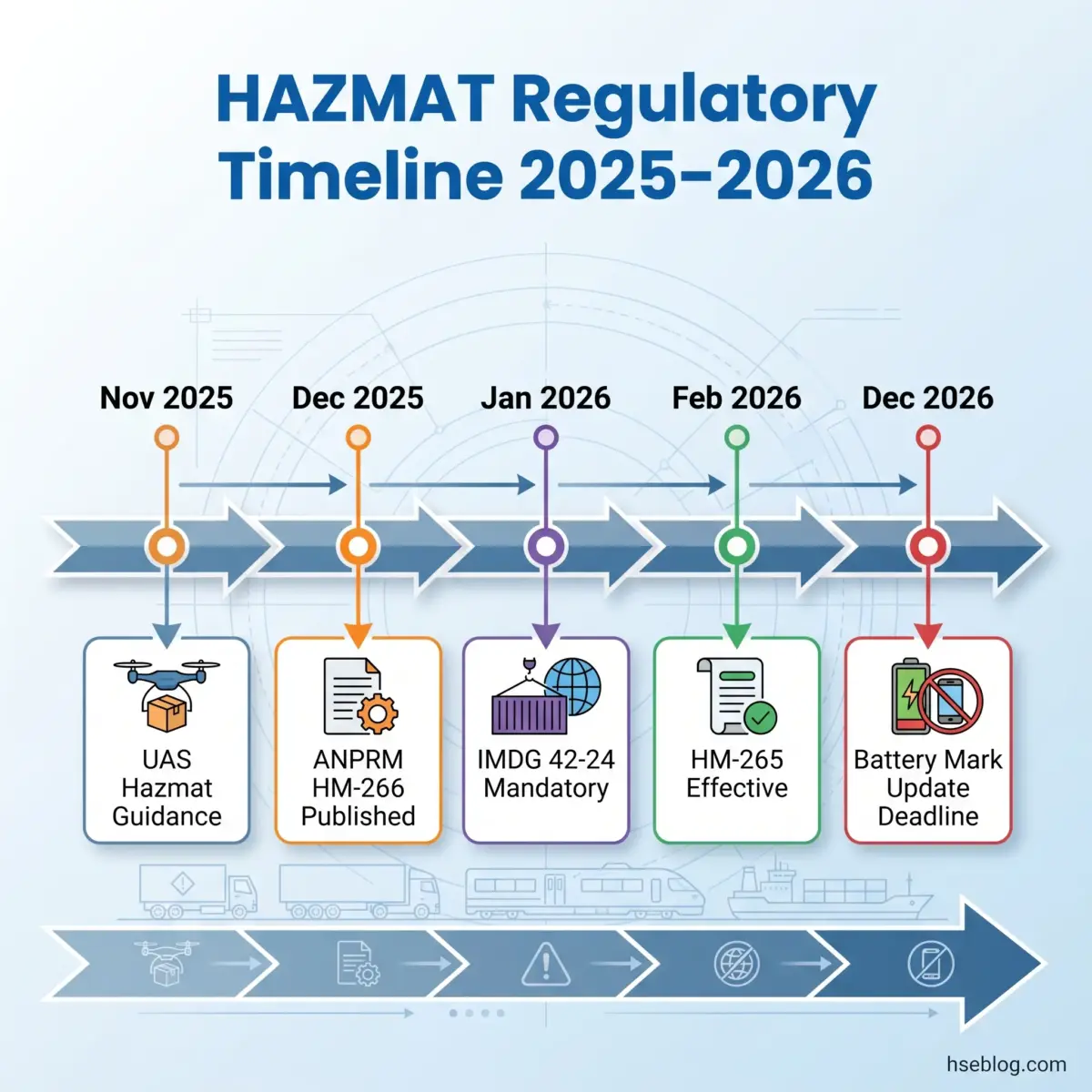
A recent regulatory change worth noting: the HM-265 final rule (PHMSA, effective February 13, 2026) exempts employees whose sole hazmat function is packaging from the security awareness training component. This targeted exemption reduces the training burden on distribution and fulfillment operations without weakening security coverage for higher-risk functions.
Penalties for HAZMAT Transportation Violations
The penalty structure for HMR violations is calibrated to make non-compliance financially untenable. Civil penalty amounts are adjusted annually for inflation, and the 2025 figures (effective December 30, 2024) set the current ceiling.
Civil penalties reach up to $102,348 per violation (DOT/PHMSA, 2024). When a violation results in death, serious illness or injury, or substantial destruction of property, the maximum increases to $238,809 per violation. A minimum civil penalty of $617 applies to training-related violations.
The per-violation calculation is critical to understand. Each package constitutes a potential separate violation. A single mislabeled pallet containing 20 non-bulk packages could theoretically generate 20 independent penalty assessments — the arithmetic is not hypothetical. Each shipping day that a violation continues may also count separately.
Criminal penalties apply to knowing, willful, or reckless violations: fines up to $250,000 per incident for individuals and $500,000 for corporations, with imprisonment of up to five years. If a hazmat release causes death or bodily injury, imprisonment extends to ten years.
Over the 2011–2020 decade, 94 fatalities resulted from dangerous goods transportation incidents in the United States, with nearly all occurring on highways (PHMSA, 2021). Behind each fatality are investigations, enforcement actions, and — increasingly — criminal referrals.
PHMSA's inspection priorities target known violators identified through carrier audits, incident reports filed under 49 CFR 171.15 and 171.16, complaints, and inter-agency referrals. The agency has expanded its enforcement capacity in recent years and coordinates with modal agencies for roadside, facility, and air cargo inspections.
Exceptions and Special Provisions in Hazmat Transportation
Not every hazmat shipment requires full HMR compliance. Several exception frameworks exist for lower-risk transport scenarios, but each carries conditions that must be precisely met — partial compliance with an exception's terms means the exception does not apply, and full HMR requirements govern.
Limited Quantity provisions (49 CFR 173.156) allow reduced marking and documentation requirements for hazardous materials shipped in small quantities below specified thresholds. The material must be in inner packaging within an outer packaging, with inner packaging quantities not exceeding the limits in Column 8a of the Hazardous Materials Table. Note that the ORM-D consumer commodity designation was phased out as of December 31, 2020, replaced by the Limited Quantity marking (a diamond with contrasting upper and lower halves).
Materials of Trade (49 CFR 173.6) provides a partial exemption for commercial businesses transporting hazardous materials incidental to their primary business — landscapers carrying herbicides, pool service companies transporting chlorine, HVAC technicians with refrigerant cylinders. The conditions are strict: materials must be in manufacturer's original packaging or DOT-authorized packaging, must not exceed specified quantity limits, and must be properly marked.
Field Test: The Materials of Trade exception is widely relied upon by service industries but frequently fails on closer inspection. The most common breakdown: materials transferred out of original manufacturer packaging into unlabeled containers, or aggregate quantities exceeding the per-vehicle limits. If the conditions aren't fully met, the exception evaporates and full HMR compliance is required retroactively.
De minimis quantities and the personal-use exemption round out the most common exceptions. Special permits issued by PHMSA may authorize operations not otherwise allowed under the HMR, but these require individual application, approval, and compliance with permit conditions.
DOT's guide to getting started with hazmat shipping provides a practical starting point for shippers determining which requirements apply to their operations.
Emerging Issues: Lithium Batteries, Automated Vehicles, and Regulatory Modernization
The hazmat regulatory landscape is actively evolving in several areas that will reshape compliance obligations over the next two to five years.
Lithium batteries represent the most acute intersection of consumer product ubiquity and genuine transport hazard. Classified as Class 9 (with a 9A sub-designation gaining traction), lithium-ion and lithium-metal batteries present thermal runaway risks that escalate with increasing energy density. PHMSA has documented a significant increase in lithium battery fires during transport and storage. For shippers, key developments include revised marking requirements — the phone number will be removed from the lithium battery handling mark by December 31, 2026 — watt-hour rating marking requirements for batteries exceeding 100 Wh, and revised quantity limits for batteries packed with equipment. The PHMSA Lithium Battery Guide for Shippers is the authoritative starting reference.
Automated and unmanned transport is the next regulatory frontier. PHMSA published an Advance Notice of Proposed Rulemaking (ANPRM HM-266) in December 2025, seeking stakeholder input on modernizing the HMR for hazardous materials transport using highly automated transportation systems — essentially, how should the regulations adapt when there is no driver to perform placarding checks, carry shipping papers, or respond to an en-route incident? Separately, FAA and PHMSA issued joint guidance in November 2025 on hazmat transport by unmanned aircraft systems (UAS), addressing a capability that is approaching commercial viability.
The HM-265 final rule (PHMSA, effective February 13, 2026) focuses on reducing unnecessary regulatory burden. Key provisions include restoring petroleum distillate fuel marking flexibility (allowing cargo tanks carrying qualifying fuels to display the UN identification number of the lowest-flash-point product carried during the current or previous business day), permitting video cameras for cargo tank external visual inspections, enabling electronic cargo tank facility registration, and the training exemption noted earlier. PHMSA projects $145.3 million in annualized cost savings from these changes (PHMSA/Federal Register, 2026).
Frequently Asked Questions
Is hazmat training required for employees who only ship limited quantities?
Yes. Employees handling limited-quantity or excepted-quantity shipments are still performing functions subject to the HMR and must receive training under 49 CFR 172, Subpart H. The limited quantity exception reduces packaging and marking requirements — it does not eliminate training obligations. The scope of function-specific training may be narrower, reflecting the reduced regulatory requirements, but general awareness and safety training still apply in full.
What is the difference between a hazmat label and a hazmat placard?
Labels are diamond-shaped hazard identifiers measuring 100mm × 100mm, affixed directly to non-bulk packages by the shipper. Placards are larger versions — 273mm × 273mm minimum — displayed on the exterior of transport vehicles and bulk containers, typically the carrier's responsibility. Different regulatory thresholds trigger each: labels apply per-package based on hazard class, while placards are triggered by aggregate quantity thresholds (any quantity for Table 1 materials; 454 kg aggregate for Table 2).
How do you determine the packing group for a hazardous material?
Packing groups indicate severity: I (great danger), II (medium), III (minor). Assignment is based on the material's physical and chemical properties using criteria in 49 CFR Part 173 — flash point and boiling point for flammable liquids, oral/dermal/inhalation toxicity for Division 6.1 materials, corrosion rate for Class 8. The assigned packing group is listed in the Hazardous Materials Table for each proper shipping name and determines minimum packaging performance standards.
What is the difference between DOT hazmat regulations and IATA dangerous goods regulations?
The DOT's HMR (49 CFR) governs all US domestic transport across every mode. IATA DGR governs international air transport, incorporating ICAO Technical Instructions with additional airline-industry restrictions. IATA is generally more restrictive — particularly on quantity limits per package, packaging specifications, and documentation detail. A shipment that complies with 49 CFR for the ground leg may exceed IATA limits for the air leg. Multimodal shipments must satisfy the applicable regulation for each transport segment independently.
Do hazmat regulations apply to e-commerce sellers shipping consumer products?
Absolutely. Many consumer products — aerosols, perfumes, nail polish, lithium batteries, cleaning solvents — meet the DOT definition of hazardous materials. The shipper, including an individual e-commerce seller, bears full legal responsibility for correct classification, packaging, marking, labeling, and documentation regardless of business size. PHMSA enforcement actions against small shippers who declared regulated products as general merchandise have increased as e-commerce shipping volumes have grown.
What should you do if there is a hazmat spill or incident during transportation?
Federal law requires an immediate phone report to the National Response Center (1-800-424-8802) within 12 hours for qualifying incidents — those involving fatalities, hospitalizations requiring inpatient care, property damage exceeding $50,000 in value, evacuation of the general public, or closure of a major transportation artery — as specified in 49 CFR 171.15. A written follow-up report on DOT Form 5800.1 must be submitted within 30 days per 49 CFR 171.16.
Conclusion
The regulatory framework for hazardous materials transportation is undergoing more active revision now than at any point in the past decade. The HM-265 rulemaking addresses long-standing industry burdens around fuel transport marking and inspection methods. ANPRM HM-266 signals that PHMSA is preparing the HMR for a transport environment that may not always have a human operator behind the wheel. Lithium battery regulation continues to tighten as energy densities climb and incident data accumulates. Internationally, IMDG Amendment 42-24 entering mandatory force in January 2026 and ADR 2025 taking effect mid-year mean that cross-border and multimodal shippers face a compressed window of compliance adaptation.
For HSE professionals and compliance officers, the strategic imperative is treating classification as the load-bearing decision it is — the single determination from which packaging, marking, labeling, placarding, documentation, training, and penalty exposure all cascade. Getting classification right is not the beginning of compliance paperwork; it is the beginning of hazard control in transit.
The materials moving through transport networks — more than 1.2 million shipments crossing the US every day — do not become less dangerous because the regulations are complex. They become more dangerous when the complexity is used as an excuse to guess rather than verify.