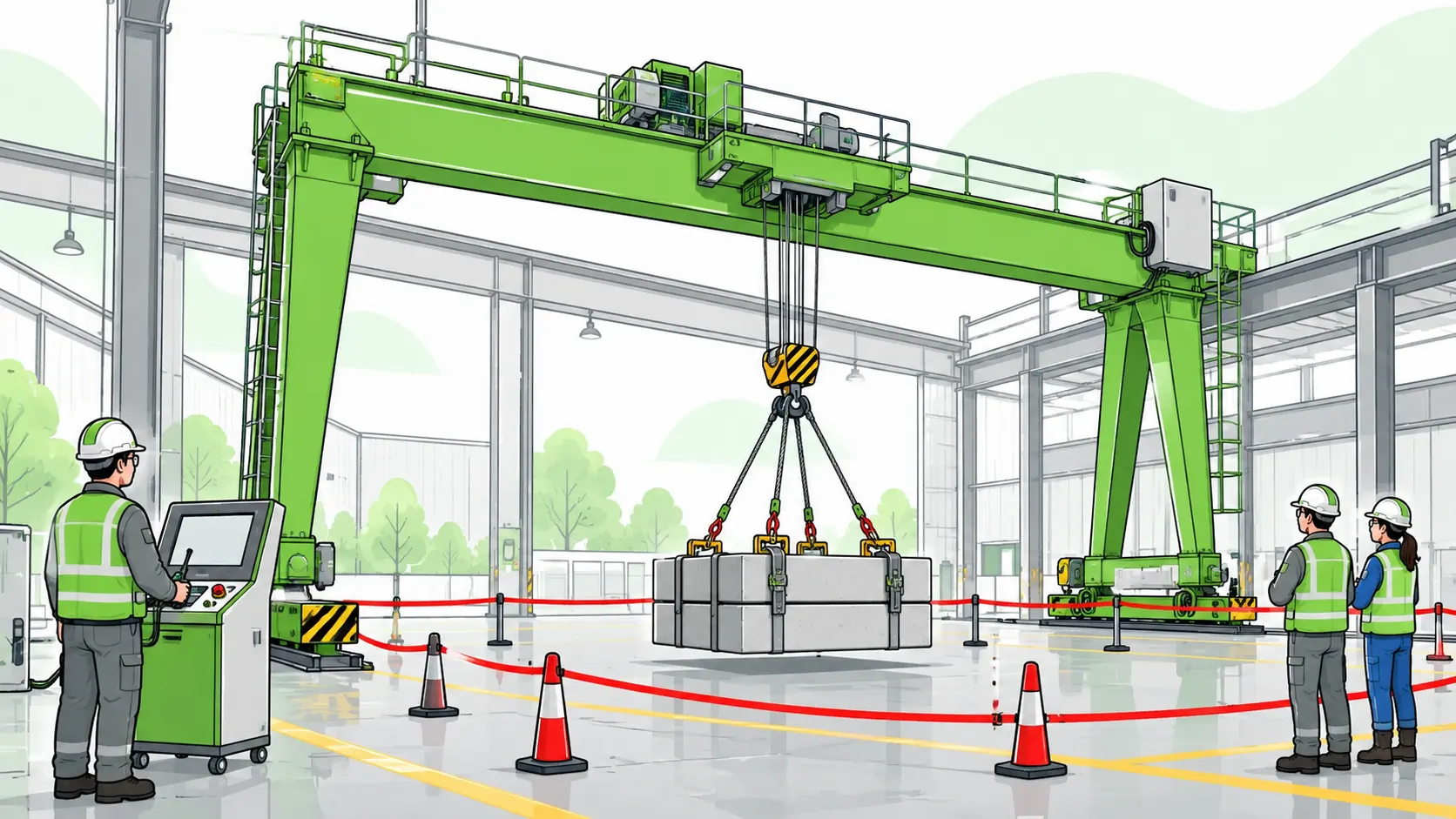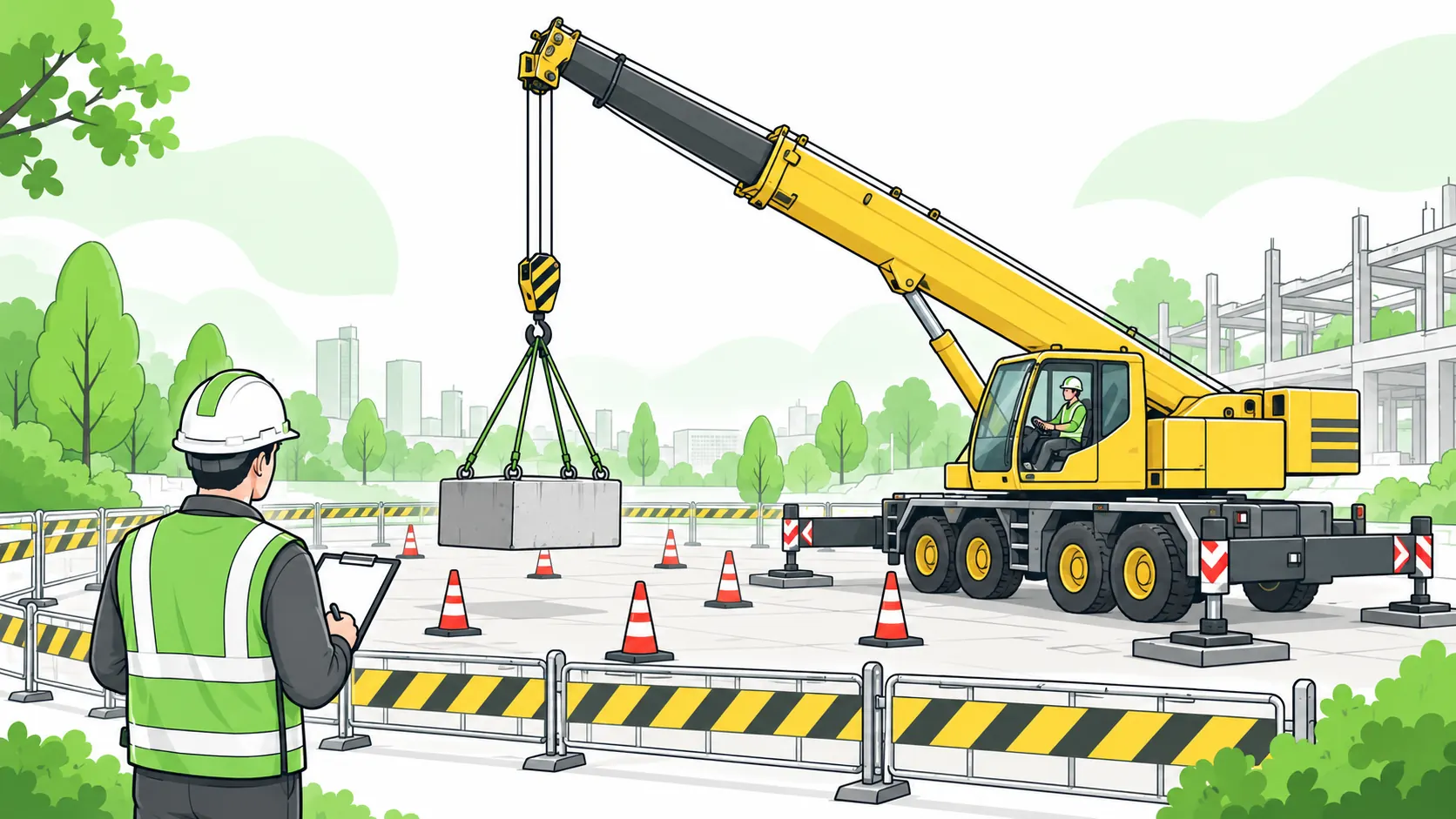

A crane daily inspection checklist is a structured visual and functional check performed by a competent person before each shift, covering control mechanisms, safety devices, wire rope, hooks, hydraulic systems, electrical apparatus, and ground conditions. Under OSHA 29 CFR 1926.1412(d), any deficiency that constitutes a safety hazard requires the crane to be immediately removed from service until a qualified person completes the repair and a re-inspection confirms the crane is safe to operate.
This article provides general HSE knowledge on crane pre-use inspection procedures. Life-critical lifting operations must be planned and supervised by a competent person with crane-type-specific training, jurisdiction-specific authorization, and site-specific risk assessment. The information here does not replace that competent-person requirement.
What Is a Pre-Use Crane Inspection and Why Does It Matter?
Between 2011 and 2017, 297 workers died in crane-related incidents across the United States — an average of 42 fatalities per year (US Bureau of Labor Statistics, 2023). Over half of those deaths involved the worker being struck by an object or equipment, with falling loads accounting for a significant proportion (US Bureau of Labor Statistics, 2023). A pre-use crane inspection exists to catch the defects that cause these failures before anyone is standing under a suspended load.
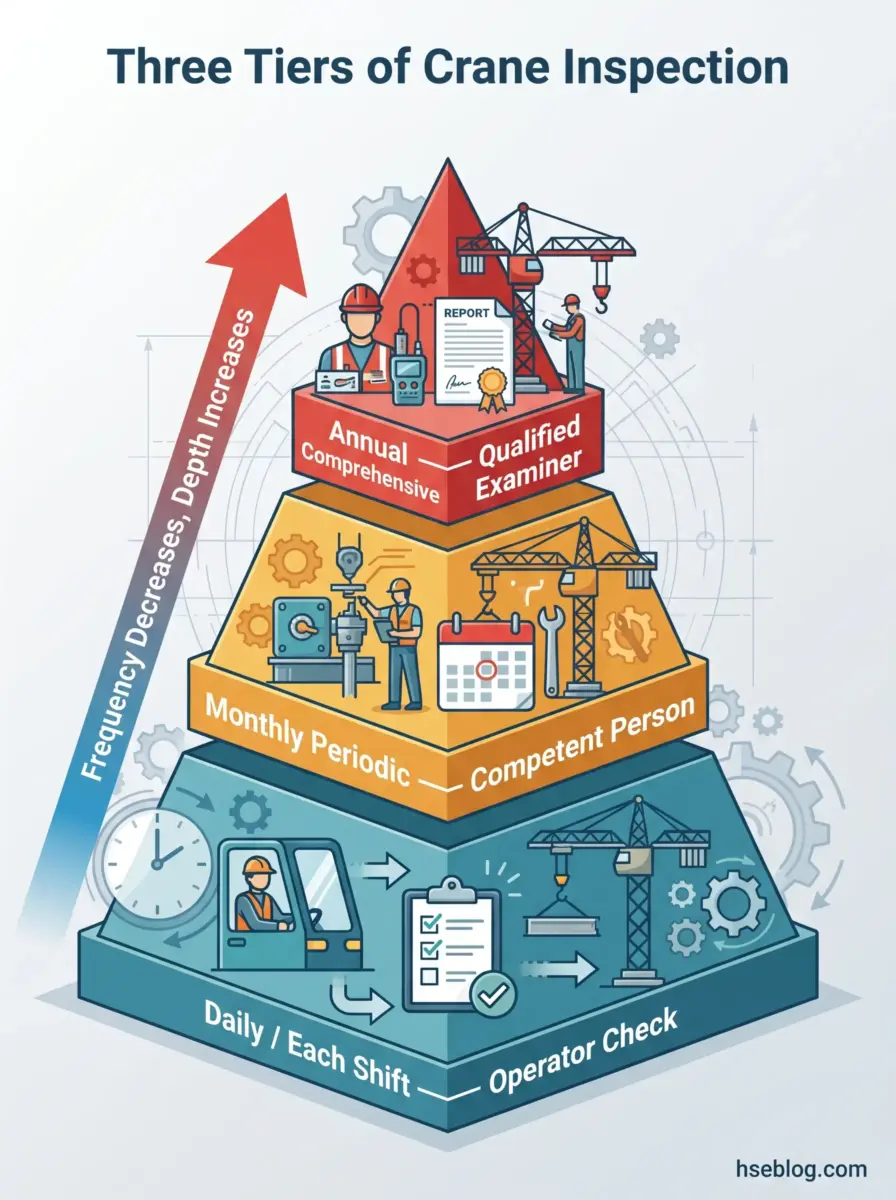
A pre-use inspection — also called a daily or each-shift inspection — is the operator-level visual and functional check completed before the crane handles its first load of the shift. It sits at the front line of a three-tier inspection system that every crane program must maintain.
The three tiers serve different purposes and involve different personnel. Understanding where the daily check fits prevents the common error of treating it as a scaled-down version of a comprehensive inspection — or, worse, treating the annual inspection as the only one that matters.
| Inspection Tier | Frequency | Who Performs It | Scope | Documentation Required |
|---|---|---|---|---|
| Pre-use / Shift | Before each shift | Competent person (typically the operator) | Visual walk-around + functional test of safety devices, controls, wire rope, hooks, ground conditions | Not required by OSHA for construction (strongly recommended); required under PUWER (UK) |
| Monthly / Periodic | Monthly (or as specified by manufacturer) | Competent person with documented crane-specific training | More detailed inspection of items from pre-use list, plus items not practical to check daily | OSHA requires records retained 3 months |
| Annual / Comprehensive | Every 12 months (6 months for personnel-lifting under LOLER) | Qualified person (US) / Competent examiner (UK) | Complete structural, mechanical, electrical examination; may require disassembly | OSHA requires records retained 12 months; LOLER requires Schedule 1 reports within 28 days |
Conditions change between shifts. Temperature shifts affect hydraulic response. Wind changes alter ground stability under outriggers. A different operator may have encountered an issue and failed to report it. The pre-use check is the only systematic opportunity to catch these changes before the crane goes to work.
A pattern I consistently observe across multi-shift operations: operators assume the previous shift's crew already checked the crane. On a three-shift site, this creates windows where no one inspects at all between handovers. The pre-use inspection belongs to the operator starting the shift — every time, regardless of what happened before.
Who Is Responsible for Performing Daily Crane Inspections?
The answer depends on jurisdiction, and the terminology differences between the US and UK systems trip up more people than the inspection itself.
Under OSHA's crane standards, a competent person is someone capable of identifying existing and predictable hazards in the surroundings or working conditions, and who has authorization to take prompt corrective measures to eliminate them. For daily inspections, this is typically the crane operator — but only if the employer has verified that the operator has the training and knowledge specific to that crane type. A qualified person — someone with a recognized degree, certificate, or professional standing, plus extensive knowledge and experience — is reserved for annual comprehensive inspections and engineering evaluations, not for the daily walk-around.
This distinction matters operationally. A failure mode I see flagged repeatedly in OSHA citation narratives: competent-person status assumed rather than verified. An operator competent for a 50-ton hydraulic truck crane is not automatically competent for a tower crane. On multi-crane sites, this distinction gets buried under schedule pressure, and the result is an operator signing off on a crane type they are not trained to inspect.
In the UK, the structure is analogous but uses different language. The trained operator performs daily pre-use checks under PUWER 1998. The LOLER "competent person" performs the formal thorough examination — a role closer to OSHA's qualified person than to OSHA's competent person.
| Role | US (OSHA) | UK (LOLER/PUWER) |
|---|---|---|
| Daily pre-use inspection | Competent person (typically operator) | Trained operator (PUWER Regulation 6) |
| Monthly periodic inspection | Competent person | Trained operator / competent examiner depending on scope |
| Annual comprehensive / thorough examination | Qualified person | LOLER competent person (independent examiner) |
| Employer obligation | Ensure competent-person designation is crane-type-specific | Ensure operator training and LOLER examination schedule maintained |
The employer's duty does not end at naming someone competent. Under both jurisdictions, the employer must ensure the designated person has crane-type-specific training, understands the manufacturer's inspection requirements, and knows the rejection criteria for critical components.
What Are the Regulatory Requirements for Crane Pre-Use Inspections?
Inspection-related violations under 29 CFR 1926.1412 are the most frequently cited crane-related OSHA standard — outpacing the next two most-cited crane violations combined (Corfix, 2025). The reason is straightforward: inspection failures are the easiest for a compliance officer to verify. Either the inspection happened, or it didn't. Either the records exist, or they don't.
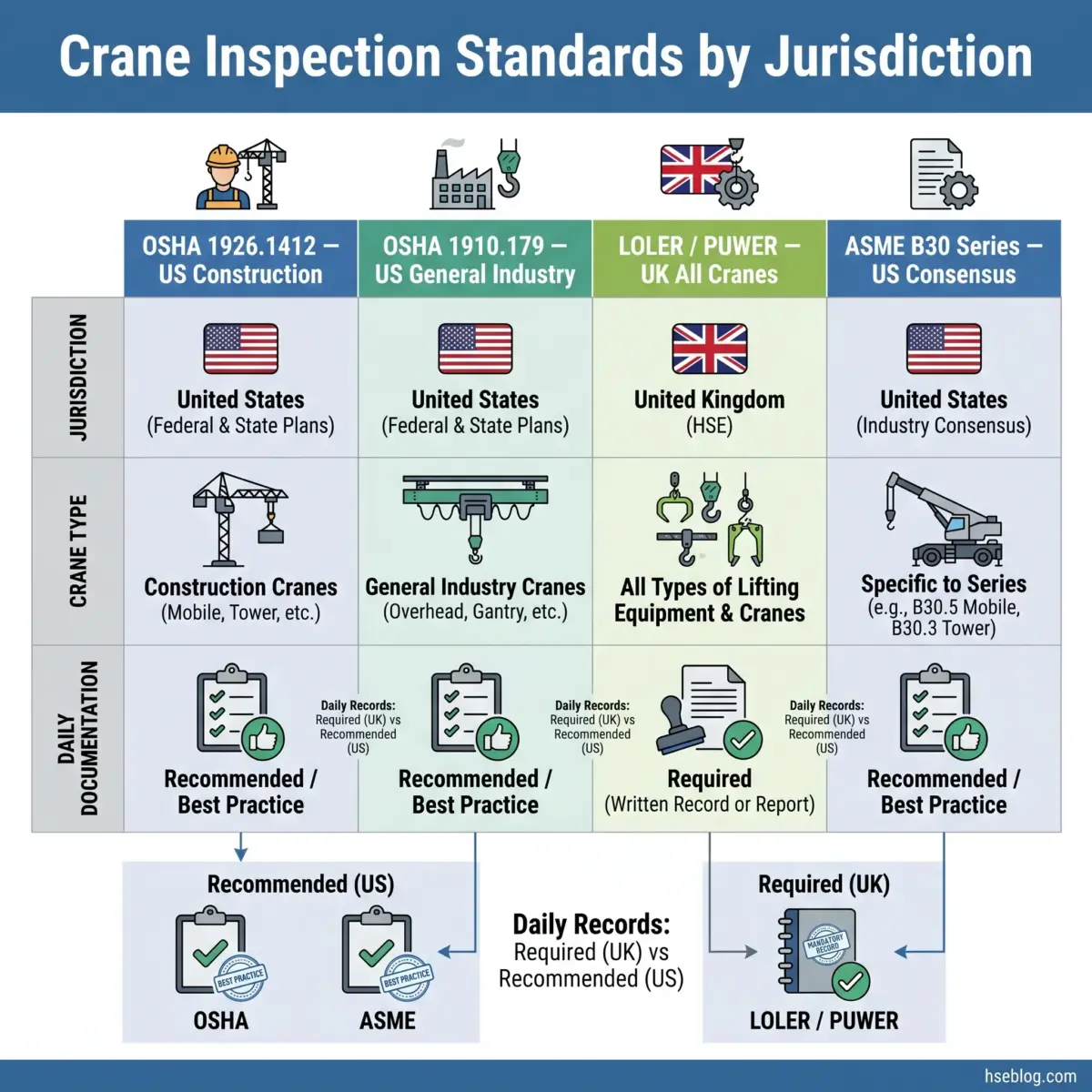
The regulatory landscape for crane pre-use inspections spans multiple standards depending on the crane type, the industry, and the jurisdiction. The following table maps the core requirements.
| Standard | Jurisdiction | Crane Type | Inspection Frequency | Documentation Required |
|---|---|---|---|---|
| OSHA 29 CFR 1926.1412(d) | US — Construction | All construction cranes | Each shift, before or during | Not required for each-shift; monthly records retained 3 months; annual records retained 12 months |
| OSHA 29 CFR 1926.753(c)(1) | US — Steel Erection | Cranes used in steel erection | Pre-shift visual | Per Subpart R requirements |
| OSHA 29 CFR 1910.179(j) | US — General Industry | Overhead and gantry cranes | Frequent (daily to monthly) and periodic (1–12 months) | Monthly hook inspections require certification records |
| ASME B30.5 (2021) | US (internationally referenced) | Mobile and locomotive cranes | Pre-use, periodic, annual | Recommended per ASME appendix guidance |
| ASME B30.2 | US (internationally referenced) | Overhead and gantry cranes | Frequent and periodic | Recommended per ASME appendix guidance |
| ASME B30.3 | US (internationally referenced) | Tower cranes | Pre-use, periodic, annual | Recommended per ASME appendix guidance |
| PUWER 1998 (Regulation 6) | UK | All work equipment including cranes | Routine inspection between LOLER examinations; frequency by risk assessment | Records required as part of maintenance obligation |
| LOLER 1998 | UK | All lifting equipment | Thorough examination: 12 months (6 months for personnel-lifting and lifting accessories) | Schedule 1 written reports within 28 days |
| BS 7121-2-1:2012 | UK | All crane types | Pre-use checks, in-service inspection, thorough examination | Per BS 7121 recommendations |
One of the most misunderstood positions in crane compliance: OSHA 29 CFR 1926.1412(d) does not require written documentation of each-shift inspections for construction cranes. Many employers interpret this as permission to skip record-keeping entirely.
The practical reading of this clause on most sites should be different. In an investigation following an incident, the absence of any daily record means the employer cannot demonstrate the inspection occurred. "No documentation required" is a minimum compliance threshold, not a risk-management strategy. The defensible standard — regardless of jurisdiction — is to document every shift inspection.
Jurisdiction Note: UK employers have less ambiguity here. PUWER 1998 requires routine inspection records as part of the maintenance obligation. The documentation question is primarily a US compliance gap that best practice fills.
Pre-Use Inspection Checklist for Mobile Cranes
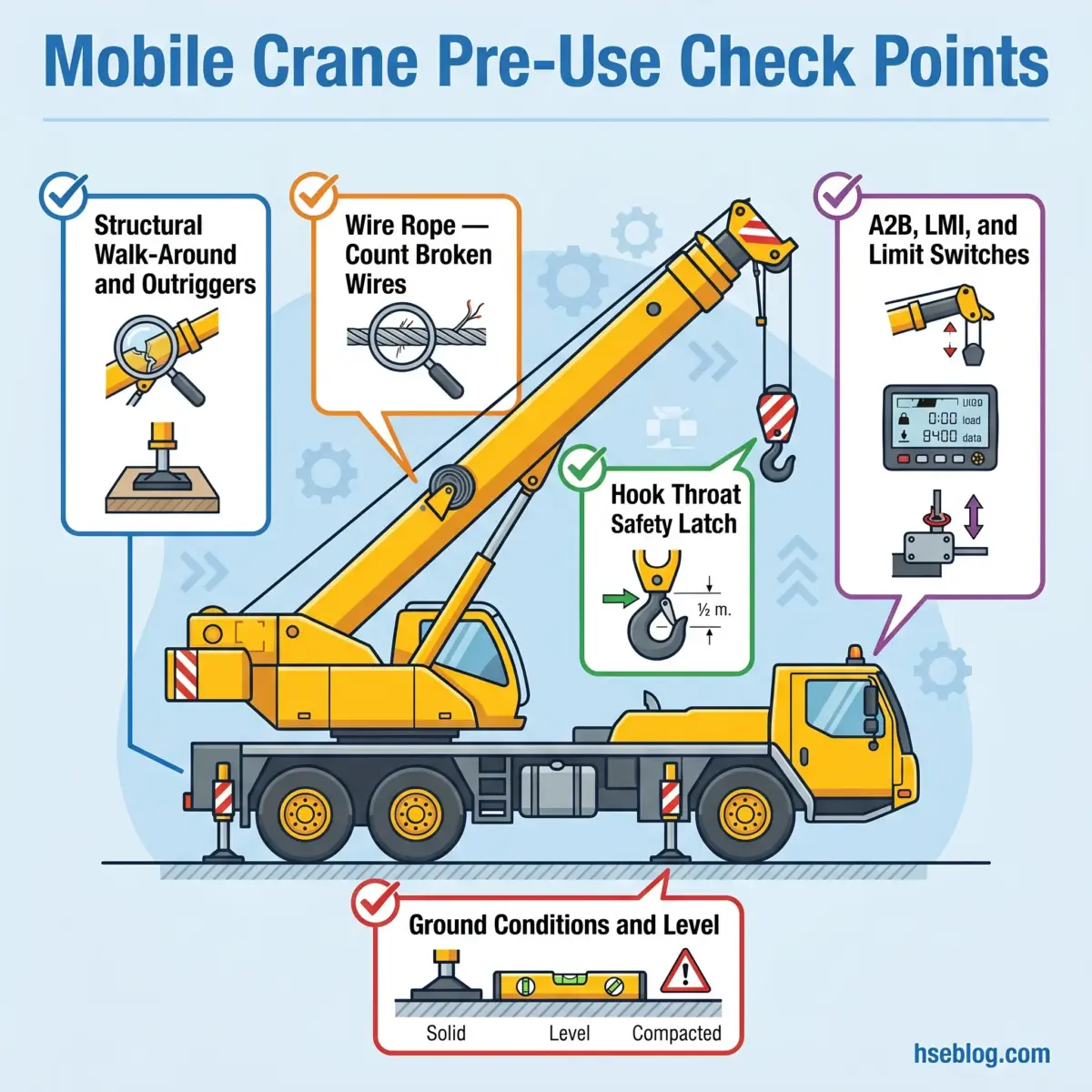
Mobile cranes — truck-mounted, all-terrain, rough-terrain, and crawler configurations — carry the highest daily inspection burden because they move between sites, set up on varying ground, and expose more systems to environmental wear. The following checklist follows the logical sequence an operator would use walking around and then operating the crane, with each item mapped to ASME B30.5-2.1.2 and OSHA 1926.1412(d).
Walk-Around and Structural Check
- Boom sections and pin connections — visually inspect for cracks, deformation, missing pins, and loose fasteners. Check that boom sections are properly seated and locked.
- Counterweight configuration — verify counterweight is installed per the load chart configuration for planned lifts. Confirm attachment bolts are secure.
- Outrigger pads and beams — extend outriggers fully, confirm pads are seated on solid ground with adequate bearing area. Check for ground softening, voids, or water undermining pad support.
- Tire condition and inflation (wheeled cranes) — check for cuts, bulges, and adequate inflation per manufacturer specifications. Under-inflated tires affect crane level and stability.
- Crawler tracks and sprockets (crawler cranes) — inspect track tension, shoe condition, and sprocket wear.
- Hydraulic system — check fluid levels, inspect hoses and fittings for leaks, examine cylinder rods for scoring, pitting, or seal weepage.
- Engine compartment — fluid levels (engine oil, coolant, hydraulic reservoir), belt condition, visible leaks, battery connections.
Wire Rope and Rigging
- Wire rope condition — inspect the full visible length for broken wires, kinking, crushing, birdcaging, core protrusion, and corrosion. Under ASME B30.5-2.4.2, six broken wires in one rope lay or three broken wires in one strand triggers immediate removal from service. Run the rope through its full travel range to inspect sections normally hidden on the drum.
- Drum spooling — confirm rope is properly seated in drum grooves with no crossover or loose wraps.
- Sheaves — check for groove wear, rope tracking, and free rotation.
Watch For: Wire rope defects past ASME replacement criteria are one of the two most commonly missed items during daily inspections. Operators tend to undercount broken wires, particularly on multi-layer spooled drums where inner wraps are difficult to examine. If the full rope travel cannot be inspected visually, run the rope through its range under no load and observe each section as it passes over a sheave.
Hooks
- Throat opening — measure or visually compare against the manufacturer's baseline. A deformation exceeding 15% of the original throat opening requires the hook to be removed from service.
- Safety latch — must close fully and spring back. A latch that "mostly" closes is not functional.
- Free rotation — the hook block must swivel freely without binding.
- Crack inspection — look for cracks at the shank, saddle, and throat. Any visible crack is a removal-from-service condition.
Safety Devices and Controls
- Anti-two-block (A2B) device — functionally test by slowly raising the hook block toward the boom tip. The system must arrest movement before two-blocking occurs.
- Load moment indicator (LMI) — power on and verify it reads accurately for the current boom length and configuration. Confirm alarm and cutoff functions.
- Boom angle indicator — verify it reads within manufacturer tolerance.
- Upper limit switch — test by slowly inching the hoist up with no load.
- Emergency stop — test all e-stop locations (cab, remote, pendant if equipped).
- Control mechanisms — all levers and pedals must return to neutral when released. Operation should be smooth, responsive, and without delay or drift.
Ground Conditions and Setup
- Crane level — verify the crane is level within the manufacturer's specified tolerance using the built-in level indicators.
- Overhead power line clearance — confirm minimum clearance distances per OSHA 1926.1408 (20 feet for lines up to 350 kV, increased for higher voltages).
Pre-Use Inspection Checklist for Overhead and Gantry Cranes
Overhead cranes in manufacturing, warehousing, and distribution environments operate under OSHA 29 CFR 1910.179(j) and ASME B30.2. The inspection sequence moves from power-off visual checks through power-on functional testing — a sequence that matters because energizing a crane with an undetected electrical fault or failed brake creates an immediate hazard.
Power-Off Visual Inspection
- Runway and bay clearance — confirm the travel path is clear of obstructions, stored materials, and personnel working at height.
- Pendant or radio controller — inspect the controller casing for damage, verify button labels are legible, and confirm the deadman switch (if equipped) functions.
- Warning labels — all capacity, hazard, and operational labels must be legible.
- Lockout/tagout verification — confirm no LOTO tags or locks are present that would indicate the crane is under active maintenance.
Bridge, Trolley, and Hoist
- Bridge and trolley wheels — inspect for flat spots, flange wear, and rail alignment.
- End-stop bumpers — verify bumpers are present and intact on bridge and trolley rails.
- Hoist and wire rope — same broken-wire and deformation criteria as mobile cranes apply. For chain hoists, inspect chain links for stretching, wear, twisting, and nicking.
- Hooks — throat opening, safety latch, free rotation, and crack inspection — identical criteria to mobile crane hooks.
Functional Testing (Power On)
- Upper hoist limit switch — test by slowly inching the unloaded hook block upward. The limit switch must arrest hoist travel before the block contacts the drum or sheave assembly.
- Lower limit switch (if equipped) — test similarly by lowering.
- Trolley and bridge travel limits — verify travel stops at each end of the runway and trolley rail.
- Emergency stop — test the pendant e-stop and cab e-stop (if equipped). The crane must de-energize completely.
- Hoist brake test — this is the single most important functional check on an overhead crane. Lift a known load slightly off the ground, release all controls, and observe the hook for drift. A brake that holds initially but creeps under sustained load is a developing failure that visual inspection alone cannot detect.
Field Test: The brake-drift test separates a genuine inspection from a paper exercise. With a known light load suspended 150–300 mm off the ground, release the hoist control and watch for any downward drift over 30–60 seconds. Any perceptible drift means the brake requires immediate attention from qualified maintenance — do not continue operating.
Electrical
- No exposed wiring — inspect for damaged insulation, loose connections, or hanging conductors.
- Conductor bars — confirm bars are clear of obstructions and collector shoes are tracking properly.
- Cab environment (if cab-operated) — windows clean and uncracked, cab lighting functional, operator visibility unobstructed.
Pre-Use Inspection Checklist for Tower Cranes
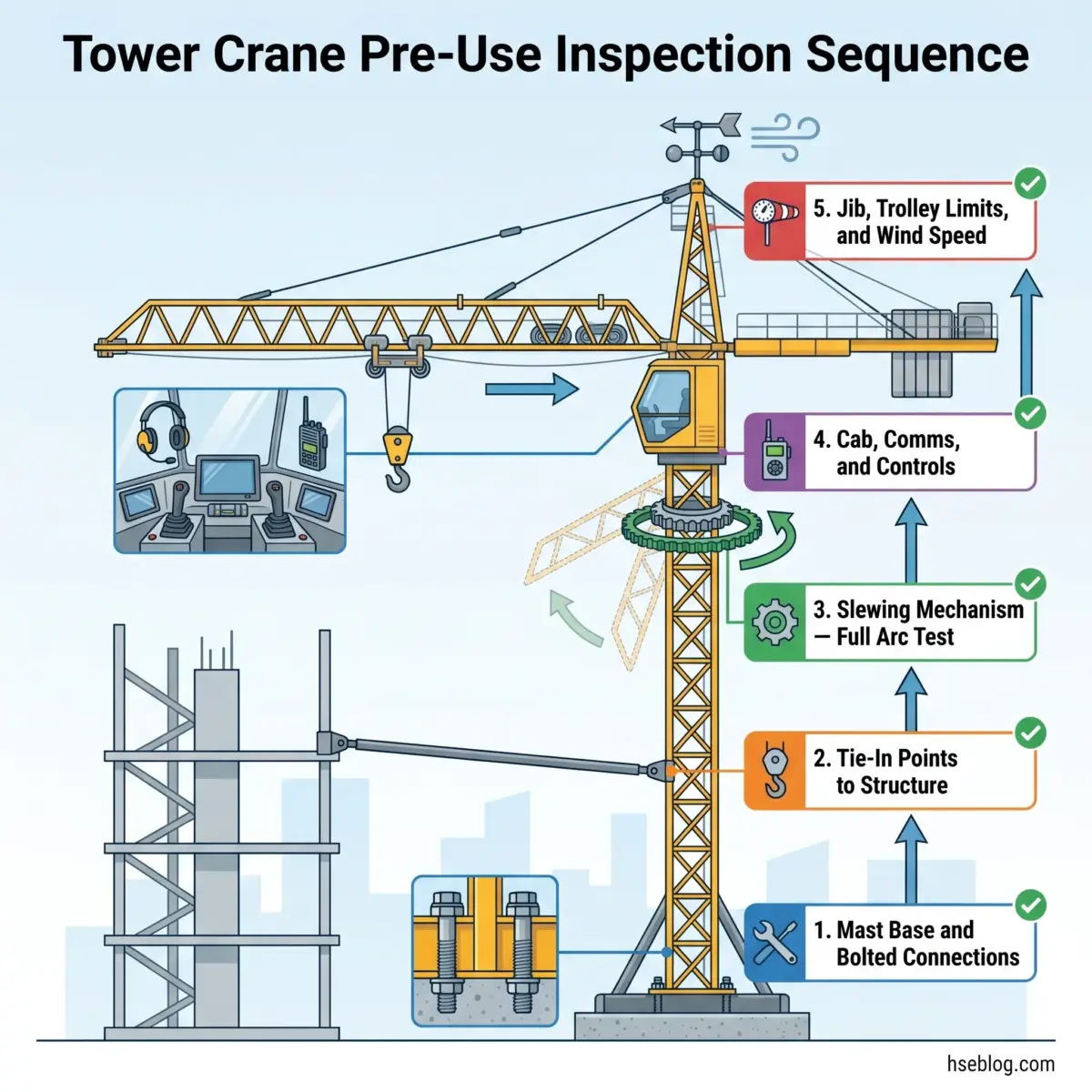
Tower cranes introduce inspection items that mobile and overhead cranes do not share — items related to the mast structure, slewing mechanism, climbing system, and weather exposure. ASME B30.3 and OSHA 1926.1412(d) govern, with additional tower-specific provisions under 1926.1435.
- Mast and tower sections — inspect bolted connections for tightness, verify plumb using reference indicators, and check tie-in points to the building structure for any signs of movement or loose fasteners.
- Slewing mechanism — the crane must rotate smoothly through its full arc. Abnormal noise, vibration, or hesitation during slewing indicates bearing or gear wear requiring investigation.
- Trolley travel and jib — test trolley travel across the full jib length. Verify trolley limit switches arrest travel before the trolley reaches the jib tip. Confirm rope alignment on sheaves.
- Anemometer and wind speed — check the wind speed indicator before each shift and confirm the manufacturer's maximum wind-speed limits for the crane's current configuration. The judgment call here is between the manufacturer's rated limit and site-specific wind behavior — localized gusting around tall structures can exceed ambient readings.
- Cab systems — cab lighting, visibility from the operator's position, and communication systems (radio to signal person / banksman) must all be functional.
- Climbing frame (if recently climbed) — verify climbing pins are fully seated, base bolts are torqued to specification, and the mast sections added during the climb are properly connected.
Tower crane operators who work the same crane daily develop a familiarity that can suppress attention to slow-developing changes. Mast bolt loosening over weeks, gradual rope wear at sheave entry points, progressive corrosion at tie-in brackets — these are changes that accumulate below the threshold of casual observation. A disciplined, fixed-sequence checklist is more important on tower cranes than on any other type precisely because the operator's daily proximity to the equipment creates a false confidence that they would "just notice" a problem.
Audit Point: When reviewing a tower crane operator's inspection records, look for identical entries across weeks. If every daily form reads "OK / OK / OK" with no variation, the checklist is being completed from memory at the desk, not from observation at the crane.
What to Do When You Find a Defect During a Pre-Use Inspection
Finding a defect is not the end of the inspection — it is the beginning of an escalation protocol. The operator's role is to identify, classify, and report. Never repair.
Defects fall into three severity categories, and the response differs for each:
| Severity | Examples | Required Action |
|---|---|---|
| Critical — Immediate Shutdown | Non-functioning A2B or LMI; wire rope meeting ASME rejection criteria; hook deformation exceeding 15%; brake failure; hydraulic leak at a safety-critical valve; structural crack | Stop all operations. Apply lockout/tagout. Notify supervisor and qualified maintenance immediately. Crane does not return to service until repair is complete and a qualified person re-inspects. |
| Moderate — Report and Monitor | Fluid weepage at a non-critical fitting; minor cosmetic damage to non-structural components; warning light malfunction for non-safety systems | Document the finding. Report to supervisor. Continue operating only if the deficiency does not constitute a safety hazard. Schedule repair for the next maintenance window. |
| Minor — Log for Maintenance | Paint damage, cab comfort items, non-critical label wear | Record in the inspection log. Address during scheduled maintenance. |
The most important phrase in crane defect management is "report, don't repair." Operators identify and document. Only qualified maintenance personnel — with the correct parts, tools, and manufacturer documentation — make corrections. An operator who attempts a field repair on a hydraulic fitting or wire rope termination introduces a new hazard.
Documenting defects is always required — even though OSHA does not mandate daily inspection records for construction cranes, deficiency records are a separate obligation. When a safety hazard is identified, the record of that finding, the corrective action taken, and the re-inspection clearance form a defensible chain. Without it, the employer's position in any subsequent investigation collapses.
The real-world pressure operators face when reporting a defect is schedule disruption. Flagging a critical deficiency at 0600 delays the shift start, potentially affecting the day's lift plan, concrete pour schedule, or erection sequence. The inspection protocol must give the operator explicit, unambiguous authority to stop — and the organization must back that authority without formal or informal penalties. If operators learn through experience that reporting defects earns them problems, defects stop getting reported.
Common Mistakes in Daily Crane Inspections
Published OSHA citation data and crane incident investigations reveal recurring patterns in how daily inspections fail. Knowing these patterns turns a checklist from a compliance exercise into a genuine hazard-detection tool.
Skipping the wire rope full-travel inspection. The most common wire rope inspection failure is checking only the visible section between the boom tip and the hook. Broken wires, crushing, and birdcaging frequently occur at sections that sit on the drum or pass through sheaves — areas only visible when the rope is run through its full range. An inspection that examines 30% of the rope and marks "pass" is worse than no inspection, because it creates a false record.
Not functionally testing the hoist brake under load. Visual inspection cannot detect a brake that is beginning to fail. The only way to verify brake function is to lift a known load off the ground, release the control, and watch for drift. This takes 60 seconds. Skipping it can cost a life.
Failing to test limit switches. Upper hoist limits, trolley limits, and bridge travel limits are safety-critical devices that must be functionally activated during the pre-use check. Looking at a limit switch and seeing it is "still there" is not a test. It must be tripped — slowly, with no load — to confirm it arrests motion.
Vague documentation. Records that read "looks OK" or "no issues" provide zero value. Under ASME B30 appendix guidance, documentation should identify each inspection item, its condition, and any corrective action taken. A record that cannot be used to reconstruct what the inspector actually examined and observed is a record that fails its purpose.
Treating the inspection as a desk exercise. The checklist is meant to guide a physical walk-around and a functional test sequence. Completing the form from the cab — or worse, from the site office — and then walking out to operate the crane defeats the entire purpose. An inspection that isn't performed at the crane, on the crane, and with the crane's systems activated is not an inspection.
Familiarity replacing inspection. Operators who use the same crane daily are statistically more likely to skip items. The assumption that "I was on this crane yesterday and it was fine" is the most dangerous sentence in crane inspection. It presumes nothing changed — but conditions always change.
The Fix That Works: Rotate the starting point of the checklist weekly. Start at the boom tip one week, the cab the next, the outriggers the following week. Breaking the routine breaks the autopilot that lets operators walk past developing defects.
Paper vs Digital Crane Inspection Records
The choice between paper and digital inspection records is a practical decision with compliance implications that have shifted significantly through 2025–2026.
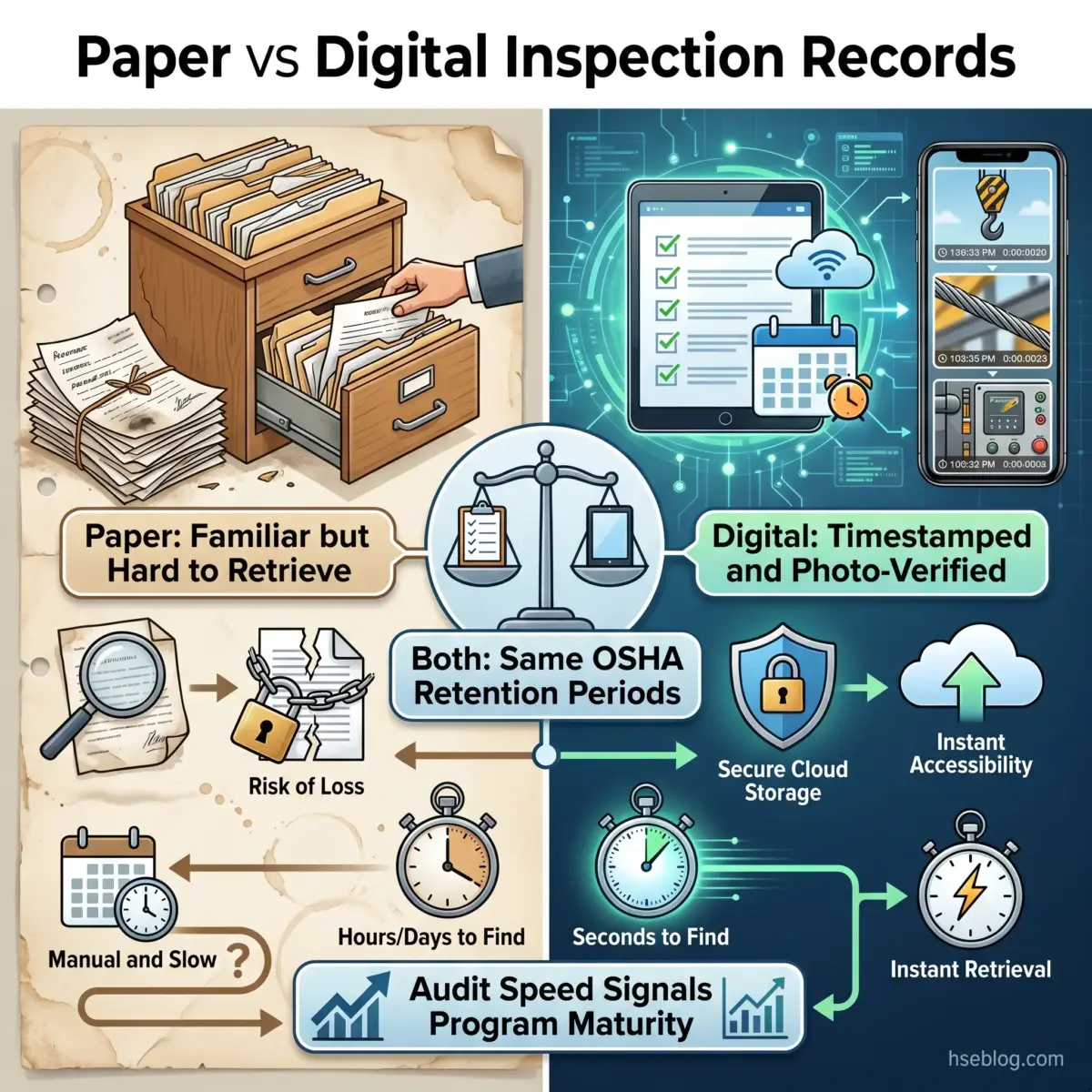
Paper records are familiar and require no technology infrastructure. They are also prone to illegibility, physical loss, and slow retrieval. When an OSHA compliance officer asks to see three months of monthly inspection records, the time it takes to locate and produce those records is itself an indicator of program maturity. Organized, immediately retrievable documentation is the single strongest signal of a functioning inspection program during an enforcement visit.
Digital inspection platforms — now industry-standard across most crane operations — offer timestamped, geotagged records with photo-capture capability. Automatic scheduling ensures no inspection is missed. Audit trails are instant. Several platforms (CraneCheck, HVI, SafetyCulture) now offer ASME B30 and OSHA-mapped digital checklists that mirror the regulatory item lists, with built-in prompts for rejection-criteria thresholds.
OSHA enforcement priorities have increasingly favored digital documentation. While neither format is required over the other, timestamped and photo-verified records are harder to fabricate, easier to audit, and more defensible in litigation. The retention periods remain the same — 3 months for monthly records, 12 months for annual records — but digital systems eliminate the risk of paper loss.
The penalty context reinforces why records matter. As of 2026, OSHA serious violations carry penalties up to $16,550 per instance, and willful violations can reach $165,514 (OSHA, 2026). In December 2025, Virginia Transformer Corp. was cited $986,888 for violations that included unsafe crane operations with faulty brakes and switches (National Association of Safety Professionals, 2025). Inspection records — or their absence — are central to how these citations are built.
Frequently Asked Questions
How long should a daily crane inspection take?
A thorough pre-use inspection takes 15–30 minutes for an overhead crane and 30–60 minutes for a mobile crane, depending on the crane's size and configuration. The time varies because mobile cranes require ground condition assessment, outrigger checks, and full wire rope travel inspection that overhead cranes do not. Rushing the inspection below these minimums is the primary reason defects go undetected — particularly wire rope broken-wire counts and brake-drift testing, which require deliberate, slow observation.
Does OSHA require daily crane inspection documentation?
Under 29 CFR 1926.1412(d), OSHA requires the each-shift inspection to be performed by a competent person but does not require written documentation of the daily check for construction cranes. Monthly inspections must be documented and records retained for three months. However, best practice — and legal defensibility — strongly favor keeping records of every shift inspection. Without a record, the employer cannot demonstrate the inspection occurred during an investigation.
What is the difference between a frequent inspection and a periodic inspection?
OSHA 1910.179 uses this terminology for overhead and gantry cranes. A frequent inspection is the daily or shift-level operator check — a visual and functional review of operating mechanisms, hooks, hoist chains, and wire rope. A periodic inspection occurs at intervals of one to twelve months, performed by a qualified person, and covers a deeper examination of structural members, bearings, brake systems, and components requiring disassembly. The construction crane standard (1926.1412) uses the terms shift, monthly, and annual, which correspond roughly to the same tiers.
Can a crane operator refuse to operate a crane that fails inspection?
Yes. Both OSHA and ASME B30 series standards give the operator authority to stop operations and refuse to handle loads until safety is assured. Under OSHA's crane standards, a deficiency constituting a safety hazard requires the crane to be removed from service until corrected by qualified personnel. The employer may not discipline or penalize an operator for exercising this authority — doing so creates a retaliatory environment that suppresses defect reporting.
What are the wire rope rejection criteria for crane daily inspection?
ASME B30.5-2.4.2 specifies immediate removal-from-service criteria: six broken wires in one rope lay, or three broken wires in one strand in one rope lay. Additional rejection triggers include kinking, crushing, birdcaging, core protrusion, heat damage, and diameter reduction exceeding the manufacturer's limits. The full wire rope — not just the visible section between boom tip and hook — must be inspected by running the rope through its full travel range. OSHA 29 CFR 1926.1413 provides the construction-specific wire rope inspection criteria.
What happens if a crane is idle for several months — do you still need to inspect it?
Yes, with additional requirements. Under OSHA 29 CFR 1926.1412, a construction crane idle for three months or more requires a monthly-equivalent inspection before returning to service. Under 1910.179 for general industry, cranes idle for six months or more require a complete inspection equivalent to the periodic standard. These reinspection requirements exist because idle cranes accumulate corrosion, hydraulic seal degradation, brake condition changes, and environmental damage that operating cranes reveal through daily use.
Conclusion
The crane daily inspection checklist is not a form to complete — it is 15 to 60 minutes of structured observation and functional testing that stands between a functioning crane and a catastrophic failure. Every item on the checklist exists because a crane without that check has killed someone.
The practical challenge is not knowing what to inspect. The checklists in this article, mapped to OSHA 29 CFR 1926.1412(d), 1910.179(j), ASME B30.2, B30.3, B30.5, and UK LOLER/PUWER requirements, cover the regulatory minimum and the commonly missed items that turn inspections from paper exercises into genuine safety controls. The harder challenge is building the organizational discipline to perform the check properly every shift — resisting the schedule pressure to rush, resisting the familiarity that lets developing defects slide past, and backing the operator who reports a defect that delays the day's work.
Ask yourself one question before your next shift: if the crane you are about to operate dropped its load this morning, could you show an investigator exactly what you checked, when you checked it, and what you found? If the answer is no, your inspection program has a gap that no checklist template can fill. The checklist is the tool. The discipline is yours.