Crane operations during piling work require specialist safety controls beyond standard lifting procedures. The primary hazards include ground bearing failure causing crane or rig overturning, dynamic impact loads from pile driving, suspended load swing during pile handling, and proximity to underground services. Regulatory frameworks governing these operations include OSHA 29 CFR 1926 Subpart CC and §1926.603 in the US, LOLER 1998 and BRE 470 in the UK, and the EFFC/DFI Guide to Working Platforms internationally.
This article provides general HSE knowledge. Life-critical work such as crane lifting operations during piling, working platform design, and pile driving procedures must be planned and supervised by a competent person with relevant training, jurisdiction-specific authorization, and site-specific risk assessment. The information here does not replace that.
In 2021, a drill rig operator in Philadelphia attempted a service lift using the rig's auxiliary winch — equipment the manufacturer explicitly warns is not designed for suspended load handling. The rig overturned, killing a worker. The NIOSH investigation that followed identified this as part of a recurring pattern: operators treating auxiliary winches as general-purpose hoisting devices because the equipment physically has a winch, without understanding that the mast geometry, pick zones, and load ratings make the operation fundamentally unsafe.
That incident sits at the intersection of two high-risk activities — crane operations and piling work — where the hazards of each compound in ways that generic safety guidance for either discipline fails to address. Piling rigs weighing up to 200 tonnes operate on temporary platforms over subgrade conditions that deteriorate throughout the project. The crane serving that operation handles suspended piles with irregular centres of gravity, duty-cycle shock loads that standard load charts ignore, and service lifts that rarely receive formal planning. This article bridges that gap: a single, practitioner-grade reference integrating crane safety planning with piling operations, anchored in specific regulatory frameworks across jurisdictions and sourced from the published incident record.
Why Crane Safety in Piling Operations Demands Specialist Attention
Standard crane safety procedures assume stable, prepared hard standing beneath the equipment. Piling operations violate that assumption from the first borehole.
The risk profile is distinct because the work itself progressively degrades the ground the crane depends on. Bore spoil accumulates, drainage channels block, water migrates through granular fill, and vibration from driving operations loosens compacted material. A working platform that met design specifications on mobilization day may contain hidden weak zones two weeks later — zones that were not present during the initial inspection.
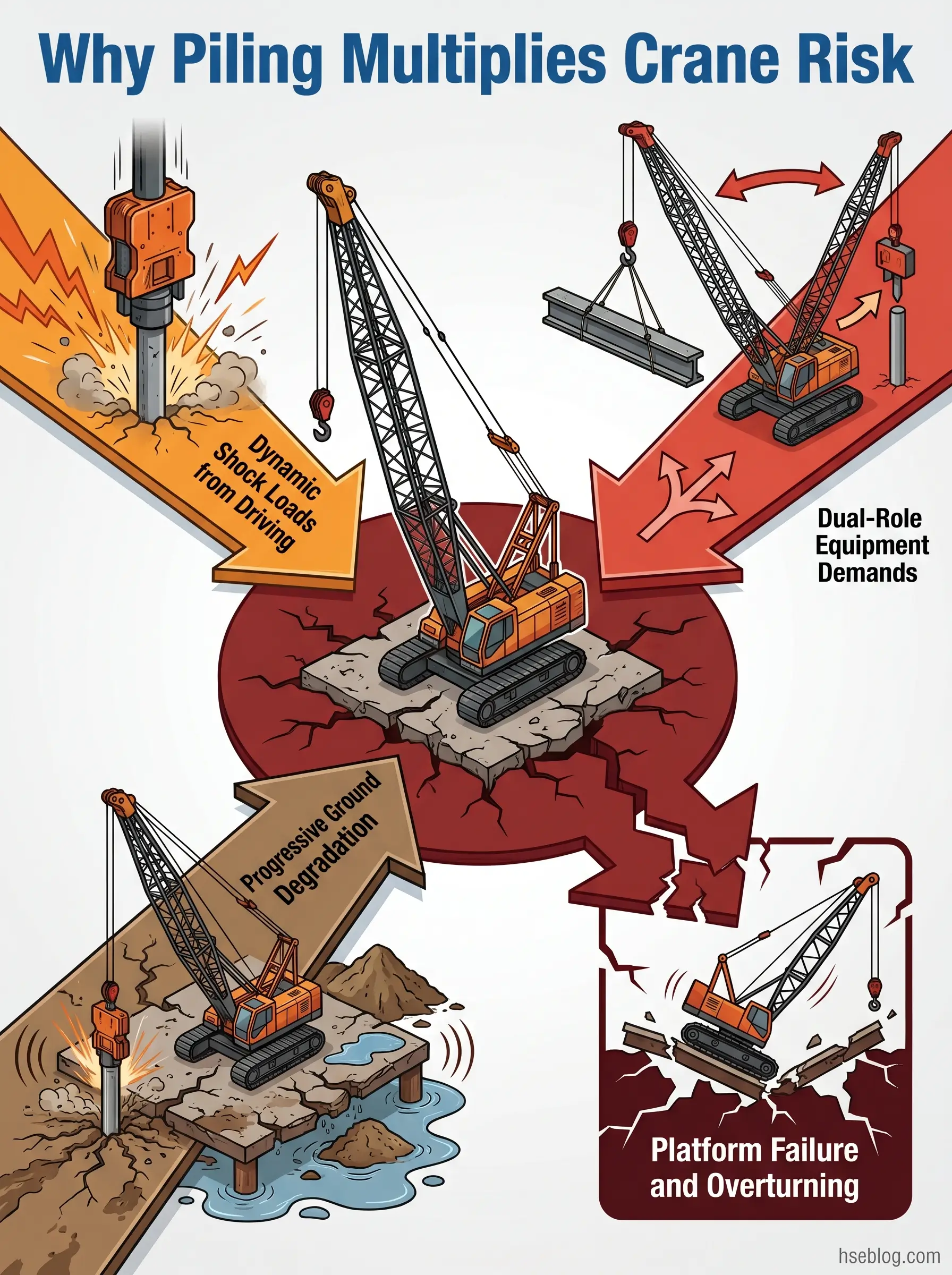
Three compounding factors separate crane-piling interfaces from standard construction lifting:
- Dynamic loading beyond load chart parameters — pile driving transmits repeated shock loads through the crane structure that static-capacity load charts do not represent. Each hammer blow creates an impulse force that standard rigging calculations treat as nonexistent.
- Dual-role equipment — the same crane suspends piles, handles hammers, and performs service lifts. Each function imposes different loading characteristics and capacity requirements, but site teams often apply a single lift plan to all three.
- Continuously changing ground conditions — unlike a concrete pad or compacted laydown area, a piling working platform is a temporary structure sitting over subgrade that the piling operation itself is actively disturbing.
Approximately one-third of all accidents in the piling industry result from defects in working platforms (Federation of Piling Specialists, 2019). That figure alone makes working platform integrity the dominant safety variable in any piling operation involving cranes or tracked plant.
Hazard Profile: What Makes Crane-Piling Interfaces High Risk
The hazards at crane-piling interfaces are not simply crane hazards plus piling hazards — they interact, and in several failure modes, one amplifies the other. A structured hazard map helps practitioners build a complete picture rather than addressing risks in isolation.
Crane Overturning and Ground Bearing Failure
Ground bearing failure is the single most catastrophic hazard in crane-piling operations, and the failure mechanism is more localized than most site teams expect.
The typical failure is not general bearing capacity collapse across the entire platform. It is punching shear — a localized failure under a single track or outrigger pad where the applied pressure exceeds the bearing capacity of a zone as small as 1 m². This can happen even when the overall platform passes a general assessment.
Localized failures develop from several sources:
- Undiscovered buried obstructions — old foundations, backfilled cellars, or abandoned utilities create voids or differential stiffness beneath the platform surface.
- Progressive degradation — bore arisings left on the platform, blocked drainage, or rainfall saturation reduce the effective bearing capacity of the granular fill in specific zones.
- Edge proximity — when platforms are narrower than designed (a persistent problem flagged by the Federation of Piling Specialists), cranes tracking near edges operate over reduced platform depth.
The 2003 Channel Tunnel Rail Link piling rig overturn is a documented case where ground conditions beneath the working platform contributed directly to equipment instability during piling operations. Published incident data from NIOSH documents multiple drill rig overturns in the US — including the 2021 Chicago and 2021 Philadelphia incidents — reinforcing that this hazard is not theoretical.
Suspended Load and Rigging Hazards During Pile Handling
Piles are not standard construction loads. Steel H-piles, sheet piles, and precast concrete piles share characteristics that make slinging and handling distinctly hazardous:
- Length-to-weight ratio — piles are long and heavy, creating significant swing and spin potential once lifted.
- Non-uniform weight distribution — especially precast concrete piles with reinforcement concentrated at one end, or sheet piles with interlocking profiles that shift the centre of gravity.
- Transition risk — the moment between initial lift-off and vertical positioning is when uncontrolled swing is most likely.
Tag lines are essential during pile handling to control rotation and swing. Exclusion zones must be enforced beneath and around the load path — a requirement that sounds straightforward but becomes operationally complex when the pile must be positioned into a guide frame or leader system with workers nearby.
Dynamic and Impact Loading
Pile driving generates repeated shock loads that pass through the crane's structural members with every hammer blow. Standard load charts assume static or quasi-static loading. They do not account for the cumulative fatigue effect of thousands of impact cycles during a driving shift.
This gap between what the load chart represents and what the equipment actually experiences is a fundamental reason why duty-cycle operations require reduced capacity utilization.
Proximity Hazards Specific to Piling Sites
Piling operations create proximity risks that do not exist in standard crane work:
- Underground services — electrical cables and gas mains may lie in the path of driven or bored piles. Pre-construction utility surveys are essential, but records are frequently incomplete.
- Overhead power lines — tall piling masts and crane booms operating near overhead lines require approach-distance controls. The mast height on many piling rigs exceeds standard crane boom heights for equivalent-capacity equipment.
- Adjacent structures — vibration from impact piling can damage nearby buildings, utilities, and retaining structures, creating secondary hazards.
Noise and Vibration Exposure
Impact pile driving produces impulse noise levels that significantly exceed standard crane operation profiles. Under OSHA (US), the permissible exposure limit is 90 dBA TWA. Under UK regulations, the lower exposure action value is 80 dB(A) and the upper value is 85 dB(A).
Hearing protection zones around piling rigs typically need to extend further than zones around standard crane operations. The impulse character of pile driving noise — sharp peaks rather than steady-state — makes it particularly damaging and harder to attenuate with standard hearing protection.
Working Platform Design and Integrity: The Foundation of Crane Safety in Piling
No single control measure does more to prevent crane and rig overturning during piling than a properly designed, constructed, and maintained working platform. Every other safety measure — lift planning, operator competence, equipment selection — depends on the assumption that the ground beneath the equipment can support the applied loads.
The EFFC/DFI released the 2nd Edition of the Guide to Working Platforms in May 2025, providing updated guidance on track loading calculations, design methodology, and platform testing for piling rigs and cranes (Deep Foundations Institute, 2025). This edition extends the principles originally established in BRE Report 470 (UK, 2004) to an international audience with revised loading data reflecting modern equipment weights.
Platform Lifecycle: Design Through Decommissioning
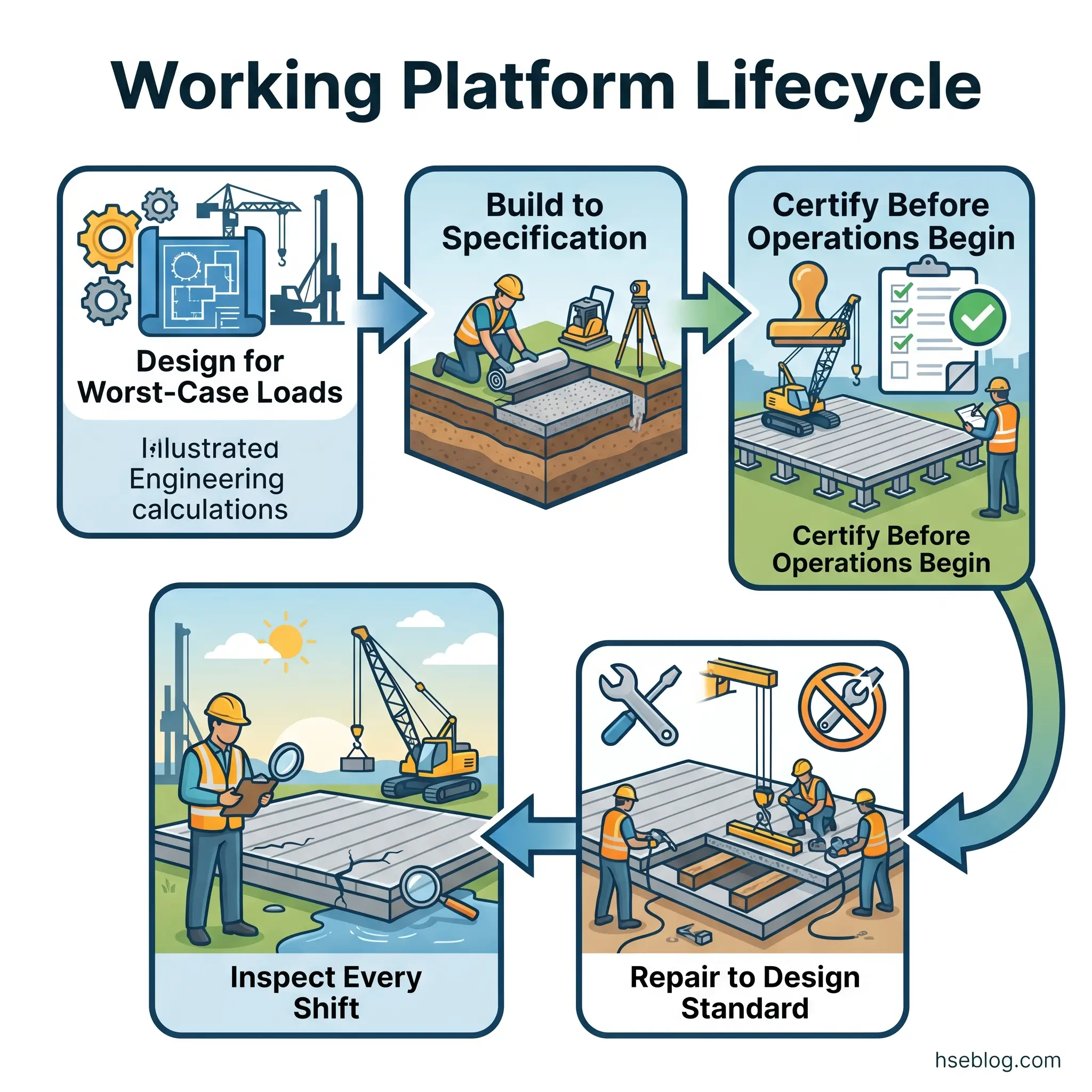
A working platform is not a one-time deliverable. It follows a lifecycle that requires active management at every stage:
- Design — platform depth, material specification, and extent must be calculated for the specific rig and crane track pressures under worst-case loading conditions. Static weight alone is insufficient — the design must account for dynamic loads during driving, maximum boom-out radius, and the effect of rig repositioning.
- Construction — the platform must be built to the design specification, verified by the designer or a competent person. Common failures at this stage include reduced platform extent (narrower than designed) and substitution of fill material.
- Certification — a Working Platform Certificate should be issued before piling or crane operations commence. Under the FPS system, the main contractor signs this certificate, confirming the platform meets design requirements.
- Maintenance and inspection — ongoing inspection before each shift and whenever the rig is repositioned. Platforms degrade through trafficking, weather, spoil contamination, and excavation-related disturbance.
- Repair — when inspections identify deficiencies, repairs must restore the platform to design specification before operations resume.
Responsibility Sits with the Main Contractor
A critical point that generates confusion on many sites: the main contractor holds responsibility for platform design, installation, maintenance, and repair — not the piling subcontractor.
The piling subcontractor provides the equipment data (track pressures, rig weights, operational loads) needed for the design. The main contractor commissions and delivers the platform. When this responsibility boundary is unclear, platforms arrive underspec or late, and the commercial pressure to start piling pushes operations onto inadequate ground.
The Federation of Piling Specialists has repeatedly flagged the pattern where platforms are designed to correct specifications but are physically narrower than planned when the piling contractor mobilizes — reducing maneuvering space and increasing the risk of tracks approaching platform edges where bearing capacity diminishes.
Crane Selection and Configuration for Piling Work
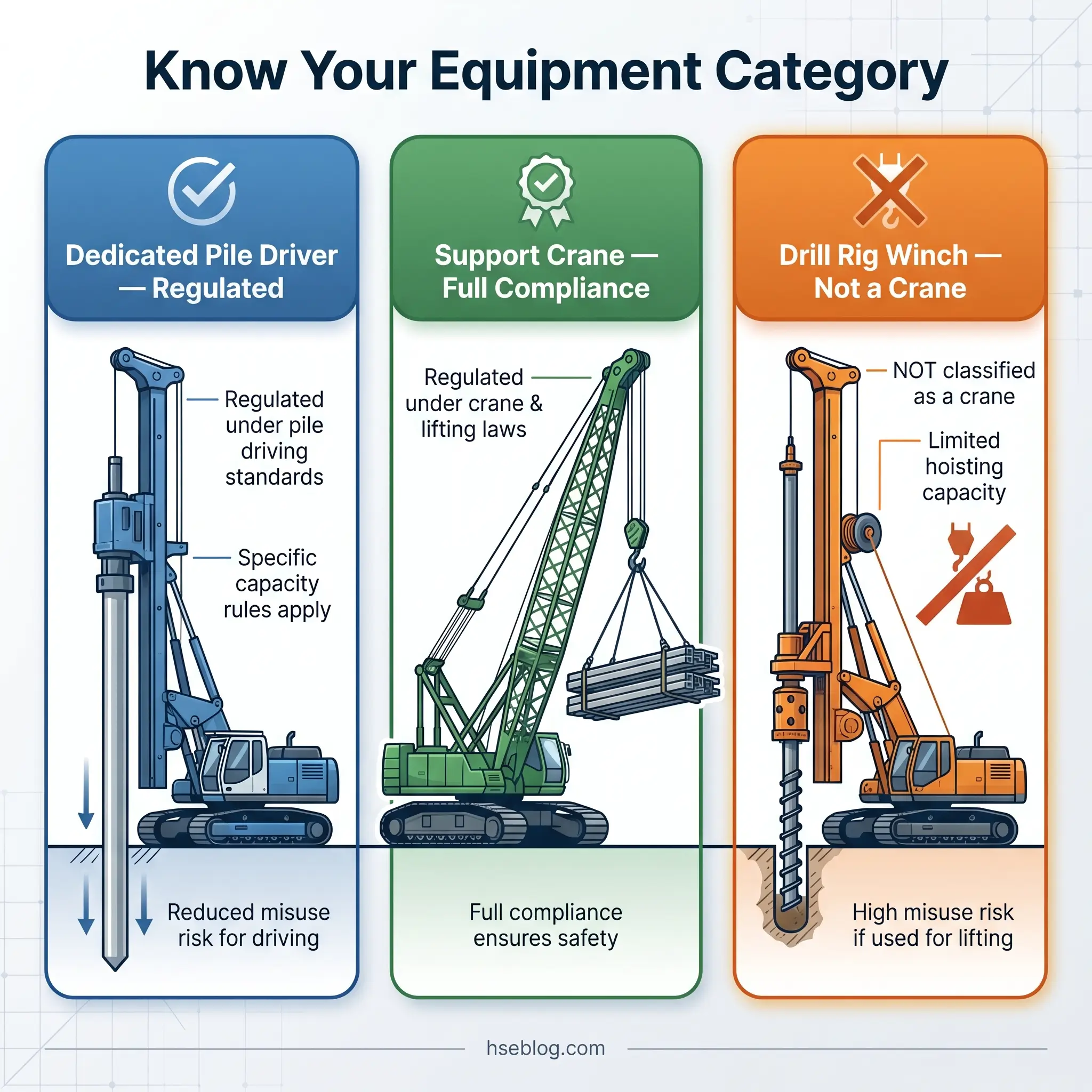
The equipment used for piling-related lifting falls into three categories, each governed by different regulatory provisions and capacity rules. Confusing them — particularly treating a drill rig as a crane — has caused fatalities.
Dedicated Pile Driver vs. Crane for Piling Support vs. Drill Rig Auxiliary Winch
| Criterion | Dedicated Pile Driver | Crane (Piling Support Lifts) | Drill Rig Auxiliary Winch |
|---|---|---|---|
| Regulatory scope (US) | OSHA Subpart CC includes explicitly | OSHA Subpart CC — full compliance | Not classified as a crane; §1926.603 may apply to pile driving equipment generally |
| Jib restrictions | No jib attached during driving operations (29 CFR 1926.1417, US) | Standard jib use per load chart | N/A — no jib configuration |
| Capacity rule | Duty-cycle: ≤75% of rated capacity (WorkSafeBC benchmark) | Standard load chart with site-specific deductions | Manufacturer-specified limited capacity; restricted pick zones |
| Common misuse pattern | Operating beyond duty-cycle capacity limits | Informal service lifts without lift plans | Used as a general-purpose crane — fatal misuse |
The distinction between a crane and a drill rig auxiliary winch deserves particular emphasis. Drill rig manufacturers explicitly warn that auxiliary winches are not designed for suspended load handling. The winch has limited hoisting capacity, the mast geometry restricts the pick zone, and the rig's stability calculations do not account for the load moments generated by lateral lifts.
The NIOSH guidance on preventing drill rig overturn injuries documents this misuse pattern across multiple incidents. The judgment call here is unambiguous — if the task requires suspending a load and moving it laterally, a crane must be used, not a drill rig.
Duty-Cycle Capacity: The 75% Benchmark
For pile driving duty-cycle operations, WorkSafeBC guidance establishes that total load should not exceed 75% of rated capacity. Neither OSHA Subpart CC (US) nor LOLER (UK) specifies a numeric threshold — the requirement is expressed as "safely below rated capacity" (US) or "adequate strength and stability" (UK).
In the absence of a jurisdiction-specific numeric limit, the 75% benchmark represents the stricter, more protective reference and should govern operational planning. The rationale is straightforward: duty-cycle operations impose repeated shock loads that degrade structural integrity over thousands of cycles. A crane operating at 85% of rated capacity under static conditions may be within safe limits for a single lift, but that margin evaporates under the cumulative stress of pile driving.
Lift Planning and Competent Persons in the Piling Context
Under both LOLER 1998 (UK) and OSHA Subpart CC (US), every lifting operation must satisfy a three-part competence requirement: planned by a competent person, supervised by a competent person, and carried out by competent persons. The terminology differs between jurisdictions, but the structural requirement is functionally identical.
Role Hierarchy in Piling Crane Operations
The UK system defines specific roles with clear responsibilities:
- Appointed Person — plans the lifting operation, selects equipment, and produces the lift plan. Must have sufficient knowledge and experience of the specific lifting operations being planned.
- Lifting Supervisor — on-site during the operation, ensures the lift plan is followed, has authority to stop operations.
- Slinger/Signaller — attaches and detaches loads, provides signals to the crane operator. For piling, this person must understand the slinging characteristics of piles specifically — not just general loads.
- Banksman — directs rig and crane movement, maintaining line of sight with both the operator and the ground conditions beneath the tracks.
Under OSHA Subpart CC, the equivalent functions exist but are described differently: a qualified person develops rigging procedures, a competent person conducts inspections, and a qualified signal person directs operations.
The Service Lift Gap
A consistent pattern across the published incident record: lift plans are prepared meticulously for the "main" piling lifts — positioning piles, handling hammers, placing casings — but service lifts receive no formal planning at all.
Service lifts include moving tools between pile positions, repositioning small casings, lifting ancillary equipment, and handling materials for the piling crew. These lifts are treated as informal because they involve lighter loads and shorter distances. The problem is that informal lifts bypass every control that the lift plan provides — no pre-lift ground condition check, no calculated radius and capacity verification, no designated exclusion zone.
These unplanned service lifts account for a disproportionate share of piling crane incidents. The fix is operationally simple: every lift, regardless of load weight, requires a documented plan proportionate to its risk. A service lift plan does not need to be as detailed as a heavy lift plan, but it must exist.
Ground Conditions in the Lift Plan
The lift plan must address ground conditions as verified by the Working Platform Certificate — not assumed from a desk-based assessment or a ground investigation report prepared months before mobilization.
Pre-planning should also account for maintenance and refuelling logistics. Mobile maintenance and refuelling stations brought to the rig minimize unnecessary tracking across the platform, reducing both trafficking damage and the risk of the crane traversing deteriorated zones.
Pre-Operation Inspection and Daily Checks for Crane-Piling Operations
Wire rope degradation rates in piling duty-cycle operations are significantly higher than in standard construction lifting. The combination of repeated shock loads, exposure to abrasive bore spoil, and wet conditions accelerates fatigue and surface wear beyond what general crane maintenance schedules anticipate.
Replacement intervals derived from standard lifting applications do not apply to cranes working in piling environments. Ropes must be inspected more frequently, and discard criteria must be applied against manufacturer duty-cycle specifications, not general-use tables.
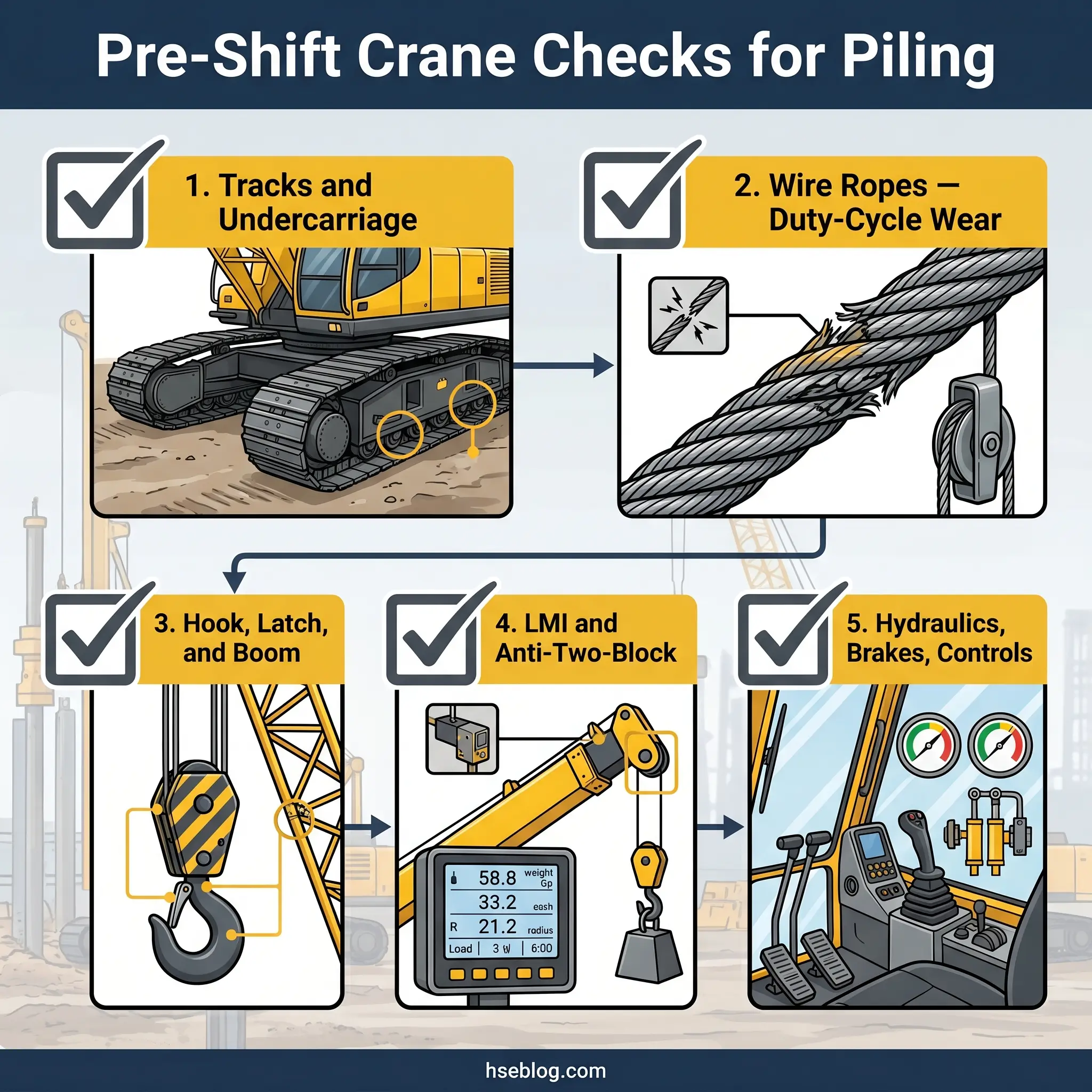
Operator Pre-Use Checks (Every Shift)
Before starting operations each shift, the operator must verify:
- Track and undercarriage condition — track tension, pad condition, and cleanliness (spoil accumulation restricts movement and alters ground pressure distribution).
- Wire rope integrity — check for broken wires, kinking, crushing, corrosion, and diameter reduction. In piling, pay particular attention to the section of rope that repeatedly passes over sheaves during duty-cycle operations.
- Hook and latch — hook latch functional and closing fully; hook body free of cracks or deformation.
- Boom and structural members — visual inspection for cracks, dents, or misalignment, especially at pin connections subject to vibration.
- Safety devices — load moment indicator (LMI) functional and calibrated, anti-two-block device operational.
- Controls — all operational controls responsive and functioning correctly.
Engine Start-Up and Functional Checks
After initial visual inspection:
- Hydraulic system — check for leaks, verify operating pressure, confirm all cylinders respond.
- Brakes and clutches — test holding capacity before any load is applied.
- Swing and travel locks — engage and disengage to confirm functionality.
- Drum ratchets and pawls — critical for holding loads during pile positioning.
Hose Security on Boom-Mounted Equipment
For piling configurations where steam, jet, or hydraulic hoses run along the boom to the tip, 29 CFR 1926.603 (US) requires that these hoses have safety chains secured to the boom. A hose failure at height can create a whipping hazard and loss of hydraulic function simultaneously — both consequences are amplified during pile driving when the system is under dynamic stress.
What Are the Regulatory Requirements for Cranes Used in Piling?
The regulatory landscape for cranes in piling operations spans multiple frameworks, and a common trap for multinational contractors is applying home-country standards on overseas projects without verifying whether local requirements are stricter — particularly around operator certification and working platform obligations.
United States — OSHA Framework
Sites cited under OSHA Subpart CC typically show deficiencies in ground condition assessment, operator certification documentation, or signal person qualifications. The key provisions for piling operations:
The written lift plan must cover ground conditions, and the employer must verify ground conditions are adequate before beginning operations (29 CFR 1926.1402, US). For dedicated pile drivers and cranes used for pile driving, OSHA Subpart CC explicitly includes these in scope — a point some contractors miss because they assume pile driving equipment is governed only by §1926.603.
When the equipment is configured for pile driving, no jib may be attached during driving operations — a requirement under 29 CFR 1926.1417 (US) that prevents the additional moment and structural stress a jib introduces during repeated impact loading.
Operator certification must be through an accredited testing organization (NCCCO or equivalent) under §1926.1427 (US). For pile driving specifically, ANSI/ASSP A10.19 (US) provides consensus safety requirements for pile installation and extraction operations, while A10.23 (US) covers drilled shaft operations.
United Kingdom — LOLER and Supporting Standards
The field procedure most aligned with LOLER 1998 (UK) for piling crane operations requires three interlocking elements:
- Lifting equipment must be of adequate strength and stability for the proposed use, including the ground conditions it operates on.
- Every lifting operation must be planned by a competent person and supervised by a competent person.
- Thorough examinations at statutory intervals — every 6 months for equipment used to lift persons, every 12 months for other lifting equipment, or per an examination scheme prepared by a competent person.
BRE Report 470 (UK, 2004) provides the design methodology for working platforms, using a punching shear bearing capacity calculation. The PUWER 1998 regulations (UK) add the requirement that work equipment must be suitable for its intended use, which for cranes on piling sites means demonstrably suitable for the specific ground conditions and loading regime.
International and Emerging Requirements
The EFFC/DFI Guide to Working Platforms, 2nd Edition (May 2025), extends the BRE 470 methodology internationally with updated track loading data and testing protocols for modern piling equipment. This edition represents the most current international guidance on working platform design for piling rigs and cranes (Deep Foundations Institute, 2025).
Washington State adopted updated crane safety regulations in August 2025 (WAC 296-155-52900), implementing 2024 legislation (2SHB 2022) enacted in response to the 2019 Seattle tower crane collapse. These updated regulations explicitly include dedicated pile drivers in scope and introduce new operator competency requirements (Washington State Register, 2025).
In Canada, Ontario's Health and Safety Act introduced explicit training requirements for rotary foundation drill rig operators as of July 2016 — a provision that does not exist in all North American jurisdictions.
Regulatory content here reflects general HSE professional understanding of the cited jurisdictions' requirements as of 2025–2026. It is not legal advice. Specific compliance questions, enforcement situations, or prosecution risk should be directed to qualified legal counsel in the applicable jurisdiction.
Communication, Signalling, and Exclusion Zones on Piling Sites
Exclusion zones on piling sites must move with the crane and rig — and this is where communication protocols consistently break down. Unlike a fixed crane on a construction site where barrier placement is largely static, piling operations require the exclusion zone to reposition every time the rig tracks to a new pile location.
Signal Person Requirements
Under OSHA Subpart CC (US), a qualified signal person is required whenever the operator cannot see the load path or the area around the load. Standard OSHA/ASME hand signals apply. In the UK, the lifting supervisor or appointed person determines the signalling method appropriate to the operation.
Radio communication provides essential redundancy when visual signals are compromised by distance, weather, or obstructions from piling masts. On larger piling sites with multiple rigs operating simultaneously, dedicated radio channels prevent cross-talk between operations.
The Banksman's Dual Attention Problem
The banksman directing rig movement faces a specific cognitive challenge: attention must be divided between the mast (for overhead clearance and load path) and the ground beneath the tracks (for platform condition, edge proximity, and personnel in the travel path).
A recurring pattern in piling incidents is the banksman focusing on the mast or suspended load while the rig tracks over a deteriorated section of platform, or approaches the platform edge without adequate clearance. Effective banksman procedures require either designated ground watchers supporting the banksman, or a protocol that pauses movement at defined intervals to verify ground conditions — not relying on one person to monitor everything simultaneously.
Emergency Stop Protocol
Emergency stop signals must be understood by every person on the piling site, not just the crane crew. The standard — a single arm extended, palm down, moving horizontally — takes immediate priority over all other signals. No operation continues until the person who issued the emergency stop confirms it is safe to resume.
Environmental and Weather Considerations for Crane-Piling Safety
Commercial pressure to maintain piling schedules is the most common driver of weather-related safety compromises. Piling contracts carry high daily equipment costs — a large piling rig and support crane can cost thousands per day in hire charges alone. When weather conditions deteriorate, the financial incentive to continue operations directly conflicts with safety decisions.
That conflict must be resolved before it arises, through pre-agreed weather trigger points written into the lift plan and the piling method statement — not left as a judgment call for the operator or supervisor under schedule pressure.
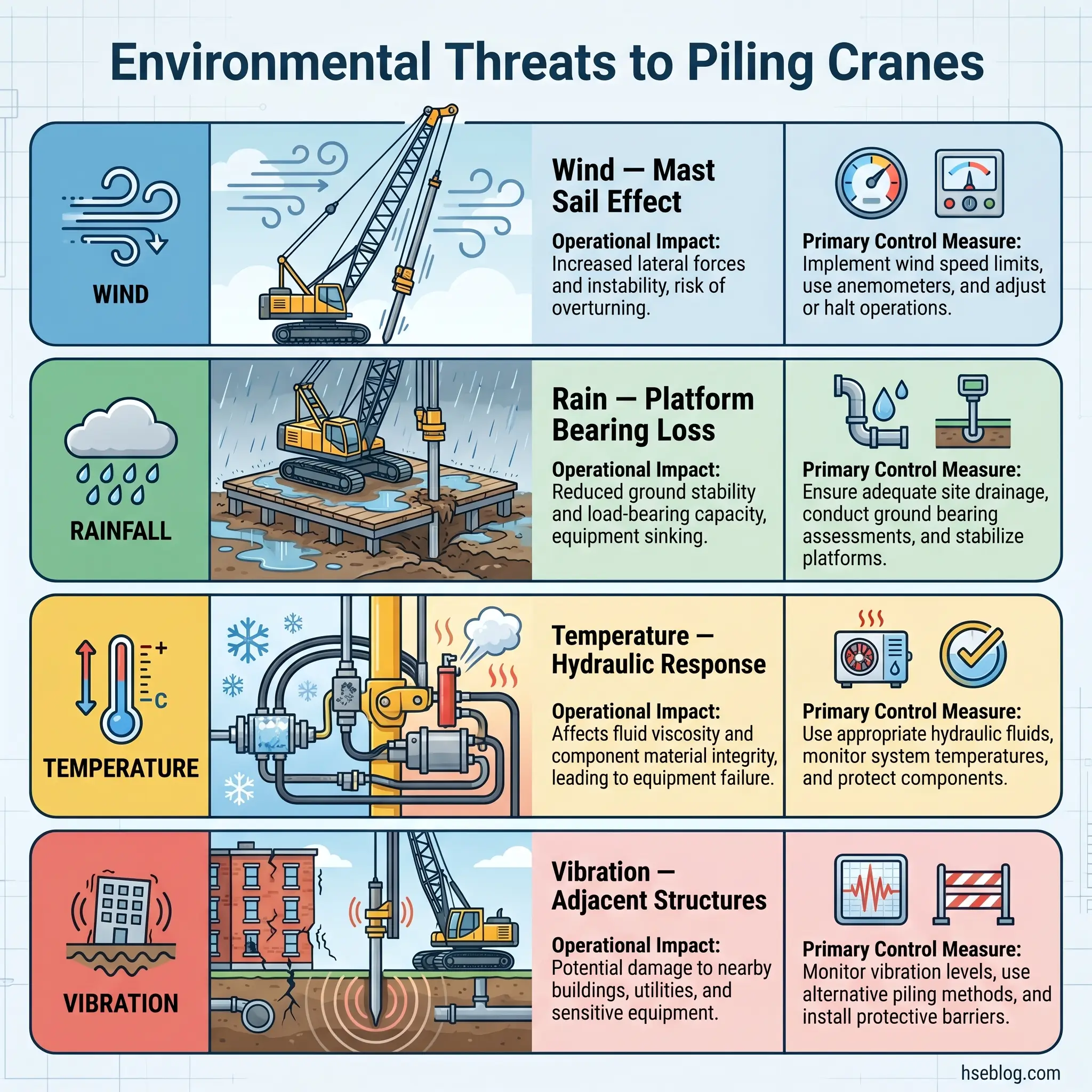
Wind
Manufacturers specify operational wind speed limits for cranes, but tall piling masts introduce an additional variable. The mast acts as a sail area that increases wind loading beyond what the crane experiences in standard configurations.
For crane-piling combinations, the effective wind limit may be lower than either the crane or rig manufacturer specifies individually. The appointed person or lift planner must assess the combined wind exposure — not apply each manufacturer's limit independently.
Rainfall and Water Management
Working platform integrity depends on effective surface water drainage. Pooling water softens granular fill, migrates through platform layers, and creates zones of reduced bearing capacity that are invisible from the surface.
The practical control is straightforward: drainage channels must be maintained throughout the project, not just installed during construction. Bore spoil management is inseparable from water management — wet spoil deposited on the platform acts as both a loading surcharge and a water source that saturates the fill beneath it.
Temperature Extremes
- Cold weather — hydraulic fluid viscosity increases, reducing response speed and control precision. Boom steel may become more brittle. Frozen ground can mask soft conditions that become apparent during thaw.
- Hot weather — operator fatigue accelerates, particularly in enclosed cabs on piling rigs where vibration and noise compound thermal stress.
Vibration Monitoring for Adjacent Structures
Piling-induced ground vibration can damage adjacent buildings, underground services, and retaining structures. Vibration monitoring at sensitive receptors should begin before piling starts (to establish baseline readings) and continue throughout operations.
The threshold values that trigger operational changes vary by jurisdiction and by the sensitivity of the receiving structure. BS 5228-2 (UK) and the FTA Transit Noise and Vibration Impact Assessment guidance (US) provide reference criteria — but site-specific limits should be set by a specialist vibration consultant, not defaulted from generic tables.
Frequently Asked Questions
Can a drill rig be used as a crane on a piling site?
No. Drill rig manufacturers explicitly warn that auxiliary winches are not designed for suspended load handling. The winch has limited hoisting capacity, restricted pick zones, and the mast geometry does not support the load moments created by lateral lifts. The NIOSH blog documenting the 2021 Philadelphia fatal overturn identifies this exact misuse — treating a drill rig auxiliary winch as a general-purpose hoist — as the direct cause. If a load needs to be suspended and moved, a crane must be used.
What is a Working Platform Certificate and who is responsible for issuing it?
A Working Platform Certificate confirms that the platform's design, construction, and maintenance are adequate for the specific equipment that will operate on it. The system originated with the Federation of Piling Specialists in the UK. The main contractor — not the piling subcontractor — holds responsibility for issuing the certificate. The piling contractor provides equipment data (track pressures, rig weights), but the main contractor commissions and delivers the platform to specification.
How often should a working platform be inspected during piling operations?
Before each shift and whenever the rig is repositioned to a new pile location. The initial design verification confirms adequacy at the start of the project, but ongoing condition monitoring must be continuous. Platforms degrade progressively through trafficking, weather exposure, bore spoil contamination, and excavation-related disturbance. A platform that passed inspection on day one may contain hidden weak zones by day thirty.
What is the maximum crane capacity utilization for pile driving duty-cycle work?
WorkSafeBC guidance establishes a benchmark of 75% of rated capacity for pile driving duty-cycle operations. Neither OSHA Subpart CC (US) nor LOLER 1998 (UK) specifies a numeric threshold — both require that loads remain "safely below rated capacity." In practice, the 75% figure should govern because duty-cycle shock loads impose cumulative stress that standard static load charts do not represent.
Do OSHA crane regulations apply to dedicated pile drivers?
Yes. OSHA 29 CFR 1926 Subpart CC explicitly includes dedicated pile drivers and cranes used as dedicated pile drivers within its scope. Additionally, §1926.1417 (US) prohibits jib attachment during pile driving operations, and §1926.603 (US) covers specific requirements for pile driving equipment including boiler systems and pressure vessels. These provisions apply alongside, not instead of, the general Subpart CC requirements.
What causes piling rigs and cranes to overturn on construction sites?
Working platform failure is the leading cause — specifically localized soft spots from inadequate platform thickness, poor drainage, contamination with bore arisings, or undiscovered buried obstructions creating differential bearing capacity. Additional causes include exceeding lifting capacity during informal service lifts, operating too close to platform edges where bearing capacity is reduced, and using drill rig auxiliary winches for tasks that require a crane. The failure mechanism is typically punching shear under a single track or outrigger, not general bearing collapse.
Conclusion
The industry's recurring blind spot with crane-piling operations is treating them as two separate activities that happen to share the same site. They are not separate. The crane's stability depends on the ground, and piling operations continuously alter that ground. Every borehole changes drainage patterns. Every truckload of spoil left on the platform adds surcharge and moisture. Every hammer blow transmits vibration into fill that was compacted to a specification it may no longer meet.
The highest-impact change any piling contractor or main contractor can make is to treat the working platform as a live system requiring active management — not a box ticked at mobilization. Design it for worst-case loads, certify it before operations begin, inspect it before every shift, and repair it when it degrades. That single control underpins every other safety measure discussed here, from lift planning to operator competence to exclusion zone management.
Crane safety in piling operations is not solved by applying generic crane procedures to a piling site. It requires practitioners who understand both disciplines — and who recognize that the ground beneath the equipment is not a constant but a variable that changes with every metre of pile installed.