
An asbestos management plan is a written, site-specific document that sets out how asbestos-containing materials in a building will be identified, assessed, monitored, and controlled to prevent exposure. It records what ACMs are present, what decisions have been made about each one, who is responsible for ongoing management, and what procedures are in place if materials are accidentally disturbed.
More than 5,000 people die every year in Great Britain alone from diseases caused by past asbestos exposure (UK Health and Safety Executive, 2024). Globally, asbestos-related thoracic cancers — mesothelioma and asbestos-attributable lung cancer combined — killed over 216,500 people in 2021 (BMJ Public Health, 2025). These deaths trace back to exposures that occurred years or decades earlier, often in buildings where asbestos-containing materials were present but not managed.
The asbestos management plan exists to break that chain. It is the operational document that translates survey findings and register data into enforceable decisions — what stays, what goes, who is told, and how the building is monitored. In the UK, Australia, and the United States, having this plan is a legal obligation for dutyholders of non-domestic premises, workplaces, and schools. This article explains what an asbestos management plan contains, who is responsible for it, how to write one from scratch, and where plans most commonly fail in practice.
What Is an Asbestos Management Plan?
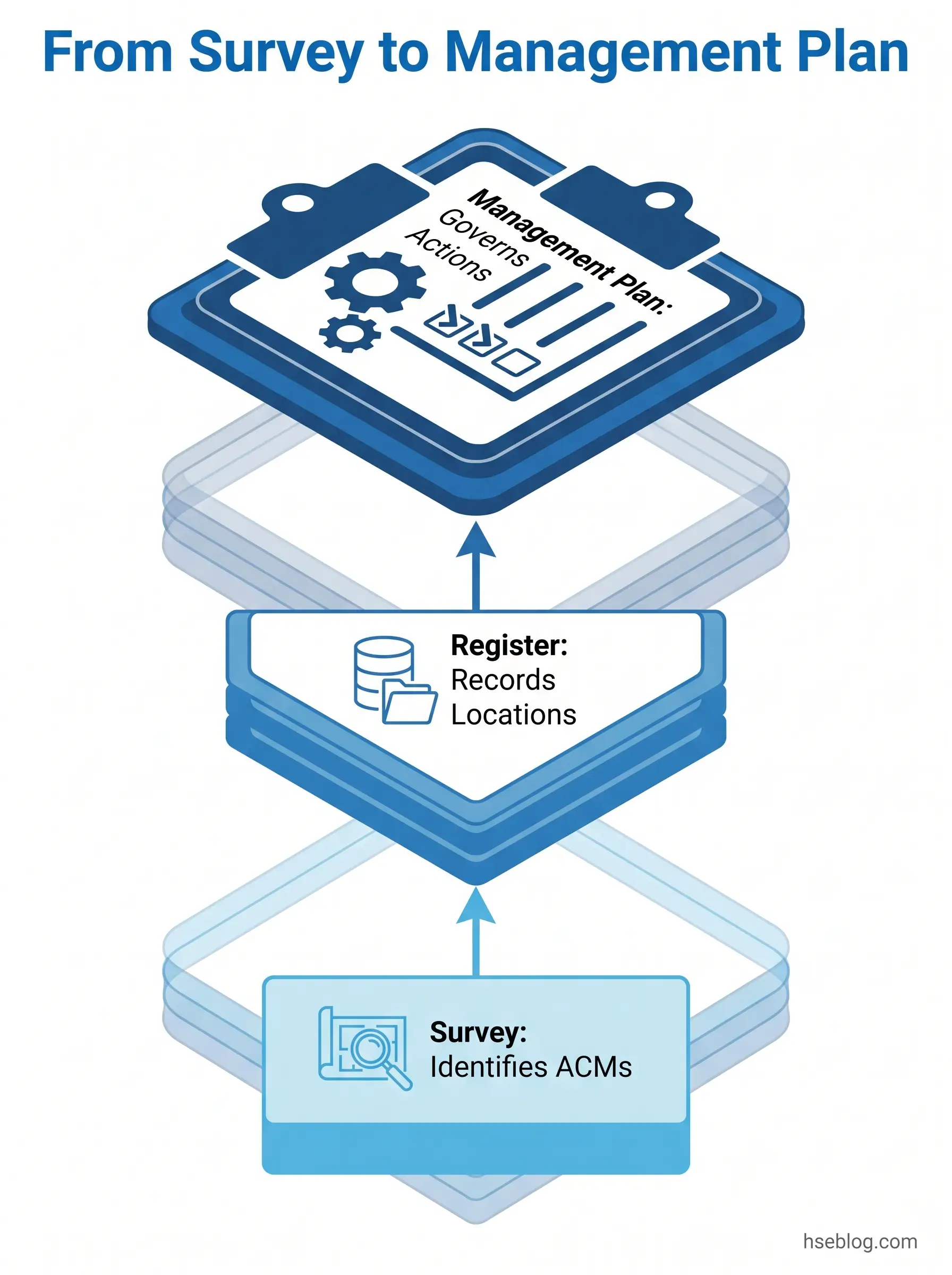
An asbestos management plan is the written strategy that governs how every identified or presumed ACM in a building will be managed over time. It is not the survey report. It is not the register. It is the layer that sits on top of both and turns raw information into coordinated action.
A consistent pattern across compliance failures is the assumption that commissioning a survey completes the obligation. The survey identifies what is present. The register records locations and conditions. The management plan answers a different question entirely: what will you do about it, who will do it, and how will you verify it is being done?
This distinction matters because the plan applies across every jurisdiction that regulates asbestos in buildings:
- UK — Non-domestic premises, including common areas of residential buildings (CAR 2012, Regulation 4)
- US — General industry and construction workplaces (OSHA 29 CFR 1910.1001 and 1926.1101); schools specifically under EPA AHERA (40 CFR Part 763, Subpart E)
- Australia/NZ — Any workplace where ACMs are identified or reasonably assumed to be present (WHS Regulations, Clauses 425 and 429)
Asbestos Survey vs Asbestos Register vs Asbestos Management Plan
Many dutyholders conflate these three documents. Each serves a distinct purpose, is produced by a different party, and carries its own legal basis.
| Element | Asbestos Survey | Asbestos Register | Asbestos Management Plan |
|---|---|---|---|
| Purpose | Identify and assess ACMs in the building | Record the location, type, and condition of each ACM | Set out how each ACM will be managed, monitored, and communicated |
| Who creates it | Competent surveyor (accredited in UK/Australia) | Dutyholder/PCBU, typically compiled from survey findings | Dutyholder/PCBU, based on survey and register |
| Legal basis (UK) | CAR 2012, Regulation 4 | CAR 2012, Regulation 4 | CAR 2012, Regulation 4 |
| Legal basis (US) | OSHA 1926.1101(k); AHERA inspections | OSHA building owner records; AHERA | AHERA management plan; OSHA building owner duties |
| Legal basis (Australia) | WHS Regulations | WHS Regulations, Clause 425 | WHS Regulations, Clause 429 |
| Update frequency | When building use changes, or before refurbishment/demolition | Ongoing — updated whenever ACM condition changes or new information emerges | UK: at least annually. Australia: at least every 5 years. US (AHERA): 6-month surveillance + 3-year re-inspection |
The survey is an input. The register is a record. The plan is the operational commitment.
Why Do You Need an Asbestos Management Plan?
The legal answer is straightforward: in every major jurisdiction, the plan is mandatory. The practical answer runs deeper — the plan is what prevents the next exposure event in your building.
Legal Obligation
The duty to produce and maintain a written asbestos management plan is a criminal-law requirement in the UK, a federal regulatory requirement in the US, and a workplace health and safety obligation in Australia.
- UK (CAR 2012, Regulation 4): Dutyholders of non-domestic premises must assess whether ACMs are or are likely to be present, prepare a written plan for managing them, and implement it. Non-compliance is a criminal offence carrying unlimited fines and up to 2 years' imprisonment in the Crown Court.
- US (OSHA 1926.1101(k)): Building and facility owners must determine the presence, location, and quantity of ACMs or presumed ACMs before any covered work begins, and notify employers and workers. For schools, EPA AHERA requires a formal management plan with 6-month surveillance and 3-year re-inspections.
- Australia (WHS Regulations, Clauses 425 and 429): The person with management or control of the workplace (PCBU) must prepare an asbestos register and a written management plan if ACMs are identified or assumed present.
Health Reality
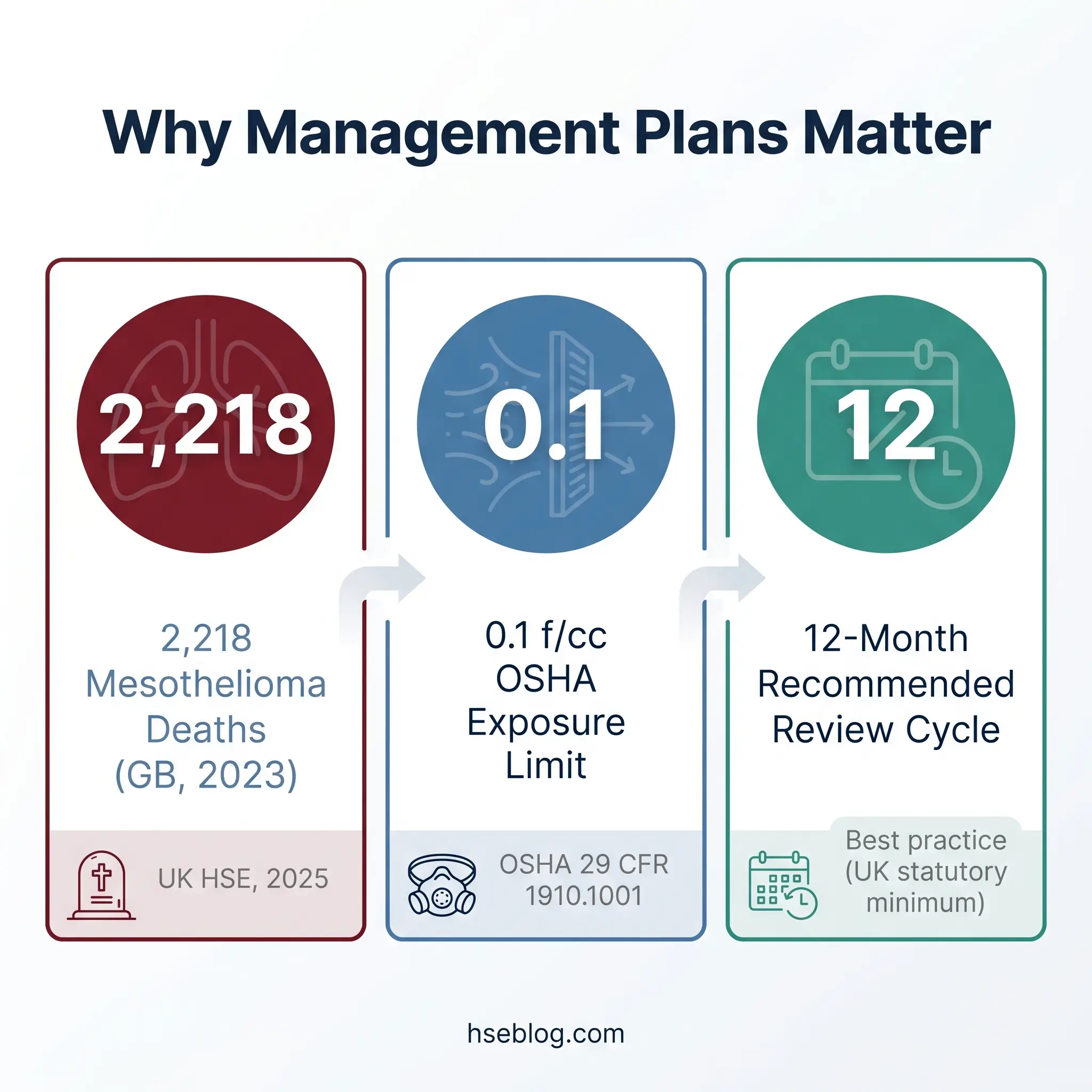
The lag between asbestos exposure and disease onset — typically 15 to 50 years — makes the consequences invisible at the moment of failure. In 2023, 2,218 people died from mesothelioma in Great Britain (UK Health and Safety Executive, 2025). In the United States, approximately 3,000 new mesothelioma cases are diagnosed each year (American Cancer Society).
These numbers reflect exposures that occurred decades ago. The management plan's purpose is to ensure that today's building occupants, maintenance workers, and contractors are not added to tomorrow's statistics.
Enforcement Is Not Theoretical
Penalties for failing to manage asbestos are actively enforced. In the UK, the Health and Safety Executive launched its "Asbestos: Your Duty" campaign in early 2024, directly targeting dutyholders of non-domestic premises. Prosecution data shows that non-compliance with Regulation 4 is among the most common enforcement actions for asbestos-related offences.
The judgment call for dutyholders is not whether they can afford to write the plan. It is whether they can afford the prosecution, the exposure incident, and the liability that follows from not having one.
Who Is Responsible for the Asbestos Management Plan?
Responsibility falls on the person who controls the building's maintenance and repair obligations — but identifying that person is frequently harder than it sounds.
Each jurisdiction uses different terminology for the same concept:
| Jurisdiction | Responsible Party | Legal Basis |
|---|---|---|
| UK | Dutyholder — the owner, leasee, or person in control of maintenance/repair | CAR 2012, Regulation 4 |
| US (general) | Building/facility owner | OSHA 29 CFR 1926.1101(k) |
| US (schools) | Local Education Agency (LEA) designated person | EPA AHERA |
| Australia/NZ | Person with management or control of the workplace (PCBU) | WHS Regulations |
The Multi-Tenancy Problem
The most dangerous gap in asbestos management is not a missing survey — it is an undefined dutyholder. In multi-tenanted commercial premises, the lease often splits maintenance responsibilities between landlord and tenants. If the lease is ambiguous about who maintains the building fabric (walls, ceilings, service risers), the duty to manage asbestos can fall into a gap where no party actively owns it.
Before writing a management plan, the first question to resolve is: who is the dutyholder for this building? If the answer is unclear, the lease terms must be reviewed, and the responsibility must be explicitly documented and agreed. Regulators will not accept ambiguity as a defence.
The Appointed Person
In UK practice, the dutyholder often designates an "appointed person" — someone trained and competent to coordinate day-to-day asbestos management. This person handles re-inspections, contractor notifications, and register updates on behalf of the dutyholder.
The appointed person carries out the operational work. The legal responsibility remains with the dutyholder regardless.
What Should an Asbestos Management Plan Include?
The plan must be comprehensive enough to satisfy a regulator's inspection and practical enough that a maintenance supervisor can use it before authorising work. The HSE guidance on writing an asbestos management plan sets out the expected contents for UK premises, and the principles apply across jurisdictions.
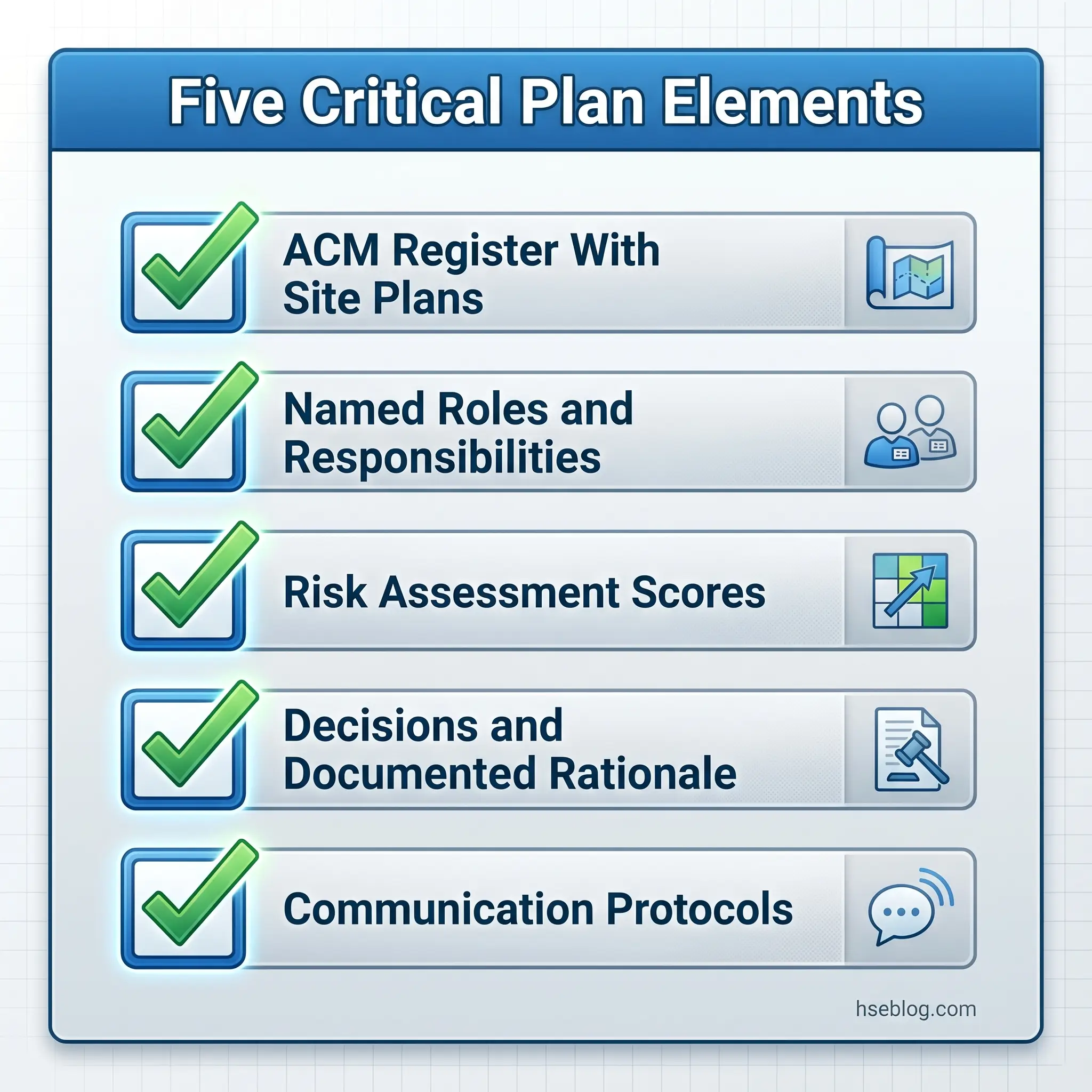
A compliant plan includes the following elements:
- Asbestos register with site plans — locations of all identified or presumed ACMs, areas that were not accessed during the survey, and marked-up floor plans showing ACM positions.
- Named individuals and roles — the dutyholder, the appointed person (if designated), the competent surveyor who conducted the assessment, and any specialist contractors retained.
- Risk assessment findings — material assessment scores (condition, surface treatment, asbestos type, friability) and priority assessment scores (occupant activity, likelihood of disturbance, exposure potential) for each ACM.
- Management decisions and rationale — for every identified ACM, the plan states whether it will be left in place and monitored, encapsulated, repaired, or removed — and why that decision was made.
- Safe work procedures — how work near ACMs is controlled, including any permit-to-work system, notification protocols, and prohibitions.
- Emergency procedures — what happens if ACMs are accidentally disturbed: stop work, evacuate the immediate area, prevent further disturbance, notify the dutyholder, and engage a competent person.
- Communication protocols — how contractors, staff, and building occupants are informed about ACM locations and the plan's requirements before any work begins.
- Training requirements — asbestos awareness training for all workers who may encounter ACMs, and duty-to-manage training for the dutyholder and appointed person.
- Monitoring and re-inspection schedule — defined intervals for checking ACM condition (typically 6–12 months in the UK, depending on risk rating).
- Review triggers and timetable — the schedule for planned reviews and the events that trigger an immediate review (ACM disturbance, building refurbishment, change of dutyholder).
- Recordkeeping — document retention, version control, and an audit trail of all changes.
The most common content gap in plans that technically exist but fail operationally is item 4. Many plans catalogue ACM locations with precision but never explain the reasoning behind each management decision. That reasoning is exactly what a regulator examines during enforcement — and exactly what protects the dutyholder if an incident occurs.
How to Write an Asbestos Management Plan: Step-by-Step
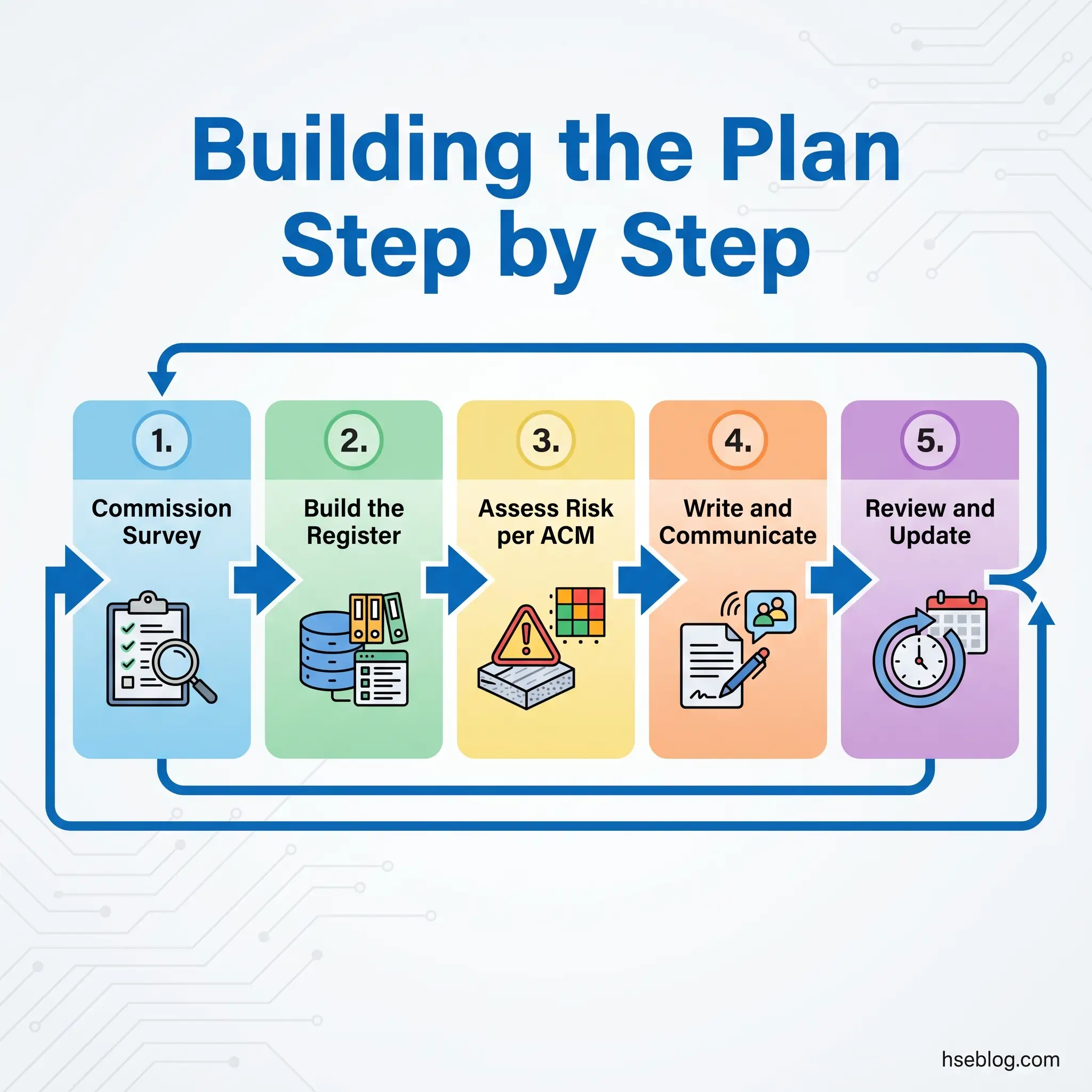
Creating the plan is a sequential process. Each step builds on the output of the one before it. Skipping steps — particularly the survey and risk assessment — produces a document that looks like a plan but cannot function as one.
Step 1: Determine whether your premises requires a plan. Any non-domestic building in the UK, any workplace in Australia, and any school covered by AHERA in the US requires one if ACMs are present or reasonably assumed. For UK buildings, the practical rule is: if the building was constructed or refurbished before the year 2000, assume asbestos may be present until a survey proves otherwise.
Step 2: Commission an asbestos management survey. The management survey (sometimes called a Type 2 survey in older UK terminology) is a non-destructive assessment designed to locate and assess ACMs that could be disturbed during normal occupancy and maintenance. It is distinct from a refurbishment/demolition survey, which is intrusive and required before major works. The survey must be conducted by a competent, accredited surveyor.
Step 3: Prepare or update the asbestos register. Compile survey findings into a register listing every identified or presumed ACM, its location, type, condition, and accessibility. Include floor plans with ACM locations clearly marked, and note any areas the surveyor could not access.
Step 4: Conduct a risk assessment for each ACM. Assess each material on two dimensions. The material assessment evaluates the ACM itself — its condition, surface treatment, asbestos type, and friability. The priority assessment evaluates the context — how likely the material is to be disturbed, what activities occur nearby, and who might be exposed. Together, these produce a risk rating that drives the management decision.
Step 5: Decide on management actions and document the rationale. For each ACM, choose one of four options: leave in place and monitor, encapsulate, repair, or remove. Record the reasoning. A high-risk friable material in a high-traffic area warrants a different response than a low-risk non-friable material in a sealed ceiling void that no one accesses.
Step 6: Assign responsibilities by name. Identify the dutyholder, the appointed person, and any other individuals with defined roles. Generic titles are insufficient — the plan must name specific people so that accountability is clear and auditable.
Step 7: Compile the plan. Bring all elements together into a single, accessible document. Structure it logically: identification → assessment → decisions → procedures → monitoring → review. Refer to the HSE guidance on asbestos management plans for UK expectations, or the EPA model AHERA management plan for US school settings.
Step 8: Communicate the plan. This is where most plans silently fail. The document is complete, filed on a server or in a cabinet — and the maintenance team that needs it before drilling into a soffit has never seen it. Every contractor must be shown relevant sections before starting work. Staff working in or near ACM areas must receive asbestos awareness training. Visitors and occupants must be informed where necessary.
A plan that is written but not communicated is, functionally, no plan at all.
Step 9: Implement. Activate the monitoring schedules. Begin re-inspections at the defined intervals. Ensure the permit-to-work system is operational. Confirm that training records align with the plan's requirements.
Step 10: Review and update. Set the review schedule (at least annually in the UK; at least every 5 years in Australia, though annual is best practice). Define the triggers for immediate review: ACM disturbance, removal, encapsulation, building refurbishment, change of dutyholder, or new survey information.
Conducting an Asbestos Risk Assessment for Your Plan
The risk assessment methodology underpinning Step 4 varies slightly between jurisdictions, but the logic is consistent. The material assessment scores the ACM's inherent risk: what type of asbestos is it, how friable is it, what is its surface condition, and how damaged is it? The priority assessment scores the exposure risk: what activities happen near it, how accessible is it, how many people could be exposed, and how often?
UK HSE guidance (ACOP L143) and Australian Codes of Practice both use scoring algorithms that produce a numerical risk rating. The OSHA asbestos standard for construction does not prescribe a specific scoring model but requires the building owner to assess and communicate ACM/PACM information.
The practical interpretation across all frameworks: a high material-risk score combined with a high priority-risk score demands immediate action — typically removal or robust encapsulation. A low material-risk score with a low priority-risk score permits managed monitoring. The grey area between those extremes is where professional judgment operates, and where the documented rationale becomes critical.
How Often Should an Asbestos Management Plan Be Reviewed?
The minimum legal review frequency depends on jurisdiction, but the operationally sound interval is shorter than most statutes require.
| Jurisdiction | Minimum Plan Review | ACM Re-inspection | Surveillance |
|---|---|---|---|
| UK (CAR 2012) | At least every 12 months | Every 6–12 months depending on risk | Ongoing |
| Australia (WHS Regs) | At least every 5 years | As specified in plan | Ongoing |
| US (AHERA — schools) | No fixed plan-review cycle specified | Every 3 years (full re-inspection) | Every 6 months (periodic surveillance) |
The gap between the minimum statutory interval and the operationally necessary interval is significant. A plan reviewed only at the 5-year Australian minimum will almost certainly be out of date in any building with regular maintenance, refurbishment, or tenant turnover. The SafeWork NSW guidance on asbestos registers and management plans acknowledges this by recommending more frequent review as best practice.
Trigger Events Requiring Immediate Review
Regardless of the scheduled review cycle, the plan must be reviewed immediately when:
- ACM damage is discovered during a re-inspection or reported by building occupants
- ACM is removed, encapsulated, or repaired
- Building refurbishment or demolition is planned
- The dutyholder, PCBU, or building owner changes
- New survey information becomes available (e.g., previously inaccessible areas are opened)
- An accidental disturbance or exposure event occurs
High-traffic and high-maintenance premises — hospitals, schools, retail centres, industrial facilities — should adopt a 6-month review cycle as standard practice, regardless of jurisdiction.
Asbestos Management Plans for Schools
Schools carry a unique combination of regulatory scrutiny and vulnerability. The occupants include children, the buildings are often decades old, and the materials most likely to be disturbed — ceiling tiles, pipe lagging, floor tiles — are the same materials most likely to contain asbestos in pre-2000 construction.
US: AHERA Requirements
Under the Asbestos Hazard Emergency Response Act (EPA AHERA, 40 CFR Part 763, Subpart E), public school districts and non-profit private schools must:
- Inspect all buildings for ACMs using accredited inspectors
- Develop a written management plan for each school building
- Conduct periodic surveillance every 6 months
- Conduct full re-inspections every 3 years
- Notify parents, teachers, and staff annually about the plan's availability and any asbestos-related activities
The LEA (Local Education Agency) must designate a person to oversee plan implementation. The EPA model AHERA management plan for schools provides a downloadable template and step-by-step guide.
For-profit private schools are exempt from AHERA — a gap that leaves a segment of school buildings without the same regulatory protection.
UK: Emerging Enforcement Priority
In the UK, schools fall under the general duty to manage asbestos under CAR 2012, Regulation 4. Emerging research from 2023–2024 (Mesothelioma UK and the British Occupational Hygiene Society) shows that teachers and former pupils exposed to damaged amosite in 1960s–1980s school buildings face significantly elevated mesothelioma risk. This is not solely a historical problem.
The British Safety Council has called for a review of CAR 2012, and the proposed Asbestos Information Certificate (AIC) — a compliance rating system for dutyholders — is being trialled across sectors, including education. The Work and Pensions Committee continues to follow up on asbestos management in schools as an active policy area.
Australia
Australian schools are covered as workplaces under WHS Regulations. The same register and management plan obligations (Clauses 425 and 429) apply. State-level enforcement varies, but the principles are identical to commercial premises.

Common Mistakes in Asbestos Management Plans
Reviewing plans across different organisations reveals a consistent set of failure patterns. These are not obscure edge cases — they are the errors that appear most frequently in enforcement actions and compliance audits.
Confusing the Survey With the Plan
The single most common misconception: a dutyholder commissions a management survey, receives the report, and believes the obligation is discharged. The survey identifies what is present. The plan governs what happens next. They are different documents with different purposes, and having one does not satisfy the requirement for the other.
Missing Decisions and Rationale
Plans that catalogue ACM locations in detail but never explain why a particular management option was chosen leave the dutyholder exposed. When a regulator asks "why was this friable material left in place rather than removed?", the plan should contain the answer. If it does not, the dutyholder is defending a decision that was never formally made.
Plans That Exist but Are Not Communicated
A technically complete plan stored on a shared drive that contractors have never been shown is the operational equivalent of having no plan. The failure is not in the writing — it is in the communication chain. Contractor sign-off, staff briefings, and accessible plan copies at the point of work are the minimum.
No Named Individual Owns the Plan
When responsibility is assigned to a job title rather than a named person — or worse, not assigned at all — the plan drifts. Re-inspections are missed. The register is not updated after maintenance work. The plan becomes a historical document rather than a living one.
The Plan Is Never Updated
Building work happens. Tenants change. ACMs are removed or disturbed. If the plan is not updated to reflect these events, the register becomes inaccurate, the risk ratings become unreliable, and the entire system decays.
Regulators increasingly look beyond whether the plan exists to whether it is actively implemented — whether contractors sign off on having reviewed it, whether re-inspections happen on schedule, and whether training records match the plan's stated requirements.
Asbestos Management Plan Template: Key Sections
No single template fits every building, but a compliant plan follows a predictable structure. The sections below provide a framework that satisfies UK, US, and Australian requirements. Dutyholders should adapt them to their premises and jurisdiction.
- Cover page — building name, address, dutyholder details, plan version number, date of issue
- Policy statement and scope — the dutyholder's commitment to managing asbestos and the buildings covered by the plan
- Roles and responsibilities — named dutyholder, appointed person, surveyor, and any specialist contractors
- Asbestos register — attached or cross-referenced, with version control
- Site plans — floor plans with ACM locations clearly marked, including areas not surveyed
- Risk assessment summary — material and priority scores for each ACM, with overall risk ratings
- Management decisions and rationale — for each ACM: leave, encapsulate, repair, or remove, with documented reasoning
- Safe work procedures — permit-to-work requirements, prohibited activities, notification protocols
- Emergency procedures — accidental disturbance response: stop work, evacuate, prevent further release, notify competent person
- Communication and training plan — who is trained, to what level, how contractors are briefed, how occupants are informed
- Monitoring and re-inspection schedule — defined intervals, named inspector, recording method
- Review log and version history — dates of all reviews, changes made, trigger events, sign-off
Official templates are available from the EPA for AHERA school plans and from HSE for UK premises. These provide a strong starting framework that can be adapted to specific building types and risk profiles.
A Note on the US Regulatory Landscape
In March 2024, the EPA finalised a ban on ongoing uses of chrysotile asbestos under TSCA Section 6(a) — the first comprehensive US ban on an asbestos product under the amended Toxic Substances Control Act. The ban took effect on May 28, 2024, though in June 2025, the EPA filed a motion requesting abeyance to reconsider certain provisions, and the rule is currently under judicial review in the Fifth Circuit.
Critically, this ban applies to new manufacture, import, processing, and distribution of chrysotile — not to legacy asbestos already installed in buildings. The OSHA permissible exposure limit remains at 0.1 fibers per cubic centimeter of air (8-hour TWA) (OSHA, 29 CFR 1910.1001). Management plans for existing buildings remain as essential as ever.
Frequently Asked Questions
Is an asbestos management plan a legal requirement?
Yes, in most jurisdictions — but the specific legal basis differs. In the UK, CAR 2012 Regulation 4 requires dutyholders of non-domestic premises to prepare and implement a written plan. In the US, OSHA imposes building owner duties under 29 CFR 1926.1101(k), and EPA AHERA mandates formal management plans for public and non-profit schools. In Australia, WHS Regulations (Clause 429) require PCBUs to maintain a written plan wherever ACMs are identified or assumed. For-profit private schools in the US are exempt from AHERA.
What is the difference between an asbestos management survey and an asbestos management plan?
The survey is the investigative process — a competent surveyor inspects the building to identify and assess ACMs. The management plan is the operational document built from those findings. One is an input; the other is an output. Both are legally required, and commissioning a survey does not fulfil the separate obligation to produce and implement a plan.
Can I write an asbestos management plan myself?
In the UK, the dutyholder can prepare the plan, provided it is based on a survey conducted by a competent, accredited surveyor. Many organisations commission specialist consultants to draft the plan, particularly for complex premises. Regardless of who writes the document, the dutyholder retains full legal responsibility for its accuracy, implementation, and review.
Does an asbestos management plan apply to domestic properties?
In the UK, Regulation 4 applies to non-domestic premises and the common parts of domestic buildings — for example, stairwells, corridors, and plant rooms in blocks of flats. In Australia, the obligation applies to workplaces. Domestic homeowners are not generally required to have a formal plan, but anyone planning renovation or demolition in a pre-2000 home should have the property assessed for asbestos before work begins.
What happens if asbestos is accidentally disturbed and the plan is not followed?
The immediate response is: stop all work, evacuate the area, prevent further disturbance, and contact a competent person. The area must not be re-entered until assessed. If the management plan's emergency procedure was not followed — or if no emergency procedure existed — the dutyholder faces potential prosecution, enforcement notices, and civil liability for any resulting exposure.
Do I need a new asbestos management plan after asbestos removal?
The plan does not need to be rewritten from scratch, but it must be updated. Remove the ACM from the register, update the site plans, record the clearance certificate and analytical results, and adjust the monitoring schedule. The review log should document the removal as a trigger event and confirm the plan reflects the current state of the building.
Conclusion
The gap the industry continues to get wrong is not the existence of the plan — it is the distance between the document and the people who need it. A management plan that cannot be located by the maintenance team at the moment they need it, that has not been updated since the last tenant fit-out, or that lists a dutyholder who left two years ago is a compliance artefact, not a safety system.
The single highest-impact change for most dutyholders is not a better template or a more detailed survey. It is closing the communication loop: ensuring that every contractor signs off on having reviewed the relevant sections before starting work, that every re-inspection happens on schedule and is recorded, and that the plan is treated as a living operational document rather than a regulatory filing.
Asbestos-related diseases will continue to claim lives for decades because of exposures that have already occurred. The management plan cannot undo past exposure. What it can do — when written properly, communicated effectively, and reviewed consistently — is prevent the next one.