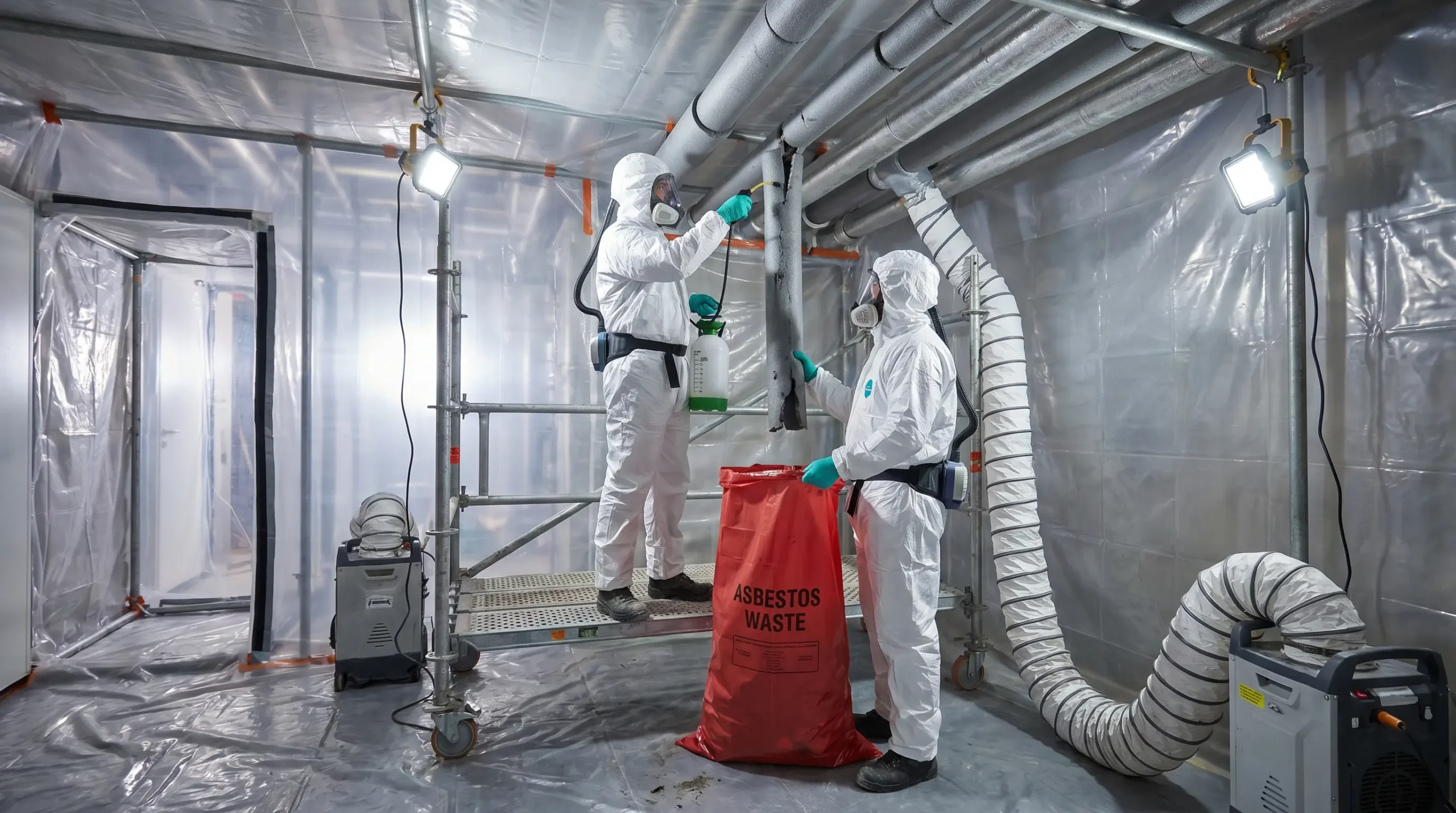
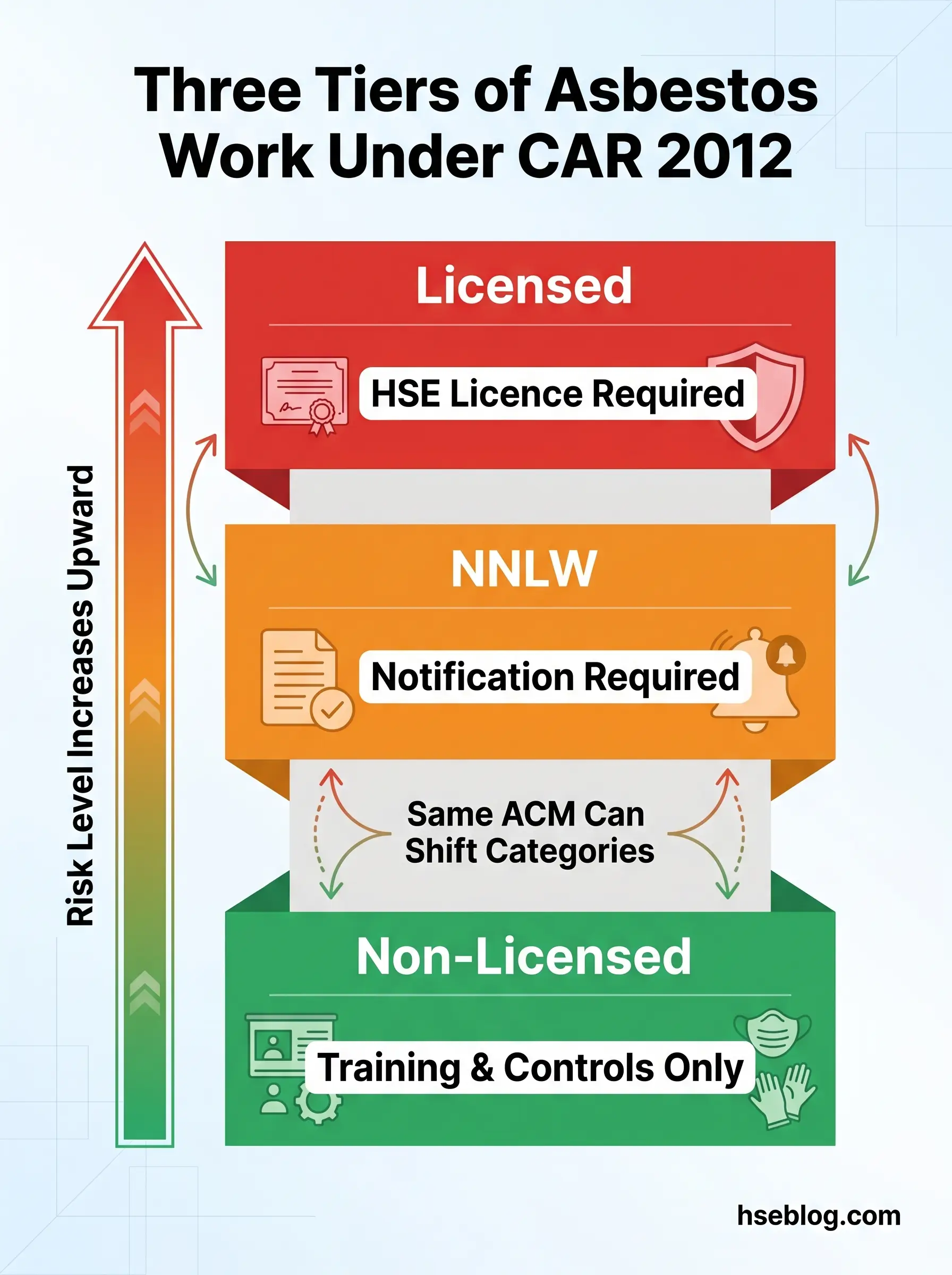
Under the Control of Asbestos Regulations 2012, asbestos work in Great Britain falls into three categories — not two. Licensed work covers high-risk removal requiring an HSE licence. Notifiable non-licensed work (NNLW) sits between the two extremes, mandating notification and medical surveillance without a licence. Standard non-licensed work applies to lower-risk tasks with bound materials. Classification depends on the ACM type, its condition, the planned disturbance method, and whether exposure will remain sporadic and below 0.1 f/cm³.
Regulation 8 of the Control of Asbestos Regulations 2012 makes it a criminal offence to carry out licensable asbestos work without an HSE licence — and misclassifying a project as non-licensed when it should be licensed is one of the most consequential compliance errors a dutyholder can make. Approximately 5,000 asbestos-related disease deaths occur every year in Great Britain (HSE, 2025), a figure driven in part by historic exposures but sustained by ongoing disturbance of asbestos-containing materials during maintenance, refurbishment, and demolition. The classification decision made before work begins determines every downstream control — who can do the work, what notifications are required, what medical surveillance applies, and what records must be kept for up to 40 years.
This article breaks down the three categories of asbestos work under CAR 2012 — licensed, notifiable non-licensed (NNLW), and standard non-licensed — with specific regulation references, the decision logic for classifying a project correctly, and the training, notification, and documentation obligations that follow from each category. The focus is practical: not just what the categories are, but how you determine which one applies to the work in front of you, and where the classification errors most commonly occur.
What Are the Three Categories of Asbestos Work Under CAR 2012?
CAR 2012 creates three distinct categories of asbestos work, not two — and the widespread failure to recognise the middle category is where the most damaging classification errors begin.
The regulations, which came into force on 6 April 2012 replacing the 2006 Regulations, establish a three-tier framework defined primarily by risk level:
- Licensed work — highest risk, requiring an HSE-granted licence before any work begins.
- Notifiable non-licensed work (NNLW) — elevated risk that does not require a licence but triggers notification, medical surveillance, and enhanced record-keeping obligations.
- Non-licensed work — lowest risk, still requiring training, risk assessment, and a written plan of work, but without notification or medical surveillance requirements.
A critical point that the regulations make clear: the same ACM can shift categories depending on its condition and the method of disturbance. A sheet of intact asbestos cement on a garage roof is textbook non-licensed work. That same material after fire damage — where the cement matrix has degraded and fibres are loosely bound — may be NNLW or even licensed, depending on the risk assessment outcome.
All three categories still require compliance with the baseline obligations under CAR 2012: a suitable and sufficient risk assessment (Regulation 6), a written plan of work (Regulation 7), adequate training (Regulation 10), and proper waste handling and disposal.
Quick-Reference Comparison Table
| Requirement | Licensed | NNLW | Non-Licensed |
|---|---|---|---|
| ACM examples | Sprayed coatings, pipe lagging, loose-fill, AIB (not short duration) | Damaged asbestos cement, large-scale textured coatings, short-duration AIB work | Intact asbestos cement, undamaged vinyl tiles, sealed textured coatings |
| HSE licence needed? | Yes | No | No |
| Notification | ASB5 form, 14 days before work | ASB NNLW1 online form, before work starts | None |
| Training category | Category C | Category B | Category B |
| Medical surveillance | Every 2 years (HSE-appointed doctor) | Every 3 years (any doctor) | Not required |
| Health record retention | 40 years | 40 years | Not required (recommended) |
| Four-stage clearance | Yes (UKAS-accredited analyst) | No | No |
What Qualifies as Licensed Asbestos Work?
Licensed work is defined by a three-part test under CAR 2012 Regulation 2 — and meeting any single condition triggers the licence requirement.
The three conditions are:
- Exposure is not sporadic and of low intensity. The sporadic/low intensity short-term threshold is 0.6 f/cm³ measured over 10 minutes. If the work will exceed this, or if it forms part of a regular pattern of work rather than an isolated task, the first condition is met.
- The risk assessment cannot demonstrate the control limit will not be exceeded. The control limit is 0.1 asbestos fibres per cubic centimetre of air (0.1 f/cm³) averaged over a continuous 4-hour period. If there is reasonable doubt the work will stay below this threshold, the second condition is met.
- The work involves asbestos coatings, asbestos insulation, or asbestos insulating board (AIB) and is not short duration. "Short duration" is narrowly defined: no more than 2 hours of work in any 7-day period, with no individual worker exposed for more than 1 hour.
Meeting any one of these conditions means the work is licensable. Common examples include removal of sprayed coatings (limpet asbestos), stripping pipe lagging, clearing loose-fill insulation from ceiling voids, and large-scale AIB removal.
The HSE licence is granted by the Asbestos Licensing Unit, with a current application fee of £3,683. Licences are time-limited (typically 3 years) and subject to renewal assessment. Before licensed work begins, a 14-day prior notification must be submitted to HSE via the ASB5 form. A waiver of the 14-day period is available only for genuine emergencies — routine scheduling pressure does not qualify.
Licensed Work Requirements at a Glance
Once work is classified as licensed, the operational requirements are substantial:
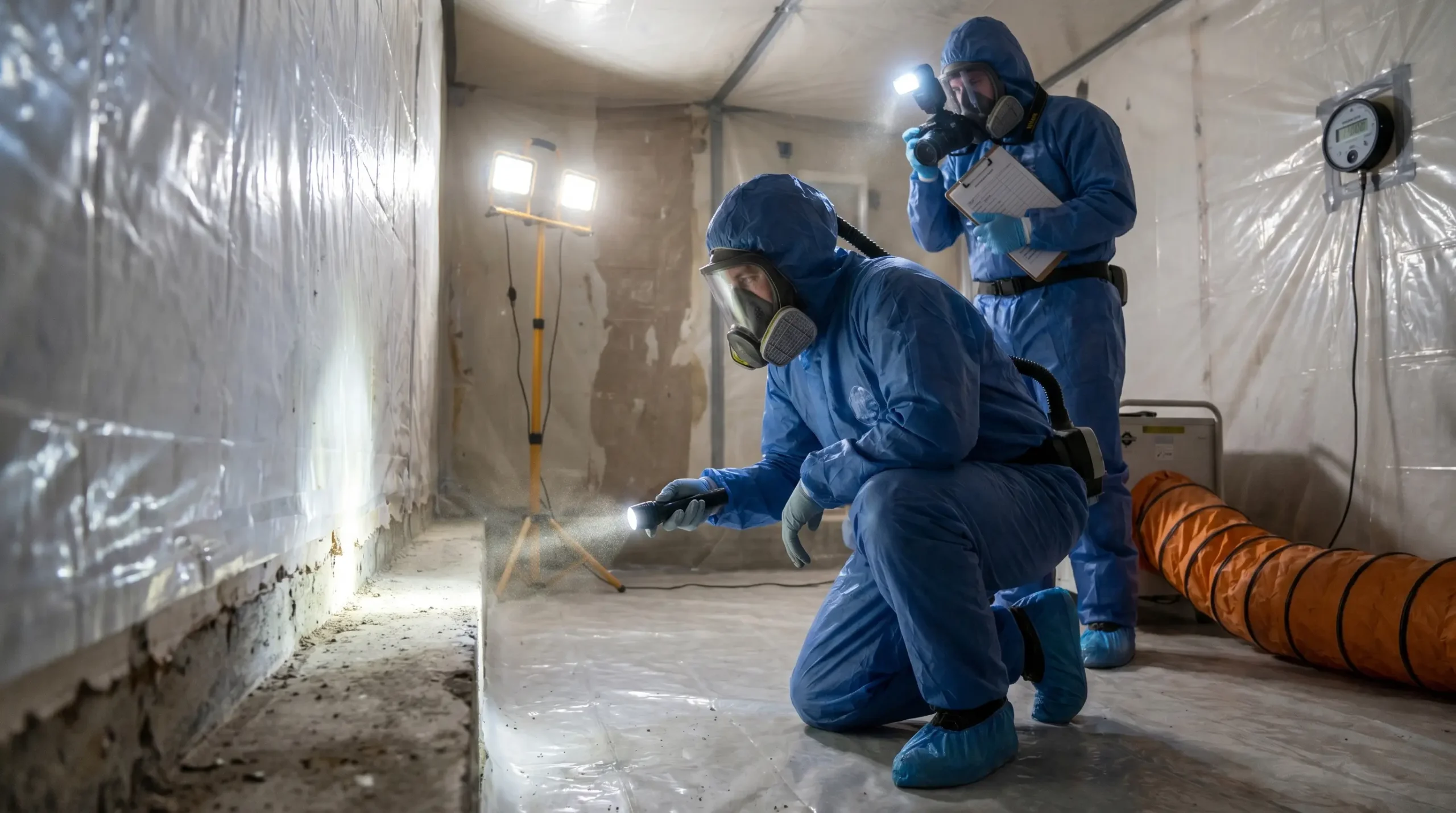
- Enclosure and containment — negative pressure enclosures with airlocks and bag locks, maintained under continuous monitoring.
- RPE and PPE — full respiratory protective equipment and disposable protective clothing, with decontamination units on site.
- Air monitoring — continuous monitoring during removal, plus background and reassurance sampling.
- Four-stage clearance — mandatory after licensed removal, conducted by a UKAS-accredited analyst: visual inspection, ambient air monitoring, reassurance sampling, and final certificate.
- Medical surveillance — every 2 years by an HSE-appointed doctor, with health records maintained for 40 years.
A common misunderstanding worth flagging: contractors sometimes assume all AIB removal is automatically licensed. The short-duration exception allows certain limited AIB tasks to be classified as NNLW — but this exception is narrower than many contractors realise. Over-reliance on it without a thorough risk assessment is a known enforcement trigger, because the 2-hour/7-day and 1-hour individual limits are strict, and any project that creeps beyond them becomes licensable by default. As stated in HSE's licensable work guidance, the burden of demonstrating that the exception applies rests with the employer.
What Counts as Non-Licensed Asbestos Work?
Non-licensed work is the lowest-risk category, but "non-licensed" does not mean "unregulated" — a distinction that matters because this is where untrained workers are most likely to disturb ACMs without adequate controls.
For work to qualify as non-licensed, all three of the following conditions must be met simultaneously:
- The work is sporadic and of low intensity.
- The control limit of 0.1 f/cm³ (4-hour TWA) will demonstrably not be exceeded.
- The ACMs are either being removed intact without deliberate breakage while firmly bound in a matrix, being sealed or encapsulated while in good condition, or being sampled or monitored.
Common non-licensed tasks include removing intact asbestos cement sheets (such as a garage roof), cleaning undamaged ACMs, drilling textured coatings for fixture installation using appropriate controls, and maintaining vinyl floor tiles containing asbestos.
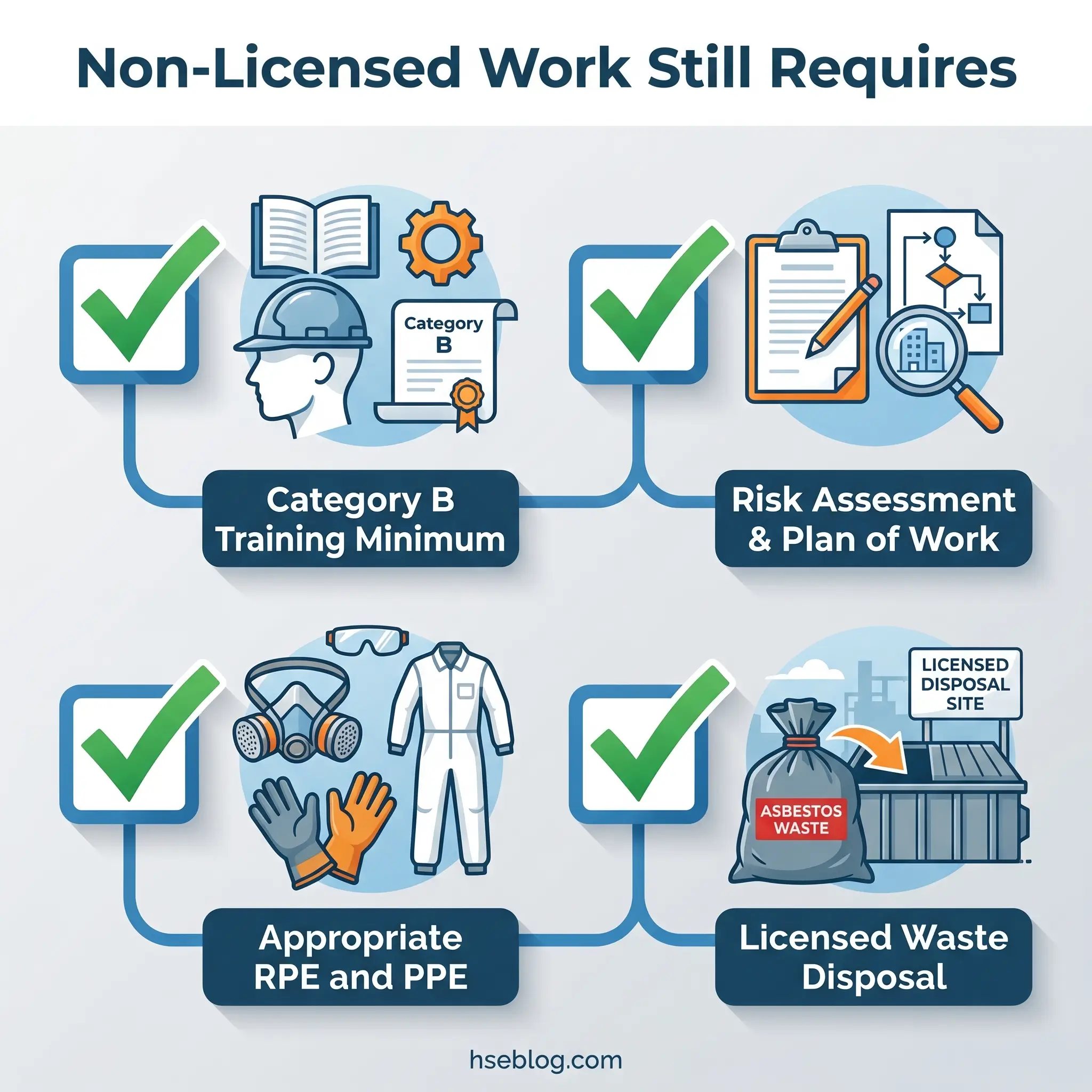
What Non-Licensed Work Still Requires
Even at this lowest tier, CAR 2012 imposes clear obligations:
- Training — Category B (non-licensed work) training at minimum. Category A asbestos awareness training teaches recognition and avoidance — it does not equip anyone to physically disturb or handle ACMs.
- Risk assessment and plan of work — both must be completed and documented before work begins.
- Appropriate RPE/PPE — specified by the task.
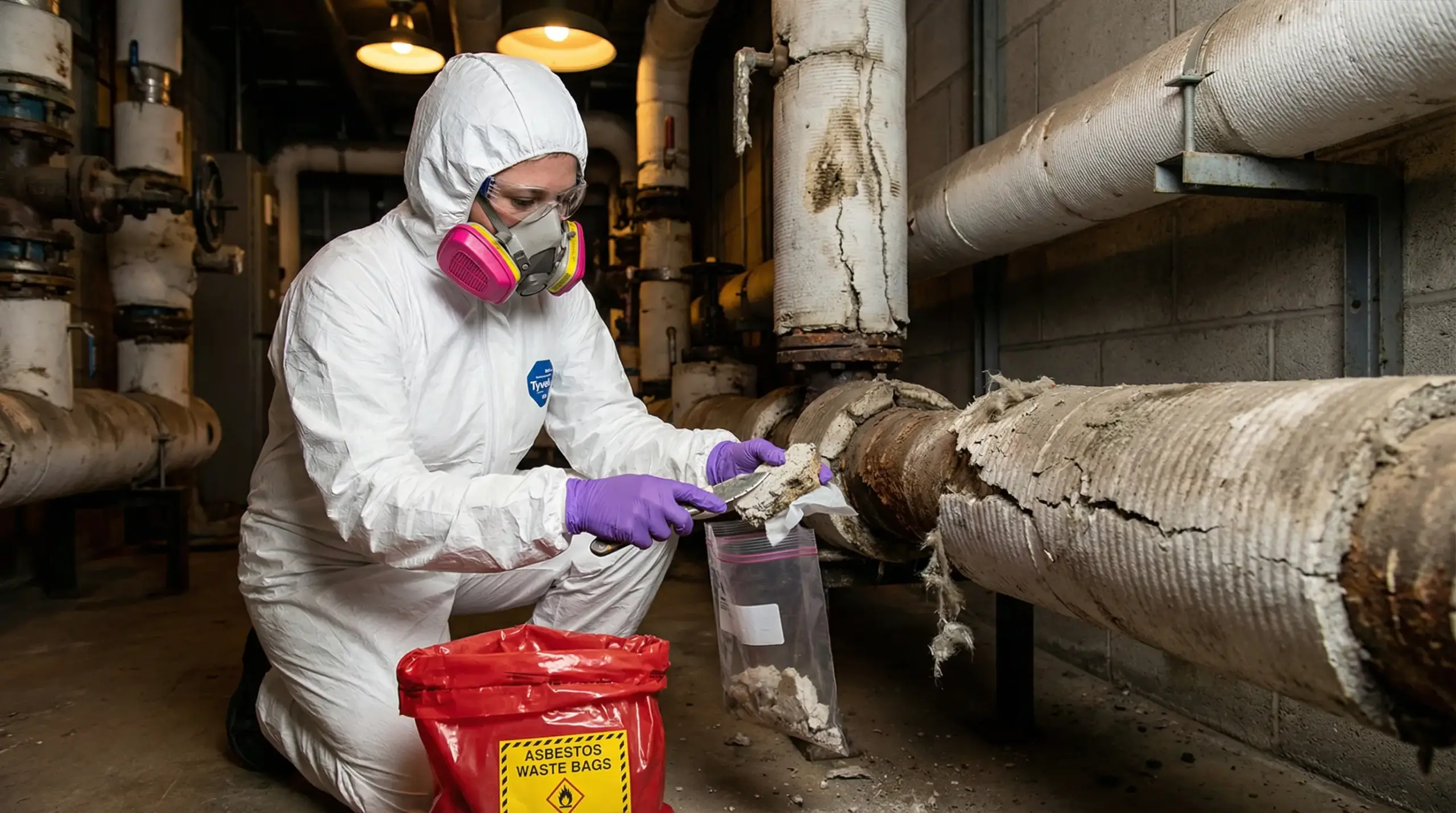
- Waste handling — double-bagged, labelled, and disposed of at a licensed hazardous waste facility.
No notification to HSE is required, and there is no mandatory medical surveillance obligation.
HSE's Asbestos Essentials task sheets provide task-specific method statements and equipment guidance for each common non-licensed activity. These are practical, free-to-access documents that map directly from the planned task to the required controls — and using them demonstrates compliance with the duty to follow good practice under ACOP L143.
The phrase "non-licensed" creates a dangerous perception gap. Because no licensing gateway exists for this category, there is no formal competence check before work begins. In the published enforcement record, non-licensed work is where tradespeople — electricians routing cables, plumbers accessing risers, roofers replacing sheets — are most frequently found disturbing ACMs without adequate training or controls. The licensing system catches incompetence in the licensed tier; the non-licensed tier relies entirely on the employer's compliance culture and the dutyholder's management plan.
What Is Notifiable Non-Licensed Work (NNLW) and Why Does It Matter?
NNLW is the most misunderstood category in the CAR 2012 framework — and the one where the most consequential misclassification errors occur in practice.
Introduced when CAR 2012 replaced the 2006 Regulations, NNLW occupies the space between licensed and standard non-licensed work. It does not require an HSE licence, but it imposes obligations that standard non-licensed work does not carry: formal notification, medical surveillance, and long-term record-keeping.
When Does Non-Licensed Work Become NNLW?
Work escalates from standard non-licensed to NNLW when normally non-licensed materials present an elevated risk of fibre release. This typically occurs because:
- The material has deteriorated, been weathered, or sustained fire or flood damage, degrading the binding matrix.
- The planned removal method will cause significant breakage of otherwise bound materials.
- The scale or duration of work exceeds what would qualify as genuinely sporadic and low intensity for that material type.
Specific examples include large-scale removal of textured decorative coatings via steaming or gelling, removal of substantially damaged asbestos cement, and short-duration work on AIB or minor pipe insulation damage that falls within the short-duration exception (no more than 2 hours in any 7-day period).
NNLW Obligations Beyond Standard Non-Licensed Work
The additional requirements are defined under Regulation 3(2) of CAR 2012:
- Notification — submit the online ASB NNLW1 form to the relevant enforcing authority before work starts. There is no minimum advance notice period, and no need to wait for permission — but the notification must be filed before work begins.
- Designated work areas — the work area must be designated and clearly marked.
- Medical surveillance — every 3 years. Unlike licensed work medicals (which must be conducted by an HSE-appointed doctor), NNLW medicals can be performed by any doctor. A licensed-work medical satisfies the NNLW requirement; the reverse is not true.
- Health records — must be maintained for 40 years.
The most consequential misclassification in practice involves damaged asbestos cement. A sheet of intact asbestos cement on a domestic garage roof is standard non-licensed work. The same material after fire damage — where the cement matrix has degraded and fibres are no longer firmly bound — is NNLW at minimum, because the friability has changed. The material is identical. The condition determines the category. Dutyholders who classify by material name alone, without assessing condition, consistently get this wrong.
How Do You Determine Which Category Your Asbestos Work Falls Into?
The classification decision follows a logical sequence — and the step most commonly skipped is assessing the disturbance potential of the planned work method.
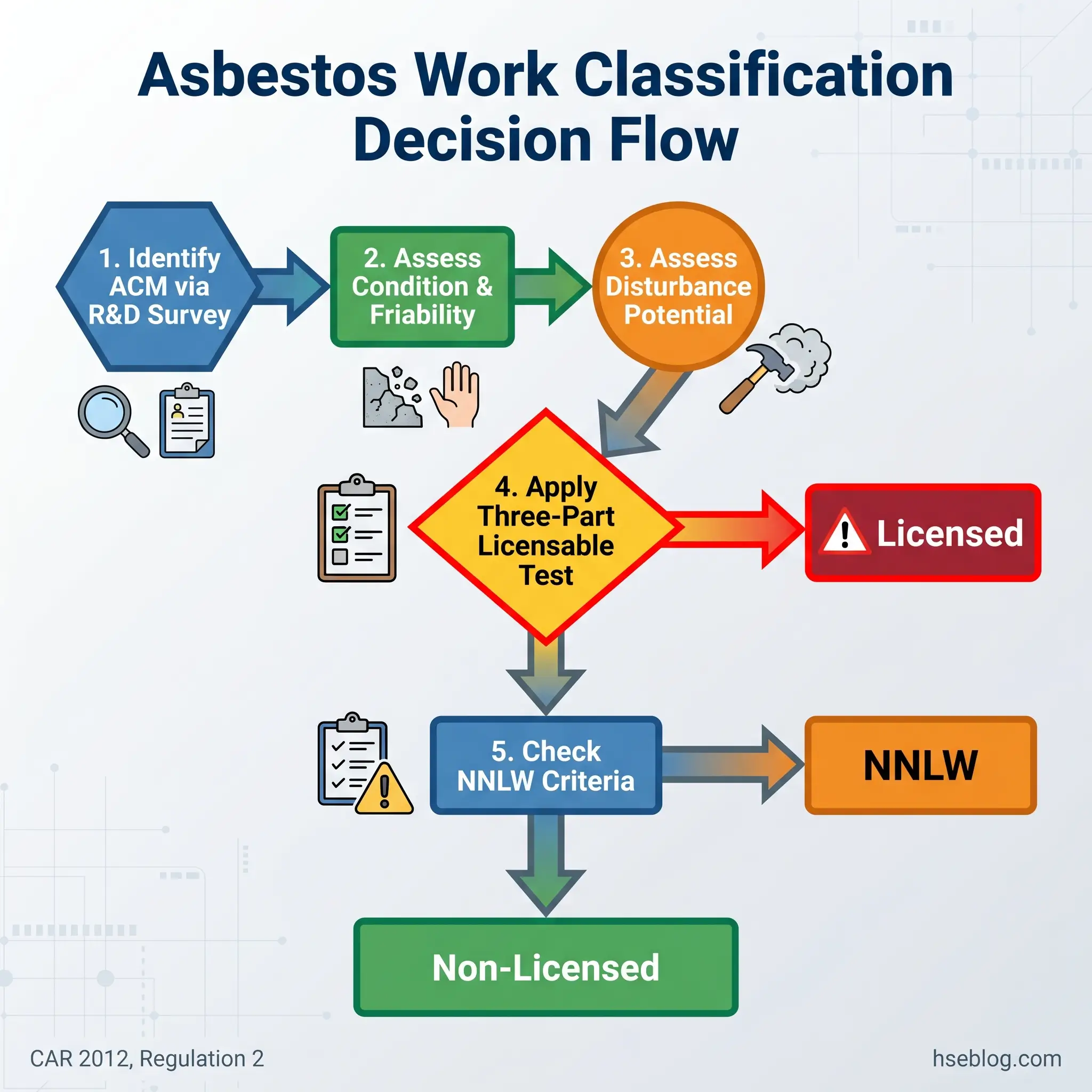
Step-by-Step Classification
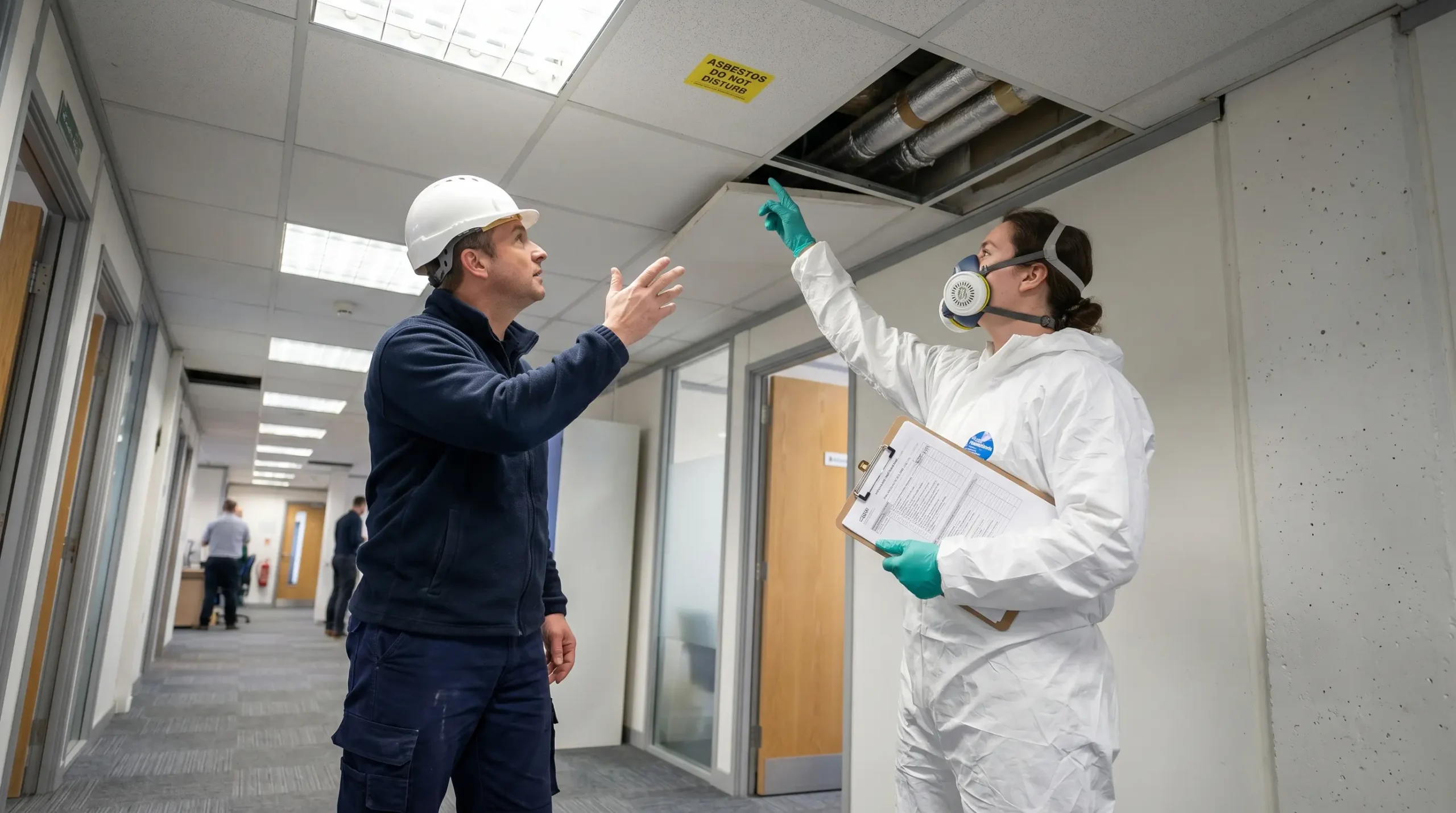
- Identify the ACM type via survey. A refurbishment/demolition (R&D) survey — not just a management survey — is required before any work that will disturb the building fabric (Regulation 5, CAR 2012). The R&D survey provides the material identification needed for classification.
- Assess the ACM's condition and friability. Is the binding matrix intact? Has the material been damaged by water, fire, age, or previous disturbance? A competent surveyor scores condition — this score directly influences classification.
- Assess the planned work method and its disturbance potential. This is the step where most classification errors originate. Dutyholders often classify based on ACM type alone ("it's asbestos cement, so it's non-licensed") without considering whether the planned removal method — cutting, breaking, drilling, or power-tool use — will degrade the matrix and release fibres at levels that change the risk profile.
- Apply the three-part licensable work test (Regulation 2). If the work meets any one of the three conditions — non-sporadic/non-low-intensity exposure, inability to demonstrate control limit compliance, or work on coatings/insulation/AIB that is not short duration — it is licensed.
- If not licensable, determine whether NNLW criteria are met. Does the material's condition or the work method create elevated risk beyond standard non-licensed levels? If yes, classify as NNLW.
- If neither licensed nor NNLW, classify as standard non-licensed.
The risk assessment must be carried out by a competent person and documented before work begins (Regulation 6). The classification decision rests with the dutyholder or employer — not the contractor. This is a legal responsibility. Where genuine uncertainty exists, the default should always be to classify upward to the higher-risk category. HSE's Asbestos Essentials guidance and ACOP L143 both support this precautionary approach.
Training Requirements for Each Category of Asbestos Work
Asbestos awareness training alone is never sufficient for any worker who will physically disturb an ACM — and this remains one of the most persistent compliance gaps across the industry.
Regulation 10 of CAR 2012 requires training to be adequate and proportionate to the nature and degree of exposure. HSE structures this into three tiers that map directly onto the three work categories.
| Training Category | Covers | Work Authorised | Typical Accreditation |
|---|---|---|---|
| Category A — Awareness | Recognition, avoidance, emergency response | None — workers who may encounter ACMs but will not disturb them | UKATA, IATP |
| Category B — Non-Licensed Work | Risk assessment, control measures, RPE/PPE use, wet-working methods, waste handling, decontamination, emergency procedures | Non-licensed work and NNLW | UKATA, IATP |
| Category C — Licensed Work | All of Category B plus practical enclosure work, negative pressure unit operation, four-stage clearance procedures | Licensed work (under an HSE licence) | ACAD; typically leads to NVQ Level 2 and ACAD CSCS Skilled Worker Card |
The Awareness-Training Trap
The most common training-related compliance failure is employers treating Category A awareness training as sufficient for Category B tasks. This affects tradespeople — electricians, plumbers, carpenters — who encounter ACMs during their primary trade work and need to move, drill into, or work around materials they must disturb.
Category A tells them what to avoid. It does not equip them to work safely with or around ACMs when disturbance is unavoidable. The gap between "I can recognise asbestos cement" and "I can safely remove a section of asbestos cement sheeting using wet methods and appropriate RPE" is substantial — and it is precisely the gap between Category A and Category B.
Annual refresher training is expected across all categories. UKATA, IATP, and ACAD are the main recognised training accreditation bodies.
Notification, Documentation, and Record-Keeping Obligations
The documentation burden differs sharply across the three categories — and NNLW record-keeping obligations are frequently underestimated because they mirror licensed work's 40-year retention period.
Licensed Work Documentation
- ASB5 notification — submitted 14 days before work starts.
- Plan of work and risk assessment — detailed, task-specific documents.
- Medical records — every 2 years by HSE-appointed doctor.
- Health records — kept for 40 years.
- Air monitoring records — from continuous and reassurance sampling.
- Four-stage clearance certificate — issued by UKAS-accredited analyst.
- Waste consignment notes — kept for 3 years minimum.
NNLW Documentation
- ASB NNLW1 notification — submitted online before work starts (no advance period required).
- Risk assessment and plan of work — documented before work begins.
- Medical records — every 3 years.
- Health records — kept for 40 years.
- Designated area records — including signage documentation.
Non-Licensed Work Documentation
- Risk assessment and plan of work — documented.
- Records of workers and exposure levels — recommended but not mandatory.
- Waste disposal documentation — consignment notes from licensed facility.
The enforcing authority receiving notifications may be HSE, the local authority, or the Office of Rail and Road, depending on premises type. The online notification system routes submissions to the correct body automatically.
A pattern worth noting from the audit record: NNLW health records frequently exist only as copies of the notification form, which may lack individual worker exposure estimates. While HSE accepts this as a minimum, the 40-year retention obligation means these records may need to support future occupational disease claims — for diseases with latency periods of 15 to 60 years. Practitioners should ensure records are complete enough to be clinically and legally useful decades after the work is finished.

Penalties for Misclassifying Asbestos Work
Enforcement focus has shifted in recent years from the removal phase to the pre-work classification phase — and the consequences of getting the classification wrong extend well beyond a regulatory fine.
Carrying out licensable asbestos work without a licence is a criminal offence under Regulation 8 of CAR 2012. HSE does not treat this as an administrative oversight. In 2024/25, HSE completed 246 criminal prosecutions across all health and safety offences, achieving a 96% conviction rate and securing fines exceeding £33 million (HSE via DAC Beachcroft, 2025). Asbestos management was a stated inspection priority that year, with over 600 duty-to-manage inspections and 713 licensed contractor inspections conducted (HSE, 2025).
Penalties under the Sentencing Council guidelines for health and safety offences include unlimited fines, scaled to organisational turnover and culpability. For the most serious cases — particularly those involving deliberate disregard for licensing requirements — imprisonment of up to 2 years is available in the Crown Court. Directors and dutyholders can be personally liable, and HSE has established precedent for imprisoning company directors who failed to appoint licensed contractors for licensable work.
The enforcement trajectory matters for how practitioners think about classification risk. HSE inspectors are increasingly scrutinising whether the initial decision to treat work as non-licensed was justified by the risk assessment — not just whether the removal itself was competently executed. A project where the removal went smoothly but the classification was wrong is still a compliance failure, because the workers were denied the protections (notification, medical surveillance, clearance testing) the regulations require.
Beyond criminal liability, exposure resulting from misclassified work creates long-tail civil claims. Mesothelioma, asbestosis, and asbestos-related lung cancer have latency periods of 15 to 60 years. A classification error made today may result in a civil claim in 2060. The 2,218 mesothelioma deaths recorded in Great Britain in 2023 (HSE, 2025) — while declining from the 2011–2020 average — are a standing reminder that the consequences of asbestos exposure are measured in decades, not project timelines.
HSE's 2025/26 Business Plan reinforces this direction, placing asbestos on the front page of its strategic priorities. The plan commits to over 700 planned inspections on duty-to-manage obligations in public sector buildings and 800 inspections of licensed asbestos contractor compliance (BOHS, 2025). The November 2025 consultation on proposed CAR 2012 amendments included a specific proposal to clarify the definition and management of NNLW — a signal that the regulator recognises the classification ambiguity that dutyholders face and intends to tighten the framework (HSE, 2025).
Frequently Asked Questions
Can a homeowner remove asbestos cement from their own property without a licence?
In domestic premises, a homeowner can remove non-licensed ACMs — such as intact asbestos cement from a garage roof — without a licence. They must still follow HSE Asbestos Essentials task sheet guidance, wear appropriate RPE and PPE, use wet-working methods to suppress dust, and dispose of waste correctly at a licensed hazardous waste facility. If the material is damaged, friable, or if the work involves licensed materials (sprayed coatings, insulation, AIB), a licensed contractor must be used regardless of the property's domestic status.
What is the asbestos control limit in the UK?
The control limit under Regulation 2 of CAR 2012 is 0.1 asbestos fibres per cubic centimetre of air (0.1 f/cm³), averaged over a continuous 4-hour period. The sporadic and low intensity short-term threshold is 0.6 f/cm³ measured over 10 minutes. Both limits apply to all six regulated asbestos fibre types and form part of the three-part test that determines whether work is licensable.
Is asbestos awareness training enough to remove asbestos cement?
No. Category A awareness training teaches recognition and avoidance — it does not cover safe handling, removal techniques, RPE selection, wet-working methods, or decontamination procedures. Any worker who will physically disturb or remove ACMs, even non-licensed materials like intact asbestos cement, requires Category B training at minimum. HSE has specifically addressed this gap in its guidance, and it remains a common finding in enforcement inspections.
Do I need to notify HSE for non-licensed asbestos work?
Standard non-licensed work does not require notification. However, if the work qualifies as NNLW — for example, large-scale removal of textured decorative coatings, or removal of damaged asbestos cement where the matrix has deteriorated — notification via the online ASB NNLW1 form is required before work starts. There is no minimum advance notice period, and there is no need to wait for permission before beginning, but the form must be submitted.
What is the difference between a management survey and a refurbishment/demolition survey?
A management survey identifies ACMs during normal building occupation to support ongoing management — it is non-intrusive and does not involve destructive inspection. A refurbishment/demolition (R&D) survey is more intrusive and is specifically required before any work that will disturb the building fabric. The R&D survey provides the detailed material identification and condition assessment needed to classify work as licensed, NNLW, or non-licensed. Classification without an R&D survey — when one is required — is a regulatory failure at the outset.
Can a licensed contractor also do non-licensed asbestos work?
Yes. Licensed contractors routinely carry out NNLW and non-licensed work alongside their licensed projects. However, holding a licence does not exempt a contractor from NNLW notification requirements. A licensed contractor performing NNLW must still submit a separate ASB NNLW1 notification before that specific work begins. The licence covers the contractor's competence and systems; it does not replace the task-specific notification obligations.
Conclusion
The classification decision before asbestos work begins is not an administrative formality — it is the single control that determines whether workers receive the protections CAR 2012 was designed to provide. Getting it right requires a competent person to assess the ACM type, its condition, and the disturbance potential of the planned work method — not just match a material name to a category list.
The three-category framework exists because asbestos risk is not binary. NNLW was introduced precisely because certain work sits above non-licensed risk levels without reaching the threshold for full licensing. Treating the classification as a binary licensed-or-not decision — as many dutyholders still do — means NNLW work either gets over-specified at unnecessary cost or, far worse, under-specified without the notification, medical surveillance, and record-keeping that regulation requires.
Before the next asbestos project on your site, ask a specific question: was the classification based on the material's current condition and the planned disturbance method, or just its name on the survey report? If it was just the name, the classification may be wrong — and the consequences of that error will outlast the project by decades.
Regulatory content in this article reflects general HSE professional understanding of UK (Great Britain) requirements under CAR 2012 as of 2025. It is not legal advice. Specific compliance questions, enforcement situations, or prosecution risk should be directed to qualified legal counsel in the applicable jurisdiction.