
TL;DR
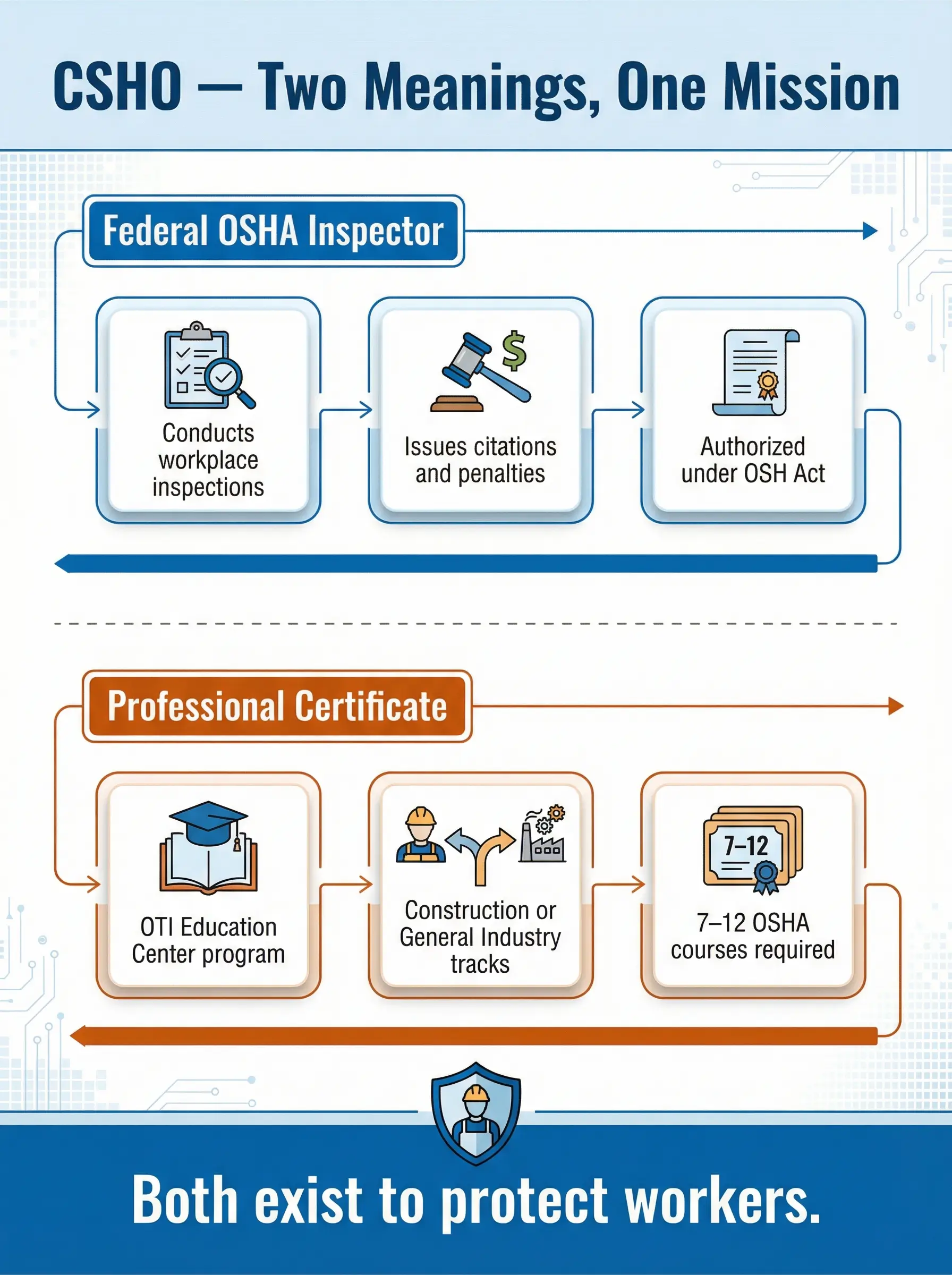
- CSHO carries two distinct meanings: It refers to OSHA’s federal Compliance Safety and Health Officers who conduct workplace inspections, and separately to a nationally recognized certificate program offered through OSHA Training Institute Education Centers for private-sector safety professionals.
- Federal CSHOs are OSHA’s enforcement frontline: These inspectors have legal authority to enter workplaces without advance notice, document violations, interview employees confidentially, and recommend citations that carry penalties up to $165,514 per willful violation.
- The CSHO certificate builds deep regulatory competence: The program requires completion of 7–12 OSHA courses across Construction or General Industry tracks, covering standards interpretation, hazard recognition, industrial hygiene, and program development — all within a five-year window.
- Understanding CSHOs protects your operation: Whether you encounter one during an unannounced inspection or pursue the credential yourself, knowing how CSHOs operate directly affects your ability to maintain compliance, manage enforcement risk, and build credible safety leadership.
- OSHA conducted over 34,600 inspections in FY 2024 alone: Every one of those inspections was led by a CSHO — making this role the single most consequential point of contact between federal enforcement and workplace safety performance.
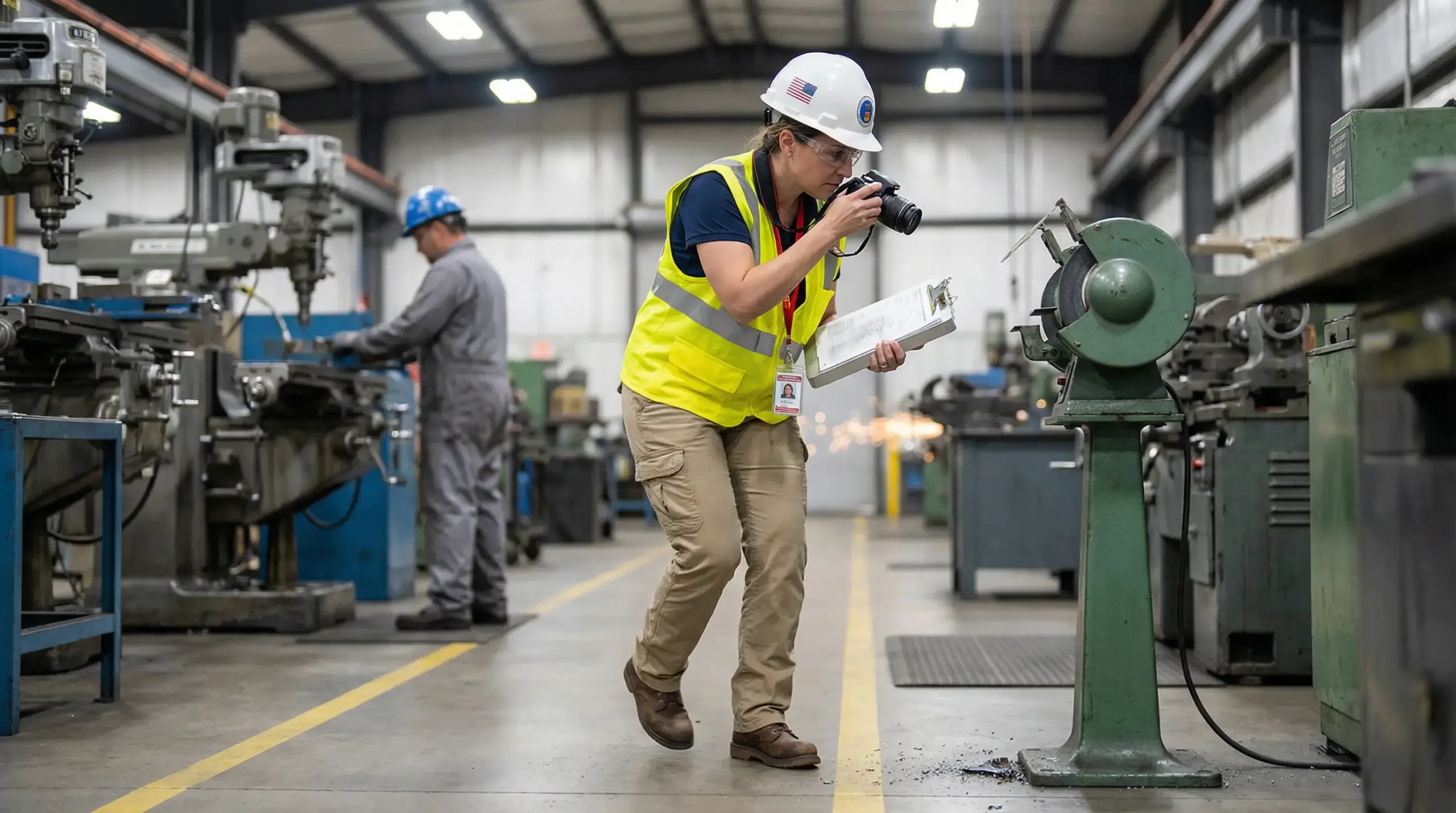
I was reviewing a contractor’s excavation work on a highway expansion project when a white government sedan pulled into the site entrance. Two people stepped out — clipboards in hand, photo IDs visible on lanyards, hard hats already on. Before the site superintendent could finish his phone call, they had already started scanning the perimeter, photographing the open trench from the public right-of-way. The lead inspector introduced herself as a Compliance Safety and Health Officer and handed over her credentials. Within minutes, our entire site operation shifted from production mode to inspection mode — and that shift exposed gaps we didn’t know we had.
That visit changed how I prepared every site I managed afterward. The term “CSHO” — Certified Safety and Health Official or, in OSHA’s federal enforcement context, Compliance Safety and Health Officer — is one of the most consequential designations in occupational safety. It represents both the people who enforce federal workplace safety law and a rigorous professional certificate that sharpens private-sector practitioners. Whether a CSHO shows up at your gate with inspection authority or you pursue the credential to strengthen your own competence, understanding this role is essential for anyone responsible for keeping workers alive.
What Exactly Is a Certified Safety and Health Official (CSHO)?
A Certified Safety and Health Official is a safety professional who has completed a structured certificate program administered through OSHA Training Institute (OTI) Education Centers across the United States. The program provides broad-based, regulation-grounded education in occupational safety and health — covering standards interpretation, hazard recognition, employee rights, employer accountability, and safety program development. It is offered in two major tracks: Construction and General Industry.
The term “CSHO” also carries a separate — and arguably more high-stakes — meaning within federal enforcement. OSHA’s own field inspectors hold the official title of Compliance Safety and Health Officer, abbreviated identically as CSHO. These are federal employees authorized under the Occupational Safety and Health Act of 1970 to enter and inspect any covered workplace, investigate complaints and fatalities, document violations, and recommend enforcement actions.
The critical distinction matters for practitioners on both sides of the clipboard:
- The CSHO certificate is a voluntary professional credential earned by completing a curriculum of OSHA courses. It signals regulatory competence and commitment to safety education. It does not grant enforcement authority.
- The CSHO federal role is a government position within OSHA’s enforcement structure. These officers carry legal authority to conduct inspections, issue citations, and propose penalties. Their training is internal to OSHA and follows a separate developmental program mandated by the agency’s Directorate of Training and Education.
29 CFR 1903.22 defines a Compliance Safety and Health Officer as “a person authorized by the Occupational Safety and Health Administration, U.S. Department of Labor, to conduct inspections.”
Pro Tip: When someone on your site says “the CSHO is here,” they almost always mean a federal OSHA inspector — not a certificate holder. Know the difference, because your response protocol depends entirely on which one just walked through your gate.
The Federal CSHO: OSHA’s Enforcement Frontline
Understanding how a federal CSHO operates is not academic — it directly determines how your facility or project handles the most consequential safety interaction it will face. These officers are the primary mechanism through which OSHA enforces the OSH Act across more than seven million worksites nationwide.
Who They Are
Federal CSHOs are trained professionals employed by the U.S. Department of Labor. Their backgrounds typically include safety engineering, industrial hygiene, toxicology, or occupational medicine. The following characteristics define the role in practice:
- Legal entry authority: The OSH Act grants CSHOs the right to enter and inspect any covered workplace at reasonable times without prior arrangement. Advance notice is prohibited in most cases — and any CSHO who tips off an employer about an upcoming inspection faces fines and potential imprisonment.
- Dual specialization: CSHOs typically specialize in either safety compliance or industrial hygiene, though their training program requires cross-discipline familiarity. Safety-focused officers concentrate on physical hazards, fall protection, machine guarding, and electrical standards. Industrial hygiene officers focus on chemical exposures, noise, respiratory hazards, and air monitoring.
- Credential verification: Upon arrival, a CSHO must present official U.S. Department of Labor photo identification with a serial number. Employers have the right to verify these credentials by contacting the nearest OSHA Area Office before granting access.
- Rigorous developmental training: New-hire CSHOs undergo a mandatory developmental program that includes the OSHA #100 Initial Compliance Course, standards courses, inspection techniques training, and supervised field inspections across multiple industry types before operating independently.
What Triggers a CSHO Visit
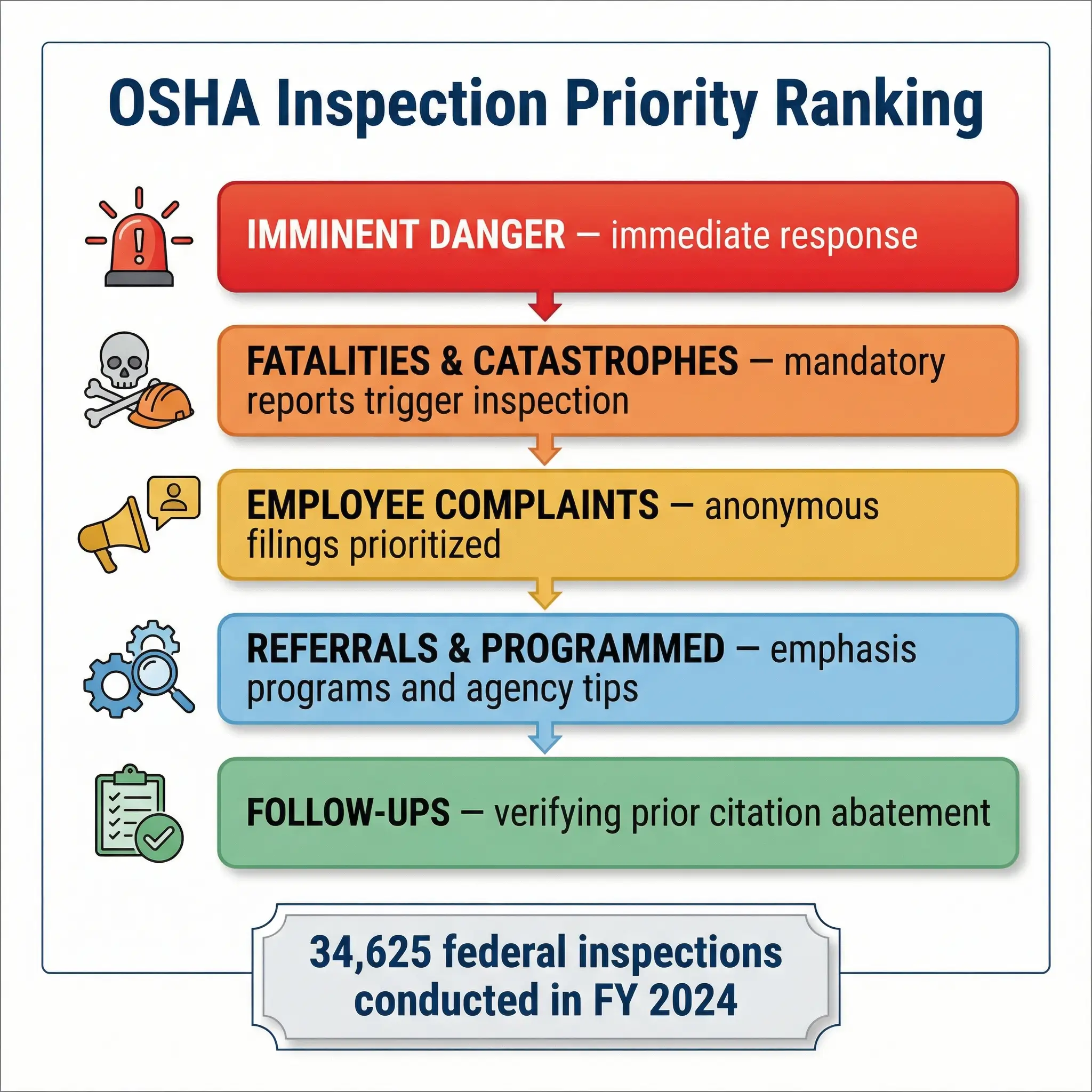
Not every worksite gets inspected — but any covered worksite can be. OSHA prioritizes inspections using a hierarchy that every safety professional should know cold:
- Imminent danger situations: Conditions where death or serious physical harm could occur immediately. These trigger the fastest OSHA response.
- Fatalities and catastrophes: Employers must report workplace fatalities within 8 hours and hospitalizations, amputations, or eye losses within 24 hours. These reports almost always trigger a CSHO inspection.
- Employee complaints: Workers have the legal right to file anonymous complaints about unsafe conditions. OSHA treats these as high-priority triggers.
- Referrals: Other federal, state, or local agencies, media reports, or organizations can refer worksites for inspection.
- Programmed inspections: OSHA targets high-hazard industries through emphasis programs — construction, process safety, heat illness, silica exposure, and fall protection are perennial focus areas.
- Follow-up inspections: If your site was previously cited, a CSHO may return to verify that abatement has actually occurred.
Pro Tip: I once watched a CSHO drive past a construction site three times before pulling in. She later told me she was observing from the public road first — checking the condition of perimeter fencing, fall protection on visible scaffolds, and whether workers on elevated platforms were tied off. The inspection started before she ever knocked on the trailer door. Your site’s “curb appeal” is your first impression with enforcement.
How an OSHA Inspection Actually Works — The CSHO Process
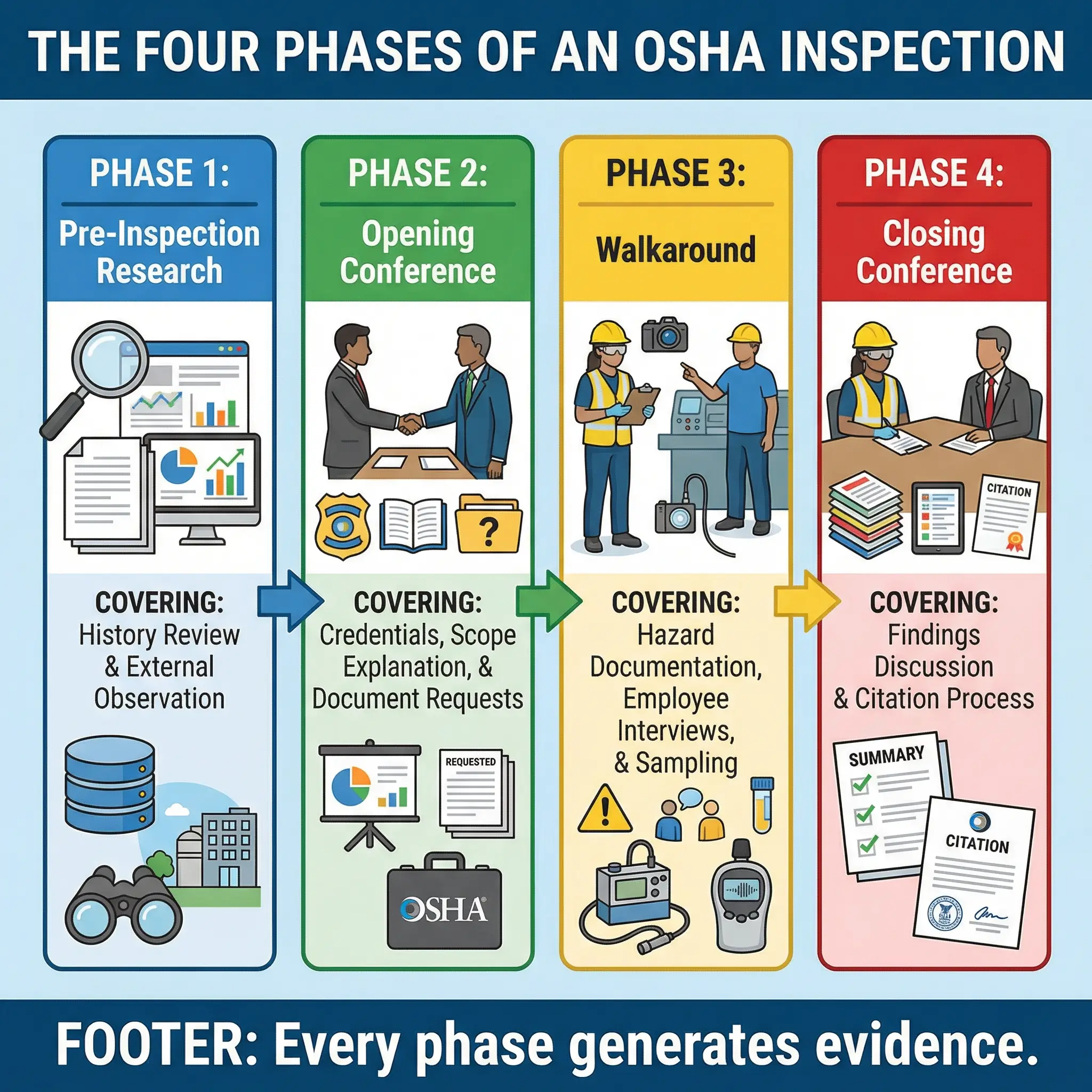
I have been on the receiving end of OSHA inspections more times than I would prefer to count. Every single one followed the same four-phase structure, and the CSHOs who conducted them were methodical, observant, and thoroughly prepared before they ever reached the front gate.
Phase 1: Pre-Inspection Research
Before arriving, the CSHO reviews the establishment’s inspection history in OSHA’s database. This background check covers prior citations, complaint records, injury and illness logs, and any previous enforcement actions — including violations received in State Plan jurisdictions. The following elements shape the CSHO’s approach before they set foot on your property:
- Historical violation patterns: Repeat violations within five years trigger elevated scrutiny and significantly higher penalties — up to $165,514 per repeat citation.
- Industry hazard profile: The CSHO arrives with knowledge of the most common hazards in your sector and the specific standards that apply.
- Exterior observation: Many CSHOs observe the worksite from public areas first, noting visible hazards, housekeeping conditions, and whether workers are using required PPE. Photographs taken from the road are admissible evidence.
Phase 2: Opening Conference
Once on-site, the CSHO presents credentials and requests to meet with an employer representative. OSHA typically allows up to one hour for the employer to make someone available. The opening conference covers the following ground:
- Inspection scope and purpose: The CSHO explains why your site was selected — complaint, referral, programmed inspection, or fatality/catastrophe response.
- Employer and employee rights: The CSHO distributes OSHA publications covering rights and responsibilities, including anti-retaliation protections under Section 11(c) of the OSH Act.
- Document requests: Expect immediate requests for OSHA 300 logs, safety training records, written safety programs, and any relevant permits.
- Representative designation: Both the employer and employees have the right to designate a representative to accompany the CSHO during the walkaround.
Phase 3: Walkaround Inspection
This is where the real work happens. The CSHO physically inspects the worksite, and this phase demands your full attention because everything observed becomes potential evidence:
- Hazard documentation: The CSHO photographs, videos, and notes working conditions, equipment, and employee practices. Environmental samples — air monitoring, noise dosimetry, surface wipe samples — may be collected for health-related inspections.
- Employee interviews: The CSHO conducts confidential, private interviews with workers. Employees must answer truthfully but can decline specific questions. Employers cannot be present during these interviews, and any retaliation against participating employees is a federal violation.
- Quick-fix opportunities: If the CSHO identifies violations that the employer corrects immediately during the inspection, a penalty reduction may apply. This is a tactical advantage that prepared employers use — but only if abatement is genuine and verified on the spot.
- Scope escalation: If a CSHO conducting a focused inspection discovers that the number and severity of hazards indicates an inadequate safety program, the inspection scope can expand to a comprehensive review of the entire operation.
Phase 4: Closing Conference
The closing conference typically occurs one to six weeks after the physical inspection, often by phone. The CSHO discusses findings, explains any apparent violations, and outlines the citation and penalty process. No citations are issued during the inspection itself — they arrive later, formally, with proposed penalties and abatement deadlines.
| Inspection Phase | What the CSHO Does | Your Response |
|---|---|---|
| Pre-Inspection | Reviews your history, observes from public areas | Maintain visible compliance at all times — perimeter, signage, PPE |
| Opening Conference | Presents credentials, explains scope, requests records | Verify credentials, designate a representative, have records ready |
| Walkaround | Documents hazards, interviews employees, collects samples | Accompany the CSHO, take parallel notes, correct hazards immediately |
| Closing Conference | Discusses findings, explains citation process | Listen carefully, document everything, prepare for formal response |
OSHA Field Operations Manual, Chapter 3: “It is important that the Compliance Safety and Health Officer adequately prepare for each inspection. Due to the wide variety of industries and associated hazards likely to be encountered, pre-inspection preparation is essential to the conduct of a quality inspection.”
The CSHO Certificate Program: Building Regulatory Competence
Separate from the federal enforcement role, the CSHO certificate is a professional development program that safety practitioners pursue to deepen their understanding of OSHA regulations and build demonstrable competence. I earned mine years into my career, and the coursework reshaped how I read standards, structured safety programs, and prepared sites for regulatory scrutiny.
Program Structure and Tracks
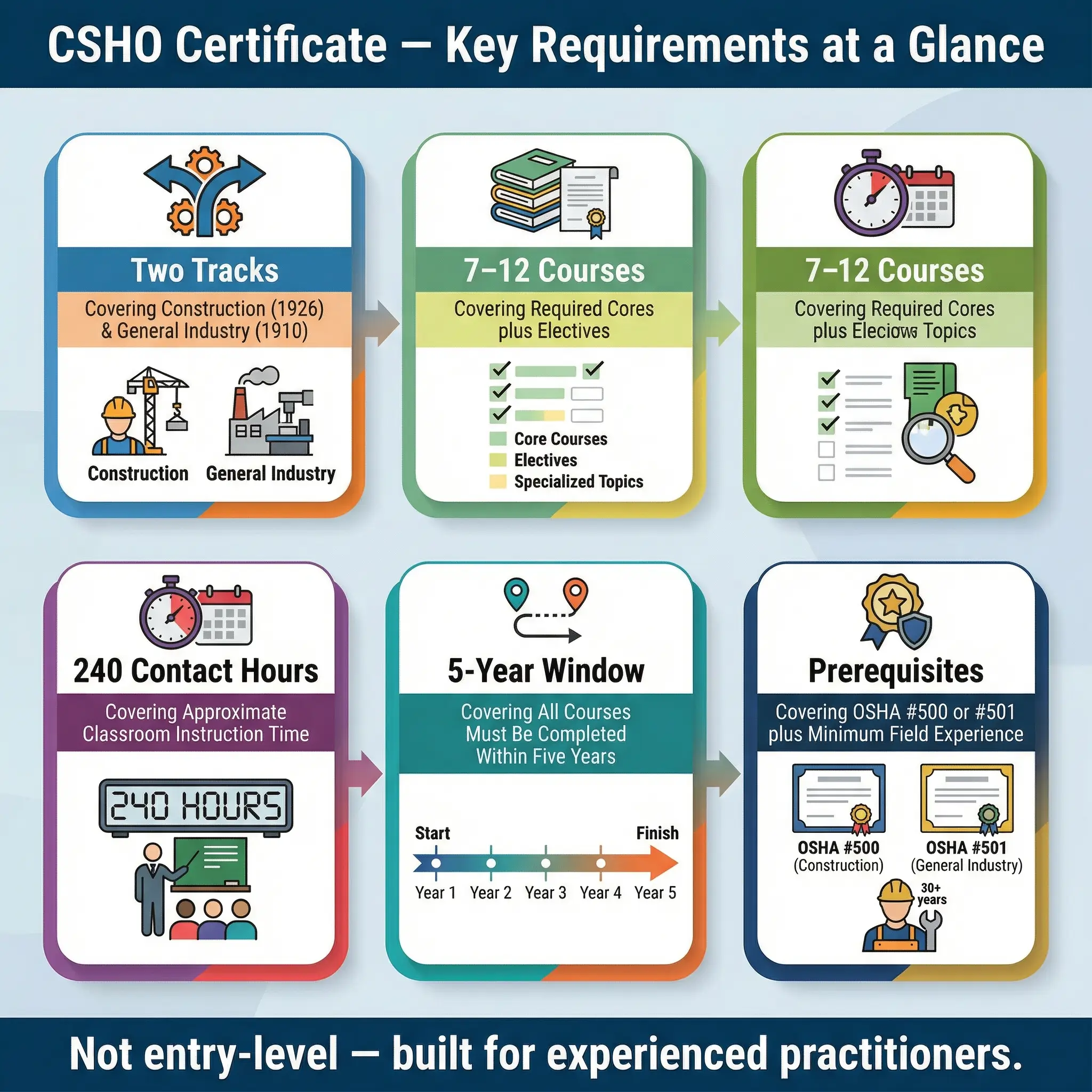
The CSHO certificate is offered through OSHA Training Institute Education Centers located across the United States. The program is structured around two industry-specific tracks, and candidates must complete a defined curriculum of required and elective courses within a five-year window:
- Construction Track: Focuses on 29 CFR 1926 standards — excavation and trenching, scaffolding, fall protection, electrical hazards, crane operations, and construction-specific hazard communication. Typically requires 9 core courses plus 3 electives.
- General Industry Track: Focuses on 29 CFR 1910 standards — machine guarding, permit-required confined spaces, ergonomics, electrical standards, lockout/tagout, and industrial hygiene. Requires a similar course structure with general industry–specific content.
Both tracks share common foundational courses that bridge the two disciplines:
- OSHA #510 — Occupational Safety and Health Standards for the Construction Industry
- OSHA #511 — Occupational Safety and Health Standards for General Industry
- OSHA #521 — OSHA Guide to Industrial Hygiene
- OSHA #7845 — Recordkeeping Rule Seminar
- OSHA #500 or #501 — Authorized Outreach Trainer courses (Construction or General Industry)
Elective Flexibility
The elective portion allows candidates to tailor the credential to their operational context. Common elective choices include:
- OSHA #2015 — Hazardous Materials
- OSHA #2225 — Respiratory Protection
- OSHA #2264 — Permit-Required Confined Space Entry
- OSHA #2255 — Principles of Ergonomics
- OSHA #7210 — Pandemic Illness Preparedness (added as an elective option in 2020)
- OSHA #7215 — Silica in Construction, Maritime, and General Industries
At some education centers, two OSHA #7000-series short courses may substitute for one full elective, providing additional flexibility for professionals who need targeted knowledge without committing to a full-length course.
Prerequisites and Completion Requirements
The program is not entry-level. The prerequisites and completion standards ensure that CSHO holders carry genuine field credibility:
- Minimum 5 years of experience overseeing safety operations (required by some OTI Education Centers)
- Prerequisite courses: OSHA #500 or #501 (Authorized Outreach Trainer) must be completed before enrollment
- At least 50% of courses must be completed at a single OTI Education Center (rules vary by center — some require the final two courses be taken at the issuing center)
- Five-year completion window: All courses must be completed within five years of enrollment. Courses taken at other accredited OTI Education Centers within two years prior to enrollment may transfer
- Approximately 240 contact hours of instruction across the full curriculum
Pro Tip: The five-year clock is the single biggest trap I see professionals fall into. People start the program, take two or three courses, then let work demands push the rest out for years. By the time they circle back, their earliest courses have expired. Map your course schedule against project timelines before you enroll — and treat those training dates like permit renewals. Non-negotiable.
CSHO Certificate vs. Other Safety Credentials: Where Does It Fit?
Safety professionals often ask how the CSHO stacks up against other credentials in the field. The answer depends entirely on what you need the credential to do for you — and the honest comparison reveals distinct roles for each.
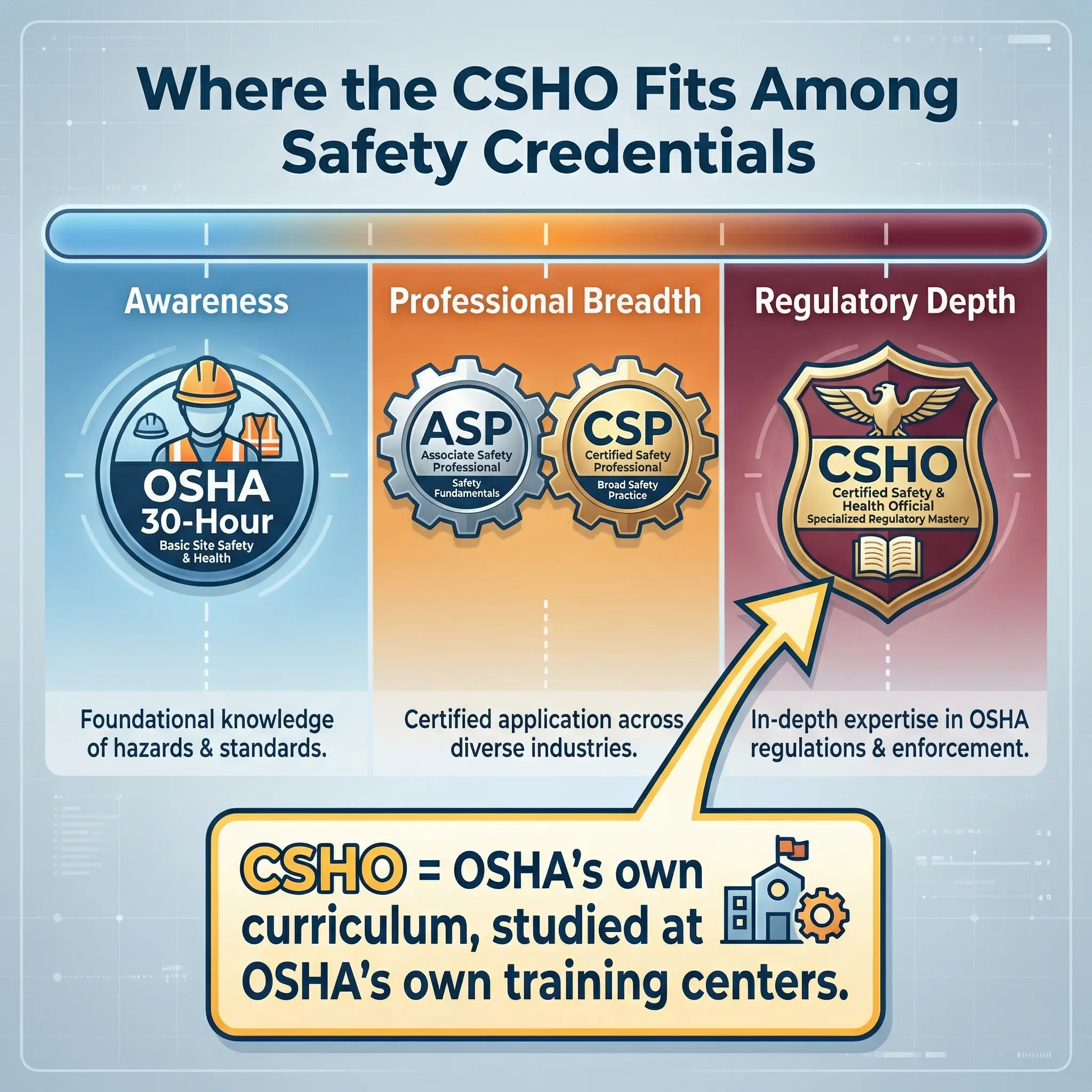
The following table provides a practical comparison of the CSHO against the most commonly referenced safety credentials:
| Credential | Issuing Body | Focus Area | Exam Required? | Experience Requirement | Best For |
|---|---|---|---|---|---|
| CSHO | OTI Education Centers | OSHA regulation mastery, standards application | No formal exam — course-based | 5 years (at some centers) | Practitioners needing deep OSHA regulatory competence |
| CSP (Certified Safety Professional) | BCSP | Broad safety management, risk assessment | Yes — rigorous proctored exam | Bachelor’s + 4 years safety experience | Career credentialing, professional recognition |
| ASP (Associate Safety Professional) | BCSP | Foundational safety knowledge | Yes — proctored exam | Bachelor’s degree (experience not required) | Entry to mid-level professionals building toward CSP |
| OSHA 30-Hour | OSHA Outreach Program | Hazard awareness — Construction or General Industry | No — completion-based | None | Workers and supervisors needing baseline safety awareness |
| NEBOSH International General Certificate | NEBOSH (UK) | International health and safety management | Yes — written exams + practical | None (recommended experience) | Professionals working across international jurisdictions |
The CSHO occupies a unique niche. It is not a certification in the traditional sense — there is no standardized exam administered by an independent board. It is a structured certificate of completion that demonstrates extensive coursework in OSHA’s own training curriculum. That distinction matters for credibility in regulatory contexts: a CSHO holder has studied the same material that OSHA trains its own compliance officers on.
I have worked with safety directors who held both the CSP and the CSHO, and the combination made them formidable. The CSP gave them broad professional recognition. The CSHO gave them granular regulatory knowledge that made them effective during actual OSHA interactions — knowing not just what the standard says, but how enforcement officers interpret and apply it in the field.
What a CSHO Inspection Means for Your Operation — Penalties, Citations, and Consequences
No article about CSHOs is complete without addressing what happens when the inspection is over and the findings arrive in the mail. I have helped organizations respond to OSHA citations ranging from minor recordkeeping deficiencies to six-figure willful violation penalties — and the financial and operational consequences are always more significant than employers anticipate.
The Citation and Penalty Framework
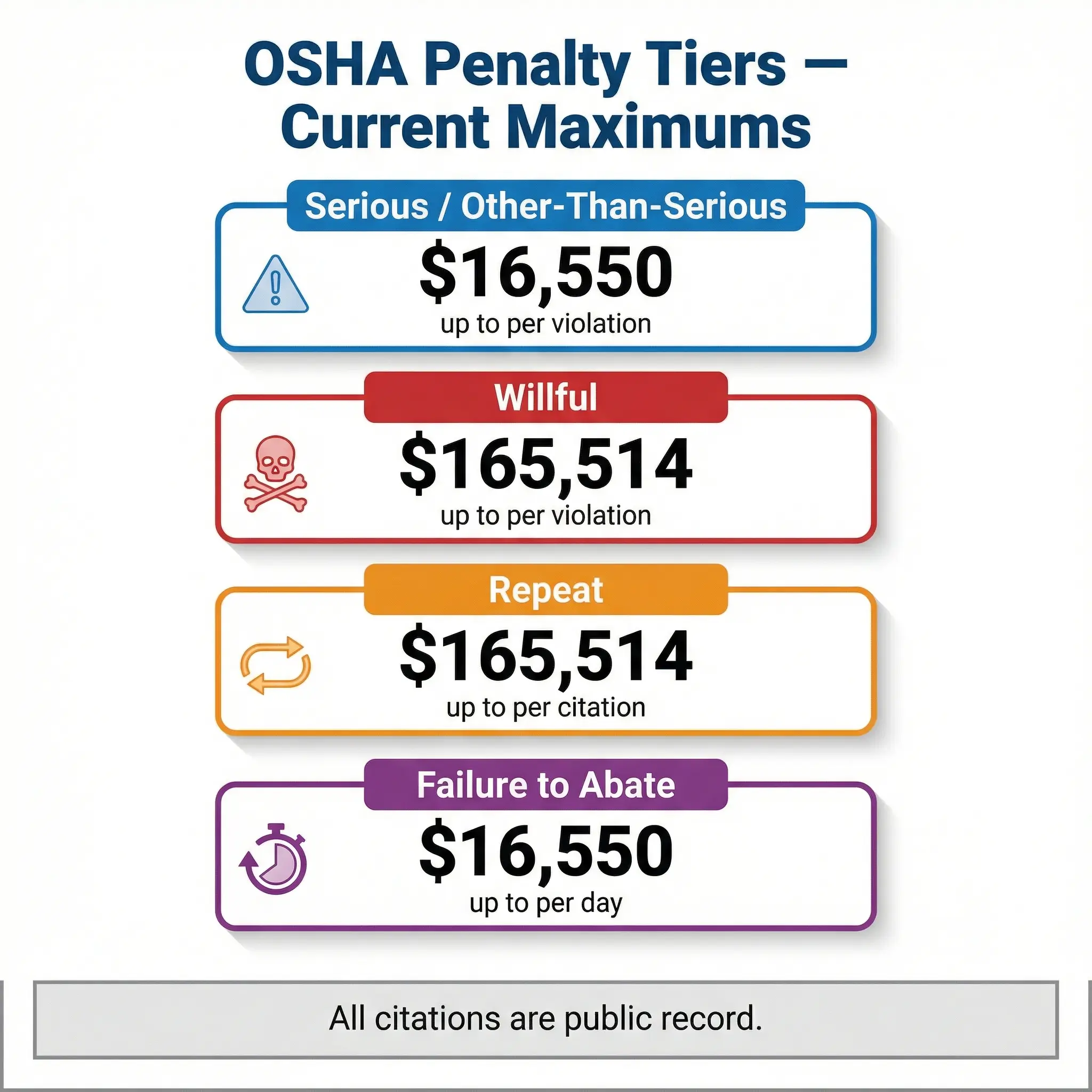
OSHA’s penalty structure follows a Gravity-Based Penalty system that accounts for the severity of the violation, the employer’s size, good-faith efforts, and history of prior violations. The current maximum penalties (adjusted for inflation as of January 2025) carry real financial weight:
- Serious violations: Up to $16,550 per violation. These are issued when a hazard could cause death or serious physical harm, and the employer knew or should have known about it.
- Other-than-serious violations: Same maximum as serious — $16,550 — but typically reduced based on employer good faith, size, and history. These address hazards that have a direct relationship to safety but are unlikely to cause death or serious harm.
- Willful violations: $11,823 to $165,514 per violation. Issued when an employer intentionally disregards a known requirement or is plainly indifferent to employee safety. If a worker dies as a result, criminal prosecution is possible — with fines up to $250,000 for individuals or $500,000 for corporations, plus potential imprisonment.
- Repeat violations: Up to $165,514 per citation. Triggered when the same or a substantially similar violation is found within five years — and the five-year window applies across all company locations, not just the site where the original violation occurred.
- Failure to abate: Up to $16,550 per day beyond the abatement deadline for each violation that remains uncorrected.
Real Enforcement in Action
These numbers are not theoretical. In 2025, OSHA’s largest proposed penalties reinforced how aggressively the agency pursues repeat offenders:
- A concrete contractor received over $1.2 million in proposed penalties for seven willful and four serious violations — all related to trenching and excavation hazards that had been cited in previous inspections.
- A food processing facility was cited for more than $1.1 million after a worker was killed during equipment cleaning due to systemic lockout/tagout failures.
- A transformer manufacturer faced nearly $987,000 in penalties after 53 serious and repeat violations were documented in a single inspection.
Every one of those inspections was conducted by a CSHO. Every citation package was built on evidence that a CSHO gathered during the walkaround — photographs, employee interviews, air samples, equipment observations, and document reviews.
Beyond Fines: The Operational Impact
The penalty amount is often the least damaging consequence of a CSHO inspection that goes badly. The broader operational impacts hit harder and last longer:
- Public record: All OSHA citations are publicly searchable in OSHA’s enforcement database. Clients, insurers, and competitors can see your violation history.
- Insurance implications: Carriers assess loss history independently of inspection counts. A pattern of citations — even without incidents — can tighten underwriting conditions and increase premiums.
- Contract disqualification: Many owner-operators and general contractors review OSHA citation history as part of prequalification. Willful or repeat violations can disqualify you from bidding on projects.
- Employee trust erosion: Workers who see their employer cited for safety failures lose confidence in the safety program. That trust deficit shows up in reporting rates, participation in safety meetings, and willingness to stop unsafe work.
How to Prepare for a CSHO Inspection Before One Arrives
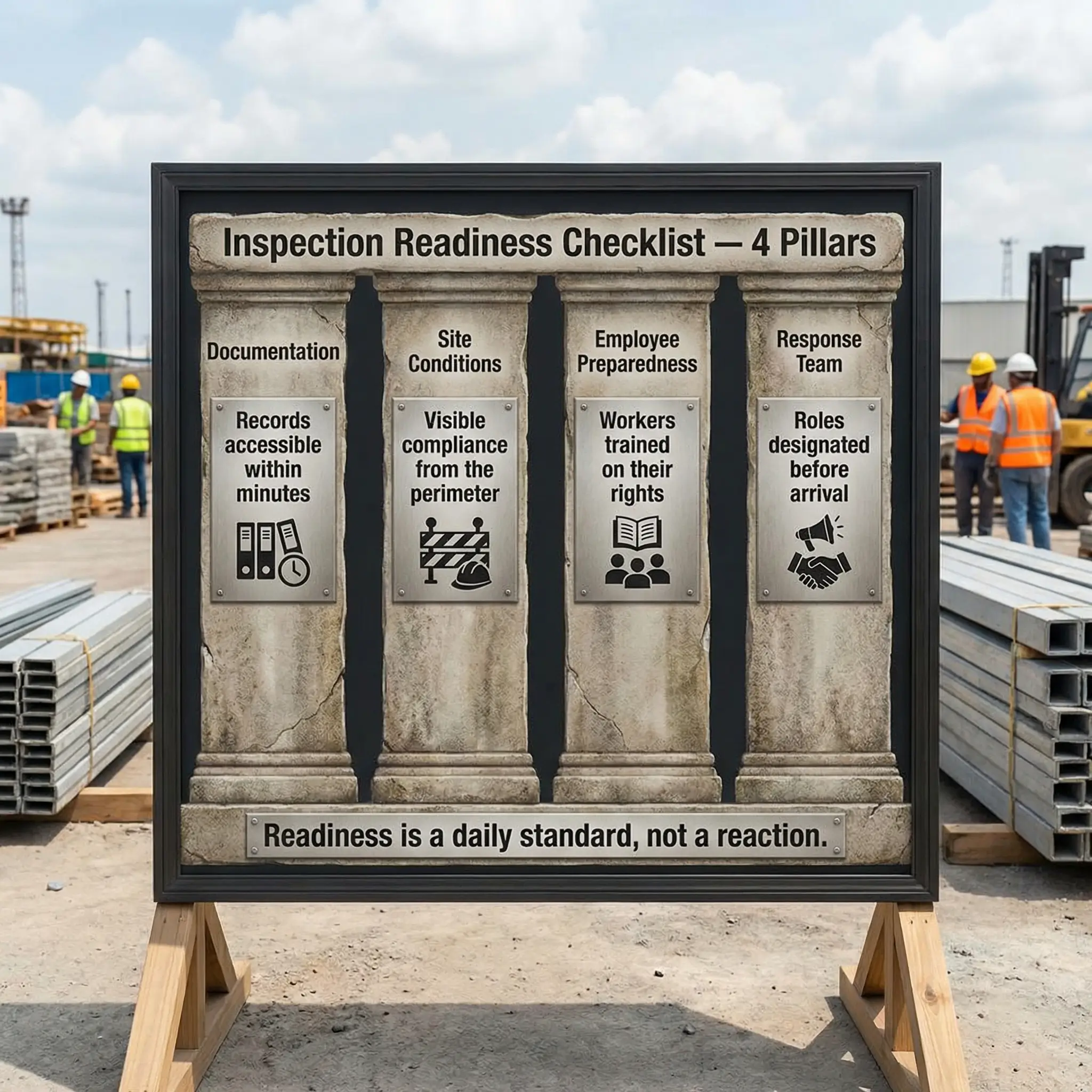
The best inspection outcome is the one you prepared for years before the CSHO pulled into your parking lot. Every well-managed site I have worked on treated inspection readiness as an operational baseline — not a scramble.
The following preparation framework reflects what has consistently worked across construction, manufacturing, and process industry sites I have managed or audited:
Documentation Readiness
Your paperwork is the first thing a CSHO requests, and delays in producing records signal disorganization. Keep these accessible within minutes — not hours:
- OSHA 300/300A/301 logs: Current year and previous five years, completed accurately. Recordkeeping violations (29 CFR 1904) are among the most frequently cited standards every year.
- Written safety programs: Hazard communication, lockout/tagout, respiratory protection, confined space, fall protection, emergency action plans — every applicable written program should be current, site-specific, and signed by responsible personnel.
- Training records: Documented by employee name, date, topic, instructor, and method of competency verification. “We trained them” without documentation is the same as “we didn’t train them” during an OSHA inspection.
- Inspection and maintenance logs: Equipment pre-use inspections, fire extinguisher checks, eyewash station testing, scaffold competent person inspections — all current and complete.
Site Condition Management
A CSHO forms initial impressions before entering your facility. These visible conditions either build or destroy your credibility:
- Housekeeping: Clean walkways, organized material storage, clear egress paths, and properly labeled containers. Poor housekeeping is the fastest way to signal a weak safety culture.
- PPE compliance: Every worker visible from the perimeter should be wearing the correct PPE for their task. One worker without eye protection on a grinding operation is enough to trigger a citation — and more importantly, to invite deeper scrutiny.
- Signage and postings: Current OSHA poster (OSHA 3165), site-specific hazard warnings, permit boards, emergency contact information, and any required regulatory notices — all visible, legible, and current.
- Active hazard controls: Guardrails, barricades, lockout/tagout devices, ventilation systems, and fall protection anchorages should all be in place and functional at all times — not just when you know someone is watching.
Employee Preparation
Your workers will be interviewed privately. You cannot coach them on what to say — and you should not try. What you can do is build a culture where the truth helps you:
- Train employees on their rights: Workers should know they have the right to speak with a CSHO, to file complaints without retaliation, and to have a representative present during the walkaround.
- Normalize safety communication: If your workers are comfortable reporting hazards and participating in safety discussions every day, they will communicate naturally and accurately during an interview. The danger is when workers have been silenced or ignored — that is when interviews produce damaging testimony.
- Designate an inspection response team: Know in advance who will accompany the CSHO, who will retrieve records, and who will manage ongoing operations during the inspection. Improvising these roles under pressure leads to mistakes.
Pro Tip: Run an internal mock inspection at least quarterly. Walk the site with the same checklist a CSHO would use — the OSHA Field Operations Manual is publicly available. Document your findings. Fix them. The goal is not to pass an inspection. The goal is to run a site where an inspection finds nothing — because the hazards were already controlled.
Who Should Pursue the CSHO Certificate — And Who Should Not
The CSHO certificate is a significant investment of time, money, and schedule coordination. It is not the right credential for everyone, and I have watched professionals waste both by pursuing it at the wrong point in their career.
The credential is a strong fit for the following profiles:
- Mid-career safety professionals who already hold supervisory or management responsibilities and need deeper OSHA regulatory knowledge to lead compliance programs effectively.
- Construction safety managers who manage multi-trade, multi-employer worksites where OSHA construction standards apply daily and inspection interactions are frequent.
- Safety trainers and consultants who deliver OSHA Outreach training (10-hour and 30-hour courses) and want to expand their teaching authority and technical depth.
- HSE managers preparing for OSHA Voluntary Protection Programs (VPP) applications, where demonstrating a culture of regulatory competence strengthens the submission.
- Industrial hygienists crossing into safety management roles who need structured exposure to safety-specific standards beyond their health discipline expertise.
The credential is not the right move for the following situations:
- Entry-level professionals without meaningful field experience. The coursework assumes practical familiarity with worksite hazards, and the concepts will not anchor without that foundation.
- Professionals seeking a single, universally recognized certification. The CSP from BCSP carries broader industry recognition. The CSHO is powerful but narrower in scope — it validates OSHA regulatory knowledge specifically, not general safety management competence.
- International practitioners working primarily outside U.S. jurisdiction. The CSHO curriculum is built entirely around U.S. OSHA standards. Professionals working under HSE UK, EU-OSHA, or other regulatory frameworks will find limited direct applicability — though the hazard recognition and program development principles transfer well conceptually.
Common Misconceptions About CSHOs
Misunderstandings about the CSHO — both the federal role and the certificate — circulate widely in the safety profession. Clearing them up prevents costly mistakes during inspections and poor career decisions around credentialing.
The following misconceptions appear repeatedly in the field:
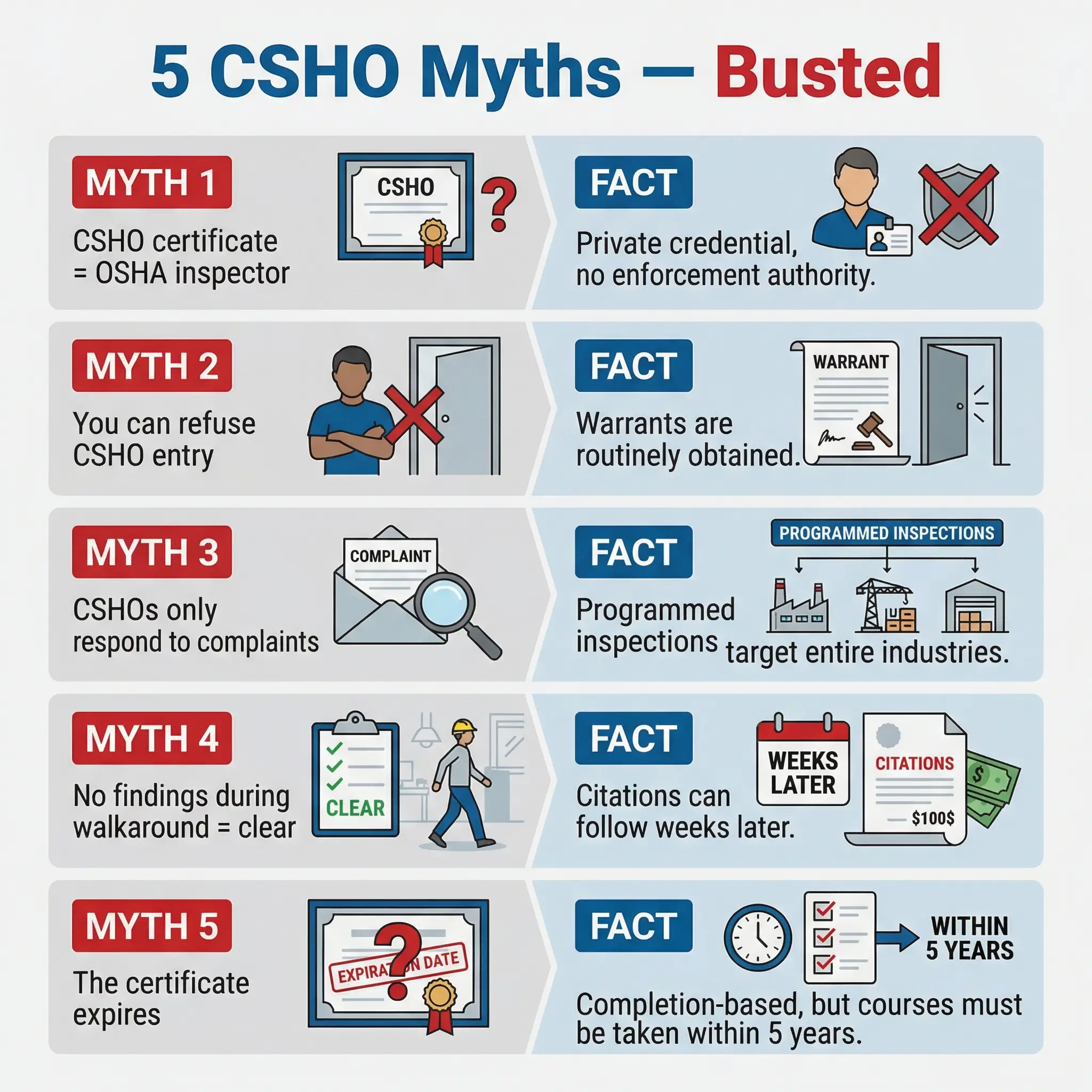
- “A CSHO certificate makes you an OSHA inspector.” It does not. The certificate is a professional development credential for private-sector practitioners. Federal CSHO positions are government employment, filled through USAJOBS, with separate internal training requirements.
- “You can refuse entry to a CSHO.” Technically, employers can request that a CSHO obtain an administrative warrant before entering. However, OSHA routinely obtains warrants, and refusal can escalate the inspection’s intensity and scope. It also signals to the CSHO that you may have something to hide.
- “CSHOs only come when there’s a complaint.” OSHA conducts thousands of programmed inspections annually through emphasis programs targeting high-hazard industries. Your site can be selected without any complaint, referral, or incident — purely based on industry classification and hazard profile.
- “If the CSHO doesn’t find anything during the walkaround, you’re safe.” The closing conference can occur weeks after the physical inspection. The CSHO reviews photographs, samples, interview transcripts, and records during that interim period. Violations can be identified and cited long after the inspector leaves your site.
- “The CSHO certificate expires.” The certificate itself does not expire once earned, but the courses used to earn it must be completed within a five-year window. Some OTI Education Centers require continuing education to maintain the credential’s currency, though this varies by institution.
Conclusion
The Certified Safety and Health Official — whether standing at your gate with federal credentials or sitting in your safety manager’s office with a course completion certificate — represents something that should matter deeply to every safety professional: the operational intersection of regulatory knowledge and real-world enforcement.
I have sat across the table from CSHOs during closing conferences, and I have sat in CSHO coursework learning the same standards those officers enforce. Both experiences taught me the same lesson — the gap between what a safety program claims on paper and what actually happens on the ground is exactly where citations, injuries, and fatalities live. The CSHO’s job, in both its forms, is to close that gap. If you manage people, lead projects, or carry responsibility for anyone’s physical safety, your job is to close it first.
Safety is not a credential on a wall or a clipboard in a truck. It is the daily, unglamorous discipline of making sure the trench is shored before the worker steps in, the atmosphere is tested before the permit is signed, and the lockout is verified before the wrench turns. A CSHO — federal or certified — exists because too many operations skip those steps. The best compliment an operation can earn is an inspection that finds nothing to cite — not because the hazards were hidden, but because they were already controlled.