
TL;DR
- If your load includes any Table 1 material (US) → placard at any quantity, no threshold exception — explosives, poison-by-inhalation, and certain radioactive materials trigger immediate placarding under 49 CFR 172.504.
- If you’re shipping mixed Table 2 materials under 454 kg aggregate → no placarding is required, but the moment total gross weight crosses 1,001 lbs, every applicable hazard class must be placarded — or a single DANGEROUS placard used under specific conditions.
- If your vehicle crosses from the US into Europe → expect a fundamentally different system: ADR requires rectangular orange panels bearing Kemler hazard-identification numbers, not just diamond placards.
- If placards are faded, peeling, or weather-damaged → you are already non-compliant: 49 CFR 172.519 requires placards to remain legible and durable, and degraded placards are among the most common violations found during CVSA roadside inspections.
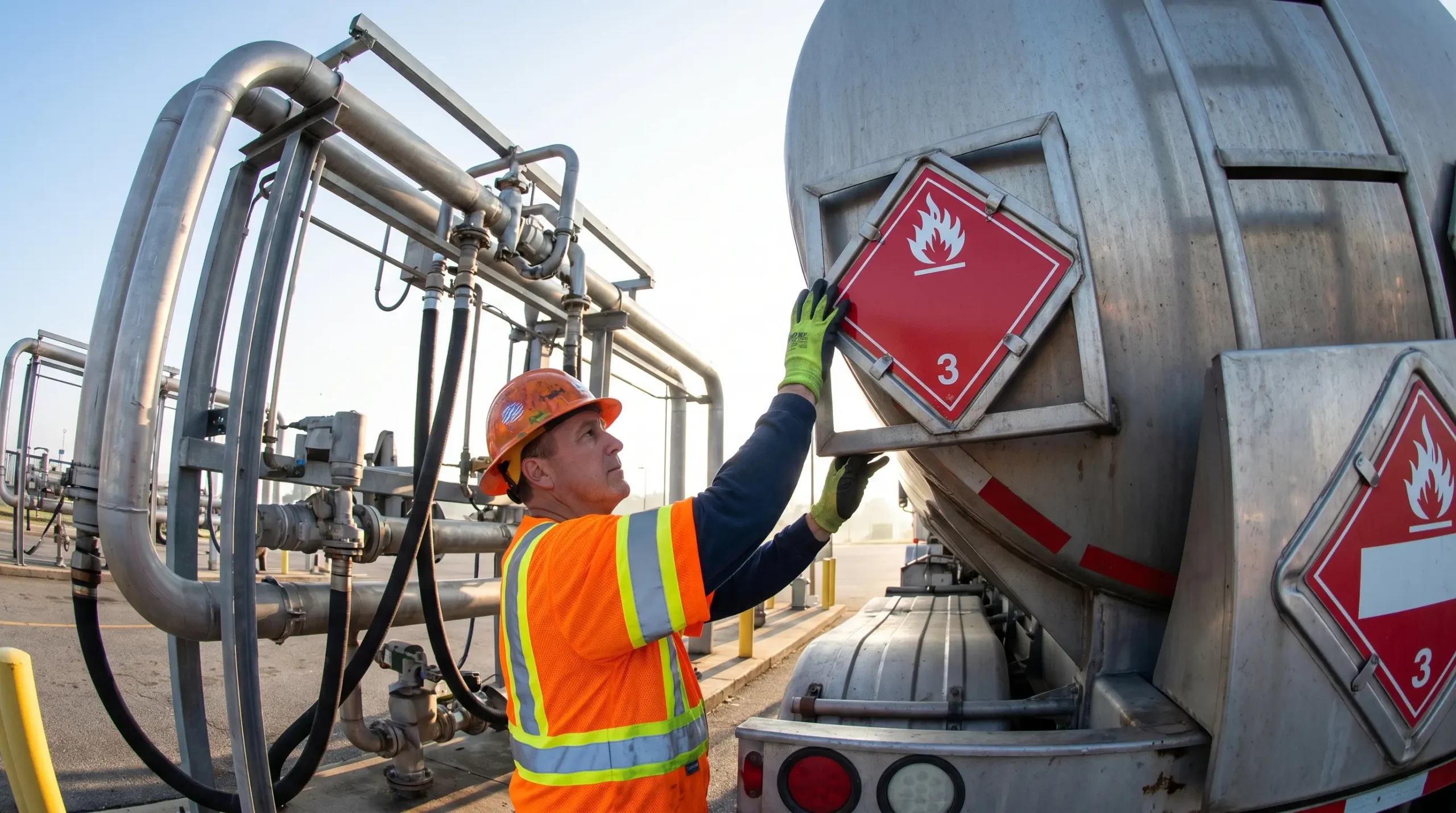
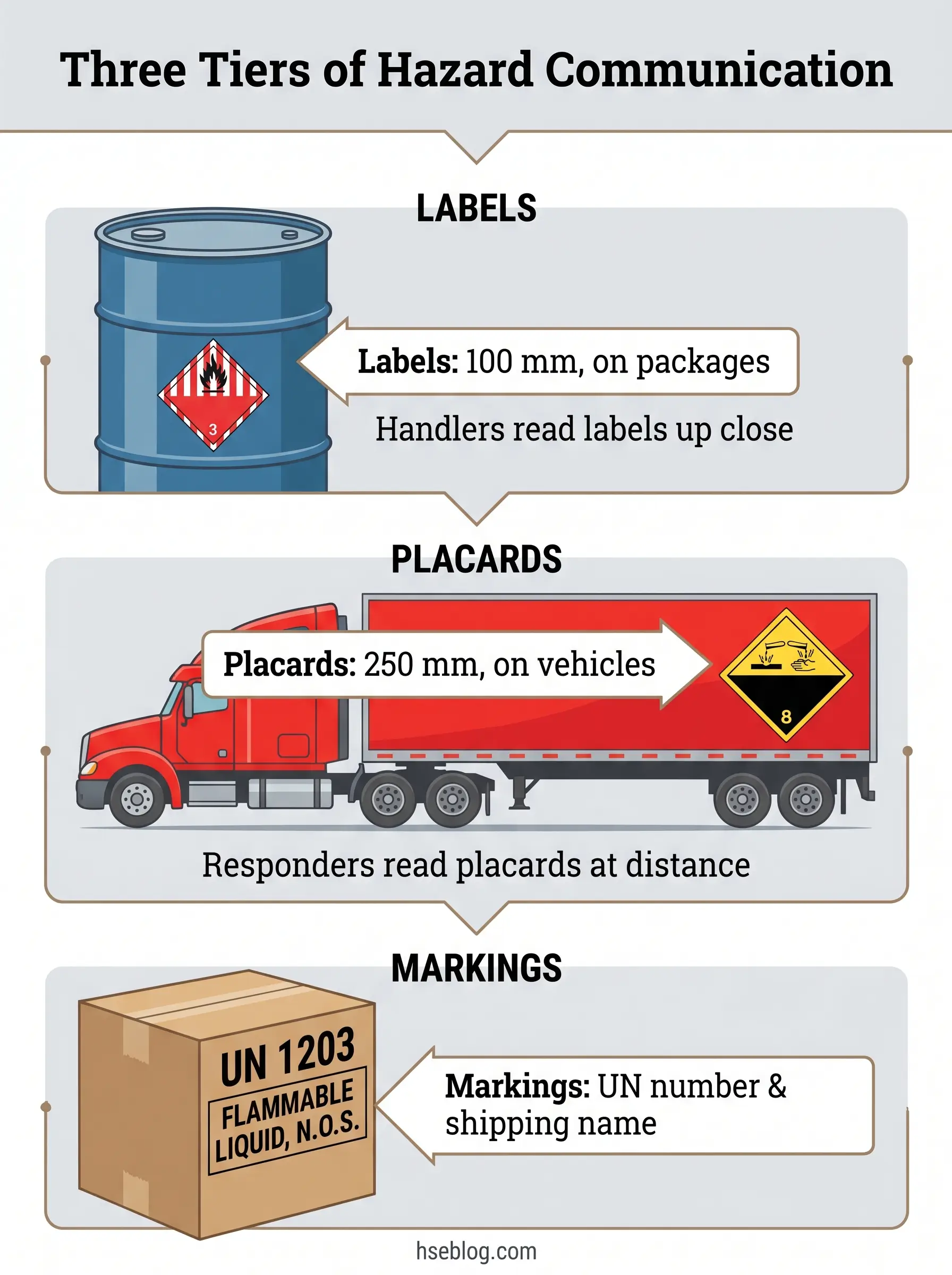
Dangerous goods placards, labels, and markings form a three-tier hazard communication system mandated by international regulations for transporting hazardous materials. Labels are small diamond-shaped identifiers (minimum 100 mm per side) affixed to individual packages. Placards are larger diamond-shaped signs (minimum 250 mm per side) displayed on vehicles and freight containers. Markings — UN numbers, proper shipping names, orientation arrows, limited quantity marks — provide supplementary identification. Together, these elements enable handlers, carriers, and emergency responders to identify hazards at every stage of transport.
On May 11, 1996, ValuJet Flight 592 crashed into the Florida Everglades eleven minutes after takeoff from Miami, killing all 110 people aboard. The National Transportation Safety Board investigation determined that improperly labeled and undeclared chemical oxygen generators in the cargo hold ignited and caused the fire that brought the aircraft down. Those oxygen generators should have been classified as Class 2.2 (Division 5.1 subsidiary risk), properly marked with UN numbers, labeled with oxidizer hazard labels, and documented on hazardous materials shipping papers — none of which happened. The disaster became the defining case for why hazard communication in transport is not administrative paperwork but a life-safety system.
That accident reshaped enforcement priorities across every transport mode. Yet nearly three decades later, the US Department of Transportation estimates that approximately 1,500 undeclared hazmat incidents still occur every year in the United States alone (US DOT/PHMSA, Check the Box campaign, 2024). The problem persists because dangerous goods placarding, labeling, and marking requirements are spread across multiple regulatory frameworks, vary by jurisdiction and transport mode, and demand precise technical judgment at every handoff between shipper, carrier, and receiver. This article synthesizes those requirements across the US, European, and Canadian systems — and identifies where compliance most commonly breaks down.
What Are Dangerous Goods Placards, Labels, and Markings?
These three elements serve different audiences at different distances, and treating them as interchangeable — which happens routinely — is itself a compliance failure. The UN Model Regulations (Rev. 23, Chapter 5) establish the international framework from which all regional and modal regulations derive, and that framework deliberately separates labels, placards, and markings into distinct functions.
Labels are diamond-shaped hazard indicators, minimum 100 mm per side, affixed directly to packages and small means of containment (≤450 L capacity). They communicate primary and subsidiary hazards to handlers working at arm’s length — the warehouse worker picking the drum, the loader positioning it in the vehicle.
Placards are larger diamond-shaped signs, minimum 250 mm per side, displayed on vehicles, freight containers, and bulk packaging. Their purpose is fundamentally different: they communicate hazard information to people who cannot see or reach the packages inside — emergency responders arriving at an incident, other road users, and enforcement officers conducting roadside inspections.
Markings are text, symbols, or pictograms that provide identification and handling data: the UN number, proper shipping name, orientation arrows, limited quantity marks, and the environmentally hazardous substance mark. They are distinct from labels despite sometimes appearing at similar scale on a package surface.
| Element | Minimum Size | Applied To | Primary Audience | US Reference | ADR Reference |
|---|---|---|---|---|---|
| Label | 100 mm per side | Packages, small containers | Handlers at close range | 49 CFR 172 Subpart E | ADR 5.2.2 |
| Placard | 250 mm per side | Vehicles, freight containers, bulk packaging | Emergency responders, enforcement, public | 49 CFR 172 Subpart F | ADR 5.3.1 |
| Marking | Varies by type | Packages, overpacks, vehicles | All parties in the supply chain | 49 CFR 172 Subpart D | ADR 5.2.1 |
A pattern that surfaces repeatedly in audit findings: organizations assign “labeling” as a blanket task, and the person responsible applies hazard labels but omits markings — no UN number, no proper shipping name, no orientation arrows — because they assumed the diamond label covered everything. The regulatory subparts exist separately for a reason. Each requires separate verification.
The UN Classification System: Nine Hazard Classes
The entire placarding and labeling system rests on nine hazard classes established by the UN Committee of Experts. Each class maps to a specific label color and symbol, and that color-coding is deliberately consistent across all jurisdictions — a red diamond means flammability whether you are in Houston, Hamburg, or Halifax.
| Class | Hazard | Primary Color | Example Materials |
|---|---|---|---|
| 1 (Div. 1.1–1.6) | Explosives | Orange | Dynamite, detonators, fireworks |
| 2.1 | Flammable gas | Red | Propane, acetylene |
| 2.2 | Non-flammable, non-toxic gas | Green | Nitrogen, CO₂ |
| 2.3 | Toxic gas | White | Chlorine, ammonia |
| 3 | Flammable liquid | Red | Gasoline, ethanol, acetone |
| 4.1 / 4.2 / 4.3 | Flammable solids / spontaneous combustion / dangerous when wet | Red-white stripes / Red-white / Blue | Matches, phosphorus, sodium |
| 5.1 / 5.2 | Oxidizers / organic peroxides | Yellow | Ammonium nitrate, benzoyl peroxide |
| 6.1 / 6.2 | Toxic substances / infectious substances | White | Pesticides, clinical waste |
| 7 | Radioactive | White-yellow | Medical isotopes, uranium |
| 8 | Corrosive | Black-white | Sulfuric acid, sodium hydroxide |
| 9 | Miscellaneous | Black-white stripes | Lithium batteries, dry ice, asbestos |
The color logic follows a pattern worth internalizing: red signals flammability, yellow signals oxidizing or instability risk, blue means dangerous reaction with water, and white backgrounds indicate toxic or infectious hazards.
The most frequent classification errors in practice involve Class 9 materials and subsidiary risk assignments. Class 9 functions as a regulatory catch-all, and shippers uncertain about classification default to it — sometimes correctly, often not. Subsidiary risk is equally problematic: when a material presents multiple hazards, each subsidiary risk requires its own label on the package, and the primary hazard class drives the placard selection. Missing a subsidiary risk label is a common finding that cascades into incorrect emergency response information.
How Do Labels, Placards, and Markings Work Together in Transport?
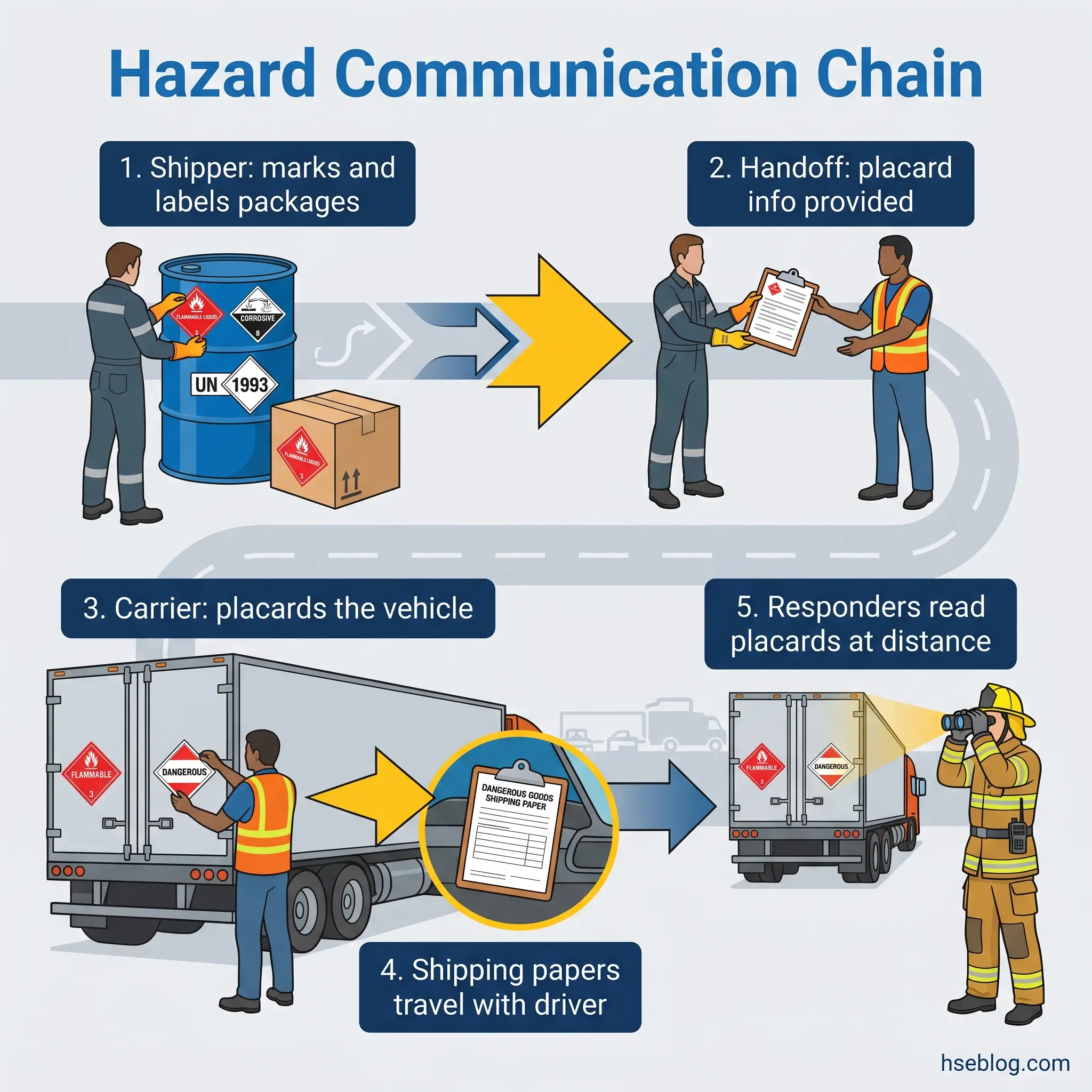
The three elements form a layered information system where each layer serves a different point in the transport chain. The shipper marks and labels packages. The carrier applies placards to the vehicle based on the cargo loaded. Emergency responders arriving at an incident read placards first — at a distance — then approach to read labels and markings on individual packages, cross-referencing against shipping papers.
Consider a standard scenario: a 200-liter drum of toluene (UN 1294, Class 3, Packing Group II) being shipped by road.
- The shipper marks the drum with the UN number (“UN 1294”), the proper shipping name (“Toluene”), and orientation arrows if the drum has liquid-tight closures on top.
- The shipper labels the drum with a Class 3 flammable liquid diamond label (red, flame symbol), minimum 100 mm per side, on two opposing sides.
- The carrier placards the vehicle with Class 3 diamond placards on all four sides — assuming the load meets or exceeds the applicable quantity threshold.
- Shipping papers travel with the driver, providing the fourth leg of hazard communication: the document that connects the visual identifiers to detailed information about quantity, emergency contact, and response guidance.
Where this system breaks down most consistently is at the handoff between shipper and carrier. Under 49 CFR 172.506, the shipper must provide the carrier with the required placards or the information needed to placard correctly. In practice — particularly on partial loads where multiple shippers contribute cargo — this step is frequently missed. The carrier arrives, loads the freight, and departs without updating vehicle placards to reflect the actual hazard profile of the combined cargo.
Overpack marking adds another layer of complexity. When multiple packages are consolidated into an overpack (a crate, pallet wrap, or outer container), the overpack must be marked with the word “OVERPACK” and must either display all required labels and markings from the inner packages or be transparent enough that inner markings remain visible. The common failure: overpacks that obscure inner package labels without reproducing them on the outer surface.
When Are Placards Required? Thresholds and Exceptions
This is where compliance most frequently fails — not because the rules are hidden, but because the threshold system creates judgment calls that shippers and carriers get wrong under time pressure. The core question is deceptively simple: does this load require placards? The answer depends on what is being shipped, how much, which regulatory framework applies, and whether any exceptions bite.
The US system (49 CFR 172.504) divides hazardous materials into two tables:
- Table 1 materials require placarding at any quantity. These are the highest-risk categories: explosives (Division 1.1, 1.2, 1.3), poison-by-inhalation (Zone A and B), certain radioactive materials (highway route controlled quantity), and Division 2.3 toxic gases. There is no minimum weight threshold — a single package triggers the obligation.
- Table 2 materials require placarding only when the aggregate gross weight of all Table 2 materials aboard the vehicle exceeds 454 kg (1,001 lbs). Below that threshold, no placarding is needed for those materials.
For mixed Table 2 loads — where materials from multiple hazard classes are present but each individually falls under the weight threshold — 49 CFR Part 172 Subpart F placarding regulations permit the use of a single DANGEROUS placard in place of individual class placards, under specific conditions. The DANGEROUS placard cannot substitute for any Table 1 placard and cannot be used when 2,268 kg (5,000 lbs) or more of a single Table 2 class is loaded.
Key exceptions that practitioners must track:
- Limited quantities — no placarding required, but the limited quantity mark must appear on packages
- Small quantities — materials in quantities below the reportable quantity threshold in excepted packaging
- Empty non-bulk residue packages — generally exempt from placarding unless residue meets hazard thresholds
- Class 9 domestic highway exception — Class 9 materials do not require placarding for domestic US highway or rail transport, but this exception does not apply internationally or to air/sea modes
The Class 9 threshold interaction is a persistent compliance trap. Shippers frequently miscalculate whether to include Class 9 weight in the Table 2 aggregate total. Since Class 9 is exempt from domestic placarding regardless, some shippers exclude its weight from the 454 kg calculation for other classes — which is correct. Others include it — which inflates the total and may trigger unnecessary placarding. The confusion runs both directions, and PHMSA Letter of Interpretation 09-007 addressed it, but the error remains common in practice.
Canada (TDGR, Part 4) takes a different structural approach. Placarding is tied to “large means of containment” — containers exceeding 450 L capacity — rather than to aggregate weight thresholds. Transport Canada’s dangerous goods marks guidance provides the regulatory reference for Canadian requirements. The practical impact: a vehicle carrying many small packages of dangerous goods may not require placarding in Canada even though the same aggregate weight would trigger placarding under US rules.
ADR Orange Panels vs. Diamond Placards: Key Differences
Vehicles carrying dangerous goods across Europe and the 53 UNECE signatory countries operate under a fundamentally different visual communication system than North American carriers. The ADR 2025 full text (UNECE), which entered into force on January 1, 2025 and became mandatory from July 1, 2025, requires rectangular orange panels in addition to — or in certain configurations instead of — diamond placards.
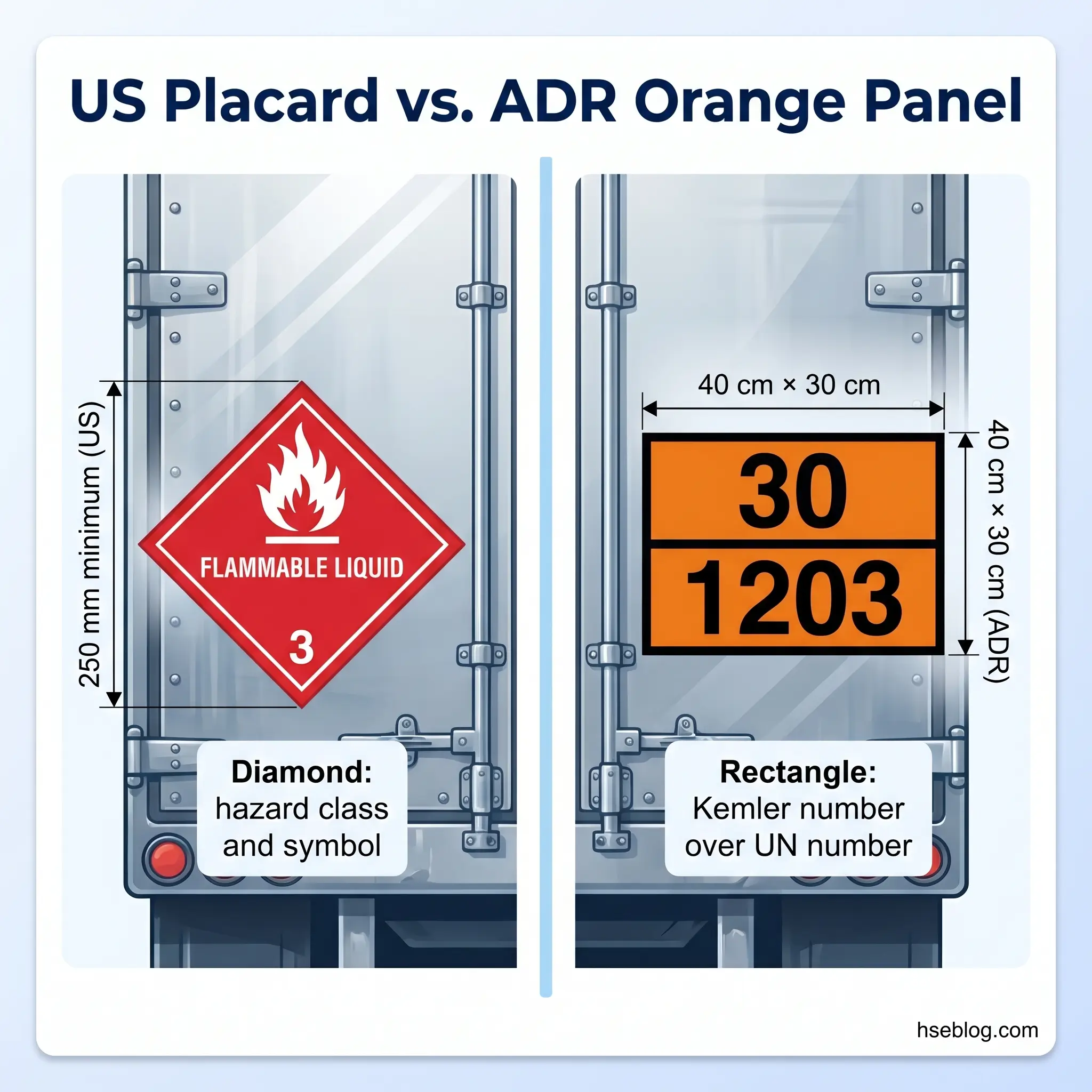
The orange panel is a rectangular plate measuring 40 cm wide by 30 cm high, with a black border, divided horizontally into two halves:
- Upper half — the hazard identification number (commonly called the Kemler number), a two- or three-digit code describing the nature of the hazard
- Lower half — the UN substance number identifying the specific material
The Kemler numbering system encodes hazard information compactly. The first digit indicates the primary hazard (2 = gas, 3 = flammable liquid, 4 = flammable solid, 5 = oxidizing, 6 = toxic, 8 = corrosive). Doubling the digit intensifies the hazard (33 = highly flammable liquid). The prefix “X” indicates the material reacts dangerously with water.
| Feature | US Diamond Placard | ADR Orange Panel |
|---|---|---|
| Shape | Diamond (rotated square) | Rectangle |
| Minimum size | 250 mm per side | 40 cm × 30 cm |
| Information displayed | Hazard class, division, symbol, optional text | Kemler number + UN number |
| Material-specific identification | Optional (UN number may be shown) | Mandatory (UN number on every panel) |
| Used alongside diamond labels? | N/A — placards are the vehicle-level system | Yes — diamond placards also required on containers/tanks |
For multimodal shippers moving goods between US and European jurisdictions, this difference is operationally significant. A vehicle compliant under 49 CFR — bearing four diamond placards without UN numbers — does not satisfy ADR requirements. Conversely, an ADR-compliant vehicle arriving at a US port with orange panels alone may not satisfy 49 CFR if the panels lack the required diamond placard format.
ADR 2025 also introduced 10 new UN numbers, including entries for sodium-ion batteries (UN 3551 and UN 3552) and provisions for battery-electric vehicles under the FL vehicle category, which require updated label templates and placarding procedures (UNECE, 2025).
Placard Placement, Size, and Durability Standards
Knowing which placard to display is only half the obligation — where and how it is displayed determines whether the placard actually functions. A correctly selected placard mounted in the wrong position, or one that has degraded beyond legibility, provides zero value to an emergency responder approaching from the wrong side of the vehicle.
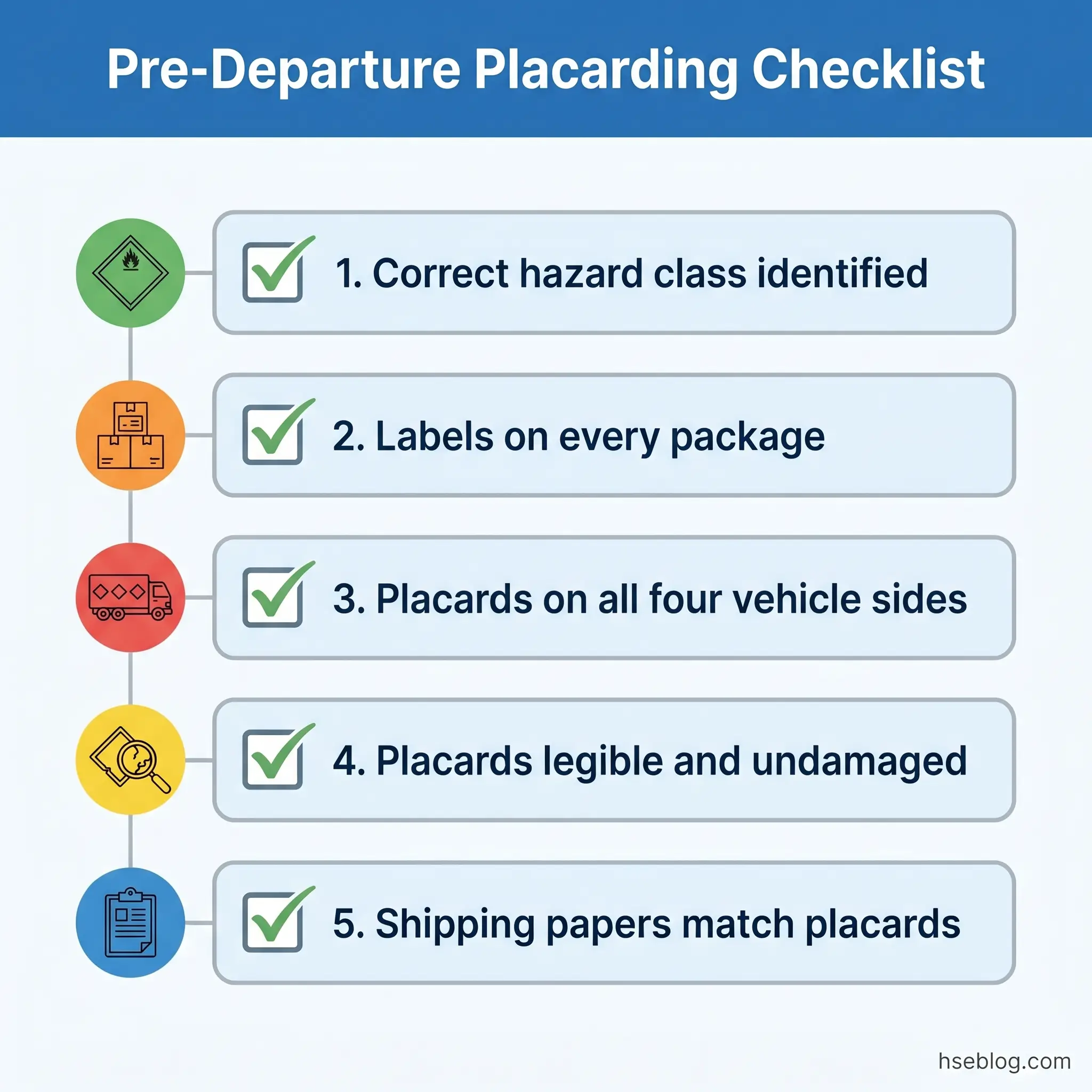
Under 49 CFR 172.516, placards must be displayed on each side and each end of the vehicle — four placards minimum. Specific placement requirements include:
- Visibility — placards must be clearly visible from the direction they face, not obscured by ladders, spare tires, equipment, or cargo securement devices.
- Square-on orientation — the diamond must be displayed point-up, with the hazard class number at the bottom vertex.
- Square white background — required for specific high-hazard materials: highway route controlled quantity radioactive materials, certain Division 1.1/1.2 explosives, and Division 6.1 PG I (poison-by-inhalation zone A/B). The white background increases contrast and signals elevated hazard.
Size and durability requirements are non-negotiable. Each side of the diamond must measure at least 250 mm (9.84 inches). Under 49 CFR 172.519, placards must be able to withstand 30-day exposure to open weather conditions without material deterioration in color, legibility, or structural integrity.
Whether to use holders/brackets or adhesive-applied placards is a practical judgment call. Brackets allow quick changes when cargo varies between loads — standard practice for carriers handling mixed commodities. Adhesive placards are more tamper-resistant but require physical removal and replacement. The operational environment should drive the choice: a dedicated tanker running the same product continuously may use permanent mounting; a general freight carrier handling variable loads needs the flexibility of bracket systems.
Durability failures deserve specific attention because they represent a category of violation that accumulates silently. A placard that was fully compliant when applied six months ago may now be faded, cracked, or partially delaminated — still technically “displayed” but no longer meeting the legibility standard. These degradation-at-roadside findings are among the most common placarding deficiencies identified during enforcement inspections.
Common Placarding Violations and Enforcement Consequences
The enforcement data tells a clear story: placarding violations are found frequently, penalized heavily, and result in immediate operational disruption. Unlike training deficiencies or recordkeeping gaps that require documentation review to identify, a missing or incorrect placard is visible from across a parking lot — making it the most exposed compliance failure a carrier can have.
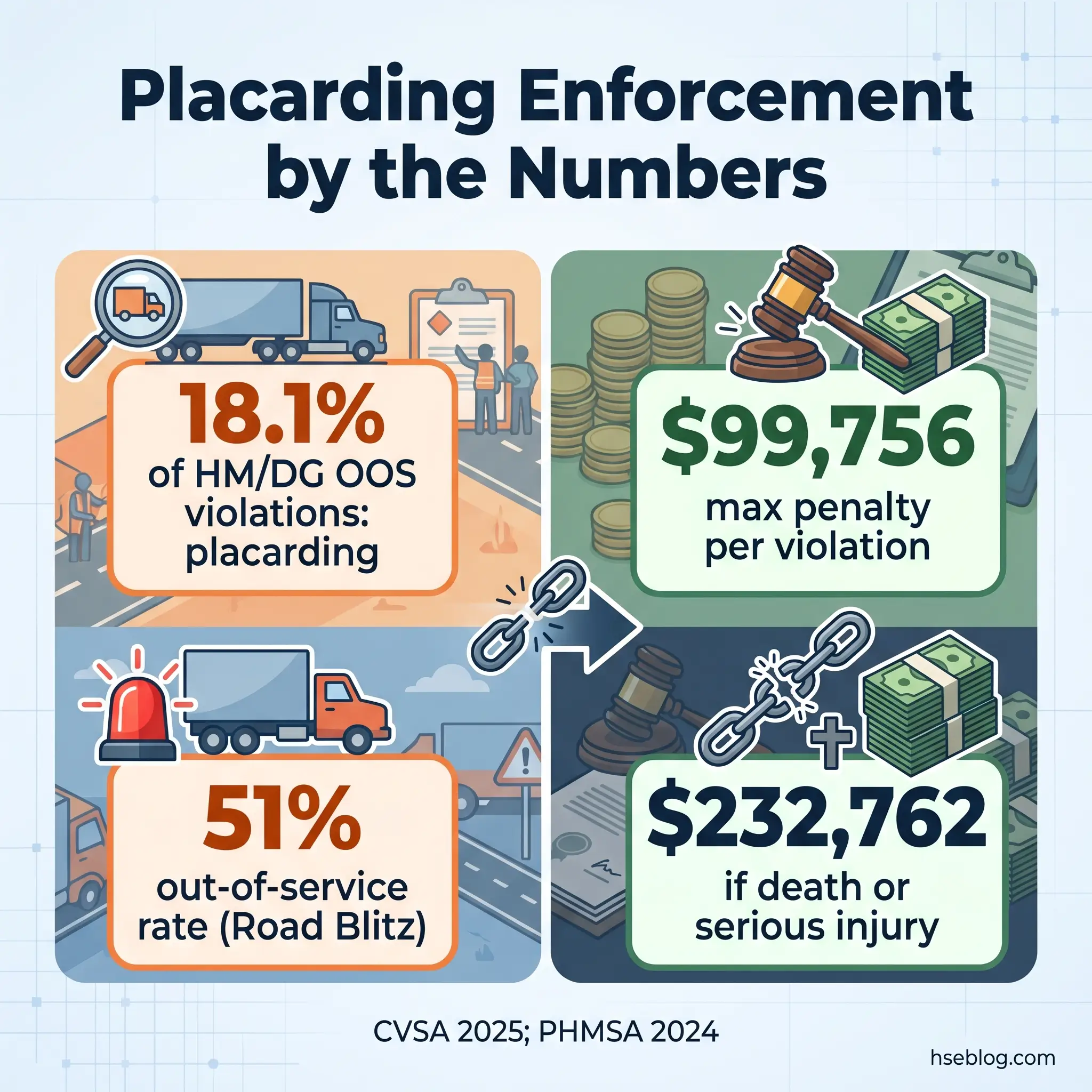
During the CVSA 2025 International Roadcheck (May 13–15, 2025), inspectors conducted 56,178 vehicle inspections across the US, Canada, and Mexico. Of those, 177 resulted in hazardous materials/dangerous goods out-of-service violations. Placarding accounted for 18.1% of all HM/DG OOS violations, ranking as the third most common category (CVSA, 2025).
The targeted enforcement picture is even more pointed. The CVSA 2025 HM/DG Road Blitz (June 9–13, 2025) — an unannounced, focused inspection initiative — conducted 4,629 HM/DG inspections and found 1,169 violations, with a 51% out-of-service rate (CVSA, 2025). That means more than half of the hazmat vehicles inspected during the blitz had violations serious enough to halt them on the spot.
Financial penalties reinforce the operational consequences. PHMSA’s civil penalty maximums, adjusted effective December 30, 2024, now stand at up to $99,756 per violation, and up to $232,762 per violation that results in death, serious illness, severe injury, or substantial property destruction (PHMSA, 2024).
The practical implications cascade:
- Immediate operational impact — an out-of-service order means the vehicle cannot move until the violation is corrected at the roadside. For time-sensitive freight, the cost extends well beyond the penalty itself.
- Carrier safety rating — repeated violations affect the carrier’s safety fitness determination, increasing inspection frequency and potentially jeopardizing operating authority.
- Insurance and contractual exposure — carriers with poor HM/DG compliance records face premium increases and may be disqualified from shipper-approved carrier lists.
A judgment call that experienced compliance managers understand: the cost of a robust pre-trip placard inspection program — checking every placard for correct class, legibility, placement, and durability before departure — is trivial compared to a single OOS violation at a weigh station.
What Is the Role of Placards in Emergency Response?
Placards exist, ultimately, for the people who arrive first at an incident scene — firefighters, hazmat teams, law enforcement — who need to identify what they are dealing with before they get close enough to read a package label or a shipping paper. The entire system is engineered around that single operational need: hazard identification at distance.
The first-responder decision sequence follows a specific logic:
- Identify placards at distance — determine the hazard class and, where displayed, the UN number.
- Reference the Emergency Response Guidebook (ERG) — look up the placard class or UN number to find the correct guide page.
- Establish initial isolation distances — the ERG prescribes minimum isolation and protective-action distances based on the identified material.
- Determine response actions — suppression methods, evacuation zones, PPE requirements, and decontamination protocols all flow from the initial placard identification.
The critical dependency in this sequence is accuracy. The ERG’s initial isolation distances assume the placard is correct. If a vehicle is placarded as Class 3 (flammable liquid) but actually carries Division 2.3 (toxic gas), the initial response zone will be dangerously undersized. Responders may approach without appropriate respiratory protection. Suppression methods appropriate for a flammable liquid spill may be entirely wrong for a toxic gas release.
The ValuJet Flight 592 disaster illustrates the extreme consequence of hazard communication failure. The chemical oxygen generators aboard that aircraft were not classified, not labeled, not marked with UN numbers, and not declared on shipping papers. Emergency responders to the crash site initially had no indication that oxidizing materials were involved. The subsequent regulatory response — including FAA and PHMSA enforcement actions and revised shipper certification requirements — reinforced that every element of the hazard communication system exists to prevent exactly this scenario.
Outside North America, the UK and Australia use the HAZCHEM system as a complementary emergency information framework. HAZCHEM codes — displayed on rectangular plates alongside UN numbers — provide first responders with specific response instructions: which extinguishing agents to use, whether to dilute or contain runoff, and whether evacuation is recommended. This system operates alongside placards rather than replacing them.
Multimodal Transport: How Placarding Requirements Vary by Mode
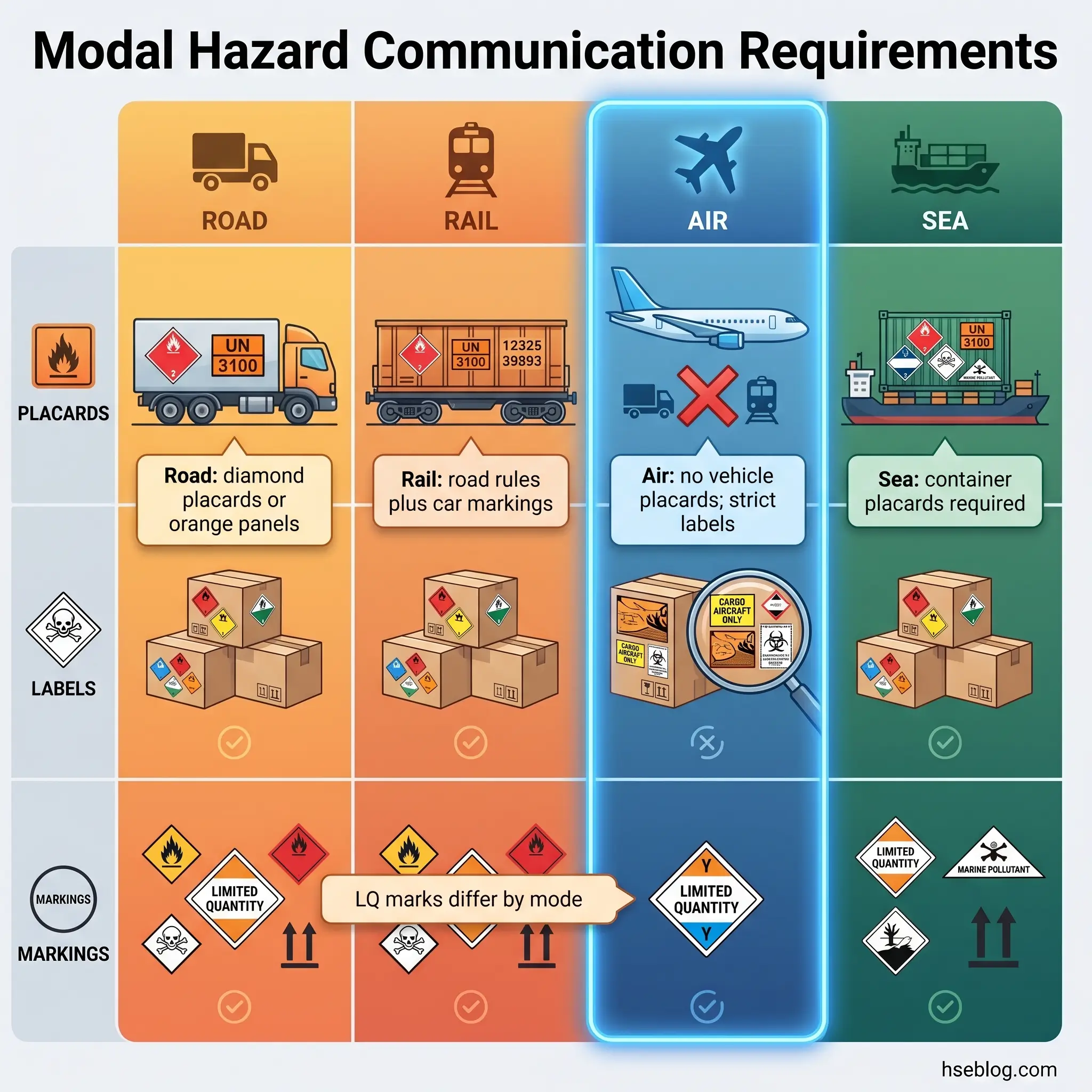
A shipment that satisfies all road-transport placarding and labeling requirements in one jurisdiction may be non-compliant the moment it transfers to a different transport mode. This is not an edge case — it is the default condition for international freight, and the most common multimodal failure is the assumption that road-compliant labeling automatically satisfies air or sea requirements.
| Requirement | Road (49 CFR / ADR / TDGR) | Rail | Air (IATA DGR) | Sea (IMDG Code) |
|---|---|---|---|---|
| Vehicle/unit placarding | Diamond placards (US/Canada); orange panels + placards (ADR) | Same as road, plus rail car identification marks | Not applicable — no vehicle-level placards | Freight container placards required |
| Package labeling | Standard hazard class labels | Same as road | Standard labels + handling labels (CAO, orientation) | Standard labels + marine pollutant mark |
| Limited quantity threshold | Varies by material | Same as road | Significantly lower thresholds; separate “Y” LQ mark | Aligns with UN Model but separate LQ provisions |
| Key additional requirement | Shipping papers with driver | Rail consist documentation | Shipper’s Declaration for Dangerous Goods (mandatory specific form) | Dangerous Goods Manifest |
The air-mode differences are the most consequential and the most frequently underestimated. The IATA Dangerous Goods Regulations impose restrictions that go far beyond placarding:
- Quantity limits per package are substantially lower for air transport than for surface modes. Materials acceptable in 200-liter drums by road may be restricted to 1-liter or 5-liter inner containers by air.
- The Cargo Aircraft Only (CAO) label restricts certain materials from passenger aircraft entirely — a restriction that has no surface-transport equivalent.
- The limited quantity mark for air transport — bearing the “Y” identifier — differs from the surface-transport LQ mark. Using the wrong mark is a violation.
Sea transport under the IMDG Code introduces its own layer: freight container placards must reflect all hazard classes of goods loaded inside, segregation requirements between incompatible classes reference placard categories, and the marine pollutant mark must be applied to packages and containers carrying environmentally hazardous substances.
The practical takeaway for multimodal shippers: never assume modal compliance transfers. Each mode requires independent verification against its own regulatory framework. The DOT Chart 15 — Hazardous Materials Markings, Labeling and Placarding Guide remains one of the most useful quick references for US surface-transport requirements, but it does not cover air or sea modes.
Frequently Asked Questions
Conclusion
The lesson the dangerous goods transport sector keeps relearning — from ValuJet 592 in 1996 to the 1,169 violations found in CVSA’s 2025 Road Blitz — is that hazard communication failures cluster at the same points: the handoff between shipper and carrier where placard information goes missing, the threshold calculations where Class 9 weight is mishandled, the roadside where degraded placards technically exist but no longer function, and the modal transfer point where road compliance is assumed to cover air or sea requirements.
The highest-impact change most organizations can make is not adding more placards or more training hours. It is closing the verification gap at each transition point — shipper to carrier, single-mode to multimodal, warehouse to vehicle. Every placard, label, and marking is a message. If that message is wrong, missing, or unreadable, the people who depend on it — handlers, drivers, and most critically the emergency responders who arrive when everything has already gone wrong — are making decisions in the dark. The enforcement numbers and penalty figures exist to quantify that risk. The obligation is to eliminate it.