
TL;DR
- Excavation is not one activity — it’s a family of methods: Each type of excavation in construction carries unique hazards, soil behavior, equipment demands, and safety control requirements that generic “excavation safety” plans fail to address.
- Matching the method to the ground conditions is a safety decision, not just an engineering one: Choosing the wrong excavation type for the soil classification, water table, or proximity to existing structures directly increases collapse, utility strike, and flooding risk.
- Every excavation type demands a specific competent person assessment: OSHA 29 CFR 1926 Subpart P and HSE UK requirements mandate that a competent person evaluates the ground conditions, selects protective systems, and re-inspects after every environmental change — regardless of excavation type.
- The most dangerous excavations are often the “simple” ones: Shallow utility trenches and topsoil strips kill more workers than deep foundation excavations because crews underestimate them, skip shoring, and treat them as routine.
- Understanding excavation types is foundational knowledge for any construction HSE professional: You cannot write a credible excavation safety plan, conduct a meaningful inspection, or challenge an unsafe method if you don’t understand how each excavation type behaves in the field.
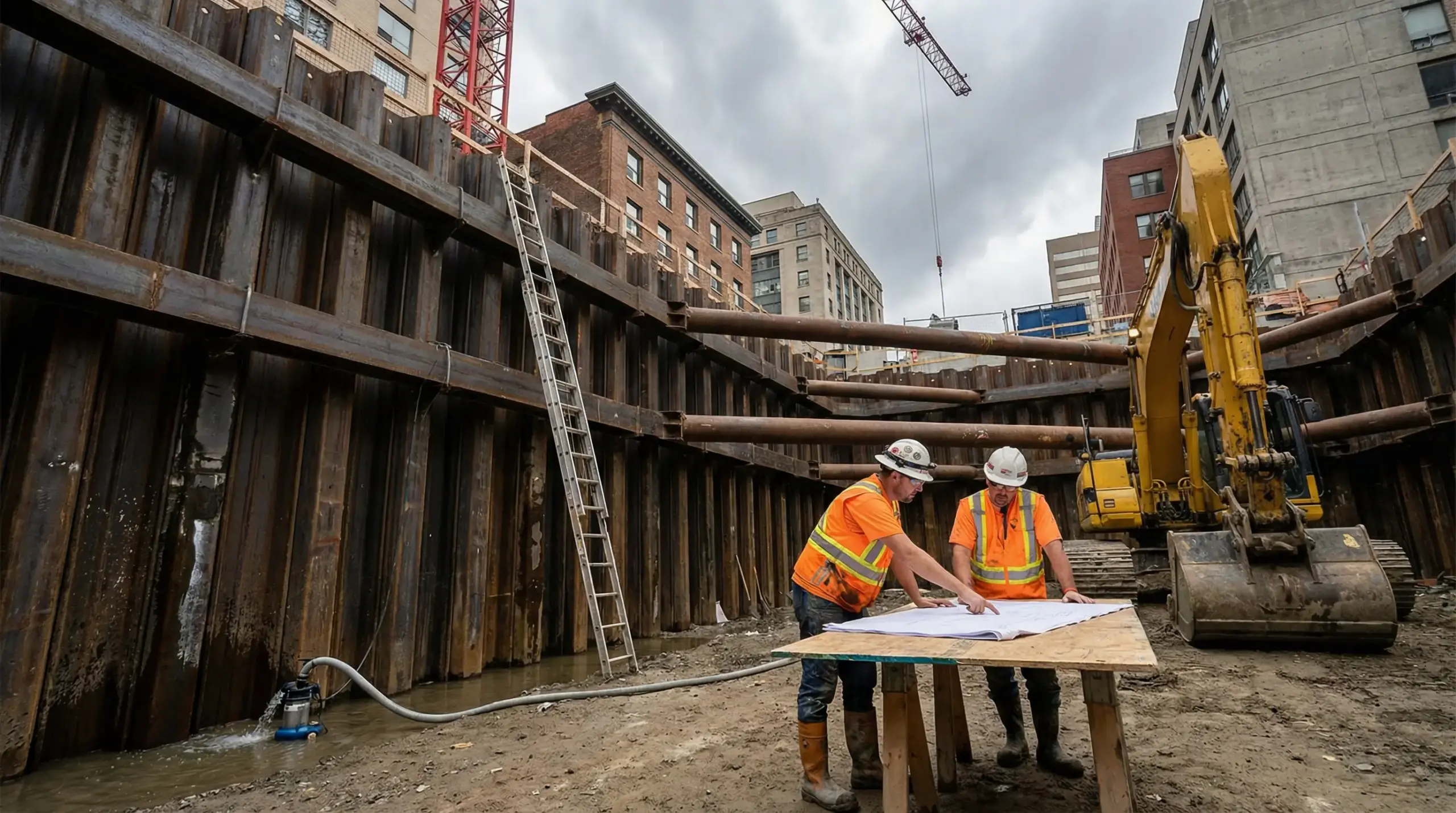
The backhoe had been working for less than forty minutes when the operator hit something that wasn’t on any drawing. I was conducting a routine walkthrough on an infrastructure project in the Gulf when I heard the machine stall, followed by a pressurized hiss that sent the banksman sprinting backward. A 200mm gas main — undocumented, unmapped, and sitting 600mm below grade in what the project team had classified as a straightforward topsoil strip. The excavation type was simple. The consequences of treating it casually were anything but.
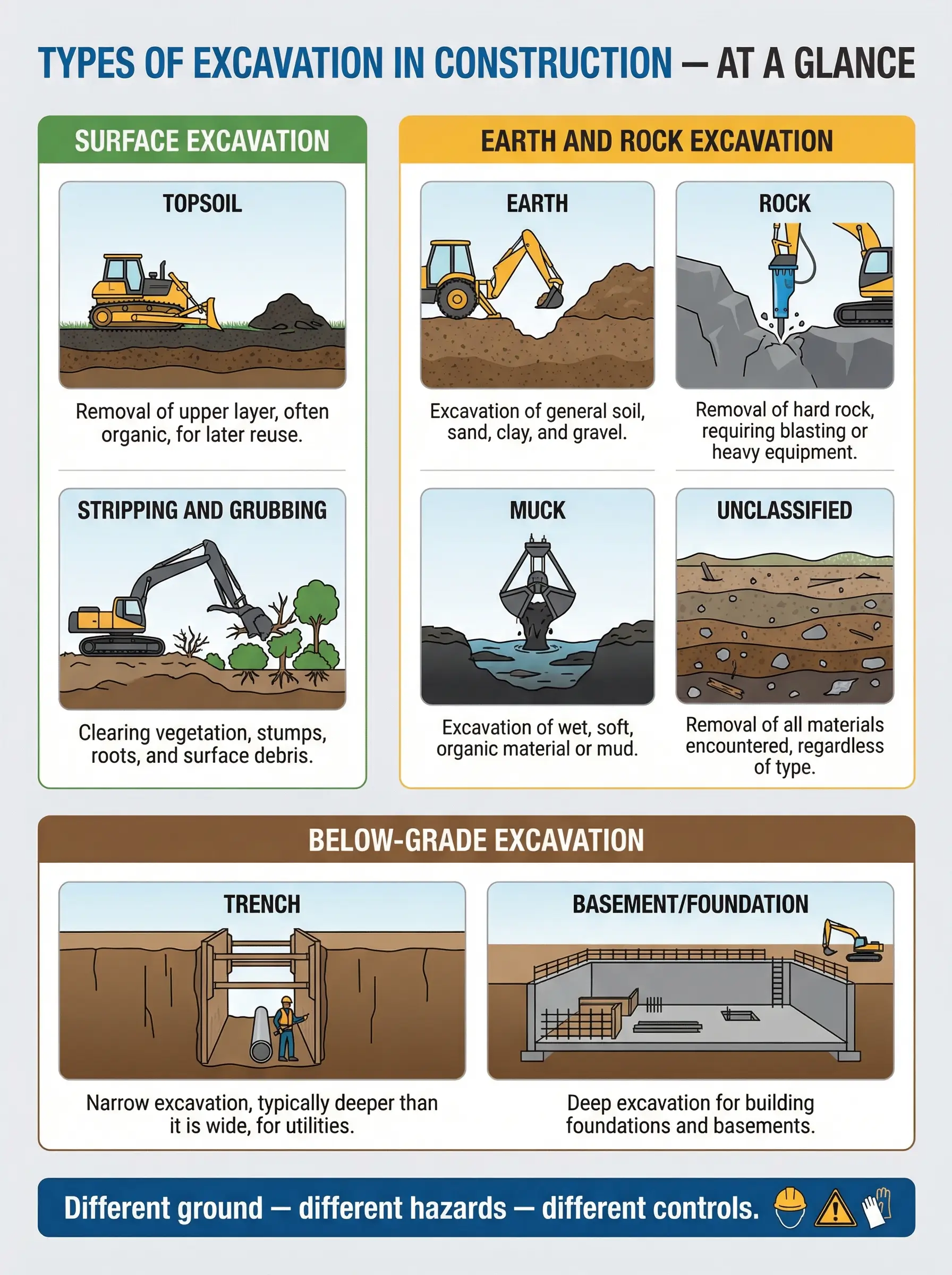
That incident reinforced something I’ve carried through every project since: the word “excavation” covers an enormous range of activities, and each type behaves differently in the ground, interacts differently with surrounding hazards, and demands different controls. A trench is not a basement dig. A rock excavation is not a channel dredge. Yet I still review excavation safety plans that use one generic method statement to cover every type of ground-breaking work on a project. This article breaks down the different types of excavation used in construction — not as an academic classification exercise, but as a practical field guide for HSE professionals who need to understand what’s happening in the ground beneath their sites, why it matters for worker safety, and what controls each method demands.
What Excavation Means in Construction and Why Classification Matters
Excavation in construction refers to the process of moving earth, rock, or other materials from their natural position to create a cavity, trench, depression, or altered ground profile required for a structure, utility, roadway, or drainage system. It sounds straightforward on paper. On site, it is one of the most hazardous categories of construction work — consistently ranking among the top causes of fatal workplace injuries across every jurisdiction that tracks construction deaths.
The reason classification matters goes beyond engineering convenience. Each excavation type presents a distinct risk profile, and understanding those differences is what separates a competent safety inspection from a clipboard walk. Here is what classification determines from an HSE standpoint:
- Soil behavior and collapse potential: Topsoil excavation in cohesive clay behaves entirely differently from muck removal in saturated organic material. The protective system that works for one may be lethal in the other.
- Equipment selection and exclusion zones: Rock excavation using hydraulic breakers or controlled blasting demands exclusion zones, vibration monitoring, and fly-rock protection that earth excavation does not.
- Proximity hazard exposure: Trench excavation for utility installation routinely brings workers within striking distance of live services — gas, electric, water, telecom — in ways that wide-area topsoil stripping typically does not.
- Water management requirements: Excavation in high water table conditions or near watercourses introduces drowning, soil liquefaction, and slope destabilization hazards that require dewatering systems and continuous monitoring.
- Regulatory classification triggers: Under OSHA 29 CFR 1926 Subpart P, the soil classification (Type A, B, or C) directly determines the allowable slopes, shoring requirements, and protective systems. Under HSE UK, the Construction (Design and Management) Regulations 2015 require that excavation work is planned, managed, and monitored by competent persons with method-specific assessments.
OSHA 29 CFR 1926.651(a): “The estimated location of utility installations, such as sewer, telephone, fuel, electric, water lines, or any other underground installations that reasonably may be expected to be encountered during excavation work, shall be determined prior to opening an excavation.”
Pro Tip: When I review an excavation safety plan, the first thing I check is whether it differentiates between excavation types or uses a single generic method statement for all ground-breaking work. A plan that says “excavation” without specifying which type is a plan that hasn’t been thought through — and on audit, it’s a finding every time.
Topsoil Excavation
Topsoil excavation involves the removal of the uppermost layer of earth — typically the first 150–300mm of organic, vegetation-bearing soil — to expose a stable subgrade suitable for construction. It is almost always the first ground-breaking activity on any greenfield project, and it is almost always underestimated.
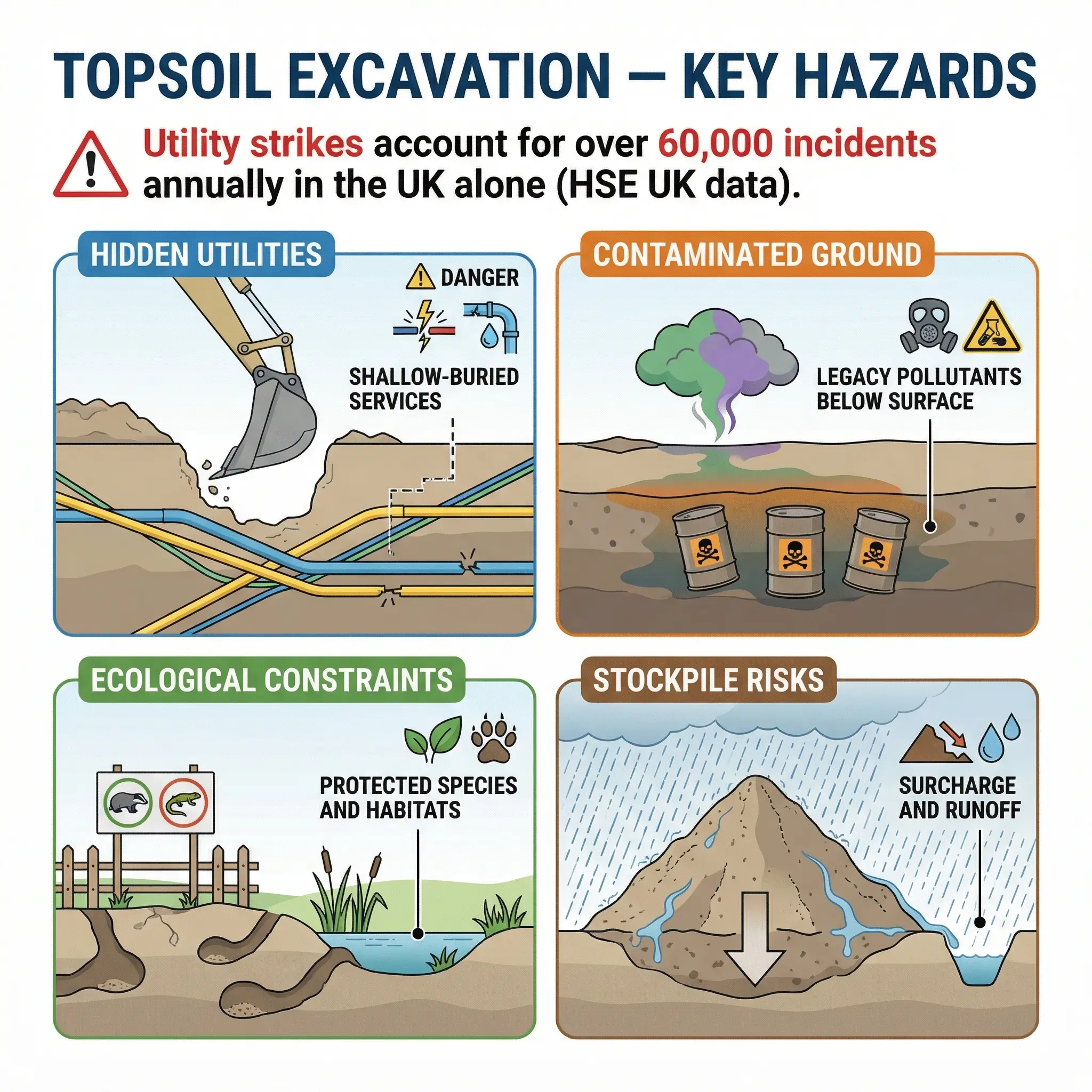
I’ve seen topsoil strips treated as non-hazardous because the excavation depth is shallow. That assumption has been behind some of the worst utility strike incidents I’ve investigated. The following hazards are specific to topsoil excavation and must be addressed before work begins:
- Uncharted utilities at shallow depth: Gas mains, fiber optic cables, and electrical feeders are frequently installed within the topsoil zone — especially on brownfield sites or land adjacent to existing infrastructure. A “topsoil-only” classification does not eliminate utility strike risk.
- Contaminated ground: On former industrial, agricultural, or landfill sites, the topsoil layer may contain heavy metals, hydrocarbons, asbestos-containing materials, or pesticide residues. Disturbance without prior ground investigation triggers occupational exposure and environmental contamination risks.
- Ecological and environmental constraints: Topsoil stripping during nesting season, in proximity to watercourses, or within protected habitat zones may require ecological pre-clearance, silt management, and environmental permits that delay or restrict the excavation method.
- Stockpile management: Removed topsoil is typically stockpiled for later reinstatement. Unsecured stockpiles create silt runoff, block access routes, and — if placed near excavation edges — surcharge the ground and increase collapse risk on adjacent deeper excavations.
The control measures for topsoil excavation focus on what’s hidden, not what’s visible. Before any machine cuts the ground, these actions are non-negotiable:
- Underground utility survey (UUS): A full desktop search of utility records combined with a ground-penetrating radar (GPR) or electromagnetic locator (EML) sweep of the work area. Cat and genny scans are the minimum — not the maximum.
- Contamination assessment: Phase 1 desk study and, where flagged, Phase 2 intrusive investigation to characterize soil contaminants before excavation begins.
- Ecological survey: Required where environmental permits or planning conditions mandate pre-clearance checks.
- Topsoil handling plan: Defines stockpile locations, maximum heights, setback distances from excavation edges, silt controls, and reinstatement procedures.
Pro Tip: On a highway widening project in Northern Europe, our topsoil strip exposed asbestos-containing made ground that didn’t appear in any desktop records. The Phase 1 study had classified the area as undeveloped agricultural land. It had been, until the 1970s — when a construction firm used it as an unofficial waste dump. The lesson: never trust a desk study as your only contamination screen on any land with more than twenty years of history.
Earth Excavation
Earth excavation is the most common excavation type across all construction sectors. It involves the removal of soil beneath the topsoil layer — clay, silt, sand, gravel, loam, or combinations — to achieve a designed formation level for foundations, roads, pipelines, drainage systems, or earthwork profiles. It is the excavation type that most HSE professionals encounter daily, and the one where complacency is most dangerous.
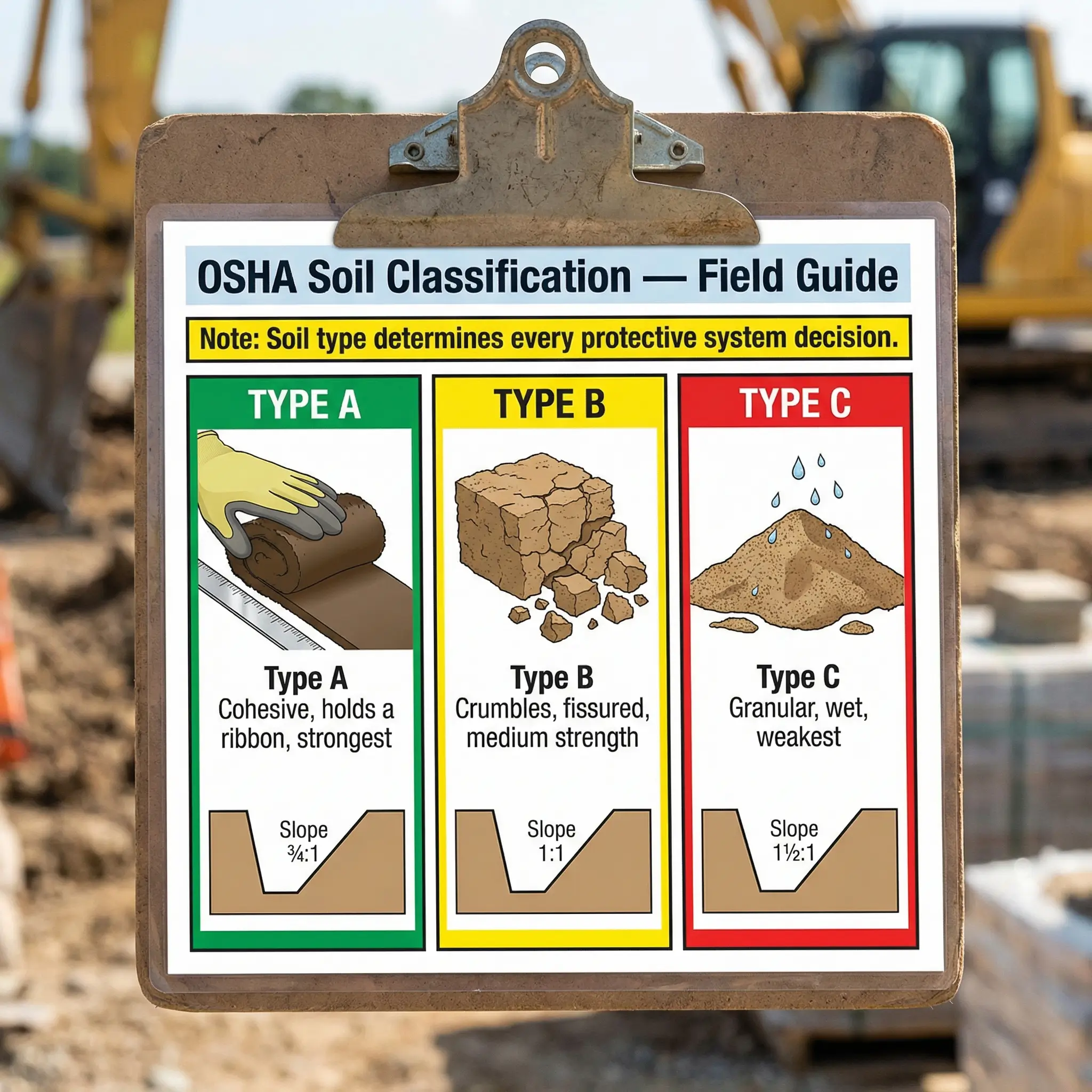
The behavior of earth excavation is entirely governed by soil type and moisture content. The same trench profile that stands stable in stiff clay will collapse without warning in loose granular sand. OSHA’s soil classification system under Appendix A of 29 CFR 1926 Subpart P provides the framework for assessing this, and a competent person must classify the soil before any protective system is selected. The three classifications and their practical implications are laid out below:
| Soil Type | Description | Unconfined Compressive Strength | Maximum Allowable Slope (H:V) | Field Behavior |
|---|---|---|---|---|
| Type A | Cohesive soils — clay, silty clay, hardpan | 1.5 tsf or greater | ¾:1 (53°) | Holds a vertical face temporarily; can be hand-molded into a ribbon without crumbling |
| Type B | Medium cohesion — angular gravel, silt, silty clay with fissures | 0.5–1.5 tsf | 1:1 (45°) | Crumbles when hand-molded; shows tension cracks near edges |
| Type C | Granular, submerged, or unstable — loose sand, gravel, saturated clay | 0.5 tsf or less | 1½:1 (34°) | Flows or bulges; does not hold a vertical cut; standing water present |
Every earth excavation over 1.5 meters (5 feet) deep must have a protective system — sloping, benching, shoring, or shielding — selected based on the soil classification. The most common field failures I encounter during inspections relate directly to this requirement:
- Misclassification by optimism: Supervisors classifying saturated silt as Type B because it “looks firm enough” — ignoring that water seepage automatically downgrades the classification.
- No re-inspection after rain: A Type A excavation that was stable on Monday morning may be Type C by Tuesday afternoon after overnight rainfall. Re-assessment after every weather event, water ingress, or vibration exposure is mandatory, not discretionary.
- Spoil pile placement: Excavated material dumped within the setback zone (minimum 600mm / 2 feet from the edge) surcharges the ground and dramatically increases the probability of wall failure.
- Inadequate access and egress: OSHA requires a ladder, stairway, or ramp within 25 feet of lateral travel for any trench 1.2 meters (4 feet) or deeper. I still find excavations where the only way out is climbing the bucket of an excavator.
HSE UK guidance (HSG 185): Excavation work is one of the most dangerous construction activities. The risk of collapse, which can cause death or serious injury, must be prevented by providing adequate support or by battering the sides to a safe angle.
Rock Excavation
Rock excavation involves the removal of solid, naturally formed rock that cannot be effectively removed by standard earthmoving equipment alone. It is encountered during foundation works, road cuttings, tunneling approaches, pipeline routes through mountainous terrain, and basement excavations in bedrock geology. The moment a project hits rock, the excavation methodology, equipment, timeline, cost, and safety risk profile all change fundamentally.
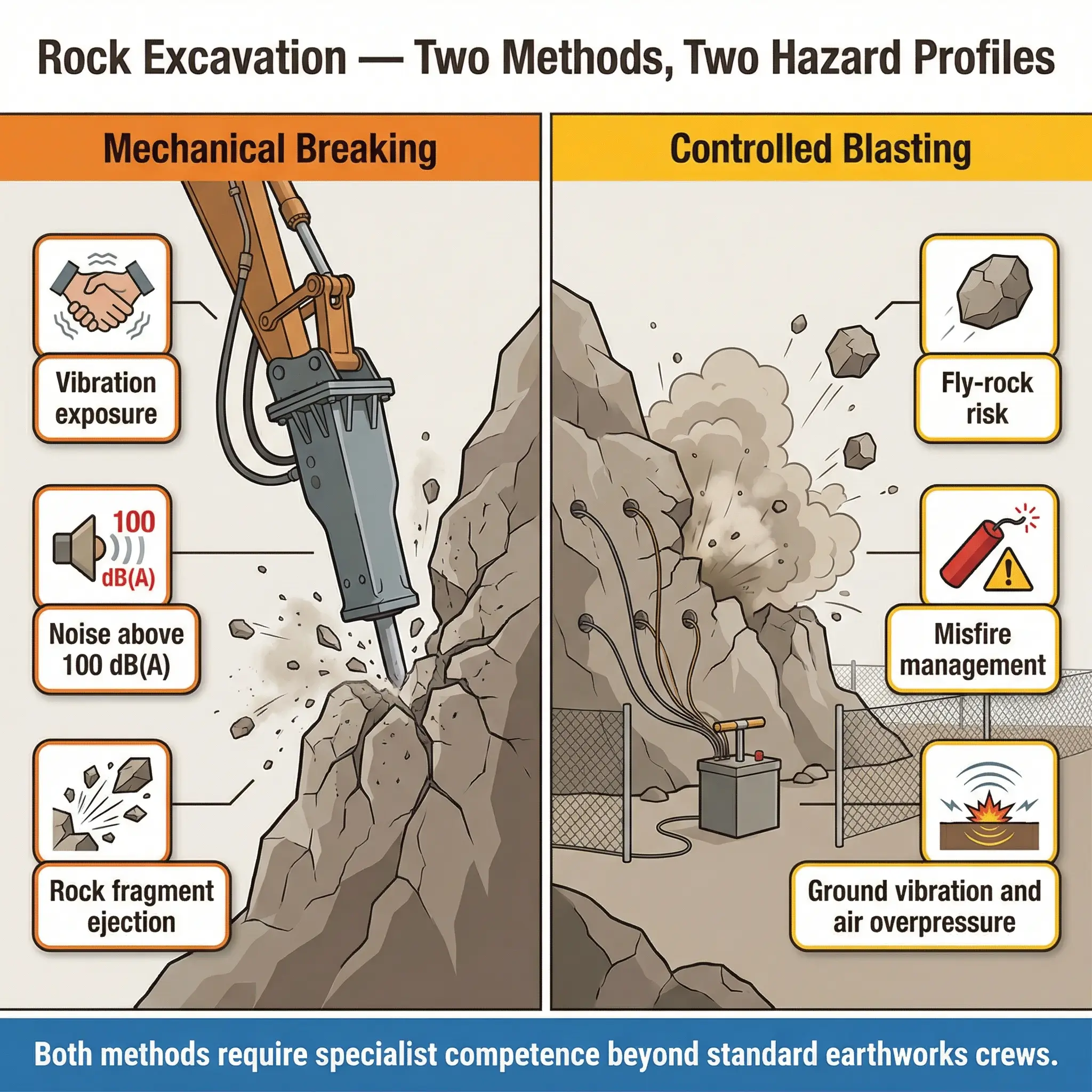
There are two primary methods for rock excavation in construction, and each carries a different hazard set. The selection depends on rock hardness, fracture patterns, proximity to existing structures, vibration sensitivity, and environmental constraints:
- Mechanical breaking: Hydraulic breakers (rock hammers), rippers mounted on heavy excavators, or rock wheel cutters are used to fracture and remove rock mechanically. This is the preferred method in urban environments or near sensitive structures where blasting vibration would cause damage. The primary hazards are whole-body and hand-arm vibration exposure for operators, noise levels regularly exceeding 100 dB(A) at the source, and high-velocity rock fragment ejection.
- Controlled blasting (drill and blast): Blast holes are drilled into the rock face, charged with explosives, and detonated in a controlled sequence to fragment the rock for mechanical removal. This is common in highway cuttings, quarry development, and large-scale foundation excavation in hard rock. The hazard profile includes fly-rock, ground vibration, air overpressure, premature detonation, misfire management, and exclusion zone control.
The safety controls for rock excavation are more specialized than for any other excavation type, and they require competencies that standard earthworks crews rarely possess. The following controls are baseline requirements regardless of method:
- Vibration monitoring: Both environmental vibration (to protect adjacent structures) and occupational vibration (to protect operators from HAVS and whole-body vibration injuries) must be monitored against defined trigger and action levels. Under the EU Physical Agents (Vibration) Directive 2002/44/EC, the daily exposure action value for hand-arm vibration is 2.5 m/s² and the exposure limit value is 5 m/s².
- Blast management plan: Where controlled blasting is used, a licensed shotfirer must design, supervise, and execute every blast. The blast plan covers hole patterns, charge weights, delay sequences, exclusion zones, fly-rock calculations, pre-blast surveys of adjacent properties, and post-blast inspection procedures.
- Hearing conservation program: Noise levels during mechanical rock breaking routinely exceed 85 dB(A) action levels. Engineering controls (cab enclosures, remote operation) are the first line of defense, with hearing protection as supplementary — not primary — control.
- Rock face inspection: Before and after every work shift, and after every blast event, a competent geotechnical observer must inspect the rock face for overhang, loose blocks, wedge failures, and tension cracks that indicate imminent rockfall.
Pro Tip: I was on a dam access road project in Southern Africa where the blast contractor’s fly-rock calculations were technically correct for the charge weights used — but they hadn’t accounted for a natural joint plane in the granite that redirected fragments 40 meters beyond the exclusion zone. Two vehicles were damaged. No injuries, but only because the traffic management plan had extended the closure beyond the calculated zone as a precaution. Always add margin to calculated exclusion zones in jointed or foliated rock. The geology doesn’t read the calculations.
Trench Excavation
Trench excavation is a specific subset of earth excavation where the depth exceeds the width — typically defined as an excavation that is deeper than it is wide, or deeper than 1.2 meters (4 feet). Trenches are excavated for utility installation (water, sewer, gas, electrical, telecom), drainage systems, foundation strip footings, and pipeline construction. They are, without exaggeration, the deadliest type of routine excavation in construction.
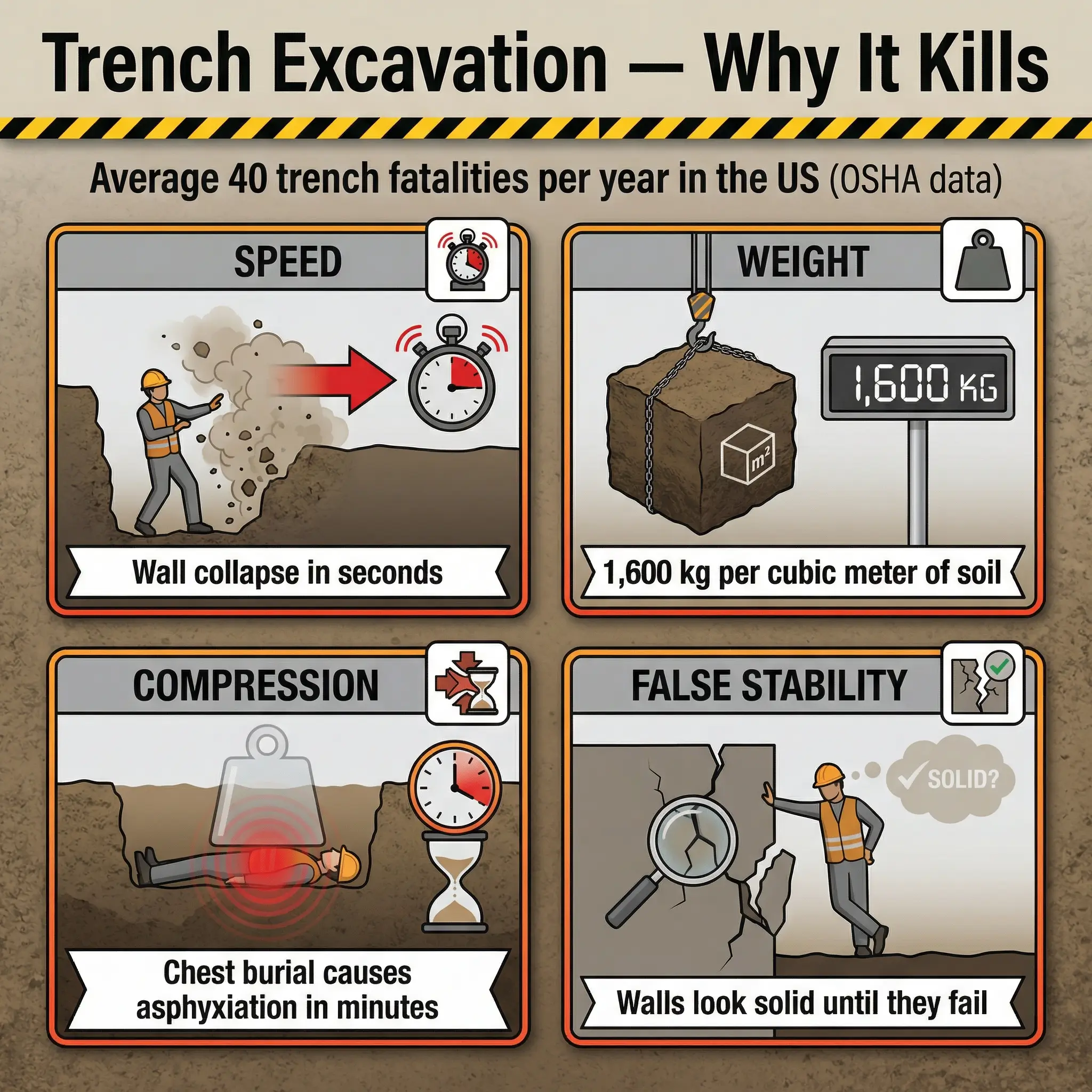
The statistics are stark. OSHA reports that trench collapses kill an average of 40 workers per year in the United States alone. In the UK, HSE data consistently identifies excavation collapse — overwhelmingly in trenches — as a leading cause of construction fatalities. The geometry of a trench is what makes it lethal: narrow width means a collapsing wall doesn’t have far to travel before it buries a worker, and the confined dimensions make rescue extremely difficult once someone is trapped.
I have investigated three trench collapse fatalities over my career. Every single one shared the same root cause pattern — the work was treated as routine, the trench was considered “not deep enough to need shoring,” and the competent person inspection either didn’t happen or was a signature without a site visit. The following factors make trench excavation uniquely dangerous:
- Speed of collapse: A cubic meter of soil weighs approximately 1,600 kg (3,500 lbs). A trench wall failure buries a worker in seconds — there is no time to react, climb, or be pulled out.
- Chest compression: Even partial burial to waist or chest level can kill through compressive asphyxiation. The victim cannot expand their chest to breathe against the weight of soil. Death can occur within 3–5 minutes.
- False stability: A trench wall that appears stable can be undercut by water seepage, vibration from nearby equipment or traffic, or drying and cracking in hot weather — all invisible from the surface until the moment of failure.
- Access and egress limitations: The narrow profile of a trench restricts escape routes. A ladder at one end of a 30-meter trench is useless to a worker at the other end when the wall between them collapses.
The protective systems for trench excavation are well established, and OSHA Subpart P lays them out clearly. The competent person selects from these options based on soil classification, trench depth, and site conditions:
- Sloping: Cutting the trench walls back at an angle determined by soil type. Effective but requires significant additional excavation width — often impractical on congested sites or near existing structures.
- Benching: Creating a stair-step profile in the trench walls. Only permitted in Type A and Type B soils — never in Type C. Each bench must not exceed 1.2 meters (4 feet) in height.
- Shoring: Installing hydraulic, pneumatic, or timber support systems against the trench walls to prevent collapse. The system must be designed for the specific soil type, trench depth, and surcharge loads.
- Shielding (trench boxes): Placing a prefabricated steel or aluminum shield inside the trench to protect workers. The shield does not prevent collapse — it creates a protected zone within the collapse area. Workers must never work outside the shield.
| Protective System | Best For | Limitations | Soil Type Restrictions |
|---|---|---|---|
| Sloping | Open sites with space; long pipeline trenches | Requires wide excavation footprint; impractical near structures | All types (angle varies by classification) |
| Benching | Moderate-depth trenches in stable soils | Not permitted in Type C soils; limited depth application | Type A and B only |
| Shoring | Deep trenches, urban sites, near structures | Requires engineering design for depths over 6m (20 ft); installation and removal are high-risk phases | All types (design varies) |
| Shielding | Utility trenches, progressive pipe-laying | Does not prevent collapse — only protects workers inside; must move with the work face | All types |
Pro Tip: The most dangerous moment in a shored or shielded trench is not during the main work — it’s during installation and removal of the protective system. I’ve seen crews climb into unprotected trenches to position shoring frames “because it’ll only take a minute.” That minute is when people die. Insist on installation from the surface using mechanical means, or use a drag-in shielding system that doesn’t require workers in the unprotected trench.
Muck Excavation
Muck excavation is the removal of soil or earth material that is excessively saturated with water, or that contains a high proportion of decaying organic matter, rendering it unsuitable as structural fill or stable ground. Muck is defined practically by its inability to support loads — it deforms under pressure, flows when disturbed, and cannot be compacted to engineering specifications. It is typically found in marshlands, river floodplains, former ponds, landfill margins, and coastal reclamation zones.
I worked on a logistics park development on a reclaimed coastal site in Southeast Asia where the first 2.5 meters of ground was classified as muck — black, saturated organic clay with a consistency closer to pudding than soil. Standard excavators sank when they tracked onto the working surface. The ground investigation report had identified it, but the contractor’s method statement still called for conventional open-cut excavation with battered sides. The sides didn’t batter — they flowed. Within two hours of opening the first cut, the excavation was a flooded, shapeless pond with no defined edges.
The unique hazards and considerations for muck excavation include the following:
- No self-supporting capability: Muck cannot hold a vertical or sloped face. Any excavation in muck will spread, slump, or flow unless continuously supported or contained. Conventional shoring designed for cohesive soils is inadequate — the muck flows around or under the supports.
- Equipment entrapment: Heavy plant can sink into muck surfaces, trapping machines and creating recovery operations that are themselves high-risk. Ground bearing capacity assessment and temporary working platforms (geotextile-reinforced stone pads) are essential before any machine enters the area.
- Contamination potential: Organic muck frequently contains hydrogen sulfide (H₂S), methane (CH₄), and other decomposition gases. Disturbing muck releases these gases, creating both toxic atmosphere and flammable atmosphere hazards — particularly in enclosed or low-lying areas where gases can accumulate.
- Disposal classification: Muck with high organic content, contamination, or saturation may be classified as unsuitable fill or even controlled waste, requiring off-site disposal to licensed facilities rather than re-use on the project.
- Dewatering challenges: Pumping water from muck excavations is often ineffective because the muck itself is semi-fluid. Settlement ponds, silt management, and environmental discharge permits are required to manage the effluent.
The control measures for muck excavation are fundamentally different from standard earth excavation, and they are often underestimated in project planning:
- Ground investigation before excavation: Boreholes and trial pits to confirm the depth, extent, and composition of the muck layer — critical for determining the excavation method, disposal route, and temporary works design.
- Temporary working platforms: Engineered platforms using geotextile membranes and imported granular fill to provide a stable surface for excavator operation. Designed to BRE Report 470 or equivalent standards.
- Atmospheric monitoring: Continuous or frequent spot monitoring for H₂S and CH₄ in and around the excavation, especially in warm conditions that accelerate organic decomposition.
- Specialist disposal route: Pre-agreed with waste management contractors and licensed receiving facilities. Muck cannot simply be “spread around the site.”
Unclassified Excavation
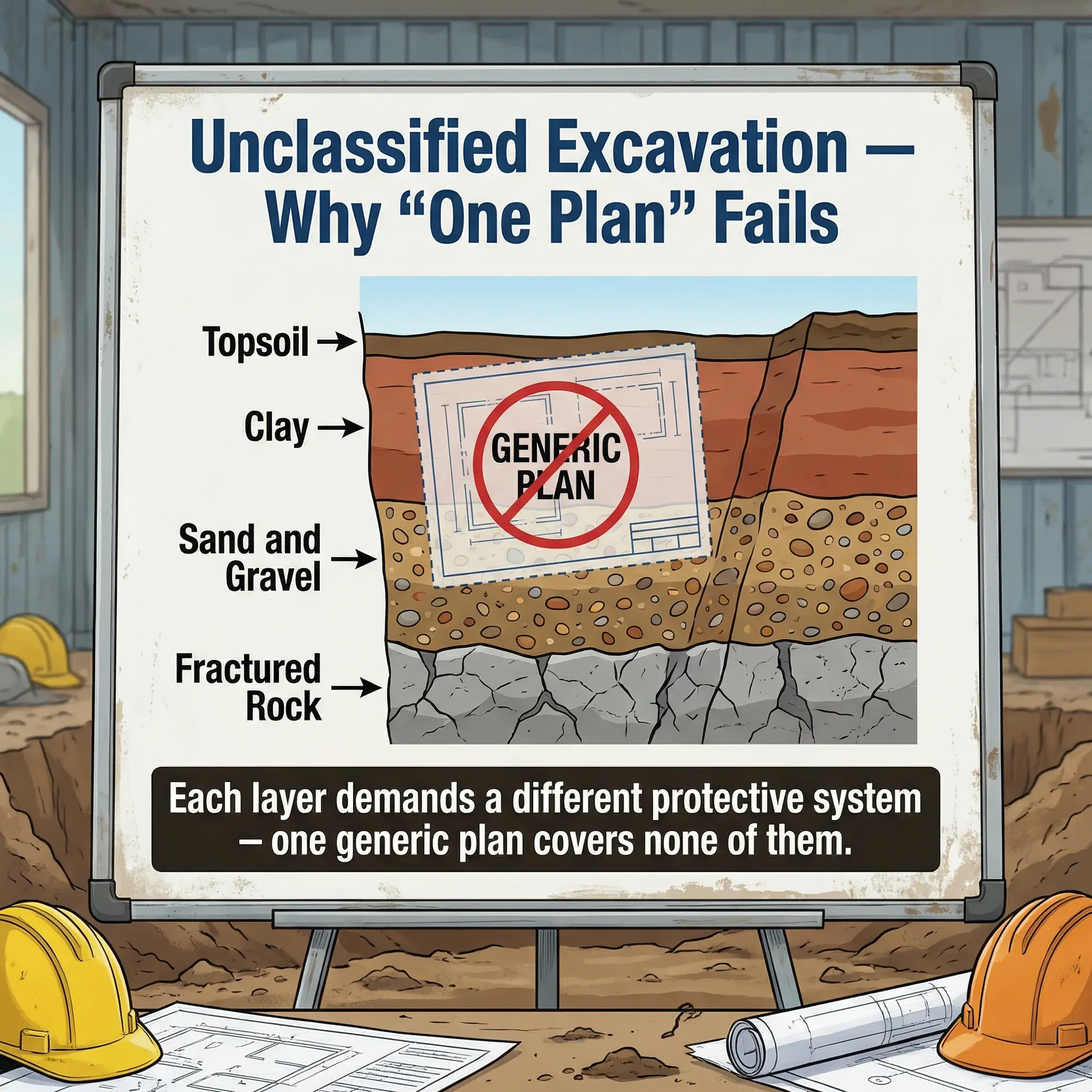
Unclassified excavation is a contractual and operational term — not a geological one — used when the excavation scope includes a mix of material types (earth, rock, muck, fill, rubble) that are not separated or measured individually. The contractor is paid a single rate per cubic meter regardless of what comes out of the ground. From an engineering and commercial standpoint, it simplifies measurement. From an HSE standpoint, it can be dangerously misleading.
The problem with unclassified excavation is that it encourages a single method statement for multiple material types. I’ve audited projects where the excavation was contractually “unclassified,” and the safety plan reflected that ambiguity — one generic risk assessment, one set of controls, one protective system specification — applied uniformly to conditions that ranged from soft alluvial silt to fractured limestone within the same excavation footprint.
In practice, unclassified excavation demands more vigilance from the competent person, not less. The following principles apply:
- Continuous assessment: Because the material type may change with every bucket load, the competent person must be present and actively monitoring ground conditions — not reviewing from a site office.
- Adaptive protective systems: Shoring or sloping designed for one soil type may be inadequate within meters as the excavation moves into different material. The ability to switch protective systems mid-excavation must be planned, resourced, and rehearsed.
- Equipment flexibility: The excavation plant must be appropriate for the hardest material expected. Discovering rock mid-dig with only a standard-bucket excavator on site creates pressure to “work around” the rock unsafely rather than stop and mobilize the correct equipment.
- Clear communication protocol: The excavator operator, banksman, and competent person must have an agreed system for flagging material changes in real time — especially unexpected rock, groundwater, voids, buried structures, or contamination indicators.
Pro Tip: On a road construction project in Eastern Europe, the bill of quantities classified the entire 3 km cut-and-fill operation as “unclassified excavation.” During the second week, the excavators hit an abandoned concrete culvert network that nobody had mapped. The operator tried to rip through it, fractured a hydraulic line, and sprayed hydraulic oil across the excavation face. Had that been a gas main instead of a culvert, the outcome would have been catastrophic. Unclassified excavation on paper does not mean unclassified risk in the ground. Investigate before you excavate — always.
Cut and Fill Excavation
Cut and fill is a bulk earthmoving method used to create level platforms for roads, railways, building pads, airports, and large infrastructure projects on undulating or sloping terrain. Material excavated from high areas (“cut”) is transported and placed in low areas (“fill”) to achieve a designed formation level. When balanced correctly, the volume of cut equals the volume of fill, minimizing the need for imported material or off-site disposal.
This is excavation at scale — often involving hundreds of thousands of cubic meters of earth moved across kilometers of project length. The HSE challenges of cut and fill operations are distinct from smaller, localized excavations because of the scale of plant movement, the duration of open excavation faces, and the interaction between excavation and fill placement happening simultaneously across the site.
The primary hazards in cut and fill operations require a different management approach from isolated trench or foundation excavations:
- Plant-pedestrian interaction: Cut and fill sites involve continuous movement of large earthmoving equipment — excavators, dump trucks, dozers, compactors — across haul routes that intersect with survey teams, quality inspectors, and other ground workers. Segregation of plant and pedestrian zones is the single most important control.
- Cut face stability: Large open cuts in sloping terrain create exposed faces that may remain open for weeks or months. The face must be designed to a safe angle based on soil classification, and it must be inspected after every rainfall event, seismic activity, or adjacent blasting.
- Fill compaction and stability: Improperly placed or compacted fill creates weak zones that can collapse under load, subside under structures, or fail as slopes. From a safety standpoint, fill slopes that fail during construction can bury workers and equipment below.
- Haul road management: Temporary haul roads carrying loaded dump trucks across unfinished earthwork profiles are a significant risk for rollovers, collision with excavation edges, and brake failure on grades. Haul road design, maintenance, speed limits, and edge protection are critical controls.
- Drainage during works: Cut and fill operations disrupt natural drainage patterns. Water collecting in cut areas, flowing across fill surfaces, or ponding at the cut-fill interface creates erosion, slope instability, and equipment bogging hazards.
The control measures for safe cut and fill operations are as much about traffic management and temporary works design as they are about excavation technique:
- Traffic management plan (TMP): Dedicated haul routes, one-way systems where possible, passing bays, speed limits (typically 15–20 km/h on unfinished surfaces), and banksmen at all blind intersections.
- Cut face design and monitoring: Geotechnical design of cut slopes with factor-of-safety calculations, inclinometer or survey prism monitoring for slow creep movement, and immediate exclusion zones when monitoring triggers are reached.
- Fill placement specification: Layer thickness limits (typically 200–300mm lifts), compaction testing at defined frequencies, and moisture conditioning requirements to ensure each lift achieves the specified density.
- Progressive drainage installation: Temporary surface drains, interceptor ditches, and settlement ponds installed progressively as the earthworks advance — not left until the end of the earthmoving phase.
Dredging Excavation
Dredging is the excavation of material from beneath water — riverbeds, lake floors, harbor basins, canals, offshore seabeds, and coastal zones. It is carried out for navigation channel maintenance, land reclamation, flood defense works, marine construction (bridge piers, jetties, offshore platform foundations), and environmental remediation of contaminated sediments.
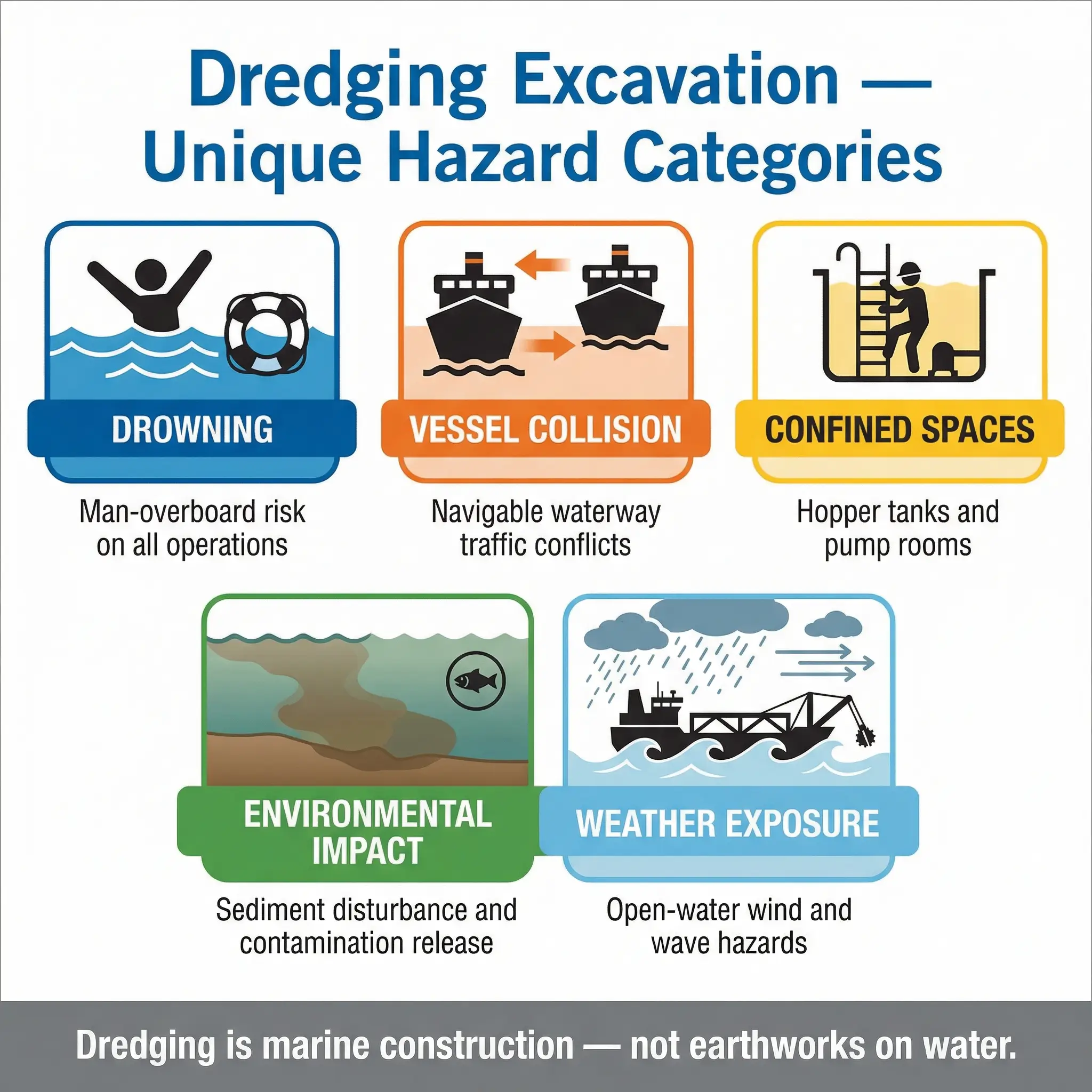
Dredging is a specialist discipline that sits at the intersection of marine operations, geotechnical engineering, and environmental management. The HSE risk profile is fundamentally different from land-based excavation because the work environment itself — open water — introduces drowning, vessel collision, weather exposure, and confined space hazards that do not exist on terrestrial sites.
I was involved in the HSE oversight of a capital dredging operation for a new port development in the Middle East, where trailing suction hopper dredgers were extracting sand from borrow areas 12 km offshore and pumping it ashore for land reclamation. The operation ran 24 hours a day, 7 days a week, for 18 months. The hazard profile was nothing like any land-based excavation I’d managed before. The following hazards are characteristic of dredging operations:
- Drowning and man-overboard risk: The primary life-safety hazard on any dredging operation. All personnel on vessels and floating plant must wear inflatable personal flotation devices (PFDs), and man-overboard alarm and rescue systems must be tested and drilled regularly.
- Vessel collision: Dredgers operating in navigable waterways interact with commercial shipping, recreational vessels, and support craft. Collision avoidance, marine traffic management, and exclusion zone enforcement around the dredger are critical controls.
- Confined space entry on vessels: Dredging vessels contain hopper spaces, pump rooms, ballast tanks, and engine room bilges that are classified confined spaces. OSHA-equivalent maritime confined space entry procedures apply.
- Environmental impact: Dredging disturbs sediments, increases turbidity, can release buried contaminants, and affects marine habitats. Environmental monitoring (turbidity curtains, water quality sampling, marine mammal observation) is typically a condition of the dredging license.
- Noise and vibration: Cutter suction dredgers and backhoe dredgers generate significant noise and vibration levels at the point of excavation. Operator cabins must be acoustically treated, and exposure monitoring is required for deck crews.
The types of dredging equipment each carry specific operational safety considerations:
- Trailing suction hopper dredger (TSHD): Self-propelled vessel that drags a suction pipe along the seabed. Hazards include drag head entanglement, hopper overflow management, and vessel stability during loading and discharge cycles.
- Cutter suction dredger (CSD): Stationary platform with a rotating cutter head that excavates the seabed and pumps material through a pipeline. Hazards include pipeline pressure failures, spud leg operations (raising and lowering anchoring spuds), and swing wire management.
- Backhoe dredger: A hydraulic excavator mounted on a pontoon or barge. Hazards are similar to land-based excavator operation — plus vessel stability, load limits, and open-water weather exposure.
Basement and Foundation Excavation
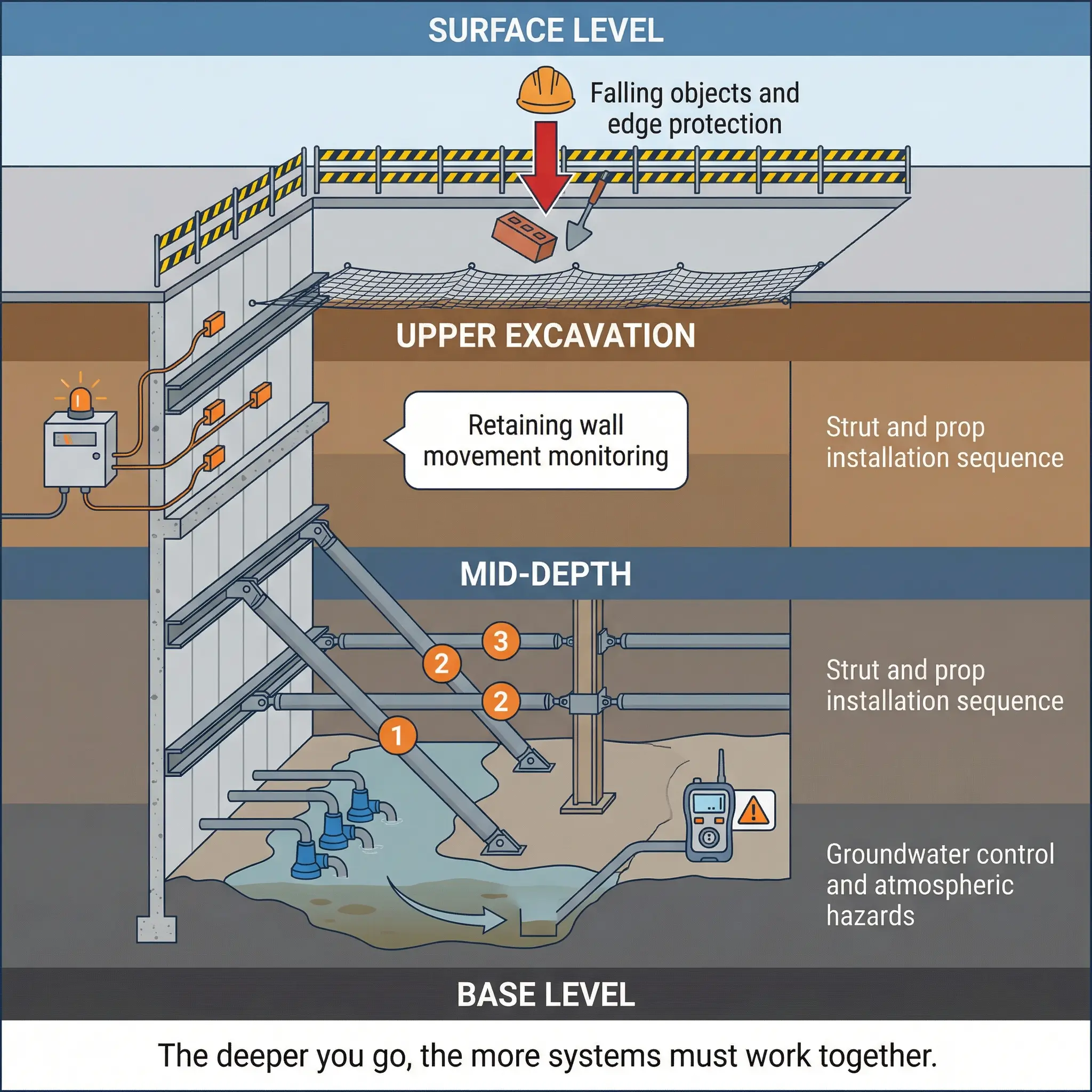
Basement and foundation excavation involves the removal of earth to create below-grade spaces for building basements, deep foundations (piled or caisson), elevator shafts, subterranean car parks, utility vaults, and underground service corridors. These are among the deepest and most geometrically complex excavations on construction sites — frequently exceeding 10–15 meters in depth in urban environments — and they are almost always adjacent to existing structures, live utilities, and public spaces.
The defining characteristic of basement excavation from an HSE perspective is confinement within a retained perimeter. Unlike open-cut excavations that can be sloped back, basement digs are typically vertically retained by sheet piles, contiguous piled walls, diaphragm walls, or secant pile walls because the site boundary does not permit sloping. This creates a deep, enclosed work area where multiple trades operate simultaneously — piling rigs, excavators, concrete crews, reinforcement fixers, dewatering pumps, and crane operations all sharing a confined footprint.
The following hazards are specific to or intensified by the basement and foundation excavation environment:
- Retaining wall movement and failure: Temporary retaining structures must withstand earth pressure, water pressure, surcharge loads from adjacent buildings and traffic, and construction loads from within the excavation. Monitoring (inclinometers, settlement surveys, strut load cells) is continuous throughout the excavation phase.
- Ground movement affecting adjacent structures: Deep excavations in urban areas can cause settlement, heave, or lateral movement in neighboring buildings, roads, and utilities. Damage to third-party property and the safety of occupants in adjacent structures are direct HSE concerns.
- Groundwater management: Deep basements frequently penetrate the water table. Dewatering systems (wellpoints, deep wells, sump pumping) must be designed to lower the water level below the working formation without causing drawdown-induced settlement in surrounding ground.
- Falling objects and materials: Workers at the base of a 12-meter excavation are exposed to tools, materials, and debris falling from the surface or from intermediate working levels. Exclusion zones, toe boards, edge protection, and secured tool lanyards are mandatory.
- Atmospheric hazards in deep excavations: Deep basement excavations — particularly in ground with organic content, contamination history, or proximity to landfill — can accumulate gases (CO₂, CH₄, H₂S) in the base of the excavation where natural ventilation is poor. Atmospheric monitoring may be required.
Basement excavation requires a level of temporary works coordination that most other excavation types do not. The following roles and controls are essential:
- Temporary Works Coordinator (TWC): Under BS 5975 or equivalent, a designated TWC oversees the design, installation, monitoring, and removal of all temporary retaining and support structures. This is not an optional role — it is a defined competency position.
- Instrumentation and monitoring plan: Pre-defined trigger and action levels for wall deflection, ground settlement, strut loads, and groundwater levels — with clear protocols for who receives the data, who makes the decision to stop work, and within what timeframe.
- Sequence-dependent safety: The excavation, propping, and dewatering sequence is structurally interdependent. Excavating below a design level before installing the corresponding prop creates an unsupported span that the wall was not designed to resist. Adherence to the designed sequence is a structural safety requirement, not a construction preference.
BS 5975:2019 (Code of Practice for Temporary Works): Requires that a Temporary Works Coordinator be appointed for all projects involving temporary works, including excavation support systems, and that a formal design check procedure is followed before any temporary structure is loaded.
Pro Tip: On a high-rise project in the Gulf, the basement excavation reached its fifth prop level — about 14 meters below street level. The contractor wanted to skip the fifth prop and “just get to formation quickly” to save two weeks on the program. The structural designer’s analysis showed that omitting that prop would have increased the wall deflection by 400% at the base, risking a progressive failure that could have propagated to the adjacent highway. We stopped the work, installed the prop, and the project still finished on time. Two weeks is never worth a wall failure at 14 meters depth. Never compromise the designed sequence — ever.
Stripping and Grubbing
Stripping and grubbing is the initial site clearance phase — removing vegetation, tree stumps, root systems, organic debris, and the top layer of unsuitable material to prepare the site for construction earthworks. While it sounds like the simplest form of excavation, it carries specific hazards that are routinely underestimated because the activity is perceived as “clearance” rather than “excavation.”
The reason stripping and grubbing matters for HSE professionals is that it is the first time machines break ground on a project. It sets the safety culture tone for every excavation activity that follows. The hazards during this phase overlap with topsoil excavation but include additional risks unique to vegetation and stump removal:
- Tree felling and stump extraction: Large trees require qualified chainsaw operators and planned felling procedures. Stump extraction using excavators creates unpredictable loads as root systems release suddenly, swinging stumps and attached soil masses.
- Buried obstructions: Former fence lines, boundary walls, old foundations, and unrecorded services are frequently encountered during stripping. The assumption that “it’s just trees and grass” leads to reduced vigilance on utility scanning.
- Ecological and permit compliance: Protected species (nesting birds, bats in trees, reptile habitats, protected flora) may be present and require pre-clearance ecological surveys. Proceeding without surveys can result in criminal prosecution under wildlife protection legislation in most jurisdictions.
- Burning restrictions and air quality: On some sites, stripped vegetation and organic material is burned on-site. Open burning creates fire spread risk, smoke inhalation exposure, and air quality violations. Controlled burning requires permits, fire management plans, and atmospheric monitoring downwind.
- Ground stability after removal: Removing deep root systems from slopes or embankments can destabilize the ground. Root networks contribute to soil cohesion — their removal may trigger shallow landslips that weren’t predicted.
The control hierarchy for stripping and grubbing focuses on sequencing and competence:
- Pre-clearance surveys: Ecological, archaeological, and utility surveys completed before any machine enters the clearance area. Non-negotiable.
- Qualified operators: Chainsaw work must comply with applicable national competency standards (e.g., NPTC in the UK, or equivalent certification). Stump extraction must be supervised by someone experienced in the unpredictable forces involved.
- Sequenced clearance: Work from the site perimeter inward, maintaining clear escape routes for operators and a defined safe distance between machines and ground workers.
- Material management plan: Defines disposal or re-use routes for cleared vegetation, stumps, and organic material — preventing uncontrolled stockpiling that creates fire, pest, and drainage blockage hazards.
Common Excavation Safety Failures Across All Types
Regardless of the specific excavation type, the root causes of excavation-related incidents follow predictable patterns. Over a decade of incident investigations, audits, and enforcement observations, I see the same failures repeated across industries, geographies, and project sizes. These are not theoretical risks — they are the actual mechanisms that kill and injure workers in excavations.
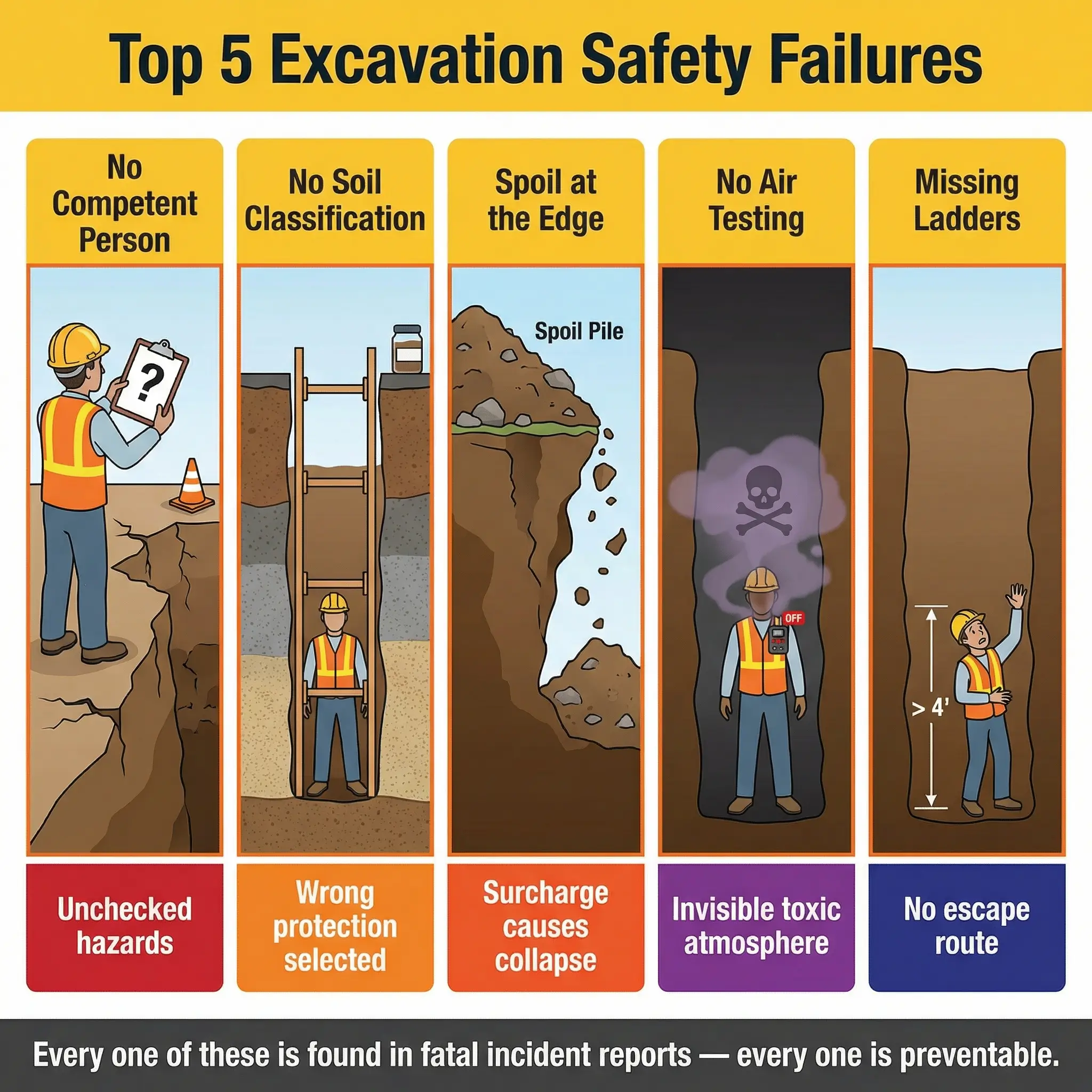
The most frequent excavation safety failures cluster into a small number of categories, and every one of them is preventable with basic competence and management commitment:
- No competent person on site: The most critical single failure. OSHA requires a competent person to inspect excavations daily, before each shift, and after any event that could change conditions. HSE UK requires the same under CDM 2015. In practice, the “competent person” is often whoever signed the paperwork in the office — not someone who physically inspected the excavation that morning.
- Failure to classify soil: Protective systems are selected based on soil classification. If nobody classifies the soil — through visual inspection, manual tests, and pocket penetrometer or torvane readings — the protective system selection is a guess. Guesses kill.
- Spoil pile within the setback zone: The 600mm (2-foot) minimum setback for excavated material is violated on nearly every site I visit for the first time. Spoil piled at the edge of an excavation is an active surcharge load pushing the wall toward collapse.
- No atmospheric testing in deep excavations: Excavations over 1.2 meters (4 feet) deep in contaminated ground, near landfill, or in organic soils can accumulate hazardous atmospheres — CO₂, CH₄, H₂S — at the base. Without testing, workers enter these zones unaware.
- Inadequate access and egress: Ladders missing, improperly secured, or positioned too far from workers. In a trench collapse, every second of escape time matters. A ladder 30 meters away provides zero protection.
- Work in unprotected excavations “just for a minute”: The most commonly cited phrase in fatal excavation investigation transcripts. The trench doesn’t know how long you planned to be in it.
| Failure | Why It Happens | Consequence | Prevention |
|---|---|---|---|
| No competent person | Cost pressure, assumed simplicity | Unidentified hazards, wrong protective system | Dedicated, qualified CP on every excavation site |
| No soil classification | Assumed stable ground, time pressure | Collapse due to wrong slope or shoring selection | Mandatory field classification before every excavation |
| Spoil in setback zone | Convenience, lack of space | Surcharge-induced wall failure | Enforced exclusion zone, supervised spoil placement |
| No atmospheric testing | “It’s open air, it’s fine” | Toxic or oxygen-deficient atmosphere exposure | 4-gas monitor for all excavations >1.2m in suspect ground |
| Missing access/egress | Not planned, removed for “access” | Entrapment after partial collapse | Ladder within 25 ft lateral travel, secured at top |
Conclusion
Excavation is not a single activity — it is a spectrum of ground-breaking methods, each with its own geology, equipment demands, hazard profile, and safety control requirements. The HSE professional who treats all excavation as one thing will inevitably miss the specific risk that causes the next incident. Topsoil strips hide utilities. Earth excavation depends entirely on soil classification. Rock excavation introduces vibration and blast hazards. Trenches kill through geometry alone. Muck flows rather than fails. Basement digs demand engineered temporary works and continuous monitoring at depths where mistakes are unrecoverable.
What unites every type of excavation in construction is the same foundational principle: before you break ground, you must understand what the ground is, what’s in it, what’s beside it, and how it will behave when you change its state. That understanding is not a desk exercise — it requires a competent person physically at the excavation, every day, every shift, making real-time judgments based on what they see, test, and measure. No document, method statement, or risk assessment substitutes for that presence.
The ground does not forgive shortcuts. It does not read method statements or care about construction programs. A worker who enters an unprotected excavation trusts — whether they know it or not — that someone with competence and authority assessed that ground and determined it was safe. That trust is the most serious professional responsibility in construction safety. Honour it with the diligence it demands, and every worker goes home.