
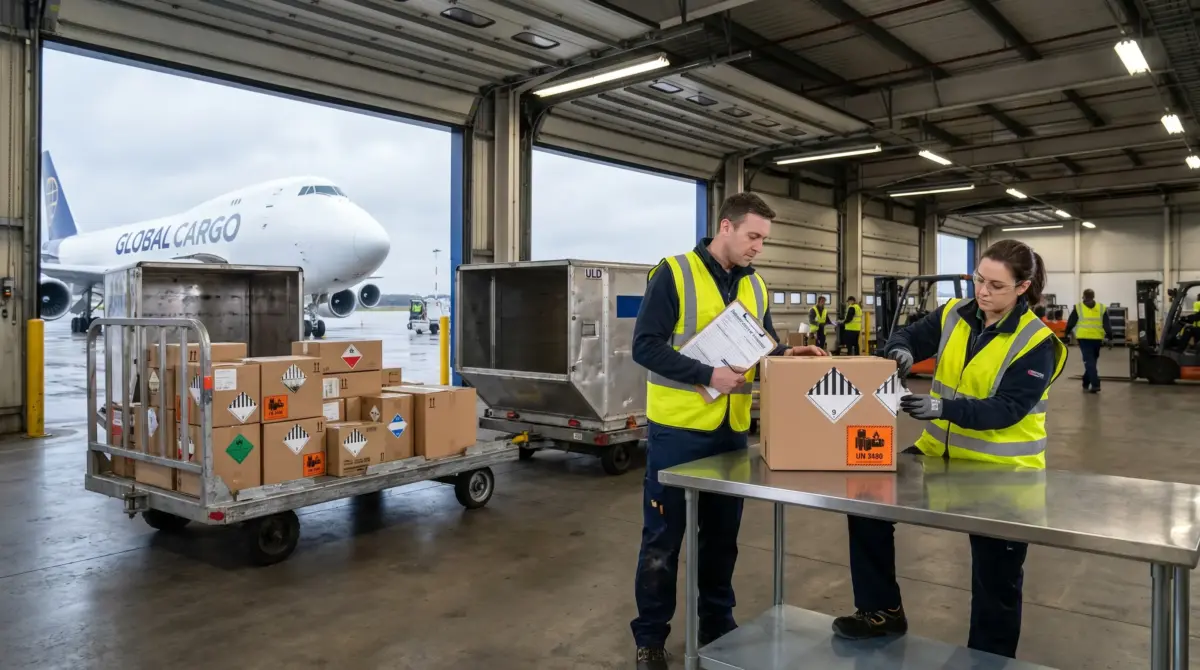
The IATA Dangerous Goods Regulations (DGR) are the global operational standard used by airlines, freight forwarders, and shippers to classify, package, mark, label, and document dangerous goods for air transport. Published annually by the International Air Transport Association, the DGR translates the legally binding ICAO Technical Instructions (Doc 9284) into practical guidance. The current 67th edition, effective January 1, 2026, covers all nine UN hazard classes and incorporates significant lithium battery and power bank restrictions prompted by recent in-flight fire incidents.
What Is the IATA DGR and Why Does It Matter for Air Freight Safety?
On January 28, 2025, a lithium-ion power bank ignited inside an overhead compartment on Air Busan Flight 391 at Gimhae International Airport, South Korea. The fire destroyed the aircraft entirely. All 176 occupants evacuated, and 27 sustained injuries (multiple sources reporting ARAIB preliminary findings, 2025). The power bank was a single consumer device — legal to carry under the rules in force at the time. That one item forced an international regulatory response within weeks and reshaped how the global aviation system treats portable battery-powered devices.
The incident underscores why the IATA Dangerous Goods Regulations exist — and why treating them as bureaucratic overhead is a fundamental misread of their function. More than 1.25 million dangerous goods shipments move by air each year (IATA, undated), ranging from pharmaceutical isotopes and industrial chemicals to the lithium batteries inside consumer electronics. Every one of those shipments carries potential energy — chemical, radiological, thermal — that the aircraft environment amplifies. Pressurized cabins, altitude-driven pressure differentials, limited firefighting capability, and the impossibility of pulling over at 35,000 feet make air transport the most restrictive mode for dangerous goods by a wide margin. This article breaks down the DGR's regulatory hierarchy, walks through the compliance chain from classification to acceptance, addresses the lithium battery rules that dominate current enforcement attention, and flags the operational failure points that cause the majority of shipment rejections.
How the IATA DGR Relates to ICAO Technical Instructions and National Regulations
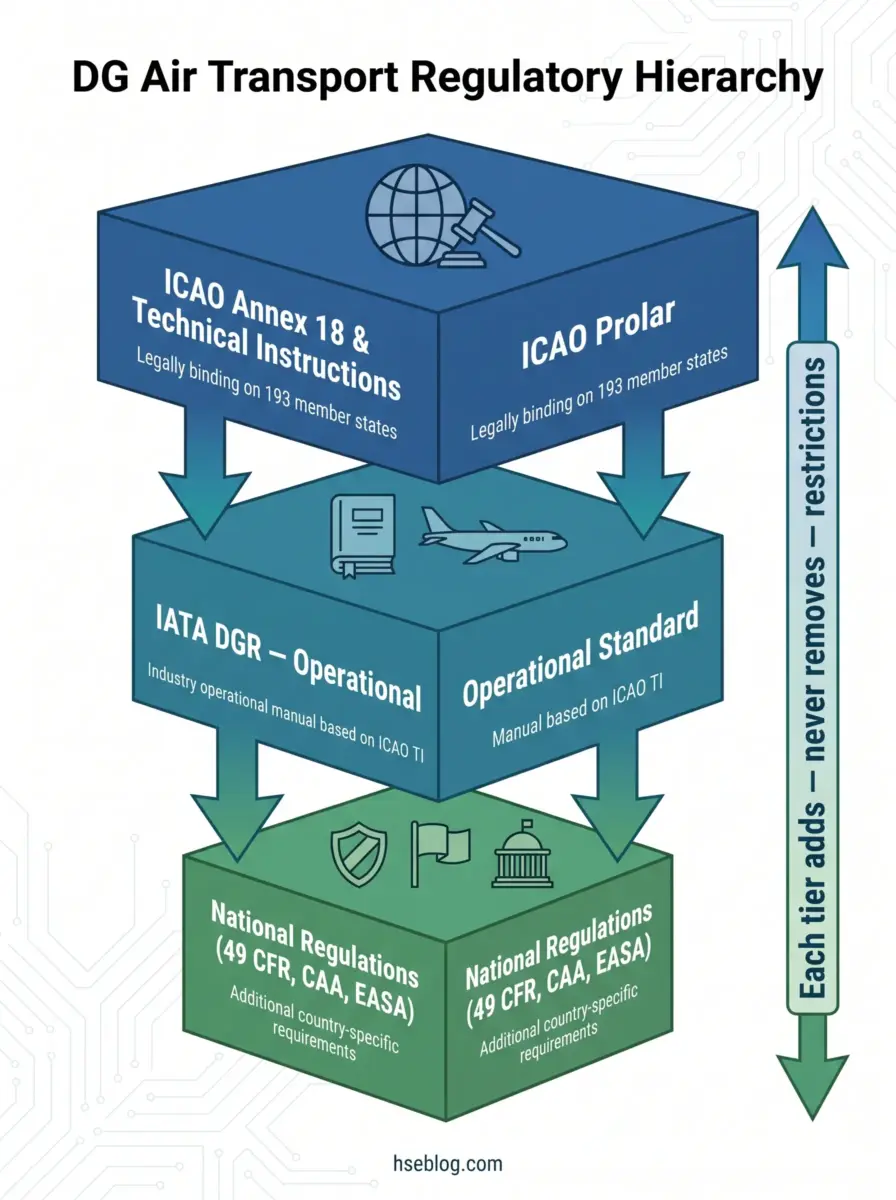
A persistent misconception among shippers new to dangerous goods air transport is that "meeting the IATA DGR" is sufficient for compliance. In practice, the DGR sits in the middle of a three-tier structure, and shippers must satisfy all applicable layers.
At the top sits ICAO Annex 18 to the Chicago Convention and the ICAO Technical Instructions for the Safe Transport of Dangerous Goods by Air (Doc 9284) — the sole legally binding international framework. All 193 ICAO member states are obligated to adopt these instructions. The current edition covers 2025–2026, with Addendum No. 1 issued March 27, 2026, introducing new power bank restrictions (ICAO, 2026).
The IATA DGR occupies the middle tier. It is not itself a law or regulation — it is an industry standard produced by the International Air Transport Association. Airlines contractually require compliance with it, and many national regulators recognize or incorporate its requirements. The DGR translates ICAO's legal text into operational language, adds practical guidance (such as the detailed packing instruction tables), and may impose requirements stricter than the Technical Instructions — but never less restrictive. Because the DGR is updated annually while ICAO publishes the Technical Instructions biennially, the DGR often incorporates emerging changes faster.
National regulations form the third layer. In the United States, 49 CFR Parts 171–180 (administered by PHMSA/DOT) set minimum requirements for hazardous materials transportation, including air. The FAA's overview of dangerous goods regulations for air transportation explains how the ICAO Technical Instructions are accepted as an alternative to 49 CFR for international shipments, but certain US-specific requirements — such as the prohibition of primary lithium metal batteries (UN 3090) on all US passenger-carrying aircraft — apply independently regardless. In the UK, the Civil Aviation Authority enforces requirements through the Air Navigation Order. In the EU, EASA regulations align closely with ICAO but add European-specific operator requirements.
The practical consequence of this hierarchy: a shipper must verify compliance at every applicable tier for the origin, transit, and destination countries. Treating the DGR as a single-source compliance solution is the most common root cause of shipment rejections.
| Feature | ICAO Technical Instructions (Doc 9284) | IATA DGR (67th Edition) | US 49 CFR Parts 171–180 |
|---|---|---|---|
| Legal status | Binding international law | Industry standard (contractually required) | US federal regulation |
| Publication frequency | Biennial (with mid-cycle addenda) | Annual (effective January 1) | Continuously updated |
| Scope | All ICAO member states | IATA member airlines worldwide | US commerce (all modes) |
| Enforcement | National aviation authorities | Airlines (acceptance/refusal) | PHMSA/DOT/FAA |
| Relationship | Legal source document | Must be ≥ as restrictive as ICAO TI | Must align with ICAO TI; adds US-specific requirements |
The Nine Classes of Dangerous Goods Under the IATA DGR
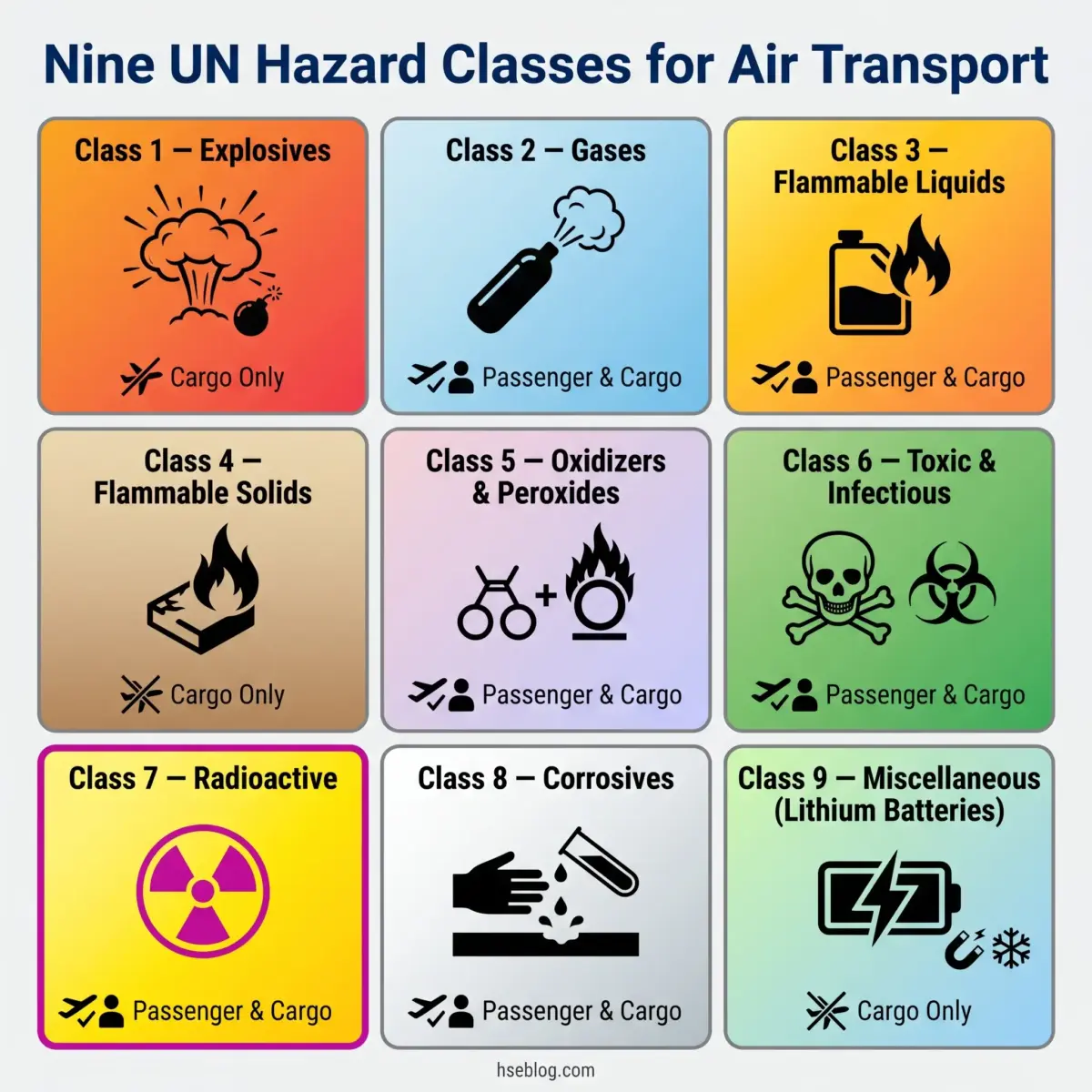
The UN classification system assigns every dangerous good to one of nine hazard classes based on its primary risk. For air transport, the classification determines not just packaging and labelling but whether the material can fly at all — and if so, whether on passenger aircraft, cargo aircraft only, or neither. The following covers each class with the air-transport-specific restrictions and practical considerations that matter most.
Class 1 — Explosives (Divisions 1.1–1.6). Most divisions are restricted to cargo aircraft only. Division 1.4S (compatible group S, presenting no significant blast hazard) is the most commonly accepted by air — small-arms ammunition is a frequent example. Divisions 1.1 and 1.2 are forbidden on passenger aircraft under all circumstances.
Class 2 — Gases (Divisions 2.1–2.3). Aerosols (Division 2.1 and 2.2) are the most frequently shipped items in this class. Altitude-induced pressure differentials create air-specific risks — containers designed for ground-level ambient pressure may vent or rupture at reduced cabin pressure in cargo holds.
Class 3 — Flammable Liquids. Consumer products routinely trigger DG requirements that shippers do not anticipate. Perfumes, nail polish, paint, and industrial cleaning solvents all fall here. Flash point and boiling point determine the packing group, which in turn drives quantity limits per package.
Class 4 — Flammable Solids (Divisions 4.1–4.3). Division 4.3 materials react dangerously with water, requiring moisture-proof packaging. Certain self-reactive substances in Division 4.1 require temperature-controlled transport — a logistical challenge for air freight routing.
Class 5 — Oxidizers and Organic Peroxides (Divisions 5.1–5.2). Chemical oxygen generators carry particular historical weight. The ValuJet Flight 592 crash in 1996 — caused by improperly packaged expired chemical oxygen generators in the cargo hold — killed all 110 people aboard and remains the defining case for why the DGR exists. Temperature-controlled transport requirements apply to many organic peroxides.
Class 6 — Toxic and Infectious Substances (Divisions 6.1–6.2). Infectious substances (Division 6.2) require the triple-packaging system (primary receptacle, secondary packaging, rigid outer packaging) specified in packing instruction 620. Medical and pharmaceutical logistics account for the majority of Class 6 air shipments.
Class 7 — Radioactive Material. The Transport Index system governs how many packages can be loaded together and their distance from occupied areas. Medical isotope shipments — used in diagnostic imaging and cancer treatment — are the most common use case and often operate under tight time constraints due to short half-lives.
Class 8 — Corrosives. Liquids require orientation arrows on all outer packaging. Compatibility segregation with other classes is critical — loading corrosives adjacent to flammable materials or oxidizers creates compound hazard scenarios.
Class 9 — Miscellaneous Dangerous Goods. This is the fastest-growing category and the one most frequently involved in air transport incidents. Lithium batteries, dry ice, and environmentally hazardous substances all sit here. The "miscellaneous" label is dangerously misleading — shippers frequently treat Class 9 items as low-risk, yet lithium batteries have the most complex packing instructions in the entire DGR, the most frequently updated restrictions, and the highest incident rate of any dangerous goods class in air transport.
How to Ship Dangerous Goods by Air: The Step-by-Step Compliance Chain
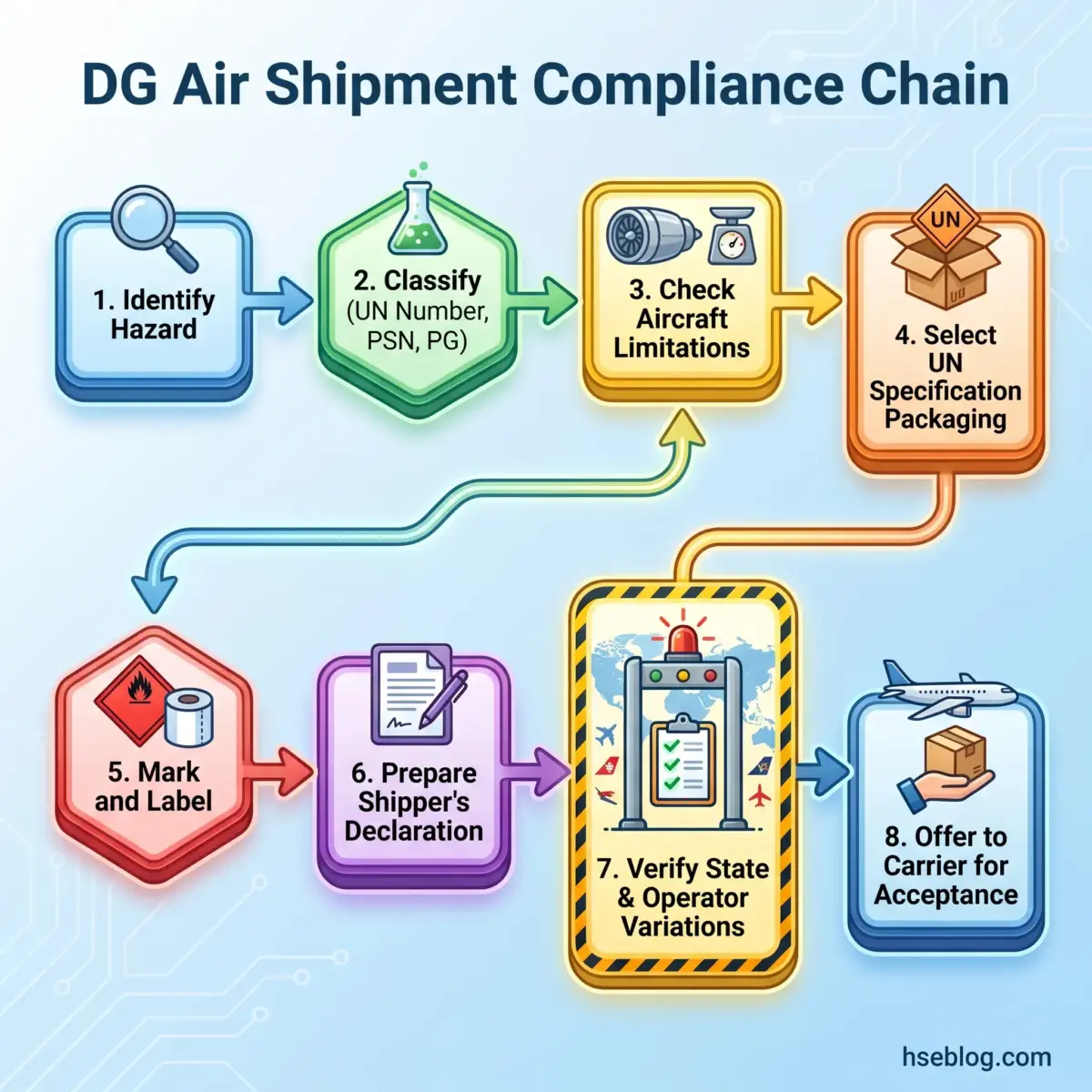
The most common compliance failures do not stem from exotic edge cases. They come from errors in the basic sequence that every dangerous goods shipment must follow — a sequence where each step depends on the previous one being done correctly. Getting step two wrong cascades through everything that follows.
Step 1: Identify the hazard. Start with the Safety Data Sheet (SDS), but treat it as a starting point, not a definitive transport classification source. SDSs are authored under GHS (Globally Harmonized System) criteria, which do not align perfectly with transport classification. Section 14 of the SDS covers transport information, but it is frequently incomplete, out of date, or outright inaccurate for air-specific requirements. The practical judgment call: always cross-reference SDS Section 14 against the DGR's Dangerous Goods List (Section 4.2) using the UN number and proper shipping name.
Step 2: Classify correctly. Assign the UN number, proper shipping name (exactly as listed in the DGR — not abbreviated, not paraphrased), hazard class, and packing group (I, II, or III, corresponding to great, medium, or minor danger). The UN Recommendations on the Transport of Dangerous Goods — Model Regulations (23rd Revised Edition, UN, 2023) provide the foundational classification system that the DGR incorporates.
Step 3: Check limitations. Determine whether the material is permitted on passenger aircraft, restricted to cargo aircraft only, or forbidden entirely. Verify quantity limits per package (the "net quantity" column in the DGR's Dangerous Goods List) and per aircraft. Some materials have aggregate limits per aircraft that restrict how many packages can fly together.
Step 4: Select packaging. UN specification packaging is required for most dangerous goods. The packing instruction number (found in the Dangerous Goods List) specifies exactly which packaging types, materials, and closure methods are acceptable. Packing group assignment drives the performance standard the packaging must meet — Group I packaging undergoes the most rigorous drop, stack, and pressure testing.
Step 5: Mark and label. Apply the proper shipping name, UN number (prefixed "UN"), hazard labels corresponding to primary and subsidiary hazards, handling labels (such as "Cargo Aircraft Only"), and orientation arrows for liquid-containing packages. Marking must be durable and legible. Under IATA DGR and ICAO Technical Instructions (international jurisdiction), the proper shipping name must appear in English at minimum; additional languages are permitted but not a substitute.
Step 6: Prepare documentation. Complete the Shipper's Declaration for Dangerous Goods in the required format — including colour requirements (red hatched border), language (English minimum), and the specific information blocks prescribed by the DGR. Prepare the Air Waybill with the required dangerous goods handling information. The 67th edition clarified Air Waybill requirements in paragraph 8.2.3 for low-risk substances where a full declaration may not be required.
Step 7: Check state and operator variations. This step is where the majority of shipment rejections originate. State variations (DGR Section 2.8.2) are additional or divergent requirements imposed by individual countries along the routing. Operator variations (DGR Section 2.8.3) are additional restrictions imposed by the specific airline. Both can prohibit materials the base DGR permits, impose stricter quantity limits, or require additional documentation. Check both layers for every country of origin, transit, and destination — and for every carrier.
Step 8: Offer to carrier for acceptance. Present the shipment to the carrier's acceptance staff with all documentation. The carrier's trained acceptance personnel verify classification, packaging, marking, labelling, and documentation against the DGR before accepting the shipment. Under DGR paragraph 1.2.4, airlines retain the right to refuse any shipment — even one that is fully compliant — a point consistently omitted by competitor guidance.
Completing the Shipper's Declaration for Dangerous Goods
The Shipper's Declaration is the single most rejection-prone document in the compliance chain. Formatting errors — not substantive classification mistakes — account for a disproportionate share of acceptance failures. The declaration must bear the red hatched border, must be completed in English (with additional languages permitted), and must include the specific information blocks in the sequence the DGR prescribes: shipper and consignee details, transport details (passenger/cargo aircraft), the nature and quantity of goods block (UN number, proper shipping name, class/division, packing group, quantity, packing instruction, authorization), and the shipper's signed certification that the contents are fully and accurately described and properly classified, packaged, marked, labelled, and in proper condition for transport.
The 67th edition refined the Air Waybill requirements under paragraph 8.2.3. For certain low-risk substances — where the DGR specifies that a full Shipper's Declaration is not required — the Air Waybill must still carry specific dangerous goods handling information. This distinction matters for Section II lithium battery shipments and excepted quantities, where shippers sometimes assume that "no declaration required" means "no documentation required." It does not.
Lithium Battery Air Transport Rules: The DGR's Most Complex and Fastest-Changing Area
No other category in the DGR generates as many compliance failures, regulatory updates, or in-flight safety incidents as lithium batteries. The FAA recorded 89 verified lithium battery incidents involving smoke, fire, or extreme heat on aircraft in 2024 — a 16% increase over the prior year, with 12 occurring on cargo aircraft and 77 on passenger aircraft (US Federal Aviation Administration, 2025). These numbers reflect only verified incidents; the actual frequency of thermal events is likely higher.
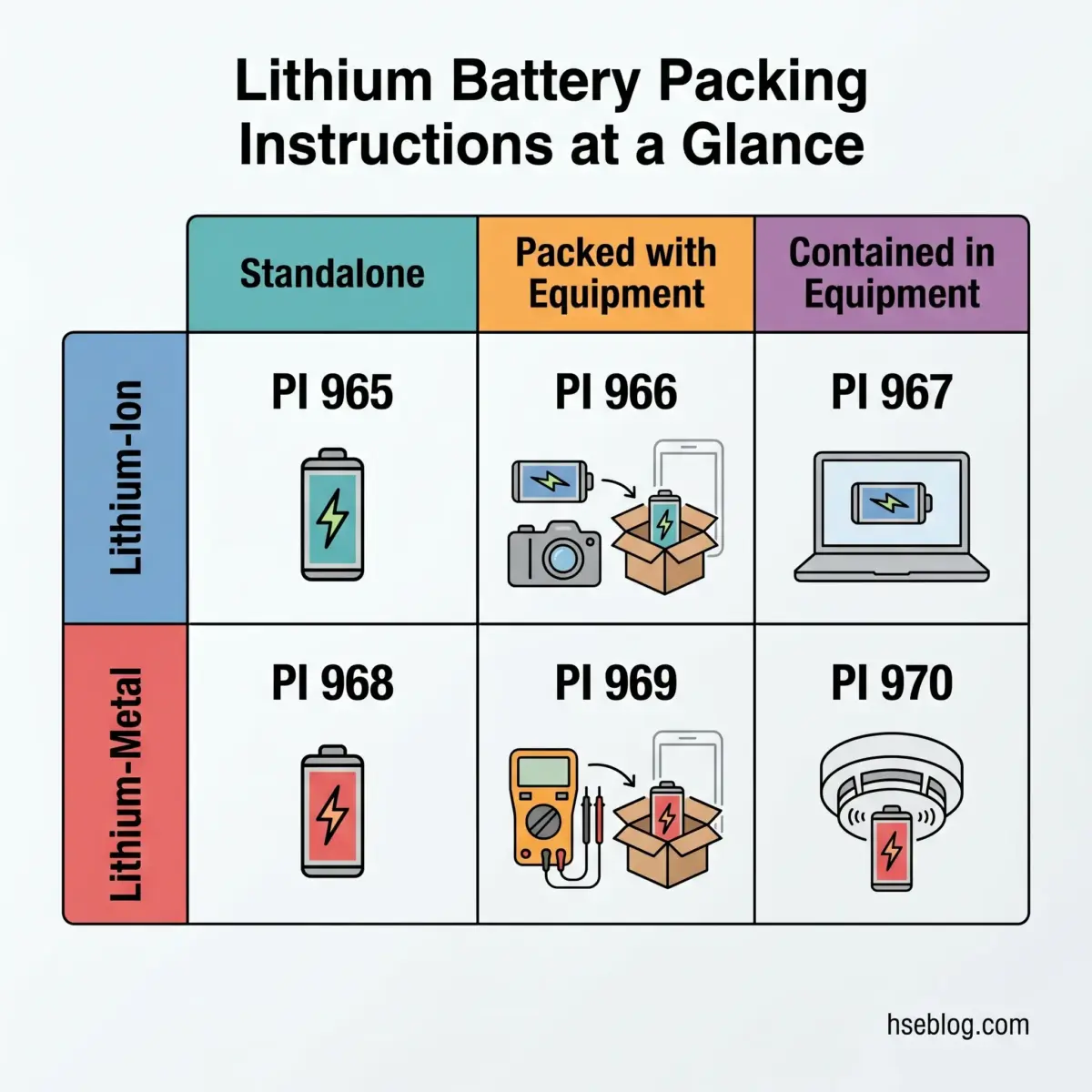
The packing instruction structure for lithium batteries spans six instructions — PI 965 through PI 970 — covering every combination of lithium-ion and lithium-metal batteries in three configurations: standalone (not installed in or packed with equipment), packed with equipment, and contained in equipment. Each packing instruction is further divided into Section I (fully regulated, subject to all DGR requirements including the Shipper's Declaration) and Section II (reduced requirements for smaller batteries meeting specific watt-hour or lithium-content thresholds). The FAA lithium battery resources and incident data page provides current incident tracking and PackSafe guidance for US operators.
The Section I/Section II boundary is where classification errors concentrate. For lithium-ion batteries, Section II applies when the watt-hour rating does not exceed 100 Wh per cell or battery (20 Wh for cells). For lithium-metal batteries, the threshold is 1 g of lithium content per cell or 2 g per battery. The judgment call for practitioners: always verify the Wh rating or lithium content directly from the battery marking or manufacturer test summary — never rely solely on the SDS or product datasheet, which may state values that do not match the actual production batch.
The 67th edition introduced a critical change. The 30% state-of-charge (SOC) limit for lithium-ion batteries shipped under PI 966 Section I (packed with equipment) and for lithium-ion-battery-powered vehicles is now a hard mandatory requirement, effective January 1, 2026 (IATA DGR 67th Edition Significant Changes, 2026). In the 66th edition, this was a recommendation. Shipping above 30% SOC now requires written approval from both the state of origin and the operator's state — a dual-approval process that, in practice, few shippers can navigate quickly.
The freshest development affects passengers and cabin safety directly. ICAO issued Addendum No. 1 to the 2025–2026 Technical Instructions, effective March 27, 2026, as a direct consequence of the Air Busan Flight 391 fire (ICAO via IATA guidance document, 2026). Under the addendum, power banks are now separated from other spare batteries in the passenger provisions of the Technical Instructions. Passengers are limited to two power banks each. In-flight charging of power banks is prohibited. Multiple airlines have imposed even stricter measures through operator variations.
Additionally, the 67th edition introduced sodium-ion batteries under a new UN number (UN 3551). While this battery chemistry is newer and potentially less prone to thermal runaway than lithium-ion, it still requires classification and handling under the DGR. UPS has already prohibited sodium-ion batteries to, from, and within Europe through an operator variation — an early signal that carriers are approaching the new chemistry cautiously.
State and Operator Variations: The Hidden Compliance Layer
A shipment can satisfy every requirement in the DGR's base text and still be refused at acceptance — or seized in transit — because of a state or operator variation the shipper never checked. This is the compliance layer that competitors consistently undertreat, yet it is the source of a large proportion of operational rejections.
State variations are additional or divergent requirements imposed by individual countries. They are listed in DGR Section 2.8.2 and can apply to the state of origin, transit, or destination. A state variation might prohibit a material the DGR otherwise permits, impose lower quantity limits, or require additional documentation. The 67th edition includes new or updated state variations from Thailand, France, and the United Kingdom. States are now invited to notify both IATA and ICAO simultaneously when introducing variations — a procedural change that should reduce the lag between a state imposing a new restriction and shippers learning about it, though enforcement of simultaneous notification remains voluntary.
Operator variations are additional restrictions imposed by individual airlines, listed in DGR Section 2.8.3. Airlines exercise these under the DGR paragraph 1.2.4 right to refuse any substance. An operator variation might ban a specific UN number entirely, restrict certain classes to specific aircraft types, or impose stricter labelling requirements.
The 67th edition introduced a practical improvement that deserves more attention than it has received: standardized wording for the most common operator variation restrictions. Previously, five airlines could express the same restriction in five different ways — "not accepted," "prohibited," "will not carry," "restricted — contact carrier," "not permitted" — creating ambiguity that led to unnecessary rejections and disputes at acceptance. Standardized wording reduces interpretation errors for multi-carrier shipments where the freight forwarder must cross-reference variations across several operators on a single routing.
The operational discipline required is straightforward but time-consuming: for every shipment, verify state variations for the origin country, every transit country, and the destination country, then verify operator variations for every carrier in the routing. When routing changes — due to schedule disruption, capacity constraints, or interline transfer — the variation check must be repeated for the new routing. Skipping this step is not a minor oversight. It is a compliance failure with the same legal consequences as misdeclaring the goods themselves.
What Are the Training Requirements for Dangerous Goods Air Transport?
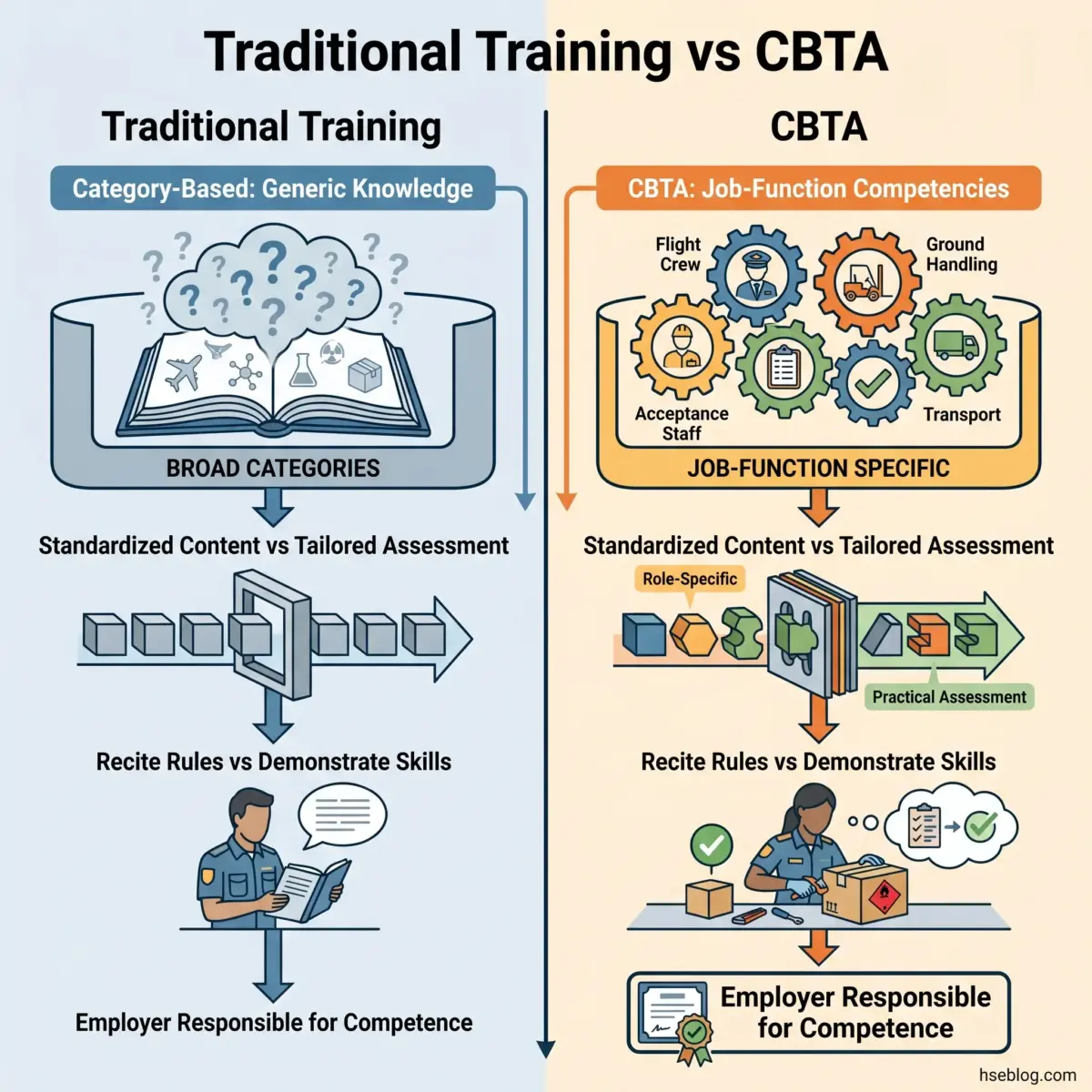
Competency-based training and assessment (CBTA) became the mandatory training approach for all personnel involved in the air transport of dangerous goods effective January 1, 2023, under both the ICAO Technical Instructions (international jurisdiction) and the IATA DGR. This was not merely a format change — it fundamentally restructured how organizations must design, deliver, and verify dangerous goods training.
Under the traditional model, training was category-based: personnel were assigned to broad categories (shipper, operator, freight forwarder, ground handler) and received standardized instruction regardless of their specific job function. CBTA replaces this with a training needs analysis tied to the individual's actual duties. A warehouse operative who physically handles packages has different competency requirements than a compliance officer who reviews declarations, even though both work within the same freight forwarding operation.
The CBTA framework requires three elements from the employer: a training needs analysis identifying the specific competencies required for each job function, a competency-based assessment plan that tests those competencies through practical and knowledge-based evaluation, and documented evidence of achieved competency. IATA offers three CBTA-specific courses — Instructor, Instructional Designer, and Inspector — and has established the IATA competency-based training for dangerous goods certification program for organizations.
Training must be approved by the appropriate national authority, though enforcement consistency varies by jurisdiction. Recurrent training is required every two years under ICAO Technical Instructions and the IATA DGR. In the United States, 49 CFR 172.704 (US jurisdiction) requires recurrent training every three years for hazmat employees — a divergence from the ICAO cycle that US-based operations must track separately.
The scope of who requires training extends well beyond the obvious roles. Shippers, freight forwarders, ground handlers, airline acceptance staff, cabin crew, flight crew, security screeners, and cargo operations managers all fall within the DGR's training requirements. The employer — not the individual — bears ultimate responsibility for employee competence under both the DGR and national regulations.
The transition from traditional training to CBTA has proven more difficult than many organizations anticipated. The challenge is not the training delivery itself. It is the systematic design of assessment plans that reliably demonstrate competence for specific job functions rather than generic regulatory knowledge. An assessment that tests whether someone can recite the nine hazard classes is category-based thinking in CBTA clothing. A genuine CBTA assessment tests whether the employee can correctly classify a specific material, select the correct packing instruction, and identify applicable state variations for a real routing — the actual tasks their job requires.
Why Undeclared Dangerous Goods Are the Greatest Threat in Air Cargo
Over 261,000 tons of dangerous goods are transported by air in the United States annually, within a broader flow of more than 3 billion tons of regulated dangerous goods moving across all US transportation modes (US Federal Aviation Administration, undated). The overwhelming majority of these shipments are properly classified, packaged, and declared. The ones that are not — the undeclared and misdeclared shipments — represent the single largest dangerous goods safety challenge in aviation.
Undeclared dangerous goods are materials that meet the definition of a dangerous good but are offered for air transport without the required classification, packaging, marking, labelling, or documentation. Misdeclared goods are identified as dangerous but assigned incorrect information — wrong UN number, wrong class, wrong packing group, wrong quantity. Both create the same operational risk: materials with hazard potential are loaded onto aircraft without the handling precautions their properties demand.
The scale of the problem is growing. E-commerce has dramatically increased the volume of small shipments from consumer sellers who have no dangerous goods training and may not understand that their products contain regulated materials. A consumer selling lithium battery-powered devices, perfume, aerosol sprays, or nail polish online may not realize these are classified dangerous goods requiring specific air transport procedures. The structural gap in enforcement is significant — no jurisdiction maintains systematic package-opening inspection authority for domestic air cargo. Carriers rely on shipper declarations as evidence of compliance, but those declarations are only as reliable as the shipper's training and honesty.
The consequences are not theoretical. The FAA recorded 89 verified lithium battery incidents involving smoke, fire, or extreme heat on aircraft in 2024 (US Federal Aviation Administration, 2025). The Air Busan Flight 391 fire demonstrated how a single non-conforming power bank destroyed an aircraft (multiple sources, 2025). Going further back, the ValuJet Flight 592 disaster — 110 fatalities caused by improperly handled chemical oxygen generators that should never have been loaded — remains the most devastating illustration of what undeclared or improperly declared dangerous goods can do inside a pressurized fuselage.
Penalties for undeclared shipments are severe. In the US, PHMSA/DOT can assess civil penalties up to $96,624 per violation per day (adjusted periodically for inflation under 49 CFR, US jurisdiction), with criminal penalties possible for knowing violations. Beyond fines, carriers routinely refuse future business from shippers with undeclared-goods violations — a commercial consequence that can be more damaging than the regulatory penalty.
Key Changes in the IATA DGR 67th Edition (2026)
The 67th edition, effective January 1, 2026, introduced several operationally significant changes. For practitioners already familiar with the DGR framework, this section covers what has shifted.
The General Philosophy section received an update emphasizing supply chain safety and the roles of all stakeholders — shipper, freight forwarder, ground handler, operator — in maintaining compliance integrity. While philosophical statements might seem administrative, this update signals IATA's alignment with ICAO's increasing focus on supply chain accountability beyond the shipper.
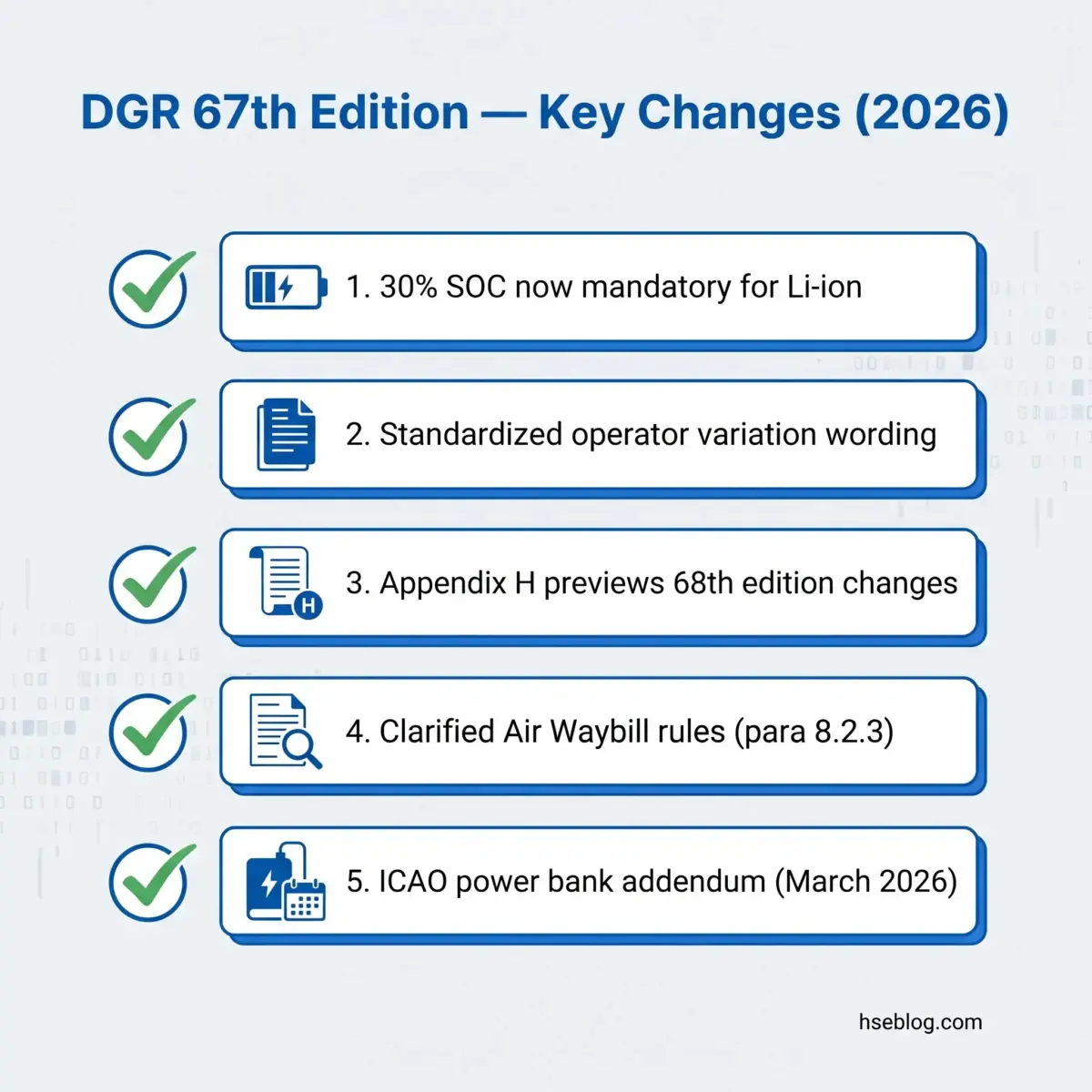
The 30% state-of-charge mandate for lithium-ion batteries is the highest-impact change. Under PI 966 Section I (packed with equipment) and for lithium-ion-battery-powered vehicles, shipping above 30% SOC now requires written approval from both the state of origin and the operator's state (IATA DGR 67th Edition Significant Changes, 2026). The 66th edition expressed this as a recommendation. The shift to mandatory status means non-compliance is now a regulatory violation, not merely a best-practice departure.
New UN 3166 hybrid vehicle entries add descriptive text to the shipping name to differentiate between vehicle types. The descriptive text is informational and not part of the formal proper shipping name — a distinction that matters when completing the Shipper's Declaration.
Standardized operator variation wording for common restrictions reduces ambiguity across carriers, as discussed in the state and operator variations section above.
Clarified Air Waybill requirements (paragraph 8.2.3) specify the handling information required on the Air Waybill for low-risk shipments where a full Shipper's Declaration is not required.
Appendix H is a notable editorial addition — it previews impending changes for the 68th edition, effective January 2027. This gives shippers early visibility into forthcoming requirements, enabling compliance planning rather than reactive January scrambles. Reviewing Appendix H should become a standard part of annual compliance review cycles.
The SDS definition has been added to the DGR glossary, and Appendix B.4 now includes expanded GHS information — a recognition that SDSs are the most common (if imperfect) starting point for transport classification.
Finally, ICAO Addendum No. 1 (effective March 27, 2026) — while technically an amendment to the Technical Instructions rather than the DGR itself — was issued as a direct consequence of the Air Busan incident and introduces the power bank restrictions described in the lithium battery section above. The DGR will incorporate these provisions in the 68th edition; in the interim, they apply through the ICAO Technical Instructions directly.
Frequently Asked Questions
What is the difference between the IATA DGR and the ICAO Technical Instructions?
The ICAO Technical Instructions (Doc 9284) are the sole legally binding international framework for dangerous goods air transport, published biennially and binding on all 193 ICAO member states. The IATA DGR is an industry-produced operational standard, updated annually, that translates ICAO legal text into practical compliance guidance. The DGR may impose requirements stricter than the Technical Instructions but never less restrictive ones. Compliance with the DGR generally ensures ICAO TI compliance, but shippers must still verify applicable national regulations separately. For more detail, IATA's official FAQ on transporting dangerous goods by air covers additional operational questions.
Is the IATA DGR a law or a regulation?
The DGR is an industry standard, not a statute or regulation in the legal sense. However, airlines contractually require compliance with it as a condition of acceptance, and many national regulators recognize or incorporate its requirements into their own frameworks. In the US, the ICAO Technical Instructions — which the DGR aligns with — are accepted as an alternative to 49 CFR for international air shipments under PHMSA rules, but certain US-specific requirements (such as the ban on primary lithium metal batteries on passenger aircraft) apply independently regardless.
Can an airline refuse a fully DGR-compliant dangerous goods shipment?
Yes. DGR paragraph 1.2.4 explicitly states that airlines are not obliged to transport any particular dangerous substance. Airlines may impose requirements beyond the DGR through operator variations, and they may refuse shipments at their discretion even when all regulatory requirements are met. Confirming acceptance with the specific carrier before tendering shipments is an essential step that many shippers skip — leading to last-minute rejections and routing disruptions.
What are the penalties for shipping undeclared dangerous goods by air?
Penalties vary significantly by jurisdiction. In the United States, PHMSA/DOT can assess civil penalties up to $96,624 per violation per day, with criminal penalties available for knowing violations under 49 CFR (US jurisdiction). Other jurisdictions maintain comparable enforcement regimes. Beyond regulatory fines, carriers typically refuse future business from shippers with undeclared-goods violations, and customs authorities in several jurisdictions can seize shipments and impose additional sanctions.
What changed about power banks on flights in 2026?
Following the Air Busan Flight 391 fire in January 2025 — which destroyed the aircraft and injured 27 of the 176 evacuated occupants — ICAO issued Addendum No. 1 to the 2025–2026 Technical Instructions, effective March 27, 2026. Power banks are now separated from other spare batteries in the passenger provisions, limited to two per passenger, and prohibited from being charged during flight. Several airlines have introduced additional restrictions through operator variations.
What is CBTA and is it mandatory for dangerous goods training?
CBTA — competency-based training and assessment — became the mandatory training approach for all personnel involved in air transport of dangerous goods effective January 1, 2023, under both the ICAO Technical Instructions (international) and the IATA DGR. It requires employers to design training around specific job-function competencies with validated assessment plans, replacing the previous one-size-fits-all category-based approach. Recurrent training is required every two years under ICAO and the DGR; the US requirement under 49 CFR 172.704 specifies a three-year recurrence cycle.
Conclusion
The pattern that connects the Air Busan fire, the rising lithium battery incident count, and the persistent volume of undeclared goods is not regulatory failure — the rules are comprehensive and getting stricter. The pattern is a gap between the pace at which dangerous goods enter the air transport system and the pace at which the people handling them achieve genuine competence. The DGR is a 1,200-page document updated annually for good reason: the hazard landscape is not static, the chemistry is evolving, and the volume is growing.
What the industry consistently gets wrong is treating the DGR as a reference to consult when something goes wrong, rather than a system to operate within from the first moment a shipment is planned. The highest-impact change any organization can make is structural — building dangerous goods compliance into procurement and shipping workflows upstream, before the material reaches the warehouse, rather than relying on trained acceptance personnel to catch errors at the final gate. The acceptance check is the last line of defense. It was never designed to be the only one.
The 67th edition's addition of Appendix H — previewing impending changes for the next edition — suggests IATA recognizes this dynamic. Compliance is not a January event. It is a continuous process of monitoring state and operator variations, tracking addenda, verifying battery specifications against actual markings, and ensuring that every person in the supply chain who touches a dangerous goods shipment has the competency their specific role demands. The DGR provides the framework. The operational discipline to apply it correctly, every time, remains the human responsibility no regulation can automate.