
TL;DR
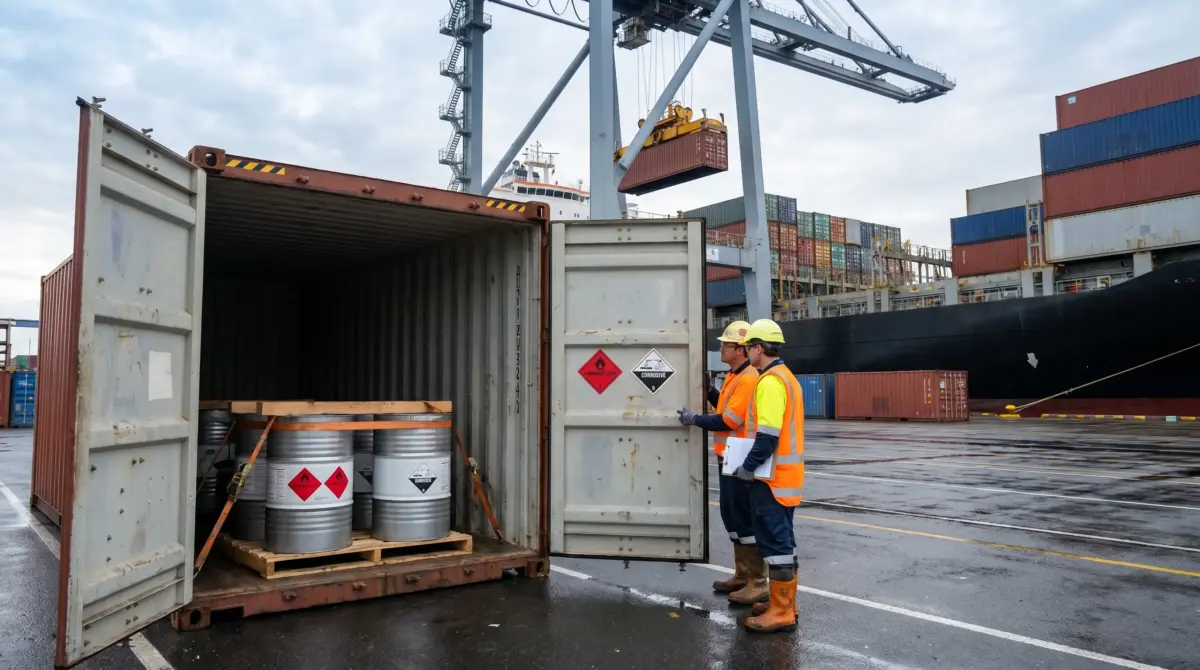
- If your cargo meets the criteria for any of the nine IMDG Code classes, then classification, packaging, marking, labelling, documentation, and stowage must comply with the current mandatory edition — Amendment 42-24 — before the goods reach the port.
- If you ship lithium batteries, sodium-ion batteries, or carbon products, then Amendment 42-24 introduced new UN numbers, stricter stowage categories, and enhanced documentation requirements that became mandatory on 1 January 2026.
- If a Dangerous Goods Declaration contains errors or uses trade names instead of the Proper Shipping Name, then the shipment faces rejection at port, financial penalties, and potential criminal liability — and the legal burden falls on the shipper regardless of freight forwarder involvement.
- If your shore-based personnel lack current IMDG Code training, then every shipment they handle carries compliance risk — and the employer is liable for ensuring training records are available to the competent authority on request.
The IMDG Code is the international regulatory framework, published by the International Maritime Organization, that governs the classification, packaging, marking, labelling, documentation, stowage, and segregation of dangerous goods transported by sea in packaged form. Mandatory under both SOLAS Chapter VII and MARPOL Annex III, the Code applies to all ships in over 150 countries whose fleets represent more than 98% of global merchant fleet tonnage (US PHMSA / IMO, 2023).
What Is the IMDG Code and Why Does It Matter?
In 2024, approximately 250 fire and explosion incidents occurred across all vessel types worldwide — a 20% year-on-year increase and the highest total in at least a decade (Allianz Safety & Shipping Review, 2025). Behind that number sits a regulatory framework designed to prevent exactly those outcomes: the International Maritime Dangerous Goods Code.
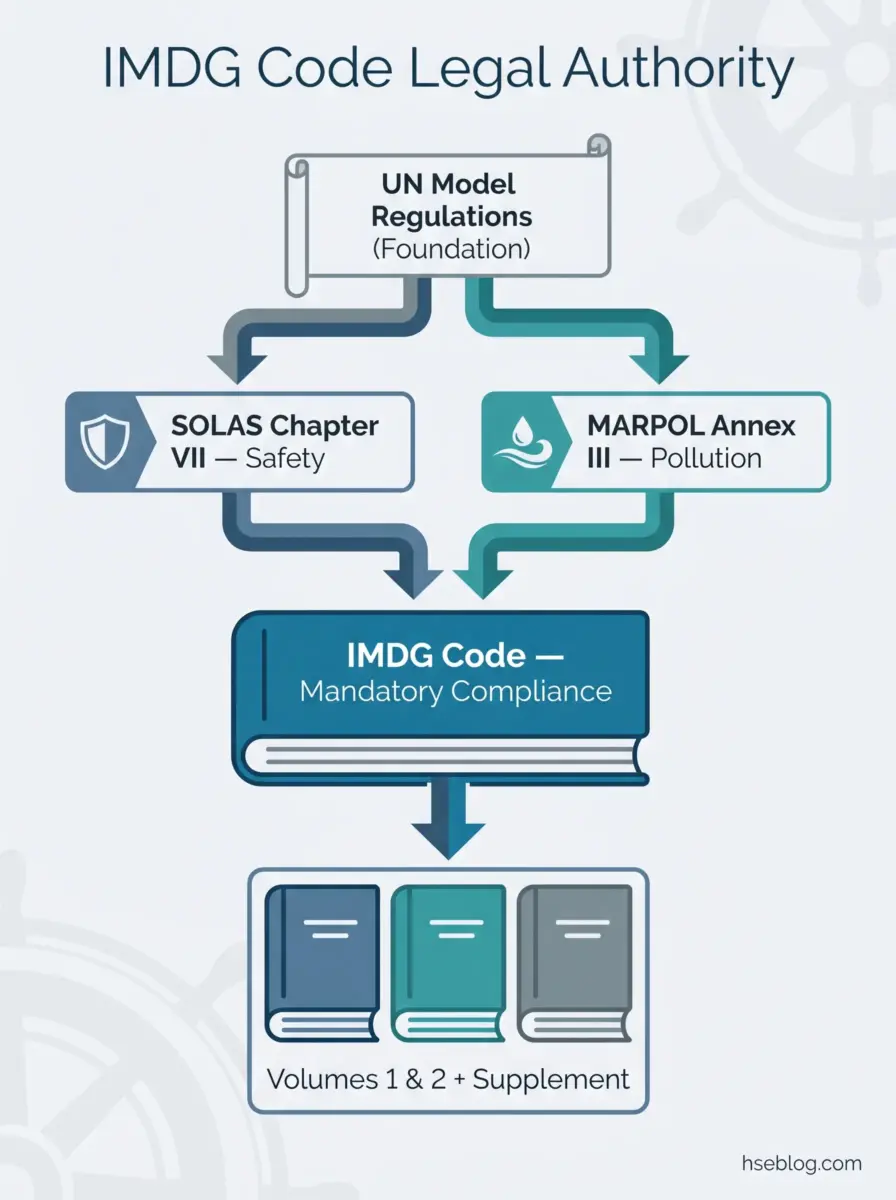
The IMDG Code is not a set of guidelines. It is a mandatory instrument under two of the most consequential international maritime conventions — SOLAS (the International Convention for the Safety of Life at Sea, 1974) and MARPOL (the International Convention for the Prevention of Pollution from Ships, 1973/78). SOLAS Chapter VII, Part A prohibits the carriage of dangerous goods in packaged form unless the shipment complies with the Code. MARPOL Annex III extends the same obligation to harmful substances and marine pollutants. Developed by the IMO and built on the UN Recommendations on the Transport of Dangerous Goods — often called the “Orange Book” — the Code has evolved from a 1965 recommendation into the single binding reference that over 150 countries enforce through their national maritime authorities. Its two-volume structure, plus a Supplement containing the Emergency Schedule (EmS) Guide and Medical First Aid Guide (MFAG), covers every stage of the dangerous goods shipping chain: classification, packaging, marking, labelling, consignment documentation, stowage, segregation, and training. For any logistics professional, freight forwarder, or shipping compliance officer handling hazardous cargo by sea, the IMDG Code is the operational rulebook — and the fire statistics suggest that too many shipments still move without properly consulting it.
How the IMDG Code Is Structured: Volumes, Parts, and Supplement
A recurring issue in dangerous goods compliance is that shippers consult only the Dangerous Goods List in Volume 2 — they look up their UN number, note the class and packing group, and consider the job done. That approach misses the packing instructions, special provisions, and transport operations requirements that sit in Volume 1. The two volumes function as a single system, and breaking them apart is a compliance failure waiting to happen.
The Code’s architecture spans seven parts across the two volumes, plus the Supplement:
Volume 1 contains Parts 1 and 2 (general provisions, definitions, training obligations, and classification criteria) and Parts 4 through 7 (packing and consignment procedures, construction and testing of packagings, and transport operations including stowage and segregation rules).
Volume 2 houses Part 3 — the Dangerous Goods List (DGL), along with the special provisions index and appendices. The DGL is the operational heart of the Code. Every entry, indexed by UN number, specifies the substance’s Proper Shipping Name, class, subsidiary hazards, packing group, labels, limited-quantity thresholds, packing instructions, stowage category, segregation codes, and the applicable EmS schedule.
The Supplement provides the emergency response framework used aboard ship: the EmS Guide (fire and spillage schedules), the MFAG for medical response to exposure, reporting procedures for incidents involving dangerous goods, and provisions of the INF Code governing irradiated nuclear fuel shipments.
| Part | Volume | Content |
|---|---|---|
| Part 1 | Volume 1 | General provisions, definitions, training |
| Part 2 | Volume 1 | Classification criteria |
| Part 3 | Volume 2 | Dangerous Goods List, special provisions |
| Part 4 | Volume 1 | Packing and tank provisions |
| Part 5 | Volume 1 | Consignment procedures |
| Part 6 | Volume 1 | Construction and testing of packagings |
| Part 7 | Volume 1 | Transport operations (stowage, segregation, handling) |
| Supplement | Separate | EmS Guide, MFAG, reporting, INF Code |
The current mandatory edition is Amendment 42-24, adopted under IMO Resolution MSC.556(108), which became mandatory on 1 January 2026. The official IMDG Code publications are available from IMO. Using an outdated edition aboard a vessel or at a shore facility is itself a compliance deficiency — a pattern that port state control inspectors encounter more often than it should occur.
The Nine IMDG Code Classes of Dangerous Goods
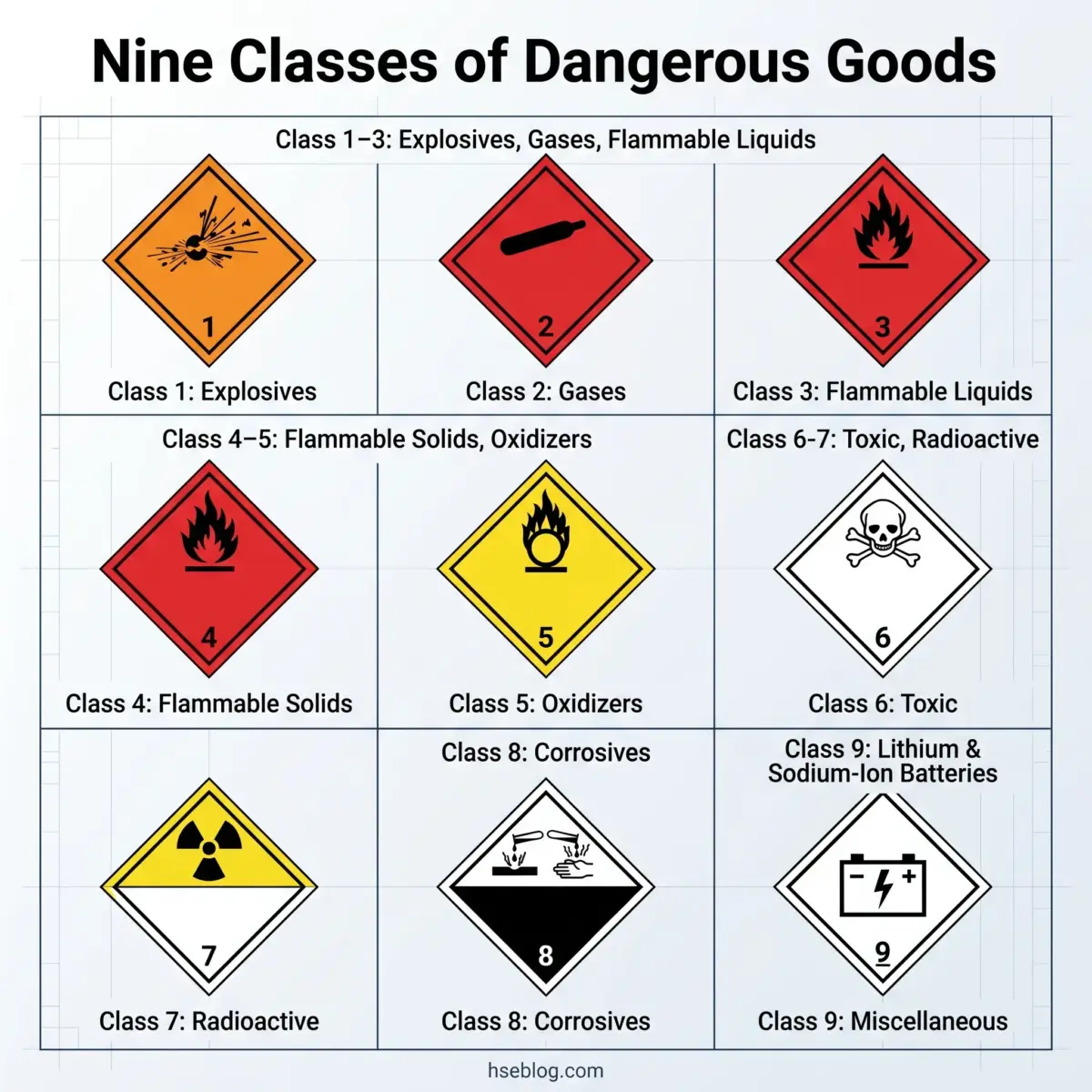
Every dangerous substance or article transported by sea in packaged form falls into one of nine hazard classes. The classification drives everything downstream — packaging, marking, labelling, stowage position on the vessel, segregation from incompatible cargoes, and emergency response procedures. Treating classification as a formality rather than a technical determination is where the compliance chain first breaks.
| Class | Division(s) | Hazard Type | Common Examples |
|---|---|---|---|
| 1 | 1.1–1.6 | Explosives | Ammunition, detonators, fireworks |
| 2 | 2.1, 2.2, 2.3 | Gases (flammable, non-flammable/non-toxic, toxic) | Propane, nitrogen, chlorine |
| 3 | — | Flammable liquids | Acetone, diesel, paints |
| 4 | 4.1, 4.2, 4.3 | Flammable solids, spontaneous combustion, dangerous when wet | Matches, activated carbon, sodium |
| 5 | 5.1, 5.2 | Oxidizers, organic peroxides | Ammonium nitrate, methyl ethyl ketone peroxide |
| 6 | 6.1, 6.2 | Toxic substances, infectious substances | Pesticides, clinical waste |
| 7 | — | Radioactive material | Medical isotopes, industrial radiography sources |
| 8 | — | Corrosives | Sulfuric acid, sodium hydroxide |
| 9 | — | Miscellaneous dangerous goods | Lithium batteries, sodium-ion batteries, dry ice, environmentally hazardous substances |
Class 9 deserves particular attention. Its “miscellaneous” label creates a dangerous perception gap — shippers sometimes assume that Class 9 goods pose less risk than Classes 1 through 8. That assumption ignores the reality that lithium batteries have caused some of the most destructive container fires in recent years, and that Amendment 42-24 added new Class 9 entries for sodium-ion batteries (UN 3551, UN 3552) precisely because the hazard profile demanded formal regulatory control. The growing volume of battery-powered goods in global trade means Class 9 entries now represent a rapidly increasing share of dangerous goods shipments.
Classification begins with the substance’s Safety Data Sheet — specifically Section 14 (Transport Information) — and is confirmed against the Dangerous Goods List in Volume 2. Multi-hazard substances require the Precedence of Hazard table in Part 2 to determine which class takes priority. The assigned packing group (I for great danger, II for medium, III for minor) sets the packaging performance standard.
How to Classify Dangerous Goods Under the IMDG Code
Classification is where IMDG Code compliance either holds or collapses. The single most common failure at this stage is using a trade name or commercial product description instead of the Proper Shipping Name from the Dangerous Goods List. A second recurring issue — one that surfaces every amendment cycle — is failing to reclassify a substance when its DGL entry changes between editions.
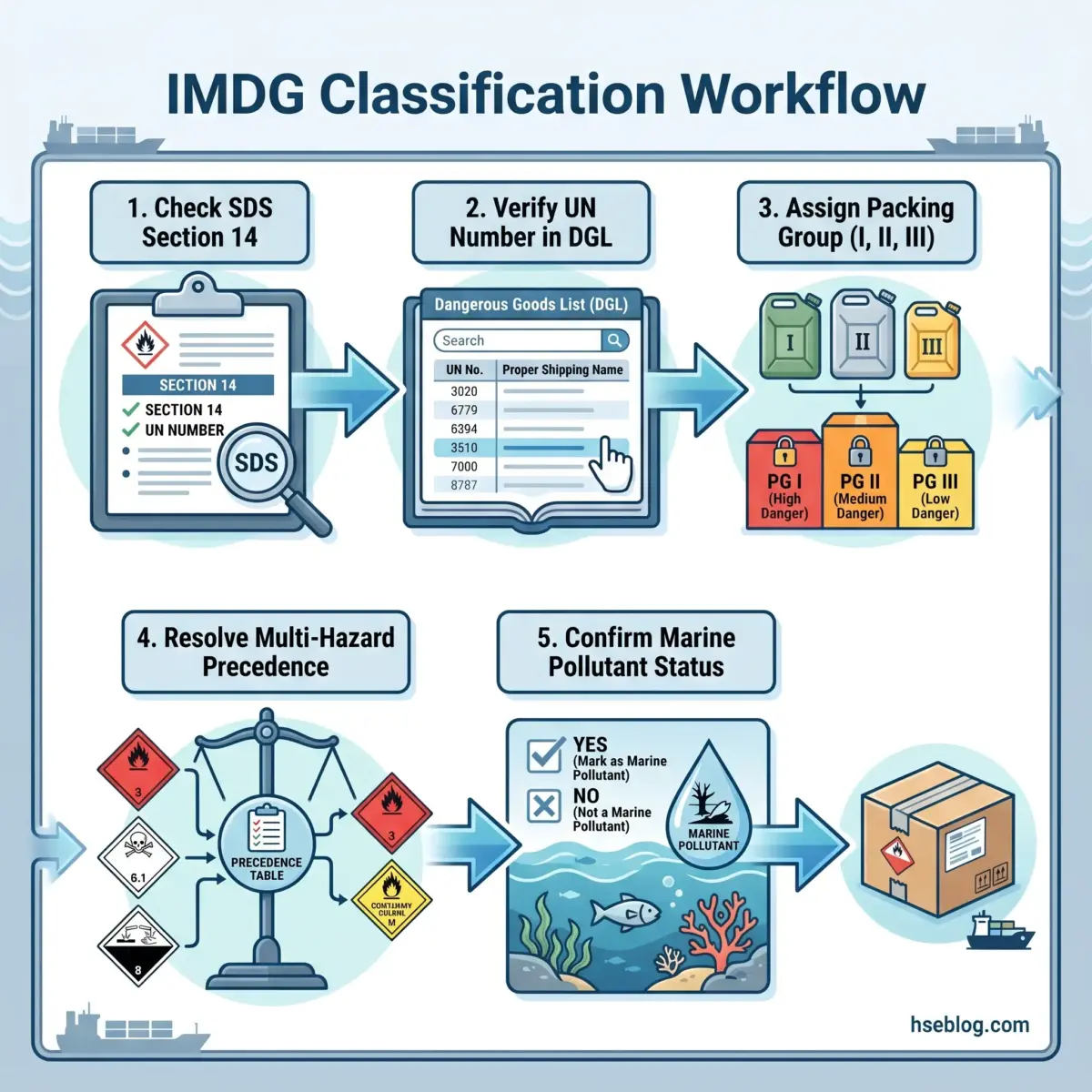
The classification workflow proceeds through five steps:
- Obtain the substance’s Safety Data Sheet and locate Section 14 (Transport Information). This section should identify the UN number, Proper Shipping Name, class/division, packing group, and any subsidiary hazards. If Section 14 is incomplete or absent, the substance still requires classification — the shipper cannot default to “not dangerous goods” based on a missing SDS field.
- Verify the UN number and PSN against the Dangerous Goods List in Volume 2. Confirm the class, division, subsidiary hazards, and any special provisions that apply. Special provisions can modify packaging requirements, impose documentation obligations, or restrict transport entirely.
- Assign the packing group where applicable. Packing Group I indicates substances presenting great danger, Group II medium danger, and Group III minor danger. Not all classes use packing groups — gases (Class 2), infectious substances (Division 6.2), and radioactive material (Class 7) have separate criteria.
- Resolve multi-hazard substances using the Precedence of Hazard table in Part 2. When a substance presents hazards of more than one class, the table determines which class governs as primary and which appears as a subsidiary hazard on labelling and documentation.
- Check marine pollutant status. If the substance meets the marine pollutant criteria under MARPOL Annex III, an additional marine pollutant mark is required on packages and a declaration on the documentation.
Limited Quantities and Excepted Quantities
The IMDG Code provides reduced requirements for small quantities that present proportionally lower risk. Limited Quantity (LQ) provisions allow inner packagings below specified thresholds to ship in shrink-wrapped trays or closed outer packages up to 30 kg gross, marked with the LQ diamond. These packages are exempt from certain labelling and packaging certification requirements but not from documentation or stowage obligations.
Excepted Quantities (EQ) allow even smaller amounts — typically laboratory or sample quantities — under EQ codes E0 through E5. E0 means no excepted quantity is authorized for that substance. Packages must meet specific construction and testing criteria, carry the EQ mark, and comply with a maximum net quantity per package.
Packaging, Marking, and Labelling Requirements
The practical judgment call in dangerous goods packaging is understanding that three separate compliance layers operate simultaneously — and an error in any one invalidates the shipment. Correct UN-certified packaging matched to the right packing instruction. Correct marks applied to the package surface. Correct hazard labels positioned and sized per the Code. Each layer has its own failure mode, and multimodal shippers face the added complexity that IMDG, IATA DGR (air), and ADR (road — European jurisdiction) requirements overlap but are not identical.
Packaging must be UN-certified, identified by the UN packaging symbol (a circle containing the letters “UN”) and a packaging code indicating type, material, and performance level. Packing instructions — designated by P-codes for single packagings, LP-codes for large packagings, and IBC-codes for intermediate bulk containers — specify which packaging types are authorized for each substance and under what conditions.
Marking requirements include the UN number (preceded by “UN”), the Proper Shipping Name, the consignor and consignee names and addresses, the net quantity or gross mass, orientation arrows for liquid-containing inner packagings, and the marine pollutant mark where applicable. Overpacks require the word “OVERPACK” and, unless all marks and labels on inner packages remain visible, reproduction of those marks externally.
Labelling requires primary hazard diamonds on two opposite sides of the package, subsidiary hazard labels where the DGL specifies, and additional marks such as the elevated-temperature mark or fumigation warning sign where relevant. Cargo transport units — containers and vehicles — require enlarged placards (minimum 250 mm × 250 mm) on all four sides.
The 66% figure is worth internalizing: TT Club data from 2019 attributed 66% of cargo damage across all freight modes to poor packing and labelling of dangerous materials (TT Club, 2019). Marking and labelling errors are disproportionately common precisely because the requirements look straightforward on paper but involve substance-specific detail that changes between modal regulations.
Stowage and Segregation: Preventing Incompatible Cargo Reactions
Segregation is where the gap between paper compliance and physical reality grows widest. The IMDG Code assigns every dangerous goods entry a stowage category (ranging from A through E) and segregation codes that dictate minimum separation distances from other classes. In theory, the ship’s cargo plan reflects these requirements before loading begins. In practice, container terminals operating under berth-window pressure sometimes prioritize slot efficiency — and the master bears ultimate responsibility for verifying that what was planned is what was loaded.
Stowage categories carry specific operational meaning. Category A permits stowage on deck or under deck. Category B requires stowage on deck or under deck in closed cargo transport units. Category D — which Amendment 42-24 expanded — restricts goods to on deck only, in closed CTUs. This last category now applies to lithium batteries installed in cargo transport units (UN 3536), a change driven by the recognition that detecting and fighting a battery fire in a hold is exponentially harder than responding to one on an exposed deck.
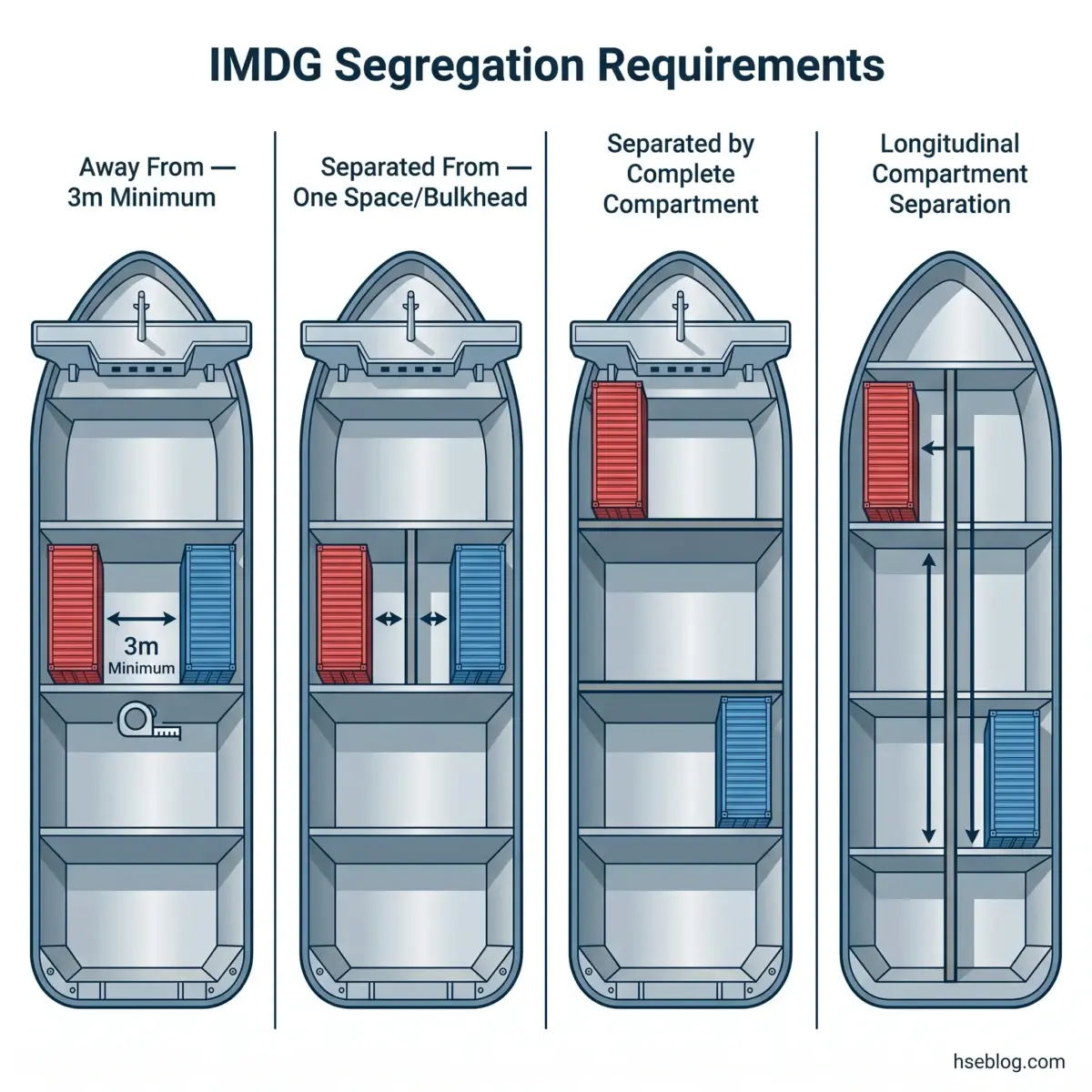
The segregation table in Part 7 uses four terms, each representing an escalating physical separation requirement: “away from” (minimum 3 metres horizontal separation), “separated from” (one container space or one bulkhead between), “separated by a complete compartment or hold from” (two bulkheads between), and for the most dangerous combinations, “separated longitudinally by an intervening complete compartment or hold from.” High-risk pairings include oxidizers (Class 5.1) adjacent to flammable solids (Class 4.1), and corrosives (Class 8) near toxic substances (Class 6.1) — combinations that, in the presence of a packaging failure, can trigger violent exothermic reactions.
Amendment 42-24 brought carbon (UN 1361/1362) under stricter Class 4 stowage provisions, a regulatory response to multiple incidents where activated carbon self-heated in cargo holds during transit. The revised provisions under Special Provision SP979 require enhanced documentation — including date of production, date of packaging, and temperature at time of packaging — as preconditions for accepting the cargo.
Documentation Required for Shipping Dangerous Goods by Sea
Documentation errors are the most common reason dangerous goods shipments are rejected at port. The legal architecture of the IMDG Code places the burden of a correct declaration squarely on the shipper or consignor — a responsibility that is not transferable through Incoterms, freight forwarder contracts, or any commercial arrangement. When a flawed Dangerous Goods Declaration reaches port state control, it is the shipper’s name on the liability.
The core documents required under the Code include:
- Dangerous Goods Declaration (DGD) — also known as the Multimodal Dangerous Goods Form. The shipper certifies that the goods are correctly classified, packaged, marked, labelled, placarded, and in proper condition for transport. The DGD must include the UN number, Proper Shipping Name, class, packing group, number and type of packages, net and gross quantities, marine pollutant status, and the shipper’s signed declaration. Errors here — particularly using trade names instead of the PSN, or failing to declare subsidiary hazards — are the root cause of most documentation-related detentions.
- Container/Vehicle Packing Certificate — issued by the person responsible for packing the cargo transport unit. This certificate confirms that the CTU was inspected, that the goods were packed and secured in accordance with the Code, and that no incompatible goods were loaded together.
- Emergency information — the applicable EmS codes (fire schedule and spillage schedule) and a 24-hour emergency contact number must be provided with the documentation.
- Dangerous Goods manifest or stowage plan — prepared for the ship’s master, listing all dangerous goods aboard with their locations.
- Exemption certificates — Amendment 42-24 introduced Section 5.4.4.2 (International jurisdiction), requiring that exemption certificates accompany the cargo documentation when exemptions from any IMDG Code provision have been authorized by the competent authority.
For carbon products under the revised SP979 provisions, the documentation must additionally include the date of production, the date of packaging, and the temperature at the time of packaging — information that was not previously required and that many shippers of carbon-based products are still adapting to.
IMDG Code Training Requirements
The field procedure most aligned with Chapter 1.3 of the IMDG Code (International jurisdiction) is competence-based training that goes beyond exam scores. Training requirements became mandatory with Amendment 34-08 and apply to all shore-based personnel whose duties involve the transport of dangerous goods — not just those who physically handle the cargo.
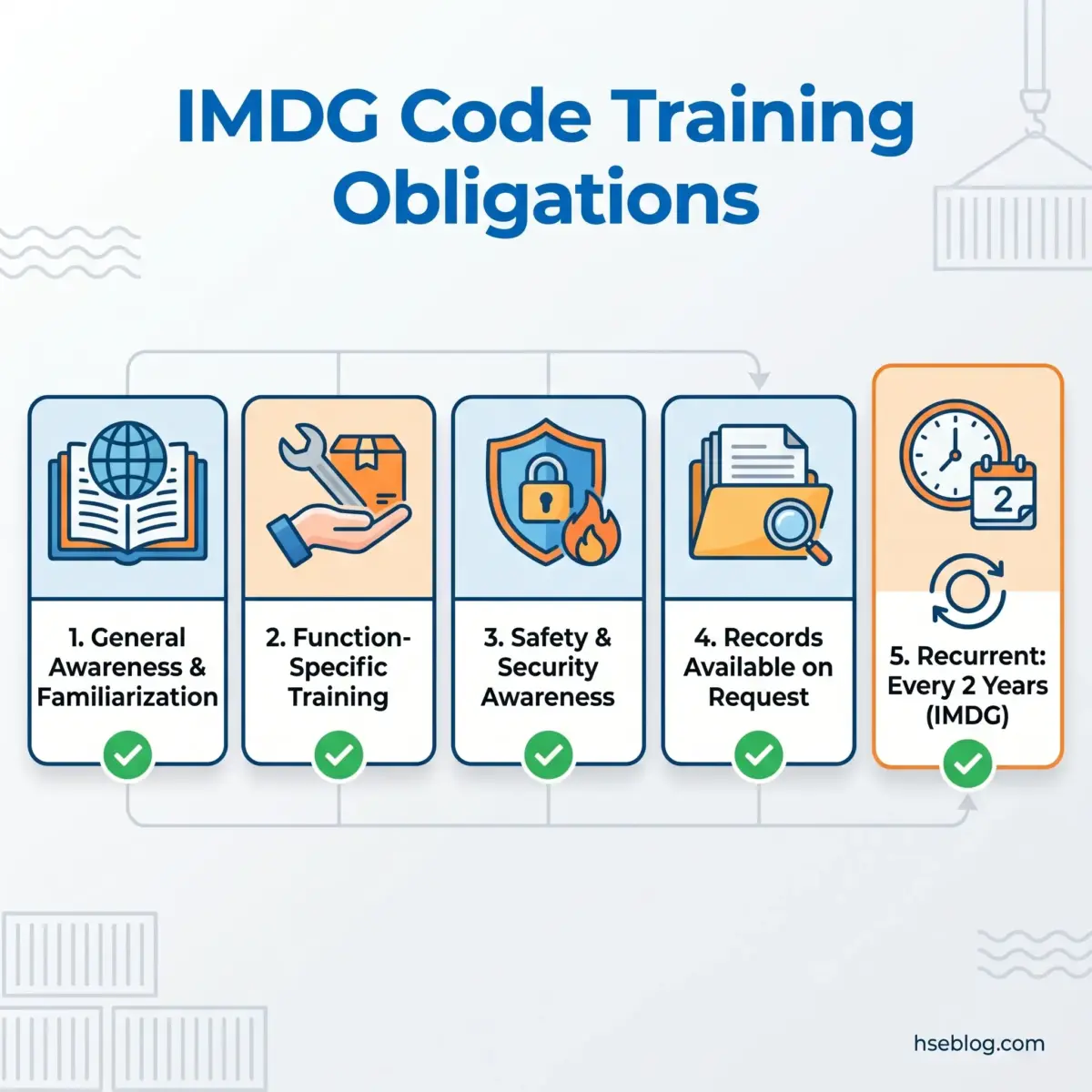
The Code specifies four training categories: general awareness and familiarization, function-specific training, safety training, and security awareness training. Personnel must complete training before assuming unsupervised responsibilities, though they may perform duties under direct supervision of a trained person during the training period. Employers are required to maintain training records and produce them on request by the competent authority.
Recurrent training frequency reveals a practical discrepancy worth noting. The IMDG Code recommends training every two years, aligned with its biennial amendment cycle — which makes operational sense, since each new edition can change classification entries, packing instructions, and documentation requirements. US 49 CFR Parts 100–185 (United States jurisdiction) requires recurrent hazmat training at intervals not exceeding three years. Shipboard crew training falls under the STCW Convention and flag-state regulations, separate from the IMDG Code’s shore-based requirements.
The persistent gap in training practice is the difference between certification and competence. A training program that covers classification rules but omits scenario-based exercises — where trainees must prepare a DGD from a Safety Data Sheet, or identify segregation conflicts in a stowage plan — produces personnel who can pass a written assessment but miss real-world errors. The judgment call for any dangerous goods safety advisor is whether their organization’s training develops recognition skills, not just retention skills.
What Changed in IMDG Code Amendment 42-24 (2024 Edition)?
Amendment 42-24, adopted under Resolution MSC.556(108) (International jurisdiction), was available for voluntary application from 1 January 2025 and became mandatory on 1 January 2026. The changes are not editorial housekeeping — several directly respond to real incident patterns and emerging cargo categories that the previous edition did not adequately address.
Sodium-ion batteries received their first standalone entries: UN 3551 (sodium-ion batteries) and UN 3552 (sodium-ion batteries contained in or packed with equipment). The testing and documentation requirements mirror those for lithium batteries, reflecting the same thermal runaway hazard mechanism. Shippers who previously moved sodium-ion batteries under generic Class 9 entries now face substance-specific packaging, marking, and documentation obligations.
New vehicle UN numbers — UN 3556, UN 3557, and UN 3558 — now cover vehicles powered by lithium-ion, lithium metal, and sodium-ion batteries respectively. These entries replace the previous practice of shipping battery-powered vehicles under the generic UN 3171. The new numbers carry specific stowage and documentation requirements that reflect the battery chemistry involved.
Carbon products (UN 1361/1362) received substantially stricter treatment under Special Provision SP979. The revised requirements mandate enhanced documentation — date of production, date of packaging, and temperature at the time of packaging — and bring carbon under Class 4 stowage provisions. This change was a direct regulatory response to multiple incidents where activated carbon self-heated in cargo holds, sometimes smoldering undetected for days before fire was discovered.
Lithium batteries installed in cargo transport units (UN 3536) moved to Stowage Category D, restricting them to on-deck-only carriage in closed CTUs. The rationale is straightforward: a thermal runaway event involving batteries in a below-deck hold is far more difficult to detect and suppress than one on an exposed deck.
Section 5.4.4.2 now requires exemption certificates to accompany the cargo documentation — a procedural tightening that closes a gap where exemptions were sometimes authorized but not communicated through the documentation chain to the vessel.
Fire suppressant dispersing devices gained a new entry under UN 3559, formalizing classification requirements for these devices as dangerous goods.
Misdeclared Dangerous Goods: The Leading Cause of Container Ship Fires
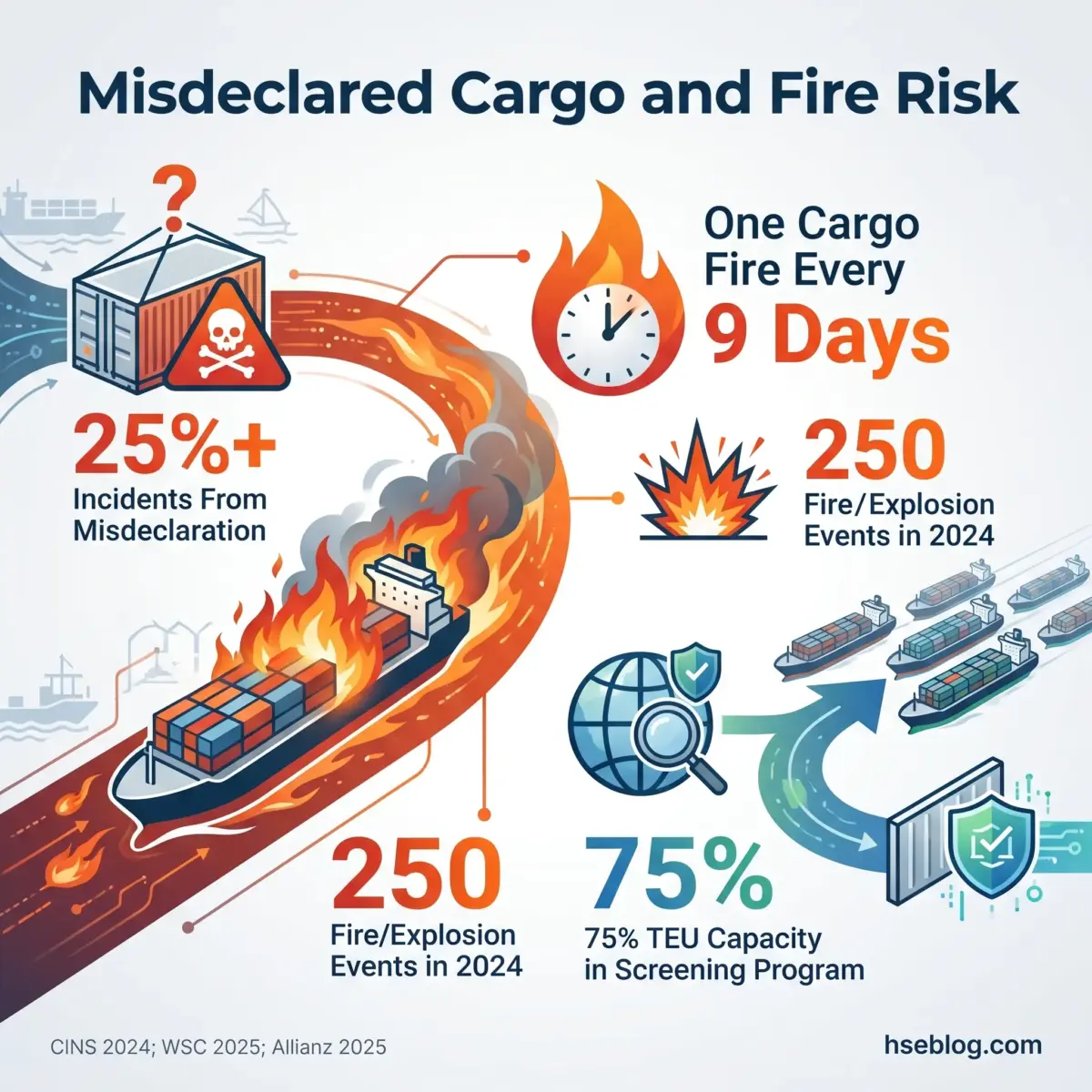
Approximately 250 million containers move by sea every year (World Shipping Council / Gard, 2024). Roughly 10% of those containers are declared as carrying dangerous goods. An estimated additional 5% contain undeclared or misdeclared dangerous goods — cargo that enters the maritime supply chain without the classification, packaging, documentation, or stowage protections the IMDG Code requires. The consequences are measured in fire statistics: one container cargo fire approximately every nine days in 2023 (CINS, 2024), and misdeclared dangerous goods responsible for more than 25% of all cargo-related incidents (World Shipping Council, 2025).
Misdeclaration is not always deliberate fraud. A significant proportion stems from supply-chain ignorance — manufacturers who do not recognize that their product meets IMDG classification criteria, or logistics personnel using commercial product descriptions rather than the Proper Shipping Name from the DGL. Lithium batteries described as “synthetic resins” or “computer parts” on shipping documents is a pattern that recurs across investigation reports. Carbon products shipped without the enhanced documentation now required under SP979 is another emerging pattern. These are not exotic failure modes — they are systemic classification errors driven by inadequate training, outdated knowledge, and commercial pressure to avoid the cost and complexity of hazmat shipping procedures.
The industry’s most significant response to date is the WSC Cargo Safety Program, launched in September 2025. The program deploys an AI-powered cargo screening tool developed by the National Cargo Bureau that scans bookings in real time to detect potential misdeclaration before containers are loaded. At launch, carriers representing over 75% of global TEU capacity had joined the program. Whether this technology can materially reduce the misdeclaration rate depends on the quality of its training data and the willingness of the supply chain to act on its flags — but the scale of industry adoption signals that the sector recognizes enforcement-based approaches alone have not solved the problem.
The IMO’s framework for dangerous goods safety, including the IMDG Code’s role in preventing these incidents, is detailed through IMO’s dangerous goods safety program.
What Are the Consequences of IMDG Code Non-Compliance?
Enforcement of the IMDG Code operates through three overlapping mechanisms: flag state requirements (the vessel’s registration state), port state control inspections (the country where the vessel calls), and national competent authority enforcement (the jurisdiction where the shipper or consignor operates). Non-compliance triggers consequences across operational, financial, legal, and reputational dimensions.
The most immediate operational consequence is shipment rejection at port. When port state control identifies a documentation deficiency, marking error, or packaging non-compliance, the cargo cannot be loaded. The shipper absorbs storage fees for stalled cargo, re-packaging and re-labelling costs, and the delay — which for documentation errors alone can average several days.
Financial penalties vary by jurisdiction. In the United States, PHMSA and the US Coast Guard impose civil penalties for hazardous materials violations under 49 CFR (United States jurisdiction), with penalty amounts that can reach tens of thousands of dollars per violation. PHMSA’s IMDG Code guidance for US shippers details the regulatory relationship between the Code and domestic enforcement.
Insurance implications add a layer that many shippers underestimate. Non-compliance with the IMDG Code — particularly misdeclaration — may void Protection and Indemnity (P&I) club coverage. If a misdeclared substance causes a fire, the carrier’s insurer may deny the claim and pursue recovery from the shipper.
Criminal liability enters the picture when deliberate misdeclaration results in injury, death, or significant environmental damage. Prosecutions under national hazardous goods legislation are not theoretical — they occur, and the penalties include imprisonment.
The most underappreciated consequence operates quietly: carriers maintain internal databases of non-compliant shippers. Repeated violations — even resolved ones — can result in refusal of future bookings, effectively locking a company out of key trade lanes. No formal enforcement action is required; the carrier simply declines the business.
Frequently Asked Questions
The industry’s track record makes one pattern unmistakable: the IMDG Code does not fail when it is applied — it fails when it is bypassed. Misdeclared cargo, outdated editions, trade names substituted for Proper Shipping Names, segregation plans overridden by terminal schedules, training that tests memory instead of competence. The published incident data — 250 fire and explosion events in a single year (Allianz Safety & Shipping Review, 2025), 576 containers lost at sea in 2024 (World Shipping Council, 2025) — measures the cost of those bypasses in hardware and, too often, in lives.
The single highest-impact change any organization in the dangerous goods supply chain can make is not procedural — it is cultural. Classification accuracy must be treated as a safety-critical function, not an administrative one. That means investing in current-edition training that develops recognition skills, building verification steps into booking workflows before cargo reaches the terminal, and accepting that the cost of IMDG Code compliance is not a shipping overhead but the price of preventing the next container fire.
Amendment 42-24’s stricter provisions for batteries, carbon, and vehicles signal where the regulatory trajectory is heading: tighter controls on the cargo categories that are driving the incident trend. Organizations that adapt their procedures now — rather than waiting for a port state control detention or a fire to force the issue — protect their operations, their supply chains, and the people who work alongside dangerous goods at every stage of the journey.