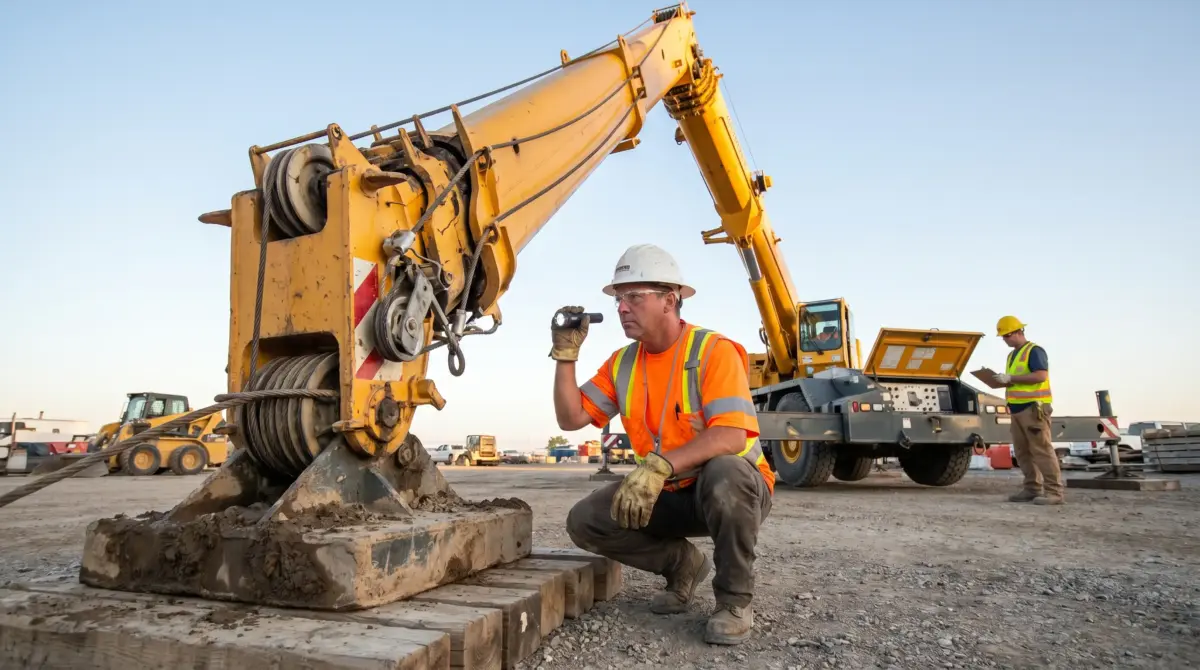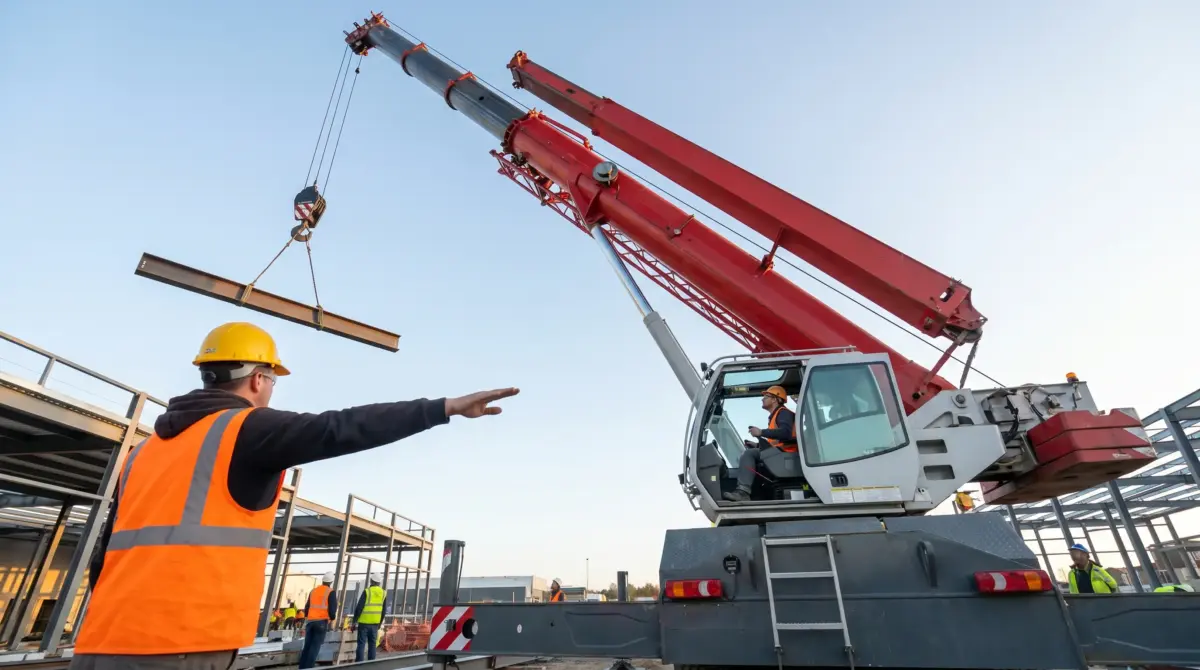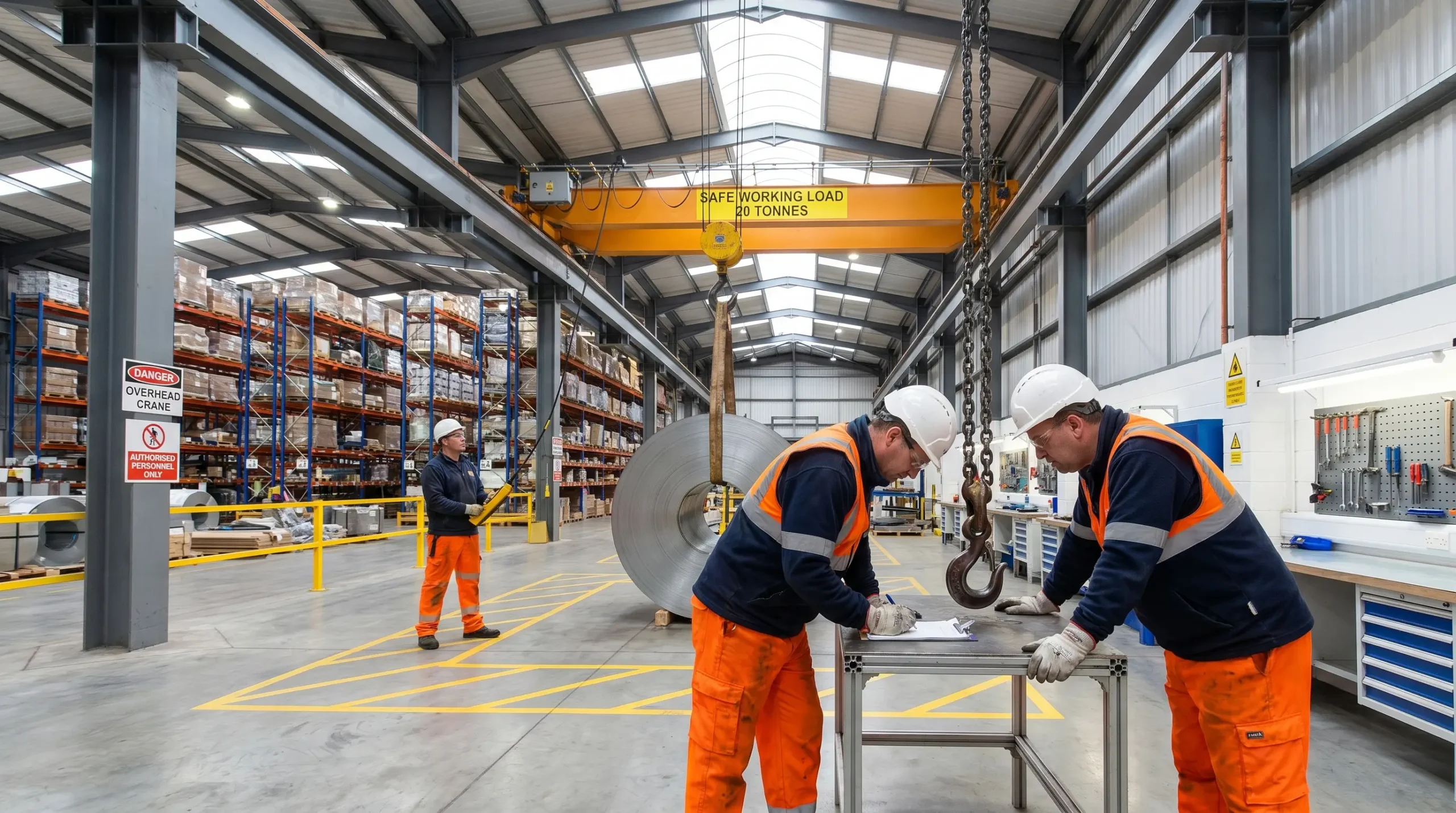
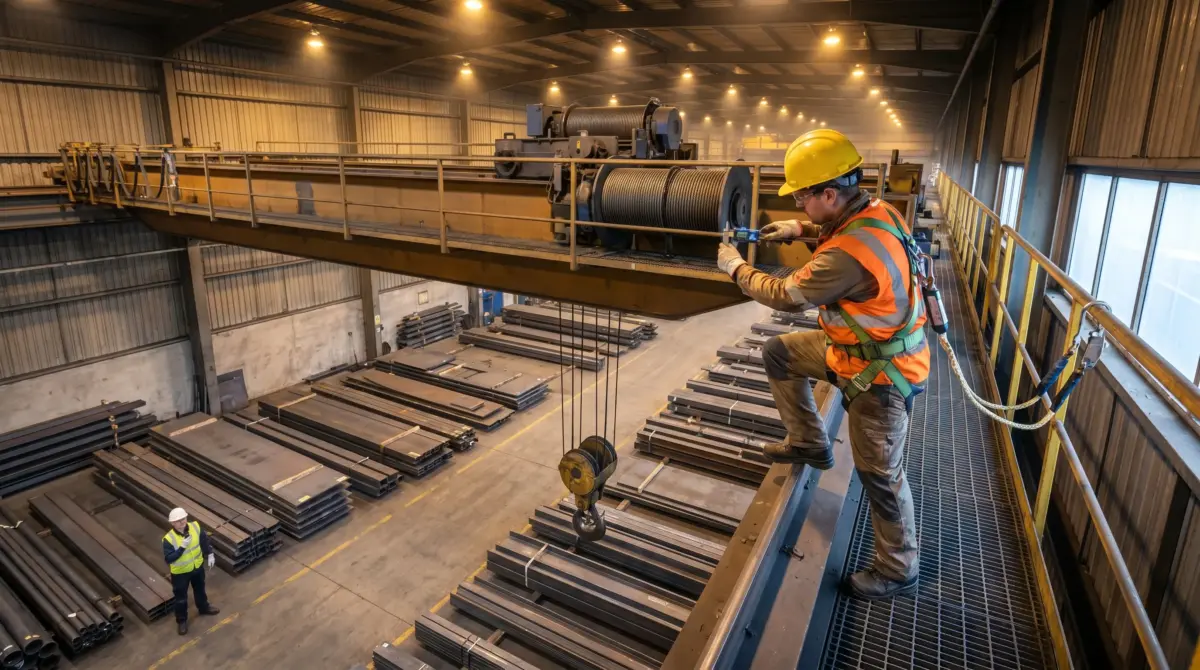
Crane inspection frequency under OSHA 1910.179 (US) is not a universal calendar — it is determined by the crane's service classification. Cranes range from Class A (standby) through Class F (continuous severe service), with frequent inspection intervals spanning from semi-annual to daily and periodic inspections from annual to monthly. Higher duty cycles and closer-to-capacity loading demand shorter intervals. In the UK, LOLER 1998 requires thorough examination by an independent competent person at least every twelve months, or every six months for equipment lifting persons.
Why Crane Inspections Are a Life-Safety Requirement
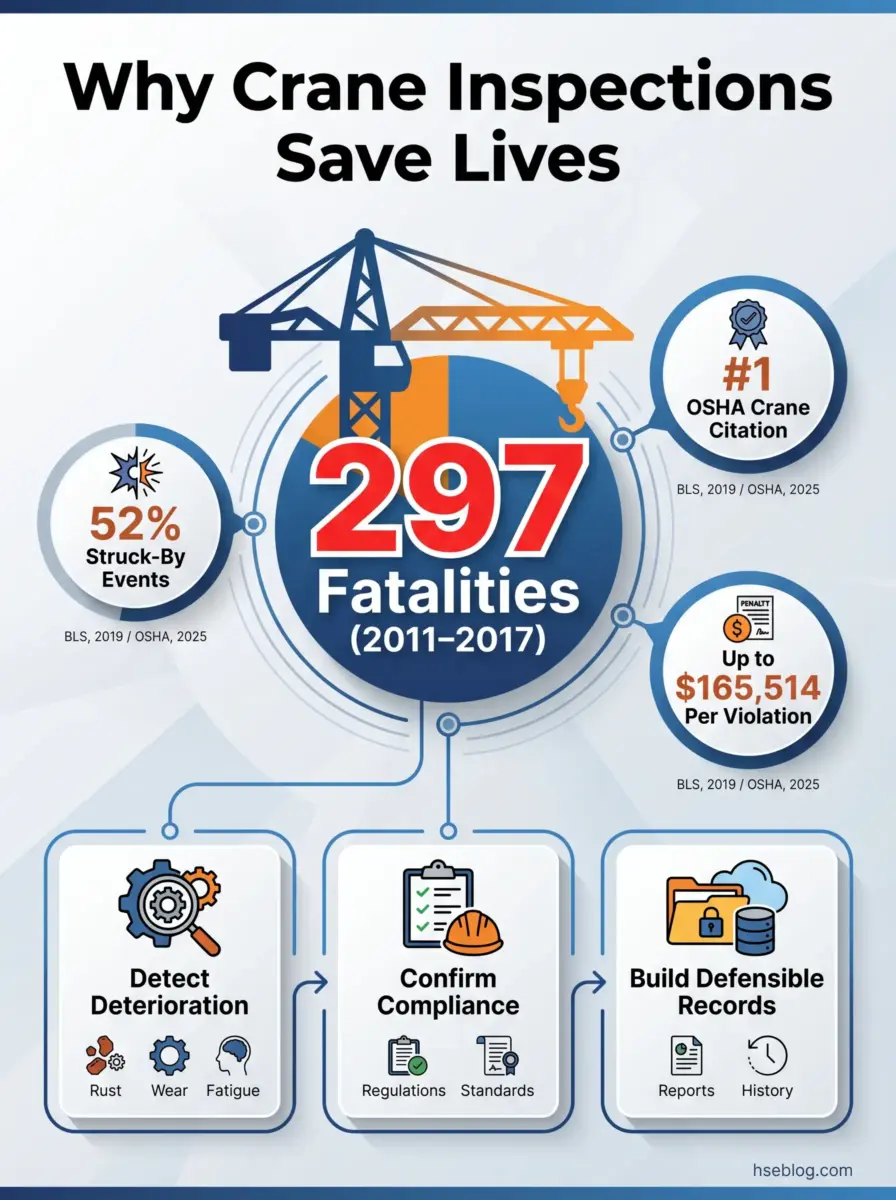
Between 2011 and 2017, 297 workers in the United States died in crane-related incidents — an average of 42 fatalities per year (US Bureau of Labor Statistics, 2019). Over half of those deaths, roughly 52%, involved a worker being struck by an object or equipment (US Bureau of Labor Statistics, 2019). These are not abstract numbers. Each one represents a load that dropped, a boom that failed, a rigging point that gave way — and in a significant number of cases, a deterioration that a competent inspection would have detected before it became catastrophic.
What makes crane inspection failures particularly damaging from a compliance standpoint is that inspections under 1926.1412 (US) are the single most cited crane-related OSHA violation, accounting for more citations than the next two categories combined (Corfix / OSHA enforcement data, 2024). Penalties for willful violations can reach $165,514 per occurrence (OSHA, 2025 penalty schedule). The inspection requirement exists because cranes deteriorate in ways that are not visible to casual observation — wire rope fatigue progresses internally, hook throat opening increases by fractions of a millimeter per load cycle, brake linings wear beneath their housing. A structured inspection program serves three functions: detecting deterioration before failure, confirming regulatory compliance, and building a defensible maintenance record that protects both workers and the organization.
This article provides general HSE knowledge. Life-critical crane inspection, load testing, and return-to-service decisions must be planned and executed by a competent person (for routine inspections) or qualified person (for comprehensive inspections) with relevant training, jurisdiction-specific authorization, and site-specific risk assessment. The information here does not replace that professional judgment.
Types of Crane Inspections: From Pre-Shift to Comprehensive
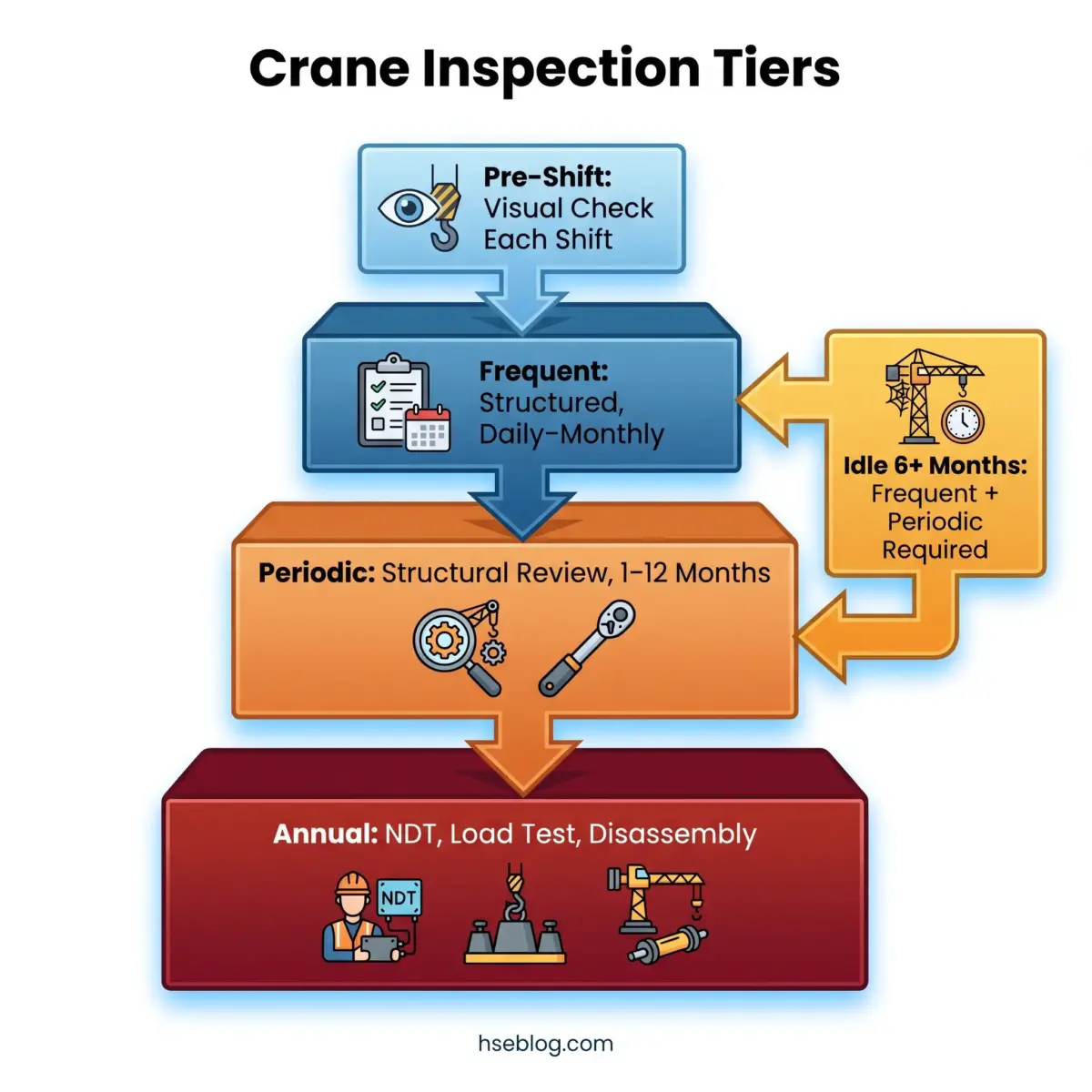
A crane inspection program is not a single activity — it is a layered defense system where each tier targets a different failure mode at a different detection depth. The distinction matters because organizations that collapse multiple tiers into one generic "inspection" end up performing none of them properly. OSHA structures crane inspections into distinct categories, each with its own scope, personnel requirements, and documentation obligations. Understanding what each tier is designed to catch is the foundation of a program that actually prevents failures rather than just generating paperwork.
The following table maps the primary inspection types to their regulatory basis and key characteristics:
| Inspection Type | Purpose | Who Performs | OSHA Reference (US) | Documentation Required |
|---|---|---|---|---|
| Initial | Verify new, altered, or reassembled crane before first use | Qualified person | 1910.179(j)(1) | Yes — full record |
| Pre-shift / Each-shift | Rapid visual check before each operating shift | Operator / competent person | 1926.1412(d) | Not required by OSHA; best practice |
| Frequent | Structured evaluation of operational components (daily–monthly) | Competent person | 1910.179(j)(2) | Yes — monthly minimum |
| Periodic | Comprehensive structural and mechanical evaluation (1–12 months) | Qualified person | 1910.179(j)(3) | Yes — full record |
| Annual / Comprehensive | Deepest tier — may include NDT, load testing, disassembly | Qualified person | 1926.1412(f) | Yes — retained 12 months min. |
| Post-repair | Verify corrective action before return to service | Competent or qualified person | 1926.1412(g) | Yes |
| Idle crane (6+ months) | Frequent + periodic before returning to service | Per applicable tier | 1910.179(j)(2)/(3) | Yes |
Initial Inspection
Before a crane enters service for the first time — whether new from the manufacturer, relocated from another facility, or reassembled after structural modification — an initial inspection establishes the baseline condition against which all future inspections are measured. Under OSHA 1910.179 (US), this includes functional testing of all mechanisms and a load test. The practical reading of this requirement on most sites is that the initial inspection also generates the reference measurements (hook throat dimension, wire rope diameter at marked points, brake stopping distance) that later inspections compare against. Without a documented baseline, the periodic inspector has no reference point to determine whether wear is within acceptable limits.
A point that catches many general-industry sites: 1910.179 (US) requires that initial inspections be repeated every four years for cranes remaining in service. This is not a widely known obligation, and compliance audits frequently identify it as a gap.
Pre-Shift and Frequent Inspections
The most common inspection-program failure is treating pre-shift checks and frequent inspections as the same activity. They are not. A pre-shift inspection under 1926.1412(d) (US — construction) is a rapid visual check performed by the operator before each shift. It covers control function, safety devices, wire rope reeving, and obvious damage. OSHA does not require documentation for pre-shift checks, though documented checklists remain a best practice because they create a contemporaneous record that the check actually occurred.
Frequent inspections under 1910.179(j)(2) (US — general industry) are more structured. They cover operating mechanisms, hoist chains, hooks (including latch condition and throat opening), wire rope condition, and limit switches. The interval — daily to monthly — is determined by the crane's service classification, not by a blanket site policy. Monthly frequent inspection results must be documented with the inspector's name, date, and findings. The components examined overlap with pre-shift checks but require closer evaluation: where the operator looks for obvious damage, the frequent inspector measures, tests, and records.
Watch For: Organizations that issue a single checklist labeled "daily inspection" and use it for both pre-shift and frequent inspection obligations. The result is typically a document that satisfies neither — too cursory for a frequent inspection, too burdensome for a rapid pre-shift check. Separate forms with distinct scopes prevent this conflation.
Periodic and Annual/Comprehensive Inspections
Periodic inspections under 1910.179(j)(3) (US) represent the first tier where structural integrity enters the scope. Beyond the operational components covered in frequent inspections, periodic evaluations examine structural members (girders, end trucks, runway rails) for cracking, corrosion, and deformation; examine electrical systems for deterioration; and assess the overall mechanical condition of hoisting machinery. The interval ranges from one to twelve months, again driven by service classification.
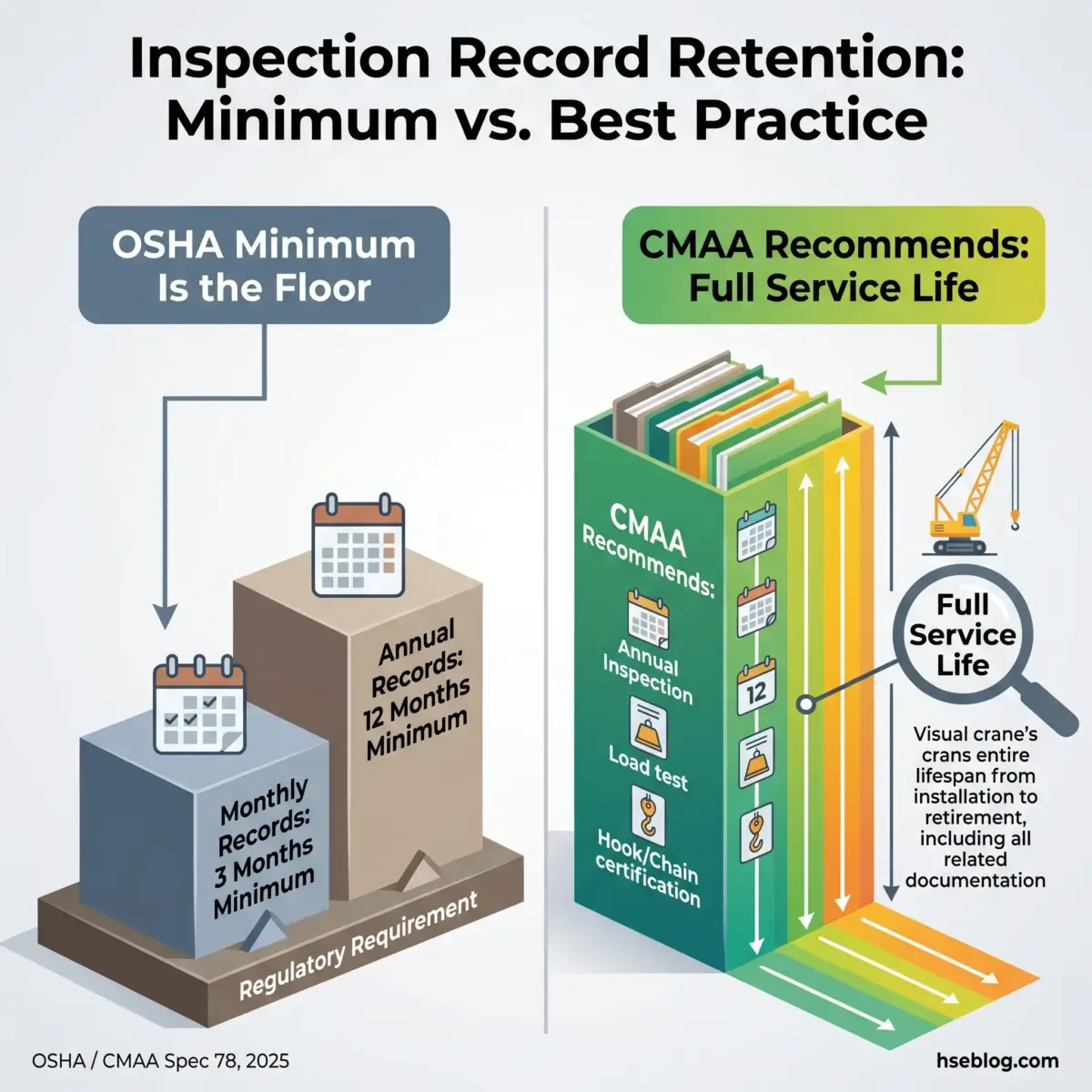
The annual comprehensive inspection under 1926.1412(f) (US — construction) is the deepest evaluation tier. It may require disassembly of specific components, non-destructive testing (NDT) of critical welds and structural connections, and load testing where the qualified person determines it is warranted. Documentation must include every item checked, the results, the inspector's name and signature, and the date — retained for a minimum of twelve months. The CMAA Specification 78 (2025 revision, US) goes further, recommending that annual inspection and load test records be retained for the entire service life of the crane.
Idle Crane Inspections
Cranes that sit unused are not exempt from inspection. Under 1910.179(j)(2) (US), a crane idle for one to six months requires a frequent inspection before returning to service. A crane idle for six months or more requires both a complete frequent and periodic inspection before any loads are lifted. Standby cranes — those designated as backups but not regularly operated — must still be inspected at least semi-annually.
The pattern observed across published enforcement actions is that idle cranes are treated as "not our problem until we need them." When production demand spikes and the idle crane is pressed into service without the required inspections, the organization has both a compliance violation and an unverified piece of equipment handling critical loads.
How Does Crane Service Classification Determine Inspection Frequency?
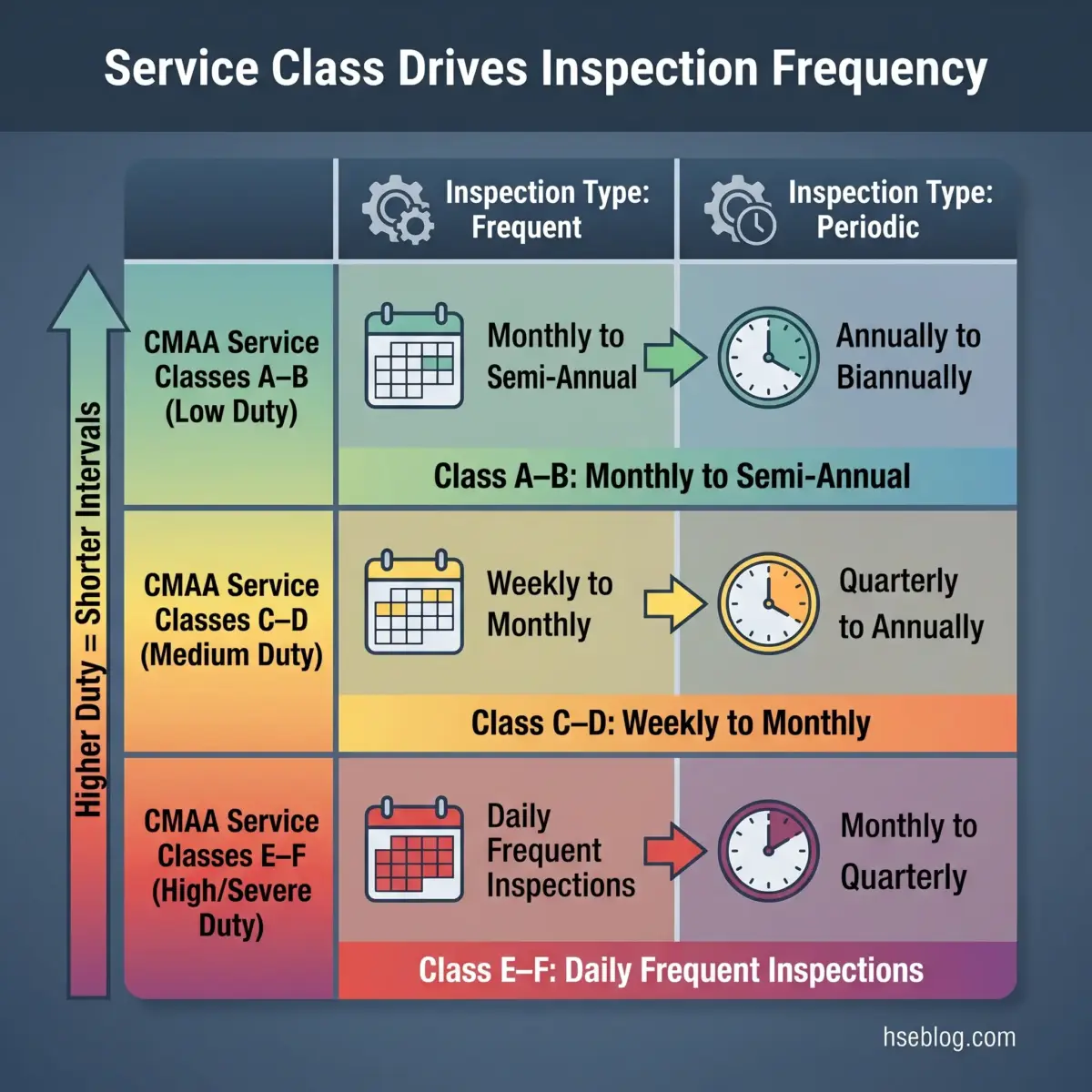
OSHA 1910.179 (US) does not prescribe a single inspection calendar for all cranes. Instead, it ties frequency to the severity of service — and the framework for defining that severity is the CMAA service classification system. This is the single most misunderstood element of crane inspection programs, because the regulation's language ("daily to monthly" for frequent inspections, "1 to 12 months" for periodic) gives a range without telling you where your crane falls within it. The answer lies in the CMAA classification.
The CMAA Specification 70 classifies overhead cranes into six service classes based on load spectrum (how close to rated capacity the crane regularly operates) and operating frequency (number of lift cycles per hour, shift, and year). The classification directly determines the minimum inspection intervals:
| Service Class | Operational Profile | Frequent Inspection Interval | Periodic Inspection Interval |
|---|---|---|---|
| Class A — Standby/Infrequent | Precise handling, infrequent use, light loads | Semi-annual | Annual |
| Class B — Light | Light loads, slow speeds, up to 5 lifts/hour | Monthly | Annual |
| Class C — Moderate | Moderate loads, 5–10 lifts/hour | Weekly to monthly | Semi-annual |
| Class D — Heavy | Near-capacity loads, 10–20 lifts/hour | Weekly | Quarterly to semi-annual |
| Class E — Severe | At-capacity loads, 20+ lifts/hour | Daily | Monthly to quarterly |
| Class F — Continuous Severe | At-capacity loads, continuous operation | Daily | Monthly |
The practical formula is straightforward: higher duty cycle and closer-to-capacity loading equals shorter intervals between inspections.
The most common failure mode in inspection program design is defaulting every crane in the facility to the same schedule. A Class A standby crane inspected daily wastes inspector hours that produce no safety value. A Class D heavy-service crane inspected only annually creates months of unmonitored exposure to progressive deterioration. The judgment call for the safety manager is to classify each crane honestly based on its actual operating profile — not its nameplate rating, not its original purchase specification, but how it is used today. Service conditions change over time as production demands shift, and the inspection program must recalibrate when they do.
Audit Point: Auditors testing this requirement typically ask for the documented basis of each crane's service classification and then compare it against the inspection schedule. If the classification document says "Class B — Light" but production records show 15 lifts per hour at 80% capacity, the inspection frequency is inadequate regardless of what the schedule says.
What Gets Inspected: Key Components and Rejection Criteria
Listing what to inspect is the easy part — every checklist does that. The harder question is: at what measurable threshold does a component fail? Without defined rejection criteria, inspection becomes subjective opinion, and subjective opinion does not hold up under enforcement scrutiny or, more importantly, prevent a failure.
Hooks require visual inspection at every shift and a documented monthly evaluation with a certification record under 1910.179 (US). The rejection criteria are specific and measurable: a hook must be removed from service if the throat opening has increased by more than 15% over its original dimension, or if the hook body has twisted more than 10 degrees from the plane of the unbent hook. These measurements require a caliper and a recorded baseline — not estimation. The monthly certification record must identify the hook by serial number or component identifier, the inspector's name and signature, and the date.
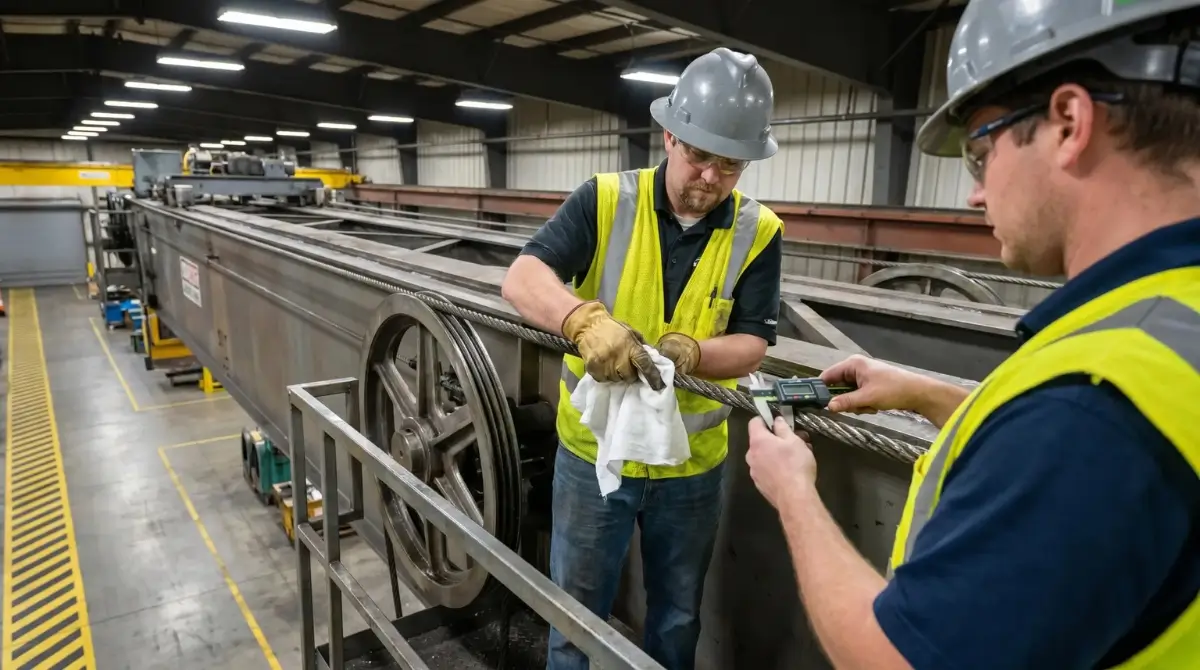
Wire ropes are the component where the gap between "inspected" and "actually evaluated" is widest. Under ASME B30.2 (US — incorporated by reference into OSHA), a wire rope must be removed from service when any of the following conditions exist: six or more randomly distributed broken wires in one rope lay length, three or more broken wires in one strand in one lay, or greater than 5% reduction in nominal rope diameter. Diameter measurement must be taken with a caliper at the same reference point each inspection cycle. Visual-only assessment reliably misses gradual diameter reduction — a rope losing 0.5mm per month looks unchanged shift to shift but reaches the rejection threshold within a year.
The remaining critical components each carry their own inspection focus:
- Hoist chains — examined for excessive wear, twist, elongation beyond manufacturer limits, and distorted or cracked links. Chain stretch is measured against the original pitch length.
- Brakes — tested for holding capacity under rated load, drift distance, and stopping performance. Any perceptible drift under static load is grounds for immediate corrective action.
- Limit switches — upper and lower hoist limits functionally tested with no load attached. A limit switch that trips only under load conditions may not activate during an unloaded overtravel event.
- Structural members — girders, end trucks, and runway rails examined for cracks, corrosion, and deformation. Crack detection in welded connections may require magnetic particle or ultrasonic testing during periodic or annual inspections.
- Electrical systems — contactors, collectors, push-button pendant stations inspected for pitting, arc damage, and insulation deterioration.
Field Test: A reliable audit check for wire rope inspection quality: ask the inspector to show you the last three diameter measurements at the reference point. If they cannot produce numerical readings — only checkmarks — the inspection has been visual-only, and gradual deterioration may be progressing undetected.
Who Can Perform Crane Inspections? Competent vs. Qualified Person
OSHA draws a clear personnel hierarchy for crane inspections that many organizations blur in practice. The distinction between a competent person and a qualified person is not academic — it determines which inspection tiers a given individual is authorized to perform and what legal exposure the employer carries if the wrong person conducts the wrong inspection.
A competent person under OSHA's definition is someone capable of identifying existing and predictable hazards in the surroundings or working conditions and who has authorization to take prompt corrective measures to eliminate them. For crane inspections, the competent person performs pre-shift and frequent inspections. The standard does not require third-party certification — it requires demonstrable capability and employer authorization.
A qualified person is defined as someone with a recognized degree, certificate, professional standing, or extensive knowledge and experience who has successfully demonstrated the ability to solve problems relating to the subject matter. Periodic and annual/comprehensive inspections fall within the qualified person's scope. The depth of evaluation — structural assessment, NDT interpretation, load test supervision — demands technical knowledge beyond operational familiarity.
The misconception that needs correcting here is the assumption that a skilled crane operator automatically qualifies as a competent inspector. Operating a crane safely and inspecting one competently are distinct skill sets. An operator may run a crane for years without being trained to detect subsurface wire rope deterioration, measure hook distortion against baseline dimensions, or evaluate the structural significance of a hairline crack in a girder weld. Inspection competence must be trained, evaluated, and documented separately from operating competence.
The CMAA Specification 78 (2025 revision, US) significantly tightened the qualification framework. The updated standard now requires a minimum of 2,000 hours of documented field experience for crane inspection and maintenance personnel, along with biennial training updates to maintain qualification. It also recommends periodic load testing of in-service cranes every four years — a practice that, while not an OSHA mandate, aligns with the initial inspection retest interval under 1910.179 (US).
For voluntary third-party credentialing, the NCCCO (National Commission for the Certification of Crane Operators) offers a Crane Inspector certification program consisting of a core written examination plus crane-type-specific specialty modules (mobile, tower, overhead). While OSHA does not mandate NCCCO certification, it is the most widely recognized credential in the US and is increasingly specified in owner and general contractor requirements.
Under UK LOLER 1998, the competent person performing a thorough examination must be independent from the organization's routine maintenance function. This is a critical jurisdictional difference: in the US, an in-house qualified engineer may conduct annual inspections of equipment they also maintain. In the UK, the thorough examiner cannot assess the adequacy of their own maintenance work — the independence requirement is structural, not optional.
Documentation and Record-Keeping Requirements
The regulatory minimum for crane inspection documentation is lower than most safety managers assume — and the operational best practice is significantly higher. Understanding both prevents the twin failures of over-documenting routine checks (creating administrative burden that degrades compliance) and under-documenting critical inspections (creating legal exposure that compounds during enforcement actions).
Under 1926.1412(e) (US — construction), monthly inspection records must include the items checked, the results of each check, the name and signature of the inspector, and the date. These records must be retained for a minimum of three months. Annual/comprehensive inspection records under 1926.1412(f) carry the same content requirements but must be retained for at least twelve months.
For general industry overhead cranes, 1910.179 (US) requires that hooks and chains receive monthly inspection with a certification record bearing the inspector's signature and component identifier. An OSHA letter of interpretation issued in 2015 clarified an important timing point: the annual inspection is due on or before the anniversary date of the previous inspection — not "anytime within that month" or "within a reasonable period." Late inspections are violations regardless of the reason for the delay.
CMAA Specification 78 (2025 revision, US) recommends a substantially higher retention standard: load test records and annual inspection records should be retained for the entire service life of the crane. The rationale is that deterioration trends only become visible when you can compare current measurements against years of historical data. A single annual inspection tells you the crane's condition today; a decade of annual inspections tells you its rate of deterioration — and that trajectory is what enables predictive maintenance decisions.
The shift from paper checklists to digital inspection platforms is accelerating across the industry. The practical advantage is less about technology itself and more about solving the persistent problem of illegible handwritten forms stored in facility filing cabinets. Timestamped, GPS-tagged, photo-documented digital records with electronic signatures are substantially more defensible under audit or litigation than paper forms that may be completed after the fact. The OSHA 2025 updates to 1926.1412 and 1910.179 reflect this trajectory, emphasizing integration of modern technologies and replacing subjective inspection language with measurable criteria.
| Record Type | OSHA Minimum Retention | CMAA Spec 78 Recommendation |
|---|---|---|
| Monthly frequent inspection | 3 months | Service life of crane |
| Annual/comprehensive inspection | 12 months | Service life of crane |
| Load test records | 12 months | Service life of crane |
| Hook/chain monthly certification | Until next inspection | Service life of crane |
Crane Inspection Requirements Under UK LOLER and PUWER
For organizations operating in the United Kingdom — or multinational operations managing crane fleets across both US and UK jurisdictions — the inspection framework differs from OSHA's structure in terminology, personnel requirements, and legal enforcement mechanism. The two systems share the same objective but diverge in how they achieve it.
LOLER 1998 (UK), Regulation 9, requires a thorough examination of lifting equipment by an independent competent person at three trigger points: before first use, after each new site installation, and periodically — at intervals not exceeding twelve months for cranes, or six months for equipment used to lift persons or for lifting accessories (slings, shackles, spreader beams). The thorough examination is a statutory safety evaluation. It is explicitly not the same as routine maintenance or servicing — a distinction that creates compliance problems when organizations assign thorough examination duties to the same personnel responsible for day-to-day maintenance.
PUWER 1998 (UK) operates alongside LOLER, requiring in-service inspections — daily and weekly visual checks by operators and supervisors — to catch operational deterioration between thorough examinations. A consistent compliance failure in the UK is treating the LOLER thorough examination as a substitute for PUWER routine inspections, or the reverse. They serve different functions at different frequencies: PUWER catches emerging issues in real time; LOLER provides the statutory structural assurance at defined intervals.
Upon completion of a thorough examination under LOLER, the competent person must issue a written report within 28 days. If the examination identifies an immediate defect — one presenting an existing or imminent risk of serious personal injury — the equipment must be taken out of service immediately, and the examiner must notify the Health and Safety Executive (HSE UK) directly. Timed defects, where the risk is not immediate but the deficiency must be corrected within a specified window, allow continued operation only until the repair deadline. All thorough examination records must be retained for a minimum of two years.
The following comparison highlights the key structural differences between the US and UK frameworks:
| Parameter | OSHA (US) | LOLER / PUWER (UK) |
|---|---|---|
| Inspection tiers | Pre-shift, frequent, periodic, annual/comprehensive | PUWER routine + LOLER thorough examination |
| Maximum periodic interval | 12 months (annual comprehensive) | 12 months (6 months for lifting persons) |
| Personnel | Competent person (routine) / Qualified person (annual) | Independent competent person (must not assess own maintenance) |
| Documentation retention | 3 months (monthly) / 12 months (annual) | 2 years minimum |
| Deficiency response | Remove from service until corrected | Immediate defects: out of service + notify HSE; timed defects: repair within window |
Jurisdiction Note: The independence requirement under LOLER is non-negotiable: the person conducting the thorough examination must not be the same person — or part of the same team — responsible for the crane's routine maintenance. In practice, most UK organizations use insurance-company engineering surveyors or independent inspection bodies to satisfy this requirement.
What Happens When a Crane Fails Inspection?
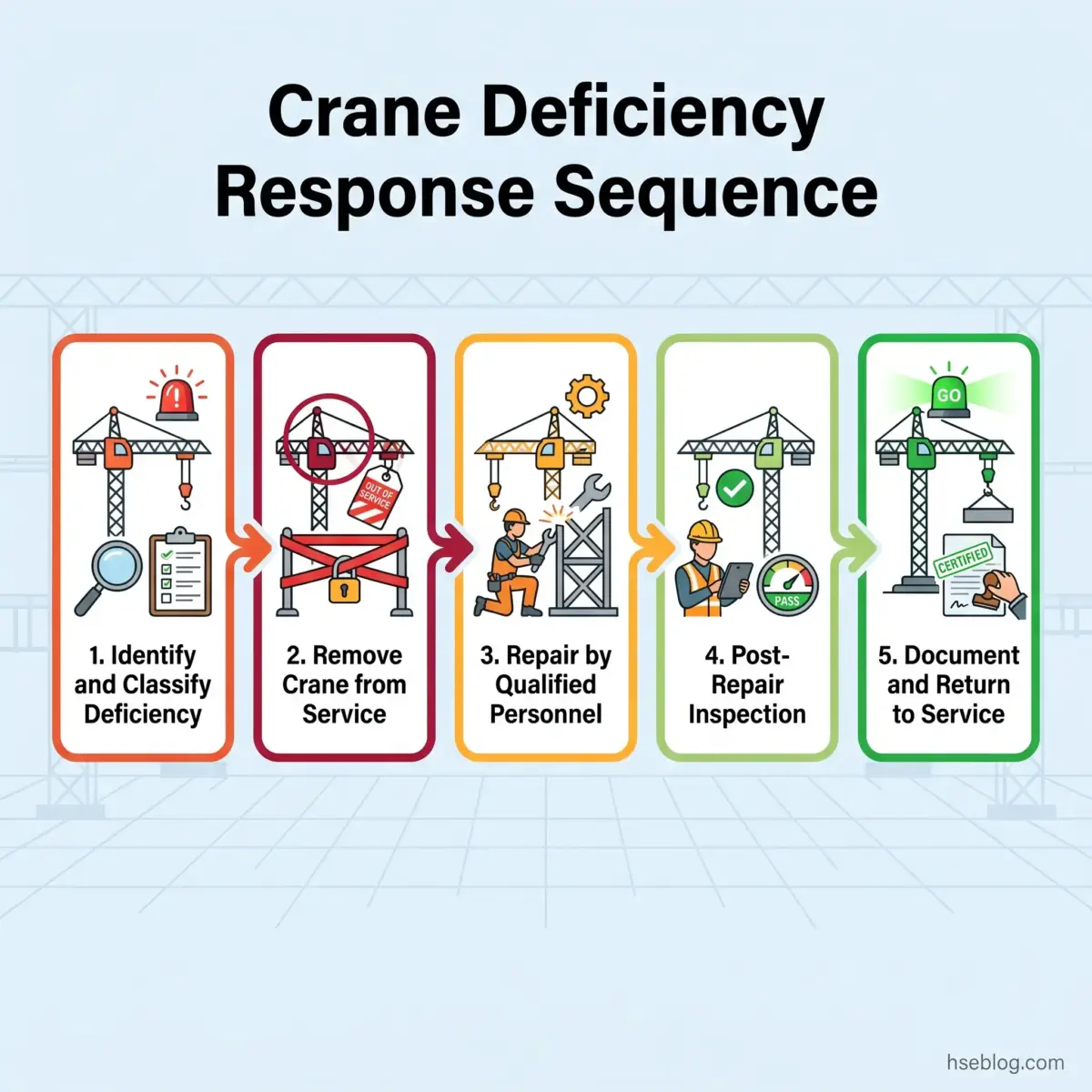
The regulations are clear on the immediate obligation: any deficiency constituting a safety hazard requires the crane to be removed from service until the deficiency is corrected and a post-repair inspection confirms the crane is safe to operate. The challenge is not understanding the rule — it is applying it under production pressure.
Under OSHA (US), a crane with a known safety deficiency that continues to operate exposes the employer to General Duty Clause liability in addition to the specific inspection standard violation. The deficiency, the corrective action taken, and the results of the return-to-service inspection must all be documented. Under LOLER (UK), the response is more formally structured: immediate defects require the crane to be taken out of service and the HSE notified; timed defects allow continued operation only within the repair window specified by the thorough examiner.
The real-world pressure point is predictable: a critical crane goes down mid-production. The temptation to continue operating "just until the shift ends" or "just for this one lift" is where the most serious crane injuries originate. A well-designed inspection program anticipates this moment and includes a pre-planned response protocol. That protocol addresses three questions before the crane fails: what backup lifting capacity is available, who has authority to confirm out-of-service status, and what is the escalation path for emergency repairs. When these decisions are made in advance — not under the stress of a production stoppage — safety judgment is far less likely to be overridden.
The return-to-service sequence follows a consistent logic regardless of jurisdiction: deficiency identified and classified → crane removed from service → repair or replacement performed by qualified personnel → post-repair inspection by competent or qualified person → documented clearance → crane returned to service. Skipping any step — particularly the post-repair inspection — negates the entire corrective action.
Frequently Asked Questions
Do crane inspections have to be done by a certified inspector?
OSHA (US) does not mandate certification from a specific body. Inspectors must meet the competent-person standard for routine inspections or the qualified-person standard for periodic and comprehensive evaluations. The NCCCO Crane Inspector certification is the most widely recognized voluntary credential in the US and is increasingly specified in contractor requirements. Under UK LOLER, the competent person must demonstrate both relevant technical knowledge and independence from the equipment's routine maintenance function — but again, no single certification is legally mandated.
What is the difference between a frequent and periodic crane inspection?
Frequent inspections (daily to monthly, depending on service class) focus on operational components: hooks, wire ropes, brakes, limit switches, and safety devices. They are conducted by a competent person and detect in-service deterioration. Periodic inspections (one to twelve months) are comprehensive structural and mechanical evaluations conducted by a qualified person. They cover everything in the frequent scope plus structural members, electrical systems, and overall crane geometry. The service classification determines where within each range the specific crane falls.
How often do overhead cranes need to be inspected?
Daily pre-shift visual checks are universal for all operating cranes. Beyond that, frequency depends on the CMAA service classification. A Class A standby crane may require frequent inspections only semi-annually, while a Class E severe-service crane requires daily frequent inspections. Periodic inspections range from annual (Class A–B) to monthly (Class F). Annual comprehensive inspections are required at minimum every twelve months for most service classes under both OSHA 1910.179 (US) and LOLER (UK).
What happens if a crane has been idle for six months or more?
Under OSHA 1910.179 (US), a crane idle for six or more months must undergo both a complete frequent inspection and a periodic inspection before being returned to service. A crane idle for one to six months requires a frequent inspection before resuming operation. Standby cranes — those designated as backups — must be inspected at least semi-annually regardless of whether they were operated. Idle status does not pause deterioration; corrosion, seal degradation, and brake settling all progress during inactivity.
What is the ASME B30 standard and is it legally required?
ASME B30 is a suite of consensus engineering standards covering specific crane types: B30.2 (overhead and gantry), B30.3 (tower), and B30.5 (mobile and locomotive). OSHA incorporates these standards by reference under 29 CFR 1910.6 (US), which gives them the force of federal regulation. B30 standards provide more detailed technical criteria than OSHA's regulatory text — for example, the specific wire rope rejection thresholds (six broken wires in one lay, three in one strand, greater than 5% diameter reduction) come from ASME B30.2, not from the OSHA standard text itself.
How long must crane inspection records be kept?
OSHA (US) requires monthly inspection records to be retained for at least three months and annual/comprehensive records for at least twelve months. CMAA Specification 78 (2025 revision, US) recommends retaining annual inspection and load test records for the entire service life of the crane — a substantially higher standard that enables deterioration trend analysis. Under UK LOLER, thorough examination records must be retained for a minimum of two years. In practice, retaining records for the crane's full service life is the defensible approach regardless of jurisdiction.
Conclusion
The question worth asking after reading this is not whether your facility has a crane inspection program — nearly every site does. The question is whether that program is calibrated to the actual service conditions of each crane, or whether it applies a blanket schedule that over-inspects low-use equipment and under-inspects the cranes that carry the heaviest operational burden. Service classification is the pivot point. If you cannot produce the documented basis for each crane's classification and demonstrate that your inspection intervals match, the program has a structural vulnerability that no amount of completed checklists will fix.
Crane inspection is ultimately a measurement discipline, not a visual one. Hook throat dimensions measured against recorded baselines. Wire rope diameters taken with calipers at consistent reference points. Brake drift distances quantified under rated load. The shift from subjective observation to documented measurement — reinforced by the CMAA Specification 78 (2025) qualification requirements and the OSHA 2025 emphasis on measurable criteria — is where inspection programs either protect workers or merely create a paper trail.
Ask yourself one uncomfortable question: if your most critical crane failed tomorrow and the investigation team pulled your inspection records, would those records show measured values trending toward rejection criteria — evidence that the deterioration was being tracked — or would they show years of identical checkmarks that reveal nothing about the crane's actual condition?