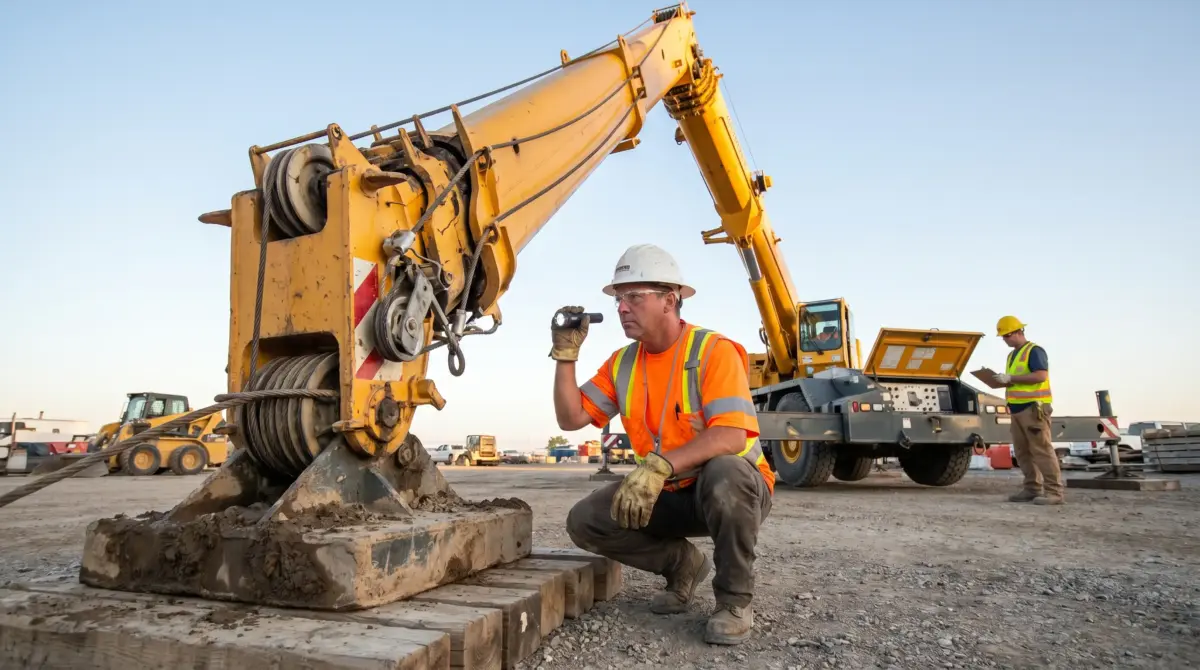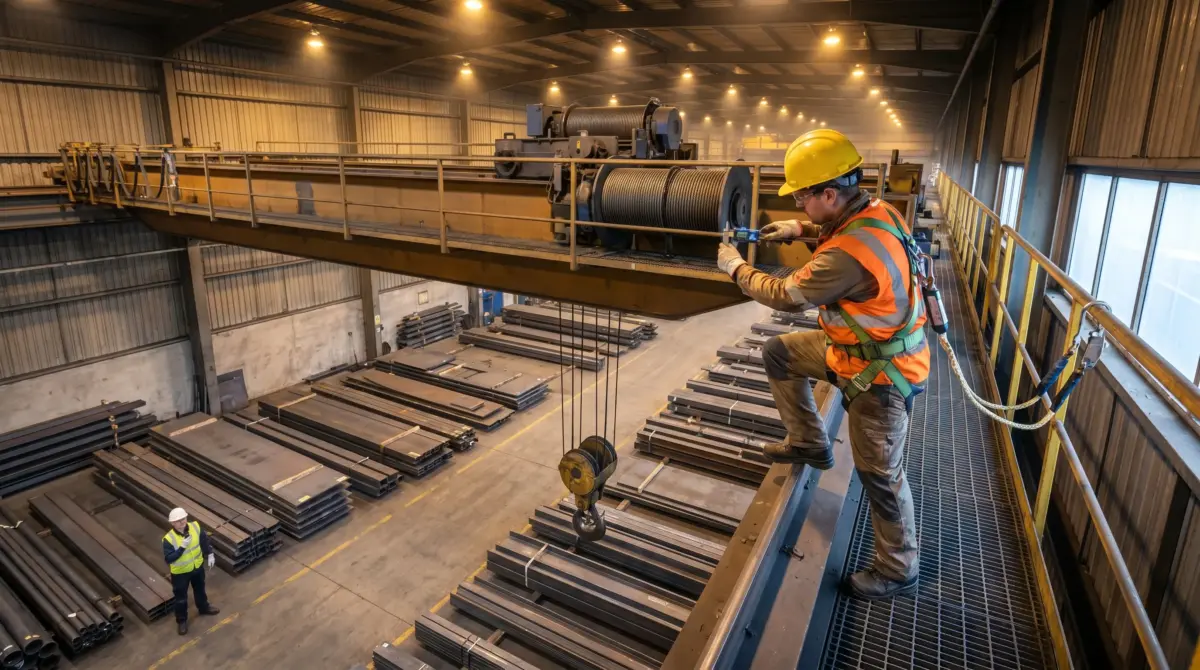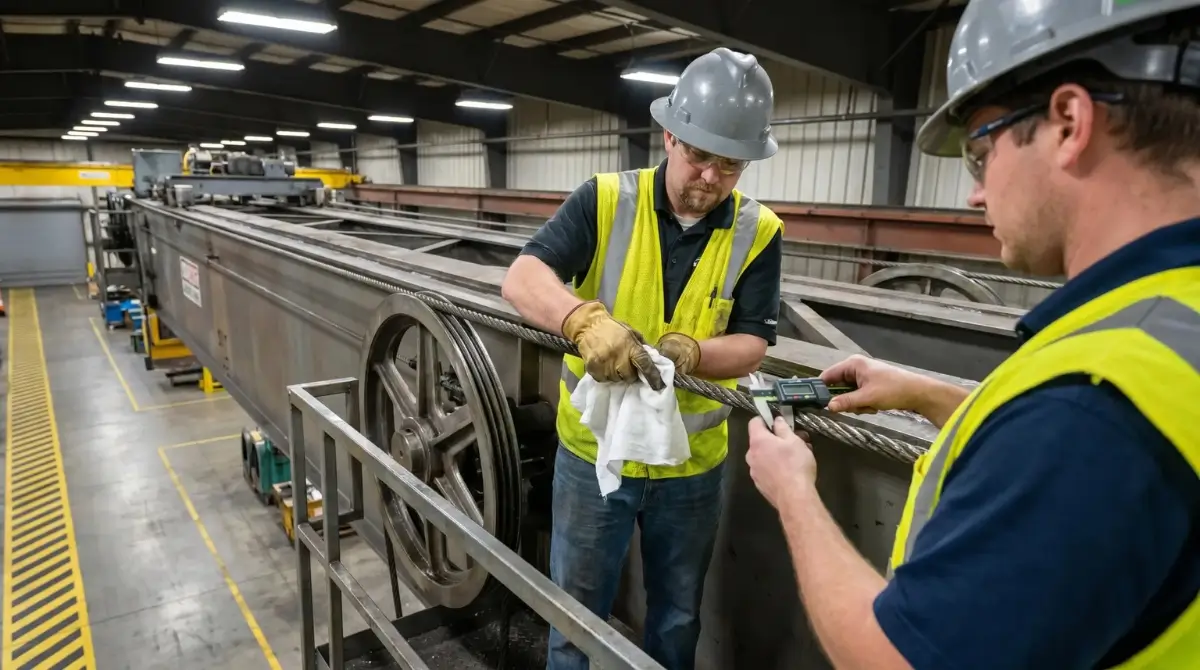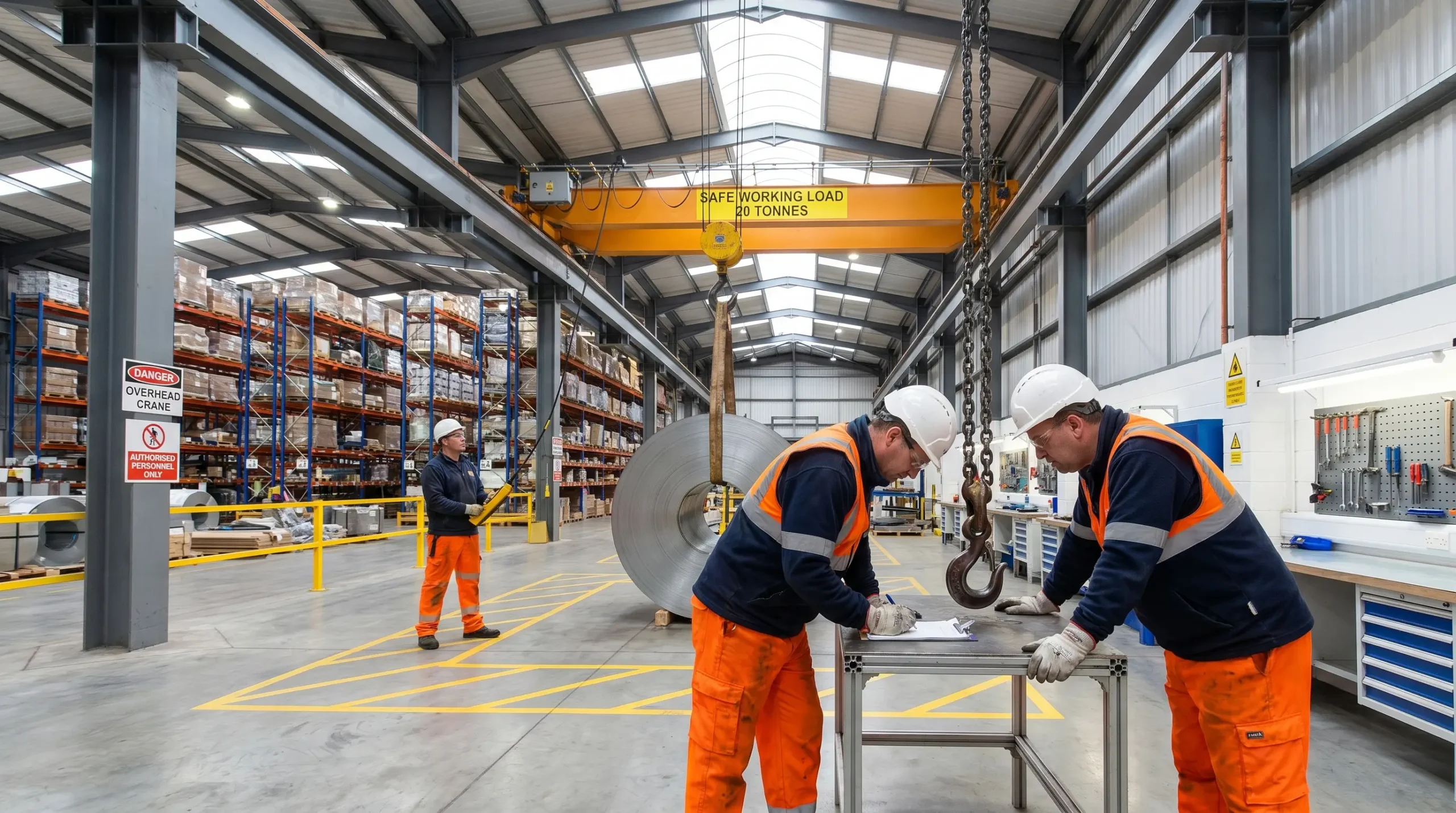
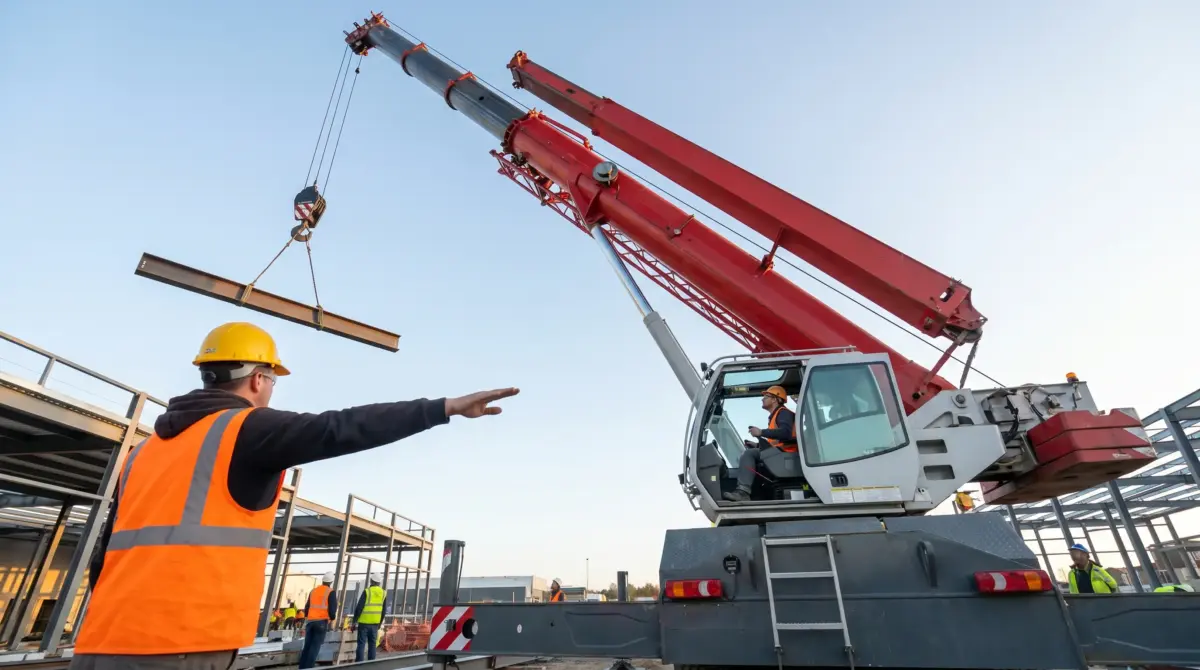
Crane certification is a formal process in which an independent, accredited testing organization verifies that a crane operator possesses the knowledge and practical skill to operate a specific type of crane safely. In the United States, OSHA requires operators of most construction cranes above 2,000 lb rated capacity to hold certification under 29 CFR 1926.1427. The credential involves passing both a written knowledge exam and a hands-on practical exam, and must be renewed every five years.
Between 2011 and 2017, crane-related incidents killed an average of 42 to 44 workers per year in the United States (US Bureau of Labor Statistics, 2019). That figure represents not a single catastrophic event, but a persistent annual toll — one that continues despite decades of available technology, established standards, and a mature training infrastructure. Industry estimates attribute approximately 90% of crane accidents to human error (Crane Inspection & Certification Bureau), and while "human error" is a broad category, it consistently traces back to gaps in operator knowledge, situational judgment, and competency verification. Certification exists to close those gaps at their source.
Yet the term "crane certification" itself is one of the most misunderstood concepts in lifting operations. Employers conflate it with training. Operators confuse it with licensing. Project managers treat it as a single compliance checkbox when, under OSHA's framework, it is one leg of a three-part obligation. This article breaks down what crane certification actually involves, who needs it, how the process works across jurisdictions, and where compliance most commonly breaks down in practice — the interpretation gaps that generate citations and, in the worst cases, fatalities.
This article provides general HSE knowledge. Life-critical work such as crane operation, lift planning, and rigging must be planned and supervised by a competent person with relevant training, jurisdiction-specific authorization, and site-specific risk assessment. The information here does not replace that. Readers pursuing certification should consult recognized training pathways including NCCCO, NCCER, CPCS (UK), and OSHA Outreach programs.
What Is Crane Certification?
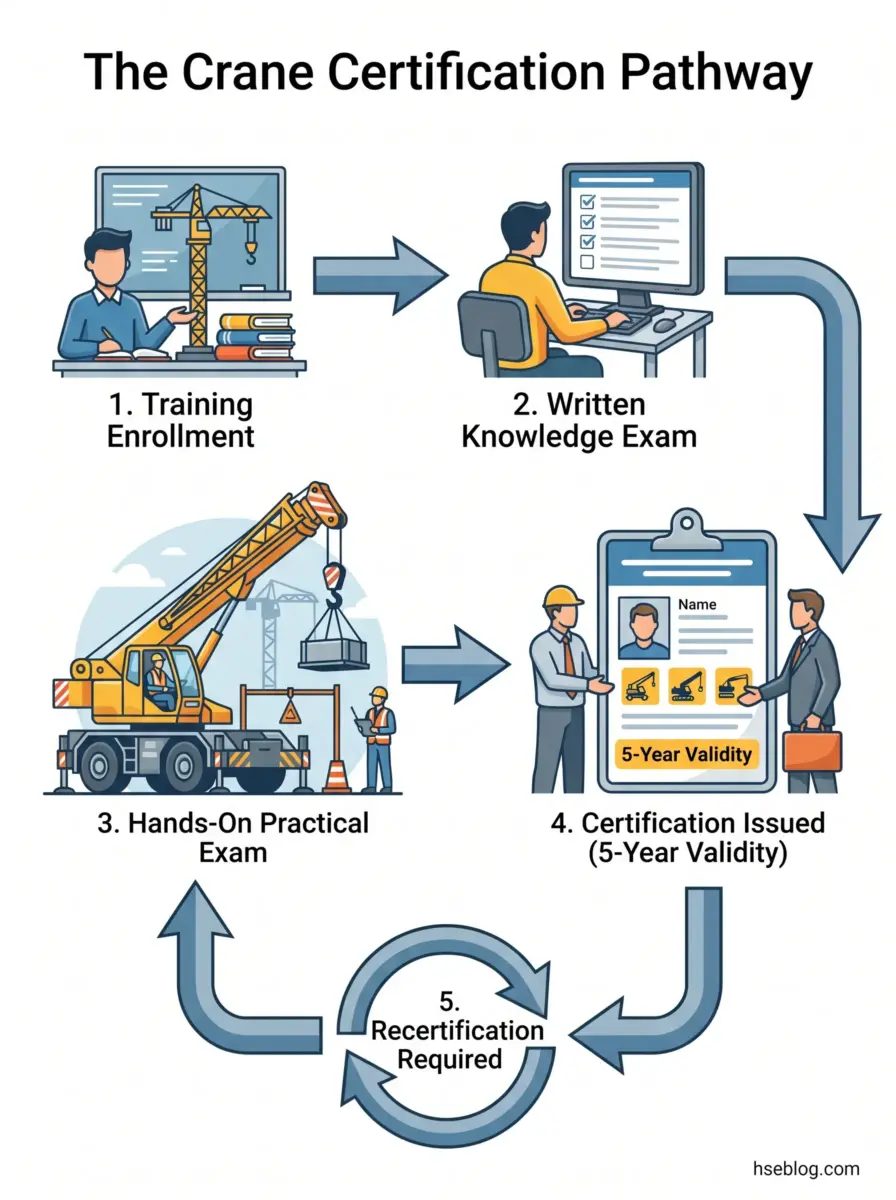
Crane certification is the formal verification — by an independent, accredited testing organization — that an individual possesses the technical knowledge and practical skill to operate a specific type of crane safely. The word "independent" carries weight here. Unlike in-house training or employer-issued competency cards, certification requires assessment by a body that has no financial stake in the candidate's outcome and holds accreditation from a recognized authority such as ANSI or NCCA.
The process has two distinct components. A written knowledge exam tests the candidate's understanding of load charts, crane capacities, rigging principles, safety procedures, and the applicable regulatory framework. A hands-on practical exam then tests the candidate's ability to operate the crane through a controlled course under examination conditions. Both components must be passed for the certification to be issued, and the credential is type-specific — a mobile crane certification does not authorize tower crane operation, and vice versa.
A misconception that persists across the industry is the belief that completing a training course constitutes certification. It does not. Training prepares a candidate for the certification exam, but training and certification are separate activities with different legal standing. An operator who has attended a two-week crane training program but has not sat and passed the independent exam is trained, not certified. The distinction is not semantic — it is the difference between compliance and citation under OSHA's construction crane standard.
Internationally, parallel systems exist. The NCCCO (National Commission for the Certification of Crane Operators) dominates the US market; in the United Kingdom, the CPCS (Construction Plant Competence Scheme) administered by CITB serves a similar function. While the underlying principle — independent competency verification — is consistent, the credentials are not interchangeable between jurisdictions.
Why Crane Certification Matters for Workplace Safety
The fatality data makes the case in terms that do not require interpretation. An average of 42 to 44 crane-related deaths occurred annually in the United States between 2011 and 2017 (US Bureau of Labor Statistics, 2019). These are not confined to a single sector or crane type — they span mobile cranes, tower cranes, overhead cranes, and derricks across construction, manufacturing, and maritime operations.
Certification functions as a validated baseline. It confirms that an operator understands load dynamics, can read a load chart under variable conditions, recognizes environmental factors that affect crane stability, and can execute controlled lifts within the crane's rated capacity. Without that baseline, the operator is making judgment calls — about outrigger placement, boom angle, wind limits, ground conditions — without verified knowledge of the principles governing those decisions.
However, treating certification as a standalone guarantee of safe operation is itself a failure pattern. Certification validates knowledge and skill at a point in time, on a standardized test. It does not confirm that the operator is competent on the specific crane model at the specific site with the specific ground conditions and lift plan in front of them today. That is the employer's evaluation duty — a separate legal obligation under §1926.1427(f) that organizations routinely neglect once they see a valid certification card.
Watch For: The most common enforcement gap in crane compliance is not the absence of the certification card. It is the absence of a documented, machine-specific employer evaluation. Organizations that treat certification as a "set-and-forget" checkbox expose themselves to citation even when every operator on site holds a valid credential.
The pattern across published enforcement actions is consistent: employers invest in certification, file the cards, and then stop. The ongoing evaluation duty — verifying that each operator can safely operate the specific crane they are assigned to, documenting that evaluation, and keeping it available on-site — falls through the gap between the HR function that tracks credentials and the operations function that assigns operators to equipment.
Who Needs Crane Certification?
The legal trigger in the United States is specific and frequently misapplied. Under OSHA's crane operator certification standard, employers must ensure that operators of cranes used in construction with a manufacturer-rated capacity exceeding 2,000 lb are certified by an accredited testing organization. The standard applies to construction as defined by OSHA — a definition broader than many employers realize, encompassing not just new building construction but also renovation, demolition, and certain maintenance activities.
Several categories of equipment fall outside the federal mandate. Derricks, sideboom cranes, and equipment rated at 2,000 lb or below are excepted from §1926.1427, though operators of excepted equipment must still receive adequate training. The construction versus non-construction distinction is the single most frequent source of compliance confusion. Employers operating cranes for industrial maintenance or facility service work often assume they need construction-grade certification when their work falls under general industry standards — or, conversely, fail to obtain it when their operations do qualify as construction under OSHA's broad definition.
General-industry overhead cranes present a different regulatory picture entirely. Under 29 CFR 1910.179, operators must be trained, evaluated, and designated as competent by their employer, but the standard does not require third-party certification from an accredited testing organization. Some employers voluntarily pursue NCCCO overhead crane certification as a best practice, but it is not a federal legal requirement for general-industry operations.
Beyond the federal floor, several states and municipalities impose additional requirements. California, New York City, West Virginia, and Hawaii each maintain crane operator licensing programs with prerequisites that may exceed the federal standard. In these jurisdictions, holding an NCCCO card alone is insufficient — operators must also obtain the applicable state or city license.
| Jurisdiction | Requirement | Governing Standard |
|---|---|---|
| US Federal (Construction) | Third-party certification for cranes >2,000 lb | 29 CFR 1926.1427 |
| US Federal (General Industry) | Training + employer designation | 29 CFR 1910.179 |
| California, NYC, West Virginia, Hawaii | State/city license (in addition to federal) | Varies by jurisdiction |
| United Kingdom | CPCS card (red → blue pathway) | LOLER 1998, PUWER 1998, BS 7121 |
Types of Crane Certifications
Crane certification is not a single credential — it is a family of type-specific certifications, each tied to a distinct crane category and, in some cases, to distinct operational roles beyond the operator's seat. Understanding the landscape requires looking at both the crane type dimension and the certifying body dimension.
By Crane Type
The most commonly pursued certification is for mobile cranes — telescopic boom, lattice boom, and crawler configurations. Mobile crane certification accounts for the largest share of NCCCO credentials issued annually, reflecting the prevalence of these machines on construction sites. Tower crane certification covers hammerhead and luffing boom configurations and carries its own distinct written and practical examinations. Overhead crane certification addresses cab-operated, pendant-controlled, and remote-controlled configurations used primarily in manufacturing and warehousing.
Articulating cranes and service truck cranes, increasingly common in utility and maintenance work, represent a growing certification category. These are mechanically distinct from conventional mobile cranes and require operators to understand different load moment dynamics.
By Personnel Role
A critical gap that appears repeatedly in enforcement records is the narrow focus on operator certification to the exclusion of other required personnel qualifications. Under OSHA's Subpart CC (29 CFR 1926.1400–1441), riggers and signal persons carry their own separate qualification requirements. Rigger qualification is governed by §1926.1425, and signal person qualification by §1926.1428. These are not optional additions — they are independent legal requirements, and their absence is a frequent citation even on sites where every operator holds a valid card.
The full personnel certification landscape includes operator (by crane type), rigger (Level I and Level II), signal person, lift director, and crane inspector. In the UK, CPCS mirrors this with separate categories: A02 (Crawler Crane), A04 (Tower Crane), A60 (Mobile Crane), A61 (Appointed Person — responsible for lift planning), and A62 (Crane Supervisor).
Audit Point: When reviewing a site's crane compliance, check rigger and signal person qualifications with the same rigor applied to operator certification. These are the credentials most likely to be missing, and OSHA treats their absence as a separate violation from any operator-related deficiency.
Accredited Certification Bodies: NCCCO, CIC, NCCER, and OECP
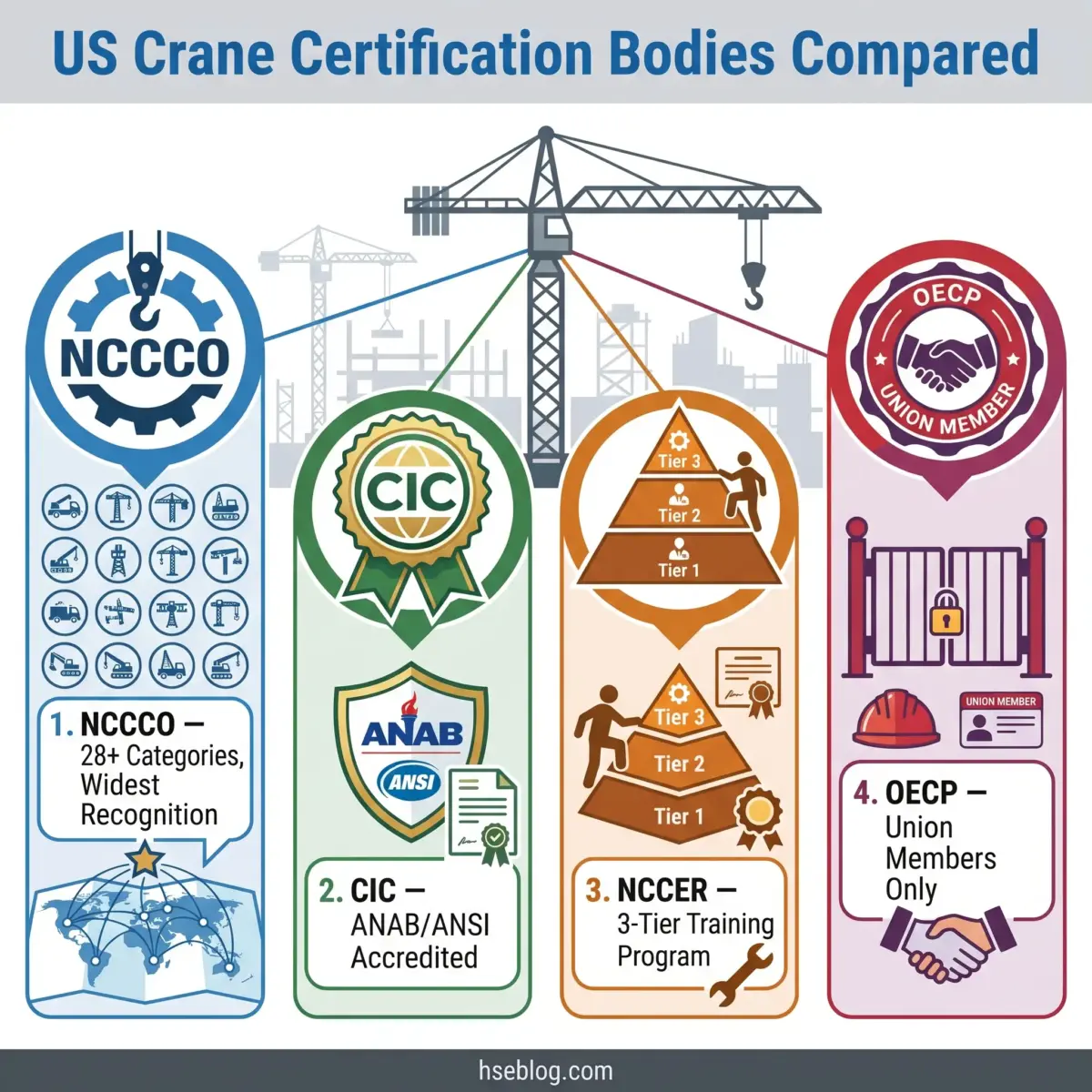
OSHA does not prescribe a specific certifying body. The requirement under §1926.1427 is that the certification come from a testing organization accredited by a nationally recognized accrediting agency — in practice, ANSI or NCCA accreditation. Four major organizations currently meet this threshold in the United States, though they differ in scope, recognition, and practical portability.
NCCCO (National Commission for the Certification of Crane Operators) is the most widely used certifying organization in the US market, offering 28+ certification categories with a five-year validity period. Its credentials carry broad recognition across employers, general contractors, and project owners. NCCCO's mobile crane operator certification is the single most commonly held crane credential in the country.
CIC (Crane Institute Certification) holds ANAB/ANSI accreditation and covers major crane types. NCCER (National Center for Construction Education and Research) takes a broader construction-skills approach with a three-tiered program structure (Level 1 through 3) that integrates longer training hours with the certification pathway. OECP (Operating Engineers Certification Program) serves exclusively International Union of Operating Engineers (IUOE) members.
The judgment call for an individual operator or employer is not simply "which is accredited" — all four meet the federal threshold — but which credential carries practical currency in their target market. NCCCO dominates market share to the degree that certain jurisdictions (West Virginia, for example) accept only NCCCO credentials. Before investing in training and examination fees, operators should confirm which credential their target employer, general contractor, or project owner requires. Employers should verify current accreditation status through the NCCCO Foundation's directory, as accreditation can be suspended or revoked.
The Crane Certification Process: From Training to Exam
The pathway from candidate to certified operator follows a defined sequence, though the timeline varies considerably depending on prior experience and the training program selected.
Eligibility prerequisites are straightforward: minimum age of 18, physical fitness adequate for crane operation, compliance with substance abuse requirements, and basic literacy sufficient to read load charts and operational manuals. There is no formal educational prerequisite — the barrier to entry is competency, not credentials.
The written exam, using the NCCCO structure as the reference, consists of a core examination (90 questions, 90 minutes) covering general crane knowledge applicable across crane types, plus at least one specialty examination (26 questions, 60 minutes) specific to the crane type being certified. The core exam tests load chart interpretation, crane stability principles, rigging hardware, safety procedures, and regulatory awareness. The specialty exam tests type-specific operational knowledge — boom configurations, counterweight systems, outrigger setup, or tower crane erection procedures, depending on the credential.
The practical exam is where the pass rate drops. Candidates must demonstrate crane operation through a controlled course involving pylon navigation and load management under timed examination conditions. The assessment is pass/fail on objective criteria — exceeding time limits, striking pylons, or dropping loads results in failure regardless of how well the written exam went. The most common failure pattern is candidates who pass the written comfortably but underestimate the practical exam's precision requirements. Examination nerves produce errors that never appear in practice sessions — rushed movements, overcorrection, and loss of the smooth, deliberate control that examiners are evaluating.
OSHA allows a 12-month window between passing the written exam and completing the practical exam. If the practical is not passed within that window, the written exam results expire and the candidate must start over. Cost ranges vary: examination fees run approximately $250 to $1,000, while training program costs range from $500 for focused refresher courses to $5,000 or more for comprehensive programs with extensive seat time. Under §1926.1427(a), OSHA places the cost burden on the employer, not the operator.
Certification vs. Licensing vs. Employer Evaluation
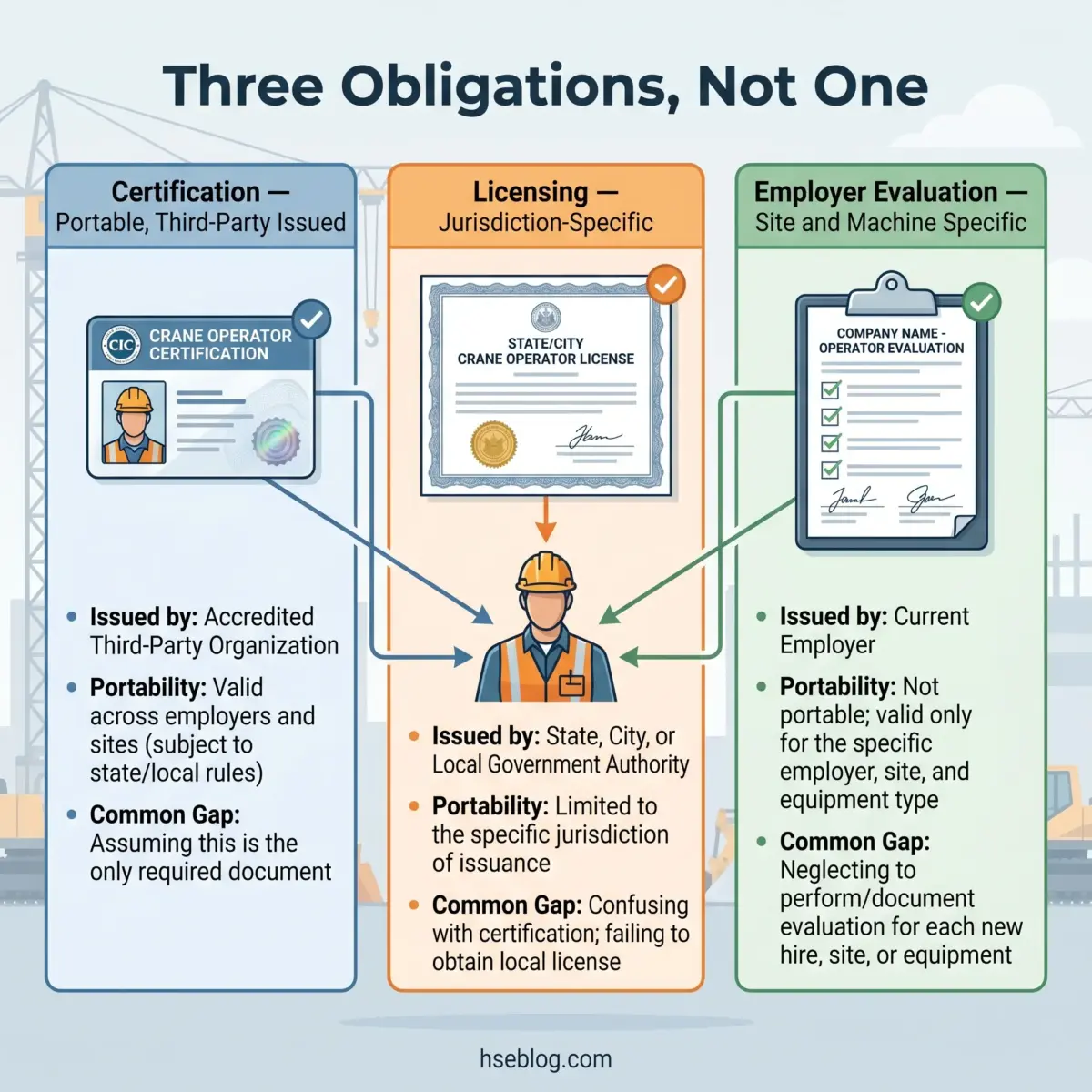
This is the distinction that generates more compliance failures and enforcement citations than any other aspect of crane regulation. OSHA's framework creates a three-part obligation, and the three parts are cumulative — not interchangeable.
Certification is a portable credential issued by an accredited third-party testing organization after the operator passes written and practical examinations. It is valid for five years, recognized by any employer, and confirms baseline knowledge and skill. Certification travels with the operator.
Licensing is a state or city requirement that exists in some — not all — jurisdictions. Where it applies (California, New York City, West Virginia, Hawaii, among others), licensing may impose additional prerequisites beyond federal certification, including state-specific examinations, medical clearances, or experience thresholds. A license is jurisdiction-specific and does not transfer automatically to another state.
Employer evaluation is the obligation most frequently neglected and the one that most often triggers enforcement action. Under §1926.1427(f), the employer must evaluate each operator on the specific crane type and configuration they will operate. This evaluation must be documented and available on-site. It is not portable — it applies to the specific employer-operator-equipment combination.
| Certification | Licensing | Employer Evaluation | |
|---|---|---|---|
| Issued by | Accredited testing organization | State or city agency | Employer |
| Portability | Yes — travels with operator | No — jurisdiction-specific | No — employer-specific |
| Validity | 5 years | Varies by jurisdiction | Ongoing — must be current |
| Legal basis (US) | §1926.1427(a)–(e) | State/city statutes | §1926.1427(f) |
| Most common gap | Expired credentials | Operating across state lines | Undocumented evaluations |
The practical consequence of this three-part structure is that an operator working on a construction site in New York City may need all three: NCCCO certification, a NYC Department of Buildings crane operator license, and a documented employer evaluation on the specific crane. Holding one or two without the third still constitutes a violation.
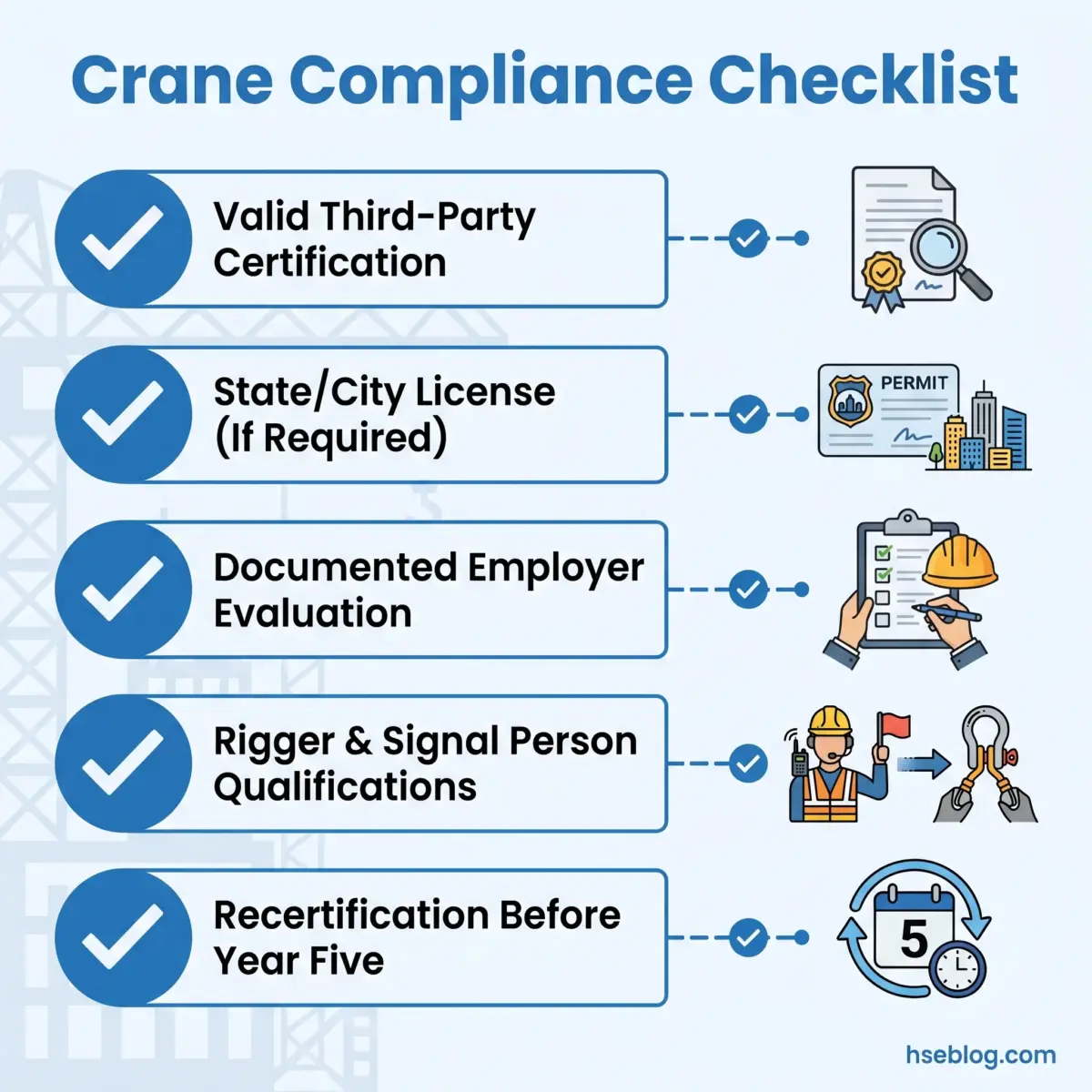
Field Test: Pull five operator files from any active crane site. For each operator, verify: (1) valid certification from an accredited body, (2) applicable state/city license if required, and (3) a documented employer evaluation specific to the crane they are currently assigned to. In most audits, element three is the one that is missing.
Maintaining and Renewing Crane Certification
Certification is not permanent. The standard recertification cycle runs five years, and the process should begin in the fourth year to avoid any lapse in credential validity. An expired certification cannot be retroactively renewed — the operator must go through the recertification examination process, and any lifts performed during a lapse period place the employer in violation of 29 CFR 1926.1427.
The recertification examination has one significant concession: the written re-examination is always mandatory, but the practical exam may be waived if the operator can document 1,000 or more hours of operating experience on the specific crane type during the certification period. This waiver is frequently misapplied. The hours must represent actual operating time — hands on the controls, performing lifts — not time spent in a crane-related role such as rigging, signaling, or supervising. And the hours must be on the specific crane type for which recertification is sought. An operator recertifying for mobile crane cannot count tower crane hours toward the threshold. Employers who sign off on experience logs without verifying these specifics expose both themselves and the operator to enforcement risk.
Independent of the recertification cycle, employers retain a continuous duty to retrain operators when deficiencies are identified, when equipment changes, or when site conditions change in ways that affect crane operation. This employer-side obligation runs parallel to the certification cycle and is not satisfied by pointing to a valid certification card. The 2025 edition of CMAA Specification No. 78 reinforces this principle for crane inspectors specifically, introducing measurable qualification criteria including 2,000 hours of documented field experience and biennial training updates — replacing the subjective language that previously allowed organizations to define competency however they wished (CMAA, 2025).
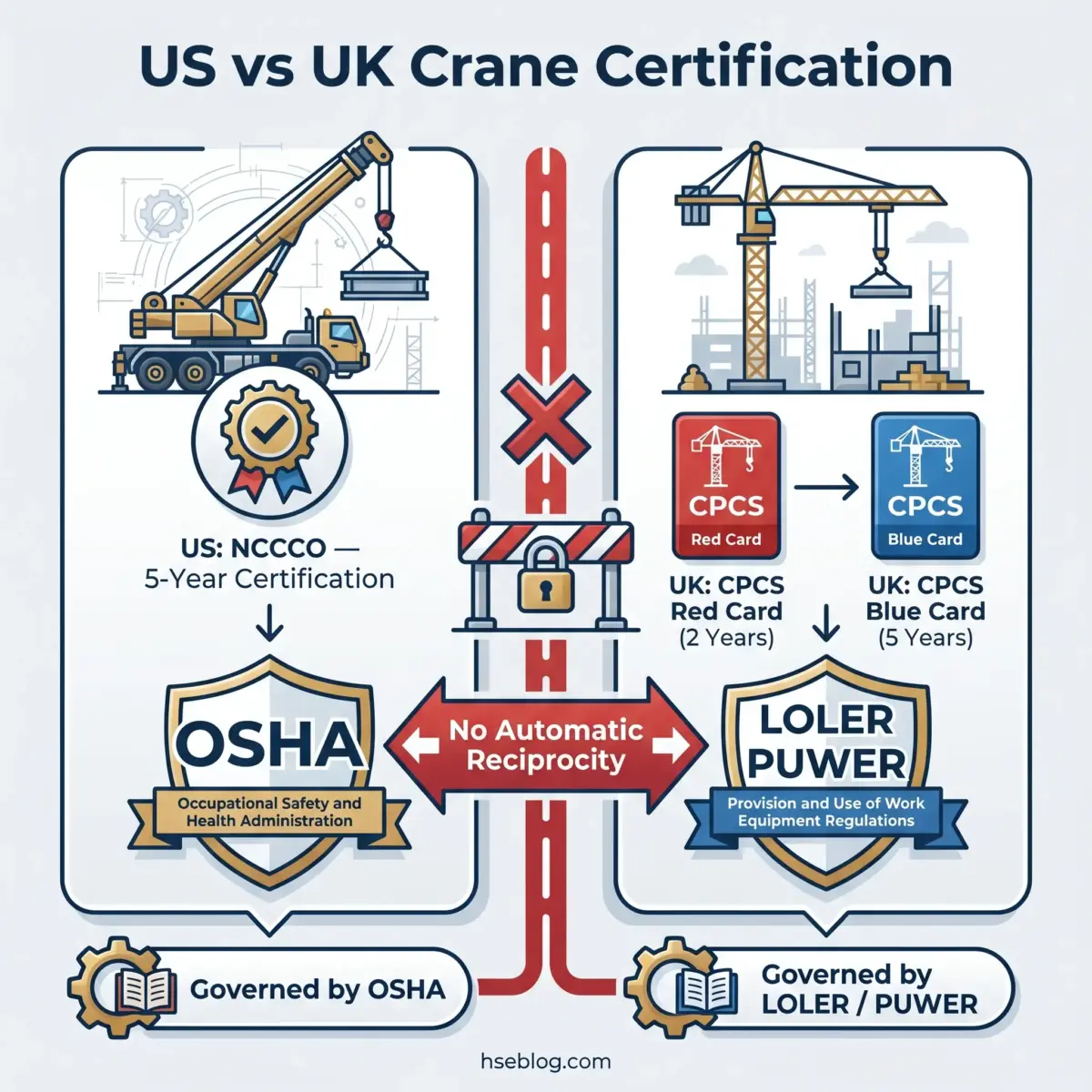
In the United Kingdom, the recertification pathway differs structurally. A CPCS red card (Trained Operator) is valid for two years and must be upgraded to a blue card (Competent Operator) by completing an NVQ or SVQ within that period. The blue card then requires renewal every five years through a CPCS Renewal Test. Failure to upgrade from red to blue within the two-year window means the operator must restart the qualification process.
What Are the Penalties for Operating Without Crane Certification?
The financial exposure for non-compliance has increased steadily and reached its highest levels following the January 2025 penalty adjustment. OSHA now imposes penalties of up to $16,550 per serious violation and up to $165,514 per willful or repeat violation (OSHA, 2025). A single crane site with multiple uncertified operators, missing employer evaluations, and unqualified riggers can generate citations that stack rapidly into six-figure territory.
OSHA conducted 34,221 inspections in 2023, and crane and lifting violations consistently rank among the highest-severity citations issued. The agency's emphasis area programs and the National Emphasis Program on trenching and excavation frequently bring inspectors onto sites where crane operations are also occurring — meaning crane compliance is tested even during inspections triggered by unrelated hazards.
Financial penalties, however, represent the smallest component of the total cost of non-compliance. A single crane fatality typically generates total direct and indirect costs exceeding $4 million when investigation costs, legal settlements, operational shutdown, project delays, and increased insurance premiums are aggregated. Insurance carriers routinely void coverage when an investigation reveals that the operator lacked valid certification or the employer failed to document the required evaluation. Wrongful-death litigation in crane fatality cases regularly produces settlements in the millions, particularly when the plaintiff can demonstrate that the employer knew — or should have known — that the operator was uncertified.
In the United Kingdom, the penalty structure is potentially more severe in criminal terms. Serious breaches of LOLER 1998 prosecuted in Crown Court carry unlimited fines and custodial sentences of up to two years. The Health and Safety Sentencing Guidelines introduced in 2016 have driven UK fines sharply upward, with crane-related prosecutions regularly exceeding £1 million for large organizations.
Jurisdiction Note: US penalty amounts are adjusted annually for inflation. The figures cited here reflect the January 15, 2025 adjustment. Verify current rates through OSHA's penalty page before using them in compliance communications or cost-benefit analyses.
Crane Certification Requirements Outside the United States
Most competing guidance on crane certification is exclusively US-focused, leaving employers and operators in multinational or UK-based operations without a clear compliance picture. The regulatory frameworks share a common principle — operators must demonstrate verified competence before operating lifting equipment — but the credential structures, governing legislation, and reciprocity rules differ materially.
In the United Kingdom, the CPCS (Construction Plant Competence Scheme) administered by CITB is the primary competence framework for crane operators. The pathway begins with a CPCS red card (Trained Operator), obtained by passing a CPCS theory test and practical assessment. The red card is valid for two years, during which the operator must achieve an NVQ or SVQ in Plant Operations to upgrade to a blue card (Competent Operator). The blue card is valid for five years and is the credential most sites require for unsupervised operation.
The UK regulatory framework governing crane operations rests on three interlocking instruments. LOLER 1998 requires that all lifting operations be planned by a competent person, that lifting equipment be marked with its safe working load, and that cranes undergo thorough examination every 12 months (with lifting accessories examined every 6 months). PUWER 1998 addresses equipment suitability, maintenance, and operator training. BS 7121 provides the code of practice for the safe use of cranes, covering planning, operator competence, inspection, and site management.
At the international level, ISO 15513:2012 establishes competency requirements for crane operators, dogmen (slingers), and signallers, providing a framework that national schemes can adopt or reference. The EU Machinery Directive 2006/42/EC sets baseline equipment safety requirements but leaves operator certification to individual member states — resulting in significant variation across European jurisdictions.
Multinational construction firms moving operators between US and UK projects regularly discover that NCCCO and CPCS are not mutually recognized. There is no automatic reciprocity. An operator certified under NCCCO must obtain CPCS credentials to work in the UK, and vice versa. The practical implication for international employers is that operator deployment across borders requires advance planning for credential acquisition in the destination jurisdiction.
Frequently Asked Questions
How long does it take to get crane certification?
The timeline depends on prior experience and the training program selected. Exam preparation typically runs from three days for experienced operators to several weeks for candidates new to crane operation. After passing the written exam, OSHA allows a 12-month window to complete the practical exam. From enrollment to receiving the certification card, most candidates complete the process in four to eight weeks, assuming they pass both examinations on the first attempt.
How much does crane certification cost?
Examination fees range from approximately $250 to $1,000 depending on the certifying body and the number of specialty exams taken. Training program costs are separate and vary widely — from $500 for focused refresher courses to $5,000 or more for comprehensive programs with extended seat time. Under OSHA's 29 CFR 1926.1427(a), the employer bears the cost of certification for construction crane operators.
Is crane certification the same as a crane operator license?
No. Certification is a portable credential issued by an accredited testing organization such as NCCCO. Licensing is a state or city-specific requirement with its own prerequisites, issued by a government agency. Some jurisdictions require both, and holding one does not satisfy the other. Employers operating across state lines must verify which credentials each jurisdiction demands.
Do overhead crane operators need NCCCO certification?
Not under federal law. OSHA's construction crane certification mandate under 29 CFR 1926.1427 does not extend to overhead cranes in general industry. However, 29 CFR 1910.179 requires employers to ensure overhead crane operators are trained, evaluated, and designated as competent. Some organizations voluntarily pursue NCCCO overhead crane certification as a best-practice measure beyond the minimum legal requirement.
Can I operate a crane while waiting for certification?
Yes, under specific conditions. OSHA's operator-in-training provisions at §1926.1427(b) allow uncertified operators to perform crane work provided they have received sufficient training, are continuously monitored by a qualified trainer, and observe restrictions on certain types of lifts. The provision is not an indefinite workaround — it is a structured pathway toward certification with defined limitations.
What happens if my crane certification expires?
Operating with an expired certification places the employer in violation of 29 CFR 1926.1427. Federal law provides no automatic grace period. The operator must complete the recertification process — the written re-exam is mandatory, while the practical may be waived with 1,000 or more documented operating hours on the applicable crane type. Some certifying bodies have administrative policies that facilitate late renewal, but these do not override the federal compliance requirement.
Conclusion
The crane certification landscape is not complicated — it is precise. The industry's persistent compliance failures stem not from the difficulty of the requirements, but from the widespread habit of treating certification as a single obligation when it is three. An NCCCO card confirms baseline competency. A state license, where applicable, satisfies jurisdictional requirements. The employer evaluation — documented, machine-specific, and current — closes the final gap between credential and site-ready competence. All three must be in place, and the third is the one that most organizations neglect.
What the published enforcement record reveals, consistently, is that the organizations cited most often are not those that ignored crane certification entirely. They are organizations that invested in certification, filed the cards, and then stopped — treating the credential as an endpoint rather than a foundation. The highest-impact change any employer can make is not to send more operators to NCCCO exams. It is to build the discipline of documenting machine-specific evaluations, verifying rigger and signal person qualifications alongside operator credentials, and beginning recertification in year four rather than scrambling in year five.
Crane certification matters because cranes are unforgiving machines operating in unforgiving environments. The margin between a controlled lift and a catastrophic failure is measured in judgment — judgment that certification validates, that employer evaluation confirms, and that ongoing competency verification sustains. The regulatory framework exists because the industry proved, through decades of preventable fatalities, that voluntary compliance alone was insufficient. The question is not whether certification is worth the investment. It is whether any employer can justify the cost — human, legal, and financial — of operating without it.